EP1330246B1 - Utilisation de derives d'acide hydroxyeicosatetranoique (hete) dans la chirurgie intra-oculaire - Google Patents
Utilisation de derives d'acide hydroxyeicosatetranoique (hete) dans la chirurgie intra-oculaire Download PDFInfo
- Publication number
- EP1330246B1 EP1330246B1 EP01983088A EP01983088A EP1330246B1 EP 1330246 B1 EP1330246 B1 EP 1330246B1 EP 01983088 A EP01983088 A EP 01983088A EP 01983088 A EP01983088 A EP 01983088A EP 1330246 B1 EP1330246 B1 EP 1330246B1
- Authority
- EP
- European Patent Office
- Prior art keywords
- alkyl
- free
- functionally modified
- group
- pharmaceutically acceptable
- Prior art date
- Legal status (The legal status is an assumption and is not a legal conclusion. Google has not performed a legal analysis and makes no representation as to the accuracy of the status listed.)
- Expired - Lifetime
Links
- 238000001356 surgical procedure Methods 0.000 title claims abstract description 12
- 150000002442 hydroxyeicosatetraenoic acids Chemical class 0.000 title description 2
- 210000000871 endothelium corneal Anatomy 0.000 claims abstract description 12
- 125000000217 alkyl group Chemical group 0.000 claims description 87
- 125000000753 cycloalkyl group Chemical group 0.000 claims description 55
- 125000002887 hydroxy group Chemical group [H]O* 0.000 claims description 54
- 125000003545 alkoxy group Chemical group 0.000 claims description 52
- 125000003118 aryl group Chemical group 0.000 claims description 48
- 125000003710 aryl alkyl group Chemical group 0.000 claims description 38
- -1 2,3,4,5-tetrazol-1-yl Chemical group 0.000 claims description 32
- 239000000203 mixture Substances 0.000 claims description 31
- 125000002252 acyl group Chemical group 0.000 claims description 28
- 150000003839 salts Chemical group 0.000 claims description 28
- 125000003277 amino group Chemical group 0.000 claims description 26
- 229910052760 oxygen Inorganic materials 0.000 claims description 21
- 125000000816 ethylene group Chemical group [H]C([H])([*:1])C([H])([H])[*:2] 0.000 claims description 20
- 125000003396 thiol group Chemical group [H]S* 0.000 claims description 20
- 150000002148 esters Chemical class 0.000 claims description 17
- 150000007970 thio esters Chemical class 0.000 claims description 17
- 229910052794 bromium Inorganic materials 0.000 claims description 16
- 229910052801 chlorine Inorganic materials 0.000 claims description 16
- 229910052731 fluorine Inorganic materials 0.000 claims description 16
- 125000002915 carbonyl group Chemical group [*:2]C([*:1])=O 0.000 claims description 15
- 229910052736 halogen Inorganic materials 0.000 claims description 15
- 150000002367 halogens Chemical class 0.000 claims description 15
- LFQSCWFLJHTTHZ-UHFFFAOYSA-N Ethanol Chemical compound CCO LFQSCWFLJHTTHZ-UHFFFAOYSA-N 0.000 claims description 14
- 125000003342 alkenyl group Chemical group 0.000 claims description 13
- 229910052799 carbon Inorganic materials 0.000 claims description 12
- 150000001875 compounds Chemical class 0.000 claims description 12
- 229910052740 iodine Inorganic materials 0.000 claims description 12
- LYGJENNIWJXYER-UHFFFAOYSA-N nitromethane Chemical compound C[N+]([O-])=O LYGJENNIWJXYER-UHFFFAOYSA-N 0.000 claims description 12
- 125000000304 alkynyl group Chemical group 0.000 claims description 11
- 125000001072 heteroaryl group Chemical group 0.000 claims description 11
- 229910052717 sulfur Inorganic materials 0.000 claims description 11
- 125000005282 allenyl group Chemical group 0.000 claims description 10
- 125000004366 heterocycloalkenyl group Chemical group 0.000 claims description 10
- 229910052739 hydrogen Inorganic materials 0.000 claims description 10
- 150000001768 cations Chemical class 0.000 claims description 9
- 125000000592 heterocycloalkyl group Chemical group 0.000 claims description 8
- 239000013010 irrigating solution Substances 0.000 claims description 7
- 238000004519 manufacturing process Methods 0.000 claims description 7
- 238000006467 substitution reaction Methods 0.000 claims description 7
- 125000004953 trihalomethyl group Chemical group 0.000 claims description 7
- 125000006527 (C1-C5) alkyl group Chemical group 0.000 claims description 6
- 229940082649 blood substitutes and perfusion irrigating solutions Drugs 0.000 claims description 6
- 125000001559 cyclopropyl group Chemical group [H]C1([H])C([H])([H])C1([H])* 0.000 claims description 6
- 125000003258 trimethylene group Chemical group [H]C([H])([*:2])C([H])([H])C([H])([H])[*:1] 0.000 claims description 6
- QVGXLLKOCUKJST-UHFFFAOYSA-N atomic oxygen Chemical compound [O] QVGXLLKOCUKJST-UHFFFAOYSA-N 0.000 claims description 4
- IPZJQDSFZGZEOY-UHFFFAOYSA-N dimethylmethylene Chemical compound C[C]C IPZJQDSFZGZEOY-UHFFFAOYSA-N 0.000 claims description 4
- 239000001301 oxygen Substances 0.000 claims description 4
- 125000001997 phenyl group Chemical group [H]C1=C([H])C([H])=C(*)C([H])=C1[H] 0.000 claims description 4
- 125000002924 primary amino group Chemical group [H]N([H])* 0.000 claims description 4
- 125000003282 alkyl amino group Chemical group 0.000 claims description 3
- 125000002091 cationic group Chemical group 0.000 claims description 3
- 125000000113 cyclohexyl group Chemical group [H]C1([H])C([H])([H])C([H])([H])C([H])(*)C([H])([H])C1([H])[H] 0.000 claims description 3
- 125000006273 (C1-C3) alkyl group Chemical group 0.000 claims description 2
- 125000006729 (C2-C5) alkenyl group Chemical group 0.000 claims description 2
- 125000006730 (C2-C5) alkynyl group Chemical group 0.000 claims description 2
- WSFSSNUMVMOOMR-UHFFFAOYSA-N Formaldehyde Chemical compound O=C WSFSSNUMVMOOMR-UHFFFAOYSA-N 0.000 claims description 2
- DBTDEFJAFBUGPP-UHFFFAOYSA-N Methanethial Chemical compound S=C DBTDEFJAFBUGPP-UHFFFAOYSA-N 0.000 claims description 2
- 125000000033 alkoxyamino group Chemical group 0.000 claims description 2
- 125000000383 tetramethylene group Chemical group [H]C([H])([*:1])C([H])([H])C([H])([H])C([H])([H])[*:2] 0.000 claims description 2
- 150000003573 thiols Chemical class 0.000 claims description 2
- 125000001475 halogen functional group Chemical group 0.000 claims 3
- 208000002177 Cataract Diseases 0.000 abstract description 2
- 102000015728 Mucins Human genes 0.000 description 11
- 108010063954 Mucins Proteins 0.000 description 11
- 125000002496 methyl group Chemical group [H]C([H])([H])* 0.000 description 11
- 125000004104 aryloxy group Chemical group 0.000 description 9
- 125000000392 cycloalkenyl group Chemical group 0.000 description 9
- 125000004435 hydrogen atom Chemical group [H]* 0.000 description 9
- UFHFLCQGNIYNRP-UHFFFAOYSA-N Hydrogen Chemical compound [H][H] UFHFLCQGNIYNRP-UHFFFAOYSA-N 0.000 description 7
- 150000001721 carbon Chemical group 0.000 description 7
- 239000001257 hydrogen Substances 0.000 description 7
- FAPWRFPIFSIZLT-UHFFFAOYSA-M Sodium chloride Chemical compound [Na+].[Cl-] FAPWRFPIFSIZLT-UHFFFAOYSA-M 0.000 description 6
- HEMHJVSKTPXQMS-UHFFFAOYSA-M Sodium hydroxide Chemical compound [OH-].[Na+] HEMHJVSKTPXQMS-UHFFFAOYSA-M 0.000 description 6
- 239000003795 chemical substances by application Substances 0.000 description 6
- 125000005842 heteroatom Chemical group 0.000 description 6
- 229940051875 mucins Drugs 0.000 description 6
- 125000000000 cycloalkoxy group Chemical group 0.000 description 5
- 125000005553 heteroaryloxy group Chemical group 0.000 description 5
- 230000028327 secretion Effects 0.000 description 5
- HBAQYPYDRFILMT-UHFFFAOYSA-N 8-[3-(1-cyclopropylpyrazol-4-yl)-1H-pyrazolo[4,3-d]pyrimidin-5-yl]-3-methyl-3,8-diazabicyclo[3.2.1]octan-2-one Chemical class C1(CC1)N1N=CC(=C1)C1=NNC2=C1N=C(N=C2)N1C2C(N(CC1CC2)C)=O HBAQYPYDRFILMT-UHFFFAOYSA-N 0.000 description 3
- 0 CCCC(CC1C(CC)CCC1)C(C)CC(*)C(C1)C(C)C1C1=CC=C=CC1 Chemical compound CCCC(CC1C(CC)CCC1)C(C)CC(*)C(C1)C(C)C1C1=CC=C=CC1 0.000 description 3
- WQZGKKKJIJFFOK-GASJEMHNSA-N Glucose Natural products OC[C@H]1OC(O)[C@H](O)[C@@H](O)[C@@H]1O WQZGKKKJIJFFOK-GASJEMHNSA-N 0.000 description 3
- 125000001931 aliphatic group Chemical group 0.000 description 3
- 125000003302 alkenyloxy group Chemical group 0.000 description 3
- 239000003963 antioxidant agent Substances 0.000 description 3
- 235000006708 antioxidants Nutrition 0.000 description 3
- 125000004429 atom Chemical group 0.000 description 3
- 125000003917 carbamoyl group Chemical group [H]N([H])C(*)=O 0.000 description 3
- 125000004432 carbon atom Chemical group C* 0.000 description 3
- 125000004465 cycloalkenyloxy group Chemical group 0.000 description 3
- 210000003560 epithelium corneal Anatomy 0.000 description 3
- 125000005843 halogen group Chemical group 0.000 description 3
- 210000004072 lung Anatomy 0.000 description 3
- 229910052757 nitrogen Inorganic materials 0.000 description 3
- 125000004430 oxygen atom Chemical group O* 0.000 description 3
- 229920006395 saturated elastomer Polymers 0.000 description 3
- 239000011780 sodium chloride Substances 0.000 description 3
- YWIVKILSMZOHHF-QJZPQSOGSA-N sodium;(2s,3s,4s,5r,6r)-6-[(2s,3r,4r,5s,6r)-3-acetamido-2-[(2s,3s,4r,5r,6r)-6-[(2r,3r,4r,5s,6r)-3-acetamido-2,5-dihydroxy-6-(hydroxymethyl)oxan-4-yl]oxy-2-carboxy-4,5-dihydroxyoxan-3-yl]oxy-5-hydroxy-6-(hydroxymethyl)oxan-4-yl]oxy-3,4,5-trihydroxyoxane-2- Chemical compound [Na+].CC(=O)N[C@H]1[C@H](O)O[C@H](CO)[C@@H](O)[C@@H]1O[C@H]1[C@H](O)[C@@H](O)[C@H](O[C@H]2[C@@H]([C@@H](O[C@H]3[C@@H]([C@@H](O)[C@H](O)[C@H](O3)C(O)=O)O)[C@H](O)[C@@H](CO)O2)NC(C)=O)[C@@H](C(O)=O)O1 YWIVKILSMZOHHF-QJZPQSOGSA-N 0.000 description 3
- XLYOFNOQVPJJNP-UHFFFAOYSA-N water Chemical compound O XLYOFNOQVPJJNP-UHFFFAOYSA-N 0.000 description 3
- 239000008215 water for injection Substances 0.000 description 3
- GVJHHUAWPYXKBD-UHFFFAOYSA-N (±)-α-Tocopherol Chemical compound OC1=C(C)C(C)=C2OC(CCCC(C)CCCC(C)CCCC(C)C)(C)CCC2=C1C GVJHHUAWPYXKBD-UHFFFAOYSA-N 0.000 description 2
- LBUJPTNKIBCYBY-UHFFFAOYSA-N 1,2,3,4-tetrahydroquinoline Chemical compound C1=CC=C2CCCNC2=C1 LBUJPTNKIBCYBY-UHFFFAOYSA-N 0.000 description 2
- HBEDSQVIWPRPAY-UHFFFAOYSA-N 2,3-dihydrobenzofuran Chemical compound C1=CC=C2OCCC2=C1 HBEDSQVIWPRPAY-UHFFFAOYSA-N 0.000 description 2
- CIWBSHSKHKDKBQ-JLAZNSOCSA-N Ascorbic acid Chemical compound OC[C@H](O)[C@H]1OC(=O)C(O)=C1O CIWBSHSKHKDKBQ-JLAZNSOCSA-N 0.000 description 2
- IJGRMHOSHXDMSA-UHFFFAOYSA-N Atomic nitrogen Chemical compound N#N IJGRMHOSHXDMSA-UHFFFAOYSA-N 0.000 description 2
- KXDHJXZQYSOELW-UHFFFAOYSA-M Carbamate Chemical compound NC([O-])=O KXDHJXZQYSOELW-UHFFFAOYSA-M 0.000 description 2
- OKTJSMMVPCPJKN-UHFFFAOYSA-N Carbon Chemical compound [C] OKTJSMMVPCPJKN-UHFFFAOYSA-N 0.000 description 2
- RTZKZFJDLAIYFH-UHFFFAOYSA-N Diethyl ether Chemical compound CCOCC RTZKZFJDLAIYFH-UHFFFAOYSA-N 0.000 description 2
- 208000003556 Dry Eye Syndromes Diseases 0.000 description 2
- 206010013774 Dry eye Diseases 0.000 description 2
- YLQBMQCUIZJEEH-UHFFFAOYSA-N Furan Chemical compound C=1C=COC=1 YLQBMQCUIZJEEH-UHFFFAOYSA-N 0.000 description 2
- 102000003886 Glycoproteins Human genes 0.000 description 2
- 108090000288 Glycoproteins Proteins 0.000 description 2
- SIKJAQJRHWYJAI-UHFFFAOYSA-N Indole Chemical compound C1=CC=C2NC=CC2=C1 SIKJAQJRHWYJAI-UHFFFAOYSA-N 0.000 description 2
- TWRXJAOTZQYOKJ-UHFFFAOYSA-L Magnesium chloride Chemical compound [Mg+2].[Cl-].[Cl-] TWRXJAOTZQYOKJ-UHFFFAOYSA-L 0.000 description 2
- 101000844719 Mus musculus Deleted in malignant brain tumors 1 protein Proteins 0.000 description 2
- WCUXLLCKKVVCTQ-UHFFFAOYSA-M Potassium chloride Chemical compound [Cl-].[K+] WCUXLLCKKVVCTQ-UHFFFAOYSA-M 0.000 description 2
- JUJWROOIHBZHMG-UHFFFAOYSA-N Pyridine Chemical compound C1=CC=NC=C1 JUJWROOIHBZHMG-UHFFFAOYSA-N 0.000 description 2
- KAESVJOAVNADME-UHFFFAOYSA-N Pyrrole Chemical compound C=1C=CNC=1 KAESVJOAVNADME-UHFFFAOYSA-N 0.000 description 2
- SMWDFEZZVXVKRB-UHFFFAOYSA-N Quinoline Chemical compound N1=CC=CC2=CC=CC=C21 SMWDFEZZVXVKRB-UHFFFAOYSA-N 0.000 description 2
- UIIMBOGNXHQVGW-UHFFFAOYSA-M Sodium bicarbonate Chemical compound [Na+].OC([O-])=O UIIMBOGNXHQVGW-UHFFFAOYSA-M 0.000 description 2
- YTPLMLYBLZKORZ-UHFFFAOYSA-N Thiophene Chemical compound C=1C=CSC=1 YTPLMLYBLZKORZ-UHFFFAOYSA-N 0.000 description 2
- 108010003205 Vasoactive Intestinal Peptide Proteins 0.000 description 2
- 102400000015 Vasoactive intestinal peptide Human genes 0.000 description 2
- 125000006323 alkenyl amino group Chemical group 0.000 description 2
- 125000004453 alkoxycarbonyl group Chemical group 0.000 description 2
- 125000006319 alkynyl amino group Chemical group 0.000 description 2
- 125000005133 alkynyloxy group Chemical group 0.000 description 2
- 125000005225 alkynyloxycarbonyl group Chemical group 0.000 description 2
- 238000011914 asymmetric synthesis Methods 0.000 description 2
- WQZGKKKJIJFFOK-VFUOTHLCSA-N beta-D-glucose Chemical compound OC[C@H]1O[C@@H](O)[C@H](O)[C@@H](O)[C@@H]1O WQZGKKKJIJFFOK-VFUOTHLCSA-N 0.000 description 2
- 239000011203 carbon fibre reinforced carbon Substances 0.000 description 2
- 210000004027 cell Anatomy 0.000 description 2
- 230000006378 damage Effects 0.000 description 2
- 239000008121 dextrose Substances 0.000 description 2
- 229940061607 dibasic sodium phosphate Drugs 0.000 description 2
- BNIILDVGGAEEIG-UHFFFAOYSA-L disodium hydrogen phosphate Chemical compound [Na+].[Na+].OP([O-])([O-])=O BNIILDVGGAEEIG-UHFFFAOYSA-L 0.000 description 2
- 239000003937 drug carrier Substances 0.000 description 2
- 230000000694 effects Effects 0.000 description 2
- 210000002919 epithelial cell Anatomy 0.000 description 2
- 210000000981 epithelium Anatomy 0.000 description 2
- 210000002175 goblet cell Anatomy 0.000 description 2
- 229940089982 healon Drugs 0.000 description 2
- 238000004128 high performance liquid chromatography Methods 0.000 description 2
- RAXXELZNTBOGNW-UHFFFAOYSA-N imidazole Natural products C1=CNC=N1 RAXXELZNTBOGNW-UHFFFAOYSA-N 0.000 description 2
- 238000001727 in vivo Methods 0.000 description 2
- 239000004615 ingredient Substances 0.000 description 2
- 238000005461 lubrication Methods 0.000 description 2
- 238000000034 method Methods 0.000 description 2
- 125000000956 methoxy group Chemical group [H]C([H])([H])O* 0.000 description 2
- 125000000719 pyrrolidinyl group Chemical group 0.000 description 2
- 238000000926 separation method Methods 0.000 description 2
- 239000007858 starting material Substances 0.000 description 2
- 230000004936 stimulating effect Effects 0.000 description 2
- 238000003860 storage Methods 0.000 description 2
- 239000003190 viscoelastic substance Substances 0.000 description 2
- KIUKXJAPPMFGSW-DNGZLQJQSA-N (2S,3S,4S,5R,6R)-6-[(2S,3R,4R,5S,6R)-3-Acetamido-2-[(2S,3S,4R,5R,6R)-6-[(2R,3R,4R,5S,6R)-3-acetamido-2,5-dihydroxy-6-(hydroxymethyl)oxan-4-yl]oxy-2-carboxy-4,5-dihydroxyoxan-3-yl]oxy-5-hydroxy-6-(hydroxymethyl)oxan-4-yl]oxy-3,4,5-trihydroxyoxane-2-carboxylic acid Chemical compound CC(=O)N[C@H]1[C@H](O)O[C@H](CO)[C@@H](O)[C@@H]1O[C@H]1[C@H](O)[C@@H](O)[C@H](O[C@H]2[C@@H]([C@@H](O[C@H]3[C@@H]([C@@H](O)[C@H](O)[C@H](O3)C(O)=O)O)[C@H](O)[C@@H](CO)O2)NC(C)=O)[C@@H](C(O)=O)O1 KIUKXJAPPMFGSW-DNGZLQJQSA-N 0.000 description 1
- 125000004973 1-butenyl group Chemical group C(=CCC)* 0.000 description 1
- 125000006021 1-methyl-2-propenyl group Chemical group 0.000 description 1
- 125000006055 1-methyl-4-pentenyl group Chemical group 0.000 description 1
- MSWZFWKMSRAUBD-IVMDWMLBSA-N 2-amino-2-deoxy-D-glucopyranose Chemical compound N[C@H]1C(O)O[C@H](CO)[C@@H](O)[C@@H]1O MSWZFWKMSRAUBD-IVMDWMLBSA-N 0.000 description 1
- YAZDSTCFFRZJLW-UHFFFAOYSA-N 2-hydroxyicosa-2,4,6,8-tetraenoic acid Chemical compound CCCCCCCCCCCC=CC=CC=CC=C(O)C(O)=O YAZDSTCFFRZJLW-UHFFFAOYSA-N 0.000 description 1
- 125000003903 2-propenyl group Chemical group [H]C([*])([H])C([H])=C([H])[H] 0.000 description 1
- NNDIXBJHNLFJJP-UHFFFAOYSA-N 20-Hydroxyeicosatetraenoic acid Chemical compound OCCCCCC=CCC=CCC=CCC=CCCCC(O)=O NNDIXBJHNLFJJP-UHFFFAOYSA-N 0.000 description 1
- 125000004179 3-chlorophenyl group Chemical group [H]C1=C([H])C(*)=C([H])C(Cl)=C1[H] 0.000 description 1
- 125000001255 4-fluorophenyl group Chemical group [H]C1=C([H])C(*)=C([H])C([H])=C1F 0.000 description 1
- UXVMQQNJUSDDNG-UHFFFAOYSA-L Calcium chloride Chemical compound [Cl-].[Cl-].[Ca+2] UXVMQQNJUSDDNG-UHFFFAOYSA-L 0.000 description 1
- BVKZGUZCCUSVTD-UHFFFAOYSA-L Carbonate Chemical compound [O-]C([O-])=O BVKZGUZCCUSVTD-UHFFFAOYSA-L 0.000 description 1
- 208000004683 Corneal Endothelial Cell Loss Diseases 0.000 description 1
- 206010011033 Corneal oedema Diseases 0.000 description 1
- FBPFZTCFMRRESA-KVTDHHQDSA-N D-Mannitol Chemical compound OC[C@@H](O)[C@@H](O)[C@H](O)[C@H](O)CO FBPFZTCFMRRESA-KVTDHHQDSA-N 0.000 description 1
- 102000004190 Enzymes Human genes 0.000 description 1
- 108090000790 Enzymes Proteins 0.000 description 1
- ZPACYDRSPFRDHO-ROBAGEODSA-N Gefarnate Chemical compound CC(C)=CCC\C(C)=C\CC\C(C)=C\CCC(=O)OC\C=C(/C)CCC=C(C)C ZPACYDRSPFRDHO-ROBAGEODSA-N 0.000 description 1
- 229920001386 Gefarnate Polymers 0.000 description 1
- 108010053070 Glutathione Disulfide Proteins 0.000 description 1
- 206010020751 Hypersensitivity Diseases 0.000 description 1
- 102000003820 Lipoxygenases Human genes 0.000 description 1
- 108090000128 Lipoxygenases Proteins 0.000 description 1
- 229930195725 Mannitol Natural products 0.000 description 1
- VMHLLURERBWHNL-UHFFFAOYSA-M Sodium acetate Chemical compound [Na+].CC([O-])=O VMHLLURERBWHNL-UHFFFAOYSA-M 0.000 description 1
- NINIDFKCEFEMDL-UHFFFAOYSA-N Sulfur Chemical compound [S] NINIDFKCEFEMDL-UHFFFAOYSA-N 0.000 description 1
- XSQUKJJJFZCRTK-UHFFFAOYSA-N Urea Chemical compound NC(N)=O XSQUKJJJFZCRTK-UHFFFAOYSA-N 0.000 description 1
- 206010047571 Visual impairment Diseases 0.000 description 1
- 229930003427 Vitamin E Natural products 0.000 description 1
- DPXJVFZANSGRMM-UHFFFAOYSA-N acetic acid;2,3,4,5,6-pentahydroxyhexanal;sodium Chemical compound [Na].CC(O)=O.OCC(O)C(O)C(O)C(O)C=O DPXJVFZANSGRMM-UHFFFAOYSA-N 0.000 description 1
- 125000005090 alkenylcarbonyl group Chemical group 0.000 description 1
- 125000005092 alkenyloxycarbonyl group Chemical group 0.000 description 1
- 125000005087 alkynylcarbonyl group Chemical group 0.000 description 1
- 208000026935 allergic disease Diseases 0.000 description 1
- 230000007815 allergy Effects 0.000 description 1
- 150000001408 amides Chemical class 0.000 description 1
- 230000003444 anaesthetic effect Effects 0.000 description 1
- 239000003098 androgen Substances 0.000 description 1
- 229940030486 androgens Drugs 0.000 description 1
- 230000003078 antioxidant effect Effects 0.000 description 1
- YZXBAPSDXZZRGB-DOFZRALJSA-N arachidonic acid Chemical class CCCCC\C=C/C\C=C/C\C=C/C\C=C/CCCC(O)=O YZXBAPSDXZZRGB-DOFZRALJSA-N 0.000 description 1
- 125000002029 aromatic hydrocarbon group Chemical group 0.000 description 1
- 125000001769 aryl amino group Chemical group 0.000 description 1
- 125000005161 aryl oxy carbonyl group Chemical group 0.000 description 1
- 235000010323 ascorbic acid Nutrition 0.000 description 1
- 229960005070 ascorbic acid Drugs 0.000 description 1
- 239000011668 ascorbic acid Substances 0.000 description 1
- 239000003855 balanced salt solution Substances 0.000 description 1
- 230000004888 barrier function Effects 0.000 description 1
- MSWZFWKMSRAUBD-UHFFFAOYSA-N beta-D-galactosamine Natural products NC1C(O)OC(CO)C(O)C1O MSWZFWKMSRAUBD-UHFFFAOYSA-N 0.000 description 1
- 230000015572 biosynthetic process Effects 0.000 description 1
- 229910021538 borax Inorganic materials 0.000 description 1
- KGBXLFKZBHKPEV-UHFFFAOYSA-N boric acid Chemical compound OB(O)O KGBXLFKZBHKPEV-UHFFFAOYSA-N 0.000 description 1
- 239000004327 boric acid Substances 0.000 description 1
- 235000010338 boric acid Nutrition 0.000 description 1
- 125000001246 bromo group Chemical group Br* 0.000 description 1
- 210000000424 bronchial epithelial cell Anatomy 0.000 description 1
- 239000007853 buffer solution Substances 0.000 description 1
- 239000006172 buffering agent Substances 0.000 description 1
- 125000000484 butyl group Chemical group [H]C([*])([H])C([H])([H])C([H])([H])C([H])([H])[H] 0.000 description 1
- 235000019282 butylated hydroxyanisole Nutrition 0.000 description 1
- 239000001110 calcium chloride Substances 0.000 description 1
- 229910001628 calcium chloride Inorganic materials 0.000 description 1
- LLSDKQJKOVVTOJ-UHFFFAOYSA-L calcium chloride dihydrate Chemical compound O.O.[Cl-].[Cl-].[Ca+2] LLSDKQJKOVVTOJ-UHFFFAOYSA-L 0.000 description 1
- 239000004202 carbamide Substances 0.000 description 1
- CREMABGTGYGIQB-UHFFFAOYSA-N carbon carbon Chemical compound C.C CREMABGTGYGIQB-UHFFFAOYSA-N 0.000 description 1
- 150000001733 carboxylic acid esters Chemical class 0.000 description 1
- 229940082638 cardiac stimulant phosphodiesterase inhibitors Drugs 0.000 description 1
- 229940112107 cellugel Drugs 0.000 description 1
- 238000004296 chiral HPLC Methods 0.000 description 1
- 125000001309 chloro group Chemical group Cl* 0.000 description 1
- KXKPYJOVDUMHGS-OSRGNVMNSA-N chondroitin sulfate Chemical compound CC(=O)N[C@H]1[C@H](O)O[C@H](OS(O)(=O)=O)[C@H](O)[C@@H]1O[C@H]1[C@H](O)[C@@H](O)[C@H](O)[C@@H](C(O)=O)O1 KXKPYJOVDUMHGS-OSRGNVMNSA-N 0.000 description 1
- 210000000795 conjunctiva Anatomy 0.000 description 1
- 210000004087 cornea Anatomy 0.000 description 1
- 201000004778 corneal edema Diseases 0.000 description 1
- 210000000399 corneal endothelial cell Anatomy 0.000 description 1
- 125000006310 cycloalkyl amino group Chemical group 0.000 description 1
- 125000001995 cyclobutyl group Chemical group [H]C1([H])C([H])([H])C([H])(*)C1([H])[H] 0.000 description 1
- 125000000596 cyclohexenyl group Chemical group C1(=CCCCC1)* 0.000 description 1
- 125000002433 cyclopentenyl group Chemical group C1(=CCCC1)* 0.000 description 1
- 125000001511 cyclopentyl group Chemical group [H]C1([H])C([H])([H])C([H])([H])C([H])(*)C1([H])[H] 0.000 description 1
- 230000006735 deficit Effects 0.000 description 1
- 125000004852 dihydrofuranyl group Chemical group O1C(CC=C1)* 0.000 description 1
- 125000005043 dihydropyranyl group Chemical group O1C(CCC=C1)* 0.000 description 1
- 125000002147 dimethylamino group Chemical group [H]C([H])([H])N(*)C([H])([H])[H] 0.000 description 1
- 125000001495 ethyl group Chemical group [H]C([H])([H])C([H])([H])* 0.000 description 1
- 239000012530 fluid Substances 0.000 description 1
- 125000001153 fluoro group Chemical group F* 0.000 description 1
- WIGCFUFOHFEKBI-UHFFFAOYSA-N gamma-tocopherol Natural products CC(C)CCCC(C)CCCC(C)CCCC1CCC2C(C)C(O)C(C)C(C)C2O1 WIGCFUFOHFEKBI-UHFFFAOYSA-N 0.000 description 1
- 229960003779 gefarnate Drugs 0.000 description 1
- 229960002442 glucosamine Drugs 0.000 description 1
- 239000008103 glucose Substances 0.000 description 1
- YPZRWBKMTBYPTK-BJDJZHNGSA-N glutathione disulfide Chemical compound OC(=O)[C@@H](N)CCC(=O)N[C@H](C(=O)NCC(O)=O)CSSC[C@@H](C(=O)NCC(O)=O)NC(=O)CC[C@H](N)C(O)=O YPZRWBKMTBYPTK-BJDJZHNGSA-N 0.000 description 1
- 229940045883 glutathione disulfide Drugs 0.000 description 1
- 125000005241 heteroarylamino group Chemical group 0.000 description 1
- 125000005226 heteroaryloxycarbonyl group Chemical group 0.000 description 1
- 239000005556 hormone Substances 0.000 description 1
- 229940088597 hormone Drugs 0.000 description 1
- 229920002674 hyaluronan Polymers 0.000 description 1
- 229960003160 hyaluronic acid Drugs 0.000 description 1
- 125000001183 hydrocarbyl group Chemical group 0.000 description 1
- 230000007062 hydrolysis Effects 0.000 description 1
- 238000006460 hydrolysis reaction Methods 0.000 description 1
- 125000002349 hydroxyamino group Chemical group [H]ON([H])[*] 0.000 description 1
- 125000002883 imidazolyl group Chemical group 0.000 description 1
- 239000007943 implant Substances 0.000 description 1
- 238000000338 in vitro Methods 0.000 description 1
- PZOUSPYUWWUPPK-UHFFFAOYSA-N indole Natural products CC1=CC=CC2=C1C=CN2 PZOUSPYUWWUPPK-UHFFFAOYSA-N 0.000 description 1
- RKJUIXBNRJVNHR-UHFFFAOYSA-N indolenine Natural products C1=CC=C2CC=NC2=C1 RKJUIXBNRJVNHR-UHFFFAOYSA-N 0.000 description 1
- 238000011835 investigation Methods 0.000 description 1
- VBUWHHLIZKOSMS-RIWXPGAOSA-N invicorp Chemical compound C([C@@H](C(=O)N[C@@H](CC(C)C)C(=O)N[C@@H](CC(N)=O)C(=O)N[C@@H](CO)C(=O)N[C@@H]([C@@H](C)CC)C(=O)N[C@@H](CC(C)C)C(=O)N[C@@H](CC(N)=O)C(O)=O)NC(=O)[C@H](CCCCN)NC(=O)[C@H](CCCCN)NC(=O)[C@@H](NC(=O)[C@H](C)NC(=O)[C@H](CCSC)NC(=O)[C@H](CCC(N)=O)NC(=O)[C@H](CCCCN)NC(=O)[C@H](CCCNC(N)=N)NC(=O)[C@H](CC(C)C)NC(=O)[C@H](CCCNC(N)=N)NC(=O)[C@@H](NC(=O)[C@H](CC=1C=CC(O)=CC=1)NC(=O)[C@H](CC(N)=O)NC(=O)[C@H](CC(O)=O)NC(=O)[C@@H](NC(=O)[C@H](CC=1C=CC=CC=1)NC(=O)[C@@H](NC(=O)[C@H](C)NC(=O)[C@H](CC(O)=O)NC(=O)[C@H](CO)NC(=O)[C@@H](N)CC=1NC=NC=1)C(C)C)[C@@H](C)O)[C@@H](C)O)C(C)C)C1=CC=C(O)C=C1 VBUWHHLIZKOSMS-RIWXPGAOSA-N 0.000 description 1
- 125000002346 iodo group Chemical group I* 0.000 description 1
- 150000002500 ions Chemical class 0.000 description 1
- 125000001449 isopropyl group Chemical group [H]C([H])([H])C([H])(*)C([H])([H])[H] 0.000 description 1
- 239000002502 liposome Substances 0.000 description 1
- 230000001050 lubricating effect Effects 0.000 description 1
- 229910001629 magnesium chloride Inorganic materials 0.000 description 1
- DHRRIBDTHFBPNG-UHFFFAOYSA-L magnesium dichloride hexahydrate Chemical compound O.O.O.O.O.O.[Mg+2].[Cl-].[Cl-] DHRRIBDTHFBPNG-UHFFFAOYSA-L 0.000 description 1
- 239000000594 mannitol Substances 0.000 description 1
- 235000010355 mannitol Nutrition 0.000 description 1
- 239000000463 material Substances 0.000 description 1
- 210000004379 membrane Anatomy 0.000 description 1
- 239000012528 membrane Substances 0.000 description 1
- 239000002207 metabolite Substances 0.000 description 1
- 229940045641 monobasic sodium phosphate Drugs 0.000 description 1
- 229910000403 monosodium phosphate Inorganic materials 0.000 description 1
- 235000019799 monosodium phosphate Nutrition 0.000 description 1
- 125000001624 naphthyl group Chemical group 0.000 description 1
- 125000004433 nitrogen atom Chemical group N* 0.000 description 1
- 125000006574 non-aromatic ring group Chemical group 0.000 description 1
- 235000015097 nutrients Nutrition 0.000 description 1
- 238000006053 organic reaction Methods 0.000 description 1
- 230000003647 oxidation Effects 0.000 description 1
- 238000007254 oxidation reaction Methods 0.000 description 1
- 239000002571 phosphodiesterase inhibitor Substances 0.000 description 1
- 125000004193 piperazinyl group Chemical group 0.000 description 1
- 239000001103 potassium chloride Substances 0.000 description 1
- 235000011164 potassium chloride Nutrition 0.000 description 1
- 125000001436 propyl group Chemical group [H]C([*])([H])C([H])([H])C([H])([H])[H] 0.000 description 1
- 230000001681 protective effect Effects 0.000 description 1
- 102000004169 proteins and genes Human genes 0.000 description 1
- 108090000623 proteins and genes Proteins 0.000 description 1
- 229940117392 provisc Drugs 0.000 description 1
- 238000005086 pumping Methods 0.000 description 1
- 238000000746 purification Methods 0.000 description 1
- UMJSCPRVCHMLSP-UHFFFAOYSA-N pyridine Natural products COC1=CC=CN=C1 UMJSCPRVCHMLSP-UHFFFAOYSA-N 0.000 description 1
- 125000006413 ring segment Chemical group 0.000 description 1
- 210000004739 secretory vesicle Anatomy 0.000 description 1
- 239000001632 sodium acetate Substances 0.000 description 1
- 235000017281 sodium acetate Nutrition 0.000 description 1
- 235000017557 sodium bicarbonate Nutrition 0.000 description 1
- 229910000030 sodium bicarbonate Inorganic materials 0.000 description 1
- 239000001509 sodium citrate Substances 0.000 description 1
- NLJMYIDDQXHKNR-UHFFFAOYSA-K sodium citrate Chemical compound O.O.[Na+].[Na+].[Na+].[O-]C(=O)CC(O)(CC([O-])=O)C([O-])=O NLJMYIDDQXHKNR-UHFFFAOYSA-K 0.000 description 1
- 235000011083 sodium citrates Nutrition 0.000 description 1
- AJPJDKMHJJGVTQ-UHFFFAOYSA-M sodium dihydrogen phosphate Chemical compound [Na+].OP(O)([O-])=O AJPJDKMHJJGVTQ-UHFFFAOYSA-M 0.000 description 1
- 239000001488 sodium phosphate Substances 0.000 description 1
- 229910000162 sodium phosphate Inorganic materials 0.000 description 1
- 235000011008 sodium phosphates Nutrition 0.000 description 1
- 159000000000 sodium salts Chemical class 0.000 description 1
- 235000010339 sodium tetraborate Nutrition 0.000 description 1
- 239000011593 sulfur Substances 0.000 description 1
- 238000003786 synthesis reaction Methods 0.000 description 1
- 230000004489 tear production Effects 0.000 description 1
- 125000000999 tert-butyl group Chemical group [H]C([H])([H])C(*)(C([H])([H])[H])C([H])([H])[H] 0.000 description 1
- 125000003718 tetrahydrofuranyl group Chemical group 0.000 description 1
- 125000001412 tetrahydropyranyl group Chemical group 0.000 description 1
- 150000003568 thioethers Chemical class 0.000 description 1
- 229930192474 thiophene Natural products 0.000 description 1
- 239000012929 tonicity agent Substances 0.000 description 1
- BSVBQGMMJUBVOD-UHFFFAOYSA-N trisodium borate Chemical compound [Na+].[Na+].[Na+].[O-]B([O-])[O-] BSVBQGMMJUBVOD-UHFFFAOYSA-N 0.000 description 1
- RYFMWSXOAZQYPI-UHFFFAOYSA-K trisodium phosphate Chemical compound [Na+].[Na+].[Na+].[O-]P([O-])([O-])=O RYFMWSXOAZQYPI-UHFFFAOYSA-K 0.000 description 1
- 229940042596 viscoat Drugs 0.000 description 1
- 208000029257 vision disease Diseases 0.000 description 1
- 230000000007 visual effect Effects 0.000 description 1
- 230000004393 visual impairment Effects 0.000 description 1
- 235000019165 vitamin E Nutrition 0.000 description 1
- 229940046009 vitamin E Drugs 0.000 description 1
- 239000011709 vitamin E Substances 0.000 description 1
Classifications
-
- A—HUMAN NECESSITIES
- A61—MEDICAL OR VETERINARY SCIENCE; HYGIENE
- A61L—METHODS OR APPARATUS FOR STERILISING MATERIALS OR OBJECTS IN GENERAL; DISINFECTION, STERILISATION OR DEODORISATION OF AIR; CHEMICAL ASPECTS OF BANDAGES, DRESSINGS, ABSORBENT PADS OR SURGICAL ARTICLES; MATERIALS FOR BANDAGES, DRESSINGS, ABSORBENT PADS OR SURGICAL ARTICLES
- A61L31/00—Materials for other surgical articles, e.g. stents, stent-grafts, shunts, surgical drapes, guide wires, materials for adhesion prevention, occluding devices, surgical gloves, tissue fixation devices
-
- A—HUMAN NECESSITIES
- A61—MEDICAL OR VETERINARY SCIENCE; HYGIENE
- A61K—PREPARATIONS FOR MEDICAL, DENTAL OR TOILETRY PURPOSES
- A61K31/00—Medicinal preparations containing organic active ingredients
- A61K31/16—Amides, e.g. hydroxamic acids
-
- A—HUMAN NECESSITIES
- A61—MEDICAL OR VETERINARY SCIENCE; HYGIENE
- A61K—PREPARATIONS FOR MEDICAL, DENTAL OR TOILETRY PURPOSES
- A61K31/00—Medicinal preparations containing organic active ingredients
- A61K31/185—Acids; Anhydrides, halides or salts thereof, e.g. sulfur acids, imidic, hydrazonic or hydroximic acids
- A61K31/19—Carboxylic acids, e.g. valproic acid
- A61K31/20—Carboxylic acids, e.g. valproic acid having a carboxyl group bound to a chain of seven or more carbon atoms, e.g. stearic, palmitic, arachidic acids
- A61K31/202—Carboxylic acids, e.g. valproic acid having a carboxyl group bound to a chain of seven or more carbon atoms, e.g. stearic, palmitic, arachidic acids having three or more double bonds, e.g. linolenic
-
- A—HUMAN NECESSITIES
- A61—MEDICAL OR VETERINARY SCIENCE; HYGIENE
- A61K—PREPARATIONS FOR MEDICAL, DENTAL OR TOILETRY PURPOSES
- A61K31/00—Medicinal preparations containing organic active ingredients
- A61K31/21—Esters, e.g. nitroglycerine, selenocyanates
- A61K31/215—Esters, e.g. nitroglycerine, selenocyanates of carboxylic acids
- A61K31/22—Esters, e.g. nitroglycerine, selenocyanates of carboxylic acids of acyclic acids, e.g. pravastatin
- A61K31/23—Esters, e.g. nitroglycerine, selenocyanates of carboxylic acids of acyclic acids, e.g. pravastatin of acids having a carboxyl group bound to a chain of seven or more carbon atoms
- A61K31/232—Esters, e.g. nitroglycerine, selenocyanates of carboxylic acids of acyclic acids, e.g. pravastatin of acids having a carboxyl group bound to a chain of seven or more carbon atoms having three or more double bonds, e.g. etretinate
-
- A—HUMAN NECESSITIES
- A61—MEDICAL OR VETERINARY SCIENCE; HYGIENE
- A61K—PREPARATIONS FOR MEDICAL, DENTAL OR TOILETRY PURPOSES
- A61K9/00—Medicinal preparations characterised by special physical form
- A61K9/0012—Galenical forms characterised by the site of application
- A61K9/0048—Eye, e.g. artificial tears
-
- A—HUMAN NECESSITIES
- A61—MEDICAL OR VETERINARY SCIENCE; HYGIENE
- A61P—SPECIFIC THERAPEUTIC ACTIVITY OF CHEMICAL COMPOUNDS OR MEDICINAL PREPARATIONS
- A61P27/00—Drugs for disorders of the senses
- A61P27/02—Ophthalmic agents
-
- A—HUMAN NECESSITIES
- A61—MEDICAL OR VETERINARY SCIENCE; HYGIENE
- A61P—SPECIFIC THERAPEUTIC ACTIVITY OF CHEMICAL COMPOUNDS OR MEDICINAL PREPARATIONS
- A61P41/00—Drugs used in surgical methods, e.g. surgery adjuvants for preventing adhesion or for vitreum substitution
-
- A—HUMAN NECESSITIES
- A61—MEDICAL OR VETERINARY SCIENCE; HYGIENE
- A61L—METHODS OR APPARATUS FOR STERILISING MATERIALS OR OBJECTS IN GENERAL; DISINFECTION, STERILISATION OR DEODORISATION OF AIR; CHEMICAL ASPECTS OF BANDAGES, DRESSINGS, ABSORBENT PADS OR SURGICAL ARTICLES; MATERIALS FOR BANDAGES, DRESSINGS, ABSORBENT PADS OR SURGICAL ARTICLES
- A61L2430/00—Materials or treatment for tissue regeneration
- A61L2430/16—Materials or treatment for tissue regeneration for reconstruction of eye parts, e.g. intraocular lens, cornea
Definitions
- the present invention is directed to the use of hydroxyeicosatetraenoic acid derivatives for the manufacture of a composition for use during intraocular surgery.
- the invention relates to the use of such derivatives for the manufacture of a composition for the protection of the corneal endothelium during intraocular surgery.
- Mucins are proteins which are heavily glycosylated with glucosamine-based moieties. Mucins provide protective and lubricating effects to epithelial cells, especially those of mucosal membranes. Mucins have been shown to be secreted by vesicles and discharged on the surface of the conjunctival epithelium of human eyes (Greiner et al., Mucous Secretory Vesicles in Conjunctival Epithelial Cells of Wearers of Contact Lenses, Archives of Ophthalmology , volume 98, pages 1843-1846 (1980); and Dilly et al., Surface Changes in the Anaesthetic Conjunctiva in Man, with Special Reference to the Production of Mucous from a Non-Goblet-Cell Source, British Journal of Ophthalmology , volume 65, pages 833-842 (1981)).
- Mucins are also produced and secreted in other parts of the body including lung airway passages, and more specifically from goblet cells interspersed among tracheal/bronchial epithelial cells. Certain arachidonic acid metabolites have been shown to stimulate mucin production in these cells.
- Yanni reported the increased secretion of mucosal glycoproteins in rat lung by hydroxyeicosatetraenoic acid ("HETE") derivatives (Yanni et al, Effect of Intravenously Administered Lipoxygenase Metabolites on Rat Trachael Mucous Gel Layer Thickness, International Archives of Allergy And Applied Immunology , volume 90, pages 307-309 (1989)).
- HETE hydroxyeicosatetraenoic acid
- Agents claimed for increasing ocular mucin and/or tear production include vasoactive intestinal polypeptide (Dartt et . al ., Vasoactive intestinal peptide-stimulated glycoconjugate secretion from conjunctival goblet cells. Experimental Eye Research , volume 63, pages 27-34, (1996)), gefarnate (Nakmura et . al ., Gefamate stimulates secretion of mucin-like glycoproteins by corneal epithelium in vitro and protects corneal epithelium from dessication in vivo , Experimental Eye Research , volume 65, pages 569-574 (1997)), liposomes (U.S. Patent No.
- U.S. Patent No. 5,696,166 discloses compositions containing HETE derivatives and methods of using them topically for treating dry eye. Yanni et al. discovered that compositions comprising HETE derivatives increase ocular mucin secretion and are thus useful in treating dry eye. This patent does not disclose the use of the HETE derivatives during intraocular surgery for the protection of the corneal endothelium.
- the corneal endothelium is susceptible to damage by physical contacts with instrumentation or implants and fluid turbulence and ultrasonic disturbance during phacoemulsification.
- the corneal endothelium does not regenerate.
- Corneal endothelial cell damage can lead to a reduction in corneal endothelial cell density and an impairment of ion-pumping function, both of which can lead to corneal edema and visual impairment.
- Irrigating solutions containing nutrients (ions, glucose, etc.) and/or anti-oxidants have been proposed to maintain or protect the corneal endothelium. Additionally, viscoelastics are used to provide a physical barrier in order to prevent contact damage.
- the present invention is directed to the use of HETE derivatives for the manufacture of a composition to maintain and protect the corneal endothelium during intraocular surgery.
- the HETE derivatives maintain and protect the corneal endothelium by stimulating mucin secretion in the corneal endothelium.
- HETE derivative means a compound of formulas I - XI.
- Preferred HETE derivatives include the compounds of formulas I - III wherein X is a pharmaceutically acceptable salt containing a cation selected from the group consisting of: Na + ; K + ; Li + ; Cs + ; and (A) 4 N + ; and A is independently H, alkyl, cycloalkyl, (cycloalkyl)alkyl, alkyl(cycloalkyl), aryl, arylalkyl, heteroaryl, or (A) 4 N + forms a heteroaryl, heterocycloalkenyl or heterocycloalkyl ring.
- X is a pharmaceutically acceptable salt containing a cation selected from the group consisting of: Na + ; K + ; Li + ; Cs + ; and (A) 4 N + ; and A is independently H, alkyl, cycloalkyl, (cycloalkyl)alkyl, alkyl(cycloalkyl), aryl, arylalkyl,
- the individual enantiomers can be enantioselectively synthesized from the appropriate enantiomerically pure or enriched starting material by means such as those described below. Alternatively, they may be enantioselectively synthesized from racemic/non-racemic or achiral starting materials.
- racemic and non-racemic mixtures may be obtained by several means, including without limitation, nonenantioselective synthesis, partial resolution, or even mixing samples having different enantiomeric ratios. Departures may be made from such details within the scope of the accompanying claims without departing from the principles of the invention and without sacrificing its advantages. Also included within the scope of the present invention are the individual isomers substantially free of their respective enantiomers.
- free hydroxy group means an OH.
- functionally modified hydroxy group means an OH which has been functionalized to form: an ether, in which an alkyl, aryl, cycloalkyl, heterocycloalkyl, alkenyl, cycloalkenyl, heterocycloalkenyl, alkynyl, or heteroaryl group is substituted for the hydrogen; an ester, in which an acyl group is substituted for the hydrogen; a carbamate, in which an aminocarbonyl group is substituted for the hydrogen; or a carbonate, in which an aryloxy-, heteroaryloxy-, alkoxy-, cycloalkoxy-, heterocycloalkoxy-, alkenyloxy-, cycloalkenyloxy-, heterocycloalkenyloxy-, or alkynyloxy-carbonyl group is substituted for the hydrogen.
- Preferred moieties include OH, OCH 2 C(O)CH 3 ,OCH 2 C(O)C 2 H 5 , OCH 3 , OCH 2 CH 3 , OC(O)CH 3 , and OC(O)C 2 H 5 .
- free amino group means an NH 2 .
- functionally modified amino group means an NH 2 which has been functionalized to form: an aryloxy-, heteroaryloxy-, alkoxy-, cycloalkoxy-, heterocycloalkoxy-, alkenyl-, cycloalkenyl-, heterocycloalkenyl-, alkynyl-, or hydroxy-amino group, wherein the appropriate group is substituted for one of the hydrogens; an aryl-, heteroaryl-, alkyl-, cycloalkyl-, heterocycloalkyl-, alkenyl-, cycloalkenyl-, heterocycloalkenyl-, or alkynyl-amino group, wherein the appropriate group is substituted for one or both of the hydrogens; an amide, in which an acyl group is substituted for one of the hydrogens; a carbamate, in which an aryloxy-, heteroaryloxy-, alkoxy
- substitution patterns for example an NH 2 in which one of the hydrogens is replaced by an alkyl group and the other hydrogen is replaced by an alkoxycarbonyl group, also fall under the definition of a functionally modified amino group and are included within the scope of the present invention.
- Preferred moieties include NH 2 , NHCH 3 , NHC 2 H 5 , N(CH 3 ) 2 , NHC(O)CH 3 , NHOH, and NH(OCH 3 ).
- free thiol group means an SH.
- functionally modified thiol group means an SH which has been functionalized to form: a thioether, where an alkyl, aryl, cycloalkyl, heterocycloalkyl, alkenyl, cycloalkenyl, heterocycloalkenyl, alkynyl, or heteroaryl group is substituted for the hydrogen; or a thioester, in which an acyl group is substituted for the hydrogen.
- Preferred moieties include SH, SC(O)CH 3 , SCH 3 , SC 2 H 5 , SCH 2 C(O)C 2 H 5 , and SCH 2 C(O)CH 3 .
- acyl represents a group that is linked by a carbon atom that has a double bond to an oxygen atom and a single bond to another carbon atom.
- alkyl includes straight or branched chain aliphatic hydrocarbon groups that are saturated and have 1 to 15 carbon atoms.
- the alkyl groups may be interrupted by one or more heteroatoms, such as oxygen, nitrogen, or sulfur, and may be substituted with other groups, such as halogen, hydroxyl, aryl, cycloalkyl, aryloxy, or alkoxy.
- Preferred straight or branched alkyl groups include methyl, ethyl, propyl, isopropyl, butyl and t -butyl.
- cycloalkyl includes straight or branched chain, saturated or unsaturated aliphatic hydrocarbon groups which connect to form one or more rings, which can be fused or isolated.
- the rings may be substituted with other groups, such as halogen, hydroxyl, aryl, aryloxy, alkoxy, or lower alkyl.
- Preferred cycloalkyl groups include cyclopropyl, cyclobutyl, cyclopentyl and cyclohexyl.
- C 1 - C 5 cyclopropyl means an alkyl chain of 1 to 5 carbon atoms containing a cyclopropyl group wherein the cyclopropyl group may start, be contained in or terminate the alkyl chain.
- heterocycloalkyl refers to cycloalkyl rings that contain at least one heteroatom such as O, S, or N in the ring, and can be fused or isolated.
- the rings may be substituted with other groups, such as halogen, hydroxyl, aryl, aryloxy, alkoxy, or lower alkyl.
- Preferred heterocycloalkyl groups include pyrrolidinyl, tetrahydrofuranyl, piperazinyl, and tetrahydropyranyl.
- alkenyl includes straight or branched chain hydrocarbon groups having 1 to 15 carbon atoms with at least one carbon-carbon double bond, the chain being optionally interrupted by one or more heteroatoms.
- the chain hydrogens may be substituted with other groups, such as halogen.
- Preferred straight or branched alkenyl groups include, allyl, 1-butenyl, 1-methyl-2-propenyl and 4-pentenyl.
- cycloalkenyl includes straight or branched chain, saturated or unsaturated aliphatic hydrocarbon groups which connect to form one or more non-aromatic rings containing a carbon-carbon double bond, which can be fused or isolated.
- the rings may be substituted with other groups, such as halogen, hydroxyl, alkoxy, or lower alkyl.
- Preferred cycloalkenyl groups include cyclopentenyl and cyclohexenyl.
- heterocycloalkenyl refers to cycloalkenyl rings which contain one or more heteroatoms such as O, N, or S in the ring, and can be fused or isolated.
- the rings may be substituted with other groups, such as halogen, hydroxyl, aryl, aryloxy, alkoxy, or lower alkyl.
- Preferred heterocycloalkenyl groups include pyrrolidinyl, dihydropyranyl, and dihydrofuranyl.
- carbonyl group represents a carbon atom double bonded to an oxygen atom, wherein the carbon atom has two free valencies.
- aminocarbonyl represents a free or functionally modified amino group bonded from its nitrogen atom to the carbon atom of a carbonyl group, the carbonyl group itself being bonded to another atom through its carbon atom.
- lower alkyl represents alkyl groups containing one to six carbons (C 1 -C 6 ).
- halogen represents fluoro, chloro, bromo, or iodo.
- aryl refers to carbon-based rings which are aromatic.
- the rings may be isolated, such as phenyl, or fused, such as naphthyl.
- the ring hydrogens may be substituted with other groups, such as lower alkyl, halogen, free or functionalized hydroxy, trihalomethyl, etc.
- Preferred aryl groups include phenyl, 3-(trifluoromethyl)phenyl, 3-chlorophenyl, and 4-fluorophenyl.
- heteroaryl refers to aromatic hydrocarbon rings which contain at least one heteroatom such as O, S, or N in the ring. Heteroaryl rings may be isolated, with 5 to 6 ring atoms, or fused, with 8 to 10 atoms.
- the heteroaryl ring(s) hydrogens or heteroatoms with open valency may be substituted with other groups, such as lower alkyl or halogen. Examples of heteroaryl groups include imidazole, pyridine, indole, quinoline, furan, thiophene, pyrrole, tetrahydroquinoline, dihydrobenzofuran, and dihydrobenzindole.
- aryloxy represents an aryl, heteroaryl, alkyl, cycloalkyl, heterocycloalkyl, alkenyl, cycloalkenyl, heterocycloalkenyl, or alkynyl group, respectively, attached through an oxygen linkage.
- alkoxycarbonyl represents an alkoxy, aryloxy, heteroaryloxy, cycloalkoxy, heterocycloalkoxy, alkenyloxy, cycloalkenyloxy, heterocycloalkenyloxy, or alkynyloxy group, respectively, bonded from its oxygen atom to the carbon of a carbonyl group, the carbonyl group itself being bonded to another atom through its carbon atom.
- compositions prepared by the present invention comprise a pharmaceutically effective amount of one or more HETE derivatives of formulas I - XI and a pharmaceutically acceptable carrier.
- Suitable pharmaceutical carriers are those that can be used in connection with intraocular surgery and include, but are not limited to, ophthalmically acceptable surgical irrigating solutions and ophthalmically acceptable viscoelastic materials. Many such irrigating solutions and viscoelastic materials are known. Examples of irrigating solutions include, but not limited to, BSS® and BSS PLUS® irrigating solutions (Alcon Laboratories, Inc.).
- viscoelastics examples include, but are not limited to, CELLUGEL®, VISCOAT® and PROVISC® viscoelastics (Alcon Laboratories, Inc.) and HEALON® and HEALON® GV viscoelastics (Pharmacia Corporation).
- the term "pharmaceutically effective amount” refers to an amount of one or more compounds of formula (I) that, when administered to a patient, protects or helps maintain the corneal endothelium.
- the compounds of formula (I) will be contained in a composition prepared by the present invention in a concentration range of about 0.00001 to 10 per cent weight/volume ("% w/v").
- the compositions will contain one or more compounds of formula (I) in a concentration of from about 0.00001-0.01% w/v.
- the compositions prepared by the present invention will also contain ethanol.
- an effective concentration of ethanol refers to a concentration that enhances the biological efficacy of the formula (I) compositions in vivo.
- concentration of ethanol necessary for the enhancement of the compounds of formula (I) is believed to be somewhat proportional to the concentration of the formula (I) compound(s) administered. If a relatively high concentration of formula (I) compound(s), e.g., above 0.1% w/v, is administered, the concentration of ethanol in such compositions may be proportionally less than analogous compositions containing lower concentrations of formula (I) compounds.
- the ethanol concentration contained in the ophthalmic compositions prepared by the present invention will range from about 0.001-2% w/v.
- Compositions containing formula (I) concentrations of about 0.00001-0.05% w/v preferably will contain ethanol in a concentration of about 0.005-0.40% w/v, and most preferably, about 0.02-0.20% w/v.
- compositions prepared by the present invention may be included in the compositions prepared by the present invention to adjust tonicity, preferably to that of natural tears for ophthalmic compositions.
- sodium chloride, potassium chloride, magnesium chloride, calcium chloride, dextrose and/or mannitol may be added to the composition to approximate physiological tonicity.
- Such an amount of tonicity agent will vary, depending on the particular agent to be added. In general, however, the compositions will have one or more tonicity agents in a total concentration sufficient to cause the composition to have an osmolality of about 200 - 400 mOsm.
- An appropriate buffer system e.g., sodium phosphate, sodium acetate, sodium citrate, sodium borate or boric acid
- concentration will vary, depending on the agent employed. In general, however, the buffering agent will be present in an amount sufficient to hold the pH within the range 6.5 - 8.0, preferably 6.8 - 7.6.
- Antioxidants may be added to compositions prepared by the present invention to protect the formula (I) compounds from oxidation during storage and/or or to provide antioxidant effects in the eye.
- antioxidants include, but are not limited to, vitamin E and analogs thereof, ascorbic acid and derivatives, and butylated hydroxyanisole (BHA).
- Two-Part Irrigating solution (use within 6 hours of reconstitution): Ingredient Concentration (%w/v) Part I (approx. 480 mL) HETE derivative 0.00001 - 0.01 NaCl 0.7 - 0.8 KCI 0.03 - 0.04 Dibasic Sodium Phosphate 0.04 - 0.05 Sodium Bicarbonate 0.2 - 0.3 HCl/NaOH pH adjust to 7.4 Water for injection qs 100 Part II (approx. 20 mL) Glutathione Disulfide 0.4 - 0.5 Calcium Chloride (Dihydrate) 0.3 - 0.4 Magnesium Chloride (Hexahydrate) 0.4 - 0.6 Dextrose (Anhydrous) 2 - 3 Water for injection qs 100
- Viscoelastic composition Ingredient Concentration (%w/v) HETE derivative 0.00001 - 0.01 Sodium Chondroitin Sulfate 3.5 - 4 Hyaluronic Acid (Sodium Salt) 2.9 - 3 NaCl 0.3 - 0.5 Dibasic Sodium Phosphate (Anhydrous) 0.15 - 0.25 Monobasic Sodium Phosphate (Monohydrate) 0.04 - 0.05 HCl/NaOH pH adjust to 7.4 Water for injection qs 100
Landscapes
- Health & Medical Sciences (AREA)
- Life Sciences & Earth Sciences (AREA)
- Veterinary Medicine (AREA)
- Public Health (AREA)
- General Health & Medical Sciences (AREA)
- Animal Behavior & Ethology (AREA)
- Epidemiology (AREA)
- Chemical & Material Sciences (AREA)
- Medicinal Chemistry (AREA)
- Pharmacology & Pharmacy (AREA)
- Ophthalmology & Optometry (AREA)
- Surgery (AREA)
- Bioinformatics & Cheminformatics (AREA)
- Chemical Kinetics & Catalysis (AREA)
- General Chemical & Material Sciences (AREA)
- Organic Chemistry (AREA)
- Nuclear Medicine, Radiotherapy & Molecular Imaging (AREA)
- Emergency Medicine (AREA)
- Engineering & Computer Science (AREA)
- Heart & Thoracic Surgery (AREA)
- Vascular Medicine (AREA)
- Pharmaceuticals Containing Other Organic And Inorganic Compounds (AREA)
- Acyclic And Carbocyclic Compounds In Medicinal Compositions (AREA)
- Organic Low-Molecular-Weight Compounds And Preparation Thereof (AREA)
Claims (7)
- Utilisation d'un ou plusieurs dérivés d'HETE pour la fabrication d'une composition pour maintenir et protéger l'endothélium cornéen au cours d'une chirurgie intraoculaire, dans laquelle le dérivé d'HETE est un composé de formules I-XI :I-III :
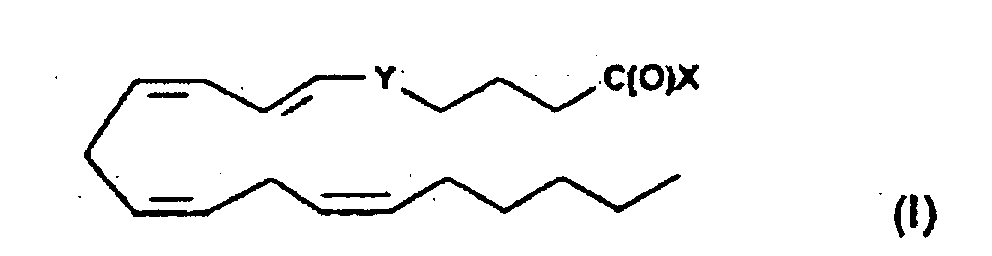 et
 dans lesquelles :
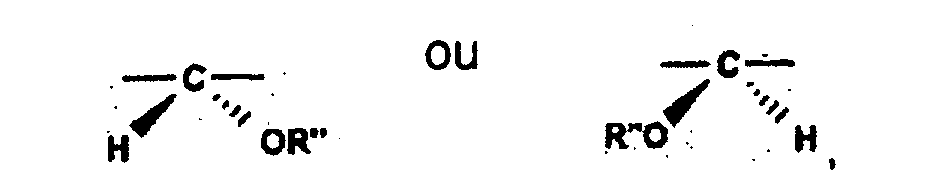
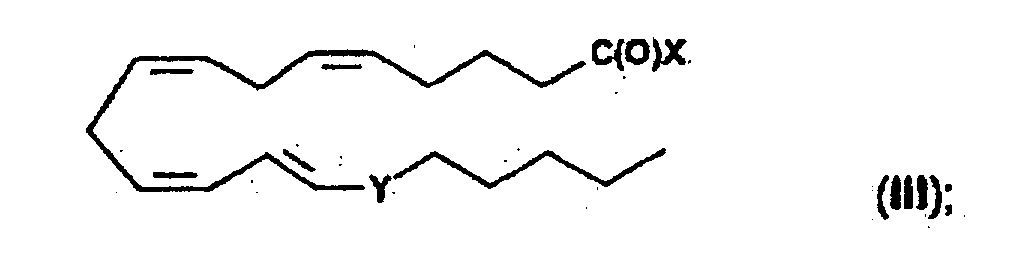 dans lequel R" est H ou un groupe C(O)R;X est un groupe OR ou NHR';R est H, un fragment de sel pharmaceutiquement acceptable cationique, un groupe alkyle, cycloalkyle, (cycloalkyl)alkyle, aryle, arylalkyle substitué ou non substitué, dans lequel la substitution est effectuée avec un fragment choisi dans le groupe comprenant les alkyles, les halogènes, l'hydroxy et les hydroxy modifiés fonctionnellement;R' est H, un groupe alkyle, cycloalkyle, (cycloalkyl)alkyle, aryle, arylalkyle substitué ou non substitué, dans lequel la substitution est effectuée avec un fragment choisi dans le groupe comprenant les alkyles, les halogènes, l'hydroxy et les hydroxy modifiés fonctionnellement; etY est un groupe
 IV :dans laquelle :
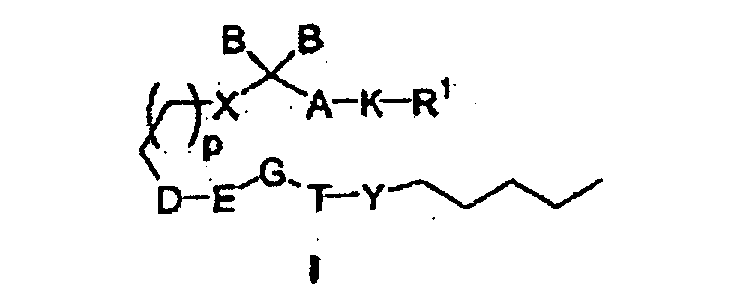 dans lequel R9O constitue un groupe hydroxy libre ou modifié fonctionnellement;R1 est un groupe CO2R, CONR2R3, CH2OR4, CH2NR5R6, CH2N3, CH2-Hal, CH2NO2, CH2SR20, COSR21 ou 2,3,4,5-tétrazol-1-yle, dans lequel :R est H ou CO2R forme un sel pharmaceutiquement acceptable ou un ester pharmaceutiquement acceptable;NR2R3 et NR5R6 sont identiques ou différents et comprennent un groupe amino libre ou modifié fonctionnellement, par exemple R2, R3, R5 et R6 sont identiques ou différents et sont H ou un groupe alkyle, cycloalkyle, aralkyle, aryle, OH ou alcoxy, à la condition qu'au plus seulement un des R2 et R3 représente un groupe OH ou alcoxy et qu'au plus seulement un des R5 et R6 représente un groupe OH ou alcoxy;OR4 comprend un groupe hydroxy libre ou modifié fonctionnellement, par exemple R4 est H ou un groupe acyle, alkyle, cycloalkyle, aralkyle ou aryle;Hal est F, Cl, Br ou I;SR20 comprend un groupe thiol libre ou modifié fonctionnellement;R21 est H, ou COSR21 forme un sel pharmaceutiquement acceptable ou un thioester pharmaceutiquement acceptable;K est un groupe alkyle en C2-C8, alcényle ou alcynyle, ou un groupe allényle en C3-C8;A et X sont identiques ou différents et représentent une liaison directe, CH2, NR7, O ou S, à la condition qu'au moins un des A et X soit NR7, O ou S;B est H, ou bien BB ensemble comprend un O, S ou NR8 doublement lié, à la condition que BB comprenne un O, S ou NR8 doublement lié lorsque A et X sont identiques ou différents et représentent NR7, O ou S; dans lesquels :NR7 et NR8 sont identiques ou différents et comprennent un groupe amino modifié fonctionnellement, par exemple R7 et R8 sont identiques ou différents et représentent H, un groupe alkyle, cycloalkyle, aryle, aralkyle, acyle, OH ou alcoxy;p est égal à 0 ou 1;D-E, G-H sont identiques ou différents et représentent un groupe CH2CH2, CH=CH ou C≡C; etY représente un groupe C(O) (c'est-à-dire un groupe carbonyle), ou Y est un groupe
 V:dans laquelle :
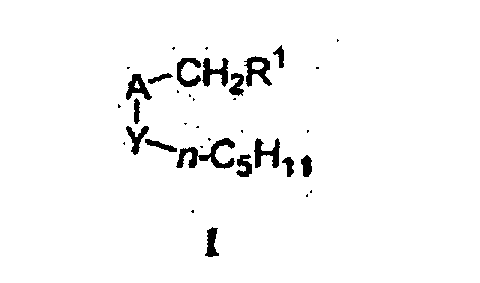 dans lequel R9O constitue un groupe hydroxy libre ou modifié fonctionnellement;R1 est un groupe CO2R, CONR2R3, CH2OR4, CH2NR5R6, CH2N3, CH2Hal, CH2NO2, CH2SR20, COSR21 ou 2,3,4,5-tétrazol-1-yle, où :R est H ou un cation pharmaceutiquement acceptable, ou bien CO2R forme un fragment d'ester pharmaceutiquement acceptable;NR2R3, NR5R6 sont identiques ou différents et comprennent un groupe amino libre ou modifié fonctionnellement;OR4 comprend un groupe hydroxy libre ou modifié fonctionnellement;Hal est F, Cl, Br ou I;R20 est H, alkyle, acyle;R21 est H ou un cation pharmaceutiquement acceptable, ou bien COSR21 forme un fragment de thioester pharmaceutiquement acceptable;A est L1-A2-L2, L1-A2-L2, L3-A2-L4 ou L5-A2-L3;A1 est CH2CH2;A2 est
 L1 est CH2-B-D;B et D sont identiques ou différents et représentent un groupe CH2CH2, CH=CH ou C≡C;L2 est CH2-K-CH2CH2;K est CH2CH2, CH=CH ou C≡C;L3 est CH2CH2CH2, CH2CH=CH, CH2C≡C, CH=CHCH2, C≡CCH2 ou CH=C=CH;L4 est X-CH2CH2;X est CH2CH2CH=CH, CH2CH2C≡C, CH2CH2CH2CH2, CH2CH=CHCH2, CH2C≡CCH2, CH=CHCH2CH2, C=CCH2CH2, CH2CH=C=CH ou CH=C=CHCH2;L5 est CH2CH2-B-D; etY est un groupe C(O) (c'est-à-dire un groupe carbonyle) ou bien Y est un groupe
 VI:dans laquelle :
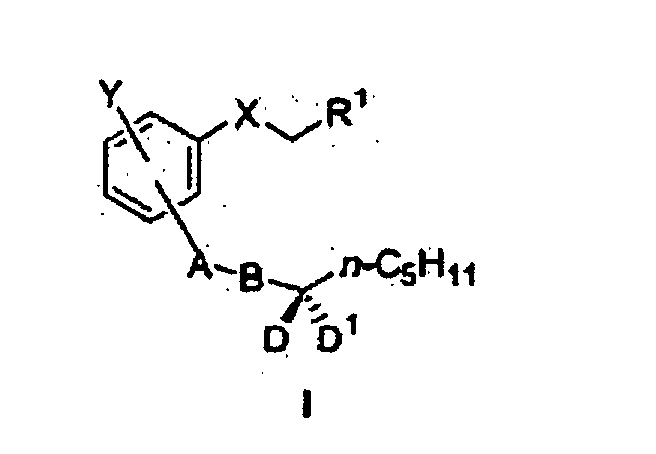 R1 est un groupe CO2R, CONR2R3, CH2OR4, CH2NR5R6, CH2N3, CH2-Hal, CH2NO2, CH2SR20, COSR21 ou 2,3,4,5-tétrazol-1-yle, dans lequel :R est H ou CO2R forme un sel pharmaceutiquement acceptable ou un ester pharmaceutiquement acceptable;NR2R3 et NR5R6 sont identiques ou différents et comprennent un groupe amino libre ou modifié fonctionnellement, par exemple R2, R3, R5 et R6 sont identiques ou différents et sont H ou un groupe alkyle, cycloalkyle, aralkyle, aryle, OH ou alcoxy, à la condition qu'au plus seulement un des R2 et R3 représente un groupe OH ou alcoxy et qu'au plus seulement un des R5 et R6 représente un groupe OH ou alcoxy;OR4 comprend un groupe hydroxy libre ou modifié fonctionnellement, par exemple R4 est H ou un groupe acyle, alkyle, cycloalkyle, aralkyle ou aryle; Hal est F, Cl, Br ou I;SR20 comprend un groupe thiol libre ou modifié fonctionnellement;R21 est H ou COSR21 forme un sel pharmaceutiquement acceptable ou un thioester pharmaceutiquement acceptable;X est un groupe alkyle en C2-C5, alcynyle ou alcényle ou un groupe allényle en C3-C5;Y est H, un groupe hydroxy libre ou modifié fonctionnellement, un groupe halo, un groupe trihalométhyle, un groupe amino libre ou modifié fonctionnellement, un groupe thiol libre ou modifié fonctionnellement, un groupe C(O)R7 ou alkyle;R7 est H, OH, un groupe alkyle, alcoxy, amino, alkylamino ou alcoxyamino;A est une liaison directe ou un groupe alkyle en C1-C3;B est un groupe CH2CH2, cis- ou trans-CH=CH, ou C≡C; etun des D et D1 est H et l'autre est un groupe OH libre ou modifié fonctionnellement, ou bien DD1 ensemble comprend un oxygène doublement lié;VII :dans laquelle :
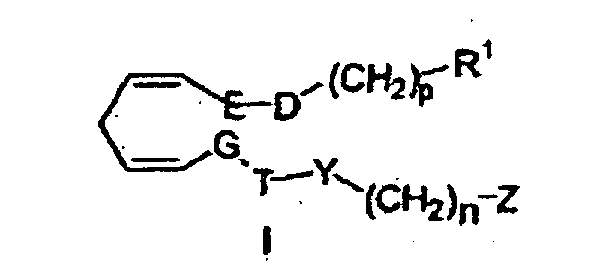 dans laquelle :R1 est un groupe CO2R, CONR2R3, CH2OR4, CH2NR5R6, CH2N3, CH2Hal, CH2NO2, CH2SR20, COSR21 ou 2,3,4,5-tétrazol-1-yle, dans lequel :R est H ou CO2R forme un sel pharmaceutiquement acceptable ou un ester pharmaceutiquement acceptable;NR2R3 et NR5R6 sont identiques ou différents et comprennent un groupe amino libre ou modifié fonctionnellement, par exemple R2, R3, R5 et R6 sont identiques ou différents et sont H ou un groupe alkyle, cycloalkyle, aralkyle, aryle, OH ou alcoxy, à la condition qu'au plus seulement un des R2 et R3 représente un groupe OH ou alcoxy et qu'au plus seulement un des R5 et R6 représente un groupe OH ou alcoxy;OR4 comprend un groupe hydroxy libre ou modifié fonctionnellement, par exemple R4 est H ou un groupe acyle, alkyle, cycloalkyle, aralkyle ou aryle;Hal est F, Cl, Br ou I;SR20 comprend un groupe thiol libre ou modifié fonctionnellement;R21 est H ou COSR21 forme un sel pharmaceutiquement acceptable ou un thioester pharmaceutiquement acceptable;E-D est CH2CH2CH2 ou cis-CH2CH=CH; ou bien E est trans-CH=CH et D est CH(OH) dans chaque configuration, le OH étant libre ou modifié fonctionnellement; ou bien E est CH2CH2 et D est une liaison directe;p est égal à 1 ou 3 lorsque E-D est CH2CH2CH2 ou cis-CH2CH=CH, ou lorsque E est trans-CH=CH et D est CH(OH) dans chaque configuration, le OH étant libre ou modifié fonctionnellement; ou bien p est égal à 0 lorsque E est CH2CH2 et D est une liaison directe;G-T est un groupe CH2CH2, CH(SR7)CH2 ou trans-CH=CH;R7 est H ou un groupe alkyle, aryle, aralkyle, cycloalkyle ou acyle;Y est un groupe CH(OH) dans chaque configuration, le OH étant libre ou modifié fonctionnellement, ou C=O (c'est-à-dire un groupe carbonyle);n est égal à 0, 2 ou 4; etZ est un groupe CH3, CO2R, CONR2R3 ou CH2OR4; VIII :
 dans lequel R9O constitue un groupe hydroxy libre ou modifié fonctionnellement;R1 est un groupe (CH2)nCO2R, (CH2)nCONR2R3, (CH2)nCH2OR4, (CH2)nCH2NR5R6, (CH2)nCH2N3, (CH2)nCH2Hal, (CH2)nCH2NO2, (CH2)nCH2SR20, (CH2)nCOSR21 ou (CH2)n-2,3,4,5-tétrazol-1-yle, dans lequel :R est H ou CO2R forme un sel pharmaceutiquement acceptable ou un ester pharmaceutiquement acceptable;NR2R3 et NR5R6 sont identiques ou différents et comprennent un groupe amino libre ou modifié fonctionnellement, par exempte R2, R3, R5 et R6 sont identiques ou différents et sont H ou un groupe alkyle, cycloalkyle, aralkyle, aryle, OH ou alcoxy, à la condition qu'au plus seulement un des R2 et R3 représente un groupe OH ou alcoxy et qu'au plus seulement un des R5 et R6 représente un groupe OH ou alcoxy;OR4 comprend un groupe hydroxy libre ou modifié fonctionnellement, par exemple R4 est H ou un groupe acyle, alkyle, cycloalkyle, aralkyle ou aryle;Hal est F, Cl, Br ou I;SR20 comprend un groupe thiol libre ou modifié fonctionnellement;R21 est H ou COSR21 forme un sel pharmaceutiquement acceptable ou un thioester pharmaceutiquement acceptable;n est égal à 0 ou 2;X est un groupe O, S(O)p, NR7 ou CH2, à la condition que X ne puisse pas être CH2 lorsque n est égal à 0;p est égal à 0, 1 ou 2;NR7 comprend un groupe amino libre ou modifié fonctionnellement, par exemple R7 est H ou un groupe alkyle, cycloalkyle, aralkyle, aryle, OH ou alcoxy;A-B, D-E, G-T et J-K sont identiques ou différents et représentent un groupe CH2CH2, CH=CH ou C≡C, à la condition qu'au moins un des A-B, D-E, G-T et J-K soit un groupe CH=CH ou C≡C; etY est un groupe C(O) (c'est-à-dire un carbonyle), ou Y est un groupe
 IX :dans laquelle :
 dans lequel R9O constitue un groupe hydroxy libre ou modifié fonctionnellement;R1 est un groupe CO2R, CONR2R3, CH2OR4, CH2NR5R6, CH2N3, CH2-Hal, CH2NO2, CH2SR20, COSR21 ou 2,3,4,5-tétrazol-1-yle, dans lequel :R est H ou CO2R forme un sel pharmaceutiquement acceptable ou un ester pharmaceutiquement acceptable;NR2R3 et NR5R6 sont identiques ou différents et comprennent un groupe amino libre ou modifié fonctionnellement, par exemple R2, R3, R5 et R6 sont identiques ou différents et sont H ou un groupe alkyle, cycloalkyle, aralkyle, aryle, OH ou alcoxy, à la condition qu'au plus seulement un des R2 et R3 représente un groupe OH ou alcoxy et qu'au plus seulement un des R5 et R6 représente un groupe OH ou alcoxy;OR4 comprend un groupe hydroxy libre ou modifié fonctionnellement, par exemple R4 est H ou un groupe acyle, alkyle, cycloalkyle, aralkyle ou aryle;Hal est F, Cl, Br ou I;SR20 comprend un groupe thiol libre ou modifié fonctionnellement;R21 est H ou COSR21 forme un sel pharmaceutiquement acceptable ou un thioester pharmaceutiquement acceptable;A, B, C et D sont identiques ou différents et représentent un groupe alkyle en C1-C5, alcényle ou alcynyle ou un groupe allényle en C3-C5;X est un groupe C(O) (c'est-à-dire un groupe carbonyle) ou bien X est un groupe
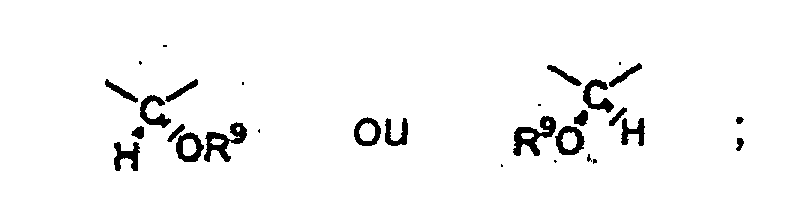 X:dans laquelle :
 R1 est un groupe (CH2)nCO2R, (CH)nCONR2R3, (CH2)nCH2OR4, (CH2)nCH2NR5R6, (CH2)nCH2N3, (CH2)nCH2Hal, (CH2)nCH2NO2, (CH2)nCH2SR20, (CH2)nCOSR21 ou (CH2)n-2,3,4,5-tétrazol-1-yle, dans lequel :R est H ou CO2R forme un sel pharmaceutiquement acceptable ou un ester pharmaceutiquement acceptable;NR2R3 et NR5R6 sont identiques ou différents et comprennent un groupe amino libre ou modifié fonctionnellement, par exemple R2, R3, R5 et R6 sont identiques ou différents et sont H ou un groupe alkyle, cycloalkyle, aralkyle, aryle, OH ou alcoxy, à la condition qu'au plus seulement un des R2 et R3 représente un groupe OH ou alcoxy et qu'au plus seulement un des R5 et R6 représente un groupe OH ou alcoxy;OR4 comprend un groupe hydroxy libre ou modifié fonctionnellement, par exemple R4 est H ou un groupe acyle, alkyle, cycloalkyle, aralkyle ou aryle; Hal est F, CI, Br ou I;SR20 comprend un groupe thiol libre ou modifié fonctionnellement;R21 est H ou COSR21 forme un sel pharmaceutiquement acceptable ou un thioester pharmaceutiquement acceptable;n est égal à 0 ou 2;A, B, C et D représentent un groupe alkyle en C1-C5, alcényle ou alcynyle ou un groupe allényle en C3-C5;Y est un groupe
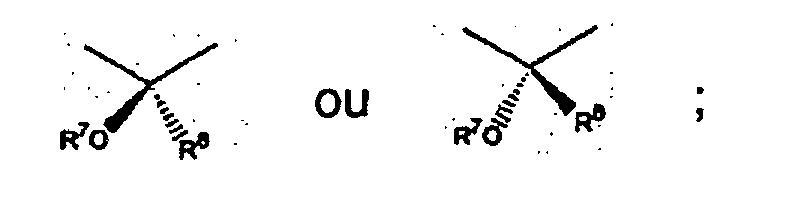 dans lequel R8 est H ou CH3, etX est un groupe CH2, CH(CH3) ou C(CH3)2; ou bienY est un groupe CH2, CH(CH3) ou C(CH3)2, et X est un groupe
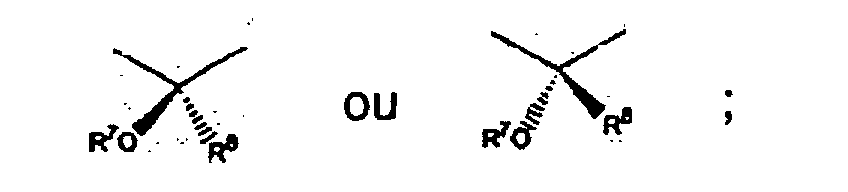 dans lequel R8 est H ou CH3, à la condition que Y ne puisse pas être CH2 lorsque X est un groupeet
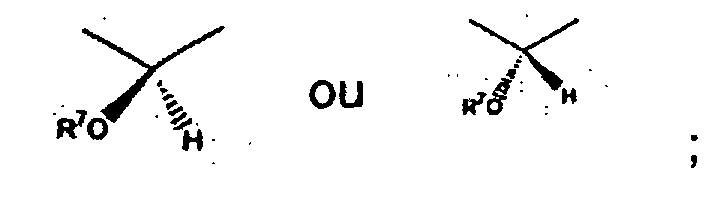 R'O comprend un groupe hydroxy libre ou modifié fonctionnellement; etXI :dans laquelle :
 où:R1 est un groupe CO2R, CONR2R3, CH2OR4, CH2NR5R6, CH2N3, CH2Hal, CH2NO2, CH2SR20, COSR21 ou 2,3,4,5-tétrazol-1-yle, où :R est H ou un cation pharmaceutiquement acceptable, ou bien CO2R forme un fragment d'ester pharmaceutiquement acceptable;NR2R3, NR5R6 sont identiques ou différents et comprennent un groupe amino libre ou modifié fonctionnellement;OR4 comprend un groupe hydroxy libre ou modifié fonctionnellement;Hal est F, Cl, Br ou I;SR20 comprend un groupe thiol libre ou modifié fonctionnellement;R21 est H ou un cation pharmaceutiquement acceptable, ou bien COSR21 forme un fragment de thioester pharmaceutiquement acceptable;A, B, C, D sont identiques ou différents et représentent un groupe alkyle en C1-C5, alcényle en C2-C5, cyclopropyle en C1-C5, alcynyle en C2-C5 ou allényle en C3-C5;E est un groupe
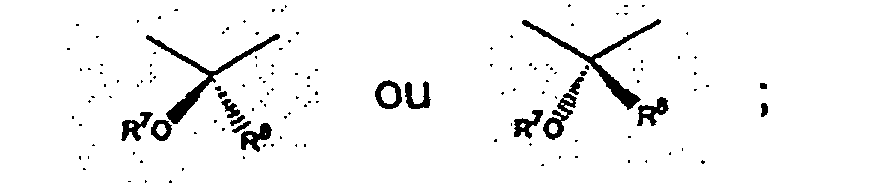 où OR7 comprend un groupe hydroxy libre ou modifié fonctionnellement;X est un groupe (CH2)m ou (CH2)mO, où m = 1-6; etY = un cycle phényle éventuellement substitué par un groupe alkyle, halo, trihalométhyle, acyle, ou un groupe hydroxy, amino ou thiol libre ou modifié fonctionnellement; ou bienX-Y = (CH2)pY1; où p = 0,6; et
 W = CH2, O, S(O)q, NR8, CH2CH2, CH=CH, CH2O, CH2S(O)q, CH=N ou CH2NR8;où q = 0-2, et R8 = H, alkyle ou acyle;Z = H, alkyle, acyle, halo, trihalométhyle, ou un groupe amino, thiol ou hydroxy libre ou modifié fonctionnellement; et---- = simple ou double liaison;ou bien X-Y = cyclohexyle.
- Utilisation suivant la revendication 1, dans laquelle le dérivé d'HETE est un composé de la formule :dans laquelle :
 dans lequel R" est H ou un groupe C(O)R.X est un groupe OR ou NHR';R est H, un fragment de sel pharmaceutiquement acceptable cationique, un groupe alkyle, cycloalkyle, (cyctoalkyl)alkyle, aryle, arylalkyle substitué ou non substitué, dans lequel la substitution est effectuée avec un fragment choisi dans le groupe comprenant les alkyles, les halogènes, l'hydroxy et les hydroxy modifiés fonctionnellement;R' est H, un groupe alkyle, cycloalkyle, (cycloalkyl)alkyle, aryle, arylalkyle substitué ou non substitué, dans lequel la substitution est effectuée avec un fragment choisi dans le groupe comprenant les alkyles, les halogènes, l'hydroxy et les hydroxy modifiés fonctionnellement; etY est un groupe

- Utilisation suivant la revendication 2, dans laquelle R est choisi dans le groupe comprenant Na+, K+, Li+, Cs+ et (A)4N+ et A représente indépendamment H, un groupe alkyle, cycloalkyle, (cycloalkyl)alkyle, alkyl(cycloalkyle), aryle, arylalkyle, hétéroaryle, ou bien (A)4N+ forme un cycle hétéroaryle, hétérocycloalcényle ou hétéro-cycloalkyle.
- Utilisation suivant la revendication 1, dans laquelle la composition est choisie parmi les solutions d'irrigation chirurgicales et les compositions viscoélastiques.
- Utilisation suivant la revendication 1, dans laquelle le dérivé d'HETE est présent dans la composition dans une plage de concentrations d'environ 0,00001 à 10% en pds/vol.
- Utilisation suivant la revendication 5, dans laquelle la plage de concentrations est d'environ 0,00001-0,01% en pds/vol.
- Utilisation suivant la revendication 1, dans laquelle la composition comprend de l'éthanol.
Applications Claiming Priority (3)
| Application Number | Priority Date | Filing Date | Title |
|---|---|---|---|
| US24250100P | 2000-10-23 | 2000-10-23 | |
| US242501P | 2000-10-23 | ||
| PCT/US2001/030212 WO2002034258A1 (fr) | 2000-10-23 | 2001-09-21 | Utilisation de derives d'acide hydroxyeicosatetranoique (hete) dans la chirurgie intra-oculaire |
Publications (2)
| Publication Number | Publication Date |
|---|---|
| EP1330246A1 EP1330246A1 (fr) | 2003-07-30 |
| EP1330246B1 true EP1330246B1 (fr) | 2005-04-27 |
Family
ID=22915018
Family Applications (1)
| Application Number | Title | Priority Date | Filing Date |
|---|---|---|---|
| EP01983088A Expired - Lifetime EP1330246B1 (fr) | 2000-10-23 | 2001-09-27 | Utilisation de derives d'acide hydroxyeicosatetranoique (hete) dans la chirurgie intra-oculaire |
Country Status (11)
| Country | Link |
|---|---|
| US (1) | US6462082B2 (fr) |
| EP (1) | EP1330246B1 (fr) |
| JP (1) | JP2004517055A (fr) |
| AT (1) | ATE293969T1 (fr) |
| AU (2) | AU1454302A (fr) |
| CA (1) | CA2419373A1 (fr) |
| DE (1) | DE60110449T2 (fr) |
| DK (1) | DK1330246T3 (fr) |
| ES (1) | ES2237607T3 (fr) |
| PT (1) | PT1330246E (fr) |
| WO (1) | WO2002034258A1 (fr) |
Families Citing this family (4)
| Publication number | Priority date | Publication date | Assignee | Title |
|---|---|---|---|---|
| AU2003221707A1 (en) * | 2002-06-14 | 2003-12-31 | Alcon, Inc. | Topical use of hydroxyeicosatetraenoic acid compounds to treat psoriasis |
| WO2003105831A1 (fr) * | 2002-06-14 | 2003-12-24 | Alcon, Inc. | Utilisation de composes d'acide hydroxyeicosatetraenoique pour traiter des troubles inflammatoires ophtalmiques |
| GB0411165D0 (en) * | 2004-05-19 | 2004-06-23 | Bionovate Ltd | Hyaluronic acid containing pharmaceutical or veterinary compounds |
| TW200940054A (en) * | 2007-12-21 | 2009-10-01 | Alcon Res Ltd | Intraocular irrigating solutions and methods for treating corneal edema |
Family Cites Families (11)
| Publication number | Priority date | Publication date | Assignee | Title |
|---|---|---|---|---|
| US5409904A (en) * | 1984-11-13 | 1995-04-25 | Alcon Laboratories, Inc. | Hyaluronic acid compositions and methods |
| US4753945A (en) | 1986-02-19 | 1988-06-28 | Eye Research Institute Of Retina Foundation | Stimulation of tear secretion with phosphodiesterase inhibitors |
| US4868154A (en) | 1986-02-19 | 1989-09-19 | Eye Research Institute Of Retina Foundation | Stimulation of tear secretion with melanocyte stimulating hormones |
| US4818537A (en) | 1986-10-21 | 1989-04-04 | Liposome Technology, Inc. | Liposome composition for treating dry eye |
| US4906467A (en) * | 1988-03-24 | 1990-03-06 | New York Medical College | Novel, long-duration treatment for glaucoma |
| US5103840A (en) * | 1990-05-07 | 1992-04-14 | Kavoussi Harold P | Viscoelastic collagen gel for ophthalmic surgery |
| JPH07508716A (ja) | 1992-04-21 | 1995-09-28 | ザ スキーペンズ アイ リサーチ インスティテュート,インコーポレイテッド | シェーグレン症候群における眼のアンドロゲン療法 |
| US5455265A (en) | 1993-02-11 | 1995-10-03 | Allergan, Inc. | Method of treatment with compounds having selective agonist-like activity on RXR retinoid receptors |
| US5696166A (en) * | 1995-10-31 | 1997-12-09 | Yanni; John M. | Compositions containing hydroxyeicosatetraenoic acid derivatives and methods of use in treating dry eye disorders |
| DE19853007C2 (de) * | 1998-11-17 | 2000-11-30 | Matthias Meyer | Hyaluronsäure enthaltende Irrigationslösung für Operationen am Auge |
| ES2220561T3 (es) | 1999-11-09 | 2004-12-16 | Alcon Inc. | Composiciones que contienen derivados de acido hidroxieicosa tetraenoico y metodo de uso para tratar trastornos de la xeroftalmia. |
-
2001
- 2001-09-21 DK DK01983088T patent/DK1330246T3/da active
- 2001-09-21 WO PCT/US2001/030212 patent/WO2002034258A1/fr not_active Ceased
- 2001-09-27 CA CA002419373A patent/CA2419373A1/fr not_active Abandoned
- 2001-09-27 AU AU1454302A patent/AU1454302A/xx active Pending
- 2001-09-27 JP JP2002537310A patent/JP2004517055A/ja not_active Withdrawn
- 2001-09-27 ES ES01983088T patent/ES2237607T3/es not_active Expired - Lifetime
- 2001-09-27 AU AU2002214543A patent/AU2002214543B2/en not_active Ceased
- 2001-09-27 AT AT01983088T patent/ATE293969T1/de not_active IP Right Cessation
- 2001-09-27 PT PT01983088T patent/PT1330246E/pt unknown
- 2001-09-27 EP EP01983088A patent/EP1330246B1/fr not_active Expired - Lifetime
- 2001-09-27 US US09/965,348 patent/US6462082B2/en not_active Expired - Fee Related
- 2001-09-27 DE DE60110449T patent/DE60110449T2/de not_active Expired - Fee Related
Also Published As
| Publication number | Publication date |
|---|---|
| CA2419373A1 (fr) | 2002-05-02 |
| AU2002214543B2 (en) | 2005-11-17 |
| US20020103257A1 (en) | 2002-08-01 |
| DE60110449D1 (de) | 2005-06-02 |
| DK1330246T3 (da) | 2005-08-08 |
| WO2002034258A1 (fr) | 2002-05-02 |
| ES2237607T3 (es) | 2005-08-01 |
| PT1330246E (pt) | 2005-06-30 |
| ATE293969T1 (de) | 2005-05-15 |
| EP1330246A1 (fr) | 2003-07-30 |
| US6462082B2 (en) | 2002-10-08 |
| DE60110449T2 (de) | 2005-12-01 |
| JP2004517055A (ja) | 2004-06-10 |
| AU1454302A (en) | 2002-05-06 |
Similar Documents
| Publication | Publication Date | Title |
|---|---|---|
| US6645978B1 (en) | Lipoxin A4 and its analogs for the treatment of dry eye | |
| CN1387505A (zh) | 含羟基二十碳四烯酸衍生物的组合物和用于治疗干眼病的方法 | |
| US6462082B2 (en) | Use of hydroxyeicosatetraenoic acid derivatives in intraocular surgery | |
| AU2002214543A1 (en) | Use of hydroxyeicosatetraenoic acid derivatives in intraocular surgery | |
| US6353012B1 (en) | 15-Hydroxyeicosatetraenoic acid-related compounds and methods of use | |
| US6825232B2 (en) | Use of hydroxyeicosatetraenoic acid compounds to treat ophthalmic inflammatory disorders | |
| ES2208440T3 (es) | Derivados del acido 15-hidroxieicosatetraenoico con cadena omega modificada utiles para el tratamiento del ojo seco. | |
| US6458853B2 (en) | Phospholipids of hydroxyeicosatetraenoic acid-like derivatives and methods of use | |
| US6458854B2 (en) | Phospholipids of hydroxyeicosatetraenoic acid-like derivatives and methods of use | |
| ES2239621T3 (es) | Derivados bencenoides del acido 15-hidroxieicosatetraenoico y metodos para su uso en el tratamiento de trastornos del ojo seco. | |
| US6255343B1 (en) | 2,2-difluoro 15-hydroxyeicosatetraenoic acid analogs and methods of use | |
| ZA200202276B (en) | Hydroxyeicosatetraenoate salts, compositions and methods of use in treating dry eye disorders. |
Legal Events
| Date | Code | Title | Description |
|---|---|---|---|
| PUAI | Public reference made under article 153(3) epc to a published international application that has entered the european phase |
Free format text: ORIGINAL CODE: 0009012 |
|
| 17P | Request for examination filed |
Effective date: 20030130 |
|
| AK | Designated contracting states |
Designated state(s): AT BE CH CY DE DK ES FI FR GB GR IE IT LI LU MC NL PT SE TR |
|
| 17Q | First examination report despatched |
Effective date: 20030924 |
|
| GRAP | Despatch of communication of intention to grant a patent |
Free format text: ORIGINAL CODE: EPIDOSNIGR1 |
|
| GRAS | Grant fee paid |
Free format text: ORIGINAL CODE: EPIDOSNIGR3 |
|
| GRAA | (expected) grant |
Free format text: ORIGINAL CODE: 0009210 |
|
| AK | Designated contracting states |
Kind code of ref document: B1 Designated state(s): AT BE CH CY DE DK ES FI FR GB GR IE IT LI LU MC NL PT SE TR |
|
| REG | Reference to a national code |
Ref country code: GB Ref legal event code: FG4D |
|
| REG | Reference to a national code |
Ref country code: CH Ref legal event code: EP |
|
| REG | Reference to a national code |
Ref country code: GR Ref legal event code: EP Ref document number: 20050401419 Country of ref document: GR Ref country code: IE Ref legal event code: FG4D |
|
| REF | Corresponds to: |
Ref document number: 60110449 Country of ref document: DE Date of ref document: 20050602 Kind code of ref document: P |
|
| REG | Reference to a national code |
Ref country code: PT Ref legal event code: SC4A Free format text: AVAILABILITY OF NATIONAL TRANSLATION Effective date: 20050511 Ref country code: CH Ref legal event code: NV Representative=s name: PATENTANWAELTE SCHAAD, BALASS, MENZL & PARTNER AG |
|
| REG | Reference to a national code |
Ref country code: SE Ref legal event code: TRGR |
|
| REG | Reference to a national code |
Ref country code: ES Ref legal event code: FG2A Ref document number: 2237607 Country of ref document: ES Kind code of ref document: T3 |
|
| REG | Reference to a national code |
Ref country code: DK Ref legal event code: T3 |
|
| ET | Fr: translation filed | ||
| PLBE | No opposition filed within time limit |
Free format text: ORIGINAL CODE: 0009261 |
|
| STAA | Information on the status of an ep patent application or granted ep patent |
Free format text: STATUS: NO OPPOSITION FILED WITHIN TIME LIMIT |
|
| 26N | No opposition filed |
Effective date: 20060130 |
|
| PGFP | Annual fee paid to national office [announced via postgrant information from national office to epo] |
Ref country code: AT Payment date: 20060901 Year of fee payment: 6 |
|
| PGFP | Annual fee paid to national office [announced via postgrant information from national office to epo] |
Ref country code: MC Payment date: 20060904 Year of fee payment: 6 Ref country code: TR Payment date: 20060904 Year of fee payment: 6 |
|
| PGFP | Annual fee paid to national office [announced via postgrant information from national office to epo] |
Ref country code: PT Payment date: 20060905 Year of fee payment: 6 |
|
| PGFP | Annual fee paid to national office [announced via postgrant information from national office to epo] |
Ref country code: CY Payment date: 20060918 Year of fee payment: 6 Ref country code: FR Payment date: 20060918 Year of fee payment: 6 |
|
| PGFP | Annual fee paid to national office [announced via postgrant information from national office to epo] |
Ref country code: NL Payment date: 20060924 Year of fee payment: 6 |
|
| PGFP | Annual fee paid to national office [announced via postgrant information from national office to epo] |
Ref country code: GB Payment date: 20060925 Year of fee payment: 6 |
|
| PGFP | Annual fee paid to national office [announced via postgrant information from national office to epo] |
Ref country code: ES Payment date: 20060926 Year of fee payment: 6 |
|
| PGFP | Annual fee paid to national office [announced via postgrant information from national office to epo] |
Ref country code: IE Payment date: 20060927 Year of fee payment: 6 |
|
| PGFP | Annual fee paid to national office [announced via postgrant information from national office to epo] |
Ref country code: CH Payment date: 20060928 Year of fee payment: 6 Ref country code: FI Payment date: 20060928 Year of fee payment: 6 Ref country code: GR Payment date: 20060928 Year of fee payment: 6 |
|
| PGFP | Annual fee paid to national office [announced via postgrant information from national office to epo] |
Ref country code: DK Payment date: 20060929 Year of fee payment: 6 |
|
| PGFP | Annual fee paid to national office [announced via postgrant information from national office to epo] |
Ref country code: IT Payment date: 20060930 Year of fee payment: 6 |
|
| PGFP | Annual fee paid to national office [announced via postgrant information from national office to epo] |
Ref country code: LU Payment date: 20061004 Year of fee payment: 6 |
|
| PGFP | Annual fee paid to national office [announced via postgrant information from national office to epo] |
Ref country code: BE Payment date: 20061018 Year of fee payment: 6 |
|
| PGFP | Annual fee paid to national office [announced via postgrant information from national office to epo] |
Ref country code: DE Payment date: 20061031 Year of fee payment: 6 |
|
| PGFP | Annual fee paid to national office [announced via postgrant information from national office to epo] |
Ref country code: SE Payment date: 20060927 Year of fee payment: 6 |
|
| BERE | Be: lapsed |
Owner name: *ALCON INC. Effective date: 20070930 |
|
| REG | Reference to a national code |
Ref country code: PT Ref legal event code: MM4A Free format text: LAPSE DUE TO NON-PAYMENT OF FEES Effective date: 20080327 |
|
| PG25 | Lapsed in a contracting state [announced via postgrant information from national office to epo] |
Ref country code: SE Free format text: LAPSE BECAUSE OF NON-PAYMENT OF DUE FEES Effective date: 20070928 Ref country code: MC Free format text: LAPSE BECAUSE OF NON-PAYMENT OF DUE FEES Effective date: 20070930 |
|
| REG | Reference to a national code |
Ref country code: DK Ref legal event code: EBP |
|
| REG | Reference to a national code |
Ref country code: CH Ref legal event code: PL |
|
| EUG | Se: european patent has lapsed | ||
| GBPC | Gb: european patent ceased through non-payment of renewal fee |
Effective date: 20070927 |
|
| PG25 | Lapsed in a contracting state [announced via postgrant information from national office to epo] |
Ref country code: FI Free format text: LAPSE BECAUSE OF NON-PAYMENT OF DUE FEES Effective date: 20070927 Ref country code: NL Free format text: LAPSE BECAUSE OF NON-PAYMENT OF DUE FEES Effective date: 20080401 Ref country code: PT Free format text: LAPSE BECAUSE OF NON-PAYMENT OF DUE FEES Effective date: 20080327 |
|
| NLV4 | Nl: lapsed or anulled due to non-payment of the annual fee |
Effective date: 20080401 |
|
| REG | Reference to a national code |
Ref country code: IE Ref legal event code: MM4A |
|
| PG25 | Lapsed in a contracting state [announced via postgrant information from national office to epo] |
Ref country code: CY Free format text: LAPSE BECAUSE OF NON-PAYMENT OF DUE FEES Effective date: 20070927 Ref country code: AT Free format text: LAPSE BECAUSE OF NON-PAYMENT OF DUE FEES Effective date: 20070927 |
|
| PG25 | Lapsed in a contracting state [announced via postgrant information from national office to epo] |
Ref country code: DE Free format text: LAPSE BECAUSE OF NON-PAYMENT OF DUE FEES Effective date: 20080401 Ref country code: CH Free format text: LAPSE BECAUSE OF NON-PAYMENT OF DUE FEES Effective date: 20070930 Ref country code: LI Free format text: LAPSE BECAUSE OF NON-PAYMENT OF DUE FEES Effective date: 20070930 |
|
| PG25 | Lapsed in a contracting state [announced via postgrant information from national office to epo] |
Ref country code: BE Free format text: LAPSE BECAUSE OF NON-PAYMENT OF DUE FEES Effective date: 20070930 |
|
| REG | Reference to a national code |
Ref country code: FR Ref legal event code: ST Effective date: 20080531 |
|
| PG25 | Lapsed in a contracting state [announced via postgrant information from national office to epo] |
Ref country code: FR Free format text: LAPSE BECAUSE OF NON-PAYMENT OF DUE FEES Effective date: 20071001 Ref country code: DK Free format text: LAPSE BECAUSE OF NON-PAYMENT OF DUE FEES Effective date: 20071001 Ref country code: IE Free format text: LAPSE BECAUSE OF NON-PAYMENT OF DUE FEES Effective date: 20070927 |
|
| PG25 | Lapsed in a contracting state [announced via postgrant information from national office to epo] |
Ref country code: GB Free format text: LAPSE BECAUSE OF NON-PAYMENT OF DUE FEES Effective date: 20070927 |
|
| REG | Reference to a national code |
Ref country code: ES Ref legal event code: FD2A Effective date: 20070928 |
|
| PG25 | Lapsed in a contracting state [announced via postgrant information from national office to epo] |
Ref country code: ES Free format text: LAPSE BECAUSE OF NON-PAYMENT OF DUE FEES Effective date: 20070928 |
|
| PG25 | Lapsed in a contracting state [announced via postgrant information from national office to epo] |
Ref country code: GR Free format text: LAPSE BECAUSE OF NON-PAYMENT OF DUE FEES Effective date: 20080402 |
|
| PG25 | Lapsed in a contracting state [announced via postgrant information from national office to epo] |
Ref country code: IT Free format text: LAPSE BECAUSE OF NON-PAYMENT OF DUE FEES Effective date: 20070927 Ref country code: LU Free format text: LAPSE BECAUSE OF NON-PAYMENT OF DUE FEES Effective date: 20070927 |
|
| PG25 | Lapsed in a contracting state [announced via postgrant information from national office to epo] |
Ref country code: TR Free format text: LAPSE BECAUSE OF FAILURE TO SUBMIT A TRANSLATION OF THE DESCRIPTION OR TO PAY THE FEE WITHIN THE PRESCRIBED TIME-LIMIT Effective date: 20050427 |