EP1331202A2 - Dispositif électronique avec une électrode en metal sur laquelle nanotubes de carbone sont déposés - Google Patents
Dispositif électronique avec une électrode en metal sur laquelle nanotubes de carbone sont déposés Download PDFInfo
- Publication number
- EP1331202A2 EP1331202A2 EP02257772A EP02257772A EP1331202A2 EP 1331202 A2 EP1331202 A2 EP 1331202A2 EP 02257772 A EP02257772 A EP 02257772A EP 02257772 A EP02257772 A EP 02257772A EP 1331202 A2 EP1331202 A2 EP 1331202A2
- Authority
- EP
- European Patent Office
- Prior art keywords
- electrode
- metal
- carbon
- electronic device
- oxygen
- Prior art date
- Legal status (The legal status is an assumption and is not a legal conclusion. Google has not performed a legal analysis and makes no representation as to the accuracy of the status listed.)
- Withdrawn
Links
Images



Classifications
-
- B—PERFORMING OPERATIONS; TRANSPORTING
- B82—NANOTECHNOLOGY
- B82Y—SPECIFIC USES OR APPLICATIONS OF NANOSTRUCTURES; MEASUREMENT OR ANALYSIS OF NANOSTRUCTURES; MANUFACTURE OR TREATMENT OF NANOSTRUCTURES
- B82Y10/00—Nanotechnology for information processing, storage or transmission, e.g. quantum computing or single electron logic
-
- B—PERFORMING OPERATIONS; TRANSPORTING
- B82—NANOTECHNOLOGY
- B82Y—SPECIFIC USES OR APPLICATIONS OF NANOSTRUCTURES; MEASUREMENT OR ANALYSIS OF NANOSTRUCTURES; MANUFACTURE OR TREATMENT OF NANOSTRUCTURES
- B82Y30/00—Nanotechnology for materials or surface science, e.g. nanocomposites
-
- B—PERFORMING OPERATIONS; TRANSPORTING
- B82—NANOTECHNOLOGY
- B82Y—SPECIFIC USES OR APPLICATIONS OF NANOSTRUCTURES; MEASUREMENT OR ANALYSIS OF NANOSTRUCTURES; MANUFACTURE OR TREATMENT OF NANOSTRUCTURES
- B82Y40/00—Manufacture or treatment of nanostructures
-
- C—CHEMISTRY; METALLURGY
- C01—INORGANIC CHEMISTRY
- C01B—NON-METALLIC ELEMENTS; COMPOUNDS THEREOF; METALLOIDS OR COMPOUNDS THEREOF NOT COVERED BY SUBCLASS C01C
- C01B32/00—Carbon; Compounds thereof
- C01B32/15—Nano-sized carbon materials
- C01B32/158—Carbon nanotubes
- C01B32/16—Preparation
- C01B32/162—Preparation characterised by catalysts
-
- H—ELECTRICITY
- H10—SEMICONDUCTOR DEVICES; ELECTRIC SOLID-STATE DEVICES NOT OTHERWISE PROVIDED FOR
- H10K—ORGANIC ELECTRIC SOLID-STATE DEVICES
- H10K10/00—Organic devices specially adapted for rectifying, amplifying, oscillating or switching; Organic capacitors or resistors having potential barriers
- H10K10/40—Organic transistors
- H10K10/46—Field-effect transistors, e.g. organic thin-film transistors [OTFT]
- H10K10/462—Insulated gate field-effect transistors [IGFETs]
-
- H—ELECTRICITY
- H10—SEMICONDUCTOR DEVICES; ELECTRIC SOLID-STATE DEVICES NOT OTHERWISE PROVIDED FOR
- H10K—ORGANIC ELECTRIC SOLID-STATE DEVICES
- H10K71/00—Manufacture or treatment specially adapted for the organic devices covered by this subclass
- H10K71/60—Forming conductive regions or layers, e.g. electrodes
-
- H—ELECTRICITY
- H10—SEMICONDUCTOR DEVICES; ELECTRIC SOLID-STATE DEVICES NOT OTHERWISE PROVIDED FOR
- H10K—ORGANIC ELECTRIC SOLID-STATE DEVICES
- H10K85/00—Organic materials used in the body or electrodes of devices covered by this subclass
- H10K85/20—Carbon compounds, e.g. carbon nanotubes or fullerenes
- H10K85/221—Carbon nanotubes
-
- H—ELECTRICITY
- H10—SEMICONDUCTOR DEVICES; ELECTRIC SOLID-STATE DEVICES NOT OTHERWISE PROVIDED FOR
- H10K—ORGANIC ELECTRIC SOLID-STATE DEVICES
- H10K10/00—Organic devices specially adapted for rectifying, amplifying, oscillating or switching; Organic capacitors or resistors having potential barriers
- H10K10/40—Organic transistors
- H10K10/46—Field-effect transistors, e.g. organic thin-film transistors [OTFT]
- H10K10/462—Insulated gate field-effect transistors [IGFETs]
- H10K10/466—Lateral bottom-gate IGFETs comprising only a single gate
Definitions
- the present invention relates to an electronic device, and more particularly, to an electronic device having an electrode which is proper to a case where carbon nanotubes are deposited on the electrode by chemical vapor deposition.
- carbon nanotubes are applied to a variety of types of electrode devices. For example, they can be applied to the fields of electron emitters, substances containing hydrogen, cathode materials for secondary cells, catalyzers, and sensors. In addition, more applications of carbon nanotubes are under development.
- a method using paste is inferior to a method using chemical vapor deposition in a characteristic such as selective deposition or alignment. Accordingly, it is predicted that the method using chemical vapor deposition will be widely used in manufacturing electronic devices.
- Representative chemical vapor deposition methods are a thermal chemical vapor deposition method and a plasma chemical vapor deposition method.
- the plasma chemical vapor deposition method is advantageous in synthesizing carbon nanotubes at a lower temperature than in a electric discharge method or a laser deposition method.
- the thermal chemical vapor deposition method is advantageous in synthesizing carbon nanotubes on a large area and synthesizing carbon nanotubes of high quality.
- methane (CH 4 ), acetylene (C 2 H 2 ), or carbon monoxide (CO) is used as a reactant gas for deposition of carbon nanotubes.
- This reactant gas is mixed with an etching gas such as hydrogen (H 2 ) or ammonia (NH 3 ).
- carbon nanotubes of good quality can be generated.
- carbon nanotubes can be deposited at a low temperature.
- Carbon monoxide allows the hydrogen impurity content of carbon nanotubes to be reduced so that carbon nanotubes of good quality can be deposited at a low temperature.
- carbon monoxide competes with oxygen atoms or radicals, which are generated during manufacturing of carbon nanotube, for chemical reaction with a metal or other carbon molecules, thereby oxidizing the metal or generating a product such as carbon dioxide.
- the surface of the metal oxidized by carbon monoxide is reduced in electrical conductivity, thereby disturbing the correct operation of electronic devices.
- an object of the present invention to provide an electronic device having an electrode, in which the electrical conductivity of the electrode is maintained constant and carbon nanotubes of good quality are formed on the electrode when the carbon nanotubes are deposited on the electrode using a chemical vapor deposition method.
- an electronic device having an electrode on which carbon nanotubes are deposited by a chemical vapor deposition method using a reactant gas containing carbon and oxygen.
- the electrode is made of a metal generating less reaction enthalpy when reacting with carbon than when reacting with oxygen.
- the metal is Ti or Mo.
- the metal reacts with carbon, forming a carbonized metal.
- the reactant gas is for example, carbon monoxide, carbon dioxide, methyl alcohol or ethyl alcohol.
- an electronic device having an electrode on which carbon nanotubes are deposited by a chemical vapor deposition method, the electron having a carbonized metal layer formed on a surface thereof.
- the carbonized metal layer prevents the electrode from being oxidized.
- the metal is Ti or Mo.
- the present invention uses a metal, which generates less reaction enthalpy when reacting with carbon than when reacting with oxygen, for an electrode, the metal of the electrode reacts with carbon prior to oxygen to form a carbonized metal layer on the surface of the electrode when a reactant gas containing carbon and oxygen is injected in a chemical vapor deposition apparatus. Due to the carbonized metal layer, oxygen cannot permeate into the electrode. Accordingly, the electrode is prevented from being oxidized, thereby maintaining the electrical conductivity of the electrode constant and increasing the yield of carbon nanotubes.
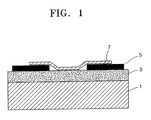
- FIG. 1 is a diagram of an electronic device having electrodes according to an embodiment of the present invention.
- an insulation layer 3 is deposited on a substrate 1
- two metal electrodes 5 in the form of foils are disposed to be separated from each other by a predetermined space at both sides on the surface of the insulation layer 3, and a carbon nanotube layer 7 connects the two metal electrodes 5.
- the structure is a most simple current-voltage (I-V) device if silicon is not doped with impurities and is a field-effect transistor (FET) if silicon is doped with P-type or N-type impurities.
- I-V current-voltage
- FET field-effect transistor
- the metal electrodes 5 of the electronic device are made of a metal such as titanium (Ti) or molybdenum (Mo).
- the metal generates less reaction enthalpy when reacting with carbon than when reacting with oxygen, so the metal reacts with carbon at higher speed than oxygen.
- FIG. 2 is a diagram for explaining a method of manufacturing an electronic device having electrodes according to the embodiment of the present invention using plasma chemical vapor deposition.
- a plasma chemical vapor deposition apparatus an upper electrode 14 and a lower electrode 12 are provided, and a substrate 11 on which a catalytic metal layer is formed is positioned on the lower electrode 12.
- a thermal resistance heater 13 positioned below the lower electrode 12 supplies heat to the substrate 11.
- a filament 15 is disposed between the upper electrode 14 and the lower electrode 12 to supply energy necessary for decomposing a reactant gas or synthesizing carbon nanotubes.
- a motor 19 rotates the lower electrode 12 on which the substrate 11 is positioned.
- a metal electrode 16 of an electron device to be manufactured is positioned on the surface of the catalytic metal layer on the substrate 11.
- the metal electrode 16 is made of a metal generating larger reaction enthalpy when reacting with carbon than when reacting with oxygen.
- the electronic device to be manufactured may have another layer having a different function, for example, an insulation layer, between the substrate 11 and the metal electrode 16.
- An RF power supply 17 is connected to the upper and lower electrodes 14 and 12 to supply electrical energy.
- a pipe for injecting a reactant gas is connected to the center of the upper electrode 14 so that a reactant gas such as carbon monoxide, methane, acetylene, or hydrogen is supplied to a reaction chamber 10.
- a glass, quartz, silicon, or alumina (Al 2 O 3 ) substrate may be used as the substrate 11.
- the metal electrode 16 of an electronic device may be made of a metal such as Ti, Mo, or iron (Fe) that reacts with carbon at higher speed than oxygen because it generates less reaction enthalpy when reacting with carbon than when reacting with oxygen.
- a metal such as Ti, Mo, or iron (Fe) that reacts with carbon at higher speed than oxygen because it generates less reaction enthalpy when reacting with carbon than when reacting with oxygen.
- Formula (1) is a chemical reaction formula illustrating the production of a carbonized metal when a metal reacts with carbon monoxide.
- Formula (2) illustrates a chemical reaction for producing an oxidized metal. 2 M + 2 CO ⁇ 2 MC + O 2 2 M + 2 CO ⁇ 2 MO + 2C
- the binding energy of TiO is 672.4 kJ/mol
- the binding energy of TiC is 423 kJ/mol
- a reaction enthalpy according to Formula (1) is -1307.1 kJ
- a reaction enthalpy according to Formula (2) is -808.2 kJ, so it can be inferred that the reaction according to Formula (1) is more dominant than the reaction according to Formula (2).
- the binding energy of MoO is 560.2 kJ/mol
- the binding energy of MoC is 481 kJ/mol
- a reaction enthalpy according to Formula (1) is -1191 kJ
- a reaction enthalpy according to Formula (2) is -1032 kJ, so it can be inferred that the reaction according to Formula (1) is more dominant than the reaction according to Formula (2).
- a carbonized metal such as carbon titanium, carbon molybdenum, or iron carbide is formed on the surface of a metal, thereby preventing the metal from contacting oxygen.
- a chemical reaction between carbon and metal and a chemical reaction between oxygen and metal are exothermic reactions, and a decrement in internal energy in the chemical reaction between carbon and metal is larger than a decrement in internal energy in the chemical reaction between oxygen and metal, so reaction enthalpy in the chemical reaction between carbon and metal is less than that in the chemical reaction between oxygen and metal.
- reaction enthalpy in the chemical reaction between carbon and metal is less than that in the chemical reaction between oxygen and metal.
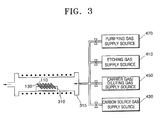
- An electronic device having an electrode made of a metal according to the embodiment of the present invention may be manufactured by a thermal chemical vapor deposition method.
- substrates 130 having electrodes 110 are arranged on a boat 310 of a thermal chemical vapor deposition apparatus to be separated from one another by a predetermined space in a line, and the boat 310 is loaded within a reaction furnace 315. Thereafter, the temperature of the reaction furnace 315 is raised to a process temperature, and an etching gas and a reactant gas are injected to the reaction furnace 315 to deposit carbon nanotubes on the electrodes 110.
- the electrode 16 or 110 is made of a metal such as Ti, Mo, or Fe that reacts with carbon better than with oxygen, so a carbonized metal layer is formed on the electrode 16 or 110. Accordingly, the electrode 16 or 110 is prevented from being oxidized during formation of carbon nanotubes. Since electrical conductivity is maintained constant, an electronic device can be easily manufactured. Therefore, an electronic device having good performance can be manufactured.
- FIG. 4 is a graph showing a change in an atom concentration (%) with respect to a chrome (Cr) electrode, which has been exposed to the conditions of carbon nanotube manufacturing using a mixed gas of carbon monoxide and hydrogen as a reactant gas, in the form of an Auger electron spectrum.
- chrome reacts with oxygen prior to carbon so as to form chrome oxide (CrO x )
- CrO x chrome oxide
- a Cr-atom concentration is small to a predetermined depth from the surface but increases as the depth is deeper into the inside of the chrome electrode.
- oxygen which is familiar with chrome is adsorbed to the surface of the chrome electrode much, so an O-atom concentration is high to a predetermined depth from the surface but decreases as the depth is deeper into the inside of the chrome electrode.
- Carbon hardly reacts with chrome, so a C-atom concentration is maintained nearly constant.
- FIG. 5A is a graph showing a change in an atom concentration with respect to an aluminum (Al) electrode, which has been exposed to the conditions of carbon nanotube manufacturing using a mixed gas of carbon monoxide and hydrogen as a reactant gas, in the form of an X-ray photoelectron spectrum.
- an Al-atom concentration increases while an O-atom concentration decreases as a depth from the surface of the aluminum electrode is deeper.
- Aluminum reacts with oxygen or hydrogen, thereby producing alumina (Al 2 O 3 ) or aluminum hydride (AIH x , for example, AlH 3 ).
- alumina Al 2 O 3
- AIH x aluminum hydride
- FIG. 5 As the depth from the surface of the aluminum electrode is deeper, more aluminum hydride is produced.
- aluminum hydride is more produced than alumina.
- aluminum hydride has a low melting point, so aluminum is inappropriate for the electrode.
- FIG. 6 is a graph showing a change in an atom concentration with respect to a molybdenum (Mo) electrode, which is included in an electron device according to the embodiment of the present invention and which has been exposed to the conditions of carbon nanotube manufacturing using a mixed gas of carbon monoxide and hydrogen as a reactant gas, in the form of an X-ray photoelectron spectrum.
- Mo molybdenum
- an electronic device in the case of using a reactant gas containing carbon and oxygen in forming carbon nanotubes, an electronic device has an electrode made of a metal that reacts with carbon at higher speed than oxygen because it generates less reaction enthalpy when reacting with carbon than when reacting with oxygen so that a carbonized metal layer is formed on the surface of the electrode to prevent oxidization. Accordingly, carbon nanotubes can be grown on the electronic device under a state in which the electrical conductivity of the electrode is maintained constant, thereby improving the performance of the electronic device.
- an electronic device has an electrode made of a metal which reacts with carbon better than with oxygen so that a carbonized metal layer is formed on the electrode so as to prevent oxidization of the electrode.
- the electrical conductivity of the electrode is maintained constant, thereby allowing carbon nanotubes to be formed by various methods and improving the entire performance of the electronic device.
Landscapes
- Engineering & Computer Science (AREA)
- Chemical & Material Sciences (AREA)
- Nanotechnology (AREA)
- Materials Engineering (AREA)
- Crystallography & Structural Chemistry (AREA)
- Physics & Mathematics (AREA)
- Manufacturing & Machinery (AREA)
- Condensed Matter Physics & Semiconductors (AREA)
- General Physics & Mathematics (AREA)
- Organic Chemistry (AREA)
- Composite Materials (AREA)
- Mathematical Physics (AREA)
- Theoretical Computer Science (AREA)
- Chemical Kinetics & Catalysis (AREA)
- Inorganic Chemistry (AREA)
- Carbon And Carbon Compounds (AREA)
- Electrodes Of Semiconductors (AREA)
- Ceramic Capacitors (AREA)
- Electrochromic Elements, Electrophoresis, Or Variable Reflection Or Absorption Elements (AREA)
- Cold Cathode And The Manufacture (AREA)
Applications Claiming Priority (2)
| Application Number | Priority Date | Filing Date | Title |
|---|---|---|---|
| KR1020020003688A KR100837393B1 (ko) | 2002-01-22 | 2002-01-22 | 탄소와 친화도가 높은 금속을 전극으로 구비하는 전자소자 |
| KR2002003688 | 2002-01-22 |
Publications (2)
| Publication Number | Publication Date |
|---|---|
| EP1331202A2 true EP1331202A2 (fr) | 2003-07-30 |
| EP1331202A3 EP1331202A3 (fr) | 2005-01-19 |
Family
ID=19718736
Family Applications (1)
| Application Number | Title | Priority Date | Filing Date |
|---|---|---|---|
| EP02257772A Withdrawn EP1331202A3 (fr) | 2002-01-22 | 2002-11-08 | Dispositif électronique avec une électrode en metal sur laquelle nanotubes de carbone sont déposés |
Country Status (5)
| Country | Link |
|---|---|
| US (2) | US20040214429A1 (fr) |
| EP (1) | EP1331202A3 (fr) |
| JP (1) | JP2003331711A (fr) |
| KR (1) | KR100837393B1 (fr) |
| CN (1) | CN1319114C (fr) |
Cited By (7)
| Publication number | Priority date | Publication date | Assignee | Title |
|---|---|---|---|---|
| FR2860780A1 (fr) * | 2003-10-13 | 2005-04-15 | Centre Nat Rech Scient | Procede de synthese de structures filamentaires nanometriques et composants pour l'electronique comprenant de telles structures |
| WO2005069412A1 (fr) * | 2004-01-14 | 2005-07-28 | Kh Chemicals Co., Ltd. | Electrode en nanotubes de carbone ou en nanofibres de carbone comprenant des particules de soufre ou de metal utilisees en tant que liant et procede de fabrication correspondant |
| US7531267B2 (en) | 2003-06-02 | 2009-05-12 | Kh Chemicals Co., Ltd. | Process for preparing carbon nanotube electrode comprising sulfur or metal nanoparticles as a binder |
| CN1608980B (zh) * | 2003-07-31 | 2011-08-03 | 株式会社半导体能源研究所 | 极细碳纤维、以及场致发射元件的制作方法 |
| EP2259043A4 (fr) * | 2008-02-27 | 2012-06-27 | Japan Science & Tech Agency | Support de nanotube de carbone et procédé pour produire le support de nanotube de carbone |
| US9506194B2 (en) | 2012-09-04 | 2016-11-29 | Ocv Intellectual Capital, Llc | Dispersion of carbon enhanced reinforcement fibers in aqueous or non-aqueous media |
| CN110295296A (zh) * | 2019-08-16 | 2019-10-01 | 深圳利都科技有限公司 | 一种钼基碳纳米管电子封装材料的制备方法 |
Families Citing this family (21)
| Publication number | Priority date | Publication date | Assignee | Title |
|---|---|---|---|---|
| US7454295B2 (en) | 1998-12-17 | 2008-11-18 | The Watereye Corporation | Anti-terrorism water quality monitoring system |
| US9056783B2 (en) | 1998-12-17 | 2015-06-16 | Hach Company | System for monitoring discharges into a waste water collection system |
| US8958917B2 (en) | 1998-12-17 | 2015-02-17 | Hach Company | Method and system for remote monitoring of fluid quality and treatment |
| US8920619B2 (en) | 2003-03-19 | 2014-12-30 | Hach Company | Carbon nanotube sensor |
| JP4620401B2 (ja) * | 2004-07-21 | 2011-01-26 | 三菱電機株式会社 | 半導体レーザ素子 |
| US7598516B2 (en) * | 2005-01-07 | 2009-10-06 | International Business Machines Corporation | Self-aligned process for nanotube/nanowire FETs |
| KR20070003467A (ko) * | 2005-07-02 | 2007-01-05 | 삼성전자주식회사 | 면광원장치와 이를 포함하는 액정표시장치 |
| US20120021954A1 (en) * | 2006-12-04 | 2012-01-26 | Ramot At Tel Aviv University Ltd. | Formation of organic nanostructure array |
| DE102007006444B4 (de) * | 2007-02-05 | 2015-05-13 | Airbus Defence and Space GmbH | Mikrotriebwerk, insbesondere zur Verwendung als Lageregelungstriebwerk, Kleintriebwerk sowie Verfahren zum Herstellen eines Mikrotriebwerks |
| JP4875517B2 (ja) * | 2007-03-05 | 2012-02-15 | シャープ株式会社 | 化学物質センシング素子、化学物質センシング装置、及び化学物質センシング素子の製造方法 |
| FR2922364B1 (fr) * | 2007-10-12 | 2014-08-22 | Saint Gobain | Procede de fabrication d'une electrode en oxyde de molybdene |
| KR101001477B1 (ko) * | 2009-02-27 | 2010-12-14 | 아주대학교산학협력단 | 바이오-메디컬 응용을 위한 상압 저온 마이크로 플라즈마 분사 장치 |
| US8624396B2 (en) | 2012-06-14 | 2014-01-07 | Taiwan Semiconductor Manufacturing Company, Ltd. | Apparatus and method for low contact resistance carbon nanotube interconnect |
| US10418647B2 (en) | 2015-04-15 | 2019-09-17 | Lockheed Martin Energy, Llc | Mitigation of parasitic reactions within flow batteries |
| KR20180042852A (ko) | 2015-08-19 | 2018-04-26 | 록히드 마틴 에너지, 엘엘씨 | 플로우 배터리 내의 고형물 저감 방법 |
| US10381674B2 (en) | 2016-04-07 | 2019-08-13 | Lockheed Martin Energy, Llc | High-throughput manufacturing processes for making electrochemical unit cells and electrochemical unit cells produced using the same |
| US10147957B2 (en) | 2016-04-07 | 2018-12-04 | Lockheed Martin Energy, Llc | Electrochemical cells having designed flow fields and methods for producing the same |
| US10109879B2 (en) * | 2016-05-27 | 2018-10-23 | Lockheed Martin Energy, Llc | Flow batteries having an electrode with a density gradient and methods for production and use thereof |
| US10403911B2 (en) | 2016-10-07 | 2019-09-03 | Lockheed Martin Energy, Llc | Flow batteries having an interfacially bonded bipolar plate-electrode assembly and methods for production and use thereof |
| US10573899B2 (en) | 2016-10-18 | 2020-02-25 | Lockheed Martin Energy, Llc | Flow batteries having an electrode with differing hydrophilicity on opposing faces and methods for production and use thereof |
| US10581104B2 (en) | 2017-03-24 | 2020-03-03 | Lockheed Martin Energy, Llc | Flow batteries having a pressure-balanced electrochemical cell stack and associated methods |
Citations (1)
| Publication number | Priority date | Publication date | Assignee | Title |
|---|---|---|---|---|
| EP1126494A1 (fr) | 2000-02-16 | 2001-08-22 | Ise Electronics Corporation | Module, source émettrice d'électrons et procédé de fabrication |
Family Cites Families (9)
| Publication number | Priority date | Publication date | Assignee | Title |
|---|---|---|---|---|
| KR100365444B1 (ko) * | 1996-09-18 | 2004-01-24 | 가부시끼가이샤 도시바 | 진공마이크로장치와이를이용한화상표시장치 |
| DE69834673T2 (de) * | 1997-09-30 | 2006-10-26 | Noritake Co., Ltd., Nagoya | Verfahren zur Herstellung einer Elektronenemittierenden Quelle |
| WO1999066523A1 (fr) * | 1998-06-18 | 1999-12-23 | Matsushita Electric Industrial Co., Ltd. | Dispositif emetteur d'electrons, source emettrice d'electrons, affichage d'images ainsi que procede de production de ceux-ci |
| EP1061554A1 (fr) * | 1999-06-15 | 2000-12-20 | Iljin Nanotech Co., Ltd. | Source de lumière blanche à nanotubes de carbone et procédé de fabrication |
| TW494423B (en) * | 1999-10-12 | 2002-07-11 | Matsushita Electric Industrial Co Ltd | Elecron-emitting element, electronic source using the element, field emission display device, fluorescent lamp, and method for producing those |
| EP1102299A1 (fr) * | 1999-11-05 | 2001-05-23 | Iljin Nanotech Co., Ltd. | Ecran d'affichage à amission avec nanotubes de carbone aignés verticalement et procédé de fabrication de cet écran |
| US6495258B1 (en) * | 2000-09-20 | 2002-12-17 | Auburn University | Structures with high number density of carbon nanotubes and 3-dimensional distribution |
| JP2002146533A (ja) * | 2000-11-06 | 2002-05-22 | Mitsubishi Electric Corp | 炭素薄体、炭素薄体形成方法および電界放出型電子源 |
| US6423583B1 (en) * | 2001-01-03 | 2002-07-23 | International Business Machines Corporation | Methodology for electrically induced selective breakdown of nanotubes |
-
2002
- 2002-01-22 KR KR1020020003688A patent/KR100837393B1/ko not_active Expired - Fee Related
- 2002-11-08 EP EP02257772A patent/EP1331202A3/fr not_active Withdrawn
- 2002-11-12 CN CNB021504393A patent/CN1319114C/zh not_active Expired - Fee Related
- 2002-11-18 US US10/295,868 patent/US20040214429A1/en not_active Abandoned
-
2003
- 2003-01-22 JP JP2003012946A patent/JP2003331711A/ja active Pending
-
2007
- 2007-05-01 US US11/797,185 patent/US20080152839A1/en not_active Abandoned
Patent Citations (1)
| Publication number | Priority date | Publication date | Assignee | Title |
|---|---|---|---|---|
| EP1126494A1 (fr) | 2000-02-16 | 2001-08-22 | Ise Electronics Corporation | Module, source émettrice d'électrons et procédé de fabrication |
Cited By (9)
| Publication number | Priority date | Publication date | Assignee | Title |
|---|---|---|---|---|
| US7531267B2 (en) | 2003-06-02 | 2009-05-12 | Kh Chemicals Co., Ltd. | Process for preparing carbon nanotube electrode comprising sulfur or metal nanoparticles as a binder |
| US8278010B2 (en) | 2003-06-02 | 2012-10-02 | Kh Chemicals Co., Ltd. | Carbon nanotube electrode comprising sulfur or metal nanoparticles as a binder and process for preparing the same |
| CN1608980B (zh) * | 2003-07-31 | 2011-08-03 | 株式会社半导体能源研究所 | 极细碳纤维、以及场致发射元件的制作方法 |
| FR2860780A1 (fr) * | 2003-10-13 | 2005-04-15 | Centre Nat Rech Scient | Procede de synthese de structures filamentaires nanometriques et composants pour l'electronique comprenant de telles structures |
| WO2005037710A1 (fr) * | 2003-10-13 | 2005-04-28 | Centre National De La Recherche Scientifique-Cnr S | Procede de synthese de structures filamentaires nanometriques et composants pour l'electronique comprenant de telles structures |
| WO2005069412A1 (fr) * | 2004-01-14 | 2005-07-28 | Kh Chemicals Co., Ltd. | Electrode en nanotubes de carbone ou en nanofibres de carbone comprenant des particules de soufre ou de metal utilisees en tant que liant et procede de fabrication correspondant |
| EP2259043A4 (fr) * | 2008-02-27 | 2012-06-27 | Japan Science & Tech Agency | Support de nanotube de carbone et procédé pour produire le support de nanotube de carbone |
| US9506194B2 (en) | 2012-09-04 | 2016-11-29 | Ocv Intellectual Capital, Llc | Dispersion of carbon enhanced reinforcement fibers in aqueous or non-aqueous media |
| CN110295296A (zh) * | 2019-08-16 | 2019-10-01 | 深圳利都科技有限公司 | 一种钼基碳纳米管电子封装材料的制备方法 |
Also Published As
| Publication number | Publication date |
|---|---|
| KR20030063530A (ko) | 2003-07-31 |
| CN1434480A (zh) | 2003-08-06 |
| CN1319114C (zh) | 2007-05-30 |
| US20080152839A1 (en) | 2008-06-26 |
| KR100837393B1 (ko) | 2008-06-12 |
| EP1331202A3 (fr) | 2005-01-19 |
| JP2003331711A (ja) | 2003-11-21 |
| US20040214429A1 (en) | 2004-10-28 |
Similar Documents
| Publication | Publication Date | Title |
|---|---|---|
| US20080152839A1 (en) | Electron device having electrode made of metal that is familiar with carbon | |
| KR100537512B1 (ko) | 카본나노튜브구조체 및 이의 제조방법 그리고 이를 응용한전계방출소자 및 표시장치 | |
| JP4855758B2 (ja) | 針状突起配列構造を表面に有するダイヤモンドの製造方法 | |
| EP1061041A1 (fr) | Dispositif de dépôt en phase vapeur à basse température et méthode de préparation de nanotubes de carbone l'utilisant | |
| JP3837451B2 (ja) | カーボンナノチューブの作製方法 | |
| JP2004284938A (ja) | 炭素ナノチューブの製造方法 | |
| JP2009196873A (ja) | カーボンナノチューブの製造方法及び製造装置 | |
| WO2008013309A1 (fr) | Nanoparoi de carbone à structure contrôlée et procédé de contrôle de la structure d'une nanoparoi de carbone | |
| Kabbara et al. | A microplasma process for hexagonal boron nitride thin film synthesis | |
| JP2007096136A (ja) | カーボンナノ構造体を用いた光起電力素子 | |
| JP2006015342A (ja) | カーボンナノチューブ製造用の触媒ベースの製造方法及びそれを利用したカーボンナノチューブの製造方法 | |
| US20080206484A1 (en) | Graphitized Carbon Coatings for Composite Electrodes | |
| KR20040025987A (ko) | 탄소나노튜브를 이용한 연료전지의 전극용 백금촉매제조방법 | |
| JP5116961B2 (ja) | カーボンナノウォールを用いたダイオード | |
| JP6210445B2 (ja) | カーボンナノチューブの製造方法 | |
| US20060068100A1 (en) | Film forming method | |
| KR101602628B1 (ko) | 원자층 증착법을 이용한 나노선의 제조 방법 | |
| US7641884B2 (en) | Method for fabricating carbon nanotubes and carbon nano particles | |
| KR102387536B1 (ko) | 플라즈마를 이용한 팔면체 전이금속 디칼코게나이드 제조 방법 | |
| US7312140B2 (en) | Film forming method | |
| JP2009082909A (ja) | 電極触媒及びそれを用いた電極 | |
| JP2000344505A (ja) | カーボンナノチューブの製造方法および製造装置 | |
| JP2007091484A (ja) | カーボンファイバの製造方法および基板ユニット | |
| JP2002167207A (ja) | 非結晶性炭素の除去方法 | |
| JP2006128064A (ja) | 触媒によるカーボンナノチューブの製造方法、電界放出電子源の製造方法、電界放出電子源及び電界放出型ディスプレイ |
Legal Events
| Date | Code | Title | Description |
|---|---|---|---|
| PUAI | Public reference made under article 153(3) epc to a published international application that has entered the european phase |
Free format text: ORIGINAL CODE: 0009012 |
|
| AK | Designated contracting states |
Designated state(s): AT BE BG CH CY CZ DE DK EE ES FI FR GB GR IE IT LI LU MC NL PT SE SK TR |
|
| AX | Request for extension of the european patent |
Extension state: AL LT LV MK RO SI |
|
| PUAL | Search report despatched |
Free format text: ORIGINAL CODE: 0009013 |
|
| AK | Designated contracting states |
Kind code of ref document: A3 Designated state(s): AT BE BG CH CY CZ DE DK EE ES FI FR GB GR IE IT LI LU MC NL PT SE SK TR |
|
| AX | Request for extension of the european patent |
Extension state: AL LT LV MK RO SI |
|
| 17P | Request for examination filed |
Effective date: 20050511 |
|
| AKX | Designation fees paid |
Designated state(s): DE FR GB |
|
| STAA | Information on the status of an ep patent application or granted ep patent |
Free format text: STATUS: THE APPLICATION IS DEEMED TO BE WITHDRAWN |
|
| 18D | Application deemed to be withdrawn |
Effective date: 20100601 |