EP1333009A1 - Verfahren zur partialoxidation von methan unter verwendung einer dichten, sauerstoffselektiven keramischen permeationsmembran - Google Patents
Verfahren zur partialoxidation von methan unter verwendung einer dichten, sauerstoffselektiven keramischen permeationsmembran Download PDFInfo
- Publication number
- EP1333009A1 EP1333009A1 EP01965672A EP01965672A EP1333009A1 EP 1333009 A1 EP1333009 A1 EP 1333009A1 EP 01965672 A EP01965672 A EP 01965672A EP 01965672 A EP01965672 A EP 01965672A EP 1333009 A1 EP1333009 A1 EP 1333009A1
- Authority
- EP
- European Patent Office
- Prior art keywords
- methane
- partial oxidation
- membrane
- catalyst
- ceramic membrane
- Prior art date
- Legal status (The legal status is an assumption and is not a legal conclusion. Google has not performed a legal analysis and makes no representation as to the accuracy of the status listed.)
- Ceased
Links
Images

Classifications
-
- C—CHEMISTRY; METALLURGY
- C01—INORGANIC CHEMISTRY
- C01B—NON-METALLIC ELEMENTS; COMPOUNDS THEREOF; METALLOIDS OR COMPOUNDS THEREOF NOT COVERED BY SUBCLASS C01C
- C01B3/00—Hydrogen; Gaseous mixtures containing hydrogen; Separation of hydrogen from mixtures containing it; Purification of hydrogen; Reversible storage of hydrogen
- C01B3/02—Production of hydrogen; Production of gaseous mixtures containing hydrogen
- C01B3/32—Production of hydrogen; Production of gaseous mixtures containing hydrogen by reaction of gaseous or liquid organic compounds with gasifying agents, e.g. water, carbon dioxide or air
- C01B3/34—Production of hydrogen; Production of gaseous mixtures containing hydrogen by reaction of gaseous or liquid organic compounds with gasifying agents, e.g. water, carbon dioxide or air by reaction of hydrocarbons with gasifying agents
- C01B3/38—Production of hydrogen; Production of gaseous mixtures containing hydrogen by reaction of gaseous or liquid organic compounds with gasifying agents, e.g. water, carbon dioxide or air by reaction of hydrocarbons with gasifying agents using catalysts
- C01B3/386—Catalytic partial combustion
-
- B—PERFORMING OPERATIONS; TRANSPORTING
- B01—PHYSICAL OR CHEMICAL PROCESSES OR APPARATUS IN GENERAL
- B01J—CHEMICAL OR PHYSICAL PROCESSES, e.g. CATALYSIS OR COLLOID CHEMISTRY; THEIR RELEVANT APPARATUS
- B01J23/00—Catalysts comprising metals or metal oxides or hydroxides, not provided for in group B01J21/00
- B01J23/70—Catalysts comprising metals or metal oxides or hydroxides, not provided for in group B01J21/00 of the iron group metals or copper
- B01J23/89—Catalysts comprising metals or metal oxides or hydroxides, not provided for in group B01J21/00 of the iron group metals or copper combined with noble metals
- B01J23/8933—Catalysts comprising metals or metal oxides or hydroxides, not provided for in group B01J21/00 of the iron group metals or copper combined with noble metals also combined with metals, or metal oxides or hydroxides provided for in groups B01J23/02 - B01J23/36
- B01J23/8946—Catalysts comprising metals or metal oxides or hydroxides, not provided for in group B01J21/00 of the iron group metals or copper combined with noble metals also combined with metals, or metal oxides or hydroxides provided for in groups B01J23/02 - B01J23/36 with alkali or alkaline earth metals
-
- B—PERFORMING OPERATIONS; TRANSPORTING
- B01—PHYSICAL OR CHEMICAL PROCESSES OR APPARATUS IN GENERAL
- B01J—CHEMICAL OR PHYSICAL PROCESSES, e.g. CATALYSIS OR COLLOID CHEMISTRY; THEIR RELEVANT APPARATUS
- B01J35/00—Catalysts, in general, characterised by their form or physical properties
- B01J35/50—Catalysts, in general, characterised by their form or physical properties characterised by their shape or configuration
- B01J35/58—Fabrics or filaments
- B01J35/59—Membranes
-
- B—PERFORMING OPERATIONS; TRANSPORTING
- B01—PHYSICAL OR CHEMICAL PROCESSES OR APPARATUS IN GENERAL
- B01J—CHEMICAL OR PHYSICAL PROCESSES, e.g. CATALYSIS OR COLLOID CHEMISTRY; THEIR RELEVANT APPARATUS
- B01J37/00—Processes, in general, for preparing catalysts; Processes, in general, for activation of catalysts
- B01J37/02—Impregnation, coating or precipitation
- B01J37/024—Multiple impregnation or coating
- B01J37/0248—Coatings comprising impregnated particles
-
- C—CHEMISTRY; METALLURGY
- C01—INORGANIC CHEMISTRY
- C01B—NON-METALLIC ELEMENTS; COMPOUNDS THEREOF; METALLOIDS OR COMPOUNDS THEREOF NOT COVERED BY SUBCLASS C01C
- C01B13/00—Oxygen; Ozone; Oxides or hydroxides in general
- C01B13/02—Preparation of oxygen
- C01B13/0229—Purification or separation processes
- C01B13/0248—Physical processing only
- C01B13/0251—Physical processing only by making use of membranes
-
- C—CHEMISTRY; METALLURGY
- C01—INORGANIC CHEMISTRY
- C01B—NON-METALLIC ELEMENTS; COMPOUNDS THEREOF; METALLOIDS OR COMPOUNDS THEREOF NOT COVERED BY SUBCLASS C01C
- C01B2203/00—Integrated processes for the production of hydrogen or synthesis gas
- C01B2203/02—Processes for making hydrogen or synthesis gas
- C01B2203/025—Processes for making hydrogen or synthesis gas containing a partial oxidation step
- C01B2203/0261—Processes for making hydrogen or synthesis gas containing a partial oxidation step containing a catalytic partial oxidation step [CPO]
-
- C—CHEMISTRY; METALLURGY
- C01—INORGANIC CHEMISTRY
- C01B—NON-METALLIC ELEMENTS; COMPOUNDS THEREOF; METALLOIDS OR COMPOUNDS THEREOF NOT COVERED BY SUBCLASS C01C
- C01B2203/00—Integrated processes for the production of hydrogen or synthesis gas
- C01B2203/10—Catalysts for performing the hydrogen forming reactions
- C01B2203/1041—Composition of the catalyst
- C01B2203/1047—Group VIII metal catalysts
- C01B2203/1052—Nickel or cobalt catalysts
-
- C—CHEMISTRY; METALLURGY
- C01—INORGANIC CHEMISTRY
- C01B—NON-METALLIC ELEMENTS; COMPOUNDS THEREOF; METALLOIDS OR COMPOUNDS THEREOF NOT COVERED BY SUBCLASS C01C
- C01B2203/00—Integrated processes for the production of hydrogen or synthesis gas
- C01B2203/10—Catalysts for performing the hydrogen forming reactions
- C01B2203/1041—Composition of the catalyst
- C01B2203/1047—Group VIII metal catalysts
- C01B2203/1064—Platinum group metal catalysts
-
- C—CHEMISTRY; METALLURGY
- C01—INORGANIC CHEMISTRY
- C01B—NON-METALLIC ELEMENTS; COMPOUNDS THEREOF; METALLOIDS OR COMPOUNDS THEREOF NOT COVERED BY SUBCLASS C01C
- C01B2203/00—Integrated processes for the production of hydrogen or synthesis gas
- C01B2203/12—Feeding the process for making hydrogen or synthesis gas
- C01B2203/1205—Composition of the feed
- C01B2203/1211—Organic compounds or organic mixtures used in the process for making hydrogen or synthesis gas
- C01B2203/1235—Hydrocarbons
- C01B2203/1241—Natural gas or methane
-
- C—CHEMISTRY; METALLURGY
- C01—INORGANIC CHEMISTRY
- C01B—NON-METALLIC ELEMENTS; COMPOUNDS THEREOF; METALLOIDS OR COMPOUNDS THEREOF NOT COVERED BY SUBCLASS C01C
- C01B2203/00—Integrated processes for the production of hydrogen or synthesis gas
- C01B2203/12—Feeding the process for making hydrogen or synthesis gas
- C01B2203/1258—Pre-treatment of the feed
-
- C—CHEMISTRY; METALLURGY
- C01—INORGANIC CHEMISTRY
- C01B—NON-METALLIC ELEMENTS; COMPOUNDS THEREOF; METALLOIDS OR COMPOUNDS THEREOF NOT COVERED BY SUBCLASS C01C
- C01B2210/00—Purification or separation of specific gases
- C01B2210/0043—Impurity removed
- C01B2210/0046—Nitrogen
-
- Y—GENERAL TAGGING OF NEW TECHNOLOGICAL DEVELOPMENTS; GENERAL TAGGING OF CROSS-SECTIONAL TECHNOLOGIES SPANNING OVER SEVERAL SECTIONS OF THE IPC; TECHNICAL SUBJECTS COVERED BY FORMER USPC CROSS-REFERENCE ART COLLECTIONS [XRACs] AND DIGESTS
- Y02—TECHNOLOGIES OR APPLICATIONS FOR MITIGATION OR ADAPTATION AGAINST CLIMATE CHANGE
- Y02P—CLIMATE CHANGE MITIGATION TECHNOLOGIES IN THE PRODUCTION OR PROCESSING OF GOODS
- Y02P20/00—Technologies relating to chemical industry
- Y02P20/50—Improvements relating to the production of bulk chemicals
- Y02P20/52—Improvements relating to the production of bulk chemicals using catalysts, e.g. selective catalysts
Definitions
- the present invention relates to a reaction technology using an oxygen selective permeation ceramic membrane reactor for producing synthesis gas, which is a mixture of hydrogen and carbon monoxide, that can be used as a feedstock for producing clean liquid fuel such as Fischer-Tropsch synthesis oil, methanol and dimethyl ether, using a gas which includes methane as the feedstock,and the above technology is characterized by minimizing the quantity of catalyst to be used, suppressing the deterioration of the catalyst and significantly improving the reaction efficiency.
- the present invention also relates to a technology for reducing the size of the membrane reactor and a related facility while maximizing the oxygen permeability through the oxygen selective permeation ceramic membrane and significantly increasing the yield of synthesis gas production.
- Producing a clean synthetic liquid fuel from a gas including methane as a feedstock contributes to the effective utilization of untapped natural gas and other resources and to the supply of an environmentally-friendly clean energy source.
- technologies for producing synthesis liquid fuel have hardly been commercialized anywhere in the world at present, except for methanol that is used as the feedstock for the chemical industry. This is because the technology is not economically viable for commercial application based on the current level of technology and the prices of existing fuels, indicating that further improvement of the technology is indispensable for reducing the cost.
- This technology consists of two phases; the production of a synthesis gas from a gas that contains methane, and the production of a liquid fuel from the synthesis gas.
- these processes include the methane combustion reaction and the reforming reaction of CO 2 , H 2 O that are generated by the combustion with methane. That is, the following exothermic reaction and endothermic reactions proceed in combination.
- the process that is being applied to commercial plants is the gas phase partial oxidation while there has not been much progress in the commercial application of the fixed bed autothermal reforming process.
- the fluidized bed autothermal reforming process remains at the stage of pilot testing, while the catalytic partial oxidation remains at the basic research stage.
- these technologies utilize the thermal energy supplied from the inside, energy efficiency is improved over that of the steam reforming, but it is difficult to significantly reduce the cost because it requires the supply of expensive pure oxygen produced by the cryogenic distillation air separator.
- oxygen molecules included in air are selectively ionized on the surface of the membrane and pass through the crystal lattice, being driven by the difference in partial pressure of oxygen on both sides of the membrane.
- electrons move in a direction opposite to the flow of oxygen ions so as to maintain the electrical neutrality.
- Partial pressure of oxygen on the methane side can be minimized by placing a catalyst on the side opposite to the air side so as to oxidize methane and other substances (consume oxygen), thereby maximizing the difference in partial pressure of oxygen, namely the driving force for the selective permeation of oxygen.
- the ceramic material exhibits mixed conductivity at a high temperature from 800 to 900°C
- partial oxidation reaction of methane and other substances can be carried out simultaneously with the separation of air, namely in a single unit, thus providing the possibility that the reactor could become more compact and low-cost.
- basic research on the use of the ceramic membrane has been conducted by many researchers, such as the methane oxidation coupling and production of synthesis gas from methane.
- Particularly intensive efforts have been poured, world-wide, into the production of synthesis gas from methane including a big research project with a fund granted by the U.S. Energy Department, since there are possibilities of drastic cost reduction and reducing energy consumption.
- the membrane As for the configuration of the membrane, it must be thin in order to increase the oxygen permeability against the bulk diffusion resistance of oxygen in the ceramic membrane, and such proposals have been made as a method for producing an inorganic thin film by means of organometallic chemical deposition on a porous supporting structure (Japanese Unexamined Patent Publication (Kokai) No. 6-135703). Also in case the surface exchange such as selective dissociation of oxygen reaches the rate-determining step of the oxygen permeation rate as the membrane is made thinner, it maybe required to add a porous layer that increases the surface area or add an oxygen dissociating catalyst (WO98/41394, etc.).
- WO99/21649 discloses two-dimensional and three-dimensional arrangements of various methane reforming catalysts, it does not disclose any specific means of suppressing the precipitation of carbon under normal to high pressures.
- EP-0999180A2 discloses a method for suppressing carbon precipitation by recycling the product from the membrane reactor, consisting mainly of hydrogen, to the feed side, it has a drawback of complex process.
- a methane partial oxidation catalyst such as those based on Ni loses the methane reforming capability due to oxidation. As oxygen comes out of the membrane in the membrane reactor, the methane reforming catalyst located near the surface of the membrane tends to be deactivated by oxidation.
- the present invention relates to an oxygen permeation membrane reactor for producing synthesis gas using a gas that contains methane and air as the feedstock, and provides a method for producing synthesis gas with high efficiency, stability and low cost in a range from normal pressure to high pressure around 20 atm, while overcoming such drawbacks as carbon precipitation on the catalyst and deactivation of catalyst due to oxidation of a metal catalyst, and also providing solutions to problems caused by these drawbacks such as a decrease in oxygen supply from the ceramic membrane and the consumption of catalyst.
- the problems described above can be solved by disposing a methane partial oxidation catalyst based on Ni or on noble metal such as Ru that has a low tendency of carbon precipitation in such an amount that deactivation due to oxidation does not occur, in a two-dimensional arrangement in the vicinity of the surface of the ceramic membrane where oxygen comes out thereof in the upstream of the methane-containing gas flow in the oxygen permeation membrane reactor, and disposing the methane partial oxidation catalyst based on Ni or on noble metal such as Ru that has a low tendency of carbon precipitation, in a three-dimensional arrangement with respect to the ceramic membrane in the downstream of the methane-containing gas flow in the reactor, and supplying steam to the methane-containing gas, that is fed to the reactor, in a ratio from 0.25 to 0.5 of steam to the carbon content in the gas.
- the membrane reactor may have either tubular or planar configuration, and the feedstock gas may flow in countercurrent, direct flow or flow in perpendicular direction to the air. In the case of tubular configuration, the
- the partial oxidation of methane has an extremely small influence, namely the concentration of hydrogen and other reaction product is very low and methane concentration is high in a portion that is distant from the ceramic membrane surface in the upstream portion of the gas flow, for example in a portion located near the center of the ceramic membrane reactor of tubular configuration filled with catalyst, because oxygen flows along the flow of the gas that contains methane thereby to join therewith in the membrane reactor.
- the three-dimensional contact arrangement of the methane partial oxidation catalyst in the upstream of the gas flow that contains methane in the membrane reactor provides a sufficient active surface area for the progress of partial oxidation reaction of methane, although it cannot be tolerated from the view point of carbon precipitation.
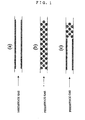
- the methane partial oxidation catalyst in two-dimensional arrangement (Refer to Fig. 1(a)) in the vicinity of the ceramic membrane surface where oxygen comes therefrom in the upstream of the gas flow that contains methane in the membrane reactor, clogging of the reactor tube due to precipitation of carbon is prevented, precipitation of carbon is significantly mitigated, oxygen permeability through the ceramic membrane is maximized and catalyst consumption is minimized.
- oxygen permeability through the ceramic membrane depends mainly on the surface area of the active metal that is in reducing state. That is, high oxygen permeability is obtained if the active metal, that is in reducing state, has a sufficient surface area, or oxygenpermeability is low otherwise. This is because the partial pressure of oxygen varies considerably depending on whether water and carbon dioxide, generated by complete combustion of methane or hydrogen existing in the vicinity of the surface of the ceramic membrane, are in such a state as can be readily consumed in the methane reforming reaction. When the surface area of the active metal that is in reducing state is not sufficiently large, partial pressure of oxygen becomes high and results in lower oxygen permeability through the ceramic membrane.
- oxygen permeability through the ceramic membrane and selectivity factor of carbon monoxide are subjected to periodical fluctuation.
- selectivity factor of carbon monoxide ratio of the number of moles of carbon monoxide to the total number of moles of carbon monoxide and carbon dioxide included in the reaction product
- the present invention uses a methane partial oxidation catalyst based on Ni or on noble metal such as Ru disposed in a two-dimensional contact arrangement on the ceramic membrane.
- the Ni-based methane partial oxidation catalyst is preferably made in such a composition that it has a strong interaction between Ni and the support so that fine Ni particles can be distributed and the support has high capability to supply oxygen.
- catalysts are supported in two-dimensional arrangement by applying a slurry, that has been prepared from fired catalyst ground into fine powder which is mixed with an organic solvent, onto the surface of a ceramic membrane that is then fired at a high temperature around 900°C.
- quantity of the catalyst that is supported by baking is from 1.5 to 3.5 mg, preferably from 2.0 to 3.0 mg per unit surface area (1 cm 2 ) of the ceramic membrane and unit oxygen permeation through the membrane (1 scc/min/cm 2 ).
- the reaction of partial oxidation of methane is caused to proceed completely by disposing the catalyst in the two-dimensional arrangement in an upstream portion of the gas flow that contains methane in the membrane reactor while disposing the methane partial oxidation catalyst that provides sufficient active sites for reaction in three-dimensional contact arrangement on the ceramic membrane in the downstream portion (refer to Fig. 1(c)).
- the condition of carbon precipitation is mitigated in the downstreamportion, when compared to the condition of conventional steam reforming operation, the condition of carbon precipitation is still harsher, particularly under high pressures.
- a methane partial oxidation catalyst based on Ni or on noble metal such as Ru is used similarly to the catalyst that is disposed in the two-dimensional arrangement in the upstream portion.
- These catalysts are supported in three-dimensional arrangement by forming the fired catalyst into size and shape that are suited to the extent of the reaction to be achieved, which is then put into the membrane reactor so as to fill the space of gas flow downstream of the gas flow including methane flowing from upstream to downstream.
- the temperature increases as the reaction proceeds, with the rate of rising temperature increasing as the reaction pressure becomes higher.
- the methane reforming reaction increases the number of moles of the substances involved, and the rate of conversion is higher at a lower pressure and is lower at a higher pressure due to the principle of equilibrium.
- the methane reforming reaction endothermic reaction
- the ceramic membrane reactor is operated to run at a high temperature of about 850°C in order to achieve sufficient oxygen permeability through the ceramic membrane and have the partial oxidation of methane fully proceed.
- the temperature rise in the reactor is preferably restricted to a minimum level and it is indispensable to supply steam.
- supplying an excessive quantity of steam increases the H 2 /CO ratio in the reaction product to a value significantly higher than 2, and compromises the applicability of the reaction product to the liquid synthesizing process in the downstream.
- the supply of H 2 O increases the partial pressure of oxygen on the methane side of the ceramic membrane, oxygen permeability decreases.
- the steam/carbon ratio is set in a range from 0.25 to 0.5, thereby to mitigate the conditions of carbon precipitation as well.
- the mixture solution was heated to 80 to 90°C while stirring, so as to evaporate water and make a sol containing an organometallic complex salt.
- the sol was subjected to pyrolysis at 200°C and 500°C each for five hours, followed by firing at 900°C in air for 10 hours, thereby making the catalyst having composition of Ni 0.2 /BaTiO 3 .
- BaTiO 3 of a perovskite structure and a trace of NiO were identified by X-ray diffraction analysis.
- This catalyst was immersed in aqueous solution of rhodium nitrate so as to carry 100 ppm by weight of rhodium for unit weight of catalyst, before being dried and fired at 600°C.
- This Example emulates the two-dimensional arrangement and the three-dimensional arrangement of the methane partial oxidation catalyst in the ceramic membrane reactor. Specifically, a dense ceramic membrane (11 mm in effective diameter and 1.2 mm in thickness) having disk shape made of a material having composition of Ba 1.x Sr x Co 1-x Fe x O 3-d that was fired at 1150°C was used.
- the methane partial oxidation catalyst as described in the example of preparing catalyst that was fired at 900°C was crushed into powder having mean particle size of 10 ⁇ m and was turned into slurry with an organic solvent. The slurry was applied to one side of the ceramic membrane and was fired at 900°C. Weight of the catalyst that was supported by baking was about 25 mg.
- the ceramic membrane carrying the catalyst baked thereon was set on an experiment apparatus shown in Fig. 1.
- a powder having composition similar to that of the catalyst that was applied by slurry coating, was formed into particles of 20/40 mesh size after being subjected to uniaxial compression under a pressure of approximately 7 ton/cm 2 .
- About 300 mg of the powder was fixed in a downstream portion of a quartz tube using quartz wool.
- the experiment apparatus was heated from the outside in an electric furnace so that the central portion thereof was heated to 850°C, while supplying 150 scc/min of air and 30 scc/min of methane, and the results shown in Table 1 were obtained.
- a ceramic membrane having a catalyst made similarly to that of Example 1 baked thereon was set in the experiment apparatus shown in Fig. 1.
- the experiment apparatus was heated from the outside in an electric furnace so that the central portion thereof was heated to 850°C, while supplying 150 scc/min of air and 30 scc/min of methane, and the results shown in Table 1 were obtained.
- a dense ceramic membrane the same as that of Example 1, was loaded with about 15 mg of methane partial oxidation catalyst by slurry coating by the method described in Example 1.
- the membrane supporting the catalyst was set in the experiment apparatus shown in Fig. 1 and was heated from the outside in an electric furnace so that the central portion thereof was heated to 850°C, while supplying 150 scc/min of air and 30 scc/min of methane, and the results shown in Table 1 were obtained.
- the dense ceramic membrane described in Example 1 was loaded with about 900 mg of catalyst, that was processed for grading of particle size as described in Example 1, supported on the membrane as shown in Fig. 1.
- the experiment apparatus was heated from the outside in an electric furnace so that the central portion thereof was heated to 850°C, while supplying 150 scc/min of air and 30 scc/min of methane, and the results shown in Table 1 were obtained.
- Example 1 The dense ceramic membrane described in Example 1 was set in an experiment apparatus similarly to Comparative Examples 1, 2, 4 and 5, without loading the methane partial oxidation catalyst.
- the experiment apparatus was heated from the outside in an electric furnace so that the central portion thereof was heated to 850°C, while supplying 150 scc/minof air to one side of the ceramicmembrane and 30 scc/min of methane to the other side, and the results shown in Table 1 were obtained.
- Example 1 The dense ceramic membrane described in Example 1 was set in an experiment apparatus similarly to Comparative Examples 1, 2, 4 and 5, without loading the methane partial oxidation catalyst.
- the experiment apparatus was heated from the outside in an electric furnace so that the central portion thereof was heated to 850°C, while supplying 150 scc/min of air to one side of the ceramic membrane and 30 scc/min of helium to the other side, and the results shown in Table 1 were obtained.
- the present invention specifies a method for partial oxidation of methane using a dense, oxygen selective permeation ceramic membrane, wherein carbon precipitation on the methane partial oxidation catalyst and deactivation of a metal catalyst due to oxidation are suppressed while maximizing the amount of oxygen permeated through the ceramic membrane and the yield of synthesis gas production and minimizing the consumption of the catalyst, in a range of feedstock gas stream pressures from normal pressure to a high pressure around 20 atm. Effects of the method were verified through experiments.
Landscapes
- Chemical & Material Sciences (AREA)
- Organic Chemistry (AREA)
- Chemical Kinetics & Catalysis (AREA)
- Engineering & Computer Science (AREA)
- Materials Engineering (AREA)
- Inorganic Chemistry (AREA)
- Combustion & Propulsion (AREA)
- General Health & Medical Sciences (AREA)
- Health & Medical Sciences (AREA)
- Analytical Chemistry (AREA)
- Hydrogen, Water And Hydrids (AREA)
- Catalysts (AREA)
- Separation Using Semi-Permeable Membranes (AREA)
Applications Claiming Priority (3)
| Application Number | Priority Date | Filing Date | Title |
|---|---|---|---|
| JP2000284647 | 2000-09-20 | ||
| JP2000284647 | 2000-09-20 | ||
| PCT/JP2001/008036 WO2002024571A1 (en) | 2000-09-20 | 2001-09-17 | Method for partial oxidation of methane using dense, oxygen selective permeation ceramic membrane |
Publications (2)
| Publication Number | Publication Date |
|---|---|
| EP1333009A1 true EP1333009A1 (de) | 2003-08-06 |
| EP1333009A4 EP1333009A4 (de) | 2004-08-04 |
Family
ID=18768824
Family Applications (1)
| Application Number | Title | Priority Date | Filing Date |
|---|---|---|---|
| EP01965672A Ceased EP1333009A4 (de) | 2000-09-20 | 2001-09-17 | Verfahren zur partialoxidation von methan unter verwendung einer dichten, sauerstoffselektiven keramischen permeationsmembran |
Country Status (10)
| Country | Link |
|---|---|
| US (1) | US7105147B2 (de) |
| EP (1) | EP1333009A4 (de) |
| JP (1) | JP4953546B2 (de) |
| CN (1) | CN1461282A (de) |
| AU (1) | AU2001286258A1 (de) |
| CA (1) | CA2422567A1 (de) |
| NO (1) | NO20031264L (de) |
| RU (1) | RU2003111161A (de) |
| WO (1) | WO2002024571A1 (de) |
| ZA (1) | ZA200303049B (de) |
Cited By (1)
| Publication number | Priority date | Publication date | Assignee | Title |
|---|---|---|---|---|
| EP1795260A1 (de) * | 2005-12-07 | 2007-06-13 | L'AIR LIQUIDE, Société Anonyme pour l'Etude et l'Exploitation des Procédés Georges Claude | Katalysator enthaltend einen festen Träger, ein Oxid und eine auf das Oxid aufgebrachte, metallische, aktive Phase; Verfahren zu seiner Herstellung und Verwendung |
Families Citing this family (30)
| Publication number | Priority date | Publication date | Assignee | Title |
|---|---|---|---|---|
| US7576032B2 (en) * | 2003-12-17 | 2009-08-18 | Daihatsu Motor Co., Ltd. | Catalyst composition |
| US7419648B2 (en) * | 2004-07-16 | 2008-09-02 | Shell Oil Company | Process for the production of hydrogen and carbon dioxide |
| CN100438978C (zh) * | 2006-12-20 | 2008-12-03 | 中国科学院山西煤炭化学研究所 | 一种天然气部分氧化制备合成气的催化剂及其制备方法 |
| EA012979B1 (ru) * | 2006-12-27 | 2010-02-26 | Милфорд Груп Венчурс Лимитед | Способ повышения нефтеотдачи продуктивного пласта |
| JP2009062258A (ja) * | 2007-03-27 | 2009-03-26 | Tdk Corp | 燃料改質モジュール及び水素発生装置 |
| US20080260631A1 (en) | 2007-04-18 | 2008-10-23 | H2Gen Innovations, Inc. | Hydrogen production process |
| GB201000156D0 (en) * | 2010-01-07 | 2010-02-24 | Gas2 Ltd | Isothermal reactor for partial oxidisation of methane |
| EP2374526A1 (de) | 2010-03-29 | 2011-10-12 | Centre National de la Recherche Scientifique (C.N.R.S) | Feststoffverbundmembran mit Sauerstoffleitfähigkeit und einer Substratkatalysatorschnittstelle |
| CN102424360A (zh) * | 2011-09-13 | 2012-04-25 | 昆明理工大学 | 一种载氧膜连续催化甲烷制合成气的方法 |
| CA2860773C (en) | 2012-01-13 | 2020-11-03 | Siluria Technologies, Inc. | Process for separating hydrocarbon compounds |
| US9969660B2 (en) | 2012-07-09 | 2018-05-15 | Siluria Technologies, Inc. | Natural gas processing and systems |
| CN102744060B (zh) * | 2012-07-23 | 2014-02-19 | 福州大学 | 一种BaTiO3 负载钌氨合成催化剂及其制备方法 |
| AU2013355038B2 (en) | 2012-12-07 | 2017-11-02 | Lummus Technology Llc | Integrated processes and systems for conversion of methane to multiple higher hydrocarbon products |
| WO2015081122A2 (en) | 2013-11-27 | 2015-06-04 | Siluria Technologies, Inc. | Reactors and systems for oxidative coupling of methane |
| CA2935937A1 (en) | 2014-01-08 | 2015-07-16 | Siluria Technologies, Inc. | Ethylene-to-liquids systems and methods |
| CA2935946C (en) | 2014-01-09 | 2022-05-03 | Siluria Technologies, Inc. | Oxidative coupling of methane implementations for olefin production |
| US10377682B2 (en) | 2014-01-09 | 2019-08-13 | Siluria Technologies, Inc. | Reactors and systems for oxidative coupling of methane |
| US9334204B1 (en) | 2015-03-17 | 2016-05-10 | Siluria Technologies, Inc. | Efficient oxidative coupling of methane processes and systems |
| US10793490B2 (en) | 2015-03-17 | 2020-10-06 | Lummus Technology Llc | Oxidative coupling of methane methods and systems |
| US20160289143A1 (en) | 2015-04-01 | 2016-10-06 | Siluria Technologies, Inc. | Advanced oxidative coupling of methane |
| US9328297B1 (en) | 2015-06-16 | 2016-05-03 | Siluria Technologies, Inc. | Ethylene-to-liquids systems and methods |
| EP3786138A1 (de) | 2015-10-16 | 2021-03-03 | Lummus Technology LLC | Oxidative kupplung von methan |
| EP3442934A4 (de) | 2016-04-13 | 2019-12-11 | Siluria Technologies, Inc. | Oxidative kupplung von methan zur olefinherstellung |
| US10539324B2 (en) * | 2016-06-09 | 2020-01-21 | King Fahd University Of Petroleum And Minerals | System for combusting a methane stream and a method of combustion |
| CN107537499B (zh) * | 2016-06-29 | 2020-06-09 | 中国石油化工股份有限公司 | 多孔陶瓷负载镍基费托催化剂及其使用方法 |
| EP3554672A4 (de) | 2016-12-19 | 2020-08-12 | Siluria Technologies, Inc. | Verfahren und systeme für chemische abscheidungen |
| KR20200034961A (ko) | 2017-05-23 | 2020-04-01 | 루머스 테크놀로지 엘엘씨 | 메탄의 산화적 커플링 공정의 통합 |
| AU2018298234B2 (en) | 2017-07-07 | 2022-11-17 | Lummus Technology Llc | Systems and methods for the oxidative coupling of methane |
| CA3138540A1 (en) | 2020-11-13 | 2022-05-13 | Lummus Technology Llc | Methods and systems for converting carbon oxides to olefins |
| CN118302400A (zh) | 2021-08-31 | 2024-07-05 | 鲁玛斯科技有限责任公司 | 用于进行甲烷氧化偶联的方法和系统 |
Family Cites Families (18)
| Publication number | Priority date | Publication date | Assignee | Title |
|---|---|---|---|---|
| US5306411A (en) * | 1989-05-25 | 1994-04-26 | The Standard Oil Company | Solid multi-component membranes, electrochemical reactor components, electrochemical reactors and use of membranes, reactor components, and reactor for oxidation reactions |
| US5360635A (en) | 1992-01-02 | 1994-11-01 | Air Products And Chemicals, Inc. | Method for manufacturing inorganic membranes by organometallic chemical vapor deposition |
| US6355093B1 (en) * | 1993-12-08 | 2002-03-12 | Eltron Research, Inc | Two component-three dimensional catalysis |
| US6033632A (en) * | 1993-12-08 | 2000-03-07 | Eltron Research, Inc. | Solid state oxygen anion and electron mediating membrane and catalytic membrane reactors containing them |
| US5725218A (en) * | 1996-11-15 | 1998-03-10 | The University Of Chicago | High temperature seal for joining ceramics and metal alloys |
| US5846641A (en) * | 1997-03-20 | 1998-12-08 | Exxon Research And Engineering Company | Multi-layer membrane composites and their use in hydrocarbon partical oxidation |
| US5980840A (en) | 1997-04-25 | 1999-11-09 | Bp Amoco Corporation | Autothermic reactor and process using oxygen ion--conducting dense ceramic membrane |
| US5820654A (en) | 1997-04-29 | 1998-10-13 | Praxair Technology, Inc. | Integrated solid electrolyte ionic conductor separator-cooler |
| US6077323A (en) | 1997-06-06 | 2000-06-20 | Air Products And Chemicals, Inc. | Synthesis gas production by ion transport membranes |
| US5935533A (en) | 1997-10-28 | 1999-08-10 | Bp Amoco Corporation | Membrane reactor hollow tube module with ceramic/metal interfacial zone |
| CA2256801C (en) | 1997-12-23 | 2002-05-28 | Air Products And Chemicals, Inc. | Utilization of synthesis gas produced by mixed conducting membranes |
| JP4335356B2 (ja) | 1998-04-14 | 2009-09-30 | 石油資源開発株式会社 | リホーミング用ニッケル系触媒およびこれを用いた合成ガスの製法 |
| US6139810A (en) | 1998-06-03 | 2000-10-31 | Praxair Technology, Inc. | Tube and shell reactor with oxygen selective ion transport ceramic reaction tubes |
| US6010614A (en) * | 1998-06-03 | 2000-01-04 | Praxair Technology, Inc. | Temperature control in a ceramic membrane reactor |
| US6153163A (en) | 1998-06-03 | 2000-11-28 | Praxair Technology, Inc. | Ceramic membrane reformer |
| JP4154123B2 (ja) * | 1998-07-02 | 2008-09-24 | ハルダー トプソー エイエス | 炭化水素供給原料の自動熱改質の方法 |
| US6458334B1 (en) * | 2000-03-02 | 2002-10-01 | The Boc Group, Inc. | Catalytic partial oxidation of hydrocarbons |
| US6733692B2 (en) * | 2000-04-20 | 2004-05-11 | Conocophillips Company | Rhodium foam catalyst for the partial oxidation of hydrocarbons |
-
2001
- 2001-09-17 US US10/363,699 patent/US7105147B2/en not_active Expired - Fee Related
- 2001-09-17 JP JP2002528594A patent/JP4953546B2/ja not_active Expired - Fee Related
- 2001-09-17 CN CN01815998A patent/CN1461282A/zh active Pending
- 2001-09-17 RU RU2003111161/15A patent/RU2003111161A/ru not_active Application Discontinuation
- 2001-09-17 WO PCT/JP2001/008036 patent/WO2002024571A1/ja not_active Ceased
- 2001-09-17 AU AU2001286258A patent/AU2001286258A1/en not_active Abandoned
- 2001-09-17 CA CA002422567A patent/CA2422567A1/en not_active Abandoned
- 2001-09-17 EP EP01965672A patent/EP1333009A4/de not_active Ceased
-
2003
- 2003-03-19 NO NO20031264A patent/NO20031264L/no not_active Application Discontinuation
- 2003-09-17 ZA ZA200303049A patent/ZA200303049B/en unknown
Non-Patent Citations (2)
| Title |
|---|
| No further relevant documents disclosed * |
| See also references of WO0224571A1 * |
Cited By (2)
| Publication number | Priority date | Publication date | Assignee | Title |
|---|---|---|---|---|
| EP1795260A1 (de) * | 2005-12-07 | 2007-06-13 | L'AIR LIQUIDE, Société Anonyme pour l'Etude et l'Exploitation des Procédés Georges Claude | Katalysator enthaltend einen festen Träger, ein Oxid und eine auf das Oxid aufgebrachte, metallische, aktive Phase; Verfahren zu seiner Herstellung und Verwendung |
| WO2007065849A1 (fr) * | 2005-12-07 | 2007-06-14 | L'air Liquide Societe Anonyme Pour L'etude Et L'exploitation Des Procedes Georges Claude | Catalyseur constitué d'un support solide, d'un oxyde, et d'une phase active métallique greffée sur l'oxyde, procédé pour sa préparation et application |
Also Published As
| Publication number | Publication date |
|---|---|
| ZA200303049B (en) | 2004-04-19 |
| NO20031264D0 (no) | 2003-03-19 |
| EP1333009A4 (de) | 2004-08-04 |
| RU2003111161A (ru) | 2004-08-27 |
| US20040101472A1 (en) | 2004-05-27 |
| WO2002024571A1 (en) | 2002-03-28 |
| AU2001286258A1 (en) | 2002-04-02 |
| NO20031264L (no) | 2003-05-19 |
| US7105147B2 (en) | 2006-09-12 |
| CA2422567A1 (en) | 2003-03-18 |
| JPWO2002024571A1 (ja) | 2004-01-29 |
| JP4953546B2 (ja) | 2012-06-13 |
| CN1461282A (zh) | 2003-12-10 |
Similar Documents
| Publication | Publication Date | Title |
|---|---|---|
| US7105147B2 (en) | Method for partial oxidation of methane using dense, oxygen selective permeation ceramic membrane | |
| Yang et al. | Combined steam and CO2 reforming of methane over La1-xSrxNiO3 perovskite oxides | |
| Luisetto et al. | Co and Ni supported on CeO2 as selective bimetallic catalyst for dry reforming of methane | |
| CN102083745B (zh) | 运行hts反应器的方法 | |
| Iulianelli et al. | The oncoming energy vector: Hydrogen produced in Pd-composite membrane reactor via bioethanol reforming over Ni/CeO2 catalyst | |
| Jia et al. | High-temperature ethanol steam reforming in PdCu membrane reactor | |
| JP6534388B2 (ja) | 選択的透過性の膜を利用するプロセス | |
| US7771702B2 (en) | Sulfur-tolerant catalysts and related precursors and processes | |
| Ferreira-Aparicio et al. | Catalysis in membrane reformers: a high-performance catalytic system for hydrogen production from methane | |
| Djinović et al. | Ru-based catalysts for CO selective methanation reaction in H2-rich gases | |
| Xia et al. | Innovative steam methane reforming for coproducing CO‐free hydrogen and syngas in proton conducting membrane reactor | |
| US10369549B2 (en) | Use of nickel-manganese olivine and nickel-manganese spinel as bulk metal catalysts for carbon dioxide reforming of methane | |
| WO2003106332A2 (en) | Suppression of methanation activity of platinum group metal water-gas shift catalysts | |
| WO2007031713A1 (en) | Process for hydrogen production | |
| WO2020012687A1 (ja) | 炭化水素改質触媒および炭化水素改質装置 | |
| WO2018231961A1 (en) | Nano-engineered catalysts for dry reforming of methane | |
| CN100402150C (zh) | 一氧化碳去除催化剂和生产该催化剂的方法以及去除一氧化碳的装置 | |
| CA2629078C (en) | Process conditions for pt-re bimetallic water gas shift catalysts | |
| KR101400889B1 (ko) | 탄화수소 개질촉매 및 이의 제조방법 | |
| JPWO2005075344A1 (ja) | 選択透過膜型反応器による炭化水素の二酸化炭素改質方法 | |
| JP2007516825A (ja) | 改質触媒 | |
| EP4215513A1 (de) | Verfahren zur herstellung von kohlenwasserstoffen | |
| JP4848294B2 (ja) | 燃料電池用水素製造触媒及びdss運転対応型燃料電池 | |
| Shen et al. | Reaction mechanism on reduction surface of mixed conductor membrane for H2 production by coal-gas | |
| JP2014189477A (ja) | 合成ガスの製造方法及びその製造装置 |
Legal Events
| Date | Code | Title | Description |
|---|---|---|---|
| PUAI | Public reference made under article 153(3) epc to a published international application that has entered the european phase |
Free format text: ORIGINAL CODE: 0009012 |
|
| 17P | Request for examination filed |
Effective date: 20030312 |
|
| AK | Designated contracting states |
Designated state(s): AT BE CH CY DE DK ES FI FR GB GR IE IT LI LU MC NL PT SE TR |
|
| AX | Request for extension of the european patent |
Extension state: AL LT LV MK RO SI |
|
| RBV | Designated contracting states (corrected) |
Designated state(s): AT BE CH CY DE FR GB LI NL |
|
| A4 | Supplementary search report drawn up and despatched |
Effective date: 20040618 |
|
| RAP1 | Party data changed (applicant data changed or rights of an application transferred) |
Owner name: INPEX CORPORATION |
|
| REG | Reference to a national code |
Ref country code: DE Ref legal event code: R003 |
|
| STAA | Information on the status of an ep patent application or granted ep patent |
Free format text: STATUS: THE APPLICATION HAS BEEN REFUSED |
|
| 18R | Application refused |
Effective date: 20170406 |