EP1333152A1 - Eingekapselte Flüssigkeit zur Behandlung von Bohrlöchern - Google Patents
Eingekapselte Flüssigkeit zur Behandlung von Bohrlöchern Download PDFInfo
- Publication number
- EP1333152A1 EP1333152A1 EP03250619A EP03250619A EP1333152A1 EP 1333152 A1 EP1333152 A1 EP 1333152A1 EP 03250619 A EP03250619 A EP 03250619A EP 03250619 A EP03250619 A EP 03250619A EP 1333152 A1 EP1333152 A1 EP 1333152A1
- Authority
- EP
- European Patent Office
- Prior art keywords
- acid
- liquid
- capsule
- solid
- capsules
- Prior art date
- Legal status (The legal status is an assumption and is not a legal conclusion. Google has not performed a legal analysis and makes no representation as to the accuracy of the status listed.)
- Granted
Links
- 239000007788 liquid Substances 0.000 title claims abstract description 162
- 238000011282 treatment Methods 0.000 title abstract description 20
- 239000002775 capsule Substances 0.000 claims abstract description 164
- 239000007787 solid Substances 0.000 claims abstract description 88
- 239000012528 membrane Substances 0.000 claims abstract description 49
- 238000000034 method Methods 0.000 claims description 91
- 239000002253 acid Substances 0.000 claims description 82
- KRKNYBCHXYNGOX-UHFFFAOYSA-N citric acid Chemical compound OC(=O)CC(O)(C(O)=O)CC(O)=O KRKNYBCHXYNGOX-UHFFFAOYSA-N 0.000 claims description 78
- 239000012530 fluid Substances 0.000 claims description 57
- VEXZGXHMUGYJMC-UHFFFAOYSA-N Hydrochloric acid Chemical compound Cl VEXZGXHMUGYJMC-UHFFFAOYSA-N 0.000 claims description 44
- 230000015572 biosynthetic process Effects 0.000 claims description 31
- 230000008569 process Effects 0.000 claims description 27
- CSCPPACGZOOCGX-UHFFFAOYSA-N Acetone Chemical compound CC(C)=O CSCPPACGZOOCGX-UHFFFAOYSA-N 0.000 claims description 24
- XLYOFNOQVPJJNP-UHFFFAOYSA-N water Substances O XLYOFNOQVPJJNP-UHFFFAOYSA-N 0.000 claims description 22
- 238000005530 etching Methods 0.000 claims description 20
- QTBSBXVTEAMEQO-UHFFFAOYSA-N Acetic acid Chemical compound CC(O)=O QTBSBXVTEAMEQO-UHFFFAOYSA-N 0.000 claims description 15
- 238000004519 manufacturing process Methods 0.000 claims description 15
- QAOWNCQODCNURD-UHFFFAOYSA-N Sulfuric acid Chemical compound OS(O)(=O)=O QAOWNCQODCNURD-UHFFFAOYSA-N 0.000 claims description 14
- -1 ethylene, propylene, isobutylene Chemical group 0.000 claims description 13
- 239000003112 inhibitor Substances 0.000 claims description 13
- WEVYAHXRMPXWCK-UHFFFAOYSA-N Acetonitrile Chemical compound CC#N WEVYAHXRMPXWCK-UHFFFAOYSA-N 0.000 claims description 12
- ZMXDDKWLCZADIW-UHFFFAOYSA-N N,N-Dimethylformamide Chemical compound CN(C)C=O ZMXDDKWLCZADIW-UHFFFAOYSA-N 0.000 claims description 12
- AEMRFAOFKBGASW-UHFFFAOYSA-N Glycolic acid Chemical compound OCC(O)=O AEMRFAOFKBGASW-UHFFFAOYSA-N 0.000 claims description 10
- NBIIXXVUZAFLBC-UHFFFAOYSA-N Phosphoric acid Chemical compound OP(O)(O)=O NBIIXXVUZAFLBC-UHFFFAOYSA-N 0.000 claims description 10
- 238000005260 corrosion Methods 0.000 claims description 10
- 230000007797 corrosion Effects 0.000 claims description 10
- BDAGIHXWWSANSR-UHFFFAOYSA-N methanoic acid Natural products OC=O BDAGIHXWWSANSR-UHFFFAOYSA-N 0.000 claims description 10
- 238000002156 mixing Methods 0.000 claims description 10
- 238000009792 diffusion process Methods 0.000 claims description 9
- 229910052500 inorganic mineral Inorganic materials 0.000 claims description 9
- 239000011707 mineral Substances 0.000 claims description 9
- 235000010755 mineral Nutrition 0.000 claims description 9
- 239000000203 mixture Substances 0.000 claims description 9
- 150000001298 alcohols Chemical class 0.000 claims description 8
- VZCYOOQTPOCHFL-OWOJBTEDSA-N Fumaric acid Chemical compound OC(=O)\C=C\C(O)=O VZCYOOQTPOCHFL-OWOJBTEDSA-N 0.000 claims description 7
- GRYLNZFGIOXLOG-UHFFFAOYSA-N Nitric acid Chemical compound O[N+]([O-])=O GRYLNZFGIOXLOG-UHFFFAOYSA-N 0.000 claims description 7
- 150000007513 acids Chemical class 0.000 claims description 7
- 229920001577 copolymer Polymers 0.000 claims description 7
- 229910017604 nitric acid Inorganic materials 0.000 claims description 7
- FAPWRFPIFSIZLT-UHFFFAOYSA-M Sodium chloride Chemical compound [Na+].[Cl-] FAPWRFPIFSIZLT-UHFFFAOYSA-M 0.000 claims description 6
- HEMHJVSKTPXQMS-UHFFFAOYSA-M Sodium hydroxide Chemical compound [OH-].[Na+] HEMHJVSKTPXQMS-UHFFFAOYSA-M 0.000 claims description 6
- 150000001875 compounds Chemical class 0.000 claims description 6
- 239000003814 drug Substances 0.000 claims description 6
- 238000002844 melting Methods 0.000 claims description 6
- 230000008018 melting Effects 0.000 claims description 6
- 239000002455 scale inhibitor Substances 0.000 claims description 6
- VZCYOOQTPOCHFL-UHFFFAOYSA-N trans-butenedioic acid Natural products OC(=O)C=CC(O)=O VZCYOOQTPOCHFL-UHFFFAOYSA-N 0.000 claims description 6
- OEPOKWHJYJXUGD-UHFFFAOYSA-N 2-(3-phenylmethoxyphenyl)-1,3-thiazole-4-carbaldehyde Chemical compound O=CC1=CSC(C=2C=C(OCC=3C=CC=CC=3)C=CC=2)=N1 OEPOKWHJYJXUGD-UHFFFAOYSA-N 0.000 claims description 5
- OSWFIVFLDKOXQC-UHFFFAOYSA-N 4-(3-methoxyphenyl)aniline Chemical compound COC1=CC=CC(C=2C=CC(N)=CC=2)=C1 OSWFIVFLDKOXQC-UHFFFAOYSA-N 0.000 claims description 5
- OFOBLEOULBTSOW-UHFFFAOYSA-N Propanedioic acid Natural products OC(=O)CC(O)=O OFOBLEOULBTSOW-UHFFFAOYSA-N 0.000 claims description 5
- 229910000147 aluminium phosphate Inorganic materials 0.000 claims description 5
- 239000004568 cement Substances 0.000 claims description 5
- 239000003431 cross linking reagent Substances 0.000 claims description 5
- 239000003599 detergent Substances 0.000 claims description 5
- 239000000975 dye Substances 0.000 claims description 5
- 239000003337 fertilizer Substances 0.000 claims description 5
- 235000013373 food additive Nutrition 0.000 claims description 5
- 239000002778 food additive Substances 0.000 claims description 5
- 235000019253 formic acid Nutrition 0.000 claims description 5
- VZCYOOQTPOCHFL-UPHRSURJSA-N maleic acid Chemical compound OC(=O)\C=C/C(O)=O VZCYOOQTPOCHFL-UPHRSURJSA-N 0.000 claims description 5
- 239000011976 maleic acid Substances 0.000 claims description 5
- 239000003973 paint Substances 0.000 claims description 5
- 239000002304 perfume Substances 0.000 claims description 5
- 239000000575 pesticide Substances 0.000 claims description 5
- 239000003016 pheromone Substances 0.000 claims description 5
- 239000000049 pigment Substances 0.000 claims description 5
- 239000003505 polymerization initiator Substances 0.000 claims description 5
- 150000003839 salts Chemical class 0.000 claims description 5
- IIACRCGMVDHOTQ-UHFFFAOYSA-N sulfamic acid group Chemical class S(N)(O)(=O)=O IIACRCGMVDHOTQ-UHFFFAOYSA-N 0.000 claims description 5
- WCUXLLCKKVVCTQ-UHFFFAOYSA-M Potassium chloride Chemical compound [Cl-].[K+] WCUXLLCKKVVCTQ-UHFFFAOYSA-M 0.000 claims description 4
- 150000001732 carboxylic acid derivatives Chemical class 0.000 claims description 4
- 150000002170 ethers Chemical class 0.000 claims description 4
- 239000008172 hydrogenated vegetable oil Substances 0.000 claims description 4
- 239000004094 surface-active agent Substances 0.000 claims description 4
- 150000003573 thiols Chemical class 0.000 claims description 4
- DCXXMTOCNZCJGO-UHFFFAOYSA-N tristearoylglycerol Chemical compound CCCCCCCCCCCCCCCCCC(=O)OCC(OC(=O)CCCCCCCCCCCCCCCCC)COC(=O)CCCCCCCCCCCCCCCCC DCXXMTOCNZCJGO-UHFFFAOYSA-N 0.000 claims description 4
- QGZKDVFQNNGYKY-UHFFFAOYSA-O Ammonium Chemical compound [NH4+] QGZKDVFQNNGYKY-UHFFFAOYSA-O 0.000 claims description 3
- BZHJMEDXRYGGRV-UHFFFAOYSA-N Vinyl chloride Chemical compound ClC=C BZHJMEDXRYGGRV-UHFFFAOYSA-N 0.000 claims description 3
- 150000002148 esters Chemical class 0.000 claims description 3
- 230000005484 gravity Effects 0.000 claims description 3
- 239000011780 sodium chloride Substances 0.000 claims description 3
- VGGSQFUCUMXWEO-UHFFFAOYSA-N Ethene Chemical compound C=C VGGSQFUCUMXWEO-UHFFFAOYSA-N 0.000 claims description 2
- 239000005977 Ethylene Substances 0.000 claims description 2
- 108010010803 Gelatin Proteins 0.000 claims description 2
- 229940123973 Oxygen scavenger Drugs 0.000 claims description 2
- 239000004698 Polyethylene Substances 0.000 claims description 2
- 229920002367 Polyisobutene Polymers 0.000 claims description 2
- 239000004743 Polypropylene Substances 0.000 claims description 2
- 239000003139 biocide Substances 0.000 claims description 2
- 229920001525 carrageenan Polymers 0.000 claims description 2
- 239000004927 clay Substances 0.000 claims description 2
- 238000000151 deposition Methods 0.000 claims description 2
- 229920000159 gelatin Polymers 0.000 claims description 2
- 235000019322 gelatine Nutrition 0.000 claims description 2
- 235000011852 gelatine desserts Nutrition 0.000 claims description 2
- 229920000126 latex Polymers 0.000 claims description 2
- 239000004816 latex Substances 0.000 claims description 2
- 239000012188 paraffin wax Substances 0.000 claims description 2
- 229920000573 polyethylene Polymers 0.000 claims description 2
- 229920001155 polypropylene Polymers 0.000 claims description 2
- 239000001103 potassium chloride Substances 0.000 claims description 2
- 235000011164 potassium chloride Nutrition 0.000 claims description 2
- 239000012255 powdered metal Substances 0.000 claims description 2
- 239000003381 stabilizer Substances 0.000 claims description 2
- 150000007524 organic acids Chemical class 0.000 claims 2
- 235000005985 organic acids Nutrition 0.000 claims 2
- RWSOTUBLDIXVET-UHFFFAOYSA-N Dihydrogen sulfide Chemical compound S RWSOTUBLDIXVET-UHFFFAOYSA-N 0.000 claims 1
- 150000002016 disaccharides Chemical class 0.000 claims 1
- 239000001530 fumaric acid Substances 0.000 claims 1
- 229920001519 homopolymer Polymers 0.000 claims 1
- 229910000037 hydrogen sulfide Inorganic materials 0.000 claims 1
- 150000007522 mineralic acids Chemical class 0.000 claims 1
- 150000002772 monosaccharides Chemical class 0.000 claims 1
- 229920000642 polymer Polymers 0.000 claims 1
- 235000015112 vegetable and seed oil Nutrition 0.000 claims 1
- 239000008158 vegetable oil Substances 0.000 claims 1
- OKKJLVBELUTLKV-UHFFFAOYSA-N Methanol Chemical compound OC OKKJLVBELUTLKV-UHFFFAOYSA-N 0.000 description 33
- 239000000126 substance Substances 0.000 description 29
- 239000000243 solution Substances 0.000 description 19
- 238000005538 encapsulation Methods 0.000 description 14
- 239000002002 slurry Substances 0.000 description 11
- 230000008901 benefit Effects 0.000 description 8
- 239000000463 material Substances 0.000 description 8
- 239000002245 particle Substances 0.000 description 8
- 239000011148 porous material Substances 0.000 description 8
- 239000011521 glass Substances 0.000 description 6
- 229910021532 Calcite Inorganic materials 0.000 description 5
- 239000000654 additive Substances 0.000 description 5
- 238000004458 analytical method Methods 0.000 description 5
- 238000006243 chemical reaction Methods 0.000 description 5
- 238000004090 dissolution Methods 0.000 description 5
- 239000000499 gel Substances 0.000 description 5
- 238000010438 heat treatment Methods 0.000 description 5
- 229930195733 hydrocarbon Natural products 0.000 description 5
- 150000002430 hydrocarbons Chemical class 0.000 description 5
- 238000002347 injection Methods 0.000 description 5
- 239000007924 injection Substances 0.000 description 5
- 238000005033 Fourier transform infrared spectroscopy Methods 0.000 description 4
- 230000007246 mechanism Effects 0.000 description 4
- 239000011343 solid material Substances 0.000 description 4
- 239000003153 chemical reaction reagent Substances 0.000 description 3
- 239000003795 chemical substances by application Substances 0.000 description 3
- 238000010790 dilution Methods 0.000 description 3
- 239000012895 dilution Substances 0.000 description 3
- 230000000717 retained effect Effects 0.000 description 3
- 239000011435 rock Substances 0.000 description 3
- 125000006850 spacer group Chemical group 0.000 description 3
- 239000007858 starting material Substances 0.000 description 3
- 239000004215 Carbon black (E152) Substances 0.000 description 2
- ZCCIPPOKBCJFDN-UHFFFAOYSA-N calcium nitrate Chemical compound [Ca+2].[O-][N+]([O-])=O.[O-][N+]([O-])=O ZCCIPPOKBCJFDN-UHFFFAOYSA-N 0.000 description 2
- OSGAYBCDTDRGGQ-UHFFFAOYSA-L calcium sulfate Chemical compound [Ca+2].[O-]S([O-])(=O)=O OSGAYBCDTDRGGQ-UHFFFAOYSA-L 0.000 description 2
- 230000008859 change Effects 0.000 description 2
- 238000001035 drying Methods 0.000 description 2
- 230000000694 effects Effects 0.000 description 2
- 238000007667 floating Methods 0.000 description 2
- 238000002955 isolation Methods 0.000 description 2
- 229910052751 metal Inorganic materials 0.000 description 2
- 239000002184 metal Substances 0.000 description 2
- TVDSBUOJIPERQY-UHFFFAOYSA-N prop-2-yn-1-ol Chemical compound OCC#C TVDSBUOJIPERQY-UHFFFAOYSA-N 0.000 description 2
- 239000004342 Benzoyl peroxide Substances 0.000 description 1
- OMPJBNCRMGITSC-UHFFFAOYSA-N Benzoylperoxide Chemical compound C=1C=CC=CC=1C(=O)OOC(=O)C1=CC=CC=C1 OMPJBNCRMGITSC-UHFFFAOYSA-N 0.000 description 1
- UXVMQQNJUSDDNG-UHFFFAOYSA-L Calcium chloride Chemical compound [Cl-].[Cl-].[Ca+2] UXVMQQNJUSDDNG-UHFFFAOYSA-L 0.000 description 1
- RYGMFSIKBFXOCR-UHFFFAOYSA-N Copper Chemical compound [Cu] RYGMFSIKBFXOCR-UHFFFAOYSA-N 0.000 description 1
- 239000002841 Lewis acid Substances 0.000 description 1
- 238000010521 absorption reaction Methods 0.000 description 1
- 238000010306 acid treatment Methods 0.000 description 1
- 238000013019 agitation Methods 0.000 description 1
- 229910052782 aluminium Inorganic materials 0.000 description 1
- XAGFODPZIPBFFR-UHFFFAOYSA-N aluminium Chemical compound [Al] XAGFODPZIPBFFR-UHFFFAOYSA-N 0.000 description 1
- 239000008346 aqueous phase Substances 0.000 description 1
- 239000011324 bead Substances 0.000 description 1
- 235000019400 benzoyl peroxide Nutrition 0.000 description 1
- 150000001642 boronic acid derivatives Chemical class 0.000 description 1
- 239000001110 calcium chloride Substances 0.000 description 1
- 229910001628 calcium chloride Inorganic materials 0.000 description 1
- 150000001735 carboxylic acids Chemical class 0.000 description 1
- 239000000919 ceramic Substances 0.000 description 1
- 150000001860 citric acid derivatives Chemical class 0.000 description 1
- 239000000084 colloidal system Substances 0.000 description 1
- 239000012141 concentrate Substances 0.000 description 1
- 238000013270 controlled release Methods 0.000 description 1
- 229910052802 copper Inorganic materials 0.000 description 1
- 239000010949 copper Substances 0.000 description 1
- 230000002950 deficient Effects 0.000 description 1
- 239000008367 deionised water Substances 0.000 description 1
- 229910021641 deionized water Inorganic materials 0.000 description 1
- 238000000502 dialysis Methods 0.000 description 1
- 239000002270 dispersing agent Substances 0.000 description 1
- 239000012153 distilled water Substances 0.000 description 1
- 229940079593 drug Drugs 0.000 description 1
- 230000008030 elimination Effects 0.000 description 1
- 238000003379 elimination reaction Methods 0.000 description 1
- 239000008393 encapsulating agent Substances 0.000 description 1
- 238000005516 engineering process Methods 0.000 description 1
- 239000003623 enhancer Substances 0.000 description 1
- 230000002708 enhancing effect Effects 0.000 description 1
- 238000011067 equilibration Methods 0.000 description 1
- 230000004907 flux Effects 0.000 description 1
- 150000004675 formic acid derivatives Chemical class 0.000 description 1
- 150000004676 glycans Chemical class 0.000 description 1
- 230000003116 impacting effect Effects 0.000 description 1
- 150000002500 ions Chemical class 0.000 description 1
- 150000007517 lewis acids Chemical class 0.000 description 1
- 239000007791 liquid phase Substances 0.000 description 1
- 229910001960 metal nitrate Inorganic materials 0.000 description 1
- 230000007935 neutral effect Effects 0.000 description 1
- 239000003921 oil Substances 0.000 description 1
- 235000019198 oils Nutrition 0.000 description 1
- 150000002894 organic compounds Chemical class 0.000 description 1
- 239000013618 particulate matter Substances 0.000 description 1
- 238000005192 partition Methods 0.000 description 1
- 230000035515 penetration Effects 0.000 description 1
- 150000002978 peroxides Chemical class 0.000 description 1
- 150000003009 phosphonic acids Chemical class 0.000 description 1
- 239000005017 polysaccharide Substances 0.000 description 1
- 229920001282 polysaccharide Polymers 0.000 description 1
- 238000001556 precipitation Methods 0.000 description 1
- 238000011084 recovery Methods 0.000 description 1
- 238000004064 recycling Methods 0.000 description 1
- 230000009467 reduction Effects 0.000 description 1
- 239000011347 resin Substances 0.000 description 1
- 229920005989 resin Polymers 0.000 description 1
- 239000004576 sand Substances 0.000 description 1
- 239000010454 slate Substances 0.000 description 1
- 230000003068 static effect Effects 0.000 description 1
- 238000003860 storage Methods 0.000 description 1
- 150000003467 sulfuric acid derivatives Chemical class 0.000 description 1
- 239000008399 tap water Substances 0.000 description 1
- 235000020679 tap water Nutrition 0.000 description 1
Images

Classifications
-
- C—CHEMISTRY; METALLURGY
- C09—DYES; PAINTS; POLISHES; NATURAL RESINS; ADHESIVES; COMPOSITIONS NOT OTHERWISE PROVIDED FOR; APPLICATIONS OF MATERIALS NOT OTHERWISE PROVIDED FOR
- C09K—MATERIALS FOR MISCELLANEOUS APPLICATIONS, NOT PROVIDED FOR ELSEWHERE
- C09K8/00—Compositions for drilling of boreholes or wells; Compositions for treating boreholes or wells, e.g. for completion or for remedial operations
- C09K8/60—Compositions for stimulating production by acting on the underground formation
- C09K8/92—Compositions for stimulating production by acting on the underground formation characterised by their form or by the form of their components, e.g. encapsulated material
-
- C—CHEMISTRY; METALLURGY
- C09—DYES; PAINTS; POLISHES; NATURAL RESINS; ADHESIVES; COMPOSITIONS NOT OTHERWISE PROVIDED FOR; APPLICATIONS OF MATERIALS NOT OTHERWISE PROVIDED FOR
- C09K—MATERIALS FOR MISCELLANEOUS APPLICATIONS, NOT PROVIDED FOR ELSEWHERE
- C09K8/00—Compositions for drilling of boreholes or wells; Compositions for treating boreholes or wells, e.g. for completion or for remedial operations
- C09K8/60—Compositions for stimulating production by acting on the underground formation
- C09K8/62—Compositions for forming crevices or fractures
-
- C—CHEMISTRY; METALLURGY
- C09—DYES; PAINTS; POLISHES; NATURAL RESINS; ADHESIVES; COMPOSITIONS NOT OTHERWISE PROVIDED FOR; APPLICATIONS OF MATERIALS NOT OTHERWISE PROVIDED FOR
- C09K—MATERIALS FOR MISCELLANEOUS APPLICATIONS, NOT PROVIDED FOR ELSEWHERE
- C09K8/00—Compositions for drilling of boreholes or wells; Compositions for treating boreholes or wells, e.g. for completion or for remedial operations
- C09K8/60—Compositions for stimulating production by acting on the underground formation
- C09K8/62—Compositions for forming crevices or fractures
- C09K8/72—Eroding chemicals, e.g. acids
Definitions
- This invention relates to a method of encapsulating a liquid, and to use of the encapsulated liquid for well treatment.
- Hydrocarbon production typically requires a variety of chemical treatments. Normally injected downhole, the chemicals treat the producing formation or portions of the well. When injecting chemicals in the liquid state, the operator must compensate for dilution of the treatment chemicals by the carrier fluid. Further, certain well treatment chemicals, such as acids, require the use of additional safety procedures to protect on-site personnel and the environment.
- the invention provides a method of encapsulating a liquid, which method comprises:
- the invention also includes a method treating the downhole region of a well, which method comprises: placing an encapsulated liquid made by the method of the invention, within the downhole region of a well; and releasing said liquid from the capsule.
- the invention further includes a method of acid etching a fracture face located in a subterranean production zone, which method comprises the steps of:
- the present invention is particularly useful for acid etching a fractured production zone. Following the fracturing of a production zone, well operators commonly acid etch the fracture face to enhance hydrocarbon production rates.
- the acid etching process involves injection of an acid downhole through the production pipe string into the fracture. Preferably, the acid penetrates the entire length of the fracture. Once in the fracture, the acid reacts with the fracture rock face creating channels in the rock face. Following the release of pressure on the fractured zone, the resulting channels provide a flow path thereby increasing the flow of hydrocarbons from the production zone to the borehole.
- the acid used in the etching process can be delivered in a safe, environmentally friendly and undiluted manner to the exact location where acid etching is desired.
- the invention achieves other advantages as well.
- the acid detrimentally impacts the pipe string and casing. Repeated acid treatments may require a "work over" or recompletion of the well to replace those portions of the pipe string damaged by the acid.
- Encapsulating the acid in accordance with the invention permits injection of the acid without exposing the pipe string to the corrosive effects of the acid. Further, for example, the encapsulated acid can be delivered deeply into the fracture prior to release.
- the well treatment process of the invention also improves the performance and economics of other well treatment chemicals. For example, encapsulation permits the controlled release of well treatment chemicals at a desired downhole location. Therefore, where the operator previously used a large quantity of chemicals to compensate for dilution or reaction during transport, the operator may now reduce the quantity of chemicals used. Thus, as an added benefit, the operator will conserve resources, save money and reduce the risk associated with handling chemicals at the well site.
- the present invention provides a method of encapsulating a liquid within a semi-permeable membrane.
- the method first encapsulates solid material within a semi-permeable membrane to form a capsule.
- the capsule is placed in a liquid capable of passing through the membrane and dissolving the solid.
- the solid is allowed to dissolve in said liquid.
- the capsule remains in the liquid for a period of time sufficient to permit concentration gradient driving forces to displace substantially all dissolved solid from within the capsule.
- the resulting capsule contains primarily the liquid.
- the present invention also provides an alternative method for encapsulating a liquid within a semi-permeable membrane.
- This method encapsulates a solid within a semi-permeable membrane to form a capsule.
- the capsule is placed in a first liquid capable of passing through the membrane and dissolving the solid.
- the capsule containing a solution of solid and first liquid is placed in contact with a second liquid.
- concentration and/or volume of the second liquid contacting the capsule in comparison to the volume of the solution within the capsule, creates an environment in which concentration gradient driving forces will remove substantially all of the solution of first liquid and solid from the capsule.
- the capsule contains primarily the second liquid.
- the present invention also provides a method for treating a downhole region of a well with well treatment chemicals or additives.
- the method encapsulates a solid within a semi-permeable membrane to form a capsule.
- the capsule is placed in a liquid capable of passing through the semi-permeable membrane and dissolving the solid.
- the solid is allowed to dissolve in said liquid.
- the capsule remains in the liquid for a period of time sufficient to permit concentration gradient driving forces to displace substantially all dissolved solid from within the capsule.
- the resulting capsule contains primarily the liquid.
- the liquid containing capsule is placed downhole at a preselected point. Following positioning, the encapsulated liquid is released.
- the present invention provides an alternative method for treating the downhole region of a well.
- This method encapsulates a solid within a semi-permeable membrane to form a capsule.
- the capsule is placed in a first liquid capable of passing through the membrane and dissolving the solid.
- the capsule containing a solution of solid and first liquid is placed in contact with a second liquid.
- concentration and/or volume of the second liquid contacting the capsule in comparison to the volume of the solution within the capsule, creates an environment in which concentration gradient driving forces will remove substantially all of the solution of first liquid and solid from the capsule.
- the capsule contains primarily the second liquid. Following placement at the desired location, the second liquid is released from the capsules.
- the present invention provides a method for acid etching a fracture face located in a subterranean production zone.
- the method provides for hydraulically fracturing a subterranean formation to produce a fractured formation having at least one fracture face.
- capsules of liquid acid are injected into the fractured formation while hydraulic pressure is maintained on the formation.
- a carrier fluid is used to transport the capsules downhole to the fractured formation.
- hydraulic pressure is released from the formation. The drop in hydraulic pressure allows the formation to close on and crush the capsules thereby releasing the liquid acid.
- the acid subsequently reacts with and etches the fracture face.
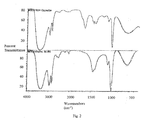
- Fig. 1 is an FTIR scan of unused Golpanol PAP and a scan of the fluid obtained from the capsules of Example 3.
- Fig. 2 is an infrared analysis of the fluid obtained from the capsules of Example 4.
- the term “downhole region” includes the subsurface portion of the well bore, any subsurface production zones and the hardware associated with operating the well.
- the term “free flowing liquid” generally describes a substance in a liquid phase, capable of passing through a semi-permeable membrane. Examples of free flowing liquids include acids and water.
- the term “liquid” includes single component liquids as well as multi-component solutions.
- the present invention provides methods for encapsulating free flowing fluids within a semi-permeable membrane.
- this aspect of the invention provides a method for encapsulating fluids capable of passing through a semi-permeable membrane.
- a non-exclusive list of liquids suitable for encapsulation includes: water, hydrochloric acid, sulfuric acid, phosphoric acid, nitric acid, formic acid, acetic acid, sulfamic acids, citric acid, glycolic acid, maleic acid, fumeric acid, alcohols, thiols, polyphosphonic acid, polyphosphonate, scale inhibitors, corrosion inhibitors, fertilizers, pharmaceuticals, detergents, cement retarders and accelerators, food additives, pesticides, dyes, pigments, paints, pheromones, dimethyl formamide, acetone, acetonitrile, ethers, perfumes, cross-linking agents and polymerization initiators.
- Semi-permeable membranes suitable for use in the current invention may be formed from materials including but not limited to: partially to fully hydrogenated vegetable oil, such as tristearin, latex, gelatins, carageenans, polyethylene, polypropylene, polyisobutylene, a copolymer of vinyl chloride and vinylidene chloride, a copolymer of vinylidene chloride and an ester of an unsaturated carboxylic acid or a copolymer of ethylene and an unsaturated carboxylic acid.
- partially to fully hydrogenated vegetable oil such as tristearin, latex, gelatins, carageenans, polyethylene, polypropylene, polyisobutylene, a copolymer of vinyl chloride and vinylidene chloride, a copolymer of vinylidene chloride and an ester of an unsaturated carboxylic acid or a copolymer of ethylene and an unsaturated carboxylic acid.
- the methods of the current invention use a solid encapsulated within a semi-permeable membrane as a starting material.
- solids suitable for use in the invention include: mineral salts such as sodium chloride and potassium chloride, calcium chloride, metal sulfates, metal nitrates, such as calcium nitrate and calcium sulfate, citric acid, powdered metals such as copper and aluminum, organic salts such as metal salts of carboxylic acids, citrates or formates, alcohols such as ethoxylated alcohols, mono-, di- and polysaccharides, sodium hydroxide, and ammonium bi-fluoride.
- encapsulated solids suitable for use in the current invention are readily available from the Balchem Corporation, P.O. Box 175, Slate Hill, NY 10973 (Balchem).
- Balchem markets encapsulated citric acid under the brand name CAP-SHURE®.
- Balchem markets several forms of CAP-SHURE® which are suitable for use in the current invention.
- Three versions currently available are CAP-SHURE® CITRIC ACID C-165-85, CAP-SHURE® CITRIC ACID C-165-63 and CAP-SHURE® CITRIC ACID C-150-50.
- Each product has a semi-permeable membrane formed from partially hydrogenated vegetable oil.
- the semi-permeable membrane has a melting point ranging from 59°C to 70°C.
- the membrane comprises 13-17% by weight of the total capsule.
- the C-165-63 product has a membrane comprising 35-39% by weight of the total capsule and in the C-150-50, the membrane comprises 48-52% by weight of the total capsule.
- the C-165-85 has a particle size wherein no more than 2% of the particles are retained on a #20 mesh screen (USSS).
- the C-165-63 has a particle size wherein no more than 2% of the particles are retained on a #16 mesh screen (USSS).
- the C-150-50 has a particle size wherein no more than 2% of the particles are retained on a #10 mesh screen (USSS). Therefore, in each instance about 98% of the particles passed through the respective screen.
- Other encapsulated solids marketed by Balchem suitable for use in the current invention include sodium chloride and fumeric acid, marketed under the trade name Bakeshure FT.
- Halliburton Company also markets encapsulated solids suitable for use as a starting material in the current invention including encapsulated solids marketed in association with the trade names "Optiflo II,” “Optiflo III,” “Optiflo HTE” and “Optiflo LT.”
- One method for encapsulating a liquid comprises the steps of: 1) placing an encapsulated solid in the liquid to be encapsulated; 2) allowing the liquid to penetrate the semi-permeable membrane and subsequently dissolve the solid; and, 3) maintaining sufficient volume and concentration of the liquid to establish the concentration gradient necessary to drive substantially all of the solid from the interior of the capsule to the exterior.
- This method yields a capsule containing substantially only the liquid.
- the final concentration of the liquid within the capsule will be greater than 50% of the concentration of the liquid used during the exchange process. For example, if a 30% HCl solution is used to dissolve the solid, then the capsule will contain a solution of at least 15% HCl.
- Gradient diffusion can be described by osmosis or dialysis, depending on the size of the diffusing substance and the membrane pore size. Temperature, concentration gradient, diffusion constants, membrane thickness and membrane area will affect permeation and diffusion rates.
- the preferred volume of liquid on the exterior of the capsule is sufficiently large so as to dissolve and draw substantially all of the solids to the exterior of the capsule. If necessary to achieve complete exchange, multiple changes of the batch solution, large liquid to capsule volumes or continuous replacement of the desired liquid will move the exchange toward completion.
- the time period and temperature necessary for each of the steps in the current invention will vary depending upon the solubility of the encapsulated solid, the porosity of the semi-permeable membrane, the concentration of the liquid and the temperature.
- the temperature for carrying out the exchange may range from about room temperature to slightly lower than the melting point of the semi-permeable membrane.
- the time period necessary for the exchange can be calculated based on the temperature, the pore size of the membrane and the solubility parameter of the solid in the liquid.
- the encapsulated solid must be soluble in the liquid to be encapsulated.
- the encapsulating material must have a pore size sufficient to permit penetration by the liquid and transfer of the dissolved solid to the exterior of the capsule.
- the concentration and/or volume of the liquid must be sufficient to permit concentration gradient driving forces to drive substantially all solid material to the exterior of the capsule.
- the temperature and time period necessary to complete the exchange of solid material for the liquid will vary depending on the composition of the solid material, the concentration and volume of the liquid and the pore size of the encapsulating material.
- solubility parameters and semi-permeable membranes necessary to readily establish these operating parameters.
- This example demonstrates the single step, solid/liquid exchange process for encapsulating a mineral acid.
- the process requires a solid, soluble in the desired mineral acid, as the encapsulated solid.
- an encapsulated citric acid marketed by Balchem under the trade name CAP-SHURE® provides an adequate starting material.
- CAP-SHURE® 165-85 and 75 grams of reagent grade hydrochloric acid (“HCl”) were combined in a glass jar. Added to this mixture was 0.1 ml of Sperse-All-M dispersant available from the Halliburton Company. Following mixing, nearly all of the encapsulated citric acid material remained at the bottom of the jar. A few capsules floated after mixing; however, these capsules were likely damaged. After 16 days at room temperature, the majority of the capsules remained at the bottom of the jar. The capsules were filtered, rinsed with water and then rinsed with acetone. After drying, an attempt was made to squeeze the acid out of the capsules by applying mechanical force.
- HCl hydrochloric acid
- Example 2 Heating Improves the Exchange Efficiency in Single Step Exchange Process
- This Example demonstrates the improved exchange efficiency achieved by heating the capsules during the exchange process.
- This Example demonstrates that heating the capsules enhances the dissolution of the citric acid in the HCl and improves the exchange rate. Although the concentration of HCl within the capsule has been reduced, the concentration is sufficient for downhole applications such as acid etching of a fracture face.
- CAP-SHURE® C 165-85 and 38.4 grams of a propargyl alcohol propoxylated were combined in a glass jar.
- Propargyl alcohol propoxylated (CAS number 7732-18-5) is a corrosion inhibitor available from BASF under the trade name Golpanol PAP. Initially, the capsules remained at the bottom of the jar. After standing at room temperature for 17 days, the buoyant capsules were isolated using a büchner funnel, washed with acetone and dried. The dried capsules were placed in a 5 cc glass syringe and crushed with the plunger. After crushing, a light yellow fluid was collected and analyzed using FTIR analysis.
- Fig. 1 Scan A is the scan generated by the unused sample of Golpanol PAP and Fig. 1, Scan B is the scan generated by the fluid obtained from the capsules.
- a comparison of the FTIR scans indicates that fluid obtained from the capsules is Golpanol PAP.
- the extra peaks found at approximately 2070 and 1727 cm -1 in Scan B are possibly due to encapsulant.
- the current invention provides a suitable mechanism for encapsulating organic compounds useful as corrosion inhibitors.
- the inventive process will work equally well with any solid/liquid system in which the solid is soluble in the liquid and in which the solution of dissolved solid in the desired liquid will pass through the semi-permeable membrane.
- citric acid is also soluble in a solution of phosphonic acids or esters such as polyphosphonic acid or polyphosphonate, common well treatment chemicals used to prevent the precipitation of scale on the interior walls of a pipe string. Therefore, the foregoing method will be able to produce capsules containing polyphosphonic acid or polyphosphonate.
- the variables of temperature and treatment time will vary depending on the encapsulated solid, the desired liquid and the pore size of the encapsulating material; however, one familiar with the dissolution rates of the solid in the liquid will readily determine the proper operating conditions with only minimal experimentation.
- An alternative embodiment of the current invention comprises the steps of: 1) placing an encapsulated solid in a first liquid capable of dissolving the solid; 2) allowing the first liquid to dissolve the solid; 3) placing the capsules containing the solution of first liquid and solid in a second liquid; and 4) maintaining sufficient volume and/or concentration of the liquid to establish the concentration gradient necessary to drive substantially all of the solid from the interior of the capsule to the exterior.
- the resulting product is a capsule containing substantially only the second liquid.
- the initial liquid can be, for example, water, hydrochloric acid, sulfuric acid, phosphoric acid, nitric acid, formic acid, acetic acid, sulfamic acids, citric acid, glycolic acid, maleic acid, fumeric acid, corrosion inhibitors, scale inhibitors, fertilizers, pharmaceuticals, detergents, cement retarders and accelerators, food additives, pesticides, dyes, pigments, paints, pheromones and perfumes.
- polymerization initiators includes, but is not limited to peroxides such as benzoyl peroxide, Lewis acids and nitriles compounds.
- Cross-linking agents includes compounds such as titanates, borates and zirconates as commonly used in the art.
- step 2) can be stopped prior to removing substantially all solid from the capsule.
- step 2) proceeds at least until the resulting solution reaches equilibrium between the solid and the first liquid.
- the capsule containing a solution of the first liquid and dissolved solid will be transferred to the second liquid.
- step 2) may be allowed to progress to the point where concentration gradient driving forces have removed substantially all of the solid from the capsule.
- the time period and temperature necessary for each of the above steps will vary depending upon the solubility of the encapsulated solid, the porosity of the semi-permeable membrane, the concentration of the liquid, the temperature and the concentration of the second liquid.
- the temperature for carrying out the exchange may range from about room temperature to slightly lower than the melting point of the semi-permeable membrane.
- the requisite time period can be calculated based on the temperature, the pore size of the membrane and the solubility parameter of the solid in the liquid.
- the time period necessary for the liquid/liquid exchange can be calculated based on the temperature, pore size, diffusion rate, concentration gradient and the partition coefficients of the two liquids. Further, if necessary to achieve complete exchange, multiple changes of the batch solution, large liquid to capsule volumes or continuous replacement of desired liquid will move the exchange toward completion.
- One advantage of this particular embodiment of the invention is the ability to encapsulate a liquid incapable of dissolving the encapsulated solid.
- the first liquid is chosen for its ability to dissolve the solid and its miscibility with the second liquid.
- this process also permits recovery and recycling of the solid from the first liquid.
- Another advantage of the liquid/liquid exchange process is the ability to decouple the first exchange step from the second exchange step in time and space.
- Another advantage of the liquid/liquid process is a reduction in overall time to provide the desired encapsulated liquid as compared to the single liquid process.
- Citric acid has a low solubility constant in methanol. Therefore, a solid/liquid exchange of methanol for citric acid will take an inordinate amount of time and may not result in complete exchange of methanol for citric acid.
- the preferred method will be the solid/liquid & liquid/liquid exchange process of the current invention.
- citric acid is very soluble in water and methanol is miscible with water. Therefore, the solid/liquid & liquid/liquid exchange method of the current invention will provide a mechanism for encapsulating methanol in a reasonable period of time.
- Capsules containing citric acid were initially immersed in water at room temperature for a period of time sufficient to completely exchange the citric acid for water.
- the fluid removed from the capsules was analyzed using infrared analysis.
- the resulting scan provided in Fig. 2, correlates well with reagent grade methanol except for some additional water peaks. These peaks likely resulted from trace concentrations of water remaining in the capsules.
- Solid citric acid encapsulated in hydrogenated vegetable oil was obtained from Balchem.
- a sufficient quantity of capsules was placed in tap water to form a slurry.
- the slurry was maintained for several days until reaching equilibrium as evidenced by the capsules having a density less than that of the aqueous phase. Heating the slurry accelerated the equilibration process; however, the heating step may be omitted.
- the resulting water containing capsules were transferred to a solution of concentrated HCl (31.45%).
- the capsules were maintained in the concentrated HCl for 24 hours. Upon removal from the HCl, the capsules were washed with deionized water and dried.
- the present invention also provides improved methods for chemically treating a downhole region of a well.
- a non-exclusive list of common well treatment chemicals and additives includes: acid etching agents, scale inhibitors, corrosion inhibitors, biocides, paraffin and asphaltene inhibitors, H 2 S scavengers, oxygen scavengers, demulsifiers, clay stabilizers; surfactants, acidizing agents and mixtures thereof.
- acid etching agents scale inhibitors, corrosion inhibitors, biocides, paraffin and asphaltene inhibitors
- H 2 S scavengers oxygen scavengers
- demulsifiers demulsifiers
- clay stabilizers clay stabilizers
- surfactants acidizing agents and mixtures thereof.
- the process of chemically treating a well entails encapsulating the desired well treatment chemicals according to one of the methods described in the preceding section of this disclosure. Following encapsulation, the capsules of well treatment chemicals are blended into a carrier fluid capable of transporting the capsules to a desired location downhole.
- Carrier fluids suitable for use in the current invention include fracturing fluids as well as acidizing fluids, gelled or non-gelled fluids, gravel pack fluids, completion fluids and work over fluids.
- the methods currently used for blending solids and slurries at the wellhead will provide satisfactory blending of the capsules and the carrier fluid. For example, devices such as slurry processors and blenders are suitable for blending the capsules into a carrier fluid.
- Blending will typically be achieved by feeding the capsules to the blender or processor by means of an auger feed or from a liquid storage tank containing a slurry of capsules.
- capsules may be suspended in either a gel carrier or an inert fluid designed to prevent settling.
- the specific gravity of the gel or inert fluid should approximate the specific gravity of the capsules.
- the capsules may also be suspended via mechanical agitation in a pre-blender familiar to those skilled in the art of hydraulic fracturing.
- a slurry processor or blender uses a gallinger pump for the suction end.
- the capsules enter the gallinger pump via either the auger system or holding tank.
- the final slurry Upon blending with the fracturing gel or other fluid, the final slurry enters the low pressure suction side of the high pressure pump grid and exits via high pressure discharge lines connected to the wellhead assembly.
- United States Pat No. 5,799,734 discloses a method for preparing a slurry containing particulate matter such as resin coated sand, glass bead, ceramic particles and the like. The method disclosed by the '734 patent will also provide a satisfactory means for preparing a slurry of encapsulated liquid.
- the capsules After blending into a carrier fluid, the capsules are injected downhole to a desired location in the well.
- a typical fracturing process first positions a spacer in the pipe string just below the fractured formation. After positioning of the spacer, fracturing fluid is pumped at fracturing rates into the target formation. The spacer acts to initiate the fracture by focusing fluid pressure on the desired formation. Following fracturing of the formation, acid etching of the fracture typically takes place. Thus, a carrier fluid containing the acid filled capsules would then be initiated to the well.
- the hydraulic fracture will likely continue to grow.
- the capsules will travel the length of the fracture. Leak off of the non-acid carrier fluid into the rock fractures and pores concentrates the capsules where they are needed for pinpoint reaction. In this manner, the reaction occurs where it is most needed.
- Acids suitable for encapsulation and acid etching include but are not limited to hydrochloric acid, nitric acid, sulfuric acid and mixtures thereof.
- release of the acid from the capsules occurs when hydraulic pressure is removed from the fracture. Upon removal of hydraulic pressure from the fracture, the fracture will close and crush the capsules. The released acid reacts with the fracture face forming channels. These channels provide the passages necessary to increase the production of hydrocarbons from the producing formation.
- Isolation of the encapsulated fluid from the carrier fluid and the downhole environment by the inventive encapsulation process provides several advantages. For example, using encapsulated well treatment chemicals permits blending of normally incompatible compounds in the carrier fluid.
- the present invention permits the transport of an acid compound to a downhole environment by a carrier fluid having a neutral or basic pH without detrimentally impacting either the carrier fluid or the acid.
- the present invention provides a mechanism for carrying out a chemical reaction in the downhole environment between two liquid compounds. Specifically, one or more of the compounds can be separately encapsulated and placed in the carrier fluid. Following placement of the liquids downhole, the liquids are then released from the capsules and allowed to react.
- the inventive method provides a means for transporting the well treatment chemicals to the desired location without dilution by the carrier fluid.
- the carrier fluid will behave as a non-acid.
- Viscosity enhancing agents and/or other additives may be added to the carrier fluid without reducing the concentration of the well treatment chemicals or additives.
- the carrier fluid when transporting corrosive chemicals such as mineral acids, the carrier fluid will behave as a non-acid.
- the current invention enhances the economic usage of the specific target chemical or acid.
- a non-limiting list of mechanisms suitable for releasing the encapsulated fluid includes: a change in pH, crushing, rupture, dissolution of the semi-permeable membrane, diffusion and/or thermal melting of the encapsulating membrane.
- acid etching of a fracture face typically follows formation fracturing.
- the acid containing capsules will be injected into the formation with the fracturing fluid. This process places the acid in direct contact with the fracture face.
- the fracture Upon removal of hydraulic pressure from the fracture, the fracture will close and crush the capsules.
- the released acid reacts with the fracture face forming channels. These channels provide the passages necessary to increase the production of hydrocarbons from the producing formation.
- a fracture cool down model is prepared to design or predict thermal cool down effects and effective depth of transport prior to achieving thermal release of the liquid.
- plots of the fraction release vs. time provide the release rates needed to calculate pump rate, pump time or shut-in period to achieve the desired liquid release point.
- Acid etching a well fracture requires an acid encapsulated within a semi-permeable membrane.
- the previously described processes will produce capsules containing a suitable acid such as HCl.
- encapsulation of HCl may take place either at the well location or off-site. In either case, following encapsulation, the operator blends the encapsulated HCl with the desired carrier fluid prior to injection downhole. If desired, surfactants may be added to aid in dispersing and carrying the capsules. Alternatively foamed or gelled fluids may also be used to transport capsules.
- the carrier fluid may also double as the fracturing fluid. In either case, despite the high concentration of acid dispersed therein, the carrier fluid will act as a non-acid and will generally have a pH between about 4 and about 11.5.
- the operator releases the HCl by any of several methods including but not limited to: releasing pressure on the fracture causing it to close and crush the capsule; dissolution of the semi-permeable membrane by other downhole chemicals; dissolution or rupture of the membrane due to a change in pH; changing the downhole static pressure leading to rupture of the membrane; diffusion; and/or, melting of the encapsulating membrane.
- the acid Upon release, the acid will react with the fracture face to create additional channels and passages for oil production.
Landscapes
- Chemical & Material Sciences (AREA)
- Life Sciences & Earth Sciences (AREA)
- General Life Sciences & Earth Sciences (AREA)
- Engineering & Computer Science (AREA)
- Materials Engineering (AREA)
- Organic Chemistry (AREA)
- Chemical Kinetics & Catalysis (AREA)
- General Chemical & Material Sciences (AREA)
- Manufacturing Of Micro-Capsules (AREA)
Applications Claiming Priority (2)
| Application Number | Priority Date | Filing Date | Title |
|---|---|---|---|
| US62342 | 2002-02-01 | ||
| US10/062,342 US6761220B2 (en) | 2002-02-01 | 2002-02-01 | Treatment of a well with an encapsulated liquid and process for encapsulating a liquid |
Publications (2)
| Publication Number | Publication Date |
|---|---|
| EP1333152A1 true EP1333152A1 (de) | 2003-08-06 |
| EP1333152B1 EP1333152B1 (de) | 2012-05-30 |
Family
ID=22041844
Family Applications (1)
| Application Number | Title | Priority Date | Filing Date |
|---|---|---|---|
| EP03250619A Expired - Lifetime EP1333152B1 (de) | 2002-02-01 | 2003-01-31 | Eingekapselte Flüssigkeit zur Behandlung von Bohrlöchern |
Country Status (7)
| Country | Link |
|---|---|
| US (1) | US6761220B2 (de) |
| EP (1) | EP1333152B1 (de) |
| AU (1) | AU2003200261B2 (de) |
| CA (1) | CA2417601A1 (de) |
| DK (1) | DK1333152T3 (de) |
| MX (1) | MXPA03000883A (de) |
| NO (1) | NO20030486L (de) |
Cited By (5)
| Publication number | Priority date | Publication date | Assignee | Title |
|---|---|---|---|---|
| CN104088613A (zh) * | 2014-07-17 | 2014-10-08 | 中国石油大学(华东) | 一种提高裂缝性油藏采收率方法 |
| CN107255027A (zh) * | 2017-07-13 | 2017-10-17 | 西南石油大学 | 一种碳酸盐岩储层复合改造方法 |
| US10053621B2 (en) | 2014-07-18 | 2018-08-21 | Halliburton Energy Services, Inc. | Methods for increasing the surface area of fractures or to increase the depth of penetration fractures in low permeability oil and gas reservoirs containing shale to increase productivity |
| CN109456748A (zh) * | 2018-11-15 | 2019-03-12 | 重庆地质矿产研究院 | 一种储层改造压裂用粘土稳定剂及其制备方法 |
| US10858570B2 (en) | 2012-07-17 | 2020-12-08 | Dow Global Technologies Llc | Aqueous cement compositions incorporating particles that are activated to control rheology when water soluble portions of the particles are released in the presence of water |
Families Citing this family (32)
| Publication number | Priority date | Publication date | Assignee | Title |
|---|---|---|---|---|
| GB2395555B (en) * | 2002-11-22 | 2005-10-12 | Schlumberger Holdings | Apparatus and method of analysing downhole water chemistry |
| US6986392B2 (en) * | 2003-03-25 | 2006-01-17 | Halliburton Energy Services, Inc. | Recyclable foamed fracturing fluids and methods of using the same |
| US6966379B2 (en) * | 2003-10-10 | 2005-11-22 | Halliburton Energy Services, Inc. | Methods of fracturing a subterranean formation using a pH dependent foamed fracturing fluid |
| US7156174B2 (en) | 2004-01-30 | 2007-01-02 | Halliburton Energy Services, Inc. | Contained micro-particles for use in well bore operations |
| US20050172861A1 (en) * | 2004-02-10 | 2005-08-11 | Rich Zachary T. | Plastic resin delivery and dispensing system for fluid concrete admixtures |
| WO2005077856A1 (en) * | 2004-02-10 | 2005-08-25 | Zachary Rich | Plastic resin delivery and dispensing system for fluid concrete admixtures |
| US7461696B2 (en) * | 2004-11-30 | 2008-12-09 | Halliburton Energy Services, Inc. | Methods of fracturing using fly ash aggregates |
| CA2554347C (en) * | 2005-08-01 | 2013-10-01 | National Research Council Of Canada | Controlled release of chemical admixtures |
| US8230936B2 (en) | 2005-08-31 | 2012-07-31 | Schlumberger Technology Corporation | Methods of forming acid particle based packers for wellbores |
| US8481462B2 (en) * | 2006-09-18 | 2013-07-09 | Schlumberger Technology Corporation | Oxidative internal breaker system with breaking activators for viscoelastic surfactant fluids |
| US7635028B2 (en) | 2006-09-18 | 2009-12-22 | Schlumberger Technology Corporation | Acidic internal breaker for viscoelastic surfactant fluids in brine |
| US7431089B1 (en) * | 2007-06-25 | 2008-10-07 | Schlumberger Technology Corporation | Methods and compositions for selectively dissolving sandstone formations |
| US7931091B2 (en) * | 2007-10-03 | 2011-04-26 | Schlumberger Technology Corporation | Open-hole wellbore lining |
| US20090209439A1 (en) * | 2008-02-15 | 2009-08-20 | Schlumberger Technology Corporation | Acidizing treatment compositions and methods |
| US8394464B2 (en) * | 2009-03-31 | 2013-03-12 | Schlumberger Technology Corporation | Lining of wellbore tubing |
| US8143198B2 (en) * | 2009-08-25 | 2012-03-27 | Hallilburton Energy Services Inc. | Radiation-induced triggering for set-on-command compositions |
| US8714256B2 (en) | 2010-06-18 | 2014-05-06 | Schlumberger Technology Corporation | Method of isolating a wellbore with solid acid for fracturing |
| US9441447B2 (en) | 2010-06-18 | 2016-09-13 | Schlumberger Technology Corporation | Method of isolating a wellbore with solid acid for fracturing |
| US8919451B2 (en) * | 2011-01-21 | 2014-12-30 | Halliburton Energy Services, Inc. | Varying pore size in a well screen |
| US9371479B2 (en) * | 2011-03-16 | 2016-06-21 | Schlumberger Technology Corporation | Controlled release biocides in oilfield applications |
| US9217101B2 (en) * | 2011-04-07 | 2015-12-22 | Los Alamos National Security, Llc | Low-melting elemental metal or fusible alloy encapsulated polymerization initiator for delayed initiation |
| US20120285695A1 (en) * | 2011-05-11 | 2012-11-15 | Schlumberger Technology Corporation | Destructible containers for downhole material and chemical delivery |
| CA2806782C (en) * | 2012-03-30 | 2014-10-14 | Dober Chemical Corporation | Compositions, systems and methods for releasing additive components |
| US9631139B2 (en) | 2014-07-17 | 2017-04-25 | Aramco Services Company | Encapsulation and controlled delivery of strong mineral acids |
| US10947438B2 (en) | 2016-09-20 | 2021-03-16 | Saudi Arabian Oil Company | Method for monitoring cement using polymer-based capsules |
| US10377940B2 (en) | 2016-09-20 | 2019-08-13 | Saudi Arabian Oil Company | Cement having cross-linked polymers |
| US10947437B2 (en) | 2016-09-20 | 2021-03-16 | Saudi Arabian Oil Company | Chemical composition of superabsorbent vesicles, method for mortar cement admixture, and applications of the same |
| EP3735450A1 (de) | 2018-01-02 | 2020-11-11 | Saudi Arabian Oil Company | Zusammensetzung von eingekapselten chemischen additiven und verfahren zu ihrer herstellung |
| CA3087384A1 (en) | 2018-01-02 | 2019-07-11 | Saudi Arabian Oil Company | Capsule design for the capture of reagents |
| CA3087375A1 (en) | 2018-01-02 | 2019-07-11 | Saudi Arabian Oil Company | Material design for the encapsulation of additives and release |
| CN111944082B (zh) * | 2019-05-15 | 2022-06-28 | 中国石油化工股份有限公司 | 一种固体酸的制备方法及固体酸的应用 |
| US11486242B2 (en) * | 2021-01-27 | 2022-11-01 | Saudi Arabian Oil Company | Methods for targeted chemical treatment of well bores |
Citations (6)
| Publication number | Priority date | Publication date | Assignee | Title |
|---|---|---|---|---|
| US5110486A (en) * | 1989-12-14 | 1992-05-05 | Exxon Research And Engineering Company | Breaker chemical encapsulated with a crosslinked elastomer coating |
| US5164099A (en) * | 1990-12-06 | 1992-11-17 | The Western Company Of North America | Encapsulations for treating subterranean formations and methods for the use thereof |
| GB2273484A (en) * | 1992-11-25 | 1994-06-22 | Intevep Sa | Encapsulated acid composition and process for well stimulation using same |
| US5373901A (en) * | 1993-07-27 | 1994-12-20 | Halliburton Company | Encapsulated breakers and method for use in treating subterranean formations |
| US5799734A (en) | 1996-07-18 | 1998-09-01 | Halliburton Energy Services, Inc. | Method of forming and using particulate slurries for well completion |
| US6207620B1 (en) * | 1999-06-04 | 2001-03-27 | Texaco Inc. | Use of encapsulated acid in acid fracturing treatments |
Family Cites Families (14)
| Publication number | Priority date | Publication date | Assignee | Title |
|---|---|---|---|---|
| US3632296A (en) | 1968-04-12 | 1972-01-04 | Cluett Peabody & Co Inc | Application of reactants and/or catalysts to textile fabrics in microencapsulated form |
| US4183918A (en) | 1977-03-08 | 1980-01-15 | Exxon Research & Engineering Co. | Detoxifying-medicinal emulsions |
| GB8331546D0 (en) | 1983-11-25 | 1984-01-04 | Exxon Research Engineering Co | Polymeric compositions |
| US4713251A (en) | 1985-12-18 | 1987-12-15 | Durkee Industrial Foods Corp. | Process for encapsulating liquid acids and product |
| US4741401A (en) | 1987-01-16 | 1988-05-03 | The Dow Chemical Company | Method for treating subterranean formations |
| US4923753A (en) | 1987-03-26 | 1990-05-08 | The Dow Chemical Company | Controlled-release compositions for acids |
| US4792359A (en) | 1987-11-13 | 1988-12-20 | Armstrong World Industries, Inc. | Durable phosphate ceramic structures and their preparation |
| US4986354A (en) | 1988-09-14 | 1991-01-22 | Conoco Inc. | Composition and placement process for oil field chemicals |
| US5102559A (en) * | 1989-12-14 | 1992-04-07 | Exxon Research And Engineering Company | Encapsulated breaker chemical with a multi-coat layer urea |
| US5922652A (en) | 1992-05-05 | 1999-07-13 | Procter & Gamble | Microencapsulated oil field chemicals |
| US5346738A (en) | 1992-11-04 | 1994-09-13 | X-Cal Corporation | Identification label with micro-encapsulated etchant |
| JP2000128778A (ja) | 1998-10-20 | 2000-05-09 | Tokai Capsule Kk | 捩じり切り開披型ソフトカプセル |
| US6279656B1 (en) | 1999-11-03 | 2001-08-28 | Santrol, Inc. | Downhole chemical delivery system for oil and gas wells |
| US6511944B2 (en) * | 2001-02-23 | 2003-01-28 | Halliburton Energy Services, Inc. | Methods and compositions for treating subterranean formations with gelled hydrocarbon fluids |
-
2002
- 2002-02-01 US US10/062,342 patent/US6761220B2/en not_active Expired - Lifetime
-
2003
- 2003-01-29 MX MXPA03000883A patent/MXPA03000883A/es active IP Right Grant
- 2003-01-29 AU AU2003200261A patent/AU2003200261B2/en not_active Ceased
- 2003-01-29 CA CA002417601A patent/CA2417601A1/en not_active Abandoned
- 2003-01-30 NO NO20030486A patent/NO20030486L/no not_active Application Discontinuation
- 2003-01-31 DK DK03250619.8T patent/DK1333152T3/da active
- 2003-01-31 EP EP03250619A patent/EP1333152B1/de not_active Expired - Lifetime
Patent Citations (6)
| Publication number | Priority date | Publication date | Assignee | Title |
|---|---|---|---|---|
| US5110486A (en) * | 1989-12-14 | 1992-05-05 | Exxon Research And Engineering Company | Breaker chemical encapsulated with a crosslinked elastomer coating |
| US5164099A (en) * | 1990-12-06 | 1992-11-17 | The Western Company Of North America | Encapsulations for treating subterranean formations and methods for the use thereof |
| GB2273484A (en) * | 1992-11-25 | 1994-06-22 | Intevep Sa | Encapsulated acid composition and process for well stimulation using same |
| US5373901A (en) * | 1993-07-27 | 1994-12-20 | Halliburton Company | Encapsulated breakers and method for use in treating subterranean formations |
| US5799734A (en) | 1996-07-18 | 1998-09-01 | Halliburton Energy Services, Inc. | Method of forming and using particulate slurries for well completion |
| US6207620B1 (en) * | 1999-06-04 | 2001-03-27 | Texaco Inc. | Use of encapsulated acid in acid fracturing treatments |
Cited By (5)
| Publication number | Priority date | Publication date | Assignee | Title |
|---|---|---|---|---|
| US10858570B2 (en) | 2012-07-17 | 2020-12-08 | Dow Global Technologies Llc | Aqueous cement compositions incorporating particles that are activated to control rheology when water soluble portions of the particles are released in the presence of water |
| CN104088613A (zh) * | 2014-07-17 | 2014-10-08 | 中国石油大学(华东) | 一种提高裂缝性油藏采收率方法 |
| US10053621B2 (en) | 2014-07-18 | 2018-08-21 | Halliburton Energy Services, Inc. | Methods for increasing the surface area of fractures or to increase the depth of penetration fractures in low permeability oil and gas reservoirs containing shale to increase productivity |
| CN107255027A (zh) * | 2017-07-13 | 2017-10-17 | 西南石油大学 | 一种碳酸盐岩储层复合改造方法 |
| CN109456748A (zh) * | 2018-11-15 | 2019-03-12 | 重庆地质矿产研究院 | 一种储层改造压裂用粘土稳定剂及其制备方法 |
Also Published As
| Publication number | Publication date |
|---|---|
| US6761220B2 (en) | 2004-07-13 |
| AU2003200261A1 (en) | 2003-08-21 |
| NO20030486L (no) | 2003-08-04 |
| CA2417601A1 (en) | 2003-08-01 |
| US20030196808A1 (en) | 2003-10-23 |
| AU2003200261B2 (en) | 2007-04-26 |
| EP1333152B1 (de) | 2012-05-30 |
| MXPA03000883A (es) | 2005-09-08 |
| DK1333152T3 (da) | 2012-08-20 |
| NO20030486D0 (no) | 2003-01-30 |
Similar Documents
| Publication | Publication Date | Title |
|---|---|---|
| EP1333152B1 (de) | Eingekapselte Flüssigkeit zur Behandlung von Bohrlöchern | |
| CN1288327C (zh) | 用于地层处理的组合物和方法 | |
| CA2877708C (en) | Method of using isophthalic acid and terephthalic acid and derivatives thereof in well treatment operations | |
| US9638016B2 (en) | Methods of treating subterranean formations with fluids comprising proppant containing particle | |
| CA2442649A1 (en) | Methods of introducing treating fluids into subterranean producing zones | |
| EA005154B1 (ru) | Обработка скважин | |
| GB2540841A (en) | Oil field chemical delivery fluids, methods for their use in the targeted delivery of oil field chemicals to subterranean hydrocarbon reservoirs and methods f | |
| WO2000075486A1 (en) | The use of encapsulated acid in acid fracturing treatments | |
| US3097694A (en) | Hydraulic fracturing process | |
| US10392887B2 (en) | Downhole payload release containers, method and system of using the same | |
| WO2014004542A2 (en) | Use of metal silicides in hydrocarbon production and transportation | |
| US4120369A (en) | Method for drilling a well through unconsolidated dolomite formations | |
| Yang et al. | Controlled-release chemicals in oilfield application: A review | |
| US5291950A (en) | Method of well treatment | |
| RU2052086C1 (ru) | Способ обработки скважины в карбонатных коллекторах | |
| RU2102589C1 (ru) | Способ термохимической обработки призабойной зоны пласта и ствола скважины | |
| NO302840B1 (no) | Fremgangsmåte ved behandling av sandstensformasjoner | |
| CN112724953B (zh) | 一种纳米降压增注驱油降粘一体剂及其制备方法和应用 | |
| US3285340A (en) | Acidizing propped fractures | |
| RU2456444C2 (ru) | Способ кислотной обработки призабойной зоны нефтяного пласта | |
| RU2117756C1 (ru) | Способ извлечения тяжелых нефтей | |
| CN108661607B (zh) | 一种耦合破碎溶液冲洗开采海洋天然气水合物藏的方法 | |
| SU1719622A1 (ru) | Способ обработки карбонатного продуктивного пласта | |
| RU2194157C1 (ru) | Замедленный кислотный и гелеобразующий состав | |
| WO2026025208A1 (en) | Nonaqueous delivery of acid generating solids in reservoir stimulation |
Legal Events
| Date | Code | Title | Description |
|---|---|---|---|
| PUAI | Public reference made under article 153(3) epc to a published international application that has entered the european phase |
Free format text: ORIGINAL CODE: 0009012 |
|
| AK | Designated contracting states |
Designated state(s): AT BE BG CH CY CZ DE DK EE ES FI FR GB GR HU IE IT LI LU MC NL PT SE SI SK TR |
|
| AX | Request for extension of the european patent |
Extension state: AL LT LV MK RO |
|
| 17P | Request for examination filed |
Effective date: 20030904 |
|
| AKX | Designation fees paid |
Designated state(s): DE DK FR GB IT NL |
|
| 17Q | First examination report despatched |
Effective date: 20070102 |
|
| GRAP | Despatch of communication of intention to grant a patent |
Free format text: ORIGINAL CODE: EPIDOSNIGR1 |
|
| GRAS | Grant fee paid |
Free format text: ORIGINAL CODE: EPIDOSNIGR3 |
|
| GRAA | (expected) grant |
Free format text: ORIGINAL CODE: 0009210 |
|
| AK | Designated contracting states |
Kind code of ref document: B1 Designated state(s): DE DK FR GB IT NL |
|
| REG | Reference to a national code |
Ref country code: GB Ref legal event code: FG4D |
|
| REG | Reference to a national code |
Ref country code: NL Ref legal event code: T3 |
|
| REG | Reference to a national code |
Ref country code: DE Ref legal event code: R096 Ref document number: 60341073 Country of ref document: DE Effective date: 20120726 |
|
| REG | Reference to a national code |
Ref country code: DK Ref legal event code: T3 |
|
| PG25 | Lapsed in a contracting state [announced via postgrant information from national office to epo] |
Ref country code: IT Free format text: LAPSE BECAUSE OF FAILURE TO SUBMIT A TRANSLATION OF THE DESCRIPTION OR TO PAY THE FEE WITHIN THE PRESCRIBED TIME-LIMIT Effective date: 20120530 |
|
| PLBE | No opposition filed within time limit |
Free format text: ORIGINAL CODE: 0009261 |
|
| STAA | Information on the status of an ep patent application or granted ep patent |
Free format text: STATUS: NO OPPOSITION FILED WITHIN TIME LIMIT |
|
| 26N | No opposition filed |
Effective date: 20130301 |
|
| REG | Reference to a national code |
Ref country code: DE Ref legal event code: R097 Ref document number: 60341073 Country of ref document: DE Effective date: 20130301 |
|
| REG | Reference to a national code |
Ref country code: DE Ref legal event code: R082 Ref document number: 60341073 Country of ref document: DE |
|
| PGFP | Annual fee paid to national office [announced via postgrant information from national office to epo] |
Ref country code: DK Payment date: 20131227 Year of fee payment: 12 Ref country code: GB Payment date: 20131227 Year of fee payment: 12 |
|
| PGFP | Annual fee paid to national office [announced via postgrant information from national office to epo] |
Ref country code: NL Payment date: 20140108 Year of fee payment: 12 |
|
| PGFP | Annual fee paid to national office [announced via postgrant information from national office to epo] |
Ref country code: FR Payment date: 20131223 Year of fee payment: 12 |
|
| PGFP | Annual fee paid to national office [announced via postgrant information from national office to epo] |
Ref country code: DE Payment date: 20150126 Year of fee payment: 13 |
|
| REG | Reference to a national code |
Ref country code: NL Ref legal event code: V1 Effective date: 20150801 |
|
| REG | Reference to a national code |
Ref country code: DK Ref legal event code: EBP Effective date: 20150131 |
|
| GBPC | Gb: european patent ceased through non-payment of renewal fee |
Effective date: 20150131 |
|
| PG25 | Lapsed in a contracting state [announced via postgrant information from national office to epo] |
Ref country code: NL Free format text: LAPSE BECAUSE OF NON-PAYMENT OF DUE FEES Effective date: 20150801 |
|
| PG25 | Lapsed in a contracting state [announced via postgrant information from national office to epo] |
Ref country code: GB Free format text: LAPSE BECAUSE OF NON-PAYMENT OF DUE FEES Effective date: 20150131 |
|
| REG | Reference to a national code |
Ref country code: FR Ref legal event code: ST Effective date: 20150930 |
|
| PG25 | Lapsed in a contracting state [announced via postgrant information from national office to epo] |
Ref country code: FR Free format text: LAPSE BECAUSE OF NON-PAYMENT OF DUE FEES Effective date: 20150202 |
|
| PG25 | Lapsed in a contracting state [announced via postgrant information from national office to epo] |
Ref country code: DK Free format text: LAPSE BECAUSE OF NON-PAYMENT OF DUE FEES Effective date: 20150131 |
|
| REG | Reference to a national code |
Ref country code: DE Ref legal event code: R119 Ref document number: 60341073 Country of ref document: DE |
|
| PG25 | Lapsed in a contracting state [announced via postgrant information from national office to epo] |
Ref country code: DE Free format text: LAPSE BECAUSE OF NON-PAYMENT OF DUE FEES Effective date: 20160802 |