EP1333635A2 - Verfahren und Vorrichtung zur Fragmentierung und Wiederzusammensetzung von Internet Key Exchange Paketen - Google Patents
Verfahren und Vorrichtung zur Fragmentierung und Wiederzusammensetzung von Internet Key Exchange Paketen Download PDFInfo
- Publication number
- EP1333635A2 EP1333635A2 EP02028878A EP02028878A EP1333635A2 EP 1333635 A2 EP1333635 A2 EP 1333635A2 EP 02028878 A EP02028878 A EP 02028878A EP 02028878 A EP02028878 A EP 02028878A EP 1333635 A2 EP1333635 A2 EP 1333635A2
- Authority
- EP
- European Patent Office
- Prior art keywords
- ike
- packet
- packets
- network
- smaller
- Prior art date
- Legal status (The legal status is an assumption and is not a legal conclusion. Google has not performed a legal analysis and makes no representation as to the accuracy of the status listed.)
- Granted
Links
- 238000000034 method Methods 0.000 title claims abstract description 59
- 239000012634 fragment Substances 0.000 claims abstract description 112
- 230000005540 biological transmission Effects 0.000 claims abstract description 13
- 230000004044 response Effects 0.000 claims description 18
- 238000013467 fragmentation Methods 0.000 abstract description 20
- 238000006062 fragmentation reaction Methods 0.000 abstract description 20
- 230000004048 modification Effects 0.000 abstract description 4
- 238000012986 modification Methods 0.000 abstract description 4
- 230000006855 networking Effects 0.000 abstract 1
- 230000008569 process Effects 0.000 description 28
- 239000003999 initiator Substances 0.000 description 18
- 230000006854 communication Effects 0.000 description 15
- 238000004891 communication Methods 0.000 description 15
- 238000010586 diagram Methods 0.000 description 8
- 238000012545 processing Methods 0.000 description 8
- 230000009118 appropriate response Effects 0.000 description 5
- 238000007726 management method Methods 0.000 description 4
- 238000012804 iterative process Methods 0.000 description 3
- 238000012546 transfer Methods 0.000 description 3
- 239000000872 buffer Substances 0.000 description 2
- 230000001010 compromised effect Effects 0.000 description 2
- 238000005516 engineering process Methods 0.000 description 2
- 230000006870 function Effects 0.000 description 2
- 230000000977 initiatory effect Effects 0.000 description 2
- 230000007246 mechanism Effects 0.000 description 2
- 230000003287 optical effect Effects 0.000 description 2
- 230000009885 systemic effect Effects 0.000 description 2
- 208000032368 Device malfunction Diseases 0.000 description 1
- 206010000210 abortion Diseases 0.000 description 1
- 230000007175 bidirectional communication Effects 0.000 description 1
- 230000008859 change Effects 0.000 description 1
- 238000001514 detection method Methods 0.000 description 1
- 230000000694 effects Effects 0.000 description 1
- 238000005538 encapsulation Methods 0.000 description 1
- 238000012423 maintenance Methods 0.000 description 1
- 239000000463 material Substances 0.000 description 1
- 238000007620 mathematical function Methods 0.000 description 1
- 230000005055 memory storage Effects 0.000 description 1
- 230000009466 transformation Effects 0.000 description 1
- 238000013519 translation Methods 0.000 description 1
- 230000014616 translation Effects 0.000 description 1
- 230000007723 transport mechanism Effects 0.000 description 1
- 238000010200 validation analysis Methods 0.000 description 1
Images



Classifications
-
- H—ELECTRICITY
- H04—ELECTRIC COMMUNICATION TECHNIQUE
- H04L—TRANSMISSION OF DIGITAL INFORMATION, e.g. TELEGRAPHIC COMMUNICATION
- H04L63/00—Network architectures or network communication protocols for network security
- H04L63/02—Network architectures or network communication protocols for network security for separating internal from external traffic, e.g. firewalls
- H04L63/029—Firewall traversal, e.g. tunnelling or, creating pinholes
-
- H—ELECTRICITY
- H04—ELECTRIC COMMUNICATION TECHNIQUE
- H04L—TRANSMISSION OF DIGITAL INFORMATION, e.g. TELEGRAPHIC COMMUNICATION
- H04L61/00—Network arrangements, protocols or services for addressing or naming
- H04L61/09—Mapping addresses
- H04L61/25—Mapping addresses of the same type
- H04L61/2503—Translation of Internet protocol [IP] addresses
- H04L61/256—NAT traversal
-
- H—ELECTRICITY
- H04—ELECTRIC COMMUNICATION TECHNIQUE
- H04L—TRANSMISSION OF DIGITAL INFORMATION, e.g. TELEGRAPHIC COMMUNICATION
- H04L63/00—Network architectures or network communication protocols for network security
- H04L63/06—Network architectures or network communication protocols for network security for supporting key management in a packet data network
- H04L63/061—Network architectures or network communication protocols for network security for supporting key management in a packet data network for key exchange, e.g. in peer-to-peer networks
-
- H—ELECTRICITY
- H04—ELECTRIC COMMUNICATION TECHNIQUE
- H04L—TRANSMISSION OF DIGITAL INFORMATION, e.g. TELEGRAPHIC COMMUNICATION
- H04L69/00—Network arrangements, protocols or services independent of the application payload and not provided for in the other groups of this subclass
- H04L69/16—Implementation or adaptation of Internet protocol [IP], of transmission control protocol [TCP] or of user datagram protocol [UDP]
-
- H—ELECTRICITY
- H04—ELECTRIC COMMUNICATION TECHNIQUE
- H04L—TRANSMISSION OF DIGITAL INFORMATION, e.g. TELEGRAPHIC COMMUNICATION
- H04L69/00—Network arrangements, protocols or services independent of the application payload and not provided for in the other groups of this subclass
- H04L69/16—Implementation or adaptation of Internet protocol [IP], of transmission control protocol [TCP] or of user datagram protocol [UDP]
- H04L69/164—Adaptation or special uses of UDP protocol
-
- H—ELECTRICITY
- H04—ELECTRIC COMMUNICATION TECHNIQUE
- H04L—TRANSMISSION OF DIGITAL INFORMATION, e.g. TELEGRAPHIC COMMUNICATION
- H04L69/00—Network arrangements, protocols or services independent of the application payload and not provided for in the other groups of this subclass
- H04L69/16—Implementation or adaptation of Internet protocol [IP], of transmission control protocol [TCP] or of user datagram protocol [UDP]
- H04L69/166—IP fragmentation; TCP segmentation
Definitions
- the invention relates generally to fragmenting and reassembling data packets and, more particularly, to fragmenting and reassembling data packets that are created through a protocol stack that implements the Internet Key Exchange (“IKE”) protocol.
- IKE Internet Key Exchange
- an individual who desires to purchase goods or services in an on-line transaction may be required to transfer funds and/or supply credit card or banking information to the merchant.
- authorized senders and recipients may desire to transmit information that is confidential, such as a corporate strategy document, over the Internet. For obvious reasons, this information is extraordinarily plausible to criminals and other eavesdroppers, who may be highly motivated to intercept secret and/or private data.
- Encryption is typically accomplished through the use of an appropriate mathematical function to change an intelligible string of numbers into a form that is not easily deciphered.
- Decryption is accomplished by reversing the process.
- the encryption and subsequent decryption may be performed through the use of a pair of "keys.”
- the two keys are related such that one operation, encryption for example, can be performed using one key from the pair, while the reverse transformation can only be computed using the other key in the pair.
- Unauthorized eavesdroppers that do not have access to the key set used to encrypt and decrypt the information will typically find it infeasible to access the confidential data.
- the key exchange is thus a critical part of establishing secure communications over a data network.
- IPsec Internet Protocol Security
- the IKE protocol was designed to negotiate and provide authenticated keying material for security associations ("SAs").
- SAs security associations
- the IKE protocol is particularly useful for the secure exchange of encryption keys between two computers. Keys exchanged through the IKE protocol may be used to subsequently encrypt and decrypt information transmitted between computers over a public or private network.
- the IKE protocol adheres to the high-level semantics for key management protocols specified by the Internet Security Association and Key Management Protocol (ISAKMP) and the Internet IP Security Domain of Interpretation (DOI).
- ISAKMP Internet Security Association and Key Management Protocol
- DOI Internet IP Security Domain of Interpretation
- the IKE protocol is typically implemented on a high-level layer of a suite of network protocol stacks. An application within a network node typically invokes the IKE protocol stack, which subsequently generates a series of well-defined messages.
- the code that implements the IKE protocol i.e ., the IKE protocol stack, is further responsible for transmitting messages to the intended recipient node.
- the IKE protocol stack does not implement all of the operations that are necessary to communicate over a network. Instead, like other high-level services and applications, the IKE protocol stack relies on lower-level stacks that implement protocols such as the User Datagram Protocol (UDP) and the Internet Protocol (IP) to facilitate network communications.
- UDP User Datagram Protocol
- IP Internet Protocol
- All communications over an IP network are accomplished by the transmission and switching of fixed-sized data packets.
- the IP protocol stack will transmit a maximum length packet, which length is identified as the Maximum Transmission Unit (MTU).
- MTU may be specified for a network or for an application on a network.
- Some IP networks and applications provide a mechanism for revealing or explicitly providing the MTU, e.g., they will provide an MTU value in response to a query from the transmitting application.
- the IP protocol itself includes limited provisions for determining the MTU for a given network or application, which determination is known as MTU discovery. It may not always be possible, however, to determine the MTU for a given network or application.
- the IP protocol stack will repackage the data into smaller packets that do not exceed the relevant MTU.
- the step of repackaging is also known as fragmentation. Smaller fragmented data packets that do not exceed the relevant MTU are then transmitted over the network to the intended recipient, where they are subsequently reassembled into the original data.
- IKE payloads the information contained within an IKE packet, also known as IKE payloads, may at times exceed the MTU for a given network or application.
- an IP protocol stack that is running on an IKE-enabled transmitting application will fragment an IKE payload into a size that does not exceed the MTU.
- the IKE protocol stack does not set a DF (don't fragment) flag that is contained as part of an IKE message. Consequently, the IKE protocol authorizes any IP stack to fragment IKE payloads as appropriate.
- a local IP stack may be unaware of the lowest MTU on a node or link that is downstream of the initiating IKE node.
- the IP stack of the initiating node may fragment an IKE payload, the resulting fragments still may be too. large for certain networks and applications. This condition may cause yet additional fragmentation of the IKE payload.
- An intended IKE peer may not receive a transmitted IKE packet for a variety of reasons. For example, problems with the network infrastructure between IKE peers, i.e ., cabling problems, data collisions, software difficulties, etc., may cause packets to be dropped on a seemingly random basis. For these types of communication problems, it is possible to retransmit the dropped IKE packets, and thereby achieve a successful message exchange.
- certain applications such as NATs, may have a systemic problem in handling IKE packets. This is because an IP fragment that is associated with an IKE packet may not contain sufficient information to permit the NAT to appropriately format or route data. Many IP fragments ordinarily will not contain port or other state information that the NAT requires to perform address and source translations. Thus, IP fragments may be routinely dropped by certain NATs.
- the inventive system and method provides a mechanism for fragmenting and reassembling data packets and, more particularly, for fragmenting and reassembling data packets that are created through a protocol stack that implements the Internet Key Exchange ("IKE") protocol.
- IKE Internet Key Exchange
- the present inventive system and method determines whether it is necessary for the transmitting node to fragment outgoing IKE data packets and whether the receiving node is capable of receiving the fragmented packets.
- the present inventive system and method further intercepts outgoing IKE data packets on the transmitting node if the size of such packets exceeds a specified threshold and if the receiving node is capable of receiving fragmented packets.
- the IKE packets are then fragmented into smaller data packets that are transmitted over a network and received at the receiving node.
- the inventive system and method further includes numerous features that protect the nodes on the network from various attacks.
- the present invention may be implemented by programming code modules that are executed by a computer.
- program modules include routines, objects, components, data structures and the like that perform particular tasks or implement particular abstract data types.
- program and “module” as used herein may connote a single program module or multiple program modules acting in concert.
- the invention may be implemented on a variety of types of computers, including personal computers (PCs), telephones, hand-held devices, multi-processor systems, microprocessor-based programmable consumer electronics, network PCs, minicomputers, mainframe computers and the like.
- the invention may also be employed in thin clients and distributed computing environments, where tasks are performed by remote processing devices that are linked through a communications network. In a distributed computing environment, modules may be located in both local and remote memory storage devices.
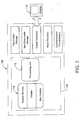
- the example network includes several computers 100 communicating with one another over a network 102, represented by a cloud.
- Network 102 may include many well-known components, such as routers, gateways, hubs, etc. and may allow the computers 100 to communicate via wired and/or wireless media.
- the computer 100 typically includes at least one processing unit 112 and memory 114.
- the memory 114 may be volatile (such as RAM), non-volatile (such as ROM or flash memory) or some combination of the two.
- This most basic configuration is illustrated in FIG. 2 by line 106.
- the computer may also have additional features/functionality.
- computer 100 may also include additional storage (removable and/or non-removable) including, but not limited to, magnetic or optical disks or tape.
- Computer storage media includes volatile and non-volatile, removable and non-removable media implemented in any method or technology for storage of information such as computer readable instructions, data structures, program modules, or other data.
- Computer storage media includes, but is not limited to, RAM, ROM, EEPROM, flash memory or other memory technology, CD-ROM, digital versatile disk (DVD) or other optical storage, magnetic cassettes, magnetic tape, magnetic disk storage or other magnetic storage devices, or any other medium which can be used to stored the desired information and which can be accessed by the computer 100. Any such computer storage media may be part of computer 100.
- Computer 100 may also contain communications connections that allow the device to communicate with other devices.
- a communication connection is an example of a communication medium.
- Communication media typically embodies computer readable instructions, data structures, program modules or other data in a modulated data signal such as a carrier wave or other transport mechanism and includes any information delivery media.
- communication media includes wired media such as a wired network or direct-wired connection, and wireless media such as acoustic, RF, infrared and other wireless media.
- the term computer readable media as used herein includes both storage media and communication media.
- Computer 100 may also have input devices such as a keyboard, mouse, pen, voice input device, touch input device, etc.
- Output devices such as a display 116, speakers, a printer, etc. may also be included. All these devices are well known in the art and need not be discussed at length here.
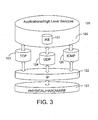
- FIG.3 illustrates the logical devices, applications, and programming code modules, collectively identified by reference numeral 120, which enable computer 100 to communicate over a network.
- This figure illustrates, among other things, an exemplary suite of protocol stacks, identified by reference numerals 122 through 126.
- the physical/hardware components 121 illustrated in FIG. 3 may include, for example, a Network Interface Card (NIC) and various device drivers for the hardware components.
- NIC Network Interface Card
- IP stack 122 implements the Internet Protocol (IP).
- IP Internet Protocol
- IP stack 122 Above the IP stack 122 are several additional protocol stacks including a Transmission Control Protocol (TCP) stack 123, a User Datagram Protocol (UDP) stack 124, and an Internet Control Message Protocol (ICMP) stack 125.
- TCP stack 123 provides the code for implementing a connection-oriented, end-to-end reliable protocol.
- TCP stack 123 further insures reliable inter-process communication between network devices.
- UDP stack 124 provides the code for implementing a connectionless mode of communications with datagrams in an interconnected set of computer networks. The UDP protocol does not guarantee packet delivery or that duplicate packets have not been sent.
- ICMP stack 125 includes the code that is necessary for Internet Protocol control.
- the main functions of the ICMP stack 125 include error reporting, route-change notification, performance, subnet addressing and other maintenance.
- components 122-125 have been illustrated as a portion of the preferred embodiment, none are absolutely required to implement the invention.
- Alternatives to these protocol stacks may be used, either separately or in combination with various of the foregoing protocol stacks, to form a network connection between nodes on a network. More or fewer protocols could also be used.
- the application and high-level services comprise the highest layer 126. This is where application programs to carry out desired functionality for a network device reside. For example, the application programs for the computer 100 may include printer application programs. This is also where the IKE protocol stack 127 resides.
- the IKE protocol stack 127 permits the secure exchange of encryption keys between two computers. Keys exchanged via the IKE protocol stack 127 may be used to subsequently encrypt information transmitted between computers over a public or private network.
- An application that seeks to establish a Security Association (SA) may invoke the IKE protocol stack 127 to begin the process of key exchange and other related information.
- SA Security Association
- IPsec has published several documents that provide details on establishing an SA between nodes.
- an SA can be established such that each endpoint trusts the security of the connection and an identity of each node is authenticated to the other.
- IPsec specifically defines two security services, each having an associated header that is added to an IP packet that it protects: an Authentication Header ("AH”) and an Encapsulating Security Payload (“ESP”) header.
- AH Authentication Header
- ESP Encapsulating Security Payload
- IP Encapsulating Security Payload (ESP)
- S. Kent and R. Atkinson, RFC-2406, November 1998 describes the ESP header, and is also incorporated herein by reference.
- IPsec protocols establish and use an SA to identify a secure virtual connection between two endpoints.
- An SA is a unidirectional connection between two endpoints that represents a single IPsec protocol-mode combination.
- Two termination endpoints, i.e ., network devices, of a single SA define a secure virtual connection that is protected by IPsec services.
- One of the endpoints sends IP packets, and the other endpoint receives them. Since an SA is unidirectional, a minimum of two SAs is required for secure, bi-directional communications. It is also possible to configure multiple layers of IPsec protocols between two endpoints by combining multiple SAs.
- IPsec SA The process of establishing an IPsec SA involves both negotiation and authentication.
- the negotiation results in an agreement between the two endpoints as to which security protocol and mode to use, as well as specific encryption techniques and associated parameters.
- the authentication ensures that each endpoint can trust the identity of the other endpoint during negotiation, and hence after the SA is established.
- the IKE protocol has been proposed as a standard for establishing SAs. As noted above, the IKE protocol adheres to the ISAKMP semantics, which are described in "Internet Security Association and Key Management Protocol," by D. Maughan, M.Schertler, M. Schneider and J. Turner, RFC-2408, November, 1998, and incorporated herein by reference. SA negotiation is carried out as a sequence of messages that are exchanged between nodes on a network.
- FIG. 4 illustrates a typical set of messages that are exchanged according to the ISAMKP and IKE protocols.
- the network nodes are indicated in FIG. 4 as an initiator node 131 and a responder node 132.
- the initiator node 131 proposes in message 135 a security protocol and encryption algorithm.
- the message 135 includes an IKE header, labeled HDR, and the data corresponding to an appropriate SA message.
- the responder sends a response message 136 that indicates its acceptance or counter-proposal to the first message 135.
- the response message also includes an IKE header, labeled HDR, and the data corresponding to its response SA message.
- the next pair of messages includes key exchange.
- the initiator node 131 first transmits message 139 that includes an IKE header, key exchange payloads and nonces.
- the responder node 132 provides a message 140 of its own that also includes key exchange payloads and nonces. From this information an exclusively shared secret may be derived, which leads to key generation and future key management.
- the final pair of messages 142 again includes a message 142 from the initiator node 131 and a response message 144 from the responder node 132.
- the final message pair provides an identification of the communicating nodes.
- the initiator node's message 143 includes an IKE header and the ID payload of the initiator.
- the responder node's message 144 again includes an IKE header and the ID payload of the initiator. More details regarding possible messages that may be exchanged between the respective nodes are contained in the Harkins RFC identified above and in "An Architecture for the Internet Key Exchange Protocol" by P.C. Cheng, IBM System Journal, Vol. 40, No. 3, 2001, which is incorporated herein by reference.
- the various IPsec protocols, SA messages and the like are further discussed in U.S. Patent 6,055,236 to Nessett et al., which is also incorporated herein by reference.
- the messages transmitted according to the IKE protocol are variable in both content and length of data. Depending on the results of the negotiation that occurs in the first pair of IKE protocol messages 134, the subsequent messages can vary. In addition, the length of the certification chains that are exchanged as part of the IKE ID messages 142 may vary depending on the certification authority and other factors that are beyond the control of the initiator node and the responder node. As a result, it is possible for the messages to exceed a Maximum Transfer Unit (MTU).
- MTU Maximum Transfer Unit
- the local IP protocol stack will fragment an IKE payload into a size that does not exceed the MTU.
- other routers and network devices further downstream from the transmitting node will further fragment the IKE payload. This will not cause a problem if all fragments are successfully transmitted.
- an IKE peer will not be able to validate or respond to messages from another IKE peer. This is a problem particularly for devices, such as certain types of NATs, that may have a systemic problem in handling IKE packets.
- An IKE fragment that is formatted according to known techniques may not contain sufficient information to permit a NAT to appropriately route it or any other related fragments.
- the inventive system and method solves this problem by detecting whether the responding node is receiving the outgoing IKE payloads. If not, the code that implements the invention may cause retransmission of the IKE payload at least one additional time.
- This aspect of the invention handles the case of random or sporadic transmission difficulties and prevents unnecessary fragmentation of IKE packets. If the retransmitted packet still does not appear to have been received by the responding node, the invention will fragment the IKE payload into a smaller size that may be successfully transmitted over the network.
- FIG. 5 illustrates the logical relationship between the code modules that implement a preferred embodiment of the invention. This figure reproduces the application and high level services layer 126 of the network environment generally illustrated in FIG. 3. In addition to the IKE protocol stack 127, however, FIG. 5 includes a fragmenter/reassembler code module 150 (hereafter, "fragmenter 150") that resides in the application layer 126, but is logically below the IKE protocol stack 127. In an environment that supports IKE fragmentation, a fragmenter 150 will reside on both the initiator node and the responder node.
- fragmenter 150 fragmenter/reassembler code module 150
- Fragmenter 150 fragments IKE data packets through a transmission module 151 and reassembles IKE data packets through a receiving module 152.
- fragmenter 150 contains the logic that is necessary to detect whether IKE data packets have been received at the responding node and to cause the retransmission of IKE payloads as necessary.
- fragmenter 150 performs many functions beyond fragmentation or packet reassembly, and the descriptive name for this module should not be construed in a limiting fashion.
- fragmenter 150 beneath the IKE protocol stack insures that little or no changes to the IKE protocol will be required to implement the invention. This may be particularly advantageous because the invention will be interoperable with preexisting implementations. In addition, locating the inventive code beneath the IKE protocol stack provides a readily deployable solution to the problem of dropped IKE fragments. Finally, by not modifying the IKE protocol state machine, the underlying security of the IKE protocol is not compromised.
- fragmenter 150 intercepts outgoing IKE packets on the one node and also incoming IKE packets on the other node. If necessary, these intercepted packets are fragmented on one end and reassembled on the other. Any processing that must be undertaken to accomplish the fragmentation or reassembly of IKE payloads is thus transparent to the IKE protocol stack.
- FIG. 6 illustrates an IKE ID packet 160, which corresponds, for example, to message 143 in FIG. 4.
- the packet includes an IKE header 161, which includes, among other things, a flag to indicate whether the data in the payload has been encrypted. It further includes information that identifies the next IKE packet.
- the IKE packet includes the actual data that comprises the ID payload. Among other things, this data includes the certification chains that are required to establish and maintain an SA.
- FIG. 7 illustrates the same data as that in FIG. 6, but as fragmented by the fragmenter 150.
- the fragmenter 150 is operable to transform a single message that exceeds an MTU into a plurality of smaller messages. It further adds an IKE header onto each smaller message, which includes only a portion of the original IKE payload.
- the collection of packets illustrated in FIG. 7 includes all of the data 162 that comprised the original IKE ID payload.
- the first fragment 171 also includes the original IKE header 161.
- the fragmenter 150 retains all of the original data provided by the IKE protocol stack 127.
- IKE payloads truncates the data portion of IKE payloads, particularly but not exclusively for the IKE ID payloads, and then encapsulates the data within a new smaller packet, the length of which does not exceed a selected MTU. Other packets contain the remainder of the truncated data.
- FIG. 8 illustrates the logical flow of the code module that implements fragmenter 150. It should be understood that this flow diagram is provided for a preferred embodiment and is not exhaustive of all possible modifications that would be understood to a person of skill in the art. It should be further understood that the logic depicted in FIG. 8 is directed mostly to the transmitter module 151 within the fragmenter 150, although the receiving module 152 may perform certain steps.
- the initiator node of an IKE application that desires to establish an SA with a responder node will transmit an IKE message.
- This message may be any of the messages illustrated in FIG. 4 or any message by the IKE protocol stack.
- the fragmenter 150 monitors the message and, after a suitable time interval, determines whether an appropriate response has been received, step 182.
- the fragmenter 150 will simply permit the process to continue according to the usual IKE protocol, step 183. According to this logic, no fragmentation will occur if the IKE payloads are successfully transmitted.
- the fragmenter 150 will retransmit the appropriate IKE payload, step 184.
- This step which may be repeated more than one time, is implemented to address the situation where the IKE payload size has not caused a communications problem. For example, an IKE payload may have been inadvertently dropped by a temporary device malfunction, in which case fragmentation according to the present invention will not be required.
- the fragmenter 150 detects whether it is possible to receive a suitable response without fragmentation of the original IKE payload.
- step 185 indicates that the transmitter module 151 may attempt to retransmit the IKE payload three or four times, for example, before continuing to step 186. This step thus saves network bandwidth and further insures that the IKE fragmenter need not be unnecessarily invoked. If a suitable response is received after retransmission, step 185, the fragmenter 150 permits the IKE protocol stack to again continue without further fragmentation, step 183.
- the fragmenter 150 If, however, the fragmenter 150 still does not receive an appropriate response after one or more attempts to retransmit the original IKE payload, step 185, it will determine that the IKE payload exceeds the MTU for the particular network or application. In this case, the transmitter module 151 will either begin the fragmentation process or it will cause the initiator node's IKE protocol stack to abort the process of establishing an SA with the responder node. This determination step is indicated by reference numeral 186. In step 186, the transmitter module 151 determines whether a receiving module has the capability of receiving fragmented packets. If it does not, the fragmenter 150 may again attempt to retransmit the IKE payload one or more times (step not shown), or it will abort the entire process, step 187. On the other hand, if the receiving node has its own fragmenter and capable receiving module, the transmitter module will begin the process of fragmenting the IKE payload for transmission.
- the fragmenter 150 is able to determine the fragmentation capabilities of the receiving node by reference to a vendor identification value (vendor ID) that is transmitted during one of the first exchanges in the process of establishing an SA.
- vendor ID is typically exchanged as a part of the IKE protocol.
- the transmitter module 151 will be able to determine whether the receiver module 152 has the capacity to handle fragmented IKE payloads.
- the transmitter module 151 of fragmenter 150 After determining that a suitable receiving module exists, the transmitter module 151 of fragmenter 150 will begin to fragment the original IKE payload.
- the first step in the fragmentation process is to determine an appropriate value for the MTU, step 188.
- the appropriate MTU to use in the fragmentation process is the smallest possible transmission unit that is specified for the particular network upon which the initiator node and responder node are communicating. For example, the smallest dialup transmission unit for certain networks and applications is 576 bytes. Thus, in step 188, the MTU size will be determined to be 576 bytes.
- the fragmenter 150 may attempt to determine the MTU through an iterative process whereby increasingly smaller packet sizes are selected until a suitable response is received. This iterative process is not illustrated in the logic of FIG. 8, but based on the foregoing description, could be readily implemented by persons of ordinary skill in the art. After the appropriate MTU has been determined, whether it is an optimal value determined by an iterative process or an absolute value, the fragmenter 150 will accordingly reduce the MTU that will be used for future IKE-related communications.
- the fragmenter 150 fragments the original IKE payload, step 189.
- This process includes encapsulation and truncation of the original IKE payload.
- the original IKE header 161 is also encapsulated and the payload data is then divided into separate packets such that the combination of IKE headers and data does not exceed the newly determined MTU size, step 189.
- the data included in the fragmented IKE packets will be a new IKE payload type ISA _ FRAG defined as follows:
- Each fragment will thus include information (metadata) that uniquely identifies the original IKE payload and its position within the original IKE payload.
- metadata transmitted in a first fragmented message such as. message 171
- the receiving module 152 uses this information to reassemble the original IKE payload. It also uses this information to thwart attacks by third parties on the initiator and/or responder.
- step 190 all fragments are then transmitted over the network, each of which does not exceed the determined MTU value.
- IKE fragments created according to the present invention may be efficiently processed by certain types of NATs or firewalls that either cannot track prior art IKE fragments or have difficulty doing so.
- an IKE fragment that was created through previously known techniques may not have all of the state information required for the NAT or firewall to process and route the fragment. This is particularly true for out-of-order fragments. For example, if a second IKE fragment that was created by previously known techniques arrives before the first IKE fragment, many NATs or firewalls will not have sufficient information to route it to the appropriate downstream node. Hence, the NAT or firewall will drop the fragment and the IKE packet will not be successfully received at its intended node.
- the present invention resolves this issue by, among other things, transmitting smaller size packets and including state information in each IKE fragment.
- Each IKE fragment created according to the present invention contains an IKE header.
- the transmitting node will further include a UDP header on each IKE fragment.
- the UDP header has specific information for NATs, firewalls and other similar devices to process the fragment.
- the present invention thus insures that each IKE fragment will have the information required by a NAT or firewall for processing, and it reduces and/or eliminates the need for certain types of NATs or firewalls to employ their own fragmentation and reassembly processes.
- the transmitter module 151 will set a timer to wait for a response after it transmits the fragments to the intended receiving node, step 190.
- the transmitter module 151 will also check to determine whether a responder module has transmitted a no acknowledgment message (NAK), step 191. If a NAK is transmitted by the receiving node, based upon conditions described below, and then received by the transmitting node, the appropriate fragment or fragments will be retransmitted, step 192.
- the transmitter module 151 will continue to wait for a response unless a NAK is received or the timer expires, step 193. If the timer expires, all fragments will again be retransmitted and a new timer will be set, step 190.
- step 190 The process of transmitting fragments and setting a timer, step 190, determining whether any NAKs have been received, step 191, and determining whether the timer has expired, step 193, is continued until a response is received. After a certain number of cycles, the transmitter module will eventually abort the process of attempting to transmit the fragmented IKE payload. This is indicated by the dashed line at step 193.
- step 194 determines whether it is an appropriate response to the original IKE payload. If yes, control is passed back to the IKE protocol stack, which again continues according to its protocol, step 183. If, on the other hand, the responder node still does not provide an appropriate response, step 194, the fragmenter 150 will abort the process of establishing an SA, step 187. In the preferred embodiment, the fragmenter 150 will retransmit all fragments for two or more times before aborting the entire process. Thus, if an appropriate response is not received at step 194, the transmitting module 151 will return to step 190 for a predetermined number of times before it aborts the process.
- FIG. 9 generally illustrates the logical flow of the code module that implements fragmenter 150 on a receiving node, particularly the receiving module 152. As with FIG. 8, it should be understood that this flow diagram is provided for a preferred embodiment and is not exhaustive of all possible modifications that would be understood by a person of skill in the art. It should be further understood that certain steps identified FIG. 9 may be performed by the transmitting module and/or the receiving module of fragmenter 150.
- This step is performed in the preferred embodiment by the transmission of the receiving node's vendor ID.
- the receiving module 152 of fragmenter 150 it is possible for the receiving module 152 of fragmenter 150 to transmit a specific message, whether in response to a specific query or not, that indicates its capability to handle fragmented IKE payloads (not shown). This step may be performed early in the initiator's attempt to establish an SA or only upon detection of a problem.
- the receiving module 152 will receive or intercept all packets that are destined for IKE protocol stack 127. If the original IKE payload is successfully received without fragmentation, the receiving module will pass the original payload to the responder node's IKE protocol stack 127 (step not shown) for its usual processing. The receiving module 152, however, will intercept and consume all IKE packets that have been fragmented according the invention, step 197. Thereafter, the receiving module will use the fragment's metadata to process the fragment itself.
- the receiving module will check the fragment identification (fragment ID) of the received fragment, step 198.
- the data structure described above contains a field for the fragment ID that may be used in this step.
- Each fragment that corresponds to a single, non-fragmented IKE payload will have the same fragment ID.
- the receiving module of fragmenter 150 will discard any packet fragment, step 199, that does not contain an appropriate fragment ID.
- the receiving module of a preferred embodiment may process only a predetermined number of IKE payloads at any instant in time, albeit a fragmented IKE payload, before it attempts to process any others. In a preferred embodiment, this predetermined number is one.
- the receiving module must receive all fragments that correspond to a single IKE payload, i.e ., all fragments that have the same fragment ID, before it attempts to process fragments that contain a different fragment ID.
- the receiving module 152 within a preferred embodiment of the invention will examine the sequence number of each received fragment, step 200, to determine whether the sequence number of the fragment is in an appropriate order. If yes, the fragment is stored in a buffer for further processing, step 203. If not, the receiving module will evaluate the out-of-sequence error condition, step 201. In this step, the receiving module determines whether to store a particular fragment, discard it and/or send a NAK message to the initiator node. For example, if the first and third fragments in a sequence have been received, but not the second, the receiving module may send a NAK to the transmitting module 151 of the initiator node to retransmit the appropriate fragment, step 192 of FIG. 8.
- the receiving module 152 may discard the fragment or all fragments that contain a particular fragment ID.
- the receiving module may determine, according to a set of predetermined rules, that the out-of-sequence fragment ought to be stored for further processing, step 203. In this last option, it may be desirable to store at least one fragment whose sequence number differs from a prior fragment's sequence number by a small amount. The rules for determining which out-of-sequence fragments to store and which to discard may be created and flexibly applied depending on the desired response of a particular system.
- the receiving module 152 will then determine whether the total length of all received and stored fragments exceeds a predetermined size threshold, step 204. In a preferred embodiment, this is a 64K byte limit because that is the maximum size for any given IKE payload. This determination may be flexibly implemented and modified to prevent or mitigate denial-of-service attacks or other similar attacks, such as those associated with the man-in-the-middle attacks. If the total size limit is exceeded, the receiving module 152 discards all fragments that contain the same fragment ID, step 199.
- the receiving module 152 evaluates the flags on the stored fragment to determine whether it is the last in the sequence of fragments. If not, the receiving module returns to wait for additional fragments, step 197. If the fragment is the last in sequence, the receiving module next determines whether it has received all fragments that correspond to a particular fragment ID, step 206. If not all fragments pertaining to a particular IKE payload have been received, the receiving module again returns to await additional fragments, step 197. The incoming packets are then evaluated as described above until either all fragments corresponding to a particular IKE payload have been received or until a fragment is received that contains a new fragment ID. In the latter case, as described above, the current assembly is discarded according to steps 198 and 199.
- step 207 the packet is assembled into correct order.
- the step of assembling the packet should be understood to include all necessary operations to repackage the original IKE payload, including the stripping of all data that is related to the fragmentation process.
- step 208 the receiving module 152 passes the reassembled IKE payload to the IKE protocol stack 127 for its ordinary processing.
- the receiving module 152 will discard a fragment assembly if it receives a fragment that has a later-in-time fragment ID. In other words, only one IKE payload will be processed at a time. This process will maximize security and mitigate the effects of a denial-of-service or other similar attack. In alternative embodiments, however, more than one IKE payload could be processed by the receiving module 152. For example, a discrete number of IKE payloads, such as two, three, fifteen, twenty-seven , etc., could be tracked as received.
- the fragment data contents are validated prior to reassembly according to known methods. This validation assists in determining, at an early stage in the receiving process, whether the fragment that is received has been transmitted from a valid peer.
Landscapes
- Engineering & Computer Science (AREA)
- Computer Networks & Wireless Communication (AREA)
- Signal Processing (AREA)
- Computer Security & Cryptography (AREA)
- Computer Hardware Design (AREA)
- Computing Systems (AREA)
- General Engineering & Computer Science (AREA)
- Data Exchanges In Wide-Area Networks (AREA)
Applications Claiming Priority (2)
| Application Number | Priority Date | Filing Date | Title |
|---|---|---|---|
| US10/056,889 US7500102B2 (en) | 2002-01-25 | 2002-01-25 | Method and apparatus for fragmenting and reassembling internet key exchange data packets |
| US56889 | 2002-01-25 |
Publications (3)
| Publication Number | Publication Date |
|---|---|
| EP1333635A2 true EP1333635A2 (de) | 2003-08-06 |
| EP1333635A3 EP1333635A3 (de) | 2005-06-08 |
| EP1333635B1 EP1333635B1 (de) | 2008-02-06 |
Family
ID=22007176
Family Applications (1)
| Application Number | Title | Priority Date | Filing Date |
|---|---|---|---|
| EP02028878A Expired - Lifetime EP1333635B1 (de) | 2002-01-25 | 2002-12-23 | Verfahren und Vorrichtung zur Fragmentierung und Wiederzusammensetzung von Internet Key Exchange Paketen |
Country Status (5)
| Country | Link |
|---|---|
| US (1) | US7500102B2 (de) |
| EP (1) | EP1333635B1 (de) |
| JP (1) | JP4271451B2 (de) |
| AT (1) | ATE385642T1 (de) |
| DE (1) | DE60224917T2 (de) |
Cited By (5)
| Publication number | Priority date | Publication date | Assignee | Title |
|---|---|---|---|---|
| US7370197B2 (en) | 2002-07-12 | 2008-05-06 | Microsoft Corporation | Method and system for authenticating messages |
| US7409544B2 (en) | 2003-03-27 | 2008-08-05 | Microsoft Corporation | Methods and systems for authenticating messages |
| US7500102B2 (en) | 2002-01-25 | 2009-03-03 | Microsoft Corporation | Method and apparatus for fragmenting and reassembling internet key exchange data packets |
| US7610487B2 (en) | 2003-03-27 | 2009-10-27 | Microsoft Corporation | Human input security codes |
| US7624264B2 (en) | 2003-03-27 | 2009-11-24 | Microsoft Corporation | Using time to determine a hash extension |
Families Citing this family (31)
| Publication number | Priority date | Publication date | Assignee | Title |
|---|---|---|---|---|
| US7558873B1 (en) | 2002-05-08 | 2009-07-07 | Nvidia Corporation | Method for compressed large send |
| US20030212735A1 (en) * | 2002-05-13 | 2003-11-13 | Nvidia Corporation | Method and apparatus for providing an integrated network of processors |
| US7437548B1 (en) * | 2002-07-11 | 2008-10-14 | Nvidia Corporation | Network level protocol negotiation and operation |
| US7346771B2 (en) * | 2002-11-13 | 2008-03-18 | Nokia Corporation | Key distribution across networks |
| US7397797B2 (en) * | 2002-12-13 | 2008-07-08 | Nvidia Corporation | Method and apparatus for performing network processing functions |
| US8261062B2 (en) * | 2003-03-27 | 2012-09-04 | Microsoft Corporation | Non-cryptographic addressing |
| US7913294B1 (en) | 2003-06-24 | 2011-03-22 | Nvidia Corporation | Network protocol processing for filtering packets |
| US7359380B1 (en) | 2003-06-24 | 2008-04-15 | Nvidia Corporation | Network protocol processing for routing and bridging |
| US7620070B1 (en) | 2003-06-24 | 2009-11-17 | Nvidia Corporation | Packet processing with re-insertion into network interface circuitry |
| US7359983B1 (en) | 2003-06-24 | 2008-04-15 | Nvidia Corporation | Fragment processing utilizing cross-linked tables |
| US8117273B1 (en) * | 2003-07-11 | 2012-02-14 | Mcafee, Inc. | System, device and method for dynamically securing instant messages |
| US7574603B2 (en) * | 2003-11-14 | 2009-08-11 | Microsoft Corporation | Method of negotiating security parameters and authenticating users interconnected to a network |
| US20050131835A1 (en) * | 2003-12-12 | 2005-06-16 | Howell James A.Jr. | System for pre-trusting of applications for firewall implementations |
| EP1562346A1 (de) * | 2004-02-06 | 2005-08-10 | Matsushita Electric Industrial Co., Ltd. | Verfahren und System für den zuverlässigen Abbau von IPSec-Sicherheitsverbindungen |
| US7929689B2 (en) | 2004-06-30 | 2011-04-19 | Microsoft Corporation | Call signs |
| IES20050439A2 (en) * | 2005-06-30 | 2006-08-09 | Asavie R & D Ltd | A method of network communication |
| US8086842B2 (en) | 2006-04-21 | 2011-12-27 | Microsoft Corporation | Peer-to-peer contact exchange |
| US8125907B2 (en) * | 2008-06-12 | 2012-02-28 | Talari Networks Incorporated | Flow-based adaptive private network with multiple WAN-paths |
| EP2242273A1 (de) | 2009-04-14 | 2010-10-20 | Fraunhofer-Gesellschaft zur Förderung der angewandten Forschung e.V. | Übertragungsschema für Informationen auf Textbasis |
| US8289970B2 (en) * | 2009-07-17 | 2012-10-16 | Microsoft Corporation | IPSec encapsulation mode |
| CN102025742A (zh) * | 2010-12-16 | 2011-04-20 | 成都市华为赛门铁克科技有限公司 | 一种ike报文的协商方法和设备 |
| US9185073B2 (en) | 2011-10-06 | 2015-11-10 | Qualcomm Incorporated | Systems and methods for data packet processing |
| CN102647251A (zh) * | 2012-03-26 | 2012-08-22 | 北京星网锐捷网络技术有限公司 | 数据传输方法及系统、发送端设备与接收端设备 |
| JP6221786B2 (ja) | 2014-01-31 | 2017-11-01 | 富士通株式会社 | 中継装置、通信システム、および、通信方法 |
| US9525661B2 (en) * | 2014-09-05 | 2016-12-20 | Alcatel Lucent | Efficient method of NAT without reassemling IPV4 fragments |
| US11258694B2 (en) * | 2017-01-04 | 2022-02-22 | Cisco Technology, Inc. | Providing dynamic routing updates in field area network deployment using Internet Key Exchange v2 |
| US11082408B2 (en) * | 2017-07-20 | 2021-08-03 | Michael T. Jones | Systems and methods for packet spreading data transmission with anonymized endpoints |
| US11108751B2 (en) * | 2017-10-27 | 2021-08-31 | Nicira, Inc. | Segmentation of encrypted segments in networks |
| US11201749B2 (en) * | 2019-09-11 | 2021-12-14 | International Business Machines Corporation | Establishing a security association and authentication to secure communication between an initiator and a responder |
| US11206144B2 (en) | 2019-09-11 | 2021-12-21 | International Business Machines Corporation | Establishing a security association and authentication to secure communication between an initiator and a responder |
| US12348494B2 (en) * | 2019-09-24 | 2025-07-01 | Pribit Technology, Inc. | Network access control system and method therefor |
Family Cites Families (22)
| Publication number | Priority date | Publication date | Assignee | Title |
|---|---|---|---|---|
| US5959974A (en) * | 1996-12-02 | 1999-09-28 | International Business Machines Corporation | System and method for discovering path MTU of internet paths |
| FI105753B (fi) * | 1997-12-31 | 2000-09-29 | Ssh Comm Security Oy | Pakettien autentisointimenetelmä verkko-osoitemuutosten ja protokollamuunnosten läsnäollessa |
| US7032242B1 (en) * | 1998-03-05 | 2006-04-18 | 3Com Corporation | Method and system for distributed network address translation with network security features |
| US6055236A (en) * | 1998-03-05 | 2000-04-25 | 3Com Corporation | Method and system for locating network services with distributed network address translation |
| US6453357B1 (en) * | 1999-01-07 | 2002-09-17 | Cisco Technology, Inc. | Method and system for processing fragments and their out-of-order delivery during address translation |
| US6615357B1 (en) * | 1999-01-29 | 2003-09-02 | International Business Machines Corporation | System and method for network address translation integration with IP security |
| US6957346B1 (en) * | 1999-06-15 | 2005-10-18 | Ssh Communications Security Ltd. | Method and arrangement for providing security through network address translations using tunneling and compensations |
| JP2001007858A (ja) | 1999-06-25 | 2001-01-12 | Sony Corp | 送信装置および送信方法、並びに媒体 |
| JP2001211147A (ja) | 2000-01-25 | 2001-08-03 | Advanced Mobile Telecommunications Security Technology Research Lab Co Ltd | キーエスクロー方法 |
| MXPA03000419A (es) | 2000-07-14 | 2003-06-06 | Irdeto Access Bv | Arquitectura para difusion segura de datos a base de paquetes. |
| JP2002044135A (ja) * | 2000-07-25 | 2002-02-08 | Mitsubishi Electric Corp | 暗号装置及び暗号通信システム |
| US6876669B2 (en) * | 2001-01-08 | 2005-04-05 | Corrigent Systems Ltd. | Packet fragmentation with nested interruptions |
| US20020165973A1 (en) * | 2001-04-20 | 2002-11-07 | Doron Ben-Yehezkel | Adaptive transport protocol |
| US20020184383A1 (en) | 2001-05-29 | 2002-12-05 | Docomo Communications Laboratories Usa, Inc. | Live mobile camera system with a communication protocol and a server cluster |
| FI111115B (fi) * | 2001-06-05 | 2003-05-30 | Nokia Corp | Menetelmä ja järjestelmä avainten vaihtoon tietoverkossa |
| FI118170B (fi) * | 2002-01-22 | 2007-07-31 | Netseal Mobility Technologies | Menetelmä ja järjestelmä viestin lähettämiseksi turvallisen yhteyden läpi |
| US7500102B2 (en) | 2002-01-25 | 2009-03-03 | Microsoft Corporation | Method and apparatus for fragmenting and reassembling internet key exchange data packets |
| US7120930B2 (en) * | 2002-06-13 | 2006-10-10 | Nvidia Corporation | Method and apparatus for control of security protocol negotiation |
| US7346770B2 (en) * | 2002-10-31 | 2008-03-18 | Microsoft Corporation | Method and apparatus for traversing a translation device with a security protocol |
| US7409544B2 (en) * | 2003-03-27 | 2008-08-05 | Microsoft Corporation | Methods and systems for authenticating messages |
| KR100651715B1 (ko) * | 2004-10-07 | 2006-12-01 | 한국전자통신연구원 | 차세대 인터넷에서 자동으로 주소를 생성하고 수락하는방법 및 이를 위한 데이터 구조 |
| WO2006068450A1 (en) | 2004-12-24 | 2006-06-29 | Samsung Electronics Co., Ltd. | System and method for providing mobility and secure tunnel using mobile internet protocol within internet key exchange protocol version 2 |
-
2002
- 2002-01-25 US US10/056,889 patent/US7500102B2/en not_active Expired - Lifetime
- 2002-12-23 EP EP02028878A patent/EP1333635B1/de not_active Expired - Lifetime
- 2002-12-23 DE DE60224917T patent/DE60224917T2/de not_active Expired - Lifetime
- 2002-12-23 AT AT02028878T patent/ATE385642T1/de not_active IP Right Cessation
-
2003
- 2003-01-27 JP JP2003018021A patent/JP4271451B2/ja not_active Expired - Fee Related
Non-Patent Citations (4)
| Title |
|---|
| "Minutes of IPSEC Working Group Meeting" PROCEEDINGS OF THE 52TH INTERNET ENGINEERING TASK FORCE, DECEMBER 9 -14, 2001, SALT LAKE CITY, UTAH, USA, [Online] 12 December 2001 (2001-12-12), XP002324820 Retrieved from the Internet: URL:http://www.ietf.org/proceedings/01dec/ 195.htm> [retrieved on 2005-04-13] * |
| HARKINS D ET AL: "The Internet Key Exchange (IKE) Protocol" INTERNET DRAFT, November 2001 (2001-11), XP002324821 * |
| KENT C A ET AL: "FRAGMENTATION CONSIDERED HARMFUL" COMPUTER COMMUNICATION REVIEW, ASSOCIATION FOR COMPUTING MACHINERY. NEW YORK, US, vol. 25, no. 1, January 1995 (1995-01), pages 75-87, XP000512245 ISSN: 0146-4833 * |
| MOGUL J. ; DEERING S.: "RFC 1191: Path MTU Discovery" REQUEST FOR COMMENTS: NETWORK WORKING GROUP, November 1990 (1990-11), XP015006135 * |
Cited By (5)
| Publication number | Priority date | Publication date | Assignee | Title |
|---|---|---|---|---|
| US7500102B2 (en) | 2002-01-25 | 2009-03-03 | Microsoft Corporation | Method and apparatus for fragmenting and reassembling internet key exchange data packets |
| US7370197B2 (en) | 2002-07-12 | 2008-05-06 | Microsoft Corporation | Method and system for authenticating messages |
| US7409544B2 (en) | 2003-03-27 | 2008-08-05 | Microsoft Corporation | Methods and systems for authenticating messages |
| US7610487B2 (en) | 2003-03-27 | 2009-10-27 | Microsoft Corporation | Human input security codes |
| US7624264B2 (en) | 2003-03-27 | 2009-11-24 | Microsoft Corporation | Using time to determine a hash extension |
Also Published As
| Publication number | Publication date |
|---|---|
| US20030142823A1 (en) | 2003-07-31 |
| EP1333635A3 (de) | 2005-06-08 |
| DE60224917D1 (de) | 2008-03-20 |
| JP4271451B2 (ja) | 2009-06-03 |
| DE60224917T2 (de) | 2009-01-29 |
| US7500102B2 (en) | 2009-03-03 |
| JP2003244233A (ja) | 2003-08-29 |
| ATE385642T1 (de) | 2008-02-15 |
| EP1333635B1 (de) | 2008-02-06 |
Similar Documents
| Publication | Publication Date | Title |
|---|---|---|
| US7500102B2 (en) | Method and apparatus for fragmenting and reassembling internet key exchange data packets | |
| US6779033B1 (en) | System and method for transacting a validated application session in a networked computing environment | |
| US7346770B2 (en) | Method and apparatus for traversing a translation device with a security protocol | |
| US7353380B2 (en) | Method and apparatus for providing secure streaming data transmission facilities using unreliable protocols | |
| EP1463265B1 (de) | Verfahren und Vorrichtung zur Authentifizierung von Paketnutzdaten über Nachrichtenauthentifizierungscodes | |
| US6772334B1 (en) | System and method for preventing a spoofed denial of service attack in a networked computing environment | |
| US7913261B2 (en) | Application-specific information-processing method, system, and apparatus | |
| US20030105977A1 (en) | Offload processing for secure data transfer | |
| US7536719B2 (en) | Method and apparatus for preventing a denial of service attack during key negotiation | |
| WO2003026196A1 (en) | Providing internet protocol (ip) security | |
| Thornburgh | Adobe's Secure Real-Time Media Flow Protocol | |
| Aboba et al. | Securing block storage protocols over ip | |
| US20040049585A1 (en) | SERVER SIDE CONFIGURATION OF CLIENT IPSec LIFETIME SECURITY PARAMETERS | |
| US7860977B2 (en) | Data communication system and method | |
| Mahboob et al. | Transport Layer Security (TLS)–A Network Security Protocol for E-commerce | |
| CN116389169B (zh) | 一种避免国密IPSecVPN网关数据包乱序、分片的方法 | |
| Lindskog et al. | Dynamic data protection services for network transfers: Concepts and taxonomy | |
| Jönsson et al. | IPsec, the Future of Network Security? | |
| Thornburgh | RFC 7016: Adobe's Secure Real-Time Media Flow Protocol | |
| Dahlgren et al. | Master thesis, IA7400 Spring Semester 2000 IPsec, the Future of Network Security? | |
| Aboba et al. | RFC3723: Securing Block Storage Protocols over IP | |
| Chen | Optimization of Transport Security for Securing Peer-to-Peer Communication in Heterogeneous Networks | |
| Edward | Performance and Power Consumption Analysis of Symmetric Encryption Algorithms in Wireless Devices | |
| Al-Haj et al. | Performance Evaluation of Secure Call Admission Control (SCAC) and Secure Socket Layer (SSL) | |
| Gin | Building a Secure Short Duration Transaction Network |
Legal Events
| Date | Code | Title | Description |
|---|---|---|---|
| PUAI | Public reference made under article 153(3) epc to a published international application that has entered the european phase |
Free format text: ORIGINAL CODE: 0009012 |
|
| AK | Designated contracting states |
Designated state(s): AT BE BG CH CY CZ DE DK EE ES FI FR GB GR IE IT LI LU MC NL PT SE SI SK TR |
|
| AX | Request for extension of the european patent |
Extension state: AL LT LV MK RO |
|
| PUAL | Search report despatched |
Free format text: ORIGINAL CODE: 0009013 |
|
| AK | Designated contracting states |
Kind code of ref document: A3 Designated state(s): AT BE BG CH CY CZ DE DK EE ES FI FR GB GR IE IT LI LU MC NL PT SE SI SK TR |
|
| AX | Request for extension of the european patent |
Extension state: AL LT LV MK RO |
|
| 17P | Request for examination filed |
Effective date: 20051103 |
|
| AKX | Designation fees paid |
Designated state(s): AT BE BG CH CY CZ DE DK EE ES FI FR GB GR IE IT LI LU MC NL PT SE SI SK TR |
|
| 17Q | First examination report despatched |
Effective date: 20060117 |
|
| GRAP | Despatch of communication of intention to grant a patent |
Free format text: ORIGINAL CODE: EPIDOSNIGR1 |
|
| GRAS | Grant fee paid |
Free format text: ORIGINAL CODE: EPIDOSNIGR3 |
|
| GRAA | (expected) grant |
Free format text: ORIGINAL CODE: 0009210 |
|
| AK | Designated contracting states |
Kind code of ref document: B1 Designated state(s): AT BE BG CH CY CZ DE DK EE ES FI FR GB GR IE IT LI LU MC NL PT SE SI SK TR |
|
| REG | Reference to a national code |
Ref country code: GB Ref legal event code: FG4D |
|
| REG | Reference to a national code |
Ref country code: CH Ref legal event code: EP |
|
| REG | Reference to a national code |
Ref country code: IE Ref legal event code: FG4D |
|
| REF | Corresponds to: |
Ref document number: 60224917 Country of ref document: DE Date of ref document: 20080320 Kind code of ref document: P |
|
| PG25 | Lapsed in a contracting state [announced via postgrant information from national office to epo] |
Ref country code: ES Free format text: LAPSE BECAUSE OF FAILURE TO SUBMIT A TRANSLATION OF THE DESCRIPTION OR TO PAY THE FEE WITHIN THE PRESCRIBED TIME-LIMIT Effective date: 20080517 Ref country code: FI Free format text: LAPSE BECAUSE OF FAILURE TO SUBMIT A TRANSLATION OF THE DESCRIPTION OR TO PAY THE FEE WITHIN THE PRESCRIBED TIME-LIMIT Effective date: 20080206 |
|
| NLV1 | Nl: lapsed or annulled due to failure to fulfill the requirements of art. 29p and 29m of the patents act | ||
| PG25 | Lapsed in a contracting state [announced via postgrant information from national office to epo] |
Ref country code: AT Free format text: LAPSE BECAUSE OF FAILURE TO SUBMIT A TRANSLATION OF THE DESCRIPTION OR TO PAY THE FEE WITHIN THE PRESCRIBED TIME-LIMIT Effective date: 20080206 |
|
| ET | Fr: translation filed | ||
| PG25 | Lapsed in a contracting state [announced via postgrant information from national office to epo] |
Ref country code: SI Free format text: LAPSE BECAUSE OF FAILURE TO SUBMIT A TRANSLATION OF THE DESCRIPTION OR TO PAY THE FEE WITHIN THE PRESCRIBED TIME-LIMIT Effective date: 20080206 Ref country code: BE Free format text: LAPSE BECAUSE OF FAILURE TO SUBMIT A TRANSLATION OF THE DESCRIPTION OR TO PAY THE FEE WITHIN THE PRESCRIBED TIME-LIMIT Effective date: 20080206 |
|
| PG25 | Lapsed in a contracting state [announced via postgrant information from national office to epo] |
Ref country code: DK Free format text: LAPSE BECAUSE OF FAILURE TO SUBMIT A TRANSLATION OF THE DESCRIPTION OR TO PAY THE FEE WITHIN THE PRESCRIBED TIME-LIMIT Effective date: 20080206 Ref country code: NL Free format text: LAPSE BECAUSE OF FAILURE TO SUBMIT A TRANSLATION OF THE DESCRIPTION OR TO PAY THE FEE WITHIN THE PRESCRIBED TIME-LIMIT Effective date: 20080206 Ref country code: PT Free format text: LAPSE BECAUSE OF FAILURE TO SUBMIT A TRANSLATION OF THE DESCRIPTION OR TO PAY THE FEE WITHIN THE PRESCRIBED TIME-LIMIT Effective date: 20080707 Ref country code: SE Free format text: LAPSE BECAUSE OF FAILURE TO SUBMIT A TRANSLATION OF THE DESCRIPTION OR TO PAY THE FEE WITHIN THE PRESCRIBED TIME-LIMIT Effective date: 20080506 Ref country code: CZ Free format text: LAPSE BECAUSE OF FAILURE TO SUBMIT A TRANSLATION OF THE DESCRIPTION OR TO PAY THE FEE WITHIN THE PRESCRIBED TIME-LIMIT Effective date: 20080206 Ref country code: SK Free format text: LAPSE BECAUSE OF FAILURE TO SUBMIT A TRANSLATION OF THE DESCRIPTION OR TO PAY THE FEE WITHIN THE PRESCRIBED TIME-LIMIT Effective date: 20080206 |
|
| PLBE | No opposition filed within time limit |
Free format text: ORIGINAL CODE: 0009261 |
|
| STAA | Information on the status of an ep patent application or granted ep patent |
Free format text: STATUS: NO OPPOSITION FILED WITHIN TIME LIMIT |
|
| 26N | No opposition filed |
Effective date: 20081107 |
|
| PG25 | Lapsed in a contracting state [announced via postgrant information from national office to epo] |
Ref country code: BG Free format text: LAPSE BECAUSE OF FAILURE TO SUBMIT A TRANSLATION OF THE DESCRIPTION OR TO PAY THE FEE WITHIN THE PRESCRIBED TIME-LIMIT Effective date: 20080506 Ref country code: EE Free format text: LAPSE BECAUSE OF FAILURE TO SUBMIT A TRANSLATION OF THE DESCRIPTION OR TO PAY THE FEE WITHIN THE PRESCRIBED TIME-LIMIT Effective date: 20080206 |
|
| PG25 | Lapsed in a contracting state [announced via postgrant information from national office to epo] |
Ref country code: CY Free format text: LAPSE BECAUSE OF FAILURE TO SUBMIT A TRANSLATION OF THE DESCRIPTION OR TO PAY THE FEE WITHIN THE PRESCRIBED TIME-LIMIT Effective date: 20080206 Ref country code: MC Free format text: LAPSE BECAUSE OF NON-PAYMENT OF DUE FEES Effective date: 20081231 |
|
| REG | Reference to a national code |
Ref country code: CH Ref legal event code: PL |
|
| PG25 | Lapsed in a contracting state [announced via postgrant information from national office to epo] |
Ref country code: LI Free format text: LAPSE BECAUSE OF NON-PAYMENT OF DUE FEES Effective date: 20081231 Ref country code: IE Free format text: LAPSE BECAUSE OF NON-PAYMENT OF DUE FEES Effective date: 20081223 Ref country code: CH Free format text: LAPSE BECAUSE OF NON-PAYMENT OF DUE FEES Effective date: 20081231 |
|
| PG25 | Lapsed in a contracting state [announced via postgrant information from national office to epo] |
Ref country code: LU Free format text: LAPSE BECAUSE OF NON-PAYMENT OF DUE FEES Effective date: 20081223 |
|
| PG25 | Lapsed in a contracting state [announced via postgrant information from national office to epo] |
Ref country code: TR Free format text: LAPSE BECAUSE OF FAILURE TO SUBMIT A TRANSLATION OF THE DESCRIPTION OR TO PAY THE FEE WITHIN THE PRESCRIBED TIME-LIMIT Effective date: 20080206 |
|
| PG25 | Lapsed in a contracting state [announced via postgrant information from national office to epo] |
Ref country code: GR Free format text: LAPSE BECAUSE OF FAILURE TO SUBMIT A TRANSLATION OF THE DESCRIPTION OR TO PAY THE FEE WITHIN THE PRESCRIBED TIME-LIMIT Effective date: 20080507 |
|
| REG | Reference to a national code |
Ref country code: DE Ref legal event code: R082 Ref document number: 60224917 Country of ref document: DE Representative=s name: GRUENECKER, KINKELDEY, STOCKMAIR & SCHWANHAEUS, DE |
|
| REG | Reference to a national code |
Ref country code: GB Ref legal event code: 732E Free format text: REGISTERED BETWEEN 20150108 AND 20150114 |
|
| REG | Reference to a national code |
Ref country code: DE Ref legal event code: R081 Ref document number: 60224917 Country of ref document: DE Owner name: MICROSOFT TECHNOLOGY LICENSING, LLC, REDMOND, US Free format text: FORMER OWNER: MICROSOFT CORP., REDMOND, WASH., US Effective date: 20150126 Ref country code: DE Ref legal event code: R082 Ref document number: 60224917 Country of ref document: DE Representative=s name: GRUENECKER PATENT- UND RECHTSANWAELTE PARTG MB, DE Effective date: 20150126 |
|
| REG | Reference to a national code |
Ref country code: FR Ref legal event code: TP Owner name: MICROSOFT TECHNOLOGY LICENSING, LLC, US Effective date: 20150724 |
|
| REG | Reference to a national code |
Ref country code: FR Ref legal event code: PLFP Year of fee payment: 14 |
|
| REG | Reference to a national code |
Ref country code: FR Ref legal event code: PLFP Year of fee payment: 15 |
|
| REG | Reference to a national code |
Ref country code: FR Ref legal event code: PLFP Year of fee payment: 16 |
|
| PGFP | Annual fee paid to national office [announced via postgrant information from national office to epo] |
Ref country code: IT Payment date: 20181220 Year of fee payment: 17 |
|
| PGFP | Annual fee paid to national office [announced via postgrant information from national office to epo] |
Ref country code: DE Payment date: 20191210 Year of fee payment: 18 |
|
| PGFP | Annual fee paid to national office [announced via postgrant information from national office to epo] |
Ref country code: FR Payment date: 20191113 Year of fee payment: 18 |
|
| PGFP | Annual fee paid to national office [announced via postgrant information from national office to epo] |
Ref country code: GB Payment date: 20191219 Year of fee payment: 18 |
|
| PG25 | Lapsed in a contracting state [announced via postgrant information from national office to epo] |
Ref country code: IT Free format text: LAPSE BECAUSE OF NON-PAYMENT OF DUE FEES Effective date: 20191223 |
|
| REG | Reference to a national code |
Ref country code: DE Ref legal event code: R119 Ref document number: 60224917 Country of ref document: DE |
|
| GBPC | Gb: european patent ceased through non-payment of renewal fee |
Effective date: 20201223 |
|
| PG25 | Lapsed in a contracting state [announced via postgrant information from national office to epo] |
Ref country code: FR Free format text: LAPSE BECAUSE OF NON-PAYMENT OF DUE FEES Effective date: 20201231 |
|
| PG25 | Lapsed in a contracting state [announced via postgrant information from national office to epo] |
Ref country code: DE Free format text: LAPSE BECAUSE OF NON-PAYMENT OF DUE FEES Effective date: 20210701 Ref country code: GB Free format text: LAPSE BECAUSE OF NON-PAYMENT OF DUE FEES Effective date: 20201223 |