EP1335041A1 - Korrosionsschutzmittel zum Schutz von metallischen Werkstoffen in stark alkalischem Medium - Google Patents
Korrosionsschutzmittel zum Schutz von metallischen Werkstoffen in stark alkalischem Medium Download PDFInfo
- Publication number
- EP1335041A1 EP1335041A1 EP03000645A EP03000645A EP1335041A1 EP 1335041 A1 EP1335041 A1 EP 1335041A1 EP 03000645 A EP03000645 A EP 03000645A EP 03000645 A EP03000645 A EP 03000645A EP 1335041 A1 EP1335041 A1 EP 1335041A1
- Authority
- EP
- European Patent Office
- Prior art keywords
- amine
- polyamine
- group
- nitrogen
- radical
- Prior art date
- Legal status (The legal status is an assumption and is not a legal conclusion. Google has not performed a legal analysis and makes no representation as to the accuracy of the status listed.)
- Granted
Links
- 238000005260 corrosion Methods 0.000 title claims abstract description 30
- 230000007797 corrosion Effects 0.000 title claims abstract description 23
- 239000007769 metal material Substances 0.000 title claims description 12
- 239000003112 inhibitor Substances 0.000 title abstract 3
- 150000001412 amines Chemical class 0.000 claims abstract description 31
- HEMHJVSKTPXQMS-UHFFFAOYSA-M Sodium hydroxide Chemical group [OH-].[Na+] HEMHJVSKTPXQMS-UHFFFAOYSA-M 0.000 claims description 96
- IJGRMHOSHXDMSA-UHFFFAOYSA-N nitrogen Substances N#N IJGRMHOSHXDMSA-UHFFFAOYSA-N 0.000 claims description 26
- 238000000034 method Methods 0.000 claims description 22
- 229920000768 polyamine Polymers 0.000 claims description 18
- LSHROXHEILXKHM-UHFFFAOYSA-N n'-[2-[2-[2-(2-aminoethylamino)ethylamino]ethylamino]ethyl]ethane-1,2-diamine Chemical compound NCCNCCNCCNCCNCCN LSHROXHEILXKHM-UHFFFAOYSA-N 0.000 claims description 16
- 229910052757 nitrogen Inorganic materials 0.000 claims description 15
- QGZKDVFQNNGYKY-UHFFFAOYSA-N Ammonia Chemical compound N QGZKDVFQNNGYKY-UHFFFAOYSA-N 0.000 claims description 10
- 239000003795 chemical substances by application Substances 0.000 claims description 9
- 239000011814 protection agent Substances 0.000 claims description 8
- -1 benzyl radicals Chemical class 0.000 claims description 7
- SLRMQYXOBQWXCR-UHFFFAOYSA-N 2154-56-5 Chemical compound [CH2]C1=CC=CC=C1 SLRMQYXOBQWXCR-UHFFFAOYSA-N 0.000 claims description 6
- 150000001450 anions Chemical class 0.000 claims description 6
- 239000007795 chemical reaction product Substances 0.000 claims description 6
- 125000001424 substituent group Chemical group 0.000 claims description 6
- 229910021529 ammonia Inorganic materials 0.000 claims description 5
- SCYULBFZEHDVBN-UHFFFAOYSA-N 1,1-Dichloroethane Chemical compound CC(Cl)Cl SCYULBFZEHDVBN-UHFFFAOYSA-N 0.000 claims description 4
- PIICEJLVQHRZGT-UHFFFAOYSA-N Ethylenediamine Chemical compound NCCN PIICEJLVQHRZGT-UHFFFAOYSA-N 0.000 claims description 4
- GLUUGHFHXGJENI-UHFFFAOYSA-N Piperazine Chemical compound C1CNCCN1 GLUUGHFHXGJENI-UHFFFAOYSA-N 0.000 claims description 4
- 229910052736 halogen Inorganic materials 0.000 claims description 4
- 150000002367 halogens Chemical class 0.000 claims description 4
- FAGUFWYHJQFNRV-UHFFFAOYSA-N tetraethylenepentamine Chemical compound NCCNCCNCCNCCN FAGUFWYHJQFNRV-UHFFFAOYSA-N 0.000 claims description 4
- VILCJCGEZXAXTO-UHFFFAOYSA-N 2,2,2-tetramine Chemical compound NCCNCCNCCN VILCJCGEZXAXTO-UHFFFAOYSA-N 0.000 claims description 3
- 125000000022 2-aminoethyl group Chemical group [H]C([*])([H])C([H])([H])N([H])[H] 0.000 claims description 3
- RPNUMPOLZDHAAY-UHFFFAOYSA-N Diethylenetriamine Chemical compound NCCNCCN RPNUMPOLZDHAAY-UHFFFAOYSA-N 0.000 claims description 3
- QJGQUHMNIGDVPM-UHFFFAOYSA-N nitrogen group Chemical group [N] QJGQUHMNIGDVPM-UHFFFAOYSA-N 0.000 claims description 3
- IAYPIBMASNFSPL-UHFFFAOYSA-N Ethylene oxide Chemical compound C1CO1 IAYPIBMASNFSPL-UHFFFAOYSA-N 0.000 claims description 2
- AQGNVWRYTKPRMR-UHFFFAOYSA-N n'-[2-[2-[2-[2-(2-aminoethylamino)ethylamino]ethylamino]ethylamino]ethyl]ethane-1,2-diamine Chemical compound NCCNCCNCCNCCNCCNCCN AQGNVWRYTKPRMR-UHFFFAOYSA-N 0.000 claims description 2
- IMUDHTPIFIBORV-UHFFFAOYSA-N aminoethylpiperazine Chemical compound NCCN1CCNCC1 IMUDHTPIFIBORV-UHFFFAOYSA-N 0.000 claims 1
- HFGWIQJWHMUPCR-UHFFFAOYSA-N azane;oxirane Chemical compound N.C1CO1 HFGWIQJWHMUPCR-UHFFFAOYSA-N 0.000 claims 1
- 239000003513 alkali Substances 0.000 abstract description 3
- 229910052751 metal Inorganic materials 0.000 abstract description 3
- 239000002184 metal Substances 0.000 abstract description 3
- 150000002739 metals Chemical class 0.000 abstract description 2
- 235000011121 sodium hydroxide Nutrition 0.000 description 30
- PXHVJJICTQNCMI-UHFFFAOYSA-N Nickel Chemical compound [Ni] PXHVJJICTQNCMI-UHFFFAOYSA-N 0.000 description 24
- 239000000243 solution Substances 0.000 description 14
- XTEGARKTQYYJKE-UHFFFAOYSA-M Chlorate Chemical compound [O-]Cl(=O)=O XTEGARKTQYYJKE-UHFFFAOYSA-M 0.000 description 12
- 229910052759 nickel Inorganic materials 0.000 description 12
- 238000012360 testing method Methods 0.000 description 10
- 238000007792 addition Methods 0.000 description 8
- 239000000126 substance Substances 0.000 description 8
- 238000001704 evaporation Methods 0.000 description 7
- 230000008020 evaporation Effects 0.000 description 7
- 238000011835 investigation Methods 0.000 description 7
- 239000000463 material Substances 0.000 description 6
- 229910001055 inconels 600 Inorganic materials 0.000 description 4
- 239000000203 mixture Substances 0.000 description 4
- VEXZGXHMUGYJMC-UHFFFAOYSA-M Chloride anion Chemical compound [Cl-] VEXZGXHMUGYJMC-UHFFFAOYSA-M 0.000 description 3
- NHNBFGGVMKEFGY-UHFFFAOYSA-N Nitrate Chemical compound [O-][N+]([O-])=O NHNBFGGVMKEFGY-UHFFFAOYSA-N 0.000 description 3
- 230000002378 acidificating effect Effects 0.000 description 3
- 239000012528 membrane Substances 0.000 description 3
- ZAMOUSCENKQFHK-UHFFFAOYSA-N Chlorine atom Chemical compound [Cl] ZAMOUSCENKQFHK-UHFFFAOYSA-N 0.000 description 2
- 229910002651 NO3 Inorganic materials 0.000 description 2
- QAOWNCQODCNURD-UHFFFAOYSA-L Sulfate Chemical compound [O-]S([O-])(=O)=O QAOWNCQODCNURD-UHFFFAOYSA-L 0.000 description 2
- 239000000654 additive Substances 0.000 description 2
- 239000007864 aqueous solution Substances 0.000 description 2
- WGQKYBSKWIADBV-UHFFFAOYSA-N benzylamine Chemical compound NCC1=CC=CC=C1 WGQKYBSKWIADBV-UHFFFAOYSA-N 0.000 description 2
- 238000009835 boiling Methods 0.000 description 2
- 210000003298 dental enamel Anatomy 0.000 description 2
- 230000000694 effects Effects 0.000 description 2
- 238000012423 maintenance Methods 0.000 description 2
- 238000004519 manufacturing process Methods 0.000 description 2
- 238000005259 measurement Methods 0.000 description 2
- 239000007800 oxidant agent Substances 0.000 description 2
- SUKJFIGYRHOWBL-UHFFFAOYSA-N sodium hypochlorite Chemical compound [Na+].Cl[O-] SUKJFIGYRHOWBL-UHFFFAOYSA-N 0.000 description 2
- 229910001220 stainless steel Inorganic materials 0.000 description 2
- 125000004169 (C1-C6) alkyl group Chemical group 0.000 description 1
- BZSXEZOLBIJVQK-UHFFFAOYSA-N 2-methylsulfonylbenzoic acid Chemical compound CS(=O)(=O)C1=CC=CC=C1C(O)=O BZSXEZOLBIJVQK-UHFFFAOYSA-N 0.000 description 1
- NLHHRLWOUZZQLW-UHFFFAOYSA-N Acrylonitrile Chemical compound C=CC#N NLHHRLWOUZZQLW-UHFFFAOYSA-N 0.000 description 1
- 229910000497 Amalgam Inorganic materials 0.000 description 1
- NOWKCMXCCJGMRR-UHFFFAOYSA-N Aziridine Chemical compound C1CN1 NOWKCMXCCJGMRR-UHFFFAOYSA-N 0.000 description 1
- VYZAMTAEIAYCRO-UHFFFAOYSA-N Chromium Chemical compound [Cr] VYZAMTAEIAYCRO-UHFFFAOYSA-N 0.000 description 1
- BWLUMTFWVZZZND-UHFFFAOYSA-N Dibenzylamine Chemical compound C=1C=CC=CC=1CNCC1=CC=CC=C1 BWLUMTFWVZZZND-UHFFFAOYSA-N 0.000 description 1
- KWYUFKZDYYNOTN-UHFFFAOYSA-M Potassium hydroxide Chemical compound [OH-].[K+] KWYUFKZDYYNOTN-UHFFFAOYSA-M 0.000 description 1
- 239000012670 alkaline solution Substances 0.000 description 1
- 229910045601 alloy Inorganic materials 0.000 description 1
- 239000000956 alloy Substances 0.000 description 1
- QVGXLLKOCUKJST-UHFFFAOYSA-N atomic oxygen Chemical compound [O] QVGXLLKOCUKJST-UHFFFAOYSA-N 0.000 description 1
- 150000003939 benzylamines Chemical class 0.000 description 1
- 238000006243 chemical reaction Methods 0.000 description 1
- 239000003153 chemical reaction reagent Substances 0.000 description 1
- 239000000460 chlorine Substances 0.000 description 1
- 229910052801 chlorine Inorganic materials 0.000 description 1
- 229910052804 chromium Inorganic materials 0.000 description 1
- 239000011651 chromium Substances 0.000 description 1
- 239000013065 commercial product Substances 0.000 description 1
- 150000001875 compounds Chemical class 0.000 description 1
- 238000010276 construction Methods 0.000 description 1
- 239000000356 contaminant Substances 0.000 description 1
- 238000011109 contamination Methods 0.000 description 1
- 230000001419 dependent effect Effects 0.000 description 1
- 238000004821 distillation Methods 0.000 description 1
- 150000004677 hydrates Chemical class 0.000 description 1
- 125000001183 hydrocarbyl group Chemical group 0.000 description 1
- 230000002401 inhibitory effect Effects 0.000 description 1
- 150000002500 ions Chemical class 0.000 description 1
- 238000009533 lab test Methods 0.000 description 1
- 239000007788 liquid Substances 0.000 description 1
- WPBNNNQJVZRUHP-UHFFFAOYSA-L manganese(2+);methyl n-[[2-(methoxycarbonylcarbamothioylamino)phenyl]carbamothioyl]carbamate;n-[2-(sulfidocarbothioylamino)ethyl]carbamodithioate Chemical compound [Mn+2].[S-]C(=S)NCCNC([S-])=S.COC(=O)NC(=S)NC1=CC=CC=C1NC(=S)NC(=O)OC WPBNNNQJVZRUHP-UHFFFAOYSA-L 0.000 description 1
- 239000000155 melt Substances 0.000 description 1
- 229910021645 metal ion Inorganic materials 0.000 description 1
- MXHTZQSKTCCMFG-UHFFFAOYSA-N n,n-dibenzyl-1-phenylmethanamine Chemical compound C=1C=CC=CC=1CN(CC=1C=CC=CC=1)CC1=CC=CC=C1 MXHTZQSKTCCMFG-UHFFFAOYSA-N 0.000 description 1
- RIWRFSMVIUAEBX-UHFFFAOYSA-N n-methyl-1-phenylmethanamine Chemical compound CNCC1=CC=CC=C1 RIWRFSMVIUAEBX-UHFFFAOYSA-N 0.000 description 1
- 230000007935 neutral effect Effects 0.000 description 1
- 150000002829 nitrogen Chemical class 0.000 description 1
- 239000001301 oxygen Substances 0.000 description 1
- 229910052760 oxygen Inorganic materials 0.000 description 1
- 239000004810 polytetrafluoroethylene Substances 0.000 description 1
- 229920001343 polytetrafluoroethylene Polymers 0.000 description 1
- 125000002924 primary amino group Chemical group [H]N([H])* 0.000 description 1
- 239000000047 product Substances 0.000 description 1
- QQONPFPTGQHPMA-UHFFFAOYSA-N propylene Natural products CC=C QQONPFPTGQHPMA-UHFFFAOYSA-N 0.000 description 1
- 230000001603 reducing effect Effects 0.000 description 1
- 150000003839 salts Chemical group 0.000 description 1
- 229930195734 saturated hydrocarbon Natural products 0.000 description 1
- 229910052709 silver Inorganic materials 0.000 description 1
- 239000004332 silver Substances 0.000 description 1
- 239000007787 solid Substances 0.000 description 1
- XLYOFNOQVPJJNP-UHFFFAOYSA-N water Chemical compound O XLYOFNOQVPJJNP-UHFFFAOYSA-N 0.000 description 1
Classifications
-
- C—CHEMISTRY; METALLURGY
- C01—INORGANIC CHEMISTRY
- C01D—COMPOUNDS OF ALKALI METALS, i.e. LITHIUM, SODIUM, POTASSIUM, RUBIDIUM, CAESIUM, OR FRANCIUM
- C01D1/00—Oxides or hydroxides of sodium, potassium or alkali metals in general
- C01D1/04—Hydroxides
- C01D1/42—Concentration; Dehydration
-
- C—CHEMISTRY; METALLURGY
- C23—COATING METALLIC MATERIAL; COATING MATERIAL WITH METALLIC MATERIAL; CHEMICAL SURFACE TREATMENT; DIFFUSION TREATMENT OF METALLIC MATERIAL; COATING BY VACUUM EVAPORATION, BY SPUTTERING, BY ION IMPLANTATION OR BY CHEMICAL VAPOUR DEPOSITION, IN GENERAL; INHIBITING CORROSION OF METALLIC MATERIAL OR INCRUSTATION IN GENERAL
- C23F—NON-MECHANICAL REMOVAL OF METALLIC MATERIAL FROM SURFACE; INHIBITING CORROSION OF METALLIC MATERIAL OR INCRUSTATION IN GENERAL; MULTI-STEP PROCESSES FOR SURFACE TREATMENT OF METALLIC MATERIAL INVOLVING AT LEAST ONE PROCESS PROVIDED FOR IN CLASS C23 AND AT LEAST ONE PROCESS COVERED BY SUBCLASS C21D OR C22F OR CLASS C25
- C23F11/00—Inhibiting corrosion of metallic material by applying inhibitors to the surface in danger of corrosion or adding them to the corrosive agent
- C23F11/06—Inhibiting corrosion of metallic material by applying inhibitors to the surface in danger of corrosion or adding them to the corrosive agent in markedly alkaline liquids
Definitions
- the invention relates to a new anti-corrosion agent and its use for Protection of metallic materials in a strongly alkaline medium.
- Sodium hydroxide solution can be made by different processes, the different Provide concentrations in aqueous solution or melts. Examples of this are the diaphragm, membrane and amalgam processes. The same applies to the Production of potassium hydroxide solution or other strongly alkaline solutions of alkali or Erdalkaliehydroxiden. Is the concentration of the aqueous sodium hydroxide solution correct? too low, it is raised by evaporation. The concentrations NaOH in the membrane process is approx. 30%. The commercial NaOH concentration however, is around 50%.
- the invention had for its object to provide a method which Corrosion of metallic materials by strongly alkaline media, in particular Media containing caustic soda, significantly reduced.
- Polyamines are preferably used, selected from the group of Reaction products of dichloroethane with ammonia and / or other amines or from the group of reaction products of ethylene oxide with ammonia or others Amines. These products are usually water-soluble / water-miscible liquids or solid hydrates.
- Polyamines are particularly preferred because of their water vapor volatility are removed from the material flow again during the evaporation process or which are so low in steam volatility that they do not or only in very small concentrations can be found in the evaporation condensate.
- Under Polyamines are understood to mean those compounds which consist of a saturated hydrocarbon chain with terminal amine functions, interrupted by an alternating one Number of secondary and / or tertiary and / or quaternary amino functions consist.
- the polyamines can be neutral or ionic, especially quaternary Nitrogen (tetrasubstituted nitrogen). Counterions are then chloride, sulfate, Nitrate or other anions. They can also be cross-linked by other reagents or be branched, e.g. B. by subsequent reactions with dichloroethane, ethyleneimine or Acrylonitrile, optionally with subsequent reduction.
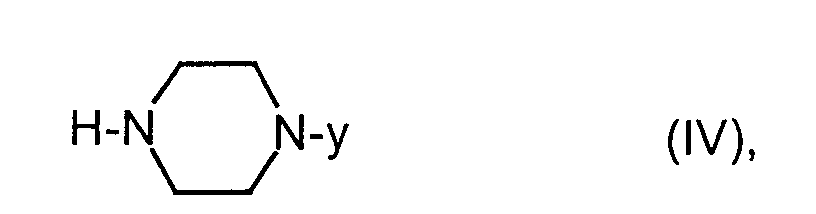
- Nitrogen-containing heterocycles are also preferred, in particular piperazine or derivatives thereof, in particular of the formula (IV) where y is H, or an aminoalkyl radical, in particular aminoethyl.
- Preferred substances are also the following substances of the general formulas (V) and (VI): NH 2 -CH 2 -CH 2 - [NH-CH 2 -CH 2 ] n -NH 2 NH 2 -CH 2 -CH 2 -CH 2 - [NH-CH 2 -CH 2 -CH 2 ] n -NH 2 where "n" represents 0 or an integer from 1 to 300.
- the above substances are related to their chemical composition mostly also as a commercial product, mixtures of up to a few hundred individual components, distinguished by their boiling behavior.
- EDA and PEHA are preferred used, very particularly preferably PEHA.
- the invention further relates to a method for protecting metallic materials characterized in a strongly alkaline medium with an anti-corrosion agent, that the anti-corrosion agent contains an amine or a polyamine.
- an anti-corrosion agent contains an amine or a polyamine.
- 0.001 ppm to 200,000 ppm of an amine becomes the alkaline Medium added.
- the supply takes place at temperatures from 0 to 500 ° C and Pressure from -1 to +1000 bar instead.
- An addition of 0.1 ppm to 1000 is preferred ppm of an amine, under pressures from -1 to +15 bar, and under temperatures of 50 up to 300 ° C.
- the aliquot of amine and the alkaline stream are mixed if necessary.
- All corrosion protection agents described in the literature can be used for the corrosion protection agent generally added if they do not contain oxidizing agents or react with the above agent to the effect of corrosion protection to improve. In particular, substances with reducing properties can improve the effect of the anti-corrosion agent.
- the aim of the investigations was to determine the dependence of the removal rates of nickel (mat.no. 2.4068) on the PEHA concentration. Welded samples made of nickel (mat.no. 2.4068) were used in these investigations.
- investigation material Test medium Removal rate (mm / a) 7th nickel 80% NaOH 0.40 +25 ppm ClO 3 - 8th. nickel 80% NaOH 0.11 +25 ppm ClO 3 - +20 ppm PEHA 9th nickel 80% NaOH 0.05 +25 ppm ClO 3 - +50 ppm PEHA 10th nickel 80% NaOH 0.03 +25 ppm ClO 3 - +300 ppm PEHA
Landscapes
- Chemical & Material Sciences (AREA)
- Organic Chemistry (AREA)
- Engineering & Computer Science (AREA)
- Materials Engineering (AREA)
- Inorganic Chemistry (AREA)
- Mechanical Engineering (AREA)
- Metallurgy (AREA)
- Preventing Corrosion Or Incrustation Of Metals (AREA)
Abstract
Description

- R1
- für einen C1-C6 Alkylrest, H, oder ein Benzylrest und
- R2
- für einen C1-C6 Alkylrest, H, oder ein Benzylrest steht
- n
- für 0 oder eine ganze Zahl von 1 bis 300,
- p, q, s und t
- für 1 und 2, und
- r
- für 0 und 1 steht,
wobei zusätzlich zum Ladungsausgleich ein Anion An vorhanden ist, wenn der Stickstoff 4-fach gebunden vorliegt. Bevorzugte Anionen sind insbesondere Chlorid, Sulfat oder Nitrat.

| Trivialname | Handelsname |
| EDA | Ethylendiamin |
| DETA | Diethylentriamin |
| TETA | Triethylentetramin |
| TEPA | Tetraethylenpentamin |
| PEHA | Pentaethylenhexamin |
| HEHA | Hexaethylenheptamin |
| Untersuchung | Werkstoff | Prüfmedium | Abtragungsrate (mm/a) |
| 1. | Nickel | 80 %ige NaOH | 0,10 |
| 2. | Inconel 600 | 80 %ige NaOH | 0,10 |
| 3. | Nickel | 80 %ige NaOH | 0,40 |
| + 25 ppm ClO3 - | |||
| 4. | Inconel 600 | 80 %ige NaOH | 0,50 |
| + 25 ppm ClO3 - | |||
| 5. | Nickel | 80 %ige NaOH | 0,03 |
| + 25 ppm ClO3 - | |||
| +300 ppm PEHA | |||
| 6. | Inconel 600 | 80 %ige NaOH | 0,03 |
| + 25 ppm ClO3 - | |||
| +300 ppm PEHA |
| Untersuchung | Werkstoff | Prüfmedium | Abtragungsrate (mm/a) |
| 7. | Nickel | 80 %ige NaOH | 0,40 |
| +25 ppm ClO3 - | |||
| 8. | Nickel | 80 %ige NaOH | 0,11 |
| +25 ppm ClO3 - | |||
| +20 ppm PEHA | |||
| 9. | Nickel | 80 %ige NaOH | 0,05 |
| +25 ppm ClO3 - | |||
| +50 ppm PEHA | |||
| 10. | Nickel | 80 %ige NaOH | 0,03 |
| +25 ppm ClO3 - | |||
| +300 ppm PEHA |
| Untersuchung | Werkstoff | Prüfmedium | Abtragungsrate (mm/a) |
| 11. | Nickel | 80 %ige NaOH | 0,04 |
| +25 ppm ClO3 - | |||
| + 300ppm Ethylendiamin |
Claims (17)
- Korrosionsschutzmittel dadurch gekennzeichnet, dass es ein Amin enthält, worin das Amin mindestens eine am Stickstoff gebundene CH-Gruppe enthält.
- Korrosionsschutzmittel gemäß Anspruch 1, worin das Amin der folgenden Formel (I) entsprichtworin

- R1
- für einen C1-C6 Alkylrest, H, oder einen Benzylrest und
- R2
- für einen C1-C6 Alkylrest, H, oder einen Benzylrest steht,
- Korrosionsschutzmittel gemäß Anspruch 1, worin das Amin ein Polyamin aus der Gruppe der Reaktionsprodukte von Dichlorethan mit Ammoniak und/oder anderen Aminen oder aus der Gruppe der Reaktionsprodukte aus Ethylenoxid mit Ammoniak oder anderen Aminen, ist.
- Korrosionsschutzmittel gemäß Anspruch 3, worin das Polyamin einer der folgenden Formeln (II) oder (III) entspricht:
- n
- für 0 oder eine ganze Zahl von 1 bis 300,
- p, q, s und t
- für 1 und 2, und
- r
- für 0 und 1 steht,
wobei zusätzlich zum Ladungsausgleich ein Anion An vorhanden ist, wenn der Stickstoff 4-fach gebunden vorliegt. - Korrosionsschutzmittel gemäß Anspruch 3, worin das Polyamin der folgenden Formel (IV) entspricht:worin y für H, oder ein Aminoalkylrest, insbesondere Aminoethyl steht.
- Korrosionsschutzmittel gemäß Anspruch 3, worin das Polyamin einer der folgenden Formeln (V) oder (VI) entspricht:
- Verfahren zum Schutz von metallischen Werkstoffen in stark alkalischem Medium mit einem Korrosionsschutzmittel, dadurch gekennzeichnet, dass das Korrosionsschutzmittel ein Amin enthält, worin das Amin mindestens eine am Stickstoff gebundene CH-Gruppe aufweist.
- Verfahren gemäß Anspruch 7, worin das Amin der folgenden Formel (I) entsprichtworin

- R1
- für einen C1-C6 Alkylrest, H, oder einen Benzylrest und
- R2
- für einen C1-C6 Alkylrest, H, oder einen Benzylrest steht,
- Verfahren gemäß Anspruch 7, worin das Amin ein Polyamin aus der Gruppe der Reaktionsprodukte von Dichlorethan mit Ammoniak und/oder anderen Aminen oder aus der Gruppe der Reaktionsprodukte aus Ethylenoxid mit Ammoniak oder anderen Aminen, ist.
- Verfahren gemäß Anspruch 9, worin das Polyamin einer der folgenden Formeln (II) oder (III) entspricht:
- n
- für 0 oder eine ganze Zahl von 1 bis 300,
- p, q, s und t
- für 1 und 2, und
- r
- für 0 und 1 steht,
wobei zusätzlich zum Ladungsausgleich ein Anion An vorhanden ist, wenn den Stickstoff 4-fach gebunden vorliegt. - Verfahren gemäß Anspruch 9, worin das Polyamin der folgende Formel (IV) entspricht:worin y für H, oder ein Aminoalkylrest, insbesondere Aminoethyl steht.

- Verfahren gemäß Anspruch 9, worin das Polyamin einer der folgenden Formeln (V) oder (VI) entspricht:
- Verfahren gemäß Anspruch 9, worin das Polyamin aus der Gruppe Ethylendiamin, Diethylentriamin, Aminoethylpiperazin, Piperazin, Triethylentetramin, Tetraethylenpentamin, Pentaethylenhexamin oder Hexaethylenheptamin ausgewählt ist.
- Verfahren gemäß Anspruch 9, worin das Polyamin Pentaethylenhexamin ist.
- Verfahren gemäß Ansprüche 7 bis 14, dadurch gekennzeichnet, dass 0,001 bis 200.000 ppm eines Amins, insbesondere 0,1 ppm bis 1000 ppm dem Medium beigegeben wird.
- Verfahren gemäß Ansprüche 7 bis 15, dadurch gekennzeichnet, dass das Korrosionsschutzmittel einem alkalischen Medium, insbesondere einem alkalischen Medium mit pH Werten ab pH >13 beigegeben wird.
- Verfahren gemäß Ansprüche 16, dadurch gekennzeichnet, dass das alkalische Medium Natronlauge ist, insbesondere Natronlauge mit einer Konzentration von 30 bis 90 Gew.-%.
Applications Claiming Priority (2)
| Application Number | Priority Date | Filing Date | Title |
|---|---|---|---|
| DE10203329 | 2002-01-29 | ||
| DE10203329A DE10203329A1 (de) | 2002-01-29 | 2002-01-29 | Korrosionsschutzmittel zum Schutz von metallischen Werkstoffen in stark alkalischem Medium |
Publications (2)
| Publication Number | Publication Date |
|---|---|
| EP1335041A1 true EP1335041A1 (de) | 2003-08-13 |
| EP1335041B1 EP1335041B1 (de) | 2009-08-12 |
Family
ID=27588117
Family Applications (1)
| Application Number | Title | Priority Date | Filing Date |
|---|---|---|---|
| EP03000645A Expired - Lifetime EP1335041B1 (de) | 2002-01-29 | 2003-01-16 | Verfahren zum Schutz von metallischen Werkstoffen in stark alkalischem Medium |
Country Status (7)
| Country | Link |
|---|---|
| US (2) | US7468158B2 (de) |
| EP (1) | EP1335041B1 (de) |
| JP (1) | JP4478392B2 (de) |
| CN (1) | CN100385041C (de) |
| AT (1) | ATE439460T1 (de) |
| CA (1) | CA2417354A1 (de) |
| DE (2) | DE10203329A1 (de) |
Families Citing this family (6)
| Publication number | Priority date | Publication date | Assignee | Title |
|---|---|---|---|---|
| US9670596B2 (en) | 2012-05-21 | 2017-06-06 | Bridgestone Corporation | Production method for purified polysaccharide fibers, purified polysaccharide fibers, fiber-rubber complex, and tire |
| KR101476601B1 (ko) * | 2012-08-21 | 2014-12-24 | 주식회사 케이피엠테크 | 무전해 니켈 도금액 및 이를 이용한 전자 부품 |
| JP2014227619A (ja) | 2013-05-21 | 2014-12-08 | 株式会社ブリヂストン | 精製多糖類繊維の製造方法、精製多糖類繊維、及びタイヤ |
| US11453816B2 (en) | 2020-07-06 | 2022-09-27 | Saudi Arabian Oil Company | Accelerated cement compositions and methods for treating lost circulation zones |
| US11939520B2 (en) * | 2020-08-12 | 2024-03-26 | Saudi Arabian Oil Company | Methods and cement compositions for reducing corrosion of wellbore casings |
| US11485894B2 (en) | 2020-08-17 | 2022-11-01 | Saudi Arabian Oil Company | Accelerated cement compositions and methods for top-job cementing of a wellbore to reduce corrosion |
Citations (5)
| Publication number | Priority date | Publication date | Assignee | Title |
|---|---|---|---|---|
| GB1111749A (en) * | 1965-07-21 | 1968-05-01 | Akerlund & Rausing Ab | A method of corrosion protective treatment and a package for use in such a method |
| US4282178A (en) * | 1979-11-15 | 1981-08-04 | Vulcan Materials Company | Use of hydrazine compounds as corrosion inhibitors in caustic solutions |
| US4289645A (en) * | 1980-07-14 | 1981-09-15 | Betz Laboratories, Inc. | Hydroquinone and mu-amine compositions |
| JPS63130785A (ja) * | 1986-11-20 | 1988-06-02 | Sumitomo Metal Ind Ltd | Ni基合金の粒界応力腐食割れを防止する方法 |
| EP0565371A2 (de) * | 1992-04-08 | 1993-10-13 | Betz Europe, Inc. | Doppelter Puffer für Heizkessel |
Family Cites Families (15)
| Publication number | Priority date | Publication date | Assignee | Title |
|---|---|---|---|---|
| US3732347A (en) * | 1969-01-22 | 1973-05-08 | Goodrich Co B F | Method for vulcanizing open end belting |
| US3962113A (en) * | 1972-12-26 | 1976-06-08 | Olin Corporation | Method for accelerating oxygen removal employing an aqueous solution of an alkyl hydrazine |
| DE2903537C2 (de) * | 1979-01-31 | 1985-03-07 | Mobil Oil Corp., New York, N.Y. | Schwer entflammbare Flüssigkeit |
| JPS57149474A (en) * | 1981-03-11 | 1982-09-16 | Chiyoda Kagaku Kenkyusho:Kk | Corrosion inhibitor for cuppric metal |
| US4476930A (en) * | 1982-08-23 | 1984-10-16 | Union Oil Company Of California | Inhibition of scale deposition from steam generation fluids |
| US4670186A (en) * | 1982-12-17 | 1987-06-02 | Petrolite Corporation | Acid inhibitor composition |
| US4693866A (en) * | 1984-11-21 | 1987-09-15 | Betz Laboratories, Inc. | Method of scavenging oxygen from aqueous mediums |
| US4657740A (en) * | 1984-11-21 | 1987-04-14 | Betz Laboratories, Inc. | Method of scavenging oxygen from aqueous mediums |
| JPS63216984A (ja) * | 1987-03-03 | 1988-09-09 | Sumitomo Metal Ind Ltd | Ni基合金部材の粒界損傷を防止する方法 |
| US4980128A (en) * | 1987-03-16 | 1990-12-25 | W. R. Grace & Co.-Conn. | Control of corrosion in aqueous systems |
| US5231230A (en) * | 1990-03-30 | 1993-07-27 | Union Carbide Chemicals & Plastics Technology Corporation | Selective production of diethylenetriamine |
| GB2303848B (en) * | 1992-08-17 | 1997-04-16 | Grace W R & Co | Inhibition of oxygen corrosion in aqueous systems |
| US5391636A (en) * | 1993-02-10 | 1995-02-21 | Westvaco Corporation | Polyamine condensates of styrene-maleic anhydride copolymers as corrosion inhibitors |
| US6140280A (en) * | 1996-10-29 | 2000-10-31 | Idemitsu Kosan Co., Ltd. | Succinimide compound and method for producing it, lubricating oil additive comprising the compound and lubricating oil composition comprising the compound for diesel engine |
| FR2774398B1 (fr) * | 1998-02-02 | 2000-03-24 | Ceca Sa | Inhibiteurs de la corrosion carbonique du fer ecocompatibles |
-
2002
- 2002-01-29 DE DE10203329A patent/DE10203329A1/de not_active Ceased
-
2003
- 2003-01-16 AT AT03000645T patent/ATE439460T1/de not_active IP Right Cessation
- 2003-01-16 EP EP03000645A patent/EP1335041B1/de not_active Expired - Lifetime
- 2003-01-16 DE DE50311789T patent/DE50311789D1/de not_active Expired - Lifetime
- 2003-01-23 US US10/349,756 patent/US7468158B2/en not_active Expired - Fee Related
- 2003-01-24 CA CA002417354A patent/CA2417354A1/en not_active Abandoned
- 2003-01-29 CN CNB031042058A patent/CN100385041C/zh not_active Expired - Fee Related
- 2003-01-29 JP JP2003020624A patent/JP4478392B2/ja not_active Expired - Fee Related
-
2008
- 2008-06-23 US US12/214,841 patent/US20080267813A1/en not_active Abandoned
Patent Citations (5)
| Publication number | Priority date | Publication date | Assignee | Title |
|---|---|---|---|---|
| GB1111749A (en) * | 1965-07-21 | 1968-05-01 | Akerlund & Rausing Ab | A method of corrosion protective treatment and a package for use in such a method |
| US4282178A (en) * | 1979-11-15 | 1981-08-04 | Vulcan Materials Company | Use of hydrazine compounds as corrosion inhibitors in caustic solutions |
| US4289645A (en) * | 1980-07-14 | 1981-09-15 | Betz Laboratories, Inc. | Hydroquinone and mu-amine compositions |
| JPS63130785A (ja) * | 1986-11-20 | 1988-06-02 | Sumitomo Metal Ind Ltd | Ni基合金の粒界応力腐食割れを防止する方法 |
| EP0565371A2 (de) * | 1992-04-08 | 1993-10-13 | Betz Europe, Inc. | Doppelter Puffer für Heizkessel |
Non-Patent Citations (1)
| Title |
|---|
| PATENT ABSTRACTS OF JAPAN vol. 012, no. 387 (C - 536) 14 October 1988 (1988-10-14) * |
Also Published As
| Publication number | Publication date |
|---|---|
| JP4478392B2 (ja) | 2010-06-09 |
| CN100385041C (zh) | 2008-04-30 |
| JP2003253477A (ja) | 2003-09-10 |
| US20030152479A1 (en) | 2003-08-14 |
| CA2417354A1 (en) | 2003-07-29 |
| ATE439460T1 (de) | 2009-08-15 |
| HK1056201A1 (zh) | 2004-02-06 |
| EP1335041B1 (de) | 2009-08-12 |
| DE10203329A1 (de) | 2003-08-14 |
| DE50311789D1 (de) | 2009-09-24 |
| US20080267813A1 (en) | 2008-10-30 |
| US7468158B2 (en) | 2008-12-23 |
| CN1435511A (zh) | 2003-08-13 |
Similar Documents
| Publication | Publication Date | Title |
|---|---|---|
| DE69809118T2 (de) | Einsatz von korrosionsverhindernden organischen Säurezusammensetzungen | |
| DE2308105C3 (de) | Verfahren zur Herstellung eines halogenierten aromatischen Amins | |
| DE69227730T2 (de) | Korrosionsinhibierung in stark säuren Medien mittels Pyridinsalzen zusammen mit bestimmten kationischen Tensiden | |
| DE69100500T2 (de) | Multifunktionale Behandlung von Dampferzeugersystemen zum Schutz vor Korrosion durch Sauerstoff und Kohlendioxid. | |
| DE69905261T2 (de) | Zusammensetzung und verfahren zur entfernung saurer gase | |
| DE19849948A1 (de) | Reinigung von Makromolekülchromophoren (MMCs) für Tintenstrahltinten unter Verwendung von Membranverfahren | |
| DE3136491A1 (de) | Zusammensetzung und verfarhen zur korrosionsverhinderung | |
| DE2813047A1 (de) | Loesung zur inhibierung der korrosion von eisen und stahl | |
| DE60110072T2 (de) | Verfahren zur Verhütung von Verschmutzung und Korrosion durch Ammoniumchlorid und Ammoniumsulfat | |
| EP1335041B1 (de) | Verfahren zum Schutz von metallischen Werkstoffen in stark alkalischem Medium | |
| DE69225023T2 (de) | Amin-Addukte als Korrosionsinhibitoren | |
| EP1200340B1 (de) | Verfahren zur herstellung von hochreinen stabilisierten hydroxylaminlösungen | |
| US4347381A (en) | Method of treating long chain alkyl amines or products derived therefrom | |
| DE69225669T2 (de) | Zusammensetzung und Verfahren zur Kesselstein- und Korrosionsinhibierung, unter Verwendung von Naphtylaminpolykarbonsäuren | |
| DE3038189A1 (de) | Verfahren zum schutz von metalloberflaechen vor korrosion | |
| DE69208288T2 (de) | Korrosioninhibierung in stark sauren Umgebungen | |
| DE3887040T2 (de) | Entfernung von Ablagerungen von glasverkleideten Behältern. | |
| JP6719214B2 (ja) | オキソ酸イオン吸着剤 | |
| HK1056201B (en) | Corrosion inhibitor for protecting metallic materials in strongly alkaline medium | |
| DD149062A5 (de) | Verfahren zur herstellung m-chlorsubstituierter aniline | |
| DE2813126A1 (de) | Zusammensetzung fuer inhibierung der korrosion von eisen und stahl | |
| DE2746913A1 (de) | Zusammensetzung zur inhibierung der korrosion bei der behandlung von gassystemen mit waessrigem alkanolamin | |
| DE955086C (de) | Verfahren zur Verbesserung der Aktivitaet von frischen, ungebrauchten Katalysatoren aus Platin oder Palladium auf Tonerdetraegern | |
| DE3247144C2 (de) | Wäßriges alkalisches Bad für das stromlose Vergolden und Verfahren zu seiner Herstellung sowie Verwendung | |
| DE68908369T2 (de) | Entfernung von Ablagerungen von glasbeschichteten Behältern. |
Legal Events
| Date | Code | Title | Description |
|---|---|---|---|
| PUAI | Public reference made under article 153(3) epc to a published international application that has entered the european phase |
Free format text: ORIGINAL CODE: 0009012 |
|
| AK | Designated contracting states |
Designated state(s): AT BE BG CH CY CZ DE DK EE ES FI FR GB GR HU IE IT LI LU MC NL PT SE SI SK TR |
|
| AX | Request for extension of the european patent |
Extension state: AL LT LV MK RO |
|
| RAP1 | Party data changed (applicant data changed or rights of an application transferred) |
Owner name: BAYER CHEMICALS AG |
|
| 17P | Request for examination filed |
Effective date: 20040213 |
|
| AKX | Designation fees paid |
Designated state(s): AT BE BG CH CY CZ DE DK EE ES FI FR GB GR HU IE IT LI LU MC NL PT SE SI SK TR |
|
| RAP1 | Party data changed (applicant data changed or rights of an application transferred) |
Owner name: LANXESS DEUTSCHLAND GMBH |
|
| 17Q | First examination report despatched |
Effective date: 20050616 |
|
| 17Q | First examination report despatched |
Effective date: 20050616 |
|
| GRAP | Despatch of communication of intention to grant a patent |
Free format text: ORIGINAL CODE: EPIDOSNIGR1 |
|
| RTI1 | Title (correction) |
Free format text: PROCESS FOR INHIBITING CORROSION OF METALLIC MATERIALS IN HIGHLY ALKALINE MEDIA |
|
| GRAS | Grant fee paid |
Free format text: ORIGINAL CODE: EPIDOSNIGR3 |
|
| GRAA | (expected) grant |
Free format text: ORIGINAL CODE: 0009210 |
|
| AK | Designated contracting states |
Kind code of ref document: B1 Designated state(s): AT BE BG CH CY CZ DE DK EE ES FI FR GB GR HU IE IT LI LU MC NL PT SE SI SK TR |
|
| REG | Reference to a national code |
Ref country code: GB Ref legal event code: FG4D Free format text: NOT ENGLISH |
|
| REG | Reference to a national code |
Ref country code: CH Ref legal event code: EP |
|
| REG | Reference to a national code |
Ref country code: IE Ref legal event code: FG4D |
|
| REF | Corresponds to: |
Ref document number: 50311789 Country of ref document: DE Date of ref document: 20090924 Kind code of ref document: P |
|
| PG25 | Lapsed in a contracting state [announced via postgrant information from national office to epo] |
Ref country code: FI Free format text: LAPSE BECAUSE OF FAILURE TO SUBMIT A TRANSLATION OF THE DESCRIPTION OR TO PAY THE FEE WITHIN THE PRESCRIBED TIME-LIMIT Effective date: 20090812 Ref country code: SE Free format text: LAPSE BECAUSE OF FAILURE TO SUBMIT A TRANSLATION OF THE DESCRIPTION OR TO PAY THE FEE WITHIN THE PRESCRIBED TIME-LIMIT Effective date: 20090812 Ref country code: ES Free format text: LAPSE BECAUSE OF FAILURE TO SUBMIT A TRANSLATION OF THE DESCRIPTION OR TO PAY THE FEE WITHIN THE PRESCRIBED TIME-LIMIT Effective date: 20091123 |
|
| PG25 | Lapsed in a contracting state [announced via postgrant information from national office to epo] |
Ref country code: SI Free format text: LAPSE BECAUSE OF FAILURE TO SUBMIT A TRANSLATION OF THE DESCRIPTION OR TO PAY THE FEE WITHIN THE PRESCRIBED TIME-LIMIT Effective date: 20090812 |
|
| REG | Reference to a national code |
Ref country code: IE Ref legal event code: FD4D |
|
| PG25 | Lapsed in a contracting state [announced via postgrant information from national office to epo] |
Ref country code: BG Free format text: LAPSE BECAUSE OF FAILURE TO SUBMIT A TRANSLATION OF THE DESCRIPTION OR TO PAY THE FEE WITHIN THE PRESCRIBED TIME-LIMIT Effective date: 20091112 Ref country code: PT Free format text: LAPSE BECAUSE OF FAILURE TO SUBMIT A TRANSLATION OF THE DESCRIPTION OR TO PAY THE FEE WITHIN THE PRESCRIBED TIME-LIMIT Effective date: 20091212 |
|
| PG25 | Lapsed in a contracting state [announced via postgrant information from national office to epo] |
Ref country code: IE Free format text: LAPSE BECAUSE OF FAILURE TO SUBMIT A TRANSLATION OF THE DESCRIPTION OR TO PAY THE FEE WITHIN THE PRESCRIBED TIME-LIMIT Effective date: 20090812 Ref country code: EE Free format text: LAPSE BECAUSE OF FAILURE TO SUBMIT A TRANSLATION OF THE DESCRIPTION OR TO PAY THE FEE WITHIN THE PRESCRIBED TIME-LIMIT Effective date: 20090812 Ref country code: DK Free format text: LAPSE BECAUSE OF FAILURE TO SUBMIT A TRANSLATION OF THE DESCRIPTION OR TO PAY THE FEE WITHIN THE PRESCRIBED TIME-LIMIT Effective date: 20090812 Ref country code: CZ Free format text: LAPSE BECAUSE OF FAILURE TO SUBMIT A TRANSLATION OF THE DESCRIPTION OR TO PAY THE FEE WITHIN THE PRESCRIBED TIME-LIMIT Effective date: 20090812 |
|
| PG25 | Lapsed in a contracting state [announced via postgrant information from national office to epo] |
Ref country code: SK Free format text: LAPSE BECAUSE OF FAILURE TO SUBMIT A TRANSLATION OF THE DESCRIPTION OR TO PAY THE FEE WITHIN THE PRESCRIBED TIME-LIMIT Effective date: 20090812 |
|
| PLBE | No opposition filed within time limit |
Free format text: ORIGINAL CODE: 0009261 |
|
| STAA | Information on the status of an ep patent application or granted ep patent |
Free format text: STATUS: NO OPPOSITION FILED WITHIN TIME LIMIT |
|
| 26N | No opposition filed |
Effective date: 20100517 |
|
| PG25 | Lapsed in a contracting state [announced via postgrant information from national office to epo] |
Ref country code: MC Free format text: LAPSE BECAUSE OF NON-PAYMENT OF DUE FEES Effective date: 20100131 |
|
| REG | Reference to a national code |
Ref country code: CH Ref legal event code: PL |
|
| PG25 | Lapsed in a contracting state [announced via postgrant information from national office to epo] |
Ref country code: GR Free format text: LAPSE BECAUSE OF FAILURE TO SUBMIT A TRANSLATION OF THE DESCRIPTION OR TO PAY THE FEE WITHIN THE PRESCRIBED TIME-LIMIT Effective date: 20091113 Ref country code: CH Free format text: LAPSE BECAUSE OF NON-PAYMENT OF DUE FEES Effective date: 20100131 Ref country code: LI Free format text: LAPSE BECAUSE OF NON-PAYMENT OF DUE FEES Effective date: 20100131 |
|
| PG25 | Lapsed in a contracting state [announced via postgrant information from national office to epo] |
Ref country code: AT Free format text: LAPSE BECAUSE OF NON-PAYMENT OF DUE FEES Effective date: 20100116 |
|
| PGFP | Annual fee paid to national office [announced via postgrant information from national office to epo] |
Ref country code: IT Payment date: 20120118 Year of fee payment: 10 |
|
| PG25 | Lapsed in a contracting state [announced via postgrant information from national office to epo] |
Ref country code: CY Free format text: LAPSE BECAUSE OF FAILURE TO SUBMIT A TRANSLATION OF THE DESCRIPTION OR TO PAY THE FEE WITHIN THE PRESCRIBED TIME-LIMIT Effective date: 20090812 |
|
| PG25 | Lapsed in a contracting state [announced via postgrant information from national office to epo] |
Ref country code: LU Free format text: LAPSE BECAUSE OF NON-PAYMENT OF DUE FEES Effective date: 20100116 Ref country code: HU Free format text: LAPSE BECAUSE OF FAILURE TO SUBMIT A TRANSLATION OF THE DESCRIPTION OR TO PAY THE FEE WITHIN THE PRESCRIBED TIME-LIMIT Effective date: 20100213 |
|
| PG25 | Lapsed in a contracting state [announced via postgrant information from national office to epo] |
Ref country code: TR Free format text: LAPSE BECAUSE OF FAILURE TO SUBMIT A TRANSLATION OF THE DESCRIPTION OR TO PAY THE FEE WITHIN THE PRESCRIBED TIME-LIMIT Effective date: 20090812 |
|
| PGFP | Annual fee paid to national office [announced via postgrant information from national office to epo] |
Ref country code: FR Payment date: 20130204 Year of fee payment: 11 Ref country code: GB Payment date: 20130116 Year of fee payment: 11 |
|
| PGFP | Annual fee paid to national office [announced via postgrant information from national office to epo] |
Ref country code: NL Payment date: 20130110 Year of fee payment: 11 Ref country code: BE Payment date: 20130114 Year of fee payment: 11 |
|
| BERE | Be: lapsed |
Owner name: LANXESS DEUTSCHLAND G.M.B.H. Effective date: 20140131 |
|
| REG | Reference to a national code |
Ref country code: NL Ref legal event code: V1 Effective date: 20140801 |
|
| GBPC | Gb: european patent ceased through non-payment of renewal fee |
Effective date: 20140116 |
|
| PG25 | Lapsed in a contracting state [announced via postgrant information from national office to epo] |
Ref country code: NL Free format text: LAPSE BECAUSE OF NON-PAYMENT OF DUE FEES Effective date: 20140801 |
|
| REG | Reference to a national code |
Ref country code: FR Ref legal event code: ST Effective date: 20140930 |
|
| PG25 | Lapsed in a contracting state [announced via postgrant information from national office to epo] |
Ref country code: GB Free format text: LAPSE BECAUSE OF NON-PAYMENT OF DUE FEES Effective date: 20140116 Ref country code: FR Free format text: LAPSE BECAUSE OF NON-PAYMENT OF DUE FEES Effective date: 20140131 |
|
| PG25 | Lapsed in a contracting state [announced via postgrant information from national office to epo] |
Ref country code: BE Free format text: LAPSE BECAUSE OF NON-PAYMENT OF DUE FEES Effective date: 20140131 |
|
| PG25 | Lapsed in a contracting state [announced via postgrant information from national office to epo] |
Ref country code: IT Free format text: LAPSE BECAUSE OF NON-PAYMENT OF DUE FEES Effective date: 20140116 |
|
| PGFP | Annual fee paid to national office [announced via postgrant information from national office to epo] |
Ref country code: DE Payment date: 20210105 Year of fee payment: 19 |
|
| REG | Reference to a national code |
Ref country code: DE Ref legal event code: R119 Ref document number: 50311789 Country of ref document: DE |
|
| PG25 | Lapsed in a contracting state [announced via postgrant information from national office to epo] |
Ref country code: DE Free format text: LAPSE BECAUSE OF NON-PAYMENT OF DUE FEES Effective date: 20220802 |