EP1335566B1 - Mobiltelefon, das zur möglichen verwendung als ein pda in einen handapparat und einen host-fernsprecher aufgeteilt wird, und kommunikationsverfahren dafür - Google Patents
Mobiltelefon, das zur möglichen verwendung als ein pda in einen handapparat und einen host-fernsprecher aufgeteilt wird, und kommunikationsverfahren dafür Download PDFInfo
- Publication number
- EP1335566B1 EP1335566B1 EP01982052A EP01982052A EP1335566B1 EP 1335566 B1 EP1335566 B1 EP 1335566B1 EP 01982052 A EP01982052 A EP 01982052A EP 01982052 A EP01982052 A EP 01982052A EP 1335566 B1 EP1335566 B1 EP 1335566B1
- Authority
- EP
- European Patent Office
- Prior art keywords
- phone
- host
- handset
- low
- transceiver module
- Prior art date
- Legal status (The legal status is an assumption and is not a legal conclusion. Google has not performed a legal analysis and makes no representation as to the accuracy of the status listed.)
- Expired - Lifetime
Links
Images

Classifications
-
- H—ELECTRICITY
- H04—ELECTRIC COMMUNICATION TECHNIQUE
- H04M—TELEPHONIC COMMUNICATION
- H04M1/00—Substation equipment, e.g. for use by subscribers
- H04M1/72—Mobile telephones; Cordless telephones, i.e. devices for establishing wireless links to base stations without route selection
- H04M1/725—Cordless telephones
-
- H—ELECTRICITY
- H04—ELECTRIC COMMUNICATION TECHNIQUE
- H04M—TELEPHONIC COMMUNICATION
- H04M1/00—Substation equipment, e.g. for use by subscribers
- H04M1/72—Mobile telephones; Cordless telephones, i.e. devices for establishing wireless links to base stations without route selection
- H04M1/724—User interfaces specially adapted for cordless or mobile telephones
- H04M1/72403—User interfaces specially adapted for cordless or mobile telephones with means for local support of applications that increase the functionality
- H04M1/72409—User interfaces specially adapted for cordless or mobile telephones with means for local support of applications that increase the functionality by interfacing with external accessories
- H04M1/72412—User interfaces specially adapted for cordless or mobile telephones with means for local support of applications that increase the functionality by interfacing with external accessories using two-way short-range wireless interfaces
-
- H—ELECTRICITY
- H04—ELECTRIC COMMUNICATION TECHNIQUE
- H04M—TELEPHONIC COMMUNICATION
- H04M1/00—Substation equipment, e.g. for use by subscribers
- H04M1/02—Constructional features of telephone sets
- H04M1/0202—Portable telephone sets, e.g. cordless phones, mobile phones or bar type handsets
- H04M1/0254—Portable telephone sets, e.g. cordless phones, mobile phones or bar type handsets comprising one or a plurality of mechanically detachable modules
- H04M1/0256—Portable telephone sets, e.g. cordless phones, mobile phones or bar type handsets comprising one or a plurality of mechanically detachable modules wherein the modules are operable in the detached state, e.g. one module for the user interface and one module for the transceiver
-
- H—ELECTRICITY
- H04—ELECTRIC COMMUNICATION TECHNIQUE
- H04M—TELEPHONIC COMMUNICATION
- H04M2250/00—Details of telephonic subscriber devices
- H04M2250/02—Details of telephonic subscriber devices including a Bluetooth® interface
-
- Y—GENERAL TAGGING OF NEW TECHNOLOGICAL DEVELOPMENTS; GENERAL TAGGING OF CROSS-SECTIONAL TECHNOLOGIES SPANNING OVER SEVERAL SECTIONS OF THE IPC; TECHNICAL SUBJECTS COVERED BY FORMER USPC CROSS-REFERENCE ART COLLECTIONS [XRACs] AND DIGESTS
- Y02—TECHNOLOGIES OR APPLICATIONS FOR MITIGATION OR ADAPTATION AGAINST CLIMATE CHANGE
- Y02D—CLIMATE CHANGE MITIGATION TECHNOLOGIES IN INFORMATION AND COMMUNICATION TECHNOLOGIES [ICT], I.E. INFORMATION AND COMMUNICATION TECHNOLOGIES AIMING AT THE REDUCTION OF THEIR OWN ENERGY USE
- Y02D30/00—Reducing energy consumption in communication networks
- Y02D30/70—Reducing energy consumption in communication networks in wireless communication networks
Definitions
- the present invention relates generally to a mobile phone in the wireless communication field, particularly to a mobile phone separated into a handset and a host-phone with PDA function and communication method between them.
- a wireless terminal with PDA function some with smaller display panel is inconvenient for reading, writing or connecting to a network; some with bigger display panel is inconvenient for grasping at hand to listen a telephone call.
- PDA function if PDA function is further strengthened, the basic function, as a mobile phone, must be affected. For example, increasing display panel size will make a mobile phone being inconvenient for grasping at hand. If using a hands-free earphone, usually it does not have ringing function. It is inconvenient for grasping at hand, and has some trouble to listen a phone call.
- a mobile phone can work with telephone at home in complement.
- a mobile phone is used for communication; when the subscriber is back home, communication is automatically switched to the telephone at home to save the communication cost.
- a mobile phone is divided (separated) into two parts: one has a translator with emitting function; another one has a handset with receiving function. Connection between the translator and the handset can be wire mode or micro-power wireless mode.
- This technical scheme solves the problem that emitting electromagnetic wave with a larger power leaves the human brain far enough, i.e., the radiation protection problem.
- the technical scheme does not solve the problem that adding on the PDA function in a mobile phone conflicts with using convenience of a telephone function in the mobile phone.
- a reference of which publication number is JP 2000312387 discloses a personal digital assistant (PDA) to obtain a personal digital assistant suitable for both data and voice radio communication.
- the PDA is provided with a first radio section for mobile station and a second radio section for a wireless handset.
- the PDA can make voice communication between a base station and the wireless handset.
- the PDA and its wireless handset access a mobile system rather than a PSTN.
- EP0930768 A discloses a communication terminal apparatus is separated into a housing that is capable of video/voice communications and a housing that is capable of only voice communications.
- the purpose of the invention is to provide a separated mobile phone with PDA function and a communication method thereof.
- the mobile phone is convenient for use and carrying in case of any networks.
- the mobile phone solves conflict between using telephone conveniently and adding on PDA function, which cause size of a mobile phone bigger.
- the mobile phone solves complementary use of a mobile phone and a telephone at home. Further, the mobile phone solves radiation protection problem.
- the invention comprises a mobile phone according to claim 1 and a method according to claim 13.
- the invention is implemented with a technical scheme as follow: mobile phone which comprises a host-phone (2)with PDA function and a wireless handset (1) which separates from the host-phone (2) in space, wherein the wireless handset (1) accesses a mobile communication system through the host-phone (2), characterized by the host-phone (2) or the wireless handset (1) configured to access a public switched telephone network through a host-phone of a cordless telephone (4).
- the host-phone (2) comprises a wireless modem module (21), a main controller (22), a control signal interface (23), a digital audio interface (24), a low-power wireless transceiver module (25) and a PDA device (26).
- the wireless modem module (21), the control signal interface (23) and the PDA device (26) are connected with the main controller (22), respectively.
- the digital audio interface (24) is connected with the wireless modem module (25).
- the digital audio interface (24) and the control signal interface (23) are connected with the low-power wireless transceiver module (25), respectively.
- the wireless handset (1) comprises a main controller (11), a display (12), a microphone (13), a speaker (14), a keyboard (15) and a low-power wireless transceiver module (16).
- the display (12), the microphone (13), the speaker (14) and the low-power wireless transceiver module (16) are connected to the main controller (11), respectively.
- the keyboard (15) is connected with the low-power wireless transceiver module (16).
- the low-power wireless transceiver module (16) in the handset (1) corresponds to the low-power wireless transceiver module (25) in the host-phone (2).
- the low-power wireless transceiver module (25) in the host-phone (2) and the low-power wireless transceiver module (26) in the wireless handset (1) is a Bluetooth protocol module.
- the low-power wireless transceiver module (25) in the host-phone (2) and the low-power wireless transceiver module (26) in the wireless handset (1) is a Home Radio Frequency protocol module.
- the low-power wireless transceiver module (25) of the host-phone (2) is outside the host-phone (2).
- the low-power wireless transceiver module (25) of the host-phone (2) is inside the host-phone (2).
- working frequency between the host-phone (2) and the wireless handset (1) of the mobile phone is 2.4GHz.
- the control signal interface (23) in the host-phone (2) is a RS232 interface.
- the control signal interface (23) in the host-phone (2) is an USB interface.
- the wireless handset (1) pages the host-phone (2) when the host-phone (2) is in a wait state.
- the wireless handset (1) pages the host-phone (2) periodically.
- the wireless handset (1) alarms to warn a subscriber that the host-phone (2) may be lost or stolen if there is no acknowledgement when the wireless handset (1) pages the host-phone (2).
- the invention is further implemented with a communication method that the host-phone or the wireless handset accesses to a public switched telephone network through a host-phone of a cordless telephone.
- the wireless handset (1) paging the host-phone (2).
- step of the wireless handset (1) paging the host-phone (2) is executed periodically.
- the handset alarming to warn the subscriber that the host-phone (2) may be lost or stolen.
- the invention has the following advantages, which makes the invention purpose to be reached.
- a mobile phone of the invention includes a host-phone (PDA + wireless Modem) 2 and a handset 1.
- the handset 1 connects with a mobile communication system (wireless communication network) 3, such as GSM/GPRS, WCDMA, CDMA 2000, TD-SCDMA and UWC136, through host-phone 2 and its air interface.
- a mobile communication system wireless communication network
- the handset 1 When the handset 1 is set as a handset of a home cordless telephone 4, the handset 1 connects with a wire communication network 5 (public switched telephone network (PSTN)) through the host-phone of the cordless telephone 4.
- PSTN public switched telephone network
- the host-phone 2 also can access to PSTN through the cordless telephone 4.
- the handset 1 can implement dialing a phone call and listening a phone call through the wireless communication such as Bluetooth or HomeRF between the handset 1 and the host-phone 2.
- the handset size can be smaller for carrying and listening easily.
- the host-phone size can be larger for setting a larger display panel. Since distance between the host-phone 2 and the handset 1 is shorter, emission power can be very small.
- the mobile phone of the invention is implemented with the following scheme.
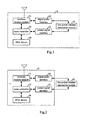
- a mobile phone of the invention is consisted of a separated host-phone 2 (as shown in Fig.1 and Fig.2 ) and a separated handset 1 (as shown in Fig. 3 ).
- the host-phone 2 comprises a wireless modem module 21, a main controller 22, a control signal interface 23, a digital audio interface 24, a low-power wireless transceiver module 25 and a PDA device 26.
- the wireless modem module 21, the control signal interface 23 and the PDA device 26 are connected with the main controller 22, respectively.
- the digital audio interface 24 is connected with the wireless modem module 21.
- the digital audio interface 24 and the control signal interface 23 are connected with the low-power wireless transceiver module 25, respectively.
- the wireless modem module 21 is connected with an antenna.
- the low-power wireless transceiver module 25 of the host-phone 2 in Fig. 1 is inside and the low-power wireless transceiver module 25 of the host-phone 2 in Fig. 2 is outside.
- the handset 1 comprises a main controller 11, a liquid crystal display (LCD) 12, a microphone 13, a speaker 14, a keyboard 15 and a low-power wireless transceiver module 16.
- the low-power wireless transceiver module 16 corresponds to the low-power wireless transceiver module 25 in the host-phone 2.
- the LCD 12, the microphone 13, the speaker 14 and the low-power wireless transceiver module 16 are connected to the main controller 11, respectively.
- the keyboard 15 is connected with the low-power wireless transceiver module 16.
- the audio signal coming from the microphone 13 of handset 1 and having been processed by the main controller 11, is sent to the low-power wireless transceiver module 16 for transmitting.
- the transmitted signal After the transmitted signal has been received by the low-power wireless transceiver module 25 in the host-phone 2, it is transferred to the wireless modem module 21 through the digital audio interface 24.
- the signal After having been processed and modulated in the wireless modem module 21, the signal is emitted in the air by the antenna.
- the signal coming from the air is demodulated by the wireless modem module 21 and recovered to an audio signal, which is then transferred to the low-power wireless transceiver 25 through the digital audio interface 24.
- the audio signal is modulated by the low-power wireless transceiver 25 and transmitted to the handset 1 in a short distance.
- the modulated audio signal is demodulated to an audio signal by the low-power wireless transceiver module 16.
- the audio signal is sent to the speaker 14 for output, under control of the main controller.
- the control command sent out by the keyboard 15 in the handset is first modulated by the low-power wireless transceiver module 16, and then transmitted to the low-power wireless transceiver module 25 in the host-phone 2.
- the control command is solved by the control signal interface 23 and the main controller 22, then it is modulated and emitted to the air by the wireless modem module 21.
- the control command coming from the air is modulated and transmitted to the handset 1 by the low-power wireless transceiver module 25 in the host-phone, after having been passed through the wireless modem module 21, the main controller 22 and the control signal interface 23.
- the low-power wireless transceiver module 16 receives the control command, and the LCD displays the control command after having been processed by the main controller 11.
- the low-power wireless transceiver modules 25 and 16 can use Bluetooth protocol or home radio frequency (HomeRF) protocol.
- HomeRF home radio frequency
- the working frequency between the host-phone 2 and the handset 1 is 2.4GHz. Of course, other frequency can also be used.
- the low-power wireless transceiver module 25 of host-phone 2 can be set inside or outside, as shown in Fig.1 and Fig.2 , respectively.
- the control signal interface 23 in host-phone 2 can be a RS232 interface or a USB interface.
- Bluetooth protocol is a protocol that provides short distance wireless communication. Purpose of the protocol is to replace cable connection between electronic equipment with a wireless mode.
- the protocol can work at ISM frequency band (Industrial, Scientific and Medical Frequency Band) without application.
- ISM frequency band Industrial, Scientific and Medical Frequency Band
- FDD Frequency Division Duplex
- the maximum emission power can reach 100mw and symbol rate is 1Mb/s.
- the protocol provides "point to point” or "point to multipoint” connection, and works at hopping frequency mode and has about 10 meters communication distance.
- HomeRF mode is a short distance communication mode based on wireless LAN technology and DECT (Digital European Cordless Telecommunication) technology. Purpose of the mode is to establish a wireless local area network at home. The mode also can work at ISM frequency band without application. Frame structure of the mode is a mixture of TDMA (Time Division Multiple Access) mode and CSMA (Carrier Sense Multiple Access) mode, which is a combination of DECT frame structure and wireless LAN frame structure. The mode takes into account requirement of voice communication and high-speed data communication, and can support six full-duplex voice communications or a 2Mb/s data communication. The HomeRF mode also uses hopping frequency mode, and has an emission power of 100mw and 50 meters communication distance. HomeRF will have a bright application future for household appliances communication.
- TDMA Time Division Multiple Access
- CSMA Carrier Sense Multiple Access
- the low-power wireless transceiver modules in host-phone and handset use Bluetooth protocol or HomeRF protocol so that the purpose of the invention can be achieved.
- the mobile phone has the following embodiments:
- a subscriber can keep the host-phone in a carrying dispatch-case or pocket, and takes the handset at hand.
- a callee telephone number is directly dialed at the handset, and the handset controls the host-phone to hook off and send out the telephone number.
- the subscriber uses directly the handset to make conversation with the callee.
- the handset rings and displays the caller telephone number, and the subscriber uses the handset to listen the call directly.
- a subscriber uses the PDA function at the host-phone, and a call can be switched to the host-phone.
- the host-phone is in a wait state, the handset can page the host-phone periodically. If there is no acknowledgement, the handset will alarm to warn the subscriber that the host-phone may be lost or stolen.
- the host-phone or handset When a subscriber is at home, the host-phone or handset can be connected to the home cordless telephone, automatically or manually. When the subscriber wants to use a telephone or access to a network, using the cordless telephone to access to PSTN is priority.
Landscapes
- Engineering & Computer Science (AREA)
- Computer Networks & Wireless Communication (AREA)
- Signal Processing (AREA)
- Human Computer Interaction (AREA)
- Telephone Function (AREA)
- Mobile Radio Communication Systems (AREA)
- Telephone Set Structure (AREA)
- Cleaning Implements For Floors, Carpets, Furniture, Walls, And The Like (AREA)
Claims (17)
- Mobiltelefon, das ein Host-Telefon (2) mit PDA-Funktion und einen drahtlosen Handapparat (1) aufweist, der sich betriebsmäßig vom Host-Telefon (2) räumlich trennen kann, wobei der drahtlose Handapparat (1) dafür eingerichtet ist, über das Host-Telefon (2) auf ein mobiles Kommunikationssystem zuzugreifen, dadurch gekennzeichnet, daß das Host-Telefon (2) oder der drahtlose Handapparat (1) dafür konfiguriert ist, über ein Host-Telefon eines schnurlosen Telefons (4) auf ein öffentliches Telefonwählnetz zuzugreifen.
- Mobiltelefon nach Anspruch 1, wobei:das Host-Telefon (2) ein drahtloses Modemmodul (21), einen Hauptcontroller (22), eine Steuersignalschnittstelle (23), eine digitale Audioschnittstelle (24), ein drahtloses Sender/Empfänger-Modul kleiner Leistung (25) und eine PDA-Vorrichtung (26) aufweist; das drahtlose Modemmodul (21), die Steuersignalschnittstelle (23) und die PDA-Vorrichtung (26) jeweils mit dem Hauptcontroller (22) verbunden sind; die digitale Audioschnittstelle (24) mit dem drahtlosen Modemmodul (21) verbunden ist; die digitale Audioschnittstelle (24) und die Steuersignalschnittstelle (23) jeweils mit dem drahtlosen Sender/Empfänger-Modul kleiner Leistung verbunden sind;der drahtlose Handapparat (1) einen Hauptcontroller (11), eine Anzeige (12), ein Mikrofon (13), einen Lautsprecher (14), eine Tastatur (15) und ein drahtloses Sender/Empfänger-Modul kleiner Leistung (16) aufweist; die Anzeige (12), das Mikrofon (13), der Lautsprecher (14) und das drahtlose Sender/Empfänger-Modul kleiner Leistung (16) jeweils mit dem Hauptcontroller (11) verbunden sind; die Tastatur (15) mit dem drahtlosen Sender/Empfänger-Modul kleiner Leistung (16) verbunden ist;das drahtlose Sender/Empfänger-Modul kleiner Leistung (16) im Handapparat (1) dem drahtlosen Sender/Empfänger-Modul kleiner Leistung (25) im Host-Telefon (2) entspricht.
- Mobiltelefon nach Anspruch 2, wobei das drahtlose Sender/Empfänger-Modul kleiner Leistung (25) im Host-Telefon (2) und das drahtlose Sender/Empfänger-Modul kleiner Leistung (16) im drahtlosen Handapparat (1) ein Bluetoothprotokoll-Modul ist.
- Mobiltelefon nach Anspruch 2, wobei das drahtlose Sender/Empfänger-Modul kleiner Leistung (25) im Host-Telefon (2) und das drahtlose Sender/Empfänger-Modul kleiner Leistung (16) im drahtlosen Handapparat (1) ein Heimfunkfrequenzprotokoll-Modul ist.
- Mobiltelefon nach Anspruch 2, wobei das drahtlose Sender/Empfänger-Modul kleiner Leistung (25) des Host-Telefons (2) sich außerhalb des Host-Telefons (2) befindet.
- Mobiltelefon nach Anspruch 2, wobei das drahtlose Sender/Empfänger-Modul kleiner Leistung (25) des Host-Telefons (2) sich innerhalb des Host-Telefons (2) befindet.
- Mobiltelefon nach Anspruch 2, wobei eine Arbeitsfrequenz zwischen dem Host-Telefon (2) und dem drahtlosen Handapparat (1) des Mobiltelefons 2,4 GHz beträgt.
- Mobiltelefon nach Anspruch 2, wobei die Steuersignalschnittstelle (23) im Host-Telefon (2) eine RS232-Schnittstelle ist.
- Mobiltelefon nach Anspruch 2, wobei die Steuersignalschnittstelle (23) im Host-Telefon (2) eine USB-Schnittstelle ist.
- Mobiltelefon nach Anspruch 1, wobei der drahtlose Handapparat (1) dafür eingerichtet ist, das Host-Telefon (2) per Funkruf zu rufen, wenn das Host-Telefon (2) in einem Wartezustand ist.
- Mobiltelefon nach Anspruch 1, wobei der drahtlose Handapparat (1) dafür eingerichtet ist, das Host-Telefon (2) per Funkruf periodisch zu rufen.
- Mobiltelefon nach Anspruch 10 oder 11, wobei der drahtlose Handapparat (1) dafür eingerichtet ist, einen Alarm auszuführen, um einen Teilnehmer darauf hinzuweisen, daß das Host-Telefon (2) verlorengegangen oder gestohlen sein kann, falls keine Bestätigung erfolgt, wenn der drahtlose Handapparat (1) dafür eingerichtet ist, das Host-Telefon (2) per Funkruf zu rufen.
- Kommunikationsverfahren eines Mobiltelefons, das ein Host-Telefon (2) mit PDA-Funktion und einen drahtlosen Handapparat (1) aufweist, der sich betriebsfähig vom Host-Telefon (2) räumlich trennen kann, wobei der drahtlose Handapparat (1) dafür eingerichtet ist, sich über das Host-Telefon (2) mit einem Mobilkommunikationssystem zu verbinden, dadurch gekennzeichnet, daß das Host-Telefon (2) oder der drahtlose Handapparat (1) dafür eingerichtet ist, über ein Host-Telefon eines schnurlosen Telefons (4) auf ein öffentliches Telefonwählnetz zuzugreifen.
- Kommunikationsverfahren nach Anspruch 13, ferner folgendes umfassend: Wenn das Host-Telefon (2) in einem Wartezustand ist, ist der drahtlose Handapparat (1) dafür eingerichtet, das Host-Telefon (2) per Funkruf zu rufen.
- Kommunikationsverfahren nach Anspruch 14, wobei der Schritt des Rufens des Host-Telefons (2) per Funkruf durch den drahtlosen Handapparat (1) periodisch ausgeführt wird.
- Kommunikationsverfahren nach Anspruch 14 oder 15, ferner folgendes umfassend: Falls keine Bestätigung erfolgt, wenn der drahtlose Handapparat (1) das Host-Telefon (2) per Funkruf ruft, gibt der Handapparat Meldung, um den Teilnehmer darauf aufmerksam zu machen, daß das Host-Telefon (2) verlorengegangen oder gestohlen sein kann.
- Kommunikationsverfahren nach einem der Ansprüche 13 bis 16, ferner umfassend ein Sendeverfahren und ein Empfangsverfahren, wobei:das Sendeverfahren aufweist: Senden eines von einem Mikrofon eines Handapparats kommenden Audiosignals, nachdem es durch einen Hauptcontroller des Handapparats verarbeitet worden ist, an ein drahtloses Sender/Empfänger-Modul kleiner Leistung zur Übertragung; Empfangen des übertragenen Signals durch ein drahtloses Sender/Empfänger-Modul kleiner Leistung in einem Host-Telefon und Übergeben desselben über eine digitale Audioschnittstelle an ein drahtloses Modemmodul; nachdem es im drahtlosen Modemmodul verarbeitet und moduliert worden ist, Ausstrahlen des Signals in die Luft;das Empfangsverfahren aufweist: Demodulieren eines aus der Luft kommenden Signals durch das drahtlose Modemmodul im Host-Telefon und Wiederherstellen desselben als ein Audiosignal, das dann über die digitale Audioschnittstelle an den drahtlosen Sender/Empfänger kleiner Leistung übergeben wird; Modulieren des wiederhergestellten Audiosignals durch den drahtlosen Sender/Empfänger kleiner Leistung und Übertragen desselben an den Handapparat in einer kurzen Entfernung; im Handapparat erfolgendes Empfangen und Demodulieren des modulierten Audiosignals zu einem Audiosignal durch das drahtlose Sender/Empfänger-Modul kleiner Leistung; Senden des Audiosignals an den Lautsprecher im Handapparat zum Ausgeben, unter Steuerung des Hauptcontrollers des Handapparats;ferner folgendes aufweisend: zuerst Modulieren eines durch eine Tastatur im Handapparat ausgesendeten Steuerbefehls und dann Übertragen desselben an das drahtlose Sender/Empfänger-Modul kleiner Leistung im Host-Telefon; im Host-Telefon erfolgendes Auflösen des Steuerbefehls durch eine Steuersignalschnittstelle und den Hauptcontroller, dann Modulieren und Ausstrahlen desselben durch das drahtlose Modemmodul in die Luft;Empfangen und Demodulieren eines aus der Luft kommenden Steuerbefehls durch das drahtlose Modemmodul im Host-Telefon; nachdem er über einen Hauptcontroller und die Steuersignalschnittstelle weitergegeben worden ist, Modulieren und Übertragen des Steuerbefehls an den Handapparat durch das drahtlose Sender/Empfänger-Modul kleiner Leistung im Host-Telefon; im Handapparat erfolgendes Empfangen des Steuerbefehls vom drahtlosen Sender/Empfänger-Modul kleiner Leistung und Zeigen desselben auf einer Anzeige, nachdem er durch den Hauptcontroller verarbeitet worden ist.
Applications Claiming Priority (3)
| Application Number | Priority Date | Filing Date | Title |
|---|---|---|---|
| CNB001330683A CN1145334C (zh) | 2000-11-18 | 2000-11-18 | 一种具有个人数字辅助机功能的分体式移动电话 |
| CN00133068 | 2000-11-18 | ||
| PCT/CN2001/001170 WO2002041606A1 (en) | 2000-11-18 | 2001-07-11 | Mobile phone being separated into handset and host phone which could be used as a pda and communication method thereof |
Publications (3)
| Publication Number | Publication Date |
|---|---|
| EP1335566A1 EP1335566A1 (de) | 2003-08-13 |
| EP1335566A4 EP1335566A4 (de) | 2006-06-07 |
| EP1335566B1 true EP1335566B1 (de) | 2008-03-26 |
Family
ID=4595510
Family Applications (1)
| Application Number | Title | Priority Date | Filing Date |
|---|---|---|---|
| EP01982052A Expired - Lifetime EP1335566B1 (de) | 2000-11-18 | 2001-07-11 | Mobiltelefon, das zur möglichen verwendung als ein pda in einen handapparat und einen host-fernsprecher aufgeteilt wird, und kommunikationsverfahren dafür |
Country Status (7)
| Country | Link |
|---|---|
| US (1) | US20040029581A1 (de) |
| EP (1) | EP1335566B1 (de) |
| CN (1) | CN1145334C (de) |
| AT (1) | ATE390794T1 (de) |
| AU (1) | AU2002213749A1 (de) |
| DE (1) | DE60133401T2 (de) |
| WO (1) | WO2002041606A1 (de) |
Families Citing this family (22)
| Publication number | Priority date | Publication date | Assignee | Title |
|---|---|---|---|---|
| US20040132445A1 (en) * | 2003-01-03 | 2004-07-08 | Gary Rogalski | Methods and systems of sharing mutual resources between an external device and a cordless telephone via a communications medium |
| KR100464368B1 (ko) * | 2003-01-06 | 2005-01-03 | 삼성전자주식회사 | 이종의 디바이스가 독립적 동작을 수행할 수 있는 복합단말기 및 이를 이용한 독립 동작 방법 |
| EP1463246A1 (de) | 2003-03-27 | 2004-09-29 | Motorola Inc. | Übertragung von Konversationsdaten zwischen Endgeräten über eine Funkverbindung |
| CN100463481C (zh) * | 2003-06-30 | 2009-02-18 | 中兴通讯股份有限公司 | 一种在公用电话交换网实现短距离无线通讯的方法及系统 |
| CN1301027C (zh) * | 2004-01-14 | 2007-02-14 | 杭州波导软件有限公司 | 带有附属机的移动电话 |
| KR100736851B1 (ko) * | 2005-12-09 | 2007-07-10 | (주)케이티에프테크놀로지스 | 근거리 무선 통신 모듈을 구비한 mbmm 단말기 및 통신방법 |
| US8738103B2 (en) * | 2006-07-18 | 2014-05-27 | Fractus, S.A. | Multiple-body-configuration multimedia and smartphone multifunction wireless devices |
| FR2911747A1 (fr) * | 2007-01-24 | 2008-07-25 | Lmqtech Sarl Sarl | Dispositif pour realiser tout telephone mobile ou nomade en deux elements physiques distincts selon une repartition avantageuse des fonctions. |
| US7830834B2 (en) * | 2007-03-22 | 2010-11-09 | Eaton Corporation | Wireless communication network including network coordinator assigning time slots and channels to nodes to provide collision-free schedules and data aggregation method for the same |
| WO2008117098A1 (en) * | 2007-03-27 | 2008-10-02 | Gert Frederik Meyer | A mobile telephone comprising a projector and a separable handset |
| ATE539547T1 (de) | 2008-07-09 | 2012-01-15 | Ericsson Telefon Ab L M | Modemvorrichtung für ein modulares drahtloses kommunikationssystem |
| CN102111504A (zh) * | 2011-02-28 | 2011-06-29 | 鸿富锦精密工业(深圳)有限公司 | 无绳电话 |
| CN102546962A (zh) * | 2012-03-27 | 2012-07-04 | 无锡德思普科技有限公司 | 一种低辐射健康手机系统和低辐射手机通讯方法 |
| CN102843451A (zh) * | 2012-10-08 | 2012-12-26 | 吉昌辉 | 插接扩展式智能手机 |
| US9369169B2 (en) * | 2013-08-19 | 2016-06-14 | Mbit Wireless, Inc. | Method and apparatus for an add-on communication device |
| CN104010056A (zh) * | 2014-05-22 | 2014-08-27 | 苏州锟恩电子科技有限公司 | 蓝牙显示屏 |
| CN105635101A (zh) * | 2015-08-28 | 2016-06-01 | 宇龙计算机通信科技(深圳)有限公司 | 一种多域分体式移动终端控制方法、装置及系统 |
| WO2020048231A1 (zh) * | 2018-09-06 | 2020-03-12 | Oppo广东移动通信有限公司 | 终端设备及其主机端 |
| CN209545630U (zh) * | 2018-12-29 | 2019-10-25 | Oppo广东移动通信有限公司 | 手机及主机 |
| CN112956178B (zh) * | 2018-12-29 | 2023-07-04 | Oppo广东移动通信有限公司 | 移动终端 |
| CN112055118A (zh) * | 2019-06-06 | 2020-12-08 | Oppo广东移动通信有限公司 | 电子装置及其终端设备 |
| CN112073571A (zh) * | 2019-06-10 | 2020-12-11 | Oppo广东移动通信有限公司 | 终端设备 |
Family Cites Families (19)
| Publication number | Priority date | Publication date | Assignee | Title |
|---|---|---|---|---|
| US5671267A (en) * | 1994-12-30 | 1997-09-23 | Lucent Technologies Inc. | Interactive system for communications between a cordless telephone and a remotely operated device |
| JPH09130289A (ja) * | 1995-10-31 | 1997-05-16 | Mitsubishi Electric Corp | アナログ携帯通信機 |
| US6289213B1 (en) * | 1996-02-14 | 2001-09-11 | International Business Machines Corporation | Computers integrated with a cordless telephone |
| US5913163A (en) * | 1996-03-14 | 1999-06-15 | Telefonaktiebolaget Lm Ericsson | Integrated local communication system |
| US5796338A (en) * | 1997-02-03 | 1998-08-18 | Aris Mardirossian, Inc. | System for preventing loss of cellular phone or the like |
| CN1166163C (zh) * | 1997-03-03 | 2004-09-08 | 株式会社东芝 | 通信终端装置 |
| JP4301530B2 (ja) * | 1997-03-12 | 2009-07-22 | ソニー株式会社 | 情報処理装置および方法 |
| US5983073A (en) * | 1997-04-04 | 1999-11-09 | Ditzik; Richard J. | Modular notebook and PDA computer systems for personal computing and wireless communications |
| US5974334A (en) * | 1997-10-16 | 1999-10-26 | Ericsson Inc. | Multi-positional handset for personal digital assistant |
| US6542758B1 (en) * | 1997-12-11 | 2003-04-01 | Ericsson Inc. | Distributed radio telephone for use in a vehicle |
| CN1227996A (zh) * | 1998-03-02 | 1999-09-08 | 海南今朝电子技术有限公司 | 分体式防辐射移动电话机 |
| CN1231570A (zh) * | 1998-04-08 | 1999-10-13 | 于旭宏 | 便携的移动通信终端装置 |
| CN1093726C (zh) * | 1998-05-16 | 2002-10-30 | 华为技术有限公司 | 一种手持式移动台 |
| US6266539B1 (en) * | 1998-06-12 | 2001-07-24 | Cisco Technology, Inc. | Telephone docking station for personal digital assistant |
| US6542721B2 (en) * | 1999-10-11 | 2003-04-01 | Peter V. Boesen | Cellular telephone, personal digital assistant and pager unit |
| JP2000312387A (ja) * | 2000-01-01 | 2000-11-07 | Toshiba Corp | 携帯型情報機器 |
| US6643522B1 (en) * | 2000-03-27 | 2003-11-04 | Sharp Laboratories Of America, Inc. | Method and apparatus providing simultaneous dual mode operations for radios in the shared spectrum |
| US6885869B2 (en) * | 2001-01-26 | 2005-04-26 | Ericsson Inc. | Method for mating a mobile terminal with a cordless phone system |
| US7437167B2 (en) * | 2002-12-10 | 2008-10-14 | Steve Gene Kartchner | Apparatus, system, and method for locating a transceiver using RF communications and radio services |
-
2000
- 2000-11-18 CN CNB001330683A patent/CN1145334C/zh not_active Expired - Lifetime
-
2001
- 2001-07-11 AU AU2002213749A patent/AU2002213749A1/en not_active Abandoned
- 2001-07-11 DE DE60133401T patent/DE60133401T2/de not_active Expired - Lifetime
- 2001-07-11 AT AT01982052T patent/ATE390794T1/de not_active IP Right Cessation
- 2001-07-11 EP EP01982052A patent/EP1335566B1/de not_active Expired - Lifetime
- 2001-07-11 WO PCT/CN2001/001170 patent/WO2002041606A1/zh not_active Ceased
-
2003
- 2003-05-14 US US10/437,429 patent/US20040029581A1/en not_active Abandoned
Also Published As
| Publication number | Publication date |
|---|---|
| WO2002041606A1 (en) | 2002-05-23 |
| CN1354583A (zh) | 2002-06-19 |
| CN1145334C (zh) | 2004-04-07 |
| AU2002213749A1 (en) | 2002-05-27 |
| DE60133401T2 (de) | 2009-04-16 |
| DE60133401D1 (de) | 2008-05-08 |
| EP1335566A1 (de) | 2003-08-13 |
| US20040029581A1 (en) | 2004-02-12 |
| EP1335566A4 (de) | 2006-06-07 |
| ATE390794T1 (de) | 2008-04-15 |
Similar Documents
| Publication | Publication Date | Title |
|---|---|---|
| EP1335566A1 (de) | Mobiltelefon, das zur möglichen verwendung als ein pda in einen handapparat und einen host-fernsprecher aufgeteilt wird, und kommunikationsverfahren dafür | |
| US8285342B2 (en) | Wireless telecommunication device and uses thereof | |
| US5960366A (en) | Wrist-watch wireless telephone | |
| US5966643A (en) | Hand-held radiotelephone having two-part construction | |
| GB2398461A (en) | Wireless communication between cordless base and cellular telephone handset | |
| US20040266425A1 (en) | Wireless wide area network charger and cradle | |
| US20070263804A1 (en) | Telephone with ability to communicate with mobile phones | |
| JP2003110751A (ja) | 携帯型情報機器及び回線切替え方法 | |
| CN100459623C (zh) | 无线电话与个人计算机接口的系统和方法 | |
| JP2000261857A (ja) | 携帯電話装置 | |
| US20030083111A1 (en) | Compact mobile phone device with hook | |
| JP5332298B2 (ja) | 携帯電話機、該携帯電話機に用いられる送受信機ユニット及び入出力装置 | |
| JP2001077893A (ja) | 携帯端末アダプター | |
| CN2626151Y (zh) | 多功能延伸座机 | |
| JP3021898B2 (ja) | 携帯無線電話装置 | |
| CN200953639Y (zh) | 便捷式手机 | |
| KR200244227Y1 (ko) | 무선 헤드셋을 이용한 근거리 무선통화시스템 | |
| KR200321467Y1 (ko) | 단축 다이얼을 갖는 핸즈프리 | |
| KR20030056437A (ko) | 통신단말기의 무선키보드 | |
| JP2002344587A (ja) | 携帯電話無線機 | |
| JPH07212437A (ja) | コードレス電話機 | |
| KR20040016713A (ko) | 무선 모뎀이 장착되는 전화단말기 | |
| KR20040008301A (ko) | 손목시계형 다기능 이동통신단말기 | |
| KR960027541A (ko) | 셀룰라폰의 무선 멀티 핸드셑 | |
| US20080076467A1 (en) | Mobile communication apparatus |
Legal Events
| Date | Code | Title | Description |
|---|---|---|---|
| PUAI | Public reference made under article 153(3) epc to a published international application that has entered the european phase |
Free format text: ORIGINAL CODE: 0009012 |
|
| 17P | Request for examination filed |
Effective date: 20030516 |
|
| AK | Designated contracting states |
Designated state(s): AT BE CH CY DE DK ES FI FR GB GR IE IT LI LU MC NL PT SE TR |
|
| AX | Request for extension of the european patent |
Extension state: AL LT LV MK RO SI |
|
| R17P | Request for examination filed (corrected) |
Effective date: 20030513 |
|
| A4 | Supplementary search report drawn up and despatched |
Effective date: 20060426 |
|
| RIC1 | Information provided on ipc code assigned before grant |
Ipc: H04M 1/00 20060101AFI20020528BHEP Ipc: G06F 1/16 20060101ALI20060420BHEP |
|
| 17Q | First examination report despatched |
Effective date: 20060726 |
|
| GRAP | Despatch of communication of intention to grant a patent |
Free format text: ORIGINAL CODE: EPIDOSNIGR1 |
|
| GRAS | Grant fee paid |
Free format text: ORIGINAL CODE: EPIDOSNIGR3 |
|
| GRAA | (expected) grant |
Free format text: ORIGINAL CODE: 0009210 |
|
| AK | Designated contracting states |
Kind code of ref document: B1 Designated state(s): AT BE CH CY DE DK ES FI FR GB GR IE IT LI LU MC NL PT SE TR |
|
| REG | Reference to a national code |
Ref country code: GB Ref legal event code: FG4D |
|
| REG | Reference to a national code |
Ref country code: CH Ref legal event code: EP Ref country code: IE Ref legal event code: FG4D |
|
| REF | Corresponds to: |
Ref document number: 60133401 Country of ref document: DE Date of ref document: 20080508 Kind code of ref document: P |
|
| PG25 | Lapsed in a contracting state [announced via postgrant information from national office to epo] |
Ref country code: FI Free format text: LAPSE BECAUSE OF FAILURE TO SUBMIT A TRANSLATION OF THE DESCRIPTION OR TO PAY THE FEE WITHIN THE PRESCRIBED TIME-LIMIT Effective date: 20080326 |
|
| PG25 | Lapsed in a contracting state [announced via postgrant information from national office to epo] |
Ref country code: AT Free format text: LAPSE BECAUSE OF FAILURE TO SUBMIT A TRANSLATION OF THE DESCRIPTION OR TO PAY THE FEE WITHIN THE PRESCRIBED TIME-LIMIT Effective date: 20080326 |
|
| NLV1 | Nl: lapsed or annulled due to failure to fulfill the requirements of art. 29p and 29m of the patents act | ||
| PG25 | Lapsed in a contracting state [announced via postgrant information from national office to epo] |
Ref country code: BE Free format text: LAPSE BECAUSE OF FAILURE TO SUBMIT A TRANSLATION OF THE DESCRIPTION OR TO PAY THE FEE WITHIN THE PRESCRIBED TIME-LIMIT Effective date: 20080326 |
|
| PG25 | Lapsed in a contracting state [announced via postgrant information from national office to epo] |
Ref country code: SE Free format text: LAPSE BECAUSE OF FAILURE TO SUBMIT A TRANSLATION OF THE DESCRIPTION OR TO PAY THE FEE WITHIN THE PRESCRIBED TIME-LIMIT Effective date: 20080626 Ref country code: ES Free format text: LAPSE BECAUSE OF FAILURE TO SUBMIT A TRANSLATION OF THE DESCRIPTION OR TO PAY THE FEE WITHIN THE PRESCRIBED TIME-LIMIT Effective date: 20080707 Ref country code: PT Free format text: LAPSE BECAUSE OF FAILURE TO SUBMIT A TRANSLATION OF THE DESCRIPTION OR TO PAY THE FEE WITHIN THE PRESCRIBED TIME-LIMIT Effective date: 20080901 |
|
| PG25 | Lapsed in a contracting state [announced via postgrant information from national office to epo] |
Ref country code: NL Free format text: LAPSE BECAUSE OF FAILURE TO SUBMIT A TRANSLATION OF THE DESCRIPTION OR TO PAY THE FEE WITHIN THE PRESCRIBED TIME-LIMIT Effective date: 20080326 |
|
| ET | Fr: translation filed | ||
| PG25 | Lapsed in a contracting state [announced via postgrant information from national office to epo] |
Ref country code: DK Free format text: LAPSE BECAUSE OF FAILURE TO SUBMIT A TRANSLATION OF THE DESCRIPTION OR TO PAY THE FEE WITHIN THE PRESCRIBED TIME-LIMIT Effective date: 20080326 |
|
| PLBE | No opposition filed within time limit |
Free format text: ORIGINAL CODE: 0009261 |
|
| STAA | Information on the status of an ep patent application or granted ep patent |
Free format text: STATUS: NO OPPOSITION FILED WITHIN TIME LIMIT |
|
| REG | Reference to a national code |
Ref country code: CH Ref legal event code: PL |
|
| 26N | No opposition filed |
Effective date: 20081230 |
|
| PG25 | Lapsed in a contracting state [announced via postgrant information from national office to epo] |
Ref country code: MC Free format text: LAPSE BECAUSE OF NON-PAYMENT OF DUE FEES Effective date: 20080731 |
|
| PG25 | Lapsed in a contracting state [announced via postgrant information from national office to epo] |
Ref country code: LI Free format text: LAPSE BECAUSE OF NON-PAYMENT OF DUE FEES Effective date: 20080731 Ref country code: CH Free format text: LAPSE BECAUSE OF NON-PAYMENT OF DUE FEES Effective date: 20080731 |
|
| PG25 | Lapsed in a contracting state [announced via postgrant information from national office to epo] |
Ref country code: IE Free format text: LAPSE BECAUSE OF NON-PAYMENT OF DUE FEES Effective date: 20080711 |
|
| PG25 | Lapsed in a contracting state [announced via postgrant information from national office to epo] |
Ref country code: IT Free format text: LAPSE BECAUSE OF FAILURE TO SUBMIT A TRANSLATION OF THE DESCRIPTION OR TO PAY THE FEE WITHIN THE PRESCRIBED TIME-LIMIT Effective date: 20080326 |
|
| PG25 | Lapsed in a contracting state [announced via postgrant information from national office to epo] |
Ref country code: CY Free format text: LAPSE BECAUSE OF FAILURE TO SUBMIT A TRANSLATION OF THE DESCRIPTION OR TO PAY THE FEE WITHIN THE PRESCRIBED TIME-LIMIT Effective date: 20080326 |
|
| PG25 | Lapsed in a contracting state [announced via postgrant information from national office to epo] |
Ref country code: LU Free format text: LAPSE BECAUSE OF NON-PAYMENT OF DUE FEES Effective date: 20080711 |
|
| PG25 | Lapsed in a contracting state [announced via postgrant information from national office to epo] |
Ref country code: TR Free format text: LAPSE BECAUSE OF FAILURE TO SUBMIT A TRANSLATION OF THE DESCRIPTION OR TO PAY THE FEE WITHIN THE PRESCRIBED TIME-LIMIT Effective date: 20080326 |
|
| PG25 | Lapsed in a contracting state [announced via postgrant information from national office to epo] |
Ref country code: GR Free format text: LAPSE BECAUSE OF FAILURE TO SUBMIT A TRANSLATION OF THE DESCRIPTION OR TO PAY THE FEE WITHIN THE PRESCRIBED TIME-LIMIT Effective date: 20080627 |
|
| REG | Reference to a national code |
Ref country code: FR Ref legal event code: PLFP Year of fee payment: 16 |
|
| REG | Reference to a national code |
Ref country code: FR Ref legal event code: PLFP Year of fee payment: 17 |
|
| REG | Reference to a national code |
Ref country code: FR Ref legal event code: PLFP Year of fee payment: 18 |
|
| PGFP | Annual fee paid to national office [announced via postgrant information from national office to epo] |
Ref country code: FR Payment date: 20200611 Year of fee payment: 20 |
|
| PGFP | Annual fee paid to national office [announced via postgrant information from national office to epo] |
Ref country code: DE Payment date: 20200630 Year of fee payment: 20 Ref country code: GB Payment date: 20200701 Year of fee payment: 20 |
|
| REG | Reference to a national code |
Ref country code: DE Ref legal event code: R071 Ref document number: 60133401 Country of ref document: DE |
|
| REG | Reference to a national code |
Ref country code: GB Ref legal event code: PE20 Expiry date: 20210710 |
|
| PG25 | Lapsed in a contracting state [announced via postgrant information from national office to epo] |
Ref country code: GB Free format text: LAPSE BECAUSE OF EXPIRATION OF PROTECTION Effective date: 20210710 |