EP1336105B1 - Teststab - Google Patents
Teststab Download PDFInfo
- Publication number
- EP1336105B1 EP1336105B1 EP01974533A EP01974533A EP1336105B1 EP 1336105 B1 EP1336105 B1 EP 1336105B1 EP 01974533 A EP01974533 A EP 01974533A EP 01974533 A EP01974533 A EP 01974533A EP 1336105 B1 EP1336105 B1 EP 1336105B1
- Authority
- EP
- European Patent Office
- Prior art keywords
- capture
- dipstick
- different
- kit
- detection
- Prior art date
- Legal status (The legal status is an assumption and is not a legal conclusion. Google has not performed a legal analysis and makes no representation as to the accuracy of the status listed.)
- Expired - Lifetime
Links
- 238000003556 assay Methods 0.000 title claims description 19
- 238000001514 detection method Methods 0.000 claims abstract description 119
- 239000000523 sample Substances 0.000 claims abstract description 98
- 208000037265 diseases, disorders, signs and symptoms Diseases 0.000 claims abstract description 66
- 239000012488 sample solution Substances 0.000 claims abstract description 60
- 230000027455 binding Effects 0.000 claims abstract description 57
- 201000010099 disease Diseases 0.000 claims abstract description 52
- 244000005700 microbiome Species 0.000 claims abstract description 47
- 238000012360 testing method Methods 0.000 claims abstract description 41
- 239000012678 infectious agent Substances 0.000 claims abstract description 37
- 230000015572 biosynthetic process Effects 0.000 claims abstract description 13
- 239000003550 marker Substances 0.000 claims abstract description 13
- 208000035475 disorder Diseases 0.000 claims abstract description 12
- 230000007274 generation of a signal involved in cell-cell signaling Effects 0.000 claims abstract description 8
- 102000039446 nucleic acids Human genes 0.000 claims description 55
- 108020004707 nucleic acids Proteins 0.000 claims description 55
- 150000007523 nucleic acids Chemical class 0.000 claims description 55
- 239000003446 ligand Substances 0.000 claims description 30
- YBJHBAHKTGYVGT-ZKWXMUAHSA-N (+)-Biotin Chemical compound N1C(=O)N[C@@H]2[C@H](CCCCC(=O)O)SC[C@@H]21 YBJHBAHKTGYVGT-ZKWXMUAHSA-N 0.000 claims description 12
- 239000003593 chromogenic compound Substances 0.000 claims description 12
- 239000000427 antigen Substances 0.000 claims description 11
- 102000036639 antigens Human genes 0.000 claims description 11
- 108091007433 antigens Proteins 0.000 claims description 11
- 102000008394 Immunoglobulin Fragments Human genes 0.000 claims description 8
- 108010021625 Immunoglobulin Fragments Proteins 0.000 claims description 8
- 230000001745 anti-biotin effect Effects 0.000 claims description 7
- 229960002685 biotin Drugs 0.000 claims description 7
- 239000011616 biotin Substances 0.000 claims description 7
- 230000009471 action Effects 0.000 claims description 6
- 235000020958 biotin Nutrition 0.000 claims description 6
- MHMNJMPURVTYEJ-UHFFFAOYSA-N fluorescein-5-isothiocyanate Chemical compound O1C(=O)C2=CC(N=C=S)=CC=C2C21C1=CC=C(O)C=C1OC1=CC(O)=CC=C21 MHMNJMPURVTYEJ-UHFFFAOYSA-N 0.000 claims description 4
- 239000002245 particle Substances 0.000 claims description 4
- 239000004753 textile Substances 0.000 claims description 4
- 241000701076 Macacine alphaherpesvirus 1 Species 0.000 claims description 3
- 241000700605 Viruses Species 0.000 claims description 3
- 108090000790 Enzymes Proteins 0.000 claims description 2
- 102000004190 Enzymes Human genes 0.000 claims description 2
- 241000606768 Haemophilus influenzae Species 0.000 claims description 2
- 241000589989 Helicobacter Species 0.000 claims description 2
- 208000019802 Sexually transmitted disease Diseases 0.000 claims description 2
- PCHJSUWPFVWCPO-UHFFFAOYSA-N gold Chemical compound [Au] PCHJSUWPFVWCPO-UHFFFAOYSA-N 0.000 claims description 2
- 239000004816 latex Substances 0.000 claims description 2
- 229920000126 latex Polymers 0.000 claims description 2
- 229910052751 metal Inorganic materials 0.000 claims description 2
- 239000002184 metal Substances 0.000 claims description 2
- 208000015181 infectious disease Diseases 0.000 abstract description 17
- 238000002809 confirmatory assay Methods 0.000 abstract description 8
- 239000000975 dye Substances 0.000 description 17
- 230000008901 benefit Effects 0.000 description 7
- 238000003745 diagnosis Methods 0.000 description 7
- FAPWRFPIFSIZLT-UHFFFAOYSA-M Sodium chloride Chemical compound [Na+].[Cl-] FAPWRFPIFSIZLT-UHFFFAOYSA-M 0.000 description 6
- 241000725303 Human immunodeficiency virus Species 0.000 description 5
- 239000003153 chemical reaction reagent Substances 0.000 description 5
- KCXVZYZYPLLWCC-UHFFFAOYSA-N EDTA Chemical compound OC(=O)CN(CC(O)=O)CCN(CC(O)=O)CC(O)=O KCXVZYZYPLLWCC-UHFFFAOYSA-N 0.000 description 4
- 241000711549 Hepacivirus C Species 0.000 description 4
- 239000003086 colorant Substances 0.000 description 4
- 238000003119 immunoblot Methods 0.000 description 4
- 238000000034 method Methods 0.000 description 4
- 239000001488 sodium phosphate Substances 0.000 description 4
- 229910000162 sodium phosphate Inorganic materials 0.000 description 4
- RYFMWSXOAZQYPI-UHFFFAOYSA-K trisodium phosphate Chemical compound [Na+].[Na+].[Na+].[O-]P([O-])([O-])=O RYFMWSXOAZQYPI-UHFFFAOYSA-K 0.000 description 4
- 238000007423 screening assay Methods 0.000 description 3
- 239000011780 sodium chloride Substances 0.000 description 3
- 241000894007 species Species 0.000 description 3
- 241000588724 Escherichia coli Species 0.000 description 2
- 239000008280 blood Substances 0.000 description 2
- 210000004369 blood Anatomy 0.000 description 2
- 206010022000 influenza Diseases 0.000 description 2
- 208000030159 metabolic disease Diseases 0.000 description 2
- 230000035935 pregnancy Effects 0.000 description 2
- 238000002360 preparation method Methods 0.000 description 2
- 108090000765 processed proteins & peptides Proteins 0.000 description 2
- 102000004196 processed proteins & peptides Human genes 0.000 description 2
- 102000004169 proteins and genes Human genes 0.000 description 2
- 108090000623 proteins and genes Proteins 0.000 description 2
- 230000004044 response Effects 0.000 description 2
- 238000012216 screening Methods 0.000 description 2
- 239000000126 substance Substances 0.000 description 2
- 210000002700 urine Anatomy 0.000 description 2
- 230000000007 visual effect Effects 0.000 description 2
- 125000001917 2,4-dinitrophenyl group Chemical group [H]C1=C([H])C(=C([H])C(=C1*)[N+]([O-])=O)[N+]([O-])=O 0.000 description 1
- 108090001008 Avidin Proteins 0.000 description 1
- 101100476210 Caenorhabditis elegans rnt-1 gene Proteins 0.000 description 1
- 229920001917 Ficoll Polymers 0.000 description 1
- 108010010803 Gelatin Proteins 0.000 description 1
- 208000031886 HIV Infections Diseases 0.000 description 1
- 241000700721 Hepatitis B virus Species 0.000 description 1
- 241000713772 Human immunodeficiency virus 1 Species 0.000 description 1
- 241000713340 Human immunodeficiency virus 2 Species 0.000 description 1
- 239000000020 Nitrocellulose Substances 0.000 description 1
- 102000007056 Recombinant Fusion Proteins Human genes 0.000 description 1
- 108010008281 Recombinant Fusion Proteins Proteins 0.000 description 1
- 108010090804 Streptavidin Proteins 0.000 description 1
- CZMRCDWAGMRECN-UGDNZRGBSA-N Sucrose Chemical compound O[C@H]1[C@H](O)[C@@H](CO)O[C@@]1(CO)O[C@@H]1[C@H](O)[C@@H](O)[C@H](O)[C@@H](CO)O1 CZMRCDWAGMRECN-UGDNZRGBSA-N 0.000 description 1
- 229930006000 Sucrose Natural products 0.000 description 1
- 101800001690 Transmembrane protein gp41 Proteins 0.000 description 1
- 229920004894 Triton X-305 Polymers 0.000 description 1
- FJWGYAHXMCUOOM-QHOUIDNNSA-N [(2s,3r,4s,5r,6r)-2-[(2r,3r,4s,5r,6s)-4,5-dinitrooxy-2-(nitrooxymethyl)-6-[(2r,3r,4s,5r,6s)-4,5,6-trinitrooxy-2-(nitrooxymethyl)oxan-3-yl]oxyoxan-3-yl]oxy-3,5-dinitrooxy-6-(nitrooxymethyl)oxan-4-yl] nitrate Chemical compound O([C@@H]1O[C@@H]([C@H]([C@H](O[N+]([O-])=O)[C@H]1O[N+]([O-])=O)O[C@H]1[C@@H]([C@@H](O[N+]([O-])=O)[C@H](O[N+]([O-])=O)[C@@H](CO[N+]([O-])=O)O1)O[N+]([O-])=O)CO[N+](=O)[O-])[C@@H]1[C@@H](CO[N+]([O-])=O)O[C@@H](O[N+]([O-])=O)[C@H](O[N+]([O-])=O)[C@H]1O[N+]([O-])=O FJWGYAHXMCUOOM-QHOUIDNNSA-N 0.000 description 1
- 230000009286 beneficial effect Effects 0.000 description 1
- 239000002981 blocking agent Substances 0.000 description 1
- 238000005119 centrifugation Methods 0.000 description 1
- 230000008859 change Effects 0.000 description 1
- 230000021615 conjugation Effects 0.000 description 1
- 230000003111 delayed effect Effects 0.000 description 1
- 230000007613 environmental effect Effects 0.000 description 1
- 238000002474 experimental method Methods 0.000 description 1
- 229920000159 gelatin Polymers 0.000 description 1
- 239000008273 gelatin Substances 0.000 description 1
- 235000019322 gelatine Nutrition 0.000 description 1
- 235000011852 gelatine desserts Nutrition 0.000 description 1
- 238000011534 incubation Methods 0.000 description 1
- 230000002458 infectious effect Effects 0.000 description 1
- 230000001524 infective effect Effects 0.000 description 1
- 230000003993 interaction Effects 0.000 description 1
- 239000012528 membrane Substances 0.000 description 1
- 230000005012 migration Effects 0.000 description 1
- 238000013508 migration Methods 0.000 description 1
- 238000012544 monitoring process Methods 0.000 description 1
- 230000035772 mutation Effects 0.000 description 1
- 229920001220 nitrocellulos Polymers 0.000 description 1
- 229940079938 nitrocellulose Drugs 0.000 description 1
- 230000001717 pathogenic effect Effects 0.000 description 1
- 239000013610 patient sample Substances 0.000 description 1
- 239000003755 preservative agent Substances 0.000 description 1
- 230000002335 preservative effect Effects 0.000 description 1
- 230000005180 public health Effects 0.000 description 1
- 239000012723 sample buffer Substances 0.000 description 1
- 230000000405 serological effect Effects 0.000 description 1
- 239000008279 sol Substances 0.000 description 1
- 239000005720 sucrose Substances 0.000 description 1
- 230000002123 temporal effect Effects 0.000 description 1
- 238000012549 training Methods 0.000 description 1
- 238000005406 washing Methods 0.000 description 1
Images
Classifications
-
- G—PHYSICS
- G01—MEASURING; TESTING
- G01N—INVESTIGATING OR ANALYSING MATERIALS BY DETERMINING THEIR CHEMICAL OR PHYSICAL PROPERTIES
- G01N33/00—Investigating or analysing materials by specific methods not covered by groups G01N1/00 - G01N31/00
- G01N33/48—Biological material, e.g. blood, urine; Haemocytometers
- G01N33/50—Chemical analysis of biological material, e.g. blood, urine; Testing involving biospecific ligand binding methods; Immunological testing
- G01N33/53—Immunoassay; Biospecific binding assay; Materials therefor
- G01N33/569—Immunoassay; Biospecific binding assay; Materials therefor for microorganisms, e.g. protozoa, bacteria, viruses
-
- G—PHYSICS
- G01—MEASURING; TESTING
- G01N—INVESTIGATING OR ANALYSING MATERIALS BY DETERMINING THEIR CHEMICAL OR PHYSICAL PROPERTIES
- G01N33/00—Investigating or analysing materials by specific methods not covered by groups G01N1/00 - G01N31/00
- G01N33/48—Biological material, e.g. blood, urine; Haemocytometers
- G01N33/50—Chemical analysis of biological material, e.g. blood, urine; Testing involving biospecific ligand binding methods; Immunological testing
- G01N33/53—Immunoassay; Biospecific binding assay; Materials therefor
- G01N33/543—Immunoassay; Biospecific binding assay; Materials therefor with an insoluble carrier for immobilising immunochemicals
- G01N33/54366—Apparatus specially adapted for solid-phase testing
-
- G—PHYSICS
- G01—MEASURING; TESTING
- G01N—INVESTIGATING OR ANALYSING MATERIALS BY DETERMINING THEIR CHEMICAL OR PHYSICAL PROPERTIES
- G01N33/00—Investigating or analysing materials by specific methods not covered by groups G01N1/00 - G01N31/00
- G01N33/48—Biological material, e.g. blood, urine; Haemocytometers
- G01N33/50—Chemical analysis of biological material, e.g. blood, urine; Testing involving biospecific ligand binding methods; Immunological testing
- G01N33/53—Immunoassay; Biospecific binding assay; Materials therefor
- G01N33/543—Immunoassay; Biospecific binding assay; Materials therefor with an insoluble carrier for immobilising immunochemicals
- G01N33/54366—Apparatus specially adapted for solid-phase testing
- G01N33/54386—Analytical elements
- G01N33/54387—Immunochromatographic test strips
- G01N33/54388—Immunochromatographic test strips based on lateral flow
-
- Y—GENERAL TAGGING OF NEW TECHNOLOGICAL DEVELOPMENTS; GENERAL TAGGING OF CROSS-SECTIONAL TECHNOLOGIES SPANNING OVER SEVERAL SECTIONS OF THE IPC; TECHNICAL SUBJECTS COVERED BY FORMER USPC CROSS-REFERENCE ART COLLECTIONS [XRACs] AND DIGESTS
- Y02—TECHNOLOGIES OR APPLICATIONS FOR MITIGATION OR ADAPTATION AGAINST CLIMATE CHANGE
- Y02A—TECHNOLOGIES FOR ADAPTATION TO CLIMATE CHANGE
- Y02A50/00—TECHNOLOGIES FOR ADAPTATION TO CLIMATE CHANGE in human health protection, e.g. against extreme weather
- Y02A50/30—Against vector-borne diseases, e.g. mosquito-borne, fly-borne, tick-borne or waterborne diseases whose impact is exacerbated by climate change
-
- Y—GENERAL TAGGING OF NEW TECHNOLOGICAL DEVELOPMENTS; GENERAL TAGGING OF CROSS-SECTIONAL TECHNOLOGIES SPANNING OVER SEVERAL SECTIONS OF THE IPC; TECHNICAL SUBJECTS COVERED BY FORMER USPC CROSS-REFERENCE ART COLLECTIONS [XRACs] AND DIGESTS
- Y10—TECHNICAL SUBJECTS COVERED BY FORMER USPC
- Y10S—TECHNICAL SUBJECTS COVERED BY FORMER USPC CROSS-REFERENCE ART COLLECTIONS [XRACs] AND DIGESTS
- Y10S435/00—Chemistry: molecular biology and microbiology
- Y10S435/97—Test strip or test slide
-
- Y—GENERAL TAGGING OF NEW TECHNOLOGICAL DEVELOPMENTS; GENERAL TAGGING OF CROSS-SECTIONAL TECHNOLOGIES SPANNING OVER SEVERAL SECTIONS OF THE IPC; TECHNICAL SUBJECTS COVERED BY FORMER USPC CROSS-REFERENCE ART COLLECTIONS [XRACs] AND DIGESTS
- Y10—TECHNICAL SUBJECTS COVERED BY FORMER USPC
- Y10S—TECHNICAL SUBJECTS COVERED BY FORMER USPC CROSS-REFERENCE ART COLLECTIONS [XRACs] AND DIGESTS
- Y10S436/00—Chemistry: analytical and immunological testing
- Y10S436/807—Apparatus included in process claim, e.g. physical support structures
- Y10S436/808—Automated or kit
-
- Y—GENERAL TAGGING OF NEW TECHNOLOGICAL DEVELOPMENTS; GENERAL TAGGING OF CROSS-SECTIONAL TECHNOLOGIES SPANNING OVER SEVERAL SECTIONS OF THE IPC; TECHNICAL SUBJECTS COVERED BY FORMER USPC CROSS-REFERENCE ART COLLECTIONS [XRACs] AND DIGESTS
- Y10—TECHNICAL SUBJECTS COVERED BY FORMER USPC
- Y10S—TECHNICAL SUBJECTS COVERED BY FORMER USPC CROSS-REFERENCE ART COLLECTIONS [XRACs] AND DIGESTS
- Y10S436/00—Chemistry: analytical and immunological testing
- Y10S436/807—Apparatus included in process claim, e.g. physical support structures
- Y10S436/81—Tube, bottle, or dipstick
-
- Y—GENERAL TAGGING OF NEW TECHNOLOGICAL DEVELOPMENTS; GENERAL TAGGING OF CROSS-SECTIONAL TECHNOLOGIES SPANNING OVER SEVERAL SECTIONS OF THE IPC; TECHNICAL SUBJECTS COVERED BY FORMER USPC CROSS-REFERENCE ART COLLECTIONS [XRACs] AND DIGESTS
- Y10—TECHNICAL SUBJECTS COVERED BY FORMER USPC
- Y10S—TECHNICAL SUBJECTS COVERED BY FORMER USPC CROSS-REFERENCE ART COLLECTIONS [XRACs] AND DIGESTS
- Y10S436/00—Chemistry: analytical and immunological testing
- Y10S436/823—Immunogenic carrier or carrier per se
Definitions
- the present invention relates to dipsticks, kits comprising dipsticks, and to dipstick assays for confirming infection by an infectious agent or disease causing microorganism.
- immunoblot assays have several disadvantages. These assays comprise multiple steps, requiring stepwise addition of different components in a particular order. Incubation and washing steps are necessary after addition of each new component. It may not be possible to complete an assay in less than 5 hours and usually more than 20 hours is required. This is a significant disadvantage because it is desirable to obtain the result as quickly as possible, for example to keep patient waiting times to a minimum. In remote areas, if the general screening and confirmatory assays are not performed during a single visit from a patient, the patient may never obtain the test result because they may be unlikely or unable to return at a later date.
- a further disadvantage of immunoblot assays is that specialist equipment is required. Such equipment may not be readily available, particularly in remote areas or resource-poor countries, thus requiring the patient to travel long distances for the tests to be performed.
- the relatively high cost of immunoblot assays can also reduce their availability in resource-poor countries. Patient and public health can be endangered if tests are not readily available, or if results are not communicated to patients because they are unlikely or unable to return at a later date.
- a kit for testing for the presence of a plurality of different targets in a sample solution which comprises:
- the marker may be any marker indicating the existence of any disease, disorder, or condition which it is possible to detect using a dipstick.
- the marker may, for example, be an antibody raised in the host in response to infection by an infectious agent or disease causing microorganism, or a chemical indicating the existence of a disorder such as a metabolic disorder.
- An example of a condition which may be tested for includes HLA subtype.
- the markers may be markers for pregnancy.
- the plurality of different detection probes may be added to the sample solution and the dipstick immersed in the sample solution so that the capture zones are immersed in the sample solution.
- the dipstick may further comprise a contact end, remote from the capture zones, for contacting the sample solution, and be capable of transporting the sample solution by capillary action to the capture zones when the sample solution is contacted with the contact end.
- the plurality of detection probes are added to the sample solution to allow binding of the detection probes to target in the sample solution.
- the contact end of the dipstick is contacted with the sample solution to cause sample solution and target-detection probe complexes to rise up the dipstick by capillary action to the capture zones where they can be detected.
- a dipstick for testing for the presence of a plurality of different targets in a sample solution which comprises:
- An advantage of capture moieties being releasably immobilised to the dipstick is that all the components required to obtain a result from a dipstick assay can be present on the dipstick with no other reagents or equipment being required.
- the dipstick may be immersed in the sample solution so that the detection probes and the capture zones are immersed in the sample solution.
- Contact of the detection probes with the sample solution causes them to be released from the dipstick so that they can bind to target in the sample solution which can, in turn bind to its capture moiety and thereby allow detection of the target.
- a dipstick of the second aspect of the invention may further comprise a contact end, remote from the capture zones, for contacting the sample solution, the detection probes being releasably immobilised between the contact end and the capture zones, wherein the dipstick is capable of transporting the sample solution by capillary action to the capture zones when the sample solution is contacted with the contact end.
- the contact end of the dipstick may be contacted with the sample solution to cause the sample solution to rise up the dipstick by capillary action to the capture zones.
- the detection probes are released by the sample solution as it rises up the dipstick allowing them to bind to target in the sample solution. Detection probe-target complexes can then bind capture moiety at the appropriate capture zone.
- the marker may be any marker indicating the existence of any disease, disorder, or condition which it is possible to detect using a dipstick.
- the marker may, for example, be an antibody raised in the host in response to infection by an infectious agent or disease causing microorganism, or a chemical indicating the existence of a disorder such as a metabolic disorder.
- An example of a condition which may be tested for includes HLA subtype.
- the markers may be markers for pregnancy.
- Dipsticks and kits of the invention and tests carried out using these have several advantages.
- the dipsticks and kits allow reliable diagnosis of infection by an infectious agent or disease causing microorganism.
- Tests using the dipsticks or kits are simple because they can be performed in a very low number of steps, or even a single step. Minimal training is required, therefore, for a person to be able to perform a test.
- the tests can be performed rapidly. It is possible to carry out a test in less than one hour, including sample preparation time. No specialist equipment is needed.
- the kits, dipsticks, and any reagents used can be provided at low cost.
- dipsticks and kits of the invention are particularly advantageous for use in performing confirmatory assays for infection by an infectious agent or disease causing microorganism.
- Such assays can be performed rapidly, thus keeping patient waiting times to a minimum and allowing screening and confirmatory assays to be performed during a single visit from a patient.
- Such rapid testing can also make it easier to maintain the confidentiality of the patient.
- the lack of requirement for specialist equipment and the relatively low cost of performing the assays means that tests can be made readily available. This is a particular advantage in resource-poor countries, and in remote areas where the cost of performing conventional tests, and the requirement for specialist equipment to perform the conventional tests can mean that they are not readily available.
- test or assay can now be designed to take into account any or all known/detectable targets which are available for any specific organism of interest, thereby providing an improved test or assay for that organism.
- Detection of different components of the same infectious agent or disease causing microorganism not only allows more reliable diagnosis of an infection, but can also provide information relating to the state of an infection or progression of a disease, disorder or condition.
- antibodies to both structural and non-structural antigens of an infectious agent or microorganism are seen during an infection and could be used as the basis of an assay of the invention.
- a serological profile of a patient could be determined which could assist in making decisions regarding further monitoring or treatment of the infection.
- test or assay it is desirable in any test or assay to reduce or eliminate false negative results, especially when the test or assay is for detecting an infectious agent or a disease causing microorganism or a marker indicating the existence of a disease, disorder or condition caused by an infectious agent or microorganism.
- the same species of microorganism may exhibit different potential "targets" due to there being more than one sub-type, strain, variant, mutant etc of the species.
- the invention may also provide a test/assay for distinguishing between or detecting the presence/absence of particular genotypes, serotypes, sub-types, strains, variants, mutants, etc., in a patient sample. This would be of particular value in cases where it is helpful to know whether or not a patient has a particularly virulent or dangerous strain as compared to possibly innocuous or even beneficial/enteric strains.
- An example would be to check for E.coli 0157 (a very dangerous, often fatal infectious strain) in the presence of other enteric or infective strains.
- Another example would be in testing patients for influenza infection, where mutation or variation of the strains is known to occur and some forms of influenza are far more pathogenic than others.
- a further example is detection of different strains of HIV, for example HIV-1 and HIV-2.
- variants In some embodiments of the invention designed to establish whether a patient is infected with a particular genotype, serotype, sub-type, strain, variant, mutant, etc. (referred to collectively as variants below) of infectious agent or disease causing microorganism, different capture moieties each capable of capturing a target specific to each variant may be immobilised to different capture zones. A capture moiety capable of capturing a target common to all of the variants may also be immobilised at a further capture zone. Thus, identification of which variant is present is confirmed in a single test. The identification of a particular variant could allow the most appropriate treatment for the disease caused by that variant to be administered.
- a single sub-type, strain, mutant, variant etc of a microorganism may exhibit different potential "targets" at different times and/or under different conditions.
- the present invention provides a kit or dipstick which can be designed to detect such a microorganism regardless of time or condition.
- Temporal changes in target may occur for example by virtue of the "life-cycle" of the organism or by virtue of its interaction with a host (ie pre- or post-infection).
- Conditional changes in targets may occur for example by virtue of external environmental conditions, conditions in an infected host, sample collection, storage, preparation, handling etc.
- infectious agent or microorganism may be a sexually transmitted disease causing infectious agent or microorganism, such as HIV.
- the infectious agent or disease causing microorganism may be any other organism such as Hep B virus, Hep C virus, E.coli, H. Influenzae, Helicobacter.
- a confirmatory assay for HCV may detect any of core, envelope, NS2, NS3, NS4, and NS5 regions, or antibodies reactive with these regions.
- purified recombinant antigens or proteins or synthetic peptides representing the core, envelope, NS2, NS3, NS4, or NS5 regions could be immobilised as capture moieties.
- a confirmatory assay for HIV may detect antibodies to any of the GAG, POL, and ENV regions, for example to p24, p31, gp41, gp120, or gp160. Purified recombinant proteins or synthetic peptides representing these proteins may be immobilised as capture moieties.
- Antibodies can be used to capture antigens (HbsAg) in the diagnosis of HBV infection.
- different targets are detected in a confirmatory assay to those detected in a screening assay so that the possibility of false diagnosis is further minimised.
- Different detection formats could additionally or alternatively be used to minimise false diagnosis.
- the signal is preferably a visible signal. This has the significant advantage that additional equipment or reagents are not required to visualise and record the results of tests performed using kits and dipsticks of the invention.
- the visible signal used for the detection of each target may be the same colour. However, in some circumstances it is possible that use of the same colour in the detection of each target could allow a positive result for a target to be assigned to the wrong target, particularly to a target which binds to an adjacent capture zone where the capture zones are closely spaced on the dipstick. Any confusion is undesirable as it can lead to mistakes in recording which targets are present or absent in the sample solution. In order to avoid making mistakes in recording which targets are present or absent in a sample solution the position on the dipstick at which a positive result has been obtained could be measured. This may be undesirable as it can slow the speed at which the results can be read from the dipstick. Alternatively, a casing indicating the identity of the target for each capture zone could be provided. However, this may be undesirable as the cost and complexity of the test is increased.
- the invention provides a kit or dipstick as described above wherein each detection signal is a different colour.
- Each detection probe is preferably directly coupled to a visible label. This allows simple and rapid detection of targets without use of other reagents or equipment.
- the detection probes may be nucleic acid or non nucleic acid.
- At least one of the detection probes may comprise a nucleic acid or nucleic acid analogue capable of hybridising to its target.
- the or each detection probe may comprise a "hook" detection probe capable of binding to the target for that detection probe and a "universal" detection probe capable of binding to the hook detection probe.
- the hook detection probe and the universal detection probe are preferably nucleic acids or nucleic acid analogues.
- At least one of the detection probes may comprise an antibody or an antibody fragment.
- At least one of the detection probes may comprise a converting enzyme capable of converting a chromogenic substrate thereby enabling formation of the colour indicating the presence of the target for that detection probe.
- a kit of the first aspect of the invention may further comprise the or each chromogenic substrate.
- a dipstick of the second aspect of the invention may be provided as part of a kit with the or each chromogenic substrate.
- the dipstick will normally be immersed in a separate solution comprising the or each chromogenic substrate after the dipstick has been contacted with the sample solution.
- a separate solution comprising the or each chromogenic substrate after the dipstick has been contacted with the sample solution.
- a solution comprising the or each chromogenic substrate, or different solutions each comprising a different chromogenic substrate may be applied directly to the appropriate capture zone(s) of the dipstick.
- At least one of the detection probes may comprise a detection ligand which can be bound by a colour labelled detection ligand binding moiety thereby enabling formation of the colour indicating the presence of the target for that detection probe.
- a kit of the first aspect of the invention may further comprise one or more colour labelled detection ligand binding moieties.
- a dipstick of the second aspect of the invention may be provided as part of a kit with one or more colour labelled detection ligand binding moieties.
- the dipstick of the kit or the dipstick may comprise a contact end and a conjugate zone between the contact end and the capture zones, the or each colour labelled detection ligand binding moiety being releasably immobilised to the conjugate zone.
- the detection ligand may be biotin and a colour labelled detection ligand binding moiety may comprise a biotin binding moiety, such as an anti-biotin antibody, streptavidin, avidin or a derivative thereof which retains biotin binding activity.
- the detection ligand may be DNP and a colour labelled detection ligand binding moiety may comprise an anti-DNP antibody.
- the detection ligand may be FITC and a colour labelled detection ligand binding moiety may comprise an anti-FITC antibody.
- At least one of the detection probes of kits or dipsticks of the invention may comprise nucleic acid which can be bound by a colour labelled nucleic acid thereby enabling formation of a colour indicating the presence of the target for that detection probe.
- a kit of the first aspect of the invention may further comprise one or more colour labelled nucleic acid.
- a dipstick of the second aspect of the invention may be provided as part of a kit with one or more colour labelled nucleic acids.
- the capture moieties may be nucleic acid or non nucleic acid.
- At least one of the capture moieties may comprise a nucleic acid or nucleic acid analogue.
- a capture moiety comprising a nucleic acid or nucleic acid analogue may be capable of binding directly or indirectly to its target.
- the target comprises nucleic acid
- the nucleic acid or nucleic acid analogue of the capture moiety may be capable of binding to another nucleic acid or nucleic acid analogue bound to the target.
- nucleic acid or nucleic acid analogue of the capture moiety is capable of binding to another nucleic acid or nucleic acid analogue bound to the target, it will be appreciated that the latter nucleic acid or nucleic acid analogue should be contacted with, or added to the sample solution in order to detect the presence of the target.
- a dipstick of the invention may be provided with, or a kit of the invention may include, a nucleic acid or nucleic acid analogue to be contacted with, or added to the sample solution in order for a capture moiety to be able to bind indirectly to its target.
- the or each capture moiety may comprise a "hook" capture probe capable of binding to the target for that capture moiety and a "universal" capture probe bound to the hook capture probe.
- the hook capture probe and the universal capture probe are preferably nucleic acids or nucleic acid analogues.
- At least one of the capture moieties may comprise an antibody or antibody fragment.
- a capture moiety which comprises an antibody or antibody fragment may be capable of binding directly or indirectly to its target.
- the target comprises nucleic acid
- the antibody or antibody fragment may be capable of binding to a capture ligand of a capture probe hybridised to the target.
- the capture probe may comprise a nucleic acid or nucleic acid analogue coupled to a capture ligand.
- a capture moiety comprises an antibody or antibody fragment capable of binding to a capture ligand of a capture probe
- the capture probe should be contacted with, or added to the sample solution in order to detect the presence of the target.
- a dipstick of the invention may be provided with, or a kit of the invention may include, a capture probe to be contacted with, or added to the sample solution in order for a capture moiety to be able to bind indirectly to its target.
- a plurality of different capture probes may be used to capture a target, each of the different capture probes capable of being bound by a capture moiety.
- the target comprises nucleic acid
- several different nucleic acid capture probes could be provided, each capable of binding to a different region of the target, but each capture probe comprising a capture ligand which can be bound by the same capture moiety.
- a capture moiety immobilised at its capture zone may comprise an antibody or antibody fragment bound to the capture ligand of a capture probe capable of hybridising to the nucleic acid of the target.
- Suitable capture ligands include biotin, FITC and DNP. These ligands can be bound by anti-biotin, anti-FITC, and anti-DNP antibodies, respectively.
- a first capture moiety may be capable of binding to nucleic acid of the infectious agent or disease causing microorganism and a second capture moiety may be capable of binding to an antigen of the same infectious agent or disease causing microorganism.
- a first detection probe may be capable of binding to nucleic acid of the infectious agent or disease causing microorganism and a second detection probe may be capable of binding to an antigen of the same infectious agent or disease causing microorganism.
- a first detection probe may be capable of binding to a first nucleic acid of the infectious agent or disease causing microorganism and the second detection probe may be capable of binding to a second nucleic acid of the same infectious agent or disease causing microorganism.
- a first detection probe may be capable of binding to a first antigen of the infectious agent or disease causing microorganism and a second detection probe may be capable of binding to a second antigen of the same infectious agent or disease causing microorganism.
- a plurality of different detection probes may be used to detect a target, each of the different detection probes capable of being bound by a colour labelled detection ligand binding moiety.
- the target comprises nucleic acid
- several different detection probes could be provided, each capable of binding to a different region of the target, but each detection probe comprising a detection ligand which can be bound by the same colour labelled detection ligand binding moiety.
- kit or a dipstick of the invention for testing for the presence of a plurality of different targets or markers for the same infectious agent or disease causing microorganism in a sample solution.
- suitable colour labels to be used in kits or dipsticks of the invention include a textile dye, a metal sol such as colloidal gold, and/or coloured particles such as coloured latex particles.
- Textile dyes are particularly preferred because they are stable, inexpensive, and available in a wide range of colours.
- detection signal is not provided by a colour label it may be provided by any suitable signal-producing moiety known to those skilled in the art. Examples are (but are not limited to) radio-labels, fluorescence-labels, stains etc.
- the sample solution may be a blood sample, a urine sample or it may be derived from a blood sample, urine sample, swab or other sample (for example a tissue sample) obtained from a host in order to test for the presence of a plurality of targets in the host.
- a plurality of different capture moieties capable of binding to different targets which are components or markers of the same infectious agent or disease causing microogranism are immobilised to the same capture zone of a dipstick.
- a plurality of detection probes are provided either separately from the dipstick or releasably immobilised to the dipstick, each detection probe being capable of binding to a different target and each detection probe being labelled with or enabling the formation of a detection signal so that the presence of each target is indicated by the formation of a signal at the capture zone.
- the dyes were washed by centrifugation followed by resuspension in the above buffer (x3).
- the dyes were diluted to an O.D. reading of:
- the navy dye was conjugated to an anti-FITC antibody by combining:
- the solution was mixed for 1 hour after which 500 ul of 20 % (w/v) blocking agent, such as BSA, was added.
- 20 % (w/v) blocking agent such as BSA
- the conjugate was stirred for a further hour after which 500 ul of 50 % (w/v) sucrose and Proclin (preservative) was added.
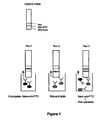
- BSA, BSA conjugated to FITC and BSA conjugated to biotin were applied to different zones of a nitro-cellulose dipstick at 1.5, 1.3 and 1 cm from the bottom of the disptick, respectively.
Landscapes
- Health & Medical Sciences (AREA)
- Life Sciences & Earth Sciences (AREA)
- Immunology (AREA)
- Engineering & Computer Science (AREA)
- Molecular Biology (AREA)
- Biomedical Technology (AREA)
- Chemical & Material Sciences (AREA)
- Hematology (AREA)
- Urology & Nephrology (AREA)
- Physics & Mathematics (AREA)
- Microbiology (AREA)
- Cell Biology (AREA)
- Food Science & Technology (AREA)
- Medicinal Chemistry (AREA)
- Biotechnology (AREA)
- Analytical Chemistry (AREA)
- Biochemistry (AREA)
- General Health & Medical Sciences (AREA)
- General Physics & Mathematics (AREA)
- Pathology (AREA)
- Tropical Medicine & Parasitology (AREA)
- Virology (AREA)
- Measuring Or Testing Involving Enzymes Or Micro-Organisms (AREA)
- Apparatus Associated With Microorganisms And Enzymes (AREA)
- Radar Systems Or Details Thereof (AREA)
- Investigating Or Analysing Materials By Optical Means (AREA)
- Luminescent Compositions (AREA)
- Saccharide Compounds (AREA)
- Devices For Conveying Motion By Means Of Endless Flexible Members (AREA)
- Acyclic And Carbocyclic Compounds In Medicinal Compositions (AREA)
Claims (30)
- Kit zum Ermitteln der Anwesenheit einer Mehrzahl verschiedener Targets in einer Probenlösung, der Folgendes beinhaltet:einen Messstab mit einer Mehrzahl verschiedener Erfassungszonen und einem an den jeweiligen Erfassungszonen immobilisierten unterschiedlichen Erfassungsanteil, wobei jeder Erfassungsanteil ein unterschiedliches Target erfassen kann; und, separat,eine Mehrzahl verschiedener Nachweissonden, wobei sich jede Nachweissonde an ein unterschiedliches Target binden kann und jede Nachweissonde mit einem Nachweissignal markiert wird oder die Bildung eines Nachweissignals ermöglicht, so dass die Anwesenheit der jeweiligen Targets durch die Bildung eines Signals in der Erfassungszone für die jeweiligen Targets angezeigt wird; wobei das Target für wenigstens zwei der Erfassungsanteile ein infektiöses Agens oder ein krankheitsverursachender Mikroorganismus oder ein Marker ist, der die Existenz einer Krankheit, Störung oder eines Zustands des Wirts, von dem die Probenlösung stammt, angibt, und wobei sich wenigstens zwei der Erfassungsanteile an unterschiedliche Komponenten oder Marker des gleichen infektiösen Agens oder krankheitsverursachenden Mikroorganismus als Targets solcher Erfassungsanteile binden können.
- Kit nach Anspruch 1, bei dem der Messstab ein von den Erfassungszonen entfernt gelegenes Kontaktende beinhaltet, das mit der Probenlösung in Kontakt kommt, wobei der Messstab die Probenlösung durch Kapillarwirkung zu den Erfassungszonen transportieren kann, wenn die Probenlösung mit dem Kontaktende in Kontakt kommt.
- Messstab zum Ermitteln der Anwesenheit einer Mehrzahl verschiedener Targets in einer Probenlösung, der Folgendes beinhaltet:eine Mehrzahl verschiedener Erfassungszonen und einen an den jeweiligen Erfassungszonen immobilisierten unterschiedlichen Erfassungsanteil, wobei sich jeder Erfassungsanteil an ein unterschiedliches Target binden kann; undeine Mehrzahl verschiedener Nachweissonden, die lösbar am Messstab immobilisiert sind, wobei sich jede Nachweissonde an ein anderes Target binden kann und jede Nachweissonde mit einem Nachweissignal markiert wird oder die Bildung eines Nachweissignals ermöglicht, so dass der Nachweis der jeweiligen Targets durch die Bildung eines Signals in der Erfassungszone für die jeweiligen Targets angezeigt wird; wobei das Target von wenigstens zwei der Erfassungsanteile ein infektiöses Agens oder ein krankheitsverursachender Mikroorganismus oder ein Marker ist, der die Existenz einer Krankheit, Störung oder eines Zustands des Wirts, von dem die Probenlösung stammt, angibt, und wobei sich wenigstens zwei der Erfassungsanteile an unterschiedliche Komponenten oder Marker des gleichen infektiösen Agens oder krankheitsverursachenden Mikroorganismus als Targets solcher Erfassungsanteile binden können.
- Messstab nach Anspruch 3, der ein von den Erfassungszonen entfernt gelegenes Kontaktende beinhaltet, das mit der Probenlösung in Kontakt kommt, und wobei die Nachweissonden zwischen dem Kontaktende und den Erfassungszonen lösbar immobilisiert sind, wobei der Messstab die Probenlösung durch Kapillarwirkung zu den Erfassungszonen transportieren kann, wenn die Probenlösung mit dem Kontaktende in Kontakt kommt.
- Kit oder Messstab nach einem der Ansprüche 1 bis 4, wobei jedes Nachweissignal eine andere Farbe ist.
- Kit oder Messstab nach einem der vorherigen Ansprüche, wobei wenigstens eine der Nachweissonden eine Nucleinsäure oder ein Nucleinsäureanalog umfasst, die/das mit ihrem/seinem Target hybridisieren kann.
- Kit oder Messstab nach einem der vorherigen Ansprüche, wobei wenigstens eine der Nachweissonden einen Antikörper oder ein Antikörperfragment umfasst.
- Kit oder Messstab nach einem der vorherigen Ansprüche, wobei wenigstens eine der Nachweissonden mit einem Textilfarbstoff, einem Metallsol wie kolloidales Gold oder farbigen Partikeln wie farbige Latexpartikel markiert ist.
- Kit oder Messstab nach einem der vorherigen Ansprüche, wobei wenigstens eine der Nachweissonden ein Umwandlungsenzym umfasst, das ein chromogenes Substrat umwandeln kann, wodurch die Bildung eines Farbsignals ermöglicht wird, das auf die Anwesenheit des Targets dieser Nachweissonde hindeutet.
- Kit nach Anspruch 9, der ferner das oder jedes chromogene Substrat beinhaltet, oder ein Kit, der einen Messstab nach Anspruch 9 und das oder jedes chromogene Substrat beinhaltet.
- Kit oder Messstab nach einem der vorherigen Ansprüche, wobei wenigstens eine der Nachweissonden einen Nachweisligand umfasst, der durch einen farbig markierten Nachweisligand-Bindungsanteil gebunden werden kann, wodurch die Bildung einer Farbe ermöglicht wird, die auf die Anwesenheit des Targets dieser Nachweissonde hindeutet.
- Kit nach Anspruch 11, der ferner den oder jeden farbig markierten Nachweisligand-Bindungsanteil umfasst, oder ein Kit, der einen Messstab nach Anspruch 11 und den oder jeden farbig markierten Nachweisligand-Bindungsanteil umfasst.
- Kit oder Messstab nach Anspruch 11, wobei der Messstab des Kits oder der Messstab ein Kontaktende und eine Konjugatzone zwischen dem Kontaktende und den Erfassungszonen beinhaltet, wobei der oder jeder farbig markierte Nachweisligand-Bindungsanteil lösbar an der Konjugatzone immobilisiert ist.
- Kit nach einem der Ansprüche 11 bis 13, wobei der oder wenigstens einer der Nachweisligand(en) Biotin ist und der oder wenigstens einer der farbig markierten Nachweisligand-Bindungsanteil(e) einen Anti-Biotin-Antikörper umfasst.
- Kit nach einem der Ansprüche 11 bis 14, wobei der oder wenigstens einer der Nachweisligand(en) FITC oder DNP ist und der oder wenigstens einer der farbig markierten Nachweisligand-Bindungsanteil(e) jeweils einen Anti-FITC-Antikörper oder einen Anti-DNP-Antikörper umfasst.
- Kit oder Messstab nach einem der vorherigen Ansprüche, wobei wenigstens eine der Nachweissonden Nucleinsäure beinhaltet, die durch eine farbig markierte Nucleinsäure gebunden werden kann, wodurch die Bildung einer Farbe ermöglicht wird, die auf die Anwesenheit des Targets dieser Nachweissonde hindeutet.
- Kit nach Anspruch 16, der ferner die oder jede farbig markierte Nucleinsäure umfasst, oder ein Kit, der einen Messstab nach Anspruch 16 und die oder jede farbig markierte Nucleinsäure umfasst.
- Kit oder Messstab nach einem der vorherigen Ansprüche, wobei wenigstens einer der Erfassungsanteile eine Nucleinsäure oder ein Nucleinsäureanalog umfasst.
- Kit oder Messstab nach einem der vorherigen Ansprüche, wobei wenigstens einer der Erfassungsanteile einen Antikörper oder ein Antikörperfragment umfasst.
- Kit oder Messstab nach einem der vorherigen Ansprüche, wobei sich ein erster Erfassungsanteil an Nucleinsäure des krankheitsverursachenden Mikroorganismus binden kann und ein zweiter Erfassungsanteil an ein Antigen des gleichen krankheitsverursachenden Mikroorganismus binden kann.
- Kit oder Messstab nach einem der vorherigen Ansprüche, wobei sich wenigstens zwei der Nachweissonden an unterschiedliche Komponenten des gleichen krankheitsverursachenden Mikroorganismus als Targets der dieser Nachweissonden binden können.
- Kit oder Messstab nach Anspruch 21, wobei sich eine erste Nachweissonde an Nucleinsäure des krankheitsverursachenden Mikroorganismus binden kann und eine zweite Nachweissonde an ein Antigen des gleichen krankheitsverursachenden Mikroorganismus binden kann.
- Kit oder Messstab nach einem der vorherigen Ansprüche, wobei das infektiöse Agens oder der krankheitsverursachende Mikroorganismus ein sexuell übertragener krankheitsverursachender Mikroorganismus wie HIV ist.
- Kit oder Messstab nach einem der vorherigen Ansprüche, wobei das infektiöse Agens oder der krankheitsverursachende Mikroorganismus Hep-A-Virus, Hep-B-Virus, Hep-C-Virus, E. Coli, H. Influenzae oder Helicobacter ist.
- Kit oder Messstab nach einem der vorherigen Ansprüche, wobei die verschiedenen Komponenten oder Marker für verschiedene Genotypen, Serotypen, Subtypen, Varianten, Stämme oder Mutanten der Krankheit, Störung oder des Zustands spezifisch sind.
- Kit oder Messstab nach einem der vorherigen Ansprüche, wobei die verschiedenen Komponenten oder Marker zu verschiedenen Zeitpunkten und/oder unter verschiedenen Bedingungen im Laufe der Krankheit, Störung oder des Zustands produziert werden und/oder verfügbar sind.
- Kit oder Messstab nach einem der vorherigen Ansprüche, wobei die gleiche Anzahl an Erfassungsanteilen wie Nachweissignale, zum Beispiel Farbsignale, vorhanden ist.
- Verwendung eines Kits oder eines Messstabs nach einem der vorherigen Ansprüche zum Ermitteln der Anwesenheit einer Mehrzahl verschiedener Targets in einer Probenlösung.
- Assay zum Ermitteln der Anwesenheit einer Mehrzahl verschiedener Targets in einer Probenlösung, umfassend die folgenden Schritte:Bereitstellen eines Messstabs mit einer Mehrzahl verschiedener Erfassungszonen und einem an den jeweiligen Erfassungszonen immobilisierten unterschiedlichen Erfassungsanteil, wobei jeder Erfassungsanteil ein anderes Target erfassen kann;Inkontaktbringen der Probenlösung mit einer Mehrzahl verschiedener Nachweissonden, wobei sich jede Nachweissonde an ein unterschiedliches Target binden kann und jede Nachweissonde mit einem anderen Nachweissignal markiert wird oder ein solches bilden kann; undInkontaktbringen der Probenlösung mit dem Messstab, so dass sich Targets in der Probenlösung an die Erfassungsanteile in den Erfassungszonen binden können und so dass die Anwesenheit der jeweiligen Targets durch die Bildung eines Signals in der Erfassungszone für dieses Target angezeigt wird, wobei das Target von wenigstens zwei der Erfassungsanteile ein infektiöses Agens oder ein krankheitsverursachender Mikroorganismus oder ein Marker ist, der die Existenz einer Krankheit, Störung oder eines Zustands des Wirts, von dem die Probenlösung stammt, angibt, und wobei sich wenigstens zwei der Erfassungsanteile an unterschiedliche Komponenten oder Marker des gleichen infektiösen Agens oder krankheitsverursachenden Mikroorganismus als Targets dieser Erfassungsanteile binden können.
- Assay nach Anspruch 29, wobei die Nachweissonden mit dem Messstab anstelle mit der Probenlösung in Kontakt gebracht werden, nachdem die Targets in den Erfassungszonen erfasst wurden.
Priority Applications (1)
| Application Number | Priority Date | Filing Date | Title |
|---|---|---|---|
| EP06011562A EP1710583A3 (de) | 2000-10-14 | 2001-10-15 | Bestätigungstest mit Indikatorstäbchen |
Applications Claiming Priority (3)
| Application Number | Priority Date | Filing Date | Title |
|---|---|---|---|
| GB0025245 | 2000-10-14 | ||
| GBGB0025245.2A GB0025245D0 (en) | 2000-10-14 | 2000-10-14 | Multiple target detection |
| PCT/GB2001/004589 WO2002033413A1 (en) | 2000-10-14 | 2001-10-15 | Dipstick assay |
Related Child Applications (1)
| Application Number | Title | Priority Date | Filing Date |
|---|---|---|---|
| EP06011562A Division EP1710583A3 (de) | 2000-10-14 | 2001-10-15 | Bestätigungstest mit Indikatorstäbchen |
Publications (2)
| Publication Number | Publication Date |
|---|---|
| EP1336105A1 EP1336105A1 (de) | 2003-08-20 |
| EP1336105B1 true EP1336105B1 (de) | 2006-06-07 |
Family
ID=9901314
Family Applications (2)
| Application Number | Title | Priority Date | Filing Date |
|---|---|---|---|
| EP01974533A Expired - Lifetime EP1336105B1 (de) | 2000-10-14 | 2001-10-15 | Teststab |
| EP06011562A Withdrawn EP1710583A3 (de) | 2000-10-14 | 2001-10-15 | Bestätigungstest mit Indikatorstäbchen |
Family Applications After (1)
| Application Number | Title | Priority Date | Filing Date |
|---|---|---|---|
| EP06011562A Withdrawn EP1710583A3 (de) | 2000-10-14 | 2001-10-15 | Bestätigungstest mit Indikatorstäbchen |
Country Status (8)
| Country | Link |
|---|---|
| US (1) | US7713746B2 (de) |
| EP (2) | EP1336105B1 (de) |
| AT (1) | ATE329266T1 (de) |
| AU (2) | AU2001294048A1 (de) |
| DE (1) | DE60120460T2 (de) |
| ES (1) | ES2266267T3 (de) |
| GB (1) | GB0025245D0 (de) |
| WO (2) | WO2002033414A1 (de) |
Families Citing this family (22)
| Publication number | Priority date | Publication date | Assignee | Title |
|---|---|---|---|---|
| GB0016813D0 (en) * | 2000-07-07 | 2000-08-30 | Lee Helen | Improved dipstick assays (4) |
| GB0016836D0 (en) | 2000-07-07 | 2000-08-30 | Lee Helen | Improved dipstick assays (1) |
| AU2004286307A1 (en) * | 2003-10-31 | 2005-05-12 | Vitatex, Inc. | Blood test prototypes and methods for the detection of circulating tumor and endothelial cells |
| US7282349B2 (en) | 2003-12-16 | 2007-10-16 | Kimberly-Clark Worldwide, Inc. | Solvatochromatic bacterial detection |
| CN101080497B (zh) * | 2003-12-16 | 2010-12-29 | 金伯利-克拉克环球有限公司 | 微生物检测与定量 |
| US7300770B2 (en) | 2004-12-16 | 2007-11-27 | Kimberly-Clark Worldwide, Inc. | Detection of microbe contamination on elastomeric articles |
| US7399608B2 (en) * | 2003-12-16 | 2008-07-15 | Kimberly-Clark Worldwide, Inc. | Microbial detection and quantification |
| GB2409519B (en) * | 2003-12-22 | 2005-11-09 | Prail Price Richardson Diagnos | Microorganism detector |
| US7465587B2 (en) * | 2004-12-03 | 2008-12-16 | Genzyme Corporation | Diagnostic assay device |
| US20070015291A1 (en) | 2005-07-18 | 2007-01-18 | Smith Henry J | Rapid test for glycated albumin in blood |
| US7727513B2 (en) | 2005-12-15 | 2010-06-01 | Kimberly-Clark Worldwide, Inc. | Method for screening for bacterial conjunctivitis |
| ES2433377T3 (es) * | 2006-02-21 | 2013-12-10 | Nexus Dx, Inc. | Procedimientos y composiciones para la detección de analitos |
| SG142186A1 (en) | 2006-10-20 | 2008-05-28 | Agency Science Tech & Res | Breast tumour grading |
| US20080138842A1 (en) * | 2006-12-11 | 2008-06-12 | Hans Boehringer | Indirect lateral flow sandwich assay |
| GB2500719B (en) * | 2012-03-30 | 2017-05-31 | Medical Wireless Sensing Ltd | Coupling electromagnetic radiation into a target |
| CN102830229B (zh) * | 2012-08-27 | 2014-12-17 | 北京新兴四寰生物技术有限公司 | 梅毒螺旋体IgM抗体胶体金法检测试剂及其制备方法 |
| EP3730929A1 (de) | 2013-08-19 | 2020-10-28 | University Of Houston | Phosphoreszierende reporter |
| GB201400115D0 (en) | 2014-01-05 | 2014-02-19 | Gerardos Georgios | Multiple ligands detection using an immunoassay device |
| WO2017139587A2 (en) | 2016-02-11 | 2017-08-17 | Massachusetts Institute Of Technology | Anti-dengue virus ns1 protein monoclonal antibodies |
| CN106706908A (zh) * | 2016-12-23 | 2017-05-24 | 苏州万木春生物技术有限公司 | 一种乙型肝炎病毒表面抗原检测试纸的制备方法 |
| CN109406773A (zh) * | 2018-12-27 | 2019-03-01 | 正元盛邦(天津)生物科技有限公司 | 一种用于促黄体生成素的毛细管检测试剂盒及其制备方法 |
| CN112924443B (zh) * | 2021-01-27 | 2023-04-14 | 上海化工院检测有限公司 | 一种湿壁式气体检测装置 |
Family Cites Families (22)
| Publication number | Priority date | Publication date | Assignee | Title |
|---|---|---|---|---|
| US5183742A (en) * | 1984-02-24 | 1993-02-02 | Dai Nippon Insatsu Kabushiki Kaisha | Test device for detecting glucose, protein urobilinogen, and/or occult blood in body fluids and/or determining the PH thereof |
| US4868108A (en) * | 1985-12-12 | 1989-09-19 | Hygeia Sciences, Incorporated | Multiple-antibody detection of antigen |
| ES2150428T3 (es) * | 1987-04-27 | 2000-12-01 | Unilever Nv | Ensayos de union especifica. |
| US4943522A (en) * | 1987-06-01 | 1990-07-24 | Quidel | Lateral flow, non-bibulous membrane assay protocols |
| GB2241329B (en) | 1990-01-10 | 1994-02-09 | Princeton Biomeditech Corp | No wash immunoassay |
| US5141850A (en) * | 1990-02-07 | 1992-08-25 | Hygeia Sciences, Inc. | Porous strip form assay device method |
| EP0566695B1 (de) * | 1991-01-11 | 1999-06-02 | Quidel Corporation | Einstufiges querfluss analysenverfahren und ein darin verwendeter nichtsaugfähiger träger |
| US5451504A (en) * | 1991-07-29 | 1995-09-19 | Serex, Inc. | Method and device for detecting the presence of analyte in a sample |
| GB9217865D0 (en) * | 1992-08-21 | 1992-10-07 | Unilever Plc | Monitoring method |
| WO1994023299A1 (en) * | 1993-03-31 | 1994-10-13 | Quidel Corporation | Multiple assay device |
| US5843691A (en) * | 1993-05-15 | 1998-12-01 | Lifescan, Inc. | Visually-readable reagent test strip |
| EP0705426A4 (de) * | 1993-06-09 | 1998-07-08 | Quidel Corp | Antigenspezifisches einstufiges verfahren |
| WO1995027081A1 (en) * | 1994-03-31 | 1995-10-12 | E.I. Du Pont De Nemours And Company | A method for detection of nucleic acid fragments |
| CA2207759A1 (en) * | 1994-12-22 | 1996-06-27 | Abbott Laboratories | Differential timing method for detecting multiple analytes in a test sample |
| WO1997001758A1 (en) | 1995-06-29 | 1997-01-16 | Dako A/S | Method for the simultaneous detection of different antibodies and/or antigens |
| US5741662A (en) * | 1995-12-18 | 1998-04-21 | Quidel Corporation | Direct stain specific binding assays for microorganisms |
| WO1998036278A1 (en) | 1997-02-15 | 1998-08-20 | Beth Israel Deaconess Medical Center, Inc. | Multiple-site antibody capture immunoassays and kits |
| GB0016836D0 (en) | 2000-07-07 | 2000-08-30 | Lee Helen | Improved dipstick assays (1) |
| GB0016814D0 (en) | 2000-07-07 | 2000-08-30 | Lee Helen | Improved dipstick assays (3) |
| GB0016833D0 (en) | 2000-07-07 | 2000-08-30 | Lee Helen | Improved dipstick assays (2) |
| GB0016813D0 (en) | 2000-07-07 | 2000-08-30 | Lee Helen | Improved dipstick assays (4) |
| GB0029154D0 (en) | 2000-11-30 | 2001-01-17 | Lee Helen | Signal enhancement with multiple labelled-antibodies |
-
2000
- 2000-10-14 GB GBGB0025245.2A patent/GB0025245D0/en not_active Ceased
-
2001
- 2001-10-15 AU AU2001294048A patent/AU2001294048A1/en not_active Abandoned
- 2001-10-15 EP EP01974533A patent/EP1336105B1/de not_active Expired - Lifetime
- 2001-10-15 AU AU2001295725A patent/AU2001295725A1/en not_active Withdrawn
- 2001-10-15 EP EP06011562A patent/EP1710583A3/de not_active Withdrawn
- 2001-10-15 US US10/398,918 patent/US7713746B2/en not_active Expired - Fee Related
- 2001-10-15 WO PCT/GB2001/004592 patent/WO2002033414A1/en not_active Ceased
- 2001-10-15 WO PCT/GB2001/004589 patent/WO2002033413A1/en not_active Ceased
- 2001-10-15 ES ES01974533T patent/ES2266267T3/es not_active Expired - Lifetime
- 2001-10-15 AT AT01974533T patent/ATE329266T1/de not_active IP Right Cessation
- 2001-10-15 DE DE60120460T patent/DE60120460T2/de not_active Expired - Lifetime
Also Published As
| Publication number | Publication date |
|---|---|
| GB0025245D0 (en) | 2000-11-29 |
| WO2002033413A1 (en) | 2002-04-25 |
| AU2001294048A1 (en) | 2002-04-29 |
| EP1710583A3 (de) | 2006-10-18 |
| ATE329266T1 (de) | 2006-06-15 |
| ES2266267T3 (es) | 2007-03-01 |
| EP1336105A1 (de) | 2003-08-20 |
| US20040014094A1 (en) | 2004-01-22 |
| AU2001295725A1 (en) | 2002-04-29 |
| EP1710583A2 (de) | 2006-10-11 |
| DE60120460T2 (de) | 2007-01-04 |
| WO2002033414A1 (en) | 2002-04-25 |
| US7713746B2 (en) | 2010-05-11 |
| DE60120460D1 (de) | 2006-07-20 |
Similar Documents
| Publication | Publication Date | Title |
|---|---|---|
| US7713746B2 (en) | Dipstick assay | |
| US4748110A (en) | Immunoassay for HTLV-III antigens | |
| Buttò et al. | Laboratory diagnostics for HIV infection | |
| Nielsen et al. | Diagnosis of HIV infection in children | |
| EP1018017B1 (de) | Bovine virale diarrhöe virus serumantigen fangimmuntest | |
| US20020006608A1 (en) | Whole blood/mitogen assay for the early detection of a subject infected with hepatitis c virus and kit | |
| ES2210678T3 (es) | Inmunoensayo que utiliza dos incubaciones con antigenos marcado. | |
| Wood et al. | Evaluation of a commercial monoclonal antibody-based enzyme immunoassay for detection of adenovirus types 40 and 41 in stool specimens | |
| Van Doornum et al. | Evaluation of hepatitis C antibody testing in saliva specimens collected by two different systems in comparison with HCV antibody and HCV RNA in serum | |
| Gardner | Rapid virus diagnosis | |
| NO171754B (no) | Immunokjemisk kompetitiv metode for bestemmelse av antistoffer mot hiv, et proevesett for gjennomfoering av fremgangsmaaten samt anvendelse av proevesettet | |
| Nkengasong et al. | Field evaluation of a combination of monospecific enzyme-linked immunosorbent assays for type-specific diagnosis of human immunodeficiency virus type 1 (HIV-1) and HIV-2 infections in HIV-seropositive persons in Abidjan, Ivory Coast | |
| Taylor et al. | Comparison of the ADVIA centaur® and Abbott AxSYM immunoassay systems for a routine diagnostic virology laboratory | |
| EP0196873B1 (de) | Diagnose für Mikroorganismen | |
| US9606120B2 (en) | Interfering peptides and method for detecting microorganisms | |
| Matter et al. | Comparison of four enzyme immunoassays for detection of immunoglobulin M antibodies against rubella virus | |
| US20070026386A1 (en) | Method for the detection of newly acquired hiv infection | |
| Fabrizi et al. | Serotyping strip immunoblot assay for assessing hepatitis C virus strains in dialysis patients | |
| Martinez-Martinez et al. | New lineal immunoenzymatic assay for simultaneous detection of p24 antigen and HIV antibodies | |
| Bhopale et al. | Assessment of enzyme linked immunosorbent assay based diagnostic kits (Toxokit-G and Toxokit-M) for the detection of IgG and IgM antibodies to Toxoplasma gondii in human serum | |
| JPH08248034A (ja) | タイプ特異的抗原を使用する血清学的タイプ分け方法 | |
| Moodley et al. | The relationship between maternal-infant antibody levels and vertical transmission of HIV-1 infection | |
| JPH08506663A (ja) | ワン−ポットアッセイ | |
| Smith et al. | A comparison of two supplemental procedures for confirmation of antibody to hepatitis C virus c100–3 antigen in Louisiana blood donors | |
| CN206420886U (zh) | 一种hiv抗原抗体检测卡 |
Legal Events
| Date | Code | Title | Description |
|---|---|---|---|
| PUAI | Public reference made under article 153(3) epc to a published international application that has entered the european phase |
Free format text: ORIGINAL CODE: 0009012 |
|
| 17P | Request for examination filed |
Effective date: 20030514 |
|
| AK | Designated contracting states |
Designated state(s): AT BE CH CY DE DK ES FI FR GB GR IE IT LI LU MC NL PT SE TR |
|
| AX | Request for extension of the european patent |
Extension state: AL LT LV MK RO SI |
|
| RAP1 | Party data changed (applicant data changed or rights of an application transferred) |
Owner name: DIAGNOSTICS FOR THE REAL WORLD, LTD. |
|
| 17Q | First examination report despatched |
Effective date: 20041214 |
|
| RAP1 | Party data changed (applicant data changed or rights of an application transferred) |
Owner name: DIAGNOSTICS FOR THE REAL WORLD, LTD |
|
| RAP1 | Party data changed (applicant data changed or rights of an application transferred) |
Owner name: DIAGNOSTICS FOR THE REAL WORLD, LTD |
|
| GRAP | Despatch of communication of intention to grant a patent |
Free format text: ORIGINAL CODE: EPIDOSNIGR1 |
|
| GRAS | Grant fee paid |
Free format text: ORIGINAL CODE: EPIDOSNIGR3 |
|
| GRAA | (expected) grant |
Free format text: ORIGINAL CODE: 0009210 |
|
| AK | Designated contracting states |
Kind code of ref document: B1 Designated state(s): AT BE CH CY DE DK ES FI FR GB GR IE IT LI LU MC NL PT SE TR |
|
| PG25 | Lapsed in a contracting state [announced via postgrant information from national office to epo] |
Ref country code: NL Free format text: LAPSE BECAUSE OF FAILURE TO SUBMIT A TRANSLATION OF THE DESCRIPTION OR TO PAY THE FEE WITHIN THE PRESCRIBED TIME-LIMIT Effective date: 20060607 Ref country code: IT Free format text: LAPSE BECAUSE OF FAILURE TO SUBMIT A TRANSLATION OF THE DESCRIPTION OR TO PAY THE FEE WITHIN THE PRESCRIBED TIME-LIMIT;WARNING: LAPSES OF ITALIAN PATENTS WITH EFFECTIVE DATE BEFORE 2007 MAY HAVE OCCURRED AT ANY TIME BEFORE 2007. THE CORRECT EFFECTIVE DATE MAY BE DIFFERENT FROM THE ONE RECORDED. Effective date: 20060607 Ref country code: AT Free format text: LAPSE BECAUSE OF FAILURE TO SUBMIT A TRANSLATION OF THE DESCRIPTION OR TO PAY THE FEE WITHIN THE PRESCRIBED TIME-LIMIT Effective date: 20060607 Ref country code: BE Free format text: LAPSE BECAUSE OF FAILURE TO SUBMIT A TRANSLATION OF THE DESCRIPTION OR TO PAY THE FEE WITHIN THE PRESCRIBED TIME-LIMIT Effective date: 20060607 Ref country code: FI Free format text: LAPSE BECAUSE OF FAILURE TO SUBMIT A TRANSLATION OF THE DESCRIPTION OR TO PAY THE FEE WITHIN THE PRESCRIBED TIME-LIMIT Effective date: 20060607 |
|
| REG | Reference to a national code |
Ref country code: GB Ref legal event code: FG4D |
|
| REG | Reference to a national code |
Ref country code: CH Ref legal event code: EP |
|
| REG | Reference to a national code |
Ref country code: IE Ref legal event code: FG4D |
|
| REF | Corresponds to: |
Ref document number: 60120460 Country of ref document: DE Date of ref document: 20060720 Kind code of ref document: P |
|
| PG25 | Lapsed in a contracting state [announced via postgrant information from national office to epo] |
Ref country code: DK Free format text: LAPSE BECAUSE OF FAILURE TO SUBMIT A TRANSLATION OF THE DESCRIPTION OR TO PAY THE FEE WITHIN THE PRESCRIBED TIME-LIMIT Effective date: 20060907 Ref country code: SE Free format text: LAPSE BECAUSE OF FAILURE TO SUBMIT A TRANSLATION OF THE DESCRIPTION OR TO PAY THE FEE WITHIN THE PRESCRIBED TIME-LIMIT Effective date: 20060907 |
|
| REG | Reference to a national code |
Ref country code: CH Ref legal event code: NV Representative=s name: PATENTANWAELTE SCHAAD, BALASS, MENZL & PARTNER AG |
|
| PG25 | Lapsed in a contracting state [announced via postgrant information from national office to epo] |
Ref country code: MC Free format text: LAPSE BECAUSE OF NON-PAYMENT OF DUE FEES Effective date: 20061031 |
|
| PG25 | Lapsed in a contracting state [announced via postgrant information from national office to epo] |
Ref country code: PT Free format text: LAPSE BECAUSE OF FAILURE TO SUBMIT A TRANSLATION OF THE DESCRIPTION OR TO PAY THE FEE WITHIN THE PRESCRIBED TIME-LIMIT Effective date: 20061107 |
|
| NLV1 | Nl: lapsed or annulled due to failure to fulfill the requirements of art. 29p and 29m of the patents act | ||
| ET | Fr: translation filed | ||
| REG | Reference to a national code |
Ref country code: ES Ref legal event code: FG2A Ref document number: 2266267 Country of ref document: ES Kind code of ref document: T3 |
|
| PLBE | No opposition filed within time limit |
Free format text: ORIGINAL CODE: 0009261 |
|
| STAA | Information on the status of an ep patent application or granted ep patent |
Free format text: STATUS: NO OPPOSITION FILED WITHIN TIME LIMIT |
|
| 26N | No opposition filed |
Effective date: 20070308 |
|
| PG25 | Lapsed in a contracting state [announced via postgrant information from national office to epo] |
Ref country code: GR Free format text: LAPSE BECAUSE OF FAILURE TO SUBMIT A TRANSLATION OF THE DESCRIPTION OR TO PAY THE FEE WITHIN THE PRESCRIBED TIME-LIMIT Effective date: 20060908 |
|
| PG25 | Lapsed in a contracting state [announced via postgrant information from national office to epo] |
Ref country code: TR Free format text: LAPSE BECAUSE OF FAILURE TO SUBMIT A TRANSLATION OF THE DESCRIPTION OR TO PAY THE FEE WITHIN THE PRESCRIBED TIME-LIMIT Effective date: 20060607 Ref country code: LU Free format text: LAPSE BECAUSE OF NON-PAYMENT OF DUE FEES Effective date: 20061015 |
|
| PG25 | Lapsed in a contracting state [announced via postgrant information from national office to epo] |
Ref country code: CY Free format text: LAPSE BECAUSE OF FAILURE TO SUBMIT A TRANSLATION OF THE DESCRIPTION OR TO PAY THE FEE WITHIN THE PRESCRIBED TIME-LIMIT Effective date: 20060607 |
|
| PGFP | Annual fee paid to national office [announced via postgrant information from national office to epo] |
Ref country code: IE Payment date: 20101015 Year of fee payment: 10 |
|
| PGFP | Annual fee paid to national office [announced via postgrant information from national office to epo] |
Ref country code: CH Payment date: 20101012 Year of fee payment: 10 |
|
| REG | Reference to a national code |
Ref country code: CH Ref legal event code: PL |
|
| PG25 | Lapsed in a contracting state [announced via postgrant information from national office to epo] |
Ref country code: LI Free format text: LAPSE BECAUSE OF NON-PAYMENT OF DUE FEES Effective date: 20111031 Ref country code: CH Free format text: LAPSE BECAUSE OF NON-PAYMENT OF DUE FEES Effective date: 20111031 |
|
| REG | Reference to a national code |
Ref country code: IE Ref legal event code: MM4A |
|
| PG25 | Lapsed in a contracting state [announced via postgrant information from national office to epo] |
Ref country code: IE Free format text: LAPSE BECAUSE OF NON-PAYMENT OF DUE FEES Effective date: 20111015 |
|
| REG | Reference to a national code |
Ref country code: FR Ref legal event code: PLFP Year of fee payment: 15 |
|
| REG | Reference to a national code |
Ref country code: FR Ref legal event code: PLFP Year of fee payment: 16 |
|
| REG | Reference to a national code |
Ref country code: FR Ref legal event code: PLFP Year of fee payment: 17 |
|
| REG | Reference to a national code |
Ref country code: FR Ref legal event code: PLFP Year of fee payment: 18 |
|
| PGFP | Annual fee paid to national office [announced via postgrant information from national office to epo] |
Ref country code: GB Payment date: 20200902 Year of fee payment: 20 |
|
| PGFP | Annual fee paid to national office [announced via postgrant information from national office to epo] |
Ref country code: DE Payment date: 20201009 Year of fee payment: 20 Ref country code: ES Payment date: 20201112 Year of fee payment: 20 Ref country code: FR Payment date: 20201016 Year of fee payment: 20 Ref country code: IT Payment date: 20201027 Year of fee payment: 20 |
|
| REG | Reference to a national code |
Ref country code: DE Ref legal event code: R071 Ref document number: 60120460 Country of ref document: DE |
|
| REG | Reference to a national code |
Ref country code: GB Ref legal event code: PE20 Expiry date: 20211014 |
|
| REG | Reference to a national code |
Ref country code: ES Ref legal event code: FD2A Effective date: 20220126 |
|
| PG25 | Lapsed in a contracting state [announced via postgrant information from national office to epo] |
Ref country code: GB Free format text: LAPSE BECAUSE OF EXPIRATION OF PROTECTION Effective date: 20211014 |
|
| PG25 | Lapsed in a contracting state [announced via postgrant information from national office to epo] |
Ref country code: ES Free format text: LAPSE BECAUSE OF EXPIRATION OF PROTECTION Effective date: 20211016 |