EP1336372A2 - System zur Augenvervolgung mit Personenidentifikation - Google Patents
System zur Augenvervolgung mit Personenidentifikation Download PDFInfo
- Publication number
- EP1336372A2 EP1336372A2 EP03075245A EP03075245A EP1336372A2 EP 1336372 A2 EP1336372 A2 EP 1336372A2 EP 03075245 A EP03075245 A EP 03075245A EP 03075245 A EP03075245 A EP 03075245A EP 1336372 A2 EP1336372 A2 EP 1336372A2
- Authority
- EP
- European Patent Office
- Prior art keywords
- person
- eye
- eye tracking
- driver
- ocular profile
- Prior art date
- Legal status (The legal status is an assumption and is not a legal conclusion. Google has not performed a legal analysis and makes no representation as to the accuracy of the status listed.)
- Withdrawn
Links
Images
Classifications
-
- G—PHYSICS
- G06—COMPUTING OR CALCULATING; COUNTING
- G06V—IMAGE OR VIDEO RECOGNITION OR UNDERSTANDING
- G06V40/00—Recognition of biometric, human-related or animal-related patterns in image or video data
- G06V40/10—Human or animal bodies, e.g. vehicle occupants or pedestrians; Body parts, e.g. hands
- G06V40/18—Eye characteristics, e.g. of the iris
- G06V40/19—Sensors therefor
-
- A—HUMAN NECESSITIES
- A61—MEDICAL OR VETERINARY SCIENCE; HYGIENE
- A61B—DIAGNOSIS; SURGERY; IDENTIFICATION
- A61B3/00—Apparatus for testing the eyes; Instruments for examining the eyes
- A61B3/10—Objective types, i.e. instruments for examining the eyes independent of the patients' perceptions or reactions
- A61B3/113—Objective types, i.e. instruments for examining the eyes independent of the patients' perceptions or reactions for determining or recording eye movement
-
- G—PHYSICS
- G06—COMPUTING OR CALCULATING; COUNTING
- G06V—IMAGE OR VIDEO RECOGNITION OR UNDERSTANDING
- G06V30/00—Character recognition; Recognising digital ink; Document-oriented image-based pattern recognition
- G06V30/10—Character recognition
- G06V30/24—Character recognition characterised by the processing or recognition method
- G06V30/242—Division of the character sequences into groups prior to recognition; Selection of dictionaries
- G06V30/244—Division of the character sequences into groups prior to recognition; Selection of dictionaries using graphical properties, e.g. alphabet type or font
-
- G—PHYSICS
- G06—COMPUTING OR CALCULATING; COUNTING
- G06V—IMAGE OR VIDEO RECOGNITION OR UNDERSTANDING
- G06V40/00—Recognition of biometric, human-related or animal-related patterns in image or video data
- G06V40/10—Human or animal bodies, e.g. vehicle occupants or pedestrians; Body parts, e.g. hands
- G06V40/16—Human faces, e.g. facial parts, sketches or expressions
-
- G—PHYSICS
- G07—CHECKING-DEVICES
- G07C—TIME OR ATTENDANCE REGISTERS; REGISTERING OR INDICATING THE WORKING OF MACHINES; GENERATING RANDOM NUMBERS; VOTING OR LOTTERY APPARATUS; ARRANGEMENTS, SYSTEMS OR APPARATUS FOR CHECKING NOT PROVIDED FOR ELSEWHERE
- G07C9/00—Individual registration on entry or exit
- G07C9/30—Individual registration on entry or exit not involving the use of a pass
- G07C9/32—Individual registration on entry or exit not involving the use of a pass in combination with an identity check
- G07C9/37—Individual registration on entry or exit not involving the use of a pass in combination with an identity check using biometric data, e.g. fingerprints, iris scans or voice recognition
-
- G—PHYSICS
- G08—SIGNALLING
- G08B—SIGNALLING SYSTEMS, e.g. PERSONAL CALLING SYSTEMS; ORDER TELEGRAPHS; ALARM SYSTEMS
- G08B21/00—Alarms responsive to a single specified undesired or abnormal condition and not otherwise provided for
- G08B21/02—Alarms for ensuring the safety of persons
- G08B21/06—Alarms for ensuring the safety of persons indicating a condition of sleep, e.g. anti-dozing alarms
Definitions
- the present invention relates to eye tracking systems generally and, more particularly, but not by way of limitation, to novel eye tracking system with a larger field of view and a higher resolution imager.
- driver inattention may result from drowsiness, use of a telephone, use of a computer, changing stations on a radio, conversing with another occupant of the vehicle, and similar causes. Whatever the cause, such driver inattention may result in fatalities and non-fatal accidents.
- Eye tracking can be an accurate, non-intrusive, non-contact method, which detects driver inattention and fatigue by recording eye movement.
- Parameters such as blink duration, blink frequency, and eye closure can be useful for detecting drowsiness, fatigue, and other causes of inattentiveness.
- Pupillary data such as diameter, shape, location, and rate of change can be useful in determining the direction of the driver's gaze and workload.
- the limbus eye tracking method utilizes the difference in reflectance between the sclera and the iris.
- the reflectively difference produces a contrast that can be monitored by photodetectors mounted on either side of the eyeball. This method requires head mounted sensors and, when used alone, is sensitive to head movement when calculating gaze.
- the pupil tracking method is similar to the limbus tracking method, except that it uses the boundary between the pupil and iris, rather than the boundary between the sclera and the iris.
- This method is advantageous in that the pupil is far less covered by the eyelid than is the limbus and the border is sharper than that of the limbus, thus offering a higher resolution.
- a disadvantage is that the contrast is lower.
- the cornea/pupil relationship method may be one of two types.
- dark pupil tracking collimated, on-axis IR illumination causes a dark pupil to appear bright.
- the high contrast with the dark pupil acts as a light sink.
- bright pupil tracking uncollimated, off-axis IR illumination reflects off the retina similar to the reflection seen from the eyes of a nocturnal animal or in red-eye from flash photography.
- a CCD or CMOS detector is used. Pupil edge is located and the center is calculated.
- the artificial neural network method uses brain waves and artificial intelligence in software to calculate alertness, etc. Capturing the brain waves requires the use of electrodes placed on the scalp or placing the subject in an MRI type of device.
- the dual Purkinje image method compares the corneal reflection to the reflection from the back surface of the lens. Measurements are made of the relative displacement between the first and fourth reflections, to the shape and size of the pupil, which represent the focal point. Because the IR illumination has to travel through seven interfaces, the method is very inefficient and requires a relatively powerful illumination source.
- the electro-oculographic method calculates eye position by measuring the potential difference between the front and back of the eyeball. This method is simple, but not reliable, due to signal variations over time, and not precise, due to noise levels. Of course, electrodes must be placed around the eye.
- the search coil method requires that induction coils be embedded in the sclera or in tight fitting contact lenses. This is a very accurate method, but also quite intrusive.
- the video-oculographic method gives an accurate measurement of eye components, including ocular torsion.
- the method also provides pupil diameter measurement and monocular and binocular measurement with pupil diameter. There is no drift and reduced noise sensitivity.
- a system used in vehicular eye tracking includes one or two IR sources directed at an eye of the driver, a combination of mirrors and motors, an eye camera module, and a processing and control unit.
- the eye camera module captures and sends an image of the eye to the processing and control unit, which calculates the direction of driver gaze by comparing the locations of the two spots in the pupil.
- the mirror/motor combination is used in front of the eye camera adjusts to try to track the driver's eye as the driver's head is moved and also adjusts to driver height through calibration. This requires a complex and expensive auto focus and tracking system.
- Another problem with such current eye tracking systems is that, since each person has a slightly different ocular profile that can result in a large error in calculation, the eye tracking system needs to be calibrated for each different driver. This is done by having the driver sit still in the driver's seat, while an instructor sits in the front passenger seat. The instructor tells the driver to look at a particular spot, or fixate on predetermined alignment coordinates, for a short period of time. The instructor then measures and records oculometric data. This procedure is repeated some six or nine times. Then, the instructor takes the recorded data and develops an ocular profile of the driver that is recorded in a look-up table that is manually accessed for each driver. This must be done for each potential driver of the vehicle. In addition to the fairly tedious start-up procedure, periodic recalibration is required because of drift.
- the present invention achieves the above objects, among others, by providing, in preferred embodiments, apparatus for and method of eye tracking, comprising, in sequence, the steps of: viewing an entire face of a person to obtain predetermined facial features of said person to identify or not said person; if said person is identified, retrieving a previously stored ocular profile of said person based on said predetermined facial features; using said ocular profile to track movement of an eye of said person. If the person is not identified, an ocular profile is created.
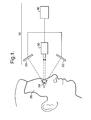
- FIG. 1 illustrates an example of a system, according to the present invention, and generally indicated by the reference numeral 10.
- System 10 includes first and second IR sources 20 and 22 disposed so as to illuminate at least the area around one eye 24 in the face 26 of a user (only the face shown).
- System 10 also includes a sensor module 30 disposed so as to receive reflections from the eye and to track movements of eye 24.
- Sensor module 30 could include electronic pan tilt to compensate for head and eye movement and the sensor module provides input to processing and control circuitry in a processing platform 40, the processing and control circuitry also controlling the other elements of system 10.
- Illumination sources 20 other than IR may be provided, as long as the other illumination sources are non-intrusive.
- System 10 has no moving parts.
- the conventional, low-resolution CCD sensor in sensor module 30 has been replaced in this invention with a high-resolution CMOS device, which permits a larger field of view, while maintaining the minimum required pixel density for precise oculometric data acquisition and permits increased freedom of head movement.
- This change increases the resolution of system 10 from the conventional sub-QVGA to high resolution such as SXGA (1280 x 1024 pixels).
- SXGA 1280 x 1024 pixels
- Facial feature extraction enables the system to recognize the driver of whom the oculometric profile is stored and uploaded quickly. This then eliminates the need for annoying recalibration for different learned drivers, as well as expedites the learning process. Facial feature extraction also enables autocalibration by the use of search and recognition algorithms to determined eye location and its associated oculometric geometry within system 10. Facial feature extraction can also be used to determine how the vehicle can be operated or access to various areas of the vehicle. For example, if the driver is not recognized, the operating system may go into "valet mode" in which certain areas of the vehicle, such as the glove compartment or the trunk of the vehicle cannot be accessed by the driver.
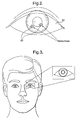
- Figure 2 illustrates the reflections 60 of IR sources 20 (Figure 1) in the eye 24 of a driver. It will be understood that the reflections shown on Figure 2 are for illustrative purposes only and that the reflections would not be visible. This is an example of a non-contact technique that uses the pupil/cornea reflection principle. The positions of the pupil and reflex centers are determined from a digitized video image and the driver's point of gaze is determined by calculating the difference vectors of reflections 60.
- Figure 3 illustrates the full face view and an eye view as used by system 10 ( Figure 10), the use of which is described below.
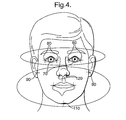
- Figure 4 illustrates facial features that a configuration similar to system 10 ( Figure 1) may use to identify a driver. These include the positions and sizes of: the eyes 70, the corners 80 of the eyes, the ears 90, the corners 100 of the mouth, the chin 110, and the ala 120, of the nose.
- Initial calibration now requires only that a driver sit in the driver's seat.
- System 10 automatically scans the face of the driver and stores identifying information in memory. Now, when the same driver sits in the driver's seat, system 10 scans the face of the driver, recognizes the driver and automatically uploads the driver's profile, eliminating the need to re-calibrate for different drivers. This profile can also be used to identify the driver and load stored presets. Of course, portions of system 10 may be overridden if, for example, the vehicle is to be given to a parking valet.
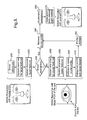
- Figure 5 is a logic flow diagram illustrating the operation of system 10 ( Figure 1).
- the whole face of a driver constitutes the field of view.
- the driver enters the vehicle at step 200.
- the system searches for particular facial features.
- the system acquires the facial features of the driver ( Figure 4).
- the system determines if the driver is recognized. If the driver is recognized, the driver's ocular profile is retrieved at step 240 from profile storage 250. This is used at step 260 to perform oculometric calculations.
- oculometrics are determined while continuing to use the whole face of the driver in the field of view.
- the system uses SXGA resolution in which an eye of the driver fills the entire field of view and, at step 280, the system searches for ocular features.
- the system acquires the ocular features.
- the system calibrates and creates an ocular profile. The ocular profile created at step 300 is then categorized at step 310 with the facial features acquired at step 220 and the ocular profile is stored in the profile storage 250.
- the system goes into standby mode until a face is recognized, with the system using the whole face in the field of view. Then, knowing where the eye being tracked is located on the face, the system can again use the ocular profile to perform oculometric calculations. The system differentiates between a normal blink and the loss of data.
Landscapes
- Engineering & Computer Science (AREA)
- Physics & Mathematics (AREA)
- General Physics & Mathematics (AREA)
- Health & Medical Sciences (AREA)
- Human Computer Interaction (AREA)
- Theoretical Computer Science (AREA)
- Multimedia (AREA)
- Life Sciences & Earth Sciences (AREA)
- General Health & Medical Sciences (AREA)
- Ophthalmology & Optometry (AREA)
- Medical Informatics (AREA)
- Public Health (AREA)
- Biomedical Technology (AREA)
- Molecular Biology (AREA)
- Surgery (AREA)
- Animal Behavior & Ethology (AREA)
- Biophysics (AREA)
- Heart & Thoracic Surgery (AREA)
- Veterinary Medicine (AREA)
- Oral & Maxillofacial Surgery (AREA)
- Emergency Management (AREA)
- Business, Economics & Management (AREA)
- Computer Vision & Pattern Recognition (AREA)
- Eye Examination Apparatus (AREA)
- Collating Specific Patterns (AREA)
Applications Claiming Priority (2)
| Application Number | Priority Date | Filing Date | Title |
|---|---|---|---|
| US78871 | 1979-09-26 | ||
| US10/078,871 US6873714B2 (en) | 2002-02-19 | 2002-02-19 | Auto calibration and personalization of eye tracking system using larger field of view imager with higher resolution |
Publications (2)
| Publication Number | Publication Date |
|---|---|
| EP1336372A2 true EP1336372A2 (de) | 2003-08-20 |
| EP1336372A3 EP1336372A3 (de) | 2004-06-16 |
Family
ID=27622804
Family Applications (1)
| Application Number | Title | Priority Date | Filing Date |
|---|---|---|---|
| EP03075245A Withdrawn EP1336372A3 (de) | 2002-02-19 | 2003-01-27 | System zur Augenvervolgung mit Personenidentifikation |
Country Status (2)
| Country | Link |
|---|---|
| US (1) | US6873714B2 (de) |
| EP (1) | EP1336372A3 (de) |
Cited By (11)
| Publication number | Priority date | Publication date | Assignee | Title |
|---|---|---|---|---|
| WO2007043954A1 (en) * | 2005-10-10 | 2007-04-19 | Tobii Technology Ab | Eye tracker having an extended span of operating distances |
| EP1801730A1 (de) * | 2005-12-23 | 2007-06-27 | Delphi Technologies, Inc. | Verfahren zur Ermittlung des Zustandes eines Fahrzeugbedieners |
| WO2007085682A1 (en) * | 2006-01-26 | 2007-08-02 | Nokia Corporation | Eye tracker device |
| WO2008066410A1 (en) * | 2006-11-28 | 2008-06-05 | Dmitry Evgenievich Antonov | Device for producing an iris image |
| EP1725999A4 (de) * | 2004-03-16 | 2008-08-27 | Nattel Group Inc | System und verfahren zum überwachen des betriebszustands eines kraftfahrzeugs |
| WO2008142697A3 (en) * | 2007-05-24 | 2009-02-12 | Yossef Gerard Cohen | Security system and method |
| CN100589752C (zh) * | 2005-10-10 | 2010-02-17 | 托比技术有限公司 | 具有延长范围的操作距离的眼跟踪器 |
| WO2012146689A1 (en) * | 2011-04-28 | 2012-11-01 | Intervet International B.V. | Method of capturing image data for iris code based identification of vertebrates |
| CN103279750A (zh) * | 2013-06-14 | 2013-09-04 | 清华大学 | 基于肤色范围的驾驶员手持电话行为检测方法 |
| US9612656B2 (en) | 2012-11-27 | 2017-04-04 | Facebook, Inc. | Systems and methods of eye tracking control on mobile device |
| CN108629876A (zh) * | 2018-04-27 | 2018-10-09 | 深圳爱酷智能科技有限公司 | 锁具的报警方法、设备及计算机可读存储介质 |
Families Citing this family (59)
| Publication number | Priority date | Publication date | Assignee | Title |
|---|---|---|---|---|
| EP1211640A3 (de) * | 2000-09-15 | 2003-10-15 | Canon Kabushiki Kaisha | Bildverarbeitungsverfahren und -Vorrichtung zur Detektion von menschlichen Gesichtern Augen und anderen Objekten in einem Bild |
| JP2003016435A (ja) * | 2001-06-27 | 2003-01-17 | Matsushita Electric Ind Co Ltd | 個体認証装置及び方法 |
| DE10251933B4 (de) * | 2002-11-08 | 2006-12-14 | Ludwig-Maximilians-Universität München (Körperschaft des öffentlichen Rechts) | Aufnahmevorrichtung für die kopfgestützte Bilderfassung und Verfahren zur Steuerung der Aufnahmevorrichtung |
| DE10339314B3 (de) * | 2003-08-27 | 2005-04-21 | Fraunhofer-Gesellschaft zur Förderung der angewandten Forschung e.V. | Verfahren zur Anzeigesteuerung von unterschiedlichen Informationen in einem Fahrzeug und optoakustische Informationseinheit |
| US7091867B2 (en) * | 2004-02-20 | 2006-08-15 | Agilent Technologies, Inc. | Wavelength selectivity enabling subject monitoring outside the subject's field of view |
| WO2005086802A2 (en) | 2004-03-08 | 2005-09-22 | Proxense, Llc | Linked account system using personal digital key (pdk-las) |
| US20060259206A1 (en) * | 2005-05-16 | 2006-11-16 | Smith Matthew R | Vehicle operator monitoring system and method |
| US7835834B2 (en) * | 2005-05-16 | 2010-11-16 | Delphi Technologies, Inc. | Method of mitigating driver distraction |
| JP4375288B2 (ja) * | 2005-06-23 | 2009-12-02 | コニカミノルタビジネステクノロジーズ株式会社 | ユーザインタフェース装置、ユーザインタフェース装置の制御方法、およびユーザインタフェース装置の制御プログラム |
| US20070036438A1 (en) * | 2005-08-15 | 2007-02-15 | Lexmark International, Inc. | Methods and systems for identifying red eye pairs |
| WO2007019842A2 (de) * | 2005-08-17 | 2007-02-22 | Seereal Technologies Gmbh | Verfahren und schaltungsanordnung zum erkennen und verfolgen von augen mehrerer betrachter in echtzeit |
| US8433919B2 (en) | 2005-11-30 | 2013-04-30 | Proxense, Llc | Two-level authentication for secure transactions |
| US8340672B2 (en) | 2006-01-06 | 2012-12-25 | Proxense, Llc | Wireless network synchronization of cells and client devices on a network |
| US11206664B2 (en) | 2006-01-06 | 2021-12-21 | Proxense, Llc | Wireless network synchronization of cells and client devices on a network |
| US7742621B2 (en) * | 2006-06-13 | 2010-06-22 | Delphi Technologies, Inc. | Dynamic eye tracking system |
| US9269221B2 (en) | 2006-11-13 | 2016-02-23 | John J. Gobbi | Configuration of interfaces for a location detection system and application |
| WO2009062194A1 (en) | 2007-11-09 | 2009-05-14 | Proxense, Llc | Proximity-sensor supporting multiple application services |
| DE102007056528B3 (de) * | 2007-11-16 | 2009-04-02 | Seereal Technologies S.A. | Verfahren und Vorrichtung zum Auffinden und Verfolgen von Augenpaaren |
| US8171528B1 (en) | 2007-12-06 | 2012-05-01 | Proxense, Llc | Hybrid device having a personal digital key and receiver-decoder circuit and methods of use |
| US9251332B2 (en) | 2007-12-19 | 2016-02-02 | Proxense, Llc | Security system and method for controlling access to computing resources |
| WO2009102979A2 (en) | 2008-02-14 | 2009-08-20 | Proxense, Llc | Proximity-based healthcare management system with automatic access to private information |
| US11120449B2 (en) | 2008-04-08 | 2021-09-14 | Proxense, Llc | Automated service-based order processing |
| EP2271251A4 (de) * | 2008-04-14 | 2012-09-19 | Univ Johns Hopkins | Systeme und verfahren zur überprüfung der vestibulären und okulomotorischen funktion |
| US7736000B2 (en) * | 2008-08-27 | 2010-06-15 | Locarna Systems, Inc. | Method and apparatus for tracking eye movement |
| JP5210773B2 (ja) * | 2008-09-16 | 2013-06-12 | トヨタ自動車株式会社 | 眠気判定装置及びプログラム |
| WO2010071928A1 (en) | 2008-12-22 | 2010-07-01 | Seeing Machines Limited | Automatic calibration of a gaze direction algorithm from user behaviour |
| US20120105486A1 (en) * | 2009-04-09 | 2012-05-03 | Dynavox Systems Llc | Calibration free, motion tolerent eye-gaze direction detector with contextually aware computer interaction and communication methods |
| WO2010143118A1 (en) * | 2009-06-12 | 2010-12-16 | Koninklijke Philips Electronics N.V. | System and method for biometric identification |
| US9418205B2 (en) | 2010-03-15 | 2016-08-16 | Proxense, Llc | Proximity-based system for automatic application or data access and item tracking |
| US9322974B1 (en) | 2010-07-15 | 2016-04-26 | Proxense, Llc. | Proximity-based system for object tracking |
| KR20120057033A (ko) * | 2010-11-26 | 2012-06-05 | 한국전자통신연구원 | Iptv 제어를 위한 원거리 시선 추적 장치 및 방법 |
| US9265450B1 (en) | 2011-02-21 | 2016-02-23 | Proxense, Llc | Proximity-based system for object tracking and automatic application initialization |
| US9380978B2 (en) | 2011-06-29 | 2016-07-05 | Bruce Reiner | Method and apparatus for real-time measurement and analysis of occupational stress and fatigue and performance outcome predictions |
| CA2853709C (en) | 2011-10-27 | 2020-09-01 | Tandemlaunch Technologies Inc. | System and method for calibrating eye gaze data |
| US20130188825A1 (en) * | 2012-01-19 | 2013-07-25 | Utechzone Co., Ltd. | Image recognition-based startup method |
| US9265458B2 (en) | 2012-12-04 | 2016-02-23 | Sync-Think, Inc. | Application of smooth pursuit cognitive testing paradigms to clinical drug development |
| US8856541B1 (en) | 2013-01-10 | 2014-10-07 | Google Inc. | Liveness detection |
| US9380976B2 (en) | 2013-03-11 | 2016-07-05 | Sync-Think, Inc. | Optical neuroinformatics |
| US9405898B2 (en) | 2013-05-10 | 2016-08-02 | Proxense, Llc | Secure element as a digital pocket |
| US10048748B2 (en) * | 2013-11-12 | 2018-08-14 | Excalibur Ip, Llc | Audio-visual interaction with user devices |
| US9361519B2 (en) | 2014-03-28 | 2016-06-07 | Intel Corporation | Computational array camera with dynamic illumination for eye tracking |
| US9829547B2 (en) | 2014-05-08 | 2017-11-28 | Resonance Technology, Inc. | Head-up display with eye-tracker for MRI applications |
| EP3140779A4 (de) | 2014-05-09 | 2017-11-29 | Google LLC | Systeme und verfahren zur verwendung von augensignalen mit sicherer mobilkommunikation |
| US10564714B2 (en) | 2014-05-09 | 2020-02-18 | Google Llc | Systems and methods for biomechanically-based eye signals for interacting with real and virtual objects |
| US9814386B2 (en) | 2014-07-02 | 2017-11-14 | IDx, LLC | Systems and methods for alignment of the eye for ocular imaging |
| KR20160071139A (ko) * | 2014-12-11 | 2016-06-21 | 삼성전자주식회사 | 시선 캘리브레이션 방법 및 그 전자 장치 |
| US11567566B2 (en) * | 2015-04-08 | 2023-01-31 | Controlrad Systems, Inc. | Devices and methods for monitoring gaze |
| US11061233B2 (en) | 2015-06-30 | 2021-07-13 | 3M Innovative Properties Company | Polarizing beam splitter and illuminator including same |
| US10535163B2 (en) * | 2016-12-01 | 2020-01-14 | Pinscreen, Inc. | Avatar digitization from a single image for real-time rendering |
| US10832148B2 (en) * | 2016-12-07 | 2020-11-10 | International Business Machines Corporation | Cognitive dialog system for driving safety |
| WO2019028798A1 (zh) * | 2017-08-10 | 2019-02-14 | 北京市商汤科技开发有限公司 | 驾驶状态监控方法、装置和电子设备 |
| IL282574B2 (en) | 2017-09-18 | 2023-10-01 | Element Inc | Methods, systems, and media for detecting spoofing in mobile authentication |
| WO2020016631A1 (en) | 2018-07-16 | 2020-01-23 | Bosch Car Multimedia Portugal S.a. | Artificial eye for calibration of an eye-tracker, eye tracking calibration system and method thereof |
| CN110855733B (zh) * | 2018-08-21 | 2023-05-26 | 上海擎感智能科技有限公司 | 车辆介绍方法、系统、服务器及车辆 |
| CA3133229C (en) | 2019-03-12 | 2023-04-04 | Element Inc. | Detecting spoofing of facial recognition with mobile devices |
| US11726560B2 (en) * | 2019-09-18 | 2023-08-15 | Apple Inc. | Eye tracking using eye odometers |
| US11507248B2 (en) | 2019-12-16 | 2022-11-22 | Element Inc. | Methods, systems, and media for anti-spoofing using eye-tracking |
| US11908233B2 (en) | 2020-11-02 | 2024-02-20 | Pinscreen, Inc. | Normalization of facial images using deep neural networks |
| EP4539722A1 (de) | 2022-06-16 | 2025-04-23 | Welch Allyn, Inc. | Sichtscreeningvorrichtung mit überabtastungssensor |
Family Cites Families (16)
| Publication number | Priority date | Publication date | Assignee | Title |
|---|---|---|---|---|
| US4836670A (en) * | 1987-08-19 | 1989-06-06 | Center For Innovative Technology | Eye movement detector |
| JPH0342337A (ja) | 1989-07-10 | 1991-02-22 | Nissan Motor Co Ltd | 車両運転者の運転状態検出装置 |
| US5142274A (en) | 1989-08-24 | 1992-08-25 | Delco Electronics Corporation | Silhouette illuminated vehicle head-up display apparatus |
| US5037182A (en) | 1990-09-12 | 1991-08-06 | Delco Electronics Corporation | Rearview mirror head-up display |
| US5777614A (en) * | 1994-10-14 | 1998-07-07 | Hitachi, Ltd. | Editing support system including an interactive interface |
| US5729619A (en) | 1995-08-08 | 1998-03-17 | Northrop Grumman Corporation | Operator identity, intoxication and drowsiness monitoring system and method |
| US5856811A (en) | 1996-01-31 | 1999-01-05 | Delco Electronics Corp. | Visual display and helmet assembly |
| US6072443A (en) * | 1996-03-29 | 2000-06-06 | Texas Instruments Incorporated | Adaptive ocular projection display |
| US6108437A (en) * | 1997-11-14 | 2000-08-22 | Seiko Epson Corporation | Face recognition apparatus, method, system and computer readable medium thereof |
| US6292575B1 (en) * | 1998-07-20 | 2001-09-18 | Lau Technologies | Real-time facial recognition and verification system |
| US6574352B1 (en) * | 1999-05-18 | 2003-06-03 | Evans & Sutherland Computer Corporation | Process for anticipation and tracking of eye movement |
| JP3768735B2 (ja) | 1999-07-07 | 2006-04-19 | 三菱電機株式会社 | 顔画像処理装置 |
| KR100343223B1 (ko) * | 1999-12-07 | 2002-07-10 | 윤종용 | 화자 위치 검출 장치 및 그 방법 |
| US6724920B1 (en) | 2000-07-21 | 2004-04-20 | Trw Inc. | Application of human facial features recognition to automobile safety |
| US6894714B2 (en) * | 2000-12-05 | 2005-05-17 | Koninklijke Philips Electronics N.V. | Method and apparatus for predicting events in video conferencing and other applications |
| US6926429B2 (en) | 2002-01-30 | 2005-08-09 | Delphi Technologies, Inc. | Eye tracking/HUD system |
-
2002
- 2002-02-19 US US10/078,871 patent/US6873714B2/en not_active Expired - Lifetime
-
2003
- 2003-01-27 EP EP03075245A patent/EP1336372A3/de not_active Withdrawn
Non-Patent Citations (1)
| Title |
|---|
| None |
Cited By (18)
| Publication number | Priority date | Publication date | Assignee | Title |
|---|---|---|---|---|
| EP1725999A4 (de) * | 2004-03-16 | 2008-08-27 | Nattel Group Inc | System und verfahren zum überwachen des betriebszustands eines kraftfahrzeugs |
| WO2007043954A1 (en) * | 2005-10-10 | 2007-04-19 | Tobii Technology Ab | Eye tracker having an extended span of operating distances |
| US8066375B2 (en) | 2005-10-10 | 2011-11-29 | Tobii Technology Ab | Eye tracker having an extended span of operating distances |
| CN100589752C (zh) * | 2005-10-10 | 2010-02-17 | 托比技术有限公司 | 具有延长范围的操作距离的眼跟踪器 |
| EP1801730A1 (de) * | 2005-12-23 | 2007-06-27 | Delphi Technologies, Inc. | Verfahren zur Ermittlung des Zustandes eines Fahrzeugbedieners |
| US7423540B2 (en) | 2005-12-23 | 2008-09-09 | Delphi Technologies, Inc. | Method of detecting vehicle-operator state |
| WO2007085682A1 (en) * | 2006-01-26 | 2007-08-02 | Nokia Corporation | Eye tracker device |
| US8360578B2 (en) | 2006-01-26 | 2013-01-29 | Nokia Corporation | Eye tracker device |
| EA014678B1 (ru) * | 2006-11-28 | 2010-12-30 | Дмитрий Евгеньевич АНТОНОВ | Устройство для получения изображения радужной оболочки глаза |
| WO2008066410A1 (en) * | 2006-11-28 | 2008-06-05 | Dmitry Evgenievich Antonov | Device for producing an iris image |
| WO2008142697A3 (en) * | 2007-05-24 | 2009-02-12 | Yossef Gerard Cohen | Security system and method |
| US8594389B2 (en) | 2007-05-24 | 2013-11-26 | Yossef Gerard Cohen | Security system and method |
| WO2012146689A1 (en) * | 2011-04-28 | 2012-11-01 | Intervet International B.V. | Method of capturing image data for iris code based identification of vertebrates |
| US9612656B2 (en) | 2012-11-27 | 2017-04-04 | Facebook, Inc. | Systems and methods of eye tracking control on mobile device |
| US9952666B2 (en) | 2012-11-27 | 2018-04-24 | Facebook, Inc. | Systems and methods of eye tracking control on mobile device |
| CN103279750A (zh) * | 2013-06-14 | 2013-09-04 | 清华大学 | 基于肤色范围的驾驶员手持电话行为检测方法 |
| CN103279750B (zh) * | 2013-06-14 | 2016-01-20 | 清华大学 | 基于肤色范围的驾驶员手持电话行为检测方法 |
| CN108629876A (zh) * | 2018-04-27 | 2018-10-09 | 深圳爱酷智能科技有限公司 | 锁具的报警方法、设备及计算机可读存储介质 |
Also Published As
| Publication number | Publication date |
|---|---|
| US20030156742A1 (en) | 2003-08-21 |
| EP1336372A3 (de) | 2004-06-16 |
| US6873714B2 (en) | 2005-03-29 |
Similar Documents
| Publication | Publication Date | Title |
|---|---|---|
| US6873714B2 (en) | Auto calibration and personalization of eye tracking system using larger field of view imager with higher resolution | |
| EP1333410B1 (de) | System zum Verfolgen von Augembewegungen mit Head-up Anzeige | |
| US7819525B2 (en) | Automatic direct gaze detection based on pupil symmetry | |
| JP7369184B2 (ja) | 運転者注意状態推定 | |
| Ji et al. | Real-time eye, gaze, and face pose tracking for monitoring driver vigilance | |
| Bergasa et al. | Real-time system for monitoring driver vigilance | |
| US5573006A (en) | Bodily state detection apparatus | |
| US6616277B1 (en) | Sequential eye screening method and apparatus | |
| JP2002514098A (ja) | 虹彩取得用イメージのための装置 | |
| US20250200977A1 (en) | Method and system for monitoring a person using infrared and visible light | |
| JP2023500210A (ja) | 高性能な明瞳孔アイトラッキング | |
| Ghosh et al. | Real time eye detection and tracking method for driver assistance system | |
| WO2007092512A2 (en) | Driver drowsiness and distraction monitor | |
| CN114391129B (zh) | 凝视方向的确定 | |
| US20210282636A1 (en) | Method and Device for Carrying Out the Method in a Vehicle | |
| WO2003054777A1 (en) | Iris registration and recognition system | |
| Bergasa et al. | Visual monitoring of driver inattention | |
| CN113827244A (zh) | 驾驶员视线方向的检测方法、监控方法、系统和装置 | |
| JP2991134B2 (ja) | 画面上の注視点検出システム | |
| DellaVecchia et al. | Methodology and apparatus for using the human iris as a robust biometric | |
| JP2006318374A (ja) | 眼鏡判別装置および認証装置ならびに眼鏡判別方法 | |
| KR102072910B1 (ko) | 졸음 인식 장치를 이용한 졸음 인식 방법 | |
| Bebis | Viusal Cues Extraction for Monitoring Driver's Vigilance | |
| Sugapriya et al. | DSM Based In-Vehicle Cabin Setting | |
| GB2626136A (en) | System and method for estimation of eye gaze direction of a user with or without eyeglasses |
Legal Events
| Date | Code | Title | Description |
|---|---|---|---|
| PUAI | Public reference made under article 153(3) epc to a published international application that has entered the european phase |
Free format text: ORIGINAL CODE: 0009012 |
|
| AK | Designated contracting states |
Designated state(s): AT BE BG CH CY CZ DE DK EE ES FI FR GB GR HU IE IT LI LU MC NL PT SE SI SK TR |
|
| AX | Request for extension of the european patent |
Extension state: AL LT LV MK RO |
|
| PUAL | Search report despatched |
Free format text: ORIGINAL CODE: 0009013 |
|
| AK | Designated contracting states |
Kind code of ref document: A3 Designated state(s): AT BE BG CH CY CZ DE DK EE ES FI FR GB GR HU IE IT LI LU MC NL PT SE SI SK TR |
|
| AX | Request for extension of the european patent |
Extension state: AL LT LV MK RO |
|
| RIC1 | Information provided on ipc code assigned before grant |
Ipc: 7A 61B 3/113 A Ipc: 7G 08B 21/06 B Ipc: 7A 61B 5/117 B |
|
| 17P | Request for examination filed |
Effective date: 20041216 |
|
| AKX | Designation fees paid |
Designated state(s): DE FR GB |
|
| 17Q | First examination report despatched |
Effective date: 20060626 |
|
| STAA | Information on the status of an ep patent application or granted ep patent |
Free format text: STATUS: THE APPLICATION IS DEEMED TO BE WITHDRAWN |
|
| 18D | Application deemed to be withdrawn |
Effective date: 20180914 |