EP1337496B1 - Keramischer werkstoff sowie dessen herstellung - Google Patents
Keramischer werkstoff sowie dessen herstellung Download PDFInfo
- Publication number
- EP1337496B1 EP1337496B1 EP01998516A EP01998516A EP1337496B1 EP 1337496 B1 EP1337496 B1 EP 1337496B1 EP 01998516 A EP01998516 A EP 01998516A EP 01998516 A EP01998516 A EP 01998516A EP 1337496 B1 EP1337496 B1 EP 1337496B1
- Authority
- EP
- European Patent Office
- Prior art keywords
- ceramic material
- group
- ceramic
- foregoing
- material according
- Prior art date
- Legal status (The legal status is an assumption and is not a legal conclusion. Google has not performed a legal analysis and makes no representation as to the accuracy of the status listed.)
- Expired - Lifetime
Links
Images



Classifications
-
- C—CHEMISTRY; METALLURGY
- C04—CEMENTS; CONCRETE; ARTIFICIAL STONE; CERAMICS; REFRACTORIES
- C04B—LIME, MAGNESIA; SLAG; CEMENTS; COMPOSITIONS THEREOF, e.g. MORTARS, CONCRETE OR LIKE BUILDING MATERIALS; ARTIFICIAL STONE; CERAMICS; REFRACTORIES; TREATMENT OF NATURAL STONE
- C04B35/00—Shaped ceramic products characterised by their composition; Ceramics compositions; Processing powders of inorganic compounds preparatory to the manufacturing of ceramic products
- C04B35/622—Forming processes; Processing powders of inorganic compounds preparatory to the manufacturing of ceramic products
- C04B35/626—Preparing or treating the powders individually or as batches ; preparing or treating macroscopic reinforcing agents for ceramic products, e.g. fibres; mechanical aspects section B
- C04B35/62605—Treating the starting powders individually or as mixtures
- C04B35/6261—Milling
-
- C—CHEMISTRY; METALLURGY
- C01—INORGANIC CHEMISTRY
- C01B—NON-METALLIC ELEMENTS; COMPOUNDS THEREOF; METALLOIDS OR COMPOUNDS THEREOF NOT COVERED BY SUBCLASS C01C
- C01B13/00—Oxygen; Ozone; Oxides or hydroxides in general
- C01B13/14—Methods for preparing oxides or hydroxides in general
- C01B13/18—Methods for preparing oxides or hydroxides in general by thermal decomposition of compounds, e.g. of salts or hydroxides
- C01B13/185—Preparing mixtures of oxides
-
- C—CHEMISTRY; METALLURGY
- C01—INORGANIC CHEMISTRY
- C01G—COMPOUNDS CONTAINING METALS NOT COVERED BY SUBCLASSES C01D OR C01F
- C01G45/00—Compounds of manganese
- C01G45/12—Complex oxides containing manganese and at least one other metal element
- C01G45/1221—Manganates or manganites with trivalent manganese, tetravalent manganese or mixtures thereof
- C01G45/125—Manganates or manganites with trivalent manganese, tetravalent manganese or mixtures thereof of the type (MnO3)n-, e.g. CaMnO3
-
- C—CHEMISTRY; METALLURGY
- C01—INORGANIC CHEMISTRY
- C01G—COMPOUNDS CONTAINING METALS NOT COVERED BY SUBCLASSES C01D OR C01F
- C01G45/00—Compounds of manganese
- C01G45/20—Compounds containing manganese, with or without oxygen or hydrogen, and containing one or more other elements
- C01G45/22—Compounds containing manganese, with or without oxygen or hydrogen, and containing two or more other elements
-
- C—CHEMISTRY; METALLURGY
- C01—INORGANIC CHEMISTRY
- C01G—COMPOUNDS CONTAINING METALS NOT COVERED BY SUBCLASSES C01D OR C01F
- C01G51/00—Compounds of cobalt
- C01G51/40—Complex oxides containing cobalt and at least one other metal element
-
- C—CHEMISTRY; METALLURGY
- C01—INORGANIC CHEMISTRY
- C01G—COMPOUNDS CONTAINING METALS NOT COVERED BY SUBCLASSES C01D OR C01F
- C01G51/00—Compounds of cobalt
- C01G51/80—Compounds containing cobalt, with or without oxygen or hydrogen, and containing one or more other elements
- C01G51/82—Compounds containing cobalt, with or without oxygen or hydrogen, and containing two or more other elements
-
- C—CHEMISTRY; METALLURGY
- C01—INORGANIC CHEMISTRY
- C01G—COMPOUNDS CONTAINING METALS NOT COVERED BY SUBCLASSES C01D OR C01F
- C01G53/00—Compounds of nickel
- C01G53/40—Complex oxides containing nickel and at least one other metal element
-
- C—CHEMISTRY; METALLURGY
- C01—INORGANIC CHEMISTRY
- C01G—COMPOUNDS CONTAINING METALS NOT COVERED BY SUBCLASSES C01D OR C01F
- C01G53/00—Compounds of nickel
- C01G53/80—Compounds containing nickel, with or without oxygen or hydrogen, and containing one or more other elements
- C01G53/82—Compounds containing nickel, with or without oxygen or hydrogen, and containing two or more other elements
-
- C—CHEMISTRY; METALLURGY
- C04—CEMENTS; CONCRETE; ARTIFICIAL STONE; CERAMICS; REFRACTORIES
- C04B—LIME, MAGNESIA; SLAG; CEMENTS; COMPOSITIONS THEREOF, e.g. MORTARS, CONCRETE OR LIKE BUILDING MATERIALS; ARTIFICIAL STONE; CERAMICS; REFRACTORIES; TREATMENT OF NATURAL STONE
- C04B35/00—Shaped ceramic products characterised by their composition; Ceramics compositions; Processing powders of inorganic compounds preparatory to the manufacturing of ceramic products
- C04B35/01—Shaped ceramic products characterised by their composition; Ceramics compositions; Processing powders of inorganic compounds preparatory to the manufacturing of ceramic products based on oxide ceramics
-
- C—CHEMISTRY; METALLURGY
- C04—CEMENTS; CONCRETE; ARTIFICIAL STONE; CERAMICS; REFRACTORIES
- C04B—LIME, MAGNESIA; SLAG; CEMENTS; COMPOSITIONS THEREOF, e.g. MORTARS, CONCRETE OR LIKE BUILDING MATERIALS; ARTIFICIAL STONE; CERAMICS; REFRACTORIES; TREATMENT OF NATURAL STONE
- C04B35/00—Shaped ceramic products characterised by their composition; Ceramics compositions; Processing powders of inorganic compounds preparatory to the manufacturing of ceramic products
- C04B35/622—Forming processes; Processing powders of inorganic compounds preparatory to the manufacturing of ceramic products
- C04B35/64—Burning or sintering processes
-
- C—CHEMISTRY; METALLURGY
- C04—CEMENTS; CONCRETE; ARTIFICIAL STONE; CERAMICS; REFRACTORIES
- C04B—LIME, MAGNESIA; SLAG; CEMENTS; COMPOSITIONS THEREOF, e.g. MORTARS, CONCRETE OR LIKE BUILDING MATERIALS; ARTIFICIAL STONE; CERAMICS; REFRACTORIES; TREATMENT OF NATURAL STONE
- C04B37/00—Joining burned ceramic articles with other burned ceramic articles or other articles by heating
- C04B37/001—Joining burned ceramic articles with other burned ceramic articles or other articles by heating directly with other burned ceramic articles
-
- C—CHEMISTRY; METALLURGY
- C04—CEMENTS; CONCRETE; ARTIFICIAL STONE; CERAMICS; REFRACTORIES
- C04B—LIME, MAGNESIA; SLAG; CEMENTS; COMPOSITIONS THEREOF, e.g. MORTARS, CONCRETE OR LIKE BUILDING MATERIALS; ARTIFICIAL STONE; CERAMICS; REFRACTORIES; TREATMENT OF NATURAL STONE
- C04B37/00—Joining burned ceramic articles with other burned ceramic articles or other articles by heating
- C04B37/003—Joining burned ceramic articles with other burned ceramic articles or other articles by heating by means of an interlayer consisting of a combination of materials selected from glass, or ceramic material with metals, metal oxides or metal salts
- C04B37/005—Joining burned ceramic articles with other burned ceramic articles or other articles by heating by means of an interlayer consisting of a combination of materials selected from glass, or ceramic material with metals, metal oxides or metal salts consisting of glass or ceramic material
-
- C—CHEMISTRY; METALLURGY
- C04—CEMENTS; CONCRETE; ARTIFICIAL STONE; CERAMICS; REFRACTORIES
- C04B—LIME, MAGNESIA; SLAG; CEMENTS; COMPOSITIONS THEREOF, e.g. MORTARS, CONCRETE OR LIKE BUILDING MATERIALS; ARTIFICIAL STONE; CERAMICS; REFRACTORIES; TREATMENT OF NATURAL STONE
- C04B37/00—Joining burned ceramic articles with other burned ceramic articles or other articles by heating
- C04B37/02—Joining burned ceramic articles with other burned ceramic articles or other articles by heating with metallic articles
- C04B37/023—Joining burned ceramic articles with other burned ceramic articles or other articles by heating with metallic articles characterised by the interlayer used
- C04B37/025—Joining burned ceramic articles with other burned ceramic articles or other articles by heating with metallic articles characterised by the interlayer used consisting of glass or ceramic material
-
- H—ELECTRICITY
- H01—ELECTRIC ELEMENTS
- H01M—PROCESSES OR MEANS, e.g. BATTERIES, FOR THE DIRECT CONVERSION OF CHEMICAL ENERGY INTO ELECTRICAL ENERGY
- H01M8/00—Fuel cells; Manufacture thereof
- H01M8/02—Details
- H01M8/0202—Collectors; Separators, e.g. bipolar separators; Interconnectors
- H01M8/0204—Non-porous and characterised by the material
- H01M8/0215—Glass; Ceramic materials
- H01M8/0217—Complex oxides, optionally doped, of the type AMO3, A being an alkaline earth metal or rare earth metal and M being a metal, e.g. perovskites
-
- H—ELECTRICITY
- H10—SEMICONDUCTOR DEVICES; ELECTRIC SOLID-STATE DEVICES NOT OTHERWISE PROVIDED FOR
- H10N—ELECTRIC SOLID-STATE DEVICES NOT OTHERWISE PROVIDED FOR
- H10N30/00—Piezoelectric or electrostrictive devices
- H10N30/80—Constructional details
- H10N30/87—Electrodes or interconnections, e.g. leads or terminals
- H10N30/877—Conductive materials
- H10N30/878—Conductive materials the principal material being non-metallic, e.g. oxide or carbon based
-
- C—CHEMISTRY; METALLURGY
- C01—INORGANIC CHEMISTRY
- C01P—INDEXING SCHEME RELATING TO STRUCTURAL AND PHYSICAL ASPECTS OF SOLID INORGANIC COMPOUNDS
- C01P2002/00—Crystal-structural characteristics
- C01P2002/30—Three-dimensional structures
- C01P2002/34—Three-dimensional structures perovskite-type (ABO3)
-
- C—CHEMISTRY; METALLURGY
- C01—INORGANIC CHEMISTRY
- C01P—INDEXING SCHEME RELATING TO STRUCTURAL AND PHYSICAL ASPECTS OF SOLID INORGANIC COMPOUNDS
- C01P2002/00—Crystal-structural characteristics
- C01P2002/70—Crystal-structural characteristics defined by measured X-ray, neutron or electron diffraction data
- C01P2002/72—Crystal-structural characteristics defined by measured X-ray, neutron or electron diffraction data by d-values or two theta-values, e.g. as X-ray diagram
-
- C—CHEMISTRY; METALLURGY
- C01—INORGANIC CHEMISTRY
- C01P—INDEXING SCHEME RELATING TO STRUCTURAL AND PHYSICAL ASPECTS OF SOLID INORGANIC COMPOUNDS
- C01P2002/00—Crystal-structural characteristics
- C01P2002/80—Crystal-structural characteristics defined by measured data other than those specified in group C01P2002/70
- C01P2002/88—Crystal-structural characteristics defined by measured data other than those specified in group C01P2002/70 by thermal analysis data, e.g. TGA, DTA, DSC
-
- C—CHEMISTRY; METALLURGY
- C01—INORGANIC CHEMISTRY
- C01P—INDEXING SCHEME RELATING TO STRUCTURAL AND PHYSICAL ASPECTS OF SOLID INORGANIC COMPOUNDS
- C01P2004/00—Particle morphology
- C01P2004/01—Particle morphology depicted by an image
- C01P2004/03—Particle morphology depicted by an image obtained by SEM
-
- C—CHEMISTRY; METALLURGY
- C01—INORGANIC CHEMISTRY
- C01P—INDEXING SCHEME RELATING TO STRUCTURAL AND PHYSICAL ASPECTS OF SOLID INORGANIC COMPOUNDS
- C01P2004/00—Particle morphology
- C01P2004/51—Particles with a specific particle size distribution
-
- C—CHEMISTRY; METALLURGY
- C01—INORGANIC CHEMISTRY
- C01P—INDEXING SCHEME RELATING TO STRUCTURAL AND PHYSICAL ASPECTS OF SOLID INORGANIC COMPOUNDS
- C01P2004/00—Particle morphology
- C01P2004/60—Particles characterised by their size
- C01P2004/61—Micrometer sized, i.e. from 1-100 micrometer
-
- C—CHEMISTRY; METALLURGY
- C01—INORGANIC CHEMISTRY
- C01P—INDEXING SCHEME RELATING TO STRUCTURAL AND PHYSICAL ASPECTS OF SOLID INORGANIC COMPOUNDS
- C01P2004/00—Particle morphology
- C01P2004/60—Particles characterised by their size
- C01P2004/62—Submicrometer sized, i.e. from 0.1-1 micrometer
-
- C—CHEMISTRY; METALLURGY
- C04—CEMENTS; CONCRETE; ARTIFICIAL STONE; CERAMICS; REFRACTORIES
- C04B—LIME, MAGNESIA; SLAG; CEMENTS; COMPOSITIONS THEREOF, e.g. MORTARS, CONCRETE OR LIKE BUILDING MATERIALS; ARTIFICIAL STONE; CERAMICS; REFRACTORIES; TREATMENT OF NATURAL STONE
- C04B2235/00—Aspects relating to ceramic starting mixtures or sintered ceramic products
- C04B2235/02—Composition of constituents of the starting material or of secondary phases of the final product
- C04B2235/30—Constituents and secondary phases not being of a fibrous nature
- C04B2235/32—Metal oxides, mixed metal oxides, or oxide-forming salts thereof, e.g. carbonates, nitrates, (oxy)hydroxides, chlorides
- C04B2235/3205—Alkaline earth oxides or oxide forming salts thereof, e.g. beryllium oxide
- C04B2235/3208—Calcium oxide or oxide-forming salts thereof, e.g. lime
-
- C—CHEMISTRY; METALLURGY
- C04—CEMENTS; CONCRETE; ARTIFICIAL STONE; CERAMICS; REFRACTORIES
- C04B—LIME, MAGNESIA; SLAG; CEMENTS; COMPOSITIONS THEREOF, e.g. MORTARS, CONCRETE OR LIKE BUILDING MATERIALS; ARTIFICIAL STONE; CERAMICS; REFRACTORIES; TREATMENT OF NATURAL STONE
- C04B2235/00—Aspects relating to ceramic starting mixtures or sintered ceramic products
- C04B2235/02—Composition of constituents of the starting material or of secondary phases of the final product
- C04B2235/30—Constituents and secondary phases not being of a fibrous nature
- C04B2235/32—Metal oxides, mixed metal oxides, or oxide-forming salts thereof, e.g. carbonates, nitrates, (oxy)hydroxides, chlorides
- C04B2235/3224—Rare earth oxide or oxide forming salts thereof, e.g. scandium oxide
- C04B2235/3227—Lanthanum oxide or oxide-forming salts thereof
-
- C—CHEMISTRY; METALLURGY
- C04—CEMENTS; CONCRETE; ARTIFICIAL STONE; CERAMICS; REFRACTORIES
- C04B—LIME, MAGNESIA; SLAG; CEMENTS; COMPOSITIONS THEREOF, e.g. MORTARS, CONCRETE OR LIKE BUILDING MATERIALS; ARTIFICIAL STONE; CERAMICS; REFRACTORIES; TREATMENT OF NATURAL STONE
- C04B2235/00—Aspects relating to ceramic starting mixtures or sintered ceramic products
- C04B2235/02—Composition of constituents of the starting material or of secondary phases of the final product
- C04B2235/30—Constituents and secondary phases not being of a fibrous nature
- C04B2235/32—Metal oxides, mixed metal oxides, or oxide-forming salts thereof, e.g. carbonates, nitrates, (oxy)hydroxides, chlorides
- C04B2235/3231—Refractory metal oxides, their mixed metal oxides, or oxide-forming salts thereof
- C04B2235/3241—Chromium oxides, chromates, or oxide-forming salts thereof
-
- C—CHEMISTRY; METALLURGY
- C04—CEMENTS; CONCRETE; ARTIFICIAL STONE; CERAMICS; REFRACTORIES
- C04B—LIME, MAGNESIA; SLAG; CEMENTS; COMPOSITIONS THEREOF, e.g. MORTARS, CONCRETE OR LIKE BUILDING MATERIALS; ARTIFICIAL STONE; CERAMICS; REFRACTORIES; TREATMENT OF NATURAL STONE
- C04B2235/00—Aspects relating to ceramic starting mixtures or sintered ceramic products
- C04B2235/02—Composition of constituents of the starting material or of secondary phases of the final product
- C04B2235/30—Constituents and secondary phases not being of a fibrous nature
- C04B2235/32—Metal oxides, mixed metal oxides, or oxide-forming salts thereof, e.g. carbonates, nitrates, (oxy)hydroxides, chlorides
- C04B2235/327—Iron group oxides, their mixed metal oxides, or oxide-forming salts thereof
- C04B2235/3275—Cobalt oxides, cobaltates or cobaltites or oxide forming salts thereof, e.g. bismuth cobaltate, zinc cobaltite
-
- C—CHEMISTRY; METALLURGY
- C04—CEMENTS; CONCRETE; ARTIFICIAL STONE; CERAMICS; REFRACTORIES
- C04B—LIME, MAGNESIA; SLAG; CEMENTS; COMPOSITIONS THEREOF, e.g. MORTARS, CONCRETE OR LIKE BUILDING MATERIALS; ARTIFICIAL STONE; CERAMICS; REFRACTORIES; TREATMENT OF NATURAL STONE
- C04B2235/00—Aspects relating to ceramic starting mixtures or sintered ceramic products
- C04B2235/02—Composition of constituents of the starting material or of secondary phases of the final product
- C04B2235/30—Constituents and secondary phases not being of a fibrous nature
- C04B2235/32—Metal oxides, mixed metal oxides, or oxide-forming salts thereof, e.g. carbonates, nitrates, (oxy)hydroxides, chlorides
- C04B2235/3281—Copper oxides, cuprates or oxide-forming salts thereof, e.g. CuO or Cu2O
-
- C—CHEMISTRY; METALLURGY
- C04—CEMENTS; CONCRETE; ARTIFICIAL STONE; CERAMICS; REFRACTORIES
- C04B—LIME, MAGNESIA; SLAG; CEMENTS; COMPOSITIONS THEREOF, e.g. MORTARS, CONCRETE OR LIKE BUILDING MATERIALS; ARTIFICIAL STONE; CERAMICS; REFRACTORIES; TREATMENT OF NATURAL STONE
- C04B2235/00—Aspects relating to ceramic starting mixtures or sintered ceramic products
- C04B2235/02—Composition of constituents of the starting material or of secondary phases of the final product
- C04B2235/30—Constituents and secondary phases not being of a fibrous nature
- C04B2235/44—Metal salt constituents or additives chosen for the nature of the anions, e.g. hydrides or acetylacetonate
- C04B2235/443—Nitrates or nitrites
-
- C—CHEMISTRY; METALLURGY
- C04—CEMENTS; CONCRETE; ARTIFICIAL STONE; CERAMICS; REFRACTORIES
- C04B—LIME, MAGNESIA; SLAG; CEMENTS; COMPOSITIONS THEREOF, e.g. MORTARS, CONCRETE OR LIKE BUILDING MATERIALS; ARTIFICIAL STONE; CERAMICS; REFRACTORIES; TREATMENT OF NATURAL STONE
- C04B2235/00—Aspects relating to ceramic starting mixtures or sintered ceramic products
- C04B2235/02—Composition of constituents of the starting material or of secondary phases of the final product
- C04B2235/30—Constituents and secondary phases not being of a fibrous nature
- C04B2235/44—Metal salt constituents or additives chosen for the nature of the anions, e.g. hydrides or acetylacetonate
- C04B2235/449—Organic acids, e.g. EDTA, citrate, acetate, oxalate
-
- C—CHEMISTRY; METALLURGY
- C04—CEMENTS; CONCRETE; ARTIFICIAL STONE; CERAMICS; REFRACTORIES
- C04B—LIME, MAGNESIA; SLAG; CEMENTS; COMPOSITIONS THEREOF, e.g. MORTARS, CONCRETE OR LIKE BUILDING MATERIALS; ARTIFICIAL STONE; CERAMICS; REFRACTORIES; TREATMENT OF NATURAL STONE
- C04B2235/00—Aspects relating to ceramic starting mixtures or sintered ceramic products
- C04B2235/02—Composition of constituents of the starting material or of secondary phases of the final product
- C04B2235/50—Constituents or additives of the starting mixture chosen for their shape or used because of their shape or their physical appearance
- C04B2235/54—Particle size related information
- C04B2235/5418—Particle size related information expressed by the size of the particles or aggregates thereof
- C04B2235/5436—Particle size related information expressed by the size of the particles or aggregates thereof micrometer sized, i.e. from 1 to 100 micron
-
- C—CHEMISTRY; METALLURGY
- C04—CEMENTS; CONCRETE; ARTIFICIAL STONE; CERAMICS; REFRACTORIES
- C04B—LIME, MAGNESIA; SLAG; CEMENTS; COMPOSITIONS THEREOF, e.g. MORTARS, CONCRETE OR LIKE BUILDING MATERIALS; ARTIFICIAL STONE; CERAMICS; REFRACTORIES; TREATMENT OF NATURAL STONE
- C04B2235/00—Aspects relating to ceramic starting mixtures or sintered ceramic products
- C04B2235/02—Composition of constituents of the starting material or of secondary phases of the final product
- C04B2235/50—Constituents or additives of the starting mixture chosen for their shape or used because of their shape or their physical appearance
- C04B2235/54—Particle size related information
- C04B2235/5418—Particle size related information expressed by the size of the particles or aggregates thereof
- C04B2235/5445—Particle size related information expressed by the size of the particles or aggregates thereof submicron sized, i.e. from 0,1 to 1 micron
-
- C—CHEMISTRY; METALLURGY
- C04—CEMENTS; CONCRETE; ARTIFICIAL STONE; CERAMICS; REFRACTORIES
- C04B—LIME, MAGNESIA; SLAG; CEMENTS; COMPOSITIONS THEREOF, e.g. MORTARS, CONCRETE OR LIKE BUILDING MATERIALS; ARTIFICIAL STONE; CERAMICS; REFRACTORIES; TREATMENT OF NATURAL STONE
- C04B2235/00—Aspects relating to ceramic starting mixtures or sintered ceramic products
- C04B2235/65—Aspects relating to heat treatments of ceramic bodies such as green ceramics or pre-sintered ceramics, e.g. burning, sintering or melting processes
- C04B2235/656—Aspects relating to heat treatments of ceramic bodies such as green ceramics or pre-sintered ceramics, e.g. burning, sintering or melting processes characterised by specific heating conditions during heat treatment
- C04B2235/6562—Heating rate
-
- C—CHEMISTRY; METALLURGY
- C04—CEMENTS; CONCRETE; ARTIFICIAL STONE; CERAMICS; REFRACTORIES
- C04B—LIME, MAGNESIA; SLAG; CEMENTS; COMPOSITIONS THEREOF, e.g. MORTARS, CONCRETE OR LIKE BUILDING MATERIALS; ARTIFICIAL STONE; CERAMICS; REFRACTORIES; TREATMENT OF NATURAL STONE
- C04B2235/00—Aspects relating to ceramic starting mixtures or sintered ceramic products
- C04B2235/65—Aspects relating to heat treatments of ceramic bodies such as green ceramics or pre-sintered ceramics, e.g. burning, sintering or melting processes
- C04B2235/656—Aspects relating to heat treatments of ceramic bodies such as green ceramics or pre-sintered ceramics, e.g. burning, sintering or melting processes characterised by specific heating conditions during heat treatment
- C04B2235/6567—Treatment time
-
- C—CHEMISTRY; METALLURGY
- C04—CEMENTS; CONCRETE; ARTIFICIAL STONE; CERAMICS; REFRACTORIES
- C04B—LIME, MAGNESIA; SLAG; CEMENTS; COMPOSITIONS THEREOF, e.g. MORTARS, CONCRETE OR LIKE BUILDING MATERIALS; ARTIFICIAL STONE; CERAMICS; REFRACTORIES; TREATMENT OF NATURAL STONE
- C04B2235/00—Aspects relating to ceramic starting mixtures or sintered ceramic products
- C04B2235/65—Aspects relating to heat treatments of ceramic bodies such as green ceramics or pre-sintered ceramics, e.g. burning, sintering or melting processes
- C04B2235/658—Atmosphere during thermal treatment
- C04B2235/6583—Oxygen containing atmosphere, e.g. with changing oxygen pressures
-
- C—CHEMISTRY; METALLURGY
- C04—CEMENTS; CONCRETE; ARTIFICIAL STONE; CERAMICS; REFRACTORIES
- C04B—LIME, MAGNESIA; SLAG; CEMENTS; COMPOSITIONS THEREOF, e.g. MORTARS, CONCRETE OR LIKE BUILDING MATERIALS; ARTIFICIAL STONE; CERAMICS; REFRACTORIES; TREATMENT OF NATURAL STONE
- C04B2235/00—Aspects relating to ceramic starting mixtures or sintered ceramic products
- C04B2235/70—Aspects relating to sintered or melt-casted ceramic products
- C04B2235/74—Physical characteristics
- C04B2235/76—Crystal structural characteristics, e.g. symmetry
- C04B2235/768—Perovskite structure ABO3
-
- C—CHEMISTRY; METALLURGY
- C04—CEMENTS; CONCRETE; ARTIFICIAL STONE; CERAMICS; REFRACTORIES
- C04B—LIME, MAGNESIA; SLAG; CEMENTS; COMPOSITIONS THEREOF, e.g. MORTARS, CONCRETE OR LIKE BUILDING MATERIALS; ARTIFICIAL STONE; CERAMICS; REFRACTORIES; TREATMENT OF NATURAL STONE
- C04B2237/00—Aspects relating to ceramic laminates or to joining of ceramic articles with other articles by heating
- C04B2237/02—Aspects relating to interlayers, e.g. used to join ceramic articles with other articles by heating
- C04B2237/04—Ceramic interlayers
- C04B2237/06—Oxidic interlayers
-
- C—CHEMISTRY; METALLURGY
- C04—CEMENTS; CONCRETE; ARTIFICIAL STONE; CERAMICS; REFRACTORIES
- C04B—LIME, MAGNESIA; SLAG; CEMENTS; COMPOSITIONS THEREOF, e.g. MORTARS, CONCRETE OR LIKE BUILDING MATERIALS; ARTIFICIAL STONE; CERAMICS; REFRACTORIES; TREATMENT OF NATURAL STONE
- C04B2237/00—Aspects relating to ceramic laminates or to joining of ceramic articles with other articles by heating
- C04B2237/02—Aspects relating to interlayers, e.g. used to join ceramic articles with other articles by heating
- C04B2237/04—Ceramic interlayers
- C04B2237/06—Oxidic interlayers
- C04B2237/068—Oxidic interlayers based on refractory oxides, e.g. zirconia
-
- C—CHEMISTRY; METALLURGY
- C04—CEMENTS; CONCRETE; ARTIFICIAL STONE; CERAMICS; REFRACTORIES
- C04B—LIME, MAGNESIA; SLAG; CEMENTS; COMPOSITIONS THEREOF, e.g. MORTARS, CONCRETE OR LIKE BUILDING MATERIALS; ARTIFICIAL STONE; CERAMICS; REFRACTORIES; TREATMENT OF NATURAL STONE
- C04B2237/00—Aspects relating to ceramic laminates or to joining of ceramic articles with other articles by heating
- C04B2237/02—Aspects relating to interlayers, e.g. used to join ceramic articles with other articles by heating
- C04B2237/10—Glass interlayers, e.g. frit or flux
-
- C—CHEMISTRY; METALLURGY
- C04—CEMENTS; CONCRETE; ARTIFICIAL STONE; CERAMICS; REFRACTORIES
- C04B—LIME, MAGNESIA; SLAG; CEMENTS; COMPOSITIONS THEREOF, e.g. MORTARS, CONCRETE OR LIKE BUILDING MATERIALS; ARTIFICIAL STONE; CERAMICS; REFRACTORIES; TREATMENT OF NATURAL STONE
- C04B2237/00—Aspects relating to ceramic laminates or to joining of ceramic articles with other articles by heating
- C04B2237/30—Composition of layers of ceramic laminates or of ceramic or metallic articles to be joined by heating, e.g. Si substrates
- C04B2237/32—Ceramic
- C04B2237/34—Oxidic
-
- C—CHEMISTRY; METALLURGY
- C04—CEMENTS; CONCRETE; ARTIFICIAL STONE; CERAMICS; REFRACTORIES
- C04B—LIME, MAGNESIA; SLAG; CEMENTS; COMPOSITIONS THEREOF, e.g. MORTARS, CONCRETE OR LIKE BUILDING MATERIALS; ARTIFICIAL STONE; CERAMICS; REFRACTORIES; TREATMENT OF NATURAL STONE
- C04B2237/00—Aspects relating to ceramic laminates or to joining of ceramic articles with other articles by heating
- C04B2237/30—Composition of layers of ceramic laminates or of ceramic or metallic articles to be joined by heating, e.g. Si substrates
- C04B2237/32—Ceramic
- C04B2237/34—Oxidic
- C04B2237/345—Refractory metal oxides
- C04B2237/348—Zirconia, hafnia, zirconates or hafnates
-
- C—CHEMISTRY; METALLURGY
- C04—CEMENTS; CONCRETE; ARTIFICIAL STONE; CERAMICS; REFRACTORIES
- C04B—LIME, MAGNESIA; SLAG; CEMENTS; COMPOSITIONS THEREOF, e.g. MORTARS, CONCRETE OR LIKE BUILDING MATERIALS; ARTIFICIAL STONE; CERAMICS; REFRACTORIES; TREATMENT OF NATURAL STONE
- C04B2237/00—Aspects relating to ceramic laminates or to joining of ceramic articles with other articles by heating
- C04B2237/30—Composition of layers of ceramic laminates or of ceramic or metallic articles to be joined by heating, e.g. Si substrates
- C04B2237/40—Metallic
- C04B2237/403—Refractory metals
-
- C—CHEMISTRY; METALLURGY
- C04—CEMENTS; CONCRETE; ARTIFICIAL STONE; CERAMICS; REFRACTORIES
- C04B—LIME, MAGNESIA; SLAG; CEMENTS; COMPOSITIONS THEREOF, e.g. MORTARS, CONCRETE OR LIKE BUILDING MATERIALS; ARTIFICIAL STONE; CERAMICS; REFRACTORIES; TREATMENT OF NATURAL STONE
- C04B2237/00—Aspects relating to ceramic laminates or to joining of ceramic articles with other articles by heating
- C04B2237/30—Composition of layers of ceramic laminates or of ceramic or metallic articles to be joined by heating, e.g. Si substrates
- C04B2237/40—Metallic
- C04B2237/405—Iron metal group, e.g. Co or Ni
- C04B2237/406—Iron, e.g. steel
-
- Y—GENERAL TAGGING OF NEW TECHNOLOGICAL DEVELOPMENTS; GENERAL TAGGING OF CROSS-SECTIONAL TECHNOLOGIES SPANNING OVER SEVERAL SECTIONS OF THE IPC; TECHNICAL SUBJECTS COVERED BY FORMER USPC CROSS-REFERENCE ART COLLECTIONS [XRACs] AND DIGESTS
- Y02—TECHNOLOGIES OR APPLICATIONS FOR MITIGATION OR ADAPTATION AGAINST CLIMATE CHANGE
- Y02E—REDUCTION OF GREENHOUSE GAS [GHG] EMISSIONS, RELATED TO ENERGY GENERATION, TRANSMISSION OR DISTRIBUTION
- Y02E60/00—Enabling technologies; Technologies with a potential or indirect contribution to GHG emissions mitigation
- Y02E60/30—Hydrogen technology
- Y02E60/50—Fuel cells
-
- Y—GENERAL TAGGING OF NEW TECHNOLOGICAL DEVELOPMENTS; GENERAL TAGGING OF CROSS-SECTIONAL TECHNOLOGIES SPANNING OVER SEVERAL SECTIONS OF THE IPC; TECHNICAL SUBJECTS COVERED BY FORMER USPC CROSS-REFERENCE ART COLLECTIONS [XRACs] AND DIGESTS
- Y02—TECHNOLOGIES OR APPLICATIONS FOR MITIGATION OR ADAPTATION AGAINST CLIMATE CHANGE
- Y02P—CLIMATE CHANGE MITIGATION TECHNOLOGIES IN THE PRODUCTION OR PROCESSING OF GOODS
- Y02P70/00—Climate change mitigation technologies in the production process for final industrial or consumer products
- Y02P70/50—Manufacturing or production processes characterised by the final manufactured product
Definitions
- the invention relates to a ceramic material, in particular an electrically conductive ceramic material, as well as its production and use.
- Electrically conductive ceramics are typically used as connecting elements between components. On the one hand, these ceramics ensure electrical contact between two components, with which this connecting element has an intimate cohesive contact as a result of a joining process. On the other hand, electrical conduction paths can be formed from such ceramics, which are located in or on a component, either to induce a physico-chemical change of the component due to the electric current (actuator function) or to the changes of a physical-chemical property of the component in electrical convert measurable quantities (sensor function).
- US 5,534,468 A is a method for producing a ceramic material having the composition La 1-x Sr x Cr 1-y Mn y O 3 known in which a colloidal solution of a polyhydroxyorganischen chelating agent and the corresponding metal salts is heated, wherein first a mixed metal oxide Precursorgel arises.
- a colloidal solution of a polyhydroxyorganischen chelating agent and the corresponding metal salts is heated, wherein first a mixed metal oxide Precursorgel arises.
- the semi-solid precursor is converted to a sol or a liquid colloidal system. Reheating drives the solvent out of the precursor to give a viscous thick viscous gel which can be poured, drawn or extruded for further use.
- JP 07 187841 A discloses a table of ceramic materials having a perovskite structure in which the materials contain either Co or Cu. These materials are porous sintered materials of the general formula La 1-x A x Mn 1-y B y O 3 , in which parts of the manganese are replaced by z. B.
- Co or Cu were exchanged.
- the aim of this replacement is to create a sintered material which has a shrinkage of less than 0.01% per heating cycle up to 1000 ° C.
- the sintering temperatures of the materials are between 600 and 1000 ° C.
- the object of the invention is to provide a ceramic material which has an improved sinterability and a lower sintering temperature compared to the prior art. Furthermore, the ceramic material should have good electrical properties. Furthermore, it is the object of the invention to provide a manufacturing method for such a ceramic material.
- At least two different metal nitrates or carbonates are dissolved in an aqueous solution together with a metal complexing agent, concentrated and reacted at low temperatures to a solid.
- Suitable metal complexing agents are all water-soluble complexing agents which can complex the metals listed above and thus bring them into solution as metal ions. These include, in particular, lactic acid, citric acid, citric acid esters or tartaric acid. Also suitable are other polycarboxylic acids, polyhydroxycarboxylic acids or polyaminocarboxylic acids, such as EDTA (ethylene-diamine-tetra-acetic acid).
- the solution of metal complexing agent and metal salts is heated so that the metal complexing agent decomposes. This can be done, for example, by splitting off gaseous carbon monoxide or dioxide (CO, CO 2 ) or else gaseous nitrogen oxides (NO x ). By heating, the water of the aqueous Evaporates solution so that the first dissolved or complexed metal ions form a solid.
- the metal compounds are used in a predetermined ratio.
- the stoichiometry of the metals corresponds to that of a ceramic having the following compositions: ABO 3 , A 2 BO 4 or A 2 B 2 O 7 , where A represents elements from the abovementioned groups A 'and A " and B denotes the abovementioned elements of the group B, where Co and Cu and / or Bi are mandatory.
- compositions Short name in FIG. 2: a) La 0.8 Ca 0.2 Cr 0.1 Co 0.6 Cu 0.3 O 3 LCC-A b) La 1.6 Ca 0.4 Cr 0.1 Co 0.6 Cu 0.3 O 4 c) La 0.8 Ca 0.2 Cr 0.1 Co 0.3 Cu 0.6 O 3 LCC-B d) La 0.8 Ca 0.2 Cr 0.1 Co 0.5 Bi 0.1 Cu 0.3 O 3 LCC-C e) La 0.6 Y 0.2 Ca 0.2 Mn 0.2 Fe 0.3 Cu 0.3 Cu 0.2 O 3 f) La 0.4 Y 0.4 Ca 0.2 (Mn 0.8 Co 0.1 Cu 0.1 ) 0.9 O 3 LCC-D G) La 0.75 Bi 0.05 Ca 0.2 Mn 0.3 CO 0.4 Cu 0.3 O 3 H) La (Mn 0.45 Co 0.35 Cu 0.2 ) O 3 LCC-F i
- compositions specified under a) to i) are advantageously suitable for use in a fuel cell, while the compositions described under j) to n) are advantageous for the use of piezoceramics.
- the heating of the aqueous solution is initially carried out slowly until most of the water has evaporated. Subsequently, the temperature is further increased, in particular up to 700 ° C. At these temperatures, the material according to the invention then advantageously converts into a perovskite, or into a multi-phase ceramic, which has a perovskite as the main component.
- the material is electrically conductive and regularly has a significantly improved sinterability compared to conventional ceramics.
- Under an improved sinterability is on the one hand to understand a reduced temperature range for the sintering, which is in the range from 800 ° C and well below 1000 ° C.
- such materials have a smaller particle size distribution, as known in the prior art for such material.
- the typical size of the individual particles (proportion> 80%) is in the range of 0.2 to 7 microns, with a mean particle diameter of 1 to 2 microns.
- a small thermal expansion coefficient in the range of 1 * 10 -6 K -1 to 16 * 10 -6 K -1 , in particular between 3.5 * 10 -6 K -1 and 13 * 10 . 6 K -1 can be set almost arbitrarily. This applies in a particular way to the example compositions j), l) and n).
- the setting of the thermal expansion coefficient is particularly advantageous if the material according to the invention is used as a connecting element either in high-temperature fuel cells or together with piezo or dielectrics.
- Their thermal expansion coefficient is at temperatures between 20 ° C and 600 ° C in a range of about 3.5 to 6.5 * 10 -6 K -1 . Layers with such adapted coefficients of thermal expansion then regularly lead to less stress than conventional connecting elements, such as silver, palladium or platinum.
- the example compositions j), k) and 1) contain elements made of piezoelectric and dielectric materials, so that a very good chemical compatibility and low piezoelectricity can be achieved. and dielectric properties regularly ensure improved long-term stability of the ceramic.
- the ceramics of the invention z. B. in piezoelectric materials are used, which are usually made of barium titanate or lead zirconium titanium oxide (PbZr 1-x Ti x O 3 , abbreviated PZT).
- PZT barium titanate or lead zirconium titanium oxide
- the material is in the form of a perovskite, it has low piezoelectric properties, so that lower stresses occur between individual components during mechanical stressing of a component made therefrom and thus contribute to a longer service life of the components.
- the material according to the invention is furthermore particularly suitable for use as an electrically conductive connecting element, in particular in metal-metal, metal-ceramic or ceramic-ceramic composites.
- a connecting element of the material according to the invention is also suitable for use in high-temperature fuel cells (SOFC), in which these ceramics produce a fixed connection between the metallic bipolar plate and the cathode.
- SOFC high-temperature fuel cells
- These ceramic materials according to the invention can replace noble metals such as silver, palladium or platinum as electrically conductive contacts. This results in an improvement The prior art alone by lower material prices.
- PZT ceramics and the connecting materials according to the invention are easy to implement.
- conventional PZT ceramics they are generally sintered at about 1200 ° C.
- a joining process at 800 - 1000 ° C is thus readily realized.
- Low-sintering PZT ceramics having sintering temperatures below 1000 ° C. can also be sintered together with the materials according to the invention, and it is thereby possible to produce a process step, ie. H. a temperature treatment, save.
- the weighed salts are dissolved in a little distilled water - only as much as necessary - while stirring in a quartz vessel with a flat bottom. After complete dissolution of the salts, twice the molar amount of citric acid is added and also dissolved to complex the cations.
- the mixture is evaporated on a hot plate until a viscous mass has formed. Subsequently, the temperature is carefully increased with a gas burner until a solid mass is present. In this case, the mixture may tend to foam strongly due to incipient decomposition of the citric acid in this phase.
- the mixture is then calcined in a box furnace at a heating rate of 3 K / min for 3 hrs. At 700 ° C in air.
- the resulting powder is then ground in a planetary mill (PM) to crush larger agglomerates.
- PM planetary mill
- Suitable milling conditions for this amount of powder are 2 hours in ethanol at 6000 U / min in ZrO 2 grinding cups and grinding balls ⁇ 1 cm proven.
- the shrinkage of the forming layer can be adapted very well to the shrinkage of the simultaneously sintering glass ceramic, which is required for the sealing of the gas spaces between the anode and cathode (see Figure 5).
- a special embodiment of the inventive concept therefore relates to a ceramic material which is applied as a bonding layer on the interconnector or on the cathode.
- B '' (Pb, Zr, Ti) with a proportion of up to 0.2 (see also the example compositions k) to m)). Additives of this size reduce the chemical diffusion gradients and thus reduce a chemical interaction between the connecting element and PZT ceramic.
- the materials can be processed by known methods using the screen printing technique to form tracks in or on actuators or sensors, the joining process after the production of the ceramic body or simultaneously with the production can be carried out.
- Example 1 shows the X-ray diffraction pattern of the powder mentioned in Example 1 (LCC-A) after a temperature treatment of 3 hours at 900 ° C.
- the occurring diffraction pattern is assigned to the perovskite structure, additional X-ray reflections of other crystalline phases are not recognizable.
- complex cuprates are formed, but they also have high conductivity and are not an obstacle to their application.
- FIG. 2 shows the particle size distributions of powders of different composition.
- grain agglomerates with a diameter of up to about 20 ⁇ m are present, which are destroyed after a short grinding time of 2 hours in a planetary mill (PM).
- the powders then each have very uniform particle size distributions with mean particle sizes (d 50 ) of 1-2 ⁇ m. With further grinding in a planetary mill, the average particle sizes only reach slightly smaller values of approx. 0.8 ⁇ m. Overall, over 80% of the particles regularly have a particle size between 0.2 and 7 ⁇ m.
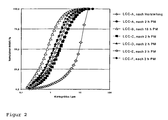
- FIG. 3 shows, by way of example, five sintering curves of perovskite ceramic samples which were measured on pressed specimens.
- An initial shrinkage at 600-700 ° C is due to the decomposition of carbonate residues in the calcined powders which may form upon decomposition of the citrate salts.
- the actual shrinkage starts between 800 and 900 ° C.
- the morphology of a sintered sample consisting of a ceramic paste of the above-mentioned contacting material (LCC-B) and sintered at 900 ° C. for two hours is shown in FIG.
- the individual ceramic particles are already very well sintered together at this temperature and form a stable, continuous network with high conductivity.
- the primary grains of the ceramic have a mean diameter of 0.5-1 microns.
- FIG. 5 shows measurements of the shrinkage behavior on pressed specimens.
- the length changes shown in FIG. 4 show the potential of the materials and their tendency to sinter
- the shrinkage for example during a joining process of a high-temperature fuel cell, can only be tested under realistic conditions.
- a fuel cell was coated with a paste of the contacting material LCC-A from the embodiment 1, sealed with a glass solder and between the top and bottom interconnector plates for simulating cell stacking placed in an oven with optical observation device.
- a small load was applied to the component assembly, and the change in contact layer and glass solder thickness was measured. From the curves of Figure 5 it can be seen that in a real use, the contact layer shrinks by about 40%.
- the shrinkage of the ceramic is well adapted to the sintering behavior of the glass solders used.
Landscapes
- Chemical & Material Sciences (AREA)
- Organic Chemistry (AREA)
- Engineering & Computer Science (AREA)
- Ceramic Engineering (AREA)
- Inorganic Chemistry (AREA)
- Materials Engineering (AREA)
- Structural Engineering (AREA)
- Manufacturing & Machinery (AREA)
- Life Sciences & Earth Sciences (AREA)
- Sustainable Development (AREA)
- Sustainable Energy (AREA)
- Chemical Kinetics & Catalysis (AREA)
- Electrochemistry (AREA)
- General Chemical & Material Sciences (AREA)
- Compositions Of Oxide Ceramics (AREA)
- Fuel Cell (AREA)
- Inorganic Compounds Of Heavy Metals (AREA)
- Oxygen, Ozone, And Oxides In General (AREA)
Description
- Die Erfindung betrifft einen keramischen Werkstoff, insbesondere einen elektrisch leitfähigen keramischen Werkstoff, sowie dessen Herstellung und Verwendung.
- Elektrisch leitfähige Keramiken werden typischerweise als Verbindungselemente zwischen Bauteilen eingesetzt. Diese Keramiken gewährleisten einerseits einen elektrischen Kontakt zwischen zwei Bauteilen, mit denen dieses Verbindungselement in Folge eines Fügeprozesses einen innigen stoffschlüssigen Kontakt hat. Andererseits können aus solchen Keramiken elektrische Leitungsbahnen ausgebildet werden, die sich in oder auf einem Bauteil befinden, um entweder infolge des elektrischen Stromes eine physikalisch-chemische Änderung des Bauteils zu induzieren (Aktorfunktion) oder um die Änderungen einer physikalisch-chemischen Eigenschaft des Bauteils in elektrisch meßbare Größen umzuwandeln (Sensorfunktion).
- Aus der Literatur sind eine Reihe von Herstellungsverfahren bekannt, die zu niedrig sinternden Keramiken führen. Sehr oft werden Synthesemethoden über Sol-Gel-Zwischenprodukte oder nanophasige Pulver herangezogen, um die Sintertemperaturen von Keramiken zu erniedrigen. Solche Verfahren zeichnen sich aber dadurch aus, daß sie sehr teurer (oft metall-organische) Ausgangs- und Hilfsstoffe bedürfen und meist in sehr geringen Mengen hergestellt werden können, siehe z. B.
U.S. Patent 4,636,378 . - Eine andere Methode, niedrig sinternde Keramiken zu erhalten, ist aus
EP 0 280 033 B1 bekannt. Dabei werden Fällungsreaktionen über z. B. Hydroxide oder Oxalate durchgeführt. Nachteilig hierbei sind oftmals die sich bildenden Salze, die bei komplexen Zusammensetzungen einerseits zur Entmischung neigen oder, wegen unterschiedlicher Löslichkeitsprodukte der Salze, nur unvollständig ausfallen und damit zu abweichenden Stöchiometrien der Produkte führen. Ein weiterer Nachteil ist oftmals die Verwendung von organischen Lösungs- oder Reinigungsmitteln, die das Herstellungsverfahren verteuern. - Weiterhin ist aus
US 3,330,697 ein Herstellungsverfahren für Niobate, Zirkonate und Titanate aus Blei und Erdalkalimetallen bekannt. Dabei werden zunächst in einer Lösung aus Polyhydroxyalkohol und Zitronensäure Verbindungen mit Titan, Zirkonium und Niob mit Blei oder Erdalkalisalzen gemischt. Durch Erwärmung der Lösung werden die organischen Komponenten entfernt. Diese Herstellungsweise wird in der Literatur als Pechini-Methode bezeichnet. Diese Methode ist jedoch, wie in der Patentschrift beschrieben, für niedrig sinternde Keramiken nicht geeignet. Die dort verwendeten Polyhydroxyalkohole haben den Nachteil, daß sie die Stammlösung mit den Kationen und der Zitronensäure bei Erwärmung durch Polymerisation in ein zähflüssiges Harz umwandeln. Ferner führt der erhöhte Anteil an organischen Hilfsstoffen dazu, daß es in den genannten Beispielen bei weiterer Temperaturerhöhung zu einer spontanen Verbrennung des zähflüssigen Harzes kommt. Eigene Untersuchungen mit dieser Herstellungsweise, aber auch mit anderen Herstellungsmethoden, die auf unkontrollierbaren Zündungen der Zwischenprodukte basieren, haben gezeigt, daß die Sinterfähigkeit der erhaltenen Keramikpulver sehr eingeschränkt wird. Eine Erwärmung, wie sie die Verbrennung des Harzes darstellt, ist daher für die Herstellung von niedrig sinternden Keramiken unbedingt zu vermeiden. - Aus
US 5,534,468 A ist ein Verfahren zur Herstellung eines keramischen Werkstoffes mit der Zusammensetzung La1-xSrxCr1-yMnyO3 bekannt, bei dem eine kolloidale Lösung aus einem polyhydroxyorganischen Chelatbildner und den entsprechenden Metallsalzen aufgeheizt wird, wobei zunächst ein gemischter Metalloxid-Precursorgel entsteht. Durch Zugabe von Säure und/oder Wasser wird der halbfeste Precursor in ein Sol oder eine flüssiges kolloidale System überführt. Erneutes Aufheizen treibt das Lösungsmittel aus dem Precursor, so dass ein dickflüssiges, viskoses Gel erhalten wird, welches zur weiteren Verwendung gegossen, gezogen oder extrudiert werden kann. - In
JP 07 187841 A - Co oder Cu ausgetauscht wurden. Ziel dieses Austausches ist es, ein Sintermaterial zu schaffen, welches pro Aufheizzyklus bis 1000 °C eine Schrumpfung von weniger als 0,01 % aufweist. Die Sintertemperaturen der Werkstoffe liegen dabei zwischen 600 und 1000 °C.
- I. Stambolowa et al. beschreibt in Ihrem Aufsatz "The effect of Ca, Sr, and Ba substitutions on the morpholgy and electrical resistivity of La1-xAxCu0,5Mn0,5O3 thin films" in Vacuum (1996), 47(10), 1239-1242 einen keramischen Werkstoff der allgemeinen Formel La1-xAxCu0,5Mn0,5O3 (A = Ca, Sr, Ba und X = 0,1, 0,2 und 0,3) mit einer Sintertemperatur zwischen 850 und 900 °C. Diese Werkstoffe weisen alle eine Perowskitstruktur auf.
- K. Y. Wang et al. berichten in "Structural, magnetic and transport properties in a Cu-doped La0,7Ca0,3MnO3 system" im Journal of Applied Physics (2001), 90(12) 6263-6267 ebenfalls über Cu-haltige keramische Werkstoffe mit der allgemeinen Formel La0,7Ca0,3Mn1-xCuxO3, mit 0 ≤ x ≤ 0,2.
- Aufgabe der Erfindung ist es, einen keramischen Werkstoff zu schaffen, der gegenüber dem Stand der Technik eine verbesserte Sinterfähigkeit und eine geringere Sintertemperatur aufweist. Weiterhin soll der keramische Werkstoff gute elektrische Eigenschaften aufweisen. Ferner ist es die Aufgabe der Erfindung ein Herstellungsverfahren für einen solchen keramischen Werkstoff zu schaffen.
- Bei dem erfindungsgemäßen Verfahren werden wenigstens zwei verschiedene Metallnitrate oder -karbonate in einer wäßrigen Lösung zusammen mit einem Metallkomplexbildner gelöst, eingeengt und bei niedrigen Temperaturen zu einem Feststoff umgesetzt.
- Bei den Metallen handelt es sich um wenigstens ein Metall aus einer ersten Gruppe A' = (Y, Sc, Ce, La, Pr, Nd, Sm, Eu, Gd) und wenigstens ein Metall aus einer zweiten Gruppe B = (Ti, V, Cr, Mn, Fe, Co, Ni, Cu, Zn, Zr, Nb, Mo, W, Sn, Sb, Pb, Bi). Notwendig sind dabei wenigstens eine Nitrat- und/oder Karbonatverbindung mit Kobalt und eine Nitrat- und/oder Karbonatverbindung mit Kupfer und/oder Wismut.
- Als Metallkomplexbildner sind dabei alle in Wasser löslichen Komplexbildner geeignet, welche die oben aufgeführten Metalle komplexieren können und diese damit als Metallionen in Lösung bringen. Dazu zählen insbesondere die Milchsäure, die Zitronensäure, Zitronensäureester oder auch die Weinsäure. Weiterhin geeignet sind auch andere Polykarbonsäuren, Polyhydroxikarbonsäuren oder Polyaminokarbonsäuren, wie beispielsweise EDTA (Ethylen-diamin-tetra-essigsäure).
- Die Lösung aus Metallkomplexbildner und Metallsalzen wird derart erwärmt, daß sich der Metallkomplexbildner zersetzt. Dies kann beispielsweise durch Abspaltung von gasförmigem Kohlenmonoxid oder -dioxid (CO, CO2) oder auch gasförmigen Stickoxiden (NOx) geschehen. Durch die Erwärmung wird gleichzeitig das Wasser der wäßrigen Lösung verdampft, so daß die zunächst gelösten bzw. komplexierten Metallionen einen Feststoff bilden.
- In einer vorteilhaften Ausgestaltung des Verfahrens wird wenigstens ein weiteres Metall der Gruppe A" = (Mg, Ca, Sr, Ba) als Nitrat oder als Karbonat in der wäßrigen Lösung gelöst.
- In einer vorteilhaften Ausführungsform des Verfahrens werden die Metallverbindungen in einem vorgegebenen Verhältnis eingesetzt. Dabei entspricht die Stöchiometrie der Metalle der einer Keramik mit folgenden Zusammensetzungen: ABO3, A2BO4 oder A2B2O7, wobei A für Elemente aus den genannten Gruppen A' und A'' und B für die genannten Elemente der Gruppe B steht, wobei Co und Cu und/oder Bi zwingend erforderlich sind.
- Es hat sich weiterhin als vorteilhaft herausgestellt, wenn bei dem erfindungsgemäßen Verfahren verschiedene Metalle der Gruppe B in unterschiedlichen Verhältnissen eingesetzt werden. Dabei haben sich insbesondere die folgenden Zusammensetzungen als besonders günstig erwiesen:
Zusammensetzung: Kurzbezeichnung in Figur 2: a) La0,8Ca0,2Cr0,1Co0,6Cu0,3O3 LCC-A b) La1,6Ca0,4Cr0,1Co0,6Cu0,3O4 c) La0,8Ca0,2Cr0,1Co0,3Cu0,6O3 LCC-B d) La0,8Ca0,2Cr0,1Co0,5Bi0,1Cu0,3O3 LCC-C e) La0,6Y0,2Ca0,2Mn0,2Fe0,3Cu0,3Cu0,2O3 f) La0,4Y0,4Ca0,2(Mn0,8Co0,1Cu0,1)0,9O3 LCC-D g) La0,75Bi0,05Ca0,2Mn0,3CO0,4Cu0,3O3 h) La(Mn0,45Co0,35Cu0,2)O3 LCC-F i) LaMn0,35Co0,45Cu0,2O3 j) La0,8Ca0, 2 (Pb, Zr, Ti) 0,2Co0,5Cu0,3O3 k) La0,95Ca0,05 (Pb, Zr, Ti)0,2Co0,5Cu0,3O3 l) La (Pb, Zr, Ti)0,1Mn0,3Co0,45CU0,15O3 m) Y0,5Ca0,5Mn0,4Co0,4Cu0,2O3 n) Y0,5Ba0,5Mn0,3Co0,4Ti0,15Cu0,15O3 - Die unter a) bis i) bezeichneten Zusammensetzungen sind vorteilhaft für die Anwendung in einer Brennstoffzelle geeignet, während die unter j) bis n) beschriebenen Zusammensetzungen vorteilhaft für die Anwendung von Piezokeramiken sind.
- Die Erwärmung der wässrigen Lösung wird insbesondere zunächst langsam durchgeführt, bis der Hauptteil des Wassers verdunstet ist. Anschließend wird die Temperatur weiter erhöht, insbesondere auf bis zu 700°C. Bei diesen Temperaturen setzt sich der erfindungsgemäße Werkstoff dann vorteilhaft in einen Perowskiten, bzw. in eine mehrphasige Keramik um, die als Hauptkomponente einen Perowskiten aufweist.
- Der erfindungsgemäße keramische Werkstoff nach Anspruch 1 wird nach dem erfindungsgemäßen Verfahren hergestellt und weist die folgende Zusammensetzung auf: A'1-x-y A''x B'1-a-b B''a B'''b O3
mit - A'
- = ein oder mehrere Elemente aus der Gruppe (Y, La, Pr, Nd,)
- A"
- = ein oder mehrere Elemente aus der Gruppe (Mg, Ca, Sr, Ba)
- B'
- = Co oder eine Mischung aus Co mit einem oder mehreren Elementen der Gruppe (Mn, Fe)
- B''
- = ein oder mehrere Elemente aus der Gruppe (Ti, V, Cr, Ni, Zn, Pb, Sb, W, Zr)
- B'''
- = ein oder mehrere Elemente aus der Gruppe (Cu, Bi)
- und
- 0 ≤ x ≤ 0,4, 0 ≤ y ≤ 0, 1,
0 ≤ a < 0,4, 0,15 < b ≤ 0,6,
(1-a-b) ≥ 0,3 und Co ≥ 0,3. - Der Werkstoff ist elektrisch leitfähig und weist regelmäßig eine deutlich verbesserte Sinterfähigkeit auf im Vergleich zu konventionellen Keramiken. Unter einer verbesserten Sinterfähigkeit ist zum einen ein erniedrigter Temperaturbereich für die Sinterung zu verstehen, die im Bereich ab 800 °C und deutlich unterhalb von 1000 °C liegt. Andererseits weisen solche Werkstoffe eine kleinere Korngrößenverteilung auf, als nach dem Stand der Technik für solche Werkstoff bekannt ist. Die typische Größenordnung der Einzelpartikel (Anteil > 80 %) liegt im Bereich von 0,2 bis 7 µm, mit einem mittleren Partikeldurchmesser von 1 bis 2 µm. Diese kleinen Korngrößen führen regelmäßig zu einer deutlich verbesserten Homogenität der Keramik während des Sintervorgangs. Gleichzeitig führt dies regelmäßig zu einer Schrumpfung von mindestens 15 %.
- Weiterhin kann durch geeignete Auswahl der eingesetzten Metalle ein kleiner thermischer Ausdehnungskoeffizient im Bereich von 1 * 10-6 K-1 bis 16 * 10-6 K-1, insbesondere zwischen 3,5 * 10-6 K-1 und 13 * 10-6 K-1 nahezu beliebig eingestellt werden. Das trifft in besonderer Weise für die Beispielzusammensetzungen j), l) und n) zu.
- Das Einstellen des thermischen Ausdehnungskoeffizienten ist besonders dann von Vorteil, wenn der erfindungsgemäße Werkstoff als Verbindungselement entweder bei Hochtemperatur-Brennstoffzellen oder zusammen mit Piezo- oder Dielektrika eingesetzt wird. Deren thermischer Ausdehnungskoeffizient liegt bei Temperaturen zwischen 20 °C und 600 °C in einem Bereich von ca. 3,5 bis 6,5 * 10-6 K-1. Schichten mit solcherweise angepassten thermischen Ausdehnungskoeffizienten führen dann regelmäßig zu weniger mechanischen Spannungen als bei herkömmlichen Verbindungselementen, wie beispielsweise aus Silber, Palladium oder Platin. Diese weisen im selben Temperaturintervall einen wesentlich größeren Ausdehnungskoeffizienten auf (22, 5*10-6 K-1 für Ag, 13,5*10-6 K-1 für Pd und 9,8*10-6 K-1 für Pt). Ferner enthalten die genannten Beispielzusammensetzungen j), k) und 1) Elemente aus Piezo- und Dielektrika, so daß eine sehr gute chemische Kompatibilität und geringe piezo- und dielektrische Eigenschaften regelmäßig eine verbesserte Langzeitstabilität der Keramik gewährleisten.
- Vorteilhaft können die erfindungsgemäßen Keramiken z. B. in Piezoelektrika (Aktoren oder Sensoren) eingesetzt werden, die in der Regel aus Bariumtitanat oder Blei-Zirkonium-Titan-Oxid (PbZr1-xTixO3, abgekürzt PZT) bestehen. Diese beiden Stoffklassen bestehen, ebenso wie eine vorteilhafte Ausgestaltung der erfindungsgemäßen Keramik, aus Perowskiten.
- Liegt der Werkstoff als Perowskit vor, weist dieser geringe piezoelektrische Eigenschaften auf, so daß während einer mechanischen Beanspruchung eines daraus gefertigten Bauteils geringere Spannungen zwischen einzelnen Komponenten entstehen und somit zu einer längeren Lebensdauer der Bauteile beitragen.
- Der erfindungsgemäße Werkstoff ist weiterhin besonders für die Verwendung als elektrisch leitendes Verbindungselement geeignet, insbesondere bei Metall-Metall-, Metall-Keramik- oder Keramik-Keramik-Verbünden.
- Ein Verbindungselement aus dem erfindungsgemäßen Werkstoff ist ferner für den Einsatz in Hochtemperatur-Brennstoffzellen (SOFC) geeignet, in denen diese Keramiken eine feste Fügung zwischen metallischer bipolarer Platte und der Kathode erzeugen. Diese erfindungsgemäßen keramischen Werkstoffe können dabei Edelmetalle, wie Silber, Palladium oder Platin als elektrisch leitfähige Kontakte ersetzen. Hierbei ergibt sich eine Verbesserung des Standes der Technik allein durch geringere Werkstoffpreise.
- Vorteilhaft ist, daß die Aufbringung und Fügung zwischen PZT-Keramiken und den erfindungsgemäßen Verbindungswerkstoffen leicht zu realisieren ist. Werden konventionelle PZT-Keramiken verwendet, werden diese im allgemeinen bei etwa 1200 °C gesintert. Ein Fügeprozeß bei 800 - 1000 °C ist somit ohne weiteres zu realisieren. Niedrig sinternde PZT-Keramiken mit Sintertemperaturen unterhalb von 1000 °C lassen sich ferner gemeinsam mit den erfindungsgemäßen Werkstoffen sintern, und es ist möglich, dadurch einen Prozeßschritt, d. h. eine Temperaturbehandlung, zu sparen.
- Im folgenden wird die Erfindung anhand von Figuren und Ausführungsbeispielen näher erläutert. Es zeigt:
- Figur 1:
- Röntgenbeugungsdiagramm eines perowskitischen Keramikpulvers (LCC-A) nach einer Temperaturbehandlung von 3 Stunden bei 900 °C.
- Figur 2:
- Korngrößenverteilung der perowskitischen Keramikpulver.
- Figur 3:
- Sinterkurven von fünf perowskitischen Keramikproben bis 900 °C. Die höchsten Schrumpfungsraten treten ab etwa 850 °C auf.
- Figur 4:
- Gefüge einer siebgedruckten Kontaktschicht (LCC-B) nach Sinterung bei 900 °C für 2 Stunden.
- Figur 5:
- Schrumpfungsverhalten von Glaskeramiken bis 900 °C (offene Symbole) und einer keramischen Kontaktpaste LCC-B (gefüllte Symbole) unter leichter Druckbelastung zur Simulation eines Brennstoffzellen-Fügeprozesses.
- Als 1. Ausführungsbeispiel wird die Herstellung einer 100 g Pulvercharge mit der Sollzusammensetzung von La0.8 Ca0.2 Cr0.1 Co0.6 Cu0.3 O3 beschrieben. Als Ausgangssalze wurden folgende Chemikalien eingesetzt:
La (NO3)3 x 6H2O = 152,7 g Ca (NO3)2 x 4H2O = 20,8 g Cr (NO3) 3 x 9H2O = 17 , 7 g Co (NO3) 2 x 6H2O = 77,0 g Cu (NO3) 2 x3H2O = 32,0 g Zitronensäure-Monohydrat = 170,0 g - Die abgewogenen Salze werden in wenig destilliertem Wasser - nur soviel wie nötig - unter Rühren in ein Quarzgefäß mit flachem Boden gelöst. Nach vollständiger Auflösung der Salze wird die doppelte Molmenge an Zitronensäure hinzugefügt und ebenfalls in Lösung gebracht, um die Kationen zu komplexieren.
- Die Mischung wird auf einer Heizplatte eingedampft, bis eine viskose Masse entstanden ist. Anschließend wird mit einem Gasbrenner die Temperatur vorsichtig weiter erhöht, bis eine feste Masse vorliegt. Hierbei kann in dieser Phase die Mischung wegen beginnender Zersetzung der Zitronensäure zu starkem Aufschäumen neigen. Die Mischung wird anschließend in einem Kammerofen bei einer Aufheizrate von 3 K/min für 3 Std. bei 700 °C an Luft kalziniert.
- Das so erhaltene Pulver wird anschließend in einer Planetenmühle (PM) gemahlen, um größere Agglomerate zu zerstoßen. Als geeignete Mahlbedingungen für diese Menge an Pulver haben sich 2 Stunden in Ethanol bei 6000 U/min in ZrO2-Mahlbeche und Mahlkugeln ∅ 1 cm bewährt.
Es folgen weitere spezielle Ausführungsformen des erfindungsgemäßen Werkstoffes im Zusammenhang mit möglichen vorteilhaften Einsatzgebieten. - Eine Hochtemperatur-Brennstoffzelle setzt sich im allgemeinen aus folgenden Komponenten zusammen:
- Einem Elektrolyten aus Yttriumoxid-stabilisiertem Zirkoniumoxid (YSZ), einer Kathode aus Lanthanmanganit und einer Anode aus dem Verbundwerkstoff Ni und YSZ.
- Um eine genügend große Leistung zu erzeugen, werden die einzelnen Zellen miteinander seriell zu einem Zellenstapel verschaltet. Als elektrisch verbindendes Bauteil, dem sogenannten Interkonnektor, eignen sich dazu Legierungen auf Fe-Cr-Basis. Mit Hilfe von keramischen Pasten aus den oben beschriebenen Pulvern werden die einzelnen Zellen miteinander verbunden, um gleichzeitig Fertigungstoleranzen auszugleichen. Hierzu wird der Zellenstapel in einem Fügeprozeß einer Temperaturbehandlung unterzogen, wobei die Pasten aushärten und sich aufgrund von Diffusionsprozessen fest mit den benachbarten Zellenkomponenten verbinden. Die Verbindungselemente besitzen unter den Betriebsbedingungen der Brennstoffzelle hohe elektrische Leitfähigkeit, an die übrigen Zellkomponenten angepaßte thermischer Ausdehnungskoeffizienten, chemische Stabilität und
- Kompatibilität mit den benachbarten Zellenkomponenten, da sie ähnliche chemische Zusammensetzungen aufweisen wie die Kathode.
- Während des Fügeprozesses kann, aufgrund der guten Sinterfähigkeit der Verbindungselemente, die Schwindung der sich bildenden Schicht sehr gut an die Schwindung der gleichzeitig sinternden Glaskeramik angepaßt werden, die für die Abdichtung der Gasräume zwischen Anode und Kathode erforderlich ist (siehe Figur 5).
- Eine spezielle Ausführungsform des Erfindungsgedankens betrifft daher einen keramischen Werkstoff, welcher als Verbindungsschicht auf den Interkonnektor oder auf die Kathode aufgebracht wird.
- Als besonders günstige Zusammensetzungen haben sich bisher Verbindungen der Zusammensetzungen
A'1-x-y A"x Mn1-a-b B"a Cub O3 bewährt,
mit - A' =
- (La, Pr, Nd)
- A'' =
- (Ca, Sr)
- B'' =
- Co oder eine Mischung aus Co und Mn und/oder Fe
- x =
- =0 - 0,4 y = 0 - 0,1
- a =
- 0 - 0, 4 b = 0, 15 - 0, 6
- Da sich während der Hochtemperaturbeanspruchung an der Grenzschicht zwischen Verbindungselement und Stahl unter anderem auch Chromate, wie CaCrO4, bilden, wird der A"-Anteil möglichst klein, insbesondere x = 0, gewählt. Diese Auswahl hängt jedoch wesentlich von den erforderlichen Leitfähigkeiten ab, die mit abnehmendem A "-Anteil ebenfalls abnehmen.
- Für die PZT-Keramiken werden kleinere thermische Ausdehnungskoeffizienten realisiert als für die Anwendung in Hochtemperatur-Brennstoffzellen. Hierfür sind vermehrt Anteile von Y und Cr anzuwenden. Zu hohe Yttrium-Anteile senken allerdings die Leitfähigkeit zu sehr. Dieser Effekt kann durch Erhöhung des A' '-Anteils jedoch kompensiert werden.
- Die Variationsbreite der Zusammensetzungen kann wie folgt zusammengefaßt werden:
A'1-x-y-z Yz A' 'x Mn1-a-b M' 'a Cub O3
mit - A' =
- (La, Pr, Nd)
- A'' =
- (Ca, Sr, Ba)
- M'' =
- Co mit 0 > a ≥ 0,3 b = 0, 1 - 0, 6
- x =
- 0 - 0,8 y = 0 - 0,05 z = 0,1 - 0,8.
- Vorteilhaft sind ferner Zusätze von B'' = (Pb, Zr, Ti) mit einem Anteil von bis zu 0,2 (siehe dazu auch die Beispielzusammensetzungen k) bis m)). Zusätze in dieser Größenordnung setzen die chemischen Diffusionsgradienten herab und vermindern so eine chemische Wechselwirkung zwischen Verbindungselement und PZT-Keramik.
- Die Materialien können nach bekannten Verfahren mit Hilfe der Siebdrucktechnik zu Leiterbahnen in oder auf Aktoren oder Sensoren verarbeitet werden, wobei der Fügeprozeß nach der Herstellung des Keramikkörpers oder gleichzeitig mit der Herstellung erfolgen kann.
- Die Figur 1 zeigt das Röntgenbeugungsdiagramm des im Ausführungsbeispiel 1 genannten Pulvers (LCC-A) nach einer Temperaturbehandlung von 3 Stunden bei 900 °C. Das auftretende Beugungsmuster ist der Perowskitstruktur zuzuordnen, zusätzliche Röntgenreflexe anderer kristalliner Phasen sind nicht erkennbar. Bei höheren Kupferkonzentrationen bilden sich komplexe Kuprate, die aber ebenfalls eine hohe Leitfähigkeit besitzen und einer Anwendung nicht hinderlich sind.
- In Figur 2 sind die Korngrößenverteilungen von Pulvern mit verschiedener Zusammensetzung dargestellt. Nach der Herstellung liegen Korn-Agglomerate mit einem Durchmesser bis zu etwa 20 µm vor, die nach kurzer Mahldauer von 2 Stunden in einer Planetenmühle (PM) zerstört sind. Die Pulver weisen dann jeweils sehr einheitliche Korngrößenverteilungen mit mittleren Korngrößen (d50) von 1-2 µm auf. Bei weiterer Mahlung in einer Planetenmühle erreichen die mittleren Partikelgrößen mit ca. 0,8 µm nur geringfügig kleinere Werte. Insgesamt weisen regelmäßig über 80 % der Partikel eine Partikelgröße zwischen 0,2 und 7 µm auf.
- Figur 3 zeigt beispielhaft fünf Sinterkurven perowskitischer Keramikproben, die an gepreßten Probekörpern gemessen wurden. Eine anfängliche Schrumpfung bei 600-700 °C ist auf die Zersetzung von Karbonatresten in den kalzinierten Pulvern zurückzuführen, die sich bei der Zersetzung der Zitratsalze bilden können. Bei höheren Temperaturen setzt die eigentliche Schwindung zwischen 800 und 900 °C ein. Bereits bei 900 °C ergeben sich Längenschrumpfungen zwischen 20 und 30 %.
- Die Morphologie einer Sinterprobe, die aus einer keramischen Paste des oben genannten Kontaktierungsmaterials (LCC-B) besteht und bei 900 °C für zwei Stunden gesintert wurde, ist in Figur 4 wiedergegeben. Die einzelnen Keramikpartikel sind bereits bei dieser Temperatur sehr gut miteinander versintert und bilden ein stabiles, durchgehendes Netzwerk mit hoher Leitfähigkeit. Die Primärkörner der Keramik haben einen mittleren Durchmesser von 0,5-1 µm.
- Figur 5 zeigt Messungen des Schrumpfungsverhaltens an gepreßten Probekörpern. Die in Figur 4 wiedergegebenen Längenänderungen zeigen zwar das Potential der Materialien und deren tendenzielles Sinterverhalten, die Schwindung beispielsweise während eines Fügeprozesses einer Hochtemperatur-Brennstoffzelle kann jedoch nur unter realitätsnahen Bedingungen getestet werden. Für diesen Zweck wurde eine solche Brennstoffzelle mit einer Paste aus dem Kontaktierungsmaterial LCC-A aus dem Ausführungsbeispiel 1 beschichtet, mit einem Glaslot abgedichtet und zwischen ober- und unterseitigen Interkonnektorplatten zur Simulation einer Zellenstapelung in einen Ofen mit optischer Beobachtungsvorrichtung gesetzt. Während des Fügens wurde eine geringe Last auf den Komponentenverbund aufgebracht, und die Änderung der Kontaktschicht- und Glaslotdicke gemessen. Aus den Kurvenverläufen der Figur 5 ist ersichtlich, dass bei einem realen Einsatz die Kontaktschicht um ca. 40 % schwindet. Ferner ist die Schwindung der Keramik gut an das Sinterverhalten der verwendeten Glaslote angepaßt.
Claims (13)
- Keramischer Werkstoff mit einer Sintertemperatur unterhalb von 1000°C und einer Perowskitstruktur mit der stöchiometrischen Zusammensetzung:
A' 1-x-y A"x B'1-a-b B"a B"'b O3
mitA' = ein oder mehrere Elemente aus der Gruppe (Y, La, Pr, Nd,)A" = ein oder mehrere Elemente aus der Gruppe (Mg, Ca, Sr, Ba)B' = Co oder eine Mischung aus Co mit einem oder mehreren Elementen der Gruppe (Mn, Fe)B'' = ein oder mehrere Elemente aus der Gruppe (Ti, V, Cr, Ni, Zn, Pb, Sb, W, Zr)B''' = ein oder mehrere Elemente aus der Gruppe (Cu, Bi)und 0 ≤ x ≤ 0,4, 0 ≤ y ≤ 0,1,
0 ≤ a < 0,4, 0,15 < b ≤ 0,6,
(1-a-b) ≥ 0,3 und Co mindestens 0,3. - Keramischer Werkstoff nach Anspruch 1, der La als Element auf der A'-Position aufweist.
- Keramischer Werkstoff nach einem der vorhergehenden Ansprüche 1 bis 2, der Cu als Element auf der B"'-Position aufweist.
- Keramischer Werkstoff nach einem der vorhergehenden Ansprüche 1 bis 3, der Y zumindest als ein Element auf der A'-Position aufweist.
- Keramischer Werkstoff nach einem der Ansprüche 1 bis 4, der beim Aufheizen bis zu Temperaturen von 900 °C eine Schrumpfung von wenigstens 15 %, insbesondere von bis zu 20% aufweist.
- Keramischer Werkstoff nach Anspruch 1, mit einer der nachfolgenden stöchiometrischen Zusammensetzungen:
A' A'' B' B'' B''' O3 La0,8 Ca0,2 Co0,6 Cr0,1 Cu0,3 O3 La1,6 Ca0,4 Co0,6 Cr0,1 Cu0,3 O4 La0,8 Ca0,2 Co0,3 Cr0,1 Cu0,6 O3 La0,8 Ca0,2 Co0,5 Cr0,1 Bi0,1Cu0,3 O3 La0,6Y0,2 Ca0,2 Mn0,2Fe0,3Co0,3 Cu0,2 O3 La0,75 Ca0,2 Mn0,3Co0,4 Cu0,3 Bi0,05 O3 La Mn0,45Co0,35 Cu0,2 O3 La0,8 Ca0,2 Co0,5 (Pb,Zr,Ti)0,2 Cu0,3 O3 La0,95 Ca0,05 Co0,5 (Pb,Zr,Ti)0,2 Cu0,3 O3 La Mn0,3Co0,45 (Pb,Zr,Ti)0,1 Cu0,15 O3 Y0,5 Ca0,5 Mn0,4Co0,4 Cu0,2 O3 La Mn0,35Co0,45 Cu0,2 O3 - Verwendung des Werkstoffs gemäß einem der vorhergehenden Ansprüche 1 bis 6 als Verbindungselement für eine Brennstoffzelle.
- Verwendung des Werkstoffs gemäß einem der vorhergehenden Ansprüche 1 bis 6 als Kontaktelement für eine Piezokeramik.
- Verfahren zur Herstellung eines keramischen Werkstoffs gemäß einem der Ansprüche 1 bis 6 mit den Schritten:a) in einer wässrigen Lösung umfassend einen Metallkomplexbildner wird
wenigstens eine Verbindung aus der Gruppe A' = (Y, La, Pr, Nd) als Nitrat und/oder Karbonat, und
wenigstens eine zweite Verbindung aus der Gruppe B = (Ti, V, Cr, Mn, Fe, Co, Ni, Cu, Zn, Bi, Pb, Sb, W, Zr) als Nitrat oder Karbonat gelöst, wobei eine Verbindung mit Co und Cu und/oder eine Verbindung mit Co und Bi zwingend sind;b) die wässrige Lösung wird erwärmt, wobei sich der Metallkomplexbildner zersetzt und der keramischer Werkstoff gebildet wird. - Verfahren nach vorhergehendem Anspruch 9, bei dem wenigstens eine dritte Verbindung aus der Gruppe A' ' = (Mg, Ca, Sr, Ba) als Nitrat und/oder Karbonat in der wässrigen Lösung gelöst wird.
- Verfahren nach einem der vorhergehenden Ansprüche 9 bis 10, bei dem eine Polykarbonsäure als Metallkomplexbildner eingesetzt wird.
- Verfahren nach einem der vorhergehenden Ansprüche 9 bis 11, bei dem Zitronensäure als Metallkomplexbildner eingesetzt wird.
- Verfahren nach einem der vorhergehenden Ansprüche 9 bis 12, bei dem bis zu 700 °C erwärmt wird.
Applications Claiming Priority (3)
| Application Number | Priority Date | Filing Date | Title |
|---|---|---|---|
| DE10059280A DE10059280A1 (de) | 2000-11-29 | 2000-11-29 | Keramischer Werkstoff sowie dessen Herstellung |
| DE10059280 | 2000-11-29 | ||
| PCT/DE2001/004497 WO2002044103A1 (de) | 2000-11-29 | 2001-11-27 | Keramischer werkstoff sowie dessen herstellung |
Publications (2)
| Publication Number | Publication Date |
|---|---|
| EP1337496A1 EP1337496A1 (de) | 2003-08-27 |
| EP1337496B1 true EP1337496B1 (de) | 2007-08-08 |
Family
ID=7665118
Family Applications (1)
| Application Number | Title | Priority Date | Filing Date |
|---|---|---|---|
| EP01998516A Expired - Lifetime EP1337496B1 (de) | 2000-11-29 | 2001-11-27 | Keramischer werkstoff sowie dessen herstellung |
Country Status (8)
| Country | Link |
|---|---|
| US (1) | US6835684B2 (de) |
| EP (1) | EP1337496B1 (de) |
| JP (1) | JP4383740B2 (de) |
| AT (1) | ATE369323T1 (de) |
| DE (2) | DE10059280A1 (de) |
| DK (1) | DK1337496T3 (de) |
| ES (1) | ES2291381T3 (de) |
| WO (1) | WO2002044103A1 (de) |
Cited By (2)
| Publication number | Priority date | Publication date | Assignee | Title |
|---|---|---|---|---|
| DE102007053075A1 (de) * | 2007-11-05 | 2009-05-07 | Fraunhofer-Gesellschaft zur Förderung der angewandten Forschung e.V. | Funktionsschicht für Hochtemperaturbrennstoffzellen und Verfahren zur Herstellung |
| US20120282394A1 (en) * | 2009-12-28 | 2012-11-08 | Posco | Composite Ceramic Material and Method for Manufacturing the Same |
Families Citing this family (21)
| Publication number | Priority date | Publication date | Assignee | Title |
|---|---|---|---|---|
| AU2003250847A1 (en) * | 2002-06-21 | 2004-01-06 | Le Centre National De La Recherche Scientifique | Carbon-coated li-containing powders and process for production thereof |
| TWI226377B (en) * | 2002-11-08 | 2005-01-11 | Ind Tech Res Inst | Dielectric material compositions |
| JP4949834B2 (ja) * | 2003-07-18 | 2012-06-13 | ヴァーサ パワー システムズ リミテッド | 燃料電池スタック |
| US7892698B2 (en) * | 2003-07-18 | 2011-02-22 | Versa Power Systems, Ltd. | Electrically conductive fuel cell contact material |
| DE10342162A1 (de) * | 2003-09-08 | 2005-04-07 | Fraunhofer-Gesellschaft zur Förderung der angewandten Forschung e.V. | Werkstoff für elektrochemische Anwendungen im Hochtemperaturbereich, ein Verfahren zu seiner Herstellung sowie Verwendungen |
| JP4719940B2 (ja) * | 2004-12-27 | 2011-07-06 | Toto株式会社 | インターコネクタ材料及びこれを備えた固体酸化物形燃料電池 |
| WO2006119311A2 (en) * | 2005-05-02 | 2006-11-09 | Symyx Technologies, Inc. | High surface area metal and metal oxide materials and methods of making same |
| KR101310883B1 (ko) | 2006-03-29 | 2013-09-25 | 삼성에스디아이 주식회사 | 다공성 금속 산화물 및 그 제조방법 |
| JP2007287745A (ja) * | 2006-04-12 | 2007-11-01 | Seiko Epson Corp | 圧電材料および圧電素子 |
| DE102007012468A1 (de) * | 2007-03-15 | 2008-09-18 | Epcos Ag | Keramikmaterial und elektrokeramisches Bauelement mit dem Keramikmaterial |
| JP5175154B2 (ja) * | 2008-09-29 | 2013-04-03 | 株式会社田中化学研究所 | ニッケル複合酸化物の製造方法、該方法により得られるニッケル複合酸化物、該ニッケル複合酸化物を用いてなる酸化ニッケル−安定化ジルコニア複合酸化物、該酸化ニッケル−安定化ジルコニア複合酸化物を含有する固体酸化物型燃料電池用燃料極 |
| JP5270296B2 (ja) * | 2008-10-23 | 2013-08-21 | 株式会社ノリタケカンパニーリミテド | 固体酸化物形燃料電池用インターコネクタおよび固体酸化物形燃料電池 |
| JP5678520B2 (ja) * | 2010-08-26 | 2015-03-04 | Tdk株式会社 | サーミスタ素子 |
| RU2489356C2 (ru) * | 2010-12-20 | 2013-08-10 | Государственное образовательное учреждение высшего профессионального образования Самарский государственный технический университет | Способ получения купратов бария и редкоземельных элементов |
| EP2836625B1 (de) * | 2012-04-13 | 2017-12-06 | Danmarks Tekniske Universitet | Umkehrbare elektrochemische hochleistungs-zelle für die h2o-elektrolyse oder umwandlung von co2 und h2o in kraftstoff |
| JP6546483B2 (ja) * | 2015-08-31 | 2019-07-17 | 地方独立行政法人神奈川県立産業技術総合研究所 | 負熱膨張性材料の製造方法 |
| ES2628027B1 (es) * | 2015-12-24 | 2018-05-11 | Consejo Superior De Investigaciones Científicas (Csic) | MATERIAL CERÁMICO PIEZOELÉCTRICO DE ALTA TEMPERATURA DE BIScO3-PbTIO3, DISEÑADO QUÍMICAMENTE PARA OPERAR EN CONDICIONES DE ALTA POTENCIA Y PROCEDIMIENTO PARA OBTENER DICHO MATERIAL CERÁMICO |
| EP3409652A1 (de) * | 2017-05-31 | 2018-12-05 | Consejo Superior de Investigaciones Cientificas (CSIC) | Piezoelektrisches, auf bisco3-pbtio3 basierendes keramisches hochtemperaturmaterial mit spannungskennlinie, das für eine verbesserte mechanische leistung mikrostrukturell manipuliert ist, verfahren zur herstellung des besagten keramikmaterials und dessen verwendung als sensorvorrichtung |
| EP3409651A1 (de) * | 2017-05-31 | 2018-12-05 | Consejo Superior de Investigaciones Cientificas (CSIC) | Leistungspiezoelektrisches, auf bisco3-pbtio3 basierendes keramisches hochtemperaturmaterial mit spannungskennlinie, das für eine verbesserte mechanische leistung mikrostrukturell manipuliert ist, verfahren zur herstellung des besagten keramikmaterials und dessen verwendung als teil einer ultraschallerzeugungsvorrichtung oder ultraschallaktivierungsvorrichtung |
| US11791478B2 (en) | 2019-10-07 | 2023-10-17 | Tennessee Technological University | Reduced-temperature sintering of spinel-type coatings and layers with metallic alloy powder precursors |
| CN111548160B (zh) * | 2020-05-22 | 2022-07-22 | 深圳先进电子材料国际创新研究院 | 一种钙钛矿结构纳米陶瓷材料及其制备方法 |
Family Cites Families (11)
| Publication number | Priority date | Publication date | Assignee | Title |
|---|---|---|---|---|
| US3330697A (en) * | 1963-08-26 | 1967-07-11 | Sprague Electric Co | Method of preparing lead and alkaline earth titanates and niobates and coating method using the same to form a capacitor |
| US4636378A (en) * | 1985-06-11 | 1987-01-13 | Hughes Aircraft Company | Method of preparation of perovskite-type compounds |
| US4874598A (en) * | 1987-01-20 | 1989-10-17 | Mitsubishi Petrochemical Co., Ltd. | Process for producing perovskite-type oxides of the ABO3 type |
| US5407618A (en) * | 1990-08-13 | 1995-04-18 | The Boeing Company | Method for producing ceramic oxide compounds |
| US5196388A (en) | 1991-06-10 | 1993-03-23 | Akzo N.V. | Process for the preparation of double metal oxide powders containing a Group IIIA and a Group IVB element and a novel double metal hydroxyl carboxylate useful in preparing same |
| US5604048A (en) * | 1993-02-26 | 1997-02-18 | Kyocera Corporation | Electrically conducting ceramic and fuel cell using the same |
| US5614127A (en) * | 1993-06-21 | 1997-03-25 | Gas Research Institute | High-performance ceramic interconnect for SOFC applications |
| US5958304A (en) * | 1993-06-21 | 1999-09-28 | Gas Research Institute | Doped lanthanum chromite material for bipolar interconnects for solid oxide fuel cells |
| JPH07187841A (ja) * | 1993-12-28 | 1995-07-25 | Ngk Insulators Ltd | 多孔質焼結体及び固体電解質型燃料電池 |
| DE19834423B4 (de) * | 1998-07-30 | 2007-01-11 | Epcos Ag | Verwendung einer Sinterkeramik für hochstabile NTC-Einschaltstrombegrenzer und niederohmige NTC-Thermistoren |
| US6551522B2 (en) * | 2000-02-08 | 2003-04-22 | Tdk Corporation | Piezoelectric ceramics |
-
2000
- 2000-11-29 DE DE10059280A patent/DE10059280A1/de not_active Withdrawn
-
2001
- 2001-11-27 WO PCT/DE2001/004497 patent/WO2002044103A1/de not_active Ceased
- 2001-11-27 EP EP01998516A patent/EP1337496B1/de not_active Expired - Lifetime
- 2001-11-27 DK DK01998516T patent/DK1337496T3/da active
- 2001-11-27 AT AT01998516T patent/ATE369323T1/de active
- 2001-11-27 US US10/432,980 patent/US6835684B2/en not_active Expired - Lifetime
- 2001-11-27 DE DE50112843T patent/DE50112843D1/de not_active Expired - Lifetime
- 2001-11-27 JP JP2002546474A patent/JP4383740B2/ja not_active Expired - Fee Related
- 2001-11-27 ES ES01998516T patent/ES2291381T3/es not_active Expired - Lifetime
Non-Patent Citations (1)
| Title |
|---|
| None * |
Cited By (4)
| Publication number | Priority date | Publication date | Assignee | Title |
|---|---|---|---|---|
| DE102007053075A1 (de) * | 2007-11-05 | 2009-05-07 | Fraunhofer-Gesellschaft zur Förderung der angewandten Forschung e.V. | Funktionsschicht für Hochtemperaturbrennstoffzellen und Verfahren zur Herstellung |
| DE102007053075B4 (de) * | 2007-11-05 | 2009-09-03 | Fraunhofer-Gesellschaft zur Förderung der angewandten Forschung e.V. | Funktionsschicht für Hochtemperaturbrennstoffzellen und Verfahren zur Herstellung |
| US20120282394A1 (en) * | 2009-12-28 | 2012-11-08 | Posco | Composite Ceramic Material and Method for Manufacturing the Same |
| US9871259B2 (en) | 2009-12-28 | 2018-01-16 | Posco | Method for manufacturing composite ceramic material |
Also Published As
| Publication number | Publication date |
|---|---|
| WO2002044103B1 (de) | 2002-11-21 |
| DK1337496T3 (da) | 2007-12-10 |
| ES2291381T3 (es) | 2008-03-01 |
| EP1337496A1 (de) | 2003-08-27 |
| US20040047789A1 (en) | 2004-03-11 |
| ATE369323T1 (de) | 2007-08-15 |
| JP2004517791A (ja) | 2004-06-17 |
| US6835684B2 (en) | 2004-12-28 |
| DE10059280A1 (de) | 2002-06-20 |
| DE50112843D1 (de) | 2007-09-20 |
| JP4383740B2 (ja) | 2009-12-16 |
| WO2002044103A1 (de) | 2002-06-06 |
Similar Documents
| Publication | Publication Date | Title |
|---|---|---|
| EP1337496B1 (de) | Keramischer werkstoff sowie dessen herstellung | |
| DE69815876T2 (de) | Bei verminderter temperatur gleichzeitig mit silber sinterbare pzt-keramikzusammensetzung und verfahren zu ihrer herstellung | |
| DE60119000T2 (de) | Ionenleiter | |
| EP2837044B1 (de) | Keramisches material und kondensator umfassend das keramische material | |
| DE102007057475B4 (de) | Piezoelektrische Keramikzusammensetzung und laminiertes piezoelektrisches Element | |
| EP1362020B1 (de) | Piezoelektrisches keramisches material, verfahren zu dessen herstellung und elektrokeramisches mehrlagenbauteil | |
| DE4406276B4 (de) | Elektrisch leitendes Keramikmaterial | |
| DE102007012915B4 (de) | Piezoelektrische Keramikzusammensetzung und laminiertes piezoelektrisches Element | |
| DE69024340T2 (de) | Halbleiterkeramikkondensator von laminiertem und zwischenkornisolationstyp und verfahren zu seiner herstellung | |
| EP2773598B1 (de) | Keramikmaterial, verfahren zur herstellung desselben und elektrokeramisches bauelement umfassend das keramikmaterial | |
| DE112018001785B4 (de) | Piezoelektrische zusammensetzung und piezoelektrisches element | |
| DE112013005662T5 (de) | Verfahren zum Herstellen einer Piezokeramik, Pietokeramik und piezoelektrisches Element | |
| DE102007057474B4 (de) | Piezoelektrische Keramikzusammensetzung und laminiertes piezoelektrisches Element | |
| DE69923635T2 (de) | Piezoelektrische Keramiken | |
| DE112015005617B4 (de) | Elektrisch leitfähiger Oxidsinterkörper, Element zur elektrischen Leitung, Gassensor, piezoelektrisches Element und Verfahren zur Herstellung des piezoelektrischen Elements | |
| EP0714866B1 (de) | Komplexer, substituierter Lanthan-Blei-Zirkon-Titan-Perowskit, keramische Zusammensetzung und Aktuator | |
| DE112018001758T5 (de) | Piezoelektrische Zusammensetzung und piezoelektrisches Element | |
| DE102011112008B4 (de) | Piezoelektrisches Bauelement und Verfahren zur Herstellung eines piezoelektrischen Bauelements | |
| DE102007012916B4 (de) | Laminiertes piezoelektrisches Element und Herstellungsverfahren hierfür | |
| DE102020118859B4 (de) | Keramikmaterial für Kondensator sowie Kondensator | |
| DE102005061528B4 (de) | Piezokeramisches Bauteil mit Bleizirkonattitanat mit Eisen-Wolfram-Dotierung, Verfahren zum Herstellen des piezokeramischen Bauteils und seine Verwendung | |
| DE112023002807T5 (de) | Temperatursensorelement und Temperatursensor | |
| DE3529933C2 (de) | ||
| DE112005002093T5 (de) | Herstellverfahren für eine piezoelektrische Keramik, Herstellverfahren für ein piezoelektrisches Element und piezoelektrisches Element | |
| DE112019001519B4 (de) | Piezoelektrische zusammensetzung und piezoelektrisches element |
Legal Events
| Date | Code | Title | Description |
|---|---|---|---|
| PUAI | Public reference made under article 153(3) epc to a published international application that has entered the european phase |
Free format text: ORIGINAL CODE: 0009012 |
|
| 17P | Request for examination filed |
Effective date: 20030514 |
|
| AK | Designated contracting states |
Designated state(s): AT BE CH CY DE DK ES FI FR GB GR IE IT LI LU MC NL PT SE TR |
|
| 17Q | First examination report despatched |
Effective date: 20031027 |
|
| GRAP | Despatch of communication of intention to grant a patent |
Free format text: ORIGINAL CODE: EPIDOSNIGR1 |
|
| GRAS | Grant fee paid |
Free format text: ORIGINAL CODE: EPIDOSNIGR3 |
|
| GRAA | (expected) grant |
Free format text: ORIGINAL CODE: 0009210 |
|
| AK | Designated contracting states |
Kind code of ref document: B1 Designated state(s): AT BE CH CY DE DK ES FI FR GB GR IE IT LI LU MC NL PT SE TR |
|
| REG | Reference to a national code |
Ref country code: GB Ref legal event code: FG4D Free format text: NOT ENGLISH |
|
| REG | Reference to a national code |
Ref country code: CH Ref legal event code: EP |
|
| REG | Reference to a national code |
Ref country code: IE Ref legal event code: FG4D Free format text: LANGUAGE OF EP DOCUMENT: GERMAN |
|
| REF | Corresponds to: |
Ref document number: 50112843 Country of ref document: DE Date of ref document: 20070920 Kind code of ref document: P |
|
| GBT | Gb: translation of ep patent filed (gb section 77(6)(a)/1977) |
Effective date: 20071106 |
|
| REG | Reference to a national code |
Ref country code: DK Ref legal event code: T3 |
|
| ET | Fr: translation filed | ||
| REG | Reference to a national code |
Ref country code: ES Ref legal event code: FG2A Ref document number: 2291381 Country of ref document: ES Kind code of ref document: T3 |
|
| REG | Reference to a national code |
Ref country code: IE Ref legal event code: FD4D |
|
| PG25 | Lapsed in a contracting state [announced via postgrant information from national office to epo] |
Ref country code: GR Free format text: LAPSE BECAUSE OF FAILURE TO SUBMIT A TRANSLATION OF THE DESCRIPTION OR TO PAY THE FEE WITHIN THE PRESCRIBED TIME-LIMIT Effective date: 20071109 |
|
| PG25 | Lapsed in a contracting state [announced via postgrant information from national office to epo] |
Ref country code: IE Free format text: LAPSE BECAUSE OF FAILURE TO SUBMIT A TRANSLATION OF THE DESCRIPTION OR TO PAY THE FEE WITHIN THE PRESCRIBED TIME-LIMIT Effective date: 20070808 Ref country code: PT Free format text: LAPSE BECAUSE OF FAILURE TO SUBMIT A TRANSLATION OF THE DESCRIPTION OR TO PAY THE FEE WITHIN THE PRESCRIBED TIME-LIMIT Effective date: 20080108 |
|
| PLBE | No opposition filed within time limit |
Free format text: ORIGINAL CODE: 0009261 |
|
| STAA | Information on the status of an ep patent application or granted ep patent |
Free format text: STATUS: NO OPPOSITION FILED WITHIN TIME LIMIT |
|
| PG25 | Lapsed in a contracting state [announced via postgrant information from national office to epo] |
Ref country code: SE Free format text: LAPSE BECAUSE OF FAILURE TO SUBMIT A TRANSLATION OF THE DESCRIPTION OR TO PAY THE FEE WITHIN THE PRESCRIBED TIME-LIMIT Effective date: 20071108 Ref country code: MC Free format text: LAPSE BECAUSE OF NON-PAYMENT OF DUE FEES Effective date: 20071130 |
|
| 26N | No opposition filed |
Effective date: 20080509 |
|
| PG25 | Lapsed in a contracting state [announced via postgrant information from national office to epo] |
Ref country code: CY Free format text: LAPSE BECAUSE OF FAILURE TO SUBMIT A TRANSLATION OF THE DESCRIPTION OR TO PAY THE FEE WITHIN THE PRESCRIBED TIME-LIMIT Effective date: 20070808 |
|
| PG25 | Lapsed in a contracting state [announced via postgrant information from national office to epo] |
Ref country code: LU Free format text: LAPSE BECAUSE OF NON-PAYMENT OF DUE FEES Effective date: 20071127 |
|
| PG25 | Lapsed in a contracting state [announced via postgrant information from national office to epo] |
Ref country code: TR Free format text: LAPSE BECAUSE OF FAILURE TO SUBMIT A TRANSLATION OF THE DESCRIPTION OR TO PAY THE FEE WITHIN THE PRESCRIBED TIME-LIMIT Effective date: 20070808 |
|
| REG | Reference to a national code |
Ref country code: FR Ref legal event code: PLFP Year of fee payment: 15 |
|
| REG | Reference to a national code |
Ref country code: FR Ref legal event code: PLFP Year of fee payment: 16 |
|
| REG | Reference to a national code |
Ref country code: FR Ref legal event code: PLFP Year of fee payment: 17 |
|
| PGFP | Annual fee paid to national office [announced via postgrant information from national office to epo] |
Ref country code: NL Payment date: 20171122 Year of fee payment: 17 Ref country code: DK Payment date: 20171124 Year of fee payment: 17 Ref country code: FI Payment date: 20171117 Year of fee payment: 17 |
|
| PGFP | Annual fee paid to national office [announced via postgrant information from national office to epo] |
Ref country code: ES Payment date: 20171201 Year of fee payment: 17 Ref country code: IT Payment date: 20171122 Year of fee payment: 17 Ref country code: BE Payment date: 20171122 Year of fee payment: 17 |
|
| PGFP | Annual fee paid to national office [announced via postgrant information from national office to epo] |
Ref country code: AT Payment date: 20181120 Year of fee payment: 18 Ref country code: DE Payment date: 20181016 Year of fee payment: 18 |
|
| PGFP | Annual fee paid to national office [announced via postgrant information from national office to epo] |
Ref country code: FR Payment date: 20181127 Year of fee payment: 18 Ref country code: CH Payment date: 20181126 Year of fee payment: 18 Ref country code: GB Payment date: 20181126 Year of fee payment: 18 |
|
| REG | Reference to a national code |
Ref country code: DK Ref legal event code: EBP Effective date: 20181130 |
|
| REG | Reference to a national code |
Ref country code: NL Ref legal event code: MM Effective date: 20181201 |
|
| PG25 | Lapsed in a contracting state [announced via postgrant information from national office to epo] |
Ref country code: FI Free format text: LAPSE BECAUSE OF NON-PAYMENT OF DUE FEES Effective date: 20181127 |
|
| REG | Reference to a national code |
Ref country code: BE Ref legal event code: MM Effective date: 20181130 |
|
| PG25 | Lapsed in a contracting state [announced via postgrant information from national office to epo] |
Ref country code: NL Free format text: LAPSE BECAUSE OF NON-PAYMENT OF DUE FEES Effective date: 20181201 |
|
| PG25 | Lapsed in a contracting state [announced via postgrant information from national office to epo] |
Ref country code: IT Free format text: LAPSE BECAUSE OF NON-PAYMENT OF DUE FEES Effective date: 20181127 Ref country code: DK Free format text: LAPSE BECAUSE OF NON-PAYMENT OF DUE FEES Effective date: 20181130 |
|
| PG25 | Lapsed in a contracting state [announced via postgrant information from national office to epo] |
Ref country code: BE Free format text: LAPSE BECAUSE OF NON-PAYMENT OF DUE FEES Effective date: 20181130 |
|
| REG | Reference to a national code |
Ref country code: ES Ref legal event code: FD2A Effective date: 20200108 |
|
| PG25 | Lapsed in a contracting state [announced via postgrant information from national office to epo] |
Ref country code: ES Free format text: LAPSE BECAUSE OF NON-PAYMENT OF DUE FEES Effective date: 20181128 |
|
| REG | Reference to a national code |
Ref country code: DE Ref legal event code: R119 Ref document number: 50112843 Country of ref document: DE |
|
| REG | Reference to a national code |
Ref country code: CH Ref legal event code: PL |
|
| PG25 | Lapsed in a contracting state [announced via postgrant information from national office to epo] |
Ref country code: CH Free format text: LAPSE BECAUSE OF NON-PAYMENT OF DUE FEES Effective date: 20191130 Ref country code: LI Free format text: LAPSE BECAUSE OF NON-PAYMENT OF DUE FEES Effective date: 20191130 |
|
| REG | Reference to a national code |
Ref country code: AT Ref legal event code: MM01 Ref document number: 369323 Country of ref document: AT Kind code of ref document: T Effective date: 20191127 |
|
| GBPC | Gb: european patent ceased through non-payment of renewal fee |
Effective date: 20191127 |
|
| PG25 | Lapsed in a contracting state [announced via postgrant information from national office to epo] |
Ref country code: FR Free format text: LAPSE BECAUSE OF NON-PAYMENT OF DUE FEES Effective date: 20191130 Ref country code: DE Free format text: LAPSE BECAUSE OF NON-PAYMENT OF DUE FEES Effective date: 20200603 Ref country code: GB Free format text: LAPSE BECAUSE OF NON-PAYMENT OF DUE FEES Effective date: 20191127 |
|
| PG25 | Lapsed in a contracting state [announced via postgrant information from national office to epo] |
Ref country code: AT Free format text: LAPSE BECAUSE OF NON-PAYMENT OF DUE FEES Effective date: 20191127 |