EP1338440A2 - Bandage pneumatique - Google Patents
Bandage pneumatique Download PDFInfo
- Publication number
- EP1338440A2 EP1338440A2 EP03003103A EP03003103A EP1338440A2 EP 1338440 A2 EP1338440 A2 EP 1338440A2 EP 03003103 A EP03003103 A EP 03003103A EP 03003103 A EP03003103 A EP 03003103A EP 1338440 A2 EP1338440 A2 EP 1338440A2
- Authority
- EP
- European Patent Office
- Prior art keywords
- cord
- carcass
- polyethylene
- pen
- ply
- Prior art date
- Legal status (The legal status is an assumption and is not a legal conclusion. Google has not performed a legal analysis and makes no representation as to the accuracy of the status listed.)
- Granted
Links
Images
Classifications
-
- B—PERFORMING OPERATIONS; TRANSPORTING
- B60—VEHICLES IN GENERAL
- B60C—VEHICLE TYRES; TYRE INFLATION; TYRE CHANGING; CONNECTING VALVES TO INFLATABLE ELASTIC BODIES IN GENERAL; DEVICES OR ARRANGEMENTS RELATED TO TYRES
- B60C9/00—Reinforcements or ply arrangement of pneumatic tyres
- B60C9/0042—Reinforcements made of synthetic materials
-
- B—PERFORMING OPERATIONS; TRANSPORTING
- B60—VEHICLES IN GENERAL
- B60C—VEHICLE TYRES; TYRE INFLATION; TYRE CHANGING; CONNECTING VALVES TO INFLATABLE ELASTIC BODIES IN GENERAL; DEVICES OR ARRANGEMENTS RELATED TO TYRES
- B60C9/00—Reinforcements or ply arrangement of pneumatic tyres
- B60C9/02—Carcasses
-
- B—PERFORMING OPERATIONS; TRANSPORTING
- B60—VEHICLES IN GENERAL
- B60C—VEHICLE TYRES; TYRE INFLATION; TYRE CHANGING; CONNECTING VALVES TO INFLATABLE ELASTIC BODIES IN GENERAL; DEVICES OR ARRANGEMENTS RELATED TO TYRES
- B60C9/00—Reinforcements or ply arrangement of pneumatic tyres
- B60C9/02—Carcasses
- B60C9/04—Carcasses the reinforcing cords of each carcass ply arranged in a substantially parallel relationship
- B60C9/08—Carcasses the reinforcing cords of each carcass ply arranged in a substantially parallel relationship the cords extend transversely from bead to bead, i.e. radial ply
-
- B—PERFORMING OPERATIONS; TRANSPORTING
- B60—VEHICLES IN GENERAL
- B60C—VEHICLE TYRES; TYRE INFLATION; TYRE CHANGING; CONNECTING VALVES TO INFLATABLE ELASTIC BODIES IN GENERAL; DEVICES OR ARRANGEMENTS RELATED TO TYRES
- B60C9/00—Reinforcements or ply arrangement of pneumatic tyres
- B60C9/18—Structure or arrangement of belts or breakers, crown-reinforcing or cushioning layers
- B60C9/20—Structure or arrangement of belts or breakers, crown-reinforcing or cushioning layers built-up from rubberised plies each having all cords arranged substantially parallel
- B60C9/22—Structure or arrangement of belts or breakers, crown-reinforcing or cushioning layers built-up from rubberised plies each having all cords arranged substantially parallel the plies being arranged with all cords disposed along the circumference of the tyre
-
- Y—GENERAL TAGGING OF NEW TECHNOLOGICAL DEVELOPMENTS; GENERAL TAGGING OF CROSS-SECTIONAL TECHNOLOGIES SPANNING OVER SEVERAL SECTIONS OF THE IPC; TECHNICAL SUBJECTS COVERED BY FORMER USPC CROSS-REFERENCE ART COLLECTIONS [XRACs] AND DIGESTS
- Y10—TECHNICAL SUBJECTS COVERED BY FORMER USPC
- Y10T—TECHNICAL SUBJECTS COVERED BY FORMER US CLASSIFICATION
- Y10T152/00—Resilient tires and wheels
- Y10T152/10—Tires, resilient
- Y10T152/10495—Pneumatic tire or inner tube
- Y10T152/10765—Characterized by belt or breaker structure
- Y10T152/1081—Breaker or belt characterized by the chemical composition or physical properties of elastomer or the like
Definitions
- the present invention relates to a pneumatic tire, more particularly to a carcass and tread band structure in which specific polyethylene-2,6-naphthalate fiber cords are used to improve tire performance such as steering stability, ride comfort, rolling resistance, road noise and durability.
- a tread band is usually provided on the radially outside of the breaker to improve high-speed durability of the tire.
- an object of the present invention to provide a pneumatic tire, in which, the above-mentioned problems can be solved and tire performance such as steering stability, ride comfort, rolling resistance, road noise and durability can be improved in a well-balanced manner by using a polyethylene-2,6-naphthalate fiber cord in the carcass and/or band.
- a pneumatic tire comprises a tread portion, a pair of sidewall portions, a pair of bead portions each with a bead core therein, a carcass extending between the bead portions, and a belt disposed radially outside the carcass in the tread portion, wherein at least one of the carcass and the belt comprises a PEN cord ply of a polyethylene-2,6-naphthalate fiber cord which has a total denier number of from 2500 to 3600, a twist number of from 30 to 40 turns/10 cm, an initial stage modulus at 25 deg.C which is in a range of from 50 to 65 gf/d, and a variation of the initial stage modulus in a temperature range between 25 deg.c to 70 deg.c which is not more than 20 % in absolute value, the PEN cord ply of the carcass comprises a plurality of the polyethylene-2,6-naphthalate fiber cords which are arranged radially at an angle of from 70 to 90 degrees with
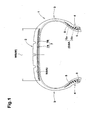
- pneumatic tire 1 comprises a tread portion 2, a pair of sidewall portions 3, a pair of bead portions 4 each with a bead core 5 therein, a carcass 6 extending between the bead portions 4, and a tread reinforcing belt disposed radially outside the carcass 6 in the tread portion.
- pneumatic tire 1 is a radial tire for passenger cars.
- the carcass 6 comprises at least one ply 6A of cords arranged radially at an angle of from 70 to 90 degrees with respect to the tire circumferential direction, extending between the bead portions through the tread portion and sidewall portions, and turned up around the bead core 5 in each of the bead portions so as to form a pair of turned up portions 6b and a main portion 6a therebetween.
- each of the bead portions 4 between the main portion 6a and turned up portion 6b, there is provided with a rubber bead apex 8 extending radially outwardly from the bead core 5 while tapering towards its radially outer end.
- the belt comprises a breaker 7 and optional band 9.
- the breaker 7 is composed of at least two cross plies 7A and 7B of parallel cords laid at an angle of from 10 to 35 degrees with respect to the tire equator. In order to reinforce the tread portion, the breaker 7 extends across the substantially overall width of the tread portion 2. Thus, high-strength cords such as steel cords and the like are used as the breaker cords.
- the band 9 is disposed on the radially outside of the breaker 7 to cover at least the axial edges of the breaker 7 in order to control lifting of the tread edges during high-speed rotation of the tire.
- the cord angle is not more than 5 degrees with respect to the tire equator.
- the band 9 can be composed of a full-width band ply extending across the substantially overall width of the breaker 7. Further, the band can be formed as an edge band made up of axially spaced two plies or parts covering the breaker edges only. Furthermore, a combination of a full-width band ply and a pair of edge band plys is also possible.
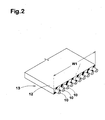
- the band 9 can be formed by spirally winding a single cord or a plurality of cords. But, for the productivity, accuracy of cord spacing and the like, it is preferably formed by spirally winding a tape 13 in stead of a cord or cords alone.
- the tape 13 is, as shown in Fig.2, a rubber tape in which a single cord or plural cords 10 are embedded in its topping rubber in parallel with each other along the longitudinal direction of the tape.
- the illustrated example comprises about ten parallel cords 10 and has a width W1 of about 10 mm.
- PEN cords are used in one of or each of the carcass and band.
- the PEN cord is a polyethylene-2,6-naphthalate fiber cord which is formed by twisting a large number of fibers together at a twist coefficient of 30 to 40 turns/10 cm.
- the material of the fibers it is, of course, possible to use homopolymer of polyethylene-2,6-naphthalate.
- the PEN cord is formed such that a plurality of strands each formed by twisting PEN fibers together (strand-twist), are twisted together into a cord (cord-twist), wherein the direction of strand-twist is reverse to the direction of cord-twist, and the strand-twist and cord-twist are in a range of from 30 to 40 turns/10 cm. It is preferable that the strand-twist number is the same as the cord-twist number. If the twist numbers are less than 30 turns/10 cm, the elongation and fatigue resistance of the cords become insufficient and it is difficult to obtain necessary durability for the carcass/band.
- twist numbers are more than 40 turns/10 cm, it becomes difficult to set the undermentioned initial stage modulus M in the preferred range. Further, dimensional stability and the tire durability are liable to deteriorate because the elongation of the carcass/band increases. By setting the twist numbers as above, it becomes possible to improve the strength, elongation and resistance to fatigue in a well-balanced manner.
- the total denier of the fibers constituting a PEN cord is set in a range of from 2500 to 3600. If the total denier is less than 2500, as the strength of the individual cord greatly decreases, in order to provide a necessary strength for the carcass/band, increase of the carcass ply number/band ply nnumber may be necessitated. If the total denier increases over 3600, the thickness of the carcass/band is accordingly increased. In either case, it is not preferable in view of tire weight reduction. Thus, the total denier is set in the range of 2500 to 3600. This is also necessary for the tire rigidity and strength.
- the carcass cords and band cords embedded in the finished tire are subjected to small elongation of about 1 to 3 % due to the stretch during tire vulcanization.
- the initial stage modulus M of the carcass cords that is, the modulus at low elongation is an important factor of improving the tire rigidity. Therefore, in order to improve steering stability and ride comfort in a well-balanced manner, the initial stage modulus M at 25 deg.c of the carcass cords is set in a range of from 50 to 65 gf/d, and further the complex elastic modulus E* thereof is set in a range of from 2800 to 4000 N/cord. If the initial stage modulus M and complex elastic modulus E* are less than the respective lower limits, the steering stability may be deteriorated. If over the upper limits, ride comfort may be deteriorated.
- the initial stage modulus M of the band cords is an important factor of improving the hoop effect of the band. Therefore, in order to improve the hoop effect of the band in the finished tire and to provide a suitable stretch during vulcanization in a well-balanced manner, the initial stage modulus M at 25 deg.C of the band cords is set in a range of from 50 to 65 gf/d. If the initial stage modulus M is less than 50 gf/d, the hoop effect becomes insufficient. If more than 65 gf/d, the tire is liable to deform due to unsuitable cord stretch. In either case, it is difficult to reduce the road noise.
- the temperature of the tire internal structure increases and sometimes reaches to 70 deg.c or more.
- the variations of the modulus M and complex elastic modulus E* should be controlled as small as possible in such a temperature range.
- the variation of the initial stage modulus M and the variation of the complex elastic modulus E* are each limited to not more than 20 % in absolute value. More specifically, a difference Mmax-M25 and a difference M25-Mmin between the initial stage modulus M25 at 25 deg.c and a maximum Mmax and a minimum Mmin of the initial stage modulus in the temperature range of from 25 deg.C to 70 deg.C are each not more than 20 % of the initial stage modulus M25 at 25 deg.C.
- a difference E*max-E*25 and a difference E*25-E*min between the complex elastic modulus E*25 at 25 deg.C and a maximum E*max and a minimum E*min of the complex elastic modulus in the temperature range of from 25 deg.C to 70 deg.C are each not more than 20% of the complex elastic modulus E*25 at 25 deg.C.
- these parameters under 20 % are preferably further limited to under 15 %, more preferably under 10 % in view of the steering stability and ride comfort.
- these parameters under 20 % are preferably further limited to under 15 %, more preferably under 10 % in view of road noise reduction because if the variation is more than 20 %, the tension of the band cords decreases greatly as the temperature raises which is not preferable in view of not only hoop effect but also road noise.
- the loss tangent (tan ⁇ ) of the carcass/band cord is decreased. Therefore, the loss tangent (tan ⁇ ) at 25 deg.C of the PEN cord is set in a range of from 0.06 to 0.09.
- the variation of the loss tangent (tan ⁇ ) in the temperature range of from 25 deg.C to 70 deg.c is set in a range of not more than 20 %, more preferably not more than 15 %, still more preferably not more than 10 %.
- a difference tan ⁇ max-tan ⁇ 25 and a difference tan ⁇ 25-tan ⁇ min between the complex elastic modulus tan ⁇ 25 at 25 deg.C and a maximum tan ⁇ max and a minimum tan ⁇ min of the loss tangent (tan ⁇ ) in the temperature range of from 25 deg.C to 70 deg.c are each not more than 20% of tan ⁇ 25 at 25 deg.C.
- the initial stage modulus M corresponds to the inclination of a tangential line to the load-elongation curve of the cord at the origin which curve is obtained according to the Japanese Industrial Standard L1017 "Testing Methods for chemical Fiber Tire Cords".
- the loss tangent (tan ⁇ ) and complex elastic modulus (E*) were measured with a viscoelastic spectrometer of IWAMOTO SEISAKUSYO make using a 30 mm long specimen (cord).
- the measuring conditions are as follows: initial load of 1000 g/cord; initial elongation of 10 %; dynamic strain of 0.01 mm; and frequency of 10 Hz.
- the following parameters of the above-mentioned material of the PEN cord fibers are preferably limited as follows: the ethylene-2,6-naphthalate is more than 90 mol %; the peak of differential scanning calorimetry (DSC) is not less than 280 deg.C; the limiting viscosity number is not less than 0.7; and the index of double refraction is not less than 0.30. Further, there is a possibility of controlling the variations by changing: conditions of RFL (resorcin-formalin-latex) treating; and/or physical parameters of the PEN cord such as twist number, denier number of the individual fiber, the number of the fibers, and the like.
- RFL resorcin-formalin-latex
- the number of the fibers in a cord is preferably set to be not less that 400 for the ride comfort, but not more than 600 for the steering stability.
- the elongation of the carcass/band cord under load of 2.0 gf/d is set in a range of from 0.5 to 2.5 % in view of dimensional stability of the tire and tire uniformity which affects road noise.
- the carcass 6 in this example is composed of a radial ply 6A of PEN cords arranged radically at an angle of 90 degrees with respect to the tire equator, extending between the bead portions 4 through the tread portion 2 and sidewall portions 3, and turned up around the bead core 5 in each of the bead portions 4 so as to form a pair of turned up portions 6b and a main portion 6a therebetween.
- the breaker 7 in this example is composed of a radially outer ply 7B and a widest radially inner ply 7A.
- the band 9 in this example extends continuously across the substantially overall width WB of the breaker 7, and the band is composed of a full-width band ply 9A of PEN cords.
- the band width W is not less than 95 % of the breaker width WB, in this example, the substantially same as the breaker width WB.
- the band ply 9A or band 9 is formed by spirally winding a rubber tape 13 as descried above and shown in Fig.2.
- the above-mentioned PEN cords are used in only the band 9.
- the carcass cords organic fiber cords such as nylon, polyester, rayon, aromatic polyamide and the like may be used for the passenger car tires. Further, steel cords may be used depending on the intended use of the tire.
- the band 9 may be formed as various types aside from the above-mentioned a single-ply full-width band.
- the belt is made up of the breaker 7 only, namely, the band 9 is omitted, it is possible that the above-mentioned PEN cords are used in only the carcass 6.
- the carcass 6 is preferably composed of a single ply of the PEN cords. However, this not necessarily means that the carcass 6 excludes an additional ply which may be of the PEN cord or another material cord.
- the hoop effect of the band is improved, and as a result, the circumferential rigidity of the tread portion 2 becomes increased and uniformed, and vibrations caused by unevenness of the road surface during running can be controlled to reduce the road noise.
- aromatic polyamide fiber cord having very high modulus it is difficult to obtain a suitable stretch during vulcanization. As a result, the tire is liable to deform. Although such deformation is small, it sometimes affect the road noise. Further, as compared with polyethylene-2,6-naphthalate fibers, energy loss of the aromatic polyamide fibers is relatively large. Therefore, it has a disadvantage for the rolling resistance and heat generation.
- Test tires of size 195/65R15 having the structure shown in Fig.1 and specifications given in Table 1 were made and tested for steering stability, ride comfort, rolling resistance and road noise.
- a 1800cc passenger car provided with test tires (pressure 200 kPa) was run on a dry asphalt road, and the steering stability was evaluated into ten ranks by the test driver's feelings during straight running and cornering, wherein the larger the rank number, the better the steering stability.
- the test car was run on rough roads in a ride comfort test course, and the test driver evaluated the ride comfort into ten ranks, based on harshness, damping, thrust-up, etc., wherein the larger the rank number, the better the ride comfort.
- the test car After warm-up of thirty-minutes running at a speed of 80 km/h, the test car was stopped on a ten-degree down slope at six meter height from a horizontal road surface extending from the lower end of the slope, and the wheel brake was released in neutral to allow the test car to go down by gravitation. Then, the total running distance until the test car made a stop by itself was measured. The distance was indicated by an index based on Ref.A1 being 100, wherein the larger the index number, the smaller the rolling resistance.
- the test car was coasted on a smooth road surface in a noise test course at a speed of 80 km/h and the noise level (dB) in 250 Hz band was measured with a microphone fixed at the driver's seat.
- the results are indicated in Table 1 by an index based on Ref.A1 being 100, wherein the smaller the index number, the better the road noise.
- Test tires of size 195/65R15 having the structure shown in Fig.1 and the specifications shown in Table 2 were made and tested for the durability and road noise.
- the runable distance was measured under the following accelerated condition: 150 % of the maximum tire load specified in Japanese Industrial Standard (JIS); 80 % of the pressure specified in JIS; and a speed of 80 km/h.
- JIS Japanese Industrial Standard
- the distance is indicated by an index based on Ref.B1 being 100, wherein the larger the index number, the better the durability.
- Tire Ref.B1 Ref.B2 Ref.B3 Ref.B4 Ex.B Carcass Number of ply 1 1 1 1 1 1 Cord Material PET 1670 dtex/2 PET 1670 dtex/2 PET 1670 dtex/2 PET 1670 dtex/2 Cord angle (deg.) 90 90 90 90 90 90 90 Cord count /5 cm 50 50 50 50 50 50 Breaker Number of ply 2 2 2 2 2 2 Cord steel 1X3/0.27 steel 1X3/0.27 steel 1X3/0.27 steel 1X3/0.27 steel 1X3/0.27 steel 1X3/0.27 Cord angle (detg.) +20/-20 +20/-20 +20/-20 +20/-20 +20/-20 Cord count/5 cm Band 40 40 40 40 40 40 Cord material nylon 66 1500 d/2 PET 1500 d/2 PEN 940 d/2 Aramid 1500 d/2 PEN 1500 d/2 Total denier 3000 3000 1880 3000 3000 Twist number (turns/10cm) 38,38 40,40 15,15 43,43 35,35
- PET polyethylene terephthalate fiber
- PEN polyethylene-2,6-naphthalate fiber
Landscapes
- Engineering & Computer Science (AREA)
- Mechanical Engineering (AREA)
- Tires In General (AREA)
Applications Claiming Priority (4)
| Application Number | Priority Date | Filing Date | Title |
|---|---|---|---|
| JP2002037150A JP4149711B2 (ja) | 2002-02-14 | 2002-02-14 | 空気入りラジアルタイヤ |
| JP2002037151 | 2002-02-14 | ||
| JP2002037151A JP4268365B2 (ja) | 2002-02-14 | 2002-02-14 | 空気入りラジアルタイヤ |
| JP2002037150 | 2002-02-14 |
Publications (3)
| Publication Number | Publication Date |
|---|---|
| EP1338440A2 true EP1338440A2 (fr) | 2003-08-27 |
| EP1338440A3 EP1338440A3 (fr) | 2003-10-29 |
| EP1338440B1 EP1338440B1 (fr) | 2007-09-19 |
Family
ID=27667534
Family Applications (1)
| Application Number | Title | Priority Date | Filing Date |
|---|---|---|---|
| EP03003103A Expired - Lifetime EP1338440B1 (fr) | 2002-02-14 | 2003-02-12 | Bandage pneumatique |
Country Status (4)
| Country | Link |
|---|---|
| US (1) | US7270164B2 (fr) |
| EP (1) | EP1338440B1 (fr) |
| CN (1) | CN100450796C (fr) |
| DE (1) | DE60316369T2 (fr) |
Cited By (4)
| Publication number | Priority date | Publication date | Assignee | Title |
|---|---|---|---|---|
| EP1798060A1 (fr) * | 2005-12-13 | 2007-06-20 | Sumitomo Rubber Industries Ltd. | Bandage pneumatique |
| WO2010094357A1 (fr) * | 2009-02-19 | 2010-08-26 | Continental Reifen Deutschland Gmbh | Pneumatique pour véhicule |
| US7900671B2 (en) * | 2005-12-13 | 2011-03-08 | Sumitomo Rubber Industries, Ltd. | Runflat tire |
| CN110809523A (zh) * | 2017-06-30 | 2020-02-18 | 株式会社普利司通 | 轮胎用增强构件和使用其的轮胎 |
Families Citing this family (6)
| Publication number | Priority date | Publication date | Assignee | Title |
|---|---|---|---|---|
| US20050148756A1 (en) * | 2003-08-22 | 2005-07-07 | Ik-Hyeon Kwon | High tenacity polyethylene-2,6-naphthalate fibers |
| JP4500075B2 (ja) * | 2004-03-22 | 2010-07-14 | 住友ゴム工業株式会社 | 空気入りタイヤ |
| US8017795B2 (en) | 2005-04-21 | 2011-09-13 | Ndsu Research Foundation | Radiation curable polymer films having improved laser ablation properties and radiation curable sensitizers therefor |
| JP4312173B2 (ja) * | 2005-05-24 | 2009-08-12 | 住友ゴム工業株式会社 | 自動二輪車用空気入りタイヤ |
| US7543619B2 (en) * | 2005-12-29 | 2009-06-09 | Sumitomo Rubber Industries, Ltd. | Heavy duty tire |
| US20090107609A1 (en) * | 2007-10-31 | 2009-04-30 | Walter Kevin Westgate | High Extensible Cut-Resistant Barrier |
Family Cites Families (18)
| Publication number | Priority date | Publication date | Assignee | Title |
|---|---|---|---|---|
| JPS51108401A (en) * | 1975-03-19 | 1976-09-25 | Bridgestone Tire Co Ltd | Rajiarutaiyano biidobukozo |
| JPS55120504U (fr) * | 1979-02-20 | 1980-08-26 | ||
| US4630663A (en) * | 1984-11-27 | 1986-12-23 | The Firestone Tire & Rubber Company | Tire construction utilizing low-twist body ply yarn with low turn-up ends |
| JP2702835B2 (ja) * | 1990-10-29 | 1998-01-26 | 住友ゴム工業株式会社 | 自動二輪車用ラジアルタイヤ |
| JPH05139111A (ja) * | 1991-11-20 | 1993-06-08 | Yokohama Rubber Co Ltd:The | 空気入りラジアルタイヤ |
| JP4054072B2 (ja) * | 1994-12-09 | 2008-02-27 | 株式会社ブリヂストン | 空気入りラジアルタイヤ |
| JP3555809B2 (ja) * | 1995-06-19 | 2004-08-18 | 株式会社ブリヂストン | ラジアルタイヤ |
| US5855704A (en) * | 1996-10-04 | 1999-01-05 | The Goodyear Tire & Rubber Company | Pneumatic tire with polyester belt cord |
| US6082423A (en) * | 1997-06-09 | 2000-07-04 | The Goodyear Tire & Rubber Company | Low cost light weight radial tire |
| EP1024968B1 (fr) * | 1997-09-26 | 2002-08-14 | The Goodyear Tire & Rubber Company | Renfort en polyethylene-naphtalate pour composites en caoutchouc |
| JP3837221B2 (ja) * | 1997-12-08 | 2006-10-25 | 横浜ゴム株式会社 | 空気入りラジアルタイヤ |
| US6634399B1 (en) * | 1998-09-15 | 2003-10-21 | The Goodyear Tire & Rubber Company | Tire with PEN reinforcement |
| DE69923759T2 (de) * | 1998-12-21 | 2006-05-11 | Bridgestone Corp. | Radialer Luftreifen |
| JP2001039113A (ja) * | 1999-05-21 | 2001-02-13 | Bridgestone Corp | 空気入りタイヤ |
| JP2001163005A (ja) * | 1999-12-09 | 2001-06-19 | Bridgestone Corp | ラジアルタイヤ |
| DE60113006T2 (de) * | 2000-05-12 | 2006-03-16 | Bridgestone Corp. | Radialer Reifen |
| JP2002012004A (ja) * | 2000-06-28 | 2002-01-15 | Sumitomo Rubber Ind Ltd | 空気入りタイヤ |
| KR100402839B1 (ko) * | 2001-05-10 | 2003-10-22 | 주식회사 효성 | 고강력 폴리에틸렌 나프탈레이트 섬유 |
-
2003
- 2003-02-12 DE DE60316369T patent/DE60316369T2/de not_active Expired - Lifetime
- 2003-02-12 EP EP03003103A patent/EP1338440B1/fr not_active Expired - Lifetime
- 2003-02-13 CN CNB031041760A patent/CN100450796C/zh not_active Expired - Fee Related
- 2003-02-14 US US10/366,658 patent/US7270164B2/en not_active Expired - Fee Related
Cited By (7)
| Publication number | Priority date | Publication date | Assignee | Title |
|---|---|---|---|---|
| EP1798060A1 (fr) * | 2005-12-13 | 2007-06-20 | Sumitomo Rubber Industries Ltd. | Bandage pneumatique |
| CN1982087B (zh) * | 2005-12-13 | 2010-09-22 | 住友橡胶工业株式会社 | 充气轮胎 |
| US7900671B2 (en) * | 2005-12-13 | 2011-03-08 | Sumitomo Rubber Industries, Ltd. | Runflat tire |
| US7926531B2 (en) | 2005-12-13 | 2011-04-19 | Sumitomo Rubber Industries, Ltd. | Pneumatic tire |
| WO2010094357A1 (fr) * | 2009-02-19 | 2010-08-26 | Continental Reifen Deutschland Gmbh | Pneumatique pour véhicule |
| RU2521159C2 (ru) * | 2009-02-19 | 2014-06-27 | Континенталь Райфен Дойчланд Гмбх | Пневматическая шина транспортного средства |
| CN110809523A (zh) * | 2017-06-30 | 2020-02-18 | 株式会社普利司通 | 轮胎用增强构件和使用其的轮胎 |
Also Published As
| Publication number | Publication date |
|---|---|
| DE60316369D1 (de) | 2007-10-31 |
| EP1338440A3 (fr) | 2003-10-29 |
| CN1438132A (zh) | 2003-08-27 |
| US7270164B2 (en) | 2007-09-18 |
| DE60316369T2 (de) | 2008-06-12 |
| CN100450796C (zh) | 2009-01-14 |
| EP1338440B1 (fr) | 2007-09-19 |
| US20040007306A1 (en) | 2004-01-15 |
Similar Documents
| Publication | Publication Date | Title |
|---|---|---|
| US6799618B2 (en) | Pneumatic tire having an overlay reinforcement | |
| US8622105B2 (en) | Pneumatic tire | |
| AU2010202120B2 (en) | Pneumatic tyre with an overlay reinforcement | |
| US20180154695A1 (en) | Pneumatic Tire | |
| JPH06305302A (ja) | 空気入りタイヤ | |
| US6926053B2 (en) | Pneumatic tire variable elasticity modules metallic band cord | |
| US5419383A (en) | Pneumatic tire including hybrid belt cord | |
| US6267165B1 (en) | Pneumatic tire with specified aramid belt | |
| US7270164B2 (en) | Pneumatic tire | |
| US5906693A (en) | Pneumatic radial tire with specified organic fiber carcass cords | |
| JP2004224074A (ja) | 空気入りタイヤ | |
| JP2011126339A (ja) | 空気入りタイヤ | |
| US20130168003A1 (en) | Pneumatic tire | |
| JP2004168118A (ja) | 空気入りタイヤ | |
| JP2009035029A (ja) | 空気入りタイヤ | |
| JP4268365B2 (ja) | 空気入りラジアルタイヤ | |
| JP4149711B2 (ja) | 空気入りラジアルタイヤ | |
| JP5170917B2 (ja) | 乗用車および小型トラック用の空気入りラジアルタイヤ | |
| JP5168801B2 (ja) | 重荷重用空気入りタイヤ | |
| JP2002096606A (ja) | タイヤ | |
| JP5890114B2 (ja) | 空気入りタイヤ | |
| JP2011143899A (ja) | 空気入りタイヤ | |
| JP4188406B1 (ja) | 空気入りタイヤ | |
| JP5013522B2 (ja) | 空気入りラジアルタイヤ | |
| JP7560771B2 (ja) | 空気入りタイヤ |
Legal Events
| Date | Code | Title | Description |
|---|---|---|---|
| PUAI | Public reference made under article 153(3) epc to a published international application that has entered the european phase |
Free format text: ORIGINAL CODE: 0009012 |
|
| AK | Designated contracting states |
Designated state(s): AT BE BG CH CY CZ DE DK EE ES FI FR GB GR HU IE IT LI LU MC NL PT SE SI SK TR |
|
| AX | Request for extension of the european patent |
Extension state: AL LT LV MK RO |
|
| PUAL | Search report despatched |
Free format text: ORIGINAL CODE: 0009013 |
|
| AK | Designated contracting states |
Kind code of ref document: A3 Designated state(s): AT BE BG CH CY CZ DE DK EE ES FI FR GB GR HU IE IT LI LU MC NL PT SE SI SK TR |
|
| AX | Request for extension of the european patent |
Extension state: AL LT LV MK RO |
|
| AKX | Designation fees paid | ||
| 17P | Request for examination filed |
Effective date: 20040407 |
|
| RBV | Designated contracting states (corrected) |
Designated state(s): DE FR GB |
|
| REG | Reference to a national code |
Ref country code: DE Ref legal event code: 8566 |
|
| GRAP | Despatch of communication of intention to grant a patent |
Free format text: ORIGINAL CODE: EPIDOSNIGR1 |
|
| GRAS | Grant fee paid |
Free format text: ORIGINAL CODE: EPIDOSNIGR3 |
|
| GRAA | (expected) grant |
Free format text: ORIGINAL CODE: 0009210 |
|
| AK | Designated contracting states |
Kind code of ref document: B1 Designated state(s): DE FR GB |
|
| REG | Reference to a national code |
Ref country code: GB Ref legal event code: FG4D |
|
| REF | Corresponds to: |
Ref document number: 60316369 Country of ref document: DE Date of ref document: 20071031 Kind code of ref document: P |
|
| ET | Fr: translation filed | ||
| PLBE | No opposition filed within time limit |
Free format text: ORIGINAL CODE: 0009261 |
|
| STAA | Information on the status of an ep patent application or granted ep patent |
Free format text: STATUS: NO OPPOSITION FILED WITHIN TIME LIMIT |
|
| 26N | No opposition filed |
Effective date: 20080620 |
|
| PGFP | Annual fee paid to national office [announced via postgrant information from national office to epo] |
Ref country code: FR Payment date: 20140211 Year of fee payment: 12 |
|
| PGFP | Annual fee paid to national office [announced via postgrant information from national office to epo] |
Ref country code: GB Payment date: 20140212 Year of fee payment: 12 |
|
| PGFP | Annual fee paid to national office [announced via postgrant information from national office to epo] |
Ref country code: DE Payment date: 20140417 Year of fee payment: 12 |
|
| REG | Reference to a national code |
Ref country code: DE Ref legal event code: R119 Ref document number: 60316369 Country of ref document: DE |
|
| GBPC | Gb: european patent ceased through non-payment of renewal fee |
Effective date: 20150212 |
|
| REG | Reference to a national code |
Ref country code: FR Ref legal event code: ST Effective date: 20151030 |
|
| PG25 | Lapsed in a contracting state [announced via postgrant information from national office to epo] |
Ref country code: DE Free format text: LAPSE BECAUSE OF NON-PAYMENT OF DUE FEES Effective date: 20150901 Ref country code: GB Free format text: LAPSE BECAUSE OF NON-PAYMENT OF DUE FEES Effective date: 20150212 |
|
| PG25 | Lapsed in a contracting state [announced via postgrant information from national office to epo] |
Ref country code: FR Free format text: LAPSE BECAUSE OF NON-PAYMENT OF DUE FEES Effective date: 20150302 |