EP1340539B1 - Abgasreinigende katalysatorverbindung, diese verbindung enthaltender katalysator und verfahren zur herstellung der verbindung - Google Patents
Abgasreinigende katalysatorverbindung, diese verbindung enthaltender katalysator und verfahren zur herstellung der verbindung Download PDFInfo
- Publication number
- EP1340539B1 EP1340539B1 EP00970100A EP00970100A EP1340539B1 EP 1340539 B1 EP1340539 B1 EP 1340539B1 EP 00970100 A EP00970100 A EP 00970100A EP 00970100 A EP00970100 A EP 00970100A EP 1340539 B1 EP1340539 B1 EP 1340539B1
- Authority
- EP
- European Patent Office
- Prior art keywords
- catalyst
- compound
- exhaust gas
- purifying
- present
- Prior art date
- Legal status (The legal status is an assumption and is not a legal conclusion. Google has not performed a legal analysis and makes no representation as to the accuracy of the status listed.)
- Expired - Lifetime
Links
Images
Classifications
-
- B—PERFORMING OPERATIONS; TRANSPORTING
- B01—PHYSICAL OR CHEMICAL PROCESSES OR APPARATUS IN GENERAL
- B01D—SEPARATION
- B01D53/00—Separation of gases or vapours; Recovering vapours of volatile solvents from gases; Chemical or biological purification of waste gases, e.g. engine exhaust gases, smoke, fumes, flue gases, aerosols
- B01D53/34—Chemical or biological purification of waste gases
- B01D53/74—General processes for purification of waste gases; Apparatus or devices specially adapted therefor
- B01D53/86—Catalytic processes
- B01D53/8621—Removing nitrogen compounds
- B01D53/8625—Nitrogen oxides
- B01D53/8628—Processes characterised by a specific catalyst
-
- B—PERFORMING OPERATIONS; TRANSPORTING
- B01—PHYSICAL OR CHEMICAL PROCESSES OR APPARATUS IN GENERAL
- B01D—SEPARATION
- B01D53/00—Separation of gases or vapours; Recovering vapours of volatile solvents from gases; Chemical or biological purification of waste gases, e.g. engine exhaust gases, smoke, fumes, flue gases, aerosols
- B01D53/34—Chemical or biological purification of waste gases
- B01D53/74—General processes for purification of waste gases; Apparatus or devices specially adapted therefor
- B01D53/86—Catalytic processes
-
- B—PERFORMING OPERATIONS; TRANSPORTING
- B01—PHYSICAL OR CHEMICAL PROCESSES OR APPARATUS IN GENERAL
- B01D—SEPARATION
- B01D53/00—Separation of gases or vapours; Recovering vapours of volatile solvents from gases; Chemical or biological purification of waste gases, e.g. engine exhaust gases, smoke, fumes, flue gases, aerosols
- B01D53/34—Chemical or biological purification of waste gases
- B01D53/74—General processes for purification of waste gases; Apparatus or devices specially adapted therefor
- B01D53/86—Catalytic processes
- B01D53/8643—Removing mixtures of carbon monoxide or hydrocarbons and nitrogen oxides
- B01D53/8646—Simultaneous elimination of the components
- B01D53/865—Simultaneous elimination of the components characterised by a specific catalyst
-
- B—PERFORMING OPERATIONS; TRANSPORTING
- B01—PHYSICAL OR CHEMICAL PROCESSES OR APPARATUS IN GENERAL
- B01J—CHEMICAL OR PHYSICAL PROCESSES, e.g. CATALYSIS OR COLLOID CHEMISTRY; THEIR RELEVANT APPARATUS
- B01J21/00—Catalysts comprising the elements, oxides, or hydroxides of magnesium, boron, aluminium, carbon, silicon, titanium, zirconium, or hafnium
- B01J21/06—Silicon, titanium, zirconium or hafnium; Oxides or hydroxides thereof
- B01J21/063—Titanium; Oxides or hydroxides thereof
-
- B—PERFORMING OPERATIONS; TRANSPORTING
- B01—PHYSICAL OR CHEMICAL PROCESSES OR APPARATUS IN GENERAL
- B01J—CHEMICAL OR PHYSICAL PROCESSES, e.g. CATALYSIS OR COLLOID CHEMISTRY; THEIR RELEVANT APPARATUS
- B01J23/00—Catalysts comprising metals or metal oxides or hydroxides, not provided for in group B01J21/00
- B01J23/002—Mixed oxides other than spinels, e.g. perovskite
-
- B—PERFORMING OPERATIONS; TRANSPORTING
- B01—PHYSICAL OR CHEMICAL PROCESSES OR APPARATUS IN GENERAL
- B01J—CHEMICAL OR PHYSICAL PROCESSES, e.g. CATALYSIS OR COLLOID CHEMISTRY; THEIR RELEVANT APPARATUS
- B01J23/00—Catalysts comprising metals or metal oxides or hydroxides, not provided for in group B01J21/00
- B01J23/16—Catalysts comprising metals or metal oxides or hydroxides, not provided for in group B01J21/00 of arsenic, antimony, bismuth, vanadium, niobium, tantalum, polonium, chromium, molybdenum, tungsten, manganese, technetium or rhenium
- B01J23/20—Vanadium, niobium or tantalum
- B01J23/22—Vanadium
-
- B—PERFORMING OPERATIONS; TRANSPORTING
- B01—PHYSICAL OR CHEMICAL PROCESSES OR APPARATUS IN GENERAL
- B01J—CHEMICAL OR PHYSICAL PROCESSES, e.g. CATALYSIS OR COLLOID CHEMISTRY; THEIR RELEVANT APPARATUS
- B01J23/00—Catalysts comprising metals or metal oxides or hydroxides, not provided for in group B01J21/00
- B01J23/16—Catalysts comprising metals or metal oxides or hydroxides, not provided for in group B01J21/00 of arsenic, antimony, bismuth, vanadium, niobium, tantalum, polonium, chromium, molybdenum, tungsten, manganese, technetium or rhenium
- B01J23/24—Chromium, molybdenum or tungsten
- B01J23/28—Molybdenum
-
- B—PERFORMING OPERATIONS; TRANSPORTING
- B01—PHYSICAL OR CHEMICAL PROCESSES OR APPARATUS IN GENERAL
- B01J—CHEMICAL OR PHYSICAL PROCESSES, e.g. CATALYSIS OR COLLOID CHEMISTRY; THEIR RELEVANT APPARATUS
- B01J37/00—Processes, in general, for preparing catalysts; Processes, in general, for activation of catalysts
- B01J37/02—Impregnation, coating or precipitation
- B01J37/0201—Impregnation
- B01J37/0213—Preparation of the impregnating solution
-
- C—CHEMISTRY; METALLURGY
- C01—INORGANIC CHEMISTRY
- C01G—COMPOUNDS CONTAINING METALS NOT COVERED BY SUBCLASSES C01D OR C01F
- C01G39/00—Compounds of molybdenum
- C01G39/006—Compounds containing molybdenum, with or without oxygen or hydrogen, and containing two or more other elements
-
- B—PERFORMING OPERATIONS; TRANSPORTING
- B01—PHYSICAL OR CHEMICAL PROCESSES OR APPARATUS IN GENERAL
- B01D—SEPARATION
- B01D2255/00—Catalysts
- B01D2255/20—Metals or compounds thereof
- B01D2255/207—Transition metals
- B01D2255/20707—Titanium
-
- B—PERFORMING OPERATIONS; TRANSPORTING
- B01—PHYSICAL OR CHEMICAL PROCESSES OR APPARATUS IN GENERAL
- B01D—SEPARATION
- B01D2255/00—Catalysts
- B01D2255/20—Metals or compounds thereof
- B01D2255/207—Transition metals
- B01D2255/20723—Vanadium
-
- B—PERFORMING OPERATIONS; TRANSPORTING
- B01—PHYSICAL OR CHEMICAL PROCESSES OR APPARATUS IN GENERAL
- B01D—SEPARATION
- B01D2255/00—Catalysts
- B01D2255/20—Metals or compounds thereof
- B01D2255/207—Transition metals
- B01D2255/20769—Molybdenum
-
- B—PERFORMING OPERATIONS; TRANSPORTING
- B01—PHYSICAL OR CHEMICAL PROCESSES OR APPARATUS IN GENERAL
- B01J—CHEMICAL OR PHYSICAL PROCESSES, e.g. CATALYSIS OR COLLOID CHEMISTRY; THEIR RELEVANT APPARATUS
- B01J21/00—Catalysts comprising the elements, oxides, or hydroxides of magnesium, boron, aluminium, carbon, silicon, titanium, zirconium, or hafnium
- B01J21/12—Silica and alumina
-
- B—PERFORMING OPERATIONS; TRANSPORTING
- B01—PHYSICAL OR CHEMICAL PROCESSES OR APPARATUS IN GENERAL
- B01J—CHEMICAL OR PHYSICAL PROCESSES, e.g. CATALYSIS OR COLLOID CHEMISTRY; THEIR RELEVANT APPARATUS
- B01J2523/00—Constitutive chemical elements of heterogeneous catalysts
-
- B—PERFORMING OPERATIONS; TRANSPORTING
- B01—PHYSICAL OR CHEMICAL PROCESSES OR APPARATUS IN GENERAL
- B01J—CHEMICAL OR PHYSICAL PROCESSES, e.g. CATALYSIS OR COLLOID CHEMISTRY; THEIR RELEVANT APPARATUS
- B01J27/00—Catalysts comprising the elements or compounds of halogens, sulfur, selenium, tellurium, phosphorus or nitrogen; Catalysts comprising carbon compounds
- B01J27/24—Nitrogen compounds
-
- C—CHEMISTRY; METALLURGY
- C01—INORGANIC CHEMISTRY
- C01P—INDEXING SCHEME RELATING TO STRUCTURAL AND PHYSICAL ASPECTS OF SOLID INORGANIC COMPOUNDS
- C01P2004/00—Particle morphology
- C01P2004/80—Particles consisting of a mixture of two or more inorganic phases
-
- C—CHEMISTRY; METALLURGY
- C01—INORGANIC CHEMISTRY
- C01P—INDEXING SCHEME RELATING TO STRUCTURAL AND PHYSICAL ASPECTS OF SOLID INORGANIC COMPOUNDS
- C01P2006/00—Physical properties of inorganic compounds
- C01P2006/12—Surface area
-
- C—CHEMISTRY; METALLURGY
- C01—INORGANIC CHEMISTRY
- C01P—INDEXING SCHEME RELATING TO STRUCTURAL AND PHYSICAL ASPECTS OF SOLID INORGANIC COMPOUNDS
- C01P2006/00—Physical properties of inorganic compounds
- C01P2006/60—Optical properties, e.g. expressed in CIELAB-values
-
- C—CHEMISTRY; METALLURGY
- C01—INORGANIC CHEMISTRY
- C01P—INDEXING SCHEME RELATING TO STRUCTURAL AND PHYSICAL ASPECTS OF SOLID INORGANIC COMPOUNDS
- C01P2006/00—Physical properties of inorganic compounds
- C01P2006/80—Compositional purity
-
- C—CHEMISTRY; METALLURGY
- C01—INORGANIC CHEMISTRY
- C01P—INDEXING SCHEME RELATING TO STRUCTURAL AND PHYSICAL ASPECTS OF SOLID INORGANIC COMPOUNDS
- C01P2006/00—Physical properties of inorganic compounds
- C01P2006/80—Compositional purity
- C01P2006/82—Compositional purity water content
Definitions
- Catalyst Compound for Purifying Exhaust Gas Catalyst Comprising the Compound, and Processes for Producing Them
- the present invention relates to a catalyst for purifying an exhaust gas. More specifically, the present invention relates to a catalyst excellent in the activity at low temperatures and resistance to SOx, and exhibiting a high activity in the reducing reaction of nitrogen oxides (NOx) with ammonia (NH 3 ) and oxidative decomposition reaction of dioxins, and relates to a method for producing the catalyst.
- NOx nitrogen oxides
- NH 3 ammonia
- NOx contained in exhaust gases or flue gases discharged from power plants, various factories, automobiles, and others are causative agents for photochemical smog and acid rain.
- an exhaust gas or flue gas denitration method by a selective catalytic reduction using ammonia (NH 3 ) as reducing agent has widely been employed with thermal power plants being the places where the method is most frequently used.
- a titanium oxide (TiO 2 ) type catalyst containing vanadium (V), molybdenum (Mo), or tungsten (W) as an active component has been used.
- a catalyst containing vanadium as one active component has become a mainstream of current denitration catalysts since the catalyst is not only high in activity but also small in deterioration due to the impurities contained in the exhaust gases and usable at temperatures including temperatures lower than those used heretofore (Laid-open Japanese Patent Publication No. Sho 50-128681 and others).
- the catalyst has been used after being molded usually into a honeycomb-like or platelike shape, and various methods for producing the catalyst has been devised.
- catalysts described above are ordinarily prepared by (i) a method in which particles of a titanium oxide, and particles of salts of active components such as V, Mo, and W of a catalyst or particles of an oxide are kneaded together with water, and the mixture thus obtained is molded and calcined (kneading method), or (ii) another method in which a molded and calcined article of a titanium oxide is impregnated with a solution of a mixture of the salts of active components of a catalyst (impregnation method) (Laid-open Japanese Patent Publication No. Sho 50-128681 , Japanese Patent Publication No. Sho 53-34195 , and others).
- EP-A-0375391 discloses a catalyst for removing nitrogen oxides and a process for producing the same.
- the catalyst comprises a mixture of a catalyst composition of titanium oxide and at least one member of oxides of vanadium, molybdenum and tungsten, and inorganic fibres.
- the subjects of the present invention are to provide a catalyst which does not require the activation of catalyst compositions by a calcination which has become a hindrance in the way of obtaining a catalyst having a high activity through conventional technology and in which catalyst the compositing of vanadium with molybdenum to form a composition material is contemplated more than enough, and a method for producing such catalyst, and to provide a catalyst having a high activity, especially having an activity at low temperatures and durability both greatly increased.
- the method adopted in the present invention in order to achieve the subjects described above is one in which (i) a molybdenum-vanadium (Mo-V) composition compound (hereinafter, “composite compound” is sometimes referred to as “compound” for brevity) having a specific composition which is not necessary to be activated through a calcination is used as an active component, and a carrier comprising a titanium oxide as a main component is impregnated with the compound; or (ii) the composition compound is added to particles or powders of a titanium oxide and then kneaded.
- Mo-V molybdenum-vanadium
- the Mo-V composite compound used in the present invention is one which was found by the present inventors as a result of diligent investigations for solving the problems in the conventional technology described above.
- the compound is a reddish brown substance produced by adding ammonium metavanadate (NH 4 VO 3 ) and molybdenum trioxide (MoO 3 ) into water so that the ratio of vanadium atom to molybdenum atom (V/Mo) becomes 1,4 to 1,6 and then stirring them for a prescribed period of time (usually more than 10 hours).
- the compound is characterised by having a solubility as large as 170 g/l at a normal temperature.
- molybdenum-vanadium (Mo-V) compound as used hereinafter is intended to mean a stable, reddish brown compound having a high solubility and formed when ammonium metavanadate and molybdenum oxide were stirred together with water.
- the compound of the present invention has a high activity by itself.
- molybdenum and vanadium are formed into a stable compound or composite in the present invention, the compound of the present invention is hardly erroded by the SOx contained in exhaust gases and provide a catalyst having a high durability.
- the catalyst of the present invention When the catalyst of the present invention is produced, an operation in which a carrier of a titanium oxide which carrier is prepared in advance is impregnated with a solution containing the Mo-V compound described above at a prescribed concentration and then dried is adopted. Since the Mo-V compound exhibits a high activity even immediately after the drying, the activation of the compound through its calcination is not necessary. However, a step of calcination may be added, when desired.
- the catalyst employing the Mo-V compound of the present invention can be obtained not only by the impregnation method described above, but also by a method in which the Mo-V compound is added to powders of a titanium oxide, molded, and then dried, and further subjected to a calcination, if necessary.
- the Mo-V compound used in the catalyst of the present invention is very stable, the compound is not decomposed even when mixed with a sol-like substance such as a silica sol.
- a catalyst high both in activity and strength can be obtained by applying a solution of the mixture of the Mo-V compound and the sol-like substance to a titanium oxide carrier to have the mixture supported by the carrier.
- the essence of the present invention resides in the use of a novel composition of matter comprising Mo-V compound discovered by the present inventors. Accordingly, the scope of the present invention is not limited by the fact that inorganic fibers, other catalyst components, or inorganic or organic bonding agents are included in the catalyst or titanium oxide. Besides, while a catalyst having a highest activity and a longest durability can be obtained when the activation by a calcination of the (molded) catalyst is not performed, the calcination may be conducted at a temperature lower than 500°C, when required, depending on the strength and use conditions of the catalyst.
- the amount of the Mo-V compound to be permeated into a titanium oxide for impregnation of or to be mixed with the titanium oxide is not limited, preferable results tend to be obtained usually when the amount is selected so that the amount of the Mo-V compound becomes less than 20 % (by weight, the same basis is also applied hereinafter) and desirably less than 10 % of the titanium oxide.
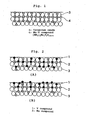
- Fig. 2(A) is a schematic diagram for illustrating the cross section of a surface layer of a catalyst obtained by a conventional kneading method before it is subjected to a calcination.
- V (vanadium) compound 1 and Mo (molybdenum) compound 2 added as active components become particles of each compound at a step of drying them, and particles of the compounds and particles of a titanium oxide exist in a mixed state.
- the active components are necessary to be calcined to become oxides.
- the particles of the V compound and particles of the Mo compound existing at separated positions are composited to develop compositing effects such as an increase of durability of the catalyst, the components are necessary to be calcined at a higher temperature to diffuse by heat thereby to react with each other.
- the catalyst was calcined, however, sintering of not only the active components but also the titanium oxide proceed. As the result, a catalyst having a small specific surface is produced, and thus a high activity of the catalyst can not be expected.
- the compositing of the active components through the heat diffusion cannot be said to be sufficient even in the aspect of the increase of durability of the catalyst since all the active components cannot uniformly react in the heat diffusion.
- Fig. 2(B) is a schematic diagram for illustrating the cross section of a surface layer of a catalyst obtained by a conventional impregnation method in the step of the drying of the catalyst. Even in the case of the impregnation method, particles of each of the active components are deposited or exist separately on the surface of particles of titanium dioxide (TiO 2 ) 3 at the step of drying of the catalyst, and thus it is needless to say that the activation or compositing of the active components through a calcination is necessary.
- TiO 2 titanium dioxide
- Fig. 1 is a schematic diagram for illustrating the cross section of a surface layer of a catalyst of the present invention.
- an active Mo component and an active V component exist on the surface of titanium dioxide particles 3 as particles 4 in a composited state already at the stage where the drying of a catalyst was completed, because the catalyst of the present invention is produced by impregnating a catalyst carrier with a solution of a Mo-V compound which was found anew by the present inventors and has a high stability, to make the carrier support the Mo-V compound. Accordingly, it is not necessary to composite the active compounds again through a calcination.
- the catalyst of the present invention does not require the activation through a calcination since the Mo-V compound supported on the carrier has a high activity by itself. Accordingly, a calcination step causing the sintering of active components and a titanium oxide is unnecessary for the catalyst of the present invention. Keeping with such an advantage, it becomes possible to obtain a catalyst having a high activity, particularly an extremely high activity at low temperatures which requires a high surface area of a catalyst. Even when a calcination step is adopted in the process for producing the catalyst of the present invention for the reasons other than the activation or compositing, the calcination can sufficiently be performed at a lowest temperature necessary for its purpose, and it becomes possible to easily obtain a catalyst having a high activity.
- More advantageous points of the present invention are that the Mo-V compound newly discovered is remarkably stable, that the compound is not broken even when mixed with a silica sol or titanium dioxide (TiO 2 ), and that the compound can be used as a solution of a mixture with a silica sol for the impregnation or can be used for the kneading with the titanium dioxde.
- a colloidal silica which has a large effect of increasing strength, at the same time for the impregnation or kneading, and thus it becomes possible to considerably simplify the manufacturing processes of the catalyst.
- the Mo-V compound used in the present invention is characterized in that the compound is uniformly supported by a carrier even down to the inside of the catalyst since the affinity of the compound for titanium dioxide is small.
- the catalyst of the present invention is advantageous even in this point since all the active points in a whole catalyst are employed in a denitration at a low temperature around 200°C used for an exhaust gas such as an exhaust gas from a municipal refuse incinerator. Besides, whereas the deterioration of a denitration catalyst with SOx tend to become remarkable at low temperatures, it becomes possible to obtain a catalyst having a high resistance to SOx in such an extent as that which was not expectable heretofore since the Mo-V compound supported is stable and does not readily react with SOx.
- the catalyst of the present invention exhibits high performances even in the oxidative decomposition of chlorine containing organic compounds, and is most suitable as a catalyst for denitrating an exhaust gas discharged from a municipal refuse incinerator and removing dioxins from the exhaust gas for which a catalyst is required to have both the resistance and the activity of oxidizing chlorine containing compounds such as dioxins at the same time at around 200°C.
- a slurry prepared by adding 40.6 g of molybdenum trioxide (MoO 3 ) and 49.4 g of ammonium metavanadate (NH 4 VO 3 ) into 410 g of water was gently stirred at a room temperature for 20 hours to react both compounds with each other thereby completely dissolve in the water.
- the concentration of the Mo-V compound was about 18 % by weight, and the ratio of the V atom to the Mo atom (V/Mo) in the compound was 3/2.
- the reddish brown substance thus formed and dissolved in the water can be expressed by the rational formula (NH 4 ) 3 Mo 2 V 3 O 15 .
- a slurry prepared by adding 49.8 g of ammonium molybdate ((NH 4 ) 6 ⁇ Mo 7 O 24 ⁇ 4H 2 O) and 49.4 g of ammonium metavanadate (NH 4 VO 3 ) into 410 g of water was gently stirred at a room temperature for 20 hours.
- concentration of the solid substance in the slurry at the stage when the stirring was completed was about 18 % by weight and the ratio of the V atom to the Mo atom (V/Mo) in the slurry was 3/2 in common with the results in Example 1, the ammonium metavanadate was not dissolved in the water and a reddish brown product was not obtained.
- a slurry prepared by adding 49.8 g of ammonium molybdate ((NH 4 ) 6 ⁇ Mo 7 O 24 ⁇ 4H 2 O) and 38.4 g of vanadium pentoxide (V 2 O 5 ) into 410 g of water was gently stirred at a room temperature for 20 hours.
- concentration of the solid substance in the slurry at the stage when the stirring was completed was about 18 % by weight and the ratio of the V atom to the Mo atom (V/Mo) in the slurry was 3/2 in common with the results in Example 1, the vanadium pentoxide was not dissolved in the water and a reddish brown product was not obtained.
- a slurry prepared by adding 65.4 g of tungsten trioxide (WO 3 ) and 49.4 g of ammonium metavanadate (NH 4 VO 3 ) into 410 g of water was gently stirred at a room temperature for 20 hours in the attempt to react both compounds with each other thereby to completely dissolve in the water.
- V/W ammonium metavanadate
- Example 1 a reddish brown substance formed in Example 1, and having the ratio of the V atom to the Mo atom (V/Mo)of 3/2 and a high solubility in water can be considered to be a specific substance formed by the reaction of ammonium metavanadate with molybdenum trioxide in water.
- the specific compound is not formed when a starting raw material is different and that even when a tungsten oxide which is a homologue of the molybdenum compound is used in place of the latter compound, the specific compound is not resulted.
- a net-like product prepared by weaving twisted yarns each comprising 1400 E glass fibers having a fiber diameter of 9 ⁇ m at a roughness of 10 yarns/inch into a plain weaving was impregnated with a slurry containing 40 % of a titania, 20 % of a silica sol, and 1 % of a polyvinyl alcohol, and then dried at 150°C to obtain a catalyst substrate imparted with a stiffness.
- a titanium oxide having a specific surface area of about 230 m 2 /g was added to 75 g of oxalic acid, water was added thereto to form a paste-like substance, and then 300 g of silica alumina fibers were added thereto and kneaded until a homogenous paste was obtained in a separate step.
- the paste thus obtained was placed between two sheets of the catalyst substrates obtained by the procedures described above, and they were passed through pressure rolls to obtain a sheet having a thickness of 0.7 mm and containing the titania. This sheet was dried at a room temperature and then calcined at 400°C for 2 hours to obtain a titania carrier.
- This titania carrier was immersed in the solution of the Mo-V compound synthesized in Example 1 to support the Mo-V compound and then dried at 80°C for 2 hours.
- the contents of molybdenum trioxide (MoO 3 ) and divanadium pentoxide (V 2 O 5 ) in the catalyst thus obtained were 4.8 % by weight and 4.5 % by weight based on the amount of titanium dioxide (TiO 2 ), respectively.
- a net-like product prepared by weaving twisted yarns each comprising 1400 E glass fibers having a fiber diameter of 9 ⁇ m at a roughness of 10 yarns/inch into a plain weaving was impregnated with a slurry containing 40 % of a titania, 20 % of a silica sol, and 1 % of a polyvinyl alcohol, and then dried at 150°C to obtain a catalyst substrate imparted with a stiffness.
- the paste thus obtained was placed between two sheets of the catalyst substrates obtained by the procedures described above, and they were passed through pressure rolls to obtain a sheet having a thickness of 0.7 mm. This sheet was dried at a room temperature and then dried at 80°C for 2 hours to obtain a catalyst.
- molybdenum trioxide (MoO 3 ) and divanadium pentoxide (V 2 O 5 ) in the catalyst thus obtained were 4.8 % by weight and 4.5 % by weight based on the amount of titanium dioxide (TiO 2 ), respectively.
- Example 2 The same catalysts as that obtained in Example 2 were calcined at 200, 300, 400, and 500°C, respectively, for 2 ours to prepare separate catalysts.
- Example 4 The same catalysts as that obtained in Example 4 were calcined at 200, 300, 400, and 500°C, respectively, in the same manner as in Examples 3 to 6 to prepare separated catalysts.
- Ammonium metavanadate in an amount of 8.67 g and 8.83 g of ammonium molybdate were dissolved in 41 cm 3 of 10 % aqueous solution of monomethyl amine.
- the carrier was dried first at a room temperature and then at 80°C to obtain the catalyst of Comparative Example 9.
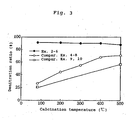
- the catalysts of the present invention exhibit an extremely high activity.
- the catalysts of Comparative Examples do not exhibit a high activity unless they were calcined at a temperature higher than 400°C
- the catalysts of the present invention for example, even the catalyst obtained by Example 2 in which the calcination was not conducted at all exhibited the same extent of excellent performances as those exhibited by calcined catalysts. From this fact, it is evident that the catalysts of the present invention are not necessary to be subjected to such an activating treatment as a calcination, and thus that the catalysts of the present invention have large advantages in the activity and production cost of catalysts.
- any of the catalysts of Comparative Examples were considerably lowered in activity by the exposure to the SO 2 containing gas.
- the catalysts of the Examples were extremely small in the lowering of the activity.
- the catalyst of Example 2 is smallest in the lowering of the activity compared with other catalysts. This is considered to be due to the fact that the catalysts of Examples are not easily affected by SOx in addition to the fact that the compounds are supported in the catalyst in the form of Mo-V compound and thus the compositing of molybdenum with vanadium is sufficient.
- a catalyst was prepared by the same manner as in Comparative Example 4 with the exception that the solution of the Mo-V compound prepared in Example 1 was used instead of the solution of ammonium molybdate and ammonium metavanadate in Comparative Example 4.
- Example 2 To the same solution of the Mo-V compound as that prepared in Example 1 was added 500 g of a colloidal silica (produced by Nissan Chemical Industry Co., Ltd.; trade name: Silica sol-o) containing SiO 2 in an amount of 20 % by weight to obtain a solution of a mixture of both components.
- a catalyst was prepared by the same manner as in Example 2.
- a solution was prepared by adding 50 g of a colloidal silica (Silica sol-o described above) to the same aqueous solution of monomethyl amine containing a mixture of ammonium metavanadate and ammonium molybdate as used in Comparative Example 9.
- a catalyst was prepared in the same manner as that in Comparative Example 9.
- Denitration activity was determined at 200°C by using the same catalyst as that obtained by Example 4, and the oxidation ratio of chlorobenzene by the catalyst was determined at the same time by adding chlorobenzene as a quasi dioxin substance in an amount of 10 ppm to the exhaust gas.
- the activities at 200°C and the results of bending strength tests of both catalysts obtained by Example 8 and Comparative Example 11, respectively, are collectively shown in Table 4.
- the catalyst of Comparative Example 11 is not only low in the activity but also has an extremely low value in the bending strength compared with the catalyst of Example 8. This is presumed to be due to the fact that the silica sol and the vanadium salt were changed to a gel-like substance by the mixing of the aqueous solution of a mixture of the molybdenum salt and vanadium salt with a silica sol, and thus the gel-like substance was not penetrated into a titania carrier.
- catalysts of the present invention exhibit such a high activity for oxidatively decompose chlorobenzene as 80 % or more.
- the catalysts of the present invention are not only excellent in the activity at such a low temperature as 200°C, but also are hardly deteriorated by the SOx contained in exhaust gases from refuse incinerators, and are excellent in the activity for oxidizing chlorine-containing organic compounds which are quasi dioxin substances, in addition. While it is desired to decompose dioxins and to perform denitration at the same time in refuse incinerators number of which is increasing more and more in recent years, the catalysts of the present invention are remarkably excellent ones matched with such social needs.
- a catalyst compound which has a catalytic activity but does not need an activating step by a calcination can be obtained.
- a catalyst having the compound supported on a carrier, or included therein by kneading is excellent in the activity at low temperatures, durability, and the activity for decomposing dioxins, and thus it becomes possible to make refuse incinerators, apparatuses for purifying exhaust gases, and the likes highly efficient.
- a calcination as a treatment for activating the active components of a catalyst become unnecessary, not only simplification of manufacturing steps of a catalyst becomes possible, but also it becomes possible to design a catalyst with the emphasis being placed on the catalyst activity, and various improvements in the performances and economical aspects of the catalyst become possible.
- the Mo-V compound used in the present invention is not only stable even when mixed with a sol-like substance such as a silica sol, but also does not form a gelation of a sol. Accordingly, it is possible to support an active component at the same time in an impregnation step of a catalyst with a silica sol conducted for the purpose of increasing the strength of the catalyst, and it becomes possible to obtain a catalyst having a high strength and a high catalytic activity through simple steps.
Landscapes
- Chemical & Material Sciences (AREA)
- Engineering & Computer Science (AREA)
- Chemical Kinetics & Catalysis (AREA)
- Organic Chemistry (AREA)
- Materials Engineering (AREA)
- Environmental & Geological Engineering (AREA)
- Health & Medical Sciences (AREA)
- Biomedical Technology (AREA)
- Analytical Chemistry (AREA)
- General Chemical & Material Sciences (AREA)
- Oil, Petroleum & Natural Gas (AREA)
- Inorganic Chemistry (AREA)
- Catalysts (AREA)
- Exhaust Gas Treatment By Means Of Catalyst (AREA)
Claims (9)
- Katalysator-Verbindung zur Reinigung von Abgas, worin die Verbindung das Verhältnis von Vanadiumatomen zu Molybdänatomen mit (V/Mo) 1,4 bis 1,6 aufweist, wobei die Verbindung ausgedrückt wird durch die Summenformel (NH4)xMO2VxO(3x+6), worin x im Bereich von 2,8 bis 3,2 liegt.
- Katalysator zur Reinigung von Abgas, worin die wasserlösliche Katalysator-Verbindung auf einem Träger gelagert ist.
- Katalysator zur Reinigung von Abgas, wobei der Katalysator hergestellt ist durch einen Schritt zur Imprägnierung eines Titandioxid (TiO2) Trägers mit der wasserlöslichen, nach Anspruch 1 bestimmten Verbindung oder einen Schritt mit Knetpulver aus Titandioxid (TiO2) zusammen mit der wasserlöslichen in Anspruch 1 bestimmten Verbindung.
- Katalysator zur Reinigung von Abgas, nach einem der Ansprüche 2 oder 3, worin der Katalysator hergestellt wird, indem der in den Ansprüchen 2 und 3 bestimmte Katalysator einer Kalzinierung bei einer Temperatur unterhalb von 500°C unterzogen wird.
- Zusammensetzung, die für einen Katalysator zur Reinigung von Abgas verwendet wird, worin die Zusammensetzung die wasserlösliche, nach Anspruch 1 bestimmte, Verbindung umfasst und eine dispersionsähnliche Substanz.
- Katalysator zur Reinigung von Abgas, worin der Katalysator, der nach Anspruch 5 zusammengesetzt ist auf einem Träger gehalten wird.
- Verfahren zur Herstellung der Katalysator-Verbindung, nach Anspruch 1, wobei das Verfahren einen Schritt zur Reaktion von Molybdäntrioxid (MoO3) mit Ammonium-Metavanadat (NH4VO3) umfaßt, beides im Wasser, bis beide Verbindungen vollständig in dem Wasser gelöst sind.
- Verfahren zur Herstellung eines Katalysators zur Reinigung von Abgas, wobei das Verfahren einen Schritt umfasst mit einer Mischung der Verbindung mit einer dispersionsähnlichen Substanz, getragen auf einem Titandioxid (TiO2) Träger oder einem Schritt zur Mischung dieser Mischung mit Pulvern aus Titandioxid (TiO2), nachdem die wasserlösliche Verbindung mit der dispersionsähnlichen Substanz vorher gemischt worden ist.
- Verfahren zur Herstellung eines Katalysators zur Reinigung von Abgas nach Anspruch 7, worin Molybdänoxid und Ammonium-Metavanadat für mehr als zehn Stunden reagiert haben.
Applications Claiming Priority (2)
| Application Number | Priority Date | Filing Date | Title |
|---|---|---|---|
| JP12050199A JP3765942B2 (ja) | 1999-04-27 | 1999-04-27 | 排ガス浄化触媒化合物、該化合物を含む触媒、およびその製法 |
| PCT/JP2000/007506 WO2002034388A1 (en) | 1999-04-27 | 2000-10-26 | Exhaust gas purifying catalyst compound, catalyst comprising said compound and method for preparing the compound |
Publications (3)
| Publication Number | Publication Date |
|---|---|
| EP1340539A1 EP1340539A1 (de) | 2003-09-03 |
| EP1340539A4 EP1340539A4 (de) | 2006-06-21 |
| EP1340539B1 true EP1340539B1 (de) | 2008-08-13 |
Family
ID=26344962
Family Applications (1)
| Application Number | Title | Priority Date | Filing Date |
|---|---|---|---|
| EP00970100A Expired - Lifetime EP1340539B1 (de) | 1999-04-27 | 2000-10-26 | Abgasreinigende katalysatorverbindung, diese verbindung enthaltender katalysator und verfahren zur herstellung der verbindung |
Country Status (8)
| Country | Link |
|---|---|
| US (1) | US7005402B1 (de) |
| EP (1) | EP1340539B1 (de) |
| JP (1) | JP3765942B2 (de) |
| CN (1) | CN1209196C (de) |
| AU (1) | AU2000279589A1 (de) |
| CA (1) | CA2427081C (de) |
| DE (1) | DE60039922D1 (de) |
| WO (1) | WO2002034388A1 (de) |
Families Citing this family (10)
| Publication number | Priority date | Publication date | Assignee | Title |
|---|---|---|---|---|
| JP3765942B2 (ja) * | 1999-04-27 | 2006-04-12 | バブコック日立株式会社 | 排ガス浄化触媒化合物、該化合物を含む触媒、およびその製法 |
| KR100392943B1 (ko) * | 2001-05-16 | 2003-07-28 | (주)케이에이치 케미컬 | 디젤엔진 배기가스의 정화용 촉매 |
| KR100549778B1 (ko) * | 2003-09-27 | 2006-02-08 | 한국전력기술 주식회사 | 저온 탈질 특성을 갖는 바나듐/티타니아계 질소산화물제거용 촉매, 이의 사용방법 및 이의 탈질방법 |
| JP4277226B2 (ja) * | 2006-02-09 | 2009-06-10 | バブコック日立株式会社 | 金属水銀酸化用触媒及び金属水銀酸化用触媒を備えた排ガス浄化用触媒とその製造方法 |
| JP2008221203A (ja) | 2007-02-13 | 2008-09-25 | Babcock Hitachi Kk | 窒素酸化物除去用触媒及び窒素酸化物除去方法 |
| JP5495001B2 (ja) | 2007-06-27 | 2014-05-21 | バブコック日立株式会社 | 触媒の再生方法 |
| JP5490074B2 (ja) * | 2010-12-28 | 2014-05-14 | トヨタ自動車株式会社 | 三酸化硫黄分解用触媒、及び水素生成方法 |
| JP5497688B2 (ja) | 2011-05-25 | 2014-05-21 | トヨタ自動車株式会社 | 三酸化硫黄分解用触媒、及び水素生成方法 |
| US8623781B2 (en) * | 2011-06-28 | 2014-01-07 | King Fahd University of Pretroleum and Minerals | Oxidative dehydrogenation of propane |
| CN111714964B (zh) * | 2020-06-29 | 2021-08-17 | 浙江严牌过滤技术股份有限公司 | 一种除尘脱二噁英一体化滤料及其制备方法 |
Citations (1)
| Publication number | Priority date | Publication date | Assignee | Title |
|---|---|---|---|---|
| EP0375391A1 (de) * | 1988-12-21 | 1990-06-27 | Babcock-Hitachi Kabushiki Kaisha | Katalysator zur Entfernung von Stickoxiden und sein Herstellungsverfahren |
Family Cites Families (10)
| Publication number | Priority date | Publication date | Assignee | Title |
|---|---|---|---|---|
| US3678091A (en) * | 1969-05-13 | 1972-07-18 | Aquitaine Petrole | Process for the preparation of unsaturated alphatic nitriles by the oxidation of olefins |
| JPS49126616A (de) * | 1973-04-13 | 1974-12-04 | ||
| US4001316A (en) * | 1973-06-15 | 1977-01-04 | Nippon Kayaku Kabushiki Kaisha | Method for manufacture of methacrylic acid |
| JPS58210849A (ja) * | 1982-06-03 | 1983-12-08 | Babcock Hitachi Kk | アンモニア接触還元用脱硝触媒 |
| US5166122A (en) * | 1988-09-19 | 1992-11-24 | Babcock-Hitachi Kabushiki Kaisha | Process for producing a denitration catalyst |
| JP3101821B2 (ja) * | 1990-02-15 | 2000-10-23 | 三菱レイヨン株式会社 | メタクリル酸製造用触媒の調製法 |
| SK152096A3 (en) * | 1994-05-30 | 1997-06-04 | Siemens Ag | Denox catalyst for reducing the nox concentration in a stream of fluid, and method of manufacturing the catalyst |
| JP2000026123A (ja) * | 1998-07-08 | 2000-01-25 | Mitsubishi Chemicals Corp | 複合酸化物および複合酸化物の製造方法 |
| JP3765942B2 (ja) * | 1999-04-27 | 2006-04-12 | バブコック日立株式会社 | 排ガス浄化触媒化合物、該化合物を含む触媒、およびその製法 |
| WO2004099081A1 (de) * | 2003-05-12 | 2004-11-18 | Basf Aktiengesellschaft | In reiner i-phase vorliegende, mo, v und alkalimetall enthaltende multimetalloxidmassen |
-
1999
- 1999-04-27 JP JP12050199A patent/JP3765942B2/ja not_active Expired - Fee Related
-
2000
- 2000-10-26 DE DE60039922T patent/DE60039922D1/de not_active Expired - Lifetime
- 2000-10-26 EP EP00970100A patent/EP1340539B1/de not_active Expired - Lifetime
- 2000-10-26 US US10/415,320 patent/US7005402B1/en not_active Expired - Lifetime
- 2000-10-26 CN CNB008199973A patent/CN1209196C/zh not_active Expired - Lifetime
- 2000-10-26 CA CA002427081A patent/CA2427081C/en not_active Expired - Fee Related
- 2000-10-26 WO PCT/JP2000/007506 patent/WO2002034388A1/ja not_active Ceased
- 2000-10-26 AU AU2000279589A patent/AU2000279589A1/en not_active Abandoned
Patent Citations (1)
| Publication number | Priority date | Publication date | Assignee | Title |
|---|---|---|---|---|
| EP0375391A1 (de) * | 1988-12-21 | 1990-06-27 | Babcock-Hitachi Kabushiki Kaisha | Katalysator zur Entfernung von Stickoxiden und sein Herstellungsverfahren |
Also Published As
| Publication number | Publication date |
|---|---|
| US7005402B1 (en) | 2006-02-28 |
| JP2000308832A (ja) | 2000-11-07 |
| CN1455700A (zh) | 2003-11-12 |
| CA2427081A1 (en) | 2003-04-14 |
| DE60039922D1 (de) | 2008-09-25 |
| JP3765942B2 (ja) | 2006-04-12 |
| WO2002034388A1 (en) | 2002-05-02 |
| EP1340539A4 (de) | 2006-06-21 |
| CN1209196C (zh) | 2005-07-06 |
| AU2000279589A1 (en) | 2002-05-06 |
| CA2427081C (en) | 2007-06-26 |
| EP1340539A1 (de) | 2003-09-03 |
Similar Documents
| Publication | Publication Date | Title |
|---|---|---|
| US5430230A (en) | Method for disposing of organohalogen compounds by oxidative decomposition | |
| US7842644B2 (en) | Catalyst for oxidation of metal mercury | |
| KR101798713B1 (ko) | 질소산화물 제거용 scr 촉매 및 그의 제조방법 | |
| EP2100664A1 (de) | Abgasreinigungskatalysator | |
| EP1340539B1 (de) | Abgasreinigende katalysatorverbindung, diese verbindung enthaltender katalysator und verfahren zur herstellung der verbindung | |
| EP0768110B1 (de) | Katalysator und Verfahren zur Umwandlung von Stickstoffoxiden | |
| EP1484109B1 (de) | Katalysator zur entfernung von stickstoffoxiden, herstellungsverfahren dafür und verfahren zur entfernung von stickstoffoxiden | |
| US20080152560A1 (en) | Titanium Oxide, Catalyst For Treating Exhaust Gas and Method For Purifying Exhaust Gas | |
| KR101670075B1 (ko) | 선택적 촉매환원반응용 탈질촉매의 제조방법 | |
| EP1293250B1 (de) | Verfahren zum Entfernen von Organohalogenverbindungen unter Verwendung eines Titan, Molybdän und Vanadium enthaltenden Katalysators sowie Verfahren zur Herstellung des Katalysators | |
| WO1994021373A1 (fr) | Catalyseur pour la decomposition de l'oxyde d'azote et procede de denitration utilisant ce catalyseur | |
| EP2324903B1 (de) | Verfahren zur reinigung von quecksilberhaltigem abgas, oxidationskatalysator für quecksilber in abgas und herstellungsverfahren dafür | |
| EP0317293B1 (de) | Verfahren zur Entfernung von Stickoxiden und Katalysator zur Anwendung in diesem Verfahren | |
| KR101631487B1 (ko) | 촉매폐기물을 이용한 선택적 환원반응의 저온 탈질촉매 및 그 제조방법 | |
| WO2013099253A1 (ja) | チタン含有粒状粉末及びそれを用いた排ガス処理触媒並びにそれらの製造方法 | |
| KR102742636B1 (ko) | 열적 안정성이 개선된 single step 육방정 질화붕소를 활용한 선택적 촉매 환원법(Selective Catalytic Reduction, SCR) 촉매 및 이의 합성방법 | |
| KR20190068173A (ko) | 탄소 재료에 촉매 활성물질이 담지된 선택적 촉매환원반응용 탈질촉매 및 그 제조방법 | |
| KR20170126837A (ko) | 질소산화물 제거용 scr 촉매 및 그의 제조방법 | |
| EP1360006B1 (de) | Verfahren zur herstellung eines katalysators zur selektiven katalytischen reduktion von stickoxiden | |
| JPH08141398A (ja) | アンモニア分解触媒 | |
| JP3833731B2 (ja) | アンモニアの分解方法 | |
| JPH0824651A (ja) | アンモニア分解用触媒およびその触媒を用いるアンモニアの分解方法 | |
| KR100714031B1 (ko) | 배가스 정화촉매 화합물, 이 화합물을 함유한 촉매 및 그 제조방법 | |
| JPH09220468A (ja) | 排ガス中の窒素酸化物除去用触媒、その製造方法およびこれを用いた排ガス中の窒素酸化物除去方法 | |
| KR102170922B1 (ko) | 탈질 촉매의 제조방법 및 이에 의해 제조된 탈질 촉매 |
Legal Events
| Date | Code | Title | Description |
|---|---|---|---|
| PUAI | Public reference made under article 153(3) epc to a published international application that has entered the european phase |
Free format text: ORIGINAL CODE: 0009012 |
|
| 17P | Request for examination filed |
Effective date: 20030502 |
|
| AK | Designated contracting states |
Kind code of ref document: A1 Designated state(s): AT BE CH CY DE DK ES FI FR GB GR IE IT LI LU MC NL PT SE |
|
| AX | Request for extension of the european patent |
Extension state: AL LT LV MK RO SI |
|
| RBV | Designated contracting states (corrected) |
Designated state(s): AT BE CH CY DE FR GB IT LI SE |
|
| A4 | Supplementary search report drawn up and despatched |
Effective date: 20060522 |
|
| 17Q | First examination report despatched |
Effective date: 20061205 |
|
| GRAP | Despatch of communication of intention to grant a patent |
Free format text: ORIGINAL CODE: EPIDOSNIGR1 |
|
| RBV | Designated contracting states (corrected) |
Designated state(s): DE FR GB IT SE |
|
| GRAS | Grant fee paid |
Free format text: ORIGINAL CODE: EPIDOSNIGR3 |
|
| GRAA | (expected) grant |
Free format text: ORIGINAL CODE: 0009210 |
|
| AK | Designated contracting states |
Kind code of ref document: B1 Designated state(s): DE FR GB IT SE |
|
| REG | Reference to a national code |
Ref country code: GB Ref legal event code: FG4D |
|
| REF | Corresponds to: |
Ref document number: 60039922 Country of ref document: DE Date of ref document: 20080925 Kind code of ref document: P |
|
| REG | Reference to a national code |
Ref country code: SE Ref legal event code: TRGR |
|
| PLBE | No opposition filed within time limit |
Free format text: ORIGINAL CODE: 0009261 |
|
| STAA | Information on the status of an ep patent application or granted ep patent |
Free format text: STATUS: NO OPPOSITION FILED WITHIN TIME LIMIT |
|
| 26N | No opposition filed |
Effective date: 20090514 |
|
| PGFP | Annual fee paid to national office [announced via postgrant information from national office to epo] |
Ref country code: GB Payment date: 20141022 Year of fee payment: 15 Ref country code: FR Payment date: 20141008 Year of fee payment: 15 Ref country code: SE Payment date: 20141013 Year of fee payment: 15 |
|
| REG | Reference to a national code |
Ref country code: DE Ref legal event code: R082 Ref document number: 60039922 Country of ref document: DE Representative=s name: WESTPHAL, MUSSGNUG & PARTNER PATENTANWAELTE MI, DE |
|
| PGFP | Annual fee paid to national office [announced via postgrant information from national office to epo] |
Ref country code: IT Payment date: 20141016 Year of fee payment: 15 |
|
| REG | Reference to a national code |
Ref country code: DE Ref legal event code: R082 Ref document number: 60039922 Country of ref document: DE Representative=s name: WESTPHAL, MUSSGNUG & PARTNER PATENTANWAELTE MI, DE Effective date: 20150305 Ref country code: DE Ref legal event code: R081 Ref document number: 60039922 Country of ref document: DE Owner name: MITSUBISHI HITACHI POWER SYSTEMS, LTD., YOKOHA, JP Free format text: FORMER OWNER: BABCOCK-HITACHI K.K., TOKIO/TOKYO, JP Effective date: 20150305 |
|
| REG | Reference to a national code |
Ref country code: FR Ref legal event code: TP Owner name: MITSUBISHI HITACHI POWER SYSTEMS, LTD., JP Effective date: 20150330 Ref country code: FR Ref legal event code: CA Effective date: 20150330 |
|
| REG | Reference to a national code |
Ref country code: SE Ref legal event code: EUG |
|
| GBPC | Gb: european patent ceased through non-payment of renewal fee |
Effective date: 20151026 |
|
| PG25 | Lapsed in a contracting state [announced via postgrant information from national office to epo] |
Ref country code: IT Free format text: LAPSE BECAUSE OF NON-PAYMENT OF DUE FEES Effective date: 20151026 Ref country code: GB Free format text: LAPSE BECAUSE OF NON-PAYMENT OF DUE FEES Effective date: 20151026 |
|
| REG | Reference to a national code |
Ref country code: FR Ref legal event code: ST Effective date: 20160630 |
|
| PG25 | Lapsed in a contracting state [announced via postgrant information from national office to epo] |
Ref country code: SE Free format text: LAPSE BECAUSE OF NON-PAYMENT OF DUE FEES Effective date: 20151027 Ref country code: FR Free format text: LAPSE BECAUSE OF NON-PAYMENT OF DUE FEES Effective date: 20151102 |
|
| PGFP | Annual fee paid to national office [announced via postgrant information from national office to epo] |
Ref country code: DE Payment date: 20191015 Year of fee payment: 20 |
|
| REG | Reference to a national code |
Ref country code: DE Ref legal event code: R071 Ref document number: 60039922 Country of ref document: DE |