EP1341272A2 - Dreidimensionaleroptische Verstärker Struktur - Google Patents
Dreidimensionaleroptische Verstärker Struktur Download PDFInfo
- Publication number
- EP1341272A2 EP1341272A2 EP03250198A EP03250198A EP1341272A2 EP 1341272 A2 EP1341272 A2 EP 1341272A2 EP 03250198 A EP03250198 A EP 03250198A EP 03250198 A EP03250198 A EP 03250198A EP 1341272 A2 EP1341272 A2 EP 1341272A2
- Authority
- EP
- European Patent Office
- Prior art keywords
- light beam
- lens
- medium
- amplifying
- optical
- Prior art date
- Legal status (The legal status is an assumption and is not a legal conclusion. Google has not performed a legal analysis and makes no representation as to the accuracy of the status listed.)
- Withdrawn
Links
- 230000003287 optical effect Effects 0.000 title claims abstract description 46
- 238000005086 pumping Methods 0.000 claims description 17
- 230000005855 radiation Effects 0.000 claims description 14
- 239000000835 fiber Substances 0.000 claims description 12
- 239000006096 absorbing agent Substances 0.000 claims description 11
- 229910017502 Nd:YVO4 Inorganic materials 0.000 claims description 9
- 230000003134 recirculating effect Effects 0.000 claims description 8
- 239000011521 glass Substances 0.000 claims description 4
- 238000000034 method Methods 0.000 claims description 4
- 230000000644 propagated effect Effects 0.000 claims description 2
- 230000001902 propagating effect Effects 0.000 claims description 2
- 230000003321 amplification Effects 0.000 description 23
- 238000003199 nucleic acid amplification method Methods 0.000 description 23
- 239000013078 crystal Substances 0.000 description 9
- 239000000463 material Substances 0.000 description 9
- 238000006243 chemical reaction Methods 0.000 description 5
- 229910052779 Neodymium Inorganic materials 0.000 description 3
- 238000004943 liquid phase epitaxy Methods 0.000 description 3
- 238000004519 manufacturing process Methods 0.000 description 3
- QEFYFXOXNSNQGX-UHFFFAOYSA-N neodymium atom Chemical compound [Nd] QEFYFXOXNSNQGX-UHFFFAOYSA-N 0.000 description 3
- 238000004891 communication Methods 0.000 description 2
- 150000002500 ions Chemical class 0.000 description 2
- 229910052594 sapphire Inorganic materials 0.000 description 2
- 239000010980 sapphire Substances 0.000 description 2
- 239000004065 semiconductor Substances 0.000 description 2
- 239000000243 solution Substances 0.000 description 2
- 230000003595 spectral effect Effects 0.000 description 2
- 241000160765 Erebia ligea Species 0.000 description 1
- 238000001069 Raman spectroscopy Methods 0.000 description 1
- 229910009372 YVO4 Inorganic materials 0.000 description 1
- 238000013459 approach Methods 0.000 description 1
- 238000005253 cladding Methods 0.000 description 1
- 230000001427 coherent effect Effects 0.000 description 1
- 238000013461 design Methods 0.000 description 1
- 238000011161 development Methods 0.000 description 1
- 230000000694 effects Effects 0.000 description 1
- 238000003384 imaging method Methods 0.000 description 1
- 238000002347 injection Methods 0.000 description 1
- 239000007924 injection Substances 0.000 description 1
- 230000003993 interaction Effects 0.000 description 1
- 230000009022 nonlinear effect Effects 0.000 description 1
- 238000007493 shaping process Methods 0.000 description 1
- 230000001360 synchronised effect Effects 0.000 description 1
Images




Classifications
-
- H—ELECTRICITY
- H01—ELECTRIC ELEMENTS
- H01S—DEVICES USING THE PROCESS OF LIGHT AMPLIFICATION BY STIMULATED EMISSION OF RADIATION [LASER] TO AMPLIFY OR GENERATE LIGHT; DEVICES USING STIMULATED EMISSION OF ELECTROMAGNETIC RADIATION IN WAVE RANGES OTHER THAN OPTICAL
- H01S3/00—Lasers, i.e. devices using stimulated emission of electromagnetic radiation in the infrared, visible or ultraviolet wave range
- H01S3/23—Arrangements of two or more lasers not provided for in groups H01S3/02 - H01S3/22, e.g. tandem arrangements of separate active media
- H01S3/2308—Amplifier arrangements, e.g. MOPA
- H01S3/2325—Multi-pass amplifiers, e.g. regenerative amplifiers
- H01S3/2341—Four pass amplifiers
-
- H—ELECTRICITY
- H01—ELECTRIC ELEMENTS
- H01S—DEVICES USING THE PROCESS OF LIGHT AMPLIFICATION BY STIMULATED EMISSION OF RADIATION [LASER] TO AMPLIFY OR GENERATE LIGHT; DEVICES USING STIMULATED EMISSION OF ELECTROMAGNETIC RADIATION IN WAVE RANGES OTHER THAN OPTICAL
- H01S3/00—Lasers, i.e. devices using stimulated emission of electromagnetic radiation in the infrared, visible or ultraviolet wave range
- H01S3/09—Processes or apparatus for excitation, e.g. pumping
- H01S3/091—Processes or apparatus for excitation, e.g. pumping using optical pumping
- H01S3/094—Processes or apparatus for excitation, e.g. pumping using optical pumping by coherent light
- H01S3/0941—Processes or apparatus for excitation, e.g. pumping using optical pumping by coherent light of a laser diode
- H01S3/09415—Processes or apparatus for excitation, e.g. pumping using optical pumping by coherent light of a laser diode the pumping beam being parallel to the lasing mode of the pumped medium, e.g. end-pumping
-
- H—ELECTRICITY
- H01—ELECTRIC ELEMENTS
- H01S—DEVICES USING THE PROCESS OF LIGHT AMPLIFICATION BY STIMULATED EMISSION OF RADIATION [LASER] TO AMPLIFY OR GENERATE LIGHT; DEVICES USING STIMULATED EMISSION OF ELECTROMAGNETIC RADIATION IN WAVE RANGES OTHER THAN OPTICAL
- H01S3/00—Lasers, i.e. devices using stimulated emission of electromagnetic radiation in the infrared, visible or ultraviolet wave range
- H01S3/005—Optical devices external to the laser cavity, specially adapted for lasers, e.g. for homogenisation of the beam or for manipulating laser pulses, e.g. pulse shaping
-
- H—ELECTRICITY
- H01—ELECTRIC ELEMENTS
- H01S—DEVICES USING THE PROCESS OF LIGHT AMPLIFICATION BY STIMULATED EMISSION OF RADIATION [LASER] TO AMPLIFY OR GENERATE LIGHT; DEVICES USING STIMULATED EMISSION OF ELECTROMAGNETIC RADIATION IN WAVE RANGES OTHER THAN OPTICAL
- H01S3/00—Lasers, i.e. devices using stimulated emission of electromagnetic radiation in the infrared, visible or ultraviolet wave range
- H01S3/05—Construction or shape of optical resonators; Accommodation of active medium therein; Shape of active medium
- H01S3/06—Construction or shape of active medium
- H01S3/0602—Crystal lasers or glass lasers
- H01S3/0604—Crystal lasers or glass lasers in the form of a plate or disc
-
- H—ELECTRICITY
- H01—ELECTRIC ELEMENTS
- H01S—DEVICES USING THE PROCESS OF LIGHT AMPLIFICATION BY STIMULATED EMISSION OF RADIATION [LASER] TO AMPLIFY OR GENERATE LIGHT; DEVICES USING STIMULATED EMISSION OF ELECTROMAGNETIC RADIATION IN WAVE RANGES OTHER THAN OPTICAL
- H01S3/00—Lasers, i.e. devices using stimulated emission of electromagnetic radiation in the infrared, visible or ultraviolet wave range
- H01S3/23—Arrangements of two or more lasers not provided for in groups H01S3/02 - H01S3/22, e.g. tandem arrangements of separate active media
- H01S3/2308—Amplifier arrangements, e.g. MOPA
- H01S3/2325—Multi-pass amplifiers, e.g. regenerative amplifiers
Definitions
- the present invention relates to an optical amplifier, and in particular to a three-dimensional optically pumped amplifier structure for lasers.
- the oscillator is traditionally a mode-locked laser producing very short pulses, typically less than 100 ps, at high frequency, typically a few tens of MHz, and with low energy per pulse, typically a few nJ.
- the amplifier working at a lower repetition rate from a few kHz to a few hundreds of kHz, depending on the pumping configuration.
- Passively Q-switched lasers using Nd-doped crystals can produce high peak power pulses of several kW at a wavelength of 1064 nm.
- the pulse width can vary from a few tens of ns (A. Agnesi, S. Dell'Acqua, E. Piccinini, G. Reali and G. Piccinno, "Efficient wavelength conversion with high power passively Q-switched diode-pumped neodymium laser", IEEE, J. Q. E., Vol. 34, 1480-1484, 1998) to a few hundreds of ps (J. J. Zayhowski, "Diode-pumped passively Q-switched picosecond microchip lasers", Opt.
- pulses of 19 ns and 108 ⁇ J can be obtained at 25 kHz and 1064 nm from a diode-pumped Nd:YAG laser with a Cr 4+ :YAG saturable absorber crystal.
- the high peak power of these lasers allows efficient wavelength conversion into the ultra-violet (UV) range with optically nonlinear materials (A. Agnesi, S. Dell'Acqua, E. Piccinini, G. Reali and G. Piccinno, "Efficient wavelength conversion with high power passively Q-switched diode-pumped neodymium laser", IEEE, J. Q. E., Vol. 34, 1480-1484, 1998; J.
- a microchip laser combines the two materials in a monolithic crystal (J. J. Zaykowski, "Non linear frequency conversion with passively Q-switched microchip lasers", CLEO 96, paper CWA6, 23 6-237, 1996) to reduce the energy to approximately 8 ⁇ J at 1064 nm.
- the two materials i.e. the laser material and the saturable absorber, can be connected by thermal bonding, or the saturable absorber can be grown by liquid phase epitaxy (LPE) directly on the laser material (B. Ferrand, B. Chambaz, M.
- Another solution consists of combining a compact oscillator, producing short pulses at high frequency, with an amplifier to increase the pulse energy.
- Amplifiers have been used in the past with pulsed microlasers. After amplification, pulses with 87 nJ (small-signal gain of 3.5) at 100 kHz have been produced using a 10-W diode bar as a pump (C. Larat, M. Schwarz, J. P. Pocholle, G. Feugnet, M. Papuchon, "High repetition rate solid-state laser for space communication", SPIE, Vol.
- Nd:YAG and Nd:YVO 4 limits the small-signal gain to a value lower than that obtained when only Nd:YVO 4 is used in both the oscillator and the amplifier; the aforementioned spectral distance is comprised between 5.5 cm -1 and 7.0 cm -1 (J. F. Bernard, E. Mc Cullough, A. J. Alcock, "High gain, diode-pumped Nd:YVO 4 slab amplifier", Opt. Commun., Vol. 109, 109-114, 1994).
- a high small-signal gain of 240 was achieved in an end-pumped double-pass bulk Nd:YLF amplifier, but it was used with a CW laser with an expensive diode-beam shaping optical setup (G. J. Friel, W. A. Clarkson, D. C. Hanna, "High gain Nd:YLF amplifier end-pumped by a beam shaped bread-stripe diode laser", CLEO 96, paper CTUL 28, p. 144, 1996).
- Nd:YAG and Nd: YVO 4 allowed the best use of their respective properties: Nd:YAG/Cr 4+ :YAG microchip lasers are simpler and easier to manufacture than Nd:YVO 4 microchips because they use the same crystal (YAG) for the laser medium and the saturable absorber, and can be produced in a collective fashion. In addition they produce shorter pulses except in the case of the semiconductor saturable absorber described in B. Braun, F. X. Kartner, G. Zhang, M. Moser, U. Keller, "56 ps passively Q-switched diode-pumped microchip laser", Opt. Lett., 22, 381-383, 1997.
- Nd:YVO 4 is on the other hand well suited for amplification due to its high stimulated emission cross section. It is also better suited than Nd:YAG for higher repetition rates due to a shorter fluorescence lifetime (100 ⁇ s instead of 230 ⁇ s).
- the light beam to be amplified initially gets passed through the amplifier medium along a first path and subsequently gets reflected back through the amplifier medium along a second path, thereby traversing the amplifier medium twice.
- the planar geometry used by Georges et al. is not optimal since the pump beam propagates in three dimensions whereas the light beam to be amplified travels in a single plane. This results in poor overlap between the volume occupied in the amplifier medium by the pump beam and the volume occupied in the amplifier medium by the light beam to be amplified.
- Georges et al. alludes to multi-pass scenarios wherein the light beam to be amplified traverses the amplifier medium at least twice. Such multi-pass amplification schemes are known.
- McIntyre discloses co-linear and two-dimensional multi-pass amplification schemes in US Patent No. 5,268,787, issued December 7, 1993.
- Plaessmann et al . in US Patent No. 5,546,222, issued August 13, 1996 discloses a multi-pass laser amplifier that uses optical focussing between subsequent passes through a single gain medium.
- the multi-pass laser amplification schemes disclosed by Plaessman et al. are all two-dimensional schemes, i.e. the multi-paths of the light beam traversing the amplifier medium all lie in a same plane.
- the number of optical components used in the embodiments taught by Plaessman et al. is relatively small and consequently, the alignment of said components is crucial in view of the multi-pass amplification scheme.
- C. LeBlanc et al . "Compact and efficient multipass Ti:sapphire system for femtosecond chirped-pulse amplification at the terawatt level", Optics Letters, Vol. 18, No. 2, Pp. 140-142, January 15, 1993, discloses a Ti:sapphire crystal amplifier medium pumped at two ends by Nd:YAG light and traversed 8 times by the light beam to be amplified. The light beam to be amplified traverses the amplifier medium four times in a first plane and four other times in a distinct second plane parallel to the first plane.
- Scott et al. "Efficient high-gain laser amplification from a low-gain amplifier by use of self-imaging multipass geometry", Applied Optics, Vol. 40, No. 15, Pp. 2461-2467, 20 May 2001.
- Scott et al. illustrates how the light beam to be amplified traverse the amplifier medium four times in a first plane and four additional times in a distinct other plane parallel to the first plane.
- a phase-conjugate mirror is then used to double the number of passes.
- An object of the invention is to provide a method for amplifying a light beam comprising the step of passing a light beam through an amplifying medium along multiple paths, wherein no more than two of the multiple paths lie in a same plane.
- a further object of the invention is to provide an optical amplifier stage for amplifying a light beam comprising:
- Figure 1 depicts a conventional entirely passive laser system for both the generation and amplification of short pulses, the full description of which is found in US Patent No. 6,373,864, issued to Georges et al. on April 16, 2002.
- the Georges et al. laser system comprises a first sub-system; i.e. a microchip laser stage 1, and a second sub-system; i.e. an amplifier stage 2.
- a first pump laser 3 emits a first pumping radiation 4, which is directed by a first lens 5 towards a microchip laser 6 .
- the microchip laser 6 comprises reflective elements, a first gain medium and a saturable absorber, all of which are not depicted.
- a microchip laser beam 8 is directed by lenses 7 and 9 towards an amplifying medium 10 which is optically pumped by a second pump laser 14, whose pumping radiation 13 is directed towards the amplifying medium 10 by a lens 12.
- a dichroic filter 11, transparent to pumping radiation 13 and reflective to the microchip laser beam 8, is disposed at an end of the amplifying medium 10.
- the pumping radiation 13 generated by pump laser 14 , is transmitted through the dichroic filter 11 and excites the amplifier medium 10, while the microchip laser beam 8, traversing the amplifying medium 10 a first time for a first amplification, is reflected by the dichroic filter 11 back through the amplifying medium 10 a second time for a second amplification.
- a twice-amplified microchip laser beam 15 is directed by lens 9 to an optical circuit (not shown).
- Figures 2a and 2b illustrate the amplifying medium 10 being pumped by the pumping radiation 13 .
- Shaded area 16 depicts a cross-sectional view of the volume being optically pumped by the pumping radiation 13 . It is apparent from figures 2a and 2b that the optically pumped volume 16 of the amplifying medium 10 is not being substantially overlapped by the microchip laser beam 8 and the twice-amplified microchip laser beam 15 .
- the present invention addresses the poor overlap situation by disclosing a three-dimensional amplification scheme that sees the beam to be amplified travel along multiple paths inside the amplifier medium with the combined volume occupied by the multiple paths inside the amplifier medium substantially overlapping with the volume occupied by the optical pump beam. This provides a laser system with high gain and good efficiency.
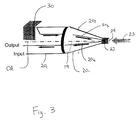
- FIG. 3 depicts a preferred embodiment of the present invention.
- a beam of light to be amplified 20 1 propagates parallel to the optical axis (OA) of a lens 19 and is directed by the lens 19 towards an amplifier medium 22, which is being optically pumped at a wavelength ⁇ p by a pump beam 23 through a dichroic filter 24 transparent to ⁇ p .
- the beam 20 1 having a wavelength ⁇ 1 , traverses the amplifier medium 22 for a first time along a first path for a first amplification and is reflected by the dichroic filter 24.
- the reflected beam 20 2 traverses the amplifier medium a second time for a second amplification along a second path and is directed by the lens 19 towards a reflector in the form of a corner cube 30.
- the corner cube 30 displaces the beam 20 2 into a displaced beam 20 3 and reflects the beam 20 3 back towards the lens 19, which directs the beam 20 3 along a third path towards the amplifier medium 22 for a third amplification.
- the dichroic filter 24 reflects the beam a second time and the reflected beam 20 4 traverses the amplifier medium for a fourth amplification along a fourth path. Subsequently, the beam 20 4 is directed towards an output port, preferably via the lens 19. It is important to note that the plane defined by the first and second paths and the plane defined by the third and fourth paths are distinct due to the beam-displacing action of the corner cube 30 .
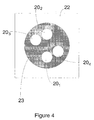
- Figure 4 shows a cross-sectional view of the amplifier medium 22 and a pump beam area 23 populated by areas occupied by the light beam to be amplified as it propagates along the first, second, third and fourth paths here labeled by the corresponding beam numerals 20 1 , 20 2 , 20 3 and 20 4 .
- the embodiment just described has the input beam 20 1 and the output beam 20 4 traversing the lens 19, it is not necessary that they do so for the invention to work.
- Figure 5 depicts an alternative embodiment of the present invention.
- the output pump beam 34 of a fiber coupled diode array 35 is imaged by a lens 36 on an amplifier medium 37 through a dichroic filter 38.
- a light beam to be amplified 39 propagates along a first path 40 towards a lens 41 , which directs the beam 39 towards the amplifier medium 37 and the dichroic filter 38 .
- the dichroic filter 38 reflects the light beam 39 back through the amplifier medium 37 and towards the lens 41 , which directs beam 39 along a second path 42 to a first roof prism 43 .
- the roof prism 43 reflects and displaces the beam 39 to propagate along a third path 44 towards the lens 41 , which directs the beam 39 towards the amplifier medium 37 and the dichroic filter 38 .
- the dichroic filter 38 reflects the beam 39 for propagation through the amplifier medium 37 and towards the lens 41 , which directs the beam 39 along a fourth path 45 to a second roof prism 46 .
- the roof prism 46 reflects and displaces the beam 39 to propagate along a fifth path 47 towards the lens 41 , which directs beam 39 through the amplifier medium 37 to the dichroic filter 38 .
- the dichroic filter 38 reflects the beam 39 through the amplifier medium 37 and towards the lens 41 , which directs the beam 39 along a sixth path 50 to a third roof prism 51 .
- the roof prism 51 reflects and displaces the beam 39 to propagate along a seventh path 52 towards the lens 41 , which directs beam 39 through the amplifier medium 37 to dichroic filter 38 .
- the dichroic filter 38 reflects the beam 39 for propagation through the amplifier medium 37 and towards the lens 41 , which directs the beam 39 along an eight path 53 towards an output port (not shown).
- the beam 39 is amplified each time it traverses the amplifier medium 37 and consequently, according to the description just given, is amplified eight times.
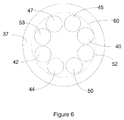
- Figure 6 shows a cross-sectional view of the amplifier medium 37 with a concentric dashed circle 60 representing the area of the cross-section being optically pumped by the pump beam 34 . Also shown in Fig. 6 are the areas of beam 39 traveling along the various paths 40, 45, 47, 53, 42, 44, 50, and 52 as they intercept the cross-section of the pump beam. One can observe in Fig. 6 that the area covered by beam paths 40, 45, 47, 53, 42, 44, 50, and 52 substantially overlap the area 60 covered by the pump beam 34 .
- Fig. 7a illustrates how a recirculating fiber 62 can be used to replace the roof prisms or the corner cube of the previously described embodiments.
- a beam of light 60 propagates towards a lens 74, intersects the lens 74 at a port 72 and is directed along a first path by the lens 74 towards a reflector 75 .
- the beam 60 is then reflected towards the lens 74 along a second path by the reflector 75 and is directed by the lens 74 towards a first end of a recirculating fiber 61 , said first end located at port 70 .
- the beam 60 propagates through the recirculating fiber 61 and exits the recirculating fiber 61 at port 71 .
- the beam 60 is then directed along a third path by the lens 74 towards the reflector 75 .
- the beam 60 is then reflected towards the lens 74 along a fourth path by the reflector 75 and is directed by the lens 74 towards a port 73 .
- the beam of light 60 then exits the port 73 as an output beam 62 .
- Fig. 7a is meant to illustrate how a recirculating fiber can serve as a redirecting means equivalent to corner cubes and roof prisms, the amplifier medium present in the aforementioned embodiments was left out.
- Fig. 7b is frontal view of the side of the lens 74 having the ports 70 , 71, 72 and 73 .
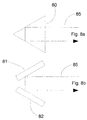
- figures 8a and 8b show how mirrors can perform the equivalent task of a roof prism.
- Fig. 8a one can see an optical beam 85 entering a roof prism 80 and being redirected by the roof prism 80 .
- Fig. 8b shows how the two mirrors 81 and 82 perform the same function as the roof prism 80 on the beam 85 .
- a combination of mirrors can function as a corner cube.
- amplifier medium can be envisaged in the present invention.
- Nd:YVO 4 Nd:YAG, Yb:YAG, Er:glass and Yb:glass can all be utilized as the amplifier medium.
Landscapes
- Physics & Mathematics (AREA)
- Electromagnetism (AREA)
- Engineering & Computer Science (AREA)
- Plasma & Fusion (AREA)
- Optics & Photonics (AREA)
- Lasers (AREA)
Applications Claiming Priority (4)
| Application Number | Priority Date | Filing Date | Title |
|---|---|---|---|
| CA 2368031 CA2368031A1 (fr) | 2002-01-15 | 2002-01-15 | Structure amplificatrice a 3 dimensions |
| CA2368031 | 2002-01-15 | ||
| CA2370037 | 2002-02-01 | ||
| CA 2370037 CA2370037A1 (fr) | 2002-01-15 | 2002-02-01 | Structure amplificatrice a 3 dimensions |
Publications (2)
| Publication Number | Publication Date |
|---|---|
| EP1341272A2 true EP1341272A2 (de) | 2003-09-03 |
| EP1341272A3 EP1341272A3 (de) | 2005-04-20 |
Family
ID=27735482
Family Applications (1)
| Application Number | Title | Priority Date | Filing Date |
|---|---|---|---|
| EP03250198A Withdrawn EP1341272A3 (de) | 2002-01-15 | 2003-01-13 | Dreidimensionaleroptische Verstärker Struktur |
Country Status (2)
| Country | Link |
|---|---|
| US (1) | US20030161035A1 (de) |
| EP (1) | EP1341272A3 (de) |
Cited By (1)
| Publication number | Priority date | Publication date | Assignee | Title |
|---|---|---|---|---|
| CN103972777A (zh) * | 2014-04-23 | 2014-08-06 | 中国科学院物理研究所 | 激光多通放大器 |
Families Citing this family (6)
| Publication number | Priority date | Publication date | Assignee | Title |
|---|---|---|---|---|
| US8665516B2 (en) * | 2009-11-24 | 2014-03-04 | Applied Energetics, Inc. | Multi-pass optical system for a pump laser |
| US8749880B2 (en) * | 2009-11-24 | 2014-06-10 | Applied Energetics | Off axis walk off multi-pass amplifiers |
| CN109936041A (zh) * | 2019-03-18 | 2019-06-25 | 苏州贝林激光有限公司 | 一种固体飞秒放大装置及其方法 |
| CN112018589B (zh) * | 2019-05-28 | 2021-07-13 | 天津凯普林激光科技有限公司 | 一种激光放大装置及激光放大方法 |
| CN113300200B (zh) * | 2021-04-07 | 2023-04-18 | 清华大学 | 脉冲激光器 |
| US20240039231A1 (en) * | 2022-07-28 | 2024-02-01 | Onelight Sensing, Llc | Slab laser with folded pump for extended performance |
Family Cites Families (8)
| Publication number | Priority date | Publication date | Assignee | Title |
|---|---|---|---|---|
| US3460046A (en) * | 1968-05-13 | 1969-08-05 | Bell Telephone Labor Inc | Lasers and optical resonators with beam twisting |
| US5546222A (en) * | 1992-11-18 | 1996-08-13 | Lightwave Electronics Corporation | Multi-pass light amplifier |
| US5268787A (en) * | 1993-02-17 | 1993-12-07 | Energy Compression Research Corp. | Multiple-pass method and apparatus for laser amplification |
| US5615043A (en) * | 1993-05-07 | 1997-03-25 | Lightwave Electronics Co. | Multi-pass light amplifier |
| US6873639B2 (en) * | 1993-05-28 | 2005-03-29 | Tong Zhang | Multipass geometry and constructions for diode-pumped solid-state lasers and fiber lasers, and for optical amplifier and detector |
| US5923684A (en) * | 1996-09-26 | 1999-07-13 | Lucent Technologies Inc. | Fiber amplifier with multiple pass pumping |
| US6373864B1 (en) * | 2000-01-21 | 2002-04-16 | Nanolase S.A. | Sub-nanosecond passively q-switched microchip laser system |
| DE10005194A1 (de) * | 2000-02-05 | 2001-08-16 | Univ Stuttgart Strahlwerkzeuge | Laserverstärkersystem |
-
2003
- 2003-01-13 EP EP03250198A patent/EP1341272A3/de not_active Withdrawn
- 2003-01-13 US US10/342,437 patent/US20030161035A1/en not_active Abandoned
Cited By (2)
| Publication number | Priority date | Publication date | Assignee | Title |
|---|---|---|---|---|
| CN103972777A (zh) * | 2014-04-23 | 2014-08-06 | 中国科学院物理研究所 | 激光多通放大器 |
| CN103972777B (zh) * | 2014-04-23 | 2017-12-26 | 中国科学院物理研究所 | 激光多通放大器 |
Also Published As
| Publication number | Publication date |
|---|---|
| EP1341272A3 (de) | 2005-04-20 |
| US20030161035A1 (en) | 2003-08-28 |
Similar Documents
| Publication | Publication Date | Title |
|---|---|---|
| US6373864B1 (en) | Sub-nanosecond passively q-switched microchip laser system | |
| US7006283B2 (en) | Three-dimensional optical amplifier structure | |
| JP3567233B2 (ja) | 高エネルギーレベルを有する高ピークパワーを供給する光増幅器 | |
| CN101496320B (zh) | 串接光放大器 | |
| US8774236B2 (en) | Ultraviolet fiber laser system | |
| US7394591B2 (en) | Utilization of Yb: and Nd: mode-locked oscillators in solid-state short pulse laser systems | |
| US5546222A (en) | Multi-pass light amplifier | |
| CN113809620B (zh) | 一种激光相干测风雷达用大能量、长脉冲1μm单频纳秒激光器 | |
| CN101981769A (zh) | 多程光功率放大器 | |
| US10535975B2 (en) | High power sub-400 femtosecond MOPA with solid-state power amplifier | |
| US6807198B1 (en) | Laser device | |
| US7876802B2 (en) | High gain tapered laser gain module | |
| US20030161035A1 (en) | Three-dimensional optical amplifier structure | |
| RU2019116405A (ru) | Усилитель высокой мощности на кристалле, легированном редкоземельными элементами, основанный на схеме закачки со сверхнизким квантовым дефектом, использующей одномодовые или низкомодовые волоконные лазеры | |
| JP7500069B2 (ja) | 光発振器 | |
| US12362531B2 (en) | Raman amplifier with shared resonator | |
| CA2416232A1 (en) | Three-dimensional optical amplifier structure | |
| JP7515103B2 (ja) | パルスレーザー光源装置 | |
| CN105896255A (zh) | 可调皮秒固体激光系统 | |
| US11152757B2 (en) | High repetition rate seed laser | |
| Creeden et al. | Multi-watt mid-IR fiber-pumped OPO | |
| US11641090B2 (en) | High-pulse energy, high-power lasers with diffraction-limited performance | |
| EP1601068A1 (de) | Lasergerät mit zwei aktiven Media | |
| Friel et al. | High-gain Nd: YLF amplifier end-pumped by a beam-shaped broad-stripe diode laser | |
| Forget et al. | New 3D multipass amplifier based on Nd: YAG or Nd: YVO4 crystals |
Legal Events
| Date | Code | Title | Description |
|---|---|---|---|
| PUAI | Public reference made under article 153(3) epc to a published international application that has entered the european phase |
Free format text: ORIGINAL CODE: 0009012 |
|
| AK | Designated contracting states |
Kind code of ref document: A2 Designated state(s): AT BE BG CH CY CZ DE DK EE ES FI FR GB GR HU IE IT LI LU MC NL PT SE SI SK TR |
|
| AX | Request for extension of the european patent |
Extension state: AL LT LV MK RO |
|
| PUAL | Search report despatched |
Free format text: ORIGINAL CODE: 0009013 |
|
| AK | Designated contracting states |
Kind code of ref document: A3 Designated state(s): AT BE BG CH CY CZ DE DK EE ES FI FR GB GR HU IE IT LI LU MC NL PT SE SI SK TR |
|
| AX | Request for extension of the european patent |
Extension state: AL LT LV MK RO |
|
| RIC1 | Information provided on ipc code assigned before grant |
Ipc: 7H 01S 3/06 B Ipc: 7H 01S 3/0941 B Ipc: 7H 01S 3/23 B Ipc: 7H 01S 3/063 A |
|
| AKX | Designation fees paid | ||
| REG | Reference to a national code |
Ref country code: DE Ref legal event code: 8566 |
|
| STAA | Information on the status of an ep patent application or granted ep patent |
Free format text: STATUS: THE APPLICATION IS DEEMED TO BE WITHDRAWN |
|
| 18D | Application deemed to be withdrawn |
Effective date: 20051021 |