EP1342802A1 - Procédé de récupération de soufre élémentaire à partir de boues contenant des sulfures métalliques et du soufre élémentaire - Google Patents
Procédé de récupération de soufre élémentaire à partir de boues contenant des sulfures métalliques et du soufre élémentaire Download PDFInfo
- Publication number
- EP1342802A1 EP1342802A1 EP20020075908 EP02075908A EP1342802A1 EP 1342802 A1 EP1342802 A1 EP 1342802A1 EP 20020075908 EP20020075908 EP 20020075908 EP 02075908 A EP02075908 A EP 02075908A EP 1342802 A1 EP1342802 A1 EP 1342802A1
- Authority
- EP
- European Patent Office
- Prior art keywords
- sulphide
- elemental sulphur
- sulphur
- slurry
- metal sulphides
- Prior art date
- Legal status (The legal status is an assumption and is not a legal conclusion. Google has not performed a legal analysis and makes no representation as to the accuracy of the status listed.)
- Withdrawn
Links
- NINIDFKCEFEMDL-UHFFFAOYSA-N Sulfur Chemical compound [S] NINIDFKCEFEMDL-UHFFFAOYSA-N 0.000 title claims abstract description 93
- 239000005864 Sulphur Substances 0.000 title claims abstract description 93
- 229910052976 metal sulfide Inorganic materials 0.000 title claims abstract description 43
- 239000002002 slurry Substances 0.000 title claims abstract description 34
- 238000000034 method Methods 0.000 title claims abstract description 29
- 238000011084 recovery Methods 0.000 title description 7
- 229920001021 polysulfide Polymers 0.000 claims abstract description 32
- UCKMPCXJQFINFW-UHFFFAOYSA-N Sulphide Chemical compound [S-2] UCKMPCXJQFINFW-UHFFFAOYSA-N 0.000 claims abstract description 30
- 239000007788 liquid Substances 0.000 claims abstract description 22
- RWSOTUBLDIXVET-UHFFFAOYSA-N Dihydrogen sulfide Chemical compound S RWSOTUBLDIXVET-UHFFFAOYSA-N 0.000 claims description 24
- 238000000926 separation method Methods 0.000 claims description 12
- UFHFLCQGNIYNRP-UHFFFAOYSA-N Hydrogen Chemical compound [H][H] UFHFLCQGNIYNRP-UHFFFAOYSA-N 0.000 claims description 7
- 229910052739 hydrogen Inorganic materials 0.000 claims description 6
- 239000001257 hydrogen Substances 0.000 claims description 6
- 241000894006 Bacteria Species 0.000 claims description 5
- 235000014113 dietary fatty acids Nutrition 0.000 claims description 2
- 229930195729 fatty acid Natural products 0.000 claims description 2
- 239000000194 fatty acid Substances 0.000 claims description 2
- 150000004665 fatty acids Chemical class 0.000 claims description 2
- 125000003158 alcohol group Chemical group 0.000 claims 1
- QTBSBXVTEAMEQO-UHFFFAOYSA-N Acetic acid Chemical compound CC(O)=O QTBSBXVTEAMEQO-UHFFFAOYSA-N 0.000 description 20
- 238000002386 leaching Methods 0.000 description 19
- 239000002184 metal Substances 0.000 description 12
- 229910052751 metal Inorganic materials 0.000 description 12
- LFQSCWFLJHTTHZ-UHFFFAOYSA-N Ethanol Chemical compound CCO LFQSCWFLJHTTHZ-UHFFFAOYSA-N 0.000 description 11
- 238000001556 precipitation Methods 0.000 description 10
- 230000003647 oxidation Effects 0.000 description 9
- 238000007254 oxidation reaction Methods 0.000 description 9
- 239000007787 solid Substances 0.000 description 9
- IJGRMHOSHXDMSA-UHFFFAOYSA-N Atomic nitrogen Chemical compound N#N IJGRMHOSHXDMSA-UHFFFAOYSA-N 0.000 description 6
- 238000006243 chemical reaction Methods 0.000 description 6
- 238000004519 manufacturing process Methods 0.000 description 6
- 230000000035 biogenic effect Effects 0.000 description 5
- 239000010949 copper Substances 0.000 description 5
- 239000007789 gas Substances 0.000 description 5
- 235000015097 nutrients Nutrition 0.000 description 5
- XLYOFNOQVPJJNP-UHFFFAOYSA-N water Substances O XLYOFNOQVPJJNP-UHFFFAOYSA-N 0.000 description 5
- CURLTUGMZLYLDI-UHFFFAOYSA-N Carbon dioxide Chemical compound O=C=O CURLTUGMZLYLDI-UHFFFAOYSA-N 0.000 description 4
- ZGSDJMADBJCNPN-UHFFFAOYSA-N [S-][NH3+] Chemical compound [S-][NH3+] ZGSDJMADBJCNPN-UHFFFAOYSA-N 0.000 description 4
- 150000002739 metals Chemical class 0.000 description 4
- 239000000203 mixture Substances 0.000 description 4
- 239000000243 solution Substances 0.000 description 4
- HEMHJVSKTPXQMS-UHFFFAOYSA-M Sodium hydroxide Chemical compound [OH-].[Na+] HEMHJVSKTPXQMS-UHFFFAOYSA-M 0.000 description 3
- 239000012159 carrier gas Substances 0.000 description 3
- XCAUINMIESBTBL-UHFFFAOYSA-N lead(ii) sulfide Chemical compound [Pb]=S XCAUINMIESBTBL-UHFFFAOYSA-N 0.000 description 3
- 229910052757 nitrogen Inorganic materials 0.000 description 3
- 239000011734 sodium Substances 0.000 description 3
- GRVFOGOEDUUMBP-UHFFFAOYSA-N sodium sulfide (anhydrous) Chemical compound [Na+].[Na+].[S-2] GRVFOGOEDUUMBP-UHFFFAOYSA-N 0.000 description 3
- 239000011701 zinc Substances 0.000 description 3
- 239000002028 Biomass Substances 0.000 description 2
- 241000186541 Desulfotomaculum Species 0.000 description 2
- 229910019142 PO4 Inorganic materials 0.000 description 2
- OAICVXFJPJFONN-UHFFFAOYSA-N Phosphorus Chemical compound [P] OAICVXFJPJFONN-UHFFFAOYSA-N 0.000 description 2
- 239000001569 carbon dioxide Substances 0.000 description 2
- 229910002092 carbon dioxide Inorganic materials 0.000 description 2
- 239000003795 chemical substances by application Substances 0.000 description 2
- 229910052802 copper Inorganic materials 0.000 description 2
- 238000010586 diagram Methods 0.000 description 2
- 238000004090 dissolution Methods 0.000 description 2
- 238000000605 extraction Methods 0.000 description 2
- 238000009434 installation Methods 0.000 description 2
- 229910052698 phosphorus Inorganic materials 0.000 description 2
- 239000011574 phosphorus Substances 0.000 description 2
- 229910052979 sodium sulfide Inorganic materials 0.000 description 2
- 239000011573 trace mineral Substances 0.000 description 2
- 235000013619 trace mineral Nutrition 0.000 description 2
- QGZKDVFQNNGYKY-UHFFFAOYSA-O Ammonium Chemical group [NH4+] QGZKDVFQNNGYKY-UHFFFAOYSA-O 0.000 description 1
- OKTJSMMVPCPJKN-UHFFFAOYSA-N Carbon Chemical compound [C] OKTJSMMVPCPJKN-UHFFFAOYSA-N 0.000 description 1
- RYGMFSIKBFXOCR-UHFFFAOYSA-N Copper Chemical compound [Cu] RYGMFSIKBFXOCR-UHFFFAOYSA-N 0.000 description 1
- 241000205101 Sulfolobus Species 0.000 description 1
- 241000229714 Thermothrix Species 0.000 description 1
- 241000605118 Thiobacillus Species 0.000 description 1
- 241000605261 Thiomicrospira Species 0.000 description 1
- 238000009825 accumulation Methods 0.000 description 1
- 230000009286 beneficial effect Effects 0.000 description 1
- -1 between 1% and 25% Chemical compound 0.000 description 1
- 230000003139 buffering effect Effects 0.000 description 1
- 229910052793 cadmium Inorganic materials 0.000 description 1
- 150000001720 carbohydrates Chemical class 0.000 description 1
- 235000014633 carbohydrates Nutrition 0.000 description 1
- 229910052799 carbon Inorganic materials 0.000 description 1
- 230000000052 comparative effect Effects 0.000 description 1
- 238000010790 dilution Methods 0.000 description 1
- 239000012895 dilution Substances 0.000 description 1
- 150000002431 hydrogen Chemical class 0.000 description 1
- 238000011835 investigation Methods 0.000 description 1
- 229910052745 lead Inorganic materials 0.000 description 1
- 238000012423 maintenance Methods 0.000 description 1
- 239000000463 material Substances 0.000 description 1
- 229910052753 mercury Inorganic materials 0.000 description 1
- 125000000896 monocarboxylic acid group Chemical group 0.000 description 1
- 230000007935 neutral effect Effects 0.000 description 1
- 229910052759 nickel Inorganic materials 0.000 description 1
- PXHVJJICTQNCMI-UHFFFAOYSA-N nickel Substances [Ni] PXHVJJICTQNCMI-UHFFFAOYSA-N 0.000 description 1
- 239000011368 organic material Substances 0.000 description 1
- 230000020477 pH reduction Effects 0.000 description 1
- 239000010452 phosphate Substances 0.000 description 1
- 125000002467 phosphate group Chemical group [H]OP(=O)(O[H])O[*] 0.000 description 1
- 239000002244 precipitate Substances 0.000 description 1
- 239000010909 process residue Substances 0.000 description 1
- 239000000047 product Substances 0.000 description 1
- 238000004064 recycling Methods 0.000 description 1
- 150000003839 salts Chemical class 0.000 description 1
- 229910052709 silver Inorganic materials 0.000 description 1
- 239000000126 substance Substances 0.000 description 1
- 230000019086 sulfide ion homeostasis Effects 0.000 description 1
- 239000000725 suspension Substances 0.000 description 1
- JBQYATWDVHIOAR-UHFFFAOYSA-N tellanylidenegermanium Chemical compound [Te]=[Ge] JBQYATWDVHIOAR-UHFFFAOYSA-N 0.000 description 1
- 239000002562 thickening agent Substances 0.000 description 1
- 230000001988 toxicity Effects 0.000 description 1
- 231100000419 toxicity Toxicity 0.000 description 1
- 229910052725 zinc Inorganic materials 0.000 description 1
Images

Classifications
-
- C—CHEMISTRY; METALLURGY
- C02—TREATMENT OF WATER, WASTE WATER, SEWAGE, OR SLUDGE
- C02F—TREATMENT OF WATER, WASTE WATER, SEWAGE, OR SLUDGE
- C02F3/00—Biological treatment of water, waste water, or sewage
- C02F3/34—Biological treatment of water, waste water, or sewage characterised by the microorganisms used
- C02F3/345—Biological treatment of water, waste water, or sewage characterised by the microorganisms used for biological oxidation or reduction of sulfur compounds
-
- C—CHEMISTRY; METALLURGY
- C22—METALLURGY; FERROUS OR NON-FERROUS ALLOYS; TREATMENT OF ALLOYS OR NON-FERROUS METALS
- C22B—PRODUCTION AND REFINING OF METALS; PRETREATMENT OF RAW MATERIALS
- C22B13/00—Obtaining lead
- C22B13/04—Obtaining lead by wet processes
-
- C—CHEMISTRY; METALLURGY
- C22—METALLURGY; FERROUS OR NON-FERROUS ALLOYS; TREATMENT OF ALLOYS OR NON-FERROUS METALS
- C22B—PRODUCTION AND REFINING OF METALS; PRETREATMENT OF RAW MATERIALS
- C22B13/00—Obtaining lead
- C22B13/04—Obtaining lead by wet processes
- C22B13/045—Recovery from waste materials
-
- C—CHEMISTRY; METALLURGY
- C22—METALLURGY; FERROUS OR NON-FERROUS ALLOYS; TREATMENT OF ALLOYS OR NON-FERROUS METALS
- C22B—PRODUCTION AND REFINING OF METALS; PRETREATMENT OF RAW MATERIALS
- C22B3/00—Extraction of metal compounds from ores or concentrates by wet processes
- C22B3/18—Extraction of metal compounds from ores or concentrates by wet processes with the aid of microorganisms or enzymes, e.g. bacteria or algae
-
- C—CHEMISTRY; METALLURGY
- C02—TREATMENT OF WATER, WASTE WATER, SEWAGE, OR SLUDGE
- C02F—TREATMENT OF WATER, WASTE WATER, SEWAGE, OR SLUDGE
- C02F2301/00—General aspects of water treatment
- C02F2301/04—Flow arrangements
- C02F2301/043—Treatment of partial or bypass streams
-
- Y—GENERAL TAGGING OF NEW TECHNOLOGICAL DEVELOPMENTS; GENERAL TAGGING OF CROSS-SECTIONAL TECHNOLOGIES SPANNING OVER SEVERAL SECTIONS OF THE IPC; TECHNICAL SUBJECTS COVERED BY FORMER USPC CROSS-REFERENCE ART COLLECTIONS [XRACs] AND DIGESTS
- Y02—TECHNOLOGIES OR APPLICATIONS FOR MITIGATION OR ADAPTATION AGAINST CLIMATE CHANGE
- Y02P—CLIMATE CHANGE MITIGATION TECHNOLOGIES IN THE PRODUCTION OR PROCESSING OF GOODS
- Y02P10/00—Technologies related to metal processing
- Y02P10/20—Recycling
Definitions
- the invention relates to a process of extracting elemental sulphur (S 0 ) from slurries containing elemental sulphur and metal sulphides (MeS).
- the process of the invention is characterised in that elemental sulphur is biologically reduced to sulphide in the presence of an electron donor, the slurry is contacted with the sulphide to solubilise the elemental sulphur, and the metal sulphides are separated from the solubilised elemental sulphur.
- the polysulphides need to be converted to elemental sulphur again. This can be done through H 2 S stripping (either through acidification or using a carrier gas, or both) or by biological oxidation of polysulphides to sulphur.
- H 2 S stripping either through acidification or using a carrier gas, or both
- biological oxidation of polysulphides to sulphur has the advantage that alkalinity is produced leading to a higher pH.
- a high pH is beneficial for polysulphide stability and thus for a stable sulphur extraction.
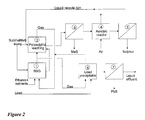
- the process of the invention for the recovery of elemental sulphur from leaching residues comprises the following process steps:
- Elemental sulphur is biologically converted to H 2 S by the Bio Sulphide Generator (BSG) (1).
- BSG Bio Sulphide Generator
- an external energy donor or electron donor will have to be added.
- the reaction ensuring sulphide production is the following: S 0 + electron donor ⁇ H 2 S + oxidised products
- the electron donor can be a fatty acid such as acetic acid (CH 3 COOH), an alcohol, such as ethanol (CH 3 CH 2 OH) or other organic material such as carbohydrates, or hydrogen gas (H 2 ).
- the demand is determined by the amount of elemental sulphur present in the slurry and H 2 S demand elsewhere on site, e.g. for the precipitation of dissolved metals: Me 2+ +S 2- ⁇ MeS
- Me denotes any divalent metal (having an insoluble sulphide) such as Co, Ni, Zn, Cu, Cd, Hg, Pb, and the like; for metals having other valencies, such as Ag and Al, similar equations apply, e.g. 2 Ag + + S 2- ⁇ Ag 2 S; 2 Al 3+ + S 2 - ⁇ Al 2 S 3 , and the like.
- the slurry to be treated can contain between 1 and 50 g elemental sulphur per liter.
- a typical sulphur load in the slurry is between 5 and 20 g/l, or around 1% w/v.
- the slurry may contain between 0.5 and 20 g, usually between 2 and 10 g/l of insoluble metal sulphides.
- a total sulphur load of e.g. 1000 kg S 0 per h will involve a liquid flow of about 100 m 3 /h.
- the mixture of metal sulphides and elemental sulphur to be separated is usually supplied as a solid obtained by separation of metal sulphide precipitate from a metal precipitation installation.
- the mixture is passed to a slurry having the required concentration by dilution with water or, preferably, with liquid recycle from the sulphur separation step (5).
- acetic acid or ethanol When acetic acid or ethanol is used, only a phosphorus source, a nitrogen source and some trace elements need to be provided.
- a carbon source e.g. acetic acid
- a commonly used phosphorus source is phosphate (PO 4 3- ).
- a commonly used nitrogen source is ammonium (NH 4 + ).
- Commercially available nutrient mixtures, such as Nutrimix® (Paques) nutrient solution can serve as a source for trace elements.
- the pH in the bioreactor can be about neutral, e.g. between 5 and 9, especially between 6 and 8.
- a pH controlling agent may added, e.g. in combination with the acetic acid or other nutrient.
- the total solids concentration is preferably between 5 and 20 g/l, which is adjusted, as necessary, by adding water as such or in combination with the nutrients.
- the anaerobic biomass necessary for the biological production of sulphide from sulphur can be obtained from common sources, e.g. existing sulphur-reducing or sulphide-oxidising bioreactors. These can comprise bacteria e.g. from the genera Desulforomonas or Desulfotomaculum. The bacteria may be mesophilic or thermophilic e.g. Desulfotomaculum KT7. Suitable bacteria are described in WO 00/29605.
- the slurry containing the sulphur and metal sulphides can advantageously be separated into two streams.
- the elemental sulphur to be reduced to sulphide in the bioreactor is advantageously contained in the original MeS/sulphur slurry.
- the bioreactor is also fed with metal sulphides (MeS).
- MeS metal sulphides
- Separators keeping the biomass in the sulphide generating reactor may be provided, especially with high-capacity generators using hydrogen as the electron donor.
- H 2 S is stripped from the reactor by means of a gas recycle using a carrier gas such as nitrogen or hydrogen.
- the carrier gas may also advantageously contain carbon dioxide, e.g. between 1% and 25%, which increases the buffering capacity of the reactor contents.
- carbon dioxide may originate from the reformer producing the hydrogen.
- the hydrogen sulphide is led from the reactor to the polysulphide leaching contactor (2).
- the slurry containing metal sulphides and elemental sulphur is contacted with the biogenic hydrogen sulphide gas (or a liquid form of sulphide) in the contactor under turbulent conditions (step 2).
- the elemental sulphur present reacts with sulphide to form polysulphides, which are soluble in water.
- the general reaction is the following nS 0 +S 2- ⁇ S n +1 2-
- n ranges from 1 to 5.
- n will preferably be 4, since S 5 2- is the most stable polysulphide.
- the ratio between the first stream (fed to the bioreactor 1) and the second flow (directly fed to the contactor 2) is between 10:90 and 33:67, in particular between 15:85 and 25:75.
- This most preferred division of the sulphur containing slurry is about 20% being fed to the bioreactor 1 and about 80% being directly fed to the contactor 2.
- the pH in the contactor is preferably alkaline, e.g. between 8 and 10. Therefore it is preferred that the part of the MeS/sulphur slurry (ideally about 80%) to be contacted is mixed with an alkaline recycle coming from oxidation step (4) or sulphur separation step (5).
- solid metal sulphides can be separated from the sulphur containing liquid in separation step (3), provided the polysulphides are sufficiently stable to avoid precipitation thereof.
- Conventional separators can be used in separation step 3, e.g. so-called Tilted Plate Separators (TPS) or thickeners.
- TPS Tilted Plate Separators
- the liquid in the separator (3) should be sufficiently alkaline, especially pH 8 or higher.
- the biologial oxidation of polysulphide to sulphur can be performed as known in the art, using common sulphide-oxidising bacteria such as from the genera Thiobacillus, Thiomicrospira, Sulfolobus and Thermothrix.
- the biological oxidation of sulphur is described e.g. in WO 91/16269 and WO 94/29227.
- solid elemental sulphur is separated (step 5), e.g. using Tilted Plate Separators, and the remaining alkaline liquid is recirculated to the polysulphide leaching.
- the pH of the alkaline liquid issuing form (5) will range from 8.5 to 9.5.
- the liquid is preferably largely returned to the sulphur leaching step (20), in particular a proportion of between 50 and 95 % of the total liquid, preferably of between 70 and 90 % of the liquid resulting form (5).
- the metal sulphides separated from the solubilised sulphur can be returned to the metal recovery process.
- the sulphide generator may also be used to provide liquid sulphide or gaseous hydrogen sulphide for the precipitation installation as depicted in figure 2 as reactor (6).
- the capacity of the sulphide generator may then be increased relative to the capacity need for the contactor (2) from between 15:85 and 25:75 without the metal precipitation to between 20:80 and 40:60 with metal precipitation.
- Sulphur removal efficiencies that can be achieved using the process of the invention can be about 95% or higher, up to about 98 %.
- the process of the invention is furthermore advantageous in using a relatively simple flow sheet as depicted in figures 1 and 2.
- Two streams that need to be treated are characterised as follows: 1) 12054 tpy (33 tpd) of final residue (sulphur containing slurry): Pb 8% (960 tpy Pb) Zn 3% (360 tpy Zn) Cu 2% (240 tpy Cu) Fe 6% (720 tpy Fe) Sulphur 70% (8430 tpy S) remainder: water, salts etc. 2) Lead bleed: Dissolved Pb 140 g/l To be recovered 2500 tpy Pb Flow to be treated 49 m3/d
- the process of the present invention is well suited for this case and comprises seven main process steps:
- ammonium sulphide (NH 4 ) 2 S) was proposed as leaching agent. After metal sulphides have been removed from the polysulphide solution, (NH 4 ) 2 S is regenerated through steam stripping and led back to the sulphur leaching. Basically, in step 2 ammonium sulphide is used for sulphur dissolution and the aerobic reactor in step 4 is replaced by a steam stripping step.
- the operational costs are much higher in this example than in the process of the invention, because of the supply of ammonium sulphide and steam generation.
Landscapes
- Chemical & Material Sciences (AREA)
- Engineering & Computer Science (AREA)
- Life Sciences & Earth Sciences (AREA)
- Organic Chemistry (AREA)
- Manufacturing & Machinery (AREA)
- Materials Engineering (AREA)
- Metallurgy (AREA)
- Mechanical Engineering (AREA)
- Microbiology (AREA)
- Environmental & Geological Engineering (AREA)
- Geology (AREA)
- Biotechnology (AREA)
- Geochemistry & Mineralogy (AREA)
- General Life Sciences & Earth Sciences (AREA)
- Biochemistry (AREA)
- Health & Medical Sciences (AREA)
- Molecular Biology (AREA)
- Biodiversity & Conservation Biology (AREA)
- Hydrology & Water Resources (AREA)
- Water Supply & Treatment (AREA)
- Removal Of Specific Substances (AREA)
- Purification Treatments By Anaerobic Or Anaerobic And Aerobic Bacteria Or Animals (AREA)
- Manufacture And Refinement Of Metals (AREA)
Priority Applications (1)
| Application Number | Priority Date | Filing Date | Title |
|---|---|---|---|
| EP20020075908 EP1342802A1 (fr) | 2002-03-08 | 2002-03-08 | Procédé de récupération de soufre élémentaire à partir de boues contenant des sulfures métalliques et du soufre élémentaire |
Applications Claiming Priority (1)
| Application Number | Priority Date | Filing Date | Title |
|---|---|---|---|
| EP20020075908 EP1342802A1 (fr) | 2002-03-08 | 2002-03-08 | Procédé de récupération de soufre élémentaire à partir de boues contenant des sulfures métalliques et du soufre élémentaire |
Publications (1)
| Publication Number | Publication Date |
|---|---|
| EP1342802A1 true EP1342802A1 (fr) | 2003-09-10 |
Family
ID=27741211
Family Applications (1)
| Application Number | Title | Priority Date | Filing Date |
|---|---|---|---|
| EP20020075908 Withdrawn EP1342802A1 (fr) | 2002-03-08 | 2002-03-08 | Procédé de récupération de soufre élémentaire à partir de boues contenant des sulfures métalliques et du soufre élémentaire |
Country Status (1)
| Country | Link |
|---|---|
| EP (1) | EP1342802A1 (fr) |
Cited By (1)
| Publication number | Priority date | Publication date | Assignee | Title |
|---|---|---|---|---|
| CN118320574A (zh) * | 2024-04-08 | 2024-07-12 | 中南大学 | 基于离子液体的二氧化硫烟气综合处理方法 |
Citations (4)
| Publication number | Priority date | Publication date | Assignee | Title |
|---|---|---|---|---|
| WO1994029227A1 (fr) * | 1993-06-10 | 1994-12-22 | Paques B.V. | aROCEDE POUR PURIFIER DES EAUX USEES CONTENANT DU SULFURE |
| WO1997029055A1 (fr) * | 1996-02-06 | 1997-08-14 | Thiopaq Sulfur Systems B.V. | Procede de traitement d'eau contenant des ions de metal lourd |
| WO2000029605A1 (fr) * | 1998-11-16 | 2000-05-25 | Paques Bio Systems B.V. | Procede de production de sulfure d'hydrogene a partir de soufre elementaire, et utilisation de ce sulfure dans la recuperation de metaux lourds |
| EP1114873A1 (fr) * | 2000-01-07 | 2001-07-11 | Paques Bio Systems B.V. | Procédé biologique pour dézinguer de la ferraille galvanisée |
-
2002
- 2002-03-08 EP EP20020075908 patent/EP1342802A1/fr not_active Withdrawn
Patent Citations (4)
| Publication number | Priority date | Publication date | Assignee | Title |
|---|---|---|---|---|
| WO1994029227A1 (fr) * | 1993-06-10 | 1994-12-22 | Paques B.V. | aROCEDE POUR PURIFIER DES EAUX USEES CONTENANT DU SULFURE |
| WO1997029055A1 (fr) * | 1996-02-06 | 1997-08-14 | Thiopaq Sulfur Systems B.V. | Procede de traitement d'eau contenant des ions de metal lourd |
| WO2000029605A1 (fr) * | 1998-11-16 | 2000-05-25 | Paques Bio Systems B.V. | Procede de production de sulfure d'hydrogene a partir de soufre elementaire, et utilisation de ce sulfure dans la recuperation de metaux lourds |
| EP1114873A1 (fr) * | 2000-01-07 | 2001-07-11 | Paques Bio Systems B.V. | Procédé biologique pour dézinguer de la ferraille galvanisée |
Cited By (1)
| Publication number | Priority date | Publication date | Assignee | Title |
|---|---|---|---|---|
| CN118320574A (zh) * | 2024-04-08 | 2024-07-12 | 中南大学 | 基于离子液体的二氧化硫烟气综合处理方法 |
Similar Documents
| Publication | Publication Date | Title |
|---|---|---|
| Morin et al. | Bioleaching of a cobalt-containing pyrite in stirred reactors: a case study from laboratory scale to industrial application | |
| AU719886B2 (en) | Process for the treatment of water containing heavy metal ions | |
| AU763302C (en) | Integrated, tank/heap biooxidation process for the lixiviation of sulfide ores | |
| US9902975B2 (en) | Process for the biological conversion of bisulphide into elemental sulphur | |
| CN103168109A (zh) | 硫酸锰/连二硫酸锰液体的处理 | |
| AU665981B2 (en) | Cyanide recycling process | |
| CN112225188B (zh) | 湿法磷酸脱砷的工艺 | |
| EP3478863B1 (fr) | Récupération de métaux lourds par précipitation sélective | |
| CN118479668B (zh) | 酸性矿山废水深度处理方法 | |
| US6852305B2 (en) | Process for the production of hydrogen sulphide from elemental sulphur and use thereof in heavy metal recovery | |
| EP1131459B1 (fr) | Procede de production de sulfure d'hydrogene a partir de soufre elementaire, et utilisation de ce sulfure dans la recuperation de metaux lourds | |
| US20070172935A1 (en) | Tank Bioleaching Process | |
| AU2025204090A1 (en) | Reduction of chalcopyrite by an aqueous phase reducant to enable hydrometallurgical extraction of copper | |
| EP1433860A1 (fr) | Procédé pour régénérer le thiosulfate dans un lixiviant de l'or épuisé en thiosulphate | |
| WO2003025235A1 (fr) | Procede de recuperation de plomb a partir de batteries mises au rebut | |
| JPH05192686A (ja) | 硫化物系廃棄物の微生物学的酸化処理方法 | |
| Lens et al. | Bioprocess engineering of sulfate reduction for environmental technology | |
| NL2038667B1 (en) | Process for the recovery of iron and phosphate from iron phosphate-comprising sludge | |
| US20250109458A1 (en) | Systems and methods for selective leaching of manganese from ores | |
| CN118946530A (zh) | 用于净化含硫酸盐废水并回收硫和氢的方法 |
Legal Events
| Date | Code | Title | Description |
|---|---|---|---|
| PUAI | Public reference made under article 153(3) epc to a published international application that has entered the european phase |
Free format text: ORIGINAL CODE: 0009012 |
|
| AK | Designated contracting states |
Kind code of ref document: A1 Designated state(s): AT BE CH CY DE DK ES FI FR GB GR IE IT LI LU MC NL PT SE TR |
|
| AX | Request for extension of the european patent |
Extension state: AL LT LV MK RO SI |
|
| AKX | Designation fees paid | ||
| REG | Reference to a national code |
Ref country code: DE Ref legal event code: 8566 |
|
| STAA | Information on the status of an ep patent application or granted ep patent |
Free format text: STATUS: THE APPLICATION IS DEEMED TO BE WITHDRAWN |
|
| 18D | Application deemed to be withdrawn |
Effective date: 20040311 |