EP1343217A2 - Transition entre une ligne de transmission coaxiale et une ligne de transmission sur un circuit imprimé - Google Patents
Transition entre une ligne de transmission coaxiale et une ligne de transmission sur un circuit imprimé Download PDFInfo
- Publication number
- EP1343217A2 EP1343217A2 EP03251393A EP03251393A EP1343217A2 EP 1343217 A2 EP1343217 A2 EP 1343217A2 EP 03251393 A EP03251393 A EP 03251393A EP 03251393 A EP03251393 A EP 03251393A EP 1343217 A2 EP1343217 A2 EP 1343217A2
- Authority
- EP
- European Patent Office
- Prior art keywords
- conductive
- transition piece
- coaxial
- transmission line
- ground plane
- Prior art date
- Legal status (The legal status is an assumption and is not a legal conclusion. Google has not performed a legal analysis and makes no representation as to the accuracy of the status listed.)
- Withdrawn
Links
- 230000007704 transition Effects 0.000 title claims abstract description 138
- 230000005540 biological transmission Effects 0.000 title claims abstract description 116
- 230000008878 coupling Effects 0.000 claims abstract description 19
- 238000010168 coupling process Methods 0.000 claims abstract description 19
- 238000005859 coupling reaction Methods 0.000 claims abstract description 19
- 238000000034 method Methods 0.000 claims description 18
- 238000007373 indentation Methods 0.000 claims description 14
- 239000000463 material Substances 0.000 claims description 6
- 238000005452 bending Methods 0.000 claims description 4
- 238000010586 diagram Methods 0.000 description 14
- 238000003466 welding Methods 0.000 description 8
- 241000755266 Kathetostoma giganteum Species 0.000 description 5
- 238000010276 construction Methods 0.000 description 5
- 230000008569 process Effects 0.000 description 5
- 230000008054 signal transmission Effects 0.000 description 5
- 238000005530 etching Methods 0.000 description 4
- 239000004020 conductor Substances 0.000 description 3
- 230000013011 mating Effects 0.000 description 3
- 238000003801 milling Methods 0.000 description 3
- 239000003292 glue Substances 0.000 description 2
- PCHJSUWPFVWCPO-UHFFFAOYSA-N gold Chemical compound [Au] PCHJSUWPFVWCPO-UHFFFAOYSA-N 0.000 description 2
- 239000010931 gold Substances 0.000 description 2
- 229910052737 gold Inorganic materials 0.000 description 2
- 238000005259 measurement Methods 0.000 description 2
- 238000000926 separation method Methods 0.000 description 2
- 229910000679 solder Inorganic materials 0.000 description 2
- 238000005476 soldering Methods 0.000 description 2
- 241001417935 Platycephalidae Species 0.000 description 1
- 230000009102 absorption Effects 0.000 description 1
- 238000010521 absorption reaction Methods 0.000 description 1
- 230000015572 biosynthetic process Effects 0.000 description 1
- 238000003486 chemical etching Methods 0.000 description 1
- 239000003989 dielectric material Substances 0.000 description 1
- 238000007689 inspection Methods 0.000 description 1
- 238000012986 modification Methods 0.000 description 1
- 230000004048 modification Effects 0.000 description 1
- 230000000149 penetrating effect Effects 0.000 description 1
Images



Classifications
-
- H—ELECTRICITY
- H01—ELECTRIC ELEMENTS
- H01P—WAVEGUIDES; RESONATORS, LINES, OR OTHER DEVICES OF THE WAVEGUIDE TYPE
- H01P5/00—Coupling devices of the waveguide type
- H01P5/08—Coupling devices of the waveguide type for linking dissimilar lines or devices
- H01P5/085—Coaxial-line/strip-line transitions
Definitions
- the present invention relates generally to couplings, and specifically to couplings between electronic transmission lines operating at high frequencies.
- Electronic transmission lines which are able to operate at frequencies of the order of 50 GHz require careful design in order to ensure efficient operation, specifically to reduce unwanted energy reflections and/or absorptions. Moreover, interconnecting these lines without careful design of the interconnections may lead to further similar inefficiencies of operation. Types of lines which are used to propagate these frequencies include coaxial and printed circuit (PC) transmission lines.
- PC printed circuit
- a PC transmission line is assumed to be any transmission line formed on a printed circuit board which is able to propagate frequencies in a range from DC (0 Hz) to approximately 50 GHz.
- a PC transmission line comprises a "signal" strip separated and insulated from at least one ground strip and/or ground plane.
- PC transmission lines are well known in the electronics art, and may be termed, inter alia, microstrip, stripline, stripguide, coplanar waveguide (CPW), grounded coplanar waveguide (GCPW), and/or slot line(s).
- a component having a coaxial transmission line output is adjusted to optimize performance of the component, and/or has measurements made on the component, before the component is ready for final use.
- a connector is attached to the output, enabling a standard coaxial connector to be coupled to the component's output. After the adjustments and/or measurements have been made, the connector is removed and the component is available for final use as a "drop-in" component.
- Couplings for connecting transmission lines operating at frequencies of 50 GHz and above need to pay particular attention to surface currents flowing on the grounds, in order to operate efficiently.
- differences between electrical properties (e.g., inductance and resistance differences) of incident and return currents must be minimized.
- a conductive plate acts as a transition between an output of a coaxial transmission line and a printed circuit (PC) transmission line, both lines having substantially the same impedance and being able to operate at frequencies from DC to approximately 50 GHz.
- the coaxial output comprises a pin and a conductive ground plane, which are typically part of a component conveying high frequency signals. There is a circular opening in the ground plane, and the pin penetrates the ground plane orthogonally via the opening, the pin being centered on the opening, thus forming a coaxial transmission line. Dimensions of the pin and the opening are implemented so as to generate a known impedance for the coaxial output, preferably substantially equal to 50 ohms.
- the PC transmission line comprises a conductive linear "signal" strip, preferably having two conductive PC ground planes positioned with substantially equal spacing on either side of the strip, although other PC ground plane arrangements known in the art, such as use of a plane beneath the signal strip with/without plated vias, are possible. Dimensions of the signal strip, its spacing to the PC ground planes, and dielectric constants of insulating media comprised in the PC line, are implemented so that an impedance of the PC line is substantially equal to the impedance of the coaxial output.
- the transition is preferably in the form of a generally rectangular plate.
- the plate preferably comprises two edge fingers between which is formed a semicircular arc, the arc center lying midway between the edge fingers. Alternatively, the two fingers are formed within the plate, rather than at an edge.
- the fingers of the transition are bent to form lugs substantially at right angles to the transition, for subsequent attachment to the printed circuit. After bending, a semicircular opening remains in the transition which has been foreshortened by the formation of the lugs.
- the transition is attached to the ground plane (of the component) so that the pin of the coaxial output is substantially coincident with the arc center, penetrating the semicircular opening.
- the two lugs and the semicircular opening of the transition plate are formed by methods other than bending which are known in the art, such as by milling or chemical etching of a single piece of material.
- the transition plate comprises a substantially circular hole, in place of the semicircular opening described above, the two lugs and a diameter of the hole lying in a plane at right angles to the transition.
- the transition is attached by screws to the component, via openings in the transition which align with tapped holes in the ground plane of the component.
- the screws comprise flathead screws
- the openings in the transition comprise countersunk holes with which the flathead screws mate, so that after attachment surfaces of heads of the screws and the transition have a common plane.
- the screws comprise heads other than flatheads, so that after attachment the heads protrude from the transition.
- the transition is welded to the component by one of the welding methods known in the art, such as spot welding.
- the attached transition and component are herein termed a "drop-in" component.
- the drop-in component is positioned with respect to the PC transmission line so that an edge of the line butts to the transition, the coaxial pin contacts the signal strip, and the lugs of the transition contact the ground planes of the PC transmission line.
- the edge of the PC transmission line may be a substantially straight line. If other screws are used, the edge of the PC transmission line may need to be indented to accommodate protrusion of the screws.
- the pin and the signal strip are connected together, and the lugs and the ground planes are also connected /soldered together, by methods known in the art, such as welding, soldering, or use of conductive glue.
- the combination of the semicircular arc or circular hole of the transition with the pin of the coaxial output forms an air-filled transmission line.
- a diameter of the semicircular arc or circular hole is set so that an impedance of the transition, i.e., of the air-filled transmission line, after the transition has been mated with the ground plane, is substantially equal to the impedances of the coaxial output and the PC transmission line.
- the transition thus couples the coaxial output and the PC transmission line efficiently, since the transition is designed to provide substantially the same impedance as the output and the line.
- the transition provides a good mating surface to the ground plane of the coaxial output, enabling the PC transmission line to be easily mechanically coupled to the coaxial output.
- the transition since the transition is formed from a single conductive sheet, it is significantly easier to implement than transitions known in the art.
- the conductive plate provides a proper ground regime, coupling the ground plane of the coaxial transmission line to the ground planes of the printed circuit, and providing a good ground transition at frequencies of the order of 50 GHz.
- a "stress-relief contact” is coupled to the coaxial pin before the PC transmission line and the drop-in component are connected.
- the stress-relief contact comprises a split cylinder and a tab, the split cylinder slidingly mating with the coaxial pin.
- the PC transmission line is coupled to the drop-in component so that the tab contacts the central strip, the tab is welded/soldered to the central strip and the lugs are welded/soldered to the ground planes, substantially as described above.
- the diameter of the semicircular arc or circular hole is most preferably adjusted to allow for the effective increased diameter of the coaxial pin due to the addition of the split cylinder, so as to maintain the impedance of the transition substantially equal to the impedances of the coaxial output and PC transmission line.
- the transition piece includes a stress-relief contact formed of a hollow cylinder coupled to a connecting tab, a wall of the hollow cylinder being split parallel to an axis of the cylinder, the stress-relief contact being aligned so that the hollow cylinder slidingly mates with the conductive pin and the connecting tab contacts the conductive strip.
- the opening is formed within the conductive plate, and the conductive plate includes lugs, the lugs being adapted to be connected to the PC ground plane.
- the coaxial ground plane is implemented so as to protrude in a region close to the conductive pin.
- the conductive plate is implemented so as to protrude from a plane including the plate in a region close to the opening.
- the opening is formed as a generally rectangular indentation in an edge of the conductive plate, and as a semicircular arc having a diameter of the arc aligned with, and symmetrically disposed with respect to, a side of the indentation parallel to the edge.
- the opening includes a substantially circular hole within the conductive plate.
- the opening includes an arcuate opening within the conductive plate.
- the conductive plate includes a substantially flat surface which mates with a substantially straight edge of the PC transmission line, the surface and the PC ground plane being adapted to receive coupling material which electrically connects the surface and the PC ground plane, and which fixedly maintains the PC transmission line relative to the surface.
- the conductive plate includes at least one lug
- the PC transmission line includes an upper and a lower side
- the PC ground plane is formed on at least one of the upper and lower sides
- the conductive strip is formed on the at least one of the upper and lower sides
- the at least one lug is adapted to connect to the PC ground plane formed on the at least one of the upper and lower sides
- the conductive pin is adapted to connect to the conductive strip formed on the at least one of the upper and lower sides.
- the opening is formed in an edge of the conductive plate, and the conductive plate includes lugs, the lugs being adapted to be connected to the PC ground plane.
- the lugs are substantially orthogonal to a plane of the transition piece, and a printed circuit implementing the PC transmission line is substantially orthogonal to the coaxial ground plane.
- the lugs consist of two lugs which are disposed symmetrically about the opening.
- the lugs are formed by bending fingers forming the opening of the conductive plate substantially orthogonal thereto.
- a method for coupling a coaxial transmission line, which terminates in a conductive pin projecting through a conductive coaxial ground plane, to a printed circuit (PC) transmission line including:
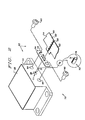
- FIG. 1A is a schematic exploded diagram of transmission lines 10 coupled in series
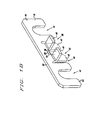
- Fig. 1B which is a schematic isometric diagram of a transition piece 16 between the lines, according to a preferred embodiment of the present invention.
- a coaxial transmission line terminates in an output 11 that consists of a conductive pin 18 which is centered on an opening 26 in a ground plane 12. Pin 18 protrudes substantially orthogonally from plane 12.
- Ground plane 12 is substantially flat, typically comprising an outer surface of a component 28 which is populated within the component by circuitry. It will be appreciated, however, that ground plane 12 may be formed from any other conductive plane.
- the surface of ground plane 12 is plated with an inert good conductor such as gold.
- Component 28 and the circuitry within the component are implemented to operate at frequencies from 0 Hz (DC) to at least 50 GHz.
- a diameter d of pin 18, and a diameter D of opening 26, are implemented so that an impedance of the output is a predetermined value such as 50 ⁇ .
- opening 26 is partially or completely filled by a dielectric material having an effective dielectric constant ⁇ .
- Ground plane 12 also comprises tapped holes 44, which are used to couple transition piece 16 to the plane, as described hereinbelow.
- Transition piece 16 is most preferably formed from a single sheet 34 of conducting material, and is generally rectangular in outline. For clarity in the following explanation, sheet 34 is assumed to be oriented with a wider side of the rectangle horizontal. It will be appreciated, however, that transition piece 16 may operate in substantially any orientation.
- An "arch-like" cutout 32 is formed generally centrally and symmetrically in a lower edge 50 of sheet 34, the cutout forming an arcuate opening having substantially vertical sides terminated in a semicircular arc 36.
- the separation of the vertical sides is substantially equal to a diameter 58 of arc 36, so that the sides are generally tangential to the arc.
- Two cutouts 38 are formed substantially symmetrically on either side of cutout 32 in edge 50, so as to form fingers 40 in sheet 34.
- Fingers 40 are bent to form lugs 46 that are substantially orthogonal to sheet 34, leaving a semicircular opening 48 in a foreshortened edge of the sheet. As described further below, lugs 46 are generally aligned with a center of arc 36.
- Cutouts 42 are also formed substantially symmetrically on either side of cutout 32, at positions in sheet 34 so that positions of cutouts 42 are generally in line with holes 44 of ground plane 12.
- transition piece 16 is coupled to component 28 by screwing screws 60 into holes 44, so that pin 18 aligns with the center of arc 36, to form a "drop-in" component 62 comprising component 28 and the transition.
- transition piece 16 is coupled to component 28 by a welding process known in the art, such as spot welding.
- a region of transition piece 16 close to cutout 32 is implemented to slightly protrude towards component 28.
- the protrusion may be implemented by any method known in the art, such as preferential etching of a region of transition piece 16.
- ground plane 12 is implemented to slightly protrude in a region close to opening 26, so as to improve the galvanic contact when the transition and the component are attached.
- a printed circuit (PC) transmission line 14 comprises a linear conductive strip 20 which has a generally constant cross-section along its length and which is formed on a surface of a printed circuit board 30.
- strip 20 is centrally and symmetrically disposed with respect to a pair of ground planes 22, the ground planes being physically separated from the strip and being formed on the same surface of board 30.
- PC line 14 is implemented from linear conductive strip 20 and one or more ground planes 22 physically separated from the strip, by methods which are well known in the transmission line art.
- ground planes 22 may comprise conductive planes on surfaces other than the surface of strip 20, and may also comprise plated vias between some of the planes. Dimensions of strip 20 and of separations between the strip and ground planes 22 are implemented so that an impedance of the PC transmission line is substantially equal to the impedance of output 11.
- Drop-in component 62 is aligned with transmission line 14 by butting an edge of PC board 30 with a surface 52 of transition piece 16, by butting lugs 46 to a horizontally-oriented surface of ground planes 22, and so that an end of strip 20 contacts pin 18 and is substantially centered at a base of opening 48.
- Lugs 46 are formed so that a horizontal level of the lugs with respect to the center of arc 36 is set so that the above alignment occurs. It will be appreciated that one or more of lugs 46 may be at different horizontal levels, depending on how ground planes 22 are implemented. Lugs 46 are then mechanically and electrically coupled to ground planes 22, and pin 18 is similarly coupled to strip 20.
- solder preforms are inserted between lugs 46 and planes 22, and/or between pin 18 and strip 20, and a process of parallel gap welding is used to heat the preforms so that they weld their respective contacting entities.
- Other methods for coupling lugs 46 to ground planes 22, and pin 18 to strip 20, will be familiar to those skilled in the art.
- lugs 46 maintain board 30 substantially orthogonal to surface 52 of the transition.
- Diameter 58 of arc 36 is most preferably implemented so that an impedance of transition piece 16, when the transition is positioned to couple output 11 and PC transmission line 14 as described above, is substantially equal to the impedances of the output and of the line. Equation (1) may be used to estimate a first approximation for diameter 58, using the diameter of pin 18 as the value of d.
- Fig. 2 is a schematic exploded diagram of coupled transmission lines 70, according to an alternative preferred embodiment of the present invention. Apart from the differences described below, the operation of lines 70 is generally similar to that of lines 10 (Figs. 1A and 1B), so that elements indicated by the same reference numerals in coupled lines 70 and 10 are generally identical in construction and in operation.
- a stress-relief contact 72 is attached to pin 18.
- contact 72 is substantially similar to a stress-relief contact K110-1 or V110-1 produced by Anritsu Corporation of Richardson, Texas.
- Contact 72 comprises a hollow cylinder 74 having a tab 76 protruding from an end of the cylinder.
- the wall of cylinder 74 is split parallel to the axis of the cylinder.
- the cylinder is formed to have an internal diameter of a dimension allowing it to be slidingly mated with pin 18, effectively increasing the diameter of the pin to be the external diameter of cylinder 74.
- diameter 58 of arc 36 is implemented to take account of the effective increased diameter of pin 18.
- tab 76 is soldered/welded to strip 20, and lugs 46 are soldered/welded to ground planes 22, substantially as described above for lines 10.
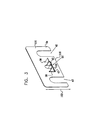
- Fig. 3 is a schematic isometric diagram of an alternative transition piece 116, according to a preferred embodiment of the present invention.
- transition piece 116 is generally similar to that of transition piece 16 (Fig. 1B), so that elements indicated by the same reference numerals in transition pieces 16 and 116 are generally similar in construction and in operation.
- arch-like cutout 32 of transition piece 116 is formed as an arcuate opening within single sheet 34, so that the cutout is bounded on its lower edge by a section 118 of piece 116.
- Fingers 40 on either side of cutout 32, are formed by cutouts 38 and an upper edge 120 of part 118, and the fingers are bent to form lugs 46. It will be appreciated that, due to section 118, a vertical height 122 of transition piece 116 is greater than a vertical height of transition piece 16, and that cutouts 42 for transition piece 116 are correspondingly deeper than those of transition piece 16.
- Fig. 4A is a schematic exploded diagram of transmission lines 410 coupled in series
- Fig. 4B is a schematic isometric diagram of a transition piece 416 between the lines, according to an alternative preferred embodiment of the present invention.
- transition piece 416 is generally similar to that of transition pieces 16 and 116 (Fig. 1A, Fig. 1B, Fig. 2 and Fig. 3), so that elements indicated by the same reference numerals in transition pieces 16, 116, and 416 are generally similar in construction and in operation.
- Transition piece 416 is most preferably formed from a single sheet 434 of conducting material, and is generally rectangular in outline.
- piece 416 is formed by milling or chemically etching the single sheet.
- sheet 434 is assumed to be oriented with a wider side of the rectangle horizontal. It will be appreciated, however, that transition piece 416 may operate in substantially any orientation.
- a generally rectangular indentation 432 is formed generally centrally and symmetrically in an upper edge 452 of sheet 434, the indentation forming an opening having substantially vertical sides and terminating with a horizontal side substantially at the center of sheet 434.
- corners that indentation 432 makes with edge 452 are chamfered.
- a semicircular arc 436 is formed with the diameter of the arc aligned to be substantially collinear with the horizontal side of the indentation and substantially centered between the vertical sides of the indentation.
- Two contacting lugs 446 are joined to the horizontal side of the indentation on either side of semicircular arc 436, the lugs protruding substantially orthogonally from one side of sheet 434.
- lugs 446 are formed, so that they contact ground planes 422 of a PC transmission line 414, as described further below. As also described further below, lugs 446 are generally aligned with a center of arc 436. Preferably, if transition piece 416 is formed by milling or chemically etching single sheet 434, lugs 446 are formed during the process. Alternatively, lugs 446 comprise generally rectangular conductive elements separate from sheet 434, which are connected to the sheet to form transition piece 416.
- transition piece 416 is initially implemented without lugs 446, and the lugs are implemented in the form of connecting tabs, preferably formed from conductive ribbon such as gold ribbon.
- the tabs are welded to ground planes 422 and to transition piece 416 when PC transmission line 414 is connected to the transition piece.
- the tabs act as coupling material which electrically couples transition piece 416 and ground planes 422, and which maintains the transition piece and the PC transmission line in substantially fixed orientation with respect to each other.
- transition piece 416 is coupled to component 28 by screwing flathead screws 460, also known as conical head screws, through conical holes 442 into holes 44, so that pin 18 aligns with the center of arc 436, to form a drop-in component 462 comprising component 28 and the transition piece.
- Flathead screws 460 when fastened completely to component 28, seat their conical heads into conical holes 442, so that a surface 450 of sheet 434 with the screw heads is substantially flat.
- transition piece 416 is coupled to component 28 by a another process known in the art, such as soldering, spot welding or use of conductive glue.
- a region of transition piece 416 close to indentation 432 is implemented to slightly protrude towards component 28.
- the protrusion may be implemented by any method known in the art, such as preferential etching of a region of transition piece 416.
- ground plane 12 is implemented to slightly protrude in a region close to opening 26, so as to improve the galvanic contact when the transition piece and the component are attached.
- PC transmission line 414 is generally similar to PC transmission line 14, described above with reference to Fig. 1A, so that a linear conductive strip 420 and ground planes 422 are respectively substantially similar in construction and operation to strip 20 and ground planes 22.
- PC transmission line 414 comprises a substantially non-indented straight edge 415, which is able to mate with substantially flat surface 450.
- Drop-in component 462 is aligned with transmission line 414 by butting edge 415 of PC board 430 with surface 450 of transition piece 416, by butting lugs 446 to a horizontally-oriented surface of ground planes 422, and so that an end of strip 420 contacts pin 18 and is substantially centered at a base of arc 436.
- Lugs 446 are formed so that a horizontal level of the lugs with respect to the center of arc 436 is set so that the above alignment occurs. It will be appreciated that one or more of lugs 446 may be at different horizontal levels, depending on how ground planes 422 are implemented. Lugs 446 are then mechanically and electrically coupled to ground planes 422, and pin 18 is similarly coupled to strip 420.
- solder preforms are inserted between lugs 446 and planes 422, and/or between pin 18 and strip 420, and a process of parallel gap welding is used to heat the preforms so that they weld their respective contacting entities.
- Other methods for coupling lugs 446 to ground planes 422, and pin 18 to strip 420, will be familiar to those skilled in the art.
- lugs 446 maintain board 430 substantially orthogonal to the transition piece.
- Diameter 458 of arc 436 is most preferably implemented so that an impedance of transition 416, when the transition is positioned to couple output 11 and PC transmission line 414 as described above, is substantially equal to the impedances of the output and of the line. Equation (1) may be used to estimate a first approximation for diameter 458, using the diameter of pin 18 as the value of d.
- Fig. 5 is a schematic isometric diagram of an alternative transition piece 516, according to a preferred embodiment of the present invention. Apart from the differences described below, implementation and operation of transition piece 516 is generally similar to that of transition piece 416 (Fig. 4B), so that elements indicated by the same reference numerals in transition pieces 516 and 416 are generally similar in construction and in operation. In contrast to transition piece 416, transition piece 516 is formed with a substantially circular hole 536 in single sheet 434, substantially centered in both vertical and horizontal directions of the sheet. Hole 536 replaces indentation 432 and semicircular arc 436. Lugs 446 are formed on either side of circular hole 536.
- a stress-relief contact 72 may be similarly used with drop-in component 462 (Fig 4A), which comprises either transition piece 416 or 516 (Fig 4B or 5, respectively).
- transition piece which couples one coaxial transmission line to one PC transmission line
- the scope of the present invention comprises coupling a plurality of coaxial transmission lines with a respective plurality of PC transmission lines.
- a transition piece generally similar to transition pieces 416 or 516, but having two openings, may be used to couple a differential coaxial transmission line, comprising two coaxial transmission lines, with a differential PC transmission line, comprising two PC transmission lines.
- PC transmission lines such as line 14 and line 414 may be configured with ground planes 22 and 422 on either an upper or a lower side, or on both sides, of the printed circuit board from which they are formed. When implemented on both sides, the two sides are preferably connected by conducting vias.
- central strip 20 or 420 of the PC transmission line may be configured on an upper or a lower side, or on both sides, of the printed circuit board. It will be appreciated that coaxial pin 18, or tab 76 when stress relief 72 is used, may be connected to the upper side or the lower side of the PC board according to how central strip 20 or 420 is configured.
- each lug of transitions 16, 116, 416, and 516 may be connected to ground planes 22 or 422 regardless of whether the ground planes are formed on an upper side, a lower side, or both sides, of the printed circuit board forming the PC transmission line.
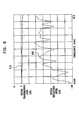
- Fig. 6 is a graph of signal transmission loss and signal reflection level vs. frequency for transition 16 (Fig. 1A), according to a preferred embodiment of the present invention. Transitions 116, 416, and 516 exhibit generally similar characteristics to those of transition 16.
- an experimental apparatus was fabricated having component 28 coupled to transition piece 16, which in turn, was coupled to PC transmission line 14, as previously described and shown in Fig. 1A. A second end of PC transmission line 14 was then coupled to an additional transition piece 16, which was in turn connected to an additional component 28
- the experimental apparatus thus comprised two drop-in components 28 coupled in a "back-to-back" arrangement by line 14.
- Radio-frequency signals ranging from 0.04 to 50.0 GHz were generated in the first component and a transmitted signal was measured in the additional component. The difference between the generated signal in the first component and the signal measured in the additional component was calculated as the signal transmission loss. Signals reflected back to the first component were also measured. The difference between the generated signal and the measured reflected signal was calculated as the signal reflection level.
- Results from the experimental apparatus described above are plotted in the graph of Fig. 6, where a vertical axis of the graph ranges from 5 to -35 decibels.
- Signal transmission loss is shown by a graph 610.
- the signal transmission loss for the entire 0.04 to 50.0 GHz range is virtually constant, and at 40 GHz has a value of approximately 0.8 dB. It will be appreciated that since the measured transmission loss includes losses due to the two coaxial connectors and the PC transmission line, a loss of a single transition 16 is of the order of 0.1 dB.
- Reflected signal is shown by a graph 620. Inspection of graph 620 shows that return loss is better than 10 dB over virtually the whole range of measured frequencies.
Landscapes
- Coupling Device And Connection With Printed Circuit (AREA)
- Multi-Conductor Connections (AREA)
Applications Claiming Priority (4)
| Application Number | Priority Date | Filing Date | Title |
|---|---|---|---|
| US10/093,095 US6842084B2 (en) | 2002-03-07 | 2002-03-07 | Transition from a coaxial transmission line to a printed circuit transmission line |
| US93095 | 2002-03-07 | ||
| US10/253,389 US7049903B2 (en) | 2002-03-07 | 2002-09-24 | Transition from a coaxial transmission line to a printed circuit transmission line |
| US253389 | 2002-09-24 |
Publications (2)
| Publication Number | Publication Date |
|---|---|
| EP1343217A2 true EP1343217A2 (fr) | 2003-09-10 |
| EP1343217A3 EP1343217A3 (fr) | 2004-03-31 |
Family
ID=27759951
Family Applications (1)
| Application Number | Title | Priority Date | Filing Date |
|---|---|---|---|
| EP03251393A Withdrawn EP1343217A3 (fr) | 2002-03-07 | 2003-03-07 | Transition entre une ligne de transmission coaxiale et une ligne de transmission sur un circuit imprimé |
Country Status (3)
| Country | Link |
|---|---|
| US (1) | US7049903B2 (fr) |
| EP (1) | EP1343217A3 (fr) |
| IL (1) | IL154767A0 (fr) |
Families Citing this family (3)
| Publication number | Priority date | Publication date | Assignee | Title |
|---|---|---|---|---|
| US9755289B2 (en) | 2015-02-18 | 2017-09-05 | National Instruments Corporation | Right angle transition to circuit |
| US9661753B1 (en) * | 2016-12-01 | 2017-05-23 | Harris Corporation | Coaxial to planar strain relief appliance and method |
| EP3432424A1 (fr) * | 2017-07-20 | 2019-01-23 | Spinner GmbH | Connecteur rf avec une interface de montage de surface |
Citations (3)
| Publication number | Priority date | Publication date | Assignee | Title |
|---|---|---|---|---|
| US3783321A (en) * | 1972-03-23 | 1974-01-01 | Adams Russel Co Inc | Coaxial connector |
| US4273407A (en) * | 1979-10-24 | 1981-06-16 | Snuffer Clifton K | Coaxial connector assembly for attachment to circuit board |
| US5532659A (en) * | 1994-05-19 | 1996-07-02 | Thomson-Csf | Connection device to provide a connection, by coaxial cable, to a printed circuit |
Family Cites Families (18)
| Publication number | Priority date | Publication date | Assignee | Title |
|---|---|---|---|---|
| US3201721A (en) * | 1963-12-30 | 1965-08-17 | Western Electric Co | Coaxial line to strip line connector |
| US3539966A (en) | 1968-07-23 | 1970-11-10 | Us Army | Microwave connector |
| US3662318A (en) * | 1970-12-23 | 1972-05-09 | Comp Generale Electricite | Transition device between coaxial and microstrip lines |
| SE426894B (sv) | 1981-06-30 | 1983-02-14 | Ericsson Telefon Ab L M | Impedansriktig koaxialovergang for mikrovagssignaler |
| US4595890A (en) | 1982-06-24 | 1986-06-17 | Omni Spectra, Inc. | Dual polarization transition and/or switch |
| FR2529725B1 (fr) | 1982-07-02 | 1987-12-18 | Thomson Csf | Oscillateur a faible bruit, fonctionnant dans la gamme des hyperfrequences |
| JPS6032402A (ja) * | 1983-08-01 | 1985-02-19 | Matsushita Electric Ind Co Ltd | 同軸−ストリップライン変換装置 |
| JPS61174801A (ja) | 1985-01-29 | 1986-08-06 | Maspro Denkoh Corp | 高周波電子機器 |
| DE3617359C1 (de) | 1986-05-23 | 1987-10-01 | Georg Dr-Ing Spinner | 3-dB-Richtkoppler |
| US4810981A (en) | 1987-06-04 | 1989-03-07 | General Microwave Corporation | Assembly of microwave components |
| US5231349A (en) | 1988-05-20 | 1993-07-27 | The Board Of Trustees Of The Leland Stanford Junior University | Millimeter-wave active probe system |
| US5165109A (en) | 1989-01-19 | 1992-11-17 | Trimble Navigation | Microwave communication antenna |
| US4975065A (en) * | 1989-09-26 | 1990-12-04 | Avantek, Inc. | Microwave circuit module connector |
| US5142255A (en) * | 1990-05-07 | 1992-08-25 | The Texas A&M University System | Planar active endfire radiating elements and coplanar waveguide filters with wide electronic tuning bandwidth |
| CA2059364A1 (fr) | 1991-01-30 | 1992-07-31 | Eric C. Kohls | Transition par guide d'ondes pour antenne plane |
| US5404117A (en) * | 1993-10-01 | 1995-04-04 | Hewlett-Packard Company | Connector for strip-type transmission line to coaxial cable |
| US5516303A (en) | 1995-01-11 | 1996-05-14 | The Whitaker Corporation | Floating panel-mounted coaxial connector for use with stripline circuit boards |
| DE59708915D1 (de) | 1996-03-13 | 2003-01-23 | Ascom Systec Ag Maegenwil | Flache dreidimensionale Antenne |
-
2002
- 2002-09-24 US US10/253,389 patent/US7049903B2/en not_active Expired - Fee Related
-
2003
- 2003-03-05 IL IL15476703A patent/IL154767A0/xx unknown
- 2003-03-07 EP EP03251393A patent/EP1343217A3/fr not_active Withdrawn
Patent Citations (3)
| Publication number | Priority date | Publication date | Assignee | Title |
|---|---|---|---|---|
| US3783321A (en) * | 1972-03-23 | 1974-01-01 | Adams Russel Co Inc | Coaxial connector |
| US4273407A (en) * | 1979-10-24 | 1981-06-16 | Snuffer Clifton K | Coaxial connector assembly for attachment to circuit board |
| US5532659A (en) * | 1994-05-19 | 1996-07-02 | Thomson-Csf | Connection device to provide a connection, by coaxial cable, to a printed circuit |
Also Published As
| Publication number | Publication date |
|---|---|
| IL154767A0 (en) | 2003-10-31 |
| US7049903B2 (en) | 2006-05-23 |
| US20030169125A1 (en) | 2003-09-11 |
| EP1343217A3 (fr) | 2004-03-31 |
Similar Documents
| Publication | Publication Date | Title |
|---|---|---|
| US5675302A (en) | Microwave compression interconnect using dielectric filled three-wire line with compressible conductors | |
| USRE36845E (en) | High density, high bandwidth, coaxial cable, flexible circuit and circuit board connection assembly | |
| EP0935315B1 (fr) | Connecteur coaxial pour trois cartes de circuits imprimés superposées | |
| US7262672B2 (en) | Coaxial connector and connection structure including the same | |
| US10148027B2 (en) | Structure for connecting board and connector, board, and method for connecting board and connector | |
| US11146002B2 (en) | Direct-attach connector | |
| JP3354641B2 (ja) | 相互接続用アセンブリ | |
| US4867704A (en) | Fixture for coupling coaxial connectors to stripline circuits | |
| CN110832711A (zh) | 具有表面安装接口的rf pcb 连接器 | |
| EP1307951B1 (fr) | Systeme d'interconnexion coaxial, haute vitesse, subminiature | |
| US5190462A (en) | Multilead microwave connector | |
| US7049903B2 (en) | Transition from a coaxial transmission line to a printed circuit transmission line | |
| CN117728138B (zh) | 一种同轴连接器与平面微带的免焊连接机构 | |
| US6842084B2 (en) | Transition from a coaxial transmission line to a printed circuit transmission line | |
| US4801269A (en) | Coaxial connector for use with printed circuit board edge connector | |
| US5356298A (en) | Wideband solderless right-angle RF interconnect | |
| EP1388189B1 (fr) | Appareil permettant de connecter des lignes de transmission | |
| JPS59148289A (ja) | コネクタ | |
| US7086868B2 (en) | Board-to-board connector | |
| WO2002029938A1 (fr) | Systeme d'interconnexion de broches coaxiales | |
| JPH06124739A (ja) | 信号伝送用コネクタ | |
| JPH0451475A (ja) | マイクロストリップライン用コネクタ | |
| JPH0451702A (ja) | マイクロストリップライン用コネクタ | |
| JPH0142118B2 (fr) | ||
| US20030042041A1 (en) | Connection structure of coaxial cable |
Legal Events
| Date | Code | Title | Description |
|---|---|---|---|
| PUAI | Public reference made under article 153(3) epc to a published international application that has entered the european phase |
Free format text: ORIGINAL CODE: 0009012 |
|
| AK | Designated contracting states |
Kind code of ref document: A2 Designated state(s): AT BE BG CH CY CZ DE DK EE ES FI FR GB GR HU IE IT LI LU MC NL PT RO SE SI SK TR |
|
| AX | Request for extension of the european patent |
Extension state: AL LT LV MK |
|
| PUAL | Search report despatched |
Free format text: ORIGINAL CODE: 0009013 |
|
| AK | Designated contracting states |
Kind code of ref document: A3 Designated state(s): AT BE BG CH CY CZ DE DK EE ES FI FR GB GR HU IE IT LI LU MC NL PT RO SE SI SK TR |
|
| AX | Request for extension of the european patent |
Extension state: AL LT LV MK |
|
| AKX | Designation fees paid | ||
| 17P | Request for examination filed |
Effective date: 20041028 |
|
| RBV | Designated contracting states (corrected) |
Designated state(s): AT BE BG CH CY CZ DE DK EE ES FI FR GB GR HU IE IT LI LU MC NL PT RO SE SI SK TR |
|
| REG | Reference to a national code |
Ref country code: DE Ref legal event code: 8566 |
|
| 17Q | First examination report despatched |
Effective date: 20071213 |
|
| RAP1 | Party data changed (applicant data changed or rights of an application transferred) |
Owner name: HERSTEIN, DOV |
|
| STAA | Information on the status of an ep patent application or granted ep patent |
Free format text: STATUS: THE APPLICATION IS DEEMED TO BE WITHDRAWN |
|
| 18D | Application deemed to be withdrawn |
Effective date: 20090603 |