EP1343231A2 - Gruppe III Nitriden Halbleiterlaser - Google Patents
Gruppe III Nitriden Halbleiterlaser Download PDFInfo
- Publication number
- EP1343231A2 EP1343231A2 EP03005054A EP03005054A EP1343231A2 EP 1343231 A2 EP1343231 A2 EP 1343231A2 EP 03005054 A EP03005054 A EP 03005054A EP 03005054 A EP03005054 A EP 03005054A EP 1343231 A2 EP1343231 A2 EP 1343231A2
- Authority
- EP
- European Patent Office
- Prior art keywords
- layer
- semiconductor laser
- group iii
- iii nitride
- nitride compound
- Prior art date
- Legal status (The legal status is an assumption and is not a legal conclusion. Google has not performed a legal analysis and makes no representation as to the accuracy of the status listed.)
- Withdrawn
Links
Images

Classifications
-
- H—ELECTRICITY
- H01—ELECTRIC ELEMENTS
- H01S—DEVICES USING THE PROCESS OF LIGHT AMPLIFICATION BY STIMULATED EMISSION OF RADIATION [LASER] TO AMPLIFY OR GENERATE LIGHT; DEVICES USING STIMULATED EMISSION OF ELECTROMAGNETIC RADIATION IN WAVE RANGES OTHER THAN OPTICAL
- H01S5/00—Semiconductor lasers
- H01S5/30—Structure or shape of the active region; Materials used for the active region
-
- H—ELECTRICITY
- H01—ELECTRIC ELEMENTS
- H01S—DEVICES USING THE PROCESS OF LIGHT AMPLIFICATION BY STIMULATED EMISSION OF RADIATION [LASER] TO AMPLIFY OR GENERATE LIGHT; DEVICES USING STIMULATED EMISSION OF ELECTROMAGNETIC RADIATION IN WAVE RANGES OTHER THAN OPTICAL
- H01S5/00—Semiconductor lasers
- H01S5/30—Structure or shape of the active region; Materials used for the active region
- H01S5/34—Structure or shape of the active region; Materials used for the active region comprising quantum well or superlattice structures, e.g. single quantum well [SQW] lasers, multiple quantum well [MQW] lasers or graded index separate confinement heterostructure [GRINSCH] lasers
- H01S5/343—Structure or shape of the active region; Materials used for the active region comprising quantum well or superlattice structures, e.g. single quantum well [SQW] lasers, multiple quantum well [MQW] lasers or graded index separate confinement heterostructure [GRINSCH] lasers in AIIIBV compounds, e.g. AlGaAs-laser, InP-based laser
- H01S5/34333—Structure or shape of the active region; Materials used for the active region comprising quantum well or superlattice structures, e.g. single quantum well [SQW] lasers, multiple quantum well [MQW] lasers or graded index separate confinement heterostructure [GRINSCH] lasers in AIIIBV compounds, e.g. AlGaAs-laser, InP-based laser with a well layer based on Ga(In)N or Ga(In)P, e.g. blue laser
-
- B—PERFORMING OPERATIONS; TRANSPORTING
- B82—NANOTECHNOLOGY
- B82Y—SPECIFIC USES OR APPLICATIONS OF NANOSTRUCTURES; MEASUREMENT OR ANALYSIS OF NANOSTRUCTURES; MANUFACTURE OR TREATMENT OF NANOSTRUCTURES
- B82Y20/00—Nanooptics, e.g. quantum optics or photonic crystals
-
- H—ELECTRICITY
- H01—ELECTRIC ELEMENTS
- H01S—DEVICES USING THE PROCESS OF LIGHT AMPLIFICATION BY STIMULATED EMISSION OF RADIATION [LASER] TO AMPLIFY OR GENERATE LIGHT; DEVICES USING STIMULATED EMISSION OF ELECTROMAGNETIC RADIATION IN WAVE RANGES OTHER THAN OPTICAL
- H01S2301/00—Functional characteristics
- H01S2301/18—Semiconductor lasers with special structural design for influencing the near- or far-field
-
- H—ELECTRICITY
- H01—ELECTRIC ELEMENTS
- H01S—DEVICES USING THE PROCESS OF LIGHT AMPLIFICATION BY STIMULATED EMISSION OF RADIATION [LASER] TO AMPLIFY OR GENERATE LIGHT; DEVICES USING STIMULATED EMISSION OF ELECTROMAGNETIC RADIATION IN WAVE RANGES OTHER THAN OPTICAL
- H01S5/00—Semiconductor lasers
- H01S5/20—Structure or shape of the semiconductor body to guide the optical wave ; Confining structures perpendicular to the optical axis, e.g. index or gain guiding, stripe geometry, broad area lasers, gain tailoring, transverse or lateral reflectors, special cladding structures, MQW barrier reflection layers
- H01S5/2004—Confining in the direction perpendicular to the layer structure
-
- H—ELECTRICITY
- H01—ELECTRIC ELEMENTS
- H01S—DEVICES USING THE PROCESS OF LIGHT AMPLIFICATION BY STIMULATED EMISSION OF RADIATION [LASER] TO AMPLIFY OR GENERATE LIGHT; DEVICES USING STIMULATED EMISSION OF ELECTROMAGNETIC RADIATION IN WAVE RANGES OTHER THAN OPTICAL
- H01S5/00—Semiconductor lasers
- H01S5/20—Structure or shape of the semiconductor body to guide the optical wave ; Confining structures perpendicular to the optical axis, e.g. index or gain guiding, stripe geometry, broad area lasers, gain tailoring, transverse or lateral reflectors, special cladding structures, MQW barrier reflection layers
- H01S5/2054—Methods of obtaining the confinement
- H01S5/2081—Methods of obtaining the confinement using special etching techniques
- H01S5/209—Methods of obtaining the confinement using special etching techniques special etch stop layers
-
- H—ELECTRICITY
- H01—ELECTRIC ELEMENTS
- H01S—DEVICES USING THE PROCESS OF LIGHT AMPLIFICATION BY STIMULATED EMISSION OF RADIATION [LASER] TO AMPLIFY OR GENERATE LIGHT; DEVICES USING STIMULATED EMISSION OF ELECTROMAGNETIC RADIATION IN WAVE RANGES OTHER THAN OPTICAL
- H01S5/00—Semiconductor lasers
- H01S5/20—Structure or shape of the semiconductor body to guide the optical wave ; Confining structures perpendicular to the optical axis, e.g. index or gain guiding, stripe geometry, broad area lasers, gain tailoring, transverse or lateral reflectors, special cladding structures, MQW barrier reflection layers
- H01S5/22—Structure or shape of the semiconductor body to guide the optical wave ; Confining structures perpendicular to the optical axis, e.g. index or gain guiding, stripe geometry, broad area lasers, gain tailoring, transverse or lateral reflectors, special cladding structures, MQW barrier reflection layers having a ridge or stripe structure
Definitions
- the present invention relates to a group III nitride compound semiconductor laser. Especially, the present invention relates to a group III nitride compound semiconductor laser having a ridge type of a resonator.
- a semiconductor laser which has a cladding layer and an active layer and so on made of a group III nitride compound semiconductor (Al x Ga y In 1-x-y N, 0 ⁇ x ⁇ 1, 0 ⁇ y ⁇ 1 and 0 ⁇ x+y ⁇ 1) has been known.
- the conventional semiconductor laser is a semiconductor diode having multi-layer structure with multiple group III nitride compound semiconductor layers, which are formed on a sapphire substrate in sequence.
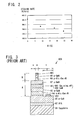
- a conventional example of the semiconductor diode, disclosed by the same applicant in Japanese Patent Laid-open No. 2000-261105, is shown in FIG. 3.
- a semiconductor laser 900 shown in FIG. 3 has the following eight layers formed on a sapphire substrate 91 in sequence: a buffer layer 92; an n-layer 93; an n-cladding layer 94; an n-guide layer 95; an active layer 96 made of multiple quantum well (MQW) layer; a p-guide layer 97; a p-cladding layer 98; and a p-contact layer 99.
- a buffer layer 92 As shown in FIG.
- a cavity or a resonator part (a ridged resonator cavity of part) A is formed by using, e.g., photoresist and etching, and a positive electrode 901 and a negative electrode 902 are formed on the upper surface of the p-contact layer 99 and the etched surface of the n-layer 93, respectively.
- the active layer 96 comprising a multiple quantum well (MQW) layer, is a semiconductor layer which functions as a main layer to oscillate laser.
- MQW multiple quantum well
- Each carriers (holes and electrons) injected from the positive electrode 901 and the negative electrode 902 combine in the active layer 96, that causes laser oscillation.
- the n-guide layer 95 and the p-guide layer 97 function to confine carriers into the active layer 96.
- the n-cladding layer 94 and the p-cladding layer 98 function to confine laser light.
- n-layer 93 and the p-contact layer 99 are semiconductor layers which are formed in order that carriers can be injected smoothly from the negative electrode 902 and the positive electrode 901 to the layers existing between the n-cladding layer 94 and the p-cladding layer 98, respectively.
- the cross-section of electric current path of the semiconductor laser is, for example, narrowed by decreasing the contact area of electrodes, or by decreasing the width w of the positive electrode 901.
- the above-mentioned Japanese Patent Laid-open No. 2000-261105 suggests forming a deep ridged hole injection part B. That is, a boundary between a ridged cavity part A and the ridged hole injection part B is regarded as a boundary between the p-guide layer 97 and the p-cladding layer 98.
- each one of group III nitride compound semiconductor layers formed on one wafer has different thickness according to the portion on which the layer is formed. So, as discloses in the above-mentioned official gazette, the applicant of the present invention suggests completely etching the p-cladding layer 98 even if a portion of the p-guide layer 97 is etched.
- the thickness of the p-guide layer 97 is extremely thin, e.g., about 100 nm. So when 200 nm in thickness of p-contact layer 99 and approximately 500 nm in thickness of p-cladding layer 98 are completely etched, the p-guide layer 97 may be damaged considerably, which may deteriorate its device characteristic as a semiconductor laser.
- An object of the present invention is to form a ridged carrier injection part in a ridge type of a group III nitride compound semiconductor laser, especially in a process of manufacturing the ridge type of a group III nitride compound semiconductor laser, so as to obtain a structure which hardly damages a guide layer.
- Another object of the present invention is that the cross sectional shape of oscillated laser beam becomes closer to a perfect circle by forming a part of cladding layer in the ridged cavity part and controlling its thickness becomes easy.
- a first aspect of the present invention is to obtain a group III nitride compound semiconductor laser comprising a laser cavity and multiple layers which are made of group III nitride compound semiconductors and formed on a substrate.
- the group III nitride compound semiconductor laser comprises: a first layer, which functions as a guide layer and actually confines carriers to an active layer which functions as a main layer oscillating laser; a second layer having smaller refractive index compared with the first layer, which is formed above or on the first layer and mainly confines light to the active layer and the first layer; and a third layer which is formed between the first layer and the second layer or formed into the second layer and has larger composition of aluminum (Al) in group III elements compared with the second layer.
- Al aluminum
- forming the third layer into the second layer represents that the second layer comprises two layers and that the third layer is formed between the upper second layer and the lower second layer.
- Composition of the upper second layer and the lower second layer may be equivalent or not equivalent.
- aluminum (Al) composition of the third layer may be larger than that of at least one layer of upper and the lower second layers.
- the second aspect of the present invention is that aluminum (Al) composition of group III elements in the second layer is larger than that in the first layer.
- the third aspect of the present invention is that the second layer functions as a cladding layer.
- the fourth aspect of the present invention is to obtain a group III nitride compound semiconductor laser comprising a laser cavity.
- the laser cavity is formed by removing multiple layers, which are made of group III nitride compound semiconductors and formed on a substrate, except the width of the laser cavity part.
- a carrier injection part is formed contacting to the laser cavity part by removing at least all layers on the third layer except the area corresponding to the width of an electrode formed above the second layer.
- the fifth aspect of the present invention is that the electrode is a positive electrode.
- the sixth aspect of the present invention is that aluminum (Al) composition of the third layer is larger than that of the second layer by 10% or more. That is represented by the formula x3 ⁇ x2+0.1 when x3 and x2 (0 ⁇ x3, x2 ⁇ 1) are aluminum (Al) compositions of the third and the second layers in all the group III elements.
- the seventh aspect of the present invention is that the third layer is thinner than the first layer.
- the third layer By forming the third layer having larger aluminum (Al) composition in group III elements compared with that of the second layer between the first layer which functions as a guide layer and actually confines carriers to an active layer functioning as a main layer to oscillate laser and the second layer which mainly confine light to the active layer which functions as a main layer oscillating laser and the first layer, the third layer can protect the first layer in an etching process. That is because etching rate of a group III nitride compound semiconductor becomes smaller in proportion as the aluminum (Al) composition increases, there are some time during etching the third layer. Accordingly, in a process of forming a ridged carrier injection part, a guide layer cannot be damaged even when the production is not uniform.
- the third layer having larger aluminum (Al) composition of group III elements compared with the second layer is formed between the upper second layer and the lower second layer, forming a part of a cladding layer in the laser cavity part enables it easier to control thickness of the cladding layer formed in the laser cavity part.
- the cross sectional shape of oscillated laser beam becomes closer to a perfect circle (the first to the fourth aspects).
- manufacturing process becomes easier (the fifth aspect).
- the difference between the aluminum (Al) composition ratios of the second layer and the third layer is 10% or more, etching rate of the third layer becomes smaller and the etching becomes more effective (the sixth aspect).
- the guide layer may not be damaged without deteriorating characteristics of a laser diode or thickness of the cladding layer formed in the laser cavity part may be controlled easily (the seventh aspect).
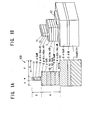
- FIG. 1A illustrates a sectional view of a semiconductor laser 100.
- FIG. 1B illustrates a view showing a structure of the semiconductor laser 100.
- the semiconductor laser 100 has a sapphire substrate 1, and an AlN buffer layer 2 having a thickness of 50 nm is formed on the substrate 1.
- the buffer layer 2 can be made of GaN, GaInN or AlGaN.
- the following layers are formed consecutively: about 4.0 ⁇ m in thickness of silicon (Si) doped gallium nitride (GaN) n-layer 3, having an electron concentration of 1 x 10 18 /cm -3 ; 500nm in thickness of Si-doped Al 0.1 Ga 0.9 N n-cladding layer 4, having an electron concentration of 1 x 10 18 /cm -3 ; 100 nm in thickness of Si-doped GaN n-guide layer 5, having an electron concentration of 1 x 10 18 /cm -3 ; and an active layer 6 having multiple quantum well (MQW) structure in which about 35 ⁇ in thickness of GaN barrier layer 62 and about 35 ⁇ in thickness of Ga 0.95 In 0.05 N well layer 61 are laminated alternately
- magnesium (Mg) doped GaN p-guide layer 7 having a hole concentration of 5 x 10 17 /cm -3
- 50 nm in thickness of Mg-doped Al 0.25 Ga 0.75 N p-layer 8 having a hole concentration of 5 x 10 17 /cm -3
- 500 nm in thickness of an Mg-doped Al 0.1 Ga 0.9 N p-cladding layer 9 having a hole concentration of 5 x 10 17 /cm -3
- 200 nm in thickness of Mg-doped GaN p-contact layer 10 having a hole concentration of 5 x 10 17 /cm -3 , are formed successively thereon.
- the p-contact layer 10 can be made of AlGaN or GaInN. Then 5 ⁇ m in width of an electrode 11 made of nickel (Ni) is formed on the p-contact layer 10, and an electrode 12 made of aluminum (Al) is formed on the n-layer 3.
- the ridged hole injection part B which contacts to the ridged cavity (or resonator) part A of the semiconductor laser 100, is formed to have a width of about 5 ⁇ m, which is equal to the width w of the Ni electrode 11.
- the ridged hole injection part B of the semiconductor laser 100 comprises the Ni electrode 11, the p-contact layer 10 and the p-cladding layer 9.
- the ridged cavity part A does not comprise the p-cladding layer 9.
- Each of the layers of the semiconductor laser 100 is formed by gaseous phase epitaxial growth, called metal organic vapor phase epitaxy (hereinafter MOVPE).
- the gases employed in this process were ammonia (NH 3 ) , a carrier gas (H 2 or N 2 ), trimethyl gallium (Ga(CH 3 ) 3 ) (hereinafter TMG), trimethyl aluminum (Al(CH 3 ) 3 ) (hereinafter TMA), trimethyl indium (In(CH 3 ) 3 ) (hereinafter TMI), silane (SiH 4 ), and biscyclopentadienyl magnesium (Mg(C 5 H 5 ) 2 ) (hereinafter CP 2 Mg).
- the single crystalline sapphire substrate 1 was placed on a susceptor in a reaction chamber for the MOVPE treatment after its main surface 'a' was cleaned by an organic washing solvent and heat treatment. Then the sapphire substrate 1 was baked for about 30 min. at 1100 °C by H 2 vapor fed into the chamber at a flow rate of 2L/min. under normal pressure.
- AlN buffer layer 2 About 50 nm in thickness of AlN buffer layer 2 was formed on the surface 'a' of the baked sapphire substrate 1 under conditions controlled by lowering the temperature in the chamber to 400 °C, keeping the temperature constant, and concurrently supplying H 2 at a flow rate of 20L/min., NH 3 at 10L/min., and TMA at 18 ⁇ mol/min. for about 90 seconds.
- Si-doped GaN was formed on the buffer layer 2, as an n-layer 3 with an electron concentration of 1 x 10 18 cm -3 , under conditions controlled by keeping the temperature of the sapphire substrate 1 at 1150°C and concurrently supplying H 2 at a flow rate of 20L/min., NH 3 at 10L/min., TMG at 170 ⁇ mol/min., and silane (SiH 4 ) diluted to 0.86 ppm by H 2 at 2nmol/min.
- Si-doped Al 0.1 Ga 0.9 N was formed on the n-layer 3, as an n-cladding layer 4 with an electron concentration of 1 x 1018cm -3 , under conditions controlled by keeping the temperature of the sapphire substrate 1 at 1100°C and concurrently supplying H 2 at a flow rate of 20L/min., NH 3 at 10L/min., TMA at 5 ⁇ mol/min., TMG at 50 ⁇ mol/min., and silane (SiH 4 ) diluted to 0.86 ppm by H 2 at 8nmol/min.
- Si-doped GaN was formed on the n-cladding layer 4, as an n-guide layer 5 with an electron concentration of 1 x 10 18 cm -3 , under conditions controlled by keeping the temperature of the sapphire substrate 1 at 1100°C and concurrently supplying H 2 at a flow rate of 20L/min., TMG at 50 ⁇ mol/min., and silane (SiH 4 ) diluted to 0.86 ppm by H 2 at 8nmol/min.
- GaN GaN was formed on the n-guide layer 5, as a barrier layer 62, concurrently supplying N 2 or H 2, NH 3 and TMG.
- about 35 ⁇ in thickness of Ga 0.95 In 0.05 N was formed on the barrier layer 62, as a well layer 61, concurrently supplying N 2 or H 2 , NH 3 , TMG and TMI. Accordingly, four pairs of the well layer 61 and the barrier layer 62 in total were formed, and an active layer 6 having a multiple quantum well (MQW) structure was obtained.
- MQW multiple quantum well
- Mg-doped GaN About 100 nm in thickness of Mg-doped GaN was formed on the active layer 6, as a p-guide layer 7, under conditions controlled by keeping the temperature of the sapphire substrate 1 to 1100°C, concurrently supplying N 2 or H 2 at a flow rate of 20L/min., NH 3 at a flow rate of 10L/min., TMG at 50 ⁇ mol/min., and Cp 2 Mg at 0.2 ⁇ mol/min.
- Mg-doped Al 0.25 Ga 0.75 N was formed on the p-guide layer 7, as a p-layer 8, under conditions controlled by keeping the temperature of the sapphire substrate 1 to 1100°C, concurrently supplying N 2 or H 2 at a flow rate of 20L/min., NH 3 at a flow rate of 10L/min., TMA at 15 ⁇ mol/min., TMG at 50 ⁇ mol/min., and Cp 2 Mg at 0.2 ⁇ mol/min.
- Mg-doped Al 0.1 Ga 0.9 N was formed on the p-layer 8, as a p-cladding layer 9, under conditions controlled by keeping the temperature of the sapphire substrate 1 to 1100°C, concurrently supplying N 2 or H 2 at a flow rate of 20L/min., NH 3 at a flow rate of 10L/min., TMA at 5 ⁇ mol/min., TMG at 50 ⁇ mol/min., and Cp 2 Mg at 0.2 ⁇ mol/min.
- Mg-doped GaN was formed on the p-cladding layer 9, as a p-contact layer 10, under conditions controlled by keeping the temperature of the sapphire substrate 1 to 1100°C, concurrently supplying N 2 or H 2 at a flow rate of 20L/min., NH 3 at a flow rate of 10L/min., TMG at 50 ⁇ mol/min., and Cp 2 Mg at 0.2 ⁇ mol/min.
- electron rays were uniformly irradiated into the three layers, or the p-contact layer 10, the p-cladding layer 9, the p-layer 8 and the p-guide layer 7, using a reflective electron beam diffraction device.
- the irradiation conditions were set at 10 kV for the accelerating voltage, 1 ⁇ A for the sample current, 0.2mm/s. for the speed of the beam scanning, 60 ⁇ m ⁇ for the beam aperture, and at 50 ⁇ Torr vacuum.
- the respective hole concentrations are 5 x 10 17 cm -3 , 5 x 10 17 cm -3 and 5 x 10 17 cm -3 .
- SiO 2 layer About 200nm in thickness of SiO 2 layer was formed on the p-contact layer 10 by sputtering, and a photoresist layer was laminated on the SiO 2 layer.
- region C was formed on a portion of the n-layer 3 as follows.
- the SiO 2 layer having a thickness of 200nm was formed by carrying out sputtering, which was covered by a photoresist layer. A portion of the photoresist layer, or a portion to form region C, was removed by using photolithography. Then the SiO 2 layer, which is not covered by the photoresist layer, was removed by using hydrofluoric acid based etching solution.
- the p-guide layer 7, the active layer 6, the n-guide layer 5, the n-cladding layer 4 and a portion of the n-layer 3, which are not covered by the photoresist layer and the SiO 2 layer, is dry-etched under conditions set at 0.04Torr vacuum and at 0.44W/cm 2 for a high-frequency power, concurrently supplying BCl 3 gas at a flow late of 10mL/min, and then dry-etched by argon (Ar) gas. Accordingly, region C shown in FIG. 1A was formed. After that the SiO 2 layer was removed.
- Nickel (Ni) was deposited uniformly on the semiconductor laser 100. A photoresist layer was laminated on the Ni layer. And after removing processes using photolithography and etching, the electrode 11 having a width of 5 ⁇ m was formed on the p-contact layer 10. Aluminum (Al) was deposited on the n-layer 3, and the electrode 12 was formed.
- the semiconductor laser 100 as shown in FIGS. 1A and 1B were obtained.
- the semiconductor laser 100 has the ridged hole injection part B which was formed by etching all the semiconductor layers, or the p-contact layer 10 and the p-cladding layer 9, except the width of the ridged hole injection part B.
- the devices are not completely uniform, a boundary between the ridged cavity part A and the ridged hole injection part B are obtained in the p-layer 8.
- a semiconductor laser 900 was formed as shown in FIG. 3.
- the semiconductor laser 900 is manufactured in the same process as the semiconductor laser 100, except that the semiconductor laser 900 does not have the p-layer 8.
- approximately 10% of the semiconductor laser has deteriorated device characteristic, e.g., a semiconductor laser whose guide layer 97 is largely damaged, and electric current is not adequately narrowed because etching of a cladding layer 98 is not sufficient.
- the semiconductor laser 100 shown in FIG. 1 no semiconductor laser whose guide layer 7 is largely damaged is found, and there is no problem about narrowing electric current.
- Thus-obtained semiconductor laser has approximately the equivalent characteristics to an acceptable product of the semiconductor laser 900 shown in FIG. 3.
- FIG. 2 illustrates a relationship between a composition ratio of aluminum and an etching rate in the experiment. As shown in FIG. 2, when a difference of composition ratio of aluminum is 10%, etching rate is different for 5%.
- FIG. 4 illustrates a sectional view of a semiconductor laser 200 in a second embodiment of the present invention.
- the semiconductor laser 200 shown in FIG. 4 has the same structure as that of the semiconductor laser 100 in FIG. 1 except that the following layers are laminated between the p-guide layer 7 and the p-contact layer 10 consecutively: about 20nm in thickness of magnesium (Mg) doped Al 0.1 Ga 0.9 N lower p-cladding layer 910, having a hole concentration of 5 x 10 17 /cm -3 ; about 50nm in thickness of magnesium (Mg) doped Al 0.25 Ga 0.75 N p-layer 8, having a hole concentration of 5 x 10 17 /cm -3 ; and about 420nm in thickness of magnesium (Mg) doped Al 0.1 Ga 0.9 N upper p-cladding layer 920, having a hole concentration of 5 x 10 17 /cm -3 , and that the lower p-cladding layer 910 is formed in the ridged cavity part A.
- Mg magnesium
- the semiconductor laser 200 shown in FIG. 4 is produced by the same method as that of the semiconductor laser 100 in FIG. 1 except for the following two points: (1) each layer is supplied with raw materials according to the structure of the wafer and is grown epitaxially; and (2) etching time is controlled in order that etching stops at the p-layer 8 formed between the lower p-cladding layer 910 and the upper p-cladding layer 920.
- the cross sectional shape of the oscillated beam is almost a perfect circle.
- the shape of the oscillated beam of the semiconductor laser 100 shown in FIG. 1 is a perfect circle with concaves at right and left of the upper positions of the circle.
- the shape of the oscillated laser beam can be close to a perfect circle, and in order to have that beam shape thickness of the loser p-cladding layer 910 can be easily controlled because there is the p-layer 8 having a larger aluminum (Al) composition.
- a single layer of p-guide layer 7 and a single layer of p-cladding layer 9 are formed as the first layer and the second layer, respectively, and a single layer of p-layer 8 is formed as the third layer between the first layer and the second layer.
- a single layer of lower p-cladding layer 910 and a single layer of upper p-cladding layer 920 formed as the second layer and a single layer of p-layer 8 is formed as the third layer between the lower p-cladding layer 910 and the upper p-cladding layer 920.
- each layer may not have single layer structure.
- each layer can have a multi-layer structure (multiple layer structure), and any layer can be formed between any two of the layers above described in order to add other function to the device.
- the second layer has a multi-layer structure, its aluminum composition of the layer which comprises most amount of aluminum and actually determines to confine lights, and when the third layer has a multi-layer structure, its aluminum composition of the layer which comprises most amount of aluminum and actually determines etching rate, are compared with each other.
- the third layer may be made of, e.g., AlN.
- the third layer is adequately thin, electric current can flow by tunneling effect.
- a semiconductor laser comprises a sapphire substrate, an A1N buffer layer, Si-doped GaN n-layer, Si-doped Al 0.1 Ga 0.9 N n-cladding layer, Si-doped GaN n-guide layer, an active layer having multiple quantum well (MQW) structure in which about 35 ⁇ in thickness of GaN barrier layer 62 and about 35 ⁇ in thickness of Ga 0.95 In 0.05 N well layer 61 are laminated alternately, Mg-doped GaN p-guide layer, Mg-doped Al 0.25 Ga 0.75 N p-layer, Mg-doped Al 0.1 Ga 0.9 N p-cladding layer, and Mg-doped GaN p-contact layer are formed successively thereon.
- MQW multiple quantum well
- a ridged hole injection part B which contacts to a ridged laser cavity part A is formed to have the same width as the width w of an Ni electrode. Because the p-layer has a larger aluminum composition, etching rate becomes smaller and that can prevent from damaging the p-guide layer in this etching process.
Landscapes
- Physics & Mathematics (AREA)
- Optics & Photonics (AREA)
- Engineering & Computer Science (AREA)
- Nanotechnology (AREA)
- Chemical & Material Sciences (AREA)
- Condensed Matter Physics & Semiconductors (AREA)
- General Physics & Mathematics (AREA)
- Electromagnetism (AREA)
- Biophysics (AREA)
- Crystallography & Structural Chemistry (AREA)
- Life Sciences & Earth Sciences (AREA)
- Semiconductor Lasers (AREA)
- Led Devices (AREA)
Applications Claiming Priority (4)
| Application Number | Priority Date | Filing Date | Title |
|---|---|---|---|
| JP2002063811 | 2002-03-08 | ||
| JP2002063811 | 2002-03-08 | ||
| JP2003040462A JP2003332688A (ja) | 2002-03-08 | 2003-02-19 | Iii族窒化物系化合物半導体レーザ |
| JP2003040462 | 2003-02-19 |
Publications (2)
| Publication Number | Publication Date |
|---|---|
| EP1343231A2 true EP1343231A2 (de) | 2003-09-10 |
| EP1343231A3 EP1343231A3 (de) | 2005-11-09 |
Family
ID=27759752
Family Applications (1)
| Application Number | Title | Priority Date | Filing Date |
|---|---|---|---|
| EP03005054A Withdrawn EP1343231A3 (de) | 2002-03-08 | 2003-03-06 | Gruppe III Nitriden Halbleiterlaser |
Country Status (4)
| Country | Link |
|---|---|
| US (2) | US6801559B2 (de) |
| EP (1) | EP1343231A3 (de) |
| JP (1) | JP2003332688A (de) |
| KR (1) | KR100589537B1 (de) |
Families Citing this family (19)
| Publication number | Priority date | Publication date | Assignee | Title |
|---|---|---|---|---|
| KR20050013045A (ko) * | 2003-12-12 | 2005-02-02 | 주식회사 이츠웰 | 사파이어 기판 식각 방법을 이용한 수직형 전극 구조를가지는 레이저 다이오드 및 그 제조 방법 |
| CN100379103C (zh) * | 2004-12-17 | 2008-04-02 | 夏普株式会社 | 半导体激光器件和设置有其的光信息记录设备 |
| JP4411540B2 (ja) * | 2005-09-15 | 2010-02-10 | ソニー株式会社 | 半導体レーザ装置 |
| KR100738079B1 (ko) * | 2005-10-19 | 2007-07-12 | 삼성전자주식회사 | 질화물계 반도체 레이저 다이오드의 제조방법 |
| KR100853241B1 (ko) * | 2005-12-16 | 2008-08-20 | 샤프 가부시키가이샤 | 질화물 반도체 발광소자 및 질화물 반도체 레이저 소자의제조방법 |
| JP5191650B2 (ja) * | 2005-12-16 | 2013-05-08 | シャープ株式会社 | 窒化物半導体発光素子および窒化物半導体発光素子の製造方法 |
| JP4705482B2 (ja) * | 2006-01-27 | 2011-06-22 | パナソニック株式会社 | トランジスタ |
| JP5004597B2 (ja) * | 2006-03-06 | 2012-08-22 | シャープ株式会社 | 窒化物半導体発光素子および窒化物半導体発光素子の製造方法 |
| JP5430826B2 (ja) | 2006-03-08 | 2014-03-05 | シャープ株式会社 | 窒化物半導体レーザ素子 |
| JP4444304B2 (ja) * | 2006-04-24 | 2010-03-31 | シャープ株式会社 | 窒化物半導体発光素子および窒化物半導体発光素子の製造方法 |
| CN100514775C (zh) * | 2006-09-20 | 2009-07-15 | 中国科学院半导体研究所 | 一种制作氮化镓基激光器管芯的方法 |
| TWI321366B (en) | 2007-02-09 | 2010-03-01 | Huga Optotech Inc | Epi-structure with uneven multi-quantum well and the method thereof |
| JP4310352B2 (ja) * | 2007-06-05 | 2009-08-05 | シャープ株式会社 | 発光デバイスおよび発光デバイスの製造方法 |
| JP2009277844A (ja) * | 2008-05-14 | 2009-11-26 | Rohm Co Ltd | 窒化物半導体レーザ素子 |
| DE102008021674A1 (de) | 2008-03-31 | 2009-10-01 | Osram Opto Semiconductors Gmbh | Halbleiterbauelement und Verfahren zur Herstellung eines Halbleiterbauelements |
| DE102012220911A1 (de) | 2012-09-27 | 2014-05-15 | Osram Opto Semiconductors Gmbh | Halbleiterlaser mit verbesserter Stromführung |
| CN103746052B (zh) * | 2013-12-27 | 2016-08-17 | 太原理工大学 | 一种InGaN基多量子阱结构及其制备方法 |
| US11705489B2 (en) * | 2018-01-15 | 2023-07-18 | Globalwafers Co., Ltd. | Buffer layer structure to improve GaN semiconductors |
| JP7165858B2 (ja) * | 2020-06-30 | 2022-11-07 | 日亜化学工業株式会社 | 発光素子の製造方法 |
Family Cites Families (21)
| Publication number | Priority date | Publication date | Assignee | Title |
|---|---|---|---|---|
| US5592501A (en) * | 1994-09-20 | 1997-01-07 | Cree Research, Inc. | Low-strain laser structures with group III nitride active layers |
| JP4018177B2 (ja) * | 1996-09-06 | 2007-12-05 | 株式会社東芝 | 窒化ガリウム系化合物半導体発光素子 |
| WO1998019375A1 (en) * | 1996-10-30 | 1998-05-07 | Hitachi, Ltd. | Optical information processor and semiconductor light emitting device suitable for the same |
| JP3478090B2 (ja) | 1997-05-26 | 2003-12-10 | 日亜化学工業株式会社 | 窒化物半導体素子 |
| JP3853470B2 (ja) | 1997-05-23 | 2006-12-06 | 株式会社リコー | 半導体発光素子 |
| JPH1183384A (ja) * | 1997-09-11 | 1999-03-26 | Nippon Light Metal Co Ltd | 熱交換器用プレコートフィン材 |
| JP3647236B2 (ja) | 1997-12-22 | 2005-05-11 | 日亜化学工業株式会社 | 窒化物半導体レーザ素子 |
| JP2000232094A (ja) | 1999-02-10 | 2000-08-22 | Hitachi Ltd | 化合物半導体のドライエッチング方法および化合物半導体素子 |
| JP2000252589A (ja) | 1999-03-01 | 2000-09-14 | Sharp Corp | 窒化ガリウム系半導体レーザ素子およびその製造方法 |
| JP2000261105A (ja) * | 1999-03-08 | 2000-09-22 | Toyoda Gosei Co Ltd | Iii族窒化物系化合物半導体レーザ |
| JP2000261099A (ja) * | 1999-03-10 | 2000-09-22 | Fuji Electric Co Ltd | Iii族窒化物レーザーダイオードおよびその製造方法 |
| JP2000332341A (ja) | 1999-05-24 | 2000-11-30 | Sony Corp | 半導体レーザ |
| JP4750238B2 (ja) * | 1999-06-04 | 2011-08-17 | ソニー株式会社 | 半導体発光素子 |
| KR20010068633A (ko) * | 2000-01-07 | 2001-07-23 | 구자홍 | 질화물 반도체 레이저 다이오드 및 그 제조방법 |
| JP2001210915A (ja) | 2000-01-24 | 2001-08-03 | Sony Corp | 半導体発光装置 |
| JP2001339121A (ja) * | 2000-05-29 | 2001-12-07 | Sharp Corp | 窒化物半導体発光素子とそれを含む光学装置 |
| JP2001345519A (ja) | 2000-06-01 | 2001-12-14 | Nichia Chem Ind Ltd | レーザ素子 |
| JP2002261099A (ja) | 2001-02-27 | 2002-09-13 | Tokyo Electron Ltd | 半導体装置及び半導体装置の配線形成方法 |
| JP2002314205A (ja) * | 2001-04-19 | 2002-10-25 | Sharp Corp | 窒化物半導体発光素子ならびにそれを用いた光学装置および発光装置 |
| JP2001320130A (ja) | 2001-05-07 | 2001-11-16 | Nichia Chem Ind Ltd | 窒化物半導体レーザ素子及びその製造方法 |
| JP2003229412A (ja) | 2002-02-04 | 2003-08-15 | Matsushita Electric Ind Co Ltd | ドライエッチング方法および半導体素子 |
-
2003
- 2003-02-19 JP JP2003040462A patent/JP2003332688A/ja active Pending
- 2003-03-06 EP EP03005054A patent/EP1343231A3/de not_active Withdrawn
- 2003-03-07 KR KR1020030014386A patent/KR100589537B1/ko not_active Expired - Fee Related
- 2003-03-07 US US10/383,229 patent/US6801559B2/en not_active Expired - Lifetime
-
2004
- 2004-08-25 US US10/924,999 patent/US7186579B2/en not_active Expired - Lifetime
Also Published As
| Publication number | Publication date |
|---|---|
| US6801559B2 (en) | 2004-10-05 |
| US20050032344A1 (en) | 2005-02-10 |
| JP2003332688A (ja) | 2003-11-21 |
| KR20030074314A (ko) | 2003-09-19 |
| US20030169794A1 (en) | 2003-09-11 |
| EP1343231A3 (de) | 2005-11-09 |
| KR100589537B1 (ko) | 2006-06-13 |
| US7186579B2 (en) | 2007-03-06 |
Similar Documents
| Publication | Publication Date | Title |
|---|---|---|
| US6242761B1 (en) | Nitride compound semiconductor light emitting device | |
| JP3688843B2 (ja) | 窒化物系半導体素子の製造方法 | |
| US8017932B2 (en) | Light-emitting device | |
| JP3770014B2 (ja) | 窒化物半導体素子 | |
| JP3438648B2 (ja) | 窒化物半導体素子 | |
| US7186579B2 (en) | Method for producing a group III nitride compound semiconductor laser | |
| US7485902B2 (en) | Nitride-based semiconductor light-emitting device | |
| US5889806A (en) | Group III nitride compound semiconductor laser diodes | |
| JP4850324B2 (ja) | 窒化物半導体素子および窒化物半導体レーザ素子 | |
| JP2002374043A (ja) | 窒化ガリウム系化合物半導体素子 | |
| US20030022028A1 (en) | Group III nitride compound semiconductor device and group III nitride compound semiconductor light-emitting device | |
| JP3438674B2 (ja) | 窒化物半導体素子の製造方法 | |
| JP2002198314A (ja) | 窒化物半導体の製造方法、窒化物半導体素子の製造方法及びそれを用いた窒化物半導体素子 | |
| JP2003229645A (ja) | 量子井戸構造およびそれを用いた半導体素子ならびに半導体素子の製造方法 | |
| JP2002016000A (ja) | 窒化物系半導体素子および窒化物系半導体基板 | |
| US5966396A (en) | Gallium nitride-based compound semiconductor laser and method of manufacturing the same | |
| US6631149B1 (en) | Laser diode using group III nitride group compound semiconductor | |
| JPH11135770A (ja) | 3−5族化合物半導体とその製造方法および半導体素子 | |
| CN101714745B (zh) | 半导体激光器及其制造方法、光拾波器和光盘驱动装置 | |
| JP3898798B2 (ja) | 窒化ガリウム系化合物半導体発光素子の製造方法 | |
| US20070008998A1 (en) | Semiconductor light emitting device | |
| JP2002314203A (ja) | 3族窒化物半導体レーザ及びその製造方法 | |
| US6680957B1 (en) | Group III nitride compound semiconductor laser | |
| JP2000077783A (ja) | インジウムを含む窒化物半導体結晶の成長方法 | |
| JP4449296B2 (ja) | GaN系半導体発光素子 |
Legal Events
| Date | Code | Title | Description |
|---|---|---|---|
| PUAI | Public reference made under article 153(3) epc to a published international application that has entered the european phase |
Free format text: ORIGINAL CODE: 0009012 |
|
| 17P | Request for examination filed |
Effective date: 20030306 |
|
| AK | Designated contracting states |
Kind code of ref document: A2 Designated state(s): AT BE BG CH CY CZ DE DK EE ES FI FR GB GR HU IE IT LI LU MC NL PT SE SI SK TR |
|
| AX | Request for extension of the european patent |
Extension state: AL LT LV MK RO |
|
| PUAL | Search report despatched |
Free format text: ORIGINAL CODE: 0009013 |
|
| AK | Designated contracting states |
Kind code of ref document: A3 Designated state(s): AT BE BG CH CY CZ DE DK EE ES FI FR GB GR HU IE IT LI LU MC NL PT SE SI SK TR |
|
| AX | Request for extension of the european patent |
Extension state: AL LT LV MK RO |
|
| AKX | Designation fees paid |
Designated state(s): DE FR GB |
|
| STAA | Information on the status of an ep patent application or granted ep patent |
Free format text: STATUS: THE APPLICATION IS DEEMED TO BE WITHDRAWN |
|
| 18D | Application deemed to be withdrawn |
Effective date: 20091001 |