EP1343745B1 - Verfahren zum entfernen von methanol aus formaldehydhaltigen lösungen - Google Patents
Verfahren zum entfernen von methanol aus formaldehydhaltigen lösungen Download PDFInfo
- Publication number
- EP1343745B1 EP1343745B1 EP01270514A EP01270514A EP1343745B1 EP 1343745 B1 EP1343745 B1 EP 1343745B1 EP 01270514 A EP01270514 A EP 01270514A EP 01270514 A EP01270514 A EP 01270514A EP 1343745 B1 EP1343745 B1 EP 1343745B1
- Authority
- EP
- European Patent Office
- Prior art keywords
- formaldehyde
- methanol
- column
- dimethyl acetal
- purified
- Prior art date
- Legal status (The legal status is an assumption and is not a legal conclusion. Google has not performed a legal analysis and makes no representation as to the accuracy of the status listed.)
- Expired - Lifetime
Links
- OKKJLVBELUTLKV-UHFFFAOYSA-N Methanol Chemical compound OC OKKJLVBELUTLKV-UHFFFAOYSA-N 0.000 title claims abstract description 222
- WSFSSNUMVMOOMR-UHFFFAOYSA-N Formaldehyde Chemical compound O=C WSFSSNUMVMOOMR-UHFFFAOYSA-N 0.000 title claims abstract description 217
- 238000000034 method Methods 0.000 title claims abstract description 39
- NKDDWNXOKDWJAK-UHFFFAOYSA-N dimethoxymethane Chemical compound COCOC NKDDWNXOKDWJAK-UHFFFAOYSA-N 0.000 claims abstract description 32
- 230000002378 acidificating effect Effects 0.000 claims abstract description 22
- 239000012535 impurity Substances 0.000 claims abstract description 21
- 239000003054 catalyst Substances 0.000 claims abstract description 19
- 238000000066 reactive distillation Methods 0.000 claims abstract description 15
- 239000011369 resultant mixture Substances 0.000 claims abstract description 13
- 239000008098 formaldehyde solution Substances 0.000 claims description 22
- 238000002360 preparation method Methods 0.000 claims description 22
- BGJSXRVXTHVRSN-UHFFFAOYSA-N 1,3,5-trioxane Chemical compound C1OCOCO1 BGJSXRVXTHVRSN-UHFFFAOYSA-N 0.000 claims description 19
- 239000000203 mixture Substances 0.000 claims description 14
- 230000003647 oxidation Effects 0.000 claims description 11
- 238000007254 oxidation reaction Methods 0.000 claims description 11
- -1 polyoxymethylene Polymers 0.000 claims description 10
- 229920000642 polymer Polymers 0.000 claims description 9
- 239000000654 additive Substances 0.000 claims description 6
- 239000000155 melt Substances 0.000 claims description 6
- WSFSSNUMVMOOMR-NJFSPNSNSA-N methanone Chemical compound O=[14CH2] WSFSSNUMVMOOMR-NJFSPNSNSA-N 0.000 claims description 6
- 229920012196 Polyoxymethylene Copolymer Polymers 0.000 claims description 5
- 229930040373 Paraformaldehyde Natural products 0.000 claims description 4
- 150000004292 cyclic ethers Chemical class 0.000 claims description 4
- 229920006324 polyoxymethylene Polymers 0.000 claims description 4
- 238000004821 distillation Methods 0.000 claims description 3
- 239000004793 Polystyrene Substances 0.000 claims description 2
- 238000004508 fractional distillation Methods 0.000 claims description 2
- 229920002223 polystyrene Polymers 0.000 claims description 2
- 238000000746 purification Methods 0.000 claims description 2
- 229920006395 saturated elastomer Polymers 0.000 claims description 2
- 125000000542 sulfonic acid group Chemical group 0.000 claims description 2
- 238000011144 upstream manufacturing Methods 0.000 claims description 2
- BDAGIHXWWSANSR-UHFFFAOYSA-N methanoic acid Natural products OC=O BDAGIHXWWSANSR-UHFFFAOYSA-N 0.000 description 14
- TZIHFWKZFHZASV-UHFFFAOYSA-N methyl formate Chemical compound COC=O TZIHFWKZFHZASV-UHFFFAOYSA-N 0.000 description 14
- SPEUIVXLLWOEMJ-UHFFFAOYSA-N 1,1-dimethoxyethane Chemical compound COC(C)OC SPEUIVXLLWOEMJ-UHFFFAOYSA-N 0.000 description 12
- 238000002474 experimental method Methods 0.000 description 12
- 239000000047 product Substances 0.000 description 10
- OSWFIVFLDKOXQC-UHFFFAOYSA-N 4-(3-methoxyphenyl)aniline Chemical compound COC1=CC=CC(C=2C=CC(N)=CC=2)=C1 OSWFIVFLDKOXQC-UHFFFAOYSA-N 0.000 description 7
- 235000019253 formic acid Nutrition 0.000 description 7
- XLYOFNOQVPJJNP-UHFFFAOYSA-N water Substances O XLYOFNOQVPJJNP-UHFFFAOYSA-N 0.000 description 6
- 238000006243 chemical reaction Methods 0.000 description 5
- 238000012856 packing Methods 0.000 description 5
- RTZKZFJDLAIYFH-UHFFFAOYSA-N Diethyl ether Chemical compound CCOCC RTZKZFJDLAIYFH-UHFFFAOYSA-N 0.000 description 4
- PUMJJNHOWLBVRE-UHFFFAOYSA-N 1-(trioxidanyl)butane Chemical compound CCCCOOO PUMJJNHOWLBVRE-UHFFFAOYSA-N 0.000 description 3
- 238000004519 manufacturing process Methods 0.000 description 3
- YZUPZGFPHUVJKC-UHFFFAOYSA-N 1-bromo-2-methoxyethane Chemical compound COCCBr YZUPZGFPHUVJKC-UHFFFAOYSA-N 0.000 description 2
- CSCPPACGZOOCGX-UHFFFAOYSA-N Acetone Chemical compound CC(C)=O CSCPPACGZOOCGX-UHFFFAOYSA-N 0.000 description 2
- HGINCPLSRVDWNT-UHFFFAOYSA-N Acrolein Chemical compound C=CC=O HGINCPLSRVDWNT-UHFFFAOYSA-N 0.000 description 2
- LCGLNKUTAGEVQW-UHFFFAOYSA-N Dimethyl ether Chemical compound COC LCGLNKUTAGEVQW-UHFFFAOYSA-N 0.000 description 2
- 241000790917 Dioxys <bee> Species 0.000 description 2
- NBBJYMSMWIIQGU-UHFFFAOYSA-N Propionic aldehyde Chemical compound CCC=O NBBJYMSMWIIQGU-UHFFFAOYSA-N 0.000 description 2
- 238000004458 analytical method Methods 0.000 description 2
- LEQAOMBKQFMDFZ-UHFFFAOYSA-N glyoxal Chemical compound O=CC=O LEQAOMBKQFMDFZ-UHFFFAOYSA-N 0.000 description 2
- NSPJNIDYTSSIIY-UHFFFAOYSA-N methoxy(methoxymethoxy)methane Chemical compound COCOCOC NSPJNIDYTSSIIY-UHFFFAOYSA-N 0.000 description 2
- 239000003921 oil Substances 0.000 description 2
- 239000007858 starting material Substances 0.000 description 2
- ZWEHNKRNPOVVGH-UHFFFAOYSA-N 2-Butanone Chemical compound CCC(C)=O ZWEHNKRNPOVVGH-UHFFFAOYSA-N 0.000 description 1
- 229910021536 Zeolite Inorganic materials 0.000 description 1
- DHKHKXVYLBGOIT-UHFFFAOYSA-N acetaldehyde Diethyl Acetal Natural products CCOC(C)OCC DHKHKXVYLBGOIT-UHFFFAOYSA-N 0.000 description 1
- 150000001298 alcohols Chemical class 0.000 description 1
- 150000001299 aldehydes Chemical class 0.000 description 1
- 238000010533 azeotropic distillation Methods 0.000 description 1
- 238000009835 boiling Methods 0.000 description 1
- ZTQSAGDEMFDKMZ-UHFFFAOYSA-N butyric aldehyde Natural products CCCC=O ZTQSAGDEMFDKMZ-UHFFFAOYSA-N 0.000 description 1
- 239000006227 byproduct Substances 0.000 description 1
- 125000004432 carbon atom Chemical group C* 0.000 description 1
- 150000001875 compounds Chemical class 0.000 description 1
- 150000001983 dialkylethers Chemical class 0.000 description 1
- HNPSIPDUKPIQMN-UHFFFAOYSA-N dioxosilane;oxo(oxoalumanyloxy)alumane Chemical compound O=[Si]=O.O=[Al]O[Al]=O HNPSIPDUKPIQMN-UHFFFAOYSA-N 0.000 description 1
- 238000011143 downstream manufacturing Methods 0.000 description 1
- 238000005516 engineering process Methods 0.000 description 1
- 150000002148 esters Chemical class 0.000 description 1
- 125000000524 functional group Chemical group 0.000 description 1
- 238000004817 gas chromatography Methods 0.000 description 1
- 229940015043 glyoxal Drugs 0.000 description 1
- 238000010438 heat treatment Methods 0.000 description 1
- 239000011261 inert gas Substances 0.000 description 1
- 230000002452 interceptive effect Effects 0.000 description 1
- 239000007791 liquid phase Substances 0.000 description 1
- 230000014759 maintenance of location Effects 0.000 description 1
- 238000004886 process control Methods 0.000 description 1
- 238000010992 reflux Methods 0.000 description 1
- 229920005989 resin Polymers 0.000 description 1
- 239000011347 resin Substances 0.000 description 1
- 238000000926 separation method Methods 0.000 description 1
- 239000002904 solvent Substances 0.000 description 1
- 239000003381 stabilizer Substances 0.000 description 1
- 239000000126 substance Substances 0.000 description 1
- 238000004448 titration Methods 0.000 description 1
- 239000010457 zeolite Substances 0.000 description 1
Images
Classifications
-
- C—CHEMISTRY; METALLURGY
- C08—ORGANIC MACROMOLECULAR COMPOUNDS; THEIR PREPARATION OR CHEMICAL WORKING-UP; COMPOSITIONS BASED THEREON
- C08G—MACROMOLECULAR COMPOUNDS OBTAINED OTHERWISE THAN BY REACTIONS ONLY INVOLVING UNSATURATED CARBON-TO-CARBON BONDS
- C08G2/00—Addition polymers of aldehydes or cyclic oligomers thereof or of ketones; Addition copolymers thereof with less than 50 molar percent of other substances
- C08G2/18—Copolymerisation of aldehydes or ketones
- C08G2/24—Copolymerisation of aldehydes or ketones with acetals
-
- C—CHEMISTRY; METALLURGY
- C07—ORGANIC CHEMISTRY
- C07C—ACYCLIC OR CARBOCYCLIC COMPOUNDS
- C07C45/00—Preparation of compounds having >C = O groups bound only to carbon or hydrogen atoms; Preparation of chelates of such compounds
- C07C45/002—Preparation of compounds having >C = O groups bound only to carbon or hydrogen atoms; Preparation of chelates of such compounds by dehydrogenation
-
- C—CHEMISTRY; METALLURGY
- C07—ORGANIC CHEMISTRY
- C07C—ACYCLIC OR CARBOCYCLIC COMPOUNDS
- C07C45/00—Preparation of compounds having >C = O groups bound only to carbon or hydrogen atoms; Preparation of chelates of such compounds
- C07C45/27—Preparation of compounds having >C = O groups bound only to carbon or hydrogen atoms; Preparation of chelates of such compounds by oxidation
- C07C45/32—Preparation of compounds having >C = O groups bound only to carbon or hydrogen atoms; Preparation of chelates of such compounds by oxidation with molecular oxygen
- C07C45/37—Preparation of compounds having >C = O groups bound only to carbon or hydrogen atoms; Preparation of chelates of such compounds by oxidation with molecular oxygen of >C—O—functional groups to >C=O groups
- C07C45/38—Preparation of compounds having >C = O groups bound only to carbon or hydrogen atoms; Preparation of chelates of such compounds by oxidation with molecular oxygen of >C—O—functional groups to >C=O groups being a primary hydroxyl group
-
- C—CHEMISTRY; METALLURGY
- C07—ORGANIC CHEMISTRY
- C07C—ACYCLIC OR CARBOCYCLIC COMPOUNDS
- C07C45/00—Preparation of compounds having >C = O groups bound only to carbon or hydrogen atoms; Preparation of chelates of such compounds
- C07C45/78—Separation; Purification; Stabilisation; Use of additives
- C07C45/81—Separation; Purification; Stabilisation; Use of additives by change in the physical state, e.g. crystallisation
- C07C45/82—Separation; Purification; Stabilisation; Use of additives by change in the physical state, e.g. crystallisation by distillation
-
- C—CHEMISTRY; METALLURGY
- C07—ORGANIC CHEMISTRY
- C07C—ACYCLIC OR CARBOCYCLIC COMPOUNDS
- C07C45/00—Preparation of compounds having >C = O groups bound only to carbon or hydrogen atoms; Preparation of chelates of such compounds
- C07C45/78—Separation; Purification; Stabilisation; Use of additives
- C07C45/85—Separation; Purification; Stabilisation; Use of additives by treatment giving rise to a chemical modification
-
- C—CHEMISTRY; METALLURGY
- C07—ORGANIC CHEMISTRY
- C07D—HETEROCYCLIC COMPOUNDS
- C07D323/00—Heterocyclic compounds containing more than two oxygen atoms as the only ring hetero atoms
- C07D323/04—Six-membered rings
- C07D323/06—Trioxane
-
- C—CHEMISTRY; METALLURGY
- C08—ORGANIC MACROMOLECULAR COMPOUNDS; THEIR PREPARATION OR CHEMICAL WORKING-UP; COMPOSITIONS BASED THEREON
- C08G—MACROMOLECULAR COMPOUNDS OBTAINED OTHERWISE THAN BY REACTIONS ONLY INVOLVING UNSATURATED CARBON-TO-CARBON BONDS
- C08G2/00—Addition polymers of aldehydes or cyclic oligomers thereof or of ketones; Addition copolymers thereof with less than 50 molar percent of other substances
- C08G2/08—Polymerisation of formaldehyde
-
- C—CHEMISTRY; METALLURGY
- C08—ORGANIC MACROMOLECULAR COMPOUNDS; THEIR PREPARATION OR CHEMICAL WORKING-UP; COMPOSITIONS BASED THEREON
- C08G—MACROMOLECULAR COMPOUNDS OBTAINED OTHERWISE THAN BY REACTIONS ONLY INVOLVING UNSATURATED CARBON-TO-CARBON BONDS
- C08G2/00—Addition polymers of aldehydes or cyclic oligomers thereof or of ketones; Addition copolymers thereof with less than 50 molar percent of other substances
- C08G2/10—Polymerisation of cyclic oligomers of formaldehyde
-
- Y—GENERAL TAGGING OF NEW TECHNOLOGICAL DEVELOPMENTS; GENERAL TAGGING OF CROSS-SECTIONAL TECHNOLOGIES SPANNING OVER SEVERAL SECTIONS OF THE IPC; TECHNICAL SUBJECTS COVERED BY FORMER USPC CROSS-REFERENCE ART COLLECTIONS [XRACs] AND DIGESTS
- Y02—TECHNOLOGIES OR APPLICATIONS FOR MITIGATION OR ADAPTATION AGAINST CLIMATE CHANGE
- Y02P—CLIMATE CHANGE MITIGATION TECHNOLOGIES IN THE PRODUCTION OR PROCESSING OF GOODS
- Y02P20/00—Technologies relating to chemical industry
- Y02P20/10—Process efficiency
Definitions
- the present invention relates to a process for removing impurities, in particular methanol, from formaldehyde-containing solutions, in which methanol is reacted with formaldehyde to give formaldehyde dimethyl acetal and distilled off.
- Aqueous formaldehyde generally contains fractions of methanol and other impurities. These may have been added as stabilizer or may be unreacted starting material from the production process or by-products from the production process. If these impurities interfere with the use of the formaldehyde, they must be removed.
- CH 688041 describes a process for the preparation of formaldehyde dimethyl acetal by reactive distillation of formaldehyde and methanol in the presence of an acidic ion exchanger.
- DE 2201865 describes the reduction in the methanol content of an aqueous formaldehyde solution by addition of bodied oils which comprise mixtures of alcohols and dialkyl ethers, each having more than seven carbon atoms.
- This object is achieved by a process for removing methanol from formaldehyde-containing solutions according to claim 1 in which methanol is converted into formaldehyde dimethyl acetal by reactive distillation in the presence of an acidic fixed-bed catalyst, and the resultant mixture comprising methanol, formaldehyde dimethyl acetal and possibly other impurities is distilled off.
- methanol is converted into formaldehyde dimethyl acetal by reactive distillation in the presence of an acidic fixed-bed catalyst, and the resultant mixture comprising methanol, formaldehyde dimethyl acetal and possibly other impurities is distilled off.
- the purified formaldehyde solution remains at the bottom of the column, while the impurities are distilled off and are found in the distillate, which comprises, in particular, a formaldehyde dimethyl acetal/methanol mixture.
- the formaldehyde-containing solution is advantageously metered continuously into a reactive distillation column in whose reaction zone methanol and formaldehyde react to give formaldehyde methyl acetal, and the formaldehyde dimethyl acetal is distilled off at the top of the column as a mixture with methanol and possibly further impurities.
- the distillation for separation of the mixture is advantageously carried out as a fractional distillation in a plurality of steps.
- the formaldehyde-containing solution is generally an aqueous formaldehyde solution.
- the formaldehyde-containing solution comprises from 10% by weight to 80% by weight, advantageously from 10 to 63% by weight, mostly more than 15% by weight, particularly advantageously from 17% by weight to 37% by weight, in particular from 17 to 22% by weight, of formaldehyde.
- the formaldehyde-containing solution may also contain other impurities depending on its origin, in particular on the production process, such as, for example, 2,4,6-trioxaheptane, formic acid, methyl formate, trioxane, aldehydes, acrolein, glyoxal, propionaldehyde, acetaldehyde, ketones, acetone, 2-butanone, dimethyl ether or esters, either individually or as a mixture with other compounds mentioned above.
- impurities depending on its origin, in particular on the production process, such as, for example, 2,4,6-trioxaheptane, formic acid, methyl formate, trioxane, aldehydes, acrolein, glyoxal, propionaldehyde, acetaldehyde, ketones, acetone, 2-butanone, dimethyl ether or esters, either individually or as a mixture with other compounds mentioned above.
- Methanol is usually present in the formaldehyde-containing solutions in an amount of from 1% by weight to 20% by weight, advantageously less than 10% by weight, in particular less than 5% by weight.
- the molar ratio between the concentrations of formaldehyde and methanol is at least 3.
- the fixed-bed catalyst used can advantageously be a polymeric ion exchanger resin, i.e. a polymer containing acidic functional groups, or a zeolite. It is particularly advantageous to use a crosslinked polystyrene containing sulfonic acid groups.
- the process according to the invention is advantageously carried out downstream of a process carried out beforehand for the preparation of formaldehyde. In this process, formaldehyde is usually prepared by oxidation or oxydehydrogenation of methanol. In particularly preferred embodiment of the present process, the distillate is fed to a further use.
- the formaldehyde dimethyl acetal/methanol mixture is very particularly preferably fed as starting material to a process for the preparation of formaldehyde carried out upstream of the purification processes according to the invention.
- the formaldehyde purified by the process according to the invention is subjected to a downstream process for the preparation of trioxane or polyoxymethylene.
- the present invention therefore also relates to a process for the preparation of formaldehyde according to claim 10, in which -formaldehyde is prepared by oxidation or oxydehydrogenation of methanol, -the formaldehyde is purified, with methanol being converted into formaldehyde dimethyl acetal by reactive distillation in the presence of an acidic fixed-bed catalyst, and the resultant mixture comprising methanol, formaldehyde dimethyl acetal and possibly other impurities is distilled off.
- the invention furthermore relates to a process for the preparation of trioxane according to claim 11 in which
- the present invention further relates to a process for the preparation of polyoxymethylene copolymers according to claim 13 in which
- the invention furthermore relates to a process for the preparation of polyoxymethylene copolymers according to claim 14 in which
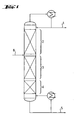
- Fig. 1 An advantageous apparatus for carrying out this process is shown in Fig. 1 and advantageously has a distillate outlet 1, stripping section 2, rectifying section 4, a reaction zone 3 and a product outlet 5 and a feed for the formaldehyde-containing solution 6.
- the reaction zone can also be located outside the column. In this case, the return is taken from a tray of the column, passed over an acidic catalyst fixed bed and subsequently fed back below said tray of the column. This arrangement can also be employed a number of times at successive column trays. In the preferred embodiment, however, the reaction zone is integrated into the column.
- the reaction zone is provided with packing elements which fix the acidic fixed-bed catalyst.
- Particularly suitable packing elements are, for example, Sulzer Katapak-S® elements, which are fitted with an acidic ion exchanger, such as, for example, Amberlyst 15®.
- the stripping and rectification sections employed are preferably columns, in particular surface rectifiers, such as packed columns or tray columns, where tray columns have a large retention capacity and packed columns have a large specific surface area.
- Particularly preferred columns are bubble-tray columns, trickle columns, columns containing packing and columns containing ordered packing. In order to achieve the lowest possible column height with high throughputs, preference is given to columns having internals which provide the largest possible exchange area, for example with structured packing.
- the DN50 column was constructed in accordance with Figure 1.
- the Katapak® elements (3) which were installed in the two reactive shots, each contained 150 g (dry weight) of Amberlyst-15® as acidic ion exchanger and were employed in a length of 2 m.
- the capacity of the catalyst is about 4.75 meq/g. 1 m Sulzer BX were employed in each of the stripping section and the rectification section.
- a total of six experiments were carried out at atmospheric pressure with the set-up shown in Figure 1. An overview of the experiments carried out is given in Table 1.
- the magnitude of the feed streams, the distillate stream and the bottom-product stream were determined gravimetrically.
- the temperatures and pressure at the top and bottom of the column and the differential pressure were recorded via a process control system.
- Table 1 Overview of the experiment carried out Experiment Feed Heating Condenser Distillate Reflux ratio Methanol number [kg/h] power power [g/h] removal [W] [W] C1 3.945 888 332 57.3 ca.75 74.7% C2 3.885 888 336 171.5 ca.25 80.5% C3 4.007 1203 663 109.7 ca.40 97.8% C4 3.984 1203 630 86.9 80 80.5% C5 2.010 753 310 33.0 20 89.4% C6 2.025 753 313 26.3 25 97.9%
- Table 2 Experiment 1 Composition Feed Bottom product Distillate Water 72.13% 75.10% 12.70% Formaldehyde 19.39% 20.22% 0.97% Methanol 3.28% 0.83% 38.25% Formaldehyde 0.10% 0.00% 28.90% dimethyl acetal 2,4,6- 0.10% 0.00% 16.30% trioxaheptane Trioxane 4.72%
Landscapes
- Chemical & Material Sciences (AREA)
- Organic Chemistry (AREA)
- Chemical Kinetics & Catalysis (AREA)
- Health & Medical Sciences (AREA)
- Medicinal Chemistry (AREA)
- Polymers & Plastics (AREA)
- Crystallography & Structural Chemistry (AREA)
- General Chemical & Material Sciences (AREA)
- Organic Low-Molecular-Weight Compounds And Preparation Thereof (AREA)
- Polyoxymethylene Polymers And Polymers With Carbon-To-Carbon Bonds (AREA)
- Heterocyclic Compounds That Contain Two Or More Ring Oxygen Atoms (AREA)
- Removal Of Specific Substances (AREA)
Claims (14)
- Verfahren zur Reinigung einer wäßrigen Formaldehydlösung durch Entfernung von Methanol aus der wäßrigen formaldehydhaltigen Lösung, wobei Methanol durch Reaktivdestillation in Gegenwart eines sauren Festbettkatalysators zu Formaldehyddimethylacetal umgesetzt wird und das erhaltene Gemisch enthaltend Methanol, Formaldehyddimethylacetal und gegebenenfalls sonstige Verunreinigungen am Kopf der Kolonne abdestilliert wird und die gereinigte wäßrige Formaldehydlösung im Sumpf verbleibt und aus dem Sumpf entfernt wird.
- Verfahren nach Anspruch 1, wobei das molare Verhältnis der Konzentrationen von Formaldehyd zu Methanol mindestens 3 beträgt.
- Verfahren nach einem der Ansprüche 1 bis 2, wobei die Abdestillation des Gemisches fraktioniert in mehreren Stufen erfolgt.
- Verfahren nach einem oder mehreren der Ansprüche 1 bis 3, wobei als saurer Festbettkatalysator ein saurer Ionenaustauscher eingesetzt wird.
- Verfahren nach einem oder mehreren der Ansprüche 1 bis 4, wobei als saurer Festbettkatalysator ein vernetztes Polystyrol mit Sulfonsäuregruppen eingesetzt wird.
- Verfahren nach einem oder mehreren der Ansprüche 1 bis 5, wobei die formaldehydhaltige Lösung 10 bis 80 Gew.-% Formaldehyd enthält.
- Verfahren nach einem oder mehreren der Ansprüche 1 bis 6, wobei die formaldehydhaltige Lösung 1 bis 20 Gew.-% Methanol enthält.
- Verfahren nach einem oder mehreren der Ansprüche 1 bis 7, wobei die formaldehydhaltige Lösung weniger als 5 Gew.-% Methanol enthält.
- Verfahren nach einem oder mehreren der Ansprüche 1 bis 8, wobei das Methanol und Formaldehyddimethylacetal enthaltende Gemisch einem dem erfindungsgemäßen Verfahren vorgeschalteten Prozeß zur Herstellung von Formaldehyd zugeführt wird.
- Verfahren zur Herstellung von Formaldehyd, wobei man eine wäßrige Formaldehydlösung durch Oxidation oder Oxydehydrierung von Methanol herstellt und die wäßrige Formaldehydlösung gereinigt wird, nach einem oder mehreren der Ansprüche 1 bis 9, wobei Methanol durch Reaktivdestillation in Gegenwart eines sauren Festbettkatalysators zu Formaldehyddimethylacetal umgesetzt wird, das erhaltene Gemisch enthaltend Methanol, Formaldehyddimethylacetal und gegebenenfalls sonstige Verunreinigungen am Kopf der Kolonne abdestilliert wird und die gereinigte wäßrige Formaldehydlösung im Sumpf verbleibt und aus dem Sumpf entfernt wird.
- Verfahren zur Herstellung von Trioxan, wobei man eine wäßrige Formaldehydlösung durch Oxidation oder Oxydehydrierung von Methanol herstellt und die wäßrige Formaldehydlösung gereinigt wird, nach einem oder mehreren der Ansprüche 1 bis 9, wobei Methanol durch Reaktivdestillation in Gegenwart eines sauren Festbettkatalysators zu Formaldehyddimethylacetal umgesetzt wird, das erhaltene Gemisch enthaltend Methanol, Formaldehyddimethylacetal und gegebenenfalls sonstige Verunreinigungen am Kopf der Kolonne abdestilliert wird, die gereinigte wäßrige Formaldehydlösung im Sumpf verbleibt, aus dem Sumpf entfernt wird, und der so gewonnene Formaldehyd zur Herstellung von Trioxan verwendet wird.
- Verfahren zur Herstellung von Polyoxymethylen, wobei man eine wäßrige Formaldehydlösung durch Oxidation oder Oxydehydrierung von Methanol herstellt und die wäßrige Formaldehydlösung gereinigt wird, nach einem oder mehreren der Ansprüche 1 bis 9, wobei Methanol durch Reaktivdestillation in Gegenwart eines sauren Festbettkatalysators zu Formaldehyddimethylacetal umgesetzt wird, das erhaltene Gemisch enthaltend Methanol, Formaldehyddimethylacetal und gegebenenfalls sonstige Verunreinigungen am Kopf der Kolonne abdestilliert wird, die gereinigte wäßrige Formaldehydlösung im Sumpf verbleibt, aus dem Sumpf entfernt wird, man die wäßrige Formaldehydlösung in wasserfreies Formaldehyd überführt, man den Formaldehyd polymerisiert, die Endgruppen des so hergestellten Polymers absättigt (Capping) und gegebenenfalls das Polymer in der Schmelze homogenisiert und/oder mit geeigneten Zusätzen versieht.
- Verfahren zur Herstellung von Polyoxymethylen-Copolymeren, wobei man eine wäßrige Formaldehydlösung durch Oxidation oder Oxydehydrierung von Methanol herstellt und die wäßrige Formaldehydlösung gereinigt wird, die gereinigte Wäßrige Formaldehydlosung im Sumpf verbleibt, aus dem Sumpf entfernt wird, nach einem oder mehreren der Ansprüche 1 bis 9, wobei Methanol durch Reaktivdestillation in Gegenwart eines sauren Festbettkatalysators zu Formaldehyddimethylacetal umgesetzt wird, das erhaltene Gemisch enthaltend Methanol, Formaldehyddimethylacetal und gegebenenfalls sonstige Verunreinigungen am Kopf der Kolonne abdestilliert wird, die gereinigte wäßrige Formaldehydlösung im Sumpf verbleibt, aus dem Sumpf entfernt wird, der so gewonnene Formaldehyd zur Herstellung von Trioxan verwendet wird, man gegebenenfalls das Trioxan reinigt, das Trioxan mit cyclischen Ethern oder cyclischen Acetalen copolymerisiert, gegebenenfalls instabile Endgruppen entfernt und das so hergestellte Polymer gegebenenfalls in der Schmelze homogenisiert und/oder mit geeigneten Zusätzen versieht.
- Verfahren zur Herstellung von Polyoxymethylen-Copolymeren, wobei man eine wäßrige Formaldehydlösung durch Oxidation oder Oxydehydrierung von Methanol herstellt, und die wäßrige Formaldehydlösung gereinigt wird, nach einem oder mehreren der Ansprüche 1 bis 9, wobei Methanol durch Reaktivdestillation in Gegenwart eines sauren Festbettkatalysators zu Formaldehyddimethylacetal umgesetzt wird, das erhaltene Gemisch enthaltend Methanol, Formaldehyddimethylacetal und gegebenenfalls sonstige Verunreinigungen am Kopf der Kolonne abdestilliert wird, die gereinigte wäßrige Formaldehydlösung im Sumpf verbleibt, aus dem Sumpf entfernt wird, man die wäßrige Formaldehydlösung in wasserfreies Formaldehyd überführt, man den Formaldehyd mit cyclischen Ethern oder cyclischen Acetalen copolymerisiert gegebenenfalls instabile Endgruppen entfernt und gegebenenfalls das Polymer in der Schmelze homogenisiert und/oder mit geeigneten Zusätzen versieht.
Applications Claiming Priority (3)
| Application Number | Priority Date | Filing Date | Title |
|---|---|---|---|
| DE10062814A DE10062814A1 (de) | 2000-12-15 | 2000-12-15 | Verfahren zur Entfernung von Methanol aus formaldeyhdhaltigen Lösungen |
| DE10062814 | 2000-12-15 | ||
| PCT/EP2001/013351 WO2002048082A1 (en) | 2000-12-15 | 2001-11-19 | Process for removing methanol from formaldehyde-containing solutions |
Publications (2)
| Publication Number | Publication Date |
|---|---|
| EP1343745A1 EP1343745A1 (de) | 2003-09-17 |
| EP1343745B1 true EP1343745B1 (de) | 2006-12-27 |
Family
ID=7667459
Family Applications (1)
| Application Number | Title | Priority Date | Filing Date |
|---|---|---|---|
| EP01270514A Expired - Lifetime EP1343745B1 (de) | 2000-12-15 | 2001-11-19 | Verfahren zum entfernen von methanol aus formaldehydhaltigen lösungen |
Country Status (11)
| Country | Link |
|---|---|
| US (1) | US7301055B2 (de) |
| EP (1) | EP1343745B1 (de) |
| JP (1) | JP4081372B2 (de) |
| CN (1) | CN1289453C (de) |
| AT (1) | ATE349411T1 (de) |
| AU (1) | AU2002220714A1 (de) |
| DE (2) | DE10062814A1 (de) |
| ES (1) | ES2279789T3 (de) |
| MY (1) | MY139930A (de) |
| TW (1) | TW572892B (de) |
| WO (1) | WO2002048082A1 (de) |
Families Citing this family (18)
| Publication number | Priority date | Publication date | Assignee | Title |
|---|---|---|---|---|
| DE10309289A1 (de) | 2003-03-04 | 2004-09-16 | Basf Ag | Verfahren zur Erzeugung hochkonzentrierter Formaldehydlösungen |
| MY151105A (en) * | 2007-12-19 | 2014-04-15 | Basf Se | Process for preparing polyoxymethylene homopolymers or copolymers by homopolymerization or copolymerization trioxane, starting from methanol |
| EP2450336A1 (de) * | 2010-11-09 | 2012-05-09 | INEOS Paraform GmbH | Verfahren zur Herstellung von reinem Methylal |
| JP2012116920A (ja) * | 2010-11-30 | 2012-06-21 | Polyplastics Co | ポリオキシメチレン樹脂の製造方法 |
| US9000229B2 (en) | 2011-06-24 | 2015-04-07 | Eastman Chemical Company | Production of hydroxy ether hydrocarbons by vapor phase hydrogenolysis of cyclic acetals and ketals |
| US8829206B2 (en) | 2011-06-24 | 2014-09-09 | Eastman Chemical Company | Production of cyclic acetals or ketals using solid acid catalysts |
| US8829207B2 (en) | 2011-06-24 | 2014-09-09 | Eastman Chemical Company | Production of cyclic acetals by reactive distillation |
| US8785697B2 (en) | 2011-06-24 | 2014-07-22 | Eastman Chemical Company | Nickel modified catalyst for the production of hydroxy ether hydrocarbons by vapor phase hydrogenolysis of cyclic acetals and ketals |
| US8969598B2 (en) | 2011-06-24 | 2015-03-03 | Eastman Chemical Company | Production of cyclic acetals or ketals using liquid-phase acid catalysts |
| US9056313B2 (en) | 2011-06-24 | 2015-06-16 | Eastman Chemical Company | Catalysts for the production of hydroxy ether hydrocarbons by vapor phase hydrogenolysis of cyclic acetals and ketals |
| US9388105B2 (en) | 2011-06-24 | 2016-07-12 | Eastman Chemical Company | Production of hydroxy ether hydrocarbons by liquid phase hydrogenolysis of cyclic acetals or cyclic ketals |
| EP2782906B1 (de) | 2011-11-24 | 2019-05-22 | Celanese Sales Germany GmbH | Verfahren zur herstellung eines cyclischen acetals |
| CN111971276A (zh) | 2018-03-29 | 2020-11-20 | 塞拉尼斯销售德国有限公司 | 在非均相反应体系中生产环状缩醛的方法 |
| US11932615B2 (en) * | 2018-06-04 | 2024-03-19 | Brian Ozero | Method for recovery of ethylene oxide |
| CN110559678B (zh) * | 2019-10-21 | 2024-02-27 | 无锡赫利邦化工科技有限公司 | 一种聚甲氧基二甲醚合成与分离的精馏塔及其使用方法 |
| CN111808067B (zh) * | 2020-06-17 | 2021-06-01 | 中化学科学技术研究有限公司 | 以甲醇为原料制备三聚甲醛的工艺 |
| CN111750228B (zh) * | 2020-07-09 | 2022-08-16 | 淄博齐星化学科技有限公司 | 一种用于混合气体的甲醛提纯设备及提取方法 |
| CN115417752B (zh) * | 2022-09-05 | 2024-09-03 | 无锡华立聚能装备有限公司 | 一种甲醛生产的分离提纯工艺 |
Family Cites Families (6)
| Publication number | Priority date | Publication date | Assignee | Title |
|---|---|---|---|---|
| DE1207365B (de) * | 1961-09-08 | 1965-12-23 | Wacker Chemie Gmbh | Verfahren zur Trennung methanolhaltiger Gemische |
| BE794046A (fr) * | 1972-01-15 | 1973-07-16 | Basf Ag | Procede de preparation de solutions aqueuses de formaldehyde pauvres en methanol |
| US4348540A (en) | 1981-06-29 | 1982-09-07 | Monsanto Company | Manufacture of aqueous formaldehyde |
| DE68914858T2 (de) * | 1988-02-03 | 1994-08-11 | Asahi Chemical Ind | Verfahren zur Herstellung von Formaldehyd und dessen Derivaten. |
| DE59807566D1 (de) * | 1997-06-02 | 2003-04-24 | Ticona Gmbh | Verfahren zur nicht oxidativen herstellung von formaldehyd aus methanol |
| US6015875A (en) * | 1998-08-11 | 2000-01-18 | Catalytic Distillation Technologies | Process for making acetals |
-
2000
- 2000-12-15 DE DE10062814A patent/DE10062814A1/de not_active Withdrawn
-
2001
- 2001-11-19 US US10/451,469 patent/US7301055B2/en not_active Expired - Fee Related
- 2001-11-19 DE DE60125589T patent/DE60125589T2/de not_active Expired - Lifetime
- 2001-11-19 CN CNB018216900A patent/CN1289453C/zh not_active Expired - Fee Related
- 2001-11-19 ES ES01270514T patent/ES2279789T3/es not_active Expired - Lifetime
- 2001-11-19 WO PCT/EP2001/013351 patent/WO2002048082A1/en not_active Ceased
- 2001-11-19 AU AU2002220714A patent/AU2002220714A1/en not_active Abandoned
- 2001-11-19 AT AT01270514T patent/ATE349411T1/de not_active IP Right Cessation
- 2001-11-19 EP EP01270514A patent/EP1343745B1/de not_active Expired - Lifetime
- 2001-11-19 JP JP2002549619A patent/JP4081372B2/ja not_active Expired - Fee Related
- 2001-12-13 TW TW090130954A patent/TW572892B/zh not_active IP Right Cessation
- 2001-12-14 MY MYPI20015721A patent/MY139930A/en unknown
Also Published As
| Publication number | Publication date |
|---|---|
| WO2002048082A1 (en) | 2002-06-20 |
| CN1289453C (zh) | 2006-12-13 |
| US20040097762A1 (en) | 2004-05-20 |
| MY139930A (en) | 2009-11-30 |
| AU2002220714A1 (en) | 2002-06-24 |
| ES2279789T3 (es) | 2007-09-01 |
| TW572892B (en) | 2004-01-21 |
| ATE349411T1 (de) | 2007-01-15 |
| DE60125589T2 (de) | 2007-10-11 |
| JP2004523500A (ja) | 2004-08-05 |
| DE60125589D1 (de) | 2007-02-08 |
| EP1343745A1 (de) | 2003-09-17 |
| US7301055B2 (en) | 2007-11-27 |
| JP4081372B2 (ja) | 2008-04-23 |
| CN1484629A (zh) | 2004-03-24 |
| DE10062814A1 (de) | 2002-06-20 |
Similar Documents
| Publication | Publication Date | Title |
|---|---|---|
| EP1343745B1 (de) | Verfahren zum entfernen von methanol aus formaldehydhaltigen lösungen | |
| US7534922B2 (en) | Processes for the manufacture of acetals | |
| KR101076971B1 (ko) | 압력 변동 정류 방법에 의한 트리옥산/포름알데히드/물혼합물로부터의 트리옥산의 분리 방법 | |
| CN101588851B (zh) | 通过变压精馏从三*烷/甲醛/水混合物中分离三*烷的方法 | |
| KR20180087394A (ko) | 프로펜의 에폭시화 방법 | |
| JP2008523014A (ja) | アセタールを製造するための方法 | |
| WO2002055513A1 (en) | Process for producing cyclic formal | |
| KR20060120218A (ko) | 트리옥산, 포름알데히드 및 물을 함유하는 혼합물로부터트리옥산의 분리 방법 | |
| US20080283384A1 (en) | Process for Producing Trioxane and at Least One Comonomer | |
| JP4259815B2 (ja) | 高純度酢酸ブチルの製造方法 | |
| KR101415467B1 (ko) | 포름알데히드로부터 트리옥산의 통합 제조 방법 | |
| US20080281109A1 (en) | Integrated Method For the Production of Trioxane From Formaldehyde | |
| US20100152466A1 (en) | Integrated method for producing trioxane from formaldehyde | |
| US20080194845A1 (en) | Integrated Process For Preparing Trioxane From Formaldehyde | |
| HU193228B (hu) | Eljárás 2-(diklór-metfl-)-2-metil-l3-dioxolán homobén katalitikus előállítására |
Legal Events
| Date | Code | Title | Description |
|---|---|---|---|
| PUAI | Public reference made under article 153(3) epc to a published international application that has entered the european phase |
Free format text: ORIGINAL CODE: 0009012 |
|
| 17P | Request for examination filed |
Effective date: 20030715 |
|
| AK | Designated contracting states |
Kind code of ref document: A1 Designated state(s): AT BE CH CY DE DK ES FI FR GB GR IE IT LI LU MC NL PT SE TR |
|
| AX | Request for extension of the european patent |
Extension state: AL LT LV MK RO SI |
|
| 17Q | First examination report despatched |
Effective date: 20050330 |
|
| GRAP | Despatch of communication of intention to grant a patent |
Free format text: ORIGINAL CODE: EPIDOSNIGR1 |
|
| GRAS | Grant fee paid |
Free format text: ORIGINAL CODE: EPIDOSNIGR3 |
|
| GRAA | (expected) grant |
Free format text: ORIGINAL CODE: 0009210 |
|
| AK | Designated contracting states |
Kind code of ref document: B1 Designated state(s): AT BE CH CY DE DK ES FI FR GB GR IE IT LI LU MC NL PT SE TR |
|
| PG25 | Lapsed in a contracting state [announced via postgrant information from national office to epo] |
Ref country code: IT Free format text: LAPSE BECAUSE OF FAILURE TO SUBMIT A TRANSLATION OF THE DESCRIPTION OR TO PAY THE FEE WITHIN THE PRESCRIBED TIME-LIMIT;WARNING: LAPSES OF ITALIAN PATENTS WITH EFFECTIVE DATE BEFORE 2007 MAY HAVE OCCURRED AT ANY TIME BEFORE 2007. THE CORRECT EFFECTIVE DATE MAY BE DIFFERENT FROM THE ONE RECORDED. Effective date: 20061227 Ref country code: DK Free format text: LAPSE BECAUSE OF FAILURE TO SUBMIT A TRANSLATION OF THE DESCRIPTION OR TO PAY THE FEE WITHIN THE PRESCRIBED TIME-LIMIT Effective date: 20061227 Ref country code: CH Free format text: LAPSE BECAUSE OF FAILURE TO SUBMIT A TRANSLATION OF THE DESCRIPTION OR TO PAY THE FEE WITHIN THE PRESCRIBED TIME-LIMIT Effective date: 20061227 Ref country code: BE Free format text: LAPSE BECAUSE OF FAILURE TO SUBMIT A TRANSLATION OF THE DESCRIPTION OR TO PAY THE FEE WITHIN THE PRESCRIBED TIME-LIMIT Effective date: 20061227 Ref country code: AT Free format text: LAPSE BECAUSE OF FAILURE TO SUBMIT A TRANSLATION OF THE DESCRIPTION OR TO PAY THE FEE WITHIN THE PRESCRIBED TIME-LIMIT Effective date: 20061227 Ref country code: FI Free format text: LAPSE BECAUSE OF FAILURE TO SUBMIT A TRANSLATION OF THE DESCRIPTION OR TO PAY THE FEE WITHIN THE PRESCRIBED TIME-LIMIT Effective date: 20061227 Ref country code: LI Free format text: LAPSE BECAUSE OF FAILURE TO SUBMIT A TRANSLATION OF THE DESCRIPTION OR TO PAY THE FEE WITHIN THE PRESCRIBED TIME-LIMIT Effective date: 20061227 |
|
| REG | Reference to a national code |
Ref country code: GB Ref legal event code: FG4D |
|
| REG | Reference to a national code |
Ref country code: IE Ref legal event code: FG4D |
|
| REF | Corresponds to: |
Ref document number: 60125589 Country of ref document: DE Date of ref document: 20070208 Kind code of ref document: P |
|
| REG | Reference to a national code |
Ref country code: SE Ref legal event code: TRGR |
|
| PG25 | Lapsed in a contracting state [announced via postgrant information from national office to epo] |
Ref country code: PT Free format text: LAPSE BECAUSE OF FAILURE TO SUBMIT A TRANSLATION OF THE DESCRIPTION OR TO PAY THE FEE WITHIN THE PRESCRIBED TIME-LIMIT Effective date: 20070528 |
|
| REG | Reference to a national code |
Ref country code: CH Ref legal event code: PL |
|
| ET | Fr: translation filed | ||
| REG | Reference to a national code |
Ref country code: ES Ref legal event code: FG2A Ref document number: 2279789 Country of ref document: ES Kind code of ref document: T3 |
|
| PLBE | No opposition filed within time limit |
Free format text: ORIGINAL CODE: 0009261 |
|
| STAA | Information on the status of an ep patent application or granted ep patent |
Free format text: STATUS: NO OPPOSITION FILED WITHIN TIME LIMIT |
|
| 26N | No opposition filed |
Effective date: 20070928 |
|
| PG25 | Lapsed in a contracting state [announced via postgrant information from national office to epo] |
Ref country code: GR Free format text: LAPSE BECAUSE OF FAILURE TO SUBMIT A TRANSLATION OF THE DESCRIPTION OR TO PAY THE FEE WITHIN THE PRESCRIBED TIME-LIMIT Effective date: 20070328 |
|
| PG25 | Lapsed in a contracting state [announced via postgrant information from national office to epo] |
Ref country code: MC Free format text: LAPSE BECAUSE OF NON-PAYMENT OF DUE FEES Effective date: 20071130 |
|
| PG25 | Lapsed in a contracting state [announced via postgrant information from national office to epo] |
Ref country code: IE Free format text: LAPSE BECAUSE OF NON-PAYMENT OF DUE FEES Effective date: 20071119 |
|
| PGFP | Annual fee paid to national office [announced via postgrant information from national office to epo] |
Ref country code: NL Payment date: 20081103 Year of fee payment: 8 |
|
| PGFP | Annual fee paid to national office [announced via postgrant information from national office to epo] |
Ref country code: ES Payment date: 20081216 Year of fee payment: 8 |
|
| PGFP | Annual fee paid to national office [announced via postgrant information from national office to epo] |
Ref country code: SE Payment date: 20081107 Year of fee payment: 8 |
|
| PGFP | Annual fee paid to national office [announced via postgrant information from national office to epo] |
Ref country code: FR Payment date: 20081112 Year of fee payment: 8 |
|
| PGFP | Annual fee paid to national office [announced via postgrant information from national office to epo] |
Ref country code: GB Payment date: 20081119 Year of fee payment: 8 |
|
| PG25 | Lapsed in a contracting state [announced via postgrant information from national office to epo] |
Ref country code: CY Free format text: LAPSE BECAUSE OF FAILURE TO SUBMIT A TRANSLATION OF THE DESCRIPTION OR TO PAY THE FEE WITHIN THE PRESCRIBED TIME-LIMIT Effective date: 20061227 Ref country code: LU Free format text: LAPSE BECAUSE OF NON-PAYMENT OF DUE FEES Effective date: 20071119 |
|
| PG25 | Lapsed in a contracting state [announced via postgrant information from national office to epo] |
Ref country code: TR Free format text: LAPSE BECAUSE OF FAILURE TO SUBMIT A TRANSLATION OF THE DESCRIPTION OR TO PAY THE FEE WITHIN THE PRESCRIBED TIME-LIMIT Effective date: 20061227 |
|
| REG | Reference to a national code |
Ref country code: NL Ref legal event code: V1 Effective date: 20100601 |
|
| EUG | Se: european patent has lapsed | ||
| GBPC | Gb: european patent ceased through non-payment of renewal fee |
Effective date: 20091119 |
|
| REG | Reference to a national code |
Ref country code: FR Ref legal event code: ST Effective date: 20100730 |
|
| PG25 | Lapsed in a contracting state [announced via postgrant information from national office to epo] |
Ref country code: FR Free format text: LAPSE BECAUSE OF NON-PAYMENT OF DUE FEES Effective date: 20091130 Ref country code: NL Free format text: LAPSE BECAUSE OF NON-PAYMENT OF DUE FEES Effective date: 20100601 |
|
| PG25 | Lapsed in a contracting state [announced via postgrant information from national office to epo] |
Ref country code: GB Free format text: LAPSE BECAUSE OF NON-PAYMENT OF DUE FEES Effective date: 20091119 |
|
| REG | Reference to a national code |
Ref country code: ES Ref legal event code: FD2A Effective date: 20110406 |
|
| PG25 | Lapsed in a contracting state [announced via postgrant information from national office to epo] |
Ref country code: SE Free format text: LAPSE BECAUSE OF NON-PAYMENT OF DUE FEES Effective date: 20091120 |
|
| PG25 | Lapsed in a contracting state [announced via postgrant information from national office to epo] |
Ref country code: ES Free format text: LAPSE BECAUSE OF NON-PAYMENT OF DUE FEES Effective date: 20110324 |
|
| PG25 | Lapsed in a contracting state [announced via postgrant information from national office to epo] |
Ref country code: ES Free format text: LAPSE BECAUSE OF NON-PAYMENT OF DUE FEES Effective date: 20091120 |
|
| REG | Reference to a national code |
Ref country code: DE Ref legal event code: R081 Ref document number: 60125589 Country of ref document: DE Owner name: CELANESE SALES GERMANY GMBH, DE Free format text: FORMER OWNER: TICONA GMBH, 65451 KELSTERBACH, DE |
|
| PGFP | Annual fee paid to national office [announced via postgrant information from national office to epo] |
Ref country code: DE Payment date: 20161116 Year of fee payment: 16 |
|
| REG | Reference to a national code |
Ref country code: DE Ref legal event code: R119 Ref document number: 60125589 Country of ref document: DE |
|
| PG25 | Lapsed in a contracting state [announced via postgrant information from national office to epo] |
Ref country code: DE Free format text: LAPSE BECAUSE OF NON-PAYMENT OF DUE FEES Effective date: 20180602 |