EP1345210B1 - Spracherkennungssystem, Spracherkennungsverfahren und Programmprodukt - Google Patents
Spracherkennungssystem, Spracherkennungsverfahren und Programmprodukt Download PDFInfo
- Publication number
- EP1345210B1 EP1345210B1 EP03004378A EP03004378A EP1345210B1 EP 1345210 B1 EP1345210 B1 EP 1345210B1 EP 03004378 A EP03004378 A EP 03004378A EP 03004378 A EP03004378 A EP 03004378A EP 1345210 B1 EP1345210 B1 EP 1345210B1
- Authority
- EP
- European Patent Office
- Prior art keywords
- speech
- signal
- image information
- sound signal
- sound
- Prior art date
- Legal status (The legal status is an assumption and is not a legal conclusion. Google has not performed a legal analysis and makes no representation as to the accuracy of the status listed.)
- Expired - Lifetime
Links
Images






Classifications
-
- G—PHYSICS
- G10—MUSICAL INSTRUMENTS; ACOUSTICS
- G10L—SPEECH ANALYSIS TECHNIQUES OR SPEECH SYNTHESIS; SPEECH RECOGNITION; SPEECH OR VOICE PROCESSING TECHNIQUES; SPEECH OR AUDIO CODING OR DECODING
- G10L13/00—Speech synthesis; Text to speech systems
- G10L13/02—Methods for producing synthetic speech; Speech synthesisers
- G10L13/033—Voice editing, e.g. manipulating the voice of the synthesiser
-
- G—PHYSICS
- G06—COMPUTING OR CALCULATING; COUNTING
- G06F—ELECTRIC DIGITAL DATA PROCESSING
- G06F18/00—Pattern recognition
- G06F18/20—Analysing
- G06F18/25—Fusion techniques
- G06F18/254—Fusion techniques of classification results, e.g. of results related to same input data
- G06F18/256—Fusion techniques of classification results, e.g. of results related to same input data of results relating to different input data, e.g. multimodal recognition
-
- G—PHYSICS
- G06—COMPUTING OR CALCULATING; COUNTING
- G06V—IMAGE OR VIDEO RECOGNITION OR UNDERSTANDING
- G06V10/00—Arrangements for image or video recognition or understanding
- G06V10/70—Arrangements for image or video recognition or understanding using pattern recognition or machine learning
- G06V10/77—Processing image or video features in feature spaces; using data integration or data reduction, e.g. principal component analysis [PCA] or independent component analysis [ICA] or self-organising maps [SOM]; Blind source separation
- G06V10/80—Fusion, i.e. combining data from various sources at the sensor level, preprocessing level, feature extraction level or classification level
- G06V10/809—Fusion, i.e. combining data from various sources at the sensor level, preprocessing level, feature extraction level or classification level of classification results, e.g. where the classifiers operate on the same input data
- G06V10/811—Fusion, i.e. combining data from various sources at the sensor level, preprocessing level, feature extraction level or classification level of classification results, e.g. where the classifiers operate on the same input data the classifiers operating on different input data, e.g. multi-modal recognition
-
- G—PHYSICS
- G06—COMPUTING OR CALCULATING; COUNTING
- G06V—IMAGE OR VIDEO RECOGNITION OR UNDERSTANDING
- G06V40/00—Recognition of biometric, human-related or animal-related patterns in image or video data
- G06V40/20—Movements or behaviour, e.g. gesture recognition
-
- G—PHYSICS
- G10—MUSICAL INSTRUMENTS; ACOUSTICS
- G10L—SPEECH ANALYSIS TECHNIQUES OR SPEECH SYNTHESIS; SPEECH RECOGNITION; SPEECH OR VOICE PROCESSING TECHNIQUES; SPEECH OR AUDIO CODING OR DECODING
- G10L15/00—Speech recognition
- G10L15/24—Speech recognition using non-acoustical features
-
- G—PHYSICS
- G10—MUSICAL INSTRUMENTS; ACOUSTICS
- G10L—SPEECH ANALYSIS TECHNIQUES OR SPEECH SYNTHESIS; SPEECH RECOGNITION; SPEECH OR VOICE PROCESSING TECHNIQUES; SPEECH OR AUDIO CODING OR DECODING
- G10L21/00—Speech or voice signal processing techniques to produce another audible or non-audible signal, e.g. visual or tactile, in order to modify its quality or its intelligibility
- G10L21/003—Changing voice quality, e.g. pitch or formants
- G10L21/007—Changing voice quality, e.g. pitch or formants characterised by the process used
- G10L21/013—Adapting to target pitch
- G10L2021/0135—Voice conversion or morphing
Definitions
- the present invention relates to a speech recognition system and method for recognizing a speech signal and a program product.
- the conventional speech-detecting device adopts a speech recognition technique for recognizing and processing a speech signal by analyzing the frequencies included in a vocalized sound signal.
- the speech recognition technique is achieved using a spectral envelope or the like.
- the conventional speech-detecting device it is impossible for the conventional speech-detecting device to detect a speech signal without the vocalized sound signal that is inputted to the conventional speech-detecting device. Further, it is necessary for a sound signal to be vocalized at a certain volume, in order to obtain a good speech-detecting result using this speech recognition technique.
- the conventional speech-detecting device cannot be used in a case where silence is required, for example, in an office, in a library, or in a public institution or the like, when a speaker may cause inconvenience to people around him/her.
- the conventional speech-detecting device has a problem in that a cross-talk problem is caused and the performance of the speech-detecting function is reduced in a high-noise environment.
- the method of image processing based on image information inputted by a video camera is known as a method for recognizing a speech signal based on the visual information of the lips.
- the method for detecting the vowels and consonants of a speaker by processing the EMG signal with a neural network is known. Further a multi-modal interface that utilizes information inputted from not only an input channel but also a plurality of input channels has been proposed and achieved.
- the conventional speech synthesis system stores data for characterizing the speech signal of a speaker, and synthesizes a speech signal using the data when the speaker vocalizes.
- the conventional speech detecting method using a technique for acquiring a speech signal from information other than a sound signal has a low success rate In recognition, in comparison with the speech detecting method using a technique for acquiring the speech signal from the sound signal. Especially, it is hard to recognize consonants vocalized by the motion of muscles in the mouth.
- the conventional speech synthesis system has a problem in that the speech signal is synthesized based on the data characterizing the speech signal of a speaker, so that the synthesized speech signal sounds mechanical, expression is not natural, and it is impossible to express the emotions of the speaker appropriately.
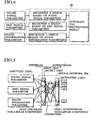
- FIG. 1 illustrates a functional block diagram of the speech recognition system according to the embodiment.
- the speech recognition system is configured with a sound signal processor 10, an EMG signal processor 13, an image information processor 16, an information integrator/recognizer 19, a speech recognizer 20, and a recognition result provider 21.
- the sound signal processor 10 is configured to process the sound signal vocalized by a speaker.
- the sound signal processor 10 is configured with a sound signal acquiring unit 11 and a sound signal processing unit 12.
- the sound signal acquiring unit 11 is a device for acquiring the sound signal from the mouth of a speaker (object), such as a microphone.
- the sound signal acquiring unit 11 detects the sound signal vocalized by the speaker, and transmits the acquired sound signal to the sound signal processing unit 12.
- the sound signal processing unit 12 is configured to extract a sound signal parameter by separating a spectral envelope or a minute structure from the sound signal, acquired by the sound signal acquiring unit 11.
- the sound signal processing unit 12 is a device for calculating the sound signal parameter, which can be processed in the speech recognizer 20, based on the sound signal acquired by the sound signal acquiring unit 11.
- the sound signal processing unit 12 cuts the sound signal per time-window set, and calculates the sound signal parameter by performing analyses which are used in speech recognition generally, such as short-time spectral analysis, Cepstrum analysis, maximum likelihood spectrum estimation method, covariance method, PARCOR analysis, and LSP analysis, on the cut sound signal.
- the EMG signal processor 13 is configured to detect and process the motion of muscles around the mouth of a speaker when the sound signal is vocalized.
- the EMG signal processor 13 is configured with an EMG signal acquiring unit 14 and an EMG signal processing unit 15.
- the EMG signal acquiring unit 14 is configured to acquire (extract) an EMG signal generated by the motion of muscles around the mouth of a speaker when a sound signal is vocalized.
- the EMG signal acquiring unit 14 detects potential changes on skin surfaces around the mouth of the speaker (object). That is to say, in order to recognize the activities of a plurality of muscles around the mouth which move in cooperation when a sound signal is vocalized, the EMG signal acquiring unit 14 detects a plurality of EMG signals from a plurality of electrodes on skin surfaces relating to the plurality of muscles, and amplifies the EMG signals to transmit to the EMG signal processing unit 15.
- the EMG signal processing unit 15 is configured to extract an EMG signal parameter by calculating the power of the EMG signal acquired by the EMG signal acquiring unit 14 or analyzing the frequencies of the EMG signal.
- the EMG signal processing unit 15 is a device for calculating an EMG signal parameter based on a plurality of EMG signals transmitted from the EMG signal acquiring unit 14. To be more specific, the EMG signal processing unit 15 cuts the EMG signal per time-window set, and calculates the EMG signal parameter by calculating a feature of average amplitude, such as RMS (root mean square). ARV (average rectified value), or IEMG (integrated EMG).
- a sound signal or an EMG signal detected by the sound signal acquiring unit 11 or the EMG acquiring unit 14 is cut per time-window by the sound signal processor 11 or the EMG signal processor 15 (S401 in FIG. 2A ).
- spectrums are extracted from the cut signal with FFT (S402 in FIG. 2B ).
- the power of each frequency is calculated by performing a 1/3 analysis on the extracted spectrums (S403 in FIG. 2C ).
- the calculated powers associated with each frequency are transmitted to the speech recognizer 20 as the sound signal parameters or the EMG signal parameters (S404 in FIG. 2D ).
- the sound signal parameters or the EMG signal parameters are recognized by the speech recognizer 20.
- the sound signal processing unit 12 or the EMG signal processing unit 15 can extract the sound signal parameters or the EMG signal parameters by using methods other than the method shown in FIG. 2A to 2D .
- the image information processor 16 is configured to detect the spatial changes around the mouth of a speaker when a sound signal is vocalized.
- the image information processor 16 is configured with an image information acquiring unit 17 and an image information processing unit 18.
- the image information acquiring unit 17 is configured to acquire image information by taking an image of the spatial changes around the mouth of a speaker (object) when a sound signal is vocalized.
- the image information acquiring unit 17 is configured with a camera for taking an image of the motion around the mouth of the speaker when the sound signal is vocalized, such as a video camera.
- the image information acquiring unit 17 detects the motion around the mouth as image information, and transmits the image information to the image information processing unit 18.
- the image information processing unit 18 is configured to calculate a motion parameter around the mouth of the speaker (image information parameter), based on the image information acquired by the image information acquiring unit 17 . To be more specific, the image information processing unit 18 calculates the image information by extracting a feature of the motion around the mouth with the optical flow.
- a feature position around the mouth of a speaker is extracted based on the image information at the time t0 (S501. in FIG. 3A ). It is possible to extract the feature position around the mouth by extracting the position of a marker placed around the mouth as the feature position, or searching for the feature position within the shot image information.
- the image information processing unit 18 can extract the feature position as a two-dimensional position from the image information.
- the image information processing unit 18 can extract the feature position as a three-dimensional position by using a plurality of cameras.
- a feature position around the mouth is extracted at the time t1 after a lapse of dt from t0 (S502, in FIG. 3B ). Then the image information processing unit 18 calculates the motion of each feature point by calculating a difference between the feature point at the time t0 and the feature point at the time t1 (S503, in FIG. 3C ). The image information processing unit 18 generates the image information parameters based on the calculated difference (S504. in FIG. 3D ).
- the image information processing unit 18 can extract the image information parameters by using methods other than the method shown in FIG. 3A to 3D .
- the information integrator/recognizer 19 is configured to integrate and recognize various information acquired from the sound signal processor 10, the EMG signal processor 13 and the image information processor 16.
- the information integrator/recognizer 19 is configured with a sound recognizer 20 and a recognition result provider 21.
- the sound recognizer 20 is a processor for recognizing speech by comparing and integrating the sound signal parameters transmitted from the sound signal processor 10, the EMG signal parameters transmitted from the EMG signal processor 13 and the image information parameters transmitted from the image signal processor 16.
- the sound recognizer 20 can recognize a speech based on only the sound signal parameters, when the noise level is small in the surroundings, when the volume of a vocalized sound signal is large, or when a speech can be recognized at adequate levels based on the sound signal parameters.
- the sound recognizer 20 can recognize speech based on not only the sound signal parameters but also the EMG signal parameters and the image information parameters, when the noise level is large in the surroundings, when the volume of a vocalized sound signal is small, or when speech cannot be recognized at adequate levels based on the sound signal parameters.
- the sound recognizer 20 can recognize specific phonemes or the like, which are not recognized correctly by using the EMG signal parameters and the image information parameters, by using only the sound signal parameters, so as to improve the recognition success rate.
- the speech recognizer 20 recognizes a speech signal based on each of the sound signal parameter, the EMG signal parameter and the image information parameter, compares each of the recognized speech signals, and recognizes the speech signal based on the compared result.
- the speech recognizer 20 recognizes speech based on only the sound signal parameters, only the EMG parameters or only the image information parameters respectively. Then the speech recognizer 20 recognizes speech, by integrating the recognized results based on the respective parameters.
- the speech recognizer 20 regards this result as the final recognition result.
- the speech recognizer 20 regards the recognition result which may have the highest success rate in recognition as the final recognition result.
- the speech recognizer 20 ignores the recognized result based on the EMG signal parameters, so as to improve the recognition success rate in.
- the speech recognizer 20 decreases the influence of the recognized result based on the sound signal parameters over the final recognition result, and recognizes speech by placing emphasis on the recognized result based on the EMG signal parameters and the image information parameters. Speech recognition based on the respective parameters can adopt the conventional speech recognition method.
- Speech recognition based on the sound signal in the speech recognizer 20 can adopt the conventional speech recognition method using various sound signals.
- Speech recognition based on the EMG signal can adopt the method disclosed in the technical literature " Noboru Sugie et al., A speech Employing a Speech Synthesizer Vowel Discrimination from Perioral Muscles Activities and Vowel Production,' IEEE transactions on Biomedical Engineering, Vol.32, No.7, pp485-490 " or JP-A-7-181888 or the like.
- Speech recognition based on image information can adopt the method disclosed in JP-A-2001-51693 or JP-A-2000-206986 or the like.
- the speech recognizer 20 shown in FIG. 4 can recognize speech based on meaningful parameters, so as to improve noise immunity or the like in the overall speech recognition system substantially, when any parameter of the sound signal parameters, the EMG signal parameters, and the image information parameters are not meaningful to speech recognition, such as when the noise level is large in the surroundings, when the volume of a vocalized sound signal is small, or when the EMG signal is not detected.
- the speech recognizer 20 recognizes the speech signal using the sound signal parameter, the EMG signal parameter and the image information parameter simultaneously.
- the speech recognizer 20 comprises a hierarchical network (for example, neural network 20a) in which a plurality of non-linear components comprising an input unit and an output unit are located from upstream to downstream hierarchically.
- a hierarchical network for example, neural network 20a
- non-linear components comprising an input unit and an output unit are located from upstream to downstream hierarchically.
- the output unit of the upstream non-linear component is connected to the input unit of the downstream non-linear component within adjacent non-linear components, a weight value is assigned to the connection or a combination of the connections, and each of the non-linear components calculates data which is outputted from the output unit and determines the connection to which the calculated data is outputted, in accordance with data inputted to the input unit and the weight value assigned to the connection or the combinations.
- the sound signal parameters, the EMG signal parameters and the image information parameters are inputted to the most upstream non-linear components in the hierarchical network as the inputted data.
- the recognized speech signals (vowels and consonants) are outputted from the output unit of the most downstream non-linear components in the hierarchical network as the outputted data.
- the speech recognizer 20 recognizes the speech signal based on the data outputted from the output unit of the most downstream non-linear components.
- the neural network can adopt the all-connected type of three-layer neural network, referring to " Nishikawa and Kitamura, 'Neural network and control of measure', Asakura Syoten, pp. 18-50 ".
- the speech recognizer 20 comprises a learning function configured to change the weight assigned to the non-linear components by inputting sampling data which is transferred from downstream to upstream.
- the speech recognizer 20 acquires sound signal parameters. EMG signal parameters and image information parameters generated according to the operation of vocalizing a specific pattern, and learns the weight by using the specific patterns as learning signals.
- the EMG signal is inputted to the speech recognition system earlier than the sound signal and the image information when a speaker vocalizes, so that the speech recognizer 20 has the function of synchronizing the sound signal, the EMG signal and the image information, by delaying inputting only the EMG signal parameters to the neural network 20a as compared with the sound signal parameters and the image information parameters.
- the neural network 20a which receives various parameters as input data outputs an phoneme relating to the inputted parameters.
- the neural network 20a can adopt a recurrent neural network (RNN) which returns the next preceding recognition result as the input data.
- RNN recurrent neural network
- the speech recognition algorithm according to the embodiment can adopt various speech recognition algorithms other than a neural network, such as a Hidden Markov Model (HMM).
- HMM Hidden Markov Model
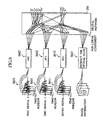
- FIG. 6 an operation of speech recognition in the speech recognizer shown in FIG. 5 will be described in detail.
- the plurality of EMG signals 1, 2 detected by the EMG signal acquiring unit 14 is amplified and cut per time-window in the EMG processing unit 15 (S601).
- the spectrums are calculated by performing an FFT on the cut EMG signals.
- the EMG signal parameters are calculated by performing a 1/ 3 octave analysis on the calculated spectrums (S602), before being inputted to the neural network 20a.
- the sound signals detected by the sound signal acquiring unit 11 is amplified and cut per time-window in the sound processing unit 12 (S611).
- the spectrums are calculated by performing an FFT on the cut sound signals.
- the sound signal parameters are calculated by performing a 1/3 octave analysis on the calculated spectrums (S612), before being inputted to the neural network 20a.
- the image information processing unit 18 extracts the motion of the feature position around the mouth as an optical flow, based on the image information detected by the image information acquiring unit 17 (S621).
- the image information parameters extracted as the optical flow are inputted to the neural network 20a.
- the neural network 20a into which the various parameters are inputted outputs the phoneme relating to the inputted parameters.
- the speech recognizer 20 can be configured to recognize speech by using the speech recognition method in shown FIG. 5 , when speech can not be recognized based on any parameters by using the speech recognition method in shown FIG. 4 .
- the speech recognizer 20 can be configured to recognize speech, by comparing the results recognized by the speech recognition method shown in FIG. 4 with the results recognized by the speech recognition method shown in FIG. 5 . or integrating them.
- the recognition result provider 21 is a device for providing (outputting) the result recognized by the speech recognizer 20.
- the recognition result provider 21 can adopt a speech generator for outputting the result recognized by the speech recognizer 20 to a speaker as a speech signal, or a display for displaying the result as text information.
- the recognition result provider 21 can comprise a communication interface which transmits the result to an application executed in a terminal such as a personal computer as data, in addition to providing the result to the speaker.
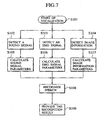
- FIG. 7 An operation of the speech recognition system according to the embodiment will be described with reference to FIG. 7 and 8 .
- FIG. 7 an operation of the speech recognition process in the speech recognition system according to the embodiment.
- step 101 a speaker starts to vocalize.
- step 102 to 104 the sound signal acquiring unit 11, the EMG signal acquiring unit 14 and the image information acquiring unit 17 detect the sound signal, the EMG signal and the image information generated respectively when the speaker vocalizes.
- step 105 to 107 the sound signal processing unit 12, the EMG signal processing unit 15 and the image information processing unit 18 calculate the sound signal parameters, the EMG signal parameters and the image information parameters respectively, based on the sound signal, the EMG signal and the image information.
- step 108 the speech recognizer 20 recognizes speech based on the calculated parameters.
- step 109 the recognition result provider 21 provides the result recognized by the speech recognizer 20.
- the recognition result provider 21 can output the result as a speech signal or display the result.
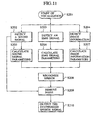
- FIG. 8 an operation of the learning process in the speech recognition system according to the embodiment.
- the speech recognition system adopts the learning function relating to the speech recognition method.
- a speaker starts to vocalize.
- the speaker types to input the vocalized contents with a keyboard or the like, that is to say, a learning signal (sampling data) while vocalizing.
- the sound signal acquiring unit 11, the EMG signal acquiring unit 14 and the image information acquiring unit 17 detect the sound signal, the EMG signal and the image information respectively.
- the sound signal processing unit 12, the EMG signal processing unit 15 and the image information processing unit 18 extract the sound signal parameters, the EMG signal parameters and the image information parameters respectively.
- step 306 the neural network 20a learns the extracted parameters based on the learning signal inputted by the keyboard. That is to say, the neural network 20a changes the weights assigned to non-linear components by inputting a learning signal (sampling data) which is transferred from downstream to upstream.
- a learning signal sampling data
- step 307 the neural network 20a determines that the learning process is finished when the error rate in recognition is less than a threshold. Then the operation ends (S308).
- step S307 when the neural network 20a determines that the learning process is not finished, the operation repeats the steps 302 to 306.
- the speech recognition system of this embodiment can recognize speech based on a plurality of parameters calculated from the sound signal, the EMG signal and the image information, so as to improve noise immunity or the like substantially.
- the speech recognition system of this embodiment comprises three types of input interfaces (a sound signal processor 10. an EMG signal processor 13 and an image information processor 16) for improving noise immunity.
- the speech recognition system can recognize speech using the available input interfaces, so as to improve the recognition success rate.
- the present invention can provide a speech recognition system which can recognize speech at adequate levels, when the noise level is large in the surroundings, or when the volume of a vocalized sound signal is small.
- the second speech synthesis system is configured with a sound signal processor 10.
- an EMG signal processor 13 an image information processor 16, a speech recognizer 20 and a speech synthesizer 55.
- the speech synthesizer 55 is configured with a first spectrum acquirer 51 , a second spectrum generator 52, a modified spectrum generator 53 and an outputter 54.
- the functions of the sound signal processor 10, the EMG signal processor 13, the image information processor 16 and the speech recognizer 20, are the same functions as the speech recognition system according to the above-described embodiment.
- the first spectrum acquirer 51 is configured to acquire a spectrum of the sound signal acquired by the sound signal acquiring unit 11 as a first spectrum.
- the acquired first spectrum includes noise contents (referring to FIG. 10C ).
- the second spectrum generator 52 is configured to generate a reconfigured spectrum of the sound signal, based on the speech signal (result) recognized by the speech recognizer 20, as a second spectrum. As shown in FIG. 10A , to be more specific, the second spectrum generator 52 reconfigures the spectrum of vocalized phonemes based on the features of the vocalized phonemes, such as a Formant Frequency, which is extracted from the result recognized by the speech recognizer 20.
- the modified spectrum generator 53 is configured to generate a modified spectrum in accordance with the first spectrum and the second spectrum. As shown in FIG. 10D , to be more specific, the modified spectrum generator 53 generates the modified spectrum without noise, by multiplying the first spectrum (referring to FIG. 10C ) by the second spectrum (referring to FIG. 10A ).
- the outputter 54 is configured to output a synthesized speech signal based on the modified spectrum.
- the outputter 54 can comprise a communicator configured to transmit the synthesized speech signal as data. As shown in FIG. 10C , to be more specific, the outputter 54 obtains the sound signal without noise contents by performing a Fourier inverse transform on the modified spectrum without noise contents (referring to FIG. 10D ), and outputs the obtained sound signal as a synthesized speech signal.
- the second speech synthesis system obtains the sound signal without noise by passing the sound signal including noise via a filter which has frequency characteristics being represented by the reconfigured spectrum, and outputs the obtained sound signal.
- the second speech synthesis system can separate the sound signal vocalized by the speaker and surrounding noise, from the signal reconfigured from the recognition result and the sound signal detected by the sound signal acquiring unit 11, by recognizing speech with various methods, so as to output a clear synthesized speech signal when the noise level is large in the surroundings.
- the second speech synthesis system can output the synthesized speech signal which is listened to as if the speaker was vocalizing in an environment without noise, when the noise level is large, or when the volume of a vocalized sound signal is small.
- the second speech synthesis system adopts the speech recognition system according to the first embodiment, however the present invention is not limited to the embodiment.
- the second speech synthesis system can recognize speech based on parameters other than the sound signal parameters.
- steps 201 to 208 the same speech recognition process as the above described embodiment is performed.
- the first spectrum acquirer 51 acquires a spectrum of the sound signal acquired by the sound signal acquiring unit 11 as a first spectrum.
- the second spectrum generator 52 generates a reconfigured spectrum of the sound signal, based on the result recognized by the speech recognizer 20, as a second spectrum.
- the modified spectrum generator 53 generates a modified spectrum, in which noise (other than the sound signal vocalized by the speaker) is removed from the sound signal acquired by the sound signal acquiring unit 11, in accordance with the first spectrum and the second spectrum.
- step 210 the outputter 54 outputs a clear synthesized speech synthesized signal based on the modified spectrum.
- the system is configured with a communications device 30 and a wristwatch-type terminal 31 separated from the communications device 30.
- the communications terminal 30 is configured to add the sound signal processor 10, the EMG signal processor 13, the speech recognizer 20 and the speech synthesizer 55 to the conventional mobile terminal.
- the EMG signal acquiring unit 14 comprises a plurality of skin surface electrodes 114, which are installed so as to be able to contact with the skin of the speaker 32, and configured to acquire the potential changes on the surface around the mouth of the speaker (the sound source) 32 as the EMG signal.
- the sound signal acquiring unit 11 comprises a microphone 111 configured to acquire the sound signal from the mouth of the speaker (the sound source) 32.
- the microphone 111 can be configured to communicate with a communications device 30.
- the microphone 111 can be installed on a surface of the communications device 30.
- the microphone 111 can be a wireless-type microphone installed adjacent to the mouth of the speaker 32.
- the skin surface electrodes 114 can be installed on a surface of the communications device 30.
- the communications terminal 30 has the function of transmitting the synthesized speech signal based on the result recognized by the speech recognizer 20 as the sound signal vocalized by the speaker 32.
- the wristwatch-type terminal 31 is configured with the image information processor 16 and the recognition result processor 21.
- a video camera 117 for taking an image of the motion of the mouth of the speaker (the sound source) 32 is installed at the body of the wristwatch-type terminal 31 as the image information acquiring unit 17.
- a display 121 for displaying the recognition result is installed on the surface of the body of the wristwatch-type terminal 31 as the recognition result provider 21.
- the wristwatch-type terminal 13 comprise a belt 33 for fixing the body of the wristwatch-type terminal 13.
- the system for integrating the speech, recognition system and the speech synthesis system acquires the EMG signal and the sound signal by the EMG signal acquiring unit 14 and the sound signal acquiring unit 11, which are installed at the communications device 30, and acquires the image information by the image information acquiring unit 17, which is installed on the body of the wristwatch-type terminal 31.
- the communications device 30 transmits and receives data with the wristwatch-type terminal 31 via wired communications or wireless communications.
- the communications device 30 and the wristwatch-type terminal 31 collects and sends the signals to the speech recognizer 20 built into the communications device 30, the speech recognizer 20 recognizes speech based on the collected signals, the recognition result provider 21 installed in the wristwatch-type terminal 31 displays the recognition result transmitted from the speech recognizer 20 via wired communications or wireless communications.
- the communications device 30 can transmit a clear synthesized speech signal without noise to the wristwatch-type terminal 31.
- the speech recognizer 20 is built into the communications device 30, and the recognition result provider 21 built into the wristwatch-type terminal 31 displays the recognition result.
- the speech recognizer 20 may be installed in the wristwatch-type terminal 31, or another terminal which can communicate with the communications device 30, and the wristwatch-type terminal 31 can recognize and synthesize speech.
- the recognition result can be outputted from the communications device as a speech signal, can be displayed on the monitor of the wristwatch-type terminal 31 (or the communications device 30), or can be outputted from another terminal which can communicate with the communications device 30 and the wristwatch-type terminal 31.
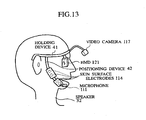
- the system is configured with a holding device 41 in the form of glasses, a video camera 117 as the image information acquiring unit 17 which is held adapted to take an image of the motion of the mouth of the speaker (the sound source) 32, a positioning device 42, a Head Mounted Display (HMD) 121 as the recognition result provider 12, and the speech recognizer 20 built into the holding device 41.
- the holding device 41 can be mounted to the head of the speaker 32.
- the skin surface electrodes 114 as the EMG signal acquiring unit 14 configured to acquire the potential changes on a surface around the mouth of the speaker 32 (the sound source), and the microphone 111, as the sound signal acquiring unit 11 configured to acquire the sound signal from the mouth of the speaker 32 (the sound source) are attached adapted to be fixed to the surroundings of the mouth of the speaker 32.
- the speaker 32 wearing the system can recognize and synthesize speech, having his/her hands free.
- the speech recognizer 20 can be built in the holding device instrument 41 or an outer terminal which can communicate with the holding device instrument 41.
- the recognition result can be displayed in an HMD (translucent display), or can be outputted from an output device such as a speaker device as a speech signal, or can be outputted from an outer terminal.
- the output device such as a speaker device can output the synthesized speech signal based on the recognition result.
- the speech recognition system, the speech recognition method, the speech synthesis system or the speech synthesis method according to the above embodiment can be achieved by executing a program described in the predetermined program language on a general-purpose computer (for example, a personal computer) 215 or an IC chip included in the communications device 30 (for example a mobile terminal) or the like.
- a general-purpose computer for example, a personal computer
- an IC chip included in the communications device 30 for example a mobile terminal
- the program can be recorded in a storage medium which can be read by a general-purpose computer 215 as shown in Fig. 14 . That is, as shown in Fig. 14 , the program can be stored on a floppy disk 216, a CD-ROM 217, a RAM 218, a cassette tape 219 or the like.
- the system or method according to the present invention can be achieved by inserting the storing media including the program into the computer 215 or installing the program to the memory of the communications device 30 or the like.
- the speech recognition system, method, and program according to the present invention can maintain a high success rate in recognition with a low-volume of sound signal without being affected by noise.
- the speech synthesis system, method, and program can synthesize a speech signal using the recognized speech signal, so as to make the synthesized speech signal more natural and clear, and to express the emotions of a speaker or the like appropriately.
Landscapes
- Engineering & Computer Science (AREA)
- Physics & Mathematics (AREA)
- Theoretical Computer Science (AREA)
- Computer Vision & Pattern Recognition (AREA)
- Health & Medical Sciences (AREA)
- Multimedia (AREA)
- General Physics & Mathematics (AREA)
- Human Computer Interaction (AREA)
- Acoustics & Sound (AREA)
- Artificial Intelligence (AREA)
- Data Mining & Analysis (AREA)
- Audiology, Speech & Language Pathology (AREA)
- Evolutionary Computation (AREA)
- General Health & Medical Sciences (AREA)
- Computational Linguistics (AREA)
- Medical Informatics (AREA)
- Evolutionary Biology (AREA)
- Databases & Information Systems (AREA)
- Computing Systems (AREA)
- Life Sciences & Earth Sciences (AREA)
- Bioinformatics & Cheminformatics (AREA)
- Bioinformatics & Computational Biology (AREA)
- Software Systems (AREA)
- General Engineering & Computer Science (AREA)
- Psychiatry (AREA)
- Social Psychology (AREA)
- Image Analysis (AREA)
- User Interface Of Digital Computer (AREA)
- Circuit For Audible Band Transducer (AREA)
- Telephonic Communication Services (AREA)
Claims (9)
- Ein Spracherkennungssystem, umfassend:einen Tonsignalprozessor (10), der konfiguriert ist zum Akquirieren eines Tonsignals von einem Objekt und zum Berechnen eines Tonsignalparameters basierend auf dem akquirierten Tonsignal;einen elektromyographischen Signalprozessor (13), der konfiguriert ist zum Akquirieren von Potentialveränderungen auf einer Oberfläche des Objekts als ein elektromyographisches Signal und zum Berechnen eines elektromyographischen Signalparameters basierend auf dem akquirierten elektromyographischen Signal;gekennzeichnet durcheinen Bildinformationsprozessor (16), der konfiguriert ist zum Akquirieren von Bildinformation durch Aufnehmen eines Bilds des Objekts und zum Berechnen eines Bildinformationsparameters basierend auf der akquirierten Bildinformation;eine Spracherkennungseinrichtung (20), die konfiguriert ist zum Erkennen eines Sprachsignals, das durch das Objekt vokalisiert ist, basierend auf lediglich dem Tonsignalparameter, lediglich dem elektromyographischen Signalparameter und lediglich dem Bildinformationsparameter, und zum Vergleichen jedes der erkannten Sprachsignale und zum Erkennen des Sprachsignals basierend auf dem verglichenen Ergebnis; undeinen Erkennungsergebnisbereitstellungseinrichtung (21), die konfiguriert ist zum Bereitstellen eines Ergebnisses, das durch die Spracherkennungseinrichtung erkannt wird.
- Das Spracherkennungssystem nach Anspruch 1, wobei die Spracherkennungseinrichtung (20) ein hierarchisches Netzwerk (20a) umfasst, in dem eine Vielzahl von nichtlinearen Komponenten, eine Eingabeeinheit und eine Ausgabeeinheit umfassend, von Upstream zu Downstream hierarchisch angeordnet sind;
wobei die Ausgabeeinheit der nichtlinearen Upstream-Komponente mit der Eingabeeinheit der nichtlinearen Downstream-Komponente innerhalb benachbarter nichtlinearer Komponenten verbunden sind;
wobei ein Gewichtungswert der Verbindung oder einer Kombination der Verbindungen zugeordnet ist;
wobei jede der nichtlinearen Komponenten Daten berechnet, die von der Ausgabeeinheit ausgegeben werden, und die Verbindung bestimmt, zu der die berechneten Daten ausgegeben werden, in Übereinstimmung mit den in die Eingabeeinheit eingegebenen Daten und dem Gewichtungswert, der der Verbindung oder den Kombinationen zugeordnet ist;
wobei der Tonsignalparameter, der elektromyographische Signalparameter und der Bildinformationsparameter in die am weitesten vorgelagerten nichtlinearen Komponenten in das hierarchische Netzwerk als die eingegebenen Daten eingegeben werden;
wobei die erkannten Sprachsignale von der Ausgabeeinheit der sich am weitesten nachgelagerten nichtlinearen Komponenten in das hierarchische Netzwerk (20a) als die ausgegebenen Daten ausgegeben werden; und
wobei die Spracherkennungseinrichtung (20) konfiguriert ist, das Sprachsignal auch basierend auf den ausgegebenen Daten zu erkennen. - Das Spracherkennungssystem nach Anspruch 2, wobei die Spracherkennungseinrichtung (20) eine Lernfunktion umfasst, die konfiguriert ist zum Verändern des Gewichts, das den nichtlinearen Komponenten zugeordnet ist, durch Eingeben von Abtastungsdaten, die von Downstream nach Upstream übertragen werden.
- Das Spracherkennungssystem nach Anspruch 1, wobei der Tonsignalprozessor (10) ein Mikrophon (111) umfasst, das konfiguriert ist zum Akquirieren des Tonsignals von einer Tonquelle, wobei das Mikrophon konfiguriert ist zum Kommunizieren mit einer Kommunikationsvorrichtung;
wobei der elektromyographische Signalprozessor (13) Elektroden (114) umfasst, die konfiguriert sind zum Akquirieren der Potentialveränderungen auf der Oberfläche um die Tonquelle herum als das elektromyographische Signal, wobei die Elektroden auf der Oberfläche der Kommunikationsvorrichtung installiert sind;
wobei der Bildinformationsprozessor (16) eine Kamera (117) umfasst, die konfiguriert ist zum Akquirieren der Bildinformation durch Aufnehmen eines Bildes der Bewegung der Tonquelle, wobei die Kamera auf einem Endgerät installiert ist, das von der Kommunikationsvorrichtung getrennt ist; und
wobei die Kommunikationsvorrichtung Daten von dem Endgerät überträgt und empfängt. - Das Spracherkennungssystem nach Anspruch 4, wobei das Endgerät ein Gehäuse, auf dem die Kamera (117) installiert ist, und einen Gurt zum Fixieren des Gehäuses umfasst; und
wobei die
Erkennungsergebnisbereitstellungseinrichtung (21) eine Anzeige zum Anzeigen des Ergebnisses ist,
wobei die Anzeige auf der Oberfläche des Gehäuses installiert ist. - Das Spracherkennungssystem nach Anspruch 1, wobei das System ferner eine Positionierungsvorrichtung und eine Haltevorrichtung umfasst; wobei
der Tonsignalprozessor (10) ein Mikrophon (111) umfasst, das konfiguriert ist zum Akquirieren des Tonsignals von einer Tonquelle;
der elektromyographische Signalprozessor (13) Elektroden (114) umfasst, die konfiguriert sind zum Akquirieren der Potentialveränderungen auf der Oberfläche um die Tonquelle herum als das elektromyographische Signal;
der Bildinformationsprozessor (16) eine Kamera (117) umfasst, die konfiguriert ist zum Akquirieren der Bildinformation durch Aufnehmen eines Bildes der Bewegung der Tonquelle;
die Positionierungsvorrichtung das Mikrophon (111) und die Elektroden (114) benachbart zur Tonquelle fixiert; und
die Haltevorrichtung (41) die Kamera und die Positionierungsvorrichtung hält. - Das Spracherkennungssystem nach Anspruch 3, wobei die Erkennungsergebnisbereitstellungseinrichtung (21) konfiguriert ist zum Anzeigen des Ergebnisses auf einer lichtdurchlässigen Anzeige, wobei die Erkennungsergebnisbereitstellungseinrichtung in der Haltevorrichtung installiert ist.
- Ein Spracherkennungsverfahren, die Schritte umfassend:(A) Akquirieren (S102) eines Tonsignals von einem Objekt und Berechnen eines Tonsignalparameters basierend auf dem akquirierten Tonsignal;(B) Akquirieren (S103) von Potentialveränderungen auf der Oberfläche des Objekts als ein elektromyographisches Signal und Berechnen eines elektromyographischen Signalparameters basierend auf dem akquirierten elektromyographischen Signal;
gekennzeichnet durch(C) Akquirieren (S104) von Bildinformation durch Aufnehmen eines Bildes des Objekts und Berechnen eines Bildinformationsparameters basierend auf der akquirierten Bildinformation;(D) Erkennen (S108) eines Sprachsignals, das durch das Objekt vokalisiert ist, basierend auf lediglich dem Tonsignalparameter, lediglich dem elektromyographischen Signalparameter und lediglich dem Bildinformationsparameter, und zum Vergleichen von jedem der erkannten Sprachsignale, und zum Erkennen des Sprachsignals basierend auf dem verglichenen Ergebnis; und(E) Bereitstellen (S109) eines Ergebnisses, das durch die Spracherkennungseinrichtung erkannt wird. - Ein Programmprodukt zum Erkennen eines Sprachsignals in einem Computer, das bei Ausführung bewirkt, dass der Computer die Schritte ausführt:(A) Akquirieren (S102) eines Tonsignals von einem Objekt und Berechnen eines Tonsignalparameters basierend auf dem akquirierten Tonsignal;(B) Akquirieren (S103) von Potentialveränderungen auf der Oberfläche des Objekts als ein elektromyographisches Signal und Berechnen eines elektromyographischen Signalparameters basierend auf dem akquirierten elektromyographischen Signal;
gekennzeichnet durch(C) Akquirieren (S104) von Bildinformation durch Aufnehmen eines Bildes des Objekts und Berechnen eines Bildinformationsparameters basierend auf der akquirierten Bildinformation;(D) Erkennen (S108) eines Sprachsignals, das durch das Objekt vokalisiert ist, basierend auf lediglich dem Tonsignalparameter, lediglich dem elektromyographischen Signalparameter und lediglich dem Bildinformationsparameter, und zum Vergleichen von jedem der erkannten Sprachsignale, und zum Erkennen des Sprachsignals basierend auf dem verglichenen Ergebnis; und(E) Bereitstellen (S109) eines Ergebnisses, das durch die Spracherkennungseinrichtung erkannt wird.
Priority Applications (1)
| Application Number | Priority Date | Filing Date | Title |
|---|---|---|---|
| EP06004029A EP1667108B1 (de) | 2002-03-04 | 2003-03-03 | Sprachsynthesesystem, Sprachsyntheseverfahren und Rechnerprogramm |
Applications Claiming Priority (2)
| Application Number | Priority Date | Filing Date | Title |
|---|---|---|---|
| JP2002057818A JP2003255993A (ja) | 2002-03-04 | 2002-03-04 | 音声認識システム、音声認識方法、音声認識プログラム、音声合成システム、音声合成方法、音声合成プログラム |
| JP2002057818 | 2002-03-04 |
Related Child Applications (1)
| Application Number | Title | Priority Date | Filing Date |
|---|---|---|---|
| EP06004029A Division EP1667108B1 (de) | 2002-03-04 | 2003-03-03 | Sprachsynthesesystem, Sprachsyntheseverfahren und Rechnerprogramm |
Publications (3)
| Publication Number | Publication Date |
|---|---|
| EP1345210A2 EP1345210A2 (de) | 2003-09-17 |
| EP1345210A3 EP1345210A3 (de) | 2005-08-17 |
| EP1345210B1 true EP1345210B1 (de) | 2008-05-28 |
Family
ID=27764437
Family Applications (2)
| Application Number | Title | Priority Date | Filing Date |
|---|---|---|---|
| EP06004029A Expired - Lifetime EP1667108B1 (de) | 2002-03-04 | 2003-03-03 | Sprachsynthesesystem, Sprachsyntheseverfahren und Rechnerprogramm |
| EP03004378A Expired - Lifetime EP1345210B1 (de) | 2002-03-04 | 2003-03-03 | Spracherkennungssystem, Spracherkennungsverfahren und Programmprodukt |
Family Applications Before (1)
| Application Number | Title | Priority Date | Filing Date |
|---|---|---|---|
| EP06004029A Expired - Lifetime EP1667108B1 (de) | 2002-03-04 | 2003-03-03 | Sprachsynthesesystem, Sprachsyntheseverfahren und Rechnerprogramm |
Country Status (5)
| Country | Link |
|---|---|
| US (2) | US7369991B2 (de) |
| EP (2) | EP1667108B1 (de) |
| JP (1) | JP2003255993A (de) |
| CN (2) | CN1442845A (de) |
| DE (2) | DE60330400D1 (de) |
Families Citing this family (102)
| Publication number | Priority date | Publication date | Assignee | Title |
|---|---|---|---|---|
| JP2004016658A (ja) | 2002-06-19 | 2004-01-22 | Ntt Docomo Inc | 生体信号測定可能な携帯型端末および測定方法 |
| US6910911B2 (en) | 2002-06-27 | 2005-06-28 | Vocollect, Inc. | Break-away electrical connector |
| US8200486B1 (en) * | 2003-06-05 | 2012-06-12 | The United States of America as represented by the Administrator of the National Aeronautics & Space Administration (NASA) | Sub-audible speech recognition based upon electromyographic signals |
| JP4713111B2 (ja) * | 2003-09-19 | 2011-06-29 | 株式会社エヌ・ティ・ティ・ドコモ | 発話区間検出装置、音声認識処理装置、送信システム、信号レベル制御装置、発話区間検出方法 |
| US20050154593A1 (en) * | 2004-01-14 | 2005-07-14 | International Business Machines Corporation | Method and apparatus employing electromyographic sensors to initiate oral communications with a voice-based device |
| US20060129394A1 (en) * | 2004-12-09 | 2006-06-15 | International Business Machines Corporation | Method for communicating using synthesized speech |
| JP4847022B2 (ja) * | 2005-01-28 | 2011-12-28 | 京セラ株式会社 | 発声内容認識装置 |
| JP4632831B2 (ja) * | 2005-03-24 | 2011-02-16 | 株式会社エヌ・ティ・ティ・ドコモ | 音声認識方法および音声認識装置 |
| US7792314B2 (en) * | 2005-04-20 | 2010-09-07 | Mitsubishi Electric Research Laboratories, Inc. | System and method for acquiring acoustic signals using doppler techniques |
| USD558761S1 (en) | 2005-09-19 | 2008-01-01 | Vocollect, Inc. | Portable processing terminal |
| USD549694S1 (en) | 2005-11-15 | 2007-08-28 | Vocollect, Inc. | Headset |
| USD552595S1 (en) | 2005-11-16 | 2007-10-09 | Vocollect, Inc. | Control panel for a headset |
| US8417185B2 (en) | 2005-12-16 | 2013-04-09 | Vocollect, Inc. | Wireless headset and method for robust voice data communication |
| US7885419B2 (en) | 2006-02-06 | 2011-02-08 | Vocollect, Inc. | Headset terminal with speech functionality |
| US7773767B2 (en) * | 2006-02-06 | 2010-08-10 | Vocollect, Inc. | Headset terminal with rear stability strap |
| US7571101B2 (en) * | 2006-05-25 | 2009-08-04 | Charles Humble | Quantifying psychological stress levels using voice patterns |
| US8082149B2 (en) * | 2006-10-26 | 2011-12-20 | Biosensic, Llc | Methods and apparatuses for myoelectric-based speech processing |
| USD626949S1 (en) | 2008-02-20 | 2010-11-09 | Vocollect Healthcare Systems, Inc. | Body-worn mobile device |
| USD605629S1 (en) | 2008-09-29 | 2009-12-08 | Vocollect, Inc. | Headset |
| US8386261B2 (en) | 2008-11-14 | 2013-02-26 | Vocollect Healthcare Systems, Inc. | Training/coaching system for a voice-enabled work environment |
| GB2466242B (en) * | 2008-12-15 | 2013-01-02 | Audio Analytic Ltd | Sound identification systems |
| US20110246187A1 (en) * | 2008-12-16 | 2011-10-06 | Koninklijke Philips Electronics N.V. | Speech signal processing |
| US8160287B2 (en) | 2009-05-22 | 2012-04-17 | Vocollect, Inc. | Headset with adjustable headband |
| US8438659B2 (en) | 2009-11-05 | 2013-05-07 | Vocollect, Inc. | Portable computing device and headset interface |
| US9634855B2 (en) | 2010-05-13 | 2017-04-25 | Alexander Poltorak | Electronic personal interactive device that determines topics of interest using a conversational agent |
| US8659397B2 (en) | 2010-07-22 | 2014-02-25 | Vocollect, Inc. | Method and system for correctly identifying specific RFID tags |
| USD643400S1 (en) | 2010-08-19 | 2011-08-16 | Vocollect Healthcare Systems, Inc. | Body-worn mobile device |
| USD643013S1 (en) | 2010-08-20 | 2011-08-09 | Vocollect Healthcare Systems, Inc. | Body-worn mobile device |
| US8700392B1 (en) * | 2010-09-10 | 2014-04-15 | Amazon Technologies, Inc. | Speech-inclusive device interfaces |
| US9274744B2 (en) | 2010-09-10 | 2016-03-01 | Amazon Technologies, Inc. | Relative position-inclusive device interfaces |
| US8775341B1 (en) | 2010-10-26 | 2014-07-08 | Michael Lamport Commons | Intelligent control with hierarchical stacked neural networks |
| US9015093B1 (en) | 2010-10-26 | 2015-04-21 | Michael Lamport Commons | Intelligent control with hierarchical stacked neural networks |
| US9223415B1 (en) | 2012-01-17 | 2015-12-29 | Amazon Technologies, Inc. | Managing resource usage for task performance |
| US9263044B1 (en) * | 2012-06-27 | 2016-02-16 | Amazon Technologies, Inc. | Noise reduction based on mouth area movement recognition |
| KR101240588B1 (ko) | 2012-12-14 | 2013-03-11 | 주식회사 좋은정보기술 | 오디오-영상 융합 음성 인식 방법 및 장치 |
| CN103338330A (zh) * | 2013-06-18 | 2013-10-02 | 腾讯科技(深圳)有限公司 | 一种图像处理方法、装置和终端 |
| US20150124566A1 (en) | 2013-10-04 | 2015-05-07 | Thalmic Labs Inc. | Systems, articles and methods for wearable electronic devices employing contact sensors |
| US10042422B2 (en) | 2013-11-12 | 2018-08-07 | Thalmic Labs Inc. | Systems, articles, and methods for capacitive electromyography sensors |
| US11921471B2 (en) | 2013-08-16 | 2024-03-05 | Meta Platforms Technologies, Llc | Systems, articles, and methods for wearable devices having secondary power sources in links of a band for providing secondary power in addition to a primary power source |
| US12504816B2 (en) | 2013-08-16 | 2025-12-23 | Meta Platforms Technologies, Llc | Wearable devices and associated band structures for sensing neuromuscular signals using sensor pairs in respective pods with communicative pathways to a common processor |
| US11199906B1 (en) | 2013-09-04 | 2021-12-14 | Amazon Technologies, Inc. | Global user input management |
| US9367203B1 (en) | 2013-10-04 | 2016-06-14 | Amazon Technologies, Inc. | User interface techniques for simulating three-dimensional depth |
| WO2015081113A1 (en) | 2013-11-27 | 2015-06-04 | Cezar Morun | Systems, articles, and methods for electromyography sensors |
| US9564128B2 (en) * | 2013-12-09 | 2017-02-07 | Qualcomm Incorporated | Controlling a speech recognition process of a computing device |
| KR20150104345A (ko) * | 2014-03-05 | 2015-09-15 | 삼성전자주식회사 | 음성 합성 장치 및 음성 합성 방법 |
| JP2015212732A (ja) * | 2014-05-01 | 2015-11-26 | 日本放送協会 | 音喩認識装置、及びプログラム |
| US9880632B2 (en) | 2014-06-19 | 2018-01-30 | Thalmic Labs Inc. | Systems, devices, and methods for gesture identification |
| TWI576826B (zh) * | 2014-07-28 | 2017-04-01 | jing-feng Liu | Discourse Recognition System and Unit |
| US9390725B2 (en) | 2014-08-26 | 2016-07-12 | ClearOne Inc. | Systems and methods for noise reduction using speech recognition and speech synthesis |
| US20160253996A1 (en) * | 2015-02-27 | 2016-09-01 | Lenovo (Singapore) Pte. Ltd. | Activating voice processing for associated speaker |
| US20160284363A1 (en) * | 2015-03-24 | 2016-09-29 | Intel Corporation | Voice activity detection technologies, systems and methods employing the same |
| JP6518134B2 (ja) | 2015-05-27 | 2019-05-22 | 株式会社ソニー・インタラクティブエンタテインメント | 眼前装着型表示装置 |
| US10032463B1 (en) * | 2015-12-29 | 2018-07-24 | Amazon Technologies, Inc. | Speech processing with learned representation of user interaction history |
| WO2018022602A1 (en) | 2016-07-25 | 2018-02-01 | Ctrl-Labs Corporation | Methods and apparatus for predicting musculo-skeletal position information using wearable autonomous sensors |
| US11179066B2 (en) | 2018-08-13 | 2021-11-23 | Facebook Technologies, Llc | Real-time spike detection and identification |
| US11331045B1 (en) | 2018-01-25 | 2022-05-17 | Facebook Technologies, Llc | Systems and methods for mitigating neuromuscular signal artifacts |
| US12554325B2 (en) | 2016-07-25 | 2026-02-17 | Meta Platforms Technologies, Llc | Methods and apparatuses for low latency body state prediction based on neuromuscular data |
| US10489986B2 (en) | 2018-01-25 | 2019-11-26 | Ctrl-Labs Corporation | User-controlled tuning of handstate representation model parameters |
| US11216069B2 (en) | 2018-05-08 | 2022-01-04 | Facebook Technologies, Llc | Systems and methods for improved speech recognition using neuromuscular information |
| EP3487402B1 (de) | 2016-07-25 | 2021-05-05 | Facebook Technologies, LLC | Verfahren und vorrichtung zum schliessen auf die absicht eines benutzers auf der grundlage von neuromuskulären signalen |
| US11337652B2 (en) | 2016-07-25 | 2022-05-24 | Facebook Technologies, Llc | System and method for measuring the movements of articulated rigid bodies |
| WO2018022658A1 (en) | 2016-07-25 | 2018-02-01 | Ctrl-Labs Corporation | Adaptive system for deriving control signals from measurements of neuromuscular activity |
| JP6686977B2 (ja) * | 2017-06-23 | 2020-04-22 | カシオ計算機株式会社 | 音源分離情報検出装置、ロボット、音源分離情報検出方法及びプログラム |
| JP6874842B2 (ja) * | 2017-07-03 | 2021-05-19 | 日本電気株式会社 | 信号処理装置、信号処理方法およびプログラム |
| CN107221324B (zh) * | 2017-08-02 | 2021-03-16 | 上海智蕙林医疗科技有限公司 | 语音处理方法及装置 |
| CN112040858B (zh) | 2017-10-19 | 2024-06-07 | 元平台技术有限公司 | 用于识别与神经肌肉源信号相关的生物结构的系统和方法 |
| WO2019148002A1 (en) | 2018-01-25 | 2019-08-01 | Ctrl-Labs Corporation | Techniques for anonymizing neuromuscular signal data |
| US11493993B2 (en) | 2019-09-04 | 2022-11-08 | Meta Platforms Technologies, Llc | Systems, methods, and interfaces for performing inputs based on neuromuscular control |
| US11150730B1 (en) | 2019-04-30 | 2021-10-19 | Facebook Technologies, Llc | Devices, systems, and methods for controlling computing devices via neuromuscular signals of users |
| US11481030B2 (en) | 2019-03-29 | 2022-10-25 | Meta Platforms Technologies, Llc | Methods and apparatus for gesture detection and classification |
| CN111902077B (zh) | 2018-01-25 | 2023-08-04 | 元平台技术有限公司 | 利用神经肌肉信号进行手部状态表示建模的校准技术 |
| EP3743790A4 (de) | 2018-01-25 | 2021-03-17 | Facebook Technologies, Inc. | Handzustandsrekonstruktion auf der grundlage mehrerer eingaben |
| US12579768B2 (en) | 2018-01-25 | 2026-03-17 | Meta Platforms Technologies, Llc | Wearable electronic devices, extended reality systems including neuromuscular sensors, and methods for generating text from speech input and modifying the generated text based on neuromuscular data |
| US10937414B2 (en) | 2018-05-08 | 2021-03-02 | Facebook Technologies, Llc | Systems and methods for text input using neuromuscular information |
| CN112074870A (zh) | 2018-01-25 | 2020-12-11 | 脸谱科技有限责任公司 | 重构的手部状态信息的可视化 |
| US10460455B2 (en) | 2018-01-25 | 2019-10-29 | Ctrl-Labs Corporation | Real-time processing of handstate representation model estimates |
| US11961494B1 (en) | 2019-03-29 | 2024-04-16 | Meta Platforms Technologies, Llc | Electromagnetic interference reduction in extended reality environments |
| US11907423B2 (en) | 2019-11-25 | 2024-02-20 | Meta Platforms Technologies, Llc | Systems and methods for contextualized interactions with an environment |
| CN108364660B (zh) * | 2018-02-09 | 2020-10-09 | 腾讯音乐娱乐科技(深圳)有限公司 | 重音识别方法、装置及计算机可读存储介质 |
| CN108957392A (zh) * | 2018-04-16 | 2018-12-07 | 深圳市沃特沃德股份有限公司 | 声源方向估计方法和装置 |
| US10592001B2 (en) * | 2018-05-08 | 2020-03-17 | Facebook Technologies, Llc | Systems and methods for improved speech recognition using neuromuscular information |
| EP3791387B1 (de) * | 2018-05-08 | 2023-08-30 | Facebook Technologies, LLC. | Systeme und verfahren zur verbesserten spracherkennung unter verwendung neuromuskulärer informationen |
| WO2019222759A1 (en) * | 2018-05-18 | 2019-11-21 | Synaptics Incorporated | Recurrent multimodal attention system based on expert gated networks |
| EP3801743B1 (de) | 2018-05-25 | 2024-07-03 | Meta Platforms Technologies, LLC | Verfahren und vorrichtung zur bereitstellung von submuskulärer kontrolle |
| CN112261907A (zh) | 2018-05-29 | 2021-01-22 | 脸谱科技有限责任公司 | 表面肌电信号测量中降噪的屏蔽技术及相关系统和方法 |
| CN112585600A (zh) | 2018-06-14 | 2021-03-30 | 脸谱科技有限责任公司 | 使用神经肌肉标记进行用户识别和认证 |
| US11045137B2 (en) | 2018-07-19 | 2021-06-29 | Facebook Technologies, Llc | Methods and apparatus for improved signal robustness for a wearable neuromuscular recording device |
| US10905350B2 (en) | 2018-08-31 | 2021-02-02 | Facebook Technologies, Llc | Camera-guided interpretation of neuromuscular signals |
| CN109087651B (zh) * | 2018-09-05 | 2021-01-19 | 广州势必可赢网络科技有限公司 | 一种基于视频与语谱图的声纹鉴定方法、系统及设备 |
| EP3853698A4 (de) | 2018-09-20 | 2021-11-17 | Facebook Technologies, LLC | Neuromuskuläre texteingabe, schreiben und zeichnen in systemen mit erweiterter realität |
| EP3857342A4 (de) | 2018-09-26 | 2021-12-01 | Facebook Technologies, LLC. | Neuromuskuläre steuerung von physikalischen objekten in einer umgebung |
| EP3860527B1 (de) | 2018-10-05 | 2024-07-10 | Meta Platforms Technologies, LLC | Verwendung von neuromuskulären signalen zur verbesserten interaktion mit physikalischen objekten in einer umgebung der erweiterten realität |
| EP3886693A4 (de) | 2018-11-27 | 2022-06-08 | Facebook Technologies, LLC. | Verfahren und vorrichtung zur autokalibrierung eines tragbaren elektrodensensorsystems |
| JP6920361B2 (ja) * | 2019-02-27 | 2021-08-18 | エヌ・ティ・ティ・コミュニケーションズ株式会社 | 判定装置、判定方法、及びプログラム |
| US10905383B2 (en) | 2019-02-28 | 2021-02-02 | Facebook Technologies, Llc | Methods and apparatus for unsupervised one-shot machine learning for classification of human gestures and estimation of applied forces |
| CN110232907B (zh) * | 2019-07-24 | 2021-11-02 | 出门问问(苏州)信息科技有限公司 | 一种语音合成方法、装置、可读存储介质及计算设备 |
| WO2021076662A1 (en) | 2019-10-16 | 2021-04-22 | Invicta Medical, Inc. | Adjustable devices for treating sleep apnea, and associated systems and methods |
| JP7495220B2 (ja) * | 2019-11-15 | 2024-06-04 | エヌ・ティ・ティ・コミュニケーションズ株式会社 | 音声認識装置、音声認識方法、および、音声認識プログラム |
| US12089953B1 (en) | 2019-12-04 | 2024-09-17 | Meta Platforms Technologies, Llc | Systems and methods for utilizing intrinsic current noise to measure interface impedances |
| US11986658B2 (en) | 2020-11-04 | 2024-05-21 | Invicta Medical, Inc. | Implantable electrodes with remote power delivery for treating sleep apnea, and associated systems and methods |
| US12230274B2 (en) | 2020-12-14 | 2025-02-18 | Intel Corporation | Speech recognition with brain-computer interfaces |
| US11868531B1 (en) | 2021-04-08 | 2024-01-09 | Meta Platforms Technologies, Llc | Wearable device providing for thumb-to-finger-based input gestures detected based on neuromuscular signals, and systems and methods of use thereof |
Family Cites Families (41)
| Publication number | Priority date | Publication date | Assignee | Title |
|---|---|---|---|---|
| US3383466A (en) * | 1964-05-28 | 1968-05-14 | Navy Usa | Nonacoustic measures in automatic speech recognition |
| US4885790A (en) * | 1985-03-18 | 1989-12-05 | Massachusetts Institute Of Technology | Processing of acoustic waveforms |
| JPS62239231A (ja) * | 1986-04-10 | 1987-10-20 | Kiyarii Rabo:Kk | 口唇画像入力による音声認識方法 |
| US4862503A (en) * | 1988-01-19 | 1989-08-29 | Syracuse University | Voice parameter extractor using oral airflow |
| FR2632725B1 (fr) * | 1988-06-14 | 1990-09-28 | Centre Nat Rech Scient | Procede et dispositif d'analyse, synthese, codage de la parole |
| JPH04273298A (ja) | 1991-02-28 | 1992-09-29 | Fujitsu Ltd | 音声認識装置 |
| US5522013A (en) * | 1991-04-30 | 1996-05-28 | Nokia Telecommunications Oy | Method for speaker recognition using a lossless tube model of the speaker's |
| DE4212907A1 (de) * | 1992-04-05 | 1993-10-07 | Drescher Ruediger | Spracherkennungsverfahren für Datenverarbeitungssysteme u.s.w. |
| US5586215A (en) | 1992-05-26 | 1996-12-17 | Ricoh Corporation | Neural network acoustic and visual speech recognition system |
| JPH0612483A (ja) | 1992-06-26 | 1994-01-21 | Canon Inc | 音声入力方法及び装置 |
| US5457394A (en) * | 1993-04-12 | 1995-10-10 | The Regents Of The University Of California | Impulse radar studfinder |
| US5536902A (en) * | 1993-04-14 | 1996-07-16 | Yamaha Corporation | Method of and apparatus for analyzing and synthesizing a sound by extracting and controlling a sound parameter |
| US5454375A (en) * | 1993-10-21 | 1995-10-03 | Glottal Enterprises | Pneumotachograph mask or mouthpiece coupling element for airflow measurement during speech or singing |
| JP3455921B2 (ja) | 1993-12-24 | 2003-10-14 | 日本電信電話株式会社 | 発声代行装置 |
| FR2715755B1 (fr) * | 1994-01-28 | 1996-04-12 | France Telecom | Procédé et dispositif de reconnaissance de la parole. |
| JPH08187368A (ja) | 1994-05-13 | 1996-07-23 | Matsushita Electric Ind Co Ltd | ゲーム装置、入力装置、音声選択装置、音声認識装置及び音声反応装置 |
| US5573012A (en) * | 1994-08-09 | 1996-11-12 | The Regents Of The University Of California | Body monitoring and imaging apparatus and method |
| JP3536363B2 (ja) | 1994-09-02 | 2004-06-07 | 松下電器産業株式会社 | 音声認識装置 |
| US5933801A (en) * | 1994-11-25 | 1999-08-03 | Fink; Flemming K. | Method for transforming a speech signal using a pitch manipulator |
| US5864812A (en) * | 1994-12-06 | 1999-01-26 | Matsushita Electric Industrial Co., Ltd. | Speech synthesizing method and apparatus for combining natural speech segments and synthesized speech segments |
| US5774846A (en) * | 1994-12-19 | 1998-06-30 | Matsushita Electric Industrial Co., Ltd. | Speech coding apparatus, linear prediction coefficient analyzing apparatus and noise reducing apparatus |
| US5701390A (en) * | 1995-02-22 | 1997-12-23 | Digital Voice Systems, Inc. | Synthesis of MBE-based coded speech using regenerated phase information |
| US5717828A (en) * | 1995-03-15 | 1998-02-10 | Syracuse Language Systems | Speech recognition apparatus and method for learning |
| JP3647499B2 (ja) | 1995-03-31 | 2005-05-11 | フオスター電機株式会社 | 音声ピックアップシステム |
| US5729694A (en) * | 1996-02-06 | 1998-03-17 | The Regents Of The University Of California | Speech coding, reconstruction and recognition using acoustics and electromagnetic waves |
| US6006175A (en) * | 1996-02-06 | 1999-12-21 | The Regents Of The University Of California | Methods and apparatus for non-acoustic speech characterization and recognition |
| US6377919B1 (en) * | 1996-02-06 | 2002-04-23 | The Regents Of The University Of California | System and method for characterizing voiced excitations of speech and acoustic signals, removing acoustic noise from speech, and synthesizing speech |
| US5960395A (en) * | 1996-02-09 | 1999-09-28 | Canon Kabushiki Kaisha | Pattern matching method, apparatus and computer readable memory medium for speech recognition using dynamic programming |
| JPH09326856A (ja) | 1996-06-03 | 1997-12-16 | Mitsubishi Electric Corp | 音声認識応答装置 |
| JP3266819B2 (ja) * | 1996-07-30 | 2002-03-18 | 株式会社エイ・ティ・アール人間情報通信研究所 | 周期信号変換方法、音変換方法および信号分析方法 |
| JPH10123450A (ja) | 1996-10-15 | 1998-05-15 | Sony Corp | 音声認識機能付ヘッドアップディスプレイ装置 |
| GB2319379A (en) * | 1996-11-18 | 1998-05-20 | Secr Defence | Speech processing system |
| US6161089A (en) * | 1997-03-14 | 2000-12-12 | Digital Voice Systems, Inc. | Multi-subframe quantization of spectral parameters |
| JPH10260692A (ja) * | 1997-03-18 | 1998-09-29 | Toshiba Corp | 音声の認識合成符号化/復号化方法及び音声符号化/復号化システム |
| GB9714001D0 (en) * | 1997-07-02 | 1997-09-10 | Simoco Europ Limited | Method and apparatus for speech enhancement in a speech communication system |
| JPH11296192A (ja) * | 1998-04-10 | 1999-10-29 | Pioneer Electron Corp | 音声認識における音声特徴量の補正方法、音声認識方法、音声認識装置及び音声認識プログラムを記録した記録媒体 |
| JP3893763B2 (ja) | 1998-08-17 | 2007-03-14 | 富士ゼロックス株式会社 | 音声検出装置 |
| US6347297B1 (en) * | 1998-10-05 | 2002-02-12 | Legerity, Inc. | Matrix quantization with vector quantization error compensation and neural network postprocessing for robust speech recognition |
| US6263306B1 (en) * | 1999-02-26 | 2001-07-17 | Lucent Technologies Inc. | Speech processing technique for use in speech recognition and speech coding |
| US6604070B1 (en) * | 1999-09-22 | 2003-08-05 | Conexant Systems, Inc. | System of encoding and decoding speech signals |
| US6862558B2 (en) * | 2001-02-14 | 2005-03-01 | The United States Of America As Represented By The Administrator Of The National Aeronautics And Space Administration | Empirical mode decomposition for analyzing acoustical signals |
-
2002
- 2002-03-04 JP JP2002057818A patent/JP2003255993A/ja active Pending
-
2003
- 2003-03-03 EP EP06004029A patent/EP1667108B1/de not_active Expired - Lifetime
- 2003-03-03 DE DE60330400T patent/DE60330400D1/de not_active Expired - Lifetime
- 2003-03-03 DE DE60321256T patent/DE60321256D1/de not_active Expired - Lifetime
- 2003-03-03 CN CN03105163A patent/CN1442845A/zh active Pending
- 2003-03-03 CN CN2005100693792A patent/CN1681002B/zh not_active Expired - Lifetime
- 2003-03-03 EP EP03004378A patent/EP1345210B1/de not_active Expired - Lifetime
- 2003-03-04 US US10/377,822 patent/US7369991B2/en not_active Expired - Lifetime
-
2006
- 2006-12-01 US US11/565,992 patent/US7680666B2/en not_active Expired - Lifetime
Also Published As
| Publication number | Publication date |
|---|---|
| EP1667108A1 (de) | 2006-06-07 |
| DE60330400D1 (de) | 2010-01-14 |
| CN1681002A (zh) | 2005-10-12 |
| DE60321256D1 (de) | 2008-07-10 |
| US20070100630A1 (en) | 2007-05-03 |
| EP1345210A3 (de) | 2005-08-17 |
| CN1442845A (zh) | 2003-09-17 |
| EP1667108B1 (de) | 2009-12-02 |
| CN1681002B (zh) | 2010-04-28 |
| JP2003255993A (ja) | 2003-09-10 |
| US7369991B2 (en) | 2008-05-06 |
| US7680666B2 (en) | 2010-03-16 |
| EP1345210A2 (de) | 2003-09-17 |
| US20030171921A1 (en) | 2003-09-11 |
Similar Documents
| Publication | Publication Date | Title |
|---|---|---|
| EP1345210B1 (de) | Spracherkennungssystem, Spracherkennungsverfahren und Programmprodukt | |
| EP4131256A1 (de) | Spracherkennungssystem und -verfahren unter verwendung von beschleunigungsmessern zur erfassung der knochenleitung | |
| US20180018974A1 (en) | System and method for detecting tantrums | |
| US20230267914A1 (en) | Synthesizing speech from facial skin movements | |
| EP1083769A1 (de) | Sprache umwandlung gerät und verfahren | |
| Yağanoğlu | Real time wearable speech recognition system for deaf persons | |
| KR20210155401A (ko) | 인공 지능을 이용하여, 합성 음성의 품질을 평가하는 음성 합성 장치 및 그의 동작 방법 | |
| KR20150104345A (ko) | 음성 합성 장치 및 음성 합성 방법 | |
| Erzin | Improving throat microphone speech recognition by joint analysis of throat and acoustic microphone recordings | |
| Srisuwan et al. | Comparison of feature evaluation criteria for speech recognition based on electromyography | |
| Bharti et al. | Automated speech to sign language conversion using Google API and NLP | |
| KR20230067501A (ko) | 음성 합성 장치 및 그의 음성 합성 방법 | |
| Fu et al. | Ultrasr: Silent speech reconstruction via acoustic sensing | |
| Ramanarayanan et al. | Directly data-derived articulatory gesture-like representations retain discriminatory information about phone categories | |
| JP4381404B2 (ja) | 音声合成システム、音声合成方法、音声合成プログラム | |
| Schwenker et al. | The GMM-SVM supervector approach for the recognition of the emotional status from speech | |
| Berger | Measurement of vowel nasalization by multi-dimensional acoustic analysis | |
| Ozsahin et al. | A speech recognition system using technologies of audio signal processing | |
| Dhanalakshmi et al. | Sentence-Level Silent Speech Classification Using Semg Scalogram Features and SVM | |
| US12322407B2 (en) | Artificial intelligence device configured to generate a mask value | |
| Gujral et al. | Various Issues In Computerized Speech Recognition Systems | |
| Heracleous et al. | A pilot study on augmented speech communication based on Electro-Magnetic Articulography | |
| Choudhary et al. | Visual Speech Recognition With Viseme-Phoneme Mapping Improving Lip-Reading Systems Using GAN | |
| Mulk et al. | Exploring Dimensionality Reduction Techniques in Word Classification using Surface EMG Signals | |
| Alvarez et al. | Continuous formanttracking applied to visual representations of the speech and speech recognition |
Legal Events
| Date | Code | Title | Description |
|---|---|---|---|
| PUAI | Public reference made under article 153(3) epc to a published international application that has entered the european phase |
Free format text: ORIGINAL CODE: 0009012 |
|
| 17P | Request for examination filed |
Effective date: 20030303 |
|
| AK | Designated contracting states |
Kind code of ref document: A2 Designated state(s): AT BE BG CH CY CZ DE DK EE ES FI FR GB GR HU IE IT LI LU MC NL PT SE SI SK TR |
|
| AX | Request for extension of the european patent |
Extension state: AL LT LV MK RO |
|
| RIC1 | Information provided on ipc code assigned before grant |
Ipc: 7G 10L 15/24 A Ipc: 7G 10L 21/02 B |
|
| PUAL | Search report despatched |
Free format text: ORIGINAL CODE: 0009013 |
|
| AK | Designated contracting states |
Kind code of ref document: A3 Designated state(s): AT BE BG CH CY CZ DE DK EE ES FI FR GB GR HU IE IT LI LU MC NL PT SE SI SK TR |
|
| AX | Request for extension of the european patent |
Extension state: AL LT LV MK RO |
|
| AKX | Designation fees paid |
Designated state(s): DE GB |
|
| GRAP | Despatch of communication of intention to grant a patent |
Free format text: ORIGINAL CODE: EPIDOSNIGR1 |
|
| RTI1 | Title (correction) |
Free format text: SPEECH RECOGNITION SYSTEM, SPEECH RECOGNITION METHOD, AND PROGRAM PRODUCT |
|
| GRAS | Grant fee paid |
Free format text: ORIGINAL CODE: EPIDOSNIGR3 |
|
| GRAA | (expected) grant |
Free format text: ORIGINAL CODE: 0009210 |
|
| AK | Designated contracting states |
Kind code of ref document: B1 Designated state(s): DE GB |
|
| REG | Reference to a national code |
Ref country code: GB Ref legal event code: FG4D |
|
| REF | Corresponds to: |
Ref document number: 60321256 Country of ref document: DE Date of ref document: 20080710 Kind code of ref document: P |
|
| REG | Reference to a national code |
Ref country code: DE Ref legal event code: R096 Ref document number: 60321256 Country of ref document: DE Effective date: 20080710 |
|
| PLBE | No opposition filed within time limit |
Free format text: ORIGINAL CODE: 0009261 |
|
| STAA | Information on the status of an ep patent application or granted ep patent |
Free format text: STATUS: NO OPPOSITION FILED WITHIN TIME LIMIT |
|
| 26N | No opposition filed |
Effective date: 20090303 |
|
| REG | Reference to a national code |
Ref country code: DE Ref legal event code: R097 Ref document number: 60321256 Country of ref document: DE Effective date: 20090303 |
|
| PGFP | Annual fee paid to national office [announced via postgrant information from national office to epo] |
Ref country code: GB Payment date: 20220127 Year of fee payment: 20 Ref country code: DE Payment date: 20220203 Year of fee payment: 20 |
|
| REG | Reference to a national code |
Ref country code: DE Ref legal event code: R071 Ref document number: 60321256 Country of ref document: DE |
|
| REG | Reference to a national code |
Ref country code: GB Ref legal event code: PE20 Expiry date: 20230302 |
|
| PG25 | Lapsed in a contracting state [announced via postgrant information from national office to epo] |
Ref country code: GB Free format text: LAPSE BECAUSE OF EXPIRATION OF PROTECTION Effective date: 20230302 |
|
| P01 | Opt-out of the competence of the unified patent court (upc) registered |
Effective date: 20230517 |