EP1346646A1 - Compression isostatique de produits similaires à la cire - Google Patents
Compression isostatique de produits similaires à la cire Download PDFInfo
- Publication number
- EP1346646A1 EP1346646A1 EP03251675A EP03251675A EP1346646A1 EP 1346646 A1 EP1346646 A1 EP 1346646A1 EP 03251675 A EP03251675 A EP 03251675A EP 03251675 A EP03251675 A EP 03251675A EP 1346646 A1 EP1346646 A1 EP 1346646A1
- Authority
- EP
- European Patent Office
- Prior art keywords
- mold
- piston
- chocolate
- expelled
- press
- Prior art date
- Legal status (The legal status is an assumption and is not a legal conclusion. Google has not performed a legal analysis and makes no representation as to the accuracy of the status listed.)
- Withdrawn
Links
Images




Classifications
-
- A—HUMAN NECESSITIES
- A23—FOODS OR FOODSTUFFS; TREATMENT THEREOF, NOT COVERED BY OTHER CLASSES
- A23G—COCOA; COCOA PRODUCTS, e.g. CHOCOLATE; SUBSTITUTES FOR COCOA OR COCOA PRODUCTS; CONFECTIONERY; CHEWING GUM; ICE-CREAM; PREPARATION THEREOF
- A23G1/00—Cocoa; Cocoa products, e.g. chocolate; Substitutes therefor
- A23G1/0003—Processes of manufacture not relating to composition or compounding ingredients
- A23G1/005—Moulding, shaping, cutting or dispensing chocolate
-
- A—HUMAN NECESSITIES
- A23—FOODS OR FOODSTUFFS; TREATMENT THEREOF, NOT COVERED BY OTHER CLASSES
- A23G—COCOA; COCOA PRODUCTS, e.g. CHOCOLATE; SUBSTITUTES FOR COCOA OR COCOA PRODUCTS; CONFECTIONERY; CHEWING GUM; ICE-CREAM; PREPARATION THEREOF
- A23G1/00—Cocoa; Cocoa products, e.g. chocolate; Substitutes therefor
- A23G1/0003—Processes of manufacture not relating to composition or compounding ingredients
- A23G1/005—Moulding, shaping, cutting or dispensing chocolate
- A23G1/0053—Processes of shaping not covered elsewhere
- A23G1/0063—Processes in which the material is shaped at least partially in a mould, in the hollows of a surface, a drum or an endless band, or by drop-by-drop casting or dispensing of the material on a surface, e.g. injection moulding or transfer moulding
-
- A—HUMAN NECESSITIES
- A23—FOODS OR FOODSTUFFS; TREATMENT THEREOF, NOT COVERED BY OTHER CLASSES
- A23G—COCOA; COCOA PRODUCTS, e.g. CHOCOLATE; SUBSTITUTES FOR COCOA OR COCOA PRODUCTS; CONFECTIONERY; CHEWING GUM; ICE-CREAM; PREPARATION THEREOF
- A23G1/00—Cocoa; Cocoa products, e.g. chocolate; Substitutes therefor
- A23G1/0003—Processes of manufacture not relating to composition or compounding ingredients
- A23G1/005—Moulding, shaping, cutting or dispensing chocolate
- A23G1/0053—Processes of shaping not covered elsewhere
- A23G1/0063—Processes in which the material is shaped at least partially in a mould, in the hollows of a surface, a drum or an endless band, or by drop-by-drop casting or dispensing of the material on a surface, e.g. injection moulding or transfer moulding
- A23G1/0069—Compression moulding of paste, optionally in the form of a ball, a rope or other preforms, powders or granules
-
- A—HUMAN NECESSITIES
- A23—FOODS OR FOODSTUFFS; TREATMENT THEREOF, NOT COVERED BY OTHER CLASSES
- A23G—COCOA; COCOA PRODUCTS, e.g. CHOCOLATE; SUBSTITUTES FOR COCOA OR COCOA PRODUCTS; CONFECTIONERY; CHEWING GUM; ICE-CREAM; PREPARATION THEREOF
- A23G1/00—Cocoa; Cocoa products, e.g. chocolate; Substitutes therefor
- A23G1/0003—Processes of manufacture not relating to composition or compounding ingredients
- A23G1/0076—Processes for moulding hollow products, open shells or other articles having cavities, e.g. open cavities
-
- A—HUMAN NECESSITIES
- A23—FOODS OR FOODSTUFFS; TREATMENT THEREOF, NOT COVERED BY OTHER CLASSES
- A23G—COCOA; COCOA PRODUCTS, e.g. CHOCOLATE; SUBSTITUTES FOR COCOA OR COCOA PRODUCTS; CONFECTIONERY; CHEWING GUM; ICE-CREAM; PREPARATION THEREOF
- A23G1/00—Cocoa; Cocoa products, e.g. chocolate; Substitutes therefor
- A23G1/04—Apparatus specially adapted for manufacture or treatment of cocoa or cocoa products
- A23G1/20—Apparatus for moulding, cutting or dispensing chocolate
-
- A—HUMAN NECESSITIES
- A23—FOODS OR FOODSTUFFS; TREATMENT THEREOF, NOT COVERED BY OTHER CLASSES
- A23G—COCOA; COCOA PRODUCTS, e.g. CHOCOLATE; SUBSTITUTES FOR COCOA OR COCOA PRODUCTS; CONFECTIONERY; CHEWING GUM; ICE-CREAM; PREPARATION THEREOF
- A23G1/00—Cocoa; Cocoa products, e.g. chocolate; Substitutes therefor
- A23G1/04—Apparatus specially adapted for manufacture or treatment of cocoa or cocoa products
- A23G1/20—Apparatus for moulding, cutting or dispensing chocolate
- A23G1/201—Apparatus not covered by groups A23G1/21 - A23G1/28
- A23G1/205—Apparatus in which the material is shaped at least partially in a mould, in the hollows of a surface, a drum or an endless band, or by drop-by-drop casting or dispensing of the material on a surface, e.g. injection moulding or transfer moulding
- A23G1/207—Compression moulding of paste, optionally in the form of a ball, a rope or other preforms, powders or granules
-
- A—HUMAN NECESSITIES
- A47—FURNITURE; DOMESTIC ARTICLES OR APPLIANCES; COFFEE MILLS; SPICE MILLS; SUCTION CLEANERS IN GENERAL
- A47J—KITCHEN EQUIPMENT; COFFEE MILLS; SPICE MILLS; APPARATUS FOR MAKING BEVERAGES
- A47J43/00—Implements for preparing or holding food, not provided for in other groups of this subclass
- A47J43/20—Shapes for preparing foodstuffs, e.g. meat-patty moulding devices, pudding moulds
-
- A—HUMAN NECESSITIES
- A47—FURNITURE; DOMESTIC ARTICLES OR APPLIANCES; COFFEE MILLS; SPICE MILLS; SUCTION CLEANERS IN GENERAL
- A47J—KITCHEN EQUIPMENT; COFFEE MILLS; SPICE MILLS; APPARATUS FOR MAKING BEVERAGES
- A47J9/00—Apparatus or utensils for shaping or dispensing portions of butter or the like
- A47J9/007—Apparatus or utensils for shaping or dispensing portions of butter or the like by molding
Definitions
- the present invention relates generally to isostatic pressing of wax-like products. More specifically, the invention concerns a children's toy for pressing wax like substances into a variety of molded shapes without the use of high temperatures.
- Craft and hobby kits comprise an important segment of the toy business.
- Toys such as toy baking ovens, vacuum forming machines and plastisol curing sets have permitted millions of children to experience the joy of making their own foods and toy items. Indeed, since these types of toys employ many of the same manufacturing methods as used in the commercial sector, a child who has used these toys has also learned something about production of items in the real world.
- Some candy making kits rely on the use of batteries to provide power to heat and melt chocolate for example, but these toys consume batteries very rapidly. Additionally, there is still the safety problem associated with the high temperatures necessary to melt a candy product.
- Home candy making and decoration kits are another form of popular craft toys, except for frosting and fondant-based candies, which may be applied to substrates and then permitted to dry and harden. These home candy making and decoration types of kits are limited primarily to the decoration of existing food items through the application of decorative edible agents, such as "red hots" (small cinnamon flavored drops) or other colored gels and the like.
- chocolate has become the candy of choice for many and has been referred to as "the king of candy". While many types of chocolate exist, a favorite is that form of chocolate, commonly known as milk chocolate, which is creamy and melts in one's mouth. Forming this chocolate into various shapes and forms adds further to the interest in the candy. For example, chocolate candy may be molded into the shape of animals and characters, such as a rabbit for Easter, or perhaps Santa Claus for Christmas. Forming the chocolate into said shapes adds value to the candy.
- One currently used forming process requires heating the chocolate until it melts into a creamy thixotropic liquid state. This liquid is then poured into molds and allowed to cool and harden. A special heat cycling process may be employed to temper the chocolate.
- Tempering yields a chocolate which is stable and which produces a "snap" when broken.
- the tempering process is somewhat complex and can be problematic to achieve.
- the heating and cooling processes for tempering must be precisely controlled for effective results.
- An isostatic press configured to form wax-like raw materials, such as milk chocolate, into a variety of interchangeable molds.
- the press includes a raw material hopper and complementary indexer for feeding raw material into an injection chamber.
- a piston blade configured to press raw material from the injection chamber through an injection channel and into a mold cavity.
- a handle operatively connected to the piston blade by moving it reciprocally between a retracted position where raw material is fed into the injection chamber and an extended position where raw material is pressed through the injection channel into the mold cavity.
- Isostatic press 10 includes a press housing 12 configured to receive a mold 14.
- a mold locking mechanism 16 is configured to lock mold 14 in place within a mold chamber 18.
- a press handle 19 may move through a stroke to operate isostatic press 10.
- a plunger knob 20 connects to a plunger (not shown in Fig. 1) near the top of housing 12 to feed chocolate through a hopper in the isostatic press.
- a plurality of molds 14 may be used in conjunction with isostatic press 10, as illustrated in Fig. 1.
- Each of molds 14 include a mold cavity 22 that may take on a variety of shapes that enhance the play value of the products created with isostatic press 10.
- Mold cavities 22 are formed into a variety of fun shapes including a heart shape, a coin shape, a star shape, a happy face shape, a teddy bear shape, and any other fun desirable shapes. Mold cavities 14 may be in virtually any shape provided that the volume of the mold cavity is sized so that the capacity of the hopper will exceed the amount of material needed to fill and pressurize the mold cavity. Of course the hopper may be repeatedly filled to accommodate large molds.
- Molds 14 each include a mold sprue 24 extending between mold cavity 22 and the exterior of mold 14 so that excess material pressed into the mold cavity has a path to escape. Molds 14 further include a mold handle 27 to facilitate easy removal of the mold from mold chamber 18. Additionally, mold sprue 24 adds to the play value of the isostatic press because material squeezing through the mold sprue makes a squishy noise and provides a visible signal that the mold is full and ready to be removed from the press. Operation of press 10 will be explained in more detail below.
- Molds 14 further include a liner detent 26 to align a mold liner 28 (shown in Fig. 2) with mold cavity 22.
- Mold liner 28 is thin and flexible and permits a user to remove the molded item from the mold cavity after the molding process.
- Mold liner 28 includes alignment points 30 configured to fit in liner detents 26 of molds 14. The alignment points 30 ensure that mold liner 28 fits properly in mold 14 by fitting into liner detents 26. Mold liners 28 facilitate removal of the product from the mold and because they are flexible the product may also be easily removed from the mold liner enhancing the play value of the press.
- Each different shape mold may have a corresponding mold liner having a corresponding shape configured to fit within that mold.
- flexible mold liners may be used, which do not correspond directly to the shape of the mold. These flexible mold liners assume the shape of the mold as the mold cavity is filled with chocolate. This flexible mold liner would replace the preformed mold liner 28 in the depicted embodiment.
- isostatic press 10 includes a plunger 32 having plunger knob 20 positioned at an upper end of the plunger.
- Plunger 32 is configured to feed raw material into the press.
- Plunger 32 includes a plunger body 34.
- Plunger body 34 is elongate and sized to fit within a hopper 36.
- Plunger body 34 may be made from two halves that are secured together with suitable fasteners 35.
- Hopper 36 is configured to receive raw material, such as milk-chocolate, for feeding into press 10.
- Hopper 36 as shown in Fig. 2, includes an elongate rectangular hollow body with an upper opening for receiving chocolate and a lower opening for allowing the chocolate to pass into a press piston region 38.
- Press piston region 38 may also be referred to as an injection zone.
- Hopper 36 may be secured within an upper portion of press housing 12.
- Press housing 12 may include two halves that are secured together with suitable fasteners 35. Press housing 12 also may include a series of reinforcement ribs 40 positioned adjacent press piston region 38, which is located below hopper 36 and is configured to receive material from the hopper. Reinforcement ribs 40 strengthen the housing where the forces generated by press handle 19 are transferred to a press piston 42.
- Press piston 42 is connected to press handle 19 through piston linkage 44 and a piston guide 46.
- Piston linkage 44 pivotally connects to piston guide 46 and press handle 19.
- Piston linkage 44 permits up and down motion of press handle 19 to be converted into reciprocal horizontal motion in press piston 42.
- press piston 42 is guided by a piston guide 46 along a horizontal reciprocal path.
- a piston guide 46 may be integral with a rear portion of press piston 42.
- Press piston 42 is sized to enhance the function of isostatic press 10.
- the cross sectional dimensions of press piston 42 are in the range of about 1/16 to 3/16 inch thick and about 5/8 to 7/8 of an inch wide. More preferably, the dimensions of press piston 42 are about 1/8 inch thick and about 3 ⁇ 4 inch wide. It will be understood that a variety of dimensions may be used provided that the cross sectional area is sized to reduce the required force on handle 19 to produce high pressure in the mold.
- isostatic press 10 includes mold chamber 18 for receiving molds 14.
- Mold chamber 18 includes a compression chamber wall 48.
- Molds 14 have an open-faced mold cavity configured to abut compression chamber wall 48.
- Mold cavity 22 forms a substantially closed compression chamber 50 with chamber wall 48.
- Compression chamber wall 48 includes a planer face 52 forming a boundary of compression chamber 50. Planer face 52 facilitates removal of mold 14 from isostatic press 10 when the pressing operation is complete because it permits the filled mold to be removed by a perpendicular sliding motion relative to the planer wall 52.
- lock mechanism 16 includes a cam structure 54 near a pivoting end and a lock handle 56 at another end.
- cam structure 54 is configured not to engage mold 14.
- lock handle 56 is in a fully downward position, as illustrated with solid lines in Fig. 3, cam structure 54 is configured to engage mold 14 and lock it into place.
- Locking mechanism 16 provides a means of supporting and clamping mold 14 so that the mold cavity will correspond to the outlet of press piston 42. The clamping readily provides for the creation of compression chamber 50 configured to withstand relatively high amounts of pressure on the order of thousands of pounds per square inch.
- Press piston 42 is fully extended while press handle 19 is in the fully down position of the handle's stroke. In the fully extended position press piston 42 ends flush with planar surface 52 of the compression chamber wall 48. As a result of this flush alignment of the end of piston 42 with wall 48, the mold when full of material may be removed without interference from press piston 42. Flush alignment of the piston end with the mold wall, additionally ensures no stem is formed on the chocolate candy extending beyond the mold wall, which may prevent easy removal of the mold and the chocolate candy.
- Fig. 4 shows, press handle 19 in a fully upward position causing press piston 42 to be fully retracted leaving the bottom opening of hopper 36 unobstructed so chocolate in hopper 36 may be pressed down by plunger 32.
- Plunger 32 is illustrated in an upward position indicating that hopper 36 is full.
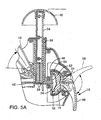
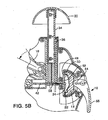
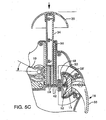
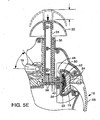
- isostatic press 10 for producing chocolate candies is described with reference to Figs. 5A-5F.
- a child selects one of molds 14 and inserts that molds corresponding mold liner 28. Holding locking mechanism 16 in an unlocked position, as illustrated by dashed lines in Fig. 5A, the child inserts the selected mold into mold chamber 18.
- the child locks mold 14 into mold chamber 18 by moving locking mechanism handle 56 to the down and locked position causing locking mechanism cam 54 to engage and secure mold 14 into place at an open end of a channel that piston 42 travels during its extension stroke.
- a Hershey® brand chocolate bar may be used.
- some Hershey® chocolate bars are scored to define twelve rectangular sections, which can be easily broken off. Two of the sections may be placed in the hopper vertically in a back-to-back, or front-to-front configuration, such that the thickness of the chocolate inserted into the hopper is approximately twice the thickness of the original Hershey® chocolate bar.
- the hopper should be filled with between one and twenty grams of chocolate, more preferably the hopper should be filled with between five and nine grams of chocolate.
- a child may use plunger 32 to push the chocolate 58 out of the bottom of hopper 36 into the path of press piston 42, while holding press handle 19 in a fully upward position so that press piston 42 is fully retracted. It will be understood that the order of loading the chocolate into isostatic press 10 and selecting mold 14 and securing it in place may be reversed without adverse consequences on the play value or functionality of isostatic press 10.
- press handle 19 moves horizontally and shears off a slice of chocolate 58 from the bottom of hopper 36 and pushes the slice through an injection channel 60 toward mold 14, as illustrated in Fig. 5B.
- compression chamber 50 includes the mold cavity bounded by mold 14 and bounded by chamber wall 48. This first downward stroke of handle 19 causing the first portion of chocolate 58 to be pressed into the compression chamber, as illustrated by Fig. 5C.
- plunger 32 indexes downward in a ratchet-type motion.
- This ratchet-type motion pushes additional chocolate 58 down out of the bottom of hopper 36 into press piston region 38, as illustrated by Fig. 5D.
- the chocolate and press are then ready to repeat the process shown in Figs. 5A-5C, pressing additional chocolate into the compression chamber in the same manner as the first portion of chocolate was pressed into compression chamber 50.
- Fig. 5E illustrates the hopper 36 and compression chamber 50 after approximately five to eight complete strokes of press handle 19 and press piston 42, have been completed. Approximately, half of the chocolate from a Hershey® bar, loaded as described above, will be pressed into the compression chamber after about six strokes of press handle 19. Compression chamber 50 begins to fill with a crumbled, coarse-powder consistency chocolate. As pressure increases in compression chamber 50 the powdery chocolate begins to agglomerate and form a flowable mixture.
- the chocolate reconstitutes to achieve a theoretical maximum density and restore the properties of the initial milk chocolate product, as indicated by the solid chocolate 58' shown in compression chamber 50 in Fig. 5F.
- the number of strokes required to cause this reconstitution pressure will vary depending on the volume of the mold being filled. The range, as noted above is between five and twenty strokes of the press piston. Preferably, it will take between eight and fifteen strokes of the piston to move the required quantity of chocolate and apply the required amount of pressure. Two few strokes of handle 19 diminish the play valve of the press. In the same way, too many strokes and the play value of the press is harmed. It will be understood that the quantity of chocolate pressed into the compression chamber in each stroke is a function of the displacement of the piston. The displacement is a measure to the volume of chocolate moved with each stroke.
- Adjustments to isostatic press 10 may be made to change the operation of the press. For example, changing the number of cycles of moving the handle up and down may be achieved by varying the cross-section of the piston and the length of the piston's travel distance from fully retracted to fully extended.
- press handle 19 and press piston 42 facilitate generating high pressure on the chocolate within the mold cavity.
- Press handle 19 may typically receive 1 to 50 pounds of downward force from a child. More commonly, a child will be able to produce a downward force of 10-15 lbs.
- a mechanism may be employed for generating a mechanical advantage to multiply the final force at the press piston to be 100 to 150 pounds of force, or more. Limiting the cross sectional area of press piston 42 to one twentieth of a square inch enables the piston to generate a hydraulic force of 2000 to 3000 PSIG (pounds per square inch gauge).
- milk chocolate is a solid at room temperature
- isostatic pressing it has been unexpectedly found that the chocolate can be formed into detailed shapes through a process of cold, isostatic pressing, as has been described herein. That is, if sufficient force is applied to the solid chocolate candy, it will undergo flow by a process of plastic deformation. This flow can be controlled in such a manner that the chocolate will be formed into virtually any desired shape such as may be defined by a mold.
- the formed chocolate flows exceedingly well at the elevated pressures, even minute details, which may be desirably incorporated into any molds used, are duplicated by the formed chocolate.
- the formed part is dense, smooth and every bit as esthetically appealing as chocolates formed using conventional melting and casting processes. Taste and "mouth” or feel of the chocolate also remains essentially unchanged.
- isostatic press 10 has so far been direct primarily to the formation of chocolate candies, it will be readily apparent that this and other embodiments of the press can be used to form objects from pseudo-solids such as wax as might be employed to make shaped candles. Similarly, the isostatic press can be employed to produce variously shaped soap products.
Landscapes
- Engineering & Computer Science (AREA)
- Food Science & Technology (AREA)
- Life Sciences & Earth Sciences (AREA)
- Chemical & Material Sciences (AREA)
- Polymers & Plastics (AREA)
- Manufacturing & Machinery (AREA)
- Mechanical Engineering (AREA)
- Confectionery (AREA)
Applications Claiming Priority (6)
| Application Number | Priority Date | Filing Date | Title |
|---|---|---|---|
| US36544902P | 2002-03-18 | 2002-03-18 | |
| US365449P | 2002-03-18 | ||
| GB0225998A GB0225998D0 (en) | 2002-03-18 | 2002-11-07 | Means and device for isostatic pressing of confectionery products |
| GB0225998 | 2002-11-07 | ||
| US42558902P | 2002-11-11 | 2002-11-11 | |
| 2003-03-28 |
Publications (1)
| Publication Number | Publication Date |
|---|---|
| EP1346646A1 true EP1346646A1 (fr) | 2003-09-24 |
Family
ID=29783034
Family Applications (1)
| Application Number | Title | Priority Date | Filing Date |
|---|---|---|---|
| EP03251675A Withdrawn EP1346646A1 (fr) | 2002-03-18 | 2003-03-18 | Compression isostatique de produits similaires à la cire |
Country Status (2)
| Country | Link |
|---|---|
| EP (1) | EP1346646A1 (fr) |
| GB (1) | GB2396132A (fr) |
Citations (2)
| Publication number | Priority date | Publication date | Assignee | Title |
|---|---|---|---|---|
| EP0730827A2 (fr) * | 1995-03-08 | 1996-09-11 | Societe Des Produits Nestle S.A. | Moulage de chocolat |
| EP0776608A2 (fr) * | 1995-10-30 | 1997-06-04 | Societe Des Produits Nestle S.A. | Moulage de chocolat |
Family Cites Families (4)
| Publication number | Priority date | Publication date | Assignee | Title |
|---|---|---|---|---|
| US1337599A (en) * | 1920-04-20 | Adding-jhachiste | ||
| US3590749A (en) * | 1969-01-16 | 1971-07-06 | Mattel Inc | Press toy |
| US4623319A (en) * | 1983-10-19 | 1986-11-18 | Marvin Glass & Associates | Figure including extrusion means actuated by figure appendages |
| US4815961A (en) * | 1988-01-11 | 1989-03-28 | Kindred William B | Modeling compound forming toy |
-
2003
- 2003-03-18 EP EP03251675A patent/EP1346646A1/fr not_active Withdrawn
- 2003-03-18 GB GB0306142A patent/GB2396132A/en not_active Withdrawn
Patent Citations (2)
| Publication number | Priority date | Publication date | Assignee | Title |
|---|---|---|---|---|
| EP0730827A2 (fr) * | 1995-03-08 | 1996-09-11 | Societe Des Produits Nestle S.A. | Moulage de chocolat |
| EP0776608A2 (fr) * | 1995-10-30 | 1997-06-04 | Societe Des Produits Nestle S.A. | Moulage de chocolat |
Also Published As
| Publication number | Publication date |
|---|---|
| GB2396132A (en) | 2004-06-16 |
| GB0306142D0 (en) | 2003-04-23 |
Similar Documents
| Publication | Publication Date | Title |
|---|---|---|
| CN108883555B (zh) | 模制工艺 | |
| US4759937A (en) | Technique for molding edible popcorn art objects | |
| EP2820957B1 (fr) | Procédé de fabrication d'un article de confiserie avec un élément décoratif en relief | |
| US8795751B2 (en) | Moulding of chocolate | |
| JPH08256690A (ja) | 押し出し脂肪含有菓子材料の射出成形方法 | |
| CZ298829B6 (cs) | Zpusob výroby pecených tvarových teles a lisovacíforma pro provádení tohoto zpusobu | |
| US20040150137A1 (en) | Isostatic pressing of wax like products | |
| KR100736013B1 (ko) | 누룽지 초코스낵과 누룽지 초코파이 및 이의 제조방법 | |
| EP0040989A2 (fr) | Articles comestibles moulés et procédé et appareil de fabrication | |
| GB2396132A (en) | Manually moulding a mouldable material | |
| US3920368A (en) | Toy molding press | |
| KR100532717B1 (ko) | 내용적을 갖는 누룽지 과자의 제조 방법과 그 장치 | |
| JP2866079B2 (ja) | 食品の製造方法及び食品製造用型 | |
| JP2896241B2 (ja) | 組み合せ菓子 | |
| JPH0683634B2 (ja) | 可動センタ−入りキヤンデ−およびその製造方法 | |
| JP3413161B2 (ja) | チョコレートの成形方法 | |
| CN208773945U (zh) | 鞋注塑成型模具 | |
| KR101989701B1 (ko) | 초콜릿 성형 몰드의 제조방법 | |
| JP3165868B2 (ja) | 携帯食品の製造方法 | |
| RU25980U1 (ru) | Кондитерское изделие | |
| JPH0591836A (ja) | 組み合せ菓子 | |
| KR101616025B1 (ko) | 두 가지 이상의 맛과 다양한 색상을 갖는 입체빙과 제조방법 및 그 입체빙과 | |
| CN109259283A (zh) | 一种用于制备艺术造型食品的模具及制备工艺 | |
| CN223844885U (zh) | 一种雪糕模具 | |
| JP2002199845A (ja) | 具材を含有するチョコレートの製造方法 |
Legal Events
| Date | Code | Title | Description |
|---|---|---|---|
| PUAI | Public reference made under article 153(3) epc to a published international application that has entered the european phase |
Free format text: ORIGINAL CODE: 0009012 |
|
| AK | Designated contracting states |
Kind code of ref document: A1 Designated state(s): AT BE BG CH CY CZ DE DK EE ES FI FR GB GR HU IE IT LI LU MC NL PT RO SE SI SK TR |
|
| AX | Request for extension of the european patent |
Extension state: AL LT LV MK |
|
| 17P | Request for examination filed |
Effective date: 20040324 |
|
| AKX | Designation fees paid |
Designated state(s): AT BE BG CH CY CZ DE DK EE ES FI FR GB GR HU IE IT LI LU MC NL PT RO SE SI SK TR |
|
| 17Q | First examination report despatched |
Effective date: 20040706 |
|
| STAA | Information on the status of an ep patent application or granted ep patent |
Free format text: STATUS: THE APPLICATION IS DEEMED TO BE WITHDRAWN |
|
| 18D | Application deemed to be withdrawn |
Effective date: 20060103 |