EP1346705A1 - Tube en matière tissée pour prothèse vasculaire de type stent et prothèse vasculaire utilisant ce tube - Google Patents
Tube en matière tissée pour prothèse vasculaire de type stent et prothèse vasculaire utilisant ce tube Download PDFInfo
- Publication number
- EP1346705A1 EP1346705A1 EP03006093A EP03006093A EP1346705A1 EP 1346705 A1 EP1346705 A1 EP 1346705A1 EP 03006093 A EP03006093 A EP 03006093A EP 03006093 A EP03006093 A EP 03006093A EP 1346705 A1 EP1346705 A1 EP 1346705A1
- Authority
- EP
- European Patent Office
- Prior art keywords
- wtvp
- multifilament
- warps
- blood
- dtex
- Prior art date
- Legal status (The legal status is an assumption and is not a legal conclusion. Google has not performed a legal analysis and makes no representation as to the accuracy of the status listed.)
- Granted
Links
- 239000008280 blood Substances 0.000 title claims abstract description 67
- 210000004369 blood Anatomy 0.000 title claims abstract description 67
- 230000002792 vascular Effects 0.000 title claims abstract description 36
- 239000007788 liquid Substances 0.000 abstract description 28
- 230000003902 lesion Effects 0.000 abstract description 27
- 230000002265 prevention Effects 0.000 abstract description 4
- XLYOFNOQVPJJNP-UHFFFAOYSA-N water Substances O XLYOFNOQVPJJNP-UHFFFAOYSA-N 0.000 description 25
- 230000000052 comparative effect Effects 0.000 description 21
- 238000000034 method Methods 0.000 description 19
- -1 polyethylene terephthalate Polymers 0.000 description 19
- 229920000139 polyethylene terephthalate Polymers 0.000 description 18
- 239000005020 polyethylene terephthalate Substances 0.000 description 18
- 210000004204 blood vessel Anatomy 0.000 description 16
- 230000035699 permeability Effects 0.000 description 13
- 238000002560 therapeutic procedure Methods 0.000 description 10
- 230000001965 increasing effect Effects 0.000 description 9
- 238000009941 weaving Methods 0.000 description 8
- 230000009172 bursting Effects 0.000 description 7
- 239000007943 implant Substances 0.000 description 7
- 238000010586 diagram Methods 0.000 description 6
- 230000007812 deficiency Effects 0.000 description 5
- 230000002349 favourable effect Effects 0.000 description 5
- 239000002994 raw material Substances 0.000 description 5
- 208000002251 Dissecting Aneurysm Diseases 0.000 description 4
- 208000007474 aortic aneurysm Diseases 0.000 description 4
- 206010002895 aortic dissection Diseases 0.000 description 4
- 230000002950 deficient Effects 0.000 description 4
- 239000000835 fiber Substances 0.000 description 4
- 238000005259 measurement Methods 0.000 description 4
- 238000013461 design Methods 0.000 description 3
- 230000002526 effect on cardiovascular system Effects 0.000 description 3
- 229920000728 polyester Polymers 0.000 description 3
- 206010002329 Aneurysm Diseases 0.000 description 2
- 235000014676 Phragmites communis Nutrition 0.000 description 2
- 230000008901 benefit Effects 0.000 description 2
- 230000015556 catabolic process Effects 0.000 description 2
- 238000010276 construction Methods 0.000 description 2
- 238000006731 degradation reaction Methods 0.000 description 2
- 230000001939 inductive effect Effects 0.000 description 2
- 230000009545 invasion Effects 0.000 description 2
- 210000000056 organ Anatomy 0.000 description 2
- 208000017667 Chronic Disease Diseases 0.000 description 1
- 208000005422 Foreign-Body reaction Diseases 0.000 description 1
- 229910000990 Ni alloy Inorganic materials 0.000 description 1
- 244000089486 Phragmites australis subsp australis Species 0.000 description 1
- 239000004721 Polyphenylene oxide Substances 0.000 description 1
- HZEWFHLRYVTOIW-UHFFFAOYSA-N [Ti].[Ni] Chemical compound [Ti].[Ni] HZEWFHLRYVTOIW-UHFFFAOYSA-N 0.000 description 1
- 238000010521 absorption reaction Methods 0.000 description 1
- 230000009471 action Effects 0.000 description 1
- 230000002411 adverse Effects 0.000 description 1
- 210000000702 aorta abdominal Anatomy 0.000 description 1
- 230000015572 biosynthetic process Effects 0.000 description 1
- 229920001400 block copolymer Polymers 0.000 description 1
- 230000000903 blocking effect Effects 0.000 description 1
- 230000017531 blood circulation Effects 0.000 description 1
- 239000002131 composite material Substances 0.000 description 1
- 238000012669 compression test Methods 0.000 description 1
- 230000003247 decreasing effect Effects 0.000 description 1
- 230000007547 defect Effects 0.000 description 1
- 230000000994 depressogenic effect Effects 0.000 description 1
- 239000006185 dispersion Substances 0.000 description 1
- 230000000694 effects Effects 0.000 description 1
- 238000011156 evaluation Methods 0.000 description 1
- 230000001747 exhibiting effect Effects 0.000 description 1
- 230000004927 fusion Effects 0.000 description 1
- 238000010438 heat treatment Methods 0.000 description 1
- 210000003090 iliac artery Anatomy 0.000 description 1
- 238000003780 insertion Methods 0.000 description 1
- 230000037431 insertion Effects 0.000 description 1
- 230000014759 maintenance of location Effects 0.000 description 1
- 239000000463 material Substances 0.000 description 1
- 230000002093 peripheral effect Effects 0.000 description 1
- 229920001707 polybutylene terephthalate Polymers 0.000 description 1
- 229920000570 polyether Polymers 0.000 description 1
- 230000008569 process Effects 0.000 description 1
- 238000009958 sewing Methods 0.000 description 1
- 239000010935 stainless steel Substances 0.000 description 1
- 229910001220 stainless steel Inorganic materials 0.000 description 1
- 239000000126 substance Substances 0.000 description 1
- 238000001356 surgical procedure Methods 0.000 description 1
- 238000009864 tensile test Methods 0.000 description 1
- 239000004753 textile Substances 0.000 description 1
- 230000001988 toxicity Effects 0.000 description 1
- 231100000419 toxicity Toxicity 0.000 description 1
- 239000002759 woven fabric Substances 0.000 description 1
Images


Classifications
-
- A—HUMAN NECESSITIES
- A61—MEDICAL OR VETERINARY SCIENCE; HYGIENE
- A61F—FILTERS IMPLANTABLE INTO BLOOD VESSELS; PROSTHESES; DEVICES PROVIDING PATENCY TO, OR PREVENTING COLLAPSING OF, TUBULAR STRUCTURES OF THE BODY, e.g. STENTS; ORTHOPAEDIC, NURSING OR CONTRACEPTIVE DEVICES; FOMENTATION; TREATMENT OR PROTECTION OF EYES OR EARS; BANDAGES, DRESSINGS OR ABSORBENT PADS; FIRST-AID KITS
- A61F2/00—Filters implantable into blood vessels; Prostheses, i.e. artificial substitutes or replacements for parts of the body; Appliances for connecting them with the body; Devices providing patency to, or preventing collapsing of, tubular structures of the body, e.g. stents
- A61F2/02—Prostheses implantable into the body
- A61F2/04—Hollow or tubular parts of organs, e.g. bladders, tracheae, bronchi or bile ducts
- A61F2/06—Blood vessels
- A61F2/07—Stent-grafts
-
- A—HUMAN NECESSITIES
- A61—MEDICAL OR VETERINARY SCIENCE; HYGIENE
- A61F—FILTERS IMPLANTABLE INTO BLOOD VESSELS; PROSTHESES; DEVICES PROVIDING PATENCY TO, OR PREVENTING COLLAPSING OF, TUBULAR STRUCTURES OF THE BODY, e.g. STENTS; ORTHOPAEDIC, NURSING OR CONTRACEPTIVE DEVICES; FOMENTATION; TREATMENT OR PROTECTION OF EYES OR EARS; BANDAGES, DRESSINGS OR ABSORBENT PADS; FIRST-AID KITS
- A61F2/00—Filters implantable into blood vessels; Prostheses, i.e. artificial substitutes or replacements for parts of the body; Appliances for connecting them with the body; Devices providing patency to, or preventing collapsing of, tubular structures of the body, e.g. stents
- A61F2/02—Prostheses implantable into the body
- A61F2/04—Hollow or tubular parts of organs, e.g. bladders, tracheae, bronchi or bile ducts
- A61F2/06—Blood vessels
- A61F2/07—Stent-grafts
- A61F2002/072—Encapsulated stents, e.g. wire or whole stent embedded in lining
-
- A—HUMAN NECESSITIES
- A61—MEDICAL OR VETERINARY SCIENCE; HYGIENE
- A61F—FILTERS IMPLANTABLE INTO BLOOD VESSELS; PROSTHESES; DEVICES PROVIDING PATENCY TO, OR PREVENTING COLLAPSING OF, TUBULAR STRUCTURES OF THE BODY, e.g. STENTS; ORTHOPAEDIC, NURSING OR CONTRACEPTIVE DEVICES; FOMENTATION; TREATMENT OR PROTECTION OF EYES OR EARS; BANDAGES, DRESSINGS OR ABSORBENT PADS; FIRST-AID KITS
- A61F2/00—Filters implantable into blood vessels; Prostheses, i.e. artificial substitutes or replacements for parts of the body; Appliances for connecting them with the body; Devices providing patency to, or preventing collapsing of, tubular structures of the body, e.g. stents
- A61F2/02—Prostheses implantable into the body
- A61F2/04—Hollow or tubular parts of organs, e.g. bladders, tracheae, bronchi or bile ducts
- A61F2/06—Blood vessels
- A61F2/07—Stent-grafts
- A61F2002/075—Stent-grafts the stent being loosely attached to the graft material, e.g. by stitching
Definitions
- This invention relates to a woven tubing for a stent type blood vascular prosthesis and to a stent type blood vascular prosthesis using the woven tubing.
- a method which comprises surgically cutting a lesion in the blood vessel and filling the remaining dent therein with a blood vascular prosthesis has been heretofore regarded as a standard.
- the surgical operation with ventrotomy or thoracotomy inflicts a large burden of invasion on the patient and entrains danger.
- the application of this surgical operation has been restricted because of inducing a complication.
- an intravascular therapy or surgery has been attracting attention.
- a blood vascular prosthesis endowed with a stent namely a stent type blood vascular prosthesis
- a stent namely a stent type blood vascular prosthesis
- the stent type blood vascular prosthesis which is used for this intravascular therapy, is inserted as folded in a small size into the catheter, conveyed to the lesion, and then allowed to unfold and restore the original tubular shape.
- the term "stent” as used herein refers to a tubular supporting skeleton, which is inserted into an intracorporeal tubular organ such as the blood vessel for supporting the organ.
- the stent functions to hold the blood vessel in its tubular shape mechanically and implant the blood vascular prosthesis fast against the wall of the blood vessel.
- the stent type blood vascular prosthesis has limited folding ability and insufficient adaptability to curved blood vessels in human bodies because it is inferior in flexibility to the blood vascular prosthesis that is devoid of stent.
- U.S. Patent No. 5,976,179 discloses an implanting device (equivalent to the "stent type blood vascular prosthesis" designated in the present specification) which has a plurality of intermittently disposed bendable wire rings (equivalent to the "stent” designated in the present specification) concatenated with the tubular surface member (equivalent to the "woven tubing” designated in the present specification) .
- the conventional stent which is provided with supporting skeletons concatenated continuously in the direction of length
- individual wire rings for constructing such a stent are not concatenated.
- This stent relies on this construction to attain an implanting device which prevents degradation of flexibility and excels in folding ability and adaptability to curved blood vessels in human bodies. Further, by using a monofilament having a shape retaining property as warps and a dense multifilament as wefts in the surface member, the surface member is aimed at attaining such a shape retaining property as avoids being crushed by the flow of blood and such a liquid tightness (low water permeability) as avoids leakage of blood to the exterior in the implanting devices even when the wire rings are not concatenated.
- the implanting device mentioned above is characterized by the combination of the wire rings and the surface member. That is to say, the wire rings themselves have no ability whatever to resist the crush exerted in the direction of the length of the device.
- this combination could possibly constitute a fatal defect because the flow of blood crushes the implanting device and the blood flows through the gap in the terminal part into the lesion.
- a monofilament as warps has brought another problem that readily gives wale streaks on the coats of the surface member.
- the wale streaks are faults which arise in the process of weaving owing to the lack of adequacy in the tension of warps, the number of the drawing-in thread through reeds, and the number of dent per unit length. They occur when scratches on warps and gaps between adjacent warps happen to manifest themselves as streaks. They are unfavorable because they lower strengths such as tensile strength, bursting strength, and liquid tightness.
- the use of a monofilament as warps brings yet another problem that readily induces occurrence of gaps at interlacing parts of warps and wefts.
- the gaps cause a serious degradation of liquid tightness.
- the surface member which uses a monofilament as warps offers no sufficient liquid tightness even if a dense multifilament is adopted as wefts, and fail to prevent the inflow of blood into the lesion owing to leakage of blood.
- the surface member, which uses the conventional multifilament as warps offers no sufficient durability to withstand the crush inflicted in the direction of length and, therefore, cannot be combined with a stent having no durability to withstand the crush such as a stent which acquires enhanced flexibility by having wire rings disposed intermittently.
- a stent having durability to withstand the crush such as a stent that has supporting skeletons concatenated in the direction of length in the Z-stent made of stainless steel, it is compelled to sacrifice flexibility.
- An object of this invention is to provide a woven tubing for a stent type blood vascular prosthesis (It may be referred to simply as "WTVP”.), which combines a shape retaining property that is able to retain the tubular shape thereof without being crushed by the flow of blood with a high liquid tightness enough to reduce the leakage of blood to the exterior when a stent type blood vascular prosthesis (It may be simply referred to as "SBVP”.) including the WTVP is implanted at the site of a lesion and allows prevention of the inflow of blood into the lesion.
- WTVP stent type blood vascular prosthesis
- Another object of this invention is to provide a SBVP that uses the WTVP mentioned above.
- a WTVP is characterized by containing at least part of multifilament formed of 2 - 5 single filaments as warps and having the single filaments disposed in single lines within wefts.
- a SBVP is characterized by comprising the WTVP and a stent.
- the WTVP of this invention can be advantageously applied even to a stent which, when used by itself, offers no durability to withstand the crush in the direction of length, consequently enabled to give rise to a SBVP which is excellent in flexibility and conformability and really useful in the intravascular therapy.
- the WTVP of this invention owing to the good shape retaining property thereof, can be applied to a stent that is devoid of durability to withstand the crush in the direction of length.
- a stent that has wire rings disposed intermittently for example, it can provide a SBVP with flexibility that can be inserted as folded in a small size into the catheter and allowed to conform to the shape of a human blood vessel.
- woven tubing refers to a tube obtained by joining the opposite edges of a flat woven fabric by sewing or fusion, or a tube formed from the stage of weaving by the technique of hollow weave, namely by having a weft woven spirally in the circumferential direction between warps disposed along the direction of length.
- the WTVP of this invention contains, in at least part of warps, a multifilament formed of 2 - 5 single filaments in which such single filaments are disposed in single lines between the wefts.
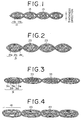
- These multifilaments are disposed in such a state that single filaments, 11a, 11b; 21a, 21b, 21c; and 31a, 31b, 31c, 31d, 31e, which form warps 11, 21, and 31, respectively, may be arranged in single lines respectively within wefts 13, 23, and 33.
- the vertical reversal of this arrangement is also embraced by this description.
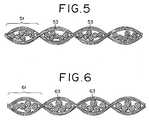
- the expression "in single lines” means that the single filaments are arranged substantially in a single line. Specifically, this expression is so extensive as to allow application up to the state of wefts 43 and warps 41 illustrated in FIG. 4, but excludes the states illustrated in FIGs. 5 and 6. As shown in FIG.
- FIG. 7 is a schematic diagram of a device for forming a state of disposal in single lines.
- a manner comprising dividing warps 71, multifilaments consist of two single filaments, with a separator 74, a heald 75 and a reed 76 into individual single filaments, aligning the divided filaments, and supplying them to a weaving part to be interlaced with weft 73 therein.
- the multifilament which is used in the warps of this invention is not particularly restricted but only required to be formed of 2 - 5 single filaments. It preferably has the following characteristics (a) - (c).
- the WTVP of this invention uses, in at least part of the warps forming the woven tubing, a multifilament which has the number of the single filament within a specific range and preferably has the number of the single filament, the size of the single filament, the total size, and the twist multiplier in respective specific ranges (which may be referred to as "the present multifilament"), and causes the single filaments to dispose in the state of single lines within the wefts.
- the WTVP when implanted at the site of a lesion as a SBVP, combines a shape retaining property which suffices to retain the tubular shape thereof without being crushed by the flow of blood with a high liquid tightness enough to reduce the leakage of blood to the exterior, and allows prevention of the inflow of blood into the lesion.
- the WTVP of the present invention is characterized by disposing the single filaments of the warp, which uses a specific multifilament, in the single line within the weft. Otherwise, when 2-5 monofilaments that are caused to parallel and disposed in a state of the single line, are used instead of the present multifilament, the monofilaments will also produce the advantage effects of the present invention.
- the size of the monofilament to be used in the present invention is preferred to be in the range of 5.5-50 dtex.
- the threads or strands other than the multifilament that is used in the warps are not particularly restricted.
- the multifilament heretofore used as the raw material for the blood vascular prosthesis namely formed of 10 - 1000 single filaments having a single filament size in the range of 0.1 - 3.5 dtex, may be used as "other threads.”
- the WTVP will be deficient in strengths such as tensile strength and bursting strength. If the size of the single filament exceeds 3.5 dtex, the single filament, when used in combination with the present multifilament, will render the WTVP and a SBVP using the WTVP difficult to be folded in a small size because of an increased wall thickness and an increased stiffness.
- the WTVP will betray deficiency in liquid tightness and fail to prevent the leakage of blood. If the number exceeds 1000, the filament will tend to incur troubles such as warp breakages and fluff during the course of weaving and impair the operational stability.
- the multifilament constructed as described above are preferred to have a total size in the range of 33 - 110 dtex. If the total size is smaller than 33 dtex, the WTVP, combined with the present multifilament, will betray deficiency in strengths such as tensile strength and bursting strength. If the total size is larger than 110 dtex, the WTVP and a SBVP using the WTVP will not be easily folded in a small size because of an increased wall thickness and an undue addition to stiffness.
- the other threads to be used in the warps may be properly selected from the multifilament mentioned above, preferably a multifilament which has a similar total size to the present multifilament to be combined. If the multifilament to be used in the warps is notably different in total size from the other threads in the warps, the WTVP will form a nonuniform surface and possibly betray deficiency in liquid tightness. It will further entail wide dispersion of strengths such as tensile strength and bursting strength and of wall thickness as well.
- the twist multiplier of the multifilament is preferred to be in the range of 0 - 1000 times/meter.
- the smaller the twist multiplier the less the mutual entangling and the overlapping of the single filaments occur. Thus, the liquid tightness is enhanced.
- the twist multiplier of not more than 1000 times/meter is allowable from the viewpoint of the stability of weaving. If the twist multiplier exceeds 1000 times/meter, the mutual entangling and the overlapping thereof will have adverse influences and then the woven tubing will have insufficient liquid tightness.
- the twist multiplier of the multifilament is preferred to be in the range of 200 - 500 times/meter for the sake of the balance between the stability of weaving and the liquid tightness.
- the ratio of the present multifilament to the other threads in the warps is preferred to be in the range of 25 : 75 - 100 : 0 on the assumption that the total number of warps forming the woven tubing is 100.
- the other threads and the multifilament are preferred to be disposed uniformly. If the ratio is smaller than 25 : 75, the WTVP and a SBVP using the WTVP will not acquire a sufficient shape retaining property and will offer no sufficient durability to withstand the crush in the direction of length. By adjusting the ratio in the range of 25 : 75 - 100 : 0, it is possible to adjust such a durability. That is to say, the durability of the WTVP and SBVP increases in accordance as the ratio the multifilament is increased.
- the wefts for forming the WTVP are not particularly restricted.
- the following multifilament may be used as the wefts: a multifilament which has been heretofore used as the raw material for the blood vascular prosthesis, i.e. a multifilament having a single filament size in the range of 0.1 - 3.5 dtex, preferably 0.1 - 1.0 dtex, and formed of 10 - 1000 single filaments. If the size of the single filament is in the range of 0.1 - 1.0 dtex, the WTVP will gain further in denseness and enjoy enhanced liquid tightness.
- the multifilament having a total size in the range of 33 - 110 dtex and a twist multiplier in the range of 0 - 1000 times/meter, preferably 200 - 500 times/meter prove particularly advantageous.
- polyester type fibers from the actual results of use as the material for a blood vascular prosthesis.
- the polyester type fibers have been widely used as the raw material for blood vascular prosthesis because they have chemical stability, great durability, and high mechanical strength and avoid exhibiting toxicity or producing any foreign body reaction.
- polyester type fibers polyethylene terephthalate, polybutylene terephthalate, polyester-polyether block copolymers, and composite fibers thereof may be cited.
- the textile design of the WTVP is not particularly restricted but includes, for example, plain weave, twill weave, satin weave, or crepe weave.
- the plain weave proves particularly favorable because it permits easy formation of a tubular article having a small wall thickness and excelling in strengths such as tensile strength and bursting strength and in liquid tightness.
- the WTVP of this invention which is obtained as described above, combines a shape retaining property that is able to retain the tubular shape thereof without being crushed by the flow of blood with a high liquid tightness enough to reduce the leakage of blood to the exterior when the WTVP is implanted as a SBVP at the site of a lesion.
- the WTVP which has the magnitudes of column strength, radius of kink, coefficient of water permeability, and wall thickness within respectively specified ranges, excels not only in the shape retaining property and the liquid tightness which are the salient merits of this invention but also in the kink resistance and the folding ability which ought to be naturally endowed for the SBVP.
- it is quite useful for the intravascular therapy.
- the column strength of the WTVP is preferred to be in the range of 0.020 - 0.130 N/mm of diameter.
- the term "column strength" as used herein represents the strength or durability to withstand the crush in the direction of length. The larger the value of the column strength is, the higher the durability to withstand the crush in the direction of length is. If the column strength is smaller than 0.020 N/mm of diameter, the WTVP, when implanted at the site of a lesion as a SBVP, will possibly be crushed by the flow of blood and compelled to yield to the inflow of blood into the site of the lesion. If the column strength exceeds 0.130 N/mm of diameter, folding the WTVP and SBVP into a small size will become difficult because of an increased stiffness. The WTVP or SBVP further will not easily follow the blood vessel after the WTVP or SBVP has been implanted therein.
- the radius of a kink in the WTVP varies with the inside diameter thereof and tends to increase in proportion to the size of inside diameters. Though the radius of a kink, therefore, cannot be uniquely defined, it is preferred to be not more than 5.5 mm when the WTVP has an inside diameter of 24 mm, for example.
- the term "kink” as used herein refers to the phenomenon in which the blood vascular prosthesis is folded under the inner flexure of a body or the external pressure. The kink resistance is expressed by the radius of a kink, namely such a radius of the loop formed in a given blood vascular prosthesis as forms a clearly discernible bend therein.
- the radius of a kink is preferred to be as near to 0 mm as possible for the sake of facilitating the insertion and implant of a SBVP using the WTVP even to a complicated bent portion in the blood vessel.
- the radius of a kink in the WTVP of this invention is preferred to be not more than 5.5 mm when the inside diameter of the WTVP is assumed to be 24 mm. If the radius is larger than 5.5 mm, a SBVP will fail to conform to a flexural curved human blood vessel when the WTVP is implanted as the SBVP at the site of a lesion.
- the WTVP of this invention is primarily supposed to be applied to the therapy of an aortic aneurysm or an aortic dissection in combination with a stent.
- the inside diameter of this WTVP may be in the range of 7 - 54 mm. On account of the possibility of personal equation, however, it is not limited to this range.
- the WTVP is preferred to have undergone a crimp treatment.
- the application of this crimp treatment improves the WTVP and a SBVP using the WTVP of this invention in the ability of flexion to the extent of enabling them to conform naturally to the shape of a human blood vessel. In other words, the radius of a kink is decreased and the kink resistance is enhanced.
- the crimps consequently imparted to the WTVP produce an effective action in the restoration of the SBVP using the WTVP from the folded state to the original shape.
- the method for imparting such crimps to the WTVP may be selected from among the knownmethods such as those described in U.S. Patent No. 3,337,673 and JP-A-1-155860.
- the coefficient of water permeability of the WTVP is preferred to be not more than 500 mL/min/cm 2 .
- the coefficient of water permeability is closely related to the liquid tightness. More preferably, this magnitude is 0 mL/min/cm 2 or approximates closely to 0 mL/min/cm 2 for the sake of exalting the degree with which the leakage of blood from the WTVP can be prevented and the thrombogenesis can be promoted.
- the upper limit of the preferred coefficient of water permeability is 500 mL/min/cm 2 . If the coefficient is larger than this upper limit, the WTVP, when implanted in the site of a lesion as a SBVP, will possibly suffer blood to leak therefrom and fail to prevent the inflow of blood into the site of the lesion.
- the wall thickness of the WTVP is preferred to be not more than 150 ⁇ m. If the wall thickness is larger than 150 ⁇ m, the WTVP and a SBVP using the WTVP will not be easily folded into a small size.
- the folding ability is an important parameter in the construction of the SBVP. If the SBVP is deficient in folding ability, it will require the catheter used in the intravascular therapy to have a large diameter and will lower operational efficiency.
- the WTVP may be furnished with a branching part.
- a branching part of a vital blood vessel e.g., from the abdominal aorta to the common iliac artery
- the use of a SBVP furnished with a branching part is advantageous and rational from the viewpoint of lightening the burden on the patient and ensuring the safety of the operation.
- the WTVP of this invention is preferred to be applied to the stent disclosed in U.S. Patent No. 5,976,179, namely the stent which, as represented by a stent having wire rings disposed intermittently and made of titanium-nickel alloy et al, is not possessed in itself of the durability to withstand the crush in the direction of length. Further, the WTVP of this invention can manifest more effectively the merit of this invention which resides in excelling in the shape retaining property, though -it is not restricted by this manifestation.
- the WTVP can be effectively used as a blood vascular prosthesis that is devoid of a stent.
- FIG. 8 is a schematic diagram showing a WTVP.
- 80 is a WTVP.
- FIG. 9 is a schematic diagram showing a SBVP.
- a WTVP 90 is innerly attached to a stent 97.
- the force required for crushing a sample of woven tubing 50 mm in length to a length of 30 mm is measured with a tensile or compression test machine.
- the denomination "mm in diameter” denotes the magnitude of the inside diameter of a given WTVP.
- the measurement of this magnitude is performed by consulting ISO7198 Cardiovascular implants-Tubular vascular prostheses. This magnitude is measured by supplying water under 120 mmHg (16.0 kPa) to the surface of a sample 0.5 - 1.0 cm 2 in area and measuring the quantity of the water which had permeated the sample in one minute. The quantity of permeating water consequently found is reduced to the rate per 1.0 cm 2 and reported as the coefficient of water permeation. The determination of the coefficient of water absorption is performed on a sample of woven tubing which has not yet undergone the crimp treatment.
- the measurement of this magnitude is performed with a constant pressure thickness meter by consulting ISO7198 Cardiovascular implants-Tubular vascular prostheses. This measurement is performed on a sample of woven tubing that has not yet undergone the crimp treatment.
- a tubing of plain weave design 24 mm in inside diameter was formed by hollow weave using an untwisted multifilament of polyethylene terephthalate having a single filament size of 18 dtex and formed of two single filaments to a total size of 36 dtex (the present multifilament) for warps and a multifilament of polyethylene terephthalate having a single filament size of 0.55 dtex and formed of 170 single filaments to a total size of 94 dtex and endowed with a twist multiplier of 200 times/meter for wefts.
- the tubing was further subjected to a crimp treatment to obtain a target WTVP.
- the state of warps in the produced WTVP is schematically illustrated in FIG. 1.
- a target WTVP was obtained by repeating the procedure of Example 1, except that an untwisted multifilament of polyethylene terephthalate having a single filament size of 33.5 dtex and formed of two single filaments to a total size of 67 dtex (the present multifilament) was used for warps.
- the single filaments of the warps were disposed in single lines.
- a target WTVP was obtained by repeating the procedure of Example 1, except that an untwisted multifilament of polyethylene terephthalate having a single filament size of 16.8 dtex and formed of four single filaments to a total size of 67 dtex (the present multifilament) was used for warps.
- the single filaments of the warps were disposed in single lines.
- a target WTVP was obtained by repeating the procedure of Example 1, except that an untwisted multifilament of polyethylene terephthalate formed of one single filament of a single filament size of 33 dtex and two single filaments of a single filament size of 18 dtex to a total size of 69 dtex (thepresentmultifilament) was used for warps.
- the state of warps in the WTVP consequently obtained is schematically illustrated in FIG. 2.
- a target WTVP was obtained by repeating the procedure of Example 1, except that an untwisted multifilament of polyethylene terephthalate having a single filament size of 18 dtex and formed of two single filaments to a total size of 36 dtex (the present multifilament) and a multifilament of polyethylene terephthalate having a single filament size of 2.8 dtex, formed of 12 single filaments to a total size of 33 dtex, and endowed with a twist multiplier of 300 times/meter at a ratio of 50 : 50 were used for warps.
- the single filaments of the warps were disposed in single lines.
- a target WTVP was obtained by repeating the procedure of Example 1, except that an untwisted multifilament of polyethylene terephthalate having a single filament size of 50 dtex and formed of four single filaments to a total size of 200 dtex (the present multifilament) was used for warps.
- the single filaments of the warps were disposed in single lines.
- a target WTVP was obtained by repeating the procedure of Example 1, except that an untwisted multifilament of polyethylene terephthalate having a single filament size of 18 dtex and formed of five single filaments to a total size of 90 dtex (the present multifilament) was used for warps.
- the state of warps in the WTVP consequently obtained is schematically illustrated in FIG. 3.
- a target WTVP was obtained by repeating the procedure of Example 1, except that a multifilament of polyethylene terephthalate having a single filament size of 18 dtex and formed of five single filaments to a total size of 90 dtex and endowed with a twist multiplier of 100 times/meter (the present multifilament) was used for warps.
- the single filaments of the warps were disposed in single lines.
- a WTVP was obtained by repeating the procedure of Example 1, except that a monofilament of polyethylene terephthalate having a size of 18 dtex was used for warps.
- a WTVP was obtained by repeating the procedure of Example 1, except that a monofilament of polyethylene terephthalate having a size of 33 dtex was used for warps.
- a WTVP was obtained by repeating the procedure of Example 1, except that an untwisted multifilament of polyethylene terephthalate having a single filament size of 18 dtex and formed of six single filaments to a total size of 108 dtex were used for warps.
- the state of warps in the WTVP consequently obtained is schematically illustrated in FIG. 5.
- a WTVP was obtained by repeating the procedure of Example 1, except that a multifilament of polyethylene terephthalate having a single filament size of 2.3 dtex and formed of 24 single filaments to a total size of 56 dtex and endowed with a twist multiplier of 300 times/meter was used for warps.
- a WTVP was obtained by repeating the procedure of Example 1, except that a multifilament of polyethylene terephthalate having a single filament size of 4.6 dtex and formed of 48 single filaments to a total size of 222 dtex and endowed with a twist multiplier of 300 times/meter was used for warps.
- a WTVP was obtained by repeating the procedure of Example 1, except that a multifilament of polyethylene terephthalate having a single filament size of 18 dtex and formed of five single filaments to a total size of 90 dtex and endowed with a twist multiplier of 150 times/meter was used for warps.
- the state of warps in the WTVP consequently obtained is schematically illustrated in FIG. 6.
- a commercially available blood vascular prosthesis (made of polyethylene terephthalate, measuring 24 mm in inside diameter, formed by hollow weave in plain weave design, and undergone a crimp treatment) was evaluated with respect to performance.
- the size and the number of the single filament used in the prosthesis were found as follows. Cross sections of the filament forming the prosthesis were observed under an electron microscope to find the number and diameters of the single filament. Then, the single filament size was calculated from the diameters of single filaments and the total size was calculated from the single filament size and the number of the single filament. As a result, the warp was found to be multifilaments having a single filament size of 0.58 dtex and formed of 216 single filaments formed to a total size of 125 dtex and the weft was found to be multifilaments having a single filament size of 0.58 dtex and formed of 144 single filaments to a total size of 84 dtex. Incidentally, the coefficient of water permeability and the wall thickness were measured of a blood vascular prosthesis which had been deprived of crimps by a heat treatment.
- SBVPs were formed by causing wire rings disclosed in U.S. Patent No. 5,976,179 to be sewn with intervals of 15 mm to WTVPs formed in a total length of 60 mm in Examples 1 - 8. These SBVPs were each implanted via a catheter into a resinous tube simulating a blood vessel and measuring 24 mm in inside diameter and 28 mm in outside diameter. The position for implanting the SBVP on the inside surface of the resinous tube was curved along the outer periphery of a cylinder 50 mm in radius and a branch was formed on the major curvature side of the position for implanting the SBVP with a tube 10 mm in inside diameter. When the water assumed to be blood was made to flow into the resinous tube, the tube held the inner cavity thereof intact without suffering the shape thereof crushed by the flow of water and leaked no water through the branch. Thus, it could acquire a satisfactory result of implant.
- SBVPs were formed by repeating the procedure of Example 9, except that the WTVPs in Comparative Examples 1 - 7 were used. These SBVPs were each implanted in the same resinous tube as used in Example 9 and the water assumed to be blood was made to flow into the resinous tube.
- the SBVPs of Comparative Examples 1, 2, 3, and 6 induced conspicuous leak of water through the branches because of large coefficients of water permeability, though they did not suffer their shapes to be crushed by the flow of water. Thus, they were suspected to be incapable of satisfactorily blocking the flow of blood into an aneurysm in the case of clinical use.
- the ring at the most proximal portion could not be easily disposed in a stable manner perpendicularly to the respective tube during the course of implant of the prostheses in the tubes.
- the SBVPs also showed a sign of partial decrease of the cross section of the inner cavity due to the occurrence of a kink. Further, the ring at the most proximal portion showed an inclination of being moved slightly toward the peripheral side by the flow of water.
- the SBVPs were suspected to have the possibility of starting from the position of implant or inducing blockage of the inner cavity after a protracted implant.
- a woven tubing for use in a stent type blood vascular prosthesis which contains a multifilament formed of two - five single filaments in at least part of warps and has the single filaments disposed in single lines, and a stent type blood vascular prosthesis using the woven tubing are described.
- the prosthesis combines a shape retaining property that is capable of maintaining its tubular shape without being crushed by the flow of blood with a high liquid tightness that is capable of reducing the leakage of blood to the exterior when implanted at the site of a lesion and allows prevention of the inflow of blood into the site of a lesion.
Landscapes
- Health & Medical Sciences (AREA)
- Gastroenterology & Hepatology (AREA)
- Pulmonology (AREA)
- Cardiology (AREA)
- Oral & Maxillofacial Surgery (AREA)
- Transplantation (AREA)
- Engineering & Computer Science (AREA)
- Biomedical Technology (AREA)
- Heart & Thoracic Surgery (AREA)
- Vascular Medicine (AREA)
- Life Sciences & Earth Sciences (AREA)
- Animal Behavior & Ethology (AREA)
- General Health & Medical Sciences (AREA)
- Public Health (AREA)
- Veterinary Medicine (AREA)
- Prostheses (AREA)
- Materials For Medical Uses (AREA)
Applications Claiming Priority (2)
| Application Number | Priority Date | Filing Date | Title |
|---|---|---|---|
| JP2002078626 | 2002-03-20 | ||
| JP2002078626 | 2002-03-20 |
Publications (2)
| Publication Number | Publication Date |
|---|---|
| EP1346705A1 true EP1346705A1 (fr) | 2003-09-24 |
| EP1346705B1 EP1346705B1 (fr) | 2005-09-14 |
Family
ID=27785300
Family Applications (1)
| Application Number | Title | Priority Date | Filing Date |
|---|---|---|---|
| EP03006093A Expired - Lifetime EP1346705B1 (fr) | 2002-03-20 | 2003-03-19 | Tube en matière tissée pour prothèse vasculaire de type stent et prothèse vasculaire utilisant ce tube |
Country Status (4)
| Country | Link |
|---|---|
| US (1) | US7063721B2 (fr) |
| EP (1) | EP1346705B1 (fr) |
| AT (1) | ATE304331T1 (fr) |
| DE (1) | DE60301583T2 (fr) |
Cited By (1)
| Publication number | Priority date | Publication date | Assignee | Title |
|---|---|---|---|---|
| EP3142607B1 (fr) | 2014-05-12 | 2019-11-13 | Edwards Lifesciences Corporation | Valve cardiaque prothétique |
Families Citing this family (11)
| Publication number | Priority date | Publication date | Assignee | Title |
|---|---|---|---|---|
| US8177834B2 (en) | 2007-03-12 | 2012-05-15 | Cook Medical Technologies Llc | Woven fabric with shape memory element strands |
| US20090171451A1 (en) * | 2007-12-27 | 2009-07-02 | Cook Incorporated | Implantable device having composite weave |
| US8834552B2 (en) * | 2007-12-27 | 2014-09-16 | Cook Medical Technologies Llc | Stent graft having floating yarns |
| US8187316B2 (en) | 2007-12-27 | 2012-05-29 | Cook Medical Technologies Llc | Implantable graft device having treated yarn and method for making same |
| US8701716B2 (en) * | 2008-02-29 | 2014-04-22 | Federal-Mogul Corporation | Protective textile sleeve having high edge abrasion resistance and method of construction |
| EP2434984B1 (fr) * | 2009-05-30 | 2016-02-17 | Deutsche Institute für Textil- und Faserforschung Denkendorf Stiftung des öffentlichen Rechts | Dispositif médical |
| CA2782385A1 (fr) * | 2009-12-01 | 2011-06-09 | Altura Medical, Inc. | Dispositifs modulaires d'endogreffe et systemes et procedes associes |
| WO2012040240A1 (fr) | 2010-09-20 | 2012-03-29 | Altura Medical, Inc. | Systèmes de pose d'endoprothèse couverte et procédés associés |
| US20140046429A1 (en) | 2012-08-10 | 2014-02-13 | Altura Medical, Inc. | Stent delivery systems and associated methods |
| US9737426B2 (en) | 2013-03-15 | 2017-08-22 | Altura Medical, Inc. | Endograft device delivery systems and associated methods |
| US20190351099A1 (en) | 2018-05-21 | 2019-11-21 | Aran Biomedical Teoranta | Insertable medical devices with low profile composite coverings |
Citations (6)
| Publication number | Priority date | Publication date | Assignee | Title |
|---|---|---|---|---|
| US3337673A (en) | 1958-07-31 | 1967-08-22 | Us Catheter & Instr Corp | Uniformly corrugated prosthesis and process of making same |
| US4718907A (en) * | 1985-06-20 | 1988-01-12 | Atrium Medical Corporation | Vascular prosthesis having fluorinated coating with varying F/C ratio |
| JPH01155860A (ja) | 1987-12-15 | 1989-06-19 | Ube Ind Ltd | 人工血管 |
| EP0464755B1 (fr) * | 1990-06-29 | 1995-05-03 | Nissho Corporation | Organe tubulaire artificiel |
| US5976179A (en) | 1993-08-20 | 1999-11-02 | Inoue; Kanji | Appliance collapsible for insertion into a human organ and capable of resilient restoration |
| US6287335B1 (en) * | 1999-04-26 | 2001-09-11 | William J. Drasler | Intravascular folded tubular endoprosthesis |
Family Cites Families (11)
| Publication number | Priority date | Publication date | Assignee | Title |
|---|---|---|---|---|
| US4517687A (en) * | 1982-09-15 | 1985-05-21 | Meadox Medicals, Inc. | Synthetic woven double-velour graft |
| US4530113A (en) * | 1983-05-20 | 1985-07-23 | Intervascular, Inc. | Vascular grafts with cross-weave patterns |
| DE3679316D1 (de) * | 1985-11-14 | 1991-06-20 | Deutsches Textilforschzentrum | Faser, filament, garn und/oder diese bzw. dieses aufweisende flaechengebilde und/oder haufwerk sowie verfahren zur herstellung derselben bzw. desselben. |
| GB8622980D0 (en) * | 1986-09-24 | 1986-10-29 | Ten Cate Over All Fabrics Bv | Establishing production history |
| DE69114505T2 (de) * | 1990-08-28 | 1996-04-18 | Meadox Medicals, Inc., Oakland, N.J. | Selbsttragendes gewebtes gefässtransplantat. |
| US5178630A (en) * | 1990-08-28 | 1993-01-12 | Meadox Medicals, Inc. | Ravel-resistant, self-supporting woven graft |
| GB9306812D0 (en) * | 1993-04-01 | 1993-05-26 | Vascutek Ltd | Textile prostheses |
| US5628788A (en) * | 1995-11-07 | 1997-05-13 | Corvita Corporation | Self-expanding endoluminal stent-graft |
| US6159239A (en) * | 1998-08-14 | 2000-12-12 | Prodesco, Inc. | Woven stent/graft structure |
| US7105021B2 (en) * | 2002-04-25 | 2006-09-12 | Scimed Life Systems, Inc. | Implantable textile prostheses having PTFE cold drawn yarns |
| WO2004039939A2 (fr) * | 2002-10-31 | 2004-05-13 | University Of North Carolina At Chapel Hill | Textiles a utiliser dans des bioreacteurs |
-
2003
- 2003-03-18 US US10/389,748 patent/US7063721B2/en not_active Expired - Lifetime
- 2003-03-19 AT AT03006093T patent/ATE304331T1/de not_active IP Right Cessation
- 2003-03-19 DE DE60301583T patent/DE60301583T2/de not_active Expired - Lifetime
- 2003-03-19 EP EP03006093A patent/EP1346705B1/fr not_active Expired - Lifetime
Patent Citations (6)
| Publication number | Priority date | Publication date | Assignee | Title |
|---|---|---|---|---|
| US3337673A (en) | 1958-07-31 | 1967-08-22 | Us Catheter & Instr Corp | Uniformly corrugated prosthesis and process of making same |
| US4718907A (en) * | 1985-06-20 | 1988-01-12 | Atrium Medical Corporation | Vascular prosthesis having fluorinated coating with varying F/C ratio |
| JPH01155860A (ja) | 1987-12-15 | 1989-06-19 | Ube Ind Ltd | 人工血管 |
| EP0464755B1 (fr) * | 1990-06-29 | 1995-05-03 | Nissho Corporation | Organe tubulaire artificiel |
| US5976179A (en) | 1993-08-20 | 1999-11-02 | Inoue; Kanji | Appliance collapsible for insertion into a human organ and capable of resilient restoration |
| US6287335B1 (en) * | 1999-04-26 | 2001-09-11 | William J. Drasler | Intravascular folded tubular endoprosthesis |
Cited By (3)
| Publication number | Priority date | Publication date | Assignee | Title |
|---|---|---|---|---|
| EP3142607B1 (fr) | 2014-05-12 | 2019-11-13 | Edwards Lifesciences Corporation | Valve cardiaque prothétique |
| US11103345B2 (en) | 2014-05-12 | 2021-08-31 | Edwards Lifesciences Corporation | Prosthetic heart valve |
| US12102528B2 (en) | 2014-05-12 | 2024-10-01 | Edwards Lifesciences Corporation | Prosthetic heart valve |
Also Published As
| Publication number | Publication date |
|---|---|
| DE60301583D1 (de) | 2005-10-20 |
| DE60301583T2 (de) | 2006-06-22 |
| EP1346705B1 (fr) | 2005-09-14 |
| US20030181970A1 (en) | 2003-09-25 |
| US7063721B2 (en) | 2006-06-20 |
| ATE304331T1 (de) | 2005-09-15 |
Similar Documents
| Publication | Publication Date | Title |
|---|---|---|
| US6344052B1 (en) | Tubular graft with monofilament fibers | |
| US10159560B2 (en) | Prosthesis having pivoting fenestration | |
| US10188503B2 (en) | Prosthesis having pivoting fenestration | |
| US6454796B1 (en) | Vascular graft | |
| US9351822B2 (en) | Prosthesis having pivoting fenestration | |
| US8702786B2 (en) | Prosthesis having pivoting fenestration | |
| US9173736B2 (en) | Method of making an endoluminal vascular prosthesis | |
| US8771336B2 (en) | Endoluminal prosthesis comprising a valve replacement and at least one fenestration | |
| EP1346705B1 (fr) | Tube en matière tissée pour prothèse vasculaire de type stent et prothèse vasculaire utilisant ce tube | |
| CA2268266C (fr) | Tissu non tisse de greffe vasculaire | |
| US7000649B2 (en) | Woven tubing for stent type blood vascular prosthesis and stent type blood vascular prosthesis using the tubing | |
| JP2016123764A (ja) | 医療用高密度織物 | |
| JP4290446B2 (ja) | ステント型血管補綴材用織成管状体及びそれを用いたステント型血管補綴材 | |
| US10292809B2 (en) | Thoracic graft having yarn modifications | |
| JP4290447B2 (ja) | ステント型血管補綴材用織成管状体及びそれを用いたステント型血管補綴材 | |
| EP1079766A1 (fr) | Greffe endovasculaire ultramince a faible porosite |
Legal Events
| Date | Code | Title | Description |
|---|---|---|---|
| PUAI | Public reference made under article 153(3) epc to a published international application that has entered the european phase |
Free format text: ORIGINAL CODE: 0009012 |
|
| AK | Designated contracting states |
Kind code of ref document: A1 Designated state(s): AT BE BG CH CY CZ DE DK EE ES FI FR GB GR HU IE IT LI LU MC NL PT SE SI SK TR |
|
| AX | Request for extension of the european patent |
Extension state: AL LT LV MK RO |
|
| 17P | Request for examination filed |
Effective date: 20040121 |
|
| 17Q | First examination report despatched |
Effective date: 20040310 |
|
| AKX | Designation fees paid |
Designated state(s): AT BE BG CH CY CZ DE DK EE ES FI FR GB GR HU IE IT LI LU MC NL PT SE SI SK TR |
|
| GRAP | Despatch of communication of intention to grant a patent |
Free format text: ORIGINAL CODE: EPIDOSNIGR1 |
|
| GRAS | Grant fee paid |
Free format text: ORIGINAL CODE: EPIDOSNIGR3 |
|
| GRAA | (expected) grant |
Free format text: ORIGINAL CODE: 0009210 |
|
| AK | Designated contracting states |
Kind code of ref document: B1 Designated state(s): AT BE BG CH CY CZ DE DK EE ES FI FR GB GR HU IE IT LI LU MC NL PT RO SE SI SK TR |
|
| PG25 | Lapsed in a contracting state [announced via postgrant information from national office to epo] |
Ref country code: SI Free format text: LAPSE BECAUSE OF FAILURE TO SUBMIT A TRANSLATION OF THE DESCRIPTION OR TO PAY THE FEE WITHIN THE PRESCRIBED TIME-LIMIT Effective date: 20050914 Ref country code: NL Free format text: LAPSE BECAUSE OF FAILURE TO SUBMIT A TRANSLATION OF THE DESCRIPTION OR TO PAY THE FEE WITHIN THE PRESCRIBED TIME-LIMIT Effective date: 20050914 Ref country code: LI Free format text: LAPSE BECAUSE OF FAILURE TO SUBMIT A TRANSLATION OF THE DESCRIPTION OR TO PAY THE FEE WITHIN THE PRESCRIBED TIME-LIMIT Effective date: 20050914 Ref country code: FI Free format text: LAPSE BECAUSE OF FAILURE TO SUBMIT A TRANSLATION OF THE DESCRIPTION OR TO PAY THE FEE WITHIN THE PRESCRIBED TIME-LIMIT Effective date: 20050914 Ref country code: IT Free format text: LAPSE BECAUSE OF FAILURE TO SUBMIT A TRANSLATION OF THE DESCRIPTION OR TO PAY THE FEE WITHIN THE PRESCRIBED TIME-LIMIT;WARNING: LAPSES OF ITALIAN PATENTS WITH EFFECTIVE DATE BEFORE 2007 MAY HAVE OCCURRED AT ANY TIME BEFORE 2007. THE CORRECT EFFECTIVE DATE MAY BE DIFFERENT FROM THE ONE RECORDED. Effective date: 20050914 Ref country code: BE Free format text: LAPSE BECAUSE OF FAILURE TO SUBMIT A TRANSLATION OF THE DESCRIPTION OR TO PAY THE FEE WITHIN THE PRESCRIBED TIME-LIMIT Effective date: 20050914 Ref country code: RO Free format text: LAPSE BECAUSE OF FAILURE TO SUBMIT A TRANSLATION OF THE DESCRIPTION OR TO PAY THE FEE WITHIN THE PRESCRIBED TIME-LIMIT Effective date: 20050914 Ref country code: CZ Free format text: LAPSE BECAUSE OF FAILURE TO SUBMIT A TRANSLATION OF THE DESCRIPTION OR TO PAY THE FEE WITHIN THE PRESCRIBED TIME-LIMIT Effective date: 20050914 Ref country code: SK Free format text: LAPSE BECAUSE OF FAILURE TO SUBMIT A TRANSLATION OF THE DESCRIPTION OR TO PAY THE FEE WITHIN THE PRESCRIBED TIME-LIMIT Effective date: 20050914 Ref country code: CH Free format text: LAPSE BECAUSE OF FAILURE TO SUBMIT A TRANSLATION OF THE DESCRIPTION OR TO PAY THE FEE WITHIN THE PRESCRIBED TIME-LIMIT Effective date: 20050914 Ref country code: AT Free format text: LAPSE BECAUSE OF FAILURE TO SUBMIT A TRANSLATION OF THE DESCRIPTION OR TO PAY THE FEE WITHIN THE PRESCRIBED TIME-LIMIT Effective date: 20050914 |
|
| RBV | Designated contracting states (corrected) |
Designated state(s): AT BE BG CH CY CZ DE DK EE ES FI FR GB GR HU IE IT LI LU MC NL PT RO SE SI SK TR |
|
| REG | Reference to a national code |
Ref country code: GB Ref legal event code: FG4D |
|
| REG | Reference to a national code |
Ref country code: CH Ref legal event code: EP |
|
| REG | Reference to a national code |
Ref country code: IE Ref legal event code: FG4D |
|
| REF | Corresponds to: |
Ref document number: 60301583 Country of ref document: DE Date of ref document: 20051020 Kind code of ref document: P |
|
| PG25 | Lapsed in a contracting state [announced via postgrant information from national office to epo] |
Ref country code: DK Free format text: LAPSE BECAUSE OF FAILURE TO SUBMIT A TRANSLATION OF THE DESCRIPTION OR TO PAY THE FEE WITHIN THE PRESCRIBED TIME-LIMIT Effective date: 20051214 Ref country code: BG Free format text: LAPSE BECAUSE OF FAILURE TO SUBMIT A TRANSLATION OF THE DESCRIPTION OR TO PAY THE FEE WITHIN THE PRESCRIBED TIME-LIMIT Effective date: 20051214 Ref country code: GR Free format text: LAPSE BECAUSE OF FAILURE TO SUBMIT A TRANSLATION OF THE DESCRIPTION OR TO PAY THE FEE WITHIN THE PRESCRIBED TIME-LIMIT Effective date: 20051214 Ref country code: SE Free format text: LAPSE BECAUSE OF FAILURE TO SUBMIT A TRANSLATION OF THE DESCRIPTION OR TO PAY THE FEE WITHIN THE PRESCRIBED TIME-LIMIT Effective date: 20051214 |
|
| PG25 | Lapsed in a contracting state [announced via postgrant information from national office to epo] |
Ref country code: ES Free format text: LAPSE BECAUSE OF FAILURE TO SUBMIT A TRANSLATION OF THE DESCRIPTION OR TO PAY THE FEE WITHIN THE PRESCRIBED TIME-LIMIT Effective date: 20051225 |
|
| PG25 | Lapsed in a contracting state [announced via postgrant information from national office to epo] |
Ref country code: PT Free format text: LAPSE BECAUSE OF FAILURE TO SUBMIT A TRANSLATION OF THE DESCRIPTION OR TO PAY THE FEE WITHIN THE PRESCRIBED TIME-LIMIT Effective date: 20060214 |
|
| NLV1 | Nl: lapsed or annulled due to failure to fulfill the requirements of art. 29p and 29m of the patents act | ||
| PG25 | Lapsed in a contracting state [announced via postgrant information from national office to epo] |
Ref country code: HU Free format text: LAPSE BECAUSE OF FAILURE TO SUBMIT A TRANSLATION OF THE DESCRIPTION OR TO PAY THE FEE WITHIN THE PRESCRIBED TIME-LIMIT Effective date: 20060315 |
|
| PG25 | Lapsed in a contracting state [announced via postgrant information from national office to epo] |
Ref country code: IE Free format text: LAPSE BECAUSE OF NON-PAYMENT OF DUE FEES Effective date: 20060320 |
|
| PG25 | Lapsed in a contracting state [announced via postgrant information from national office to epo] |
Ref country code: MC Free format text: LAPSE BECAUSE OF NON-PAYMENT OF DUE FEES Effective date: 20060331 Ref country code: LU Free format text: LAPSE BECAUSE OF NON-PAYMENT OF DUE FEES Effective date: 20060331 |
|
| REG | Reference to a national code |
Ref country code: CH Ref legal event code: PL |
|
| ET | Fr: translation filed | ||
| PLBI | Opposition filed |
Free format text: ORIGINAL CODE: 0009260 |
|
| PLAX | Notice of opposition and request to file observation + time limit sent |
Free format text: ORIGINAL CODE: EPIDOSNOBS2 |
|
| 26 | Opposition filed |
Opponent name: BOSTON SCIENTIFIC CORPORATION Effective date: 20060614 |
|
| PLBB | Reply of patent proprietor to notice(s) of opposition received |
Free format text: ORIGINAL CODE: EPIDOSNOBS3 |
|
| REG | Reference to a national code |
Ref country code: IE Ref legal event code: MM4A |
|
| PLCK | Communication despatched that opposition was rejected |
Free format text: ORIGINAL CODE: EPIDOSNREJ1 |
|
| PLBN | Opposition rejected |
Free format text: ORIGINAL CODE: 0009273 |
|
| STAA | Information on the status of an ep patent application or granted ep patent |
Free format text: STATUS: OPPOSITION REJECTED |
|
| 27O | Opposition rejected |
Effective date: 20080115 |
|
| PG25 | Lapsed in a contracting state [announced via postgrant information from national office to epo] |
Ref country code: EE Free format text: LAPSE BECAUSE OF FAILURE TO SUBMIT A TRANSLATION OF THE DESCRIPTION OR TO PAY THE FEE WITHIN THE PRESCRIBED TIME-LIMIT Effective date: 20050914 |
|
| PG25 | Lapsed in a contracting state [announced via postgrant information from national office to epo] |
Ref country code: TR Free format text: LAPSE BECAUSE OF FAILURE TO SUBMIT A TRANSLATION OF THE DESCRIPTION OR TO PAY THE FEE WITHIN THE PRESCRIBED TIME-LIMIT Effective date: 20050914 |
|
| PG25 | Lapsed in a contracting state [announced via postgrant information from national office to epo] |
Ref country code: CY Free format text: LAPSE BECAUSE OF FAILURE TO SUBMIT A TRANSLATION OF THE DESCRIPTION OR TO PAY THE FEE WITHIN THE PRESCRIBED TIME-LIMIT Effective date: 20050914 |
|
| REG | Reference to a national code |
Ref country code: FR Ref legal event code: PLFP Year of fee payment: 14 |
|
| REG | Reference to a national code |
Ref country code: FR Ref legal event code: PLFP Year of fee payment: 15 |
|
| REG | Reference to a national code |
Ref country code: FR Ref legal event code: PLFP Year of fee payment: 16 |
|
| PGFP | Annual fee paid to national office [announced via postgrant information from national office to epo] |
Ref country code: GB Payment date: 20220324 Year of fee payment: 20 Ref country code: DE Payment date: 20220324 Year of fee payment: 20 |
|
| PGFP | Annual fee paid to national office [announced via postgrant information from national office to epo] |
Ref country code: FR Payment date: 20220322 Year of fee payment: 20 |
|
| REG | Reference to a national code |
Ref country code: DE Ref legal event code: R071 Ref document number: 60301583 Country of ref document: DE |
|
| REG | Reference to a national code |
Ref country code: GB Ref legal event code: PE20 Expiry date: 20230318 |
|
| PG25 | Lapsed in a contracting state [announced via postgrant information from national office to epo] |
Ref country code: GB Free format text: LAPSE BECAUSE OF EXPIRATION OF PROTECTION Effective date: 20230318 |