EP1347121A2 - Méthode et système de construction - Google Patents
Méthode et système de construction Download PDFInfo
- Publication number
- EP1347121A2 EP1347121A2 EP03075797A EP03075797A EP1347121A2 EP 1347121 A2 EP1347121 A2 EP 1347121A2 EP 03075797 A EP03075797 A EP 03075797A EP 03075797 A EP03075797 A EP 03075797A EP 1347121 A2 EP1347121 A2 EP 1347121A2
- Authority
- EP
- European Patent Office
- Prior art keywords
- reinforcement
- bars
- molding
- rigid
- concrete
- Prior art date
- Legal status (The legal status is an assumption and is not a legal conclusion. Google has not performed a legal analysis and makes no representation as to the accuracy of the status listed.)
- Granted
Links
Images














Classifications
-
- E—FIXED CONSTRUCTIONS
- E04—BUILDING
- E04G—SCAFFOLDING; FORMS; SHUTTERING; BUILDING IMPLEMENTS OR AIDS, OR THEIR USE; HANDLING BUILDING MATERIALS ON THE SITE; REPAIRING, BREAKING-UP OR OTHER WORK ON EXISTING BUILDINGS
- E04G17/00—Connecting or other auxiliary members for forms, falsework structures, or shutterings
- E04G17/06—Tying means; Spacers ; Devices for extracting or inserting wall ties
- E04G17/065—Tying means, the tensional elements of which are threaded to enable their fastening or tensioning
- E04G17/0655—Tying means, the tensional elements of which are threaded to enable their fastening or tensioning the element consisting of several parts
- E04G17/0658—Tying means, the tensional elements of which are threaded to enable their fastening or tensioning the element consisting of several parts remaining completely or partially embedded in the cast material
-
- E—FIXED CONSTRUCTIONS
- E04—BUILDING
- E04B—GENERAL BUILDING CONSTRUCTIONS; WALLS, e.g. PARTITIONS; ROOFS; FLOORS; CEILINGS; INSULATION OR OTHER PROTECTION OF BUILDINGS
- E04B5/00—Floors; Floor construction with regard to insulation; Connections specially adapted therefor
- E04B5/16—Load-carrying floor structures wholly or partly cast or similarly formed in situ
- E04B5/32—Floor structures wholly cast in situ with or without form units or reinforcements
-
- E—FIXED CONSTRUCTIONS
- E04—BUILDING
- E04C—STRUCTURAL ELEMENTS; BUILDING MATERIALS
- E04C5/00—Reinforcing elements, e.g. for concrete; Auxiliary elements therefor
- E04C5/01—Reinforcing elements of metal, e.g. with non-structural coatings
- E04C5/06—Reinforcing elements of metal, e.g. with non-structural coatings of high bending resistance, i.e. of essentially three-dimensional [3D] extent, e.g. lattice girders
- E04C5/0636—Three-dimensional reinforcing mats composed of reinforcing elements laying in two or more parallel planes and connected by separate reinforcing parts
-
- E—FIXED CONSTRUCTIONS
- E04—BUILDING
- E04C—STRUCTURAL ELEMENTS; BUILDING MATERIALS
- E04C5/00—Reinforcing elements, e.g. for concrete; Auxiliary elements therefor
- E04C5/16—Auxiliary parts for reinforcements, e.g. connectors, spacers, stirrups
- E04C5/168—Spacers connecting parts for reinforcements and spacing the reinforcements from the form
Definitions
- the present invention relates to a system and method of reinforced concrete construction, and more particularly to a system and method setting a reinforcement bar mat and molding forms, and interlocking these components by specially designed devices to obtain a rigid assemblage capable of containing the poured concrete with precision alignment.
- the method for cast-in-place concrete construction considers at first the setting of the reinforcement.
- the reinforcment is typically composed of a plurality of bars and/or welded wire fabrics, with the minimum ties and spacers needed to hold them momentarily in place.
- the formwork is positioned concealing the reinforcement web, but using independent structural supports to externally brace the sheathing, such as studs, walers and braces, required to resist the pressure of the cementious mixture that is to be placed afterwards.
- the formwork is removed.
- the usual procedure is to begin with the scaffolding that supports beams and panels. Over them the sheathing and the reinforcement web are laid. Then the concrete mix is placed, and when it has hardened, the forms and scaffoldings are removed.
- the present invention overcomes the shortcomings associated with the background art and achieves other advantages not realized by the background art.
- An object of the present invention is to provide an improved system for cast-in-place concrete construction that can be carried out using specific hardware in order to stiffen the reinforcement so as to permit the direct attachment of molding panels on the reinforcement.
- the molding panels are held from the inside and thus the present invention avoids the heavy external bracing commonly used to structure the forms in the background art.
- An object of the present invention is to provide an improved system for cast-in-place concrete construction that results in lighter, frameless forms and faster reinforcement and sheathing installation.
- An additional object of the present invention is to provide an improved system for cast-in-place concrete construction that results in faster mold removal, precise positioning of reinforcements, and precision alignment of formworks.
- An additional object of the present invention is to provide an improved system for cast-in-place concrete construction that results in accurate control of surface finishes and job site space savings and cleaner work.
- An additional object of the present invention is to provide an improved system for cast-in-place concrete construction that results in reinforcement and formwork are coordinated and may be prefabricated, and time and cost savings in reinforcement and formwork installation.
- a method and a system for concrete construction that interlocks the reinforcement web and the molding boards as to obtain a rigid assembly capable of supporting the bar mat and resisting the pressure of the placed concrete, keeping precise alignment.
- This system is suitable for the construction in cast-in-place reinforced concrete of any of the building members, such as walls, columns, beams and slabs.
- the system is carried out by means of a set of specially designed devices, which elements are applicable depending on the different ways the reinforcement can be assembled in place.
- a rigid reinforcement bar net is obtained by (i) A prefabricated three-dimensional welded bar mat, comprised by either standard elements for typical sizes of walls, pillars, beams and slabs, or specially designed to meet the requirements of particular projects; ii) A three-dimensional reinforcement web composed by prefabricated parts, which are substantially two-dimensional elements, namely joists, assembled in place with single bars by means of connection devices that also hold the sheathing, forming a rigid structural whole; and/or iii) A three-dimensional non-welded bar mat comprised by substantially linear elements, namely straight or bent single bars, assembled in place by means of connection devices which interlock them with the sheathing, forming a rigid structural whole.
- the three-dimensional bar mats are basically formed by a double reinforcement curtain, where the curtains at each face of the wall or slab member are interlocked between them and with the sheathing.
- These basic reinforcement webs may support as well additional bars needed to meet specific structural design conditions. All the bars, including the rods and webs that interlock curtain grids and remain embedded in the concrete, should be properly considered in resistance calculations as structural members, and therefore, should not represent useless extra structural reinforcement.
- the proposed system allows that the molding boards may be easily removed after the concrete has hardened, or if desired, left in place as insulation or finishing veneer, depending on the particular requirements for each case.
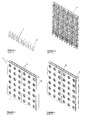
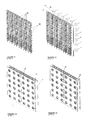
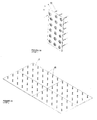
- FIGURES 1-4 are isometric views corresponding to the STEPS 1-4, respectively, in a building sequence of a typical wall member using a prefabricated three-dimensional welded reinforcement framework, standard molding boards and a set of nuts and washer plates according to an embodiment of the present invention
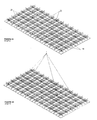
- FIGURES 5-6 are isometric views corresponding to the STEPS 1-2, respectively, in a building sequence of a typical slab member using a prefabricated three-dimensional welded reinforcement framework, standard molding boards and a set of nuts and washer plates according to an embodiment of the present invention
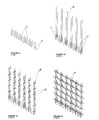
- FIGURES 7-10 are isometric views corresponding to STEPS 1-4, respectively, in a building sequence of a typical wall member using two-dimensional welded reinforcement elements in combination with straight bars, standard molding boards and a set of specially designed connection devices according to an embodiment of the present invention
- FIGURES 11-14 are isometric views corresponding to STEPS 5-8, respectively, in a building sequence of a typical wall member using two-dimensional welded reinforcement elements in combination with straight bars, standard molding boards and a set of specially designed connection devices according to an embodiment of the present invention
- FIGURES 15-16 are isometric views corresponding to STEPS 1-2, respectively, in a building sequence of a typical slab member using two-dimensional welded reinforcement elements in combination with straight bars, standard molding boards and a set of specially designed connection devices according to an embodiment of the present invention
- FIGURES 17-18 are isometric views corresponding to STEPS 3-4, respectively, in a building sequence of a typical slab member using two-dimensional welded reinforcement elements in combination with straight bars, standard molding boards and a set of specially designed connection devices according to an embodiment of the present invention
- FIGURES 19-20 are isometric views corresponding to STEPS 5-6, respectively, in a building sequence of a typical slab member using two-dimensional welded reinforcement elements in combination with straight bars, standard molding boards and a set of specially designed connection devices according to an embodiment of the present invention
- FIGURES 21-24 are isometric views corresponding to STEPS 1-4 in a building sequence of a typical wall member using straight and bent single bars, standard molding boards and a set of specially designed connection devices according to an embodiment of the present invention
- FIGURES 25-26 are isometric views corresponding to STEPS 5-6 in a building sequence of a typical wall member using straight and bent single bars, standard molding boards and a set of specially designed connection devices according to an embodiment of the present invention
- FIGURES 27-28 are isometric views corresponding to STEPS 7-8 in a building sequence of a typical wall member using straight and bent single bars, standard molding boards and a set of specially designed connection devices according to an embodiment of the present invention
- FIGURES 29-30 are isometric views corresponding to STEPS 1-2 in a building sequence of a typical slab member using straight and bent single bars, standard molding boards and a set of specially designed connection devices according to an embodiment of the present invention
- FIGURES 31-32 are isometric views corresponding to STEPS 3-4 in a building sequence of a typical slab member using straight and bent single bars, standard molding boards and a set of specially designed connection devices according to an embodiment of the present invention
- FIGURES 33-34 are isometric views corresponding to STEPS 5-6 in a building sequence of a typical slab member using straight and bent single bars, standard molding boards and a set of specially designed connection devices according to an embodiment of the present invention
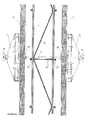
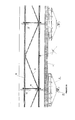
- FIGURE 35 is a side view corresponding to a vertical section of a wall member with a three dimensional welded reinforcement web showing a detail of the ties and washer plates that fasten the molding panels according to an embodiment of the present invention
- FIGURE 36 is a side view corresponding to a horizontal section of a slab member with a three dimensional reinforcement framework, showing a detail of the ties and washer plates that fasten the molding boards according to an embodiment of the present invention
- FIGURE 37 is a side view corresponding to a section of a slab member with welded bar joists showing a detail of the connection unit formed by a spacer, a bolt and nut tie, and a washer.
- the connection unit interlocks the bars and the molding boards together according to an embodiment of the present invention
- FIGURE 38 is a side view corresponding to vertical and horizontal sections of wall members showing reinforcement with welded bar joists, standard molding boards and connection devices according to an embodiment of the present invention
- FIGURE 39 is a side view corresponding to vertical and horizontal sections of wall members showing reinforcement with welded bar joists, standard molding boards and connection devices according to an embodiment of the present invention
- FIGURE 40 is a side view corresponding to a vertical section of a wall member with welded bars joists showing a detail of the connection unit formed by a spacer, bolt and nut ties, and a pair of washer plates to fasten the standard molding boards according to an embodiment of the present invention
- FIGURE 41 is a side view corresponding to a horizontal section of a wall member with welded bars joists, showing a detail of the same connection unit in FIGURE 40, and a typical bulkhead ending according to an embodiment of the present invention
- FIGURE 42 is a side view corresponding to a section of a wall member with non-welded straight and bent reinforced bars, showing a detail of the connection unit formed by a spacer, a bolt and nut tie, and a pair of washer plates.
- the connection unit interlocks the bars and the molding boards together according to an embodiment of the present invention
- FIGURE 43 is a side view corresponding to a section of a slab member with non-welded straight and bent reinforcement bars, showing a detail of the connection unit formed by a spacer, a bolt and nut tie, and a washer.
- the connection unit interlocks the bars and the molding boards together;
- FIGURE 44 is a side view corresponding to a series of vertical and horizontal prefabricated joists, namely two dimensional welded elements, intended to be used in the building sequence formerly described in FIGURES 7-20;
- FIGURE 45 is a side view corresponding to a series of vertical and horizontal prefabricated joists, namely two dimensional welded elements, intended to be used in the building sequence formerly described in FIGURES 7-20;
- FIGURES 46-48 are plan views of an injected plastic spacer according to an embodiment of the present invention.
- FIGURE 49 is an isometric view of an injected plastic spacer according to an embodiment of the present invention.
- FIGURES 50-52 are plan views of an injected plastic sleeve for connecting overlapped bars.
- the spacer is to be used in the building sequence shown in FIGURES 7-20 and the sleeve is applicable for any of the building sequences of the present invention;
- FIGURES 53, 53' and 54 are plan views of an injected plastic spacer and bar connector according to an embodiment of the present invention.
- the element is to be used in building sequences shown in FIGURES 21-34 to interlock non-welded reinforcement bars and the molding boards together;
- FIGURES 55-56 are axonometric views of separate and assembled parts of an injected plastic spacer and bar connector according to an embodiment of the present invention.
- the element is to be used in building sequences shown in FIGURES 21-30 to interlock non-welded reinforcement bars and the molding boards together;
- FIGURES 57-58 are plan views of an injected plastic conic washer plate according to an embodiment of the present invention.
- FIGURES 59-62 are side views corresponding to sections showing alternative joint seal strips installed in between molding panel edges to prevent leakage of the forms according to an embodiment of the present invention.
- FIGURES 1-4 are isometric views corresponding to the STEPS 1-4, respectively, in a building sequence of a typical wall member using a prefabricated three-dimensional welded reinforcement framework, standard molding boards and a set of nuts and washer plates according to an embodiment of the present invention.
- FIGURES 1-4 illustrate a building sequence shown in 4 steps, through Figs. 1 to 4, of a typical wall member, corresponding to a prefabricated three-dimensional welded reinforcement framework (namely, a cage) assembled to standard molding boards preferably by means of a set nuts and washer plates, as further detailed in Fig. 35.
- Fig. 1 designates an initial stage with overlapped stem bars (1) vertical outset sprouting from a floor slab, a footing or a lower wall member, aligned as to receive the cage preferably fitted in specially designed plastic sleeves (2), which are further detailed in Figs. 50, 51 and 52.
- Fig. 2 corresponds to the setting of the framework, which consists in a three-dimensional rigid structure substantially formed by some or all of the required concrete's reinforcement bars.
- the preferred arrangement shown is a prefabricated cage (3) formed by a typical double curtain made of welded-wire fabrics which are inter-connected by welded wire ties and diagonal webs. Extra bars may be added attached to the cage with common wire or plastic ties, according to specific structural design.
- Fig. 3 corresponds to the setting of molding sheathing (sides (4) and bulkhead panel (5)).
- These panels may be of plywood (typical 3/4" thick shown), wood particles, or other materials, as metals or plastics (such as transparent acrylic for seeing through or polyurethane, to be left in place for insulation).
- the panels are perforated with bores that match the ties in the cage, to let them pass through as fasteners.
- the preferred solution in order to fasten the molds to the cage considers wire ties with threaded tips secured by nuts and washer plates (6), for stress distribution on the panels, although other means, such as clamps or brackets with studs and walers may be used for the same purpose.
- the design of the washer plates is detailed in Figs. 57 and 58.
- a continuos strip seal (7) is to be placed between the joints as a gasket to prevent leakage of the forms.
- Several alternative joint seal strips in combination with square cut edges or other sheathing siding patterns, to be used depending on the desired concrete surface finishing, are further detailed in Fig. 59, 60, 61 and 62.
- the bulkhead panel has a pair of grooves into which the side panels edges are inserted to assure proper alignment and seal, and saw-cut slots at both sides to let tensioned strap fasteners, as further detailed in Fig. 41.
- Fig. 4 designates the final stage of the three-dimensional reinforcement formwork and molding assembly of a wall, ready for concrete placement.
- the preferred embodiment shown considers tensioned straps (8) belted on the washer plates to tighten the assemblage of panels for accurately sealing its joints.
- FIGURES 5-6 are isometric views corresponding to the STEPS 1-2, respectively, in a building sequence of a typical slab member using a prefabricated three-dimensional welded reinforcement framework, standard molding boards and a set of nuts and washer plates according to an embodiment of the present invention.
- FIGURES 5-6 illustrate a building sequence shown in two steps, through Figs. 5 to 6, of a typical slab member, corresponding to a prefabricated cage assembled to standard molding boards by means of a set of nuts and washer plates, as further detailed in Fig.36.
- Fig. 5 designates an initial stage, where the molding panels (4) are set as in the case before referred to wall members in Fig. 3, but only on one side of the reinforcement cage (10), which is momentarily hold in vertical position (or if preferred, horizontally up side down) to allow convenient access for placing them.
- the preferred arrangement shown is a prefabricated cage (10) formed by some or all of the concrete's reinforcement bars, with a double curtain reinforcement made of welded wire fabrics that are inter-connected by welded diagonal wire webs and welded wire.
- Fig. 6 designates the final stage of the cage and molding assembly for a slab, in which it is tilted and placed in horizontal position with the sheathing's face downwards, and then lifted and putted on scaffolding for pouring concrete in place. Extra reinforcement bars may be added at this stage, if needed according to structural design.
- FIGURES 7-10 are isometric views corresponding to STEPS 1-4, respectively, in a building sequence of a typical wall member using two-dimensional welded reinforcement elements in combination with straight bars, standard molding boards and a set of specially designed connection devices according to an embodiment of the present invention.
- FIGURES 11-14 are isometric views corresponding to STEPS 5-8, respectively, in a building sequence of a typical wall member using two-dimensional welded reinforcement elements in combination with straight bars, standard molding boards and a set of specially designed connection devices according to an embodiment of the present invention.
- FIGURES 7-14 illustrate a building sequence shown in eight steps, through Figs.7 to 14, of a typical wall member, using a reinforcement framework formed by the assembly of prefabricated substantially two-dimensional welded wire elements, namely joists, and single bars with standard molding boards, by means of specially designed connection devices, such as spacers, sleeves, washer plates and joint seal strips.
- the assembly of the elements is shown in Figs. 38 and 39, and in further detail in Figs. 40 and 41.
- the joists are detailed in Figs. 44 and 45.
- the sleeves are detailed in Figs. 50, 51 and 52, and the washers are detailed in Figs. 57 and 58, and the joint seals are detailed in Figs. 59, 60, 61 and 62.
- Fig. 7 designates an initial stage with the overlapped stem bars (1) vertical outset sprouting from a floor slab, a footing or a lower wall member, aligned as to receive the reinforcement framework preferably fitted in the specially designed plastic sleeves (2).
- Fig. 8 corresponds to step 2, with the setting of the vertical reinforcement joists (13). Each of these is preferably fixed to the stem bars by means of a pair of the spacers (14) and the sleeves (2).
- Fig. 9 corresponds to step 3, with the setting of an upper horizontal reinforcement joist (15), intended to properly aligning and stiffen that direction of the entire assemblage.
- the joist is preferably as detailed in Fig. 45.
- Fig. 10 corresponds to step 4, with the setting of the single vertical bars (16) that form part of a typical double curtain reinforcement. These bars are preferably fixed inserted downwards in the sleeves and upwards, adjusted in openings let by the wire webs of the horizontal joists.
- Fig. 11 corresponds to step 5, with the setting of single horizontal bars (17) and the plastic spacers (14).
- the horizontal bars are introduced into the aligned openings let by the wire webs of each of the vertical joists, to complete the typical double curtain reinforcement.
- the spacers (14) are set in place pressing the bars so as to get griped into their matching slots at the intersection of the stringers of the vertical reinforcement joists with the horizontal bars.
- the preferred distance between the units of spacers, ties and washers is equal to that of two spaces between bars of the reinforcement curtain, but the distance may vary coordinated with the reinforcement bar distribution and with the stiffness of the formwork, depending on the pressure caused upon the forms by the placement of the fresh concrete.
- Fig. 12 corresponds to step 6, with the setting of the back sheathing (4), usually formed by 3/4" thick plywood or similar boards.
- the boards are perforated with bores of the same diameter of the tie bolts that match the spacer distribution in the reinforcement bar mat.
- the tie bolts (11) are introduced across the washer plates (6), the panels and the corresponding bores in the spacers already located in the bar mat.
- Fig. 13 corresponds to step 7, with the setting of the frontal sheathing (4) and bulkhead mold (5), also usually formed by 3/4" thick plywood or similar boards.
- the frontal boards (4) are, as the back panels, also perforated with bores of the same diameter of the tie bolts, which correspond to the spacer distribution in the bar mat.
- the tie bolts already passed through the spacers are introduced across the matching bores in the boards and washer plates (6) and are secured preferably by wing-nuts.
- the preferred bulkhead panel (5) is similar to that referred before describing Fig. 3.
- Joint seal strips (7) are preferably placed between molding panels to prevent leakage, as already described in reference to Fig. 3.
- Fig. 14 designates the final stage of the building sequence of a wall with a reinforcement net formed by welded bar joists and single bars.
- the preferred embodiment shown considers standard tensioned straps (8) belted on the washer plates to tighten the paneling assemblage for accurately sealing joints.
- FIGURES 15-16 are isometric views corresponding to STEPS 1-2, respectively, in a building sequence of a typical slab member using two-dimensional welded reinforcement elements in combination with straight bars, standard molding boards and a set of specially designed connection devices according to an embodiment of the present invention.
- FIGURES 17-18 are isometric views corresponding to STEPS 3-4, respectively, in a building sequence of a typical slab member using two-dimensional welded reinforcement elements in combination with straight bars, standard molding boards and a set of specially designed connection devices according to an embodiment of the present invention.
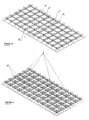
- FIGURES 19-20 are isometric views corresponding to STEPS 5-6, respectively, in a building sequence of a typical slab member using two-dimensional welded reinforcement elements in combination with straight bars, standard molding boards and a set of specially designed connection devices according to an embodiment of the present invention
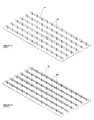
- FIGURES 15-20 illustrate a building sequence shown in six steps of a typical slab member, using a reinforcement framework formed by the assembly of prefabricated substantially two dimensional welded wire joists, and single bars, with standard molding boards, by means of specially designed connection devices such as spacers, bar links and washer plates.
- An assembly of the elements is shown in Fig. 37.
- the preferred spacers and links required are shown in Figs. 46, 47 and 48.
- the preferred washer plates needed are shown in Figs. 57 and 58.
- Fig. 15 designates an initial stage, where preferred units of ties and spacers (14) with bolts (11) and washer plates (6) are set through perforated molding panels (4) (usually 3/4" thick plywood or similar boards). The perforations should match the position and diameters of the bolts, and correspond with the distribution of the reinforcement elements.
- Fig. 16 corresponds to step 2, referred to the placement of the assemblage of the panels (4) with the spacer-tie units (14) on a flat base, to get a proper alignment of the slab's elements.
- seal strips (7), or standard tape should be placed in molding panel joints to prevent leakage.
- Fig. 17 corresponds to step 3, referred to the setting of longitudinal reinforcement joists (19) by pressing their stringers into the matching grips of the spacers, at points where diagonal webs connect the stringers, so as to allow the passage of perpendicular joists.
- Fig. 18 corresponds to step 4, referred to the setting of transversal reinforcement joists (20) by pressing their stringers into the matching grips of the spacers, at points where diagonal webs connect the stringers.
- Specially designed plastic links (18) are set in place pressing the stringer bars of the joists into their grips, to fix additional straight bars.
- Fig. 20 designates the final stage of the reinforcement and molding assembly for a slab member, in which it is lifted and putted on scaffolding, ready for pouring concrete in place.
- FIGURES 21-24 are isometric views corresponding to STEPS 1-4 in a building sequence of a typical wall member using straight and bent single bars, standard molding boards and a set of specially designed connection devices according to an embodiment of the present invention.
- FIGURES 25-26 are isometric views corresponding to STEPS 5-6 in a building sequence of a typical wall member using straight and bent single bars, standard molding boards and a set of specially designed connection devices according to an embodiment of the present invention.
- FIGURES 27-28 are isometric views corresponding to STEPS 7-8 in a building sequence of a typical wall member using straight and bent single bars, standard molding boards and a set of specially designed connection devices according to an embodiment of the present invention.
- FIGURES 21-28 illustrate a building sequence shown in eight steps of a typical wall member using a reinforcement bar mat made of single, non-welded, straight and bent deformed bars, assembled with standard molding boards by means of specially designed connection devices.
- An assemblage of the elements is further shown in Fig. 42.
- the preferred tie-spacer and bar link unit required is further detailed in Figs. 53, 54, 55 and 56.
- the preferred washer plates required are shown in Figs. 57 and 58.
- Fig. 21 designates an initial stage, with the overlapped stem bars vertical outset (1) sprouting from a floor slab, a footing or a lower wall member, aligned as to receive the reinforcement vertical bars fitted in specially designed plastic sleeves (2) (further detailed in Figs. 50, 51 and 52). Otherwise, available mechanical splices may alternatively be used for connecting reinforcement bars.
- Fig. 22 corresponds to step 2, with the setting of vertical reinforcement bars (16), preferably by inserting their tips into the sleeves (2), and also connecting them by introducing each pair of the stems and bars in both sides of the specially designed tie-spacer units (23) further detailed in Figs. 53, 54, 55 and 56. A first row of the tie-spacer units is located in this step.
- Fig. 23 corresponds to step 3, with the setting of vertical diagonal webs (24) (made of reinforcement bars with slightly bent tips) by means of the tie-spacer units (23) that connect pairs of vertical bars belonging to each reinforcement curtain of the wall with the diagonal webs (24).
- Fig. 24 corresponds to step 4, with the setting of horizontal diagonal webs (25), as already described in the precedent step referring to the setting of vertical diagonal webs.
- Fig. 25 corresponds to step 5, with the setting of additional reinforcement bars to meet structural design specific requirements, fixing them in place by means of conventional wire ties or, preferably, using the specially designed plastic links (18) further detailed in Fig. 46 and 48.
- Fig. 26 corresponds to step 6, with the setting of back sheathing (4), usually formed by 3/4" thick plywood or similar boards. The boards are perforated with bores of the same diameter of the tie bolts that match the spacer distribution in the reinforcement bar mat. The tie bolts (11) are introduced across the washer plates (6), the panels and the corresponding bores in the spacers already located in the bar mat.
- Fig. 27 corresponds to step 7, with the setting of the frontal sheathing (4) and bulkhead mold (5), usually formed by 3/4" thick plywood or similar boards.
- the frontal sheathing boards (4) are, as the back panels, also perforated with bores of the same diameter of the tie bolts, which correspond to the spacers distribution in the reinforcement bar mat.
- These frontal panels are set in place as the back panels, with tie bolts introduced across washer plates (6) and threaded into nuts inserted in the spacers already located in the bar mat. All the same, the tightening of such nuts secures the entire rigid structure formed the reinforcement and the forms.
- Removable braces (22) made of metallic angles in L shape with notches at the given distance between ties are successively set on each row of the ties, before tightening them, as rulers to assure proper alignment.
- the preferred bulkhead panel (5) is similar to that referred before when describing Fig.3.
- Joint seal strips (7) are preferably placed between molding panels to prevent leakage, as already described in reference to Fig. 3.
- Fig. 28 designates the final stage of a wall member with a non-welded bar mat and molding boards assembly.
- the preferred embodiment shown considers standard tensioned straps (8) belted on the washer plates to tighten the paneling assemblage for accurately sealing joints.
- FIGURES 29-30 are isometric views corresponding to STEPS 1-2 in a building sequence of a typical slab member using straight and bent single bars, standard molding boards and a set of specially designed connection devices according to an embodiment of the present invention.
- FIGURES 31-32 are isometric views corresponding to STEPS 3-4 in a building sequence of a typical slab member using straight and bent single bars, standard molding boards and a set of specially designed connection devices according to an embodiment of the present invention.
- FIGURES 33-34 are isometric views corresponding to STEPS 5-6 in a building sequence of a typical slab member using straight and bent single bars, standard molding boards and a set of specially designed connection devices according to an embodiment of the present invention;
- FIGURES 29-34 illustrate a building sequence shown in six steps of a typical slab member using a reinforcement bar mat made of single, non-welded, straight and bent deformed bars, assembled with standard molding boards by means of specially designed connection devices.
- An assembly of the elements is shown in Fig. 43.
- the preferred spacers and links required are shown in Figs. 53' and 54.
- the preferred washer plates required are shown in Figs. 57 and 58.
- Fig. 29 designates an initial stage, where preferred units of tie-spacers (26) with bolts (11) and washers (6) are set through perforated molding panels (4), usually 3/4" thick plywood or similar boards. The perforations should match the bolt's diameter and correspond with the distribution of the reinforcement elements.
- Fig. 30 corresponds to step 2, referred to the placement of the assemblage of the panels (4), tie-spacer units (26) and washer plates (6) on a flat base, to assure the alignment of the slab parts.
- Fig. 31 corresponds to step 3, referred to the setting of the longitudinal reinforcement bars (21) by pressing them into the slots of the soft plastic grips of the spacers (26).
- Fig. 32 corresponds to step 4, referred to the setting of longitudinal diagonal webs (27) made of deformed bars with bent tips, by also introducing them into the grips belonging to the spacer units (26)
- Fig. 33 corresponds to step 5, referred to the setting of transversal reinforcement bars (21') and transversal diagonal webs (27'), as described before in the cases of longitudinal bars (21) and longitudinal webs (27).
- a rigid double curtain reinforcement and molding assembly is obtained by tightening the nuts of the tie bolts in the tie-spacer units (26), to press the bars placed in the soft plastic inserts within them as to assure enough grip for attaining the desired stiffness of the entire structure.
- Fig. 34 designates the final stage of the reinforcement and molding assembly for a slab member, in which the additional reinforcement bars needed to meet structural design are fixed in place by means of conventional wire ties or, preferably, using the specially designed plastic links (18) further detailed in Figs. 46 and 48. Then the assemblage is lifted and putted on scaffolding, ready for pouring concrete in place.
- FIGURE 35 is a side view corresponding to a vertical section of a wall member with a three dimensional welded reinforcement web showing a detail of the ties and washer plates that fasten the molding panels according to an embodiment of the present invention.
- Fig. 35 is a vertical section of a wall member with a three-dimensional welded reinforcement web, namely a cage, detailing a preferred assemblage formed by the cage (3), with welded tie rods (3') included, the sheathing in both faces (4), a pair of small washer stoppers (28), and a pair of washer plates (6) for stress distribution on the molding boards, secured by a couple of wing nuts (29) on the tie rods (3') threaded endings.
- This detail renders a partial view of a cage formed by a double curtain reinforcement connected by welded diagonal webs in both vertical and horizontal planes and by the welded tie rods (3').
- the segments of the bars converge approximately at their welded joints to form triangular arrangements so as to stiffen the entire three-dimensional reinforcement bar mat.
- the rigid bar mat is to be prefabricated, either in series of standard bar sizes and formats, or custom built, comprising all the reinforcement needed or at least the minimum required to form a rigid cage, allowing additional single bars to be placed in site, in accordance to specific structural design.
- the tie rods (3') included in the rigid bar mat are located separated from each other at certain distances depending on the molding panels resistance to the local pressure of the placed concrete.
- the washer plates are locked in this preferred embodiment by wing nuts (29) that can be easily installed and removed in the threaded tips of the tie rods, although other devices, such as clamps, may be used for the same purpose.
- the tie rods (3') have a couple of notches to retain the molding panels in their proper position with the preferred aid of a pair of small plastic stopper washers (28) that fit in place. The notches also allow the tie rods to be easily broken by bending them, to withdraw their remaining tips afterwards the forms are removed.
- FIGURE 36 is a side view corresponding to a horizontal section of a slab member with a three dimensional reinforcement framework, showing a detail of the ties and washer plates that fasten the molding boards according to an embodiment of the present invention.
- FIGURE 37 is a side view corresponding to a section of a slab member with welded bar joists showing a detail of the connection unit formed by a spacer, a bolt and nut tie, and a washer. The connection unit interlocks the bars and the molding boards together according to an embodiment of the present invention;
- Fig. 36 and Fig. 37 are vertical sections of slab members, either formed by welded joists (substantially two-dimensional elements) and straight bars (substantially linear elements), or completely prefabricated with a welded three-dimensional rigid reinforcement web.
- Fig. 36 shows a detail of a preferred assemblage formed by the three-dimensional reinforcement cage (10), the sheathing (4), a welded tie-rod (10') and a conic washer plate for stress distribution (6), preferably secured by a wing nut (29). This detail renders a partial view of a larger framework formed by a double curtain reinforcement (10) connected by welded diagonal webs in both longitudinal and transversal planes.
- the substantially linear segments of the bars converge approximately at their welded joints to form triangular arrangements not parallel to the slab plane, so as to stiffen the section of the entire three-dimensional bar mat.
- the rigid bar mat is to be prefabricated as in the case previously referred to Fig. 35.
- Fig. 37 shows a detail of a preferred assemblage formed by the two-dimensional reinforcement elements, namely longitudinal joists (20) and transversal joists (20'), and single bars (21), with the sheathing (4), using tie-spacer units (9).
- the tie-spacer unit (9), further detailed in Fig 46, 47, 48 and 49, is formed by a plastic spacer with slots to grip each of the crossed bars pressed into them, matching both reinforcement curtains, and by removable tie bolts (11).
- the tie-spacer units are to be located in practical coincidence with the intersection of the bars in both curtains and the diagonal webs welded joints, so as to collaborate in stiffening the whole assembly (without causing bending moments on the bars).
- the preferred distance 40 cms. (aprox.
- tie-spacer units between the tie-spacer units must be coordinated with the bar distribution in the reinforcement framework, and also may as well correspond to a module of the molding boards standard format, in accordance with the resistance to the pressure of the poured concrete the boards have in combination with the washer plate (6) that hold them fastened by the tie bolts (11).
- FIGURE 38 is a side view corresponding to vertical and horizontal sections of wall members showing reinforcement with welded bar joists, standard molding boards and connection devices according to an embodiment of the present invention.
- FIGURE 39 is a side view corresponding to vertical and horizontal sections of wall members showing reinforcement with welded bar joists, standard molding boards and connection devices according to an embodiment of the present invention.
- Figs. 38 and 39 correspond to vertical and horizontal sections of a typical wall member setting, with a reinforcement framework formed by the assembly of prefabricated welded wire joists (13)(15), single bars (16)(17) and standard molding boards (4) by means of specially designed connection units (14).
- the joists (13)(15) are further detailed in Figs. 44 and 45.
- the connection units (14) are further detailed in Fig. 46, 47, 48 and 49.
- the washer plates (6) are further detailed in Figs. 57 and 58.
- Alternatives of the joint seal strips (7) are further detailed in Figs. 59, 60, 61 and 62.
- FIGURE 40 is a side view corresponding to a vertical section of a wall member with welded bars joists showing a detail of the connection unit formed by a spacer, bolt and nut ties, and a pair of washer plates to fasten the standard molding boards according to an embodiment of the present invention.
- Fig. 40 is an enlarged detail of the section of the wall member in Fig. 39, that shows the assemblage of molding boards (4), spacers (14), washer plates (6), bolts (11), washers (11') and the reinforcement rigid framework formed by vertical wire joists with a pair of stringers (13') connected by welded trusses (13") of bent wire that lets openings into which perpendicular horizontal straight bars (17) are fitted in as to complete a double curtain bar mat.
- the section A-A' shows the square profile of the spacer (14) with the slots that grip bars at their crossing points.
- FIGURE 41 is a side view corresponding to a horizontal section of a wall member with welded bars joists, showing a detail of the same connection unit in FIGURE 40, and a typical bulkhead ending according to an embodiment of the present invention
- Fig. 41 is an enlarged detail of a typical border of the wall's horizontal section in Fig. 38, that shows the assemblage of side sheathing (4), a bulkhead mold (5), spacers (14), washer plates (6), bolts (11), washers (11') and the reinforcement rigid framework formed by vertical bars and straight bars (16), whose tips are fitted into openings let by a superior horizontal joist (15) with a pair of stringers (15') connected by welded trusses (15").
- the bulkhead mold has a pair of longitudinal grooves into which the edges of both side panels are inserted, and is preferably fastened by tensed straps belted in a groove around the washers (6) and in slots made by saw cuts in the edges of this board.
- FIGURE 42 is a side view corresponding to a section of a wall member with non-welded straight and bent reinforced bars, showing a detail of the connection unit formed by a spacer, a bolt and nut tie, and a pair of washer plates.
- the connection unit interlocks the bars and the molding boards together according to an embodiment of the present invention.
- Fig. 42 is a detailed section of a typical wall member which shows the assemblage of side sheathing (4), spacers (23), washer plates (6), bolts (11), washers (11') and a reinforcement rigid framework with straight vertical (16) and horizontal (25) bars, and diagonal webs (24). The bars are griped by the soft plastic parts of the spacers (23) as the tie-bolts (11) are tightened.
- the spacers (23) are further detailed in Figs. 53, 54, 55 and 56.
- FIGURE 43 is a side view corresponding to a section of a slab member with non-welded straight and bent reinforcement bars, showing a detail of the connection unit formed by a spacer, a bolt and nut tie, and a washer.
- the connection unit interlocks the bars and the molding boards together.
- Fig. 43 is a vertical section of a slab member with a rigid reinforcement web integrated by non-welded straight and bent bars, detailing a preferred arrangement formed by the reinforcement, the sheathing (4), tie-spacer units (26) with washer plates (6) secured by a bolt (11) and nut (11") couple.
- This detail renders a partial view of a larger framework formed by a double curtain reinforcement (21) and diagonal webs (21') in both longitudinal and transversal planes connected between them and with the sheathing (4) by the tie-spacer units (26) in order to attain a rigid structure.
- tie-bolts (11) also support the molding boards through the stress distribution washer plates (6), further detailed in Figs. 57 and 58, interlocking the whole assemblage of reinforcement and sheathing.
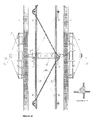
- FIGURE 44 is a side view corresponding to a series of vertical and horizontal prefabricated joists, namely two dimensional welded elements, intended to be used in the building sequence formerly described in FIGURES 7-20.
- Fig. 44 shows a preferred series of prefabricated horizontal joists of standard sizes for typical wall sections, intended for the use considered in the building sequence described in Figs. 7 to 14, and also detailed in Figs. 38, 39 and in Fig. 41.
- the joists stiffen the assemblage of the reinforcement and molding of a wall in its horizontal direction, fixing in place the upper endings of the vertical joists and bars already placed, to form a typical double curtain reinforcement.
- the stringers of the joists correspond to pairs of horizontal bars connected by the welded wire webs that form the triangular arrangements needed to structure a rigid lattice.
- the webs result of a couple of continuous wires bent as shown, in the form of two overlapped zigzag figures. This pattern has a series of openings let between the welded joints of the bent wire webs and the stringers of these horizontal joists, into which the upper tips of the vertical joists are inserted, assuring their proper alignment, and stiffening the wall's reinforcement and molding assembly at its upper horizontal border.
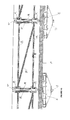
- FIGURE 45 is a side view corresponding to a series of vertical and horizontal prefabricated joists, namely two dimensional welded elements, intended to be used in the building sequence formerly described in FIGURES 7-20.
- Fig. 45 in Print 20 shows a preferred series of prefabricated vertical reinforcement joists of standard measures for several typical wall sections, intended for the use considered in the building sequence described in Figs. 7 to 14 and also detailed in Figs. 38, 39 and in Fig.40.
- the joists stiffen the assemblage of reinforcement and molding of a wall in its vertical direction.
- the stringers of the joists correspond to pairs of the vertical bars that form a typical double curtain reinforcement.
- pairs of bars are connected by welded wire webs that form the triangular arrangements needed to structure a rigid lattice, which may result of a continuous wire bent, as shown, in a zigzag pattern that slightly exceeds the margins of the pair of stringers, so as to let openings into which the horizontal straight bars can be introduced and fitted in position in order to complete a double curtain reinforcement.
- the webs may result of a series of diagonal wire segments, distributed to attain a similar zigzag pattern, with similar triangular configurations formed by the webs welded to the stringers, but with their upper endings passing outside the stringers margins as to form open hooks onto which the horizontal bars of a double curtain reinforcement may be directly laid and fixed in position.
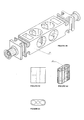
- FIGURES 46-48 are plan views of an injected plastic spacer according to an embodiment of the present invention.
- Figs. 46 and 47 are perpendicular views of a specially designed spacer intended preferably for the use considered in i): the building sequence referring to walls with prefabricated reinforcement joists described in Figs. 7 to 14 and also detailed in Figs. 38 and 39, in Fig. 40 and in Fig. 41.
- the spacer element is composed by a central body (14a) and a pair of terminals (14b), all made of an injected plastic material, such as polypropylene or nylon.
- the central body (14a) is in the general form of regular square prism, with two pairs of perpendicular semi-cylindrical slots at each side into which the reinforcement bars are to be pressed and fitted in place, plus two bores at its longitudinal axis, to let bolts in penetrating from each of its opposite sides up to a couple of void cases containing the corresponding pair of nuts, in order to fasten both sides of the wall's mold without crossing through it a continuous tie that would let it perforated when removed, as is customary.
- threading screws may be driven directly into the spacer's bores, without the need of inserted bolts, to fasten the molding boards.
- the spacer's central body prism may have other cavities to reduce material for economical production.
- the terminals (14b) should be produced in a plurality of different sizes, with slots adjusted to the variety of bar diameters commonly in use, and lengths according to different wall sections.
- the terminals (14b) may be made in one piece with the central body, or else be produced as separate parts, with alternative designs, that could be removed after the concrete has hardened, depending on the desired finishing for such wall or slab element.
- the terminals (14b) should be provided in several sizes according to the specified reinforcement cover, and also in different forms and colors if meant to remain exposed.
- Fig 48 shows a side view of a bar link of an injected plastic material, such as polypropylene or nylon, in the general form of a regular square prism with a pair of semi-cylindrical slots into which the reinforcement bars are to be pressed and fitted in place, plus an axial bore to let through the tie bolt.
- These links are intended to be used for fixing in place single perpendicular bars, as shown in Fig. 19, in Fig. 25 and in Fig. 34.
- FIGURE 49 is an isometric view of an injected plastic spacer according to an embodiment of the present invention.
- Fig. 49 is an axonometric view of the same spacer (14) already described in Figs. 47 and 48.
- FIGURES 50-52 are plan views of an injected plastic sleeve for connecting overlapped bars.
- the spacer is to be used in the building sequence shown in FIGURES 7-20 and the sleeve is applicable for any of the building sequences of the present invention.
- Figs. 50, 51 correspond to perpendicular side views of a sleeve (2) made of an injected plastic material such as polypropylene or nylon, for connecting overlapped reinforcement bars in proper alignment, as shown in Fig.1 Fig.7, and Fig. 21.
- This element has two parallel bores to be used: i) one open bore, for passing through it the overlapped bar, and the other, closed with a stopper ridge in the middle, for inserting the opposite tip of an extension bar in line with that already set in place, and, ii) passing through the open perforation the extension bar and fitting in the closed perforation the tip of the parallel overlapped bar.
- These sleeves (2) should be produced in several sizes, with their perforations adjusted to the variety of bar diameters commonly in use.
- Fig. 52 is an axonometric view of the same sleeve connector (2) already described in Figs. 50 and 51.
- FIGURES 53, 53' and 54 are plan views of an injected plastic spacer and bar connector according to an embodiment of the present invention.
- the element is to be used in building sequences shown in FIGURES 21-34 to interlock non-welded reinforcement bars and the molding boards together.
- Figs. 53 and 54 are perpendicular side views of a specially designed spacer and bar link unit preferably intended for the use considered in the constructive sequence referring to walls with a non-welded rigid bar mat, described in Figs. 21 to 28, and further detailed in Fig.42.
- FIGURES 55-56 are axonometric views of separate and assembled parts of an injected plastic spacer and bar connector according to an embodiment of the present invention.
- the element is to be used in building sequences shown in FIGURES 21-30 to interlock non-welded reinforcement bars and the molding boards together.
- Figs. 55 and 56 are axonometric views of the spacer and bar link described in Fig. 53 and 54.
- Fig. 55 shows its separate parts, which are a central body (23a), a pair of terminals (23b), a pair of bar grips (23c), and a pair of nut cases (23d).
- Fig. 58 shows these parts assembled.
- the central body (23a) is preferably in the general form of a regular square prism, with a border relief at both heads to fit in the bar grip parts (23b), and axial bores to let in tie-bolts from each side up to a pair of cavities containing their nut cases, plus several holes made to reduce material for economical production (that may also be practical to install tubes for other facilities, if required).
- the pair of terminals (23b) support the inside face of the molding boards at each side of a wall, in the system's general assembly. They have a central perforation to let through the bolt that ties this assemblage, with a collar protruding from a square pyramidal base against the sheathing, keeping the bolt concealed from direct contact with concrete and enabling its removal for demolding.
- the pyramidal base has a border relief on the opposite face of the collar to fit in the bar grip part (23b), symmetrical to that in the face of the central body (23a) already described, and four lateral extensions with saw-teeth notches to snap on the matching dented surface of the central body (23a), in order to hold in place the bar grip part (23b) in the meanwhile the bolts (11) are screwed in during the assembly process.
- the bar grip inserts (23c) have a form contained in a regular square prism, with two pairs of perpendicular semi-cylindrical slots at each side into which the reinforcement bars are to be fitted in, and central perforations to let through the bolts (11) that tie the whole spacer unit and sheathing assembly. When the tie-bolts (11) are tightened, the bars set in the inserts get compressed and firmly griped, as to attain a rigid reinforcement cage.
- These bar grips inserts (23c) are to be made of a soft plastic material such as neoprene, or preferably, of a soft plastic material capable of hardening through chemical reaction after the reinforcement bars are set in place.
- the nut cases (23d), that are to be adjusted into cavities in the spacers central body (23a), are designed to set in place standard nuts (23e) matching the tie-bolts threads, as well as protecting them from the placed concrete.
- These spacer units (23) should be produced in several sizes, with their slots in their grip inserts (23c) adjusted to the variety of bar diameters commonly in use, and their lengths according to different wall sections.
- Fig. 53' is a view of similar alternative of the former spacer in Fig. 53, to be used in the slab building sequence described in Figs. 29 to 34 and detailed in Fig. 43, in which the bolts can be tightened only from the upper side, and, thus, a single bolt that crosses it is to be used, instead of the pair considered before for the case of building sequences of walls.
- the spacer (26) is formed by a central body (26a), a lower terminal (26b), an upper terminal (26d) and a pair of bar grips (26c).
- the lower terminal is identical to the terminals "23b", and the pair of bar grips (26c) are the same named "23c" of the spacer "23" described above.
- the central body (26a) is a cylinder that lets through a tie-bolt (11), with a pair of square plates at each end equal to the heads of the central body "23a" described above, to fit in the same bar grip parts (26c) as well.
- the upper terminal (26d) has a similar base to fit the bar grip parts and a case with a snapped-in removable cap to conceal the nut that secures the tie-bolt (11') from the concrete, located leveled with required superior slab surface.
- these spacer units (26) should be produced in several sizes, with their slots in their grip inserts (26c) adjusted to the variety of bar diameters commonly in use, and their lengths according to different slab sections.
- FIGURES 57-58 are plan views of an injected plastic conic washer plate according to an embodiment of the present invention.
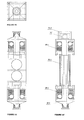
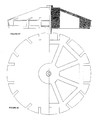
- Figs. 57 and 58 are views of a washer plate (6), preferably made of injected plastic material, or else casted in metal, in the general form of a flat cone with a central perforation, intended as a device to distribute the punctual stress of the tie bolts on the standard 3/4" thick plywood or similar molding boards. It is considered in all the building sequences illustrated in assemblages detailed in Figs. 35, 36, 37, 38, 39, 40, 41, 42 and 43.
- Fig. 57 shows a side view and a section of symmetrical halves
- Fig. 58 shows front and rear in symmetrical halves.
- the washer plates have a groove in their perimeter to allow fixing in place tensioned straps, for the purpose of tightening joints of molding boards, and border notches plus a relief in their rear face, designed to admit adjusted the tips of additional metallic braces in L shape if local extra stiffness in the formwork is required locally. They also have other cavities for reducing weight without loosing strength. Small cylindrical protrusions extending the central bores at their back face are intended to be inserted in the perforations of the panels, to make connections capable of carrying the shear stress caused by the tensioned straps belted around them, in order to press the edges between the molding panels on parallel planes.
- the washers may be produced in several sizes according to the stiffness of the molding panels used, the distance between ties and the local pressure caused on them by the placed concrete.
- FIGURES 59-62 are side views corresponding to sections showing alternative joint seal strips installed in between molding panel edges to prevent leakage of the forms according to an embodiment of the present invention.
- Figs. 59, 60, 61 and 62 are sections of alternative molding panel joints with continuos seal strips made of an extruded plastic material, fitted as gaskets between the panel's edges and pressed by the tensioned straps (8) belted around the washer plates (6), to prevent leakage of the forms, as it has been formerly described with reference to Figs. 3, 4, 13, 14, 27, 28 and 39.
- Fig. 59 shows a cylindrical strip of compressible material (as rubber or neoprene) inserted in a chamber let by the halves of semi - cylindrical grooves made in the edges of standard plywood or similar boards with a router machine. This solution leaves the minimum linear mark on the finished surface of the concrete element.
- Fig. 60 shows a plastic strip with a section that lets in square edges of standard plywood or similar boards. This solution leaves a small rustication on the finished concrete surface.
- Fig. 61 shows a plastic strip with a section that lets in beveled edges of standard plywood or similar boards. This solution leaves two slight linear marks with no relief on the finished concrete element.
- Fig. 62 shows a plastic strip inserted in central grooves saw-cut at both faces of the panel edges. This solution leaves small linear marks on the finished concrete element.
- Figures 1-62 have been drawn to scale to show the structural interrelationships between the elements of the present invention.
Landscapes
- Engineering & Computer Science (AREA)
- Architecture (AREA)
- Civil Engineering (AREA)
- Structural Engineering (AREA)
- Mechanical Engineering (AREA)
- Physics & Mathematics (AREA)
- Electromagnetism (AREA)
- Forms Removed On Construction Sites Or Auxiliary Members Thereof (AREA)
- Reinforcement Elements For Buildings (AREA)
- Conveying And Assembling Of Building Elements In Situ (AREA)
Applications Claiming Priority (2)
| Application Number | Priority Date | Filing Date | Title |
|---|---|---|---|
| US10/100,026 US7191572B2 (en) | 2002-03-19 | 2002-03-19 | Construction method and system |
| US100026 | 2002-03-19 |
Publications (3)
| Publication Number | Publication Date |
|---|---|
| EP1347121A2 true EP1347121A2 (fr) | 2003-09-24 |
| EP1347121A3 EP1347121A3 (fr) | 2005-01-26 |
| EP1347121B1 EP1347121B1 (fr) | 2010-12-01 |
Family
ID=27788326
Family Applications (1)
| Application Number | Title | Priority Date | Filing Date |
|---|---|---|---|
| EP03075797A Expired - Lifetime EP1347121B1 (fr) | 2002-03-19 | 2003-03-19 | Méthode et système de construction |
Country Status (4)
| Country | Link |
|---|---|
| US (1) | US7191572B2 (fr) |
| EP (1) | EP1347121B1 (fr) |
| AT (1) | ATE490385T1 (fr) |
| DE (1) | DE60335156D1 (fr) |
Cited By (12)
| Publication number | Priority date | Publication date | Assignee | Title |
|---|---|---|---|---|
| ITTO20121169A1 (it) * | 2012-12-28 | 2013-03-29 | Michele Caboni | Connettore per l'alloggiamento di profili multiformi, barre e staffe per creazione di gabbie di armature antisismiche diffuse e relativo sistema costruttivo modulare. |
| WO2013104809A1 (fr) * | 2012-01-10 | 2013-07-18 | Pellicer Carlos F | Procédé de fabrication de panneaux préfabriqués en ferrociment et panneau correspondant |
| WO2014048909A1 (fr) * | 2012-09-28 | 2014-04-03 | Harsco Infrastructure Services Gmbh | Coffrage de mur avec point d'ancrage optionnel |
| WO2014048908A1 (fr) * | 2012-09-28 | 2014-04-03 | Harsco Infrastructure Services Gmbh | Coffrage de mur et système de coffrage de mur |
| FR3006701A1 (fr) * | 2013-06-06 | 2014-12-12 | Sn Schoonberg Tp | Procede et dispositif pour la fabrication de murs banches au moyen d'un coffrage reutilisable et comportant au moins un cadre ajoure |
| FR3006700A1 (fr) * | 2013-06-06 | 2014-12-12 | Sn Schoonberg Tp | Procede et dispositif pour la fabrication de murs banches au moyen d'un coffrage reutilisable et d'un ferraillage d'armement |
| RU2608374C1 (ru) * | 2015-09-08 | 2017-01-18 | Сергей Михайлович Анпилов | Способ возведения теплоизолирующей стены здания с использованием несъёмной опалубки |
| US9593487B2 (en) * | 2014-09-05 | 2017-03-14 | James F. Harvey | Modular building system |
| CN111236627A (zh) * | 2020-01-16 | 2020-06-05 | 浙江省一建建设集团有限公司 | 一种高墙体混凝土一次性浇筑成型模板 |
| WO2021110277A1 (fr) * | 2019-12-06 | 2021-06-10 | Laszlo Mathe | Agencement pour réaliser une paroi à isolation thermique, dispositif d'assemblage, dispositif de fixation et panneau |
| CN116556588A (zh) * | 2023-06-12 | 2023-08-08 | 张家港市永茂住宅工业有限公司 | 一种分体式内置钢筋混凝土预制件结构及其成型方法 |
| CN116837824A (zh) * | 2023-06-20 | 2023-10-03 | 中国五冶集团有限公司 | 一种适用于基坑中的坑成型的一体化模板装置及使用方法 |
Families Citing this family (20)
| Publication number | Priority date | Publication date | Assignee | Title |
|---|---|---|---|---|
| US7934693B2 (en) * | 2003-11-25 | 2011-05-03 | Bravinski Leonid G | Formwork for erecting reinforced concrete walls, including concrete walls with textured surfaces |
| US20040226259A1 (en) * | 2004-07-15 | 2004-11-18 | Thermoformed Block Corp. | System for the placement of modular fill material forming co-joined assemblies |
| US20100193662A1 (en) * | 2009-02-04 | 2010-08-05 | Peter Juen | Form panel system for poured concrete |
| AU2010273189A1 (en) * | 2009-07-16 | 2012-02-09 | Thiess Pty Ltd | Liquefied natural gas tank |
| WO2012112789A1 (fr) * | 2011-02-16 | 2012-08-23 | Robert Graham | Système de bâtiment modulaire |
| CN102505840B (zh) * | 2011-11-02 | 2013-11-13 | 中建三局第二建设工程有限责任公司 | 一种循环可调式角钢支撑系统及加工方法 |
| US9624681B2 (en) * | 2011-11-14 | 2017-04-18 | OuiCanDuit, LLC | Guardrail stanchion and system |
| CN102808508B (zh) * | 2012-06-05 | 2015-02-25 | 中国建筑第四工程局有限公司 | 设有变形缝的钢筋砼结构浇筑方法及变形缝钢飞模模板 |
| RU2519314C1 (ru) * | 2013-01-18 | 2014-06-10 | Алексей Николаевич Чеканов | Несъемная опалубка |
| WO2015154132A1 (fr) * | 2014-04-07 | 2015-10-15 | Nxt Enterprise Ltd | Système de construction |
| CN104775617A (zh) * | 2015-04-13 | 2015-07-15 | 中冶建工集团有限公司 | 现浇混凝土模板加固方法 |
| US12428832B2 (en) | 2016-10-06 | 2025-09-30 | NXT Building System Pty. Ltd. | Building system |
| AU2018100404B4 (en) * | 2018-03-29 | 2020-07-30 | Columnform Pty Ltd | An improved column forming apparatus and process |
| AU2018206763B2 (en) * | 2018-04-08 | 2020-06-25 | Aus Chairs Pty Ltd | Reinforcing Spacer |
| CN111005485B (zh) * | 2019-12-09 | 2025-08-19 | 西藏藏建科技股份有限公司 | 一种高强度复合降噪楼板结构 |
| PE20220886A1 (es) * | 2020-10-28 | 2022-05-30 | Rubio Juan Fernando Ljubicic | Sistema de encofrado basado en piezas universales |
| CN113565237A (zh) * | 2021-07-19 | 2021-10-29 | 中国建筑一局(集团)有限公司 | 一种适用于净水厂的配水花墙结构及其施工方法 |
| CN113356474B (zh) * | 2021-07-20 | 2024-10-11 | 九冶钢结构有限公司 | 一种变截面箱型钢柱结构及其制作方法 |
| CN113529970A (zh) * | 2021-08-04 | 2021-10-22 | 山西职业技术学院 | 一种装配式钢结构建筑墙体与柱连接结构 |
| US12188232B2 (en) * | 2022-06-16 | 2025-01-07 | ICF Building Systems LLC | Concrete form systems, devices, and related methods |
Citations (7)
| Publication number | Priority date | Publication date | Assignee | Title |
|---|---|---|---|---|
| US1162554A (en) | 1914-01-10 | 1915-11-30 | Earle A Berry | Concrete-mold. |
| US2099260A (en) | 1936-04-27 | 1937-11-16 | Samuel S Colt | Concrete form and reenforcement retaining means |
| US2160489A (en) | 1939-05-30 | Spreader for building concrete | ||
| US4936540A (en) | 1989-02-13 | 1990-06-26 | Boeshart Patrick E | Tie for concrete forms |
| US5209039A (en) | 1992-04-10 | 1993-05-11 | Boeshart Patrick E | Apparatus for interconnecting concrete wall forms |
| US5704180A (en) | 1994-05-10 | 1998-01-06 | Wallsystems International Ltd. | Insulating concrete form utilizing interlocking foam panels |
| US5852907A (en) | 1994-05-23 | 1998-12-29 | Afm Corporation | Tie for foam forms |
Family Cites Families (23)
| Publication number | Priority date | Publication date | Assignee | Title |
|---|---|---|---|---|
| USRE16793E (en) | 1927-11-22 | Concrete-form | ||
| US839021A (en) | 1906-09-19 | 1906-12-18 | William T Mccarthy | Concrete construction. |
| US1735017A (en) | 1927-11-21 | 1929-11-12 | Smith David Raker | Concrete-form tie and spacer |
| US1907618A (en) | 1931-11-09 | 1933-05-09 | Universal Form Clamp Co | Form tie for wall structures |
| US2709292A (en) * | 1951-09-06 | 1955-05-31 | Raymond L Otti | Clamp for concrete forms |
| US3199827A (en) | 1963-01-04 | 1965-08-10 | Dur O Wal National Inc | Forms for plastic material |
| US3197171A (en) | 1963-12-26 | 1965-07-27 | Superior Concrete Accessories | Combined concrete wall form spreaders and reinforcing rod spacer devices |
| DE1288779B (de) | 1964-08-28 | 1969-02-06 | Klaiss Hans Dieter | Vorrichtung zum gegenseitigen Verspannen und Abstandhalten von zwei einander gegenueber aufgestellten Schalungswaenden |
| US3263956A (en) | 1964-09-14 | 1966-08-02 | Dayton Sure Grip And Shore Com | Concrete accessory |
| US3288428A (en) | 1965-06-08 | 1966-11-29 | Dur O Wal National Inc | Preassembled tie construction |
| FR2117739B1 (fr) * | 1970-12-14 | 1973-12-28 | Ctre Internal Etu Techn | |
| US3751867A (en) * | 1971-12-03 | 1973-08-14 | Raymond Lee Organization Inc | Panel to form composite concrete-reinforced wall |
| US4409764A (en) * | 1976-08-02 | 1983-10-18 | Ennis H. Proctor | System and method for reinforced concrete construction |
| US4669234A (en) * | 1985-03-18 | 1987-06-02 | Wilnau John A | Prefabricated wall section |
| US5140794A (en) | 1988-03-14 | 1992-08-25 | Foam Form Systems, Inc. | Forming system for hardening material |
| US4901494A (en) | 1988-12-09 | 1990-02-20 | Miller Brian J | Collapsible forming system and method |
| US5216860A (en) * | 1991-07-16 | 1993-06-08 | Maploca Of Illinois, Inc. | Building system for reinforced concrete construction |
| US5332189A (en) | 1992-11-12 | 1994-07-26 | Tseng Cheng Tzu | Fastener of construction moldboard |
| US5537797A (en) | 1993-11-22 | 1996-07-23 | The Salk Institute For Biological Studies | Modular concrete form system and method for constructing concrete walls |
| US5431368A (en) * | 1994-03-31 | 1995-07-11 | Wilde; Richard L. | Tie for concrete wall forms |
| US5497592A (en) * | 1994-05-19 | 1996-03-12 | Boeshart; Patrick E. | Quick release tie |
| US5922236A (en) * | 1997-04-01 | 1999-07-13 | Zuhl; David M. | Modular forming system for forming concrete foundation walls |
| JP3269808B2 (ja) * | 1998-08-24 | 2002-04-02 | 竹村工業株式会社 | 生コンクリート打設方法及び該方法に使用する型枠装置 |
-
2002
- 2002-03-19 US US10/100,026 patent/US7191572B2/en not_active Expired - Fee Related
-
2003
- 2003-03-19 EP EP03075797A patent/EP1347121B1/fr not_active Expired - Lifetime
- 2003-03-19 DE DE60335156T patent/DE60335156D1/de not_active Expired - Lifetime
- 2003-03-19 AT AT03075797T patent/ATE490385T1/de not_active IP Right Cessation
Patent Citations (7)
| Publication number | Priority date | Publication date | Assignee | Title |
|---|---|---|---|---|
| US2160489A (en) | 1939-05-30 | Spreader for building concrete | ||
| US1162554A (en) | 1914-01-10 | 1915-11-30 | Earle A Berry | Concrete-mold. |
| US2099260A (en) | 1936-04-27 | 1937-11-16 | Samuel S Colt | Concrete form and reenforcement retaining means |
| US4936540A (en) | 1989-02-13 | 1990-06-26 | Boeshart Patrick E | Tie for concrete forms |
| US5209039A (en) | 1992-04-10 | 1993-05-11 | Boeshart Patrick E | Apparatus for interconnecting concrete wall forms |
| US5704180A (en) | 1994-05-10 | 1998-01-06 | Wallsystems International Ltd. | Insulating concrete form utilizing interlocking foam panels |
| US5852907A (en) | 1994-05-23 | 1998-12-29 | Afm Corporation | Tie for foam forms |
Cited By (16)
| Publication number | Priority date | Publication date | Assignee | Title |
|---|---|---|---|---|
| WO2013104809A1 (fr) * | 2012-01-10 | 2013-07-18 | Pellicer Carlos F | Procédé de fabrication de panneaux préfabriqués en ferrociment et panneau correspondant |
| WO2014048909A1 (fr) * | 2012-09-28 | 2014-04-03 | Harsco Infrastructure Services Gmbh | Coffrage de mur avec point d'ancrage optionnel |
| WO2014048908A1 (fr) * | 2012-09-28 | 2014-04-03 | Harsco Infrastructure Services Gmbh | Coffrage de mur et système de coffrage de mur |
| ITTO20121169A1 (it) * | 2012-12-28 | 2013-03-29 | Michele Caboni | Connettore per l'alloggiamento di profili multiformi, barre e staffe per creazione di gabbie di armature antisismiche diffuse e relativo sistema costruttivo modulare. |
| WO2014102844A3 (fr) * | 2012-12-28 | 2014-11-06 | Michele Caboni | Raccord modulaire polyédrique pour loger des profilés à formes multiples, des barres et des étriers en acier à supports |
| FR3006701A1 (fr) * | 2013-06-06 | 2014-12-12 | Sn Schoonberg Tp | Procede et dispositif pour la fabrication de murs banches au moyen d'un coffrage reutilisable et comportant au moins un cadre ajoure |
| FR3006700A1 (fr) * | 2013-06-06 | 2014-12-12 | Sn Schoonberg Tp | Procede et dispositif pour la fabrication de murs banches au moyen d'un coffrage reutilisable et d'un ferraillage d'armement |
| US9593487B2 (en) * | 2014-09-05 | 2017-03-14 | James F. Harvey | Modular building system |
| US20170152659A1 (en) * | 2014-09-05 | 2017-06-01 | James F. Harvey | Modular building system |
| US10156073B2 (en) * | 2014-09-05 | 2018-12-18 | James F. Harvey | Modular building system |
| RU2608374C1 (ru) * | 2015-09-08 | 2017-01-18 | Сергей Михайлович Анпилов | Способ возведения теплоизолирующей стены здания с использованием несъёмной опалубки |
| WO2021110277A1 (fr) * | 2019-12-06 | 2021-06-10 | Laszlo Mathe | Agencement pour réaliser une paroi à isolation thermique, dispositif d'assemblage, dispositif de fixation et panneau |
| GB2589646B (en) * | 2019-12-06 | 2022-06-22 | Mathe Laszlo | Arrangement for forming a thermally insulated wall, connecting means, fixing means and panel |
| CN111236627A (zh) * | 2020-01-16 | 2020-06-05 | 浙江省一建建设集团有限公司 | 一种高墙体混凝土一次性浇筑成型模板 |
| CN116556588A (zh) * | 2023-06-12 | 2023-08-08 | 张家港市永茂住宅工业有限公司 | 一种分体式内置钢筋混凝土预制件结构及其成型方法 |
| CN116837824A (zh) * | 2023-06-20 | 2023-10-03 | 中国五冶集团有限公司 | 一种适用于基坑中的坑成型的一体化模板装置及使用方法 |
Also Published As
| Publication number | Publication date |
|---|---|
| EP1347121B1 (fr) | 2010-12-01 |
| US20030177733A1 (en) | 2003-09-25 |
| DE60335156D1 (de) | 2011-01-13 |
| ATE490385T1 (de) | 2010-12-15 |
| US7191572B2 (en) | 2007-03-20 |
| EP1347121A3 (fr) | 2005-01-26 |
Similar Documents
| Publication | Publication Date | Title |
|---|---|---|
| EP1347121B1 (fr) | Méthode et système de construction | |
| US6832456B1 (en) | Frame unit for use in construction formwork | |
| WO2004113645A1 (fr) | Systemes de coffrage | |
| JP7670753B2 (ja) | 梁の構造、梁主筋配筋用の支持部材、および梁主筋の配筋方法 | |
| EP1836364A1 (fr) | Paroi de coffrage modulaire avec connecteurs de joint en queue d'aronde | |
| EP0927796A1 (fr) | Panneau et système de coffrage | |
| US20060230696A1 (en) | Tendon-identifying, post tensioned concrete flat plate slab and method and apparatus for constructing same | |
| JPH08113981A (ja) | コンクリート建造物の構築方法 | |
| JPH0637794B2 (ja) | 建築物の壁構造及びその構築工法 | |
| JP3271810B2 (ja) | 断熱材打込みハーフpc版の製造方法。 | |
| JP3392132B1 (ja) | 型枠用セパレータ、型枠パネル及びコンクリート打設用型枠システム並びにコンクリートの打設方法 | |
| JPH0380946B2 (fr) | ||
| KR100695491B1 (ko) | 결속구, 선조립 콘크리트 구조물용 거푸집 구조체 및 이를이용한 시공방법 | |
| JPH09221706A (ja) | 路面用床版およびその敷設工法 | |
| KR0178690B1 (ko) | 철근 콘크리트 슬래브의 데크 거어더 및 데크 패널 | |
| AU2002323707B2 (en) | Formwork Systems | |
| JPH0754361A (ja) | 法面や建物等の壁面構築工法及びそれに用いる組立鉄筋 | |
| JP2620118B2 (ja) | 壁及び床のネット型枠工法 | |
| JPH09177240A (ja) | プレキャスト鉄筋コンクリート梁とその架構方法 | |
| KR100392031B1 (ko) | 건물시공용 철골조와 이를 이용한 건물 시공방법 | |
| JP2891113B2 (ja) | 鉄筋コンクリート造り耐震壁の設置工法 | |
| JPH031531Y2 (fr) | ||
| JPH06346471A (ja) | 大型プレキャスト板を用いた鉄筋コンクリート擁壁の施工法 | |
| AU711281B2 (en) | A frame unit for use in construction formwork | |
| KR20250074766A (ko) | 벽체 증타용 거푸집 시스템 |
Legal Events
| Date | Code | Title | Description |
|---|---|---|---|
| PUAI | Public reference made under article 153(3) epc to a published international application that has entered the european phase |
Free format text: ORIGINAL CODE: 0009012 |
|
| AK | Designated contracting states |
Kind code of ref document: A2 Designated state(s): AT BE BG CH CY CZ DE DK EE ES FI FR GB GR HU IE IT LI LU MC NL PT RO SE SI SK TR |
|
| AX | Request for extension of the european patent |
Extension state: AL LT LV MK |
|
| RIC1 | Information provided on ipc code assigned before grant |
Ipc: 7E 04B 2/86 B Ipc: 7E 04C 3/34 B Ipc: 7E 04G 17/06 A |
|
| PUAL | Search report despatched |
Free format text: ORIGINAL CODE: 0009013 |
|
| AK | Designated contracting states |
Kind code of ref document: A3 Designated state(s): AT BE BG CH CY CZ DE DK EE ES FI FR GB GR HU IE IT LI LU MC NL PT RO SE SI SK TR |
|
| AX | Request for extension of the european patent |
Extension state: AL LT LV MK |
|
| 17P | Request for examination filed |
Effective date: 20050318 |
|
| 17Q | First examination report despatched |
Effective date: 20050614 |
|
| AKX | Designation fees paid |
Designated state(s): AT BE BG CH CY CZ DE DK EE ES FI FR GB GR HU IE IT LI LU MC NL PT RO SE SI SK TR |
|
| 17Q | First examination report despatched |
Effective date: 20050614 |
|
| GRAP | Despatch of communication of intention to grant a patent |
Free format text: ORIGINAL CODE: EPIDOSNIGR1 |
|
| GRAS | Grant fee paid |
Free format text: ORIGINAL CODE: EPIDOSNIGR3 |
|
| GRAA | (expected) grant |
Free format text: ORIGINAL CODE: 0009210 |
|
| AK | Designated contracting states |
Kind code of ref document: B1 Designated state(s): AT BE BG CH CY CZ DE DK EE ES FI FR GB GR HU IE IT LI LU MC NL PT RO SE SI SK TR |
|
| REG | Reference to a national code |
Ref country code: GB Ref legal event code: FG4D |
|
| REG | Reference to a national code |
Ref country code: CH Ref legal event code: EP |
|
| REG | Reference to a national code |
Ref country code: CH Ref legal event code: NV Representative=s name: KELLER & PARTNER PATENTANWAELTE AG |
|
| REG | Reference to a national code |
Ref country code: IE Ref legal event code: FG4D |
|
| REG | Reference to a national code |
Ref country code: NL Ref legal event code: T3 |
|
| REF | Corresponds to: |
Ref document number: 60335156 Country of ref document: DE Date of ref document: 20110113 Kind code of ref document: P |
|
| PG25 | Lapsed in a contracting state [announced via postgrant information from national office to epo] |
Ref country code: SI Free format text: LAPSE BECAUSE OF FAILURE TO SUBMIT A TRANSLATION OF THE DESCRIPTION OR TO PAY THE FEE WITHIN THE PRESCRIBED TIME-LIMIT Effective date: 20101201 Ref country code: CY Free format text: LAPSE BECAUSE OF FAILURE TO SUBMIT A TRANSLATION OF THE DESCRIPTION OR TO PAY THE FEE WITHIN THE PRESCRIBED TIME-LIMIT Effective date: 20101201 Ref country code: SE Free format text: LAPSE BECAUSE OF FAILURE TO SUBMIT A TRANSLATION OF THE DESCRIPTION OR TO PAY THE FEE WITHIN THE PRESCRIBED TIME-LIMIT Effective date: 20101201 Ref country code: BG Free format text: LAPSE BECAUSE OF FAILURE TO SUBMIT A TRANSLATION OF THE DESCRIPTION OR TO PAY THE FEE WITHIN THE PRESCRIBED TIME-LIMIT Effective date: 20110301 Ref country code: AT Free format text: LAPSE BECAUSE OF FAILURE TO SUBMIT A TRANSLATION OF THE DESCRIPTION OR TO PAY THE FEE WITHIN THE PRESCRIBED TIME-LIMIT Effective date: 20101201 Ref country code: FI Free format text: LAPSE BECAUSE OF FAILURE TO SUBMIT A TRANSLATION OF THE DESCRIPTION OR TO PAY THE FEE WITHIN THE PRESCRIBED TIME-LIMIT Effective date: 20101201 |
|
| PG25 | Lapsed in a contracting state [announced via postgrant information from national office to epo] |
Ref country code: GR Free format text: LAPSE BECAUSE OF FAILURE TO SUBMIT A TRANSLATION OF THE DESCRIPTION OR TO PAY THE FEE WITHIN THE PRESCRIBED TIME-LIMIT Effective date: 20110302 |
|
| PG25 | Lapsed in a contracting state [announced via postgrant information from national office to epo] |
Ref country code: BE Free format text: LAPSE BECAUSE OF FAILURE TO SUBMIT A TRANSLATION OF THE DESCRIPTION OR TO PAY THE FEE WITHIN THE PRESCRIBED TIME-LIMIT Effective date: 20101201 Ref country code: CZ Free format text: LAPSE BECAUSE OF FAILURE TO SUBMIT A TRANSLATION OF THE DESCRIPTION OR TO PAY THE FEE WITHIN THE PRESCRIBED TIME-LIMIT Effective date: 20101201 Ref country code: EE Free format text: LAPSE BECAUSE OF FAILURE TO SUBMIT A TRANSLATION OF THE DESCRIPTION OR TO PAY THE FEE WITHIN THE PRESCRIBED TIME-LIMIT Effective date: 20101201 Ref country code: PT Free format text: LAPSE BECAUSE OF FAILURE TO SUBMIT A TRANSLATION OF THE DESCRIPTION OR TO PAY THE FEE WITHIN THE PRESCRIBED TIME-LIMIT Effective date: 20110401 Ref country code: ES Free format text: LAPSE BECAUSE OF FAILURE TO SUBMIT A TRANSLATION OF THE DESCRIPTION OR TO PAY THE FEE WITHIN THE PRESCRIBED TIME-LIMIT Effective date: 20110312 |
|
| PG25 | Lapsed in a contracting state [announced via postgrant information from national office to epo] |
Ref country code: RO Free format text: LAPSE BECAUSE OF FAILURE TO SUBMIT A TRANSLATION OF THE DESCRIPTION OR TO PAY THE FEE WITHIN THE PRESCRIBED TIME-LIMIT Effective date: 20101201 Ref country code: SK Free format text: LAPSE BECAUSE OF FAILURE TO SUBMIT A TRANSLATION OF THE DESCRIPTION OR TO PAY THE FEE WITHIN THE PRESCRIBED TIME-LIMIT Effective date: 20101201 |
|
| PLBE | No opposition filed within time limit |
Free format text: ORIGINAL CODE: 0009261 |
|
| STAA | Information on the status of an ep patent application or granted ep patent |
Free format text: STATUS: NO OPPOSITION FILED WITHIN TIME LIMIT |
|
| PG25 | Lapsed in a contracting state [announced via postgrant information from national office to epo] |
Ref country code: DK Free format text: LAPSE BECAUSE OF FAILURE TO SUBMIT A TRANSLATION OF THE DESCRIPTION OR TO PAY THE FEE WITHIN THE PRESCRIBED TIME-LIMIT Effective date: 20101201 Ref country code: MC Free format text: LAPSE BECAUSE OF NON-PAYMENT OF DUE FEES Effective date: 20110331 |
|
| 26N | No opposition filed |
Effective date: 20110902 |
|
| REG | Reference to a national code |
Ref country code: DE Ref legal event code: R097 Ref document number: 60335156 Country of ref document: DE Effective date: 20110902 |
|
| PG25 | Lapsed in a contracting state [announced via postgrant information from national office to epo] |
Ref country code: IT Free format text: LAPSE BECAUSE OF FAILURE TO SUBMIT A TRANSLATION OF THE DESCRIPTION OR TO PAY THE FEE WITHIN THE PRESCRIBED TIME-LIMIT Effective date: 20101201 |
|
| REG | Reference to a national code |
Ref country code: IE Ref legal event code: MM4A |
|
| PG25 | Lapsed in a contracting state [announced via postgrant information from national office to epo] |
Ref country code: IE Free format text: LAPSE BECAUSE OF NON-PAYMENT OF DUE FEES Effective date: 20110319 |
|
| PG25 | Lapsed in a contracting state [announced via postgrant information from national office to epo] |
Ref country code: LU Free format text: LAPSE BECAUSE OF NON-PAYMENT OF DUE FEES Effective date: 20110319 |
|
| PG25 | Lapsed in a contracting state [announced via postgrant information from national office to epo] |
Ref country code: TR Free format text: LAPSE BECAUSE OF FAILURE TO SUBMIT A TRANSLATION OF THE DESCRIPTION OR TO PAY THE FEE WITHIN THE PRESCRIBED TIME-LIMIT Effective date: 20101201 |
|
| PG25 | Lapsed in a contracting state [announced via postgrant information from national office to epo] |
Ref country code: HU Free format text: LAPSE BECAUSE OF FAILURE TO SUBMIT A TRANSLATION OF THE DESCRIPTION OR TO PAY THE FEE WITHIN THE PRESCRIBED TIME-LIMIT Effective date: 20101201 |
|
| PGFP | Annual fee paid to national office [announced via postgrant information from national office to epo] |
Ref country code: CH Payment date: 20140410 Year of fee payment: 12 |
|
| PGFP | Annual fee paid to national office [announced via postgrant information from national office to epo] |
Ref country code: NL Payment date: 20140730 Year of fee payment: 12 |
|
| REG | Reference to a national code |
Ref country code: CH Ref legal event code: PL |
|
| REG | Reference to a national code |
Ref country code: NL Ref legal event code: MM Effective date: 20150401 |
|
| PG25 | Lapsed in a contracting state [announced via postgrant information from national office to epo] |
Ref country code: CH Free format text: LAPSE BECAUSE OF NON-PAYMENT OF DUE FEES Effective date: 20150331 Ref country code: LI Free format text: LAPSE BECAUSE OF NON-PAYMENT OF DUE FEES Effective date: 20150331 |
|
| REG | Reference to a national code |
Ref country code: FR Ref legal event code: PLFP Year of fee payment: 14 |
|
| REG | Reference to a national code |
Ref country code: FR Ref legal event code: PLFP Year of fee payment: 15 |
|
| PGFP | Annual fee paid to national office [announced via postgrant information from national office to epo] |
Ref country code: FR Payment date: 20170330 Year of fee payment: 15 |
|
| PGFP | Annual fee paid to national office [announced via postgrant information from national office to epo] |
Ref country code: GB Payment date: 20170327 Year of fee payment: 15 |
|
| PG25 | Lapsed in a contracting state [announced via postgrant information from national office to epo] |
Ref country code: NL Free format text: LAPSE BECAUSE OF NON-PAYMENT OF DUE FEES Effective date: 20150401 |
|
| PGFP | Annual fee paid to national office [announced via postgrant information from national office to epo] |
Ref country code: DE Payment date: 20170330 Year of fee payment: 15 |
|
| REG | Reference to a national code |
Ref country code: DE Ref legal event code: R119 Ref document number: 60335156 Country of ref document: DE |
|
| GBPC | Gb: european patent ceased through non-payment of renewal fee |
Effective date: 20180319 |
|
| PG25 | Lapsed in a contracting state [announced via postgrant information from national office to epo] |
Ref country code: DE Free format text: LAPSE BECAUSE OF NON-PAYMENT OF DUE FEES Effective date: 20181002 |
|
| PG25 | Lapsed in a contracting state [announced via postgrant information from national office to epo] |
Ref country code: GB Free format text: LAPSE BECAUSE OF NON-PAYMENT OF DUE FEES Effective date: 20180319 |
|
| PG25 | Lapsed in a contracting state [announced via postgrant information from national office to epo] |
Ref country code: FR Free format text: LAPSE BECAUSE OF NON-PAYMENT OF DUE FEES Effective date: 20180331 |