EP1347997B1 - Radikalisch polymerisierbare masse mit erhöhter haftung auf mineralischen untergründen und deren verwendung als klebstoff und dichtungsmasse - Google Patents
Radikalisch polymerisierbare masse mit erhöhter haftung auf mineralischen untergründen und deren verwendung als klebstoff und dichtungsmasse Download PDFInfo
- Publication number
- EP1347997B1 EP1347997B1 EP01983745A EP01983745A EP1347997B1 EP 1347997 B1 EP1347997 B1 EP 1347997B1 EP 01983745 A EP01983745 A EP 01983745A EP 01983745 A EP01983745 A EP 01983745A EP 1347997 B1 EP1347997 B1 EP 1347997B1
- Authority
- EP
- European Patent Office
- Prior art keywords
- curable composition
- composition according
- radically curable
- weight
- meth
- Prior art date
- Legal status (The legal status is an assumption and is not a legal conclusion. Google has not performed a legal analysis and makes no representation as to the accuracy of the status listed.)
- Expired - Lifetime
Links
Classifications
-
- C—CHEMISTRY; METALLURGY
- C09—DYES; PAINTS; POLISHES; NATURAL RESINS; ADHESIVES; COMPOSITIONS NOT OTHERWISE PROVIDED FOR; APPLICATIONS OF MATERIALS NOT OTHERWISE PROVIDED FOR
- C09J—ADHESIVES; NON-MECHANICAL ASPECTS OF ADHESIVE PROCESSES IN GENERAL; ADHESIVE PROCESSES NOT PROVIDED FOR ELSEWHERE; USE OF MATERIALS AS ADHESIVES
- C09J4/00—Adhesives based on organic non-macromolecular compounds having at least one polymerisable carbon-to-carbon unsaturated bond ; adhesives, based on monomers of macromolecular compounds of groups C09J183/00 - C09J183/16
-
- C—CHEMISTRY; METALLURGY
- C08—ORGANIC MACROMOLECULAR COMPOUNDS; THEIR PREPARATION OR CHEMICAL WORKING-UP; COMPOSITIONS BASED THEREON
- C08F—MACROMOLECULAR COMPOUNDS OBTAINED BY REACTIONS ONLY INVOLVING CARBON-TO-CARBON UNSATURATED BONDS
- C08F220/00—Copolymers of compounds having one or more unsaturated aliphatic radicals, each having only one carbon-to-carbon double bond, and only one being terminated by only one carboxyl radical or a salt, anhydride ester, amide, imide or nitrile thereof
- C08F220/02—Monocarboxylic acids having less than ten carbon atoms; Derivatives thereof
- C08F220/10—Esters
- C08F220/20—Esters of polyhydric alcohols or phenols, e.g. 2-hydroxyethyl (meth)acrylate or glycerol mono-(meth)acrylate
-
- C—CHEMISTRY; METALLURGY
- C08—ORGANIC MACROMOLECULAR COMPOUNDS; THEIR PREPARATION OR CHEMICAL WORKING-UP; COMPOSITIONS BASED THEREON
- C08F—MACROMOLECULAR COMPOUNDS OBTAINED BY REACTIONS ONLY INVOLVING CARBON-TO-CARBON UNSATURATED BONDS
- C08F222/00—Copolymers of compounds having one or more unsaturated aliphatic radicals, each having only one carbon-to-carbon double bond, and at least one being terminated by a carboxyl radical and containing at least one other carboxyl radical in the molecule; Salts, anhydrides, esters, amides, imides, or nitriles thereof
- C08F222/10—Esters
- C08F222/1006—Esters of polyhydric alcohols or polyhydric phenols
- C08F222/102—Esters of polyhydric alcohols or polyhydric phenols of dialcohols, e.g. ethylene glycol di(meth)acrylate or 1,4-butanediol dimethacrylate
-
- C—CHEMISTRY; METALLURGY
- C09—DYES; PAINTS; POLISHES; NATURAL RESINS; ADHESIVES; COMPOSITIONS NOT OTHERWISE PROVIDED FOR; APPLICATIONS OF MATERIALS NOT OTHERWISE PROVIDED FOR
- C09D—COATING COMPOSITIONS, e.g. PAINTS, VARNISHES OR LACQUERS; FILLING PASTES; CHEMICAL PAINT OR INK REMOVERS; INKS; CORRECTING FLUIDS; WOODSTAINS; PASTES OR SOLIDS FOR COLOURING OR PRINTING; USE OF MATERIALS THEREFOR
- C09D4/00—Coating compositions, e.g. paints, varnishes or lacquers, based on organic non-macromolecular compounds having at least one polymerisable carbon-to-carbon unsaturated bond ; Coating compositions, based on monomers of macromolecular compounds of groups C09D183/00 - C09D183/16
-
- C—CHEMISTRY; METALLURGY
- C08—ORGANIC MACROMOLECULAR COMPOUNDS; THEIR PREPARATION OR CHEMICAL WORKING-UP; COMPOSITIONS BASED THEREON
- C08F—MACROMOLECULAR COMPOUNDS OBTAINED BY REACTIONS ONLY INVOLVING CARBON-TO-CARBON UNSATURATED BONDS
- C08F220/00—Copolymers of compounds having one or more unsaturated aliphatic radicals, each having only one carbon-to-carbon double bond, and only one being terminated by only one carboxyl radical or a salt, anhydride ester, amide, imide or nitrile thereof
- C08F220/02—Monocarboxylic acids having less than ten carbon atoms; Derivatives thereof
- C08F220/10—Esters
- C08F220/12—Esters of monohydric alcohols or phenols
- C08F220/16—Esters of monohydric alcohols or phenols of phenols or of alcohols containing two or more carbon atoms
- C08F220/18—Esters of monohydric alcohols or phenols of phenols or of alcohols containing two or more carbon atoms with acrylic or methacrylic acids
- C08F220/1808—C8-(meth)acrylate, e.g. isooctyl (meth)acrylate or 2-ethylhexyl (meth)acrylate
-
- C—CHEMISTRY; METALLURGY
- C08—ORGANIC MACROMOLECULAR COMPOUNDS; THEIR PREPARATION OR CHEMICAL WORKING-UP; COMPOSITIONS BASED THEREON
- C08F—MACROMOLECULAR COMPOUNDS OBTAINED BY REACTIONS ONLY INVOLVING CARBON-TO-CARBON UNSATURATED BONDS
- C08F220/00—Copolymers of compounds having one or more unsaturated aliphatic radicals, each having only one carbon-to-carbon double bond, and only one being terminated by only one carboxyl radical or a salt, anhydride ester, amide, imide or nitrile thereof
- C08F220/02—Monocarboxylic acids having less than ten carbon atoms; Derivatives thereof
- C08F220/10—Esters
- C08F220/26—Esters containing oxygen in addition to the carboxy oxygen
- C08F220/28—Esters containing oxygen in addition to the carboxy oxygen containing no aromatic rings in the alcohol moiety
- C08F220/281—Esters containing oxygen in addition to the carboxy oxygen containing no aromatic rings in the alcohol moiety and containing only one oxygen, e.g. furfuryl (meth)acrylate or 2-methoxyethyl (meth)acrylate
-
- Y—GENERAL TAGGING OF NEW TECHNOLOGICAL DEVELOPMENTS; GENERAL TAGGING OF CROSS-SECTIONAL TECHNOLOGIES SPANNING OVER SEVERAL SECTIONS OF THE IPC; TECHNICAL SUBJECTS COVERED BY FORMER USPC CROSS-REFERENCE ART COLLECTIONS [XRACs] AND DIGESTS
- Y10—TECHNICAL SUBJECTS COVERED BY FORMER USPC
- Y10T—TECHNICAL SUBJECTS COVERED BY FORMER US CLASSIFICATION
- Y10T156/00—Adhesive bonding and miscellaneous chemical manufacture
- Y10T156/10—Methods of surface bonding and/or assembly therefor
Definitions
- the present invention relates radically polymerizable compositions, in particular compositions with Good adhesion even on moist mineral substrates.
- Bonding and sealing in high and low Civil engineering requires a permanent good adhesion to mineral Substrates. A special position among these Substrate takes concrete. Because in these application areas In many cases the substrates are moist and after the Application often in direct contact with water, even over on the one hand the initial liability on damp concrete but also on the other hand Long-term adhesion under water of great importance. Both a fast curing, as well as a cure at low temperatures, are economically interesting, because on the one hand reduces the work and waiting times On the other hand, construction projects can be seasonal conditional cold periods do not cause longer delays to lead. Increasingly important in civil engineering the ecology aspect.
- Hydrophilic (meth) acrylates especially hydroxyalkyl (meth) acrylates, or aqueous solutions
- These monomers have long been used to solidify Soils and rocks used.
- GB 1 335 714 and GB 1 303 456 are cited.
- an excellent initial adhesion to damp mineral substrates can be achieved such binders for adhesives and coatings not suitable, since an increased water intake as well as a Liability failure detected after prolonged exposure to water can be.
- Patent EP 0 157 596 which describes a Impregnation, consisting of a hydroxyalkyl acrylate / Dicyclopentenyloxyalkylacrylat mixture and fatty acids.
- the function An impregnation is less in the warranty an adhesive bond as being primarily in a barrier effect and thus in the protection of the underground Water and dissolved in it aggressive ingredients.
- An impregnation is an enrichment of the hydrophobic Ingredients on the surface desirable so that Migration of fatty acids to the surface is not a problem while doing this with an adhesive or a coating can lead to adhesion problems.
- Epoxy acrylates are commonly the reaction products between acrylic or methacrylic acid and epoxy groups Compounds or alcohols understood which for the production of epoxy group-containing compound can be used.
- Epoxy acrylates as adhesives is in the patent literature broadly described. An important area of their commitment lies in the range of dowel masses and chemical anchors. EP 0 199 671, DE 36 17 702 and US Pat. No.
- EP 0 534 201 relates to an alkoxylated Epoxy acrylate, with the advantage that, by the alkoxylation conditionally, a low-viscosity product is obtained, causing the use of reactive diluents such as styrene or methyl methacrylate can be dispensed with.
- this base formulated adhesive has a lack of adhesion to wet concrete.
- cycloaliphatic (meth) acrylates in particular dicyclopentadienyl (meth) acrylate or dicyclopentadienyloxyethyl (meth) acrylate, e.g. Anchor materials are known (see, for example, also EP 0 431 302, EP 0 742 264 and US 5 256 723).
- Anchor materials are known (see, for example, also EP 0 431 302, EP 0 742 264 and US 5 256 723).
- the compositions however, according to the above patent documents lack of adhesion to wet concrete.
- Dicyclopentadienyl (meth) acrylate has the big disadvantage that it has a penetrating disturbing smell, what the application of this monomer severely limits.
- dicyclopentadiene which is the starting material for both dicyclopentadienyl (meth) acrylate as well as for dicyclopentadienyloxyethyl (meth) acrylate represents is also Strong smelling, has a low flash point and is toxic, resulting in the production of these monomers too Problems and overhead.
- JP 11 106 453 describes a binder, which can be used in a variety of ways, among others for the repair of concrete.
- This binder includes Epoxy (meth) acrylate, hydroxy (meth) alkyl acrylate and mandatory dicyclopentadienyloxyalkylene (meth) acrylate and is characterized by a low sensitivity against alkaline media, reduced water absorption as well as a good resistance at elevated temperature out, however, the moisture retention is deficient.
- Urethane acrylates which by the reaction of isocyanates with a hydroxyalkyl (meth) acrylate are widely used because they are one allow easy variation of the mechanics.
- EP 0 432 087 and EP 0 589 831 are those Urethane acrylates in combination with reactive diluents such as styrene or other (meth) acrylates.
- the Preparation of urethane (meth) acrylates is due to the necessary use of isocyanates with a high health risk connected in production. An alcohol is combined with an isocyanate at elevated temperature in one elaborate reaction implemented.
- EP 0 589 831 discloses a combination of epoxy and / or urethane acrylates with inorganic binders and optionally reactive diluents, i.a. Hydroxyalkyl (meth) acrylate.
- Cements, which are the preferred ones hydraulically setting binders, however, are very basic and therefore pose a risk potential in contact with the skin, which is why a waiver on cement is advantageous. It is also due to the homogeneous Distribution of the cement an inherent danger of saponification the acrylate matrix available.
- EP 0 587 332 For improving the adhesion of acrylic emulsions on mineral substrates is described in EP 0 587 332 addition of zinc oxide mentioned.
- US 4,122,074 describes a polyesteraminoalkylalkoxysilane which has a Michael Addition of an amino-functional silane to a unsaturated conjugated polyester can and which are used as a primer can.
- acrylates are critical, since the storage stability as is considered problematic.
- EP 0 327 376 describes the Preparation of a copolymer of vinyl ester and silicon-containing Monomers.
- the binders made therefrom for emulsion paints show a strong improvement Abrasion resistance against silane-free formulations.
- Emulsion polymers have a improved abrasion resistance when - as in EP373866 claimed - an emulsion polymer is used, whose Production in a second step, a post-reaction of epoxysilanes with a vinyl ester emulsion.
- FR 2 615 197 shows that a polymethyl methacrylate based coating on mineral substrates excellent adhesion, if these in advance with aqueous silanes have been treated as primers.
- JP 10 297 982 describes a concrete primer for the concrete repair, which besides 2.5-30 wt .-% of a unsaturated alkoxysilane, 60-90 wt .-% of an unsaturated Epoxyesterharzes, 2.5-30 wt .-% of a hydroxy-functional (Meth) acrylate monomer, and preferably one Solvent with a boiling point less than 120 ° C includes.
- a high silane content is bad to a reliable one Initial liability, especially with highly filled systems to ensure on wet concrete.
- Polymers made from hydrophobic (meth) acrylate monomers and / or oligomers generally indicate poor initial adhesion to mineral substrates, in special wet concrete, on.
- the crosslinking density and thus also the mechanics are steered. So lead, for example, rigid difunctional monomers or Oligomers to rigid systems while high strength, while monofunctional, aliphatic monomers to soft and flexible systems.
- a shortening of the curing time can be although also by heat supply, e.g. Heating by means of thermal Reach sources or IR radiation. In the high and However, civil engineering is often not possible.
- the present invention therefore relates in particular a free-radically curable composition which is characterized is characterized in that it is a mixture of monomers or oligomers of different hydrophilicity respectively.
- hydrophobia contains in certain proportions or from it consists.
- the inventive reactive composition is consequently free from solvents and strong smelling substances such as in particular styrene and methyl methacrylate. It is toxicologically beneficial and has a good adhesion spectrum, allowing pretreatment by means of Primer is not necessary.
- the a central component of the inventive composition represents, has the inventive reactive Mass over an excellent moisture retention.
- the inventive Mass to further increase adhesion adhesion promoter, in particular silanes are added.
- the improvement the liability can be within a short time elevated temperatures and cataplasm conditions (100% relative humidity, 70 ° C) show.
- the selection and the amount of the ( A) more hydrophobic (meth) acrylates referred to as B are within the limits specified depending on the desired properties of the cured product. Flexible systems tend to have a higher content of monofunctional alkyl (meth) acrylates than rigid systems. In addition, in the case of the composition according to the invention, the hydrophobic constituents are incorporated into the matrix, so that separation or migration after curing is thereby prevented.
- an activator is preferably used to accelerate the reaction.
- Suitable activators are known to the skilled person.
- tertiary amines such as N, N-dimethylaniline, N, N-dimethyltoluidine, N, N-diethylaniline, N, N-diethyltoluidine, N, N-bis (2-hydroxyethyl) -p-toluidine, ethoxylated p-Toluidines, N, N-bis (2-hydroxyethyl) -p-toluidine, etc.
- composition according to the invention can be replaced by radicals be hardened.
- one or more Reaction initiators used for curing. Suitable initiators are known from the prior art. Especially suitable organic peroxides, preferred is benzoyl peroxide.
- fillers The presence of additional ingredients in the mass, such as plasticizers, additives for influencing the flow behavior, the venting or the pot life, Polymerization inhibitors and inorganic and organic Fillers is possible.
- the content of fillers depends on the application of the product, since he has the Consistency influences, ranging from liquid to pasty can. For pasty systems is a lot of fillers to 300% by weight based on the sum of A + B + C + D, i. Filling degree 75%, possible, but are preferably quantities between 60% by weight and 240% by weight, i. Filling levels of 37-70 %.
- adhesives Of importance for adhesives is a thixotropic behavior, what a vertical application or such over head allows, and a run on prevented after the pressure relief of Applizier marers. For example, it is important to ensure that the pressability if possible by means of manual ejectors, too at relatively low temperatures (e.g., 5 ° C). Furthermore, preferred compositions are those which have a low Effect flow resistance in a static mixer.
- the inventive reactive composition can for various applications are used. Specially suitable is it for use as an adhesive and sealant, especially for use in high and low Civil engineering.
- Specially suitable is it for use as an adhesive and sealant, especially for use in high and low Civil engineering.
- Examples of the application may be mentioned: concrete repair mortar, Crack injections, underground consolidations, Anchorages of dowels and reinforcing irons, sewer rehabilitation, Adhesive coatings, bridge repairs etc.
- inventive composition can also used as a coating material to protect a surface be a mass according to the invention with a Initiator and then directly, i. without pretreatment, is applied to the substrate.
- a bond or seal including at least one mineral Substrates in particular moist substrates, especially concrete
- a layer of an inventive Mass placed between two substrates, so that both Substrates are in contact with it, or a layer a composition according to the invention is applied to a first substrate applied, followed by a second substrate on the the surface facing away from the first substrate of the inventive Mass is applied.
- the mass can be applied manually or by machine are preferred for smaller applications Hand-applied devices, such as 2-component cartridges or multi-chamber bags, while for larger ones Applications pumps and / or robots are used can.
- the formulations were each on Betonartplatten applied.
- the concrete slabs were previously Sandblasted to a possibly existing concrete skin remove. Subsequently, the plates were with water cleaned.
- a prepared "dry” garden concrete slab had a surface moisture of maximum 2% on.
- the wet concrete slab was stored after analogous cleaning for at least 2 weeks under water at room temperature. Before use, the water present on the surface of the plate was roughly removed with a rag.
- the prepared concrete slab had a surface moisture of between 5 and 10% and was used immediately for the application.
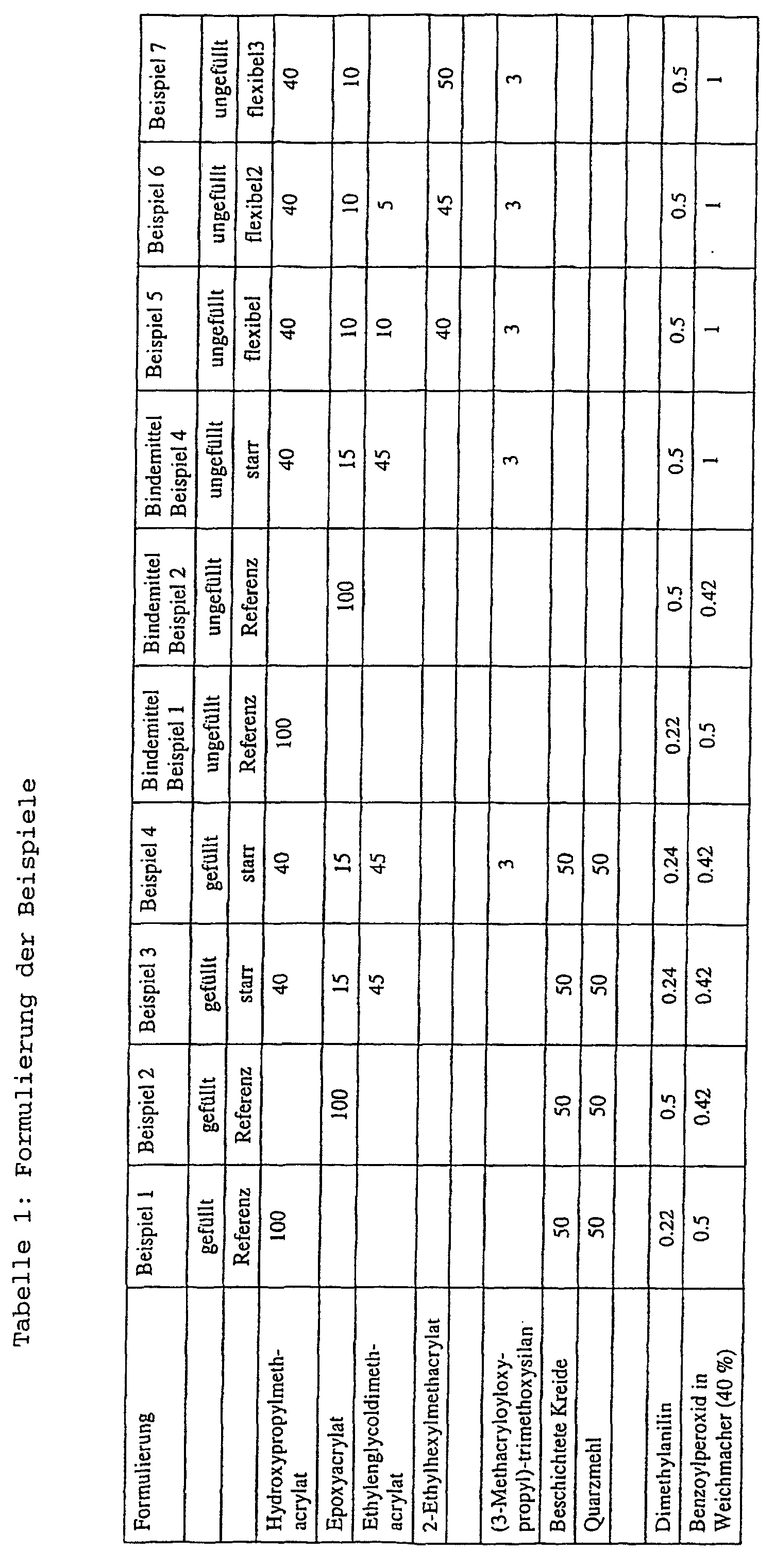
- Table 1 The formulations of Table 1 were used in applied to a layer thickness of about 2 mm.
- the layer thickness was made by means of a self-adhesive tape of this thickness and ensures its subsequent removal.
- the adhesive pull value was a Core hole of 3 cm diameter and about 2 cm depth carried out.
- the surface to be bonded was dried and sanded. Subsequently, a Steel rondelles by means of a fast-curing methacrylate adhesive glued on and the adhesion by means of adhesive puller tested at a pulling speed of approx. 2 mm / min.
- tensile strength shells were prepared and the weight increase after underwater storage was determined by weighing in comparison to the respective weight before storage in water.
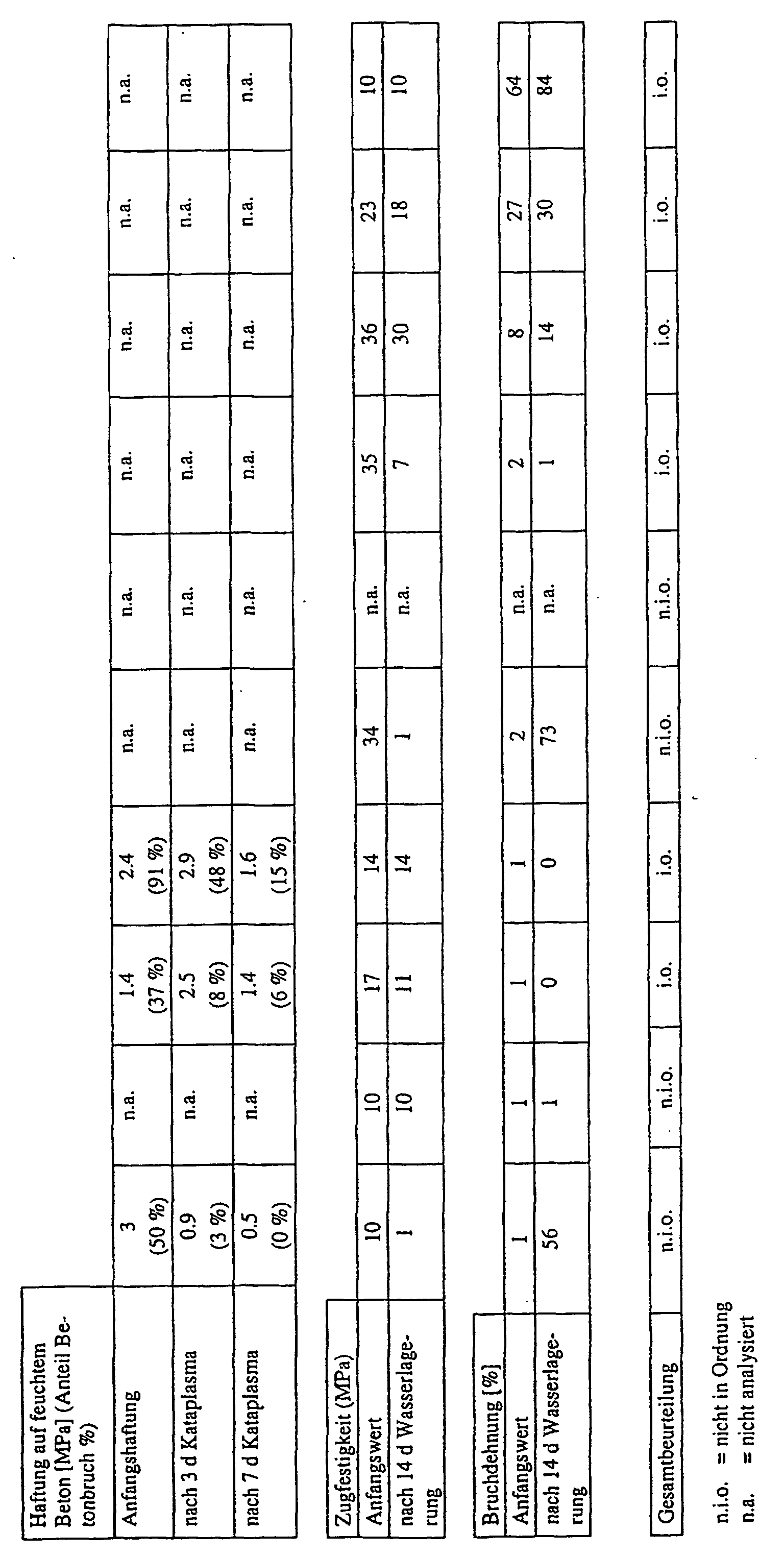
- the dry adhesion of pure epoxy acrylate is from the beginning on a very low level.
- Example 3 shows that both Initial adhesion to wet concrete as well as long-term adhesion is guaranteed.
- Example 4 To the influence of the silane to see the liability Example 4 was performed. It turns out that with silane increased concrete fracture up takes place at a higher level.
- the drastic Conditions of Cataplasma Storage 70 ° C / 100% rel. Humidity
- the formulations Examples 3 and 4 compared to that of the example 1 much longer liability with one have a large proportion of concrete fracture.
- the positive influence The silane is also visible here.
- the measurements Under cataplasm conditions serve as simulation of the Long-term storage of water at room temperature, allowing early Changes are visible.
- Examples 5 and 6 show that by the skillful Choice of hydrophobic monomers flexible binders can be produced. On the determination of others Values were waived.
Landscapes
- Chemical & Material Sciences (AREA)
- Organic Chemistry (AREA)
- Polymers & Plastics (AREA)
- Health & Medical Sciences (AREA)
- Chemical Kinetics & Catalysis (AREA)
- Medicinal Chemistry (AREA)
- Engineering & Computer Science (AREA)
- Materials Engineering (AREA)
- Wood Science & Technology (AREA)
- Life Sciences & Earth Sciences (AREA)
- Adhesives Or Adhesive Processes (AREA)
- Sealing Material Composition (AREA)
- Addition Polymer Or Copolymer, Post-Treatments, Or Chemical Modifications (AREA)
- Polymerization Catalysts (AREA)
- Paints Or Removers (AREA)
Description
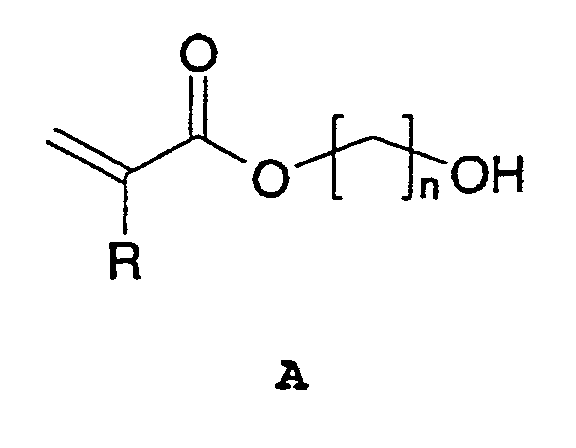
R=H, CH3, und
n = 2 - 4, vorzugsweise 3 oder 4 sind, und

R = H, CH3,
R'= H, CH3, und
n = 1 oder 2 sind,
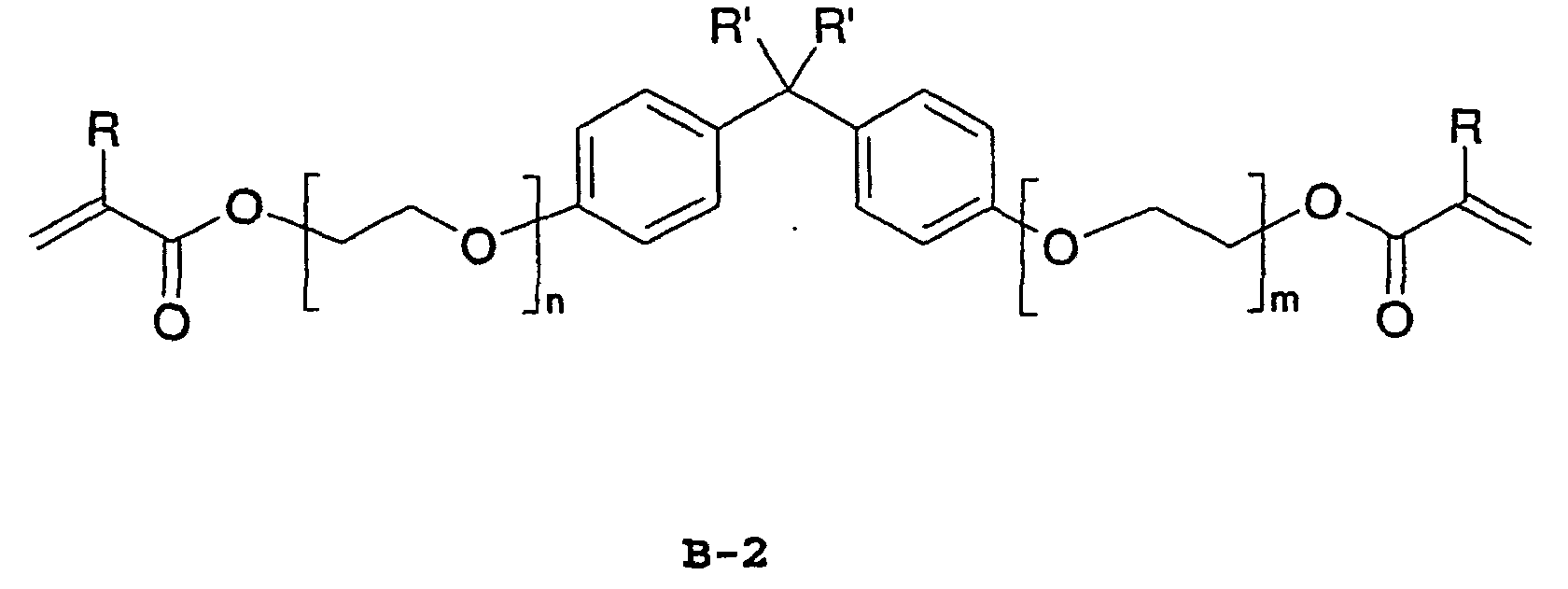
R = H, CH3,
R' = H, CH3,
n = 1 - 3, und
m = 1 - 3 sind,

R = H, CH3, und
n = 2 - 6 sind und

R = H oder CH3,
R'= H oder (CH2)nCH3 mit n = 0-2, insbesondere CH2CH3, und
R"= C3-C20-Alkyl oder Phenoxy oder O-(CH2)n-CH3 mit n = 0-2 ,insbesondere(CH2)3CH3, sind,
wobei die Summe der Gewichtsprozente von A + B = 100 Gew.-% gesetzt wurde und wobei die Summe der Gew.-% von B-1 + B-2 = 0-20 Gew.-%, der Gehalt an B-3 = 0-45 Gew.-% und der Gehalt an B-4 = 0-65 Gew.-% beträgt, und wobei mindestens eine der Verbindungen B-1, B-2 und/oder B-3 vorhanden ist. Die Verbindungen A sind hydrophiler als die Verbindungen B-1 bis B-4, weshalb die Verbindungen A auch als hydrophile, die Verbindungen B-1 bis B-4 als hydrophobe Komponenten bezeichnet werden. Die Summe von B-1 + B-2 + B-3 liegt üblicherweise im Bereich von >0 bis 65 Gew.-%, vorzugsweise im Bereich von 10 bis 65 Gew.-%, insbesondere im Bereich von 30 bis 65 Gew.-% und speziell bevorzugt um etwa 60 Gew.-%.

Claims (27)
- Radikalisch härtbare Masse, dadurch gekennzeichnet, dass sie die folgende Zusammensetzung umfasst:wobei die Summe der Gewichtsprozente von A + B = 100 Gew.-% gesetzt wurde, und wobei die Summe der Gew.-% von B-1 + B-2 = 0-20 Gew.-%, der Gehalt an B-3 = 0-45 Gew.-% und der Gehalt an B-4 = 0-65 Gew.-% beträgt, und wobei mindestens eine Verbindung B ausgewählt ist aus der Gruppe umfassend B-1, B-2, B-3 und Mischungen derselben.a) 31-60 Gew.-% mindestens eines Hydroxyalkyl(meth)acrylates der Formel Aworin
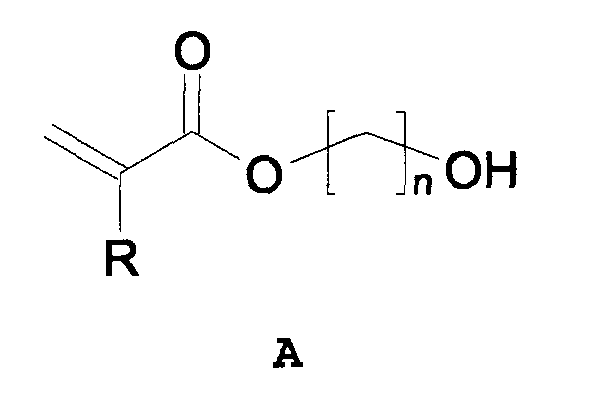
R=H, CH3, und
n = 2 - 4, vorzugsweise 3 oder 4 sind, undb) 40-70 Gew.-% mindestens eines Monomeren und/oder Oligomeren B, ausgewählt aus den folgenden Substanzen B-1, B-2, B-3 und B-4 oder Mischungen derselben, wobeib-1) Verbindungen der Formel B-1worin
R = H, CH3
R' = H, CH3, und
n = 1 oder 2 sind,b-2) Verbindungen der Formel B-2worin
R = H, CH3 ,
R'= H, CH3,
n = 1 - 3, und
m = 1 - 3 sind,b-3) difunktionelle Alkylendi(meth)acrylate B-3, undb-4) monofunktionelle Alkyl(meth)acrylate B-4 bedeuten, und - Radikalisch härtbare Masse gemäss Anspruch 1, dadurch gekennzeichnet, dass sie zusätzlich eine Verbindung B-4 enthält.
- Radikalisch härtbare Masse gemäss einem der vorangehenden Ansprüche, dadurch gekennzeichnet, dass B-3 ausgewählt ist aus mindestens einem difunktionellen Alkylendi(meth)acrylat der folgenden Formel B-3'worin

R = H, CH3 und
n = 2 - 6 sind. - Radikalisch härtbare Masse gemäss einem der vorangehenden Ansprüche, dadurch gekennzeichnet, dass B-4 ausgewählt ist aus einem oder mehreren monofunktionellen Alkyl(meth)acrylaten der folgenden Formel B-4'worin

R = H oder CH3,
R'= H öder (CH2)nCH3 mit n = 0-2, insbesondere CH2CH3, und
R"= C3-C20-Alkyl oder Phenoxy oder O-(CH2)n-CH3 mit n = 0-2 ,insbesondere(CH2)3CH3, sind. - Radikalisch härtbare Masse gemäss einem der vorangehenden Ansprüche, dadurch gekennzeichnet, dass sie zudem Haftvermittler C enthält, wobei der Gehalt an C = 1-10 Gew.-% bezogen auf A + B = 100 Gew.-% beträgt.
- Radikalisch härtbare Masse gemäss Anspruch 5, dadurch gekennzeichnet, dass der Haftvermittler C ein Silan ist, insbesondere ein Silan ausgewählt aus der folgenden Gruppe: 3-Mercaptopropyltrimethoxysilan, (3-Methacryloyloxypropyl)trimethoxysilan und 3-Glycidyloxypropyltrimethoxysilan oder deren Triethoxy-Verbindungen oder Mischungen der genannten Silane.
- Radikalisch härtbare Masse gemäss einem der vorangehenden Ansprüche, dadurch gekennzeichnet, dass sie zudem Beschleuniger D enthält, wobei der Gehalt an D = 0.5-5 Gew.-% bezogen auf A + B = 100 Gew.-% beträgt.
- Radikalisch härtbare Masse gemäss Anspruch 7, dadurch gekennzeichnet, dass der Beschleuniger D ein Aktivator ist, insbesondere ein tertiäres Amin und/oder ein Salz und/oder ein Komplex der Übergangsmetalle.
- Radikalisch härtbare Masse gemäss Anspruch 8, dadurch gekennzeichnet, dass der Beschleuniger D ausgewählt ist aus der Gruppe umfassend N,N-Dimethylanilin, N,N-dimethyltoluidin, N,N-Diethylanilin, N,N-Diethyltoluidin, N,N-bis(2-hydroxyethyl)-p-Toluidin, ethoxylierte p-Toluidine, N,N-bis(2-hydroxyethyl)-p-toluidin oder Mischungen derselben.
- Radikalisch härtbare Masse gemäss Anspruch 8, dadurch gekennzeichnet, dass die Salze und/oder Komplexe der Übergangsmetalle ausgewählt sind aus Salzen oder Komplexen der Übergangsmetalle Kobalt, Nickel und/oder Kupfer.
- Radikalisch härtbare Masse gemäss einem der vorangehenden Ansprüche, dadurch gekennzeichnet, dass sie zur Aushärtung mindestens einen Reaktionsinitiator enthält, insbesondere mindestens ein organisches Peroxid, speziell bevorzugt Benzoylperoxid.
- Radikalisch härtbare Masse gemäss einem der vorangehenden Ansprüche, dadurch gekennzeichnet, dass sie zusätzliche Bestandteile enthält, ausgewählt aus der Gruppe umfassend Weichmacher, Additive zur Beeinflussung des Fliessverhaltens, Additive zur Beeinflussung der Entlüftung, Additive zur Beeinflussung der Topfzeit, Polymerisationsinhibitoren, anorganische Füllstoffe, organische Füllstoffe und Mischungen derselben.
- Radikalisch härtbare Masse gemäss einem der vorangehenden Ansprüche, dadurch gekennzeichnet, dass sie neben dem mindestens einen Hydroxyalkyl(meth)acrylat der Formel A und mindestens einer Verbindung der Formel B mindestens einen Beschleuniger D, mindestens einen Reaktionsinitiator und mindestens eine weitere Verbindung ausgewählt aus der Gruppe bestehend aus Haftvermittler C, Weichmacher, Additiv zur Beeinflussung des Fliessverhaltens, Additiv zur Beeinflussung der Topfzeit, organische Füllstoffe, anorganische Füllstoffe und Mischungen derselben enthält oder daraus besteht.
- Radikalisch härtbare Masse gemäss Anspruch 13, dadurch gekennzeichnet, dass sie aus mindestens einem Hydroxyalkyl(meth)acrylat der Formel A und mindestens einer Verbindung der Formel B, mindestens einem Beschleuniger D, mindestens einem Reaktionsinitiator und mindestens eine weitere Verbindung ausgewählt aus der Gruppe bestehend aus Haftvermittler C, Weichmacher, Additiv zur Beeinflussung des Fliessverhaltens, Additiv zur Beeinflussung der Topfzeit, organische Füllstoffe, anorganische Füllstoffe und Mischungen derselben besteht.
- Radikalisch härtbare Masse gemäss Anspruch 13 oder 14, dadurch gekennzeichnet, dass die mindestens eine weitere Verbindung einen Haftvermittler C enthält oder daraus besteht.
- Radikalisch härtbare Masse gemäss einem der Ansprüche 13 bis 15, dadurch gekennzeichnet, dass die mindestens eine weitere Verbindung ein Additiv zur Beeinflussung der Topfzeit enthält oder daraus besteht.
- Radikalisch härtbare Masse gemäss einem der Ansprüche 13 bis 16, dadurch gekennzeichnet, dass die mindestens eine weitere Verbindung ein Additiv zur Beeinflussung der Topfzeit enthält oder daraus besteht.
- Radikalisch härtbare Masse gemäss einem der Ansprüche 13 bis 17, dadurch gekennzeichnet, dass die mindestens eine weitere Verbindung organische und/oder anorganische Füllstoffe enthält oder daraus besteht.
- Radikalisch härtbare Masse gemäss Anspruch 13, dadurch gekennzeichnet, dass sie aus mindestens einem Hydroxyalkyl(meth)acrylat der Formel A und mindestens einer Verbindung der Formel B, mindestens einem Beschleuniger D, mindestens einem Reaktionsinitiator, mindestens einem Haftvermittler C, mindestens einem Weichmacher, mindestens einem Additiv zur Beeinflussung des Fliessverhaltens, mindestens einem Additiv zur Beeinflussung der Topfzeit und mindestens einem organischen und/oder anorganischen Füllstoff besteht.
- Radikalisch härtbare Masse gemäss Anspruch 13, dadurch gekennzeichnet, dass sie aus mindestens einem Hydroxyalkyl(meth)acrylat der Formel A und mindestens einer Verbindung der Formel B, mindestens einem Beschleuniger D, mindestens einem Reaktionsinitiator, mindestens einem Weichmacher, mindestens einem Additiv zur Beeinflussung des Fliessverhaltens, mindestens einem Additiv zur Beeinflussung der Topfzeit, und mindestens einem organische und/oder mindestens einem anorganischen Füllstoff besteht.
- Radikalisch härtbare Masse gemäss einem der vorangehenden Ansprüche, dadurch gekennzeichnet, dass die Summe von B-1 + B-2 + B-3 im Bereich von >0 bis 65 Gew.-% liegt, vorzugsweise im Bereich von 10 bis 65 Gew.-%, insbesondere im Bereich von 30 bis 65 Gew.-% und speziell bevorzugt um etwa 60 Gew.-%.
- Verwendung einer radikalisch härtbaren Masse gemäss einem der vorangehenden Ansprüche als Beschichtungsmasse.
- Verwendung einer radikalisch härtbaren Masse gemäss einem der Ansprüche 1 bis 21 als Klebstoff und/oder Dichtungsmasse.
- Verwendung gemäss Anspruch 22 oder 23 auf feuchten mineralischen Substraten, insbesondere Beton.
- Verfahren zur Beschichtung eines mineralischen Substrats wie Beton, insbesondere eines feuchten mineralischen Substrats, dadurch gekennzeichnet, dass eine radikalisch härtbare Masse gemäss einem der Ansprüche 1 bis 21 direkt, d.h. ohne Vorbehandlung, auf das Substrat aufgebracht wird.
- Verfahren zur Verklebung oder Abdichtung mineralischer Substrate, insbesondere feuchter Substrate, speziell Beton, dadurch gekennzeichnet, dass eine Schicht einer radikalisch härtbaren Masse gemäss einem der Ansprüche 1 bis 21 zwischen zwei Substrate gebracht wird, derart dass beide Substrate damit in Berührung stehen.
- Verfahren zur Verklebung oder Abdichtung mineralischer Substrate, insbesondere feuchter Substrate, speziell Beton, dadurch gekennzeichnet, dass eine Schicht einer radikalisch härtbaren Masse gemäss einem der Ansprüche 1 bis 21 auf ein erstes Substrat aufgebracht wird, und dass anschliessend ein zweites Substrat auf die dem ersten Substrat abgewandte Oberfläche der radikalisch härtenden Masse aufgebracht wird.
Applications Claiming Priority (3)
| Application Number | Priority Date | Filing Date | Title |
|---|---|---|---|
| EP00125885A EP1209177A1 (de) | 2000-11-27 | 2000-11-27 | Radikalisch polymerisierbare Masse mit erhöhter Haftung auf mineralischen Untergründen und deren Verwendung als Klebstoff und Dichtungsmasse |
| EP00125885 | 2000-11-27 | ||
| PCT/IB2001/002233 WO2002042345A1 (de) | 2000-11-27 | 2001-11-26 | Radikalisch polymerisierbare masse mit erhöhter haftung auf mineralischen untergründen und deren verwendung als klebstoff und dichtungsmasse |
Publications (2)
| Publication Number | Publication Date |
|---|---|
| EP1347997A1 EP1347997A1 (de) | 2003-10-01 |
| EP1347997B1 true EP1347997B1 (de) | 2005-06-15 |
Family
ID=8170489
Family Applications (2)
| Application Number | Title | Priority Date | Filing Date |
|---|---|---|---|
| EP00125885A Withdrawn EP1209177A1 (de) | 2000-11-27 | 2000-11-27 | Radikalisch polymerisierbare Masse mit erhöhter Haftung auf mineralischen Untergründen und deren Verwendung als Klebstoff und Dichtungsmasse |
| EP01983745A Expired - Lifetime EP1347997B1 (de) | 2000-11-27 | 2001-11-26 | Radikalisch polymerisierbare masse mit erhöhter haftung auf mineralischen untergründen und deren verwendung als klebstoff und dichtungsmasse |
Family Applications Before (1)
| Application Number | Title | Priority Date | Filing Date |
|---|---|---|---|
| EP00125885A Withdrawn EP1209177A1 (de) | 2000-11-27 | 2000-11-27 | Radikalisch polymerisierbare Masse mit erhöhter Haftung auf mineralischen Untergründen und deren Verwendung als Klebstoff und Dichtungsmasse |
Country Status (9)
| Country | Link |
|---|---|
| US (2) | US20040026003A1 (de) |
| EP (2) | EP1209177A1 (de) |
| JP (1) | JP2004514750A (de) |
| AT (1) | ATE297953T1 (de) |
| AU (1) | AU2002215165A1 (de) |
| CA (1) | CA2428434A1 (de) |
| DE (1) | DE50106553D1 (de) |
| ES (1) | ES2244669T3 (de) |
| WO (1) | WO2002042345A1 (de) |
Families Citing this family (7)
| Publication number | Priority date | Publication date | Assignee | Title |
|---|---|---|---|---|
| EP1364999A1 (de) * | 2002-05-24 | 2003-11-26 | Sika Schweiz AG | Radikalisch härtbarer Klebstoff frei von cycloaliphatischen (Meth)Acrylaten |
| FR2950059B1 (fr) * | 2009-09-16 | 2016-09-16 | Jacret | Composition pour adhesif structural |
| DE102010013196B4 (de) * | 2010-03-29 | 2015-10-29 | Hilti Aktiengesellschaft | Chemische Zweikomponenten-Mörtelmasse mit verbesserter Haftung an der Oberfläche von halbgereinigten und/oder feuchten Bohrlöchern in mineralischem Untergrund und ihre Verwendung |
| US10633484B2 (en) | 2014-01-10 | 2020-04-28 | Materia, Inc. | Method and composition for improving adhesion of metathesis compositions to substrates |
| CN104046070A (zh) * | 2014-05-05 | 2014-09-17 | 哈尔滨理工大学 | 一种可快速固化的mma地坪涂料 |
| US10392494B2 (en) | 2014-06-24 | 2019-08-27 | Byk-Chemie Gmbh | Latent thickeners, rheology control kit and multi-component systems |
| DE102015222028A1 (de) * | 2015-11-09 | 2017-05-11 | Tesa Se | Kationisch polymerisierbare Polyacrylate enthaltend Alkoxysilangruppen und deren Verwendung |
Family Cites Families (5)
| Publication number | Priority date | Publication date | Assignee | Title |
|---|---|---|---|---|
| US4460625A (en) * | 1981-07-16 | 1984-07-17 | Rohm And Haas Company | Method of coating and impregnating concrete substrates, and products obtained thereby |
| DE3514031A1 (de) * | 1985-04-18 | 1986-10-23 | Hilti Ag, Schaan | Haftmittel auf acrylatharzbasis und deren verwendung zu verankerungen |
| DE3940138A1 (de) * | 1989-12-05 | 1991-06-06 | Hilti Ag | Verwendung haertbarer cycloaliphaten-derivate in duebelmassen |
| EP0619348B1 (de) * | 1993-04-07 | 1998-06-17 | Agomer Gesellschaft mit beschränkter Haftung | Abwaschbare Imprägnierflüssigkeit und deren Verwendung |
| US5387661A (en) * | 1994-05-13 | 1995-02-07 | Minnesota Mining And Manufacturing Company | Polymerizable compositions |
-
2000
- 2000-11-27 EP EP00125885A patent/EP1209177A1/de not_active Withdrawn
-
2001
- 2001-11-26 AU AU2002215165A patent/AU2002215165A1/en not_active Abandoned
- 2001-11-26 AT AT01983745T patent/ATE297953T1/de not_active IP Right Cessation
- 2001-11-26 US US10/416,453 patent/US20040026003A1/en not_active Abandoned
- 2001-11-26 WO PCT/IB2001/002233 patent/WO2002042345A1/de not_active Ceased
- 2001-11-26 JP JP2002545059A patent/JP2004514750A/ja active Pending
- 2001-11-26 CA CA002428434A patent/CA2428434A1/en not_active Abandoned
- 2001-11-26 DE DE50106553T patent/DE50106553D1/de not_active Expired - Lifetime
- 2001-11-26 EP EP01983745A patent/EP1347997B1/de not_active Expired - Lifetime
- 2001-11-26 ES ES01983745T patent/ES2244669T3/es not_active Expired - Lifetime
-
2007
- 2007-03-27 US US11/692,023 patent/US20070187034A1/en not_active Abandoned
Also Published As
| Publication number | Publication date |
|---|---|
| WO2002042345A1 (de) | 2002-05-30 |
| ES2244669T3 (es) | 2005-12-16 |
| DE50106553D1 (de) | 2005-07-21 |
| EP1209177A1 (de) | 2002-05-29 |
| US20040026003A1 (en) | 2004-02-12 |
| JP2004514750A (ja) | 2004-05-20 |
| ATE297953T1 (de) | 2005-07-15 |
| CA2428434A1 (en) | 2002-05-30 |
| US20070187034A1 (en) | 2007-08-16 |
| EP1347997A1 (de) | 2003-10-01 |
| AU2002215165A1 (en) | 2002-06-03 |
Similar Documents
| Publication | Publication Date | Title |
|---|---|---|
| US4400413A (en) | Acrylic polymer concrete compositions | |
| DE60010749T2 (de) | Hydroxide und alkoxide komplexinitiatoren, sowie damit hergestellte systeme, die diese komplexe umfassen und damit hergestellte polymerisierte zusammensetzungen | |
| DE102009043792B4 (de) | Zweikomponenten-Mörtelmasse und ihre Verwendung | |
| DE60021018T3 (de) | Polymerzusammensetzungen | |
| EP2252560B1 (de) | Mehrkomponentige zusammensetzung zum füllen und/oder verpressen von rissen, fehlstellen und hohlräumen bei bauwerken oder boden- und gesteinsformationen | |
| EP2528967B1 (de) | Formulierungen zur herstellung von fahrbahnmarkierungen mit haftung auf trockenem und feuchtem beton | |
| DE2523224A1 (de) | Verfahren zum verstaerken des haftens von organopolysiloxanelastomeren | |
| WO2015090523A1 (de) | Thiole und/oder thiolester und metallsalze als härtersystem in harzzusammensetzungen unter anderem für die befestigungstechnik | |
| EP3775017A1 (de) | Bestimmte verbindungen als beschleuniger für imin/metallsalz-initiierte radikalische polymerisation ungesättigter verbindungen und ihre verwendung als beschleuniger | |
| US20070187034A1 (en) | Radically polymerizable mass with improved adhesion to mineral bases and use thereof as an adhesive and sealing mass | |
| WO2013185993A1 (de) | Härtung von reaktionsharzen unter verwendung von asymmetrischen aminen als beschleuniger | |
| DE2535833C3 (de) | Thixotrope, pastöse und verformbare, zur Polymerisation aktivierbare Masse und Verfahren zu deren Herstellung | |
| US5387661A (en) | Polymerizable compositions | |
| DE2209149A1 (de) | Verfahren zur herstellung von im wesentlichen aus mineralischen baustoffen bestehenden formkoerpern | |
| DE69600086T2 (de) | Zusammensetzung auf der Basis von Dicyclopentadienyloxyestern von (meth)acrylsäure und ihre Verwendung im Bausektor | |
| DE60319048T2 (de) | Klebstoffe mit Vinylestern | |
| DE2029898A1 (de) | Gemische zum Überziehen von aus mineralischen Baustoffen oder Asphalten gebildeten Oberflächen | |
| EP0368226A2 (de) | Wässrige Kunsthartdispersionen | |
| EP4261197B1 (de) | Zweikomponenten-mörtelmasse und deren verwendung | |
| EP0589256A1 (de) | Polymerisate und Polymerdispersionen sowie deren Verwendung in hydraulischen Bindemitteln | |
| EP4261196B1 (de) | Zweikomponenten-mörtelmasse und deren verwendung | |
| DE2401744B2 (de) | Anaerobes Polymerisationsverfahren zum Dichten oder Verbinden von Substraten | |
| EP1364999A1 (de) | Radikalisch härtbarer Klebstoff frei von cycloaliphatischen (Meth)Acrylaten | |
| EP0599733A1 (de) | Polymer Betonzusammensetzung | |
| EP4615930A1 (de) | Hochleistungsmörtel mit tbx und analogen |
Legal Events
| Date | Code | Title | Description |
|---|---|---|---|
| PUAI | Public reference made under article 153(3) epc to a published international application that has entered the european phase |
Free format text: ORIGINAL CODE: 0009012 |
|
| 17P | Request for examination filed |
Effective date: 20030627 |
|
| AK | Designated contracting states |
Kind code of ref document: A1 Designated state(s): AT BE CH CY DE DK ES FI FR GB GR IE IT LI LU MC NL PT SE TR |
|
| AX | Request for extension of the european patent |
Extension state: AL LT LV MK RO SI |
|
| GRAP | Despatch of communication of intention to grant a patent |
Free format text: ORIGINAL CODE: EPIDOSNIGR1 |
|
| GRAS | Grant fee paid |
Free format text: ORIGINAL CODE: EPIDOSNIGR3 |
|
| GRAA | (expected) grant |
Free format text: ORIGINAL CODE: 0009210 |
|
| AK | Designated contracting states |
Kind code of ref document: B1 Designated state(s): AT BE CH CY DE DK ES FI FR GB GR IE IT LI LU MC NL PT SE TR |
|
| PG25 | Lapsed in a contracting state [announced via postgrant information from national office to epo] |
Ref country code: IE Free format text: LAPSE BECAUSE OF FAILURE TO SUBMIT A TRANSLATION OF THE DESCRIPTION OR TO PAY THE FEE WITHIN THE PRESCRIBED TIME-LIMIT Effective date: 20050615 Ref country code: NL Free format text: LAPSE BECAUSE OF FAILURE TO SUBMIT A TRANSLATION OF THE DESCRIPTION OR TO PAY THE FEE WITHIN THE PRESCRIBED TIME-LIMIT Effective date: 20050615 Ref country code: FI Free format text: LAPSE BECAUSE OF FAILURE TO SUBMIT A TRANSLATION OF THE DESCRIPTION OR TO PAY THE FEE WITHIN THE PRESCRIBED TIME-LIMIT Effective date: 20050615 Ref country code: TR Free format text: LAPSE BECAUSE OF FAILURE TO SUBMIT A TRANSLATION OF THE DESCRIPTION OR TO PAY THE FEE WITHIN THE PRESCRIBED TIME-LIMIT Effective date: 20050615 |
|
| REG | Reference to a national code |
Ref country code: GB Ref legal event code: FG4D Free format text: NOT ENGLISH Ref country code: CH Ref legal event code: EP |
|
| REF | Corresponds to: |
Ref document number: 50106553 Country of ref document: DE Date of ref document: 20050721 Kind code of ref document: P |
|
| REG | Reference to a national code |
Ref country code: IE Ref legal event code: FG4D Free format text: LANGUAGE OF EP DOCUMENT: GERMAN |
|
| PG25 | Lapsed in a contracting state [announced via postgrant information from national office to epo] |
Ref country code: DK Free format text: LAPSE BECAUSE OF FAILURE TO SUBMIT A TRANSLATION OF THE DESCRIPTION OR TO PAY THE FEE WITHIN THE PRESCRIBED TIME-LIMIT Effective date: 20050915 Ref country code: SE Free format text: LAPSE BECAUSE OF FAILURE TO SUBMIT A TRANSLATION OF THE DESCRIPTION OR TO PAY THE FEE WITHIN THE PRESCRIBED TIME-LIMIT Effective date: 20050915 Ref country code: GR Free format text: LAPSE BECAUSE OF FAILURE TO SUBMIT A TRANSLATION OF THE DESCRIPTION OR TO PAY THE FEE WITHIN THE PRESCRIBED TIME-LIMIT Effective date: 20050915 |
|
| GBT | Gb: translation of ep patent filed (gb section 77(6)(a)/1977) |
Effective date: 20050915 |
|
| PG25 | Lapsed in a contracting state [announced via postgrant information from national office to epo] |
Ref country code: PT Free format text: LAPSE BECAUSE OF FAILURE TO SUBMIT A TRANSLATION OF THE DESCRIPTION OR TO PAY THE FEE WITHIN THE PRESCRIBED TIME-LIMIT Effective date: 20051124 |
|
| PG25 | Lapsed in a contracting state [announced via postgrant information from national office to epo] |
Ref country code: CY Free format text: LAPSE BECAUSE OF FAILURE TO SUBMIT A TRANSLATION OF THE DESCRIPTION OR TO PAY THE FEE WITHIN THE PRESCRIBED TIME-LIMIT Effective date: 20051126 Ref country code: AT Free format text: LAPSE BECAUSE OF NON-PAYMENT OF DUE FEES Effective date: 20051126 |
|
| PG25 | Lapsed in a contracting state [announced via postgrant information from national office to epo] |
Ref country code: BE Free format text: LAPSE BECAUSE OF NON-PAYMENT OF DUE FEES Effective date: 20051130 Ref country code: MC Free format text: LAPSE BECAUSE OF NON-PAYMENT OF DUE FEES Effective date: 20051130 Ref country code: CH Free format text: LAPSE BECAUSE OF NON-PAYMENT OF DUE FEES Effective date: 20051130 Ref country code: LI Free format text: LAPSE BECAUSE OF NON-PAYMENT OF DUE FEES Effective date: 20051130 Ref country code: LU Free format text: LAPSE BECAUSE OF NON-PAYMENT OF DUE FEES Effective date: 20051130 |
|
| NLV1 | Nl: lapsed or annulled due to failure to fulfill the requirements of art. 29p and 29m of the patents act | ||
| REG | Reference to a national code |
Ref country code: ES Ref legal event code: FG2A Ref document number: 2244669 Country of ref document: ES Kind code of ref document: T3 |
|
| REG | Reference to a national code |
Ref country code: IE Ref legal event code: FD4D |
|
| ET | Fr: translation filed | ||
| PLBE | No opposition filed within time limit |
Free format text: ORIGINAL CODE: 0009261 |
|
| STAA | Information on the status of an ep patent application or granted ep patent |
Free format text: STATUS: NO OPPOSITION FILED WITHIN TIME LIMIT |
|
| 26N | No opposition filed |
Effective date: 20060316 |
|
| REG | Reference to a national code |
Ref country code: CH Ref legal event code: PL |
|
| BERE | Be: lapsed |
Owner name: SIKA SCHWEIZ A.G. Effective date: 20051130 |
|
| PGFP | Annual fee paid to national office [announced via postgrant information from national office to epo] |
Ref country code: DE Payment date: 20091127 Year of fee payment: 9 Ref country code: ES Payment date: 20091126 Year of fee payment: 9 |
|
| PGFP | Annual fee paid to national office [announced via postgrant information from national office to epo] |
Ref country code: FR Payment date: 20091201 Year of fee payment: 9 Ref country code: GB Payment date: 20091125 Year of fee payment: 9 Ref country code: IT Payment date: 20091126 Year of fee payment: 9 |
|
| GBPC | Gb: european patent ceased through non-payment of renewal fee |
Effective date: 20101126 |
|
| REG | Reference to a national code |
Ref country code: FR Ref legal event code: ST Effective date: 20110801 |
|
| REG | Reference to a national code |
Ref country code: DE Ref legal event code: R119 Ref document number: 50106553 Country of ref document: DE Effective date: 20110601 Ref country code: DE Ref legal event code: R119 Ref document number: 50106553 Country of ref document: DE Effective date: 20110531 |
|
| PG25 | Lapsed in a contracting state [announced via postgrant information from national office to epo] |
Ref country code: FR Free format text: LAPSE BECAUSE OF NON-PAYMENT OF DUE FEES Effective date: 20101130 |
|
| PG25 | Lapsed in a contracting state [announced via postgrant information from national office to epo] |
Ref country code: GB Free format text: LAPSE BECAUSE OF NON-PAYMENT OF DUE FEES Effective date: 20101126 |
|
| PG25 | Lapsed in a contracting state [announced via postgrant information from national office to epo] |
Ref country code: IT Free format text: LAPSE BECAUSE OF NON-PAYMENT OF DUE FEES Effective date: 20101126 |
|
| REG | Reference to a national code |
Ref country code: ES Ref legal event code: FD2A Effective date: 20120305 |
|
| PG25 | Lapsed in a contracting state [announced via postgrant information from national office to epo] |
Ref country code: ES Free format text: LAPSE BECAUSE OF NON-PAYMENT OF DUE FEES Effective date: 20101127 |
|
| PG25 | Lapsed in a contracting state [announced via postgrant information from national office to epo] |
Ref country code: DE Free format text: LAPSE BECAUSE OF NON-PAYMENT OF DUE FEES Effective date: 20110531 |