EP1348669B1 - Silice de précipitation presentant une distribution granulométrique étroite - Google Patents
Silice de précipitation presentant une distribution granulométrique étroite Download PDFInfo
- Publication number
- EP1348669B1 EP1348669B1 EP02007442A EP02007442A EP1348669B1 EP 1348669 B1 EP1348669 B1 EP 1348669B1 EP 02007442 A EP02007442 A EP 02007442A EP 02007442 A EP02007442 A EP 02007442A EP 1348669 B1 EP1348669 B1 EP 1348669B1
- Authority
- EP
- European Patent Office
- Prior art keywords
- silica
- drying
- particle size
- process according
- size distribution
- Prior art date
- Legal status (The legal status is an assumption and is not a legal conclusion. Google has not performed a legal analysis and makes no representation as to the accuracy of the status listed.)
- Expired - Lifetime
Links
- VYPSYNLAJGMNEJ-UHFFFAOYSA-N Silicium dioxide Chemical compound O=[Si]=O VYPSYNLAJGMNEJ-UHFFFAOYSA-N 0.000 title claims abstract description 98
- 239000002245 particle Substances 0.000 title claims abstract description 55
- 239000000377 silicon dioxide Substances 0.000 title claims abstract description 46
- 238000009826 distribution Methods 0.000 title claims abstract description 26
- 238000001035 drying Methods 0.000 claims abstract description 40
- 238000000034 method Methods 0.000 claims abstract description 21
- 239000000725 suspension Substances 0.000 claims abstract description 20
- 238000002485 combustion reaction Methods 0.000 claims abstract description 17
- 238000010521 absorption reaction Methods 0.000 claims abstract description 5
- 230000000704 physical effect Effects 0.000 claims abstract 2
- 239000007787 solid Substances 0.000 claims description 11
- 229920001971 elastomer Polymers 0.000 claims description 9
- 239000000203 mixture Substances 0.000 claims description 9
- 239000000806 elastomer Substances 0.000 claims description 8
- 239000011248 coating agent Substances 0.000 claims description 7
- 238000000576 coating method Methods 0.000 claims description 7
- 239000006224 matting agent Substances 0.000 claims description 6
- 230000002209 hydrophobic effect Effects 0.000 claims description 4
- 239000012798 spherical particle Substances 0.000 claims description 3
- 230000001186 cumulative effect Effects 0.000 claims description 2
- 230000001939 inductive effect Effects 0.000 claims 1
- DOIRQSBPFJWKBE-UHFFFAOYSA-N dibutyl phthalate Chemical compound CCCCOC(=O)C1=CC=CC=C1C(=O)OCCCC DOIRQSBPFJWKBE-UHFFFAOYSA-N 0.000 abstract 4
- 239000000047 product Substances 0.000 description 31
- 239000007789 gas Substances 0.000 description 23
- 239000003570 air Substances 0.000 description 16
- VNWKTOKETHGBQD-UHFFFAOYSA-N methane Chemical compound C VNWKTOKETHGBQD-UHFFFAOYSA-N 0.000 description 16
- 239000003345 natural gas Substances 0.000 description 8
- 238000001556 precipitation Methods 0.000 description 6
- 238000005516 engineering process Methods 0.000 description 5
- 238000000889 atomisation Methods 0.000 description 4
- 239000000843 powder Substances 0.000 description 4
- 235000012239 silicon dioxide Nutrition 0.000 description 4
- 239000007921 spray Substances 0.000 description 4
- 238000012360 testing method Methods 0.000 description 4
- 238000002604 ultrasonography Methods 0.000 description 4
- XLYOFNOQVPJJNP-UHFFFAOYSA-N water Substances O XLYOFNOQVPJJNP-UHFFFAOYSA-N 0.000 description 4
- 239000002253 acid Substances 0.000 description 3
- 230000015572 biosynthetic process Effects 0.000 description 3
- 239000006185 dispersion Substances 0.000 description 3
- 230000000694 effects Effects 0.000 description 3
- 238000003801 milling Methods 0.000 description 3
- 238000002360 preparation method Methods 0.000 description 3
- 238000001228 spectrum Methods 0.000 description 3
- 101100117236 Drosophila melanogaster speck gene Proteins 0.000 description 2
- QAOWNCQODCNURD-UHFFFAOYSA-N Sulfuric acid Chemical compound OS(O)(=O)=O QAOWNCQODCNURD-UHFFFAOYSA-N 0.000 description 2
- 239000012080 ambient air Substances 0.000 description 2
- 239000012065 filter cake Substances 0.000 description 2
- 238000000227 grinding Methods 0.000 description 2
- -1 is the uniform Substances 0.000 description 2
- 238000004519 manufacturing process Methods 0.000 description 2
- 238000005259 measurement Methods 0.000 description 2
- 239000003973 paint Substances 0.000 description 2
- 235000019353 potassium silicate Nutrition 0.000 description 2
- 238000010791 quenching Methods 0.000 description 2
- RMAQACBXLXPBSY-UHFFFAOYSA-N silicic acid Chemical compound O[Si](O)(O)O RMAQACBXLXPBSY-UHFFFAOYSA-N 0.000 description 2
- 125000005624 silicic acid group Chemical class 0.000 description 2
- NTHWMYGWWRZVTN-UHFFFAOYSA-N sodium silicate Chemical compound [Na+].[Na+].[O-][Si]([O-])=O NTHWMYGWWRZVTN-UHFFFAOYSA-N 0.000 description 2
- 238000001694 spray drying Methods 0.000 description 2
- 239000000126 substance Substances 0.000 description 2
- 238000009210 therapy by ultrasound Methods 0.000 description 2
- VXEGSRKPIUDPQT-UHFFFAOYSA-N 4-[4-(4-methoxyphenyl)piperazin-1-yl]aniline Chemical compound C1=CC(OC)=CC=C1N1CCN(C=2C=CC(N)=CC=2)CC1 VXEGSRKPIUDPQT-UHFFFAOYSA-N 0.000 description 1
- OKTJSMMVPCPJKN-UHFFFAOYSA-N Carbon Chemical compound [C] OKTJSMMVPCPJKN-UHFFFAOYSA-N 0.000 description 1
- LZZYPRNAOMGNLH-UHFFFAOYSA-M Cetrimonium bromide Chemical compound [Br-].CCCCCCCCCCCCCCCC[N+](C)(C)C LZZYPRNAOMGNLH-UHFFFAOYSA-M 0.000 description 1
- 150000007513 acids Chemical class 0.000 description 1
- 229910052799 carbon Inorganic materials 0.000 description 1
- 239000007795 chemical reaction product Substances 0.000 description 1
- 239000011362 coarse particle Substances 0.000 description 1
- 150000001875 compounds Chemical class 0.000 description 1
- 238000010276 construction Methods 0.000 description 1
- 238000001816 cooling Methods 0.000 description 1
- 239000000498 cooling water Substances 0.000 description 1
- 238000001514 detection method Methods 0.000 description 1
- UBHZUDXTHNMNLD-UHFFFAOYSA-N dimethylsilane Chemical compound C[SiH2]C UBHZUDXTHNMNLD-UHFFFAOYSA-N 0.000 description 1
- 239000000428 dust Substances 0.000 description 1
- 239000000839 emulsion Substances 0.000 description 1
- 239000000945 filler Substances 0.000 description 1
- 239000010419 fine particle Substances 0.000 description 1
- 239000012530 fluid Substances 0.000 description 1
- 239000012634 fragment Substances 0.000 description 1
- 229910021485 fumed silica Inorganic materials 0.000 description 1
- 238000010348 incorporation Methods 0.000 description 1
- 238000009434 installation Methods 0.000 description 1
- 239000007788 liquid Substances 0.000 description 1
- 230000007774 longterm Effects 0.000 description 1
- 238000012423 maintenance Methods 0.000 description 1
- 239000011159 matrix material Substances 0.000 description 1
- 238000002156 mixing Methods 0.000 description 1
- 238000012986 modification Methods 0.000 description 1
- 230000004048 modification Effects 0.000 description 1
- 238000012545 processing Methods 0.000 description 1
- 239000002510 pyrogen Substances 0.000 description 1
- 230000000171 quenching effect Effects 0.000 description 1
- 238000012216 screening Methods 0.000 description 1
- 238000007873 sieving Methods 0.000 description 1
- 239000005049 silicon tetrachloride Substances 0.000 description 1
- 229920002545 silicone oil Polymers 0.000 description 1
- 238000004088 simulation Methods 0.000 description 1
- 238000005549 size reduction Methods 0.000 description 1
- 210000002023 somite Anatomy 0.000 description 1
- 238000000527 sonication Methods 0.000 description 1
- 238000004544 sputter deposition Methods 0.000 description 1
- 239000007858 starting material Substances 0.000 description 1
- 238000012546 transfer Methods 0.000 description 1
Images




Classifications
-
- F—MECHANICAL ENGINEERING; LIGHTING; HEATING; WEAPONS; BLASTING
- F26—DRYING
- F26B—DRYING SOLID MATERIALS OR OBJECTS BY REMOVING LIQUID THEREFROM
- F26B23/00—Heating arrangements
- F26B23/02—Heating arrangements using combustion heating
- F26B23/026—Heating arrangements using combustion heating with pulse combustion, e.g. pulse jet combustion drying of particulate materials
-
- C—CHEMISTRY; METALLURGY
- C01—INORGANIC CHEMISTRY
- C01B—NON-METALLIC ELEMENTS; COMPOUNDS THEREOF; METALLOIDS OR COMPOUNDS THEREOF NOT COVERED BY SUBCLASS C01C
- C01B33/00—Silicon; Compounds thereof
- C01B33/113—Silicon oxides; Hydrates thereof
- C01B33/12—Silica; Hydrates thereof, e.g. lepidoic silicic acid
- C01B33/18—Preparation of finely divided silica neither in sol nor in gel form; After-treatment thereof
-
- C—CHEMISTRY; METALLURGY
- C09—DYES; PAINTS; POLISHES; NATURAL RESINS; ADHESIVES; COMPOSITIONS NOT OTHERWISE PROVIDED FOR; APPLICATIONS OF MATERIALS NOT OTHERWISE PROVIDED FOR
- C09C—TREATMENT OF INORGANIC MATERIALS, OTHER THAN FIBROUS FILLERS, TO ENHANCE THEIR PIGMENTING OR FILLING PROPERTIES ; PREPARATION OF CARBON BLACK ; PREPARATION OF INORGANIC MATERIALS WHICH ARE NO SINGLE CHEMICAL COMPOUNDS AND WHICH ARE MAINLY USED AS PIGMENTS OR FILLERS
- C09C1/00—Treatment of specific inorganic materials other than fibrous fillers; Preparation of carbon black
- C09C1/28—Compounds of silicon
- C09C1/30—Silicic acid
- C09C1/3009—Physical treatment, e.g. grinding; treatment with ultrasonic vibrations
- C09C1/3027—Drying, calcination
-
- C—CHEMISTRY; METALLURGY
- C09—DYES; PAINTS; POLISHES; NATURAL RESINS; ADHESIVES; COMPOSITIONS NOT OTHERWISE PROVIDED FOR; APPLICATIONS OF MATERIALS NOT OTHERWISE PROVIDED FOR
- C09C—TREATMENT OF INORGANIC MATERIALS, OTHER THAN FIBROUS FILLERS, TO ENHANCE THEIR PIGMENTING OR FILLING PROPERTIES ; PREPARATION OF CARBON BLACK ; PREPARATION OF INORGANIC MATERIALS WHICH ARE NO SINGLE CHEMICAL COMPOUNDS AND WHICH ARE MAINLY USED AS PIGMENTS OR FILLERS
- C09C1/00—Treatment of specific inorganic materials other than fibrous fillers; Preparation of carbon black
- C09C1/28—Compounds of silicon
- C09C1/30—Silicic acid
- C09C1/3063—Treatment with low-molecular organic compounds
-
- C—CHEMISTRY; METALLURGY
- C09—DYES; PAINTS; POLISHES; NATURAL RESINS; ADHESIVES; COMPOSITIONS NOT OTHERWISE PROVIDED FOR; APPLICATIONS OF MATERIALS NOT OTHERWISE PROVIDED FOR
- C09D—COATING COMPOSITIONS, e.g. PAINTS, VARNISHES OR LACQUERS; FILLING PASTES; CHEMICAL PAINT OR INK REMOVERS; INKS; CORRECTING FLUIDS; WOODSTAINS; PASTES OR SOLIDS FOR COLOURING OR PRINTING; USE OF MATERIALS THEREFOR
- C09D7/00—Features of coating compositions, not provided for in group C09D5/00; Processes for incorporating ingredients in coating compositions
- C09D7/40—Additives
- C09D7/42—Gloss-reducing agents
-
- C—CHEMISTRY; METALLURGY
- C01—INORGANIC CHEMISTRY
- C01P—INDEXING SCHEME RELATING TO STRUCTURAL AND PHYSICAL ASPECTS OF SOLID INORGANIC COMPOUNDS
- C01P2004/00—Particle morphology
- C01P2004/01—Particle morphology depicted by an image
- C01P2004/03—Particle morphology depicted by an image obtained by SEM
-
- C—CHEMISTRY; METALLURGY
- C01—INORGANIC CHEMISTRY
- C01P—INDEXING SCHEME RELATING TO STRUCTURAL AND PHYSICAL ASPECTS OF SOLID INORGANIC COMPOUNDS
- C01P2004/00—Particle morphology
- C01P2004/51—Particles with a specific particle size distribution
- C01P2004/52—Particles with a specific particle size distribution highly monodisperse size distribution
-
- C—CHEMISTRY; METALLURGY
- C01—INORGANIC CHEMISTRY
- C01P—INDEXING SCHEME RELATING TO STRUCTURAL AND PHYSICAL ASPECTS OF SOLID INORGANIC COMPOUNDS
- C01P2004/00—Particle morphology
- C01P2004/60—Particles characterised by their size
- C01P2004/61—Micrometer sized, i.e. from 1-100 micrometer
-
- C—CHEMISTRY; METALLURGY
- C01—INORGANIC CHEMISTRY
- C01P—INDEXING SCHEME RELATING TO STRUCTURAL AND PHYSICAL ASPECTS OF SOLID INORGANIC COMPOUNDS
- C01P2006/00—Physical properties of inorganic compounds
- C01P2006/11—Powder tap density
-
- C—CHEMISTRY; METALLURGY
- C01—INORGANIC CHEMISTRY
- C01P—INDEXING SCHEME RELATING TO STRUCTURAL AND PHYSICAL ASPECTS OF SOLID INORGANIC COMPOUNDS
- C01P2006/00—Physical properties of inorganic compounds
- C01P2006/12—Surface area
-
- C—CHEMISTRY; METALLURGY
- C01—INORGANIC CHEMISTRY
- C01P—INDEXING SCHEME RELATING TO STRUCTURAL AND PHYSICAL ASPECTS OF SOLID INORGANIC COMPOUNDS
- C01P2006/00—Physical properties of inorganic compounds
- C01P2006/19—Oil-absorption capacity, e.g. DBP values
Definitions
- the invention relates to finely dispersed silicas with narrow particle size distributions and Process for their preparation.
- Silicas are produced industrially by precipitation of water glass or by combustion of silicon tetrachloride in the H 2 / O 2 stream.
- the products thus obtained usually do not have the desired particle size or must still be subjected to drying.
- the product properties set by the production such as the specific surface areas after BET or CTAB measurement, should be changed as little as possible by the drying / milling step.
- the particle size distribution should ideally be a subsequent grinding or classification make unnecessary.
- PCD Pulse Combustion Dryer
- PCD Pulse Combustion Dryer
- the principle of the Helmholtz resonator at an ignition frequency of about 100 Hz working Pulsationsbrenner allows the dispersion of the dryer food without mechanical moving parts (rotary atomizers) or nozzles. This leaves the product stress (Shear) low. In addition, there is a low maintenance for the Atomization unit and high reliability.
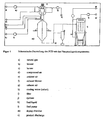
- FIG. 1 shows a typical structure of a PCD system; the main components and their function are listed below: element function burner Generation of a pulsating hot gas stream for atomization and drying of the dryer feed drying chamber Cools the hot gas stream by mixing with ambient air (quenching); determines, in conjunction with the gas flow, the residence time of the particles Supply fan Supplies the combustion chamber with air to create an ignitable natural gas / air mixture Natural gas compressor Compresses the natural gas from the mains supply pressure to the level required for the burner Feed pump Moves the dryer feed into the hot gas stream and regulates the temperature at the dryer outlet via the delivery rate cyclone Separates the solid from the gas stream (partial separator); can be bypassed filter Separates the solid from the gas stream (absolute separator) exhaust fan Determines the gas flow
- the dryer can be equipped with different gas and liquid nozzles.
- the amount of sucked into the drying chamber ambient air through Regulate variation of the so-called air ring.
- the arrangement of these elements is shown in FIG. 2 shown.
- the selection depends primarily on the throughput, but must be considered also the suspension and solids properties.
- Plant operation is mainly characterized and controlled by two temperatures.
- the hot gas temperature is set at the inlet of the drying chamber via the natural gas flow, and on the other hand, the feed pump regulates the temperature at the outlet of the chamber by means of the feed flow.
- Further possibilities of influence on the operating state result from the following list: parameter Influence Opening cross-section for atomizing air Setting the hot gas temperature Mass flow of the dryer feed Adjustment of the gas outlet temperature Speed of the air intake valve Influencing the resonance state Opening cross-section of the natural gas valve Setting the hot gas temperature Volume flow of the bypass air (Quench air) drying temperature Amplitude of the pressure waves (atomizing effect)
- the drying in the PCD affects the by precipitation or combustion (fumed silica) adjusted particle size of the silica is not essential. However, the distribution is clear closer than spray-dried or ground powder.
- the silicas according to the invention are per se in the usual way by precipitation of Water glass made with sulfuric acid, the full breadth of the possible Klallungsvarin can be used, such.
- the solid can be filtered off and the filter cake - if necessary redispersed with addition of acid - and then spray-dried.
- Spray-dried Precipitated silicas are known and z. B. under the name Sipernat® commercially.
- the particle size distribution can be determined by laser diffraction. Here are the Size of the particles that make up 5, 50 and 95% of the volume.
- the invention relates to silicas which are characterized by the following physico-chemical substance data: BET surface area (DIN 66131) m 2 / g 100 - 700 DBP absorption (DIN 53601, based on dried substance) g / 100 g 100 - 500 Tamping density (ISO 787-11) g / l 100 - 250 ALPINE sieve residue> 63 ⁇ (ISO 8130-1) % ⁇ 5 particle sizes d 95 ⁇ 40 ⁇ m (Volume cumulative distribution) d 50 ⁇ 20 ⁇ m d 5 ⁇ 10 ⁇ m
- Further objects of the present invention are processes for the preparation of silica with a fine and narrow particle size distribution, the particle size distribution (volume sum distribution) d 5 ⁇ 10 ⁇ m d 50 ⁇ 20 ⁇ m d 95 ⁇ 40 ⁇ m by drying a silica suspension in a Pulse Combustion Dryer.
- the BET surface area values may be between 150 and 600, preferably between 200 and 400 m 2 / g.
- the DBP absorption may be between 150 and 400, preferably between 200 and 400 g / l.
- the silicas according to the invention or the process of the invention are initially with prepared by the usual method, d. H. it can be precipitated silicas or pyrogens Silicas are used.
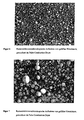
- FIGS. 4 to 10 show silicic acids dried by PCD processes.
- the silica according to the invention can have a high dispersibility.
- wk coefficient is a measure of the dispersibility of a precipitated silica. The wk coefficient is determined as follows:
- the measurement is based on the principle of laser diffraction. This is done with a CILAS granulometer 1064 L measured. For determination, 1.3 g of precipitated silica with 25 ml of water and treated for 4.5 minutes with ultrasound at 100 W (90% pulsed). Thereafter, the solution is transferred to the measuring cell and another minute with ultrasound treated. The detection with the help of two at a different angle to the sample located laser diodes takes place during the ultrasound treatment. According to the principle of Light diffraction, the laser beams are diffracted. The resulting diffraction image is evaluated computer-aided. The method makes it possible to measure over a wide measuring range (approx nm - 500 ⁇ m) to determine the particle size distribution.
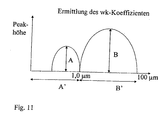
- the curves show a first maximum in the range around 1.0 - 100 ⁇ m Particle size distribution and in the range ⁇ 1.0 microns, another maximum.
- the peak in the area 1.0-100 ⁇ m gives the proportion of uncut silica particles after the Ultrasound treatment on. These rather coarse particles are found in the rubber compounds poorly dispersed.
- the second peak with significantly smaller particle sizes ( ⁇ 1.0 ⁇ m) gives that part of particles of silica which is comminuted during sonication has been on. These very small particles are distinguished in elastomer blends dispersed.
- the wk coefficient is now the ratio of the peak height of the non-degradable particles (B), whose maximum is in the range 1.0-100 ⁇ m, to the peak height of the degraded particles (A), whose maximum is in the range ⁇ 1.0 mm.
- the silicas of the invention are an organic or hydrophobic Have coating. This can be achieved by treating with a wax emulsion become. Typical are carbon contents of the so treated silicas of 5 wt .-%.
- silicas according to the invention in particular those with organic coating or Hydrophobing can be used as a matting agent for paints.
- the quality of a matting agent is determined by the reflectometer value, grindometer value, Part sizes and distribution and the coarse grain fraction (speck share) determined. Often need Regrind silicas for matting agents and / or classified.
- the product according to the invention shows markedly improved matting properties in comparison to the standard (60 ° reflectometer value: 20 in comparison to the standard: 27).
- the optional sifting of the products according to the invention allowed the grindometer values and speckle contents of the silicas according to the invention are further improved.
- the matting-relevant properties set in the precipitation could be determined with the PCD in be obtained to a special degree.
- the technology is thus for the drying of finely dispersed Silica suspensions particularly suitable.
- the silicic acids before the Drying be hydrophobic.
- organosilane compounds such as dimethylsilane or silicone oils.
- the silicas according to the invention can furthermore be used as filler in elastomer mixtures, z. B. used for tires.
- the high dispersibility is particularly important because The silicas must be distributed quickly and homogeneously in the mixture.
- Silicas according to the invention have wk coefficients of less than 3.4, preferably less than 2.
- the present invention therefore also relates to elastomer blends, such as tires, the silicas according to the invention or silicas prepared according to the invention contain.
- the other product properties of silicas are largely due to the Drying temperature determined and may be changed by the changes Output temperature of the PCD be changed. These temperatures are between 100 and 130 ° C.
- the pH values of the silicas are hardly affected by the PCD drying of the suspension changed, and determined by the pH of the suspension.
- This pH can be z. B. by Acid and / or base addition can be changed.
- the silica is after drying granulated. This is in the processing of very finely divided silicas for binding the Recommended dust content. Furthermore, the silica can be classified to fine or To further reduce rough shares. This can be done by commercial Klassiersiebe.
- the dried product of the Drying chamber collected by a cyclone and a filter.
- the cyclone you will find the larger particles with the already mentioned medium values.
- the method can also with a cooling of the Product stream are performed.
- the PCD can therefore be next to the gas nozzle and the Swirl body via a supply of air ("air ring", “compressed air”) or water ("cooling water ").
- air ring air ring
- compressed air compressed air
- water cooling water
- Matting agents based on precipitated silicas are prepared by different methods produced, in each of which the desired product properties are determined.
- a important application-technical size is the Grindometerwert, which usually by a Milling / sifting of the dried product is adjusted.
- As a drying process come the long-term drying by means of floor dryer and the short-term drying by means Spray dryer used.
- the PCD used is a system for convective drying of Suspensions.
- Essential for this technology is primarily the natural gas burner, the one generates pulsating hot gas flow while releasing thermal and mechanical energy, the is used for atomization and drying the dryer dish.
- the on the principle of Helmholtz resonator operating at an ignition frequency of about 100 Hz Pulsationsbrenner allows the dispersion of the dryer food without mechanically moving parts (Rotary atomizer) or nozzles.
- the fine droplet spectrum is due to the high frequency the pressure waves generated.
- the feed for the PCD was a suspension of a product prepared according to EP 0 901 986 Precipitated silica used. For this purpose, a corresponding filter cake by addition of Water liquefies.
- the test parameters were the solids concentration (4-12%), the Hot gas temperature (750 and 450 ° C) and the outlet temperature of the dryer (105 and 125 ° C) varies.
- the suspension in a second campaign (in terms of a Grain size reduction and thus variation of the grindometer value) the suspension by means of High performance dispersers sheared different periods of time.
- the under the o. G. Conditions generated powders were then compared to various Product properties, in particular particle sizes and coating properties analyzed.
- the particle size distributions were determined by laser diffraction (CILAS, 60 sec. Ultrasound).
- the grindometer value was determined in triplicate in the black paint and the Mean value calculated (standard deviation ⁇ 5 ⁇ m).
Landscapes
- Chemical & Material Sciences (AREA)
- Organic Chemistry (AREA)
- Engineering & Computer Science (AREA)
- Life Sciences & Earth Sciences (AREA)
- Combustion & Propulsion (AREA)
- Materials Engineering (AREA)
- Wood Science & Technology (AREA)
- Sustainable Development (AREA)
- Mechanical Engineering (AREA)
- General Engineering & Computer Science (AREA)
- Inorganic Chemistry (AREA)
- Silicon Compounds (AREA)
Claims (16)
- Acide silicique de précipitation,
caractérisé en ce qu'
il présente des particules de forme sphérique ainsi que les données physico-techniques suivantes :Surface BET (DIN 66131) m2/g 100-700Absorption de DBP (DIN 53601, g/100 g 100 - 500 par rapport à la substance sèche)
Densité du produit tassé (ISO 787-11) g/l 100 - 250Refus de criblage
ALPINE > 63 µ (ISO 8130-1) < 5Tailles des particules d95 < 40 µm (répartition totale des volumes) d50 < 20 µm d5 > 10 µm - Acide silicique selon la revendication 1,
caractérisé en ce qu'
il présente une surface BET comprise entre 150 et 600 m2. - Acide silicique selon la revendication 1 ou 2,
caractérisé en ce qu'
il présente un revêtement organique. - Acide silicique selon l'une quelconque des revendications 1 à 3,
caractérisé en ce qu'
il est hydrophobe. - Acide silicique selon l'une quelconque des revendications 1 à 4,
caractérisé en ce que
ses particules présentent une dispersibilité élevée d'un coefficient wk < 3,4. - Procédé de préparation d'acide silicique de précipitation selon l'une quelconque des revendications 1 à 5,
caractérisé en ce qu'
une suspension d'acide silicique de précipitation est séchée au moyen d'un Pulse Combustion Dryer. - Procédé selon la revendication 6,
caractérisé en ce que
la température de séchage est de 400 à 800°C. - Procédé selon l'une quelconque des revendications 6 ou 7,
caractérisé en ce que
la suspension d'acide silicique présente une teneur en substance solide de 5 % à 25 % en poids. - Procédé selon l'une quelconque des revendications 6 à 8,
caractérisé en ce que
l'acide silicique reçoit un revêtement organique avant le séchage. - Procédé selon l'une quelconque des revendications 6 à 9,
caractérisé en ce que
l'acide silicique est hydrophobé avant le séchage. - Procédé selon l'une quelconque des revendications 6 à 10,
caractérisé en ce que
l'acide silicique présente une dispersibilité élevée d'un coefficient wk < 3,4. - Procédé selon l'une quelconque des revendications 6 à 11,
caractérisé en ce que
l'acide silicique est calibré après le séchage. - Procédé selon l'une quelconque des revendication 6 à 12,
caractérisé en ce que
le Pulse Combustion Dryer présente des aubes de turbulence pour l'écoulement de l'air utilisé pour le séchage. - Utilisation de l'acide silicique selon l'une quelconque des revendications 1 à 5 dans des mélanges d'élastomères.
- Utilisation de l'acide silicique selon l'une quelconque des revendications 1 à 5 en tant qu'agent matifiant pour les peintures.
- Mélanges d'élastomères contenant un acide silicique selon l'une quelconque des revendications 1 à 5.
Priority Applications (5)
| Application Number | Priority Date | Filing Date | Title |
|---|---|---|---|
| AT02007442T ATE309176T1 (de) | 2002-03-30 | 2002-03-30 | Fällungskieselsäure mit enger partikelgrössenverteilung |
| ES02007442T ES2250534T3 (es) | 2002-03-30 | 2002-03-30 | Acidos silicicos de precipitacion con una distribucion estrecha del tamaño de particula. |
| EP02007442A EP1348669B1 (fr) | 2002-03-30 | 2002-03-30 | Silice de précipitation presentant une distribution granulométrique étroite |
| EP04106954A EP1541525A1 (fr) | 2002-03-30 | 2002-03-30 | Silice pyrogénique présentant une distribution granulométrique étroite |
| DE50204851T DE50204851D1 (de) | 2002-03-30 | 2002-03-30 | Fällungskieselsäure mit enger Partikelgrössenverteilung |
Applications Claiming Priority (1)
| Application Number | Priority Date | Filing Date | Title |
|---|---|---|---|
| EP02007442A EP1348669B1 (fr) | 2002-03-30 | 2002-03-30 | Silice de précipitation presentant une distribution granulométrique étroite |
Related Child Applications (1)
| Application Number | Title | Priority Date | Filing Date |
|---|---|---|---|
| EP04106954A Division EP1541525A1 (fr) | 2002-03-30 | 2002-03-30 | Silice pyrogénique présentant une distribution granulométrique étroite |
Publications (2)
| Publication Number | Publication Date |
|---|---|
| EP1348669A1 EP1348669A1 (fr) | 2003-10-01 |
| EP1348669B1 true EP1348669B1 (fr) | 2005-11-09 |
Family
ID=27798841
Family Applications (2)
| Application Number | Title | Priority Date | Filing Date |
|---|---|---|---|
| EP02007442A Expired - Lifetime EP1348669B1 (fr) | 2002-03-30 | 2002-03-30 | Silice de précipitation presentant une distribution granulométrique étroite |
| EP04106954A Withdrawn EP1541525A1 (fr) | 2002-03-30 | 2002-03-30 | Silice pyrogénique présentant une distribution granulométrique étroite |
Family Applications After (1)
| Application Number | Title | Priority Date | Filing Date |
|---|---|---|---|
| EP04106954A Withdrawn EP1541525A1 (fr) | 2002-03-30 | 2002-03-30 | Silice pyrogénique présentant une distribution granulométrique étroite |
Country Status (4)
| Country | Link |
|---|---|
| EP (2) | EP1348669B1 (fr) |
| AT (1) | ATE309176T1 (fr) |
| DE (1) | DE50204851D1 (fr) |
| ES (1) | ES2250534T3 (fr) |
Families Citing this family (12)
| Publication number | Priority date | Publication date | Assignee | Title |
|---|---|---|---|---|
| DE10241273A1 (de) * | 2002-09-06 | 2004-03-18 | Degussa Ag | Effiziente Mattierungsmittel basierend auf Fällungskieselsäuren |
| EP1700829A1 (fr) * | 2005-03-09 | 2006-09-13 | Degussa AG | Procédé de fabrication d'un monolithe en verre par un procédé sol-gel |
| EP1700824A1 (fr) * | 2005-03-09 | 2006-09-13 | Degussa AG | Granulés à base de silice pyrogenique, procédé pour leur obtention, utilisation de ceux-ci |
| US7470307B2 (en) | 2005-03-29 | 2008-12-30 | Climax Engineered Materials, Llc | Metal powders and methods for producing the same |
| WO2007012951A1 (fr) * | 2005-07-27 | 2007-02-01 | Forsyth, Alastair, James | Nitrates |
| EP1813573A1 (fr) | 2006-01-25 | 2007-08-01 | Degussa GmbH | Procédé pour la préparation d'une composition de caoutchouc |
| US8197885B2 (en) | 2008-01-11 | 2012-06-12 | Climax Engineered Materials, Llc | Methods for producing sodium/molybdenum power compacts |
| JP2013515661A (ja) * | 2009-12-23 | 2013-05-09 | ブルースター・シリコーンズ・フランス | 沈降シリカ |
| WO2012085211A2 (fr) * | 2010-12-22 | 2012-06-28 | Rockwool International A/S | Utilisation d'une matière en fibre vitreuse artificielle |
| DE102017209874A1 (de) | 2017-06-12 | 2018-12-13 | Evonik Degussa Gmbh | Verfahren zur Herstellung von wachsbeschichteter Kieselsäure |
| US20210114888A1 (en) | 2018-02-23 | 2021-04-22 | Wacker Chemie Ag | Highly dispersible precipitated silicas |
| CN110257089A (zh) * | 2019-06-24 | 2019-09-20 | 四川大学 | 酒糟干化及资源化处理方法和装置 |
Family Cites Families (5)
| Publication number | Priority date | Publication date | Assignee | Title |
|---|---|---|---|---|
| US4941820A (en) * | 1986-04-16 | 1990-07-17 | Nea Technologies, Inc. | Pulse combustion energy system |
| US5638609A (en) * | 1995-11-13 | 1997-06-17 | Manufacturing And Technology Conversion International, Inc. | Process and apparatus for drying and heating |
| DE19616781A1 (de) * | 1996-04-26 | 1997-11-06 | Degussa | Silanisierte Kieselsäure |
| DE19740440A1 (de) * | 1997-09-15 | 1999-03-18 | Degussa | Leicht dispergierbare Fällungskieselsäure |
| DE19755287A1 (de) * | 1997-12-12 | 1999-07-08 | Degussa | Fällungskieselsäure |
-
2002
- 2002-03-30 AT AT02007442T patent/ATE309176T1/de not_active IP Right Cessation
- 2002-03-30 EP EP02007442A patent/EP1348669B1/fr not_active Expired - Lifetime
- 2002-03-30 DE DE50204851T patent/DE50204851D1/de not_active Expired - Lifetime
- 2002-03-30 ES ES02007442T patent/ES2250534T3/es not_active Expired - Lifetime
- 2002-03-30 EP EP04106954A patent/EP1541525A1/fr not_active Withdrawn
Also Published As
| Publication number | Publication date |
|---|---|
| ES2250534T3 (es) | 2006-04-16 |
| DE50204851D1 (de) | 2005-12-15 |
| EP1348669A1 (fr) | 2003-10-01 |
| ATE309176T1 (de) | 2005-11-15 |
| EP1541525A1 (fr) | 2005-06-15 |
Similar Documents
| Publication | Publication Date | Title |
|---|---|---|
| DE10105750A1 (de) | Fällungskieselsäuren mit enger Partikelgrößenverteilung | |
| EP1348669B1 (fr) | Silice de précipitation presentant une distribution granulométrique étroite | |
| DE69603179T2 (de) | Mattierungsmittel auf basis von kieselsäureaggregat | |
| EP2101918B1 (fr) | Procédé de production de particules extrêmement fines, pulvérisateur à jet approprié, séparateur pneumatique et procédé d'exploitation correspondant | |
| EP0857764B1 (fr) | Granulés de pigments inorganiques pour colorer des matières plastiques, des laques et des matériaux de construction, et procédé pour les préparer | |
| EP3000790B2 (fr) | Procédé de fabrication de composants en verre de silice synthétique en granulés de SiO2 | |
| DE112010003823B4 (de) | Pulver, gesintertes pulver und verfahren zu deren herstellung | |
| DE102006048850A1 (de) | Amorphe submicron Partikel | |
| WO2008046403A1 (fr) | Procédé de production de particules extrêmement fines, pulvérisateur à jet approprié, séparateur pneumatique et procédé d'exploitation correspondant | |
| DE19740440A1 (de) | Leicht dispergierbare Fällungskieselsäure | |
| DE10112651A1 (de) | Inhomogene Kieselsäuren als Trägermaterial | |
| DE2615699C2 (de) | Verfahren zum Aufhellen von natürlichem calcitischen Mineral | |
| DE102007052269A1 (de) | Fällungskieselsäuren für lagerstabile RTV-1 Siliconkautschukformulierungen ohne Stabilisator | |
| EP1182233B1 (fr) | Méthode pour recouvrir de l'acide silicique avec de la cire | |
| DE10163179A1 (de) | Granulate auf Basis von pyrogen hergestelltem Siliziumdioxid, Verfahren zu ihrer Herstellung und ihre Verwendung | |
| EP1860067B1 (fr) | Acides siliciques dotés de propriétés de surface spéciales | |
| WO2018082789A1 (fr) | Procédé pour broyer des matières solides contenant du silicium | |
| DE10112652A1 (de) | Inhomogene Kieselsäuren für Elastomerenmischungen | |
| DE10112650A1 (de) | Inhomogene Kieselsäuren in Zahnpflegemittel | |
| EP3717407A1 (fr) | Acides siliciques précipités hautement dispersables | |
| DE2250402C3 (de) | Nichtstaubende Zusammensetzung und Verfahren zu deren Herstellung | |
| DE102006040591A1 (de) | Zu Schülpen kompaktiertes pyrogen hergestelltes Titandioxid | |
| DE10122861A1 (de) | Verfahren zur Belegung von Kieselsäuren mit Wachsen | |
| DE1467437B (de) | Verwendung eines kombinierten Mahl Sichters zur Aufbereitung von zum Mattie ren von Lacken und plastischen Massen ge eigneten Kieselsauren |
Legal Events
| Date | Code | Title | Description |
|---|---|---|---|
| PUAI | Public reference made under article 153(3) epc to a published international application that has entered the european phase |
Free format text: ORIGINAL CODE: 0009012 |
|
| 17P | Request for examination filed |
Effective date: 20020330 |
|
| AK | Designated contracting states |
Kind code of ref document: A1 Designated state(s): AT BE CH CY DE DK ES FI FR GB GR IE IT LI LU MC NL PT SE TR |
|
| AX | Request for extension of the european patent |
Extension state: AL LT LV MK RO SI |
|
| AKX | Designation fees paid |
Designated state(s): AT BE CH CY DE DK ES FI FR GB GR IE IT LI LU MC NL PT SE TR |
|
| 17Q | First examination report despatched |
Effective date: 20040618 |
|
| GRAP | Despatch of communication of intention to grant a patent |
Free format text: ORIGINAL CODE: EPIDOSNIGR1 |
|
| GRAS | Grant fee paid |
Free format text: ORIGINAL CODE: EPIDOSNIGR3 |
|
| GRAA | (expected) grant |
Free format text: ORIGINAL CODE: 0009210 |
|
| AK | Designated contracting states |
Kind code of ref document: B1 Designated state(s): AT BE CH CY DE DK ES FI FR GB GR IE IT LI LU MC NL PT SE TR |
|
| PG25 | Lapsed in a contracting state [announced via postgrant information from national office to epo] |
Ref country code: FI Free format text: LAPSE BECAUSE OF FAILURE TO SUBMIT A TRANSLATION OF THE DESCRIPTION OR TO PAY THE FEE WITHIN THE PRESCRIBED TIME-LIMIT Effective date: 20051109 Ref country code: NL Free format text: LAPSE BECAUSE OF FAILURE TO SUBMIT A TRANSLATION OF THE DESCRIPTION OR TO PAY THE FEE WITHIN THE PRESCRIBED TIME-LIMIT Effective date: 20051109 Ref country code: IE Free format text: LAPSE BECAUSE OF FAILURE TO SUBMIT A TRANSLATION OF THE DESCRIPTION OR TO PAY THE FEE WITHIN THE PRESCRIBED TIME-LIMIT Effective date: 20051109 |
|
| REG | Reference to a national code |
Ref country code: GB Ref legal event code: FG4D Free format text: NOT ENGLISH |
|
| REG | Reference to a national code |
Ref country code: CH Ref legal event code: EP |
|
| REG | Reference to a national code |
Ref country code: IE Ref legal event code: FG4D Free format text: LANGUAGE OF EP DOCUMENT: GERMAN |
|
| REF | Corresponds to: |
Ref document number: 50204851 Country of ref document: DE Date of ref document: 20051215 Kind code of ref document: P |
|
| GBT | Gb: translation of ep patent filed (gb section 77(6)(a)/1977) |
Effective date: 20051125 |
|
| PG25 | Lapsed in a contracting state [announced via postgrant information from national office to epo] |
Ref country code: GR Free format text: LAPSE BECAUSE OF FAILURE TO SUBMIT A TRANSLATION OF THE DESCRIPTION OR TO PAY THE FEE WITHIN THE PRESCRIBED TIME-LIMIT Effective date: 20060209 Ref country code: SE Free format text: LAPSE BECAUSE OF FAILURE TO SUBMIT A TRANSLATION OF THE DESCRIPTION OR TO PAY THE FEE WITHIN THE PRESCRIBED TIME-LIMIT Effective date: 20060209 Ref country code: DK Free format text: LAPSE BECAUSE OF FAILURE TO SUBMIT A TRANSLATION OF THE DESCRIPTION OR TO PAY THE FEE WITHIN THE PRESCRIBED TIME-LIMIT Effective date: 20060209 |
|
| PG25 | Lapsed in a contracting state [announced via postgrant information from national office to epo] |
Ref country code: AT Free format text: LAPSE BECAUSE OF NON-PAYMENT OF DUE FEES Effective date: 20060330 |
|
| PG25 | Lapsed in a contracting state [announced via postgrant information from national office to epo] |
Ref country code: MC Free format text: LAPSE BECAUSE OF NON-PAYMENT OF DUE FEES Effective date: 20060331 Ref country code: CH Free format text: LAPSE BECAUSE OF NON-PAYMENT OF DUE FEES Effective date: 20060331 Ref country code: LI Free format text: LAPSE BECAUSE OF NON-PAYMENT OF DUE FEES Effective date: 20060331 Ref country code: LU Free format text: LAPSE BECAUSE OF NON-PAYMENT OF DUE FEES Effective date: 20060331 Ref country code: BE Free format text: LAPSE BECAUSE OF NON-PAYMENT OF DUE FEES Effective date: 20060331 |
|
| PG25 | Lapsed in a contracting state [announced via postgrant information from national office to epo] |
Ref country code: PT Free format text: LAPSE BECAUSE OF FAILURE TO SUBMIT A TRANSLATION OF THE DESCRIPTION OR TO PAY THE FEE WITHIN THE PRESCRIBED TIME-LIMIT Effective date: 20060410 |
|
| REG | Reference to a national code |
Ref country code: ES Ref legal event code: FG2A Ref document number: 2250534 Country of ref document: ES Kind code of ref document: T3 |
|
| NLV1 | Nl: lapsed or annulled due to failure to fulfill the requirements of art. 29p and 29m of the patents act | ||
| ET | Fr: translation filed | ||
| REG | Reference to a national code |
Ref country code: IE Ref legal event code: FD4D |
|
| PLBE | No opposition filed within time limit |
Free format text: ORIGINAL CODE: 0009261 |
|
| STAA | Information on the status of an ep patent application or granted ep patent |
Free format text: STATUS: NO OPPOSITION FILED WITHIN TIME LIMIT |
|
| 26N | No opposition filed |
Effective date: 20060810 |
|
| REG | Reference to a national code |
Ref country code: CH Ref legal event code: PL |
|
| BERE | Be: lapsed |
Owner name: DEGUSSA A.G. Effective date: 20060331 |
|
| PG25 | Lapsed in a contracting state [announced via postgrant information from national office to epo] |
Ref country code: CY Free format text: LAPSE BECAUSE OF FAILURE TO SUBMIT A TRANSLATION OF THE DESCRIPTION OR TO PAY THE FEE WITHIN THE PRESCRIBED TIME-LIMIT Effective date: 20051109 |
|
| REG | Reference to a national code |
Ref country code: FR Ref legal event code: CD Ref country code: FR Ref legal event code: CA Ref country code: FR Ref legal event code: CJ |
|
| REG | Reference to a national code |
Ref country code: FR Ref legal event code: PLFP Year of fee payment: 15 |
|
| REG | Reference to a national code |
Ref country code: FR Ref legal event code: PLFP Year of fee payment: 16 |
|
| REG | Reference to a national code |
Ref country code: FR Ref legal event code: PLFP Year of fee payment: 17 |
|
| PGFP | Annual fee paid to national office [announced via postgrant information from national office to epo] |
Ref country code: DE Payment date: 20180322 Year of fee payment: 17 Ref country code: GB Payment date: 20180321 Year of fee payment: 17 |
|
| PGFP | Annual fee paid to national office [announced via postgrant information from national office to epo] |
Ref country code: TR Payment date: 20180328 Year of fee payment: 17 Ref country code: FR Payment date: 20180323 Year of fee payment: 17 |
|
| PGFP | Annual fee paid to national office [announced via postgrant information from national office to epo] |
Ref country code: ES Payment date: 20180427 Year of fee payment: 17 |
|
| PGFP | Annual fee paid to national office [announced via postgrant information from national office to epo] |
Ref country code: IT Payment date: 20180327 Year of fee payment: 17 |
|
| REG | Reference to a national code |
Ref country code: DE Ref legal event code: R119 Ref document number: 50204851 Country of ref document: DE |
|
| GBPC | Gb: european patent ceased through non-payment of renewal fee |
Effective date: 20190330 |
|
| PG25 | Lapsed in a contracting state [announced via postgrant information from national office to epo] |
Ref country code: GB Free format text: LAPSE BECAUSE OF NON-PAYMENT OF DUE FEES Effective date: 20190330 Ref country code: DE Free format text: LAPSE BECAUSE OF NON-PAYMENT OF DUE FEES Effective date: 20191001 |
|
| PG25 | Lapsed in a contracting state [announced via postgrant information from national office to epo] |
Ref country code: IT Free format text: LAPSE BECAUSE OF NON-PAYMENT OF DUE FEES Effective date: 20190330 Ref country code: FR Free format text: LAPSE BECAUSE OF NON-PAYMENT OF DUE FEES Effective date: 20190331 |
|
| REG | Reference to a national code |
Ref country code: ES Ref legal event code: FD2A Effective date: 20200728 |
|
| PG25 | Lapsed in a contracting state [announced via postgrant information from national office to epo] |
Ref country code: ES Free format text: LAPSE BECAUSE OF NON-PAYMENT OF DUE FEES Effective date: 20190331 |
|
| PG25 | Lapsed in a contracting state [announced via postgrant information from national office to epo] |
Ref country code: TR Free format text: LAPSE BECAUSE OF NON-PAYMENT OF DUE FEES Effective date: 20190330 |