EP1349068A2 - Création d'un volume de sauvegarde à l'aide d'un profil de données d'un volume d'hôte - Google Patents
Création d'un volume de sauvegarde à l'aide d'un profil de données d'un volume d'hôte Download PDFInfo
- Publication number
- EP1349068A2 EP1349068A2 EP03251873A EP03251873A EP1349068A2 EP 1349068 A2 EP1349068 A2 EP 1349068A2 EP 03251873 A EP03251873 A EP 03251873A EP 03251873 A EP03251873 A EP 03251873A EP 1349068 A2 EP1349068 A2 EP 1349068A2
- Authority
- EP
- European Patent Office
- Prior art keywords
- data
- block
- host
- volume
- backup
- Prior art date
- Legal status (The legal status is an assumption and is not a legal conclusion. Google has not performed a legal analysis and makes no representation as to the accuracy of the status listed.)
- Granted
Links
Images

Classifications
-
- G—PHYSICS
- G06—COMPUTING OR CALCULATING; COUNTING
- G06F—ELECTRIC DIGITAL DATA PROCESSING
- G06F11/00—Error detection; Error correction; Monitoring
- G06F11/07—Responding to the occurrence of a fault, e.g. fault tolerance
- G06F11/14—Error detection or correction of the data by redundancy in operations
- G06F11/1446—Point-in-time backing up or restoration of persistent data
- G06F11/1458—Management of the backup or restore process
- G06F11/1464—Management of the backup or restore process for networked environments
-
- G—PHYSICS
- G06—COMPUTING OR CALCULATING; COUNTING
- G06F—ELECTRIC DIGITAL DATA PROCESSING
- G06F11/00—Error detection; Error correction; Monitoring
- G06F11/07—Responding to the occurrence of a fault, e.g. fault tolerance
- G06F11/14—Error detection or correction of the data by redundancy in operations
- G06F11/1446—Point-in-time backing up or restoration of persistent data
- G06F11/1448—Management of the data involved in backup or backup restore
- G06F11/1451—Management of the data involved in backup or backup restore by selection of backup contents
-
- G—PHYSICS
- G06—COMPUTING OR CALCULATING; COUNTING
- G06F—ELECTRIC DIGITAL DATA PROCESSING
- G06F2201/00—Indexing scheme relating to error detection, to error correction, and to monitoring
- G06F2201/83—Indexing scheme relating to error detection, to error correction, and to monitoring the solution involving signatures
-
- Y—GENERAL TAGGING OF NEW TECHNOLOGICAL DEVELOPMENTS; GENERAL TAGGING OF CROSS-SECTIONAL TECHNOLOGIES SPANNING OVER SEVERAL SECTIONS OF THE IPC; TECHNICAL SUBJECTS COVERED BY FORMER USPC CROSS-REFERENCE ART COLLECTIONS [XRACs] AND DIGESTS
- Y10—TECHNICAL SUBJECTS COVERED BY FORMER USPC
- Y10S—TECHNICAL SUBJECTS COVERED BY FORMER USPC CROSS-REFERENCE ART COLLECTIONS [XRACs] AND DIGESTS
- Y10S707/00—Data processing: database and file management or data structures
- Y10S707/99941—Database schema or data structure
- Y10S707/99944—Object-oriented database structure
- Y10S707/99945—Object-oriented database structure processing
-
- Y—GENERAL TAGGING OF NEW TECHNOLOGICAL DEVELOPMENTS; GENERAL TAGGING OF CROSS-SECTIONAL TECHNOLOGIES SPANNING OVER SEVERAL SECTIONS OF THE IPC; TECHNICAL SUBJECTS COVERED BY FORMER USPC CROSS-REFERENCE ART COLLECTIONS [XRACs] AND DIGESTS
- Y10—TECHNICAL SUBJECTS COVERED BY FORMER USPC
- Y10S—TECHNICAL SUBJECTS COVERED BY FORMER USPC CROSS-REFERENCE ART COLLECTIONS [XRACs] AND DIGESTS
- Y10S707/00—Data processing: database and file management or data structures
- Y10S707/99951—File or database maintenance
- Y10S707/99952—Coherency, e.g. same view to multiple users
- Y10S707/99953—Recoverability
-
- Y—GENERAL TAGGING OF NEW TECHNOLOGICAL DEVELOPMENTS; GENERAL TAGGING OF CROSS-SECTIONAL TECHNOLOGIES SPANNING OVER SEVERAL SECTIONS OF THE IPC; TECHNICAL SUBJECTS COVERED BY FORMER USPC CROSS-REFERENCE ART COLLECTIONS [XRACs] AND DIGESTS
- Y10—TECHNICAL SUBJECTS COVERED BY FORMER USPC
- Y10S—TECHNICAL SUBJECTS COVERED BY FORMER USPC CROSS-REFERENCE ART COLLECTIONS [XRACs] AND DIGESTS
- Y10S707/00—Data processing: database and file management or data structures
- Y10S707/99951—File or database maintenance
- Y10S707/99952—Coherency, e.g. same view to multiple users
- Y10S707/99955—Archiving or backup
Definitions
- the present application generally relates to a backup system, and more particularly to creating/updating a backup volume using a data profile of a host volume.
- data stored on a host volume is copied to a backup volume.
- data stored on the backup volume corresponds to data stored on the host volume at a point in time (i.e., the time when the data was copied). If the host volume fails, then data stored on the backup volume can be used to restore the host volume.
- the backup volume is created by capturing all the data stored on the host volume at a point in time and copying the data to the backup volume.
- the host volume is typically taken off-line, which means that access to the host volume is denied or limited.
- the data stored on the host volume is typically transmitted from the host volume to the backup volume, which can be time and bandwidth consuming.
- a backup volume on a backup system is created/updated by reading data stored on a host volume on a host system.
- a data profile for the host volume is generated based on the read data, where the data profile characterizes the data stored on the host volume.
- the data profile is sent to the backup system, and data that does not need to be obtained from the host system is determined on the backup system based on the data profile.
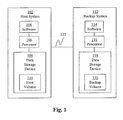
- Fig. 1 depicts an exemplary embodiment of a host system 102 connected to a backup system 112.
- host system 102 includes a data storage device 108 with a host volume 110.
- Backup system 112 also includes a data storage device 118 with a backup volume 120.
- backup volume 120 is a copy of host volume 110 at a point in time, which is generally referred to as a "snapshot" of host volume 110. It should be recognized, however, that backup volume 120 can also be used as a baseline image in a continuous backup scheme.
- U.S. Patent Application Serial No. 09/588,242, titled DATA STORAGE SYSTEM AND PROCESS incorporated herein by reference in its entirety.
- Data storage device 108/118 can be various types of devices capable of storing data, such as hard drives, tape drives, various removable media, writeable CD-ROMs, Write Once Read Many (WORMs) flash memories, Electrically Erasable Programmable Read Only Memories (EEPROMs), and the like.
- Data storage device 108/118 can be any combination of two or more types of devices. Additionally, data storage device 108/118 can be a single device or multiple devices. For example, data storage device 108 on host system 102 can include two or more hard drives. Similarly, data storage device 118 on backup system 112 can be a redundant array of inexpensive/independent disks (RAID) system, such as a RAID array level 0, 1, and/or 5.
- RAID redundant array of inexpensive/independent disks
- Host volume 110 can be a portion of a single data storage device 108 or span multiple data storage devices 108.
- backup volume 120 can be a portion of a single data storage device 118 or span multiple data storage devices 118.
- the configuration of host volume 110 and backup volume 120 need not be identical to each other.
- host volume 110 can be a portion of a single data storage device 108, such as a partition of a high-capacity hard disk, while backup volume 120 can span multiple data storage devices 118, such as a RAID system.
- host system 102 and backup system 112 include backup software 104, 114 and processors 106, 116, respectively.
- backup software 104 and processor 106 are configured to control the backup operation of host system 102.
- backup software 114 and processor 116 are configured to control the backup operation of backup system 112. It should be recognized, however, that host system 102 and backup system 112 can include various components, both hardware and software, that are not depicted in Fig. 1.
- connection 122 can be a direct connection or a remote connection.
- host system 102 and backup system 112 can be directly connected, where connection 122 is a physical cable that runs between host system 102 and backup system 112.
- host system 102 and backup system 112 can be remotely connected, where connection 122 is a network connection, such as through a local area network (LAN), a wide area network (WAN), a storage area network (SAN), the Internet, and the like.
- LAN local area network
- WAN wide area network
- SAN storage area network
- host system 102 and backup system 112 can be housed in a single housing.
- host system 102 and backup system 112 can be logical divisions within a single computer system.
- backup software 104, 114 can be one backup software
- processors 106, 116 can be a single processor
- data storage devices 108, 118 can be a single data storage device. If data storage devices 108, 118 are a single data storage device, then host volume 110 and backup volume 120 can exist as separate partitions within the single data storage device.
- connection 122 can represent a data bus within the single computer system or it can simply represent a logical connection.
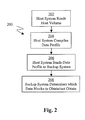
- an exemplary process 200 is depicted of creating/updating a backup volume based on a host volume.
- the host system reads the host volume. More particularly, with reference to Fig. 1, host system 102, and more particularly backup software 104 and processor 106, examines the data stored on host volume 110. In one exemplary embodiment, when backup volume 120 is being created, all of the data stored on host volume 110 is examined. When backup volume 120 is being update, only the data stored on host volume 110 that had not been previously examined is examined.
- step 204 the host system compiles a data profile for the host volume, which characterizes the examined data. More particularly, with reference to Fig. 1, in the present exemplary embodiment, data is stored on host volume 110 in data blocks of a predetermined length, such as 2 kBytes, 4 kBytes, 6 kBytes, and the like. Thus, after reading a data block, one or more profile parameters are assigned to characterize the data block.
- each data block is assigned a block state, which characterizes the allocation and/or use condition of the data block. For example, after examining a data block, host system 102 determines whether the data block is allocated. Host system 102 can also determine whether the data block is in use, meaning that the data block potentially has valid data. If the data block is determined to have been allocated and in use, host system determines if the data contained in the data block matches a common data pattern, such as all zeros, all ones, and the like.
- each data block is assigned a block number and a block state.
- each data block can be assigned an absolute index from the start of host volume 110 in native disk block size, such as 512 bytes.
- the various block states can be assigned a state value, such as using hex code, which uniquely identifies each block state: Hex Block Value Corresponding Block State 00 Block is unallocated and unused 1X Block is allocated and used 10 Block is allocated, used, and contains all zeros 11 Block is allocated, used, and contains all ones 12 Block is allocated, used, and contains valid data 1F Block is allocated, used, but the read was bad FF Block read failed
- host system 102 after examining a data block, assigns the data block a check value, such as a cyclic redundancy code checking (CRC) code, a message-digest (MD), and the like.
- a data block can be assigned a block number, a state value, and a check value.
- a data block can be assigned a block number and a check value.
- host system 102 assigns the data block a check method code and a check value to allow the use of multiple types of check methods.
- a CRC code can be used as the check value for one data block
- a MD can be used as the check value for another data block.
- the various check methods can be assigned a check method code, such as using hex code, which uniquely identifies each type of check method: Hex Check Method Code Corresponding Check Method 00 Check method unused or invalid 01 CRC-16 02 CRC-32 03 MD5 E0 Check method is full data copy, data follows block ID FF Check method failed
- check method codes can be used. It should also be recognized that more or fewer check methods can be used.
- step 206 the host system sends the data profile to the backup system.
- step 208 the backup system determines which data blocks need to be obtained and which do not need to be obtained from the host system based on the received data profile.
- the data profile includes block numbers and block states for the data blocks in host volume 110.
- certain block states are indicative of data blocks that do not need to be obtained from host system 102.
- a data block that is identified as being unallocated and unused (corresponding to Hex Block State 00 in Table 1) need not be obtained.
- certain block states are indicative of data blocks having data with a common data pattern, which can be recreated by backup system 112 without obtaining the data from host system 102.
- the number of data blocks that need to be obtained from host system 102 can be reduced.
- the data profile includes check values for the data blocks in host volume 110.
- the check values can be used to determine if the data blocks are the same. More particularly, before sending the data profile, host system 102 generates the check value for a data block based on the data in the data block in host volume 110.
- Backup system 112 calculates a check value for the corresponding data block based on the data in the corresponding data block in backup volume 120. Backup system 112 then compares the two check values and if the check values are the same, then the data in the two data blocks are assumed to be the same. Thus, if the check values are the same, then the data block in host volume 110 does not need to be obtained.
- the profile data includes check method codes and check values for the data blocks.
- backup system 112 examines the check method code for the data block to determine which check method to use.
- the data profile can include both block states and check values.
- the block states can be used to eliminate the data blocks that do not contain data, then the check values can be used to determined which data blocks that contain data do not need to be obtained from host system 102.
- the block states can be used to eliminate the data blocks that do not contain data or data blocks having data patterns that can be recreated, then the remaining data blocks can be obtained from host system 102 and the check values can be used to verify that the backup process has been successful.
- exemplary process 200 can include any number of additional steps not depicted in Fig. 2. It should also be recognized that process 200 can be implemented as a computer program, which includes computer executable instructions to direct the operation of host system 102 (Fig. 1) and/or backup system 112 (Fig. 1). For example, with reference to Fig. 1, process 200 (Fig. 2) can be a routine within backup software 104, 114 to direct the operation of processors 106, 116. Exemplary process 200 (Fig. 2) can also be implemented in hardware, such as in an Application-Specific Integrated Circuit (ASIC), or a combination of software and hardware.
- ASIC Application-Specific Integrated Circuit
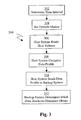
- a time interval is determined for the period of time missing from the backup system's most recent copy of the host volume. More particularly, when the first back-up is performed, the time interval is considered to be from the epoch (i.e., the beginning of time) to a set amount of time before the first write successfully transmitted to the backup system from the host system. If the backup system was off line or has gone down for any period of time, the time interval missing is a set amount of time after the last successful write transmitted to the backup system to a set amount of time before the next write successfully transmitted to the backup system from the host system. It should be recognized that various amounts of time, such as a few nanoseconds, can be used as the set amount of time before the first write or before the next write.
- an "episode marker” is set to be the end of the determined time interval (i.e., a set amount of time, such as a few nanoseconds, before the first successful write to the backup system from the host system).
- the episode marker is a variable/time marker that corresponds to the time when the backup system is in place. As will be described below, the episode marker is then applied to all data copied from the host system to the backup system during the backup process.
- step 306 the host system reads the host volume to examine the data stored on the host volume.
- step 308 the host system compiles a data profile for the host volume, which characterizes the examined data.
- step 310 the host system sends the data profile to the backup system.
- step 312 the backup system determines which data blocks need to be obtained and which do not need to be obtained from the host system.
- step 402 of exemplary process 400 the backup system determines whether data contained in a data block corresponds to a known data pattern that can be re-created by the backup system rather than obtaining the data from the host system.
- the data profile can include a block state, which indicates if the data in the data block corresponds to a known data pattern, such as all zeros or ones.
- step 402 If in step 402 the data does not correspond to a known data pattern, then in step 404 the data block is requested and received from the host system. In step 408, the received data block is assigned the episode marker.
- step 406 the data for the data block is generated from the known data pattern.
- step 408 the data block is assigned the episode marker.
- step 410 a determination is made as to whether the backup is complete. More particularly, if there are entries in the data profile that have not been processed, then the backup process has not been completed and steps 402-408 are repeated for one of the unprocessed entries in the data profile, which corresponds to another unprocessed data block.
- step 412 a determination is made as to whether the backup was successful. More particularly, as described above, in one exemplary embodiment, the data profile can include check values, which can be used to determine if the data blocks in the backup volume are the same as those in the host volume. For the data blocks that are found to be different, in step 414 the data blocks are requested and received from the host system. In step 408, the received data blocks are assigned the episode marker. If in step 412 the backup process is determined to have been successful, in step 416 the backup process is stopped.
- exemplary processes 300 (Fig. 3) and 400 (Fig. 4) can include any number of additional steps not depicted in Figs. 3 and 4. It should also be recognized that processes 300 (Fig. 3) and 400 (Fig. 4) can be implemented as a computer program, which includes computer executable instructions to direct the operation of host system 102 (Fig. 1) and/or backup system 112 (Fig. 1). For example, with reference to Fig. 1, processes 300 (Fig. 3) and 400 (Fig. 4) can be routines within backup software 104, 114 to direct the operation of processors 106, 116. Exemplary processes 300 (Fig. 3) and 400 (Fig. 4) can also be implemented in hardware, such as in an Application-Specific Integrated Circuit (ASIC), or a combination of software and hardware.
- ASIC Application-Specific Integrated Circuit
Landscapes
- Engineering & Computer Science (AREA)
- Theoretical Computer Science (AREA)
- Quality & Reliability (AREA)
- Physics & Mathematics (AREA)
- General Engineering & Computer Science (AREA)
- General Physics & Mathematics (AREA)
- Information Retrieval, Db Structures And Fs Structures Therefor (AREA)
- Testing, Inspecting, Measuring Of Stereoscopic Televisions And Televisions (AREA)
Applications Claiming Priority (2)
| Application Number | Priority Date | Filing Date | Title |
|---|---|---|---|
| US36755302P | 2002-03-25 | 2002-03-25 | |
| US367553P | 2002-03-25 |
Publications (3)
| Publication Number | Publication Date |
|---|---|
| EP1349068A2 true EP1349068A2 (fr) | 2003-10-01 |
| EP1349068A3 EP1349068A3 (fr) | 2004-09-15 |
| EP1349068B1 EP1349068B1 (fr) | 2006-08-09 |
Family
ID=27805322
Family Applications (1)
| Application Number | Title | Priority Date | Filing Date |
|---|---|---|---|
| EP03251873A Expired - Lifetime EP1349068B1 (fr) | 2002-03-25 | 2003-03-25 | Création d'un volume de sauvegarde à l'aide d'un profil de données d'un volume d'hôte |
Country Status (4)
| Country | Link |
|---|---|
| US (1) | US7185031B2 (fr) |
| EP (1) | EP1349068B1 (fr) |
| JP (1) | JP2003296170A (fr) |
| DE (1) | DE60307348T2 (fr) |
Cited By (1)
| Publication number | Priority date | Publication date | Assignee | Title |
|---|---|---|---|---|
| EP2021926A4 (fr) * | 2006-05-05 | 2009-07-15 | Hybir Inc | Système de sauvegarde de fichiers informatiques incrémentaux et complets axés sur le groupe, processus et appareil |
Families Citing this family (11)
| Publication number | Priority date | Publication date | Assignee | Title |
|---|---|---|---|---|
| US20050010588A1 (en) * | 2003-07-08 | 2005-01-13 | Zalewski Stephen H. | Method and apparatus for determining replication schema against logical data disruptions |
| JP2005234642A (ja) * | 2004-02-17 | 2005-09-02 | Jr East Japan Information Systems Co | ネガデータ配信システム |
| JP2006338461A (ja) * | 2005-06-03 | 2006-12-14 | Hitachi Ltd | 電子的なファイルの記憶を制御するシステム及び方法 |
| US7478220B2 (en) * | 2005-06-23 | 2009-01-13 | International Business Machines Corporation | Method, apparatus, and product for prohibiting unauthorized access of data stored on storage drives |
| US7769719B2 (en) * | 2006-01-05 | 2010-08-03 | International Business Machines Corporation | File system dump/restore by node numbering |
| JP2007219611A (ja) * | 2006-02-14 | 2007-08-30 | Hitachi Ltd | バックアップ装置及びバックアップ方法 |
| WO2008106686A1 (fr) * | 2007-03-01 | 2008-09-04 | Douglas Dumitru | Dispositif et méthodologie de bloc rapide |
| US8046380B2 (en) * | 2008-04-08 | 2011-10-25 | Quantum Corporation | Data storage system |
| US8219740B2 (en) * | 2008-06-25 | 2012-07-10 | International Business Machines Corporation | Flash sector seeding to reduce program times |
| US9953035B1 (en) * | 2009-10-30 | 2018-04-24 | Veritas Technologies Llc | Systems and methods for efficiently backing up data in thin-provisioned environments |
| CN103019618A (zh) * | 2012-11-29 | 2013-04-03 | 浪潮电子信息产业股份有限公司 | 一种多控器间的全局热备方法 |
Family Cites Families (32)
| Publication number | Priority date | Publication date | Assignee | Title |
|---|---|---|---|---|
| US5109485A (en) * | 1988-08-30 | 1992-04-28 | Ncr Corporation | Method for transferring data between memories |
| JP3183719B2 (ja) * | 1992-08-26 | 2001-07-09 | 三菱電機株式会社 | アレイ型記録装置 |
| US5963962A (en) * | 1995-05-31 | 1999-10-05 | Network Appliance, Inc. | Write anywhere file-system layout |
| US5435004A (en) * | 1994-07-21 | 1995-07-18 | International Business Machines Corporation | Computerized system and method for data backup |
| US5835953A (en) * | 1994-10-13 | 1998-11-10 | Vinca Corporation | Backup system that takes a snapshot of the locations in a mass storage device that has been identified for updating prior to updating |
| US5740435A (en) * | 1994-10-31 | 1998-04-14 | Sony Corporation | Data management apparatus and method for managing data of variable lengths recorded on a record medium |
| US5907672A (en) * | 1995-10-04 | 1999-05-25 | Stac, Inc. | System for backing up computer disk volumes with error remapping of flawed memory addresses |
| US5765173A (en) * | 1996-01-11 | 1998-06-09 | Connected Corporation | High performance backup via selective file saving which can perform incremental backups and exclude files and uses a changed block signature list |
| US5819310A (en) * | 1996-05-24 | 1998-10-06 | Emc Corporation | Method and apparatus for reading data from mirrored logical volumes on physical disk drives |
| US5875478A (en) * | 1996-12-03 | 1999-02-23 | Emc Corporation | Computer backup using a file system, network, disk, tape and remote archiving repository media system |
| US6208999B1 (en) * | 1996-12-12 | 2001-03-27 | Network Associates, Inc. | Recoverable computer file system with a signature area containing file integrity information located in the storage blocks |
| US6073209A (en) * | 1997-03-31 | 2000-06-06 | Ark Research Corporation | Data storage controller providing multiple hosts with access to multiple storage subsystems |
| US6081875A (en) * | 1997-05-19 | 2000-06-27 | Emc Corporation | Apparatus and method for backup of a disk storage system |
| EP1008048B1 (fr) | 1997-08-29 | 2001-10-31 | Hewlett-Packard Company | Systemes de sauvegarde et de recuperation de donnees |
| JP4363676B2 (ja) * | 1997-10-31 | 2009-11-11 | 株式会社東芝 | コンピュータシステム |
| JP3404289B2 (ja) * | 1998-05-22 | 2003-05-06 | 富士通株式会社 | ディスク制御装置及びその制御方法 |
| US6421711B1 (en) * | 1998-06-29 | 2002-07-16 | Emc Corporation | Virtual ports for data transferring of a data storage system |
| US6374266B1 (en) * | 1998-07-28 | 2002-04-16 | Ralph Shnelvar | Method and apparatus for storing information in a data processing system |
| US6269431B1 (en) * | 1998-08-13 | 2001-07-31 | Emc Corporation | Virtual storage and block level direct access of secondary storage for recovery of backup data |
| US6366987B1 (en) * | 1998-08-13 | 2002-04-02 | Emc Corporation | Computer data storage physical backup and logical restore |
| US6397307B2 (en) * | 1999-02-23 | 2002-05-28 | Legato Systems, Inc. | Method and system for mirroring and archiving mass storage |
| US6480948B1 (en) * | 1999-06-24 | 2002-11-12 | Cirrus Logic, Inc. | Configurable system memory map |
| US6446175B1 (en) * | 1999-07-28 | 2002-09-03 | Storage Technology Corporation | Storing and retrieving data on tape backup system located at remote storage system site |
| US6931422B1 (en) * | 1999-11-12 | 2005-08-16 | International Business Machines Corporation | Enhanced backup and recovery methodology |
| US6526418B1 (en) * | 1999-12-16 | 2003-02-25 | Livevault Corporation | Systems and methods for backing up data files |
| US6460054B1 (en) * | 1999-12-16 | 2002-10-01 | Adaptec, Inc. | System and method for data storage archive bit update after snapshot backup |
| US6490598B1 (en) * | 1999-12-20 | 2002-12-03 | Emc Corporation | System and method for external backup and restore for a computer data storage system |
| EP1259883B1 (fr) | 2000-03-01 | 2005-12-07 | Computer Associates Think, Inc. | Procede et systeme permettant de mettre a jour l'archivage d'un fichier informatique |
| JP2001285451A (ja) * | 2000-03-31 | 2001-10-12 | Shinji Aoyama | 携帯型電話機のデータバックアップ装置及びデータバックアップ方法 |
| US20020161983A1 (en) * | 2001-02-21 | 2002-10-31 | Storageapps Inc. | System, method, and computer program product for shared device of storage compacting |
| US8473568B2 (en) * | 2001-03-26 | 2013-06-25 | Microsoft Corporation | Methods and systems for processing media content |
| JP3938475B2 (ja) * | 2001-03-29 | 2007-06-27 | 株式会社日立製作所 | バックアップ処理方法及びその実施システム並びにその処理プログラム |
-
2003
- 2003-03-17 US US10/391,115 patent/US7185031B2/en not_active Expired - Lifetime
- 2003-03-24 JP JP2003079947A patent/JP2003296170A/ja active Pending
- 2003-03-25 EP EP03251873A patent/EP1349068B1/fr not_active Expired - Lifetime
- 2003-03-25 DE DE60307348T patent/DE60307348T2/de not_active Expired - Fee Related
Cited By (5)
| Publication number | Priority date | Publication date | Assignee | Title |
|---|---|---|---|---|
| EP2021926A4 (fr) * | 2006-05-05 | 2009-07-15 | Hybir Inc | Système de sauvegarde de fichiers informatiques incrémentaux et complets axés sur le groupe, processus et appareil |
| US8051043B2 (en) | 2006-05-05 | 2011-11-01 | Hybir Inc. | Group based complete and incremental computer file backup system, process and apparatus |
| US9679146B2 (en) | 2006-05-05 | 2017-06-13 | Hybir Inc. | Group based complete and incremental computer file backup system, process and apparatus |
| EP3336707A1 (fr) * | 2006-05-05 | 2018-06-20 | Hybir Inc. | Système de sauvegarde de fichiers informatiques incrémentaux et complets axés sur le groupe, processus et appareil |
| US10671761B2 (en) | 2006-05-05 | 2020-06-02 | Hybir Inc. | Group based complete and incremental computer file backup system, process and apparatus |
Also Published As
| Publication number | Publication date |
|---|---|
| US20040002999A1 (en) | 2004-01-01 |
| EP1349068A3 (fr) | 2004-09-15 |
| US7185031B2 (en) | 2007-02-27 |
| EP1349068B1 (fr) | 2006-08-09 |
| JP2003296170A (ja) | 2003-10-17 |
| DE60307348D1 (de) | 2006-09-21 |
| DE60307348T2 (de) | 2007-08-02 |
Similar Documents
| Publication | Publication Date | Title |
|---|---|---|
| US12253922B2 (en) | Data rebuild based on solid state memory characteristics | |
| US20230401150A1 (en) | Management of repeatedly seen data | |
| JP3283530B2 (ja) | ディスク・アレイにおいてパリティ保全性を維持するための妥当性検査システム | |
| EP3109757B1 (fr) | Procédé de stockage de données, procédé de récupération de données, appareil associé et système | |
| US5790773A (en) | Method and apparatus for generating snapshot copies for data backup in a raid subsystem | |
| US7778958B2 (en) | Recovery of data on a primary data volume | |
| JP3682256B2 (ja) | ディスクアレイ装置及び同装置におけるパリティ処理方法 | |
| US7334156B2 (en) | Method and apparatus for RAID conversion | |
| US7185031B2 (en) | Creating a backup volume using a data profile of a host volume | |
| JP3243223B2 (ja) | 記憶デバイスアレイ | |
| US7451167B2 (en) | Verification of file system log data using per-entry checksums | |
| US6928578B2 (en) | System, method, and computer program for selectable or programmable data consistency checking methodology | |
| US20020095616A1 (en) | Recovering data from arrays of storage devices after certain failures | |
| US9471450B2 (en) | Reducing data loss in a computing storage environment | |
| US7849258B2 (en) | Storage apparatus and data verification method for the same | |
| US9817576B2 (en) | Parallel update to NVRAM | |
| US7243190B2 (en) | Apparatus and method to rebuild an NVS image using cache data | |
| US6363457B1 (en) | Method and system for non-disruptive addition and deletion of logical devices | |
| CN113157715A (zh) | 纠删码数据中心机架协同更新方法 | |
| CN111399766B (zh) | 存储系统中的数据存储方法、数据读取方法、装置及系统 | |
| US7024585B2 (en) | Method, apparatus, and program for data mirroring with striped hotspare | |
| CN110389713B (zh) | 数据同步方法、设备和计算机可读介质 | |
| JPH05134936A (ja) | 多重化メモリの障害復旧方式 | |
| HK1074092A (en) | Method and apparatus for raid conversion |
Legal Events
| Date | Code | Title | Description |
|---|---|---|---|
| PUAI | Public reference made under article 153(3) epc to a published international application that has entered the european phase |
Free format text: ORIGINAL CODE: 0009012 |
|
| AK | Designated contracting states |
Kind code of ref document: A2 Designated state(s): AT BE BG CH CY CZ DE DK EE ES FI FR GB GR HU IE IT LI LU MC NL PT RO SE SI SK TR |
|
| AX | Request for extension of the european patent |
Extension state: AL LT LV MK |
|
| RAP1 | Party data changed (applicant data changed or rights of an application transferred) |
Owner name: QUANTUM CORPORATION |
|
| PUAL | Search report despatched |
Free format text: ORIGINAL CODE: 0009013 |
|
| AK | Designated contracting states |
Kind code of ref document: A3 Designated state(s): AT BE BG CH CY CZ DE DK EE ES FI FR GB GR HU IE IT LI LU MC NL PT RO SE SI SK TR |
|
| AX | Request for extension of the european patent |
Extension state: AL LT LV MK |
|
| 17P | Request for examination filed |
Effective date: 20050304 |
|
| AKX | Designation fees paid |
Designated state(s): DE GB |
|
| GRAP | Despatch of communication of intention to grant a patent |
Free format text: ORIGINAL CODE: EPIDOSNIGR1 |
|
| GRAC | Information related to communication of intention to grant a patent modified |
Free format text: ORIGINAL CODE: EPIDOSCIGR1 |
|
| GRAS | Grant fee paid |
Free format text: ORIGINAL CODE: EPIDOSNIGR3 |
|
| GRAA | (expected) grant |
Free format text: ORIGINAL CODE: 0009210 |
|
| 17Q | First examination report despatched |
Effective date: 20050726 |
|
| AK | Designated contracting states |
Kind code of ref document: B1 Designated state(s): DE GB |
|
| REG | Reference to a national code |
Ref country code: GB Ref legal event code: FG4D |
|
| REF | Corresponds to: |
Ref document number: 60307348 Country of ref document: DE Date of ref document: 20060921 Kind code of ref document: P |
|
| PLBE | No opposition filed within time limit |
Free format text: ORIGINAL CODE: 0009261 |
|
| STAA | Information on the status of an ep patent application or granted ep patent |
Free format text: STATUS: NO OPPOSITION FILED WITHIN TIME LIMIT |
|
| 26N | No opposition filed |
Effective date: 20070510 |
|
| GBPC | Gb: european patent ceased through non-payment of renewal fee |
Effective date: 20070325 |
|
| PG25 | Lapsed in a contracting state [announced via postgrant information from national office to epo] |
Ref country code: DE Free format text: LAPSE BECAUSE OF NON-PAYMENT OF DUE FEES Effective date: 20071002 |
|
| PG25 | Lapsed in a contracting state [announced via postgrant information from national office to epo] |
Ref country code: GB Free format text: LAPSE BECAUSE OF NON-PAYMENT OF DUE FEES Effective date: 20070325 |