EP1351945B1 - Neue 1,4-diamino-2-(thiazol-2-yl)-benzol-derivate und diese verbindungen enthaltende färbemittel - Google Patents
Neue 1,4-diamino-2-(thiazol-2-yl)-benzol-derivate und diese verbindungen enthaltende färbemittel Download PDFInfo
- Publication number
- EP1351945B1 EP1351945B1 EP01965269A EP01965269A EP1351945B1 EP 1351945 B1 EP1351945 B1 EP 1351945B1 EP 01965269 A EP01965269 A EP 01965269A EP 01965269 A EP01965269 A EP 01965269A EP 1351945 B1 EP1351945 B1 EP 1351945B1
- Authority
- EP
- European Patent Office
- Prior art keywords
- amino
- diamino
- thiazol
- benzene
- hydroxyethyl
- Prior art date
- Legal status (The legal status is an assumption and is not a legal conclusion. Google has not performed a legal analysis and makes no representation as to the accuracy of the status listed.)
- Expired - Lifetime
Links
Classifications
-
- A—HUMAN NECESSITIES
- A61—MEDICAL OR VETERINARY SCIENCE; HYGIENE
- A61K—PREPARATIONS FOR MEDICAL, DENTAL OR TOILETRY PURPOSES
- A61K8/00—Cosmetics or similar toiletry preparations
- A61K8/18—Cosmetics or similar toiletry preparations characterised by the composition
- A61K8/30—Cosmetics or similar toiletry preparations characterised by the composition containing organic compounds
- A61K8/49—Cosmetics or similar toiletry preparations characterised by the composition containing organic compounds containing heterocyclic compounds
- A61K8/494—Cosmetics or similar toiletry preparations characterised by the composition containing organic compounds containing heterocyclic compounds with more than one nitrogen as the only hetero atom
-
- A—HUMAN NECESSITIES
- A61—MEDICAL OR VETERINARY SCIENCE; HYGIENE
- A61K—PREPARATIONS FOR MEDICAL, DENTAL OR TOILETRY PURPOSES
- A61K8/00—Cosmetics or similar toiletry preparations
- A61K8/18—Cosmetics or similar toiletry preparations characterised by the composition
- A61K8/30—Cosmetics or similar toiletry preparations characterised by the composition containing organic compounds
- A61K8/33—Cosmetics or similar toiletry preparations characterised by the composition containing organic compounds containing oxygen
- A61K8/34—Alcohols
- A61K8/347—Phenols
-
- A—HUMAN NECESSITIES
- A61—MEDICAL OR VETERINARY SCIENCE; HYGIENE
- A61K—PREPARATIONS FOR MEDICAL, DENTAL OR TOILETRY PURPOSES
- A61K8/00—Cosmetics or similar toiletry preparations
- A61K8/18—Cosmetics or similar toiletry preparations characterised by the composition
- A61K8/30—Cosmetics or similar toiletry preparations characterised by the composition containing organic compounds
- A61K8/40—Cosmetics or similar toiletry preparations characterised by the composition containing organic compounds containing nitrogen
- A61K8/41—Amines
- A61K8/411—Aromatic amines, i.e. where the amino group is directly linked to the aromatic nucleus
-
- A—HUMAN NECESSITIES
- A61—MEDICAL OR VETERINARY SCIENCE; HYGIENE
- A61K—PREPARATIONS FOR MEDICAL, DENTAL OR TOILETRY PURPOSES
- A61K8/00—Cosmetics or similar toiletry preparations
- A61K8/18—Cosmetics or similar toiletry preparations characterised by the composition
- A61K8/30—Cosmetics or similar toiletry preparations characterised by the composition containing organic compounds
- A61K8/40—Cosmetics or similar toiletry preparations characterised by the composition containing organic compounds containing nitrogen
- A61K8/41—Amines
- A61K8/415—Aminophenols
-
- A—HUMAN NECESSITIES
- A61—MEDICAL OR VETERINARY SCIENCE; HYGIENE
- A61K—PREPARATIONS FOR MEDICAL, DENTAL OR TOILETRY PURPOSES
- A61K8/00—Cosmetics or similar toiletry preparations
- A61K8/18—Cosmetics or similar toiletry preparations characterised by the composition
- A61K8/30—Cosmetics or similar toiletry preparations characterised by the composition containing organic compounds
- A61K8/40—Cosmetics or similar toiletry preparations characterised by the composition containing organic compounds containing nitrogen
- A61K8/42—Amides
-
- A—HUMAN NECESSITIES
- A61—MEDICAL OR VETERINARY SCIENCE; HYGIENE
- A61K—PREPARATIONS FOR MEDICAL, DENTAL OR TOILETRY PURPOSES
- A61K8/00—Cosmetics or similar toiletry preparations
- A61K8/18—Cosmetics or similar toiletry preparations characterised by the composition
- A61K8/30—Cosmetics or similar toiletry preparations characterised by the composition containing organic compounds
- A61K8/49—Cosmetics or similar toiletry preparations characterised by the composition containing organic compounds containing heterocyclic compounds
- A61K8/4906—Cosmetics or similar toiletry preparations characterised by the composition containing organic compounds containing heterocyclic compounds with one nitrogen as the only hetero atom
- A61K8/4926—Cosmetics or similar toiletry preparations characterised by the composition containing organic compounds containing heterocyclic compounds with one nitrogen as the only hetero atom having six membered rings
-
- A—HUMAN NECESSITIES
- A61—MEDICAL OR VETERINARY SCIENCE; HYGIENE
- A61Q—SPECIFIC USE OF COSMETICS OR SIMILAR TOILETRY PREPARATIONS
- A61Q5/00—Preparations for care of the hair
- A61Q5/10—Preparations for permanently dyeing the hair
-
- C—CHEMISTRY; METALLURGY
- C07—ORGANIC CHEMISTRY
- C07D—HETEROCYCLIC COMPOUNDS
- C07D277/00—Heterocyclic compounds containing 1,3-thiazole or hydrogenated 1,3-thiazole rings
- C07D277/02—Heterocyclic compounds containing 1,3-thiazole or hydrogenated 1,3-thiazole rings not condensed with other rings
- C07D277/20—Heterocyclic compounds containing 1,3-thiazole or hydrogenated 1,3-thiazole rings not condensed with other rings having two or three double bonds between ring members or between ring members and non-ring members
- C07D277/22—Heterocyclic compounds containing 1,3-thiazole or hydrogenated 1,3-thiazole rings not condensed with other rings having two or three double bonds between ring members or between ring members and non-ring members with only hydrogen atoms, hydrocarbon or substituted hydrocarbon radicals, directly attached to ring carbon atoms
- C07D277/28—Radicals substituted by nitrogen atoms
Definitions
- the invention relates to novel 1,4-diamino-2- (thiazol-2-yl) benzene derivatives and agents containing these compounds for dyeing keratin fibers.
- oxidation dyes have gained substantial importance.
- the coloration is formed by reaction of certain developer substances with certain coupler substances in the presence of a suitable oxidizing agent.
- a suitable oxidizing agent 2,5-diaminotoluene, 2,5-diaminophenylethyl alcohol, p-aminophenol, 1,4-diaminobenzene and 4,5-diaminopyrazole are used as developer substances, while, for example, resorcinol, 4-chlororesorcinol, 1-naphthol, 3-aminophenol are used as coupler substances to call m-phenylenediamine, 2-amino-4- (2'-hydroxyethyl) amino-anisole, 1,3-diamino-4- (2'-hydroxyethoxy) benzene and 2,4-diamino-5-fluoro-toluene are.
- Oxidative dyes used to dye human hair have many additional requirements in addition to the desired intensity of dyeing.
- the dyes must be harmless from a toxicological and dermatological point of view, and the hair dyeings obtained must have good fastness to light, durability, acid fastness and rubbing fastness. In any case, such colorations without the action of light, friction and chemical Remain stable over a period of at least 4 to 6 weeks.
- it is necessary that a wide range of different shades can be produced by combining suitable developers and couplers.
- the present invention therefore relates to 1,4-diamino-2- (thiazol-2-yl) -benzene derivatives of the general formula (I) or their physiologically compatible, water-soluble salts, wherein R1, R2, R3 and R4 are independently hydrogen, a C 1 -C 6 alkyl group, a C 2 -C 4 hydroxyalkyl group, a C 3 -C 4 dihydroxyalkyl group or a C 2 -C 4 alkoxy (C 1 - C 2 ) alkyl group or R 1 and R 2 or R 3 and R 4 form a four-membered to eight-membered aliphatic ring, wherein at least 2 of the radicals R 1 to R 4 represent hydrogen; R5 is hydrogen, a halogen atom (F, Cl, Br, J), a C 1 -C 4 alkyl group, a C 1 -C 4 hydroxyalkyl group or a C 1 -C 4 alkoxy group; R6 and R7 are independently hydrogen
- R8 is hydrogen, an amino group is a halogen atom (F, Cl, Br, J), a nitro group or a hydroxy group.
- the compounds of the formula (I) can be employed both as free bases and in the form of their physiologically acceptable salts with inorganic or organic acids, for example hydrochloric acid, sulfuric acid, phosphoric acid, acetic acid, propionic acid, lactic acid or citric acid.
- inorganic or organic acids for example hydrochloric acid, sulfuric acid, phosphoric acid, acetic acid, propionic acid, lactic acid or citric acid.
- the 1,4-diamino-2- (thiazol-2-yl) -benzene derivatives of the formula (I) according to the invention are readily soluble in water and enable dyeings having high color intensity and excellent color fastness, in particular light fastness, wash fastness and rubbing fastness ,
- the compounds of the forms (I) furthermore have excellent storage stability, in particular as a constituent of the colorants described below.
- Another object of the present invention are therefore agents for the oxidative dyeing of keratin fibers, such as hair, furs, feathers or wool, especially human hair, based on a developer substance-coupler substance combination, which as developer at least one 1,4-diamino -2- (thiazol-2-yl) benzene derivative of the formula (I).
- the 1,4-diamino-2- (thiazol-2-yl) -benzene derivative of the formula (I) is contained in the colorant of the present invention in an amount of about 0.005 to 20% by weight, wherein an amount of about 0.01 to 5.0 Weight percent and especially 0.1 to 2.5 weight percent is preferred.
- Preferred coupler substances are N- (3-dimethylaminophenyl) urea, 2,6-diamino-pyridine, 2-amino-4 - [(2-hydroxyethyl) amino] -anisole, 2,4-diamino-1-fluoro-5 -methylbenzene, 2,4-diamino-1-methoxy-5-methylbenzene, 2,4-diamino-1-ethoxy-5-methylbenzene, 2,4-diamino-1- (2-hydroxyethoxy) 5-methyl-benzene, 2,4-di [(2-hydroxyethyl) amino] -1,5-dimethoxy-benzene, 2,3-diamino-6-methoxy-pyridine, 3-amino-6-methoxy 2- (methylamino) -pyridine, 2,6-diamino-3,5-dimethoxy-pyridine, 3,5-diamino-2,6-dimethoxy-pyridine, 1,3-
- 1,4-diamino-2- (thiazol-2-yl) -benzene derivatives of the formula (1) described herein suggest it to be used as the sole developing agent, it is of course also possible to use 1, 4-diamino-2- (thiazol-2-yl) -benzene derivatives of the formula (I) together with known developer substances, such as, for example, 1,4-diaminobenzene, 2,5-diaminotoluene, 2,5-diaminophenylethyl alcohol, 4- Aminophenol and its derivatives, for example 4-amino-3-methylphenol, 4,5-diamino-1- (2-hydroxyethyl) pyrazole, 4,5-diamino-1-benzyl-pyrazole, 4,5-diamino-1 (4-methyl-benzyl) -pyrazole or tetraaminopyrimidines use.
- known developer substances such as, for example, 1,4-diaminobenz
- the couplers and developing agents may be contained in the colorant of the present invention individually or in admixture with each other, wherein the total amount of couplers and developing agents in the colorant of the present invention (based on the total amount of the colorant) is about 0.005 to 20% by weight, preferably about 0.01 to about 5.0 weight percent and especially 0.1 to 2.5 weight percent.
- the total amount of the developer-coupler substance combination contained in the colorant described herein is preferably about 0.01 to 20 weight percent, with an amount of about 0.02 to 10 weight percent and especially 0.2 to 6.0 weight percent being particularly preferred.
- the developers and couplers are generally used in approximately equimolar amounts; however, it is not disadvantageous if the developer substances are present in a certain surplus or deficiency in this respect.
- the colorant according to the invention may additionally contain other color components, for example 6-amino-2-methylphenol and 2-amino-5-methylphenol, as well as further conventional substantive dyes, for example triphenylmethane dyes such as 4 - [(4'-aminophenyl) - (4'imino -2 ", 5" -cyclohexadiene-1 "-ylidene) -methyl] -2-methylaminobenzene monohydrochloride (Cl 42 510) and 4 - [(4'amino-3'-methyl-phenyl) - (4" -imino -3 "-methyl-2", 5 "cyclohexadiene-1” -ylidene) -methyl] -2-methyl-aminobenzene monohydrochloride (Cl 42 520), aromatic nitro dyes such as 4- (2'-hydroxyethyl) -amino-nitrotoluene, 2-amino-4,6-dinitrophenol, 2-amino
- the coupler substances and developer substances and the other color components if they are bases, in the form of the physiologically acceptable salts with organic or inorganic acids such as hydrochloric acid or sulfuric acid, or - if they have aromatic OH groups - in the form of salts Bases, for example, as Alkaliphenolate used.
- the colorants if they are to be used for dyeing hair, other conventional cosmetic additives, such as antioxidants such as ascorbic acid, thioglycolic acid or sodium sulfite, and perfume oils, complexing agents, wetting agents, emulsifiers, thickeners and conditioners may be included.
- the preparation form of the colorant according to the invention may be, for example, a solution, in particular an aqueous or aqueous-alcoholic solution.
- the particularly preferred preparation forms are a cream, a gel or an emulsion.
- Their composition is a mixture of the dye components with the additives customary for such preparations.
- Common additives in solutions, creams, emulsions or gels are, for example, solvents such as water, lower aliphatic alcohols, for example ethanol, propanol or isopropanol, glycerol or glycols such as 1,2-propylene glycol, furthermore wetting agents or emulsifiers from the classes of anionic, cationic, amphoteric or nonionic surface-active substances such as fatty alcohol sulfates, ethoxylated fatty alcohol sulfates, alkyl sulfonates, alkylbenzenesulfonates, alkyltrimethylammonium salts, alkylbetaines, ethoxylated fatty alcohols, ethoxylated nonylphenols, fatty acid alkanolamides and ethoxylated fatty acid esters, further thickeners such as higher fatty alcohols, starch, cellulose derivatives, petrolatum, paraffin oil and fatty acids, and also care substances
- constituents mentioned are used in the quantities customary for such purposes, for example the wetting agents and emulsifiers in concentrations of about 0.5 to 30 percent by weight, the thickeners in an amount of about 0.1 to 25 percent by weight and the conditioners in a concentration of about 0.1 to 5.0 weight percent.
- the colorant of the invention may be slightly acidic, neutral or alkaline. In particular, it has a pH of 6.5 to 11.5, wherein the basic adjustment is preferably carried out with ammonia.
- organic amines for example monoethanolamine and triethanolamine, or else inorganic bases such as sodium hydroxide and potassium hydroxide.
- inorganic or organic acids for example phosphoric acid, acetic acid, citric acid or tartaric acid come into consideration.
- the above-described coloring agent is mixed with an oxidizing agent immediately before use and a quantity sufficient for the hair dyeing treatment, depending on hairiness, generally about 60 to 200 grams, of this mixture on the hair.
- the oxidizing agent for the development of hair coloring are mainly hydrogen peroxide or its addition compounds of urea, melamine, sodium borate or sodium carbonate in the form of a 3 to 12prozentigen, preferably 6prozentigen, aqueous solution, but also atmospheric oxygen into consideration.
- the weight ratio of the hair dye to the oxidizing agent is 5: 1 to 1: 2, but preferably 1: 1. Larger amounts of oxidizing agent are used especially at higher dye concentrations in the hair dye, or when at the same time greater bleaching of the hair is intended.
- the mixture is allowed to act on the hair at 15 to 50 degrees Celsius for about 10 to 45 minutes, preferably 30 minutes, then the hair is rinsed with water and dried.
- the hair is washed with a shampoo and optionally rinsed with a weak organic acid such as citric acid or tartaric acid. Then the hair is dried.
- the colorants according to the invention with a content of 1,4-diamino-2- (thiazol-2-yl) benzene derivatives of the formula (I) as the developer substance allow dyeings of keratin fibers, in particular hair, with excellent color fastness, in particular with regard to light fastness, wash fastness and rubbing fastness.
- the colorants according to the invention depending on the nature and composition of the color components, offer a wide range of different color shades, ranging from blond to brown, purple, violet and even blue and black shades. Here, the shades are characterized by their special color intensity.
- the very good dyeing properties of the colorants according to the present application are further shown in the fact that these agents allow a coloring of graying, chemically undamaged hair without problems and with good hiding power.
- N, N'-bis (tert-butoxycarbonyl) -2,5-diamino-1-phenylboronic acid is prepared by reacting N, N'-bis (tert-butoxycarbonyl) -2,5-diamino-1-bromobenzene with Butyllithium and trimethylborate shown.
- the experimental prescription of this method of preparation is given by JM Tour and JJS Lamba in J. Am. Chem. Soc. 1994, 116, page 11723 described.
- Hair dyeing solutions of the following composition are prepared: 1.25 mmol 1,4-diamino-2- (thiazol-2-yl) benzene * HCl 1.25 mmol Coupler substance according to Table 1 1.0 g Potassium oleate (8% aqueous solution) 1.0 g Ammonia (22% aqueous solution) 1.0 g ethanol 0.3 g ascorbic acid ad 100.0 g water 50 g of the above staining solution are mixed immediately before use with 50 g of a 6 percent aqueous hydrogen peroxide solution. Subsequently, the mixture is applied to bleached hair.
- Hair dyeing solutions of the following composition are prepared: X g 1,4-diamino-2- (thiazol-2-yl) -benzene * HCl ( E1 ) U g Developer substance E8 to E15 according to Table 2 Y g Coupler substance K11 to K36 according to Table 4 Z g direct dye D1 to D3 according to Table 3 10.0 g Potassium oleate (8% aqueous solution) 10.0 g Ammonia (22% aqueous solution) 10.0 g ethanol 0.3 g ascorbic acid ad 100.0 g water 30 g of the above staining solution are mixed with 30 g of a 6 percent aqueous hydrogen peroxide solution immediately before use. Subsequently, the mixture is applied to bleached hair. After a contact time of 30 minutes at 40 ° C, the hair is rinsed with water, washed with a commercial shampoo and dried. The staining results are summarized in Table 5.
- It cream-colored dye carrier compositions of the following composition are prepared: xg 1,4-diamino-2- (thiazol-2-yl) -benzene * HCl ( E1 ) U g Developer substance E8 to E15 according to Table 2 Y g Coupler substance K11 to K36 according to Table 4 Z g direct dye D2 according to Table 3 15.0 g cetyl alcohol 0.3 g ascorbic acid 3.5 g Sodium lauryl alcohol diglycol ether sulfate, 28 percent aqueous solution 3.0 g Ammonia, 22% aqueous solution 0.3 g Sodium sulfite, anhydrous ad 100.0 g water 30 g of the above coloring cream are mixed immediately before use with 30 g of a 6 percent hydrogen peroxide solution.
Landscapes
- Health & Medical Sciences (AREA)
- Life Sciences & Earth Sciences (AREA)
- General Health & Medical Sciences (AREA)
- Veterinary Medicine (AREA)
- Public Health (AREA)
- Animal Behavior & Ethology (AREA)
- Epidemiology (AREA)
- Birds (AREA)
- Chemical & Material Sciences (AREA)
- Organic Chemistry (AREA)
- Emergency Medicine (AREA)
- Cosmetics (AREA)
- Thiazole And Isothizaole Compounds (AREA)
- Plural Heterocyclic Compounds (AREA)
- Pharmaceuticals Containing Other Organic And Inorganic Compounds (AREA)
- Coloring (AREA)
Description
- Die Erfindung betrifft neue 1,4-Diamino-2-(thiazol-2-yl)-benzol-Derivate sowie diese Verbindungen enthaltende Mittel zum Färben von Keratinfasern.
- Auf dem Gebiet der Färbung von Keratinfasern, insbesondere der Haarfärbung, haben Oxidationsfarbstoffe eine wesentliche Bedeutung erlangt. Die Färbung entsteht hierbei durch Reaktion bestimmter Entwicklersubstanzen mit bestimmten Kupplersubstanzen in Gegenwart eines geeigneten Oxidationsmittels. Als Entwicklersubstanzen werden hierbei insbesondere 2,5-Diaminotoluol, 2,5-Diaminophenylethylalkohol, p-Aminophenol 1,4-Diaminobenzol und 4,5-Diaminopyrazol eingesetzt, während als Kupplersubstanzen beispielsweise Resorcin, 4-Chlorresorcin, 1-Naphthol, 3-Aminophenol, m-Phenylendiamin, 2-Amino-4-(2'-hydroxyethyl)amino-anisol, 1,3-Diamino-4-(2'-hydroxyethoxy)benzol und 2,4-Diamino-5-fluor-toluol zu nennen sind.
- An Oxidationsfarbstoffe, die zur Färbung menschlicher Haare verwendet werden, werden neben der Färbung in der gewünschten Intensität zahlreiche zusätzliche Anforderungen gestellt. So müssen die Farbstoffe in toxikologischer und dermatologischer Hinsicht unbedenklich sein und die erzielten Haarfärbungen eine gute Lichtechtheit, Dauerwellechtheit, Säureechtheit und Reibeechtheit aufweisen. Auf jeden Fall aber müssen solche Färbungen ohne Einwirkung von Licht, Reibung und chemischen Mitteln über einen Zeitraum von mindestens 4 bis 6 Wochen stabil bleiben. Außerdem ist es erforderlich, daß durch Kombination geeigneter Entwicklersubstanzen und Kupplersubstanzen eine breite Palette verschiedener Farbnuancen erzeugt werden kann.
- In der
DE-PS 198 12 059 und derDE-GM 299 12 882 wird empfohlen, anstelle der seit langem bekannten p-Phenylendiamine neue 2,5-Diamino-1-(2-thienyl)-benzole als Entwicklersubstanzen in Oxidationsfärbemittein zu verwenden. - Es bestand jedoch weiterhin ein Bedürfnis nach neuen Entwickler substanzen, welche die an Oxidationsfarbstoffvorstufen gestellten Anforderungen in besonderem Masse erfüllen.
- Hierzu wurde nun überraschenderweise gefunden, daß neue 1,4-Diamino-2-(thiazol-2-yl)-benzol-Derivate gemäß der allgemeinen Formel (1) die an Entwicklersubstanzen gestellten Anforderungen in besonders hohem Masse erfüllen. So werden unter Verwendung dieser Entwicklersubstanzen mit den meisten bekannten Kupplersubstanzen farbintensive. Farbnuancen erhalten, die außerordentlich lichtecht und waschecht sind.
- Gegenstand der vorliegende Erfindung sind daher 1,4-Diamino-2-(thiazol-2-yl)-benzol-Derivate der allgemeinen Formel (I) oder deren physiologisch verträgliche, wasserlösliche Salze,

R1,R2,R3 und R4 unabhängig voneinander Wasserstoff, eine C1-C6-Alkylgruppe, eine C2-C4-Hydroxyalkylgruppe, eine C3-C4 Dihydroxyalkylgruppe oder eine C2-C4-Alkoxy-(C1-C2)-alkylgruppe darstellen oder R1und R2 beziehungsweise R3 und R4 einen viergliedrigen bis achtgliedrigen aliphatischen Ring bilden, wobei mindestens 2 der Reste R1 bis R4 Wasserstoff darstellen;
R5 gleich Wasserstoff, einem Halogenatom (F, Cl, Br, J), einer C1-C4-Alkylgruppe, einer C1-C4 -Hydroxyalkylgruppe oder einer C1-C4-Alkoxygruppe ist; R6 und R7 unabhänging voneinander gleich Wasserstoff, einem Halogenatom (F, Cl, Br, J), einer Nitrogruppe, einer C1-C4 -Alkoxygruppe, einer C1-C6. Alkylgruppe, einer C1-C4-Hydroxyalkylgruppe, einer C3-C4-Dihydroxyalkylgruppe oder einer einem Rest der Formel (II) sind
- Als geeignete Verbindungen der Formel (1) können beispielweise die folgenden Verbindungen genannt werden:
- 1,4-Diamino-2-(thiazol-2-yl)-benzol; 1,4-Diamino-2-(4-methyl-thiazoll-2-yl)-benzol; 1,4-Diamino-2-(5-methyl-thiazol-2-yl)-benzol; 1,4-Diamino-2-(4-chlor-thiazol-2-yl)-benzol; 1,4-Diamino-2-(5-chlor-thiazol-2-yl)-benzol; 1,4-Diamino-2-(5-nitro-thiazol-2-yl)-benzol; 1,4-Diamino-2-(4,5-dimethylthiazol-2-yl)-benzol; 1,4-Diamino-2-(4-methyl-5-(2-hydroxyethyl)-thiazol-2-yl)-benzol 1,4-Diamino-2-(4-phenyl-thiazol-2-yl)-benzol; 1,4-Diamino-2-(5-nitro-thiazol-2-yl)-benzol ;1,4-Diamino-2-(5-phenyl-thiazol-2-yl)-benzol; 1-Amino-4-methylamino-2-(thiazol-2-yl)-benzol; 1-Amino-4-(2-hydroxyethyl)amino-2-(thiazol-2-yl)-benzol und 1-Amino-4-bis(2-hydroxyethyl)-amino-2-(thiazol-2-yl)-benzol.
- Bevorzugt sind Verbindungen der Formel (1), bei denen (i) eine oder mehrere der Restgruppen R5, R6 und R7 gleich Wasserstoff sind und/oder (ii) R1, R2, R3 und R4 gleichzeitig Wasserstoff bedeuten und/oder (iii) eine oder beide Restgruppen R6 und R7 gleich C1-C4-Alkyl oder C1-C4-Hydroxyalkyl sind.
- Insbesondere sind die folgenden Verbindungen zu nennen:
- 1,4-Diamino-2-(thiazol-2-yl)-benzol; 1,4-Diamino-2-(4,5-dimethyl-thiazol-2-yl)-benzol; 1,4-Diamino-2-(4-phenyl-thiazol-2-yl)-benzol und 1,4-Diamino-2-(4-methyl-thiazol-2-yl)-benzol.
- Die Verbindungen der Formel (I) können sowohl als freie Basen als auch in Form ihrer physiologisch verträglichen Salze mit anorganischen oder organischen Säuren, wie zum Beispiel Salzsäure, Schwefelsäure, Phosphorsäure, Essigsäure, Propionsäure, Milchsäure oder Zitronensäure, eingesetzt werden.
- Die Herstellung der erfindungsgemäßen 1,4-Diamino-2-(thiazol-2-yl)-benzol-Derivate der Formel (1) kann unter Verwendung von bekannten Syntheseverfahren erfolgen. Die Synthese der erfindungsgemäßen Verbindungen kann beispielsweise wie folgt durchgeführt werden:
- Entweder a) durch eine Tetrakis(triphenylphospin)palladium(0) katalysierte Kupplung eines substituierten Benzols der Formel (III)


Ra die Bedeutung einer Schutzgruppe, wie sie zum Beispiel in dem Kapitel "Protective Groups" in Organic Synthesis, Kapitel 7, Wiley Interscience, 1991 beschrieben wird,
Rb die Bedeutung NR1 Ra oder NO2 hat,
Rc die Bedeutung Halogen und Rd die Bedeutung B(OH)2 beziehungsweise Rc die Bedeutung B(OH)2 und Rd die Bedeutung Halogen hat, und
R1, R5, R6 und R7 die in Formel (1) gennante Bedeutung haben, und anschließende Abspaltung der Schutzgruppe oder Abspaltung der Schutzgruppe und Reduktion der Nitrogruppe; - oder b) durch eine Tetrakis(triphenylphospin)palldium(0) katalysierte Kupplung eines substituierten Benzols der Formel (V)
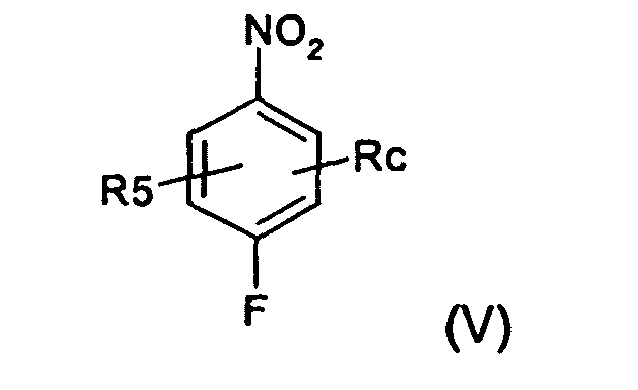

Rc die Bedeutung Halogen und Rd die Bedeutung B(OH)2 beziehungsweise Rc die Bedeutung B(OH)2 und Rd die Bedeutung Halogen hat, und
R5, R6 und R7 die in Formel (1) angegebene Bedeutung haben, anschließende Substitution des so erhaltenen substituierten Benzols der Formel (VI)
worin R1,R2 die in Formel (I) genannte Bedeutung haben, und
abschliesende Reduktion der Nitrogruppe. - Die erfindungsgemäßen 1,4-Diamino-2-(thiazol-2-yl)-benzol-Derivate der Formel (I) sind in Wasser gut löslich und ermöglichen Färbungen mit hoher Farbintensität und ausgezeichneter Farbechtheit, insbesondere was die Lichtechtheit, Waschechtheit und Reibeechtheit anbetrifft. Die Verbindungen der Formen (I) weisen weiterhin eine ausgezeichnete Lagerstabilität, insbesondere als Bestandteil der nachfolgend beschriebenen Färbemittel, auf.
- Ein weiterer Gegenstand der vorliegenden Erfindung sind daher Mittel zum oxidativen Färben von Keratinfasern, wie zum Beispiel Haaren, Pelzen, Federn oder Wolle, insbesondere menschlichen Haaren, auf der Basis einer Entwicklersubstanz-Kupplersubstanz-Kombination, welche als Entwicklersubstanz mindestens ein 1,4-Diamino-2-(thiazol-2-yl)-benzol-Derivat der Formel (I) enthalten.
- Das 1,4-Diamino-2-(thiazol-2-yl)-benzol-Derivat der Formel (I) ist in dem erfindungsgemäßen Färbemittel in einer Menge von etwa 0,005 bis 20 Gewichtsprozent enthalten, wobei eine Menge von etwa 0,01 bis 5,0 Gewichtsprozent und insbesondere 0,1 bis 2,5 Gewichtsprozent bevorzugt ist.
- Als Kupplersubstanzen kommen vorzugsweise N-(3-Dimethylaminophenyl)-harnstoff, 2,6-Diamino-pyridin, 2-Amino-4-[(2-hydroxyethyl)-amino]-anisol, 2,4-Diamino-1-fluor 5-methyl-benzol, 2,4-Diamino-1-methoxy-5-methyl-benzol, 2,4-Diamino-1-ethoxy-5-methyl-benzol, 2,4-Diamino-1-(2-hydroxyethoxy)-5-methyl-benzol, 2,4-Di[(2-hydroxy ethyl)amino]-1,5-dimethoxy-benzol, 2,3-Diamino-6-methoxy-pyridin, 3-Amino-6-methoxy-2-(methylamino)-pyridin, 2,6-Diamino-3,5-dimethoxy-pyridin, 3,5-Diamino-2,6-dimethoxy-pyridin, 1,3-Diamino-benzol, 2,4-Diamino-1-(2-hydroxyethoxy)-benzol, 1,3-Diamino-4-(2,3-dihydroxy-propoxy)-benzol, 2,4-Diamino-1,5-di(2-hydroxyethoxy)-benzol, 1-(2-Aminoethoxy)-2,4-diamino-benzol, 2-Amino-1-(2-hydroxyethoxy)-4-methylamino-benzol, 2,4-Diaminophenoxy-essigsäure, 3-[Di(2-hydroxyethyl)amino]-anilin, 4-Amino-2-di[(2-hydroxyethyl)amino]-1-ethoxy-benzol, 5-Methyl-2-(1-methylethyl)-phenol, 3-[(2-Hydroxyethyl)amino]-anilin, 3-[(2-Aminoethyl)amino]-anilin, 1,3-Di(2,4-diaminophenoxy)-propan, Di(2,4-diaminophenoxy)-methan, 1,3-Diamino-2,4-dimethoxy-benzol, 2,6-Bis(2-hydroxyethyl)amino-toluol, 4-Hydroxyindol, 3-Dimethylamino-phenol, 3-Diethylamino-phenol, 5-Amino-2-methyl-phenol, 5-Amino-4-fluor-2-methyl-phenol, 5-Amino-4-methoxy-2-methyl-phenol, 5-Amino-4-ethoxy-2-methyl-phenol, 3-Amino-2,4-dichlor-phenol, 5-Amino-2,4-dichlor-phenol, 3-Amino-2-methyl-phenol, 3-Amino-2-chlor-6-methyl-phenol, 3-Amino-phenol, 2-[(3-Hydroxyphenyl)amino]-acetamid, 5-[(2-Hydroxyethyl)amino]-4-methoxy-2-methyl-phenol, 5-[(2-Hydroxyethyl)amino]-2-methyl-phenol, 3-[(2-Hydroxyethyl)amino]-phenol, 3-[(2-Methoxyethyl)amino]-phenol, 5-Amino-2-ethyl-phenol, 5-Amino-2-methoxy-phenol, 2-(4-Amino-2-hydroxyphenoxy)-ethanol, 5-[(3-Hydroxypropyl)amino]-2-methyl-phenol, 3-[(2,3-Dihydroxypropyl)amino]-2-methyl-phenol, 3-[(2-Hydroxyethyl)amino]-2-methyl-phenol, 2-Amino-3-hydroxy-pyridin, 5-Amino-4-chlor-2-methyl-phenol, 1-Naphthol, 2-Methyl-1-naphthol, 1,5-Dihydroxy-naphthalin, 1,7-Dihydroxy-naphthalin, 2,3-Dihydroxy-naphthalin, 2,7-Dihydroxy-naphthalin, 2-Methyl-1-naphthol-acetat, 1,3-Dihydroxy-benzol, 1-Chlor-2,4-dihydroxy-benzol, 2-Chlor-1,3-dihydroxy-benzol, 1,2-Dichlor-3,5-dihydroxy-4-methyl-benzol, 1,5-Dichlor-2,4-dihydroxy-benzol, 1,3-Dihydroxy-2-methyl-benzol, 3,4-Methylendioxy-phenol, 3,4-Methylendioxy-anilin, 5-[(2-Hydroxyethyl)amino]-1,3-benzodioxol, 6-Brom-1-hydroxy-3,4-methylendioxy-benzol, 3,4-Diaminobenzoesäure, 3,4-Dihydro-6-hydroxy-1,4(2H)-benzoxazin, 6-Amino-3,4-dihydro-1,4(2H)-benzoxazin, 3-Methyl-1-phenyl-5-pyrazolon, 5,6-Dihydroxy-indol, 5,6-Dihydroxy-indolin, 5-Hydroxy-indol, 6-Hydroxy-indol, 7-Hydroxy-indol, 2,3-Indolindion in Betracht.
- Obwohl die vorteilhaften Eigenschaften der hier beschriebenen 1,4-Diamino-2-(thiazol-2-yl)-benzol-Derivate der Formel (1) es nahelegen, diese als alleinige Entwicklersubstanz zu verwenden, ist es selbstverständlich auch möglich, die 1,4-Diamino-2-(thiazol-2-yl)-benzol-Derivate der Formel (I) gemeinsam mit bekannten Entwicklersubstanzen, wie zum Beispiel 1,4-Diaminobenzol, 2,5-Diaminotoluol, 2,5-Diaminophenylethylalkohol, 4-Aminophenol und seinen Derivaten, beispielsweise 4-Amino-3-methylphenol, 4,5-Diamino-1-(2-hydroxyethyl)-pyrazol, 4,5-Diamino-1-benzyl-pyrazol, 4,5-Diamino-1-(4-methyl-benzyl)-pyrazol oder Tetraaminopyrimidinen, einzusetzen.
- Die Kupplersubstanzen und Entwicklersubstanzen können in dem erfindungsgemäßen Färbemittel jeweils einzeln oder im Gemisch miteinander enthalten sein, wobei die Gesamtmenge an Kupplersubstanzen und Entwicklersubstanzen in dem erfindungsgemäßen Färbemittel (bezogen auf die Gesamtmenge des Färbemittels) jeweils etwa 0,005 bis 20 Gewichtsprozent, vorzugsweise etwa 0,01 bis 5,0 Gewichtsprozent und insbesondere 0,1 bis 2,5 Gewichtsprozent, beträgt.
- Die Gesamtmenge der in dem hier beschriebenen Färbemittel enthaltenen Entwicklersubstanz-Kupplersubstanz-Kombination beträgt vorzugsweise etwa 0,01 bis 20 Gewichtsprozent, wobei eine Menge von etwa 0,02 bis 10 Gewichtsprozent und insbesondere 0,2 bis 6,0 Gewichtsprozent besonders bevorzugt ist. Die Entwicklersubstanzen und Kupplersubstanzen werden im allgemeinen in etwa äquimolaren Mengen eingesetzt; es ist jedoch nicht nachteilig, wenn die Entwicklersubstanzen diesbezüglich in einem gewissen Uberschuß oder Unterschuß vorhanden sind.
- Weiterhin kann das erfindungsgemäße Färbemittel zusätzlich andere Farbkomponenten, beispielsweise 6-Amino-2-methylphenol und 2-Amino-5-methylphenol, sowie ferner übliche direktziehende Farbstoffe, zum Beispiel Triphenylmethanfarbstoffe wie 4-[(4'-aminophenyl)-(4'imino-2",5"-cyclohexadien-1 "-yliden)-methyl]-2-methylaminobenzol-monohydrochlorid (C.l. 42 510) und 4-[(4'amino-3'-methyl-phenyl)-(4"-imino-3"-methyl-2",5"cyclohexadien-1"-yliden)-methyl]-2-methyl-aminobenzol monohydrochlorid (C.l. 42 520), aromatische Nitrofarbstoffe wie 4-(2'-hydroxyethyl)-amino-nitrotoluol, 2-Amino-4,6-dinitrophenol, 2-Amino-5-(2'-hydroxyethyl)-amino-nitrobenzol, 2-Chlor-6-(ethylamino)-4-nitrophenol, 4-Chlor-N-(2-hydroxyethyl)-2-nitroanilin, 5-Chlor-2-hydroxy-4-nitroanilin, 2-Amino-4-chlor-6-nitrophenol und 1-[(2'-Ureidoethyl)amino-4-nitrobenzol, Azofarbstoffe wie 6-[(4'-Aminophenyl)azo]-5hydroxy-naphthalin-1-sulfonsäure-Natriumsalz (C.1. 14 805) und Dispersionsfarbstoffe wie beispielsweise 1,4-Diaminoanthrachinon und 1,4,5,8-Tetraaminoantrachinon, enthalten. Die Färbemittel können diese Farbkomponenten in einer Menge von etwa 0,1 bis 4,0 Gewichtsprozent enthalten.
- Selbstverständlich können die Kupplersubstanzen und Entwicklersubstanzen sowie die anderen Farbkomponenten, sofern es Basen sind, auch in Form der physiologisch verträglichen Salze mit organischen oder anorganischen Säuren, wie beispielsweise Salzsäure oder Schwefelsäure, beziehungsweise - sofern sie aromatische OH-Gruppen besitzen - in Form der Salze mit Basen, zum Beispiel als Alkaliphenolate, eingesetzt werden.
- Darüber hinaus können in den Färbemitteln, falls diese zur Färbung von Haaren verwendet werden sollen, noch weitere übliche kosmetische Zusätze, beispielsweise Antioxidantien wie Ascorbinsäure, Thioglykolsäure oder Natriumsulfit, sowie Parfümöle, Komplexbildner, Netzmittel, Emulgatoren, Verdicker und Pflegestoffe enthalten sein. Die Zubereitungsform des erfindungsgemäßen Färbemittels kann beispielsweise eine Lösung, insbesondere eine wäßrige oder wäßrigalkoholische Lösung sein. Die besonders bevorzugten Zubereitungsformen sind jedoch eine Creme, ein Gel oder eine Emulsion. Ihre Zusammensetzung stellt eine Mischung der Farbstofflcomponenten mit den für solche Zubereitungen üblichen Zusätzen dar.
- Ubliche Zusätze in Lösungen, Cremes, Emulsionen oder Gelen sind zum Beispiel Lösungsmittel wie Wasser, niedere aliphatische Alkohole, beispielsweise Ethanol, Propanol oder Isopropanol, Glycerin oder Glykole wie 1,2-Propylenglykol, weiterhin Netzmittel oder Emulgatoren aus den Klassen der anionischen, kationischen, amphoteren oder nichtionogenen oberflächenaktiven Substanzen wie zum Beispiel Fettalkoholsulfate, oxethylierte Fettalkoholsulfate, Alkylsulfonate, Alkylbenzolsulfonate, Alkyltrimethylammoniumsalze, Alkylbetaine, oxethylierte Fettalkohole, oxethylierte Nonylphenole, Fettsäurealkanolamide und oxethylierte Fettsäureester ferner Verdicker wie hohere Fettalkohole, Stärke, Cellulosederivate, Petrolatum, Paraffinöl und Fettsäuren, sowie außerdem Pflegestoffe wie kationische Harze, Lanolinderivate, Cholesterin, Pantothensäure und Betain. Die erwähnten Bestandteile werden in den für solche Zwecke üblichen Mengen verwendet, zum Beispiel die Netzmittel und Emulgatoren in Konzentrationen von etwa 0,5 bis 30 Gewichtsprozent, die Verdicker in einer Menge von etwa 0,1 bis 25 Gewichtsprozent und die Pflegestoffe in einer Konzentration von etwa 0,1 bis 5,0 Gewichtsprozent.
- Je nach Zusammensetzung kann das erfindungsgemäße Färbemittel schwach sauer, neutral oder alkalisch reagieren. Insbesondere weist es einen pH-Wert von 6,5 bis 11,5 auf, wobei die basische Einstellung vorzugsweise mit Ammoniak erfolgt. Es können aber auch organische Amine, zum Beispiel Monoethanolamin und Triethanolamin, oder auch anorganische Basen wie Natriumhydroxid und Kaliumhydroxid Verwendung finden. Für eine pH-Einstellung im sauren Bereich kommen anorganische oder organische Säuren, zum Beispiel Phosphorsäure, Essigsäure Zitronensäure oder Weinsäure, in Betracht.
- Für die Anwendung zur oxidativen Färbung von Haaren vermischt man das vorstehend beschriebene Färbemittel unmittelbar vor dem Gebrauch mit einem Oxidationsmittel und trägt eine für die Haarfärbebehandlung ausreichende Menge, je nach Haarfülle, im allgemeinen etwa 60 bis 200 Gramm, dieses Gemisches auf das Haar auf.
- Als Oxidationsmittel zur Entwicklung der Haarfärbung kommen hauptsächlich Wasserstoffperoxid oder dessen Additionsverbindungen an Harnstoff, Melamin, Natriumborat oder Natriumcarbonat in Form einer 3-bis 12prozentigen, vorzugsweise 6prozentigen, wässrigen Lösung, aber auch Luftsauerstoff in Betracht. Wird eine 6prozentige Wasserstoffperoxid-Lösung als Oxidationsmittel verwendet, so beträgt das Gewichtsverhältnis zwischen Haarfärbemittel und Oxidationsmittel 5:1 bis 1:2, vorzugeweise jedoch 1:1. Größere Mengen an Oxidationsmittel werden vor allem bei höheren Farbstoffkonzentrationen im Haarfärbemittel, oder wenn gleichzeitig eine stärkere Bleichung des Haares beabsichtigt ist, verwendet. Man läßt das Gemisch bei 15 bis 50 Grad Celsius etwa 10 bis 45 Minuten lang, vorzugsweise 30 Minuten lang, auf das Haar einwirken, spült sodann das Haar mit Wasser aus und trocknet es. Gegebenenfalls wird im Anschluß an diese Spülung mit einem Shampoo gewaschen und eventuell mit einer schwachen organischen Säure, wie zum Beispiel Zitronensäure oder Weinsäure, nachgespült. Anschließend wird das Haar getrocknet.
- Die erfindungsgemäßen Färbemittel mit einem Gehalt an 1,4-Diamino-2-(thiazol-2-yl)-benzol-Derivaten der Formel (I) als Entwicklersubstanz ermöglichen Färbungen von Keratinfasern, insbesondere Haaren, mit ausgezeichneter Farbechtheit, insbesondere was die Lichtechtheit, Waschechtheit und Reibeechtheit anbetrifft. Hinsichtlich der färberischen Eigenschaften bieten die erfindungsgemäßen Färbemittel je nach Art und Zusammensetzung der Farbkomponenten eine breite Palette verschiedener Farbnuancen, welche sich von blonden über braune, purpurne, violette bis hin zu blauen und schwarzen Farbtönen erstreckt. Hierbei zeichnen sich die Farbtöne durch ihre besondere Farbintensität aus. Die sehr guten färberischen Eigenschaften der Färbemittel gemäß der vorliegenden Anmeldung zeigen sich weiterhin darin, dass diese Mittel eine Anfärbung von ergrauten, chemisch nicht vorgeschädigten Haaren problemlos und mit guter Deckkraft ermöglichen.
- Die nachfolgenden Beispiele sollen den Gegenstand der Erfindung näher erläutern, ohne ihn darauf zu beschränken.
- Die N,N'-Bis(tert-Butoxycarbonyl)-2,5-diamino-1-phenylborsäure wird durch Umsetzung von N,N'-Bis(tert-Butoxycarbonyl)-2,5-diamino-1-brombenzol mit tert-Butyllithium und Trimethylborate dargestellt. Die experimentelle Vorschrift dieser Herstellungsmethode wird von J. M. Tour und J. J. S. Lamba in J. Am. Chem. Soc.1994, 116, Seite 11723 beschrieben.
- 0,035 g (0,0001 mol) 2,5-tert.-Butyloxycarbonylamino-1-phenylborsäure aus Stufe A und 0,00015 mol 2-Brom-thiazol werden unter Argon in 10 ml 1,2-Dimethoxyethan gelöst. Anschliessend werden 0,005 g Tetrakis-(triphenylphosphin)-palladium (0,000005 mol) und 0,13 ml einer 2normalen Kaliumcarbonatlösung zugegeben und die Reaktionsmischung auf 80 °C erwärmt. Nach Beendigung der Reaktion wird die Reaktionsmischung in 10 ml Essigsäureethylester gegossen, die organische Phase mit verdünnter Natronlauge extrahiert und sodann mit Magnesiumsulfat getrocknet. Das Lösungsmittel wird am Rotationsverdampfer abdestilliert und der Rückstand an Kieselgel mit Petrolether/Essigsäureethylester (9:1) gereinigt. Das so erhaltene Produkt wird in 4 ml Ethanol auf 50 °C erwärmt. Anschliessend werden zur Herstellung des Hydrochlorides 1,5 ml einer 2,9molaren ethanolische Salzsäurelösung zugetropft. Der Niederschlag wird abfiltriert, zweimal mit 1 ml Ethanol gewaschen und sodann getrocknet.
Ausbeute: 0,015 g (94 % der Theorie)
Masspektrum: MH+ 192 (100) - Es werden Haarfärbelösungen der folgenden Zusammensetzung hergestellt:
1,25 mmol 1,4-Diamino-2-(thiazol-2-yl)-benzol*HCl 1,25 mmol Kupplersubstanz gemäß Tabelle 1 1,0 g Kaliumoleat (8-prozentige wässrige Lösung) 1,0 g Ammoniak (22-prozentige wässrige Lösung) 1,0 g Ethanol 0,3 g Ascorbinsäure ad 100,0 g Wasser Tabelle 1: Kupplersubstanz Farbe a) 1,3-Dihydroxy-benzol dunkelblond b) 1,3-Diamino-4-(2-hydroxy-ethoxy)-benzol-sulfat dunkelblau c) 5-Amino-2-methyl-phenol purpur d) 1-Naphtol blau - Es werden Haarfärbelösungen der folgenden Zusammensetzung hergestellt:
X g 1,4-Diamino-2-(thiazol-2-yl)-benzol*HCl (E1) U g Entwicklersubstanz E8 bis E15 gemäß Tabelle 2 Y g Kupplersubstanz K11 bis K36 gemäß Tabelle 4 Z g direktziehender Farbstoff D1 bis D3 gemäß Tabelle 3 10,0 g Kaliumoleat (8-prozentige wässrige Lösung) 10,0 g Ammoniak (22-prozentige wässrige Lösung) 10,0 g Ethanol 0,3 g Ascorbinsäure ad 100,0 g Wasser - Es werden cremeförmige Farbträgermassen der folgenden Zusammensetzung hergestellt:
Xg 1,4-Diamino-2-(thiazol-2-yl)-benzol*HCl (E1) U g Entwicklersubstanz E8 bis E15 gemäß Tabelle 2 Y g Kupplersubstanz K11 bis K36 gemäss Tabelle 4 Z g direktziehender Farbstoff D2 gemäss Tabelle 3 15,0 g Cetylalkohol 0,3 g Ascorbinsäure 3,5 g Natriumlaurylalkoholdiglycolethersulfat, 28-prozentige wässrige Lösung 3,0 g Ammoniak, 22-prozentige wässrige Lösung 0,3 g Natriumsulfit, wasserfrei ad 100,0 g Wasser Tabelle 2: Entwicklersubstanzen E1 1,4-Diamino-2-(thiazol-2-yl)-benzol*HCl E8 1,4-Diaminobenzol E9 2,5-Diamino-phenylethanol-sulfat E10 3-Methyl-4-amino-phenol E11 4-Amino-2-aminomethyl-phenol-dihydrochlorid E12 4-Amino-phenol E13 N,N-Bis(2'-hydroxyethyl)-p-phenylendiamin-sulfat E14 4,5-Diamino-1-(2'-hydroxyethyl)-pyrazol-sulfat E15 2,5-Diaminotoluol-sulfat Tabelle 3: Direktziehende Farbstoffe D1 2,6-Diamino-3-((pyridin-3-yl)azo)pyridin D2 6-Chlor-2-ethylamino-4-nitro-phenol D3 2-Amino-6-chlor-4-nitro-phenol Tabelle 4: Kupplersubstanzen K11 1,3-Diaminobenzol K12 2-Amino-4-(2'-hydroxyethyl)amino-anisol-sulfat K13 1,3-Diamino-4-(2'-hydroxyethoxy)benzol-sulfat K14 2,4-Diamino-5-fluor-toluol-sulfat K15 3-Amino-2-methylamino-6-methoxy-pyridin K16 3,5-Diamino-2,6-dimethoxy-pyridin-dihydrochlorid K17 2,4-Diamino-5-ethoxy-toluol-sulfat K18 N-(3-Dimethylamino)phenylharnstoff K19 1,3-Bis(2,4-Diaminophenoxy)propan-tetrahydrochlorid K21 3-Amino-phenol K22 5-Amino-2-methyl-phenol K23 3-Amino-2-chlor-6-methyl-phenol K24 5-Amino-4-fluor-2-methyl-phenol-sulfat K25 1-Naphthol K26 1-Acetoxy-2-methyl-naphthalin K31 1,3-Dihydroxy-benzol K32 2-Methyl-1,3-dihydroxy-benzol K33 1-Chlor-2,4-dihydroxy-benzol K34 4-(2'-Hydroxyethyl)amino-1,2-methylendioxybenzolhydrochlorid K35 3,4-Methylendioxy-phenol K36 2-Amino-5-methyl-phenol 

Tabelle 6: Haarfärbemittel Beispiel Nr. 13 14 15 16 17 18 Farbstoffe (Farbstoffmenge in Gramm) E1 1,80 1,80 1,80 0,70 0,70 0,70 K12 0,10 0,10 0,10 K13 1,10 1,10 1,10 K31 1,10 1,10 1,10 0,40 0,40 0,40 D2 0,10 0,10 0,10 K23 0,05 0,10 0,10 0,10 Färbeergebnis schwarz schwarz schwarz braun braun braun - Alle in der vorliegenden Anmeldung enthaltenen Prozentangaben stellen soweit nicht anders angegeben Gewichtsprozente dar.
Claims (14)

R1,R2,R3 und R4 unabhängig voneinander Wasserstoff, eine C1-C6-Alkylgruppe, eine C2-C4-Hydroxyalkylgruppe, eine C3-C4 Dihydroxyalkylgruppe oder eine C2-C4-Alkoxy-(C1-C2)-alkylgruppe darstellen oder R1 und R2 beziehungsweise R3 und R4 einen viergliedrigen bis achtgliedrigen aliphatischen Ring bilden, wobei mindestens 2 der Reste R1 bis R4 Wasserstoff darstellen;
R5 gleich Wasserstoff, einem Halogenatom, einer C1-C4-Alkylgruppe, einer C1-C4 -Hydroxyalkylgruppe oder einer C1-C4-Alkoxy-gruppe ist;
R6 und R7 unabhänging voneinander gleich Wasserstoff, einem Halogenatom, einer Nitrogruppe, einer C1-C4 -Alkoxygruppe, einer C1-C6-Alkylgruppe, einer C1-C4-Hydroxyalkylgruppe, einer C3-C4-Dihydroxyalkylgruppe oder einer einem Rest der Formel (II) sind

Applications Claiming Priority (3)
| Application Number | Priority Date | Filing Date | Title |
|---|---|---|---|
| DE10102084A DE10102084B4 (de) | 2001-01-18 | 2001-01-18 | 1,4-Diamino-2-(thiazol-2-yl)-benzol-Derivate enthaltende Haarfärbemittel |
| DE10102084 | 2001-01-18 | ||
| PCT/EP2001/010407 WO2002057243A1 (de) | 2001-01-18 | 2001-09-10 | Neue 1,4-diamino-2-(thiazol-2-yl)-benzol-derivate und diese verbindungen enthaltende färbemittel |
Publications (2)
| Publication Number | Publication Date |
|---|---|
| EP1351945A1 EP1351945A1 (de) | 2003-10-15 |
| EP1351945B1 true EP1351945B1 (de) | 2008-01-23 |
Family
ID=7670942
Family Applications (1)
| Application Number | Title | Priority Date | Filing Date |
|---|---|---|---|
| EP01965269A Expired - Lifetime EP1351945B1 (de) | 2001-01-18 | 2001-09-10 | Neue 1,4-diamino-2-(thiazol-2-yl)-benzol-derivate und diese verbindungen enthaltende färbemittel |
Country Status (11)
| Country | Link |
|---|---|
| US (1) | US6875873B2 (de) |
| EP (1) | EP1351945B1 (de) |
| JP (1) | JP4905870B2 (de) |
| AT (1) | ATE384707T1 (de) |
| AU (1) | AU2001285940B2 (de) |
| BR (1) | BR0107671A (de) |
| CA (1) | CA2435297C (de) |
| DE (2) | DE10102084B4 (de) |
| ES (1) | ES2300354T3 (de) |
| MX (1) | MXPA03006356A (de) |
| WO (1) | WO2002057243A1 (de) |
Families Citing this family (3)
| Publication number | Priority date | Publication date | Assignee | Title |
|---|---|---|---|---|
| FR2857664B1 (fr) * | 2003-07-15 | 2007-12-14 | Oreal | Nouveaux derives thiazoles et utilisation de ces derives pour la teinture des fibres keratiniques |
| WO2005014591A1 (en) * | 2003-07-15 | 2005-02-17 | L'oreal | 2-acylamino or 2-sulfonylamino-1, 3-thiazoles as couplers for the oxidation dyeing of keratin fibres |
| AU2006206504A1 (en) * | 2005-01-21 | 2006-07-27 | The Procter & Gamble Company | Keratin dyeing compositions containing benzothiazole-4-, 7-diamines, and use thereof |
Family Cites Families (10)
| Publication number | Priority date | Publication date | Assignee | Title |
|---|---|---|---|---|
| DE2125193C3 (de) * | 1971-05-21 | 1980-08-14 | Basf Ag, 6700 Ludwigshafen | 4-Nitro-2-thiazolyl-1 -aminobenzole und Verfahren zu ihrer Herstellung |
| DE3641832A1 (de) * | 1986-12-08 | 1988-06-16 | Henkel Kgaa | Oxidationshaarfaerbemittel |
| DK0513387T3 (da) * | 1990-11-30 | 2000-06-05 | Otsuka Pharma Co Ltd | Thiazolderivater som inhibitorer af aktivt oxygen |
| JP3093848B2 (ja) * | 1991-12-10 | 2000-10-03 | 三菱化学株式会社 | チアゾ−ル系化合物 |
| DE19812059C1 (de) | 1998-03-19 | 1999-09-23 | Wella Ag | Diaminobenzol-Derivate sowie diese Diaminobenzol-Derivate enthaltende Haarfärbemittel |
| DE19812058C1 (de) | 1998-03-19 | 1999-10-07 | Wella Ag | Diaminobenzol-Derivate und diese Verbindungen enthaltende Haarfärbemittel |
| DE19822041A1 (de) * | 1998-05-16 | 1999-12-23 | Wella Ag | 2,5-Diamino-1-phenylbenzol-Derivate enthaltende Oxidationshaarfärbemittel sowie neue 2,5-Diamino-1-phenylbenzol-Derivate |
| DE19922392C1 (de) * | 1999-05-14 | 2001-01-25 | Wella Ag | Diaminobenzol-Derivate und diese Verbindungen enthaltende Färbemittel |
| DE29912882U1 (de) * | 1999-07-23 | 1999-09-30 | Wella Ag | Mittel zur Färbung von keratinischen Farben |
| DE20108704U1 (de) * | 2001-05-25 | 2001-09-06 | Wella Ag, 64295 Darmstadt | 1,3-Dihydroxybenzol-Derivate sowie diese Verbindungen enthaltende Färbemittel für Keratinfasern |
-
2001
- 2001-01-18 DE DE10102084A patent/DE10102084B4/de not_active Expired - Fee Related
- 2001-09-10 CA CA002435297A patent/CA2435297C/en not_active Expired - Fee Related
- 2001-09-10 US US10/203,597 patent/US6875873B2/en not_active Expired - Lifetime
- 2001-09-10 AT AT01965269T patent/ATE384707T1/de not_active IP Right Cessation
- 2001-09-10 JP JP2002557924A patent/JP4905870B2/ja not_active Expired - Fee Related
- 2001-09-10 BR BR0107671-0A patent/BR0107671A/pt not_active Application Discontinuation
- 2001-09-10 AU AU2001285940A patent/AU2001285940B2/en not_active Ceased
- 2001-09-10 EP EP01965269A patent/EP1351945B1/de not_active Expired - Lifetime
- 2001-09-10 WO PCT/EP2001/010407 patent/WO2002057243A1/de not_active Ceased
- 2001-09-10 DE DE50113542T patent/DE50113542D1/de not_active Expired - Lifetime
- 2001-09-10 MX MXPA03006356A patent/MXPA03006356A/es active IP Right Grant
- 2001-09-10 ES ES01965269T patent/ES2300354T3/es not_active Expired - Lifetime
Also Published As
| Publication number | Publication date |
|---|---|
| WO2002057243A1 (de) | 2002-07-25 |
| DE10102084A1 (de) | 2002-08-01 |
| CA2435297A1 (en) | 2002-07-25 |
| DE10102084B4 (de) | 2006-06-29 |
| ES2300354T3 (es) | 2008-06-16 |
| AU2001285940B2 (en) | 2005-11-24 |
| US6875873B2 (en) | 2005-04-05 |
| JP2004517144A (ja) | 2004-06-10 |
| CA2435297C (en) | 2008-02-12 |
| MXPA03006356A (es) | 2005-08-16 |
| DE50113542D1 (de) | 2008-03-13 |
| ATE384707T1 (de) | 2008-02-15 |
| JP4905870B2 (ja) | 2012-03-28 |
| US20030115683A1 (en) | 2003-06-26 |
| BR0107671A (pt) | 2003-06-10 |
| EP1351945A1 (de) | 2003-10-15 |
Similar Documents
| Publication | Publication Date | Title |
|---|---|---|
| EP0943614B1 (de) | Diaminobenzol-Derivate enthaltende Färbemittel sowie die Diaminobenzol-Derivate | |
| DE19812058C1 (de) | Diaminobenzol-Derivate und diese Verbindungen enthaltende Haarfärbemittel | |
| DE19822041A1 (de) | 2,5-Diamino-1-phenylbenzol-Derivate enthaltende Oxidationshaarfärbemittel sowie neue 2,5-Diamino-1-phenylbenzol-Derivate | |
| EP1183227B1 (de) | P-diaminobenzol-derivate und diese verbindungen enthaltende färbemittel | |
| EP1558204B1 (de) | 2-amino-5-ethylphenol enthaltendes mittel zum färben von keratinfasern | |
| EP1108708B1 (de) | Neue 1,4-Diaminobenzol-Derivate und diese Verbindungen enthaltende Färbemittel | |
| EP1392673B1 (de) | 1,3-dihydroxybenzol-derivate und diese verbindungen enthaltende färbemittel | |
| EP1351921B1 (de) | Neue 1,4-diamino-2-alkenyl-benzol-derivate und diese verbindungen enthaltende färbemittel | |
| EP1370514A1 (de) | 1,3-diamino-4-(aminomethyl)-benzol-derivate und diese verbindungen enthaltende färbemittel | |
| DE19922392C1 (de) | Diaminobenzol-Derivate und diese Verbindungen enthaltende Färbemittel | |
| EP1226107B1 (de) | N-benzyl-p-phenylendiamin-derivate enthaltende färbemittel für keratinfasern sowie neue n-benzyl-p-phenylendiamin-derivate | |
| DE10102084B4 (de) | 1,4-Diamino-2-(thiazol-2-yl)-benzol-Derivate enthaltende Haarfärbemittel | |
| DE20110356U1 (de) | m-Dihydroxybenzol-Derivate sowie diese Verbindungen enthaltende Färbemittel für Keratinfasern | |
| EP1313724B1 (de) | N-heteroarylmethyl-p-phenylendiamin-derivate sowie diese verbindungen enthaltende oxidationsfärbemittel | |
| EP1355619B1 (de) | (1,1'-biphenyl)-2,4-diamin-derivate enthaltende färbemittel für keratinfasern sowie neue (1,1'-biphenyl)-2,4-diamin-derivate | |
| DE10112506B4 (de) | 1,4-Diamino-2-(2-aminoethyl)-benzol-Derivate und diese Verbindungen enthaltende Färbemittel | |
| DE20108608U1 (de) | 2,5-Diamino-benzaldehyd-Derivate und diese Verbindungen enthaltende Färbemittel | |
| EP1261599A1 (de) | 1,3-diamino-4-heteroaryl-benzol-derivate enthaltende färbemittel für keratinfasern sowie neue 1,3-diamino-4-heteroaryl-benzol-derivate | |
| DE20013155U1 (de) | 2,5-Diamino-1-(1'-hydroxyalkyl-)benzol-Derivate enthaltende Färbemittel für Keratinfasern | |
| DE10114425C1 (de) | Diaminobenzol-Derivate und diese Verbindungen enthaltende Haarfärbemittel | |
| EP1390341A1 (de) | N-benzyl-m-phenylendiamin-derivate und diese verbindungen enthaltende färbemittel | |
| DE20202609U1 (de) | (1,1'-Biphenyl)-3,5-diamin-Derivate enthaltende Färbemittel sowie neue (1,1'-Biphenyl)-3,5-diamin-Derivate | |
| DE20111036U1 (de) | 1,3-Diamino-5-(aminomethyl)-benzol-Derivate und diese Verbindungen enthaltende Färbemittel | |
| DE102004042850A1 (de) | p-Diaminobenzol-Derivate und diese Verbindungen enthaltende Färbemittel |
Legal Events
| Date | Code | Title | Description |
|---|---|---|---|
| PUAI | Public reference made under article 153(3) epc to a published international application that has entered the european phase |
Free format text: ORIGINAL CODE: 0009012 |
|
| 17P | Request for examination filed |
Effective date: 20020518 |
|
| AK | Designated contracting states |
Kind code of ref document: A1 Designated state(s): AT BE CH CY DE DK ES FI FR GB GR IE IT LI LU MC NL PT SE TR |
|
| AX | Request for extension of the european patent |
Extension state: AL LT LV MK RO SI |
|
| REG | Reference to a national code |
Ref country code: HK Ref legal event code: DE Ref document number: 1061394 Country of ref document: HK |
|
| GRAP | Despatch of communication of intention to grant a patent |
Free format text: ORIGINAL CODE: EPIDOSNIGR1 |
|
| RIC1 | Information provided on ipc code assigned before grant |
Ipc: C07D 277/28 20060101AFI20070917BHEP Ipc: A61Q 5/10 20060101ALI20070917BHEP |
|
| GRAS | Grant fee paid |
Free format text: ORIGINAL CODE: EPIDOSNIGR3 |
|
| GRAA | (expected) grant |
Free format text: ORIGINAL CODE: 0009210 |
|
| AK | Designated contracting states |
Kind code of ref document: B1 Designated state(s): AT BE CH CY DE DK ES FI FR GB GR IE IT LI LU MC NL PT SE TR |
|
| REG | Reference to a national code |
Ref country code: GB Ref legal event code: FG4D Free format text: NOT ENGLISH |
|
| REG | Reference to a national code |
Ref country code: CH Ref legal event code: EP |
|
| REG | Reference to a national code |
Ref country code: IE Ref legal event code: FG4D Free format text: LANGUAGE OF EP DOCUMENT: GERMAN |
|
| REF | Corresponds to: |
Ref document number: 50113542 Country of ref document: DE Date of ref document: 20080313 Kind code of ref document: P |
|
| GBT | Gb: translation of ep patent filed (gb section 77(6)(a)/1977) |
Effective date: 20080418 |
|
| REG | Reference to a national code |
Ref country code: ES Ref legal event code: FG2A Ref document number: 2300354 Country of ref document: ES Kind code of ref document: T3 |
|
| NLV1 | Nl: lapsed or annulled due to failure to fulfill the requirements of art. 29p and 29m of the patents act | ||
| PG25 | Lapsed in a contracting state [announced via postgrant information from national office to epo] |
Ref country code: FI Free format text: LAPSE BECAUSE OF FAILURE TO SUBMIT A TRANSLATION OF THE DESCRIPTION OR TO PAY THE FEE WITHIN THE PRESCRIBED TIME-LIMIT Effective date: 20080123 |
|
| ET | Fr: translation filed | ||
| PG25 | Lapsed in a contracting state [announced via postgrant information from national office to epo] |
Ref country code: PT Free format text: LAPSE BECAUSE OF FAILURE TO SUBMIT A TRANSLATION OF THE DESCRIPTION OR TO PAY THE FEE WITHIN THE PRESCRIBED TIME-LIMIT Effective date: 20080623 |
|
| REG | Reference to a national code |
Ref country code: IE Ref legal event code: FD4D |
|
| PG25 | Lapsed in a contracting state [announced via postgrant information from national office to epo] |
Ref country code: SE Free format text: LAPSE BECAUSE OF FAILURE TO SUBMIT A TRANSLATION OF THE DESCRIPTION OR TO PAY THE FEE WITHIN THE PRESCRIBED TIME-LIMIT Effective date: 20080423 Ref country code: IE Free format text: LAPSE BECAUSE OF FAILURE TO SUBMIT A TRANSLATION OF THE DESCRIPTION OR TO PAY THE FEE WITHIN THE PRESCRIBED TIME-LIMIT Effective date: 20080123 Ref country code: NL Free format text: LAPSE BECAUSE OF FAILURE TO SUBMIT A TRANSLATION OF THE DESCRIPTION OR TO PAY THE FEE WITHIN THE PRESCRIBED TIME-LIMIT Effective date: 20080123 Ref country code: DK Free format text: LAPSE BECAUSE OF FAILURE TO SUBMIT A TRANSLATION OF THE DESCRIPTION OR TO PAY THE FEE WITHIN THE PRESCRIBED TIME-LIMIT Effective date: 20080123 |
|
| PLBE | No opposition filed within time limit |
Free format text: ORIGINAL CODE: 0009261 |
|
| STAA | Information on the status of an ep patent application or granted ep patent |
Free format text: STATUS: NO OPPOSITION FILED WITHIN TIME LIMIT |
|
| 26N | No opposition filed |
Effective date: 20081024 |
|
| BERE | Be: lapsed |
Owner name: WELLA A.G. Effective date: 20080930 |
|
| PG25 | Lapsed in a contracting state [announced via postgrant information from national office to epo] |
Ref country code: MC Free format text: LAPSE BECAUSE OF NON-PAYMENT OF DUE FEES Effective date: 20080930 |
|
| REG | Reference to a national code |
Ref country code: CH Ref legal event code: PL |
|
| PG25 | Lapsed in a contracting state [announced via postgrant information from national office to epo] |
Ref country code: BE Free format text: LAPSE BECAUSE OF NON-PAYMENT OF DUE FEES Effective date: 20080930 Ref country code: CY Free format text: LAPSE BECAUSE OF FAILURE TO SUBMIT A TRANSLATION OF THE DESCRIPTION OR TO PAY THE FEE WITHIN THE PRESCRIBED TIME-LIMIT Effective date: 20080123 |
|
| PG25 | Lapsed in a contracting state [announced via postgrant information from national office to epo] |
Ref country code: LI Free format text: LAPSE BECAUSE OF NON-PAYMENT OF DUE FEES Effective date: 20080930 Ref country code: AT Free format text: LAPSE BECAUSE OF NON-PAYMENT OF DUE FEES Effective date: 20080910 Ref country code: CH Free format text: LAPSE BECAUSE OF NON-PAYMENT OF DUE FEES Effective date: 20080930 |
|
| PG25 | Lapsed in a contracting state [announced via postgrant information from national office to epo] |
Ref country code: LU Free format text: LAPSE BECAUSE OF NON-PAYMENT OF DUE FEES Effective date: 20080910 |
|
| PG25 | Lapsed in a contracting state [announced via postgrant information from national office to epo] |
Ref country code: TR Free format text: LAPSE BECAUSE OF FAILURE TO SUBMIT A TRANSLATION OF THE DESCRIPTION OR TO PAY THE FEE WITHIN THE PRESCRIBED TIME-LIMIT Effective date: 20080123 |
|
| PG25 | Lapsed in a contracting state [announced via postgrant information from national office to epo] |
Ref country code: GR Free format text: LAPSE BECAUSE OF FAILURE TO SUBMIT A TRANSLATION OF THE DESCRIPTION OR TO PAY THE FEE WITHIN THE PRESCRIBED TIME-LIMIT Effective date: 20080424 |
|
| PGFP | Annual fee paid to national office [announced via postgrant information from national office to epo] |
Ref country code: ES Payment date: 20100914 Year of fee payment: 10 |
|
| PGFP | Annual fee paid to national office [announced via postgrant information from national office to epo] |
Ref country code: IT Payment date: 20100917 Year of fee payment: 10 |
|
| PGFP | Annual fee paid to national office [announced via postgrant information from national office to epo] |
Ref country code: DE Payment date: 20100930 Year of fee payment: 10 |
|
| REG | Reference to a national code |
Ref country code: HK Ref legal event code: WD Ref document number: 1061394 Country of ref document: HK |
|
| REG | Reference to a national code |
Ref country code: DE Ref legal event code: R081 Ref document number: 50113542 Country of ref document: DE Owner name: WELLA GMBH, DE Free format text: FORMER OWNER: WELLA AG, 64295 DARMSTADT, DE Effective date: 20110628 |
|
| PGFP | Annual fee paid to national office [announced via postgrant information from national office to epo] |
Ref country code: GB Payment date: 20110826 Year of fee payment: 11 Ref country code: FR Payment date: 20110901 Year of fee payment: 11 |
|
| PG25 | Lapsed in a contracting state [announced via postgrant information from national office to epo] |
Ref country code: IT Free format text: LAPSE BECAUSE OF NON-PAYMENT OF DUE FEES Effective date: 20110910 |
|
| REG | Reference to a national code |
Ref country code: ES Ref legal event code: FD2A Effective date: 20130417 |
|
| PG25 | Lapsed in a contracting state [announced via postgrant information from national office to epo] |
Ref country code: ES Free format text: LAPSE BECAUSE OF NON-PAYMENT OF DUE FEES Effective date: 20110911 |
|
| GBPC | Gb: european patent ceased through non-payment of renewal fee |
Effective date: 20120910 |
|
| REG | Reference to a national code |
Ref country code: FR Ref legal event code: ST Effective date: 20130531 |
|
| REG | Reference to a national code |
Ref country code: DE Ref legal event code: R119 Ref document number: 50113542 Country of ref document: DE Effective date: 20130403 |
|
| PG25 | Lapsed in a contracting state [announced via postgrant information from national office to epo] |
Ref country code: GB Free format text: LAPSE BECAUSE OF NON-PAYMENT OF DUE FEES Effective date: 20120910 Ref country code: DE Free format text: LAPSE BECAUSE OF NON-PAYMENT OF DUE FEES Effective date: 20130403 |
|
| PG25 | Lapsed in a contracting state [announced via postgrant information from national office to epo] |
Ref country code: FR Free format text: LAPSE BECAUSE OF NON-PAYMENT OF DUE FEES Effective date: 20121001 |