EP1353246A2 - Sicherheitsschalteranordnung - Google Patents
Sicherheitsschalteranordnung Download PDFInfo
- Publication number
- EP1353246A2 EP1353246A2 EP03005564A EP03005564A EP1353246A2 EP 1353246 A2 EP1353246 A2 EP 1353246A2 EP 03005564 A EP03005564 A EP 03005564A EP 03005564 A EP03005564 A EP 03005564A EP 1353246 A2 EP1353246 A2 EP 1353246A2
- Authority
- EP
- European Patent Office
- Prior art keywords
- arrangement according
- safety
- switch arrangement
- safety switch
- monitor
- Prior art date
- Legal status (The legal status is an assumption and is not a legal conclusion. Google has not performed a legal analysis and makes no representation as to the accuracy of the status listed.)
- Granted
Links
Images


Classifications
-
- G—PHYSICS
- G05—CONTROLLING; REGULATING
- G05B—CONTROL OR REGULATING SYSTEMS IN GENERAL; FUNCTIONAL ELEMENTS OF SUCH SYSTEMS; MONITORING OR TESTING ARRANGEMENTS FOR SUCH SYSTEMS OR ELEMENTS
- G05B19/00—Program-control systems
- G05B19/02—Program-control systems electric
- G05B19/04—Program control other than numerical control, i.e. in sequence controllers or logic controllers
- G05B19/042—Program control other than numerical control, i.e. in sequence controllers or logic controllers using digital processors
-
- G—PHYSICS
- G05—CONTROLLING; REGULATING
- G05B—CONTROL OR REGULATING SYSTEMS IN GENERAL; FUNCTIONAL ELEMENTS OF SUCH SYSTEMS; MONITORING OR TESTING ARRANGEMENTS FOR SUCH SYSTEMS OR ELEMENTS
- G05B9/00—Safety arrangements
- G05B9/02—Safety arrangements electric
-
- G—PHYSICS
- G05—CONTROLLING; REGULATING
- G05B—CONTROL OR REGULATING SYSTEMS IN GENERAL; FUNCTIONAL ELEMENTS OF SUCH SYSTEMS; MONITORING OR TESTING ARRANGEMENTS FOR SUCH SYSTEMS OR ELEMENTS
- G05B2219/00—Program-control systems
- G05B2219/20—Pc systems
- G05B2219/24—Pc safety
- G05B2219/24003—Emergency stop
-
- G—PHYSICS
- G05—CONTROLLING; REGULATING
- G05B—CONTROL OR REGULATING SYSTEMS IN GENERAL; FUNCTIONAL ELEMENTS OF SUCH SYSTEMS; MONITORING OR TESTING ARRANGEMENTS FOR SUCH SYSTEMS OR ELEMENTS
- G05B2219/00—Program-control systems
- G05B2219/20—Pc systems
- G05B2219/24—Pc safety
- G05B2219/24021—Separate processor for monitoring system
-
- G—PHYSICS
- G05—CONTROLLING; REGULATING
- G05B—CONTROL OR REGULATING SYSTEMS IN GENERAL; FUNCTIONAL ELEMENTS OF SUCH SYSTEMS; MONITORING OR TESTING ARRANGEMENTS FOR SUCH SYSTEMS OR ELEMENTS
- G05B2219/00—Program-control systems
- G05B2219/20—Pc systems
- G05B2219/24—Pc safety
- G05B2219/24189—Redundant processors monitor same point, common parameters
-
- G—PHYSICS
- G05—CONTROLLING; REGULATING
- G05B—CONTROL OR REGULATING SYSTEMS IN GENERAL; FUNCTIONAL ELEMENTS OF SUCH SYSTEMS; MONITORING OR TESTING ARRANGEMENTS FOR SUCH SYSTEMS OR ELEMENTS
- G05B2219/00—Program-control systems
- G05B2219/30—Nc systems
- G05B2219/50—Machine tool, machine tool null till machine tool work handling
- G05B2219/50198—Emergency stop
-
- H—ELECTRICITY
- H04—ELECTRIC COMMUNICATION TECHNIQUE
- H04L—TRANSMISSION OF DIGITAL INFORMATION, e.g. TELEGRAPHIC COMMUNICATION
- H04L12/00—Data switching networks
- H04L12/28—Data switching networks characterised by path configuration, e.g. LAN [Local Area Networks] or WAN [Wide Area Networks]
- H04L12/40—Bus networks
- H04L2012/40208—Bus networks characterized by the use of a particular bus standard
- H04L2012/40254—Actuator Sensor Interface ASI
Definitions
- the invention relates to a safety switch arrangement according to the preamble of claim 1.
- Such safety switch arrangements are particularly safe Switching on and off of work equipment used in safety-critical Applications are used. Examples of such tools are presses, folding machines and the like. With such tools danger areas are monitored by means of sensors and the like in order to Exclude hazards to operators. A release of an implement takes place via the respective safety switch arrangement only if there is no object or person in the respective danger zone.
- a large number of sensors are typically used in complex systems and actuators for the operation and monitoring of such tools.
- DE 198 15 147 A1 relates to an arrangement of sensors for monitoring of an implement, which depending on the switching states of the Sensors can be put into operation, the sensors being slaves one after the other Form bus-master system working from a master Master forming control unit is controlled. There is a redundant one on the bus system Evaluation unit connected, which is continuously the over the bus system listens to the transmitted signals. In the evaluation unit, the signals of the sensors, which have an individual coding, their Switching states determined. Only if the coding is correctly identified the implement is put into operation via the evaluation unit.
- the redundant evaluation unit of this arrangement forms a safety monitor.
- This safety monitor determines centrally from the coding of the Control signals the switching states of the sensors, then depending these switching states the activation or deactivation of an implement is controlled centrally.
- the object of the invention is based on an expanded safety concept for the safety switch arrangement mentioned at the beginning provide.
- the safety switch arrangement according to the invention has a predefined one Number of output stages generating switching signals, depending on of the switching signals to the equipment connected to the output stages can be activated or deactivated.
- the output stages form slaves of a bus system operating according to the master-slave principle, which at least a safety monitor for listening to those transmitted via the bus system Signals is assigned.
- the security monitor are during Components of the bus system can be configured during a configuration phase and / or connectable.
- the basic idea of the invention is therefore that the or each safety monitor not only during the operation of the bus system, but also during the configuration phase to configure the bus system or Components of which are the essential safety functions for compliance a given security category.
- the safety monitor expediently indicates compliance with the required Security category based on a redundant structure.
- the master is involved in the implementation of the Configuration only to provide the control functions of the bus system needed while performing the security-related functions configuration by the safety monitor alone become.
- the master is during configuration even deactivated. Then the master functions taken over by the or a safety monitor.
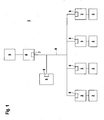
- FIG. 1 schematically shows the structure of a safety switch arrangement 1.
- the safety switch arrangement 1 essentially consists of a The sensor-actuator bus system works according to the master-slave principle and is used for Activation and deactivation of a number of implements 2, 2 '.
- the tools 2, 2 'in the present case consist of an arrangement of Motors with which a safety-relevant process is controlled.
- the motors are each controlled by an output stage 3.
- the case is the output stages 3, 3 'each of one actuator, in particular one or more relays.
- the bus system will centrally controlled by a master 4, which in turn is connected to a controller, in particular a PLC controller 5 is connected.
- Master 4 is from a control circuit is formed.
- the master 4 and the slaves are via bus lines 6 connected to each other.
- the power supply of the sensor-actuator bus system thus formed takes place via a power supply unit, not shown.
- Master 4 cyclically polls the individual slaves at specified addresses from which each slave sends a response to master 4.
- the bus system is formed by the ASi bus system.
- the ASi bus system is especially for the connection of binary sensors and Actuators designed.
- the functioning of the ASi bus system is in "ASI - Das Actuator Sensor Interface for Automation”, Werner Kriesel, Otto W. Madelung, Carl Hanser Verlag, 1994, whose content in the disclosure content this registration is involved.
- a master request (master request MR) consists of one Start bit, a 5-bit address, 2-bit control information, 4-bit user data as well as one parity and one stop bit.
- the associated slave response (slave response SR) contains a start bit, 4 bit user data and one each Parity and stop bit.
- a slave checks the received master call based on specified ASi-specific coding rules. Detects the slave a valid master call, it sends a corresponding answer. In all he does not answer other cases. Master 4 also rejects a slave response, if it does not comply with the relevant coding rules.
- the data are Manchester-coded and are transmitted as alternating, sin 2 -shaped voltage pulses via the bus lines 6.
- the master 4 is assigned an analog circuit 7, which has a transmission element (not shown) and a reception element.
- the binary data of a master call are converted into a sequence of sin 2 -shaped voltage pulses in the transmission element. These signals are sent to the slaves via the bus lines 6.
- the signals sent from the slaves via the bus lines 6 to the master 4 are converted into binary data sequences in the receiving element.
- Each slave has an interface module 8, which in the present example is formed by an Asi-IC.
- the sequences of sin 2 -shaped voltage pulses received via the bus line 6 are converted into binary data.
- the slave response which is in the form of binary data, is sent to the master 4 in a sequence of sin 2 -shaped voltage pulses and via the bus lines 6.
- the security monitor 9 represents a purely passive bus subscriber, which continuously listens to the signals transmitted on the bus lines 6.
- the safety monitor has 9 an interface module 8, whereby this as a slave Can output signals on the bus system.
- the master 4 takes over only that Control of the functions of the bus system. All security-relevant In contrast, functions are taken over by the safety monitor 9.
- the Master 4 has a single-channel structure.
- the output stages 3, 3 'as slaves of the bus system are used for activation and deactivating the work tools 2, 2 '.
- the output stages 3 thus fulfill 3 'security-relevant functions and typically have a redundant Building on.
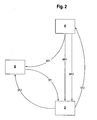
- FIG 2 is the diagram of the data transmission of the individual components the safety switch arrangement 1 shown in Figure 1, with the clarity only one of the output stages 3, 3 'is shown.
- the codes are stored as setpoints, encode the different switching signals for the downstream implement 2.
- the codes consist of a sequence of eight Digits.
- the codes are structured such that a first code is a primary sequence of eight digits.
- the remaining codes form secondary sequences, which are followed by Variations in the order of the digits of the primary sequence are derived from this are.
- the codes each comprise eight digits.
- everyone between a call transmitted to a master 4 and a slave via the bus lines 6 In addition to the address, it has a user data field of 4 bits in which the code is transmitted. Therefore, the eight-digit code must be in individual data strings divided by 4 bits and successively in several calls via the bus system be sent.
- the SR2 call consists of several individual calls. For the sake of clarity, the following is one such a series of calls as the SR2 call is shortened as a single call shown.
- the output stage 3 is driven according to the diagram shown in FIG. 2.
- the master 4 sends a first master request call to the safety monitor 9 MR1. Since the security-relevant information-forming codes in the Safety monitor 9 are stored, this call MR1 does not yet contain any Code for output stages 3, 3 '.
- the MR1 call is made by the safety monitor 9 answered.
- the response SR1 contains a code for Control of the output stage 3.
- the MR1 call and the SR1 response overheard from output stage 3, bringing the code into the output stage 3 is read.
- the code read in via response SR1 is included in output stage 3 the stored setpoint codes compared. If the read codes with one of the stored codes is a positive one Control result generated. Otherwise a negative control result is generated.
- the master request MR1 is now followed by a second master request MR2 to the output stage 3.
- the response SR2 contains this Control result, the answer to the safety monitor 9 being listened to.
- the safety monitor 9 continuously checks the control results of the slaves. If the safety monitor 9 makes a deviation at least of a control result from a predetermined target behavior, the Security monitor 9 predefined measures.
- the activation of the safety monitor 9 is not yet possible deactivated work tools 2 are maintained until, for example, over the master 4 or a controller connected to it the work equipment 2, braked in a controlled manner or brought into a rest position.
- feedback SR2 can be used to call SR1 read code cyclically monitors the functionality of output stages 3 become.
- the switching signals entered in this way to the output stages 3, 3 ' are safety-relevant signals that are used by the motor in the Normal operation or in reduced operation switched on or off becomes. Signals that are not safety-relevant, such as the specification of the exact ones Motor speed is carried out via the PLC control 5 of the bus system 1 and can expediently transmit with the MR2 calls become. This results in the output signal of an output stage 3 as Combination of a release signal generated in the safety monitor 9, which is formed by the switching signal, and one the operation of the implement 2nd controlling control signal from the PLC controller 5.
- FIG. 3 shows a modification of the arrangement according to FIG. 2.
- Such an input / output stage 10 can be, for example, from a light grid be educated.
- the light grid has several light barriers, their light beams Form beam axes.
- the beam axes define one in one plane lying monitoring area within which objects can be detected.
- a light grid can create a danger zone on a working device 2, For example, a press brake can be monitored.
- a corresponding one Object detection signal generated in the light grid. This forms the output signal which is used to generate the switching signal for the implement 2.
- the implement 2 is only activated when there is no object in the Monitoring area is located. Otherwise, the implement 2 is deactivated.
- Blanking zones are entered into the light grid, with which they are not The beam axes of the light grid that cover safety-critical areas are hidden so that when an object intrudes into a blanking zone, no corresponding object detection signal is generated.
- a working device 2 can be operated directly via the input / output stage 10 or via the security monitor 9, which may be a controls additional output stage 3 or an input / output stage 10, activated and be deactivated.
- the input / output stage 10 can be of one Surface distance sensor can be formed, by means of which objects are located in one plane can be. Various parameters are in the area distance sensor Protective fields saved. The area distance sensor is application-specific a certain protective field is selected. Then with that Area distance sensor detects whether an object is in the protective field or Not.
- the implement 2 is only activated when if there is no object in the protective field. Otherwise, the implement 2 deactivated.
- Figure 3 is the diagram of data transmission between the master 4, the Safety monitor 9 and the slave designed as input / output stage 10 shown.
- the switching signals of the input / output stage 10 for activation or deactivation of the implement 2 predetermined. can continue in this way the input / output stage 10 by specifying more specific Blanking zones or specific protective field settings can be specified.
- the configuration 3 over the call SR2 input code input signals from the Input / output stage 10 read. This includes the currently determined object detection signals and the current status of the blanking zone set or the currently set protective field.
- an input / output stage 10 can in the safety monitor 9 output signals are generated to act as parameters for example the blanking zones or protective fields of other input / output stages 10 to change in a predetermined manner.
- FIG. 4 shows the safety switch arrangement 1 with a circuit by means of which the bus system can be configured for before it is commissioned. This is to the safety monitor 9, an operating unit 11 connected by a Computer unit, in particular is formed by a personal computer. Otherwise the circuit arrangement according to FIG. 4 is identical to the arrangement according to FIG. 1.
- a configuration phase is initialized by means of the control unit 11, within which configures the bus system or at least components thereof become.
- the configuration is carried out completely by the safety monitor 9 controlled and controlled, whereby input data for the implementation of the configuration entered into the safety monitor 9 via the control unit 11 become.
- the configuration is carried out such that during In the configuration phase, master 4 of the bus system remains activated.
- the Master 4 then asks the bus participants, namely the connected slaves and the safety monitor 9 among those assigned to these components Addresses cyclically. It is essential here that the master 4 only these master functions takes over, all security-relevant functions for configuration of the bus system, however, are taken over by the safety monitor 9.
- the device-specific parameters in particular are the respective device type of a slave defining codes that are stored in the relevant slaves are transmitted from the respective slave to the safety monitor 9.
- the individual slaves are used as device-specific parameters Device versions in the form of codes in the safety monitor 9 read.
- a slave is preferably not only the current slave Device version, but also the previous device versions. To the current version status with the History of previous versions read into the safety monitor 9.
- the safety monitor 9 controls on the basis of that of the slaves read device versions, which of these device versions with each other are compatible. Depending on this check, the safety monitor sets 9 determines under which device version the individual slaves each during of the operation of the bus system for a specific application become. For example, if there is a new device version for a slave, the not yet available for the remaining slaves and not compatible with the device versions of these remaining slaves, it is agreed in the safety monitor 9 that that the one slave is not called under its current device version shall be. Rather, it is agreed that the slave is in operation the bus system is to be addressed under an earlier device version, which is compatible with the device versions of the remaining slaves.
- Another example of the configuration of slaves is that It can be specified via the safety monitor 9 whether a restart interlock in a slave is activated or deactivated.
- the geometric data of the blanking zones can be used can be specified as optical parameters.
- such protective fields which are typically defined during a teach-in process according to predefined rules and stored in the respective area distance sensor, even during a configuration phase as device parameters in the safety monitor 9 read in and stored there. Will be during another Configuration phase of the relevant area distance sensors against a new one Device replaced, so the protective field stored in the safety monitor 9 can be read directly into the new device.
- the configuration phase is preferably carried out via an input command on the Control unit 11 ends, whereupon the operation of the bus system is started.
- the master 4 becomes during the configuration phase disabled.
- the master functions from the Security monitor 9 adopted.
- Master 4 is used to deactivate disconnected from the bus system or by means of a control command into an off line Operation set.
- the security monitor 9 registers the deactivation of the Masters 4 and then takes over the master functions automatically. As soon as the master 4 is reactivated, it takes over from the safety monitor 9 the master functions again.
- the bus system is configured in the same way as the configuration with activated master 4.
- the configuration phase can also take place during the operation of the bus system can be initiated by, for example, a Exchange slave.
- the configuration phase is initialized a switch, not shown, or the like on the safety monitor 9 operated.
- the new slave is added during the configuration phase assigned an address.
- the slave then becomes analogous to the previous ones Embodiments configured.
- FIG. 5 shows the functioning of a second embodiment of the safety switch arrangement 1 according to the invention.
- the safety switch arrangement 1 is in turn formed by a master-slave bus system which is controlled by a master 4.
- a PLC controller 5 is in turn connected to the master 4.
- two redundant safety monitors 9 are provided, the address A 1 being assigned to the first safety monitor 9 and the address A 2 being assigned to the second safety monitor 9.
- a safety monitor 9 with two addresses A 1 , A 2 can also be used.
- output stages 3, 3 'are provided as slaves, which are analog to the embodiment of Figure 1 are formed by relays that operate control of tools 2, 2 'forming motors.
- the motors are used, for example for driving components of a conveyor line.
- the input stages 12, 12 ' are in the present case designed as an emergency stop switch.
- the input stages 12, 12 ' formed by sensors.
- the output stages 3, 3 'and the subordinate tools 2, 2' are in divided into two groups.
- the safety switch arrangement 1 operates according to the figure 5 as follows:
- the first group of output stages 3 and implements 2 is driven via SR1 views shown in FIGS 2 and 3 at the address A 1 of the first safety monitor 9, ie, the output stage 3, only hear the emitted at the address A 1 Views SR1 of the first safety monitor 9 with, the control results of output stages 3 being reported back via SR2 calls.
- the second group of output stages 3 'and implements 2' is controlled via SR1 calls according to FIGS. 2 and 3 at address A 2 of the second security monitor 9, ie the output stages 3 'only hear the calls SR1 of the second one sent under address A 2 Security monitor 9 with, the control results of the output stages 3 'are reported back via SR2 calls.
- the control of the first group of output stages 3 is dependent the input signals generated by the first input stage 12.
- the operation of the work tools 2 is released via the output stages 3 only if the emergency stop switch forming the input stage 12 is not actuated.
- the second group of output stages 3 'in is likewise activated Dependence of the input signals generated by the second input stage 12 '.
- the operation of the working devices 2 ' is released via the Output stages 3 'only if the emergency stop switch forming the input stage 12' is not actuated.
- the safety switch arrangement 1 is operated according to the figure 4 analogous to the embodiment according to FIG. 1.
- a personal computer is connected as an operating unit to one of the security monitors 9, in the present case to the second security monitor 9 with the address A 2, as shown in FIG.
- the master 4 disabled.
- the safety monitor takes over 9, to which the control unit 11 is connected, the Master roles.
- the configuration can be carried out in such a way that each safety monitor 9 regardless of the other security monitor 9 that him assigned subsystem configured.
- This variant is particularly independent working subsystems make sense.
- the Configuration of the entire system by a safety monitor 9 alone be performed.
- the same security monitor 9 advantageously takes over Configuration, which also took over the master functions.
- each security monitor 9 is stored in each security monitor 9 as basic information, which one Security monitor 9 with a multiple arrangement of security monitors 9 should configure the bus system.
Landscapes
- Physics & Mathematics (AREA)
- General Physics & Mathematics (AREA)
- Engineering & Computer Science (AREA)
- Automation & Control Theory (AREA)
- Safety Devices In Control Systems (AREA)
- Small-Scale Networks (AREA)
- Programmable Controllers (AREA)
Abstract
Description
- Figur 1:
- Schematische Darstellung eines Ausführungsbeispiels der erfindungsgemäßen Sicherheitsschalteranordnung.
- Figur 2:
- Erste Ausführungsform der Datenübertragung zwischen Komponenten einer Sicherheitsschalteranordnung gemäß Figur 1.
- Figur 3:
- Zweite Ausführungsform der Datenübertragung zwischen Komponenten einer Sicherheitsschalteranordnung gemäß Figur 2.
- Figur 4:
- Sicherheitsschalteranordnung gemäß Figur 1 mit einer Konfigurations-Beschaltung.
- Figur 5:
- Ausführungsform der Datenüberübertragung zwischen Komponenten einer weiteren Sicherheitsschalteranordnung.
- Primärfolge:
- Motor ein (Normalbetrieb)
- 1. Sekundärfolge:
- Motor ein (bei reduzierter Geschwindigkeit)
- restliche Sekundärfolgen:
- Motor aus
- (1)
- Sicherheitsschalteranordnung
- (2, 2')
- Arbeitsgerät
- (3, 3')
- Ausgangsstufe
- (4)
- Master
- (5)
- SPS-Steuerung
- (6)
- Busleitung
- (7)
- Analogschaltung
- (8)
- Schnittstellenbaustein
- (9)
- Sicherheitsmonitor
- (10)
- Ein-/Ausgangsstufe
- (11)
- Bedieneinheit
- (12, 12')
- Eingangsstufe
Claims (38)
- Sicherheitsschalteranordnung (1) mit einer vorgegebenen Anzahl von Schaltsignalen generierenden Ausgangsstufen (3), wobei in Abhängigkeit der Schaltsignale an die Ausgangsstufen (3) angeschlossene Arbeitsgeräte (2) aktivierbar oder deaktivierbar sind, und wobei die Ausgangsstufen (3) Slaves eines nach dem Master-Slave-Prinzip arbeitenden Bussystems bilden, welchem wenigstens ein Sicherheitsmonitor (9) zum Abhören der über das Bussystem übertragenen Signale zugeordnet ist, dadurch gekennzeichnet, dass mittels des Sicherheitsmonitors (9) während einer Konfigurationsphase Komponenten des Bussystems konfigurierbar und/oder anschließbar sind.
- Sicherheitsschalteranordnung nach Anspruch 1, dadurch gekennzeichnet, dass während des Betriebs des Bussystems die Slaves und der Sicherheitsmonitor (9) zyklisch vom Master (4) unter vorgegebenen Adressen mittels jeweils eines Master-Request-Aufrufes MR abgefragt werden, worauf der Sicherheitsmonitor (9) und die Slaves jeweils eine Antwort SR an den Master (4) senden.
- Sicherheitsschalteranordnung nach Anspruch 2, dadurch gekennzeichnet, dass während des Betriebs des Bussystems die Slaves in Abhängigkeit von im Sicherheitsmonitor (9) hinterlegten Codes steuerbar sind, wobei auf einen vom Master (4) an dem Sicherheitsmonitor (9) gesendeten Master-Request-Aufruf MR1 ein Code als Antwort SR1 von dem Sicherheitsmonitor (9) an den Master (4) gesendet und von den Slaves mitgehört und dabei in diese eingelesen wird, und dass in den jeweiligen Slaves der empfangene Code kontrolliert wird, wobei das Ergebnis der Kontrolle als Antwort SR2 auf einen zweiten Master-Request-Aufruf MR2 des Masters (4) an diesen zurückgesendet und vom Sicherheitsmonitor (9) mitgehört wird.
- Sicherheitsschalteranordnung nach einem der Ansprüche 1 - 3, dadurch gekennzeichnet, dass die Konfigurationsphase mittels einer dem Sicherheitsmonitor (9) zugeordneten Bedieneinheit (11) initialisierbar ist.
- Sicherheitsschalteranordnung nach Anspruch 4, dadurch gekennzeichnet, dass die Bedieneinheit (11) vom einem am Sicherheitsmonitor (9) angeordneten Schalter gebildet ist, welcher während des Betriebs des Bussystems zur Initialisierung der Konfigurationsphase betätigbar ist.
- Sicherheitsschalteranordnung nach Anspruch 5, dadurch gekennzeichnet, dass während der mittels des Schalters initialisierten Konfigurationsphase ein Slave des Bussystems austauschbar ist.
- Sicherheitsschalteranordnung nach Anspruch 6, dadurch gekennzeichnet, dass dem neu angeschlossenen Slave eine Adresse zugewiesen wird.
- Sicherheitsschalteranordnung nach einem der Ansprüche 6 oder 7, dadurch gekennzeichnet, dass der neu angeschlossene Slave in der Konfigurationsphase konfigurierbar ist.
- Sicherheitsschalteranordnung nach einem der Ansprüche 4 - 8, dadurch gekennzeichnet, dass die Bedieneinheit von einer an den Sicherheitsmonitor (9) anschließbaren Rechnereinheit gebildet ist, mittels derer die Konfigurationsphase vor Inbetriebnahme des Bussystems initialisierbar ist.
- Sicherheitsschalteranordnung nach Anspruch 9, dadurch gekennzeichnet, dass über die Rechnereinheit Eingabedaten zur Durchführung der Konfigurierung von Komponenten des Bussystems in den Sicherheitsmonitor (9) eingebbar sind.
- Sicherheitsschalteranordnung nach einem der Ansprüche 9 oder 10, dadurch gekennzeichnet, dass die Rechnereinheit von einem Personalcomputer gebildet ist.
- Sicherheitsschalteranordnung nach einem der Ansprüche 1 - 11, dadurch gekennzeichnet, dass während der Konfigurationsphase über den Sicherheitsmonitor (9) applikationsspezifische Parameter für die Slaves vorgegeben werden.
- Sicherheitsschalteranordnung nach einem der Ansprüche 1 - 12, dadurch gekennzeichnet, dass während der Konfigurationsphase gerätespezifische Parameter von den Slaves in den Sicherheitsmonitor (9) eingegeben werden.
- Sicherheitsschalteranordnung nach Anspruch 13, dadurch gekennzeichnet, dass von den Slaves deren Gerätetyp definierende Codes in den Sicherheitsmonitor (9) eingelesen werden.
- Sicherheitsschalteranordnung nach einem der Ansprüche 13 oder 14, dadurch gekennzeichnet, dass von den Slaves deren Geräteversionen kennzeichnende Codes in den Sicherheitsmonitor (9) eingelesen werden.
- Sicherheitsschalteranordnung nach einem der Ansprüche 12 - 15, dadurch gekennzeichnet, dass vor Abschluss der Konfigurationsphase im Sicherheitsmonitor (9) eine Liste mit sämtlichen von den Parametern gebildeten Konfigurationsdaten erstellt und abgespeichert wird.
- Sicherheitsschalteranordnung nach einem der Ansprüche 1 - 16, dadurch gekennzeichnet, dass während der Konfigurationsphase der Master (4) aktiviert ist.
- Sicherheitsschalteranordnung nach Anspruch 17, dadurch gekennzeichnet, dass die Datenübertragung zwischen den Komponenten des Bussystems während der Konfigurationsphase der Datenübertragung während des Betriebs des Bussystems entspricht.
- Sicherheitsschalteranordnung nach einem der Ansprüche 1 - 18, dadurch gekennzeichnet, dass während der Konfigurationsphase der Master (4) deaktiviert ist, und dass der Sicherheitsmonitor (9) die Masterfunktionen übernimmt.
- Sicherheitsschalteranordnung nach Anspruch 19, dadurch gekennzeichnet, dass der Master (4) zur Deaktivierung vom Bussystem abgetrennt wird oder mittels eines Steuerbefehls in einen Offline-Betrieb gesetzt wird.
- Sicherheitsschalteranordnung nach einem der Ansprüche 19 oder 20, dadurch gekennzeichnet, dass das Bussystems mehrere Sicherheitsmonitore (9) zur Ansteuerung verschiedener Gruppen von Ausgangsstufen (3, 3') aufweist, und dass der mittels der Bedieneinheit (11) aktivierte Sicherheitsmonitor (9) während der Konfigurationsphase die Masterfunktionen übernimmt.
- Sicherheitsschalteranordnung nach einem der Ansprüche 1 - 21, dadurch gekennzeichnet, dass an das Bussystem Slaves bildendende Eingangsstufen (12, 12') angeschlossen sind, wobei die von den Eingangsstufen (12, 12') generierten Eingangssignale in den Sicherheitsmonitor (9) eingebbar sind.
- Sicherheitsschalteranordnung nach einem der Ansprüche 1 - 22, dadurch gekennzeichnet, dass an das Bussystem Slaves bildende Ein-/Ausgangsstufen (10) angeschlossen sind, wobei die von den Ein-/Ausgangsstufen (10) generierten Eingangssignale in den Sicherheitsmonitor (9) eingebbar sind.
- Sicherheitsschalteranordnung nach einem der Ansprüche 22 oder 23, dadurch gekennzeichnet, dass die Eingangssignale in Form von Codes in den Sicherheitsmonitor (9) eingebbar sind.
- Sicherheitsschalteranordnung nach einem der Ansprüche 22 - 24, dadurch gekennzeichnet, dass der Sicherheitsmonitor (9) Ausgangsstufen (3, 3') in Abhängigkeit von Eingangssignalen von Eingangsstufen (12, 12') und/oder von Ein/Ausgangsstufen (10) ansteuert.
- Sicherheitsschalteranordnung nach einem der Ansprüche 1 - 25, dadurch gekennzeichnet, dass der Sicherheitsmonitor (9) einen redundanten Aufbau aufweist.
- Sicherheitsschalteranordnung nach Anspruch 26, dadurch gekennzeichnet, dass der Sicherheitsmonitor (9) von einer zweikanaligen Mikroprozessoreinheit gebildet ist.
- Sicherheitsschalteranordnung nach einem der Ansprüche 1 - 27, dadurch gekennzeichnet, dass die Slaves einen redundanten Aufbau aufweisen.
- Sicherheitsschalteranordnung nach Anspruch 28, dadurch gekennzeichnet, dass als Ausgangsstufen (3, 3') Aktoren vorgesehen sind.
- Sicherheitsschalteranordnung nach Anspruch 29, dadurch gekennzeichnet, dass die Aktoren als Relais ausgebildet sind.
- Sicherheitsschalteranordnung nach einem der Ansprüche 29 oder 30, dadurch gekennzeichnet, dass in den Ausgangsstufen (3, 3') jeweils eine Wiederanlaufsperre integriert ist.
- Sicherheitsschalteranordnung nach einem der Ansprüche 29 - 31, dadurch gekennzeichnet, dass das Ausgangssignal einer Ausgangsstufe (3, 3') von einer Kombination eines im Sicherheitsmonitor (9) generierten Freigabesignals und eines den Betrieb eines Arbeitsgeräts (2, 2') definierenden Steuersignals einer an den Master (4) angeschlossenen Steuerung gebildet ist.
- Sicherheitsschalteranordnung nach einem der Ansprüche 27 - 32, dadurch gekennzeichnet, dass als Eingangsstufen (12, 12') Sensoren vorgesehen sind.
- Sicherheitsschalteranordnung nach Anspruch 33, dadurch gekennzeichnet, dass die Sensoren von Not-Aus-Schaltern gebildet sind.
- Sicherheitsschalteranordnung nach einem der Ansprüche 27 - 34, dadurch gekennzeichnet, dass als Ein-/Ausgangsstufen (10) Sensoren vorgesehen sind.
- Sicherheitsschalteranordnung nach Anspruch 35, dadurch gekennzeichnet, dass die Sensoren von Lichtgittern gebildet sind.
- Sicherheitsschalteranordnung nach Anspruch 36, dadurch gekennzeichnet, dass die Sensoren von optischen Flächendistanzsensoren gebildet sind.
- Sicherheitsschalteranordnung nach einem der Ansprüche 1 - 37, dadurch gekennzeichnet, dass das Bussystem als Sensor-Aktor-Bussystem ausgebildet ist.
Applications Claiming Priority (2)
| Application Number | Priority Date | Filing Date | Title |
|---|---|---|---|
| DE10213446 | 2002-03-26 | ||
| DE10213446 | 2002-03-26 |
Publications (3)
| Publication Number | Publication Date |
|---|---|
| EP1353246A2 true EP1353246A2 (de) | 2003-10-15 |
| EP1353246A3 EP1353246A3 (de) | 2004-01-02 |
| EP1353246B1 EP1353246B1 (de) | 2005-11-09 |
Family
ID=7714212
Family Applications (1)
| Application Number | Title | Priority Date | Filing Date |
|---|---|---|---|
| EP20030005564 Expired - Lifetime EP1353246B1 (de) | 2002-03-26 | 2003-03-12 | Sicherheitsschalteranordnung |
Country Status (2)
| Country | Link |
|---|---|
| EP (1) | EP1353246B1 (de) |
| DE (2) | DE10201212A1 (de) |
Cited By (3)
| Publication number | Priority date | Publication date | Assignee | Title |
|---|---|---|---|---|
| EP2375636A1 (de) * | 2010-03-29 | 2011-10-12 | Sick Ag | Vorrichtung und Verfahren zum Konfigurieren eines Bussystems |
| US8549136B2 (en) | 2007-10-22 | 2013-10-01 | Phoenix Contact Gmbh & Co. Kg | System for operating at least one non-safety-critical and at least one safety-critical process |
| DE102012102187C5 (de) * | 2012-03-15 | 2016-11-03 | Phoenix Contact Gmbh & Co. Kg | Steuerungsvorrichtung zum Steuern von sicherheitskritischen Prozessen in einer automatisierten Anlage und Verfahren zur Parametrierung der Steuerungsvorrichtung |
Families Citing this family (4)
| Publication number | Priority date | Publication date | Assignee | Title |
|---|---|---|---|---|
| DE202004000893U1 (de) * | 2004-01-21 | 2004-04-01 | Thyssenkrupp Fahrtreppen Gmbh | Fahrtreppe oder Fahrsteig |
| DE102004018642A1 (de) | 2004-04-16 | 2005-12-01 | Sick Ag | Prozesssteuerung |
| DE502006002266D1 (de) | 2006-08-10 | 2009-01-15 | Sick Ag | Prozesssteuerung |
| DE102009045384A1 (de) | 2009-10-06 | 2011-04-07 | Endress + Hauser Process Solutions Ag | Verfahren zum Betreiben eines Feldbus-Interface |
Family Cites Families (6)
| Publication number | Priority date | Publication date | Assignee | Title |
|---|---|---|---|---|
| DE19629868A1 (de) * | 1996-07-24 | 1998-02-05 | Kloeckner Moeller Gmbh | Verfahren zur Übertragung binärer Daten und Schnittstellenbausteine zur Durchführung des Verfahrens |
| DE19815148B4 (de) * | 1997-04-21 | 2005-03-17 | Leuze Electronic Gmbh & Co Kg | Sensoranordnung |
| DE19815150B4 (de) * | 1997-04-21 | 2005-03-10 | Leuze Electronic Gmbh & Co Kg | Sensoranordnung |
| DE19909091A1 (de) * | 1999-03-02 | 2000-09-14 | Siemens Ag | Bussystem mit verbesserter Datenübertragungssicherheit |
| DE19927635B4 (de) * | 1999-06-17 | 2009-10-15 | Phoenix Contact Gmbh & Co. Kg | Sicherheitsbezogenes Automatisierungsbussystem |
| US6449715B1 (en) * | 1999-10-04 | 2002-09-10 | Fisher-Rosemount Systems, Inc. | Process control configuration system for use with a profibus device network |
-
2002
- 2002-01-14 DE DE2002101212 patent/DE10201212A1/de not_active Withdrawn
-
2003
- 2003-03-12 DE DE50301585T patent/DE50301585D1/de not_active Expired - Fee Related
- 2003-03-12 EP EP20030005564 patent/EP1353246B1/de not_active Expired - Lifetime
Cited By (5)
| Publication number | Priority date | Publication date | Assignee | Title |
|---|---|---|---|---|
| US8549136B2 (en) | 2007-10-22 | 2013-10-01 | Phoenix Contact Gmbh & Co. Kg | System for operating at least one non-safety-critical and at least one safety-critical process |
| EP2375636A1 (de) * | 2010-03-29 | 2011-10-12 | Sick Ag | Vorrichtung und Verfahren zum Konfigurieren eines Bussystems |
| US8572305B2 (en) | 2010-03-29 | 2013-10-29 | Sick Ag | Apparatus and method for configuring a bus system |
| DE102012102187C5 (de) * | 2012-03-15 | 2016-11-03 | Phoenix Contact Gmbh & Co. Kg | Steuerungsvorrichtung zum Steuern von sicherheitskritischen Prozessen in einer automatisierten Anlage und Verfahren zur Parametrierung der Steuerungsvorrichtung |
| US9709963B2 (en) | 2012-03-15 | 2017-07-18 | Phoenix Contact Gmbh & Co. Kg | Control device for controlling safety-critical processes in an automated plant and method for parameterizing the control device |
Also Published As
| Publication number | Publication date |
|---|---|
| DE10201212A1 (de) | 2003-07-24 |
| DE50301585D1 (de) | 2005-12-15 |
| EP1353246A3 (de) | 2004-01-02 |
| EP1353246B1 (de) | 2005-11-09 |
Similar Documents
| Publication | Publication Date | Title |
|---|---|---|
| EP2315088B1 (de) | Sicherheitssteuerung | |
| EP2317410B1 (de) | Sicherheitssteuerung | |
| EP1035953B1 (de) | Überwachungs- und steuergerät sowie verfahren zur überwachung einer technischen anlage mit erhöhten sicherheitsanforderungen, insbesondere eines handhabungsgerätes | |
| DE19939567B4 (de) | Vorrichtung zum Steuern von sicherheitskritischen Prozessen | |
| EP2363770B1 (de) | Sicherheitsvorrichtung mit einer konfigurierbaren Sicherheitssteuerung | |
| EP1642179B1 (de) | Vorrichtung zum automatisierten steuern eines betriebsablaufs bei einer technischen anlage | |
| EP2603357A1 (de) | Steuersystem und steuerverfahren für einen roboter | |
| EP3100121B1 (de) | Verfahren und vorrichtung zum sicheren abschalten einer elektrischen last | |
| EP2203821B1 (de) | Verfahren zur sicheren datenübertragung und gerät | |
| EP3420426B1 (de) | Vorrichtung und verfahren zur anpassung einer numerischen steuerung an eine zu steuernde maschine | |
| EP2098928A1 (de) | Verfahren und Vorrichtung zum Programmieren und/oder Konfigurieren einer Sicherheitssteuerung | |
| EP2099164B1 (de) | Sicherheitsvorrichtung zur sicheren Ansteuerung angeschlossener Aktoren | |
| EP1327922B1 (de) | Sicherheitsschalteranordnung | |
| EP2422248B1 (de) | System und verfahren zum verteilen von projektdaten einer sicherheitssteuerung einer automatisierten anlage auf die steuerungskomponenten | |
| EP1353246A2 (de) | Sicherheitsschalteranordnung | |
| EP1128241B1 (de) | Verfahren und Vorrichtung zur Sicherheitsüberwachung einer Steuereinrichtung | |
| EP2480940A1 (de) | Verfahren zum bereitstellen von sicherheitsfunktionen | |
| EP1672446B1 (de) | Sichere Eingabe-/Ausgabe-Baugruppen für eine Steuerung | |
| EP2767877B1 (de) | Steuerungs- und Datenübertragungssystem zum Übertragen von sicherheitsbezogenen Daten über einen Feldbus | |
| DE19940874B4 (de) | Verfahren zum Konfigurieren eines sicheren Busteilnehmers und sicheres Steuerungssystem mit einem solchen | |
| EP2312408B1 (de) | Modulare Sicherheitssteuerung | |
| EP1400882A2 (de) | Vorrichtung zur Automatisierung und/oder Steuerung von Werkzeug-oder Produktionsmaschinen | |
| EP1170645A2 (de) | Verfahren und Einrichtung zum Überwachen und Steuern von Maschinen bzw. maschinellen Anlagen | |
| EP3267270B1 (de) | Fehlersicheres automatisierungssystem | |
| DE102019109753A1 (de) | Industrieanlage |
Legal Events
| Date | Code | Title | Description |
|---|---|---|---|
| PUAI | Public reference made under article 153(3) epc to a published international application that has entered the european phase |
Free format text: ORIGINAL CODE: 0009012 |
|
| 17P | Request for examination filed |
Effective date: 20030407 |
|
| AK | Designated contracting states |
Kind code of ref document: A2 Designated state(s): BE CH DE FR GB IT LI NL |
|
| AX | Request for extension of the european patent |
Extension state: AL LT LV MK |
|
| PUAL | Search report despatched |
Free format text: ORIGINAL CODE: 0009013 |
|
| AK | Designated contracting states |
Kind code of ref document: A3 Designated state(s): BE CH DE FR GB IT LI NL |
|
| AX | Request for extension of the european patent |
Extension state: AL LT LV MK |
|
| RIC1 | Information provided on ipc code assigned before grant |
Ipc: 7G 05B 19/418 B Ipc: 7G 05B 9/02 A |
|
| AKX | Designation fees paid |
Designated state(s): BE CH DE FR GB IT LI NL |
|
| 17Q | First examination report despatched |
Effective date: 20041126 |
|
| GRAP | Despatch of communication of intention to grant a patent |
Free format text: ORIGINAL CODE: EPIDOSNIGR1 |
|
| GRAS | Grant fee paid |
Free format text: ORIGINAL CODE: EPIDOSNIGR3 |
|
| RAP1 | Party data changed (applicant data changed or rights of an application transferred) |
Owner name: LEUZE ELECTRONIC GMBH + CO KG |
|
| GRAA | (expected) grant |
Free format text: ORIGINAL CODE: 0009210 |
|
| AK | Designated contracting states |
Kind code of ref document: B1 Designated state(s): BE CH DE FR GB IT LI NL |
|
| REG | Reference to a national code |
Ref country code: GB Ref legal event code: FG4D Free format text: NOT ENGLISH |
|
| REG | Reference to a national code |
Ref country code: CH Ref legal event code: EP Ref country code: CH Ref legal event code: NV Representative=s name: ROTTMANN, ZIMMERMANN + PARTNER AG |
|
| GBT | Gb: translation of ep patent filed (gb section 77(6)(a)/1977) |
Effective date: 20051109 |
|
| REF | Corresponds to: |
Ref document number: 50301585 Country of ref document: DE Date of ref document: 20051215 Kind code of ref document: P |
|
| ET | Fr: translation filed | ||
| PLBE | No opposition filed within time limit |
Free format text: ORIGINAL CODE: 0009261 |
|
| STAA | Information on the status of an ep patent application or granted ep patent |
Free format text: STATUS: NO OPPOSITION FILED WITHIN TIME LIMIT |
|
| 26N | No opposition filed |
Effective date: 20060810 |
|
| PGFP | Annual fee paid to national office [announced via postgrant information from national office to epo] |
Ref country code: DE Payment date: 20090424 Year of fee payment: 7 |
|
| PGFP | Annual fee paid to national office [announced via postgrant information from national office to epo] |
Ref country code: CH Payment date: 20100325 Year of fee payment: 8 |
|
| PGFP | Annual fee paid to national office [announced via postgrant information from national office to epo] |
Ref country code: FR Payment date: 20100402 Year of fee payment: 8 |
|
| PGFP | Annual fee paid to national office [announced via postgrant information from national office to epo] |
Ref country code: GB Payment date: 20100322 Year of fee payment: 8 |
|
| PGFP | Annual fee paid to national office [announced via postgrant information from national office to epo] |
Ref country code: IT Payment date: 20100326 Year of fee payment: 8 Ref country code: NL Payment date: 20100325 Year of fee payment: 8 |
|
| PGFP | Annual fee paid to national office [announced via postgrant information from national office to epo] |
Ref country code: BE Payment date: 20100506 Year of fee payment: 8 |
|
| PG25 | Lapsed in a contracting state [announced via postgrant information from national office to epo] |
Ref country code: DE Free format text: LAPSE BECAUSE OF NON-PAYMENT OF DUE FEES Effective date: 20101001 |
|
| REG | Reference to a national code |
Ref country code: CH Ref legal event code: PFA Owner name: LEUZE ELECTRONIC GMBH + CO. KG Free format text: LEUZE ELECTRONIC GMBH + CO. KG#IN DER BRAIKE 1#73277 OWEN/TECK (DE) -TRANSFER TO- LEUZE ELECTRONIC GMBH + CO. KG#IN DER BRAIKE 1#73277 OWEN/TECK (DE) |
|
| BERE | Be: lapsed |
Owner name: *LEUZE ELECTRONIC G.M.B.H. + CO. K.G. Effective date: 20110331 |
|
| REG | Reference to a national code |
Ref country code: NL Ref legal event code: V1 Effective date: 20111001 |
|
| REG | Reference to a national code |
Ref country code: CH Ref legal event code: PL |
|
| GBPC | Gb: european patent ceased through non-payment of renewal fee |
Effective date: 20110312 |
|
| REG | Reference to a national code |
Ref country code: FR Ref legal event code: ST Effective date: 20111130 |
|
| PG25 | Lapsed in a contracting state [announced via postgrant information from national office to epo] |
Ref country code: BE Free format text: LAPSE BECAUSE OF NON-PAYMENT OF DUE FEES Effective date: 20110331 |
|
| PG25 | Lapsed in a contracting state [announced via postgrant information from national office to epo] |
Ref country code: CH Free format text: LAPSE BECAUSE OF NON-PAYMENT OF DUE FEES Effective date: 20110331 Ref country code: NL Free format text: LAPSE BECAUSE OF NON-PAYMENT OF DUE FEES Effective date: 20111001 Ref country code: LI Free format text: LAPSE BECAUSE OF NON-PAYMENT OF DUE FEES Effective date: 20110331 Ref country code: FR Free format text: LAPSE BECAUSE OF NON-PAYMENT OF DUE FEES Effective date: 20110331 |
|
| PG25 | Lapsed in a contracting state [announced via postgrant information from national office to epo] |
Ref country code: GB Free format text: LAPSE BECAUSE OF NON-PAYMENT OF DUE FEES Effective date: 20110312 Ref country code: IT Free format text: LAPSE BECAUSE OF NON-PAYMENT OF DUE FEES Effective date: 20110312 |