EP1354801A1 - Recipient leger en forme de bouteille fait de resine synthetique et moule bi-axialement par etirage-gonflage - Google Patents
Recipient leger en forme de bouteille fait de resine synthetique et moule bi-axialement par etirage-gonflage Download PDFInfo
- Publication number
- EP1354801A1 EP1354801A1 EP01998485A EP01998485A EP1354801A1 EP 1354801 A1 EP1354801 A1 EP 1354801A1 EP 01998485 A EP01998485 A EP 01998485A EP 01998485 A EP01998485 A EP 01998485A EP 1354801 A1 EP1354801 A1 EP 1354801A1
- Authority
- EP
- European Patent Office
- Prior art keywords
- bottle
- wall
- blow
- inflection point
- shaped container
- Prior art date
- Legal status (The legal status is an assumption and is not a legal conclusion. Google has not performed a legal analysis and makes no representation as to the accuracy of the status listed.)
- Withdrawn
Links
Images




Classifications
-
- B—PERFORMING OPERATIONS; TRANSPORTING
- B29—WORKING OF PLASTICS; WORKING OF SUBSTANCES IN A PLASTIC STATE IN GENERAL
- B29C—SHAPING OR JOINING OF PLASTICS; SHAPING OF MATERIAL IN A PLASTIC STATE, NOT OTHERWISE PROVIDED FOR; AFTER-TREATMENT OF THE SHAPED PRODUCTS, e.g. REPAIRING
- B29C49/00—Blow-moulding, i.e. blowing a preform or parison to a desired shape within a mould; Apparatus therefor
- B29C49/08—Biaxial stretching during blow-moulding
-
- B—PERFORMING OPERATIONS; TRANSPORTING
- B29—WORKING OF PLASTICS; WORKING OF SUBSTANCES IN A PLASTIC STATE IN GENERAL
- B29C—SHAPING OR JOINING OF PLASTICS; SHAPING OF MATERIAL IN A PLASTIC STATE, NOT OTHERWISE PROVIDED FOR; AFTER-TREATMENT OF THE SHAPED PRODUCTS, e.g. REPAIRING
- B29C49/00—Blow-moulding, i.e. blowing a preform or parison to a desired shape within a mould; Apparatus therefor
- B29C49/42—Component parts, details or accessories; Auxiliary operations
- B29C49/64—Heating or cooling preforms, parisons or blown articles
- B29C49/6409—Thermal conditioning of preforms
- B29C49/6436—Thermal conditioning of preforms characterised by temperature differential
- B29C49/6445—Thermal conditioning of preforms characterised by temperature differential through the preform length
-
- B—PERFORMING OPERATIONS; TRANSPORTING
- B29—WORKING OF PLASTICS; WORKING OF SUBSTANCES IN A PLASTIC STATE IN GENERAL
- B29C—SHAPING OR JOINING OF PLASTICS; SHAPING OF MATERIAL IN A PLASTIC STATE, NOT OTHERWISE PROVIDED FOR; AFTER-TREATMENT OF THE SHAPED PRODUCTS, e.g. REPAIRING
- B29C49/00—Blow-moulding, i.e. blowing a preform or parison to a desired shape within a mould; Apparatus therefor
- B29C49/18—Blow-moulding, i.e. blowing a preform or parison to a desired shape within a mould; Apparatus therefor using several blowing steps
- B29C49/1802—Blow-moulding, i.e. blowing a preform or parison to a desired shape within a mould; Apparatus therefor using several blowing steps the first mould cavity being bigger than a second mould cavity
-
- B—PERFORMING OPERATIONS; TRANSPORTING
- B29—WORKING OF PLASTICS; WORKING OF SUBSTANCES IN A PLASTIC STATE IN GENERAL
- B29C—SHAPING OR JOINING OF PLASTICS; SHAPING OF MATERIAL IN A PLASTIC STATE, NOT OTHERWISE PROVIDED FOR; AFTER-TREATMENT OF THE SHAPED PRODUCTS, e.g. REPAIRING
- B29C49/00—Blow-moulding, i.e. blowing a preform or parison to a desired shape within a mould; Apparatus therefor
- B29C49/42—Component parts, details or accessories; Auxiliary operations
- B29C49/64—Heating or cooling preforms, parisons or blown articles
- B29C49/6409—Thermal conditioning of preforms
- B29C49/6418—Heating of preforms
- B29C49/642—Heating of preforms and shrinking of the preform
-
- B—PERFORMING OPERATIONS; TRANSPORTING
- B29—WORKING OF PLASTICS; WORKING OF SUBSTANCES IN A PLASTIC STATE IN GENERAL
- B29C—SHAPING OR JOINING OF PLASTICS; SHAPING OF MATERIAL IN A PLASTIC STATE, NOT OTHERWISE PROVIDED FOR; AFTER-TREATMENT OF THE SHAPED PRODUCTS, e.g. REPAIRING
- B29C49/00—Blow-moulding, i.e. blowing a preform or parison to a desired shape within a mould; Apparatus therefor
- B29C49/42—Component parts, details or accessories; Auxiliary operations
- B29C49/64—Heating or cooling preforms, parisons or blown articles
- B29C49/6472—Heating or cooling preforms, parisons or blown articles in several stages
-
- B—PERFORMING OPERATIONS; TRANSPORTING
- B65—CONVEYING; PACKING; STORING; HANDLING THIN OR FILAMENTARY MATERIAL
- B65D—CONTAINERS FOR STORAGE OR TRANSPORT OF ARTICLES OR MATERIALS, e.g. BAGS, BARRELS, BOTTLES, BOXES, CANS, CARTONS, CRATES, DRUMS, JARS, TANKS, HOPPERS, FORWARDING CONTAINERS; ACCESSORIES, CLOSURES, OR FITTINGS THEREFOR; PACKAGING ELEMENTS; PACKAGES
- B65D1/00—Rigid or semi-rigid containers having bodies formed in one piece, e.g. by casting metallic material, by moulding plastics, by blowing vitreous material, by throwing ceramic material, by moulding pulped fibrous material or by deep-drawing operations performed on sheet material
-
- B—PERFORMING OPERATIONS; TRANSPORTING
- B65—CONVEYING; PACKING; STORING; HANDLING THIN OR FILAMENTARY MATERIAL
- B65D—CONTAINERS FOR STORAGE OR TRANSPORT OF ARTICLES OR MATERIALS, e.g. BAGS, BARRELS, BOTTLES, BOXES, CANS, CARTONS, CRATES, DRUMS, JARS, TANKS, HOPPERS, FORWARDING CONTAINERS; ACCESSORIES, CLOSURES, OR FITTINGS THEREFOR; PACKAGING ELEMENTS; PACKAGES
- B65D1/00—Rigid or semi-rigid containers having bodies formed in one piece, e.g. by casting metallic material, by moulding plastics, by blowing vitreous material, by throwing ceramic material, by moulding pulped fibrous material or by deep-drawing operations performed on sheet material
- B65D1/02—Bottles or similar containers with necks or like restricted apertures, designed for pouring contents
- B65D1/0223—Bottles or similar containers with necks or like restricted apertures, designed for pouring contents characterised by shape
-
- B—PERFORMING OPERATIONS; TRANSPORTING
- B65—CONVEYING; PACKING; STORING; HANDLING THIN OR FILAMENTARY MATERIAL
- B65D—CONTAINERS FOR STORAGE OR TRANSPORT OF ARTICLES OR MATERIALS, e.g. BAGS, BARRELS, BOTTLES, BOXES, CANS, CARTONS, CRATES, DRUMS, JARS, TANKS, HOPPERS, FORWARDING CONTAINERS; ACCESSORIES, CLOSURES, OR FITTINGS THEREFOR; PACKAGING ELEMENTS; PACKAGES
- B65D1/00—Rigid or semi-rigid containers having bodies formed in one piece, e.g. by casting metallic material, by moulding plastics, by blowing vitreous material, by throwing ceramic material, by moulding pulped fibrous material or by deep-drawing operations performed on sheet material
- B65D1/40—Details of walls
- B65D1/42—Reinforcing or strengthening parts or members
-
- B—PERFORMING OPERATIONS; TRANSPORTING
- B65—CONVEYING; PACKING; STORING; HANDLING THIN OR FILAMENTARY MATERIAL
- B65D—CONTAINERS FOR STORAGE OR TRANSPORT OF ARTICLES OR MATERIALS, e.g. BAGS, BARRELS, BOTTLES, BOXES, CANS, CARTONS, CRATES, DRUMS, JARS, TANKS, HOPPERS, FORWARDING CONTAINERS; ACCESSORIES, CLOSURES, OR FITTINGS THEREFOR; PACKAGING ELEMENTS; PACKAGES
- B65D79/00—Kinds or details of packages, not otherwise provided for
- B65D79/005—Packages having deformable parts for indicating or neutralizing internal pressure-variations by other means than venting
- B65D79/008—Packages having deformable parts for indicating or neutralizing internal pressure-variations by other means than venting the deformable part being located in a rigid or semi-rigid container, e.g. in bottles or jars
- B65D79/0084—Packages having deformable parts for indicating or neutralizing internal pressure-variations by other means than venting the deformable part being located in a rigid or semi-rigid container, e.g. in bottles or jars in the sidewall or shoulder part thereof
-
- B—PERFORMING OPERATIONS; TRANSPORTING
- B29—WORKING OF PLASTICS; WORKING OF SUBSTANCES IN A PLASTIC STATE IN GENERAL
- B29C—SHAPING OR JOINING OF PLASTICS; SHAPING OF MATERIAL IN A PLASTIC STATE, NOT OTHERWISE PROVIDED FOR; AFTER-TREATMENT OF THE SHAPED PRODUCTS, e.g. REPAIRING
- B29C2949/00—Indexing scheme relating to blow-moulding
- B29C2949/07—Preforms or parisons characterised by their configuration
- B29C2949/0715—Preforms or parisons characterised by their configuration the preform having one end closed
-
- B—PERFORMING OPERATIONS; TRANSPORTING
- B29—WORKING OF PLASTICS; WORKING OF SUBSTANCES IN A PLASTIC STATE IN GENERAL
- B29C—SHAPING OR JOINING OF PLASTICS; SHAPING OF MATERIAL IN A PLASTIC STATE, NOT OTHERWISE PROVIDED FOR; AFTER-TREATMENT OF THE SHAPED PRODUCTS, e.g. REPAIRING
- B29C49/00—Blow-moulding, i.e. blowing a preform or parison to a desired shape within a mould; Apparatus therefor
- B29C49/02—Combined blow-moulding and manufacture of the preform or the parison
- B29C49/06—Injection blow-moulding
-
- B—PERFORMING OPERATIONS; TRANSPORTING
- B29—WORKING OF PLASTICS; WORKING OF SUBSTANCES IN A PLASTIC STATE IN GENERAL
- B29C—SHAPING OR JOINING OF PLASTICS; SHAPING OF MATERIAL IN A PLASTIC STATE, NOT OTHERWISE PROVIDED FOR; AFTER-TREATMENT OF THE SHAPED PRODUCTS, e.g. REPAIRING
- B29C49/00—Blow-moulding, i.e. blowing a preform or parison to a desired shape within a mould; Apparatus therefor
- B29C49/42—Component parts, details or accessories; Auxiliary operations
- B29C49/42394—Providing specific wall thickness
- B29C49/42396—Avoiding excessive thickness differences, e.g. thinning of corners
-
- B—PERFORMING OPERATIONS; TRANSPORTING
- B29—WORKING OF PLASTICS; WORKING OF SUBSTANCES IN A PLASTIC STATE IN GENERAL
- B29L—INDEXING SCHEME ASSOCIATED WITH SUBCLASS B29C, RELATING TO PARTICULAR ARTICLES
- B29L2031/00—Other particular articles
- B29L2031/712—Containers; Packaging elements or accessories, Packages
-
- B—PERFORMING OPERATIONS; TRANSPORTING
- B65—CONVEYING; PACKING; STORING; HANDLING THIN OR FILAMENTARY MATERIAL
- B65D—CONTAINERS FOR STORAGE OR TRANSPORT OF ARTICLES OR MATERIALS, e.g. BAGS, BARRELS, BOTTLES, BOXES, CANS, CARTONS, CRATES, DRUMS, JARS, TANKS, HOPPERS, FORWARDING CONTAINERS; ACCESSORIES, CLOSURES, OR FITTINGS THEREFOR; PACKAGING ELEMENTS; PACKAGES
- B65D2501/00—Containers having bodies formed in one piece
- B65D2501/0009—Bottles or similar containers with necks or like restricted apertures designed for pouring contents
- B65D2501/0018—Ribs
- B65D2501/0027—Hollow longitudinal ribs
-
- B—PERFORMING OPERATIONS; TRANSPORTING
- B65—CONVEYING; PACKING; STORING; HANDLING THIN OR FILAMENTARY MATERIAL
- B65D—CONTAINERS FOR STORAGE OR TRANSPORT OF ARTICLES OR MATERIALS, e.g. BAGS, BARRELS, BOTTLES, BOXES, CANS, CARTONS, CRATES, DRUMS, JARS, TANKS, HOPPERS, FORWARDING CONTAINERS; ACCESSORIES, CLOSURES, OR FITTINGS THEREFOR; PACKAGING ELEMENTS; PACKAGES
- B65D2501/00—Containers having bodies formed in one piece
- B65D2501/0009—Bottles or similar containers with necks or like restricted apertures designed for pouring contents
- B65D2501/0018—Ribs
- B65D2501/0036—Hollow circonferential ribs
-
- B—PERFORMING OPERATIONS; TRANSPORTING
- B65—CONVEYING; PACKING; STORING; HANDLING THIN OR FILAMENTARY MATERIAL
- B65D—CONTAINERS FOR STORAGE OR TRANSPORT OF ARTICLES OR MATERIALS, e.g. BAGS, BARRELS, BOTTLES, BOXES, CANS, CARTONS, CRATES, DRUMS, JARS, TANKS, HOPPERS, FORWARDING CONTAINERS; ACCESSORIES, CLOSURES, OR FITTINGS THEREFOR; PACKAGING ELEMENTS; PACKAGES
- B65D2501/00—Containers having bodies formed in one piece
- B65D2501/0009—Bottles or similar containers with necks or like restricted apertures designed for pouring contents
- B65D2501/0081—Bottles of non-circular cross-section
-
- Y—GENERAL TAGGING OF NEW TECHNOLOGICAL DEVELOPMENTS; GENERAL TAGGING OF CROSS-SECTIONAL TECHNOLOGIES SPANNING OVER SEVERAL SECTIONS OF THE IPC; TECHNICAL SUBJECTS COVERED BY FORMER USPC CROSS-REFERENCE ART COLLECTIONS [XRACs] AND DIGESTS
- Y10—TECHNICAL SUBJECTS COVERED BY FORMER USPC
- Y10T—TECHNICAL SUBJECTS COVERED BY FORMER US CLASSIFICATION
- Y10T428/00—Stock material or miscellaneous articles
- Y10T428/13—Hollow or container type article [e.g., tube, vase, etc.]
- Y10T428/1352—Polymer or resin containing [i.e., natural or synthetic]
Definitions
- This invention relates to a biaxially-oriented blow-molded bottle-shaped container made of synthetic resin and also to a method of manufacturing the same.
- Bottle-shaped containers made of synthetic resin are being popularly used in many industrial fields including beverage containers. From the viewpoint of effective exploitation of resources, reduction of manufacturing cost, and that of volume of rubbish, efforts are being paid to reduce the consumption rate of synthetic resin materials by reducing a wall thickness of bottle-shaped containers made of synthetic resin.
- the above object is achieved by providing a lightweight bottle-shaped container made of synthetic resin and formed by biaxially-oriented blow-molding, characterized in that a wall thickness is increased to 109% or more of an average wall thickness of blow-molded part of the wall at an inflection point between a portion having a transversal cross sectional area and a portion having a different transversal cross sectional area in a cylindrical wall.
- the wall thickness gradually changes from the inflection point to other blow-molded part of the wall.
- the bottle-shaped container comprises a neck, a shoulder, a body, a heel and a bottom, and said inflection point is between the heel and a bottom surface of the bottom.
- the wall thickness of the entire bottom surface is at least 109% of said average wall thickness.
- the inflection point may be between the shoulder and the body.
- the body is formed with a waist, and if the body comprises an upper body located above the waist and a lower body located below the waist, the inflection point is between the upper body and the waist, and the inflection point is also between the lower body and the waist, preferably.
- a method of manufacturing a lightweight bottle-shaped container made of synthetic resin comprising heating a preform, and biaxially-oriented blow-molding the preform, characterized in that the preform is less heated at a part corresponding to an inflection point between a portion having a transversal cross sectional area and a portion having a different transversal cross sectional area in a cylindrical wall of the container, so that an area magnification from the preform to the blow-molded product is smaller at the less-heated part, so that at the inflection point, a wall-thickness has 109% or more of an average wall thickness of a blow-molded portion.
- the method comprises heating the preform, primary biaxial-orientation blow-molding the preform in a primary metal mold, to form a primary intermediate molded product; causing thermal contraction of the primary intermediate molded product by heating said primary intermediate molded product, to form a secondary intermediate molded product; and the second blow-molding the secondary intermediate molded product to form the lightweight biaxially-oriented blow-molded bottle-shaped container.
- FIGS. 1 through 3 schematically illustrate a first embodiment of a bottle-shaped container according to the invention.
- the bottle-shaped container 1 comprises a neck 11, a shoulder 12 extending downwardly from a lower end of the neck, gradually increasing its cross sectional surface, a body 13 extending vertically downwardly from a lower end of the shoulder 12, a heel 14 extending axially downwardly from a lower end of the body 13, and a bottom 15 that operates as grounding surface or bottom surface of the bottle-shaped container.
- the body 13 shows a substantially rectangular (or octangular when corners are beveled) cross section, and includes broad panel sections 131 and diagonally disposed narrow pillar sections 132 (FIGS. 2, 3).
- the body 13 is divided into an upper body 133 and a lower body 134 by a waist 16, which will be described hereinafter, so that each of the panel sections 131 is divided into an upper panel section 135 and a lower panel section 136, whereas each of the diagonal pillar sections 132 is divided into an upper pillar 137 and a lower pillar 138.
- the upper panel section 135 and the lower panel section 136 are provided with respective panels 139 for absorbing pressure reduction in the bottle-shaped container.
- the body 13 is provided with the inwardly recessed waist 16 which shows a cross section smaller than that of any other part of the body 13.
- the waist 16 has an upper wall 161 extending inwardly and downwardly from lower ends of the upper panel sections 135 and those of the upper pillars 137, a vertical wall 162 extending vertically and downwardly from a lower end of the upper wall 161, and a lower wall 163 extending outwardly and downwardly from a lower end of the vertical wall 162 and connecting to upper ends of the lower panel sections 136 and those of the lower pillars 138.
- a transversal cross section of the vertical wall 162 of the waist 16 is smaller than that of the upper body 133 and that of the lower body 134.
- the waist 16 is apt to produce buckling deformation, when axial force is applied thereto from above of the bottle-shaped container.
- the waist 16 has an inflection point 164 between the upper body 133 and the upper wall 161, an inflection point 165 between the upper wall 161 and the vertical wall 162, an inflection point 166 between the vertical wall 162 and the lower wall 163, and an inflection point 167 between the lower wall 163 and the lower body 134.
- an "inflection point" appears in a longitudinal cross section of the bottle-shaped container, when a transversal cross sectional area of the container is changed.
- buckling deformation can appear easily at inflection points, because it is considered that at such inflection points, the force gives an axial component and a component directed cross or orthogonal to the axial component.
- a buckling strength of the bottle-shaped container at the waist 16 can be increased by increasing wall thickness at the inflection points 164, 165, 166 and 167 from an average wall thickness of other blow-molded sections.
- the strength of the bottle-shaped container is raised remarkably, when the wall thickness of the container is increased at the inflection points to at least 109% of the average wall thickness of the blow-molded sections of the container.
- the wall thickness at the inflection points 164, 165, 166, 167 is formed to have at least 109% of the average wall thickness of the blow-molded sections of the container. If the wall thickness at the inflection point is less than 109%, a sufficient strength can not be obtained.
- the wall thickness at the inflection point is preferably not more than 250%, because an amount of resin to be used is increased, and because an orientation magnification of the blow-molding is reduced to derive a whitening of the resin.
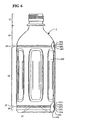
- the bottle-shaped container according to the invention is manufactured by biaxially-oriented blow-molding. Therefore, if the inflection point has a wall thicker than that of its vicinity, the wall thickness varies or changes not stepwisely but gradually. For example, at and near the inflection point 164, the wall thickness varies gradually from the upper body 133 to the inflection point 164, not stepwisely, as shown in FIG. 1. Note that, in FIG. 1 (and in FIGS. 4 and 6), the wall thickness is emphatically illustrated.
- Adjacent inflection points are located close to each other, and the wall thickness changes only gradually as described above.
- the wall thickness between an inflection point and the adjacent inflection point is substantially equal to the wall thickness at the inflection point.
- the wall thickness of the bottle-shaped container is gradually increased from the upper body 133 to become 109% or more of the average wall thickness of the oriented portion at the inflection point 164, remains substantially same (109% or more of average wall thickness) from the inflection point 164 to the inflection point 167, and then is gradually decreased from the inflection point 167 to the lower body 134.
- the heel 14 is continuously extending from the lower body 134, and shows a transversal cross sectional area equal to or smaller than that of the lower body 134.
- the bottom 15 has a bottom wall 151, which by turn has a bottom surface of the bottle-shaped container.
- the bottom shows a transversal cross sectional area (indicated by dotted broken lines in FIG. 3) smaller than that of the heel 14.
- the container Between the heel 14 and the bottom 15, the container shows a curved wall whose cross section is gradually reduced toward the bottom 15. Between the heel 14 and the bottom 15, the container has an inflection point 143 where the bottom 15 starts turning toward the heel 14, an inflection point 144 where the heel 14 starts turning toward bottom wall 151, and an inflection point 145 at a middle between the inflection point 143 and the inflection point 144.
- the heel 14 and the bottom 15 are also apt to produce buckling deformation at the inflection points 143, 144, 145, when axial force is applied thereto from above of the bottle-shaped container.
- buckling deformation can appear easily at those inflection points 143, 144, 145, because it is considered that at those inflection points, the force gives an axial component and a component directed cross or orthogonal to the axial component.
- a buckling strength of the container at the heel 14 and the bottom 15 can be increased by increasing the thickness of the wall portion (bottom wall and its peripheral portion) including the inflection points 143, 144, 145 to at least 109% of the average wall thickness of other blow-molded sections.
- the wall thickness of the bottom wall 151 may be increased entirely (in other words, the entire bottom surface) in addition to the inflection points 143, 144, 145. In this case, the entire bottom 15 can be strengthened.
- the bottle-shaped container 1 as shown in FIGS. 1 through 3 includes "inflection point between a portion having a transversal cross sectional area and a portion having a different transversal cross sectional area in a cylindrical wall" in addition to the above, namely, an inflection point 121 between the shoulder 12 and the upper body 133, and an inflection point 122 located at a position slightly below a vertical middle point of the shoulder 12.
- the wall at these inflection points 121, 122 may be formed to be thicker. However, it is not necessary that the wall at the inflection points 121, 122 in the illustrated container 1 is formed to be thicker, because the bottle-shaped container 1 having the structure as shown n FIGS. 1 through 3 can absorb external force by elastic deformation mainly at and near the waist 16 and the bottom 15.
- inflection points appear entirely in a circumferential direction of a cylindrical wall
- downward external force affects such inflection points as a component force orthogonal to the axial direction of the container.
- such force mainly affects cylindrical protrusion or recess entirely formed in circumferential direction.
- such force does not affect inflection points arranged along a periphery of the panel 139 which is not entirely formed in circumferential direction, because the pillar sections 132 operate as beams.
- a "cylindrical wall” as used herein does not necessarily mean that its transversal cross section is circular. It may show a substantially tetragonal cross sectional view as the bottle-shaped container illustrated in FIGS. 1 through 3 or some other polygonal cross sectional view.
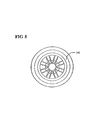
- FIGS. 4 and 5 schematically illustrate a second embodiment of the invention.
- a bottle-shaped container 2 comprises a neck 21, a shoulder 22, a body 23, a heel 24 and a bottom 12.
- the embodiment of bottle-shaped container 2 illustrated in FIGS. 4 and 5 shows a substantially circular cross section, is formed with a recessed rib 27 between a lower end of the body 23 and the heel 24, and is formed with a projection 28 under and adjacent to a waist 26.
- the waist 26 and the projection 28 are formed substantially at a middle of the body 23 in an axial direction of the container, so that the body 23 is divided into an upper body 233 and a lower body 234.
- the lower body 234 is formed with panels 239 for absorbing a pressure reduction that may arise in the bottle-shaped container.
- the waist 26 comprises an upper wall 261 extending inwardly and downwardly from a lower end of the upper body 233, a vertical wall 262 extending vertically downwardly from a lower end of the upper wall 261, and a lower wall 263 extending outwardly and downwardly from a lower end of the vertical wall 262 and connecting to an upper end of the projection 263.
- the projection 28 includes a vertical wall section 281 extending vertically downward from a lower end of the lower wall 263 of the waist 26, and a lower wall 282 extending inwardly and downwardly from a lower end of the vertical wall 281 and connecting to the lower body 234.
- the waist 26 and the projection 28 have inflection points 264, 265, 266, 267, 283, 284.
- the wall at the inflection points 264, 265, 266, 267, 283, 284 is formed to have at least 109% of the average thickness of the blow-molded sections of the container.
- the wall thickness is substantially same between the inflection point 264 and the inflection point 284, like the first embodiment, because the inflection points are located close to one another.
- the bottle-shaped container 2 illustrated in FIGS. 4 and 5 has inflection points 243, 244, 245 between the heal section 24 and the bottom 25, like the first embodiment.
- the wall at these inflection points is formed to have at least 109% of the average thickness of the blow-molded sections of the container.
- the wall thickness is substantially same between the inflection point 243 and the inflection point 245, like the first embodiment
- a bottom wall 251 of the bottom 25 is entirely (in other words, an entire bottom surface) is formed to be 109% or more of the average wall thickness of the blow-molded sections of the container, so as to strengthen the entire bottom surface.
- This embodiment differs from the first embodiment in that the bottle-shaped container 2 is provided with a recessed rib 27 disposed between a lower end of the body 23 and the heel 24.
- the recessed rib 27 has a diameter smaller than that of the lower body 234 and that of the heel 24, and includes inflection points 271, 272, 273, 274. At these inflection points, the wall thickness is 109% or more of the average wall thickness of the blow-molded sections of the container. The wall thickness is substantially same between the inflection point 271 and the inflection point 274.
- the container 2 is strengthened at the waist 26, at the recessed rib 27, and between the heel 24 and the bottom 25, so that the container shows a large strength against buckling.
- FIGS. 6 and 7 schematically illustrate a third embodiment of the invention.
- a bottle-shaped container 3 comprises a neck 31, a shoulder 32, a body 33, a heel 34 and a bottom 35, and shows a substantially circular cross section.
- the body 13 is formed with panels 339 for absorbing the pressure reduction that may arise in the bottle-shaped container.
- Each of the panels 339 extends from near an upper end of the body to near a lower end of the body. No waist is formed in the body 33 of the bottle-shaped container 3 of the third embodiment.
- the container 3 has inflection points 343, 344, 345 between the heal section 34 and the bottom 35.
- the bottle-shaped container 3 of this embodiment is provided with a recessed rib 37 between a lower end of the body 33 and the heel 34, and includes inflection points 371, 372, 373, 374. At these inflection points, a wall thickness is formed to be 109% or more of the average thickness of the blow-molded section.
- the bottle-shaped container 3 of this embodiment is provided with a recessed rib 39 between the shoulder 32 and the body 33.
- the recessed rib 39 includes inflection points 391, 392, 393, 394. At these inflection points, a wall thickness is formed to be 109% or more of the average thickness of the blow-molded section.
- the wall thickness is substantially same between the inflection point 371 and the inflection point 374, and also between the inflection point 391 and the inflection point 394.
- the bottle-shaped container is manufactured by biaxially-oriented blow-molding a preform of polyethyleneterephthalate resin.
- the present invention is not limited to polyethyleneterephthalate resin, and other synthetic resin material may also be used for the purpose of the invention.
- the preform is less heated at a portion which corresponds to the inflection point in the bottle-shaped container.
- the orientation magnification is smaller than that at the other parts, so that only at the inflection point, the wall is thicker.
- the bottle-shaped container can be formed by an ordinary biaxially-oriented blow-molding process or a two-step blow-molding process as will be described below.
- the prepared preform is then heated to 70 to 130°C, preferably to 90 to 120°C, which is a temperature range that can effectively orient or draw the preform.
- the preform is divided into sections to be heated by a heater (not shown), and in each of the sections, degree of heating is determined. In the section where corresponds to the portion of the container having thicker wall, the preform is less heated.
- heated preform is primary biaxially-oriented blow-molded to produce a primary intermediate molded product.
- a temperature of a primary metal mold to be used for the primary biaxially-oriented blow-molding is between 50 and 230°C, preferably between 70 and 180°C.
- An area magnification from the preform to the primary intermediate molded product is 4 to 22 times, preferably 6 to 15 times, so that the preform is sufficiently oriented to increase a resin density to raise a heat resistance of the container.
- the primary intermediate molded product is larger than the final product of bottle-shaped container.
- the wall of the primary intermediate molded product is formed to be thicker.
- the thus obtained primary intermediate molded product is then heat-treated, to cause thermal contraction of the primary intermediate molded product, so as to form a secondary intermediate molded product.
- a temperature immediately after the heating is between 110 and 255°C, preferably between 130 and 200°C.
- the primary intermediate molded product is forced to contract, so that a residual stress produced in the primary intermediate molded product as a result of the primary biaxially-oriented blow-molding is released.
- the primary intermediate molded product contracts by heat in this heat-treatment step, at a part or portion of the secondary intermediate molded product to be molded to the portion or part of the thicker wall of the container, the wall is also thicker than the other blow-molded portions, because such part or portion is already thicker in the primary intermediate molded product.
- the secondary intermediate molded product is secondary biaxially-oriented blow-molded to produce the final product of bottle-shaped container.
- a temperature of a secondary metal mold used in this secondary blow-molding is between 60 and 170°C, preferably between 80 and 150°C.
- An area magnification from the secondary intermediate molded product to the container is smaller than the area magnification from the preform to the primary intermediate molded product.
- residual stress produced in the secondary blow-molding is smaller than the residual stress produced in the primary blow-molding.
- the thus obtained bottle-shaped container shows a resin density between 1.380 and 1.395g/cm 3 , and is highly heat-resistant.
- the bottle-shaped container illustrated in FIG. 1 has the wall having its thickness 109% or more of the average wall thickness of the blow-molded sections of the container, and the container has a large strength against buckling.
- the degree of heating the preform is differentiated from part to part in order to change the wall thickness.
- a preform may have thicker wall at a part where corresponds to the thicker wall of the bottle-shaped container, and may be subjected to an ordinary blow-molding process to produce the bottle-shaped container.
- both method of the change of the degree of heating and the preform having the thicker wall may be combined to form the container.
- a preform of polyethyleneterephthalate was prepared.
- the preform was then heated.
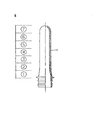
- the preform was divided to sections for heating. More specifically, the preform was divided into seven sections including the first section, the second section, ... and the seventh section, starting from the neck, in a manner as shown in FIG. 8.
- the degree of heating the third section corresponding to the waist 16 of the final product of bottle-shaped container was made to be 25% smaller than the average output of the heater (or 75% of the output), and the degree of heating the sixth section corresponding to a part extending inwardly from the inflection point 143 to a bottom center was made to be 17% smaller than the average output of the heater (or 83% of the output).
- the preform was heated at a temperature range between 90 and 120° .
- the thus heated preform was then primary biaxially-oriented blow-molded in a primary metal mold heated to 150°C, to obtain the primary intermediate molded product.
- the primary intermediate molded product was then heated to 160°C, to cause contraction of the primary intermediate molded product, so as to obtain the secondary intermediate molded product.
- the secondary intermediate molded product was secondary blow-molded in the secondary metal mold heated to 95°C, to obtain a final product of bottle-shaped container having a volume of 500ml.
- the wall thickness of the obtained bottle-shaped container was measured to find that the average wall thickness of the blow-molded portions was 0.330mm, whereas the wall thickness was 0.359mm (or 109% of the average wall thickness) at the waist 16 and 0.363mm (or 110% of the average wall thickness) between the heel 14 and the bottom 15.
- the critical strength of the bottle-shaped container against buckling was 324N.
- the wall thickness was 109% at the waist 16 and 110% between the heel 14 and the bottom 15 was 110% relative to the average wall thickness of the blow-molded parts in the above-described EXAMPLE, the wall thickness can vary depending on if the bottle-shaped container has a waist and/or one or more ribs or not as well as on a physical structure of the bottle-shaped container, and the present invention is by no means limited to the above listed specific numerical values.
- the bottle-shaped container was formed by the above-described process except that the output of the heater was not reduced for the third and sixth sections.
- the wall thickness was 105% at the waist and 107% between the heel and the bottom relative to the average wall thickness of the blow-molded parts.
- the critical strength of the bottle-shaped container against buckling was 255N.
- wall thickness is increased to 109% or more of an average wall thickness of blow-molded part of the wall at an inflection point between a portion having a transversal cross sectional area and a portion having a different transversal cross sectional area in a cylindrical wall.
- the critical strength of the bottle-shaped container against buckling is increased.
- no buckling deformation occurs even if axial force is applied to the container to produce components perpendicular to the axial direction of the container at the inflection point.
- the blow-molded part has thin wall except the inflection point, the volume of synthetic resin to be used for manufacturing the bottle-shaped container can be reduced.
- the critical strength against buckling is increased at or near the bottom wall.
- the critical strength against buckling is increased in the entire bottom wall.
- the critical strength against buckling is increased at the inflection point between the shoulder and the body.
- the wall at the inflection points between the upper body and the waist and between the lower body and the waist has the wall thickness of 109% or more of the average thickness of the blow-molded part, the critical strength against buckling is increased at the waist.
- a bottle-shaped container showing a large critical strength against buckling by changing the degree of heating at different parts of the preform. Since the method of manufacturing a bottle-shaped container according to the invention is same as conventional manufacturing methods except that the preform is heated to varying degree, the bottle-shaped container can be obtained easily without any problem.
- the bottle-shaped container is molded by two step biaxially-oriented blow-molding process, the residual internal stress produced in the primary biaxially-oriented blow-molding step is released by heat-treatment, so that the obtained bottle-shaped container is highly heat-resistant.
Landscapes
- Engineering & Computer Science (AREA)
- Mechanical Engineering (AREA)
- Manufacturing & Machinery (AREA)
- Physics & Mathematics (AREA)
- Thermal Sciences (AREA)
- Ceramic Engineering (AREA)
- Containers Having Bodies Formed In One Piece (AREA)
- Blow-Moulding Or Thermoforming Of Plastics Or The Like (AREA)
Applications Claiming Priority (3)
| Application Number | Priority Date | Filing Date | Title |
|---|---|---|---|
| JP2000362471 | 2000-11-29 | ||
| JP2000362471A JP2002166916A (ja) | 2000-11-29 | 2000-11-29 | 合成樹脂製2軸延伸ブロー成形軽量壜体容器及びその製造方法 |
| PCT/JP2001/010429 WO2002044038A1 (fr) | 2000-11-29 | 2001-11-29 | Recipient leger en forme de bouteille fait de resine synthetique et moule bi-axialement par etirage-gonflage |
Publications (2)
| Publication Number | Publication Date |
|---|---|
| EP1354801A1 true EP1354801A1 (fr) | 2003-10-22 |
| EP1354801A4 EP1354801A4 (fr) | 2009-03-18 |
Family
ID=18833738
Family Applications (1)
| Application Number | Title | Priority Date | Filing Date |
|---|---|---|---|
| EP01998485A Withdrawn EP1354801A4 (fr) | 2000-11-29 | 2001-11-29 | Recipient leger en forme de bouteille fait de resine synthetique et moule bi-axialement par etirage-gonflage |
Country Status (9)
| Country | Link |
|---|---|
| US (1) | US20040022976A1 (fr) |
| EP (1) | EP1354801A4 (fr) |
| JP (1) | JP2002166916A (fr) |
| KR (1) | KR100807011B1 (fr) |
| CN (1) | CN1244479C (fr) |
| AU (1) | AU2002222560A1 (fr) |
| CA (1) | CA2436824C (fr) |
| TW (1) | TW542809B (fr) |
| WO (1) | WO2002044038A1 (fr) |
Cited By (7)
| Publication number | Priority date | Publication date | Assignee | Title |
|---|---|---|---|---|
| US7017763B2 (en) * | 2002-07-24 | 2006-03-28 | Graham Packaging Company, L.P. | Base having a flexible vacuum area |
| WO2006069292A1 (fr) * | 2004-12-22 | 2006-06-29 | Graham Packaging Company, L.P. | Recipient avec caracteristiques controlees de charge superieure |
| WO2007032545A3 (fr) * | 2005-09-16 | 2007-07-12 | Coca Cola Co | Bouteille en plastique |
| FR2964951A1 (fr) * | 2010-09-20 | 2012-03-23 | Sidel Participations | Recipient a portion annulaire cintree surepaissie. |
| US8567624B2 (en) | 2009-06-30 | 2013-10-29 | Ocean Spray Cranberries, Inc. | Lightweight, high strength bottle |
| USD727736S1 (en) | 2013-03-15 | 2015-04-28 | Ocean Spray Cranberries, Inc. | Bottle |
| AU2015241913B2 (en) * | 2014-03-31 | 2019-03-14 | Yoshino Kogyosho Co., Ltd. | Method for manufacturing bottle |
Families Citing this family (19)
| Publication number | Priority date | Publication date | Assignee | Title |
|---|---|---|---|---|
| JP3887753B2 (ja) | 2001-11-30 | 2007-02-28 | 株式会社吉野工業所 | 合成樹脂製容器 |
| JP4314794B2 (ja) * | 2002-08-20 | 2009-08-19 | 東洋製罐株式会社 | 二軸延伸ポリエステル容器の製造方法 |
| JP5029859B2 (ja) * | 2005-06-30 | 2012-09-19 | 株式会社吉野工業所 | 合成樹脂製壜体 |
| JP4642601B2 (ja) | 2005-08-23 | 2011-03-02 | 株式会社吉野工業所 | ボトル |
| US7712624B2 (en) * | 2006-12-27 | 2010-05-11 | Kraft Foods Holdings, Inc. | Plastic coffee container with top load support by particulate product |
| JP5595498B2 (ja) * | 2010-06-28 | 2014-09-24 | 日精エー・エス・ビー機械株式会社 | 耐熱容器の製造方法 |
| JP5966322B2 (ja) | 2011-11-09 | 2016-08-10 | 東洋製罐株式会社 | ブロー成形金型 |
| EP2735427B1 (fr) * | 2012-11-27 | 2015-09-16 | The Procter and Gamble Company | Procédé de fabrication d'un produit soufflé et injecté |
| KR20170073727A (ko) * | 2012-12-28 | 2017-06-28 | 소시에떼 아노님 데 오 미네랄 데비앙 | 자가 압축 가능한 블로우 몰딩 플라스틱 박벽 용기 |
| JP6287426B2 (ja) * | 2014-03-24 | 2018-03-07 | 大日本印刷株式会社 | プラスチックボトル |
| JP6215479B2 (ja) * | 2014-08-27 | 2017-10-18 | 東洋製罐株式会社 | 多層ダイレクトブローボトル及びその製造方法 |
| MX2017005111A (es) * | 2014-10-23 | 2018-02-12 | Amcor Group Gmbh | Panel de vacio para recipientes no redondos. |
| EP3769934B1 (fr) * | 2015-04-30 | 2022-02-23 | Dai Nippon Printing Co., Ltd. | Procédé et appareil de moulage de récipient aseptique et procédé et appareil de remplissage aseptique |
| MX2020011255A (es) * | 2018-04-26 | 2020-11-12 | Graham Packaging Co | Recipiente de relleno presurizado resistente al agrietamiento del anillo de pie. |
| CN109335193B (zh) * | 2018-10-25 | 2023-09-12 | 广东星联精密机械有限公司 | 一种收腰灌装瓶及其模具 |
| JP7370248B2 (ja) * | 2019-12-27 | 2023-10-27 | 株式会社吉野工業所 | ボトル |
| AU2021202920A1 (en) * | 2020-05-08 | 2021-11-25 | Orora Packaging Australia Pty Ltd | A bottle, and an insert and a mould for making the bottle |
| CN117068532A (zh) * | 2022-05-09 | 2023-11-17 | 宜兰食品工业股份有限公司 | 一种食品容器以及食品容器生产工艺 |
| CN117068526A (zh) * | 2022-05-09 | 2023-11-17 | 宜兰食品工业股份有限公司 | 一种食品容器以及食品容器生产工艺 |
Family Cites Families (25)
| Publication number | Priority date | Publication date | Assignee | Title |
|---|---|---|---|---|
| JPS5852913Y2 (ja) * | 1979-01-16 | 1983-12-02 | 株式会社吉野工業所 | 二軸延伸される合成樹脂製壜成形用中間素材 |
| JPS6323210U (fr) * | 1986-07-31 | 1988-02-16 | ||
| US4927679A (en) * | 1987-05-29 | 1990-05-22 | Devtech, Inc. | Preform for a monobase container |
| US4863046A (en) * | 1987-12-24 | 1989-09-05 | Continental Pet Technologies, Inc. | Hot fill container |
| CA1334009C (fr) * | 1988-04-01 | 1995-01-17 | Yoshiaki Hayashi | Contenant en forme de bouteille moule par soufflage biaxial |
| JPH0216712U (fr) * | 1988-07-19 | 1990-02-02 | ||
| JPH0688315B2 (ja) * | 1990-10-25 | 1994-11-09 | 日精エー・エス・ビー機械株式会社 | 耐熱性中空容器のための一次ブロー成形品 |
| JPH0813498B2 (ja) * | 1992-02-29 | 1996-02-14 | 日精エー・エス・ビー機械株式会社 | 耐熱性容器の成形方法 |
| ATE157927T1 (de) * | 1992-07-07 | 1997-09-15 | Continental Pet Technologies | Verfahren zum formen von einem behälter mit einer seitenwand von hoher kristallinität und einem boden von niedriger kristallinität |
| JP3231879B2 (ja) * | 1993-02-25 | 2001-11-26 | 株式会社吉野工業所 | 樹脂製ボトル容器の製造方法 |
| FR2703944B1 (fr) * | 1993-04-15 | 1995-06-23 | Sidel Sa | Procédé et installation pour le traitement thermique du corps d'une préforme en matériau thermoplastique. |
| BR9303188A (pt) * | 1993-09-02 | 1995-04-25 | Celbras Quimica E Textil S A | Garrafa plástica para enchimento a quente |
| JP3358005B2 (ja) * | 1993-12-21 | 2002-12-16 | 株式会社吉野工業所 | 樹脂製ボトル容器 |
| UY24071A1 (es) * | 1994-10-27 | 1996-03-25 | Coca Cola Co | Recipiente y metodo para hacer un recipiente de naftalato de polietileno y copolimeros del mismo |
| US5704503A (en) * | 1994-10-28 | 1998-01-06 | Continental Pet Technologies, Inc. | Hot-fillable plastic container with tall and slender panel section |
| DE19502449A1 (de) * | 1995-01-26 | 1996-08-01 | Wella Ag | Kunststoffbehälter mit einer Entgasungseinrichtung |
| JP3632302B2 (ja) * | 1996-05-24 | 2005-03-23 | 東洋製罐株式会社 | 自立容器 |
| JP3353614B2 (ja) * | 1996-07-23 | 2002-12-03 | 東洋製罐株式会社 | 耐熱耐圧性に優れた自立容器の製造方法 |
| JPH10146879A (ja) * | 1996-11-15 | 1998-06-02 | Hokkai Can Co Ltd | ポリエチレンテレフタレート樹脂製ボトルの製造方法 |
| JPH10203519A (ja) * | 1997-01-17 | 1998-08-04 | Dainippon Printing Co Ltd | プラスチックボトル |
| JP3708685B2 (ja) * | 1997-07-29 | 2005-10-19 | 北海製罐株式会社 | ポリエチレンテレフタレート樹脂製容器の製造方法 |
| JP3787423B2 (ja) * | 1997-08-13 | 2006-06-21 | 日精エー・エス・ビー機械株式会社 | 合成樹脂製容器の成形方法及び成形装置 |
| JPH11130035A (ja) * | 1997-10-30 | 1999-05-18 | Yoshino Kogyosho Co Ltd | 薄肉容器 |
| JP4099923B2 (ja) * | 1999-02-27 | 2008-06-11 | 株式会社吉野工業所 | 薄肉ブローボトル |
| JP4346050B2 (ja) * | 1999-03-19 | 2009-10-14 | アサヒ飲料株式会社 | 樹脂製ボトル |
-
2000
- 2000-11-29 JP JP2000362471A patent/JP2002166916A/ja active Pending
-
2001
- 2001-11-29 CA CA2436824A patent/CA2436824C/fr not_active Expired - Fee Related
- 2001-11-29 TW TW090129493A patent/TW542809B/zh not_active IP Right Cessation
- 2001-11-29 AU AU2002222560A patent/AU2002222560A1/en not_active Abandoned
- 2001-11-29 WO PCT/JP2001/010429 patent/WO2002044038A1/fr not_active Ceased
- 2001-11-29 KR KR1020027009640A patent/KR100807011B1/ko not_active Expired - Fee Related
- 2001-11-29 EP EP01998485A patent/EP1354801A4/fr not_active Withdrawn
- 2001-11-29 CN CNB018059821A patent/CN1244479C/zh not_active Expired - Fee Related
- 2001-11-29 US US10/432,733 patent/US20040022976A1/en not_active Abandoned
Cited By (11)
| Publication number | Priority date | Publication date | Assignee | Title |
|---|---|---|---|---|
| US7017763B2 (en) * | 2002-07-24 | 2006-03-28 | Graham Packaging Company, L.P. | Base having a flexible vacuum area |
| WO2006069292A1 (fr) * | 2004-12-22 | 2006-06-29 | Graham Packaging Company, L.P. | Recipient avec caracteristiques controlees de charge superieure |
| US7374055B2 (en) | 2004-12-22 | 2008-05-20 | Graham Packaging Company, L.P. | Container having controlled top load characteristics |
| WO2007032545A3 (fr) * | 2005-09-16 | 2007-07-12 | Coca Cola Co | Bouteille en plastique |
| EA012547B1 (ru) * | 2005-09-16 | 2009-10-30 | Дзе Кока-Кола Компани | Пластиковая бутылка |
| CN101263058B (zh) * | 2005-09-16 | 2011-07-13 | 可口可乐公司 | 塑料瓶 |
| US8567624B2 (en) | 2009-06-30 | 2013-10-29 | Ocean Spray Cranberries, Inc. | Lightweight, high strength bottle |
| FR2964951A1 (fr) * | 2010-09-20 | 2012-03-23 | Sidel Participations | Recipient a portion annulaire cintree surepaissie. |
| WO2012038642A1 (fr) * | 2010-09-20 | 2012-03-29 | Sidel Participations | Récipient à portion annulaire cintrée surépaissie |
| USD727736S1 (en) | 2013-03-15 | 2015-04-28 | Ocean Spray Cranberries, Inc. | Bottle |
| AU2015241913B2 (en) * | 2014-03-31 | 2019-03-14 | Yoshino Kogyosho Co., Ltd. | Method for manufacturing bottle |
Also Published As
| Publication number | Publication date |
|---|---|
| EP1354801A4 (fr) | 2009-03-18 |
| TW542809B (en) | 2003-07-21 |
| US20040022976A1 (en) | 2004-02-05 |
| CA2436824A1 (fr) | 2002-06-06 |
| KR100807011B1 (ko) | 2008-02-25 |
| KR20020086481A (ko) | 2002-11-18 |
| CN1244479C (zh) | 2006-03-08 |
| CA2436824C (fr) | 2010-10-19 |
| WO2002044038A1 (fr) | 2002-06-06 |
| JP2002166916A (ja) | 2002-06-11 |
| CN1407935A (zh) | 2003-04-02 |
| AU2002222560A1 (en) | 2002-06-11 |
Similar Documents
| Publication | Publication Date | Title |
|---|---|---|
| CA2436824C (fr) | Contenant bi-oriente en forme de bouteille et moule par soufflage, fabrique en resine synthetique et methode de fabrication | |
| US11001404B2 (en) | Rectangular container having a stiffening groove | |
| AU2003227253B8 (en) | Synthetic resin bottle | |
| US9302805B2 (en) | Bottom of a hollow body obtained by blowing or stretch-blowing a preform of a thermoplastic material, and hollow body comprising such a bottom | |
| US9758271B2 (en) | Container having a bottom provided with a vault with a double indentation | |
| EP1365961B1 (fr) | Bouteille elancee a zone de prehension moulee par soufflage et dotee d'un dome a panneaux souples | |
| US6581794B2 (en) | Plastic container with non-cylindrical body reinforced with peripheral grooves | |
| US8181805B2 (en) | Hot fill container | |
| US8561821B2 (en) | Heat set container | |
| KR20080063297A (ko) | 다중 패널 플라스틱 용기 | |
| US20110049084A1 (en) | Dome Shaped Hot-Fill Container | |
| EP0636089A1 (fr) | Recipient en matiere plastique pour liquides chauds dote d'une rainure de renforcement radiale | |
| EP3183180B1 (fr) | Contenant pourvu d'une paroi latérale repliée | |
| WO2011112278A2 (fr) | Récipient thermofixé | |
| US20090321386A1 (en) | Lightweight container having mid-body grip | |
| EP2331307B1 (fr) | Preforme pour la production de bouteilles | |
| WO2012012182A9 (fr) | Panneau étiquette/vide résistant à la pression | |
| US10723504B2 (en) | Heat set container with label boundary panel | |
| US20150129537A1 (en) | Pressure resistant vacuum/label panel | |
| JPS6252034A (ja) | リブとへこみパネルを有する容器 | |
| AU2008202030A1 (en) | Biaxially stretch-blow molded lightweight synthetic resin bottle container and method for production thereof | |
| US20250269999A1 (en) | Plastic container and method | |
| CA3041890C (fr) | Base de contenant leger | |
| WO2023113838A1 (fr) | Base pour un contenant formé à partir d'un matériau polymère recyclé | |
| CA1164371A (fr) | Bouteille a paroi mince faite de resine synthetique, et methode de production connexe |
Legal Events
| Date | Code | Title | Description |
|---|---|---|---|
| PUAI | Public reference made under article 153(3) epc to a published international application that has entered the european phase |
Free format text: ORIGINAL CODE: 0009012 |
|
| 17P | Request for examination filed |
Effective date: 20030630 |
|
| AK | Designated contracting states |
Kind code of ref document: A1 Designated state(s): AT BE CH CY DE DK ES FI FR GB GR IE IT LI LU MC NL PT SE TR |
|
| AX | Request for extension of the european patent |
Extension state: AL LT LV MK RO SI |
|
| RBV | Designated contracting states (corrected) |
Designated state(s): DE FR GB |
|
| A4 | Supplementary search report drawn up and despatched |
Effective date: 20090212 |
|
| 17Q | First examination report despatched |
Effective date: 20090820 |
|
| STAA | Information on the status of an ep patent application or granted ep patent |
Free format text: STATUS: THE APPLICATION IS DEEMED TO BE WITHDRAWN |
|
| 18D | Application deemed to be withdrawn |
Effective date: 20140429 |