EP1356430B1 - Procede d'apprentissage supervise dans un reseau de neurones artificiels recurrent - Google Patents
Procede d'apprentissage supervise dans un reseau de neurones artificiels recurrent Download PDFInfo
- Publication number
- EP1356430B1 EP1356430B1 EP01976272A EP01976272A EP1356430B1 EP 1356430 B1 EP1356430 B1 EP 1356430B1 EP 01976272 A EP01976272 A EP 01976272A EP 01976272 A EP01976272 A EP 01976272A EP 1356430 B1 EP1356430 B1 EP 1356430B1
- Authority
- EP
- European Patent Office
- Prior art keywords
- network
- output
- units
- input
- weights
- Prior art date
- Legal status (The legal status is an assumption and is not a legal conclusion. Google has not performed a legal analysis and makes no representation as to the accuracy of the status listed.)
- Expired - Lifetime
Links
Images













Classifications
-
- G—PHYSICS
- G06—COMPUTING OR CALCULATING; COUNTING
- G06N—COMPUTING ARRANGEMENTS BASED ON SPECIFIC COMPUTATIONAL MODELS
- G06N3/00—Computing arrangements based on biological models
- G06N3/02—Neural networks
- G06N3/08—Learning methods
-
- G—PHYSICS
- G06—COMPUTING OR CALCULATING; COUNTING
- G06N—COMPUTING ARRANGEMENTS BASED ON SPECIFIC COMPUTATIONAL MODELS
- G06N3/00—Computing arrangements based on biological models
- G06N3/02—Neural networks
- G06N3/04—Architecture, e.g. interconnection topology
- G06N3/0475—Generative networks
-
- G—PHYSICS
- G06—COMPUTING OR CALCULATING; COUNTING
- G06N—COMPUTING ARRANGEMENTS BASED ON SPECIFIC COMPUTATIONAL MODELS
- G06N3/00—Computing arrangements based on biological models
- G06N3/02—Neural networks
- G06N3/04—Architecture, e.g. interconnection topology
- G06N3/0495—Quantised networks; Sparse networks; Compressed networks
-
- G—PHYSICS
- G06—COMPUTING OR CALCULATING; COUNTING
- G06N—COMPUTING ARRANGEMENTS BASED ON SPECIFIC COMPUTATIONAL MODELS
- G06N3/00—Computing arrangements based on biological models
- G06N3/02—Neural networks
- G06N3/08—Learning methods
- G06N3/09—Supervised learning
Definitions
- the present invention relates to the field of supervised teaching of recurrent neural networks.
- ANNs Artificial neural networks
- a weight w ji 0 indicates that there is no connection from the i -th to the j -th unit.
- the transfer function f j typically is a sigmoid-shaped function (linear or step functions are also relatively common). In most applications, all units have identical transfer functions. Sometimes it is beneficial to add noise to the activations.
- feedforward networks In which activation patterns are propagated from an input layer through hidden layers to an output layer.
- the characteristic feature of feedforward networks is that there are no connection cycles.
- feedforward networks represent input-output functions.
- a typical way to construct a feedforward network for a given functionality is to teach it from a training sample, i.e. to present it with a number of correct input-output-pairings, from which the network learns to approximately repeat the training sample and to generalize to other inputs not present in the training sample. Using a correct training sample is called supervised learning.
- the most widely used supervised teaching method for feedforward networks is the backpropagation algorithm, which incrementally reduces the quadratic output error on the training sample by a gradient descent on the network weights.
- the field had its breakthrough when efficient methods for computing the gradient became available, and is now an established and mature subdiscipline of pattern classification, control engineering and signal processing.
- RBF networks radial basis function networks
- Typical RBF networks have a hidden layer whose activations are computed quite differently from (1). Namely, the activation of the j-th hidden unit is a function g j ⁇ ⁇ u - v j ⁇ of the distance between the input vector u from some reference vector v j .
- the activation of output units follows the prescription (1), usually with a linear transfer function.
- the activation mechanism for hidden units is not changed. Only the weights of hidden-to-output connections have to be changed in learning. This renders the learning task much simpler than in the case of backpropagation: the weights can be determined off-line (after presentation of the training sample) using linear regression methods, or can be adapted on-line using any variant of mean square error minimization, for instance variants of the least-mean-square (LMS) method.
- LMS least-mean-square
- RNNs recurrent neural networks
- the hallmark of RNNs is that they can support self-exciting activation over time, and can process temporal input with memory influences. From a formal perspective, RNNs realize nonlinear dynamical systems (as opposed to feedforward networks which realize functions). From an engineering perspective, RNNs are systems with a memory. It would be a significant benefit for engineering applications to construct RNNs that perform a desired input-output-dynamics. However, such applications of RNNs are still rare. The major reason for this rareness lies in the difficulty of teaching RNNs. The state of the art in supervised RNN learning is marked by a number of variants of the backpropagation through time (BPTT) method.
- BPTT backpropagation through time
- NECO R P ET AL "Asynchronous translations with recurrent neural nets” 1997 IEEE INTERNATIONAL CONFERENCE ON NEURAL NETWORKS. PROCEEDINGS (ICNN'97), HOUSTON, TX, USA, 9-12 JUNE 1997, pages 2535-2540 vol.4, XP002241630 1997, New York, NY, USA, IEEE, USA ISBN: 0-7803-4122-8 which forms the preamble of claim 1.
- the invention is defined by the method of claim 1 and the network of claim 39. Individual embodiments of the invention are specified in the dependent claims.
- the present invention presents a novel method for the supervised teaching of RNNs.
- the background intuitions behind this method are quite different from existing BPTT approaches. The latter try to meet the learning objective by adjusting every weight within the network, thereby attaining a minimal-size network in which every unit contributes maximally to the desired overall behavior. This leads to a small network that performs a particular task.
- the method disclosed in the present invention utilizes a large recurrent network, whose internal weights (i.e. on hidden-to-hidden, input-to-hidden, or output-to-hidden connections) are not changed at all.
- the large, unchanged network is used as a rich "dynamical reservoir" of as many different nonlinear dynamics as there are hidden units, i.e.
- DR network reservoir for excitable dynamics
- Another perspective on this reservoir network is to view it as an overcomplete basis. Only the hidden-to-output connection weights are adjusted in the teaching process. By this adjustment, the hidden-to-output connections acquire the functionality of a filter which distils and re-combines from the "reservoir” dynamical patterns in a way that realizes the desired learning objective.
- a single instantiation of the "reservoir” network can be re-used for many tasks, by adding new output units and separately teaching their respective hidden-to-output weights for each task. After learning, arbitrarily many such tasks can be carried out in parallel, using the same single instantiation of the large "reservoir” network. Thereby, the overall cost of using an RNN set up and trained according to the present invention is greatly reduced in cases where many different tasks have to be carried out on the same input data. This occurs e.g. when a signal has to processed by several different filters.
- the temporal memory length of RNNs trained with the method of the invention is superior to existing methods. For instance, "short term memories" of about 100 time steps are easily achievable with networks of 400 units. Examples of this are described later in this document (Section on Examples).
- the invention has two aspects: (a), architectural (structure of the RNN, its setup and initialization), and (b), procedural (teaching method). Both aspects are interdependent.
- this RNN recurrent neural network whose weights are fixed and are not changed by subsequent learning.
- the function of this RNN is to serve as a "reservoir" of many different dynamical features, each of these being realized in the dynamics of the units of the network.
- this RNN will be called the dynamical reservoir, and abbreviated by DR .
- the DR is large, i.e. has in the order of 50 or more (no upper limit) units.
- the DR's spontaneous dynamics (with zero input) is globally stable, i.e. the DR converges to a unique stable state from every starting state.
- the connectivity topology of the DR may also carry a spatial structure.
- the input is fed into the DR by means of extra input units.
- the activations of such input units is set to the input u ( t ) according to Eq. (2).
- the input units may be arranged in a particular spatial fashion ("input retina") and connected to the DR in a topology-preserving way. Details of how the weights of the input-to-DR units are determined, are given in the "detailed description of preferred embodiments" section.
- input values can be fed directly as additive components to the activations of the units of the DR, with or without spatial structuring.
- the input values can be coded before they are presented to the DR.
- spatial coding of numerical values can be employed.
- m -dimensional output y ( t ) at time t is obtained from the DR by reading it out from the activations of m output units (where m ⁇ 1).
- the activations of the output units shall be denoted by y 1 ( t ),..., y m ( t ).
- these output units are attached to the DR as extra units.
- extra output units there may also be provided output-to-DR connections which feed back output unit activations into the DR network.
- no such feedback will be provided when the network is used as a passive device for signal processing (e.g., for pattern classification or for filtering).
- feedback connections will be provided when the network is used as an active signal generation device. Details of how to determine feedback weights are described in the "detailed description of preferred embodiments" section.
- the activation update method for the m outputs y 1 ( t ),..., y m ( t ) is of the form given in equation (1), with transfer functions f 1 ,.., f m .
- the transfer functions f j of output units typically will be chosen as sigmoids or as linear functions.
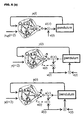
- FIG. 1 provides an overview of a preferred embodiment of the invention, with extra input and output units.
- the DR [1] is receiving input by means of extra input units [2] which feed input into the DR through input-to-DR connections [4].
- Output is read out of the network by means of extra output units [3], which in the example of Figure 1 also have output-to-DR feedback connections [7].
- Input-to-DR connections [4] and output-to-DR feedback connections [7] are fixed and not changed by training.
- the two time series u ( t ) and ⁇ ( t ) represent the desired, to-be-learnt input-output behavior.
- the input sequence u ( t ) may be absent; the learning task is then to learn a purely generative dynamics.
- the DR is updated (according to the chosen update law, e.g., Equation (1)), and the activations of the output units are set to the teacher signal ⁇ ( t ) ( teacher forcing ).
- the method of the invention can be accomodated off-line learning and on-line learning.
- ⁇ w j , x ( t ) ⁇ denotes the inner product w j ⁇ 1 ⁇ u 1 t + ... + w jn ⁇ u n t + w j , n + 1 ⁇ x 1 t + ... + w j , n + K ⁇ x K t + w j , n + K + 1 ⁇ y 1 t + ... + w j , n + K + m ⁇ y m t , this form of ⁇ w j , x ( t ) ⁇ being given if there are extra input units.
- the calculation of weights which minimize Eq. (4) is a standard problem of linear regression, and can be done with any of the well-known solution methods for this problem. Details are given in the Section "Detailed description of preferred embodiments”.
- the weights w ji are the final result of the procedural part of the method of the invention. After setting these weights in the connections that feed into the output units, the network can be exploited.
- Adaptive methods that minimize this kind of error are known collectively under the name of "recursive least squares” (RLS) methods.
- RLS recursive least squares
- E ⁇ j 2 E ⁇ f - 1 ⁇ y ⁇ j ⁇ t + 1 - ⁇ w j , x t ⁇
- E denotes statistical expectation.
- Adaptive methods that minimize (4b) are stochastic gradient descent methods, of which there are many, among them Newton's method and the most popular of all MSE minimization methods, the LMS method. However, the LMS method is not ideally suited to be used with the method of the invention. Details are given in the Section "Detailed description of preferred embodiments”.
- Example 1 a toy example to illustrate some basic aspects of the invention
- This example demonstrates the basic aspects of the invention with a toy example.
- the task is to teach a RNN to generate a sine wave signal. Since this task is almost trivial, the size of the DR was selected to be only 20 units (for more interesting tasks, network sizes should be significantly greater).
- connection weights were set randomly to either 0.5 or - 0.5.
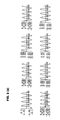
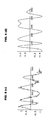
- Figure 2a shows a trace of 8 arbitrarily selected units in the asymptotic activity. It is apparent that all DR units are entrained a low-amplitude oscillation.
- an autonomous self-excitation of the DR is not desired.
- the DR's autonomous dynamics should be globally stable, i.e., converge to a stable all-zero state from any initial starting state. Therefore, the weights were decreased by a factor of 0.98, i.e., a weight that was previously 0.5 was put to 0.49.
- Figure 2b shows a 200 step trace obtained after 200 initial steps after starting the network in a random initial state. It is apparent that with the new weights the network's dynamics is globally stable, i.e. will asymptotically decay to all zero activations.
- the first seven plots in Fig. 2c show activation traces of arbitrarily selected DR units.
- the last plot shows the input signal. It becomes apparent that the DR units show a rich variety of response dynamics. This is the desired condition for the setup ofDRs according to the invention.
- Figure 2d shows the asymptotic response of seven DR units and the input signal. This Figure again emphasizes the rich variety of responses of DR units.
- the network was trained to generate the same sine signal that was administered previously as input.
- the extra unit that was previously used as input unit was left unchanged in its connections to the DR, but now was used as an output unit.
- the network was first run for 100 steps with teacher forcing to settle initial transients. The, it was run another 500 steps with teacher forcing. The activation values of the 20 DR units were recorded for these 500 steps.
- Figure 2e shows the eighth plot shows the activation of the output unit.
- Fig. 2e is virtually the same as Fig. 2d .
- the network was set up as in Figure 1 .
- the DR had a size of 100 units. It was randomly connected with a connectivity of 5 %. Nonzero weights were set to + 0.45 or - 0.45 with equal probability. This resulted in a globally stable dynamics of the DR (again, of marginal stability: increasing absolute values of weights to .475 would destroy global stability).
- the impulse response of the DR's units to a unit impulse were qualitatively similar to the ones in example 1 (cf. Fig. 2c ) and are not shown.
- One input unit was attached to the DR, by connecting the input unit to every unit of the DR. Weights of these connections were randomly set to .001 or -.001 with equal probability.
- the learning task consisted in repeating in the output node the input signal with delays of 10, 20, 40 time steps.
- the input signal used was essentially a random walk with a banded, nonstationary frequency spectrum.
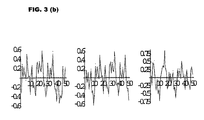
- Fig. 3a shows a 50-step sequence of the input (solid line) and the correct delayed signal (teacher signal) of delay 10 (dashed line).
- the network state was randomly initialized.
- the input was then presented to the network for 700 update steps.
- Data from the first 200 update steps were discarded to get rid of initial transient effects.
- Data from the remaining 500 update steps were collected and used with the off-line embodiment of the learning method of the invention.
- the result were weights for the connections from DR and input units to output units.
- the network run was continued with the learnt weights for another 150 update steps.
- the input and outputs of the last 50 update steps are plotted in Figure 3 (b) .
- the three plots show the correct delayed signal (solid) superimposed on the outputs generated by the learnt network (dashed). It becomes apparent that the network has successfully learnt to delay a signal even for as long as 40 time steps.
- the mean square error of each of the three output units was calculated from a sample sequence. They were found to be 0.0012, 0.0013, 0.0027 for the delays of 10, 20, 40, respectively.
- the challenge of this learning task is that the network has to serve as a temporal memory. This goal is served by two aspects of the setup of the network for learning. First, the autonomous dynamics of the DR was tuned such that it was globally stable only by a small margin. The effect is that dynamic aftereffects of input die out slowly, which enhances the temporal memory depth. Second, the input-to-DR connections had very small weights. The effect was that the ongoing (memory-serving) activation within the DR net is only weakly modulated, such that memory-relevant "repercussions" are not too greatly disturbed by incoming input.
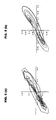
- the network was set up as in Figure 4a ,b. It consisted of two layers of 100 units, which were each arranged in a 10 ⁇ 10 grid. To avoid dealing with boundary conditions, the grid was topologically closed into a torus. The first layer was used as the DR, the second layer was the output layer.
- a local connectivity pattern was provided, as follows. Each unit of the first layer received connections from locally surrounding units within that layer ( Fig. 4a ). The weights were set depending on the distance r 1 between units, as shown in Figs. 4c . The resulting internal DR dynamics is depicted in Figure 4d , which shows the response of 8 arbitrarily selected units of the first layer to a unit impulse fed into the first unit at timestep 10. It can be seen that the DR dynamics dies out, i.e., it is globally stable.
- Each unit of the first layer additionally received connections from output units that lied in a local neighborhood of radius r2 .
- the dependency of weights from distance r 2 is shown in Figure 4e .
- the teaching signal consisted in a "soliton" wave which was teacher-forced on the output layer.
- the soliton slowly wandered with constant speed and direction across the torus.
- Fig. 4f shows four successive time steps of the teacher signal. Note the effects of torus topology in the first snapshot.
- the teaching proceeded as follows.
- the DR network state was initialized to all zeros.
- the network was then run for 60 time steps.
- the output units were updated by teacher forcing, i.e., the teacher signal shown in Fig. 4f was written into the output units.
- Data from the first 30 time steps were discarded, and the data collected from the remaining 30 time steps were used for the off-line embodiment of the learning method of the invention.
- the result were weights for the connections from DR units to output units.
- Fig. 4g shows snapshots taken at time steps 1, 5, 10, 20, 50, 100 from this free run.
- the initially forced soliton persists for some time, but then the overall dynamics reorganizes into a stable, symmetric pattern of two larger solitons that wander across the torus with the same speed and direction as the training soliton.
- Fig. 4h shows a smooth and a rippled wave pattern that emerged in this way.
- Example 4 Learning a chaotic oscillator: the Lorenz attractor
- the network was set up with a randomly and sparsely connected DR (80 units, connectivity 0.1, weights +0.4 or -0.4 with equal probability) and a single output unit (output-to-DR feedback connections with full connectivity, random weights drawn from uniform distribution over [-2, 2]).
- a transfer function f tanh was used.
- the leaking coefficients a j were choosen randomly from a uniform distribution over [0, 0.2].
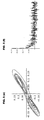
- the 1-dimensional teaching signal was obtained by projecting the well-known 3-dimensional Lorenz attractor on its first dimension. A small amount of noise was added to the signal. A delay-embedding representation of the noisy teacher signal is shown in Fig. 5a , and of the teacher signal without noise in Fig. 5b .
- the learning task was to adapt the DR-to-output weights (using the noisy training signal) such that the neural network reproduced in its output unit dynamics the (noise-free) Lorenz trace.
- the output weights were trained according to the method of the invention. For demonstration purposes, three variants are reported here: (a) offline learning, (b) online learning with the RLS method, (c) online learning with the LMS method.
- a mean square error E [ ⁇ 2 ] ⁇ 0.000125 was reached.
- Figure 5f shows the learning curve (all epochs joined), and Fig. 5g shows a time series generated by the trained network. It is apparent that the trained network produces a point attractor instead of a chaotic attractor. This highlights the fact that the LMS method is ill-suited for training DR-to-output weights.
- Example 5 a direct / state feedback controller
- ⁇ the angular velocity
- ⁇ the angle
- ⁇ the timestep increment
- u ( t ) is the control input (torque)
- ⁇ ( t ) uncontrolled noise input.
- the length of the pendulum was 0.5, so x 1 ref ( t + 2), x 2 ref ( t + 2) range in [-0.5,0.5].
- the controller has to generate a torque control input u ( t ) to the pendulum such that two update steps after the current time t the pendulum tracks the reference trajectory.
- Figure 6a shows the setup of the controller in the exploitation phase.
- a 500-step long teacher signal was prepared by simulating the pendulum's response to a time-varying control input ⁇ ( t ), which was chosen as a superposition of two random banded signals, one with high frequencies and small amplitude, the other with low frequencies and high amplitude.
- Figure 6c shows the control input ⁇ ( t ) used for the training singnal
- Fig. 6d shows the simulated pendulum's state answer x 2 ( t )
- Fig. 6e the state answer ⁇ ( t ) (the state answer component x 1 ( t ) looks qualitatively like x 2 ( t ) and is not shown).
- Figure 6b shows the training setup.
- the network was set up with the same 100-unit DR as in the previous (Lorenz attractor) example.
- 6 external input units were sparsely (connectivity 20%) and randomly (weights +0.5, -0.5 with equal probability) attached to the DR, and one output unit was provided without feedback connections back to the DR.
- the network update rule was the standard noisy sigmoid update rule (1') for the internal DR units (noise homogeneously distributed in [-0.01, +0.01]).
- the output unit was updated with a version of Eq. (1) where the transfer function was the identity (i.e., a linear unit).
- the network generated a control signal u ( t ) which was fed into the simulated pendulum.
- Figure 6f shows the network output u ( t );
- Figure 6g shows a superposition of the reference x 2 ref ( t + 2 ⁇ ) (solid line) with the 2-step-delayed pendulum trajectory x 2 ( t + 2 ⁇ ) (dashed line);
- Figure 6h shows a superposition of the reference ⁇ ref ( t + 2 ⁇ ) (solid line) with the 2-step-delayed pendulum trajectory ⁇ ( t + 2 ⁇ ) (dashed line).
- the network has learnt to function as a tracking controller.
- the trained network operates as a dynamical state feedback tracking controller. Analytic design of perfect tracking controllers for the pendulum is not difficult if the system model (8) is known. The challenge in this example is to learn such a controller without apriori information from a small training data set.
- the claim is a method to obtain obtain closed-loop tracking controllers by training of a recurrent neural network according to the method of the invention, where (1) the input training data consists of two vector-valued time series of the form y ( t + ⁇ ), y ( t ), where y ( t + ⁇ ) is a future version of the variables that will serve as a reference signal in the exploitation phase, and y ( t ) are state or observation feedback variables (not necessarily the same as in y ( t + ⁇ )), (2) the output training data consists in a vector ⁇ ( t ), which is the control input presented to the plant in order to generate the training input data y ( t + ⁇ ), y ( t ).
- Example 6 A two-way device: frequency generator + frequency meter
- the method of the invention can be used to obtain a device which can be used in two ways: as a tunable frequency generator (input: frequency target, output: oscillation of desired frequency) and as a frequency meter (input: oscillation, output: frequency indication).
- the network has two extra units, each of which can be used either as an input or as an output unit.
- both units are treated formally as output units, in the sense that two teacher signals are presented simultaneously: the target frequency and an oscillation of that frequency.
- the first training channel is a slowly changing signal that varies smoothly but irregularly between 0.1 and 0.3 ( Figure 7a ).
- the other training channel is a fast sine oscillation whose frequency is varying according the first signal ( Figure 7b , the apparent amplitude jitter is a discrete-sampling artifact).
- the network was set up with a DR of 100 units.
- This band structure induces a topology on the units.
- the nearer two units i.e., the smaller
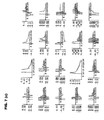
- Figure 7c shows the impulse responses of every 5th unit (impulse input at timestep 10).
- the two extra units were equipped with feedback connections which projected back into the DR. These connections were established randomly with a connectivity of 0.5 for each of the two extra units. The weights of these feedback connections were chosen randomly to be ⁇ 1.24 for the first extra unit and ⁇ 6.20 for the second extra unit.
- the network state was randomly initialized, and the network was run for 1100 steps for training.
- Two signals of the same kind as shown in Figs. 7a,b were presented to the network (the target frequency signal to the first extra unit and the oscillation to the second) and the correct teacher output was written into the two output nodes (teacher forcing).
- the update of DR units was done with a small additive noise according to Eq. (1').
- the noise was sampled from a uniform distribution over [-0.02, 0.02].
- Data from the first 100 update steps were discarded.
- Data from the remaining 1000 update steps with teacher forcing were collected and used to obtain a linear regression solution of the least mean square error Eq. (4).
- the result were weights for the connections from DR units to the two output units.
- the trained RNN was used in either of two ways, as a frequency generator or as a frequency meter.
- the no-noise version Eq. (1) of the update rule was used.
- the first extra unit was treated as an input unit, and the second as an output unit.
- a target frequency signal was fed into the input unit, for instance the 400 timestep staircase signal shown in Fig. 7d .
- the second extra unit here assigned to the output role, an oscillation was generated by the network.
- Fig. 7e shows an overlay of an oscillation of the correct frequency demanded by the staircase input (solid line) with the output actually generated by the network (dashed line).
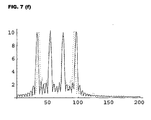
- Fig. 7f shows an overlay of the frequency amplitudes (absolutes of Fourier transforms) of the output signal (solid line) and the network-generated output (dashed line). It appears from Figs.
- Fig. 7g shows traces of 8 arbitrarily selected units of the DR. They exhibit oscillations of the same frequency as the output signal, transposed and scaled in their amplitude range according to the input signal.
- Fig. 7h shows an input signal.
- Fig. 7i presents an overlay of the perfect output (solid line) with the actually generated output (dashed line).
- the network has apparently learnt to serve as a frequency meter, although again with some distortion in the low and high ends of range.
- a trace plot of DR units would look exactly like in the frequency generator mode and is omitted.
- the challenge in this example is twofold.
- the network had to learn not an output dynamics per se, but rather “discover" the dynamical relationship between the two training signals.
- the time scales of the two signals are very different: the frequency target is essentially stationary, while the oscillation signal changes on a fast timescale.
- This example is an instance of another dependent claim of the invention, namely, to use the method of the invention to train an RNN on the dynamic relationship between several signals. More specifically, the claim is (1) to present training data ⁇ 1 ( t ) ,..., ⁇ n ( t ) to n extra units of a DR architecture according to the invention, where these extra units have feedback connections to the DR, (2) train the network such that the mean square error from Eq. (4) is minimized, and then (3) exploit the network in any "direction" by arbitrarily declaring some of the units as input units and the remaining ones as output units.
- a central architectural aspect of the invention is the provision of the DR whose weights are fixed and are not changed by subsequent learning.
- the purpose of the DR for the learning method of this invention is to provide a rich, stable, preferably long-lasting excitable dynamics.
- the invention provides the following methods to realize this goal.
- Preferred embodiments of the invention have relatively large DRs to provide for a rich variety of different unit dynamics. 50 units and (many) more would be typical cases, less than 50 units would be suitable only for undemanding applications like learning simple oscillators.
- Preferred embodiments of the invention achieve a rich variety in the impulse responses of the DR units by introducing inhomogeneity into the DR.
- the following strategies which can be used singly or in combination, contribute to the design goal of inhomogeneity:
- a preferred method to obtain a DR with a globally stable dynamics is to first construct an inhomogeneous DR according to the previously mentioned preferred embodiments, and then globally scale its weights by a common factor ⁇ which is selected such that
- a design goal is to achieve a long short-term memory in the learnt RNN.
- This design goal can be supported in embodiments of the invention by a proper selection of the stability margin of the DR.
- the design goal of long-lasting short-term memory capabilities can be served in embodiments of the invention by setting the stability margin to small values.
- values of ⁇ smaller than 0.1 are used.
- the connectivity pattern from input units to the DR network, and the weights on these input-DR-connections are fixed at construction time and are not modified during learning.
- the input-DR-connections and their weights are fixed in two steps.
- step 1 the connectivity pattern is determined and the weights are put to initial values.
- step 2 the weight values are globally scaled to maximize performance.
- Step 1 Establish input-to-DR connections and put their weights to initial values.
- the design goal to be achieved in step 1 is to ensure a high variability in the individual DR units' responses to input signals. This goal is reached, according to the method of the invention, by following the following rules, which can be used in any combination:
- Step 2 Scale the weights set in step 1 globally.
- the goal of step 2 is to optimize performance. No general rule can be given. According to the specific purpose of the network, different scaling ranges can be optimal, from very small to very large absolute weights. It will be helpful to observe the following rules, which are given here for the convenience of the user. They are applicable in embodiments where the update rule of the DR network employs nonlinear (typically, sigmoid) transfer functions.
- nonlinear typically, sigmoid
- output is read from the network always from output units.
- y j ( t + 1) f j ⁇ w j , x ( t ) ⁇ , where the inner product ⁇ w j , x ( t ) ⁇ denotes the sum of weighted activations of input units u ( t ), DR units x ( t ), and output units y ( t ): w j ⁇ 1 ⁇ u 1 t + ... + w jn ⁇ u n t + w j , n + 1 ⁇ x 1 t + ... + w j , n + K ⁇ x K t + w j , n + K + 1 ⁇ y 1 t + ... + w j , n + K + m ⁇ y m t , passed through the transfer function f j of the j -th output unit.
- f j is a sigmoid or a linear function.
- the method of the invention provides two alternatives concerning feedback from the output units to the DR: (a) the network can be set up without such connections, (b) the network can be equipped with such connections.
- Embodiments of the invention of type (a) will typically be employed for passive filtering tasks, while case (b) typically is required for active signal generation tasks.
- feedback connections can also be required in filtering tasks, especially when the filtering task involves modeling a system with an autonomous state dynamics (as in the two-way device example).
- This situation is analogous, in linear signal processing terminology, to infinite impulse response (IIR) filters.
- IIR infinite impulse response
- RNNs yield nonlinear filters. Therefore, in this patent application another terminology shall be used.
- RNNs which have input and feedback connections from the output units will be referred to as serving active filtering tasks.
- the setup of output-to-DR feedback connections is completely analogous to the setup of input-to-DR connections, which was described in detail above. Therefore, it suffices here to repeat that in a preferred embodiment of the invention, the output-to-DR feedback connections are designed in two steps. In the first step, the connectivity pattern and an initial set of weights are fixed, while in the second step the weights are globally scaled.
- the design goals and heuristic rules described for input-to-DR connections apply to output-to-DR connections without change, and need not be repeated.
- the method of the invention proceeds to determine the weights from DR units (and also possibly from input units, if they are provided) to the output units. This is done through a supervised training process.
- ⁇ j ( t ) is the desired (teacher) output of the j -th output unit, to which the inverse of the transfer function f j of this unit is applied.
- the term ⁇ w j , x ( t ) ⁇ denotes the inner product w j ⁇ 1 ⁇ u 1 t + ... + w jn ⁇ u n t + w j , n + 1 ⁇ x 1 t + ... + w j , n + K ⁇ x K t + w j , n + K + 1 ⁇ y 1 t + ... + w j , n + K + m ⁇ y m t , where u i ( t ) are activations of input units (if applicable), x i ( t ) of DR units, and y i ( t ) of output units.
- the effect of taking ⁇ s ⁇ w j , x ( t ) ⁇ instead of ⁇ w j , x ( t ) ⁇ is that only the input/DR/output units selected by the selection vector s are used for minimizing the output error.
- the connection weights from those input/DR/output units which are marked by 0's in s , to the output units, are put to zero.
- variants (4*) or (4'*) can be used to preclude the learning of output-to-output connections.
- Variant (4*) was used in the examples “short-time memory” and “feedback controller” (precluding output-to-output feedback), and in the “excitable medium” example (extensive use of (4*) for defining the local neighborhoods shown in Figs. 4a,b ).
- Training method supervised teaching with teacher forcing
- the MSE (4), (4'), (4*) or (4'*) is minimized through a procedure of supervised teaching .
- the input sequence u ( t ) may be absent when the learning task is to learn a purely generative dynamics, as in the Lorenz attractor and the excitable medium examples.
- the DR activations are initialized to zero or to small random values.
- the method of the invention can be used for constructive offline learning and for adaptive online learning.
- the method of the invention can be adjusted to these two cases, as detailed below.
- several aspects of the invention are independent from the online/offline distinction.
- This is known in the RNN field as teacher forcing .
- Teacher forcing is essential in cases where there are feedback connections from the output units to the DR. In cases where such feedback connections are not used, teacher forcing is inconsequential but assumed nonetheless for the convenience of a unified description of the method.
- the particular update law is irrelevant for the method of the invention.
- the repeated update of the DR generates an activation vector sequence x (1),..., x ( N ), where x ( t ) is a vector containing the activations of the network's units (including input units but excluding output units) at time t .
- a small amount of noise is added to the network dynamics during the training phase.
- One method to add noise is to use update equation (1'), i.e. add a noise term to each network state at each update time.
- An alternative method to introduce noise is to add noise to the input signals u ( t ) and/or ⁇ ( t ). More specifically, instead of writing u ( t ) into the input units, write u ( t ) + ⁇ ( t ) into them; and instead of teacher-forcing ⁇ ( t ) into the output units, write ⁇ ( t )+ ⁇ ( t ) into the output units ( ⁇ ( t ) is a noise term).
- the to-be-minimized MSE still refers to the non-noisified versions of the training output, i.e. to the chosen variant of Eq. (4).
- Adding noise to the network dynamics is particularly helpful in signal generation and active signal processing tasks, where output-to-DR feedback connections are present.
- the added noise randomly excites such internal units which have no stable systematic dynamic relationship with the desired I/O behavior; as a consequence, weights from such "unreliable" units to the output units receive very small values from the learning procedure.
- the net effect is that the resulting trained network behaves more robustly (i.e., less susceptible to perturbations). Adding noise was found to be indispensible in the "two-way device" example.
- Adding noise is also beneficial in cases where the training data set is not much larger than the network size. In such cases, there is danger of overfitting the training data, or stated in an alternative way: it is then difficult to achieve good generalization performance. Insertion of noise prevents the network from fitting to idiosyncrasies in the training data, thereby improving generalization. Adding noise to counteract overfitting was a necessity in the "pendulum control" example, where only a small part of the plant's control regime was visited during training, but still a reasonably generalized performance was achieved.
- N state-teacher output pairs x ( t ), ⁇ 1 ( t ),..., ⁇ m ( t ) have been collected in memory.
- the method of the invention proceeds now to compute weights w j,i from all units which have entry 1 in the selection vector s EINBETTEN x ( t ) the j output units. These weights are computed such that the chosen variant of MSE (e.g., (4) or (4*)) is minimized.
- MSE e.g., (4) or (4*)
- online adaptation methods can be used both for minimizing output state error (MSE criteria (4), (4*)) and for minimizing output value error (MSE criteria (4'), (4'*)).
- the weights w j,i to the j -th output unit are incrementally optimized at every time step, thereby becoming time-dependent variables w j,i ( t ) themselves.
- a host of well-known methods for online MSE-minimizing adaptation can be used for the method of the invention, for instance stochastic gradient descent methods like the LMS method or Newton's method (or combinations thereof), or so-called “deterministic" methods like the RLS method.
- the LMS method is by far the simplest. It is not optimally suited for the method of the invention (the reasons for this have been indicated in the discussion of the Lorenz attractor example). Nonetheless, owing to its simplicity, LMS is the best choice for a didactical illustration of the principles of the online version of the method of the invention.
Landscapes
- Engineering & Computer Science (AREA)
- Theoretical Computer Science (AREA)
- Physics & Mathematics (AREA)
- Computing Systems (AREA)
- General Physics & Mathematics (AREA)
- Biomedical Technology (AREA)
- Biophysics (AREA)
- Computational Linguistics (AREA)
- Data Mining & Analysis (AREA)
- Evolutionary Computation (AREA)
- General Health & Medical Sciences (AREA)
- Molecular Biology (AREA)
- Life Sciences & Earth Sciences (AREA)
- General Engineering & Computer Science (AREA)
- Artificial Intelligence (AREA)
- Mathematical Physics (AREA)
- Software Systems (AREA)
- Health & Medical Sciences (AREA)
- Feedback Control In General (AREA)
- Medicines Containing Antibodies Or Antigens For Use As Internal Diagnostic Agents (AREA)
- Small-Scale Networks (AREA)
- Manipulator (AREA)
- Image Analysis (AREA)
- Testing And Monitoring For Control Systems (AREA)
- Measuring Pulse, Heart Rate, Blood Pressure Or Blood Flow (AREA)
- Electrotherapy Devices (AREA)
Claims (41)
- Procédé de construction d'un réseau de neurones artificiels discret et récurrent et d'apprentissage dudit réseau afin de minimiser son erreur de sortie, le procédé comprenant les étapes suivantes:a. prévoir un réseau de neurones récurrent,b. prévoir des moyens pour fournir des entrées au réseau,c. attacher des unités de sortie au réseau au moyen de connexions pondérées,d. enseigner les poids des connexions depuis le réseau aux unités de sorties selon une méthode d'apprentissage supervisé,
caractérisé pare. construire le réseau de neurones récurrent comme un réservoir représentant des caractéristiques dynamiques des unités d'un système excitable. - Procédé selon la revendication 1, dans lequel le réseau DR comprend une nombre d'unités supérieure à 50.
- Procédé selon la revendication 1 ou 2, dans lequel le réseau DR présent une interconnexion clairsemée.
- Procédé selon l'une quelconque des revendications 1 à 3, dans lequel les connexions dans le réseau DR ont des poids assignés aléatoirement.
- Procédé selon l'une quelconque des revendications 1 à 4, dans lequel différentes règles d'actualisation ou des règles d'actualisation paramétrées de manières différentes sont utilisées pour des unités différentes du réseau DR.
- Procédé selon l'une quelconque des revendications 1 à 5, dans lequel structure spatiale est imprimée sur le réseau DR au moyen du schéma de connectivité.
- Procédé selon la revendication 6, dans lequel la structure spatiale est un réseau régulier.
- Procédé selon la revendication 6, dans lequel la structure spatiale est une structure du type Local Neighborhood, induite notamment par une structure à lignes ou à sous-lignes de la matrice de connectivité.
- Procédé selon la revendication 6, dans lequel la structure spatiale est modulaire ou organisée en niveaux.
- Procédé selon l'une quelconque des revendications 1 à 9, dans lequel les poids dans le réseau DR sont globalement cadrés de façon que la dynamique résultante du réseau DR isolé est globalement stabile.
- Procédé selon l'une quelconque des revendications 1 à 9, dans lequel les poids dans le réseau DR sont globalement cadrés de façon que la dynamique résultante du réseau DR isolé est marginalement globalement stabile afin d'obtenir une longue durée d'effets de mémoire dans le réseau final après apprentissage.
- Procédé selon la revendication 10 ou 11, dans lequel l'entrée est fournie au réseau DR au moyen des unités d'entrée additionnelles.
- Procédé selon la revendication 12, dans lequel les connexions depuis les unités d'entrée jusqu'au réseau DR sont clairsemées.
- Procédé selon la revendication 12 ou 13, dans lequel les poids de connexions depuis les unités d'entrée jusqu'au réseau DR sont fixés aléatoirement et présentent des signes négatives ou positives.
- Procédé selon l'une quelconque des revendications 12 à 14, dans lequel les poids de connexions depuis les unités d'entrée jusqu'au réseau DR sont globalement cadrés à des petites valeurs absolues afin d'obtenir une longue durée d'effets de mémoire des caractéristiques entrée/sortie du réseau final, ou afin d'obtenir des caractéristiques de temps lentes ou passe-bas dans les caractéristiques entrée/sortie du réseau final, ou afin d'obtenir des caractéristiques entrée/sortie presque linéaires.
- Procédé selon l'une quelconque des revendications 12 à 14, dans lequel les poids de connexions depuis les unités d'entrée jusqu'au réseau DR sont globalement cadrés à des grandes valeurs absolues afin d'obtenir une courte durée d'effets de mémoire, ou afin d'obtenir une action entrée/sortie rapide, ou afin d'obtenir des caractéristiques fortement non-linéaires ou de "commutation" dans le réseau final enseigné.
- Procédé selon la revendication 10 ou 11, dans lequel l'entrée est fournie au réseau DR par des moyens autre que des unités d'entrée additionnelles.
- Procédé selon l'une quelconque des revendications 1 à 17, dans lequel des unités de sortie additionnelles sont attachées au réseau DR sans connexions de feed-back depuis les unités de sortie jusqu'au réseau DR afin d'obtenir, après l'apprentissage, un réseau de traitement de signaux passif.
- Procédé selon l'une quelconque des revendications 1 à 17, dans lequel des unités de sortie additionnelles sont attachées au réseau DR avec connexions de feed-back depuis les unités de sortie jusqu'au réseau DR afin d'obtenir, après l'apprentissage, un réseau de traitement de signaux actif ou de génération de signaux.
- Procédé selon la revendication 19, dans lequel les connexions de feed-back sont clairsemées.
- Procédé selon la revendication 19 ou 20, dans lequel les poids de connexions de feed-back sont fixés aléatoirement et présentent des signes négatives et positives.
- Procédé selon l'une quelconque des revendications 19 à 21, dans lequel les poids de connexions de feed-back sont globalement cadrés à des petites valeurs absolues afin d'obtenir une longue durée d'effets de mémoire des caractéristiques entrée/sortie dans le réseau final, ou afin d'obtenir des caractéristiques de temps lentes ou passe-bas dans les caractéristiques entrée/sortie du réseau final, ou afin d'obtenir des caractéristiques entrée/sortie linéaires.
- Procédé selon l'une quelconque des revendications 19 à 21, dans lequel les poids de connexions depuis les unités d'entrée jusqu'au réseau DR sont globalement cadrés à des grandes valeurs absolues afin d'obtenir une courte durée d'effets de mémoire, ou afin d'obtenir une action entrée/sortie rapide, ou afin d'obtenir des caractéristiques fortement non-linéaires ou de "commutation" dans le réseau final enseigné.
- Procédé selon l'une quelconque des revendications 1 à 23, dans lequel le réseau DR est enseigné utilisant une version non-connectée d'apprentissage supervisé.
- Procédé selon la revendication 24, dans lequel la tâche à apprendre est une tâche de génération de signaux, aucune entrée n'existe, et le signal professeur n'est qu'un échantillon du signal d'entrée souhaité.
- Procédé selon la revendication 24, dans lequel la tâche à apprendre est une tâche de traîtement de signaux, ou une entrée existe, et le signal professeur est un échantillon de la paire de signaux d'entrée/sortie souhaitée.
- Procédé selon l'une quelconque des revendications 24 à 26, dans lequel des poids de minimalisation de l'erreur de sortie des connections aux noeuds de sortie sont calculés, le procédé comprenant les étapes suivantes:a. présenter les signaux professeur au réseau et opérant le réseau dans un mode forcé par le professeur pendant la durée de la période d'apprentissage;b. stocker dans un mémoire les états du réseau et les signaux
 c. rejeter sélectivement des paires d'état/sortie initiales pour accommoder des effets transitoires initiaux,d. calculer les poids des connexions aux noeuds de sortie par une méthode de régression linéaire standard.
 - Procédé selon l'une quelconque des revendications 24 à 27, dans lequel, pendant la période d'apprentissage, de bruit est introduit dans la dynamique du réseau DR utilisant une règle d'actualisation bruyante et/ou par ajouter de bruit à l'entrée et/ou, si des connexions de feed-back existent entre la sortie et le DR, par ajoutant un composant de bruit à la sortie professeur avant qu'elle est retournée dans le DR.
- Procédé selon l'une quelconque des revendications 24 à 28, dans lequel des poids des connexions de seulement un sous-groupe des unités d'entrée, des unités de réseau DR et des unités de sortie aux unités de sortie sont enseignés, tandis que les autres son mis à zéro.
- Procédé selon l'une quelconque des revendications 1 à 23, dans lequel de réseau DR est enseigné au moyen d'une version connectée d'apprentissage supervisé.
- Procédé selon la revendication 30, dans lequel la tâche à apprendre est une tâche de génération de signaux, aucune entrée n'existe, et le signal professeur n'est qu'un échantillon du signal de sortie souhaité.
- Procédé selon la revendication 30, dans lequel la tâche à apprendre est une tâche de traîtement de signaux, ou une entrée existe, et le signal professeur est un échantillon de la paire de signaux d'entrée/sortie souhaitée.
- Procédé selon l'une quelconque des revendications 30 à 32, dans lequel des poids de minimalisation de l'erreur de sortie des connexions aux noeuds de sortie sont actualisés à chaque pas de temps, l'actualisation comprenant les sous-étapes suivantes:a. fournir l'entrée au réseau et actualiser de réseau DR,b. pour chaque unité de sortie, calculer l'erreur de la valeur de sortie comme la différence entre la sortie professeur souhaitée et la sortie actuelle du réseau, ou, alternativement, calculer l'erreur d'état de sortie comme la différence entre la valeur
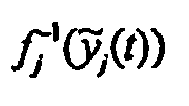 c. actualiser le poids des connexions aux noeuds de sortie par une méthode standard pour minimaliser l'erreur calculé dans la sous-étape b. précédente;d. au cas de tâches de génération de signaux ou de tâches de traîtement de signaux actif, forcer la sortie professeur dans les unités de sortie.
 - Procédé selon l'une quelconque des revendications 30 à 33, dans lequel de bruit est introduit dans la dynamique du réseau DR utilisant une règle d'actualisation bruyante ou, si des connexions de feed-back existent, par ajoutant un composant de bruit à la sortie professeur avant qu'elle est retournée dans le réseau DR.
- Procédé selon l'une quelconque des revendications 30 à 34, dans lequel des poids des connexions de seulement un sous-groupe des unités d'entrée, des unités de réseau DR et des unités de sortie aux unités de sortie sont enseignés, tandis que les autres son mis à zéro.
- Procédé selon l'une quelconque des revendications 1 à 35, dans lequel le réseau DR est enseigné sur deux unités de sortie ou plus avec connexions de feed-back au réseau DR, lesquelles sont utilisées, dans la phase d'exploitation, selon une "direction" choisie quelconque par traiter quelques unes des unités enseignées comme unités d'entrée et les autres comme unités de sortie, de cette façon réalisant enseignant les relations dynamiques entre les signaux.
- Procédé selon la revendication 36, appliqué à des tâches de mémoire reconstructive de structures dynamiques multi-dimensionnelles, comprenant les étapes suivantes:a. enseigner le réseau DR utilisant des signaux d'enseignement formés par des échantillons à dimension complète des structures,b. dans la phase d'exploitation, présenter des structures indicatrices, qui sont rendues incomplètement seulement dans quelques dimensions, comme entées dans ces dimensions, et lire les structures dynamiques complétées sur les autres unités.
- Procédé selon l'une quelconque des revendications 1 à 35, appliqué à des tâches de commande de l'état d'un circuit de réglage ou d'observation de traçage de feed-back dans une installation, comprenant les étapes suivantes:a. utiliser des échantillons d'apprentissage formés par deux types de signal d'entrée au réseau DR, à savoir (i) une version future des variables qui serviront comme signal de référence dans la phase d'exploitation, et (ii) des observations de sortie de l'installation (ou observations de l'état de l'installation); et consistant de plus d'un signal de sortie souhaité du réseau, à savoir (iii) l'entrée de commande de l'installation,b. enseigner le réseau DR en utilisant le signal d'entrée professeur et le signal de sortie de a., afin d'obtenir un réseau DR calculant comme sortie du réseau une entrée de commande de l'installation (à savoir (iii)), en fonction de l'observation de la sortie actuelle de l'installation (à savoir (ii)) et un version future de variables de référence (à savoir (i)),c. exploiter le réseau comme contrôleur à circuit fermé en l'alimentant en les entrées: (i) signaux de référence futurs et (ii) observation de sortie actuelle de l'installation (ou observation de l'état de l'installation); et causer le réseau DR à générer l'entrée de commande actuelle de l'installation.
- Réseau neuronal construit et enseigné selon l'une quelconque des revendications précédentes.
- Réseau neuronal selon la revendication 39, dans lequel le réseau est implémenté comme un micro-circuit.
- Réseau neuronal selon la revendication 39, dans lequel le réseau est implémenté par un ordinateur programmé d'une manière appropriée.
Priority Applications (1)
| Application Number | Priority Date | Filing Date | Title |
|---|---|---|---|
| EP01976272A EP1356430B1 (fr) | 2000-10-13 | 2001-10-05 | Procede d'apprentissage supervise dans un reseau de neurones artificiels recurrent |
Applications Claiming Priority (4)
| Application Number | Priority Date | Filing Date | Title |
|---|---|---|---|
| EP00122415 | 2000-10-13 | ||
| EP00122415 | 2000-10-13 | ||
| PCT/EP2001/011490 WO2002031764A2 (fr) | 2000-10-13 | 2001-10-05 | Procede d'apprentissage supervise dans un reseau de neurones artificiels recurrent |
| EP01976272A EP1356430B1 (fr) | 2000-10-13 | 2001-10-05 | Procede d'apprentissage supervise dans un reseau de neurones artificiels recurrent |
Publications (2)
| Publication Number | Publication Date |
|---|---|
| EP1356430A2 EP1356430A2 (fr) | 2003-10-29 |
| EP1356430B1 true EP1356430B1 (fr) | 2010-07-14 |
Family
ID=8170085
Family Applications (1)
| Application Number | Title | Priority Date | Filing Date |
|---|---|---|---|
| EP01976272A Expired - Lifetime EP1356430B1 (fr) | 2000-10-13 | 2001-10-05 | Procede d'apprentissage supervise dans un reseau de neurones artificiels recurrent |
Country Status (8)
| Country | Link |
|---|---|
| US (1) | US7321882B2 (fr) |
| EP (1) | EP1356430B1 (fr) |
| JP (1) | JP4093858B2 (fr) |
| AT (1) | ATE474288T1 (fr) |
| AU (1) | AU2001295591A1 (fr) |
| CA (1) | CA2424929C (fr) |
| DE (1) | DE60142582D1 (fr) |
| WO (1) | WO2002031764A2 (fr) |
Families Citing this family (163)
| Publication number | Priority date | Publication date | Assignee | Title |
|---|---|---|---|---|
| US20060184462A1 (en) | 2004-12-10 | 2006-08-17 | Hawkins Jeffrey C | Methods, architecture, and apparatus for implementing machine intelligence and hierarchical memory systems |
| US9031999B2 (en) | 2005-10-26 | 2015-05-12 | Cortica, Ltd. | System and methods for generation of a concept based database |
| WO2007049282A2 (fr) * | 2005-10-26 | 2007-05-03 | Cortica Ltd. | Dispositif informatique, systeme et procede de traitement de flux de donnees en parallele |
| US9256668B2 (en) | 2005-10-26 | 2016-02-09 | Cortica, Ltd. | System and method of detecting common patterns within unstructured data elements retrieved from big data sources |
| US8266185B2 (en) | 2005-10-26 | 2012-09-11 | Cortica Ltd. | System and methods thereof for generation of searchable structures respective of multimedia data content |
| US10691642B2 (en) | 2005-10-26 | 2020-06-23 | Cortica Ltd | System and method for enriching a concept database with homogenous concepts |
| US11003706B2 (en) | 2005-10-26 | 2021-05-11 | Cortica Ltd | System and methods for determining access permissions on personalized clusters of multimedia content elements |
| US10776585B2 (en) | 2005-10-26 | 2020-09-15 | Cortica, Ltd. | System and method for recognizing characters in multimedia content |
| US11032017B2 (en) | 2005-10-26 | 2021-06-08 | Cortica, Ltd. | System and method for identifying the context of multimedia content elements |
| US9372940B2 (en) | 2005-10-26 | 2016-06-21 | Cortica, Ltd. | Apparatus and method for determining user attention using a deep-content-classification (DCC) system |
| US9286623B2 (en) | 2005-10-26 | 2016-03-15 | Cortica, Ltd. | Method for determining an area within a multimedia content element over which an advertisement can be displayed |
| US10614626B2 (en) | 2005-10-26 | 2020-04-07 | Cortica Ltd. | System and method for providing augmented reality challenges |
| US10193990B2 (en) | 2005-10-26 | 2019-01-29 | Cortica Ltd. | System and method for creating user profiles based on multimedia content |
| US9529984B2 (en) | 2005-10-26 | 2016-12-27 | Cortica, Ltd. | System and method for verification of user identification based on multimedia content elements |
| US9477658B2 (en) | 2005-10-26 | 2016-10-25 | Cortica, Ltd. | Systems and method for speech to speech translation using cores of a natural liquid architecture system |
| US9466068B2 (en) | 2005-10-26 | 2016-10-11 | Cortica, Ltd. | System and method for determining a pupillary response to a multimedia data element |
| US10635640B2 (en) | 2005-10-26 | 2020-04-28 | Cortica, Ltd. | System and method for enriching a concept database |
| US10698939B2 (en) | 2005-10-26 | 2020-06-30 | Cortica Ltd | System and method for customizing images |
| US10372746B2 (en) | 2005-10-26 | 2019-08-06 | Cortica, Ltd. | System and method for searching applications using multimedia content elements |
| US10387914B2 (en) | 2005-10-26 | 2019-08-20 | Cortica, Ltd. | Method for identification of multimedia content elements and adding advertising content respective thereof |
| US11361014B2 (en) | 2005-10-26 | 2022-06-14 | Cortica Ltd. | System and method for completing a user profile |
| US9218606B2 (en) | 2005-10-26 | 2015-12-22 | Cortica, Ltd. | System and method for brand monitoring and trend analysis based on deep-content-classification |
| US9953032B2 (en) | 2005-10-26 | 2018-04-24 | Cortica, Ltd. | System and method for characterization of multimedia content signals using cores of a natural liquid architecture system |
| US11604847B2 (en) | 2005-10-26 | 2023-03-14 | Cortica Ltd. | System and method for overlaying content on a multimedia content element based on user interest |
| US9087049B2 (en) | 2005-10-26 | 2015-07-21 | Cortica, Ltd. | System and method for context translation of natural language |
| US11403336B2 (en) | 2005-10-26 | 2022-08-02 | Cortica Ltd. | System and method for removing contextually identical multimedia content elements |
| US10949773B2 (en) | 2005-10-26 | 2021-03-16 | Cortica, Ltd. | System and methods thereof for recommending tags for multimedia content elements based on context |
| US10380623B2 (en) | 2005-10-26 | 2019-08-13 | Cortica, Ltd. | System and method for generating an advertisement effectiveness performance score |
| US9558449B2 (en) | 2005-10-26 | 2017-01-31 | Cortica, Ltd. | System and method for identifying a target area in a multimedia content element |
| US9384196B2 (en) | 2005-10-26 | 2016-07-05 | Cortica, Ltd. | Signature generation for multimedia deep-content-classification by a large-scale matching system and method thereof |
| US9489431B2 (en) | 2005-10-26 | 2016-11-08 | Cortica, Ltd. | System and method for distributed search-by-content |
| US10180942B2 (en) | 2005-10-26 | 2019-01-15 | Cortica Ltd. | System and method for generation of concept structures based on sub-concepts |
| US10607355B2 (en) | 2005-10-26 | 2020-03-31 | Cortica, Ltd. | Method and system for determining the dimensions of an object shown in a multimedia content item |
| US11620327B2 (en) | 2005-10-26 | 2023-04-04 | Cortica Ltd | System and method for determining a contextual insight and generating an interface with recommendations based thereon |
| US10535192B2 (en) | 2005-10-26 | 2020-01-14 | Cortica Ltd. | System and method for generating a customized augmented reality environment to a user |
| US11019161B2 (en) | 2005-10-26 | 2021-05-25 | Cortica, Ltd. | System and method for profiling users interest based on multimedia content analysis |
| US20160321253A1 (en) | 2005-10-26 | 2016-11-03 | Cortica, Ltd. | System and method for providing recommendations based on user profiles |
| US11216498B2 (en) | 2005-10-26 | 2022-01-04 | Cortica, Ltd. | System and method for generating signatures to three-dimensional multimedia data elements |
| US11386139B2 (en) | 2005-10-26 | 2022-07-12 | Cortica Ltd. | System and method for generating analytics for entities depicted in multimedia content |
| US9330189B2 (en) | 2005-10-26 | 2016-05-03 | Cortica, Ltd. | System and method for capturing a multimedia content item by a mobile device and matching sequentially relevant content to the multimedia content item |
| US10380267B2 (en) | 2005-10-26 | 2019-08-13 | Cortica, Ltd. | System and method for tagging multimedia content elements |
| US9235557B2 (en) | 2005-10-26 | 2016-01-12 | Cortica, Ltd. | System and method thereof for dynamically associating a link to an information resource with a multimedia content displayed in a web-page |
| US9747420B2 (en) | 2005-10-26 | 2017-08-29 | Cortica, Ltd. | System and method for diagnosing a patient based on an analysis of multimedia content |
| US8326775B2 (en) | 2005-10-26 | 2012-12-04 | Cortica Ltd. | Signature generation for multimedia deep-content-classification by a large-scale matching system and method thereof |
| US8818916B2 (en) | 2005-10-26 | 2014-08-26 | Cortica, Ltd. | System and method for linking multimedia data elements to web pages |
| US9396435B2 (en) | 2005-10-26 | 2016-07-19 | Cortica, Ltd. | System and method for identification of deviations from periodic behavior patterns in multimedia content |
| US9639532B2 (en) | 2005-10-26 | 2017-05-02 | Cortica, Ltd. | Context-based analysis of multimedia content items using signatures of multimedia elements and matching concepts |
| US8312031B2 (en) | 2005-10-26 | 2012-11-13 | Cortica Ltd. | System and method for generation of complex signatures for multimedia data content |
| US10848590B2 (en) | 2005-10-26 | 2020-11-24 | Cortica Ltd | System and method for determining a contextual insight and providing recommendations based thereon |
| US10585934B2 (en) | 2005-10-26 | 2020-03-10 | Cortica Ltd. | Method and system for populating a concept database with respect to user identifiers |
| US10742340B2 (en) | 2005-10-26 | 2020-08-11 | Cortica Ltd. | System and method for identifying the context of multimedia content elements displayed in a web-page and providing contextual filters respective thereto |
| US9646005B2 (en) | 2005-10-26 | 2017-05-09 | Cortica, Ltd. | System and method for creating a database of multimedia content elements assigned to users |
| US9191626B2 (en) | 2005-10-26 | 2015-11-17 | Cortica, Ltd. | System and methods thereof for visual analysis of an image on a web-page and matching an advertisement thereto |
| US10380164B2 (en) | 2005-10-26 | 2019-08-13 | Cortica, Ltd. | System and method for using on-image gestures and multimedia content elements as search queries |
| US10621988B2 (en) | 2005-10-26 | 2020-04-14 | Cortica Ltd | System and method for speech to text translation using cores of a natural liquid architecture system |
| US10191976B2 (en) | 2005-10-26 | 2019-01-29 | Cortica, Ltd. | System and method of detecting common patterns within unstructured data elements retrieved from big data sources |
| US10360253B2 (en) | 2005-10-26 | 2019-07-23 | Cortica, Ltd. | Systems and methods for generation of searchable structures respective of multimedia data content |
| US9767143B2 (en) | 2005-10-26 | 2017-09-19 | Cortica, Ltd. | System and method for caching of concept structures |
| US8732098B2 (en) | 2006-02-10 | 2014-05-20 | Numenta, Inc. | Hierarchical temporal memory (HTM) system deployed as web service |
| US20070192267A1 (en) | 2006-02-10 | 2007-08-16 | Numenta, Inc. | Architecture of a hierarchical temporal memory based system |
| US10733326B2 (en) | 2006-10-26 | 2020-08-04 | Cortica Ltd. | System and method for identification of inappropriate multimedia content |
| US7647284B2 (en) * | 2007-01-12 | 2010-01-12 | Toyota Motor Engineering & Manufacturing North America, Inc. | Fixed-weight recurrent neural network controller with fixed long-term and adaptive short-term memory |
| US8037010B2 (en) | 2007-02-28 | 2011-10-11 | Numenta, Inc. | Spatio-temporal learning algorithms in hierarchical temporal networks |
| US8561777B2 (en) * | 2007-10-23 | 2013-10-22 | Mei, Inc. | Coin sensor |
| WO2009108871A2 (fr) * | 2008-02-27 | 2009-09-03 | Tsvi Achler | Systèmes et procédés de rétroaction pour la reconnaissance de formes |
| US20090276385A1 (en) * | 2008-04-30 | 2009-11-05 | Stanley Hill | Artificial-Neural-Networks Training Artificial-Neural-Networks |
| US20090299929A1 (en) * | 2008-05-30 | 2009-12-03 | Robert Kozma | Methods of improved learning in simultaneous recurrent neural networks |
| US8407166B2 (en) * | 2008-06-12 | 2013-03-26 | Numenta, Inc. | Hierarchical temporal memory system with higher-order temporal pooling capability |
| EP2614617B1 (fr) * | 2010-09-07 | 2014-11-05 | BAE Systems PLC | Attribution de ressources à des entités utilisant des ressources |
| US8775341B1 (en) | 2010-10-26 | 2014-07-08 | Michael Lamport Commons | Intelligent control with hierarchical stacked neural networks |
| US9015093B1 (en) | 2010-10-26 | 2015-04-21 | Michael Lamport Commons | Intelligent control with hierarchical stacked neural networks |
| EP2826026A1 (fr) | 2012-03-14 | 2015-01-21 | MEI, Inc. | Capteur de pièce de monnaie |
| US9541982B2 (en) * | 2013-01-25 | 2017-01-10 | Wisconsin Alumni Research Foundation | Reconfigurable event driven hardware using reservoir computing for monitoring an electronic sensor and waking a processor |
| US9620108B2 (en) * | 2013-12-10 | 2017-04-11 | Google Inc. | Processing acoustic sequences using long short-term memory (LSTM) neural networks that include recurrent projection layers |
| US20150301510A1 (en) * | 2014-04-22 | 2015-10-22 | Siegmund Düll | Controlling a Target System |
| US11080587B2 (en) * | 2015-02-06 | 2021-08-03 | Deepmind Technologies Limited | Recurrent neural networks for data item generation |
| US20160350652A1 (en) * | 2015-05-29 | 2016-12-01 | North Carolina State University | Determining edit operations for normalizing electronic communications using a neural network |
| US9807473B2 (en) * | 2015-11-20 | 2017-10-31 | Microsoft Technology Licensing, Llc | Jointly modeling embedding and translation to bridge video and language |
| US10839302B2 (en) | 2015-11-24 | 2020-11-17 | The Research Foundation For The State University Of New York | Approximate value iteration with complex returns by bounding |
| US11037015B2 (en) | 2015-12-15 | 2021-06-15 | Cortica Ltd. | Identification of key points in multimedia data elements |
| EP3374932B1 (fr) * | 2016-02-03 | 2022-03-16 | Google LLC | Modèles de réseaux neuronaux récurrents compressés |
| US11093818B2 (en) | 2016-04-11 | 2021-08-17 | International Business Machines Corporation | Customer profile learning based on semi-supervised recurrent neural network using partially labeled sequence data |
| US10984320B2 (en) | 2016-05-02 | 2021-04-20 | Nnaisense SA | Highly trainable neural network configuration |
| US11238337B2 (en) * | 2016-08-22 | 2022-02-01 | Applied Brain Research Inc. | Methods and systems for implementing dynamic neural networks |
| US10671908B2 (en) * | 2016-11-23 | 2020-06-02 | Microsoft Technology Licensing, Llc | Differential recurrent neural network |
| US11062203B2 (en) * | 2016-12-30 | 2021-07-13 | Intel Corporation | Neuromorphic computer with reconfigurable memory mapping for various neural network topologies |
| US11615285B2 (en) | 2017-01-06 | 2023-03-28 | Ecole Polytechnique Federale De Lausanne (Epfl) | Generating and identifying functional subnetworks within structural networks |
| US11636317B2 (en) | 2017-02-16 | 2023-04-25 | International Business Machines Corporation | Long-short term memory (LSTM) cells on spiking neuromorphic hardware |
| US11899707B2 (en) | 2017-07-09 | 2024-02-13 | Cortica Ltd. | Driving policies determination |
| KR102483643B1 (ko) * | 2017-08-14 | 2023-01-02 | 삼성전자주식회사 | 모델을 학습하는 방법 및 장치 및 상기 뉴럴 네트워크를 이용한 인식 방법 및 장치 |
| US10949742B2 (en) | 2017-09-18 | 2021-03-16 | International Business Machines Corporation | Anonymized time-series generation from recurrent neural networks |
| CN107729929B (zh) | 2017-09-30 | 2021-03-19 | 百度在线网络技术(北京)有限公司 | 用于获取信息的方法及装置 |
| CN107680684B (zh) * | 2017-10-12 | 2021-05-07 | 百度在线网络技术(北京)有限公司 | 用于获取信息的方法及装置 |
| CN111479982B (zh) * | 2017-11-15 | 2023-01-17 | 吉奥奎斯特系统公司 | 具有滤波器的现场操作系统 |
| JP6832833B2 (ja) * | 2017-11-30 | 2021-02-24 | 株式会社日立製作所 | リザーバコンピューティングのリザーバ層の演算を実現するデバイス及び計算機 |
| US10832137B2 (en) | 2018-01-30 | 2020-11-10 | D5Ai Llc | Merging multiple nodal networks |
| US11321612B2 (en) | 2018-01-30 | 2022-05-03 | D5Ai Llc | Self-organizing partially ordered networks and soft-tying learned parameters, such as connection weights |
| WO2019152308A1 (fr) | 2018-01-30 | 2019-08-08 | D5Ai Llc | Réseaux partiellement ordonnés à auto-organisation |
| US11138501B2 (en) * | 2018-02-22 | 2021-10-05 | International Business Machines Corporation | Hardware-implemented training of an artificial neural network |
| US10853034B2 (en) | 2018-03-30 | 2020-12-01 | Intel Corporation | Common factor mass multiplication circuitry |
| US11256979B2 (en) | 2018-03-30 | 2022-02-22 | Intel Corporation | Common factor mass multiplication circuitry |
| US11893471B2 (en) | 2018-06-11 | 2024-02-06 | Inait Sa | Encoding and decoding information and artificial neural networks |
| US12412072B2 (en) | 2018-06-11 | 2025-09-09 | Inait Sa | Characterizing activity in a recurrent artificial neural network |
| US11972343B2 (en) | 2018-06-11 | 2024-04-30 | Inait Sa | Encoding and decoding information |
| US11663478B2 (en) | 2018-06-11 | 2023-05-30 | Inait Sa | Characterizing activity in a recurrent artificial neural network |
| US10417558B1 (en) | 2018-09-28 | 2019-09-17 | Deep Insight Solutions, Inc. | Methods and systems for artificial neural network optimistic event processing |
| JP6902006B2 (ja) | 2018-09-14 | 2021-07-14 | 株式会社東芝 | 計算装置、計算プログラム、記録媒体及び計算方法 |
| US10839694B2 (en) | 2018-10-18 | 2020-11-17 | Cartica Ai Ltd | Blind spot alert |
| US11126870B2 (en) | 2018-10-18 | 2021-09-21 | Cartica Ai Ltd. | Method and system for obstacle detection |
| US20200133308A1 (en) | 2018-10-18 | 2020-04-30 | Cartica Ai Ltd | Vehicle to vehicle (v2v) communication less truck platooning |
| US12330646B2 (en) | 2018-10-18 | 2025-06-17 | Autobrains Technologies Ltd | Off road assistance |
| US11181911B2 (en) | 2018-10-18 | 2021-11-23 | Cartica Ai Ltd | Control transfer of a vehicle |
| US11700356B2 (en) | 2018-10-26 | 2023-07-11 | AutoBrains Technologies Ltd. | Control transfer of a vehicle |
| US11188797B2 (en) * | 2018-10-30 | 2021-11-30 | International Business Machines Corporation | Implementing artificial intelligence agents to perform machine learning tasks using predictive analytics to leverage ensemble policies for maximizing long-term returns |
| JP6704585B2 (ja) * | 2018-11-01 | 2020-06-03 | Fairy Devices株式会社 | 情報処理装置 |
| WO2020091122A1 (fr) * | 2018-11-02 | 2020-05-07 | 한국로봇융합연구원 | Procédé et système d'apprentissage profond dans lesquels un traitement parallèle d'une pluralité de modèles d'apprentissage est réalisé à l'aide de données chronologiques divisées selon des composantes de fréquence |
| US10789535B2 (en) | 2018-11-26 | 2020-09-29 | Cartica Ai Ltd | Detection of road elements |
| US11922314B1 (en) * | 2018-11-30 | 2024-03-05 | Ansys, Inc. | Systems and methods for building dynamic reduced order physical models |
| US11599773B2 (en) | 2018-12-27 | 2023-03-07 | Micron Technology, Inc. | Neural networks and systems for decoding encoded data |
| EP3918531A4 (fr) * | 2019-01-28 | 2022-10-26 | Ohio State Innovation Foundation | Commande sans modèle de systèmes dynamiques avec calcul en réservoir profond |
| US11643005B2 (en) | 2019-02-27 | 2023-05-09 | Autobrains Technologies Ltd | Adjusting adjustable headlights of a vehicle |
| US11285963B2 (en) | 2019-03-10 | 2022-03-29 | Cartica Ai Ltd. | Driver-based prediction of dangerous events |
| US11694088B2 (en) | 2019-03-13 | 2023-07-04 | Cortica Ltd. | Method for object detection using knowledge distillation |
| US11569978B2 (en) | 2019-03-18 | 2023-01-31 | Inait Sa | Encrypting and decrypting information |
| US11652603B2 (en) | 2019-03-18 | 2023-05-16 | Inait Sa | Homomorphic encryption |
| US11132548B2 (en) | 2019-03-20 | 2021-09-28 | Cortica Ltd. | Determining object information that does not explicitly appear in a media unit signature |
| US12055408B2 (en) | 2019-03-28 | 2024-08-06 | Autobrains Technologies Ltd | Estimating a movement of a hybrid-behavior vehicle |
| US11488290B2 (en) | 2019-03-31 | 2022-11-01 | Cortica Ltd. | Hybrid representation of a media unit |
| US10776669B1 (en) | 2019-03-31 | 2020-09-15 | Cortica Ltd. | Signature generation and object detection that refer to rare scenes |
| US11222069B2 (en) | 2019-03-31 | 2022-01-11 | Cortica Ltd. | Low-power calculation of a signature of a media unit |
| US10796444B1 (en) | 2019-03-31 | 2020-10-06 | Cortica Ltd | Configuring spanning elements of a signature generator |
| JP7250643B2 (ja) | 2019-08-13 | 2023-04-03 | 株式会社日立製作所 | 計算機システム及びモデル学習方法 |
| US11424764B2 (en) * | 2019-11-13 | 2022-08-23 | Micron Technology, Inc. | Recurrent neural networks and systems for decoding encoded data |
| US11461645B2 (en) * | 2019-12-02 | 2022-10-04 | International Business Machines Corporation | Initialization of memory networks |
| US11580401B2 (en) | 2019-12-11 | 2023-02-14 | Inait Sa | Distance metrics and clustering in recurrent neural networks |
| US11797827B2 (en) | 2019-12-11 | 2023-10-24 | Inait Sa | Input into a neural network |
| US11651210B2 (en) | 2019-12-11 | 2023-05-16 | Inait Sa | Interpreting and improving the processing results of recurrent neural networks |
| US11816553B2 (en) | 2019-12-11 | 2023-11-14 | Inait Sa | Output from a recurrent neural network |
| US10748022B1 (en) | 2019-12-12 | 2020-08-18 | Cartica Ai Ltd | Crowd separation |
| US11593662B2 (en) | 2019-12-12 | 2023-02-28 | Autobrains Technologies Ltd | Unsupervised cluster generation |
| KR102235784B1 (ko) * | 2019-12-24 | 2021-04-02 | 네이버 주식회사 | 행동 인식을 위한 시공간의 평활화 피처를 정규화하는 방법 및 시스템 |
| US11590988B2 (en) | 2020-03-19 | 2023-02-28 | Autobrains Technologies Ltd | Predictive turning assistant |
| US11827215B2 (en) | 2020-03-31 | 2023-11-28 | AutoBrains Technologies Ltd. | Method for training a driving related object detector |
| EP4134882A4 (fr) | 2020-04-08 | 2023-05-10 | Fujitsu Limited | Système de traitement d'informations, dispositif de traitement d'informations, procédé de traitement d'informations, et programme de traitement d'informations |
| US11756424B2 (en) | 2020-07-24 | 2023-09-12 | AutoBrains Technologies Ltd. | Parking assist |
| US11742901B2 (en) * | 2020-07-27 | 2023-08-29 | Electronics And Telecommunications Research Institute | Deep learning based beamforming method and apparatus |
| US12049116B2 (en) | 2020-09-30 | 2024-07-30 | Autobrains Technologies Ltd | Configuring an active suspension |
| US11935077B2 (en) | 2020-10-04 | 2024-03-19 | Vunet Systems Private Limited | Operational predictive scoring of components and services of an information technology system |
| WO2022079797A1 (fr) * | 2020-10-13 | 2022-04-21 | Tdk株式会社 | Discriminateur |
| US12142005B2 (en) | 2020-10-13 | 2024-11-12 | Autobrains Technologies Ltd | Camera based distance measurements |
| CN112364697B (zh) * | 2020-10-14 | 2021-11-30 | 陕西师范大学 | 基于r-lstm模型的脑电信号情绪识别方法 |
| JP7512843B2 (ja) * | 2020-10-29 | 2024-07-09 | 富士通株式会社 | 機械学習プログラム、装置、及び方法 |
| US12257949B2 (en) | 2021-01-25 | 2025-03-25 | Autobrains Technologies Ltd | Alerting on driving affecting signal |
| WO2021092631A2 (fr) * | 2021-02-26 | 2021-05-14 | Innopeak Technology, Inc. | Récupération de moment vidéo à base de texte faiblement supervisé |
| US11973513B2 (en) | 2021-04-27 | 2024-04-30 | Micron Technology, Inc. | Decoders and systems for decoding encoded data using neural networks |
| US11563449B2 (en) | 2021-04-27 | 2023-01-24 | Micron Technology, Inc. | Systems for error reduction of encoded data using neural networks |
| US12511873B2 (en) | 2021-06-07 | 2025-12-30 | Cortica, Ltd. | Isolating unique and representative patterns of a concept structure |
| US12139166B2 (en) | 2021-06-07 | 2024-11-12 | Autobrains Technologies Ltd | Cabin preferences setting that is based on identification of one or more persons in the cabin |
| KR20230005779A (ko) | 2021-07-01 | 2023-01-10 | 오토브레인즈 테크놀로지스 리미티드 | 차선 경계 감지 |
| EP4194300B1 (fr) | 2021-08-05 | 2026-01-28 | Autobrains Technologies LTD. | Fourniture d'une prédiction de rayon de virage d'une motocyclette |
| US12380599B2 (en) | 2021-09-13 | 2025-08-05 | Inait Sa | Characterizing and improving of image processing |
| US11755408B2 (en) | 2021-10-07 | 2023-09-12 | Micron Technology, Inc. | Systems for estimating bit error rate (BER) of encoded data using neural networks |
| US12293560B2 (en) | 2021-10-26 | 2025-05-06 | Autobrains Technologies Ltd | Context based separation of on-/off-vehicle points of interest in videos |
Family Cites Families (41)
| Publication number | Priority date | Publication date | Assignee | Title |
|---|---|---|---|---|
| CA1257351A (fr) * | 1984-07-04 | 1989-07-11 | Mount Isa Mines Limited | Correlateur |
| JPH02165388A (ja) * | 1988-12-20 | 1990-06-26 | Toshiba Corp | パターン認識方式 |
| US5425130A (en) * | 1990-07-11 | 1995-06-13 | Lockheed Sanders, Inc. | Apparatus for transforming voice using neural networks |
| US5204872A (en) * | 1991-04-15 | 1993-04-20 | Milltech-Hoh, Inc. | Control system for electric arc furnace |
| US5479571A (en) * | 1991-06-14 | 1995-12-26 | The Texas A&M University System | Neural node network and model, and method of teaching same |
| DE69328275T2 (de) | 1992-06-18 | 2000-09-28 | Seiko Epson Corp., Tokio/Tokyo | Spracherkennungssystem |
| US5428710A (en) * | 1992-06-29 | 1995-06-27 | The United States Of America As Represented By The Administrator Of The National Aeronautics And Space Administration | Fast temporal neural learning using teacher forcing |
| US5486996A (en) * | 1993-01-22 | 1996-01-23 | Honeywell Inc. | Parameterized neurocontrollers |
| US5579439A (en) * | 1993-03-24 | 1996-11-26 | National Semiconductor Corporation | Fuzzy logic design generator using a neural network to generate fuzzy logic rules and membership functions for use in intelligent systems |
| US5465321A (en) * | 1993-04-07 | 1995-11-07 | The United States Of America As Represented By The Administrator Of The National Aeronautics And Space Administration | Hidden markov models for fault detection in dynamic systems |
| US5408424A (en) * | 1993-05-28 | 1995-04-18 | Lo; James T. | Optimal filtering by recurrent neural networks |
| US5649065A (en) * | 1993-05-28 | 1997-07-15 | Maryland Technology Corporation | Optimal filtering by neural networks with range extenders and/or reducers |
| US5963929A (en) * | 1993-05-28 | 1999-10-05 | Maryland Technology Corporation | Recursive neural filters |
| US5513098A (en) * | 1993-06-04 | 1996-04-30 | The Johns Hopkins University | Method for model-free control of general discrete-time systems |
| US5390136A (en) * | 1993-06-14 | 1995-02-14 | Motorola, Inc. | Artificial neuron and method of using same |
| US6601051B1 (en) * | 1993-08-09 | 2003-07-29 | Maryland Technology Corporation | Neural systems with range reducers and/or extenders |
| JPH0784974A (ja) * | 1993-09-16 | 1995-03-31 | Nissan Motor Co Ltd | リカレント・ニューラルネットワーク |
| KR0185757B1 (ko) * | 1994-02-14 | 1999-05-15 | 정호선 | 혼돈 순환 신경회로망의 학습방법 |
| WO1996008776A1 (fr) * | 1994-09-15 | 1996-03-21 | Siemens Aktiengesellschaft | Procede et systeme de traitement d'une valeur d'entree d'un reseau neuronal |
| US5706400A (en) * | 1995-03-08 | 1998-01-06 | Nec Research Institute, Inc. | Fault-tolerant implementation of finite-state automata in recurrent neural networks |
| US5659583A (en) * | 1995-06-02 | 1997-08-19 | Hitachi America, Ltd. | Tone canceller for QAM demodulator |
| US6151592A (en) * | 1995-06-07 | 2000-11-21 | Seiko Epson Corporation | Recognition apparatus using neural network, and learning method therefor |
| US5699487A (en) * | 1995-07-07 | 1997-12-16 | Hewlett-Packard Company | Artificial neural network read channel |
| US5764858A (en) * | 1995-09-14 | 1998-06-09 | University Of Southern California | One-dimensional signal processor with optimized solution capability |
| US5943659A (en) * | 1995-10-03 | 1999-08-24 | Nec Research Institute, Inc. | Deterministic encoding of fuzzy finite state automata in continuous recurrent neural networks |
| US5960391A (en) * | 1995-12-13 | 1999-09-28 | Denso Corporation | Signal extraction system, system and method for speech restoration, learning method for neural network model, constructing method of neural network model, and signal processing system |
| US5748847A (en) * | 1995-12-21 | 1998-05-05 | Maryland Technology Corporation | Nonadaptively trained adaptive neural systems |
| US5781700A (en) * | 1996-02-05 | 1998-07-14 | Ford Global Technologies, Inc. | Trained Neural network air/fuel control system |
| US5822741A (en) * | 1996-02-05 | 1998-10-13 | Lockheed Martin Corporation | Neural network/conceptual clustering fraud detection architecture |
| US6092018A (en) * | 1996-02-05 | 2000-07-18 | Ford Global Technologies, Inc. | Trained neural network engine idle speed control system |
| US5745653A (en) * | 1996-02-05 | 1998-04-28 | Ford Global Technologies, Inc. | Generic neural network training and processing system |
| US5867397A (en) * | 1996-02-20 | 1999-02-02 | John R. Koza | Method and apparatus for automated design of complex structures using genetic programming |
| JP3515267B2 (ja) * | 1996-02-29 | 2004-04-05 | 株式会社東芝 | 多層神経回路網学習装置 |
| US6581048B1 (en) * | 1996-06-04 | 2003-06-17 | Paul J. Werbos | 3-brain architecture for an intelligent decision and control system |
| US5847952A (en) * | 1996-06-28 | 1998-12-08 | Honeywell Inc. | Nonlinear-approximator-based automatic tuner |
| US5987444A (en) * | 1997-09-23 | 1999-11-16 | Lo; James Ting-Ho | Robust neutral systems |
| US5983180A (en) * | 1997-10-23 | 1999-11-09 | Softsound Limited | Recognition of sequential data using finite state sequence models organized in a tree structure |
| KR100233091B1 (ko) * | 1997-10-23 | 1999-12-01 | 윤종용 | 에이티엠 트래픽 제어장치 및 방법 |
| US6272193B1 (en) * | 1999-09-27 | 2001-08-07 | Genesis Microchip Corp. | Receiver to recover data encoded in a serial communication channel |
| JP4516644B2 (ja) * | 1999-09-29 | 2010-08-04 | 古野電気株式会社 | 受波ビーム形成方法、受波ビーム形成装置およびマッチドフィルタ |
| US6751601B2 (en) * | 2000-07-21 | 2004-06-15 | Pablo Zegers | Method and a system for solving dynamic problems using the dynamical system architecture |
-
2001
- 2001-10-05 WO PCT/EP2001/011490 patent/WO2002031764A2/fr not_active Ceased
- 2001-10-05 EP EP01976272A patent/EP1356430B1/fr not_active Expired - Lifetime
- 2001-10-05 CA CA2424929A patent/CA2424929C/fr not_active Expired - Lifetime
- 2001-10-05 AT AT01976272T patent/ATE474288T1/de not_active IP Right Cessation
- 2001-10-05 AU AU2001295591A patent/AU2001295591A1/en not_active Abandoned
- 2001-10-05 US US10/398,914 patent/US7321882B2/en not_active Expired - Lifetime
- 2001-10-05 JP JP2002535074A patent/JP4093858B2/ja not_active Expired - Lifetime
- 2001-10-05 DE DE60142582T patent/DE60142582D1/de not_active Expired - Lifetime
Also Published As
| Publication number | Publication date |
|---|---|
| WO2002031764A3 (fr) | 2003-08-21 |
| ATE474288T1 (de) | 2010-07-15 |
| AU2001295591A1 (en) | 2002-04-22 |
| US20040015459A1 (en) | 2004-01-22 |
| US7321882B2 (en) | 2008-01-22 |
| JP2004511866A (ja) | 2004-04-15 |
| CA2424929A1 (fr) | 2002-04-18 |
| DE60142582D1 (de) | 2010-08-26 |
| CA2424929C (fr) | 2012-04-03 |
| WO2002031764A2 (fr) | 2002-04-18 |
| EP1356430A2 (fr) | 2003-10-29 |
| JP4093858B2 (ja) | 2008-06-04 |
Similar Documents
| Publication | Publication Date | Title |
|---|---|---|
| EP1356430B1 (fr) | Procede d'apprentissage supervise dans un reseau de neurones artificiels recurrent | |
| Schrauwen et al. | Improving reservoirs using intrinsic plasticity | |
| US6882992B1 (en) | Neural networks for intelligent control | |
| Lawrence et al. | What size neural network gives optimal generalization? Convergence properties of backpropagation | |
| Pineda | Recurrent backpropagation and the dynamical approach to adaptive neural computation | |
| Izhikevich | Weakly pulse-coupled oscillators, FM interactions, synchronization, and oscillatory associative memory | |
| US5253329A (en) | Neural network for processing both spatial and temporal data with time based back-propagation | |
| Puskorius et al. | Neurocontrol of nonlinear dynamical systems with Kalman filter trained recurrent networks | |
| Zhang et al. | Effects of initial conditions on the synchronization of the coupled memristor neural circuits | |
| Vamvoudakis et al. | Control of Complex Systems: Theory and Applications | |
| Amari | A mathematical approach to neural systems | |
| Pugavko et al. | Dynamics of spiking map-based neural networks in problems of supervised learning | |
| Puskorius et al. | Recurrent network training with the decoupled-extended-kalman-filter algorithm | |
| Biehl et al. | On-line learning of a time-dependent rule | |
| Baird et al. | A normal form projection algorithm for associative memory | |
| Hirsch et al. | Computing with dynamic attractors in neural networks | |
| Moon et al. | Coarse-grained clustering dynamics of heterogeneously coupled neurons | |
| Kawai et al. | Oscillation-driven reservoir computing for long-term replication of chaotic time series | |
| Aizawa et al. | Firing pattern manipulation of neuronal networks by deep unfolding‐based model predictive control | |
| Ijspeert | Synthetic approaches to neurobiology: review and case study in the control of anguiliform locomotion | |
| Maya et al. | Meta-transfer learning using wavelet decomposition for multi-horizon time series forecasting | |
| Tamura et al. | Partial-force: A fast and robust online training method for recurrent neural networks | |
| De Jong et al. | Utilizing bias to evolve recurrent neural networks | |
| Stern et al. | Contrastive learning in tunable dynamical systems | |
| Baird et al. | Cam storage of analog patterns and continuous sequences with 3n2 weights |
Legal Events
| Date | Code | Title | Description |
|---|---|---|---|
| PUAI | Public reference made under article 153(3) epc to a published international application that has entered the european phase |
Free format text: ORIGINAL CODE: 0009012 |
|
| 17P | Request for examination filed |
Effective date: 20030405 |
|
| AK | Designated contracting states |
Kind code of ref document: A2 Designated state(s): AT BE CH CY DE DK ES FI FR GB GR IE IT LI LU MC NL PT SE TR |
|
| AX | Request for extension of the european patent |
Extension state: AL LT LV MK RO SI |
|
| RAP1 | Party data changed (applicant data changed or rights of an application transferred) |
Owner name: FRAUNHOFER-GESELLSCHAFT ZUR FOERDERUNG DERANGEWAND |
|
| RAP1 | Party data changed (applicant data changed or rights of an application transferred) |
Owner name: FRAUNHOFER-GESELLSCHAFT ZUR FOERDERUNG DER ANGEWAN |
|
| 17Q | First examination report despatched |
Effective date: 20070302 |
|
| GRAP | Despatch of communication of intention to grant a patent |
Free format text: ORIGINAL CODE: EPIDOSNIGR1 |
|
| GRAS | Grant fee paid |
Free format text: ORIGINAL CODE: EPIDOSNIGR3 |
|
| GRAA | (expected) grant |
Free format text: ORIGINAL CODE: 0009210 |
|
| AK | Designated contracting states |
Kind code of ref document: B1 Designated state(s): AT BE CH CY DE DK ES FI FR GB GR IE IT LI LU MC NL PT SE TR |
|
| REG | Reference to a national code |
Ref country code: GB Ref legal event code: FG4D |
|
| REG | Reference to a national code |
Ref country code: CH Ref legal event code: EP |
|
| REG | Reference to a national code |
Ref country code: IE Ref legal event code: FG4D |
|
| REF | Corresponds to: |
Ref document number: 60142582 Country of ref document: DE Date of ref document: 20100826 Kind code of ref document: P |
|
| REG | Reference to a national code |
Ref country code: NL Ref legal event code: VDEP Effective date: 20100714 |
|
| PG25 | Lapsed in a contracting state [announced via postgrant information from national office to epo] |
Ref country code: NL Free format text: LAPSE BECAUSE OF FAILURE TO SUBMIT A TRANSLATION OF THE DESCRIPTION OR TO PAY THE FEE WITHIN THE PRESCRIBED TIME-LIMIT Effective date: 20100714 Ref country code: FI Free format text: LAPSE BECAUSE OF FAILURE TO SUBMIT A TRANSLATION OF THE DESCRIPTION OR TO PAY THE FEE WITHIN THE PRESCRIBED TIME-LIMIT Effective date: 20100714 Ref country code: AT Free format text: LAPSE BECAUSE OF FAILURE TO SUBMIT A TRANSLATION OF THE DESCRIPTION OR TO PAY THE FEE WITHIN THE PRESCRIBED TIME-LIMIT Effective date: 20100714 |
|
| PG25 | Lapsed in a contracting state [announced via postgrant information from national office to epo] |
Ref country code: PT Free format text: LAPSE BECAUSE OF FAILURE TO SUBMIT A TRANSLATION OF THE DESCRIPTION OR TO PAY THE FEE WITHIN THE PRESCRIBED TIME-LIMIT Effective date: 20101115 Ref country code: CY Free format text: LAPSE BECAUSE OF FAILURE TO SUBMIT A TRANSLATION OF THE DESCRIPTION OR TO PAY THE FEE WITHIN THE PRESCRIBED TIME-LIMIT Effective date: 20100714 |
|
| PG25 | Lapsed in a contracting state [announced via postgrant information from national office to epo] |
Ref country code: GR Free format text: LAPSE BECAUSE OF FAILURE TO SUBMIT A TRANSLATION OF THE DESCRIPTION OR TO PAY THE FEE WITHIN THE PRESCRIBED TIME-LIMIT Effective date: 20101015 Ref country code: SE Free format text: LAPSE BECAUSE OF FAILURE TO SUBMIT A TRANSLATION OF THE DESCRIPTION OR TO PAY THE FEE WITHIN THE PRESCRIBED TIME-LIMIT Effective date: 20100714 Ref country code: BE Free format text: LAPSE BECAUSE OF FAILURE TO SUBMIT A TRANSLATION OF THE DESCRIPTION OR TO PAY THE FEE WITHIN THE PRESCRIBED TIME-LIMIT Effective date: 20100714 |
|
| PG25 | Lapsed in a contracting state [announced via postgrant information from national office to epo] |
Ref country code: DK Free format text: LAPSE BECAUSE OF FAILURE TO SUBMIT A TRANSLATION OF THE DESCRIPTION OR TO PAY THE FEE WITHIN THE PRESCRIBED TIME-LIMIT Effective date: 20100714 |
|
| PLBE | No opposition filed within time limit |
Free format text: ORIGINAL CODE: 0009261 |
|
| STAA | Information on the status of an ep patent application or granted ep patent |
Free format text: STATUS: NO OPPOSITION FILED WITHIN TIME LIMIT |
|
| PG25 | Lapsed in a contracting state [announced via postgrant information from national office to epo] |
Ref country code: IT Free format text: LAPSE BECAUSE OF FAILURE TO SUBMIT A TRANSLATION OF THE DESCRIPTION OR TO PAY THE FEE WITHIN THE PRESCRIBED TIME-LIMIT Effective date: 20100714 Ref country code: MC Free format text: LAPSE BECAUSE OF NON-PAYMENT OF DUE FEES Effective date: 20101031 |
|
| REG | Reference to a national code |
Ref country code: CH Ref legal event code: PL |
|
| 26N | No opposition filed |
Effective date: 20110415 |
|
| PG25 | Lapsed in a contracting state [announced via postgrant information from national office to epo] |
Ref country code: ES Free format text: LAPSE BECAUSE OF FAILURE TO SUBMIT A TRANSLATION OF THE DESCRIPTION OR TO PAY THE FEE WITHIN THE PRESCRIBED TIME-LIMIT Effective date: 20101025 |
|
| REG | Reference to a national code |
Ref country code: DE Ref legal event code: R097 Ref document number: 60142582 Country of ref document: DE Effective date: 20110415 |
|
| PG25 | Lapsed in a contracting state [announced via postgrant information from national office to epo] |
Ref country code: LI Free format text: LAPSE BECAUSE OF NON-PAYMENT OF DUE FEES Effective date: 20101031 Ref country code: CH Free format text: LAPSE BECAUSE OF NON-PAYMENT OF DUE FEES Effective date: 20101031 |
|
| PG25 | Lapsed in a contracting state [announced via postgrant information from national office to epo] |
Ref country code: IE Free format text: LAPSE BECAUSE OF NON-PAYMENT OF DUE FEES Effective date: 20101005 |
|
| PG25 | Lapsed in a contracting state [announced via postgrant information from national office to epo] |
Ref country code: LU Free format text: LAPSE BECAUSE OF NON-PAYMENT OF DUE FEES Effective date: 20101005 |
|
| PG25 | Lapsed in a contracting state [announced via postgrant information from national office to epo] |
Ref country code: TR Free format text: LAPSE BECAUSE OF FAILURE TO SUBMIT A TRANSLATION OF THE DESCRIPTION OR TO PAY THE FEE WITHIN THE PRESCRIBED TIME-LIMIT Effective date: 20100714 |
|
| REG | Reference to a national code |
Ref country code: FR Ref legal event code: PLFP Year of fee payment: 15 |
|
| REG | Reference to a national code |
Ref country code: FR Ref legal event code: PLFP Year of fee payment: 16 |
|
| REG | Reference to a national code |
Ref country code: FR Ref legal event code: PLFP Year of fee payment: 17 |
|
| REG | Reference to a national code |
Ref country code: FR Ref legal event code: PLFP Year of fee payment: 18 |
|
| PGFP | Annual fee paid to national office [announced via postgrant information from national office to epo] |
Ref country code: DE Payment date: 20201022 Year of fee payment: 20 Ref country code: FR Payment date: 20201020 Year of fee payment: 20 Ref country code: GB Payment date: 20201022 Year of fee payment: 20 |
|
| REG | Reference to a national code |
Ref country code: DE Ref legal event code: R071 Ref document number: 60142582 Country of ref document: DE |
|
| REG | Reference to a national code |
Ref country code: GB Ref legal event code: PE20 Expiry date: 20211004 |
|
| PG25 | Lapsed in a contracting state [announced via postgrant information from national office to epo] |
Ref country code: GB Free format text: LAPSE BECAUSE OF EXPIRATION OF PROTECTION Effective date: 20211004 |