EP1359461A2 - Polymères électro-optiques à faible perte et dispositifs les incluant - Google Patents
Polymères électro-optiques à faible perte et dispositifs les incluant Download PDFInfo
- Publication number
- EP1359461A2 EP1359461A2 EP03076245A EP03076245A EP1359461A2 EP 1359461 A2 EP1359461 A2 EP 1359461A2 EP 03076245 A EP03076245 A EP 03076245A EP 03076245 A EP03076245 A EP 03076245A EP 1359461 A2 EP1359461 A2 EP 1359461A2
- Authority
- EP
- European Patent Office
- Prior art keywords
- chromophore
- group
- composition
- groups
- substituted
- Prior art date
- Legal status (The legal status is an assumption and is not a legal conclusion. Google has not performed a legal analysis and makes no representation as to the accuracy of the status listed.)
- Withdrawn
Links
- 229920000642 polymer Polymers 0.000 title claims abstract description 80
- 230000003287 optical effect Effects 0.000 claims abstract description 36
- 229920001577 copolymer Polymers 0.000 claims abstract description 32
- 239000004593 Epoxy Substances 0.000 claims abstract description 23
- AHHWIHXENZJRFG-UHFFFAOYSA-N oxetane Chemical compound C1COC1 AHHWIHXENZJRFG-UHFFFAOYSA-N 0.000 claims abstract description 22
- 230000005855 radiation Effects 0.000 claims abstract description 21
- 239000000178 monomer Substances 0.000 claims abstract description 17
- 239000012952 cationic photoinitiator Substances 0.000 claims abstract description 9
- 239000000203 mixture Substances 0.000 claims description 49
- 238000000034 method Methods 0.000 claims description 24
- 150000003553 thiiranes Chemical class 0.000 claims description 22
- 238000005253 cladding Methods 0.000 claims description 21
- 150000001875 compounds Chemical class 0.000 claims description 20
- XSROQCDVUIHRSI-UHFFFAOYSA-N thietane Chemical compound C1CSC1 XSROQCDVUIHRSI-UHFFFAOYSA-N 0.000 claims description 12
- 239000000758 substrate Substances 0.000 claims description 11
- 125000003118 aryl group Chemical group 0.000 claims description 10
- 229910052717 sulfur Inorganic materials 0.000 claims description 9
- 125000000008 (C1-C10) alkyl group Chemical group 0.000 claims description 8
- XTXRWKRVRITETP-UHFFFAOYSA-N Vinyl acetate Chemical compound CC(=O)OC=C XTXRWKRVRITETP-UHFFFAOYSA-N 0.000 claims description 7
- -1 ethylene, propylene Chemical group 0.000 claims description 7
- 229920000728 polyester Polymers 0.000 claims description 7
- 125000004169 (C1-C6) alkyl group Chemical group 0.000 claims description 6
- NIXOWILDQLNWCW-UHFFFAOYSA-N Acrylic acid Chemical class OC(=O)C=C NIXOWILDQLNWCW-UHFFFAOYSA-N 0.000 claims description 6
- 150000001252 acrylic acid derivatives Chemical class 0.000 claims description 6
- 229910052760 oxygen Inorganic materials 0.000 claims description 6
- 229920002492 poly(sulfone) Polymers 0.000 claims description 6
- 229920000570 polyether Polymers 0.000 claims description 6
- FGTSEJPJBUNITK-UHFFFAOYSA-N prop-2-enoic acid;pyrrole-2,5-dione Chemical compound OC(=O)C=C.O=C1NC(=O)C=C1 FGTSEJPJBUNITK-UHFFFAOYSA-N 0.000 claims description 6
- 125000006374 C2-C10 alkenyl group Chemical group 0.000 claims description 5
- VEXZGXHMUGYJMC-UHFFFAOYSA-M Chloride anion Chemical compound [Cl-] VEXZGXHMUGYJMC-UHFFFAOYSA-M 0.000 claims description 5
- PEEHTFAAVSWFBL-UHFFFAOYSA-N Maleimide Chemical compound O=C1NC(=O)C=C1 PEEHTFAAVSWFBL-UHFFFAOYSA-N 0.000 claims description 5
- 125000002877 alkyl aryl group Chemical group 0.000 claims description 5
- 150000004292 cyclic ethers Chemical class 0.000 claims description 5
- 150000004294 cyclic thioethers Chemical group 0.000 claims description 5
- 125000000113 cyclohexyl group Chemical group [H]C1([H])C([H])([H])C([H])([H])C([H])(*)C([H])([H])C1([H])[H] 0.000 claims description 5
- 125000000623 heterocyclic group Chemical group 0.000 claims description 5
- 238000006116 polymerization reaction Methods 0.000 claims description 5
- 150000002734 metacrylic acid derivatives Chemical class 0.000 claims description 4
- 229920006295 polythiol Polymers 0.000 claims description 4
- 230000000694 effects Effects 0.000 claims description 3
- VOZRXNHHFUQHIL-UHFFFAOYSA-N glycidyl methacrylate Chemical compound CC(=C)C(=O)OCC1CO1 VOZRXNHHFUQHIL-UHFFFAOYSA-N 0.000 claims description 3
- 229920000058 polyacrylate Polymers 0.000 claims description 3
- 229920000193 polymethacrylate Polymers 0.000 claims description 3
- PPBRXRYQALVLMV-UHFFFAOYSA-N Styrene Chemical compound C=CC1=CC=CC=C1 PPBRXRYQALVLMV-UHFFFAOYSA-N 0.000 claims 2
- BZHJMEDXRYGGRV-UHFFFAOYSA-N Vinyl chloride Chemical compound ClC=C BZHJMEDXRYGGRV-UHFFFAOYSA-N 0.000 claims 1
- 239000000463 material Substances 0.000 abstract description 41
- 238000006243 chemical reaction Methods 0.000 abstract description 18
- 230000015572 biosynthetic process Effects 0.000 abstract description 8
- 229910003327 LiNbO3 Inorganic materials 0.000 abstract description 4
- 238000007151 ring opening polymerisation reaction Methods 0.000 abstract description 4
- 238000003786 synthesis reaction Methods 0.000 abstract description 4
- 125000005068 thioepoxy group Chemical group S(O*)* 0.000 abstract 1
- 229920006254 polymer film Polymers 0.000 description 13
- 230000008569 process Effects 0.000 description 13
- ZWEHNKRNPOVVGH-UHFFFAOYSA-N 2-Butanone Chemical compound CCC(C)=O ZWEHNKRNPOVVGH-UHFFFAOYSA-N 0.000 description 12
- 239000010410 layer Substances 0.000 description 12
- 239000003999 initiator Substances 0.000 description 10
- 238000002360 preparation method Methods 0.000 description 10
- 125000002053 thietanyl group Chemical group 0.000 description 10
- IJGRMHOSHXDMSA-UHFFFAOYSA-N Atomic nitrogen Chemical compound N#N IJGRMHOSHXDMSA-UHFFFAOYSA-N 0.000 description 8
- VYPSYNLAJGMNEJ-UHFFFAOYSA-N Silicium dioxide Chemical compound O=[Si]=O VYPSYNLAJGMNEJ-UHFFFAOYSA-N 0.000 description 7
- 238000004519 manufacturing process Methods 0.000 description 7
- 125000002091 cationic group Chemical group 0.000 description 5
- 239000000835 fiber Substances 0.000 description 5
- 229910052757 nitrogen Inorganic materials 0.000 description 5
- 239000000047 product Substances 0.000 description 5
- 239000010453 quartz Substances 0.000 description 5
- 239000002904 solvent Substances 0.000 description 5
- WSNMPAVSZJSIMT-UHFFFAOYSA-N COc1c(C)c2COC(=O)c2c(O)c1CC(O)C1(C)CCC(=O)O1 Chemical compound COc1c(C)c2COC(=O)c2c(O)c1CC(O)C1(C)CCC(=O)O1 WSNMPAVSZJSIMT-UHFFFAOYSA-N 0.000 description 4
- WYURNTSHIVDZCO-UHFFFAOYSA-N Tetrahydrofuran Chemical compound C1CCOC1 WYURNTSHIVDZCO-UHFFFAOYSA-N 0.000 description 4
- 125000000217 alkyl group Chemical group 0.000 description 4
- 238000004891 communication Methods 0.000 description 4
- JHIVVAPYMSGYDF-UHFFFAOYSA-N cyclohexanone Chemical compound O=C1CCCCC1 JHIVVAPYMSGYDF-UHFFFAOYSA-N 0.000 description 4
- 239000013307 optical fiber Substances 0.000 description 4
- 239000000126 substance Substances 0.000 description 4
- YLQBMQCUIZJEEH-UHFFFAOYSA-N tetrahydrofuran Natural products C=1C=COC=1 YLQBMQCUIZJEEH-UHFFFAOYSA-N 0.000 description 4
- IZVRDZGBMDYYQT-UHFFFAOYSA-N 4-iodo-n-methylaniline Chemical compound CNC1=CC=C(I)C=C1 IZVRDZGBMDYYQT-UHFFFAOYSA-N 0.000 description 3
- BRLQWZUYTZBJKN-UHFFFAOYSA-N Epichlorohydrin Chemical compound ClCC1CO1 BRLQWZUYTZBJKN-UHFFFAOYSA-N 0.000 description 3
- ZMXDDKWLCZADIW-UHFFFAOYSA-N N,N-Dimethylformamide Chemical compound CN(C)C=O ZMXDDKWLCZADIW-UHFFFAOYSA-N 0.000 description 3
- AFBPFSWMIHJQDM-UHFFFAOYSA-N N-methylaniline Chemical compound CNC1=CC=CC=C1 AFBPFSWMIHJQDM-UHFFFAOYSA-N 0.000 description 3
- 239000012298 atmosphere Substances 0.000 description 3
- 238000010168 coupling process Methods 0.000 description 3
- 238000001723 curing Methods 0.000 description 3
- 239000010408 film Substances 0.000 description 3
- 238000005755 formation reaction Methods 0.000 description 3
- 238000005259 measurement Methods 0.000 description 3
- 125000002496 methyl group Chemical group [H]C([H])([H])* 0.000 description 3
- VLKZOEOYAKHREP-UHFFFAOYSA-N n-Hexane Chemical compound CCCCCC VLKZOEOYAKHREP-UHFFFAOYSA-N 0.000 description 3
- 150000002924 oxiranes Chemical group 0.000 description 3
- 229920002959 polymer blend Polymers 0.000 description 3
- 125000004434 sulfur atom Chemical group 0.000 description 3
- 125000006273 (C1-C3) alkyl group Chemical group 0.000 description 2
- VLVCDUSVTXIWGW-UHFFFAOYSA-N 4-iodoaniline Chemical compound NC1=CC=C(I)C=C1 VLVCDUSVTXIWGW-UHFFFAOYSA-N 0.000 description 2
- NIXOWILDQLNWCW-UHFFFAOYSA-M Acrylate Chemical compound [O-]C(=O)C=C NIXOWILDQLNWCW-UHFFFAOYSA-M 0.000 description 2
- PAYRUJLWNCNPSJ-UHFFFAOYSA-N Aniline Chemical compound NC1=CC=CC=C1 PAYRUJLWNCNPSJ-UHFFFAOYSA-N 0.000 description 2
- XKRFYHLGVUSROY-UHFFFAOYSA-N Argon Chemical compound [Ar] XKRFYHLGVUSROY-UHFFFAOYSA-N 0.000 description 2
- RTZKZFJDLAIYFH-UHFFFAOYSA-N Diethyl ether Chemical compound CCOCC RTZKZFJDLAIYFH-UHFFFAOYSA-N 0.000 description 2
- CERQOIWHTDAKMF-UHFFFAOYSA-M Methacrylate Chemical compound CC(=C)C([O-])=O CERQOIWHTDAKMF-UHFFFAOYSA-M 0.000 description 2
- MZRVEZGGRBJDDB-UHFFFAOYSA-N N-Butyllithium Chemical compound [Li]CCCC MZRVEZGGRBJDDB-UHFFFAOYSA-N 0.000 description 2
- KDLHZDBZIXYQEI-UHFFFAOYSA-N Palladium Chemical compound [Pd] KDLHZDBZIXYQEI-UHFFFAOYSA-N 0.000 description 2
- 239000004642 Polyimide Substances 0.000 description 2
- UIIMBOGNXHQVGW-UHFFFAOYSA-M Sodium bicarbonate Chemical compound [Na+].OC([O-])=O UIIMBOGNXHQVGW-UHFFFAOYSA-M 0.000 description 2
- 238000010521 absorption reaction Methods 0.000 description 2
- 150000001450 anions Chemical class 0.000 description 2
- 230000005540 biological transmission Effects 0.000 description 2
- 230000008859 change Effects 0.000 description 2
- 230000008878 coupling Effects 0.000 description 2
- 238000005859 coupling reaction Methods 0.000 description 2
- 239000013078 crystal Substances 0.000 description 2
- 125000006575 electron-withdrawing group Chemical group 0.000 description 2
- 125000004051 hexyl group Chemical group [H]C([H])([H])C([H])([H])C([H])([H])C([H])([H])C([H])([H])C([H])([H])* 0.000 description 2
- 125000004435 hydrogen atom Chemical group [H]* 0.000 description 2
- 238000003780 insertion Methods 0.000 description 2
- 230000037431 insertion Effects 0.000 description 2
- 230000003993 interaction Effects 0.000 description 2
- 230000007774 longterm Effects 0.000 description 2
- 239000011159 matrix material Substances 0.000 description 2
- 125000003566 oxetanyl group Chemical group 0.000 description 2
- 125000001997 phenyl group Chemical group [H]C1=C([H])C([H])=C(*)C([H])=C1[H] 0.000 description 2
- 229920001721 polyimide Polymers 0.000 description 2
- 239000002861 polymer material Substances 0.000 description 2
- 150000003254 radicals Chemical class 0.000 description 2
- 238000006722 reduction reaction Methods 0.000 description 2
- 150000003839 salts Chemical class 0.000 description 2
- 125000001424 substituent group Chemical group 0.000 description 2
- 125000005497 tetraalkylphosphonium group Chemical group 0.000 description 2
- 230000000930 thermomechanical effect Effects 0.000 description 2
- 239000010409 thin film Substances 0.000 description 2
- 125000005409 triarylsulfonium group Chemical group 0.000 description 2
- QERNPKXJOBLNFM-UHFFFAOYSA-N 1,1,2,2,3,3,4,4-octafluoropentane Chemical compound CC(F)(F)C(F)(F)C(F)(F)C(F)F QERNPKXJOBLNFM-UHFFFAOYSA-N 0.000 description 1
- NHTZMSBOXOTKRJ-UHFFFAOYSA-N 1,1-dichloro-3-(n-(3,3-dichloro-2-hydroxypropyl)-4-iodoanilino)propan-2-ol Chemical compound ClC(Cl)C(O)CN(CC(O)C(Cl)Cl)C1=CC=C(I)C=C1 NHTZMSBOXOTKRJ-UHFFFAOYSA-N 0.000 description 1
- UWORINMKYBTGFK-UHFFFAOYSA-N 1-(2,3,4,5,6-pentafluorophenyl)pyrrole-2,5-dione Chemical compound FC1=C(F)C(F)=C(F)C(F)=C1N1C(=O)C=CC1=O UWORINMKYBTGFK-UHFFFAOYSA-N 0.000 description 1
- IQCNMDHSAZLONN-UHFFFAOYSA-N 1-chloro-3-(4-iodo-n-methylanilino)propan-2-ol Chemical compound ClCC(O)CN(C)C1=CC=C(I)C=C1 IQCNMDHSAZLONN-UHFFFAOYSA-N 0.000 description 1
- YKTNISGZEGZHIS-UHFFFAOYSA-N 2-$l^{1}-oxidanyloxy-2-methylpropane Chemical group CC(C)(C)O[O] YKTNISGZEGZHIS-UHFFFAOYSA-N 0.000 description 1
- FYJAOEPOQBGVHD-UHFFFAOYSA-N 2-chlorooxetane Chemical compound ClC1CCO1 FYJAOEPOQBGVHD-UHFFFAOYSA-N 0.000 description 1
- IKZUTVQEBGHQJA-UHFFFAOYSA-N 4-iodobenzenethiol Chemical compound SC1=CC=C(I)C=C1 IKZUTVQEBGHQJA-UHFFFAOYSA-N 0.000 description 1
- ZCYVEMRRCGMTRW-UHFFFAOYSA-N 7553-56-2 Chemical compound [I] ZCYVEMRRCGMTRW-UHFFFAOYSA-N 0.000 description 1
- OKTJSMMVPCPJKN-UHFFFAOYSA-N Carbon Chemical group [C] OKTJSMMVPCPJKN-UHFFFAOYSA-N 0.000 description 1
- 229940126062 Compound A Drugs 0.000 description 1
- 229910052691 Erbium Inorganic materials 0.000 description 1
- LFQSCWFLJHTTHZ-UHFFFAOYSA-N Ethanol Chemical compound CCO LFQSCWFLJHTTHZ-UHFFFAOYSA-N 0.000 description 1
- JOYRKODLDBILNP-UHFFFAOYSA-N Ethyl urethane Chemical compound CCOC(N)=O JOYRKODLDBILNP-UHFFFAOYSA-N 0.000 description 1
- PXGOKWXKJXAPGV-UHFFFAOYSA-N Fluorine Chemical compound FF PXGOKWXKJXAPGV-UHFFFAOYSA-N 0.000 description 1
- 238000005033 Fourier transform infrared spectroscopy Methods 0.000 description 1
- 238000001157 Fourier transform infrared spectrum Methods 0.000 description 1
- NLDMNSXOCDLTTB-UHFFFAOYSA-N Heterophylliin A Natural products O1C2COC(=O)C3=CC(O)=C(O)C(O)=C3C3=C(O)C(O)=C(O)C=C3C(=O)OC2C(OC(=O)C=2C=C(O)C(O)=C(O)C=2)C(O)C1OC(=O)C1=CC(O)=C(O)C(O)=C1 NLDMNSXOCDLTTB-UHFFFAOYSA-N 0.000 description 1
- UMYZMYZXPFXCKS-UHFFFAOYSA-N O=CC1=C[S+](C=O)C=C1 Chemical compound O=CC1=C[S+](C=O)C=C1 UMYZMYZXPFXCKS-UHFFFAOYSA-N 0.000 description 1
- KEAYESYHFKHZAL-UHFFFAOYSA-N Sodium Chemical compound [Na] KEAYESYHFKHZAL-UHFFFAOYSA-N 0.000 description 1
- YTPLMLYBLZKORZ-UHFFFAOYSA-N Thiophene Chemical group C=1C=CSC=1 YTPLMLYBLZKORZ-UHFFFAOYSA-N 0.000 description 1
- 238000003848 UV Light-Curing Methods 0.000 description 1
- GJEAMHAFPYZYDE-UHFFFAOYSA-N [C].[S] Chemical group [C].[S] GJEAMHAFPYZYDE-UHFFFAOYSA-N 0.000 description 1
- 238000002835 absorbance Methods 0.000 description 1
- 125000003172 aldehyde group Chemical group 0.000 description 1
- 150000001299 aldehydes Chemical class 0.000 description 1
- 125000003277 amino group Chemical group 0.000 description 1
- 229920006125 amorphous polymer Polymers 0.000 description 1
- 125000002490 anilino group Chemical group [H]N(*)C1=C([H])C([H])=C([H])C([H])=C1[H] 0.000 description 1
- 238000013459 approach Methods 0.000 description 1
- 229910052786 argon Inorganic materials 0.000 description 1
- 239000012300 argon atmosphere Substances 0.000 description 1
- 125000006267 biphenyl group Chemical group 0.000 description 1
- 230000015556 catabolic process Effects 0.000 description 1
- 239000003054 catalyst Substances 0.000 description 1
- 238000010538 cationic polymerization reaction Methods 0.000 description 1
- 238000012656 cationic ring opening polymerization Methods 0.000 description 1
- 229920002301 cellulose acetate Polymers 0.000 description 1
- 239000007795 chemical reaction product Substances 0.000 description 1
- XENVCRGQTABGKY-ZHACJKMWSA-N chlorohydrin Chemical group CC#CC#CC#CC#C\C=C\C(Cl)CO XENVCRGQTABGKY-ZHACJKMWSA-N 0.000 description 1
- 238000006482 condensation reaction Methods 0.000 description 1
- 239000012792 core layer Substances 0.000 description 1
- 238000004132 cross linking Methods 0.000 description 1
- 238000006731 degradation reaction Methods 0.000 description 1
- 238000013461 design Methods 0.000 description 1
- 238000011161 development Methods 0.000 description 1
- 239000002019 doping agent Substances 0.000 description 1
- 230000005684 electric field Effects 0.000 description 1
- 230000009881 electrostatic interaction Effects 0.000 description 1
- 125000003700 epoxy group Chemical group 0.000 description 1
- UYAHIZSMUZPPFV-UHFFFAOYSA-N erbium Chemical compound [Er] UYAHIZSMUZPPFV-UHFFFAOYSA-N 0.000 description 1
- 150000002170 ethers Chemical class 0.000 description 1
- 238000002474 experimental method Methods 0.000 description 1
- 229910052731 fluorine Inorganic materials 0.000 description 1
- 239000011737 fluorine Substances 0.000 description 1
- 125000001153 fluoro group Chemical group F* 0.000 description 1
- 150000002240 furans Chemical class 0.000 description 1
- 238000007429 general method Methods 0.000 description 1
- 230000009477 glass transition Effects 0.000 description 1
- 230000007062 hydrolysis Effects 0.000 description 1
- 238000006460 hydrolysis reaction Methods 0.000 description 1
- 125000002887 hydroxy group Chemical group [H]O* 0.000 description 1
- 229910052740 iodine Inorganic materials 0.000 description 1
- 239000011630 iodine Substances 0.000 description 1
- 125000005647 linker group Chemical group 0.000 description 1
- 239000011344 liquid material Substances 0.000 description 1
- 238000006138 lithiation reaction Methods 0.000 description 1
- CSJDCSCTVDEHRN-UHFFFAOYSA-N methane;molecular oxygen Chemical compound C.O=O CSJDCSCTVDEHRN-UHFFFAOYSA-N 0.000 description 1
- LSEFCHWGJNHZNT-UHFFFAOYSA-M methyl(triphenyl)phosphanium;bromide Chemical compound [Br-].C=1C=CC=CC=1[P+](C=1C=CC=CC=1)(C)C1=CC=CC=C1 LSEFCHWGJNHZNT-UHFFFAOYSA-M 0.000 description 1
- 238000012986 modification Methods 0.000 description 1
- 230000004048 modification Effects 0.000 description 1
- 125000004433 nitrogen atom Chemical group N* 0.000 description 1
- 239000000382 optic material Substances 0.000 description 1
- 125000004430 oxygen atom Chemical group O* 0.000 description 1
- 229910052763 palladium Inorganic materials 0.000 description 1
- PIBWKRNGBLPSSY-UHFFFAOYSA-L palladium(II) chloride Chemical compound Cl[Pd]Cl PIBWKRNGBLPSSY-UHFFFAOYSA-L 0.000 description 1
- 238000005191 phase separation Methods 0.000 description 1
- 238000000206 photolithography Methods 0.000 description 1
- 230000010287 polarization Effects 0.000 description 1
- 238000006068 polycondensation reaction Methods 0.000 description 1
- 239000003505 polymerization initiator Substances 0.000 description 1
- 239000004814 polyurethane Substances 0.000 description 1
- 229920002635 polyurethane Polymers 0.000 description 1
- 238000001556 precipitation Methods 0.000 description 1
- 239000002243 precursor Substances 0.000 description 1
- 238000012545 processing Methods 0.000 description 1
- 238000010526 radical polymerization reaction Methods 0.000 description 1
- 230000009467 reduction Effects 0.000 description 1
- 238000011160 research Methods 0.000 description 1
- 238000012827 research and development Methods 0.000 description 1
- 230000004044 response Effects 0.000 description 1
- 239000000377 silicon dioxide Substances 0.000 description 1
- 229910000030 sodium bicarbonate Inorganic materials 0.000 description 1
- 235000017557 sodium bicarbonate Nutrition 0.000 description 1
- 229910000104 sodium hydride Inorganic materials 0.000 description 1
- 239000012312 sodium hydride Substances 0.000 description 1
- 238000004611 spectroscopical analysis Methods 0.000 description 1
- 238000006467 substitution reaction Methods 0.000 description 1
- 238000012360 testing method Methods 0.000 description 1
- 238000001029 thermal curing Methods 0.000 description 1
- RMVRSNDYEFQCLF-UHFFFAOYSA-N thiophenol Chemical group SC1=CC=CC=C1 RMVRSNDYEFQCLF-UHFFFAOYSA-N 0.000 description 1
- 125000000391 vinyl group Chemical group [H]C([*])=C([H])[H] 0.000 description 1
- 125000002348 vinylic group Chemical group 0.000 description 1
Images

Classifications
-
- G—PHYSICS
- G02—OPTICS
- G02F—OPTICAL DEVICES OR ARRANGEMENTS FOR THE CONTROL OF LIGHT BY MODIFICATION OF THE OPTICAL PROPERTIES OF THE MEDIA OF THE ELEMENTS INVOLVED THEREIN; NON-LINEAR OPTICS; FREQUENCY-CHANGING OF LIGHT; OPTICAL LOGIC ELEMENTS; OPTICAL ANALOGUE/DIGITAL CONVERTERS
- G02F1/00—Devices or arrangements for the control of the intensity, colour, phase, polarisation or direction of light arriving from an independent light source, e.g. switching, gating or modulating; Non-linear optics
- G02F1/35—Non-linear optics
- G02F1/355—Non-linear optics characterised by the materials used
- G02F1/361—Organic materials
- G02F1/3615—Organic materials containing polymers
- G02F1/3617—Organic materials containing polymers having the non-linear optical group in a side chain
-
- G—PHYSICS
- G02—OPTICS
- G02F—OPTICAL DEVICES OR ARRANGEMENTS FOR THE CONTROL OF LIGHT BY MODIFICATION OF THE OPTICAL PROPERTIES OF THE MEDIA OF THE ELEMENTS INVOLVED THEREIN; NON-LINEAR OPTICS; FREQUENCY-CHANGING OF LIGHT; OPTICAL LOGIC ELEMENTS; OPTICAL ANALOGUE/DIGITAL CONVERTERS
- G02F1/00—Devices or arrangements for the control of the intensity, colour, phase, polarisation or direction of light arriving from an independent light source, e.g. switching, gating or modulating; Non-linear optics
- G02F1/35—Non-linear optics
- G02F1/355—Non-linear optics characterised by the materials used
- G02F1/361—Organic materials
- G02F1/3613—Organic materials containing Sulfur
- G02F1/3614—Heterocycles having S as heteroatom
Definitions
- the invention is directed to polymeric materials having low optical loss characteristics and their use in the fabrication of electro-optic devices.
- the invention is directed to the preparation of organic electro-optic materials with high electro-optic coefficients, which can be used as an alternative to LiNbO 3 in the formation of electro-optic devices, particularly electro-optic modulators.
- EO modulators are devices that can act as electrically controlled switches, and are used to turn on or off a beam of light passing through the modulator. Modulators are controlled (turned on/off) by the imposition of an electric field at radio frequencies, and are important in optical communications systems because they are used to encode information on the beam of light passing through the system. This encoded information is then transmitted through the system via optical fibers as a series of on/off signals.
- Factors important to modulator performance include the bandwidth (the number of times the modulator can perform the on/off operation per unit time); the drive voltage, V ⁇ , which is the electrical voltage required to turn the modulator on and off; and the optical insertion loss, which is the amount of light lost as a light beam travels through the modulator (while in the "on" state, but not as a result of being turned on/off).
- the drive voltage, V ⁇ which should be as low as possible.
- EO polymers Polymeric materials incorporating EO chromophores and suitable for use in EO devices are frequently referred to as EO polymers. Over the past decade or so, research has resulted in the synthesis of new EO polymers and improved optical design with the result that modulators with record high speed, over 110 Gb/s, and low driving voltages have been achieved. These EO polymers typically consist of an EO chromophore as the active element and a thermally-stable amorphous polymer as the backbone, host or supporting material.
- molecules suitable as EO chromophores have been found to have an electron donating structure on one end and an electron accepting structure on the other end, with the two ends being connected by a conjugated molecular structure that permits electron polarization within the molecule in response to an applied, controlling electric or radio frequency signal.
- Especially desirable EO polymers and EO chromophores should be substantially optically transparent at telecommunication wavelengths; chemically, thermally and photochemically stable under conditions of use; sufficiently soluble in a solvent or exist as liquid materials to permit their use in the manufacturing of an EO device; and have large dipole moments (" ⁇ ") and a large first hyperpolarizibility (" ⁇ "). Materials with large ⁇ and ⁇ values result in low driving voltages.
- V ⁇ is a low as possible, and a driving of less than 1 volt is particularly sought.
- V ⁇ is the optical wavelength
- h is the gap between electrodes
- n is the refractive index of the EO polymer
- r 33 is the EO coefficient of the polymer waveguide
- L is the interaction length
- ⁇ is the modal overlap integral.
- r 33 is directly proportional (in the limit of no intermolecular electrostatic interaction) to the product of the molecular dipole moment ⁇ and the hyperpolarizability ⁇ with the number density N of the electro-optical chromophores in the polymer matrix. Consequently, large values for these terms result in low V ⁇ values. A value of V ⁇ ⁇ 1 volt would significantly increase the efficiency of optical fiber communication systems.
- high ⁇ chromophores are mixed with one or a plurality of selected host polymers (including copolymers), oligomers or polymerizable monomers to form EO polymer compositions that can be cast as films and used to prepare optical elements and/or devices such as, for example, optical waveguides.
- Another aspect of the present invention is the synthesis of novel, high ⁇ chromophores with a cationic-initiator-reactive epoxy material that can undergo a ring opening polymerization reaction in the presence of a cationic photoinitiator and UV radiation.
- the chromophores of the invention can be represented by the Structure I : wherein D is an electron donor and preferably an electron donor having one or a plurality of terminally pendent, polymerizable cyclo-oxo or cyclo-thio (rings containing -O- or -S-moieties therein) groups; B is or contains at least one bivalent aromatic ring; R 2 and R 3 are each, independently, either H or a substituted or unsubstituted C 1 -C 10 alkyl, a substituted or unsubstituted C 2 -C 10 alkenyl, a substituted or unsubstituted aryl, a substituted or unsubstituted alkylaryl, a substituted or unsubstituted carbocycle, a substituted or unsubstituted heterocycle, or a substituted or unsubstituted cyclohexyl; or R 2 and R 3 together form a ring structure or substituted ring
- the chromophores can be represented by the Structure II . wherein
- a polymeric material containing the high ⁇ chromophores of the invention can be polymerized and/or cured in the presence of thermal initiators or photoinitiators.
- photoinitiators and more preferably cationic photoinitiators, are used in practicing the invention.
- An additional aspect of the invention is the use of the novel, high ⁇ chromophores, mixed with a selected host polymer or oligomer to prepare optical waveguides and other optical elements and/or devices.
- Another aspect of the invention is that the EO polymer compositions of the invention, when used to fabricate optical and electro-optical elements and devices, exhibit r 33 values greater than 12 and typically greater than 15, at a wavelength of approximately 1550 nm.
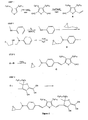
- Figure 1 is a reaction scheme for the preparation of a mono-epoxy functional EO chromophore.
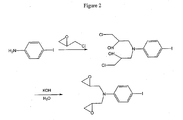
- Figure 2 is a reaction scheme illustrating the change in the reaction path of Figure 1 necessary to prepare a diepoxy-functional EO chromophore.
- Figure 3 is a schematic illustrating the overall reaction between an EO chromophore and a representative polymer host used to prepare a crosslinked EO polymer.
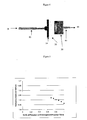
- Figure 4 is a schematic of the experimental set-up of the laser damage test used for an EO polymer film.
- Figure 5 is a graph showing the changes in the refractive indices of EO polymer films as a function of the volume percent of polymer in the EO polymer film.
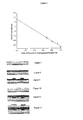
- Figure 6 is a graph showing the optical loss in a slab waveguide as a function of the volume percent of polymer in the EO polymer film.
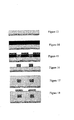
- Figures 7-12 are side views of the steps of a process for fabricating photocurable EO polymer ridge waveguides.
- Figures 13-18 are side views of the steps of a process for fabricating EO polymer channel waveguides.
- electron donating group refers to substituents which contribute electron density to a conjugated ⁇ electron system when the conjugated ⁇ electron system is polarized.
- electrospray withdrawing group refers to substituents which attract electron density from a conjugated ⁇ electron system when the conjugated ⁇ electron system is polarized.
- chromophore and "EO chromophore”, and similar terms, as used herein mean an compound comprising an electron donating group and an electron withdrawing group at opposing ends of a conjugated ⁇ electron system.
- EO polymer as used herein means a composition comprising a reaction product of an electro-optical chromophore of the invention and a host polymer.
- polymerizable cyclic ethers and “polymerizable cyclic thioethers” means carbon-oxygen and carbon-sulfur ring systems that are capable of undergoing ring-opening polymerization reactions.
- exemplary of these polymerizable cyclic ethers and “polymerizable cyclic thioethers are epoxy, episulfide, oxetane and thietane moieties whose structures are as follows:
- the present invention is directed to the synthesis of EO polymers containing high ⁇ chromophores that can be used in the cationic polymerization and ring opening polymerization reactions.
- high ⁇ chromophores having represented by the following structure I wherein D is an electron donor and preferably an electron donor having one or a plurality of terminally pendent, polymerizable cyclic ether or cyclic thioether groups; B is or contains at least one bivalent aromatic ring; R 2 and R 3 are each, independently, either H or a substituted or unsubstituted C 1 -C 10 alkyl, a substituted or unsubstituted C 2 -C 10 alkenyl, a substituted or unsubstituted aryl, a substituted or unsubstituted alkylaryl, a substituted or unsubstituted carbocycle, a substituted or unsubstituted heterocycle, or a substituted or unsubstituted
- the high ⁇ chromophores of the invention are represented by the following Structure II. wherein
- the chromophores of the invention which contain polymerizable epoxy, episulfide, oxetane and thietane groups can be reacted with any host polymer or oligomer containing groups that are reactive with such groups.
- host polymers and oligomers are those with pendent epoxy, episulfide, oxetane and thietane groups, hydroxyl groups, amine groups, and other groups known in the art which are reactive with the chromophore's polymerizable cyclic ether and cyclic thioether groups (for example, chromophore epoxy, episulfide, oxetane and thietane groups).
- the "backbone”, "frame” or “main chain” of the host polymers or oligomers containing the groups reactive with the chromophore's reactive groups can be of almost any type and include, generally, polyacrylates, polymethacrylates, polyethers and polythioethers, polysulfones, polyesters, maleimide-acrylate or methacrylate copolymers, vinyl carboxylates, vinyl acetate or chloride, ethylene, propylene, stryrene, and similar polymers, copolymers and oligomers known in the art.
- Preferred materials have high T g and low optical loss at telecommunication wavelengths.
- the chromophore-reactive groups pendent from the host polymer or oligomer may be directly attached to the backbone or may be attached by means of any suitable linking group known in the art. Further, in preferred embodiments part or all of the hydrogen atoms present in the host polymers may be replaced by fluorine or by fluorinated or highly fluorinated alkyl groups.
- the reaction between the reactive groups of the chromophore and the host polymer maybe carried out thermally or carried out by the use of initiators that are either thermally or photolytically activated to initiate polymerization.
- the initiators are cationic initiators and in particular photoactivated cationic initiators.
- Actinic radiation generally may be used.
- preferred photoinitiators include triarylsulfonium, tetraalkylphosphonium and diaryliodinium salts of large protected anions such as hexafluorophosphates or antimonates. These compounds are stable at room temperature, readily soluble in chromophore/host polymer mixtures, and are insensitive to room lighting.
- novel high ⁇ chromophores that contain cationic-initiator-reactive epoxide functional groups were prepared according to the schemes shown in Figures 1 and 2. These chromophores can undergo ring opening polymerization in the presence of a cationic photoinitiator and UV radiation.
- the novel chromophores and additional analogs described herein, either separately or in combination, can be reacted with selected polymeric or oligomeric materials, and/or additionally one or a plurality of selected monomers, in the presence of a cationic photoinitiator and UV radiation to form a highly crosslinked polymeric material suitable for use as an optical elements and devices; for example, optical waveguides.
- the chromophores and resulting polymeric materials made with the chromophores can be used in electro-optic modulators.
- Example 1 Preparation of an EO Chromophore With One Polymerizable Group.
- Step 1 a 3,4-dialkylthiophene was treated with two equivalents of butyllithium and dimethylformamide, followed by hydrolysis, to form a 3,4-dialkylthiophene-1,4-dialdehyde.
- Step 1 while the alkyl groups (R 1 and R 1a as shown in Structure II) are shown as being hexyl (C 6 H 13 ), other alkyl groups in the C 1 -C 10 range can also be used.
- Step 2 N -methylaniline was reacted with iodine in the presence of sodium bicarbonate to form 4-iodo- N -methyaniline. This product was subsequently reacted with epichlorohydrin to form 4-iodo- N -methyl- N -(3-chloro-2-hydroxypropyl)aniline. The resulting chlorohydrin moiety was then dehydrohalogenated to form the corresponding epoxide (Compound B).
- Step 3 compounds A and B were coupled using a palladium chloride catalyst to form Product C.
- Step 4 Product C was reacted with a furan derivative, herein called 1-(dicyanomethylene)-2-cyano-4-(4-cyclohexylphenyl)furan, to yield the monoepoxy functional EO chromophore having the following Structure III.
- Example 2 Preparation of an EO Chromophore With Two Polymerizable Groups.
- Step 2 of Figure 1 was modified as shown in Figure 2 in that 4-iodoaniline was used in place of 4-iodo- N -methylaniline.
- the 4-iodoaniline was reacted with two moles of epichlorohydrin to form 4-iodo- N , N -bis(3-chloro-2-hydroxychloropropyl)aniline, which was subsequently treated with KOH to yield the diepoxy species represented by the following Structure IV.
- Additional chromophores can be formed in which one or both of the epoxy groups illustrated above have been replaced by the corresponding episulfide group (O replaced by S), oxetane and thietane groups.
- the nitrogen atom of Structure IV can be replaced by a sulfur atom that will have a single pendent group.
- mixtures of the various groups comprising R 4 and R 5 can be present in a single chromophore species.
- the preferred C 1 -C 3 alkyl group is methyl (-CH 3 ).
- the aniline or N-methylaniline moiety illustrated in Structures III and IV can be replaced by a thiophenol moiety, for example, HS-C 6 H 4 -.
- thiophenol moiety for example, HS-C 6 H 4 -.
- These reactions are carried out using 4-iodothiophenol in a manner described above using 4-iodo- N -methyl aniline or 4-iodoanaline.
- the resulting product will contain a single epoxy, or other moiety as described herein, attached to the sulfur atom.
- the epoxy moiety as illustrated, can be replaced by the corresponding oxetane moiety.
- the substitution is accomplished by using 2-chlorooxetane in place of epichlorohydrin.
- epoxy and oxetane moieties described above can be replaced by similar moieties wherein the oxygen atom is replaced by a sulfur atom (e.g. episulfide and thietane moieties attached to A).
- a maleimide copolymer as an illustrative host polymer for use with one of the EO chromophores according to the invention, was prepared by reaction of 52.90 g (0.2 mol) N -pentafluorophenylmaleimide, 22.88 g (0.08 mol) 1 H , 1 H , 5 H -octafluoropentylacrylate (VISCOATTM 8F, Osaka Organic Chemical Ind.
- maleimide copolymer host was found to be particularly advantageous, other types of polymers and copolymers, including other maleimide copolymers, and their oligomeric "precursors', can also be used.
- examples include polymers, copolymers and oligomers based on acrylate, methacrylate, polyesters, polyimides, cellulose acetate, vinyl acetate, polysulfones, and urethane materials known in the art, and included such compounds wherein one or a plurality of the hydrogen atoms of the carbon skeleton have been replaced by fluorine atoms and/or fluorinated or highly fluorinated alkyl groups.
- the host polymers may be directly reactive with the reactive groups pendent on the chromophore or they may have pendent groups reactive with the chromophore's reactive groups.
- Photocurable compositions of the invention generally comprise: an EO chromophore as represented Structure I wherein D, B, R 2 and R 3 are as described elsewhere herein, a polymer, copolymer or oligomer (e.g., acrylates, methacrylates, polyethers, polysulfones, polyesters, maleimide-acrylate or methacrylate copolymers, vinyl carboxylates, vinyl acetate or chloride, and other such substances as described elsewhere herein) containing the groups reactive with the chromophore's reactive groups, and optionally, a photoinitiator.
- a polymer, copolymer or oligomer e.g., acrylates, methacrylates, polyethers, polysulfones, polyesters, maleimide-acrylate or methacrylate copolymers, vinyl carboxylates, vinyl acetate or chloride, and other such substances as described elsewhere herein
- photocurable compositions of the invention generally comprise: EO chromophores as represented by Structure II wherein D, Z, R 1 , R 1a , R 2 R 3 and q are as described elsewhere herein, a host polymer, copolymer or oligomer (e.g., acrylates, methacrylates, polyethers, polysulfones, polyesters, maleimide-acrylate or methacrylate copolymers, vinyl carboxylates, vinyl acetate or chloride, and other such substances as described elsewhere herein) either directly reactive with the chromophore's reactive groups or containing the groups reactive with the chromophore's reactive groups, and optionally, a photoinitiator, with the preferred photoinitiator being a cationic initiator.
- a host polymer, copolymer or oligomer e.g., acrylates, methacrylates, polyethers, polysulfones, polyesters, maleimide-acrylate or meth
- photocurable compositions of the invention generally comprise: EO chromophores as represented by Structure IV , wherein R 4 and A are as described elsewhere herein, and the composition can include mixtures of chromophores with combinations of R 4 and A, and further, where S in structure VI can be replaced by O; and a copolymer of a (i) maleimide first monomer and (ii) one or a plurality of second monomers selected from the group consisting of acrylate and methacrylate monomers with cationic curable groups such as epoxide, episulfide, oxetane, and thietane groups; and a polymerization initiator.
- EO chromophores as represented by Structure IV , wherein R 4 and A are as described elsewhere herein, and the composition can include mixtures of chromophores with combinations of R 4 and A, and further, where S in structure VI can be replaced by O
- the maleimide monomer contains an N-pendent moiety selected from the group consisting of fluorinated or highly fluorinated C 1 -C 6 alkyl, phenyl and biphenyl groups, highly fluorinated groups being preferred.
- the reaction between the chromophore and the host polymer, oligomer or mixture of host polymers or oligomers can be carried out by the use of initiators that are either thermally or photolytically activated to initiate polymerization.
- the initiators are cationic initiators that are photolytically activated. Examples of such preferred photoinitiators include triarylsulfonium, tetraalkylphosphonium and diaryliodinium salts of large protected anions such as hexafluorophosphates or antimonates.
- the EO polymer host combination can be thermally cured without the use of thermal curing initiators.
- An EO polymer solution was prepared by dissolving one or a mixture of the chromophores and the maleimide copolymer in cyclohexanone to which 1-3 weight percent (wt.%) of photoinitiator was added.
- a chromophore mixture can comprise epoxy, episulfide, oxetane or thietane-containing chromophores.
- the resulting EO polymer solution was filtered through a 0.2 ⁇ m syringe filter and spin-coated onto a substrate surface.
- the composition comprises 1-40 volume percent chromophore and 99-60 volume percent copolymer. Higher concentrations of chromophore can also be used.
- Absorbance spectroscopy of the EO polymer film was performed using a Perkin-Elmer 9000 UV-NIT spectrometer. The film thickness and refractive index were measured using a Metricon 2010 Prism Coupler. FTIR spectra were recorded using a Mattson Satellite FTIR spectrometer at 4 cm -1 resolution.
- the optical loss of the EO polymer film was measured from a slab waveguide using the prism-coupling method such as that described by R.E. Ulrich and R. Torge, "Measurement of Thin Film Parameters With a Prism Coupler", Applied Optics 12 , 2901 (1973).
- the waveguide fabrication process is described below and is illustrated in Figs. 7 to 18.
- Chromophore stability to laser radiation was measured as described below using the apparatus of Figure 4.
- the EO polymer films prepared herein were found to have very smooth surfaces with a minimum of roughness. No phase separation was observed in EO polymer blends containing 25 wt.% of the EO chromophore.
- the refractive index of EO polymer films containing different concentrations of the EO chromophore is shown in Figure 5.
- Pure maleimide copolymer prepared as described above (no EO chromophore) was found to have a refractive index of 1.46 at 1550 nm. This refractive index is very close to that of silica (1.46 at 1550 nm, declining to 1.44 at 1810 nm). This nearly perfect refractive index match offers lower coupling loss after waveguide fabrication.
- the refractive index of the pure EO chromophore is estimated at 1.64 ⁇ 0.01 at 1550 nm.
- the refractive indices of the polymers increase linearly with the volume concentration of the chromophore as shown in Figure 5.
- the optical losses for slab waveguides having differing concentrations of EO chromophore are shown in Figure 6.
- a pure maleimide copolymer (no EO chromophore) film has an optical loss of 0.5 dB/cm at 1550 nm as shown at the lower right hand comer of the Figure 6 plot.
- a typical polymer modulator needs a dopant level of approximately 20 vol. % chromophore to operate effectively.
- the data in Figure 6 suggests that the resulting slab waveguide will have an optical loss of 0.8 dB/cm, which is lower than that of most other reported host polymer materials.
- the stability of the EO chromophore to near infrared radiation is important.
- Near IR lasers e.g., a 1550 nm CW laser, are used in optical communication systems. Consequently, it is important that the EO chromophore is not degraded by long term exposure to 1550 nm IR radiation.
- the laser stability of the EO polymer thin film was measured as follows using the set-up shown in Figure 4.
- a small amount of the EO polymer 14 was placed on the end of a single mode optical fiber 12 which is coupled to a continuous wave laser 16 (not illustrated; a tunable erbium laser obtainable from IRE-Polus Group).
- the fiber with polymer attached was contacted with a quartz substrate 20, which was in the vertical position, and the polymer was photo-cured to thus connect the fiber, polymer and substrate.
- a photodetector 30 with optical fiber 40 attached thereto was positioned opposite the quartz substrate so that laser light passing through the quartz substrate would be detected by the detector and transmitted through fiber 40 to a suitable measuring device.
- the use of a low optical loss host polymer for example, the maleimide copolymer used in the present invention, not only reduced total insertion loss in optical devices (i.e., low propagation losses and low coupling losses), but is also believed to improve the thermal stability due to a reduction in thermo-optic effects from absorption of the NIR laser radiation.
- waveguides were fabricated according to the process illustrated in Figures 7-12 and Figures 13-18. Other elements and/or devices can be fabricated in similar fashion.
- an optical or electro-optic structure can be fabricated from a composition containing a ⁇ chromophore high as described herein as follows.
- a substrate or support can, optionally, be coated using methods known in the art with a first cladding material having a refractive index lower than that of the cured chromophore-containing composition containing the chromophore.
- the support is made of a material having a refractive index lower than that of the chromophore containing composition, this step may be eliminated.
- the support may be made of a polymeic material or have already applied thereto in an independent process a polymeric material having a refractive index lower than that of the chromophore containing composition.
- the steps of the method generally proceed as follows: applying to the above substrate a polymerizable composition containing a chromophore having at least one terminal cationically polymerizable group to form a a photopolymerizable composition layer, said composition including at least one cationic photoinitiator; imagewise exposing the photopolymerizable composition layer to sufficient actinic radiation to effect the at least partial polymerization of an imaged portion and to form at least one non-imaged portion of said composition layer; removing said at least one non-imaged portion without removing said imaged portion, thereby forming a light transmissive pattern or core from said imaged portion; applying a second cladding polymerizable composition onto the core layer; and at least partially curing said second cladding composition, wherein said cladding and the core-interfacing surface of said support have a lower refractive index than said pattern layer.
- the first and second cladding layers may be made of any polymerizable composition compatable with the composition of the chromophore-containing core compositon.
- cladding materials include polyacrylates, polymethacrylates, polyethers and polythioethers, polysulfones, polyesters, maleimide-acrylate or methacrylate copolymers, vinyl carboxylates, vinyl acetate or chloride, ethylene, propylene,. stryrene, urethanesand similar polymers, copolymer and oligomers known in the art, including partially or highly halogenated derivatives thereof, which have a refractive index lower than that of the cured chromopkore-containing composition.
- Figures 7-12 Fabricating a Ridge Waveguide. The following steps correspond to Figures 7-12.
- a cladding was spin coated with a first polymeric cladding layer material having an refractive index less than the refractive index of the optical waveguide material that will be subsequently applied.
- the material was exposed to actinic radiation, typically UV radiation, of an intensity and for a time as is typically used in the art, and then baked at selected temperature in the range of 150-200 °C for a selected time in the range of 10-60 minutes to produce a substrate having a first bottom cladding layer adhered thereto.
- actinic radiation typically UV radiation
- a second cladding layer material having an refractive index less than that of the optical waveguide material was then spin coated on the first cladding material and prebaked at a selected temperature in the range of 60-120 °C for a selected time in the range of 3-15 minutes.
- a positive photomask was placed over the second cladding material and actinic radiation was applied as above followed by a baking as described in (a) to produce a cured ridge waveguide trench form.
- a waveguide trench was developed by washing away uncured polymer with a solvent in which the polymer is soluble (E.g., methyl ethyl ketone (MEK)).
- MEK methyl ethyl ketone
- the EO polymer was then spin coated over the developed wafer of Step (d) to form a ridge waveguide, which was then cured using actinic radiation (e.g., UV radiation) followed by baking,under nitrogen, at a temperature in the range of 110 to 170 °C for a time in the range of 5 to 40 minutes. Preferred temperature and times are in the range of 130 to 160 °C and 10 to 20 minutes. If no photoinitiator was used in the EO polymer mixture, the curing was done in a vacuum over at a selected temperature the range of 160 to 180 °C for a selected time in the range of 5 to 40 minutes.
- actinic radiation e.g., UV radiation
- a top overcladding material was then spin coated on the wafer of Step (e), and cured as described above to produce an overclad layer.
- One or a plurality of electrodes were then placed on the overcladding and above the ridge waveguide by methods known in the art.
- Figures 13-18 Fabricating a Channel Waveguide. The following steps correspond to Figures 13-18.
- a cladding was spin coated with a first polymeric cladding layer material having an refractive index less than the refractive index of the optical waveguide material that will be subsequently applied.
- the material was exposed to actinic radiation, typically UV radiation, of an intensity and for a time as is typically used in the art, and then baked at selected temperature in the range of 150-200 °C for a selected time in the range of 10-60 minutes to produce a substrate having a first bottom cladding layer adhered thereto.
- actinic radiation typically UV radiation
- Preferred temperatures and times are in the range of approximately 160-170 °C and approximately 10-20 minutes, respectively.
- the EO polymer was then spin coated on the cladding layer of and prebaked in an inert atmosphere, usually nitrogen, at a selected temperature in the range of 110 to 170 °C for a selected time in the range of 5 to 40 minutes. Preferred temperature and times are in the range of 130 to 160 °C and 10 to 20 minutes.
- a photomask was placed over prebaked EO polymer material and actinic radiation was applied as above followed by a post-baking in an inert atmosphere, usually nitrogen at a selected temperature in the range of 110 to 170 °C for a selected time in the range of 5 to 40 minutes to produce a cured channel waveguide.
- Preferred temperature and times are in the range of 130 to 160 °C and 10 to 20 minutes.
- a channel waveguide was developed by washing away uncured polymer with a solvent in which the polymer is soluble; for example, methyl ethyl ketone (MEK).
- MEK methyl ethyl ketone
- a top overcladding material was spin coated on the wafer of Step (e), and cured by the use of actinic radiation and post-baking as described above to produce a channel waveguide.
- One or a plurality of electrodes were then placed on the overcladding and above the channel waveguide by methods known in the art.
- the electrical poling process was tested using a contact poling method with an approximately 4 ⁇ m EO polymer film coated on an ITO coated quartz slide. At a poling voltage of 135 V and a poling temperature of 130 °C, a r 33 value of approximately 18 pm/V was observed. The color of the sample changes slightly, but the chromophore did not break out, separate, migrate, leak or otherwise disassociate itself from the host polymer matrix. Consequently, it was determined that the poling process can tolerate a small amount of cationic photoinitiator in the curing system.
Landscapes
- Physics & Mathematics (AREA)
- Nonlinear Science (AREA)
- General Physics & Mathematics (AREA)
- Optics & Photonics (AREA)
- Polyethers (AREA)
- Addition Polymer Or Copolymer, Post-Treatments, Or Chemical Modifications (AREA)
- Epoxy Resins (AREA)
- Compositions Of Macromolecular Compounds (AREA)
Applications Claiming Priority (2)
| Application Number | Priority Date | Filing Date | Title |
|---|---|---|---|
| US136869 | 2002-04-30 | ||
| US10/136,869 US20030201429A1 (en) | 2002-04-30 | 2002-04-30 | Low loss electro-optic polymers and devices made therefrom |
Publications (1)
| Publication Number | Publication Date |
|---|---|
| EP1359461A2 true EP1359461A2 (fr) | 2003-11-05 |
Family
ID=29215683
Family Applications (1)
| Application Number | Title | Priority Date | Filing Date |
|---|---|---|---|
| EP03076245A Withdrawn EP1359461A2 (fr) | 2002-04-30 | 2003-04-29 | Polymères électro-optiques à faible perte et dispositifs les incluant |
Country Status (3)
| Country | Link |
|---|---|
| US (1) | US20030201429A1 (fr) |
| EP (1) | EP1359461A2 (fr) |
| CN (1) | CN1461750A (fr) |
Cited By (2)
| Publication number | Priority date | Publication date | Assignee | Title |
|---|---|---|---|---|
| WO2008017318A1 (fr) * | 2006-08-08 | 2008-02-14 | Pirelli & C. S.P.A. | Dispositif optique et matériau polymère à propriétés optiques non linéaires |
| EP3613810A1 (fr) * | 2018-08-07 | 2020-02-26 | General Dynamics Mission Systems, Inc. | Articles et compositions comprenant des polymères et chromophores hôtes et leurs procédés de production |
Families Citing this family (7)
| Publication number | Priority date | Publication date | Assignee | Title |
|---|---|---|---|---|
| US7625515B2 (en) * | 2006-06-19 | 2009-12-01 | Iowa State University Research Foundation, Inc. | Fabrication of layer-by-layer photonic crystals using two polymer microtransfer molding |
| US9400219B2 (en) * | 2009-05-19 | 2016-07-26 | Iowa State University Research Foundation, Inc. | Metallic layer-by-layer photonic crystals for linearly-polarized thermal emission and thermophotovoltaic device including same |
| US8742406B1 (en) | 2011-02-16 | 2014-06-03 | Iowa State University Research Foundation, Inc. | Soft lithography microlens fabrication and array for enhanced light extraction from organic light emitting diodes (OLEDs) |
| US9593170B2 (en) | 2013-05-09 | 2017-03-14 | Canon Kabushiki Kaisha | Compound, photocurable composition, and methods for producing patterned film, optical component, circuit board, electronic component by using the photocurable composition, and cured product |
| JP6179690B1 (ja) * | 2015-12-10 | 2017-08-16 | 三菱瓦斯化学株式会社 | 光硬化性組成物及び光学材料 |
| KR102118365B1 (ko) | 2017-04-21 | 2020-06-04 | 주식회사 엘지화학 | 유기전자소자 봉지용 조성물 |
| CN115960093A (zh) * | 2021-10-09 | 2023-04-14 | 香港城市大学深圳研究院 | 一种光学发色团化合物及含其的复合材料、薄膜和光电集成器件 |
Family Cites Families (2)
| Publication number | Priority date | Publication date | Assignee | Title |
|---|---|---|---|---|
| US6584266B1 (en) * | 2000-06-16 | 2003-06-24 | Corning Incorporated | Chromophores for polymeric thin films and optical waveguides and devices comprising the same |
| US6978069B1 (en) * | 2002-03-13 | 2005-12-20 | Lockheed Martin Corporation | Polymer guest-host systems and polymer electro-optic waveguide systems |
-
2002
- 2002-04-30 US US10/136,869 patent/US20030201429A1/en not_active Abandoned
-
2003
- 2003-04-29 EP EP03076245A patent/EP1359461A2/fr not_active Withdrawn
- 2003-04-30 CN CN03130777A patent/CN1461750A/zh active Pending
Cited By (2)
| Publication number | Priority date | Publication date | Assignee | Title |
|---|---|---|---|---|
| WO2008017318A1 (fr) * | 2006-08-08 | 2008-02-14 | Pirelli & C. S.P.A. | Dispositif optique et matériau polymère à propriétés optiques non linéaires |
| EP3613810A1 (fr) * | 2018-08-07 | 2020-02-26 | General Dynamics Mission Systems, Inc. | Articles et compositions comprenant des polymères et chromophores hôtes et leurs procédés de production |
Also Published As
| Publication number | Publication date |
|---|---|
| US20030201429A1 (en) | 2003-10-30 |
| CN1461750A (zh) | 2003-12-17 |
Similar Documents
| Publication | Publication Date | Title |
|---|---|---|
| US6194120B1 (en) | Organic photochromic compositions and method for fabrication of polymer waveguides | |
| US5541039A (en) | Method for forming optically active waveguides | |
| WO1991009842A1 (fr) | Materiaux electro-optiques et modulateurs de lumiere contenant ces derniers | |
| Xu et al. | Molecular engineering of structurally diverse dendrimers with large electro-optic activities | |
| US5186865A (en) | Electro-optical materials and light modulator devices containing same | |
| JP2012123425A (ja) | 電気光学用途用の最新nlo物質の設計および合成 | |
| Murase et al. | Photo-optical control with large refractive index changes by photodimerization of poly (vinyl cinnamate) film | |
| KR20020027361A (ko) | 방사선 경화성 플루오르화 조성물로부터 제조된 광디바이스 | |
| Hoshino et al. | Refractive index change in photochromic diarylethene derivatives and its application to optical switching devices | |
| EP1359461A2 (fr) | Polymères électro-optiques à faible perte et dispositifs les incluant | |
| KR20190002452A (ko) | 지환기 도입 비선형 광학 활성 코폴리머 | |
| CA3239316A1 (fr) | Materiaux optiques non lineaires contenant des solvants a point d'ebullition eleve, et procedes de polarisation efficace de ceux-ci | |
| Ding et al. | Directly written photo-crosslinked fluorinated polycarbonate photoresist materials for second-order nonlinear optical (NLO) applications | |
| US7601849B1 (en) | Nonlinear optical compounds and related macrostructures | |
| US5872882A (en) | Non-linear optical polycarbonates | |
| Aljoumaa et al. | Synthesis and characterizations of highly fluorinated poly (arylene ether) s for quadratic nonlinear optics | |
| CN115677678B (zh) | 推拉型双(二烷氧基噻吩基)乙烯生色团化合物及含其的复合材料、薄膜和光电集成器件 | |
| JP2005227376A (ja) | 有機非線形光学材料及びそれを用いた非線形光学素子 | |
| EP0464795B1 (fr) | Matériau et dispositif pour optique non linéaire | |
| EP0313477A2 (fr) | Article d'optique contenant un polymère linéaire ayant un degré élevé de susceptibilité de polarisation de second ordre | |
| JPH0539480A (ja) | フオトリフラクテイブ組成物 | |
| JP2813925B2 (ja) | 有機光非線形材料および非線形素子 | |
| CN106406029A (zh) | 一种负性含氟聚碳酸酯光刻胶组合物及用于制备光学开关 | |
| Ding et al. | Fluorinated polycarbonate photoresists with adjustable double bond density for electro-optic switch applications by directly written method | |
| Zhang et al. | Synthesis of new second-order nonlinear optical chromophores: implementing lessons learned from theory and experiment |
Legal Events
| Date | Code | Title | Description |
|---|---|---|---|
| PUAI | Public reference made under article 153(3) epc to a published international application that has entered the european phase |
Free format text: ORIGINAL CODE: 0009012 |
|
| AK | Designated contracting states |
Kind code of ref document: A2 Designated state(s): AT BE BG CH CY CZ DE DK EE ES FI FR GB GR HU IE IT LI LU MC NL PT RO SE SI SK TR |
|
| AX | Request for extension of the european patent |
Extension state: AL LT LV MK |
|
| STAA | Information on the status of an ep patent application or granted ep patent |
Free format text: STATUS: THE APPLICATION IS DEEMED TO BE WITHDRAWN |
|
| 18D | Application deemed to be withdrawn |
Effective date: 20071101 |