EP1359809B1 - Procede et usine de production de produits laitiers ou de produits a base de lactoserum a teneur reduite en spores et en bacteries - Google Patents
Procede et usine de production de produits laitiers ou de produits a base de lactoserum a teneur reduite en spores et en bacteries Download PDFInfo
- Publication number
- EP1359809B1 EP1359809B1 EP01903619A EP01903619A EP1359809B1 EP 1359809 B1 EP1359809 B1 EP 1359809B1 EP 01903619 A EP01903619 A EP 01903619A EP 01903619 A EP01903619 A EP 01903619A EP 1359809 B1 EP1359809 B1 EP 1359809B1
- Authority
- EP
- European Patent Office
- Prior art keywords
- microfiltration
- permeate
- conduit
- milk
- fraction
- Prior art date
- Legal status (The legal status is an assumption and is not a legal conclusion. Google has not performed a legal analysis and makes no representation as to the accuracy of the status listed.)
- Revoked
Links
Images

Classifications
-
- A—HUMAN NECESSITIES
- A23—FOODS OR FOODSTUFFS; TREATMENT THEREOF, NOT COVERED BY OTHER CLASSES
- A23C—DAIRY PRODUCTS, e.g. MILK, BUTTER OR CHEESE; MILK OR CHEESE SUBSTITUTES; PREPARATION THEREOF
- A23C9/00—Milk preparations; Milk powder or milk powder preparations
- A23C9/14—Milk preparations; Milk powder or milk powder preparations in which the chemical composition of the milk is modified by non-chemical treatment
- A23C9/142—Milk preparations; Milk powder or milk powder preparations in which the chemical composition of the milk is modified by non-chemical treatment by dialysis, reverse osmosis or ultrafiltration
- A23C9/1422—Milk preparations; Milk powder or milk powder preparations in which the chemical composition of the milk is modified by non-chemical treatment by dialysis, reverse osmosis or ultrafiltration by ultrafiltration, microfiltration or diafiltration of milk, e.g. for separating protein and lactose; Treatment of the UF permeate
-
- A—HUMAN NECESSITIES
- A23—FOODS OR FOODSTUFFS; TREATMENT THEREOF, NOT COVERED BY OTHER CLASSES
- A23C—DAIRY PRODUCTS, e.g. MILK, BUTTER OR CHEESE; MILK OR CHEESE SUBSTITUTES; PREPARATION THEREOF
- A23C2210/00—Physical treatment of dairy products
- A23C2210/20—Treatment using membranes, including sterile filtration
- A23C2210/208—Removal of bacteria by membrane filtration; Sterile filtration of milk products
-
- A—HUMAN NECESSITIES
- A23—FOODS OR FOODSTUFFS; TREATMENT THEREOF, NOT COVERED BY OTHER CLASSES
- A23C—DAIRY PRODUCTS, e.g. MILK, BUTTER OR CHEESE; MILK OR CHEESE SUBSTITUTES; PREPARATION THEREOF
- A23C2210/00—Physical treatment of dairy products
- A23C2210/25—Separating and blending
- A23C2210/252—Separating a milk product in at least two fractions followed by treatment of at least one of the fractions and remixing at least part of the two fractions
Definitions
- the invention relates to a process for the manufacture of a milk product having a reduced spores and bacteria content, especially a process for treating milk to produce standardized milk for consumption or cheese making, or skim milk powder or whole milk powder as well as a plant for carrying out the process, and also a process for the manufacture of whey or pre-concentrated whey having a reduced spores and bacteria content, and to a plant for performing the process
- the starting material viz. the milk
- the milk is conventionally separated into a cream fraction and a skim milk fraction before the subsequent processing.
- the cream fraction which has a high content of spores and bacteria (microorganisms) is subjected to a heat treatment suitable to obtain a maximum killing of these microorganisms (sterilization).
- the skim milk fraction which also contains spores and bacteria (microorganisms) and fat is subjected to a microfiltration resulting in a separation into a retentate carrying an increased content of microorganisms and fat and a permeate consisting of skim milk having reduced microorganism and fat content.
- the sterilized cream fraction and the permeate consisting of skim milk of reduced microorganism and fat content is brought together and mixed in a defined ratio to produce the desired milk products.
- the possibility of omitting a heat treatment or at least to use only a lenient heat treatment of the permeate due to the low content therein of the microorganisms influencing the shelf-life of the milk product (bacteria, yeasts, moulds, virus, and bacteriophages) is advantageous in connection with the production of standardized milk for human consumption.
- the desired organoleptic and nutritional characteristics of the milk are maintained at least in this component of the mixture.
- a process of this type is known from EP 0 194 286 B1 or US 4 876 100 .
- this process is restricted as far as the recovering of the cream fraction and the skim milk fraction is concerned to the use of a preliminary centrifugal separation of the milk in spatial vicinity to the subsequent treatment.
- the microfiltration of the skim milk is especially important.
- the skim milk is during the microfiltration recycled in a loop including a microfilter arranged so that the skim milk flows parallel to the surface of the filter membrane (crossflow filtration).
- the microfilter is provided with pipes and connected in a conventional manner, i.e.
- the microfiltration unit consisting of the microfilter and the pipe connections belonging thereto is supplied with the skim milk to be filtered through a feed conduit, and the permeate passing through the microfiltration membrane as well as the concentrate (the retentate) which builds up in the flow loop is recovered from the microfiltration unit through conduits connected thereto. Subsequently, the retentate is sterilized.
- a recycling loop is connected to the permeate exit from the microfilter and a pump is used for recycling permeate from the microfilter to the inlet of the circulation loop. It is not described in which ratio any permeate is recycled to the circulation loop of the one-step microfiltration unit, and for which purpose such a recycling is performed and which result is obtained thereby.
- a further process of the type in question is known from EP 0 697 816 B1 .
- the cream fraction and the skim milk fraction are recovered by a centrifugal separation of the milk in spatial vicinity to the subsequent treatment.
- the concentrate containing spores and bacteria (microorganisms) which leaves the microfiltration unit as retentate is recycled to the centrifugation and mixed with the milk fed to the centrifugal separator.
- EP 0 697 816 B1 can only be used when the cream and skim milk fractions are recovered from a milk centrifugal separator connected prior to the plant for their further treatment and spatially near said plant. Thus, it cannot be used when for instance the two fractions are provided from feed vessels connected upstream of the equipment for further treatment spatially near thereto.
- WO 91/09667 discloses a process for performing tangential microfiltration, reverse osmosis or ultrafiltration using a two-stage plant. No information is given on the envisaged field of application. In this process, a retentate formed in a first step is used as feed for a second step. It is not specified how the permeates from the two steps are used or handled. A process of this type, and in which the two permeates are pooled, is depicted in Fig. 3 on the drawing attached hereto.
- An object of the present invention is to provide a process of the type dealt with by which it is possible to produce the desired milk product via a skim milk having a reduced content of microorganisms (germs and bacteria) compared to the microoganism content in prior art processes. Moreover, the invention makes it possible to produce whey or pre-concentrated whey having a reduced spores and bacteria content by using characteristic features thereof.
- the object of the invention is achieved by a process having the characteristics defined in claim 1.
- Preferred embodiments of the proposed process are subject of the sub-claims.
- a plant for performing the proposed process is characterized by the features of claim 6.
- Advantageous embodiments of the proposed plant are subject of the sub-claims dependent on claim 6.
- Independent claim 18 characterizes a process for producing whey or pre-concentrated whey having a reduced spores and bacteria content
- claim 19 deals with an advantageous embodiment of this process.
- a plant for performing this process is characterized by the features of claim 20, and claim 21 characterizes preferred embodiments of the plant.
- the process is carried out using a two-steps microfiltration.
- a first permeate formed in the first step of the microfiltration which permeate consists of the skim milk having a reduced content of microorganisms and fat, is mixed with the sterilized cream fraction.
- the second step of the microfiltration is fed with a retentate from the first step, and a second permeate formed in the second step is completely or partially recycled to the skim milk fraction at the inlet into the first step.
- a further advantage of the process of the invention is that the reduced content of microorganisms in the permeate which has an essential influence on the shelf-life of the milk product, can be obtained without extra investments in the equipment.
- the content of microorganisms in the permeate can be influenced within some limits when a part of the second permeate is added directly to the first permeate.
- the proposed process is generally applicable under operational conditions in which the cream and skim milk fractions are recovered from a centrifugal separation of the milk performed spatially near the further treatment.
- these two fractions can be supplied to the further treatment directly from the upstream centrifugal separation, or the two fractions may also be stored following the centrifugal separation and only conducted to further treatment at a later time and/or at another location.
- a further advantage of the proposed process is that it can also be used in such operational circumstances where the two fractions are provided from a stock spatially near and upstream of their further treatment, i.e. without direct or indirect spatial relation to the centrifugal separation of the milk.
- the essential feature of the proposed plant for performing the process of the invention is a two-steps microfiltration unit.
- the two steps are performed in a manner known per se as known from the relevant prior art, as far as the construction of the microfiltration device is concerned, and is sufficiently described in the prior art (cf. e.g. cios de Ceramique Techniques (SCT), MEMBRALOX ® USERS' MANUAL).
- the two-steps microfiltration unit is connected directly to a centrifugal separator.
- a stock vessel for the relevant fractions can be inserted in the feed conduit for the cream fraction and in the feed conduit for the skim milk fraction from the centrifugal separator.
- the two fractions can, according to a further embodiment, each be taken from a stock vessel independent on the presence of a centrifugal separation unit.
- the first microfiltration section and the second microfiltration section each have at least one microfiltration module.
- Each microfiltration module has at least one microfiltration element sealed in a housing having connections for the liquid to be filtered as well as for the permeate and the retentate.
- the microfiltration element is preferably made of a porous carrier material permeable for the permeate and it has at least one duct through which the liquid to be filtered is flowing, the wall of which duct forms the carrier surface for the microfiltration membrane.
- the operational period for such microfiltration elements and the so-called flux through the microfiltration membrane of such elements is favourably influenced or increased when one or more of the features of the microfiltration element construction, such as the gradients of the thickness of the active membrane layer, the porosity of the membrane layer and/or support, when seen over the length subjected to the liquid flow compensates for the change of the pressure difference between the side for the liquid to be filtered and the permeate side, as is the case in a preferred embodiment of the invention.
- microfiltration sections of the plant according to the invention are equipped with the same or different microfiltration membranes having a pore size of 0.05-5.0 ⁇ m.
- a pore size of 0.8-1.4 ⁇ m For other applications smaller pore sizes, down to 0.05 ⁇ m can be used.
- the inventive features of the proposed process comprise a further important application, viz. the decrease of the spores and bacteria content in whey or pre-concentrated whey without subjecting these wheys to a thermal treatment.
- This is important since the constituents of the whey, such as whey proteins and lactose, are of nutritional value and should be converted as little as possible.
- structural developments in the cheese industries have resulted in the production of larger amounts of whey than can be used directly as animal feed. Due to the content of organic components, such as proteins and lactose, the disposal as waste water is not allowed.
- the spores and bacteria containing whey is subjected to a microfiltration similar to the above described treatment of the skim milk fraction obtained from the milk.
- the whey is separated in a manner known per se in a retentate having an increased content of spores and bacteria and in a permeate having a reduced content of such microorganisms.
- the microfiltration of the microorganisms containing whey is performed in two steps, whereby the first step generates a first permeate consisting of whey having a reduced content of microorganisms.
- the subsequent second step is supplied with a retentate from the first step, and a second permeate formed in the second step is recycled completely or partially to the inlet of the first step.
- the content of microorganisms in the permeate can also in this application be changed within some limits if a portion of the second permeate is recycled directly to the first permeate.
- the plant for performing the process to produce whey having a reduced content of spores and bacteria corresponds as far as the here relevant microfiltration unit is concerned, to the plant used for treatment of the skim milk fraction obtained from the milk. Also the variations of the plant described for this purpose are relevant for the plant used for whey treatment.
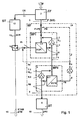
- M designates milk to be treated which is fed to a centrifugal separator 2 via a conduit 1.
- the milk M is by the centrifugal separation process step CF separated in a cream fraction CR and a skim milk fraction SM.
- the latter flows as feed F via a first feed conduit 3 to a microfiltration unit I, II comprising two steps I and II.
- the first microfiltration section I a separation takes place of the skim milk fraction SM containing microorganisms (spores and bacteria) and fat into a first retentate RI having an increased content of microorganisms and fat, and into a first permeate PI consisting of skim milk having a reduced content of microorganisms and fat.
- the first microfiltration section I has (in the depicted embodiment only one) first microfilter module I.1 into which the first feed conduit 3 debouches.
- the first retentate RI leaves the first microfilter I.1 via a first connection conduit 4 and thereby reaches (in the depicted embodiment only one) second microfilter module II.1 in the second microfiltration section II.
- a circulation loop I.2 comprising a first circulation pump I.3 connects the first connection circuit 4 with the first feed conduit 3.
- the first permeate PI formed in the first microfiltration section I is withdrawn therefrom via a permeate conduit 7 and conducted to a mixing zone 14.
- the first circulation loop I.2 the first retentate RI is circulated at a volume flow which depends on the construction of the microfiltration element, and in the present example is Q I.2 ⁇ 4,700 l/h which results in a crossflow velocity of v ⁇ 6 m/s which has a favourable influence on the operational periods and the flux rate of the microfiltration membrane.
- a second microfiltration section II is constructed similarly to the first microfiltration section. It has (in the depicted embodiment only one) second microfilter module II.1, a second circulation loop II.2 comprising a second circulation pump II.3 and it is via a retentate conduit 8 for withdrawal of the second retentate RII connected to a second sterilization unit 9.
- the second retentate II having an increased content of microorganisms and fat is subjected to a sterilization ST.
- a sterilized second retentate SRII is withdrawn from the plant for further use.
- said retentate may be introduced upstream of a first sterilization unit 12 (mentioned below) and sterilized therein together with the cream fraction.
- a second permeate PII formed in the second microfiltration section II is completely recycled from there through a first recycling conduit 5, into which a recycling pump 6 may be inserted, into the skim milk fraction SM in the first feed conduit 3 at the inlet to the first microfiltration section I.
- the recycling pump 6 can be omitted when the pressure in the permeate II is higher than the pressure in the feed F. Such advantageous relative pressures can be obtained by proper adjustment of the plant.
- the separation performance of the microfilter modules I.1 and II.1 is determined by the selection of materials to be used as microfiltration membranes and in this respect especially the pore size of the materials is important.
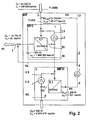
- microfiltration membranes having a pore size in the range from 0.8-1.4 ⁇ m, preferably of ceramic membrane materials, it is possible to obtain a reduction of the content of microorganisms (spores and bacteria) in the relevant permeate PI or PII by a factor of 1,000 relative to the corresponding feeds (feed F+PII or RI), cf. also Fig. 2.
- the second permeate PII formed in the second microfiltration section II is recycled to the skim milk fraction SM at the inlet of the first microfiltration section I.
- the remaining portion is led to the first permeate PI upstream of the mixing zone 14 via a second recycling conduit 5a which branches off the first recycling conduit 5 downstream of the recycling pump 6 and debouches in the permeate conduit 7.
- the cream fraction CR obtained from the centrifugal separator 2 is through a second feed conduit 11 led to a first sterilization unit 12 (process step sterilization ST) which by heating the cream fraction CR to a suitable sterilization temperature provides sterilized cream SCR.
- a second connection conduit 13 this is led from the first sterilization unit 12 to the mixing zone 14 where the sterilized cream fraction SCR and the first permeate PI are brought together in a defined ratio and mixed to produce the desired milk product, viz. standardized milk for human consumption STM or standardized milk for cheese making STKM.
- the milk for human consumption STM or the milk for cheese making STKM is via an exit conduit 15 from the mixing zone 14 led to a further treatment, for instance a pasteurization, not shown.
- the microorganisms reducing effect of the process and the plant may be increased by subjecting the second permeate P II to a separating treatment (not shown), e.g. a further microfiltration or a bacterofugation, before introducing it into the first permeate PI in conduit 7 or into the feed upstream of the first microfiltration module II 1.
- a separating treatment e.g. a further microfiltration or a bacterofugation
- the plant diagramatically shown in Fig. 1, and which forms basis for the calculations in Fig. 2, has two microfiltration steps. However, it is within the scope of the invention to use one or more further steps and recycle the permeate from each such further step, at least partially, to one or more of the steps upstream thereof relative to the retentate flow.
- volume concentration factor VCFII 10.
- the concentration of microorganisms is obtained as indicated in Fig. 2 at the relevant balance sites.
- the corresponding volume flow and concentration balance is produced for a two-steps microfiltration MF according to the prior art, as it appears from Fig. 3 and the following Table (Table 2).
- the starting material in the embodiment depicted in Fig. 1 is milk necessitating an initial separation into a cream fraction and a skim milk fraction.
- the concept of the invention is generally applicable and can be used for treating also starting materials which are not subjected to such an initial separation.
- the process does not necessarily involve a recombination of the separated fractions after treatment thereof.
Landscapes
- Engineering & Computer Science (AREA)
- Water Supply & Treatment (AREA)
- Life Sciences & Earth Sciences (AREA)
- Chemical & Material Sciences (AREA)
- Food Science & Technology (AREA)
- Polymers & Plastics (AREA)
- Dairy Products (AREA)
- Separation Using Semi-Permeable Membranes (AREA)
- Micro-Organisms Or Cultivation Processes Thereof (AREA)
Claims (23)
- Procédé pour la fabrication d'un produit laitier ayant une teneur réduite en spores et en bactéries, spécialement pour le traitement du lait (M) pour produire du lait standardisé pour la consommation humaine ou l'industrie fromagère ou du lait écrémé en poudre ou du lait entier en poudre, dans lequel• le lait (M) est amené sous la forme d'une fraction de crème (CR) et d'une fraction de lait écrémé (SM),• la fraction de crème (CR) contenant des spores et des bactéries (microorganismes) est stérilisée,• la fraction de lait écrémé (SM) contenant des spores et des bactéries (microorganismes) et des matières grasses est soumise à une microfiltration (MF) dont il résulte une séparation en un rétentat ayant une teneur accrue en microorganismes et en matières grasses et un perméat constitué de lait écrémé ayant une teneur réduite en microorganismes et en matières grasses, et• la fraction de crème stérilisée (SCR) et le perméat sont combinés dans un rapport défini et mélangés pour la préparation du produit laitier (lait standardisé pour la consommation humaine (STM) ou pour l'industrie fromagère (STKM)),caractérisé par• la microfiltration (MF) de la fraction de lait écrémé (SM) contenant des microorganismes et des matières grasses en deux étapes (I, II),• le mélange d'un premier perméat (I) formé dans la première étape (I), lequel perméat est constitué de lait écrémé ayant une teneur réduite en microorganismes et en matières grasses, avec la fraction de crème stérilisée (SCR),• l'amenée d'un rétentat (RI) de la première étape (I) à la seconde étape (II), et• le recyclage d'un second perméat (PII) généré dans la seconde étape (II), totalement ou partiellement, vers la fraction de lait écrémé (SM) au début de la première étape (I).
- Procédé selon la revendication 1, caractérisé en ce que la quantité totale dudit second perméat (II) est amenée au début de la première étape (I).
- Procédé selon la revendication 1, caractérisé en ce qu'une partie dudit second perméat (II) est amenée directement vers le premier perméat (I).
- Procédé selon la revendication 1, 2 ou 3, caractérisé en ce que la fraction de crème (CR) et la fraction de lait écrémé (SM) sont récupérées d'une séparation centrifuge amont (CF) du lait (M) proche du point de vue spatial de son traitement ultérieur.
- Procédé selon la revendication 4, caractérisé en ce que la fraction de crème (CR) et la fraction de lait écrémé (SM) sont stockées entre leur récupération par séparation centrifuge (CF) et leur traitement ultérieur.
- Procédé selon la revendication 1, 2 ou 3, caractérisé en ce que la fraction de crème (CR) et la fraction de lait écrémé (SM) sont prélevées depuis une amenée amont proche du point de vue spatial de l'emplacement pour leur traitement ultérieur.
- Procédé selon l'une quelconque des revendications précédentes, caractérisé en ce que la microfiltration dans au moins l'une des étapes (I, II) est effectuée en utilisant une vitesse d'écoulement transversal v du liquide à filtrer sur la surface du filtre dans la plage de 4 < v < 10 m/s, de préférence v ≃ 6 m/s.
- Installation pour mettre en oeuvre le procédé défini dans l'une quelconque des revendications 1 à 7, ayant• une unité de stérilisation (12) pour chauffer la fraction de crème (CR) à une température de stérilisation appropriée,• une unité de microfiltration (I, II) pour séparer la fraction de lait écrémé (SM) en un rétentat ayant une teneur accrue en microorganismes et en matières grasses et un perméat constitué de lait écrémé ayant une teneur réduite en microorganismes et en matières grasses, et• une zone de mélange (14) pour la fraction de crème stérilisée (SCR) et le perméat,caractérisée en ce que• elle a une unité de microfiltration (I, II) constituée d'une première section (I) et d'une seconde section (II),• un premier conduit d'alimentation (3) pour la fraction de lait écrémé (SM) se termine dans la première section de microfiltration (I),• la première section de microfiltration (I) est connectée à la seconde section de microfiltration (II) par un premier conduit de connexion (4) et à la zone de mélange (14) par un conduit pour perméat (7), et• la seconde section de microfiltration (II) est connectée à l'entrée de la première section de microfiltration (I) par un premier conduit de recyclage du perméat (5).
- Installation selon la revendication 8, caractérisée en ce qu'elle a un conduit pour rétentat (8) connectant la seconde section de microfiltration (II) à une unité de stérilisation choisie entre ladite unité de stérilisation (12) et une unité séparée (9).
- Installation selon la revendication 8 ou 9, caractérisée en ce qu'un second conduit de recyclage (5a) prend naissance sur ledit premier conduit de recyclage (5) et mène au conduit pour perméat (7).
- Installation selon la revendication 9 ou 10, caractérisée en ce qu'elle a un séparateur centrifuge (2) auquel ledit premier conduit d'alimentation (3) et un second conduit d'alimentation (11) pour la fraction de crème (CR) sont connectés.
- Installation selon la revendication 11, caractérisée en ce qu'un premier récipient de stockage pour la fraction de lait écrémé (SM) est inclus dans le premier conduit d'alimentation (3) et un deuxième récipient de stockage pour la fraction de crème (CR) est inséré dans le second conduit d'alimentation (11).
- Installation selon l'une quelconque des revendications 8 à 10, caractérisée en ce que le premier conduit d'alimentation (3) a son point de départ dans un troisième récipient de stockage pour la fraction de lait écrémé (SM) et le second conduit d'alimentation (11) a son point de départ dans un quatrième récipient de stockage pour la fraction de crème (CR).
- Installation selon l'une quelconque des revendications 8 à 13, caractérisée en ce que• la première section de microfiltration (I) et/ou la seconde section de microfiltration (II) comprend (comprennent) au moins un module de microfiltration,• le module de microfiltration a au moins un élément de microfiltration agencé de manière scellée dans un logement ayant des connexions pour le liquide à filtrer et pour le perméat et le rétentat,• l'élément de microfiltration a un matériau support poreux dans lequel le perméat peut pénétrer et a au moins une conduite au travers de laquelle le liquide à filtrer s'écoule, et• la paroi de la conduite forme la surface de support pour une membrane de microfiltration.
- Installation selon la revendication 14, caractérisée en ce qu'une ou plusieurs des caractéristiques de la construction de l'élément de microfiltration, telles que les gradients de l'épaisseur de la couche de la membrane active, la porosité de la couche de membrane et/ou du support, dans le cas d'une observation suivant la longueur soumise à l'écoulement de liquide, compense(nt) le changement de différence de pression entre le côté pour le liquide à filtrer et le côté du perméat.
- Installation selon l'une quelconque des revendications 8 à 15, caractérisée en ce que chacune des sections de microfiltration (I, II) comprend au moins une membrane de microfiltration ayant une taille de pore de 0,05 à 5,0 µm.
- Installation selon la revendication 16, caractérisée en ce que la taille des pores est de 0,8 à 1,4 µm.
- Installation selon l'une quelconque des revendications 8 à 17, caractérisée en ce qu'au moins la ou les membranes de microfiltration est (sont) constituée(s) d'un matériau céramique.
- Procédé pour la fabrication de lactosérum (W) ou de lactosérum préconcentré (W*) ayant une teneur réduite en spores et en bactéries, dans lequel• le lactosérum (W), (W*) contenant des spores et des bactéries (microorganismes) est soumis à une microfiltration (MF) conduisant à une séparation en un rétentat ayant une teneur accrue en microorganismes et un perméat ayant une teneur réduite en microorganismes,caractérisé par• la microfiltration (MF) du lactosérum contenant des microorganismes (W, W*) en deux étapes (I, II), en produisant ainsi dans la première étape (I) un premier perméat (PI) constitué d'un lactosérum ayant une teneur réduite en microorganismes,• l'amenée d'un rétentat (RI) de la première étape (I) à la seconde étape (II), et• le recyclage d'un second perméat (PII) formé dans la seconde étape (II), complètement ou partiellement, vers le lactosérum (W, W*) au début de la première étape (I).
- Procédé selon la revendication 19, caractérisé par le recyclage de la quantité totale du second perméat (PII) au début de la première étape (I).
- Procédé selon la revendication 19, caractérisé par le recyclage d'une partie du second perméat (II) directement vers le premier perméat (PI).
- Installation pour la mise en oeuvre du procédé selon l'une quelconque des revendications 19 à 21, ayant• une unité de microfiltration pour séparer le lactosérum (W, W*) en un rétentat ayant une teneur accrue en microorganismes et un perméat constitué de lactosérum ayant une teneur réduite en microorganismes, et• un conduit pour perméat pour retirer le perméat de l'unité de microfiltration, et• un conduit pour rétentat pour retirer le rétentat de l'unité de microfiltration,caractérisée en ce que• l'unité de microfiltration comprend au moins une première section (I) et une seconde section (II),• un premier conduit d'amenée (3) pour le lactosérum (W, W*) débouche dans la première section de microfiltration (I),• la première section de microfiltration (I) est connectée à la seconde unité de microfiltration (II) par un premier conduit de connexion (4) et par un conduit pour perméat (7) à l'extérieur de l'unité de microfiltration, et• la seconde section de microfiltration (II) est connectée à l'extérieur de l'unité de microfiltration par le conduit pour rétentat (8) et au premier conduit d'amenée (3) par un premier conduit de recyclage (5).
- Installation selon la revendication 22, caractérisée en ce qu'elle a les caractéristiques définies dans les revendications 10, ou 14 à 18.
Applications Claiming Priority (1)
| Application Number | Priority Date | Filing Date | Title |
|---|---|---|---|
| PCT/DK2001/000107 WO2002063969A1 (fr) | 2001-02-15 | 2001-02-15 | Procede et usine de production de produits laitiers ou de produits a base de lactoserum a teneur reduite en spores et en bacteries |
Publications (2)
| Publication Number | Publication Date |
|---|---|
| EP1359809A1 EP1359809A1 (fr) | 2003-11-12 |
| EP1359809B1 true EP1359809B1 (fr) | 2007-06-27 |
Family
ID=8149426
Family Applications (1)
| Application Number | Title | Priority Date | Filing Date |
|---|---|---|---|
| EP01903619A Revoked EP1359809B1 (fr) | 2001-02-15 | 2001-02-15 | Procede et usine de production de produits laitiers ou de produits a base de lactoserum a teneur reduite en spores et en bacteries |
Country Status (7)
| Country | Link |
|---|---|
| US (1) | US6652898B2 (fr) |
| EP (1) | EP1359809B1 (fr) |
| AT (1) | ATE365458T1 (fr) |
| AU (1) | AU2001231543B2 (fr) |
| DE (1) | DE60129165D1 (fr) |
| PL (1) | PL363286A1 (fr) |
| WO (1) | WO2002063969A1 (fr) |
Families Citing this family (24)
| Publication number | Priority date | Publication date | Assignee | Title |
|---|---|---|---|---|
| DE102004039733A1 (de) * | 2004-08-17 | 2006-03-09 | Martin Burger | Verfahren zur Entkeimung von Milch und Entkeimungsanlage |
| DE102005007941B4 (de) * | 2005-02-22 | 2008-01-31 | Martin Burger | Inbetriebnahmeverfahren einer Milchentkeimungsanlage und Milchentkeimungsanlage |
| DE102006053017A1 (de) * | 2006-11-10 | 2008-05-15 | Tetra Laval Holdings & Finance S.A. | Verfahren und Vorrichtung zur Geschmacksverbesserung von haltbarer Milch |
| US20080160134A1 (en) * | 2006-12-27 | 2008-07-03 | Jamie Allen Hestekin | Method Of Producing Concentrated Liquid Dairy Products |
| US9055752B2 (en) * | 2008-11-06 | 2015-06-16 | Intercontinental Great Brands Llc | Shelf-stable concentrated dairy liquids and methods of forming thereof |
| US10790723B2 (en) | 2010-08-24 | 2020-09-29 | Qwtip Llc | Disk-pack turbine |
| US9605663B2 (en) | 2010-08-24 | 2017-03-28 | Qwtip Llc | System and method for separating fluids and creating magnetic fields |
| UA112972C2 (uk) | 2010-09-08 | 2016-11-25 | Інтерконтінентал Грейт Брендс ЛЛС | Рідкий молочний концентрат з високим вмістом сухих речовин |
| US8939388B1 (en) | 2010-09-27 | 2015-01-27 | ZoomEssence, Inc. | Methods and apparatus for low heat spray drying |
| US9332776B1 (en) | 2010-09-27 | 2016-05-10 | ZoomEssence, Inc. | Methods and apparatus for low heat spray drying |
| US9469553B2 (en) | 2011-08-24 | 2016-10-18 | Qwtip, Llc | Retrofit attachments for water treatment systems |
| US9474991B2 (en) | 2011-08-24 | 2016-10-25 | Qwtip, Llc | Water treatment system and method |
| RU2582258C2 (ru) * | 2011-11-07 | 2016-04-20 | Тетра Лаваль Холдингз Энд Файнэнс С.А. | Способ получения и устройство для получения исходного молочного материала для обезжиренного молока |
| CA2808934C (fr) | 2012-04-10 | 2019-01-15 | Intercontinental Great Brands Llc | Procede de production de fromage a la creme |
| EP2679098B1 (fr) | 2012-06-26 | 2017-08-09 | DMK Deutsches Milchkontor GmbH | Lait en poudre ayant un indice élevé des protéines de lactosérum solubles |
| US20150208680A1 (en) * | 2014-01-24 | 2015-07-30 | Dmk Deutsches Milchkontor Gmbh | Milk powders with a high whey protein index ii |
| DK3298903T3 (da) | 2016-09-27 | 2021-02-22 | Dmk Deutsches Milchkontor Gmbh | Kimfattigt mælkepulver med højt valleproteinindhold (iv) |
| US9993787B1 (en) | 2017-08-04 | 2018-06-12 | ZoomEssence, Inc. | Ultrahigh efficiency spray drying apparatus and process |
| US10155234B1 (en) | 2017-08-04 | 2018-12-18 | ZoomEssence, Inc. | Ultrahigh efficiency spray drying apparatus and process |
| US10486173B2 (en) | 2017-08-04 | 2019-11-26 | ZoomEssence, Inc. | Ultrahigh efficiency spray drying apparatus and process |
| WO2019028446A1 (fr) | 2017-08-04 | 2019-02-07 | ZoomEssence, Inc. | Appareil et procédé de séchage par pulvérisation à très haut rendement |
| US9861945B1 (en) | 2017-08-04 | 2018-01-09 | ZoomEssence, Inc. | Ultrahigh efficiency spray drying apparatus and process |
| US10569244B2 (en) | 2018-04-28 | 2020-02-25 | ZoomEssence, Inc. | Low temperature spray drying of carrier-free compositions |
| JP7068076B2 (ja) * | 2018-07-04 | 2022-05-16 | 株式会社スギノマシン | バニシング加工装置 |
Family Cites Families (8)
| Publication number | Priority date | Publication date | Assignee | Title |
|---|---|---|---|---|
| SE451791B (sv) * | 1984-09-11 | 1987-11-02 | Alfa Laval Food & Dairy Eng | Sett och anleggning for framstellning av mjolk med lag bakteriehalt |
| FR2656544B1 (fr) | 1989-12-29 | 1994-02-25 | Diffusion Materiels Fluides Sa | Procede et unite de separation par microfiltration tangentielle, osmose inverse ou ultrafiltration a deux etages. |
| DK170035B1 (da) * | 1992-05-04 | 1995-05-08 | Md Foods Amba | Fremgangsmåde til regulering af mælketørstofbestanddele i koncentrerede mælkeprodukter i forbindelse med ultrafiltrering |
| DK169510B1 (da) * | 1993-05-13 | 1994-11-14 | Apv Pasilac As | Anlæg og fremgangsmåde til behandling af mælk |
| JP3622216B2 (ja) | 1993-12-24 | 2005-02-23 | ダイキン工業株式会社 | 揺動型ロータリー圧縮機 |
| SE506683C2 (sv) | 1995-05-17 | 1998-02-02 | Tetra Laval Holdings & Finance | Sätt vid framställning av konsumtionsmjölk med lång hållbarhet |
| FI960506A0 (fi) * | 1996-02-05 | 1996-02-05 | Veikko Jolkin | Foerfarande foer behandling av avfallsvatten |
| DK174656B1 (da) * | 1999-06-04 | 2003-08-11 | Apv Pasilac As | Fremgangsmåde og anlæg til behandling af mælk |
-
2001
- 2001-02-15 DE DE60129165T patent/DE60129165D1/de not_active Expired - Lifetime
- 2001-02-15 AU AU2001231543A patent/AU2001231543B2/en not_active Ceased
- 2001-02-15 WO PCT/DK2001/000107 patent/WO2002063969A1/fr not_active Ceased
- 2001-02-15 PL PL01363286A patent/PL363286A1/xx unknown
- 2001-02-15 EP EP01903619A patent/EP1359809B1/fr not_active Revoked
- 2001-02-15 AT AT01903619T patent/ATE365458T1/de not_active IP Right Cessation
- 2001-02-26 US US09/791,871 patent/US6652898B2/en not_active Expired - Fee Related
Also Published As
| Publication number | Publication date |
|---|---|
| WO2002063969A1 (fr) | 2002-08-22 |
| DE60129165D1 (de) | 2007-08-09 |
| EP1359809A1 (fr) | 2003-11-12 |
| US6652898B2 (en) | 2003-11-25 |
| AU2001231543B2 (en) | 2005-02-03 |
| US20020155203A1 (en) | 2002-10-24 |
| ATE365458T1 (de) | 2007-07-15 |
| PL363286A1 (en) | 2004-11-15 |
Similar Documents
| Publication | Publication Date | Title |
|---|---|---|
| EP1359809B1 (fr) | Procede et usine de production de produits laitiers ou de produits a base de lactoserum a teneur reduite en spores et en bacteries | |
| AU2001231543A1 (en) | A process and plant for producing a milk or whey product having a reduced spores and bacteria content | |
| CA2295444C (fr) | Procede de production de lait ecreme sterile | |
| Saboyainsta et al. | Current developments of microfiltration technology in the dairy industry | |
| Rektor et al. | Membrane filtration of Mozzarella whey | |
| EP0194286B1 (fr) | Procede et installation de production de lait presentant une faible teneur en bacteries | |
| US5685990A (en) | System and a process for membrane filtration of a dispersion | |
| US5338553A (en) | Process of treating water containing effluent from cheese-making operations | |
| AU770623B2 (en) | Method and plant for treating milk | |
| US6326044B1 (en) | Filter apparatus and method for the production of sterile skimmed milk | |
| US6737096B2 (en) | Method and apparatus for producing a sterile milk product | |
| CA2134984C (fr) | Methode pour l'obtention de produits de proteines de grande qualite a partir de petit-lait | |
| RU2264717C2 (ru) | Способ производства молочного продукта с пониженным содержанием спор и бактерий и установка для его осуществления, способ получения молочной сыворотки с пониженным содержанием спор и бактерий и установка для его осуществления | |
| JP3065328B2 (ja) | 乳製品の除菌及び均質化方法 | |
| US9167827B2 (en) | Process for the production of cheese milk | |
| NZ528188A (en) | A process and plant for producing a milk or whey product having a reduced spores and bacteria content | |
| JPH0462768B2 (fr) | ||
| NZ528351A (en) | A method and a plant for the separation of fat from proteins in whey materials | |
| AU2005331970B2 (en) | A method in the protein fractionation of skim milk by means of microfiltration | |
| AU2020266724B2 (en) | Method for producing a milk or whey powder, and use of a bacteria-removing separator | |
| HU212699B (en) | A process and an arrangement for membrane filtration of a dispersion |
Legal Events
| Date | Code | Title | Description |
|---|---|---|---|
| PUAI | Public reference made under article 153(3) epc to a published international application that has entered the european phase |
Free format text: ORIGINAL CODE: 0009012 |
|
| 17P | Request for examination filed |
Effective date: 20030715 |
|
| AK | Designated contracting states |
Kind code of ref document: A1 Designated state(s): AT BE CH CY DE DK ES FI FR GB GR IE IT LI LU MC NL PT SE TR |
|
| AX | Request for extension of the european patent |
Extension state: AL LT LV MK RO SI |
|
| GRAP | Despatch of communication of intention to grant a patent |
Free format text: ORIGINAL CODE: EPIDOSNIGR1 |
|
| RAP1 | Party data changed (applicant data changed or rights of an application transferred) |
Owner name: NIRO A/S |
|
| GRAS | Grant fee paid |
Free format text: ORIGINAL CODE: EPIDOSNIGR3 |
|
| GRAA | (expected) grant |
Free format text: ORIGINAL CODE: 0009210 |
|
| AK | Designated contracting states |
Kind code of ref document: B1 Designated state(s): AT BE CH CY DE DK ES FI FR GB GR IE IT LI LU MC NL PT SE TR |
|
| AX | Request for extension of the european patent |
Extension state: LT LV RO SI |
|
| REG | Reference to a national code |
Ref country code: GB Ref legal event code: FG4D |
|
| REG | Reference to a national code |
Ref country code: CH Ref legal event code: EP |
|
| REG | Reference to a national code |
Ref country code: IE Ref legal event code: FG4D |
|
| REF | Corresponds to: |
Ref document number: 60129165 Country of ref document: DE Date of ref document: 20070809 Kind code of ref document: P |
|
| PG25 | Lapsed in a contracting state [announced via postgrant information from national office to epo] |
Ref country code: SE Free format text: LAPSE BECAUSE OF FAILURE TO SUBMIT A TRANSLATION OF THE DESCRIPTION OR TO PAY THE FEE WITHIN THE PRESCRIBED TIME-LIMIT Effective date: 20070927 |
|
| PG25 | Lapsed in a contracting state [announced via postgrant information from national office to epo] |
Ref country code: AT Free format text: LAPSE BECAUSE OF FAILURE TO SUBMIT A TRANSLATION OF THE DESCRIPTION OR TO PAY THE FEE WITHIN THE PRESCRIBED TIME-LIMIT Effective date: 20070627 |
|
| NLV1 | Nl: lapsed or annulled due to failure to fulfill the requirements of art. 29p and 29m of the patents act | ||
| LTIE | Lt: invalidation of european patent or patent extension |
Effective date: 20070627 |
|
| REG | Reference to a national code |
Ref country code: CH Ref legal event code: PL |
|
| PG25 | Lapsed in a contracting state [announced via postgrant information from national office to epo] |
Ref country code: BE Free format text: LAPSE BECAUSE OF FAILURE TO SUBMIT A TRANSLATION OF THE DESCRIPTION OR TO PAY THE FEE WITHIN THE PRESCRIBED TIME-LIMIT Effective date: 20070627 |
|
| PG25 | Lapsed in a contracting state [announced via postgrant information from national office to epo] |
Ref country code: ES Free format text: LAPSE BECAUSE OF FAILURE TO SUBMIT A TRANSLATION OF THE DESCRIPTION OR TO PAY THE FEE WITHIN THE PRESCRIBED TIME-LIMIT Effective date: 20071008 Ref country code: NL Free format text: LAPSE BECAUSE OF FAILURE TO SUBMIT A TRANSLATION OF THE DESCRIPTION OR TO PAY THE FEE WITHIN THE PRESCRIBED TIME-LIMIT Effective date: 20070627 Ref country code: PT Free format text: LAPSE BECAUSE OF FAILURE TO SUBMIT A TRANSLATION OF THE DESCRIPTION OR TO PAY THE FEE WITHIN THE PRESCRIBED TIME-LIMIT Effective date: 20071127 |
|
| EN | Fr: translation not filed | ||
| PG25 | Lapsed in a contracting state [announced via postgrant information from national office to epo] |
Ref country code: CH Free format text: LAPSE BECAUSE OF FAILURE TO SUBMIT A TRANSLATION OF THE DESCRIPTION OR TO PAY THE FEE WITHIN THE PRESCRIBED TIME-LIMIT Effective date: 20070627 Ref country code: LI Free format text: LAPSE BECAUSE OF FAILURE TO SUBMIT A TRANSLATION OF THE DESCRIPTION OR TO PAY THE FEE WITHIN THE PRESCRIBED TIME-LIMIT Effective date: 20070627 |
|
| PLBI | Opposition filed |
Free format text: ORIGINAL CODE: 0009260 |
|
| 26 | Opposition filed |
Opponent name: AB TETRA PAK Effective date: 20080327 |
|
| PG25 | Lapsed in a contracting state [announced via postgrant information from national office to epo] |
Ref country code: IT Free format text: LAPSE BECAUSE OF FAILURE TO SUBMIT A TRANSLATION OF THE DESCRIPTION OR TO PAY THE FEE WITHIN THE PRESCRIBED TIME-LIMIT Effective date: 20070627 Ref country code: GR Free format text: LAPSE BECAUSE OF FAILURE TO SUBMIT A TRANSLATION OF THE DESCRIPTION OR TO PAY THE FEE WITHIN THE PRESCRIBED TIME-LIMIT Effective date: 20070928 Ref country code: DE Free format text: LAPSE BECAUSE OF FAILURE TO SUBMIT A TRANSLATION OF THE DESCRIPTION OR TO PAY THE FEE WITHIN THE PRESCRIBED TIME-LIMIT Effective date: 20070928 Ref country code: DK Free format text: LAPSE BECAUSE OF FAILURE TO SUBMIT A TRANSLATION OF THE DESCRIPTION OR TO PAY THE FEE WITHIN THE PRESCRIBED TIME-LIMIT Effective date: 20070627 |
|
| PLAX | Notice of opposition and request to file observation + time limit sent |
Free format text: ORIGINAL CODE: EPIDOSNOBS2 |
|
| PG25 | Lapsed in a contracting state [announced via postgrant information from national office to epo] |
Ref country code: FR Free format text: LAPSE BECAUSE OF FAILURE TO SUBMIT A TRANSLATION OF THE DESCRIPTION OR TO PAY THE FEE WITHIN THE PRESCRIBED TIME-LIMIT Effective date: 20080222 |
|
| GBPC | Gb: european patent ceased through non-payment of renewal fee |
Effective date: 20080215 |
|
| PG25 | Lapsed in a contracting state [announced via postgrant information from national office to epo] |
Ref country code: MC Free format text: LAPSE BECAUSE OF NON-PAYMENT OF DUE FEES Effective date: 20080228 |
|
| RDAF | Communication despatched that patent is revoked |
Free format text: ORIGINAL CODE: EPIDOSNREV1 |
|
| PG25 | Lapsed in a contracting state [announced via postgrant information from national office to epo] |
Ref country code: IE Free format text: LAPSE BECAUSE OF NON-PAYMENT OF DUE FEES Effective date: 20080215 |
|
| PG25 | Lapsed in a contracting state [announced via postgrant information from national office to epo] |
Ref country code: FI Free format text: LAPSE BECAUSE OF FAILURE TO SUBMIT A TRANSLATION OF THE DESCRIPTION OR TO PAY THE FEE WITHIN THE PRESCRIBED TIME-LIMIT Effective date: 20070627 |
|
| RDAG | Patent revoked |
Free format text: ORIGINAL CODE: 0009271 |
|
| STAA | Information on the status of an ep patent application or granted ep patent |
Free format text: STATUS: PATENT REVOKED |
|
| 27W | Patent revoked |
Effective date: 20090101 |
|
| PG25 | Lapsed in a contracting state [announced via postgrant information from national office to epo] |
Ref country code: GB Free format text: LAPSE BECAUSE OF NON-PAYMENT OF DUE FEES Effective date: 20080215 |
|
| PG25 | Lapsed in a contracting state [announced via postgrant information from national office to epo] |
Ref country code: CY Free format text: LAPSE BECAUSE OF FAILURE TO SUBMIT A TRANSLATION OF THE DESCRIPTION OR TO PAY THE FEE WITHIN THE PRESCRIBED TIME-LIMIT Effective date: 20070627 |
|
| PG25 | Lapsed in a contracting state [announced via postgrant information from national office to epo] |
Ref country code: LU Free format text: LAPSE BECAUSE OF NON-PAYMENT OF DUE FEES Effective date: 20080215 |
|
| PG25 | Lapsed in a contracting state [announced via postgrant information from national office to epo] |
Ref country code: TR Free format text: LAPSE BECAUSE OF FAILURE TO SUBMIT A TRANSLATION OF THE DESCRIPTION OR TO PAY THE FEE WITHIN THE PRESCRIBED TIME-LIMIT Effective date: 20070627 |