EP1362943A2 - Produktverarbeitung mit Gewebe und Produkt - Google Patents
Produktverarbeitung mit Gewebe und Produkt Download PDFInfo
- Publication number
- EP1362943A2 EP1362943A2 EP03008055A EP03008055A EP1362943A2 EP 1362943 A2 EP1362943 A2 EP 1362943A2 EP 03008055 A EP03008055 A EP 03008055A EP 03008055 A EP03008055 A EP 03008055A EP 1362943 A2 EP1362943 A2 EP 1362943A2
- Authority
- EP
- European Patent Office
- Prior art keywords
- fabric
- connection
- product
- processing
- cutting
- Prior art date
- Legal status (The legal status is an assumption and is not a legal conclusion. Google has not performed a legal analysis and makes no representation as to the accuracy of the status listed.)
- Granted
Links
Images


Classifications
-
- D—TEXTILES; PAPER
- D05—SEWING; EMBROIDERING; TUFTING
- D05B—SEWING
- D05B7/00—Linking machines, e.g. for joining knitted fabrics
-
- B—PERFORMING OPERATIONS; TRANSPORTING
- B60—VEHICLES IN GENERAL
- B60N—SEATS SPECIALLY ADAPTED FOR VEHICLES; VEHICLE PASSENGER ACCOMMODATION NOT OTHERWISE PROVIDED FOR
- B60N2/00—Seats specially adapted for vehicles; Arrangement or mounting of seats in vehicles
- B60N2/58—Seat coverings
- B60N2/5816—Seat coverings attachments thereof
- B60N2/5883—Seat coverings attachments thereof by sewing, stitching or threading
-
- B—PERFORMING OPERATIONS; TRANSPORTING
- B60—VEHICLES IN GENERAL
- B60N—SEATS SPECIALLY ADAPTED FOR VEHICLES; VEHICLE PASSENGER ACCOMMODATION NOT OTHERWISE PROVIDED FOR
- B60N2/00—Seats specially adapted for vehicles; Arrangement or mounting of seats in vehicles
- B60N2/58—Seat coverings
- B60N2/5891—Seat coverings characterised by the manufacturing process; manufacturing seat coverings not otherwise provided for
-
- Y—GENERAL TAGGING OF NEW TECHNOLOGICAL DEVELOPMENTS; GENERAL TAGGING OF CROSS-SECTIONAL TECHNOLOGIES SPANNING OVER SEVERAL SECTIONS OF THE IPC; TECHNICAL SUBJECTS COVERED BY FORMER USPC CROSS-REFERENCE ART COLLECTIONS [XRACs] AND DIGESTS
- Y10—TECHNICAL SUBJECTS COVERED BY FORMER USPC
- Y10T—TECHNICAL SUBJECTS COVERED BY FORMER US CLASSIFICATION
- Y10T428/00—Stock material or miscellaneous articles
- Y10T428/19—Sheets or webs edge spliced or joined
-
- Y—GENERAL TAGGING OF NEW TECHNOLOGICAL DEVELOPMENTS; GENERAL TAGGING OF CROSS-SECTIONAL TECHNOLOGIES SPANNING OVER SEVERAL SECTIONS OF THE IPC; TECHNICAL SUBJECTS COVERED BY FORMER USPC CROSS-REFERENCE ART COLLECTIONS [XRACs] AND DIGESTS
- Y10—TECHNICAL SUBJECTS COVERED BY FORMER USPC
- Y10T—TECHNICAL SUBJECTS COVERED BY FORMER US CLASSIFICATION
- Y10T428/00—Stock material or miscellaneous articles
- Y10T428/24—Structurally defined web or sheet [e.g., overall dimension, etc.]
- Y10T428/24033—Structurally defined web or sheet [e.g., overall dimension, etc.] including stitching and discrete fastener[s], coating or bond
Definitions
- the present invention relates to a method of processing products using fabric, and the products thereof.
- a cushioning structure using a three-dimensional structured fabric which is thin and lightweight, can provide a high cushioning ability and, at the same time, has many air passages so as to provide excellent breathability
- the solid knitted fabric (three-dimensional net member) is made into a three-dimensional structure by connecting a pair of opposing grounded knitted fabrics disposed apart from each other with a number of connecting yarns, and has excellent air-permeability, body pressure dispersive property, repulsive elasticity and so on.
- This solid knitted fabric is used as a cushioning member for various seat structures such as car seats.
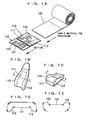
- a method shown in FIG. 7A to FIG. 7E is adopted.
- a fabric material 100 of a solid knitted fabric to be processed is provided usually in a wound roll after knitting as shown in FIG. 7A. Accordingly, when it is processed, the fabric material is rolled out to a predetermined length, and cut largely across its width substantially perpendicular to its longitudinal direction. Then, the cut fabric is divided into two pieces of the fabric 110 for a seat back and the fabric 120 for a seat cushion.
- the knitted fabric 110 for the seat back is cut along predetermined contour line shapes for a central portion 111, side portions 112, a head rest 113, and so on respectively, and they are sorted.
- Asfor the seat cushion it is similarly cut along predetermined contour line shapes for a central portion 121, side portions 122, and so on, and they are sorted.
- the knitted fabrics for the central portions 111, 121 and for the side portions 112, 122 to be connected on both sides thereof are cut in respective predetermined contour shapes plus margin for connection (margin to seam). Therefore, when both are sewn together, the edges are first aligned, and both are sewn together along the contour lines to be cutting lines. Then, by turning this inside out, a three-dimensional product is formed, which is coincident with a predetermined seat frame shape as shown in FIG. 7B to FIG. 7E.
- the present invention has been made in view of the above problem, and an object of the present invention is to provide a method of processing products using fabric, and the products thereof which facilitate cutting step, enable to reduce the processing cost, and improves the availability of the fabric material for processing.
- the inventor pays attention to the face that, conventionally, the reason of cutting a fabric to be processed along a predetermined contour line shape is for convenience of connection (sewing), and also to avoid occurrence of excess portions except a margin for connection (a margin to seam) of the minimum necessity at the time of sewing.
- the inventor then has reached an idea that by giving a positive function as a cushioning portion to perform a cushioning function to an excess portion excepting the margin for connection in the product, a shape of the cutting line can be made simple so that the above problems can be solved, and has accomplished the present invention.
- the inventor has found that the idea is especially useful when it is applied to a product which uses a solid knitted fabric (a three-dimensional net member) as a cushioning member, since when a fabric to be processed is a solid knitted fabric (a three-dimensional net member) used by being strained on a frame member like a seat structure, it produces not only a function that a feeling of hitting of an edge of the excess portion to a human body is avoided by a cushioning function of the solid knitted fabric on the front side, but also a function that a feeling of hitting of the frame member which strains the solid knitted fabric can be further reduced by the layered excess portion.
- the present invention described in claim 1 provides a method of processing a product using fabric comprising the steps of: uniting one fabric and the other fabric by connecting the other fabric to the one fabric at a predetermined position; and turning the united one and the other fabrics inside out to conceal a margin for connection, wherein a marking treatment step is provided to mark on the one fabric a position of connection with the other fabric before uniting the one fabric and the other fabric.
- the present invention described in claim 2 provides the method of processing the product using fabric according to claim 1, wherein the marking treatment step includes a step of marking on the one fabric continuously or partially along the position of connection with the other fabric by a printing means, a sewing means, a welding means, a punching means, or combination of arbitrary two or more of these means.
- the present invention described in claim 3 provides the method of processing the product using fabric according to claim 1, wherein at least one fabric out of said one fabric and the other fabric which are to be processed is a three-dimensional net member formed by connecting two layers of a front ground knitted fabric and a back ground knitted fabric with connecting yarns.
- the present invention described in claim 4 provides a method of processing a product using fabric, comprising the steps of: uniting one fabric being used by cutting out from a fabric material for processing andthe other fabric by connecting the other fabric to the one fabric at a predetermined position; and turning the united one and the other fabrics inside out to conceal a margin for connection, wherein the cutting step to cut out the one fabric from the fabric material for processing includes only a cutting step to cut the one fabric along a line shape simpler than the contour line shape along the position of connection with the other fabric on the outer side than the position of connection; and wherein a marking treatment step to mark the position of connection of the other fabric is provided before or after the cutting step.
- the present invention described in claim 5 provides the method of processing the product using fabric according to claim 4, whereinthe marking treatment step includes a step of marking on the one fabric continuously or partially along the position of connection with the other fabric by a printing means, a sewing means, a welding means, a punching means, or combination of arbitrary two or more of these means.
- the present invention described in claim 6 provides the method of processing the product using fabric according to claim 4, wherein at least one fabric out of the one fabric and the other fabric which are to be processed is a three-dimensional net member formed by connecting two layers of a front ground knitted fabric and a back ground knitted fabric with connecting yarns.
- the present invention described in claim 7 provides a method of processing a product using fabric, comprising the steps of: uniting one fabric being used by cutting out from a fabric material for processing having a predetermined length and the other fabric by connecting the other fabric to the one fabric at a predetermined position; and turning the united one and the other fabrics inside out to conceal a margin for connection, wherein the cutting step to cut out the one fabric from the fabric material for processing includes only a cutting step to cut the one fabric nearly linearly in the direction substantially perpendicular to the longitudinal direction of the fabric material for processing so as to be a predetermined size on the outer side than the position of connection with the other fabric; and wherein a marking treatment step to mark the position of connection of the other fabric is provided before or after the cutting step.
- the present invention described in claim 8 provides the method of processing the product using the fabric according to claim 7, wherein the marking treatment step includes a step of marking on the one fabric continuously or partially along the position of connection with the other fabric by a printing means, a sewing means, a welding means, a punching means, or combination of arbitrary two or more of these means.
- the present invention described in claim 9 provides the method of processing the product using fabric according to claim 7, wherein at least one fabric out of the one fabric and the other fabric which are to be processed is a three-dimensional net member formed by connecting two layers of a front ground knitted fabric and a back ground knitted fabric with connecting yarns.
- the present invention described in claim 10 provides a product using fabric, wherein the product is formed by the steps of: marking a position of connection with the other fabric on one fabric; uniting the one fabric with the other fabric by connecting both together at a marked, predetermined position; and turning the united one and the other fabrics inside out to conceal a margin for connection.
- the present invention described in claim 11 provides a product using fabric, wherein the product is formed by the steps of: marking a position of connection with the other fabric before or after a cutting step to cut out one fabric from the fabric material for processing; cutting the one fabric along a line shape simpler than the contour line shape along the position of connection with the other fabric on the outer side than the position of connection, in the cutting step to cut out the one fabric from the fabric material for processing; uniting the one fabric with the other fabric by connecting both together at a marked, predetermined position; and turning the united one and the other fabrics inside out to conceal a margin for connection.
- the present invention described in claim 12 provides a product using fabric, wherein said product is formed by the steps of: marking a position of connection with the other fabric before or after a cutting step to cut out one fabric from the fabric material for processing; cutting the one fabric nearly linearly in the direction substantially perpendicular to the longitudinal direction of the fabric material for processing so as to be a predetermined size on the outer side than the position of connection with the other fabric, in the cutting step to cut out the one fabric from the fabric material for processing; uniting the one fabric used by cutting out from the fabric material for processing having a predetermined length with the other fabric by connecting both together at a marked, predetermined position; and turning the united one and the other fabrics inside out to conceal a margin for connection.
- the present invention described in claim 13 provides a product using fabric, wherein the product is formed by uniting one fabric and the other fabric by connecting the other fabric to the one fabric at a predetermined position and turning the united one and the other fabrics inside out to conceal a margin for connection, wherein at least the one fabric includes an excess portion remaining on the outside of the margin for connection, and the excess portion serves as a cushioning portion.
- the present invention described in claim 14 provides the product using fabric according to claim 13, wherein at least one fabric out of the one fabric and the other fabric is a three-dimensional net member formed by connecting two layers of a front ground knitted fabric and a back ground knitted fabric with connecting yarns.
- the present invention described in claim 15 provides the product using fabric according to claim 13, wherein the product is used for a cushioning member of a seat structure.
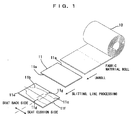
- FIG. 1 to FIG. 3 are views for explaining a method of processing relating to the embodiments using a three-dimensional net member (a solid knitted fabric).
- the solid knitted fabric composes one fabric of the present invention
- a trim cloth connecting to the solid knitted fabric composes the other fabric of the present invention.
- a fabric material 10 for processing for the solid knitted fabric has a predetermined length and a predetermined width, and is provided in a wound rolled state along its longitudinal direction.
- the solid knitted fabric is formed in a three-dimensional structure by connecting two layers of front and back ground knitted fabrics to each other with connecting yarns.
- a ground knitted fabric composing a front layer and a back layer is made of any of synthetic fiber such as polytrimethylene terephthalate fiber, polyethylene terephthalate fiber, polybuthylene terephthalate fiber, polyamide fiber, polyacrylonitrile fiber, polypropylene fiber, and so on, or of natural fiber such as cotton, linen, wool and so on, and the connecting yarn is also made of similar fiber.
- the connecting yarn is preferably made of monofilament.
- the solid knitted fabric is knitted with a double Raschel knitting machine, a double circular knitting machine, a flat knitting machine having a V bed, or the like is known.
- kind and the like of the solid knitted fabric (the three-dimensional net member) adoptable in the present invention is not limited to any specific kind.
- the fabric material 10 in a wound roll is first pulled out at a predetermined length. Then, for instance, when it is used for a cushioning member for a seat structure, it is cut at a length necessary to form a seat back and a seat cushion.
- the fabric material 10 is cut substantially linearly in a nearly perpendicular direction to the longitudinal direction of the fabric material 10 (that is, along the width direction of the fabric material 10). Therefore, in the cutting step of the present embodiment, a simple cutting machine which can cut the fabric material 10 substantially linearly can be used. Accordingly, a solid knitted fabric 11 which forms the one fabric to be processed is cut out substantially in a rectangle.
- the edge portion of the solid knitted fabric 11 can be partially melted.
- a melt down method permits to perform cutting down of the solid knitted fabric and welding treatment to prevent ravels at the edge portion simultaneously.
- Trim cloths 21 and 22 which are the other fabric as shown in FIG. 2A and FIG. 2B are supposed to connect to the solid knitted fabric 11 which is the one fabric. Since the solid knitted fabric 11 is only cut out substantially in a rectangle as described above, its sewing line (contour line) which will be a position of connection to the trim cloths 21 and 22 is not clear with this rectangular fabric only. Hitherto, since its cutting line is formed following to the sewing line (i.e. the position of connection) in advance, sewing and the like can be easily performed by sewing along the cutting line. However, in the case of the present embodiment, a cutting line 11a is formed with no relation to the sewing line which will be the position of the connection, as described above.
- marking treatment is performed to give marking for forming sewing lines 11b and 11c on the solid knitted fabric which is cut out substantially in a rectangle as described above by a predetermined means.
- the means to give the marking is optional, and for instance, a printing means, a sewing means, a welding means, a punching means and so on can be used.
- the printing means is to print the marking with any optional ink, printer or the like along the sewing lines 11b and 11c.
- the sewing means is to sew , for instance, yarn or the like different in color from the yarn or fiber which forms the solid knitted fabric 11 into the solid knitted fabric 11 along the sewing lines 11b and 11c with a sewing machine.
- the welding means is to thin the solid knitted fabric 11 along the sewing lines 11b and 11c by vibration welding.
- the marking formed by these means can be formed in a continuous line or can be formed partially (in a dotted line, for instance) along the sewing lines 11b and 11c.
- the marking is partially formed along the sewing lines 11b and 11c.
- Two or more means among the printing means, sewing means, welding means, and punching means can be combined optionally to use for the marking treatment.
- the marking treatment described above is a structure that stores the coordinates or the like indicating the position at which the sewing lines 11b and 11c are formed in a control section of a machine for the printing means, sewing means, welding means or the like, so that the marking treatment is performed automatically. Thereby, it becomes possible to carry out processing treatment more rapidly. Further, in the present embodiment, although the above-described marking treatment is carried out after cutting the fabric material 10 to get the solid knitted fabric 11 to be the one fabric substantially in a rectangle, it is also possible to give the marking treatment in advance on the fabric material 10 before the cutting step substantially in a rectangle.
- the solid knitted fabric 11 and the trim cloths 21 and 22 are sewn together (connected) along the positions of connection (the sewing lines 11b, 11c) formed by the above-described marking treatment. They are not connected using the cutting line as a guide as is in the conventional manner. Therefore, when performed by the conventional method, it contains a cutting error as a processing error at the time of cutting other than the sewing error (connection error) created when the solid knitted fabric 11 and the trim cloths 21 and 22 are united together.
- the cutting step is carried out with no relation to the sewing lines 11b and 11c as described above, consideration for such a cutting error becomes unnecessary.
- the present invention is especially effective when a product using the solid knitted fabric is formed.
- the cutting line is given a ravel preventing means to prevent ravels of yarn or fiber from the end portion by, for instance, folding back the edge portion irrespective of the kind of the fabric.
- a ravel preventing means to prevent ravels of yarn or fiber from the end portion by, for instance, folding back the edge portion irrespective of the kind of the fabric.
- stiffness of the edge portion becomes high. Accordingly, when the excess portion 11d is used in a state of being overlapped by the fabric on the front side as in the present embodiment, if the fabric is thin, the edge portion which is high in stiffness serves as a source of a feeling of hitting.
- the edge portion having a high stiffness seldom serves as a source of a feeling of hitting owing to the thickness of the solid knitted fabric (cushioning function ) positioned on the front side.
- a solid knitted fabric is used for a cushioning member of a seat structure, since the solid knitted fabric is provided on a frame member in a hammock state, it is requested to reduce a feeling of hitting of the frame member.
- measures are usually taken such that a urethane member is insertedly disposed on the portion positioned on the frame member.
- the present embodiment by disposing the above-described excess portion lid on the frame member, it becomes possible to make it serve as a cushioning member to reduce the feeling of hitting with no use of a urethane member or the like.
- the width of the fabric material 10 wound in a roll is knitted to have a length widthwise in such that, substantially with a half of the width a cushion member having a required size for a seat back or a seat cushion can be cut out. Therefore, as shown in FIG. 1, FIG. 2A and FIG. 2B, nearly half of the solid knitted fabric 11 cut out substantially in a rectangle is used for a seat back and the remaining nearly a half thereof is used for a seat cushion. However, it is optional whether a solid knitted fabric 11e for the seat back and a solid knitted fabric 11f for the seat cushion are cut apart or not.
- the solid knitted fabric 11e for the seat back and the solid knitted fabric 11f for the seat cushion are not cut apart at nearly the central portion, and after attaching the trim cloths 21 and 22 to the solid knitted fabrics 11e and 11f respectively by the above-described method into an integrated form, they are then turned inside out.
- Both solid knitted fabrics for the seat back and seat cushion are connected along lines 11h and 11h which indicate their positions of connection formed in the vicinity of the boundary between the solid knitted fabric 11e for the seat back and the solid knitted fabric 11f for the seat cushion by sewing or vibration welding.
- the vicinity of the boundary is formed in a cylindrical shape, so that these portions can be engaged with the frame member and can be pulled in backward.
- FIG. 4A, FIG. 4B, and FIG. 4C show an example to cut apart the solid knitted fabric 11e for the seat back and the solid knitted fabric 11f for the seat cushion apart and FIGS. 5A, 5B, 5C and FIGS, 6A, 6B, 6C show other examples of both solid knitted fabrics which are not cut apart as in FIG. 1.
- FIG. 4A when the solid knitted fabric lie for the seat back and the solid knitted fabric 11f for the seat cushion are cut apart, both are connected by sewing or the like (refer to FIG. 4B, and FIG. 4C).
- FIG. 5A when the solid knitted fabric is formed without making any incisions at the boundary between the solid knitted fabric 11e for the seat back and the solid knitted fabric 11f for the seat cushion, only the vicinity of both sides near the boundary between both fabrics is formed in a cylindrical shape (refer to FIG. 5B and FIG. 5C), so that it can be engaged with the frame member to pull in the above portion backward.
- FIG. 5A when the solid knitted fabric lie for the seat back and the solid knitted fabric 11f for the seat cushion are cut apart, both are connected by sewing or the like.
- FIG. 5A when the solid knitted fabric is formed without making any incisions at the boundary between the solid knitted fabric 11e for the seat back and the solid knitted fabric 11f for the seat cushion, only the vicinity of both sides near the boundary between
- a solid knitted fabric used for a cushioning member of a seat structure as in the present embodiment, only one part, the solid knitted fabric 11, substantially in a rectangle shape, which contains the solid knitted fabric 11e for the seat back and the solid knitted fabric 11f for the seat cushion is enough to be cut out, or only two parts, the solid knitted fabric 11e for the seat back and the solid knitted fabric 11f for the seat cushion, are enough to be cut out.
- the cutting step can be quite simplified compared with the conventional method shown in FIG. 7A, FIG. 7B, FIG. 7C, FIG. 7D and FIG. 7E.
- FIGS. 5A, 5B, 5C, and FIGS. 6A, 6B, 6C when the solid knitted fabric 11e for the seat back and the solid knitted fabric 11f for the seat cushion are used integrally without being cut apart, since places required to be connected become less, further reduction of the cutting cost can be realized, and when it is used for a car seat and the like, a break of the continuity of yarn composing the solid knitted fabric, which is a weak point at the time of receiving impact, does not occur. As a result, discontinuity in strength can be prevented from occurring and rupture at the weak point can be avoided. Further, the energy absorbency against impact force (collision) can be improved by elongation of the yarn.
- this method can reduce size variation due to sewing, and make a feeling of seating and the riding comfort stable. Still further, since the constitution of the fabric in the vicinity of the boundary between the solid knitted fabric 11e for the seat back and the solid knitted fabric 11f for the seat cushion is continuous, no portion is found where stiffness is partially high. Accordingly, a portion corresponding to a node of a vibration mode does not exist at the lower end of the waste portion, which makes it possible to absorb minute vibration, thereby contributing improvement of vibration absorbency around the waist. Furthermore, as shown in FIG.
- a three-dimensional net member (a solid knitted fabric) is used as said one fabric and a trim cloth which is a two-dimensional fabric member is used as the other fabric, but both may be a three-dimensional net member (a solid knitted fabric), or both may be a two-dimensional fabric member (a woven fabric, a knitted fabric, a non woven fabric, a sheet rubber and so on).
- the present invention is preferably applied to a three-dimensional net member (a solid knitted fabric) as described above.
- a rolled fabric material is used, and cut substantially in a straight line along its width direction.
- the cutting step can be more simplified by cutting on the side outer than the contour line along the positions of connection of respective fabrics, along a line shape simpler than the contour line shape. Therefore, for instance, it is also possible to cut substantially in a curve larger than the contour line.
- the present invention can be applied not only to a cushioning member for a seat structure but also to a cushioning member for a bed or the like.
- the method of processing a product using fabric of the present invention is provided with a marking treatment step to mark a position of connection of the one fabric and the other fabric before uniting the one fabric and the other fabric.
- a marking treatment step to mark a position of connection of the one fabric and the other fabric before uniting the one fabric and the other fabric.
- the one fabric out of fabrics connected to each other has an excess portion remaining on the outside of the margin for connection between both fabrics, and the excess portion is used as a cushioning portion. Therefore, when the product of the present invention is formed, it becomes unnecessary to cut along the contour lines of the product after formation, which facilitates the cutting step, so that a cheap product can be provided.
Landscapes
- Engineering & Computer Science (AREA)
- Aviation & Aerospace Engineering (AREA)
- Transportation (AREA)
- Mechanical Engineering (AREA)
- Textile Engineering (AREA)
- Treatment Of Fiber Materials (AREA)
- Knitting Of Fabric (AREA)
- Decoration Of Textiles (AREA)
Applications Claiming Priority (2)
| Application Number | Priority Date | Filing Date | Title |
|---|---|---|---|
| JP2002130270 | 2002-05-02 | ||
| JP2002130270A JP4418529B2 (ja) | 2002-05-02 | 2002-05-02 | 布帛を用いた成形物の加工方法及び布帛を用いた成形物 |
Publications (3)
| Publication Number | Publication Date |
|---|---|
| EP1362943A2 true EP1362943A2 (de) | 2003-11-19 |
| EP1362943A3 EP1362943A3 (de) | 2006-05-03 |
| EP1362943B1 EP1362943B1 (de) | 2008-07-16 |
Family
ID=29267715
Family Applications (1)
| Application Number | Title | Priority Date | Filing Date |
|---|---|---|---|
| EP03008055A Expired - Lifetime EP1362943B1 (de) | 2002-05-02 | 2003-04-14 | Produktverarbeitung mit Gewebe und Produkt |
Country Status (5)
| Country | Link |
|---|---|
| US (1) | US20030207068A1 (de) |
| EP (1) | EP1362943B1 (de) |
| JP (1) | JP4418529B2 (de) |
| CN (1) | CN100347076C (de) |
| DE (1) | DE60322145D1 (de) |
Cited By (1)
| Publication number | Priority date | Publication date | Assignee | Title |
|---|---|---|---|---|
| WO2007031952A3 (en) * | 2005-09-13 | 2007-09-27 | John Mastin | Method of preparing upholstery for installation on an article of furniture |
Families Citing this family (6)
| Publication number | Priority date | Publication date | Assignee | Title |
|---|---|---|---|---|
| DE10334644B4 (de) * | 2003-07-28 | 2008-04-30 | Johnson Controls Gmbh | Verfahren zur Verarbeitung eines textilen Flächengebildes, textiles Flächengebilde, Bezug und Vorrichtung, insbesondere Fahrzeugsitz |
| US8210567B2 (en) * | 2006-07-18 | 2012-07-03 | Irvin Automotive Products, Inc. | Seat side airbag seam |
| JP5021557B2 (ja) * | 2008-05-01 | 2012-09-12 | ユニオンタイヤコード株式会社 | 薬剤担持体 |
| DE102014221161A1 (de) * | 2014-10-17 | 2016-04-21 | Johnson Controls Gmbh | Verfahren zur Herstellung eines Sitzbezuges und Sitzbezug |
| JP6634324B2 (ja) | 2016-03-29 | 2020-01-22 | 株式会社タチエス | トリムカバー及び車両用シート |
| CN115257486B (zh) * | 2022-07-28 | 2023-10-13 | 福州联泓交通器材有限公司 | 一种汽车座椅椅套制作方法 |
Family Cites Families (10)
| Publication number | Priority date | Publication date | Assignee | Title |
|---|---|---|---|---|
| FR2542982B1 (fr) * | 1983-03-23 | 1985-06-28 | Vestra Union Sa | Machine semi-automatique pour l'alignement des dessins des rabats de poches sur un devant de veston, et l'empilage automatique des pieces positionnees |
| JPS63158209A (ja) * | 1986-12-20 | 1988-07-01 | Toyo Tire & Rubber Co Ltd | 座席用シ−トクツシヨン及びその製造方法 |
| US4844539A (en) * | 1988-11-07 | 1989-07-04 | Hoover Universal, Inc. | Covers for vehicle seat and back and method of making same |
| US5429686A (en) * | 1994-04-12 | 1995-07-04 | Lindsay Wire, Inc. | Apparatus for making soft tissue products |
| SE504859C2 (sv) * | 1994-08-12 | 1997-05-12 | Kriss Ab | Sätt att framställa ett stickat plagg |
| JPH08243271A (ja) * | 1995-03-13 | 1996-09-24 | Achilles Corp | 縫製表皮材及びこれを用いた表皮一体発泡成形方法 |
| US5873318A (en) * | 1996-12-31 | 1999-02-23 | Lear Corporation | Method and apparatus for sewing a plurality of trim pieces together |
| JP3170238B2 (ja) * | 1997-03-24 | 2001-05-28 | 洋 古舘 | 縫製システム及び縫製方法 |
| US5904187A (en) * | 1997-10-22 | 1999-05-18 | Albany International Corp. | Seam integrity in multiple layer/multiple seam press fabrics |
| JP2001246186A (ja) * | 2000-03-02 | 2001-09-11 | Tachi S Co Ltd | 表皮一体発泡用表皮材及び表皮一体発泡製品 |
-
2002
- 2002-05-02 JP JP2002130270A patent/JP4418529B2/ja not_active Expired - Fee Related
-
2003
- 2003-04-14 DE DE60322145T patent/DE60322145D1/de not_active Expired - Lifetime
- 2003-04-14 EP EP03008055A patent/EP1362943B1/de not_active Expired - Lifetime
- 2003-04-23 US US10/421,587 patent/US20030207068A1/en not_active Abandoned
- 2003-04-29 CN CNB031306128A patent/CN100347076C/zh not_active Expired - Fee Related
Cited By (1)
| Publication number | Priority date | Publication date | Assignee | Title |
|---|---|---|---|---|
| WO2007031952A3 (en) * | 2005-09-13 | 2007-09-27 | John Mastin | Method of preparing upholstery for installation on an article of furniture |
Also Published As
| Publication number | Publication date |
|---|---|
| CN1454834A (zh) | 2003-11-12 |
| EP1362943B1 (de) | 2008-07-16 |
| DE60322145D1 (de) | 2008-08-28 |
| US20030207068A1 (en) | 2003-11-06 |
| JP4418529B2 (ja) | 2010-02-17 |
| EP1362943A3 (de) | 2006-05-03 |
| JP2003328263A (ja) | 2003-11-19 |
| CN100347076C (zh) | 2007-11-07 |
Similar Documents
| Publication | Publication Date | Title |
|---|---|---|
| US5454594A (en) | Inflatable gas bag for vehicle occupant restraining systems | |
| US7823980B2 (en) | Pieces for skin members of vehicular seats and methods of manufacturing the same | |
| JP4380896B2 (ja) | シート | |
| US10611276B2 (en) | Seat cover, seat cover manufacturing method, and vehicle seat | |
| EP1140572B1 (de) | Kraftfahrzeugsitz | |
| JP5233036B2 (ja) | シートベルトのバックル装置及びその製造方法 | |
| JP6637263B2 (ja) | 車両用内装部品及びその製作方法 | |
| US10843601B2 (en) | Vehicle seat and preparing method for seat cover of vehicle seat | |
| JP6660848B2 (ja) | トリムカバー及びシート部品 | |
| EP1362943B1 (de) | Produktverarbeitung mit Gewebe und Produkt | |
| WO2007049538A1 (ja) | 乗員拘束装置 | |
| JP3155205B2 (ja) | 自動車用シートカバー | |
| JP2019006355A (ja) | 車両用シート、及び力布の縫製方法 | |
| JP2014184900A (ja) | 乗物用シート | |
| EP0742122B1 (de) | Luftsack | |
| JP2020037288A (ja) | 乗物用シートカバー | |
| JP2015067162A (ja) | 乗物内装品 | |
| JP7849750B2 (ja) | シートカバー | |
| JP6980541B2 (ja) | 皮革製品 | |
| CN117440899A (zh) | 车辆用座椅及车辆用座椅的制造方法 | |
| US10040380B2 (en) | Seat cover for vehicle seat | |
| JP7394010B2 (ja) | 乗り物用シート及びトリムカバーの製造方法 | |
| JPH07125594A (ja) | 車両用エアバッグの製造方法 | |
| JP2018192883A (ja) | 表皮の製造方法 | |
| JP6005828B2 (ja) | 乗物内装品 |
Legal Events
| Date | Code | Title | Description |
|---|---|---|---|
| PUAI | Public reference made under article 153(3) epc to a published international application that has entered the european phase |
Free format text: ORIGINAL CODE: 0009012 |
|
| AK | Designated contracting states |
Kind code of ref document: A2 Designated state(s): AT BE BG CH CY CZ DE DK EE ES FI FR GB GR HU IE IT LI LU MC NL PT RO SE SI SK TR |
|
| AX | Request for extension of the european patent |
Extension state: AL LT LV MK |
|
| PUAL | Search report despatched |
Free format text: ORIGINAL CODE: 0009013 |
|
| AK | Designated contracting states |
Kind code of ref document: A3 Designated state(s): AT BE BG CH CY CZ DE DK EE ES FI FR GB GR HU IE IT LI LU MC NL PT RO SE SI SK TR |
|
| AX | Request for extension of the european patent |
Extension state: AL LT LV MK |
|
| 17P | Request for examination filed |
Effective date: 20060824 |
|
| AKX | Designation fees paid |
Designated state(s): DE FR GB IT |
|
| 17Q | First examination report despatched |
Effective date: 20061219 |
|
| GRAP | Despatch of communication of intention to grant a patent |
Free format text: ORIGINAL CODE: EPIDOSNIGR1 |
|
| GRAS | Grant fee paid |
Free format text: ORIGINAL CODE: EPIDOSNIGR3 |
|
| GRAA | (expected) grant |
Free format text: ORIGINAL CODE: 0009210 |
|
| AK | Designated contracting states |
Kind code of ref document: B1 Designated state(s): DE FR GB IT |
|
| REG | Reference to a national code |
Ref country code: GB Ref legal event code: FG4D |
|
| REF | Corresponds to: |
Ref document number: 60322145 Country of ref document: DE Date of ref document: 20080828 Kind code of ref document: P |
|
| PLBE | No opposition filed within time limit |
Free format text: ORIGINAL CODE: 0009261 |
|
| STAA | Information on the status of an ep patent application or granted ep patent |
Free format text: STATUS: NO OPPOSITION FILED WITHIN TIME LIMIT |
|
| 26N | No opposition filed |
Effective date: 20090417 |
|
| PG25 | Lapsed in a contracting state [announced via postgrant information from national office to epo] |
Ref country code: IT Free format text: LAPSE BECAUSE OF NON-PAYMENT OF DUE FEES Effective date: 20090414 |
|
| PGRI | Patent reinstated in contracting state [announced from national office to epo] |
Ref country code: IT Effective date: 20110616 |
|
| REG | Reference to a national code |
Ref country code: FR Ref legal event code: PLFP Year of fee payment: 14 |
|
| REG | Reference to a national code |
Ref country code: FR Ref legal event code: PLFP Year of fee payment: 15 |
|
| REG | Reference to a national code |
Ref country code: FR Ref legal event code: PLFP Year of fee payment: 16 |
|
| PGFP | Annual fee paid to national office [announced via postgrant information from national office to epo] |
Ref country code: DE Payment date: 20220425 Year of fee payment: 20 Ref country code: IT Payment date: 20220421 Year of fee payment: 20 Ref country code: GB Payment date: 20220408 Year of fee payment: 20 Ref country code: FR Payment date: 20220411 Year of fee payment: 20 |
|
| REG | Reference to a national code |
Ref country code: DE Ref legal event code: R071 Ref document number: 60322145 Country of ref document: DE |
|
| REG | Reference to a national code |
Ref country code: GB Ref legal event code: PE20 Expiry date: 20230413 |
|
| PG25 | Lapsed in a contracting state [announced via postgrant information from national office to epo] |
Ref country code: GB Free format text: LAPSE BECAUSE OF EXPIRATION OF PROTECTION Effective date: 20230413 |