EP1363005B1 - Dispositif de commande d'un moteur utilisant un réseau de neurone en cascade - Google Patents
Dispositif de commande d'un moteur utilisant un réseau de neurone en cascade Download PDFInfo
- Publication number
- EP1363005B1 EP1363005B1 EP03007598A EP03007598A EP1363005B1 EP 1363005 B1 EP1363005 B1 EP 1363005B1 EP 03007598 A EP03007598 A EP 03007598A EP 03007598 A EP03007598 A EP 03007598A EP 1363005 B1 EP1363005 B1 EP 1363005B1
- Authority
- EP
- European Patent Office
- Prior art keywords
- neural network
- engine
- cascaded
- output
- rate
- Prior art date
- Legal status (The legal status is an assumption and is not a legal conclusion. Google has not performed a legal analysis and makes no representation as to the accuracy of the status listed.)
- Expired - Lifetime
Links
- 238000013528 artificial neural network Methods 0.000 title claims description 126
- 238000000034 method Methods 0.000 claims description 24
- 238000012544 monitoring process Methods 0.000 claims description 9
- 230000004044 response Effects 0.000 claims description 6
- 230000002490 cerebral effect Effects 0.000 claims description 3
- 238000003860 storage Methods 0.000 claims description 2
- 239000000446 fuel Substances 0.000 description 22
- 210000004027 cell Anatomy 0.000 description 16
- MWUXSHHQAYIFBG-UHFFFAOYSA-N Nitric oxide Chemical compound O=[N] MWUXSHHQAYIFBG-UHFFFAOYSA-N 0.000 description 15
- 238000002485 combustion reaction Methods 0.000 description 10
- 238000012545 processing Methods 0.000 description 8
- 230000006870 function Effects 0.000 description 7
- 230000008569 process Effects 0.000 description 7
- 230000005540 biological transmission Effects 0.000 description 5
- 238000002347 injection Methods 0.000 description 5
- 239000007924 injection Substances 0.000 description 5
- 239000007789 gas Substances 0.000 description 4
- 238000013461 design Methods 0.000 description 3
- 238000004422 calculation algorithm Methods 0.000 description 2
- 210000002569 neuron Anatomy 0.000 description 2
- 239000000243 solution Substances 0.000 description 2
- 238000012549 training Methods 0.000 description 2
- 230000006399 behavior Effects 0.000 description 1
- 238000013529 biological neural network Methods 0.000 description 1
- 210000004556 brain Anatomy 0.000 description 1
- 238000004364 calculation method Methods 0.000 description 1
- 230000008859 change Effects 0.000 description 1
- 238000004883 computer application Methods 0.000 description 1
- 238000003745 diagnosis Methods 0.000 description 1
- 238000010586 diagram Methods 0.000 description 1
- 238000009826 distribution Methods 0.000 description 1
- 230000000694 effects Effects 0.000 description 1
- 238000012804 iterative process Methods 0.000 description 1
- 238000004519 manufacturing process Methods 0.000 description 1
- 230000007246 mechanism Effects 0.000 description 1
- 238000012986 modification Methods 0.000 description 1
- 230000004048 modification Effects 0.000 description 1
- 230000001537 neural effect Effects 0.000 description 1
- 230000001737 promoting effect Effects 0.000 description 1
- 238000004088 simulation Methods 0.000 description 1
- 238000001228 spectrum Methods 0.000 description 1
- 230000001131 transforming effect Effects 0.000 description 1
Images


Classifications
-
- G—PHYSICS
- G05—CONTROLLING; REGULATING
- G05B—CONTROL OR REGULATING SYSTEMS IN GENERAL; FUNCTIONAL ELEMENTS OF SUCH SYSTEMS; MONITORING OR TESTING ARRANGEMENTS FOR SUCH SYSTEMS OR ELEMENTS
- G05B13/00—Adaptive control systems, i.e. systems automatically adjusting themselves to have a performance which is optimum according to some preassigned criterion
- G05B13/02—Adaptive control systems, i.e. systems automatically adjusting themselves to have a performance which is optimum according to some preassigned criterion electric
- G05B13/0265—Adaptive control systems, i.e. systems automatically adjusting themselves to have a performance which is optimum according to some preassigned criterion electric the criterion being a learning criterion
- G05B13/027—Adaptive control systems, i.e. systems automatically adjusting themselves to have a performance which is optimum according to some preassigned criterion electric the criterion being a learning criterion using neural networks only
-
- F—MECHANICAL ENGINEERING; LIGHTING; HEATING; WEAPONS; BLASTING
- F02—COMBUSTION ENGINES; HOT-GAS OR COMBUSTION-PRODUCT ENGINE PLANTS
- F02D—CONTROLLING COMBUSTION ENGINES
- F02D41/00—Electrical control of supply of combustible mixture or its constituents
- F02D41/02—Circuit arrangements for generating control signals
- F02D41/14—Introducing closed-loop corrections
- F02D41/1401—Introducing closed-loop corrections characterised by the control or regulation method
- F02D41/1405—Neural network control
-
- F—MECHANICAL ENGINEERING; LIGHTING; HEATING; WEAPONS; BLASTING
- F02—COMBUSTION ENGINES; HOT-GAS OR COMBUSTION-PRODUCT ENGINE PLANTS
- F02D—CONTROLLING COMBUSTION ENGINES
- F02D41/00—Electrical control of supply of combustible mixture or its constituents
- F02D41/02—Circuit arrangements for generating control signals
- F02D41/14—Introducing closed-loop corrections
- F02D41/1401—Introducing closed-loop corrections characterised by the control or regulation method
- F02D2041/1413—Controller structures or design
- F02D2041/1418—Several control loops, either as alternatives or simultaneous
- F02D2041/1419—Several control loops, either as alternatives or simultaneous the control loops being cascaded, i.e. being placed in series or nested
-
- F—MECHANICAL ENGINEERING; LIGHTING; HEATING; WEAPONS; BLASTING
- F02—COMBUSTION ENGINES; HOT-GAS OR COMBUSTION-PRODUCT ENGINE PLANTS
- F02D—CONTROLLING COMBUSTION ENGINES
- F02D41/00—Electrical control of supply of combustible mixture or its constituents
- F02D41/02—Circuit arrangements for generating control signals
- F02D41/14—Introducing closed-loop corrections
- F02D41/1401—Introducing closed-loop corrections characterised by the control or regulation method
- F02D2041/1433—Introducing closed-loop corrections characterised by the control or regulation method using a model or simulation of the system
-
- F—MECHANICAL ENGINEERING; LIGHTING; HEATING; WEAPONS; BLASTING
- F02—COMBUSTION ENGINES; HOT-GAS OR COMBUSTION-PRODUCT ENGINE PLANTS
- F02D—CONTROLLING COMBUSTION ENGINES
- F02D2250/00—Engine control related to specific problems or objectives
- F02D2250/12—Timing of calculation, i.e. specific timing aspects when calculation or updating of engine parameter is performed
-
- F—MECHANICAL ENGINEERING; LIGHTING; HEATING; WEAPONS; BLASTING
- F02—COMBUSTION ENGINES; HOT-GAS OR COMBUSTION-PRODUCT ENGINE PLANTS
- F02D—CONTROLLING COMBUSTION ENGINES
- F02D41/00—Electrical control of supply of combustible mixture or its constituents
- F02D41/0002—Controlling intake air
- F02D41/0007—Controlling intake air for control of turbo-charged or super-charged engines
Definitions
- the present invention relates generally to systems and methods for monitoring and controlling the operation of internal combustion engines, and more particularly to systems and methods for monitoring and controlling the operation of engines using neural networks.
- a combustion-type gas turbine has a gas path which typically includes, in a serial-flow relationship, an air intake (or inlet), a compressor, a combustor, a turbine, and a gas outlet (or exhaust nozzle).
- Sensors located at various locations throughout the gas path provide feedback to one or more proportional-integral-derivative (PID) controllers that then compare the feedback to desired predetermined values. If unexpected differences exist, changes are made to the input variables to return the output values to an acceptable range.
- PID proportional-integral-derivative
- PID controllers provide satisfactory control behavior for many single input/single output systems whose dynamics change within a relatively small range.
- efficient operation of modern turbo-charged diesel engines e.g., to obtain desired fuel economy, establish and maintain a desired power output, and reduce the level of emissions
- neural network controllers Unlike PID (or classical) controllers, neural network controllers solve for an ad hoc control relationship. In other words, neural networks do not need to "know" the governing equations of a specific system they are controlling. A neural network merely needs some set of outputs and inputs accumulated from a system during a learning period to create a control rule for controlling the system in the future.
- One particularly popular neural network controller known as a back propagation (BP) neural network includes a plurality of processing elements called neural units arranged in layers with interconnections between units of successive layers.
- a BP neural network has an input layer, an output layer, and one or more "hidden” layers in between.
- the hidden layer is necessary to allow solutions of nonlinear problems.
- Each unit functions in ways analogous to a biological neuron; a unit is capable of generating an output signal which is determined by the weighted sum of input signals it receives and a threshold specific to that unit.
- a unit is provided with inputs (either from outside the network or from other units) and uses these to compute a linear or non-linear output. The unit's output goes either to other units in subsequent layers or to outside the network.
- the input signals to each unit are weighted either positively or negatively, by factors derived in a learning process.
- a complex stimulus pattern at the input layer successively propagates between hidden layers, to result in a simpler output pattern, such as only one output layer unit having a significantly strong output.
- the network is "taught” by feeding it a succession of input patterns and corresponding expected output patterns.
- the network “learns” by measuring the difference (at each output unit) between the expected output pattern and the pattern that it just produced. Having done this, the internal weights and thresholds are modified by a learning algorithm to provide an output pattern which more closely approximates the expected output pattern, while minimizing the error over the spectrum of input patterns.
- Neural network learning is an iterative process, involving multiple "lessons”. Neural networks have the ability to process information in the presence of noisy or incomplete data and still generalize to the correct solution.
- BP neural networks are often well-suited to accurately model and control engine operation, they are not ideally suited for all such applications.
- One drawback of BP neural networks is related to the fact that in certain small computer applications, the extensive mathematical manipulations are time-consuming, and thus do not render control possible in real time for an actual physical system.
- system designers in the past have implemented a less capable cerebellar model articulation controller (CMAC) network, which is not as computationally intensive as a BP neural network.
- CMAC computes control functions by transforming each input variable into a set of intermediate variables, which are combined to select a unique set of weights. These weights are then summed to produce an output.
- each possible input vector selects a unique set of memory locations, rather than a unique single location, allows CMAC to generalize (produce similar outputs for similar inputs) by controlling the degree of overlap in the sets of memory locations which are selected for each input vector. Since CMAC networks are not capable of efficiently processing multiple inputs to generate multiple outputs, they are not effective for use in most modern combustion engines.
- U.S. Patent No. 5,570,282 to Hansen et al. discloses a multivariable nonlinear process controller that includes cascaded controllers for achieving optimal performance when the underlying process includes unmeasured disturbances, modeling errors, and unpredictable process changes. That reference, however, does not disclose the capability to provide increased processing capabilities at speeds normally associated with less capable neural networks.
- a method for monitoring an engine using a cascaded neural network that includes a plurality of neural networks includes the steps of storing in a memory, data corresponding to a cascaded neural network including a plurality of instructions executable by an engine control monitor and data representing weights corresponding to a plurality of nodes of the cascaded neural network. Signals generated by a plurality of engine sensors are then inputted into the cascaded neural network. Next, a second neural network inside the cascaded neural network is updated at a first rate, with an output of a first neural network, wherein the output is based on the inputted signals.
- the cascaded neural network then outputs at a second rate, at least one engine control signal from the second neural network, wherein the second rate is faster than the first rate.
- the present invention also includes a machine-readable storage medium having stored thereon machine executable instructions, the execution of the instructions adapted to implement the foregoing method.
- an engine 102 includes an air intake system 114, an exhaust system 116, a combustion system 117, and a turbocharger 118.
- the air intake system 114 may include an air filter or cleaner 128, an aftercooler 126, and an air intake manifold 122.
- the exhaust system 116 may include an exhaust manifold 120 and a muffler 124.
- the turbocharger 118 may include a compressor 130, a turbine 132, and a shaft 134.
- the compressor 130 is connected to the air intake system 114 between the aftercooler 126 and the air filter 128.
- the turbine 132 is connected into the exhaust system 116 between the exhaust manifold 120 and the muffler 124.
- a shaft 134 connects the compressor 130 to the turbine 132.
- the combustion system 117 includes at least one cylinder 104 and a crankshaft 106.
- Each cylinder 104 typically has an associated piston 108 and connecting rod 109.
- Each cylinder 104 typically includes a cylinder liner 110.
- Each cylinder 104 may also include a cylinder head 112, or a common head arrangement is used.
- the piston 108, cylinder liner 110, and cylinder head 112 form a combustion chamber 113.
- the cylinder head 112 forms a passageway from the air intake manifold 122 and the exhaust manifold 120 to the combustion chamber 113.
- the cylinder head 112 also forms a passageway allowing a fuel delivery system to introduce fuel into the combustion chamber 113.
- fuel is injected into the combustion chamber 113 by an electronic fuel injector 137, although other types of fuel injectors or fuel delivery systems (e.g., a carburetor) could also be used.
- Engine 102 includes a plurality of sensors (not shown) operable for sensing a variety of response parameters of the engine, such as, but not limited to; barometric pressure, inlet ambient temperature, intake manifold temperature/pressure, pilot quantity, injection duration, engine speed, rate of fuel delivery to the engine, ratio of air to fuel delivery to the engine, fuel temperature, oil pressure, oil temperature, engine speed, and exhaust temperature.
- Turbocharger 118 may include sensors (not shown) for sensing other response parameters (e.g., compressor outlet temperature/pressure, turbine inlet temperature/pressure, and the boost pressure).
- a torque converter (not shown), is indirectly coupled to crankshaft 106, and may include a sensor for sensing torque at the torque converter. All of the sensors can be of a variety of designs known in the industry.
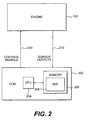
- Engine control module 202 includes a CPU 204 and a memory 206. There are other components as well, but these are not shown to facilitate description of the unique aspects of this embodiment of the invention.
- CPU 204 includes a microprocessor capable of modeling and operation of a neural network using sensor outputs 210 from the above discussed sensors as inputs and generating at least one control signal 220 for feedback to engine 102.
- Memory 206 includes a plurality of software routines 205 that receive the information from the various sensors throughout the engine and pass this information through engine control algorithms stored in ECM 202.
- software routines 205 include a plurality of modules (not shown) for interfacing with engine 102.
- Sensor outputs 210 are transmitted to ECM 202 from engine 102.
- ECM 202 then generates control signals 220 in response to the sensor outputs 210. Once generated, control signal 220 is then passed from ECM 202 to engine 102 to control its operation.
- Each control signal 220 has a specific purpose and is intended to communicate a unique message to engine 102.
- ECM 202 may output one torque control signal to the transmission at a first frequency (e.g., every 15 ms) and output a second control signal to a fuel injector control mechanism at a second frequency (e.g., every 120 ms).
- cascaded neural network 300 accepts several inputs, performs a series of operations on the inputs, and produces one or more outputs.
- a neural network such as cascaded neural network 300 is a simulation of the biological neural network of the human brain.
- cascaded neural network 300 includes at least two neural networks for processing signals received from the plurality of engine sensors. Signals from the engine sensors are input to one or more of the cascaded neural networks. When one neural network processes the input(s), it outputs at least one processed signal into a second neural network, creating a cascading effect.
- Signals output from cascaded neural network 300 may come from one of the two neural networks (in other words, all the signals from the first neural network are fed into the second neural network which then generates the outputs of cascaded neural network), or the signals may come from both neural networks (i.e., the first neural network may output some of its signals into the second neural network and the others will be outputted to ECM 202). Signals generated by each of the neural networks that constitute the cascaded neural network are generated simultaneously, or they are generated asynchronously.
- the neural network will update the coefficients (or weights) associated with the variables x and y, and ECM 202 will periodically output a value for C.
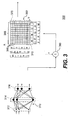
- cascaded neural network 300 includes a back propagation (BP) neural network 310 cascaded into a cerebellar model articulation controller (CMAC) neural network 360.
- BP neural network 310 consists of three layers: an input layer 312; a hidden layer 314; and an output layer 316.
- input layer 312 includes three inputs representing an input pattern to BP neural network 310.
- the input layer 312 is connected through weights to hidden layer 314, the hidden layer in turn being connected to output layer 316 through weighted connections.
- the number of hidden nodes and hidden layers can be any variable number and are obtained through trial and error to determine the number of hidden nodes and hidden layers that provides optimal results.
- the output layer 316 includes three outputs representing an output pattern of the neural network.
- the input layer 312 may include engine speed, fuel injection quantity (pilot quantity and main fuel quantity) and timing, and the output layer 316 may include fuel rate.
- the input layer 312 may include engine speed, barometric pressure, intake manifold pressure and temperature, and the output layer 316 may include exhaust manifold temperature.
- the input layer 312 may include engine speed, injection quantity (pilot quantity and main fuel quantity) and timing, and the output layer 316 may include torque.
- the input layer 312 may include engine speed, barometric pressure, intake manifold pressure and temperature, and the output layer 316 may include turbo speed.
- the input layer 312 may include engine speed, injection quantity (pilot quantity and main fuel quantity) and timing, and the output layer 316 may include Nitrogen Oxide (NO x ) production.
- output of BP neural network 310 is transmitted directly to ECM 202 and/or it is transmitted to CMAC neural network 360.
- CMAC neural network 360 includes a data space 365 including a plurality of columns 370 and a plurality of rows 375, each column 370 being identifiable by a unique three-letter combination (A - M) indicated at the bottom of data space 365, and each row 375 being identifiable by a unique three-letter combination (a - m) indicated at the left side of data space 365.
- the column and row combination results in a plurality of cells 380.
- data space 365 is a comprehensive map that characterizes performance of a vehicle component as a function of predetermined design and control parameters.
- Each cell 380 is identified by a corresponding six letter designation (three large letters and three small letters).
- the six-letter designation for each cell is determined by drawing an imaginary straight line from the cell to the X axis (through the letters adjacent to the X axis), and drawing another imaginary straight line from the cell to the Y axis (through the letters adjacent to the Y axis).
- the six letters that intersect the two lines are the six-letter designation for the cell.
- the six-letter designation represents the weights to be applied to a given cell.
- the plurality of cells 380 include six (6) corresponding weight values.
- the cell in the upper right corner of data space 365 could be identified as "M-I-D-m-i-d". That six-letter combination and the weights associated with each of those six letters is unique to that particular cell.
- the numeric value associated with each cell 380 is randomly assigned.
- the numeric values are determined by training the neural network of which the neuron is a part by ways known to those skilled in the art.
- cascaded neural network 300 Before cascaded neural network 300 is utilized to control operation of an engine, it must be trained. In one embodiment, cascaded neural network 300 is trained during normal operation of engine 102.
- ECM 202 is used for monitoring and controlling engine 102 with the following steps. First, a plurality of initial values or model constants are determined for selected engine operating conditions. A plurality of modeled engine responses are then determined as a function of the selected control signals and initial values. Then, during subsequent operation of engine 102, sensor outputs 210 are sensed and a difference is determined between the sensed outputs 210 and the modeled engine values. These differences are used adjust the weights of the neural network. In a back-propagation neural network, the error values are back-propagated to adjust the weights, and in a CMAC neural network, the error value is divided by the number of weights and applied equally to each weight.
- the weights are initialized to random values, which are either positive or negative integers or fractions (step 410).
- Start-up refers to the initialization of cascaded neural network 300.
- the previously-computed weights are stored in non-volatile memory such that they are recalled when the engine is subsequently restarted, although they need not be.
- Cascaded neural network 300 is initialized (or started up) numerous times throughout the life of engine 102, or it may only be initialized once such that the weight values will be changed only through training.
- the inputs obtained from the sensor outputs are presented to BP neural network 310 and processed (step 420).
- inputs obtained from the sensor outputs are presented to BP neural network 310 and/or CMAC neural network 360.
- the output pattern for one or more sensor outputs 210 is compared to the output of CMAC neural network 360 for the same engine response (step 430). For example, BP neural network 310 may compute one value for torque, and CMAC neural network 360 may compute a second value.
- the value extracted from CMAC neural network 360 is obtained by entering data space 365 using the set or some subset of the sensor outputs presented to the BP neural network 310, e.g., two current sensed signals (e.g., ERPM and fuel quantity) corresponding to X and Y coordinates in data space 365.
- the two torque values are compared to each other ( ⁇ 390 in FIG. 3 ) and an error value representative of the difference between the value obtained from BP neural network 310 and the value obtained from CMAC neural network 360 is computed (step 440).
- the error value is then divided by six and applied to weights corresponding to the cell identified in CMAC neural network 360 (step 450). For example, if the cell identified has the following six weights associated with it (M-I-D-m-i-d) before the error value is computed, those six weights will each be adjusted by the number represented by the total error divided by 6, such that the output from CMAC network 360 with the new weights applied, is identical to the output from BP neural network 310 for the current sensed signals. At predetermined times, an updated signal for torque is computed and outputted from ECM 202 (Step 460). The engine 102 is thus controlled as a function of the output pattern of CMAC network 360.
- weights associated with each cell of CMAC neural network 360 are updated at a first frequency, and ECM 202 may output a control signal (e.g., torque) at a second frequency.
- weights are updated and control signals outputted at the same frequency.
- the present apparatus and method for monitoring and controlling an engine using cascaded neural networks may have utility for a wide variety of machine applications wherein real time, on board diagnosis of general operating conditions, multiple fault conditions, and individual fault conditions is desired.
- One aspect of the embodiments of the present invention is the capability to provide usable inputs to the neural network as a function of the initial values and sensed parameters, and to update the initial values and network weights at differing speeds depending on control module requirements.
- the cascaded neural network is used as a virtual sensor to predict engine conditions, such as, for example, fuel rate, exhaust temperature, turbo speed, and engine torque as a function of available hardware sensor feedback signals.
- the cascaded neural network of the present invention may also calculate the amount of various Nitrogen Oxides (NO x ) generated and output a signal to adjust injection timing to control NO x emissions.
- Embodiments of the present invention may also be used to calculate exhaust manifold temperature and output a signal to adjust the fuel consumption to control exhaust temperature.
- the engine When excessive values of determined conditions are predicted, the engine is de-rated to the extent necessary to satisfy design limits.
- the present invention provides this capability without additional physical sensors by utilizing a back propagation neural network cascaded with a second neural network (or complex polynomial). By limiting the number of excessive exhaust temperature and turbo speed instances, there are less failures of the exhaust manifold and turbine housings, resulting in reduced warranty claims and higher customer satisfaction. Additional potential benefits of predicting fuel rate and engine torque with embodiments of the present invention are more accurate fuel consumption estimation and more precise shift control for automatic transmission applications.
- a typical ECM is only capable of outputting updated signals from a BP neural network relatively slowly, e.g., once every 120 ms.
- updated values e.g., torque
- the embodiments of the present invention is adapted to compute error values at one rate and to output updated desired signals (e.g., torque) at much faster rates.
- BP neural network 310 is capable of outputting a new error value for torque every 120 ms, but a processor associated with the transmission requires updated torque signals every 15 ms, the present system will output torque signals from the CMAC network 360 at the required frequency, with updated weights provided to CMAC network 360 (or complex polynomial) based on the output of the BP neural network 310 once for every eighth torque output.
- data is provided to a transmission subsystem at a rate that is much faster than normally associated with a BP neural network and that is more precise than usually associated with CMAC networks.
Landscapes
- Engineering & Computer Science (AREA)
- Artificial Intelligence (AREA)
- Evolutionary Computation (AREA)
- Health & Medical Sciences (AREA)
- Computer Vision & Pattern Recognition (AREA)
- Medical Informatics (AREA)
- Software Systems (AREA)
- Physics & Mathematics (AREA)
- General Physics & Mathematics (AREA)
- Automation & Control Theory (AREA)
- Chemical & Material Sciences (AREA)
- Combustion & Propulsion (AREA)
- Mechanical Engineering (AREA)
- General Engineering & Computer Science (AREA)
- Combined Controls Of Internal Combustion Engines (AREA)
Claims (10)
- Procédé pour surveiller un moteur (102) en utilisant un réseau de neurones en cascade (300) qui comprend une pluralité de réseaux de neurones, le procédé comprenant :mémoriser dans une mémoire, des données correspondant au réseau de neurones en cascade (300) ;introduire des signaux produits par une pluralité de capteurs de moteur dans le réseau de neurones en cascade (300) ;mettre à jour, à une première cadence, un deuxième réseau de neurones avec une sortie d'un premier réseau de neurones, ladite sortie étant basée sur les signaux introduits ; etfournir en sortie à une deuxième cadence, au moins un signal de commande de moteur (220) à partir du deuxième réseau de neurones ;dans lequel la deuxième cadence est plus rapide que la première cadence.
- Procédé selon la revendication 1, dans lequel les données correspondant au réseau de neurones en cascade (300) comprennent une pluralité de noeuds interconnectés et une pluralité de pondérations correspondant aux noeuds.
- Procédé selon la revendication 1, comprenant en outre le réglage d'au moins un paramètre de réponse de moteur sur la base de la sortie provenant du deuxième réseau de neurones.
- Procédé selon la revendication 1, dans lequel l'introduction de signaux comprend en outre l'introduction de signaux produits par une pluralité de capteurs de moteur dans l'un d'une pluralité de réseaux de neurones dans le réseau de neurones en cascade (300).
- Procédé selon la revendication 1, dans lequel l'introduction de signaux comprend en outre :introduire des signaux produits par au moins un capteur de moteur dans un premier d'une pluralité de réseaux de neurones dans le réseau de neurones en cascade (300) ; etintroduire des signaux produits par au moins un capteur de moteur dans au moins un deuxième réseau de neurones.
- Support de mémorisation lisible par ordinateur, comportant mémorisées sur lui des instructions exécutables par une machine, l'exécution desdites instructions étant apte à mettre en oeuvre le procédé selon l'une quelconque des revendications 1 à 5.
- Dispositif pour surveiller un moteur (102) en utilisant un réseau de neurones en cascade (300) qui comprend une pluralité de réseaux de neurones, le dispositif comprenant :un microprocesseur qui comprend des données correspondant au réseau de neurones en cascade (300) ;un module agencé pour recevoir des signaux produits par une pluralité de capteurs de moteur dans le réseau de neurones en cascade (300) ;un module agencé pour mettre à jour, à une première cadence, un deuxième réseau de neurones avec une sortie d'un premier réseau de neurones, ladite sortie étant basée sur les signaux introduits ; etun module agencé pour fournir à une deuxième cadence, au moins un signal de commande de moteur (220) à partir du deuxième réseau de neurones ;dans lequel la deuxième cadence est plus rapide que la première cadence.
- Dispositif selon la revendication 7, dans lequel le deuxième réseau de neurones est un contrôleur d'articulation à modèle cérébral (CMAC) (360).
- Dispositif selon la revendication 8, dans lequel le CMAC (360) est représenté par un polynôme.
- Dispositif selon la revendication 7, dans lequel le premier réseau de neurones est un réseau de neurones à propagation vers l'arrière (310).
Applications Claiming Priority (2)
| Application Number | Priority Date | Filing Date | Title |
|---|---|---|---|
| US10/145,131 US7035834B2 (en) | 2002-05-15 | 2002-05-15 | Engine control system using a cascaded neural network |
| US145131 | 2002-05-15 |
Publications (3)
| Publication Number | Publication Date |
|---|---|
| EP1363005A2 EP1363005A2 (fr) | 2003-11-19 |
| EP1363005A3 EP1363005A3 (fr) | 2008-03-19 |
| EP1363005B1 true EP1363005B1 (fr) | 2009-07-15 |
Family
ID=29269736
Family Applications (1)
| Application Number | Title | Priority Date | Filing Date |
|---|---|---|---|
| EP03007598A Expired - Lifetime EP1363005B1 (fr) | 2002-05-15 | 2003-04-02 | Dispositif de commande d'un moteur utilisant un réseau de neurone en cascade |
Country Status (4)
| Country | Link |
|---|---|
| US (2) | US7035834B2 (fr) |
| EP (1) | EP1363005B1 (fr) |
| JP (1) | JP4365133B2 (fr) |
| DE (1) | DE60328330D1 (fr) |
Cited By (2)
| Publication number | Priority date | Publication date | Assignee | Title |
|---|---|---|---|---|
| CN102968663A (zh) * | 2012-11-29 | 2013-03-13 | 河海大学 | 基于无标记样本的神经网络构建方法及其装置 |
| CN106681146A (zh) * | 2016-12-31 | 2017-05-17 | 浙江大学 | 基于bp神经网络和遗传算法的高炉多目标优化控制算法 |
Families Citing this family (85)
| Publication number | Priority date | Publication date | Assignee | Title |
|---|---|---|---|---|
| GB0216742D0 (en) * | 2002-07-18 | 2002-08-28 | Ricardo Consulting Eng | Self-testing watch dog system |
| US20050137995A1 (en) * | 2002-08-16 | 2005-06-23 | Powitec Intelligent Technologies Gmbh | Method for regulating a thermodynamic process by means of neural networks |
| US7194320B2 (en) * | 2003-06-05 | 2007-03-20 | Neuco, Inc. | Method for implementing indirect controller |
| US6736089B1 (en) | 2003-06-05 | 2004-05-18 | Neuco, Inc. | Method and system for sootblowing optimization |
| US8214271B2 (en) | 2004-02-04 | 2012-07-03 | Neuco, Inc. | System and method for assigning credit to process inputs |
| US7136779B2 (en) * | 2004-05-28 | 2006-11-14 | Daimlerchrysler Ag | Method for simplified real-time diagnoses using adaptive modeling |
| EP1607604B1 (fr) * | 2004-05-31 | 2008-07-16 | STMicroelectronics S.r.l. | Procédé informatique de calcul du taux de dégagement de chaleur (HRR) dans un moteur à combustion interne avec un système d'injection à rampe commune |
| DE102004030782A1 (de) * | 2004-06-25 | 2006-01-19 | Fev Motorentechnik Gmbh | Fahrzeug-Steuergerät mit einem neuronalen Netz |
| US7536232B2 (en) * | 2004-08-27 | 2009-05-19 | Alstom Technology Ltd | Model predictive control of air pollution control processes |
| FR2876152B1 (fr) * | 2004-10-06 | 2006-12-15 | Renault Sas | Procede et systeme ameliores d'estimation d'une temperature des gaz d'echappement et moteur a combustion interne equipe d'un tel systeme |
| US7333861B2 (en) * | 2004-10-25 | 2008-02-19 | Neuco, Inc. | Method and system for calculating marginal cost curves using plant control models |
| EP1705352B1 (fr) * | 2005-03-04 | 2012-11-21 | STMicroelectronics Srl | Procédé et dispositif pour la détermination du rapport air-carburant dans un moteur à combustion interne |
| US20060229854A1 (en) * | 2005-04-08 | 2006-10-12 | Caterpillar Inc. | Computer system architecture for probabilistic modeling |
| US20060230097A1 (en) * | 2005-04-08 | 2006-10-12 | Caterpillar Inc. | Process model monitoring method and system |
| US20060229852A1 (en) * | 2005-04-08 | 2006-10-12 | Caterpillar Inc. | Zeta statistic process method and system |
| US7565333B2 (en) * | 2005-04-08 | 2009-07-21 | Caterpillar Inc. | Control system and method |
| US8364610B2 (en) | 2005-04-08 | 2013-01-29 | Caterpillar Inc. | Process modeling and optimization method and system |
| US7877239B2 (en) * | 2005-04-08 | 2011-01-25 | Caterpillar Inc | Symmetric random scatter process for probabilistic modeling system for product design |
| US8209156B2 (en) * | 2005-04-08 | 2012-06-26 | Caterpillar Inc. | Asymmetric random scatter process for probabilistic modeling system for product design |
| US20060229753A1 (en) * | 2005-04-08 | 2006-10-12 | Caterpillar Inc. | Probabilistic modeling system for product design |
| US7233932B2 (en) | 2005-05-31 | 2007-06-19 | Honeywell International, Inc. | Fault detection system and method using approximate null space base fault signature classification |
| US20070061144A1 (en) * | 2005-08-30 | 2007-03-15 | Caterpillar Inc. | Batch statistics process model method and system |
| US7487134B2 (en) * | 2005-10-25 | 2009-02-03 | Caterpillar Inc. | Medical risk stratifying method and system |
| US20070118487A1 (en) * | 2005-11-18 | 2007-05-24 | Caterpillar Inc. | Product cost modeling method and system |
| US7499842B2 (en) * | 2005-11-18 | 2009-03-03 | Caterpillar Inc. | Process model based virtual sensor and method |
| US7953521B2 (en) * | 2005-12-30 | 2011-05-31 | Microsoft Corporation | Learning controller for vehicle control |
| US7505949B2 (en) * | 2006-01-31 | 2009-03-17 | Caterpillar Inc. | Process model error correction method and system |
| US20070203810A1 (en) * | 2006-02-13 | 2007-08-30 | Caterpillar Inc. | Supply chain modeling method and system |
| US7765795B2 (en) * | 2006-04-28 | 2010-08-03 | Caterpillar Inc | NOx control using a neural network |
| US8478506B2 (en) * | 2006-09-29 | 2013-07-02 | Caterpillar Inc. | Virtual sensor based engine control system and method |
| US20080154811A1 (en) * | 2006-12-21 | 2008-06-26 | Caterpillar Inc. | Method and system for verifying virtual sensors |
| US7483774B2 (en) * | 2006-12-21 | 2009-01-27 | Caterpillar Inc. | Method and system for intelligent maintenance |
| US20090018745A1 (en) * | 2006-12-31 | 2009-01-15 | Caterpillar Inc | System and method for operating a machine |
| US20080183449A1 (en) * | 2007-01-31 | 2008-07-31 | Caterpillar Inc. | Machine parameter tuning method and system |
| US7769512B2 (en) * | 2007-02-12 | 2010-08-03 | Deere & Company | Vehicle steering control method and performance |
| US7895135B2 (en) * | 2007-02-12 | 2011-02-22 | Deere & Company | Human perception model for speed control performance |
| US8195364B2 (en) | 2007-02-12 | 2012-06-05 | Deere & Company | Perception model for trajectory following autonomous and human augmented steering control |
| US8498796B2 (en) * | 2007-02-12 | 2013-07-30 | Deere & Company | Perception model for trajectory following autonomous and human augmented speed control |
| US7787969B2 (en) * | 2007-06-15 | 2010-08-31 | Caterpillar Inc | Virtual sensor system and method |
| US7831416B2 (en) * | 2007-07-17 | 2010-11-09 | Caterpillar Inc | Probabilistic modeling system for product design |
| US7788070B2 (en) * | 2007-07-30 | 2010-08-31 | Caterpillar Inc. | Product design optimization method and system |
| US7542879B2 (en) * | 2007-08-31 | 2009-06-02 | Caterpillar Inc. | Virtual sensor based control system and method |
| US8340824B2 (en) | 2007-10-05 | 2012-12-25 | Neuco, Inc. | Sootblowing optimization for improved boiler performance |
| US7593804B2 (en) * | 2007-10-31 | 2009-09-22 | Caterpillar Inc. | Fixed-point virtual sensor control system and method |
| US8224468B2 (en) | 2007-11-02 | 2012-07-17 | Caterpillar Inc. | Calibration certificate for virtual sensor network (VSN) |
| US8036764B2 (en) | 2007-11-02 | 2011-10-11 | Caterpillar Inc. | Virtual sensor network (VSN) system and method |
| US7658098B2 (en) * | 2007-12-31 | 2010-02-09 | Min Sun | Method for controlling vehicle emissions |
| US8086640B2 (en) * | 2008-05-30 | 2011-12-27 | Caterpillar Inc. | System and method for improving data coverage in modeling systems |
| US20090293457A1 (en) * | 2008-05-30 | 2009-12-03 | Grichnik Anthony J | System and method for controlling NOx reactant supply |
| US7917333B2 (en) * | 2008-08-20 | 2011-03-29 | Caterpillar Inc. | Virtual sensor network (VSN) based control system and method |
| US8467949B2 (en) * | 2009-05-29 | 2013-06-18 | Honeywell International Inc. | Methods and systems for turbine line replaceable unit fault detection and isolation during engine startup |
| US8744707B2 (en) | 2011-03-31 | 2014-06-03 | Caterpillar Inc. | CVT control using state space based gain scheduling |
| US8793004B2 (en) | 2011-06-15 | 2014-07-29 | Caterpillar Inc. | Virtual sensor system and method for generating output parameters |
| DE102011081197A1 (de) * | 2011-08-18 | 2013-02-21 | Siemens Aktiengesellschaft | Verfahren zur rechnergestützten Modellierung eines technischen Systems |
| CN103678773A (zh) * | 2013-11-15 | 2014-03-26 | 华南理工大学 | 球间隙放电电压检测方法 |
| CN105262396A (zh) * | 2015-11-26 | 2016-01-20 | 上海电机学院 | 基于hcmac神经网络的pmsm控制方法 |
| DE102015225279B4 (de) | 2015-12-15 | 2019-09-12 | Mtu Friedrichshafen Gmbh | Verfahren und Einrichtung zum prädiktiven Steuern und/oder Regeln einer Brennkraftmaschine sowie Brennkraftmaschine mit der Einrichtung zur Ausführung des Verfahrens |
| US10672389B1 (en) * | 2017-12-29 | 2020-06-02 | Apex Artificial Intelligence Industries, Inc. | Controller systems and methods of limiting the operation of neural networks to be within one or more conditions |
| US10620631B1 (en) * | 2017-12-29 | 2020-04-14 | Apex Artificial Intelligence Industries, Inc. | Self-correcting controller systems and methods of limiting the operation of neural networks to be within one or more conditions |
| US10802489B1 (en) * | 2017-12-29 | 2020-10-13 | Apex Artificial Intelligence Industries, Inc. | Apparatus and method for monitoring and controlling of a neural network using another neural network implemented on one or more solid-state chips |
| US10795364B1 (en) | 2017-12-29 | 2020-10-06 | Apex Artificial Intelligence Industries, Inc. | Apparatus and method for monitoring and controlling of a neural network using another neural network implemented on one or more solid-state chips |
| US10324467B1 (en) * | 2017-12-29 | 2019-06-18 | Apex Artificial Intelligence Industries, Inc. | Controller systems and methods of limiting the operation of neural networks to be within one or more conditions |
| US10802488B1 (en) * | 2017-12-29 | 2020-10-13 | Apex Artificial Intelligence Industries, Inc. | Apparatus and method for monitoring and controlling of a neural network using another neural network implemented on one or more solid-state chips |
| CN108469815A (zh) * | 2018-02-27 | 2018-08-31 | 重庆嵩岳贸易服务有限公司 | 一种基于意图的计算机深度学习自动导航和驾驶系统及其方法 |
| JP6477951B1 (ja) * | 2018-04-05 | 2019-03-06 | トヨタ自動車株式会社 | 車載電子制御ユニット |
| CN109297533B (zh) * | 2018-09-20 | 2021-04-13 | 北京恩福健康科技有限公司 | 一种精确测量皮肤表面温湿度的方法 |
| CN109375506B (zh) * | 2018-10-18 | 2022-06-07 | 北京工业大学 | 一种基于rbf神经网络的云服务资源精确控制方法 |
| CN111311646B (zh) * | 2018-12-12 | 2023-04-07 | 杭州海康威视数字技术股份有限公司 | 一种光流神经网络训练方法及装置 |
| KR102654874B1 (ko) * | 2018-12-31 | 2024-04-05 | 삼성전자주식회사 | 화자 인식을 위한 뉴럴 네트워크 장치, 및 그 동작 방법 |
| JP6741087B1 (ja) * | 2019-02-01 | 2020-08-19 | トヨタ自動車株式会社 | 内燃機関の制御装置、車載電子制御ユニット、機械学習システム、内燃機関の制御方法、電子制御ユニットの製造方法及び出力パラメータ算出装置 |
| US11137444B2 (en) | 2019-06-28 | 2021-10-05 | Rohde & Schwarz Gmbh & Co. Kg | Measurement device and method of setting a measurement device |
| US12482032B2 (en) * | 2019-06-30 | 2025-11-25 | Charles Schwab & Co., Inc. | Selective data rejection for computationally efficient distributed analytics platform |
| CN110543893A (zh) * | 2019-08-07 | 2019-12-06 | 河海大学 | 基于bp神经网络的微波衰减降水粒子类型的识别方法 |
| WO2021079179A1 (fr) | 2019-10-25 | 2021-04-29 | Volvo Truck Corporation | Système et procédé pour un capteur de vitesse de turbocompresseur virtuel utilisant des réseaux neuronaux |
| US11366434B2 (en) | 2019-11-26 | 2022-06-21 | Apex Artificial Intelligence Industries, Inc. | Adaptive and interchangeable neural networks |
| US10691133B1 (en) * | 2019-11-26 | 2020-06-23 | Apex Artificial Intelligence Industries, Inc. | Adaptive and interchangeable neural networks |
| US11367290B2 (en) | 2019-11-26 | 2022-06-21 | Apex Artificial Intelligence Industries, Inc. | Group of neural networks ensuring integrity |
| US12081646B2 (en) | 2019-11-26 | 2024-09-03 | Apex Ai Industries, Llc | Adaptively controlling groups of automated machines |
| US10956807B1 (en) | 2019-11-26 | 2021-03-23 | Apex Artificial Intelligence Industries, Inc. | Adaptive and interchangeable neural networks utilizing predicting information |
| CN112147647A (zh) * | 2020-08-11 | 2020-12-29 | 徐州徐工挖掘机械有限公司 | 一种监控预测gps终端故障的方法及系统 |
| CN113759868B (zh) * | 2021-08-16 | 2023-05-02 | 浙江运达风电股份有限公司 | 一种基于神经网络的工业以太网故障预测方法 |
| CN113642109B (zh) * | 2021-08-17 | 2023-07-04 | 湖南大学 | 一种基于bp神经网络的多传感器方案评价与优化系统及方法 |
| CN114670856B (zh) * | 2022-03-30 | 2022-11-25 | 湖南大学无锡智能控制研究院 | 一种基于bp神经网络的参数自整定纵向控制方法及系统 |
| CN116241366B (zh) * | 2023-03-28 | 2023-10-10 | 上海交通大学 | 柴油机变海拔增压系统智能可变模式控制方法 |
| CN118313234B (zh) * | 2024-01-29 | 2024-11-19 | 西南石油大学 | 基于级联前向神经网络的气井气液两相嘴流预测方法 |
Family Cites Families (32)
| Publication number | Priority date | Publication date | Assignee | Title |
|---|---|---|---|---|
| US4193115A (en) * | 1977-12-15 | 1980-03-11 | The United States Of America As Represented By The Secretary Of Commerce | Method and apparatus for implementation of the CMAC mapping algorithm |
| US6272241B1 (en) * | 1989-03-22 | 2001-08-07 | British Telecommunications Public Limited Company | Pattern recognition |
| JPH06504348A (ja) * | 1991-12-19 | 1994-05-19 | キャタピラー インコーポレイテッド | コンピュータ利用モデルを用いてエンジンを診断する方法 |
| KR950012359B1 (ko) * | 1992-08-28 | 1995-10-17 | 엘지전자주식회사 | 신경회로망 구조와 학습방법 |
| TW222337B (fr) * | 1992-09-02 | 1994-04-11 | Motorola Inc | |
| US5539638A (en) * | 1993-08-05 | 1996-07-23 | Pavilion Technologies, Inc. | Virtual emissions monitor for automobile |
| JP3096387B2 (ja) * | 1994-01-28 | 2000-10-10 | 三菱電機株式会社 | 数値演算処理装置 |
| US5825936A (en) * | 1994-09-22 | 1998-10-20 | University Of South Florida | Image analyzing device using adaptive criteria |
| US5570282A (en) * | 1994-11-01 | 1996-10-29 | The Foxboro Company | Multivariable nonlinear process controller |
| US6098012A (en) * | 1995-02-13 | 2000-08-01 | Daimlerchrysler Corporation | Neural network based transient fuel control method |
| US5822741A (en) * | 1996-02-05 | 1998-10-13 | Lockheed Martin Corporation | Neural network/conceptual clustering fraud detection architecture |
| US5796922A (en) * | 1996-03-29 | 1998-08-18 | Weber State University | Trainable, state-sampled, network controller |
| US6490571B1 (en) * | 1996-05-02 | 2002-12-03 | David L. Cooper | Method and apparatus for neural networking using semantic attractor architecture |
| US5877954A (en) * | 1996-05-03 | 1999-03-02 | Aspen Technology, Inc. | Hybrid linear-neural network process control |
| US5857321A (en) * | 1996-06-11 | 1999-01-12 | General Electric Company | Controller with neural network for estimating gas turbine internal cycle parameters |
| US5993194A (en) * | 1996-06-21 | 1999-11-30 | Lemelson; Jerome H. | Automatically optimized combustion control |
| US6278986B1 (en) * | 1996-06-27 | 2001-08-21 | Yahama Hatsudoki Kabushiki Kaisha | Integrated controlling system |
| US5832421A (en) * | 1996-12-13 | 1998-11-03 | Siemens Corporate Research, Inc. | Method for blade temperature estimation in a steam turbine |
| US6236908B1 (en) * | 1997-05-07 | 2001-05-22 | Ford Global Technologies, Inc. | Virtual vehicle sensors based on neural networks trained using data generated by simulation models |
| US6108648A (en) * | 1997-07-18 | 2000-08-22 | Informix Software, Inc. | Optimizer with neural network estimator |
| JPH1185719A (ja) * | 1997-09-03 | 1999-03-30 | Matsushita Electric Ind Co Ltd | パラメータ推定装置 |
| DE19808197C2 (de) * | 1998-02-27 | 2001-08-09 | Mtu Aero Engines Gmbh | System und Verfahren zur Diagnose von Triebwerkszuständen |
| EP0967534B1 (fr) * | 1998-05-20 | 2004-01-07 | Yamaha Hatsudoki Kabushiki Kaisha | Procédé d'apprentissage en ligne |
| US6466859B1 (en) * | 1998-06-04 | 2002-10-15 | Yamaha Motor Co Ltd | Control system |
| US6216083B1 (en) * | 1998-10-22 | 2001-04-10 | Yamaha Motor Co., Ltd. | System for intelligent control of an engine based on soft computing |
| US6240343B1 (en) * | 1998-12-28 | 2001-05-29 | Caterpillar Inc. | Apparatus and method for diagnosing an engine using computer based models in combination with a neural network |
| US6792412B1 (en) * | 1999-02-02 | 2004-09-14 | Alan Sullivan | Neural network system and method for controlling information output based on user feedback |
| US6440067B1 (en) * | 2000-02-28 | 2002-08-27 | Altec, Inc. | System and method for remotely monitoring functional activities |
| US6826550B2 (en) * | 2000-12-15 | 2004-11-30 | International Business Machines Corporation | Method, system, and program for converting application program code to executable code using neural networks based on characteristics of the inputs |
| US6401457B1 (en) * | 2001-01-31 | 2002-06-11 | Cummins, Inc. | System for estimating turbocharger compressor outlet temperature |
| JP2002251597A (ja) * | 2001-02-23 | 2002-09-06 | Yamaha Motor Co Ltd | 最適解探索装置、最適化アルゴリズムによる制御対象の制御装置及び最適解探索プログラム |
| US6616057B1 (en) * | 2002-02-28 | 2003-09-09 | Delphi Technologies, Inc. | Adaptive automatic climate control method for a motor vehicle |
-
2002
- 2002-05-15 US US10/145,131 patent/US7035834B2/en not_active Expired - Fee Related
-
2003
- 2003-04-02 EP EP03007598A patent/EP1363005B1/fr not_active Expired - Lifetime
- 2003-04-02 DE DE60328330T patent/DE60328330D1/de not_active Expired - Lifetime
- 2003-05-08 JP JP2003130763A patent/JP4365133B2/ja not_active Expired - Fee Related
-
2006
- 2006-01-27 US US11/340,515 patent/US7222112B2/en not_active Expired - Fee Related
Cited By (2)
| Publication number | Priority date | Publication date | Assignee | Title |
|---|---|---|---|---|
| CN102968663A (zh) * | 2012-11-29 | 2013-03-13 | 河海大学 | 基于无标记样本的神经网络构建方法及其装置 |
| CN106681146A (zh) * | 2016-12-31 | 2017-05-17 | 浙江大学 | 基于bp神经网络和遗传算法的高炉多目标优化控制算法 |
Also Published As
| Publication number | Publication date |
|---|---|
| EP1363005A3 (fr) | 2008-03-19 |
| JP4365133B2 (ja) | 2009-11-18 |
| US20030217021A1 (en) | 2003-11-20 |
| EP1363005A2 (fr) | 2003-11-19 |
| US7035834B2 (en) | 2006-04-25 |
| US7222112B2 (en) | 2007-05-22 |
| US20060184305A1 (en) | 2006-08-17 |
| DE60328330D1 (de) | 2009-08-27 |
| JP2003328837A (ja) | 2003-11-19 |
Similar Documents
| Publication | Publication Date | Title |
|---|---|---|
| US7035834B2 (en) | Engine control system using a cascaded neural network | |
| CN111520241B (zh) | 内燃机控制装置和方法、车载电控单元和制造方法、机器学习系统及输出参数计算装置 | |
| US10635976B2 (en) | Machine learning system for estimating a temperature of an exhaust purification catalyst | |
| Jankovic et al. | Robust nonlinear controller for turbocharged diesel engines | |
| EP1705352B1 (fr) | Procédé et dispositif pour la détermination du rapport air-carburant dans un moteur à combustion interne | |
| EP3636905B1 (fr) | Dispositif de commande de dispositif d'entraînement de véhicule, procédé de commande de dispositif d'entraînement de véhicule | |
| US5954783A (en) | Engine control system using combination of forward model and inverse model | |
| CN112682200B (zh) | 车辆用控制数据的生成方法、车辆用控制装置和车辆用控制系统 | |
| US20040158387A1 (en) | Control system and method, and control unit | |
| JP2008505378A (ja) | ニューラルネットを有する車両制御装置 | |
| CN113107685B (zh) | 车辆用控制数据的生成方法及装置、车辆用控制装置及系统、车辆用学习装置以及存储介质 | |
| Nikzadfar et al. | Investigating a new model-based calibration procedure for optimizing the emissions and performance of a turbocharged diesel engine | |
| CN113728159B (zh) | 发动机控制系统 | |
| GB2520637A (en) | Controller for controlling an internal combustion engine of a vehicle, in particular a commercial vehicle | |
| US6397113B1 (en) | Integrated control system | |
| CN113795660A (zh) | 内燃发动机控制器 | |
| CN114995152B (zh) | 一种民用航空发动机性能模型偏差修正方法 | |
| KR102066644B1 (ko) | 내연 기관의 제어 장치 | |
| CN113266481A (zh) | 车辆控制方法、车辆用控制装置以及服务器 | |
| US10876500B2 (en) | Control device of internal combustion engine | |
| Henningsson et al. | A virtual sensor for predicting diesel engine emissions from cylinder pressure data | |
| Yin et al. | On-line tuning PID parameters in an idling engine based on a modified BP neural network by particle swarm optimization | |
| DE102023202730A1 (de) | Verfahren zum Erzeugen eines Einspritzmengenkorrektur-Modells für einen Ottomotor, Verwendung des Einspritzmengenkorrektur-Modells, Steuergerät und Fahrzeug | |
| CN113266485A (zh) | 映射的学习方法 | |
| JP2021067256A (ja) | 車両用制御データの生成方法、車両用制御装置、車両用制御システム、および車両用学習装置 |
Legal Events
| Date | Code | Title | Description |
|---|---|---|---|
| PUAI | Public reference made under article 153(3) epc to a published international application that has entered the european phase |
Free format text: ORIGINAL CODE: 0009012 |
|
| AK | Designated contracting states |
Kind code of ref document: A2 Designated state(s): AT BE BG CH CY CZ DE DK EE ES FI FR GB GR HU IE IT LI LU MC NL PT RO SE SI SK TR |
|
| AX | Request for extension of the european patent |
Extension state: AL LT LV MK |
|
| PUAL | Search report despatched |
Free format text: ORIGINAL CODE: 0009013 |
|
| AK | Designated contracting states |
Kind code of ref document: A3 Designated state(s): AT BE BG CH CY CZ DE DK EE ES FI FR GB GR HU IE IT LI LU MC NL PT RO SE SI SK TR |
|
| AX | Request for extension of the european patent |
Extension state: AL LT LV MK |
|
| 17P | Request for examination filed |
Effective date: 20080904 |
|
| AKX | Designation fees paid |
Designated state(s): DE GB |
|
| GRAP | Despatch of communication of intention to grant a patent |
Free format text: ORIGINAL CODE: EPIDOSNIGR1 |
|
| GRAS | Grant fee paid |
Free format text: ORIGINAL CODE: EPIDOSNIGR3 |
|
| GRAA | (expected) grant |
Free format text: ORIGINAL CODE: 0009210 |
|
| AK | Designated contracting states |
Kind code of ref document: B1 Designated state(s): DE GB |
|
| REG | Reference to a national code |
Ref country code: GB Ref legal event code: FG4D |
|
| REF | Corresponds to: |
Ref document number: 60328330 Country of ref document: DE Date of ref document: 20090827 Kind code of ref document: P |
|
| PLBE | No opposition filed within time limit |
Free format text: ORIGINAL CODE: 0009261 |
|
| STAA | Information on the status of an ep patent application or granted ep patent |
Free format text: STATUS: NO OPPOSITION FILED WITHIN TIME LIMIT |
|
| 26N | No opposition filed |
Effective date: 20100416 |
|
| GBPC | Gb: european patent ceased through non-payment of renewal fee |
Effective date: 20100402 |
|
| PG25 | Lapsed in a contracting state [announced via postgrant information from national office to epo] |
Ref country code: GB Free format text: LAPSE BECAUSE OF NON-PAYMENT OF DUE FEES Effective date: 20100402 |
|
| PGFP | Annual fee paid to national office [announced via postgrant information from national office to epo] |
Ref country code: DE Payment date: 20150429 Year of fee payment: 13 |
|
| REG | Reference to a national code |
Ref country code: DE Ref legal event code: R119 Ref document number: 60328330 Country of ref document: DE |
|
| PG25 | Lapsed in a contracting state [announced via postgrant information from national office to epo] |
Ref country code: DE Free format text: LAPSE BECAUSE OF NON-PAYMENT OF DUE FEES Effective date: 20161101 |