EP1364978B1 - Modifizierte Epoxyacrylate - Google Patents
Modifizierte Epoxyacrylate Download PDFInfo
- Publication number
- EP1364978B1 EP1364978B1 EP03009577A EP03009577A EP1364978B1 EP 1364978 B1 EP1364978 B1 EP 1364978B1 EP 03009577 A EP03009577 A EP 03009577A EP 03009577 A EP03009577 A EP 03009577A EP 1364978 B1 EP1364978 B1 EP 1364978B1
- Authority
- EP
- European Patent Office
- Prior art keywords
- integer
- epoxy acrylates
- acid
- radical
- group
- Prior art date
- Legal status (The legal status is an assumption and is not a legal conclusion. Google has not performed a legal analysis and makes no representation as to the accuracy of the status listed.)
- Expired - Lifetime
Links
Classifications
-
- C—CHEMISTRY; METALLURGY
- C08—ORGANIC MACROMOLECULAR COMPOUNDS; THEIR PREPARATION OR CHEMICAL WORKING-UP; COMPOSITIONS BASED THEREON
- C08F—MACROMOLECULAR COMPOUNDS OBTAINED BY REACTIONS ONLY INVOLVING CARBON-TO-CARBON UNSATURATED BONDS
- C08F290/00—Macromolecular compounds obtained by polymerising monomers on to polymers modified by introduction of aliphatic unsaturated end or side groups
- C08F290/08—Macromolecular compounds obtained by polymerising monomers on to polymers modified by introduction of aliphatic unsaturated end or side groups on to polymers modified by introduction of unsaturated side groups
- C08F290/14—Polymers provided for in subclass C08G
- C08F290/144—Polymers containing more than one epoxy group per molecule
-
- C—CHEMISTRY; METALLURGY
- C08—ORGANIC MACROMOLECULAR COMPOUNDS; THEIR PREPARATION OR CHEMICAL WORKING-UP; COMPOSITIONS BASED THEREON
- C08F—MACROMOLECULAR COMPOUNDS OBTAINED BY REACTIONS ONLY INVOLVING CARBON-TO-CARBON UNSATURATED BONDS
- C08F299/00—Macromolecular compounds obtained by interreacting polymers involving only carbon-to-carbon unsaturated bond reactions, in the absence of non-macromolecular monomers
- C08F299/02—Macromolecular compounds obtained by interreacting polymers involving only carbon-to-carbon unsaturated bond reactions, in the absence of non-macromolecular monomers from unsaturated polycondensates
- C08F299/026—Macromolecular compounds obtained by interreacting polymers involving only carbon-to-carbon unsaturated bond reactions, in the absence of non-macromolecular monomers from unsaturated polycondensates from the reaction products of polyepoxides and unsaturated monocarboxylic acids, their anhydrides, halogenides or esters with low molecular weight
-
- C—CHEMISTRY; METALLURGY
- C08—ORGANIC MACROMOLECULAR COMPOUNDS; THEIR PREPARATION OR CHEMICAL WORKING-UP; COMPOSITIONS BASED THEREON
- C08G—MACROMOLECULAR COMPOUNDS OBTAINED OTHERWISE THAN BY REACTIONS ONLY INVOLVING UNSATURATED CARBON-TO-CARBON BONDS
- C08G59/00—Polycondensates containing more than one epoxy group per molecule; Macromolecules obtained by polymerising compounds containing more than one epoxy group per molecule using curing agents or catalysts which react with the epoxy groups
- C08G59/14—Polycondensates modified by chemical after-treatment
- C08G59/1433—Polycondensates modified by chemical after-treatment with organic low-molecular-weight compounds
- C08G59/1438—Polycondensates modified by chemical after-treatment with organic low-molecular-weight compounds containing oxygen
- C08G59/1455—Monocarboxylic acids, anhydrides, halides, or low-molecular-weight esters thereof
- C08G59/1461—Unsaturated monoacids
-
- C—CHEMISTRY; METALLURGY
- C08—ORGANIC MACROMOLECULAR COMPOUNDS; THEIR PREPARATION OR CHEMICAL WORKING-UP; COMPOSITIONS BASED THEREON
- C08G—MACROMOLECULAR COMPOUNDS OBTAINED OTHERWISE THAN BY REACTIONS ONLY INVOLVING UNSATURATED CARBON-TO-CARBON BONDS
- C08G59/00—Polycondensates containing more than one epoxy group per molecule; Macromolecules obtained by polymerising compounds containing more than one epoxy group per molecule using curing agents or catalysts which react with the epoxy groups
- C08G59/14—Polycondensates modified by chemical after-treatment
- C08G59/1494—Polycondensates modified by chemical after-treatment followed by a further chemical treatment thereof
-
- C—CHEMISTRY; METALLURGY
- C08—ORGANIC MACROMOLECULAR COMPOUNDS; THEIR PREPARATION OR CHEMICAL WORKING-UP; COMPOSITIONS BASED THEREON
- C08G—MACROMOLECULAR COMPOUNDS OBTAINED OTHERWISE THAN BY REACTIONS ONLY INVOLVING UNSATURATED CARBON-TO-CARBON BONDS
- C08G59/00—Polycondensates containing more than one epoxy group per molecule; Macromolecules obtained by polymerising compounds containing more than one epoxy group per molecule using curing agents or catalysts which react with the epoxy groups
- C08G59/18—Macromolecules obtained by polymerising compounds containing more than one epoxy group per molecule using curing agents or catalysts which react with the epoxy groups ; e.g. general methods of curing
- C08G59/40—Macromolecules obtained by polymerising compounds containing more than one epoxy group per molecule using curing agents or catalysts which react with the epoxy groups ; e.g. general methods of curing characterised by the curing agents used
- C08G59/62—Alcohols or phenols
- C08G59/625—Hydroxyacids
- C08G59/628—Phenolcarboxylic acids
Definitions
- Epoxy acrylates are known in large numbers and are used i.a. when photocuring components are used in coating compositions, e.g. in EP-A 0643103 or EP-A 1103540 is disclosed.
- the preferred application is the Use in photoresist formulations where they provide the end products with good thermal, confer mechanical and electrical properties.
- the epoxy acrylates used are usually relatively low molecular weight. This has the disadvantage that with these compounds Resist films produced on the circuit boards are sticky, and that the edge cover is considered insufficient. In practice, this disadvantage is due to addition tried to circumvent high molecular weight binder, but these binder additives not be included in the network during curing. This will be the Reactivity of acrylates, chemical resistance and electrical properties the resist layers reduced
- the amount of ethylenically unsaturated monocarboxylic acid is chosen so that it corresponds stoichiometrically 10 to 90% of the epoxide groups of the reaction products used Epoxynovolak and aromatic hydroxycarboxylic acid.
Landscapes
- Chemical & Material Sciences (AREA)
- Health & Medical Sciences (AREA)
- Chemical Kinetics & Catalysis (AREA)
- Medicinal Chemistry (AREA)
- Polymers & Plastics (AREA)
- Organic Chemistry (AREA)
- General Chemical & Material Sciences (AREA)
- Emergency Medicine (AREA)
- Macromonomer-Based Addition Polymer (AREA)
- Epoxy Resins (AREA)
- Addition Polymer Or Copolymer, Post-Treatments, Or Chemical Modifications (AREA)
Description

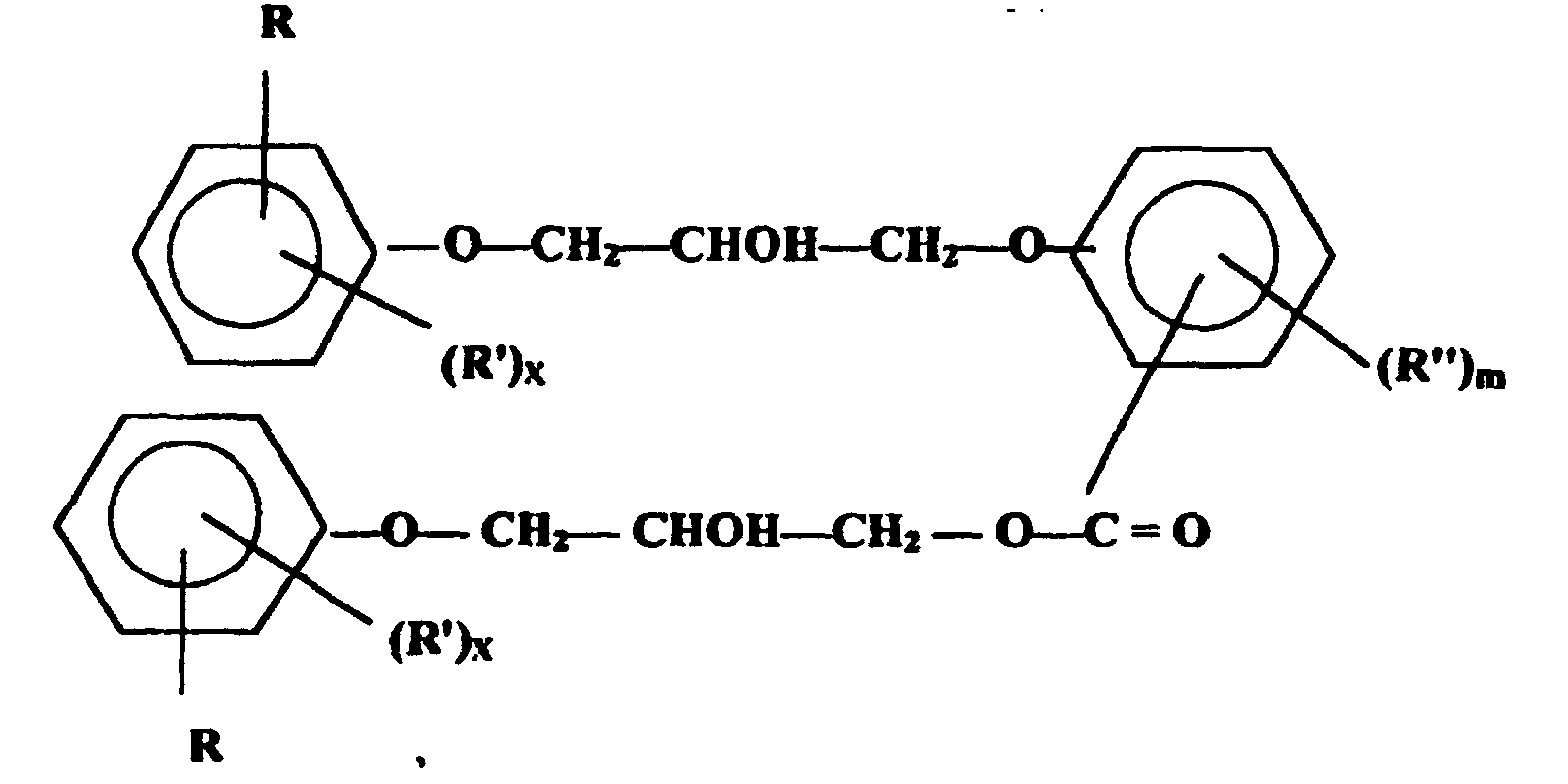
R einen Rest der allgemeinen Formel II

x eine ganze Zahl von 0 bis 3,
R" eine Hydroxylgruppe,
m eine ganze Zahl von 0 bis 4,
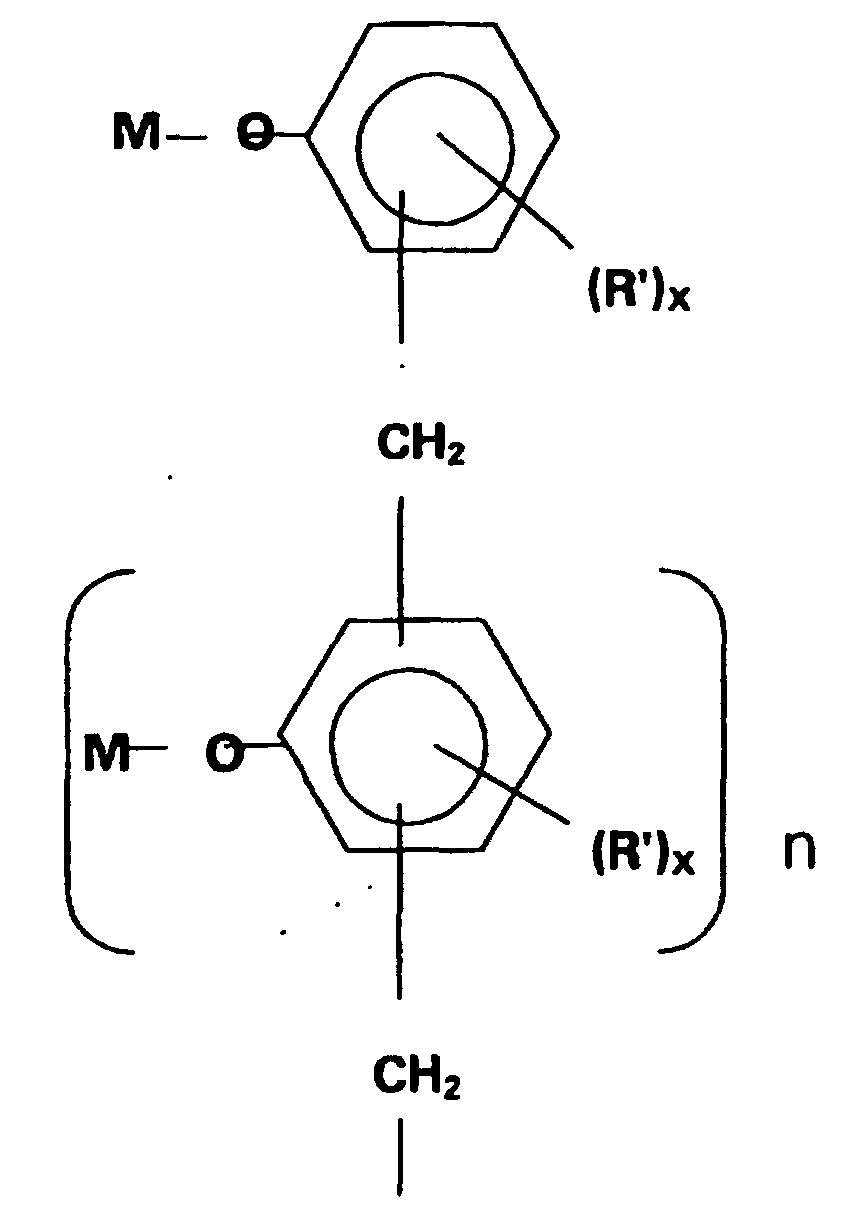
n eine ganze Zahl von 0 bis 300 und
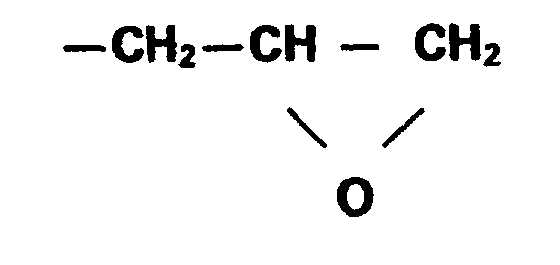
M einen Rest gemäß der Formeln


R1 Wasserstoff oder eine Methylgruppe, und
R2 Wasserstoff oder eine Methyl- oder Phenylgruppe darstellen.
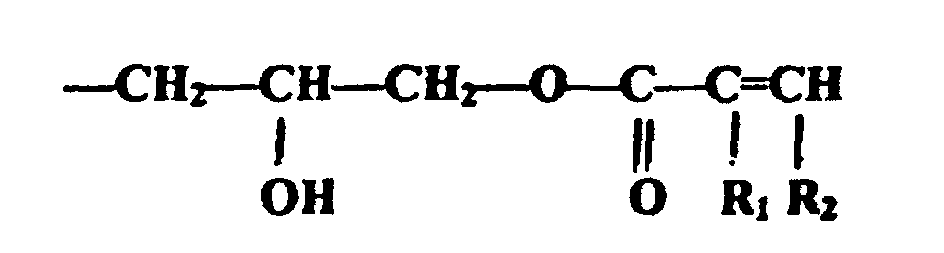
Aufgrund ihrer ethylenisch ungesättigten Gruppen vernetzten sie nach Bestrahlung zu in organischen Lösemitteln nicht mehr löslichen Polymeren. Dadurch sind Photoresistformulierungen, die diese modifizierten Epoxyacrylate enthalten, mit üblichen Lösemitteln und in den üblicherweise angewandten Verfahren entwickelbar.
Die Endvernetzung der vorvernetzten Epoxyacrylate erfolgt durch an sich bekannte thermische Vernetzung der Epoxidgruppen.
Als Epoxynovolake können alle an sich bekannten Umsetzungsprodukte aus in saurem Medium hergestellten Novolaken aus einer phenolischen Verbindung und einem Aldehyd, insbesondere Formaldehyd, mit Epichlorhydrin eingesetzt werden. Phenolische Verbindungen für derartige Novolake sind insbesondere Phenol oder mit Halogen oder C1bis C4-Alkylgruppen substituierte Phenole.
Aromatische Hydroxycarbonsäuren sind insbesondere o- oder p- Hydroxybenzoesäure, Dihydroxybenzoesäure oder Gallussäure. Die bevorzugte aromatische Hydroxycarbonsäure ist die Salicylsäure.
Die erhaltenen Reaktionsprodukte und damit auch die aus ihnen hergestellten Epoxyacrylate enthalten sowohl Ether als auch Esterbindungen.
Als ethylenisch ungesättigte Monocarbonsäuren kommen vor allem Crotonsäure, Zimtsäure, insbesondere aber Acryl- und/oder Methacrylsäure in Betracht. Die Menge der eingesetzten ethylenisch ungesättigten Monocarbonsäure bestimmt dabei die gewünschte photochemische Reaktivität. Für eine reaktive Resistformulierung ist somit eine Mindestmenge an ethylenisch ungesättigten Gruppen im modifizierten Epoxyacrylat notwendig. Diese liegt etwa bei 10% der Epoxygruppen der Reaktionsprodukte. Für die abschließende thermische Vernetzung der modifizierten Epoxyacrylate sind andererseits noch mindestens 10 % der ursprünglich vorhandenen Epoxidgruppen im Molekül notwendig. Daher wird die Menge an ethylenisch ungesättigter Monocarbonsäure so gewählt, daß sie stöchiometrisch 10 bis 90 % der Epoxidgruppen der eingesetzten Reaktionsprodukte aus Epoxynovolak und aromatischer Hydroxycarbonsäure entspricht.
Als Carbonsäureanhydride für diese Reaktion eignen sich die Anhydride gesättigter oder ungesättigter aliphatischer oder aromatischer mehrwertiger Carbonsäuren sowie Gemische mehrerer Anhydride. Beispiele sind die Anhydride der Phthal-, Tetrahydrophthal-, Hexahydrophthal-, Malein-, Malon-, Bernstein-, Glutar-, Adipin-, Itacon-, Trimellith-, Pyromellith- oder Benzophenontetracarbonsäure. Das bevorzugte Anhydrid ist das Methyltetrahydrophthalsäureanhydrid.
Das Reaktionsgemisch wird unter Rühren und Lufteinleitung weiter bei 90°C gehalten, bis es eine Säurezahl von <5mg KOH/g aufweist. Es entsteht ein modifiziertes Epoxyacrylat, dessen Feststoffanteil auf 65% eingestellt wird.
Claims (8)
- Epoxyacrylate der allgemeinen Formel Iworin
- R
- einen Rest der allgemeinen Formel II

- R'
- eine C1-C4 Alkylgruppe oder ein Halogenrest,
- x
- eine ganze Zahl von 0 bis 3,
- R"
- eine Hydroxylgruppe,
- m
- eine ganze Zahl von 0 bis 4,
- n
- eine ganze Zahl von 0 bis 300 und
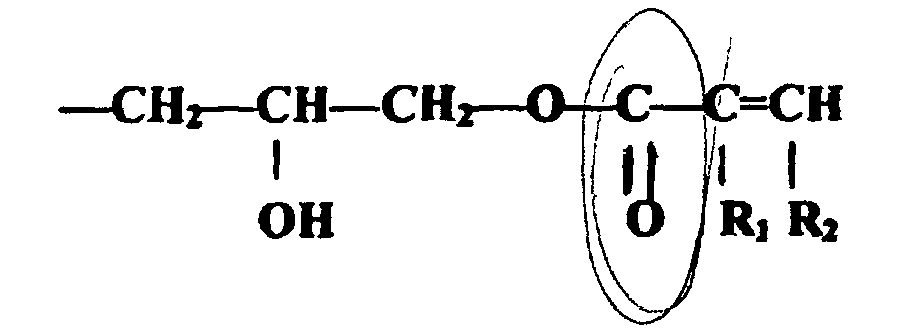
- M einen Rest gemäß der Formeln
- und/oder

- R1
- Wasserstoff oder eine Methylgruppe, und
- R2
- Wasserstoff oder eine Methyl- oder Phenylgruppe darstellen.
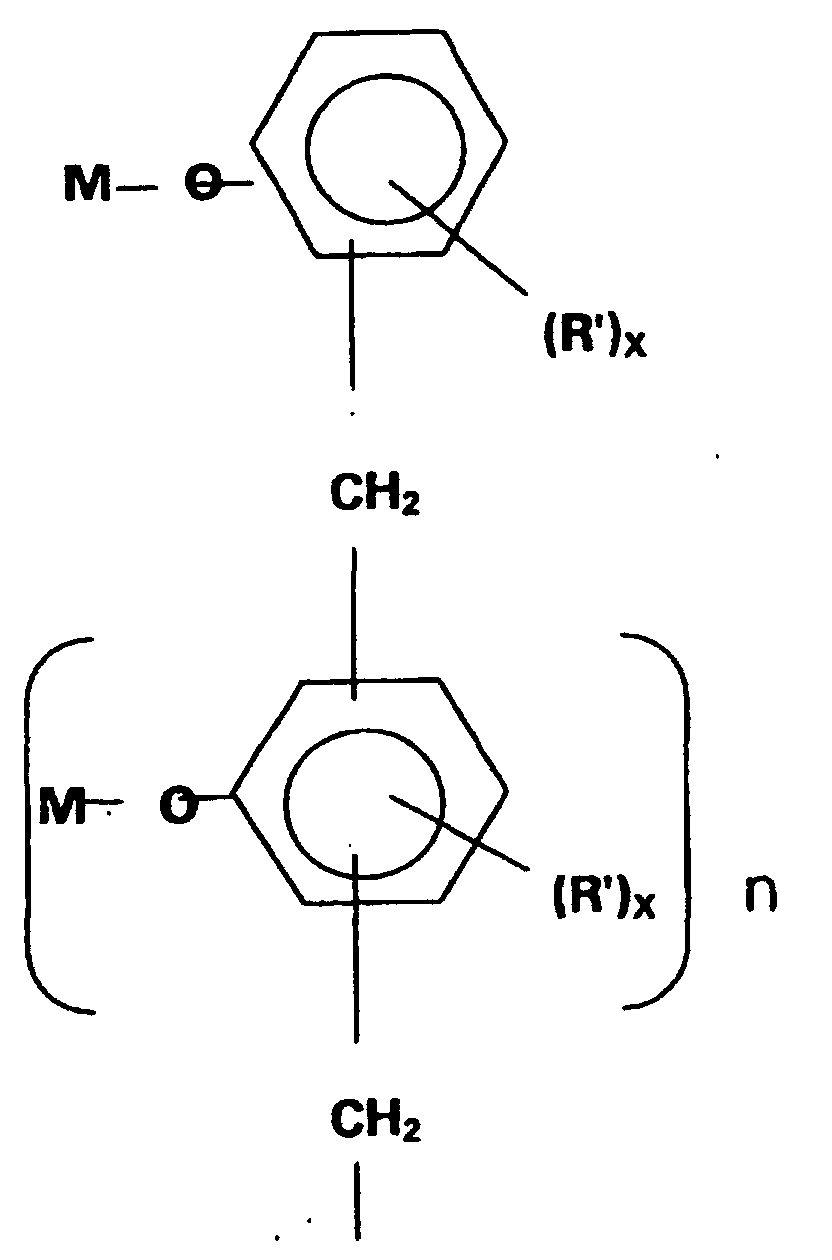
- Epoxyacrylate der allgemeinen Formelworin

- R
- einen Rest der allgemeinen Formel II
- R'
- eine C1-C4 Alkylgruppe oder ein Halogenrest,
- x
- eine ganze Zahl von 0 bis 3,
- R"
- eine Hydroxylgruppe,
- m
- eine ganze Zahl von 0 bis 4,
- n
- eine ganze Zahl von 0 bis 300 und
haben, worin
- R1
- Wasserstoff oder eine Methylgruppe, und
- R2
- Wasserstoff oder eine Methyl- oder Phenylgruppe darstellen.
- Epoxyacrylate der allgemeinen Formel Iworin
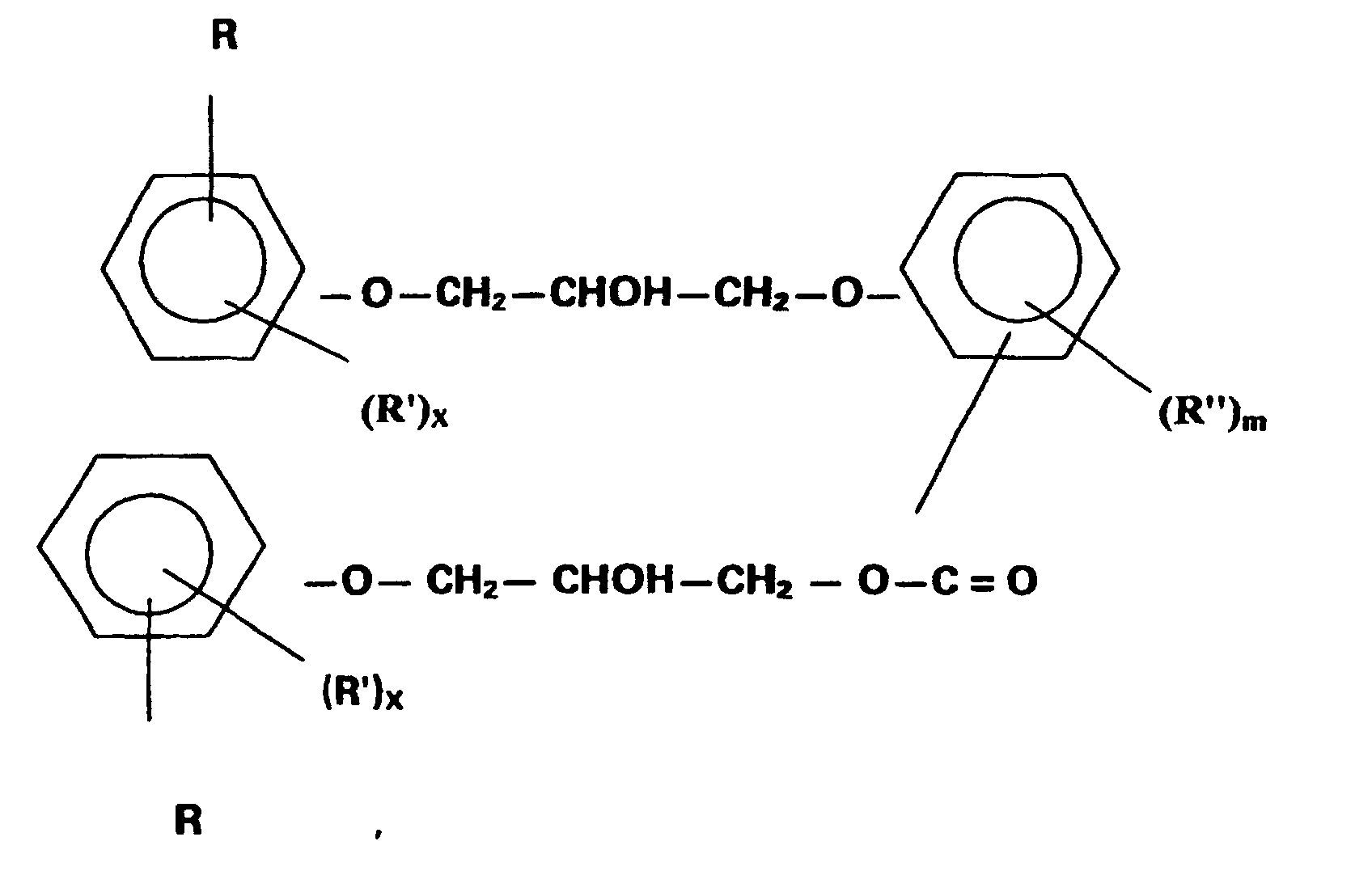
- R
- einen Rest der allgemeinen Formel II
- R'
- eine C1-C4 Alkylgruppe oder ein Halogenrest,
- x
- eine ganze Zahl von 0 bis 3,
- R"
- eine Hydroxylgruppe,
- m
- eine ganze Zahl von 0 bis 4,
- n
- eine ganze Zahl von 0 bis 300 und
- M
- einen Rest gemäß der Formeln
und/oder

- R1
- Wasserstoff oder eine Methylgruppe, und
- R2
- Wasserstoff oder eine Methyl- oder Phenylgruppe darstellen,
- Verfahren zur Herstellung der Epoxyacrylate gemäß der Ansprüche 1 und 2, dadurch gekennzeichnet, daß epoxidierte Novolake mit einer aromatischen Hydroxycarbonsäure im molaren Verhältnis epoxidierter Novolak zu Hydroxycarbonsäure von 2 : 0,5 bis 2 : 1,5 umgesetzt werden und die resultierenden Produkte mit mindestens 10 Mol% einer ethylenisch ungesättigten Monocarbonsäure umgesetzt werden.
- Verfahren nach Anspruch 4, dadurch gekennzeichnet, daß epoxidierte Novolake mit einer aromatischen Hydroxycarbonsäure im molaren Verhältnis epoxidierter Novolak zu Hydroxycarbonsäure von 2 : 1 umgesetzt werden und die resultierenden Produkte mit mindestens 10 Mol% einer ethylenisch ungesättigten Monocarbonsäure umgesetzt werden.
- Verfahren zur Herstellung der Epoxyacrylate gemäß Anspruch 3, dadurch gekennzeichnet, daß Epoxyacrylate gemäß der Ansprüche 1 oder 2 mit einem Säuranhydrid einer mehrwertigen Carbonsäure verestert werden, wobei die Menge an Carbonsäureanhydrid 50 bis 100% der stöchiometrischen Menge beträgt, die der Summe aller Hydroxylgruppen entspricht.
- Verfahren nach Anspruch 6, dadurch gekennzeichnet, daß das Carbonsäureanhydrid Methyltetrahydrophthalsäureanhydrid ist.
- Verwendung der Epoxyacrylate gemäß der Ansprüche 1 bis 3 in Photoresistformulierungen.
Applications Claiming Priority (2)
| Application Number | Priority Date | Filing Date | Title |
|---|---|---|---|
| DE10223313 | 2002-05-24 | ||
| DE10223313A DE10223313A1 (de) | 2002-05-24 | 2002-05-24 | Modifizierte Epoxyacrylate |
Publications (2)
| Publication Number | Publication Date |
|---|---|
| EP1364978A1 EP1364978A1 (de) | 2003-11-26 |
| EP1364978B1 true EP1364978B1 (de) | 2005-06-01 |
Family
ID=29285693
Family Applications (1)
| Application Number | Title | Priority Date | Filing Date |
|---|---|---|---|
| EP03009577A Expired - Lifetime EP1364978B1 (de) | 2002-05-24 | 2003-04-29 | Modifizierte Epoxyacrylate |
Country Status (3)
| Country | Link |
|---|---|
| EP (1) | EP1364978B1 (de) |
| AT (1) | ATE296847T1 (de) |
| DE (2) | DE10223313A1 (de) |
Cited By (1)
| Publication number | Priority date | Publication date | Assignee | Title |
|---|---|---|---|---|
| KR100755083B1 (ko) | 2006-06-02 | 2007-09-06 | 한학수 | 액정패널용 실란트 조성물 및 액정패널 |
Families Citing this family (3)
| Publication number | Priority date | Publication date | Assignee | Title |
|---|---|---|---|---|
| DE102008004112A1 (de) | 2008-01-11 | 2009-07-16 | Saertex Gmbh & Co. Kg | Textiles Halbzeug mit wenigstens einer mit einem Kleber versehenen Oberfläche |
| CN108164686B (zh) * | 2018-02-01 | 2020-01-21 | 江南大学 | 一种改性环氧丙烯酸酯、含该改性环氧丙烯酸酯的阻焊剂 |
| TWI854568B (zh) * | 2023-03-31 | 2024-09-01 | 國立中興大學 | 一種具有單酯基的環氧樹脂、其製備方法、其環氧固化物的製備及降解 |
Family Cites Families (5)
| Publication number | Priority date | Publication date | Assignee | Title |
|---|---|---|---|---|
| DE1618729A1 (de) * | 1966-03-10 | 1972-03-30 | North American Aviation Inc | Verfahren zur Herstellung eines photopolymerisierbaren Epoxydharzes |
| JPS61243869A (ja) * | 1985-04-19 | 1986-10-30 | Taiyo Ink Seizo Kk | レジストインキ組成物 |
| KR0126118B1 (ko) * | 1992-09-10 | 1997-12-18 | 다나카 쇼소 | 솔더레지스트용 잉크조성물 |
| TW268011B (de) * | 1993-07-02 | 1996-01-11 | Ciba Geigy | |
| TW270123B (de) * | 1993-07-02 | 1996-02-11 | Ciba Geigy |
-
2002
- 2002-05-24 DE DE10223313A patent/DE10223313A1/de not_active Withdrawn
-
2003
- 2003-04-29 DE DE50300591T patent/DE50300591D1/de not_active Expired - Lifetime
- 2003-04-29 AT AT03009577T patent/ATE296847T1/de not_active IP Right Cessation
- 2003-04-29 EP EP03009577A patent/EP1364978B1/de not_active Expired - Lifetime
Cited By (1)
| Publication number | Priority date | Publication date | Assignee | Title |
|---|---|---|---|---|
| KR100755083B1 (ko) | 2006-06-02 | 2007-09-06 | 한학수 | 액정패널용 실란트 조성물 및 액정패널 |
Also Published As
| Publication number | Publication date |
|---|---|
| ATE296847T1 (de) | 2005-06-15 |
| EP1364978A1 (de) | 2003-11-26 |
| DE10223313A1 (de) | 2003-12-11 |
| DE50300591D1 (de) | 2005-07-07 |
Similar Documents
| Publication | Publication Date | Title |
|---|---|---|
| DE2145935C3 (de) | ||
| EP0126341B1 (de) | Verfahren zur Herstellung von (Meth)-acrylsäureestern und deren Verwendung | |
| DE3789464T2 (de) | Lactonacrylat mit Carboxyl als Endgruppe. | |
| DE2643701A1 (de) | Ueberzugszusammensetzung | |
| EP0127766A1 (de) | Verfahren zur Herstellung von (Meth)Acrylsäureestern und deren Verwendung | |
| DE4040290A1 (de) | Verfahren zur herstellung von acryloyl-funktionellen polyestern (polyesteracrylaten) | |
| EP0632078B1 (de) | Epoxyacrylate | |
| DE68913130T2 (de) | Pulverbeschichtungszusammensetzung. | |
| EP0471151B1 (de) | Durch Strahlung vernetzbare Bindemittelgemische | |
| DE2907997C2 (de) | Verfahren zur Herstellung von härtbaren Copolymeren | |
| EP0254722B1 (de) | Härtbare zusammensetzung | |
| EP0101864B1 (de) | Ungesättigte, homo- und/oder copolymerisierbare Polyester, Verfahren zu ihrer Herstellung und ihre Verwendung | |
| EP0921168A1 (de) | Strahlungshärtbare Massen auf Basis von Epoxid(meth)acrylaten | |
| EP1364978A1 (de) | Modifizierte Epoxyacrylate | |
| EP2177568B1 (de) | Imprägnierharz | |
| EP1103540B1 (de) | Vinylester mit hoher Vernetzungsdichte. Verfahren zu ihrer Herstellung und Verwendung | |
| EP2655468A1 (de) | Epoxidharz-zusammensetzungen enthaltend epoxy- und vinylestergruppen | |
| EP0982339B1 (de) | Strahlenhärtbare wasserlösliche Polyesterharz-Zusammensetzungen mit hohem Feststoffanteil | |
| DE19620351A1 (de) | Überzugsmittel auf der Basis von ungesättigten Polyesterharzen | |
| EP0738741A2 (de) | Epoxy(meth)acrylate, ein Verfahren zu ihrer Herstellung und ihre Verwendung | |
| DD150065A5 (de) | Verfahren zur herstellung von polyesterimiden und deren verwendung | |
| DE2407301B2 (de) | Härtbare Beschichtungszusammensetzung und Verfahren zu ihrer Herstellung | |
| DE19939738A1 (de) | Verfahren zur Herstellung von lagerstabilen modifizierten cycloaliphatischen Epoxidharzen und deren Verwendung | |
| EP1422564A1 (de) | Lichtempfindliches wärmehärtbares Harz und Lötstoppresisttintezusammensetzung, die dieses Harz enthält | |
| EP0816412B1 (de) | Verfahren zur Herstellung von Epoxy(meth)acrylaten |
Legal Events
| Date | Code | Title | Description |
|---|---|---|---|
| PUAI | Public reference made under article 153(3) epc to a published international application that has entered the european phase |
Free format text: ORIGINAL CODE: 0009012 |
|
| AK | Designated contracting states |
Kind code of ref document: A1 Designated state(s): AT BE BG CH CY CZ DE DK EE ES FI FR GB GR HU IE IT LI LU MC NL PT RO SE SI SK TR |
|
| AX | Request for extension of the european patent |
Extension state: AL LT LV MK |
|
| 17P | Request for examination filed |
Effective date: 20040526 |
|
| 17Q | First examination report despatched |
Effective date: 20040628 |
|
| AKX | Designation fees paid |
Designated state(s): AT BE BG CH CY CZ DE DK EE ES FI FR GB GR HU IE IT LI LU MC NL PT RO SE SI SK TR |
|
| GRAP | Despatch of communication of intention to grant a patent |
Free format text: ORIGINAL CODE: EPIDOSNIGR1 |
|
| GRAS | Grant fee paid |
Free format text: ORIGINAL CODE: EPIDOSNIGR3 |
|
| GRAA | (expected) grant |
Free format text: ORIGINAL CODE: 0009210 |
|
| AK | Designated contracting states |
Kind code of ref document: B1 Designated state(s): AT BE BG CH CY CZ DE DK EE ES FI FR GB GR HU IE IT LI LU MC NL PT RO SE SI SK TR |
|
| PG25 | Lapsed in a contracting state [announced via postgrant information from national office to epo] |
Ref country code: IT Free format text: LAPSE BECAUSE OF FAILURE TO SUBMIT A TRANSLATION OF THE DESCRIPTION OR TO PAY THE FEE WITHIN THE PRESCRIBED TIME-LIMIT;WARNING: LAPSES OF ITALIAN PATENTS WITH EFFECTIVE DATE BEFORE 2007 MAY HAVE OCCURRED AT ANY TIME BEFORE 2007. THE CORRECT EFFECTIVE DATE MAY BE DIFFERENT FROM THE ONE RECORDED. Effective date: 20050601 Ref country code: GB Free format text: LAPSE BECAUSE OF FAILURE TO SUBMIT A TRANSLATION OF THE DESCRIPTION OR TO PAY THE FEE WITHIN THE PRESCRIBED TIME-LIMIT Effective date: 20050601 Ref country code: FI Free format text: LAPSE BECAUSE OF FAILURE TO SUBMIT A TRANSLATION OF THE DESCRIPTION OR TO PAY THE FEE WITHIN THE PRESCRIBED TIME-LIMIT Effective date: 20050601 Ref country code: SI Free format text: LAPSE BECAUSE OF FAILURE TO SUBMIT A TRANSLATION OF THE DESCRIPTION OR TO PAY THE FEE WITHIN THE PRESCRIBED TIME-LIMIT Effective date: 20050601 Ref country code: RO Free format text: LAPSE BECAUSE OF FAILURE TO SUBMIT A TRANSLATION OF THE DESCRIPTION OR TO PAY THE FEE WITHIN THE PRESCRIBED TIME-LIMIT Effective date: 20050601 Ref country code: IE Free format text: LAPSE BECAUSE OF FAILURE TO SUBMIT A TRANSLATION OF THE DESCRIPTION OR TO PAY THE FEE WITHIN THE PRESCRIBED TIME-LIMIT Effective date: 20050601 Ref country code: CZ Free format text: LAPSE BECAUSE OF FAILURE TO SUBMIT A TRANSLATION OF THE DESCRIPTION OR TO PAY THE FEE WITHIN THE PRESCRIBED TIME-LIMIT Effective date: 20050601 Ref country code: SK Free format text: LAPSE BECAUSE OF FAILURE TO SUBMIT A TRANSLATION OF THE DESCRIPTION OR TO PAY THE FEE WITHIN THE PRESCRIBED TIME-LIMIT Effective date: 20050601 Ref country code: NL Free format text: LAPSE BECAUSE OF FAILURE TO SUBMIT A TRANSLATION OF THE DESCRIPTION OR TO PAY THE FEE WITHIN THE PRESCRIBED TIME-LIMIT Effective date: 20050601 |
|
| REG | Reference to a national code |
Ref country code: GB Ref legal event code: FG4D Free format text: NOT ENGLISH |
|
| REG | Reference to a national code |
Ref country code: CH Ref legal event code: EP |
|
| REF | Corresponds to: |
Ref document number: 50300591 Country of ref document: DE Date of ref document: 20050707 Kind code of ref document: P |
|
| REG | Reference to a national code |
Ref country code: IE Ref legal event code: FG4D Free format text: LANGUAGE OF EP DOCUMENT: GERMAN |
|
| PG25 | Lapsed in a contracting state [announced via postgrant information from national office to epo] |
Ref country code: BG Free format text: LAPSE BECAUSE OF FAILURE TO SUBMIT A TRANSLATION OF THE DESCRIPTION OR TO PAY THE FEE WITHIN THE PRESCRIBED TIME-LIMIT Effective date: 20050901 Ref country code: DK Free format text: LAPSE BECAUSE OF FAILURE TO SUBMIT A TRANSLATION OF THE DESCRIPTION OR TO PAY THE FEE WITHIN THE PRESCRIBED TIME-LIMIT Effective date: 20050901 Ref country code: SE Free format text: LAPSE BECAUSE OF FAILURE TO SUBMIT A TRANSLATION OF THE DESCRIPTION OR TO PAY THE FEE WITHIN THE PRESCRIBED TIME-LIMIT Effective date: 20050901 Ref country code: GR Free format text: LAPSE BECAUSE OF FAILURE TO SUBMIT A TRANSLATION OF THE DESCRIPTION OR TO PAY THE FEE WITHIN THE PRESCRIBED TIME-LIMIT Effective date: 20050901 |
|
| PG25 | Lapsed in a contracting state [announced via postgrant information from national office to epo] |
Ref country code: ES Free format text: LAPSE BECAUSE OF FAILURE TO SUBMIT A TRANSLATION OF THE DESCRIPTION OR TO PAY THE FEE WITHIN THE PRESCRIBED TIME-LIMIT Effective date: 20050912 |
|
| RAP2 | Party data changed (patent owner data changed or rights of a patent transferred) |
Owner name: HEXION SPECIALTY CHEMICALS GMBH |
|
| PG25 | Lapsed in a contracting state [announced via postgrant information from national office to epo] |
Ref country code: PT Free format text: LAPSE BECAUSE OF FAILURE TO SUBMIT A TRANSLATION OF THE DESCRIPTION OR TO PAY THE FEE WITHIN THE PRESCRIBED TIME-LIMIT Effective date: 20051107 |
|
| NLV1 | Nl: lapsed or annulled due to failure to fulfill the requirements of art. 29p and 29m of the patents act | ||
| PG25 | Lapsed in a contracting state [announced via postgrant information from national office to epo] |
Ref country code: HU Free format text: LAPSE BECAUSE OF FAILURE TO SUBMIT A TRANSLATION OF THE DESCRIPTION OR TO PAY THE FEE WITHIN THE PRESCRIBED TIME-LIMIT Effective date: 20051202 |
|
| GBV | Gb: ep patent (uk) treated as always having been void in accordance with gb section 77(7)/1977 [no translation filed] |
Effective date: 20050601 |
|
| REG | Reference to a national code |
Ref country code: IE Ref legal event code: FD4D |
|
| PLBE | No opposition filed within time limit |
Free format text: ORIGINAL CODE: 0009261 |
|
| STAA | Information on the status of an ep patent application or granted ep patent |
Free format text: STATUS: NO OPPOSITION FILED WITHIN TIME LIMIT |
|
| PG25 | Lapsed in a contracting state [announced via postgrant information from national office to epo] |
Ref country code: AT Free format text: LAPSE BECAUSE OF NON-PAYMENT OF DUE FEES Effective date: 20060429 |
|
| PG25 | Lapsed in a contracting state [announced via postgrant information from national office to epo] |
Ref country code: MC Free format text: LAPSE BECAUSE OF NON-PAYMENT OF DUE FEES Effective date: 20060430 Ref country code: BE Free format text: LAPSE BECAUSE OF NON-PAYMENT OF DUE FEES Effective date: 20060430 |
|
| 26N | No opposition filed |
Effective date: 20060302 |
|
| EN | Fr: translation not filed | ||
| REG | Reference to a national code |
Ref country code: CH Ref legal event code: PL |
|
| BERE | Be: lapsed |
Owner name: BAKELITE A.G. Effective date: 20060430 |
|
| PG25 | Lapsed in a contracting state [announced via postgrant information from national office to epo] |
Ref country code: CH Free format text: LAPSE BECAUSE OF NON-PAYMENT OF DUE FEES Effective date: 20070430 Ref country code: LI Free format text: LAPSE BECAUSE OF NON-PAYMENT OF DUE FEES Effective date: 20070430 |
|
| PG25 | Lapsed in a contracting state [announced via postgrant information from national office to epo] |
Ref country code: EE Free format text: LAPSE BECAUSE OF FAILURE TO SUBMIT A TRANSLATION OF THE DESCRIPTION OR TO PAY THE FEE WITHIN THE PRESCRIBED TIME-LIMIT Effective date: 20050601 |
|
| PG25 | Lapsed in a contracting state [announced via postgrant information from national office to epo] |
Ref country code: LU Free format text: LAPSE BECAUSE OF NON-PAYMENT OF DUE FEES Effective date: 20060429 Ref country code: TR Free format text: LAPSE BECAUSE OF FAILURE TO SUBMIT A TRANSLATION OF THE DESCRIPTION OR TO PAY THE FEE WITHIN THE PRESCRIBED TIME-LIMIT Effective date: 20050601 |
|
| PG25 | Lapsed in a contracting state [announced via postgrant information from national office to epo] |
Ref country code: CY Free format text: LAPSE BECAUSE OF FAILURE TO SUBMIT A TRANSLATION OF THE DESCRIPTION OR TO PAY THE FEE WITHIN THE PRESCRIBED TIME-LIMIT Effective date: 20050601 Ref country code: FR Free format text: LAPSE BECAUSE OF FAILURE TO SUBMIT A TRANSLATION OF THE DESCRIPTION OR TO PAY THE FEE WITHIN THE PRESCRIBED TIME-LIMIT Effective date: 20050601 |
|
| REG | Reference to a national code |
Ref country code: DE Ref legal event code: R081 Ref document number: 50300591 Country of ref document: DE Owner name: MOMENTIVE SPECIALTY CHEMICALS GMBH, DE Free format text: FORMER OWNER: HEXION SPECIALTY CHEMICALS GMBH, 58642 ISERLOHN, DE Effective date: 20110322 Ref country code: DE Ref legal event code: R081 Ref document number: 50300591 Country of ref document: DE Owner name: HEXION GMBH, DE Free format text: FORMER OWNER: HEXION SPECIALTY CHEMICALS GMBH, 58642 ISERLOHN, DE Effective date: 20110322 |
|
| REG | Reference to a national code |
Ref country code: DE Ref legal event code: R081 Ref document number: 50300591 Country of ref document: DE Owner name: HEXION GMBH, DE Free format text: FORMER OWNER: MOMENTIVE SPECIALTY CHEMICALS GMBH, 58642 ISERLOHN, DE Effective date: 20150212 |
|
| REG | Reference to a national code |
Ref country code: DE Ref legal event code: R081 Ref document number: 50300591 Country of ref document: DE Owner name: HEXION GERMANY GMBH, DE Free format text: FORMER OWNER: HEXION GMBH, 58642 ISERLOHN, DE |
|
| PGFP | Annual fee paid to national office [announced via postgrant information from national office to epo] |
Ref country code: DE Payment date: 20220427 Year of fee payment: 20 |
|
| REG | Reference to a national code |
Ref country code: DE Ref legal event code: R071 Ref document number: 50300591 Country of ref document: DE |