EP1365236A2 - Cellule, dispositif et procédé pour déterminer le contenu d'une matière étrangère dans un fluide - Google Patents
Cellule, dispositif et procédé pour déterminer le contenu d'une matière étrangère dans un fluide Download PDFInfo
- Publication number
- EP1365236A2 EP1365236A2 EP20030005925 EP03005925A EP1365236A2 EP 1365236 A2 EP1365236 A2 EP 1365236A2 EP 20030005925 EP20030005925 EP 20030005925 EP 03005925 A EP03005925 A EP 03005925A EP 1365236 A2 EP1365236 A2 EP 1365236A2
- Authority
- EP
- European Patent Office
- Prior art keywords
- measuring
- liquid
- measuring chamber
- determining
- measured
- Prior art date
- Legal status (The legal status is an assumption and is not a legal conclusion. Google has not performed a legal analysis and makes no representation as to the accuracy of the status listed.)
- Withdrawn
Links
Images


Classifications
-
- G—PHYSICS
- G01—MEASURING; TESTING
- G01N—INVESTIGATING OR ANALYSING MATERIALS BY DETERMINING THEIR CHEMICAL OR PHYSICAL PROPERTIES
- G01N35/00—Automatic analysis not limited to methods or materials provided for in any single one of groups G01N1/00 - G01N33/00; Handling materials therefor
- G01N35/10—Devices for transferring samples or any liquids to, in, or from, the analysis apparatus, e.g. suction devices, injection devices
- G01N35/1095—Devices for transferring samples or any liquids to, in, or from, the analysis apparatus, e.g. suction devices, injection devices for supplying the samples to flow-through analysers
- G01N35/1097—Devices for transferring samples or any liquids to, in, or from, the analysis apparatus, e.g. suction devices, injection devices for supplying the samples to flow-through analysers characterised by the valves
-
- G—PHYSICS
- G01—MEASURING; TESTING
- G01N—INVESTIGATING OR ANALYSING MATERIALS BY DETERMINING THEIR CHEMICAL OR PHYSICAL PROPERTIES
- G01N13/00—Investigating surface or boundary effects, e.g. wetting power; Investigating diffusion effects; Analysing materials by determining surface, boundary, or diffusion effects
- G01N13/02—Investigating surface tension of liquids
-
- G—PHYSICS
- G01—MEASURING; TESTING
- G01N—INVESTIGATING OR ANALYSING MATERIALS BY DETERMINING THEIR CHEMICAL OR PHYSICAL PROPERTIES
- G01N15/00—Investigating characteristics of particles; Investigating permeability, pore-volume or surface-area of porous materials
- G01N15/06—Investigating concentration of particle suspensions
-
- G—PHYSICS
- G01—MEASURING; TESTING
- G01N—INVESTIGATING OR ANALYSING MATERIALS BY DETERMINING THEIR CHEMICAL OR PHYSICAL PROPERTIES
- G01N29/00—Investigating or analysing materials by the use of ultrasonic, sonic or infrasonic waves; Visualisation of the interior of objects by transmitting ultrasonic or sonic waves through the object
- G01N29/02—Analysing fluids
-
- G—PHYSICS
- G01—MEASURING; TESTING
- G01N—INVESTIGATING OR ANALYSING MATERIALS BY DETERMINING THEIR CHEMICAL OR PHYSICAL PROPERTIES
- G01N29/00—Investigating or analysing materials by the use of ultrasonic, sonic or infrasonic waves; Visualisation of the interior of objects by transmitting ultrasonic or sonic waves through the object
- G01N29/22—Details, e.g. general constructional or apparatus details
- G01N29/222—Constructional or flow details for analysing fluids
-
- G—PHYSICS
- G01—MEASURING; TESTING
- G01N—INVESTIGATING OR ANALYSING MATERIALS BY DETERMINING THEIR CHEMICAL OR PHYSICAL PROPERTIES
- G01N29/00—Investigating or analysing materials by the use of ultrasonic, sonic or infrasonic waves; Visualisation of the interior of objects by transmitting ultrasonic or sonic waves through the object
- G01N29/22—Details, e.g. general constructional or apparatus details
- G01N29/32—Arrangements for suppressing undesired influences, e.g. temperature or pressure variations, compensating for signal noise
- G01N29/326—Arrangements for suppressing undesired influences, e.g. temperature or pressure variations, compensating for signal noise compensating for temperature variations
-
- G—PHYSICS
- G01—MEASURING; TESTING
- G01N—INVESTIGATING OR ANALYSING MATERIALS BY DETERMINING THEIR CHEMICAL OR PHYSICAL PROPERTIES
- G01N29/00—Investigating or analysing materials by the use of ultrasonic, sonic or infrasonic waves; Visualisation of the interior of objects by transmitting ultrasonic or sonic waves through the object
- G01N29/44—Processing the detected response signal, e.g. electronic circuits specially adapted therefor
- G01N29/4409—Processing the detected response signal, e.g. electronic circuits specially adapted therefor by comparison
- G01N29/4427—Processing the detected response signal, e.g. electronic circuits specially adapted therefor by comparison with stored values, e.g. threshold values
-
- G—PHYSICS
- G01—MEASURING; TESTING
- G01N—INVESTIGATING OR ANALYSING MATERIALS BY DETERMINING THEIR CHEMICAL OR PHYSICAL PROPERTIES
- G01N33/00—Investigating or analysing materials by specific methods not covered by groups G01N1/00 - G01N31/00
- G01N33/26—Oils; Viscous liquids; Paints; Inks
- G01N33/28—Oils, i.e. hydrocarbon liquids
- G01N33/2894—Oils, i.e. hydrocarbon liquids for metal working or machining
-
- G—PHYSICS
- G01—MEASURING; TESTING
- G01N—INVESTIGATING OR ANALYSING MATERIALS BY DETERMINING THEIR CHEMICAL OR PHYSICAL PROPERTIES
- G01N2291/00—Indexing codes associated with group G01N29/00
- G01N2291/01—Indexing codes associated with the measuring variable
- G01N2291/011—Velocity or travel time
-
- G—PHYSICS
- G01—MEASURING; TESTING
- G01N—INVESTIGATING OR ANALYSING MATERIALS BY DETERMINING THEIR CHEMICAL OR PHYSICAL PROPERTIES
- G01N2291/00—Indexing codes associated with group G01N29/00
- G01N2291/01—Indexing codes associated with the measuring variable
- G01N2291/015—Attenuation, scattering
-
- G—PHYSICS
- G01—MEASURING; TESTING
- G01N—INVESTIGATING OR ANALYSING MATERIALS BY DETERMINING THEIR CHEMICAL OR PHYSICAL PROPERTIES
- G01N2291/00—Indexing codes associated with group G01N29/00
- G01N2291/02—Indexing codes associated with the analysed material
- G01N2291/028—Material parameters
- G01N2291/02818—Density, viscosity
-
- G—PHYSICS
- G01—MEASURING; TESTING
- G01N—INVESTIGATING OR ANALYSING MATERIALS BY DETERMINING THEIR CHEMICAL OR PHYSICAL PROPERTIES
- G01N2291/00—Indexing codes associated with group G01N29/00
- G01N2291/04—Wave modes and trajectories
- G01N2291/045—External reflections, e.g. on reflectors
Definitions
- the invention relates to a measuring chamber, a measuring device and a measuring method to determine the foreign matter content of a liquid.
- the invention continues by determining the concentration of individuals Components in a liquid multi-component system, an entry of water-insoluble components in particular both liquid and solid, such as oils or particles, is of interest.
- Corresponding monitoring alternatives are, for example, from DE 41 36 442 A1, DE 199 06 940 A1 and known from DE 199 27 666 A1.
- DE 41 36 442 A1 one with the dynamic surface tension of a liquid using a correlated value of a bubble tensiometer. Based on this value, then processing of the cleaning liquid and / or replenishment of the cleaning agent.
- DE 199 06 940 A1 discloses a corresponding examination procedure or a suitable one Measuring device in which one of both the detergent concentration as well as the size dependent on the load and at least on the detergent concentration or size dependent on the load and from these quantities a statement about the detergent concentration and / or the load is hit.
- the invention proposes a measuring chamber, a measuring device and a measuring method for determining the foreign matter content of a liquid with the features of the attached main claims.
- the invention proposes a measuring chamber for determining a Foreign matter content of a liquid with a bottom area and a above the upper area, which is characterized by a in the upper Area arranged suction marks. Accordingly the invention also proposes a measuring method for determining the foreign matter content a liquid in which a measured variable in a Measuring chamber is determined and which is characterized in that before Start the measurement with a sample of the liquid to be measured a negative pressure generated in the measuring chamber is conveyed into the measuring chamber becomes.
- the liquid or sample quantity to be measured can be sucked through be transferred very gently into a corresponding measuring chamber. In this way, unnecessary turbulence can in particular Air pockets are avoided, which may be the corresponding Falsify measurement result.
- the inlet opening in the bottom area of the measuring chamber is arranged, a smooth inflow of the liquid to be measured can be guaranteed.
- the inlet opening preferably also serves as an outlet opening.
- the invention proposes a measuring device for determining the Foreign matter content of a liquid, which means for determining of sound properties of the liquid and means for determining the Conductivity, surface tension and / or pH of the liquid includes.
- a measuring device for determining the Foreign matter content of a liquid which means for determining of sound properties of the liquid and means for determining the Conductivity, surface tension and / or pH of the liquid includes.
- the invention proposes cumulatively or alternatively, in which Measuring chamber tempering plates must be provided in order to be as uniform as possible and enable rapid tempering.
- Heating coils or the like are only on the edge of a measuring cell provided that the temperature control of the can cause liquid contained therein.
- the invention Temperature control plates, which in particular in the wall of a corresponding Measuring chamber may be provided or this wall at least partially can form, the time for a tempering can be considerable shortened and ensure a more even temperature control.
- the tempering plates stainless steel, as this material is used for Relatively low cost stable against chemical attacks and yet is relatively good heat conductor.
- Peltier elements are preferably used for tempering, which can be attached to the temperature control plates, for example.
- the temperature control plates can be used both for heating and for heating Serve cooling.
- such elements have been proportionate short response times so that the temperature can be regulated very precisely leaves, which in turn increases the measuring accuracy considerably can.
- the measuring chamber preferably has a housing made of plastic.
- Plastic is a relatively poor heat conductor, so this causes the measuring chamber proportionally to the outside without additional measures is well thermally insulated. This can ensure that with tempering only the liquid itself and a small one Edge area that is in contact with the liquid varies thermally, whereby the total mass to be tempered is reduced and the total duration is reduced for the temperature control.
- a housing made of polyacetals or polyoxymethylene has proven advantageous (POM) proved that this material protects against chemical attacks, for example can start from the liquid itself, relatively is stable.
- the above-described configurations of the measuring chamber are particularly suitable in interaction with the measurement of sound or ultrasonic properties, such as in particular runtime measurements or measurements of the Damping. In this context, they lead in particular to a shortening the measurement duration as well as reliable and reproducible measurement results.
- At least one sound transmitter and / or receiver is preferably behind a membrane provided in one piece with a chamber wall.
- a membrane provided in one piece with a chamber wall.
- the membrane is made with a lower roughness depth than that remaining housings, which further distorts the measurement let reduce.
- the membrane also leads to the corresponding Sound transmitter or receiver not directly with the one to be measured Liquid is in contact and in this way through the liquid cannot be attacked. It is understood that the presence such a membrane also independent of the other features the measuring chamber according to the invention is advantageous.
- a sound reflector in particular a, in the measuring chamber Sound reflector plate provided.
- the sound reflector made of a different material than one behind it Housing wall.
- a Sound reflector made of stainless steel, especially in combination with one Plastic housing provides sufficiently good results.
- such a sound reflector is also independent of the other features present invention can advantageously be used. In particular this can also reduce the number of measuring devices, which can save costs.
- the measuring accuracy for runtime and damping measurements of ultrasound can also be increased cumulatively or alternatively if one Sequence of ultrasonic pulses, for example of 200 individual pulses, for the measurement is introduced into the liquid to be measured. This sequence of pulses can then be subjected to normal statistics.
- the overall evaluation is particularly easy if only measurement results be allowed at a certain time because that time, for example depending on falling below a certain fluctuation range of the measurement results is set.
- the measurements be carried out in conjunction with temperature control processes can the fluctuation or the change of the measured values as an indication for a Temperature change can be evaluated. In this respect, if the fluctuation falls below a previously selected value, it is assumed that the liquid to be measured has the desired temperature is.
- the optical sensor can in particular comprise an optical transmitter and an optical receiver, wherein these elements can also be designed as a unit.
- a simple optical measurement can be, for example, a transmission measurement be made.
- the optical transmitter and the optical receiver a measuring section to be irradiated.
- the transmitter emits the signal
- the receiver registers, for example, in which Intensity the signal arrives.
- disturbances can lie. Especially when flowing in a Liquid is measured, often interfere with the flow entrained Air bubbles the measurement.
- a measuring device or a measuring chamber an alternative is to determine the foreign substance content of a liquid or cumulatively a sensor for measuring intramolecular properties is provided. For example, with high precision from molecular resonances of the mixture to be measured is directly based on the substances present there become.
- the senor does not require direct contact with the one to be measured Liquid. Rather, it can, for example, by optics from the Liquid must be separated, so that this advantage even with optical measurements occurs.
- the sensors can measure the fluid on a molecular level Influence level via microwave excitation or fluorescence excitation. There is no macroscopic intervention in the liquid.
- the molecularly focused measurement also has the advantage that the underlying sizes largely independent of integral properties of the liquid to be measured. Influence as an example Surface tension, temperature, density and others in particular Viscosity-determining variables determine the molecular resonance over large value ranges Not.
- intramolecular measurements such as fluorescence measurements or microwave resonance measurements or other measurements, those with selected constituents of atoms or molecules of the liquid components to be monitored interact, the advantage that external influences, such as air bubbles, temperature or Pressure fluctuations, other liquid components or color changes or the like, little or no impact on the Have measurement result.
- external influences such as air bubbles, temperature or Pressure fluctuations, other liquid components or color changes or the like
- it is used for such measurements in the Usually not necessary macroscopically, for example by taking samples, Temperature change or chemical interventions or titration in which too measure liquid or liquid circuits.
- time-resolved fluorescence measurements especially time-resolved X-ray fluorescence measurements, as these especially largely independent of other physical or chemical Environmental conditions can work.
- the appropriate measurement parameters according to the ones to be checked Particles determined beforehand, before actually taking online measurements be performed.
- Such intramolecular measurements such as fluorescence measurements, X-ray fluorescence measurements or microwave resonance measurements or other measurements, those with selected constituents of atoms or molecules of those to be monitored Liquid components interact, whether time-resolved or not, also for the determination of surface contamination with appropriate Liquids can be used, with a corresponding one Excitation beam guided over the surfaces to be checked can be.
- the same measurement parameters in particular, can be used here also found for flowing samples as selective for the measurement, as Measurement parameters can be used for surface testing.
- a laser can be radiated into a fiber that conducts laser light which lies in the mixture to be measured and at least partially there is not covered. Due to the light emission directly from the fiber into the Mixture affect the optical properties of the mixture in one Interaction of the laser light in the fiber. Depending on the ones to be measured Mixture present substances and the corresponding physical Molecular properties is irradiated at different wavelengths Laser light to determine a different molecular resonance.
- a receiver determines the intensity spectrum of the fiber emerging Laser light and compares it with the absorption line of a molecule, whose concentration is to be determined. From the change in intensity of the laser light emerging from the fiber can affect the concentration of the respective molecule in the area around the uncovered section the fiber are closed.
- the receiver can also use the fluorescent radiation emanating from the mixture at least two time intervals after a laser light pulse record the ratio between the measurement signals recorded in the intervals calculate and this with known for different concentrations Compare fluorescence decay curves to determine the concentration in Determine mixture.
- the sensors are preferably in a flow through the entire line Measuring arrangement provided. While it makes sense to take measurements so far to be carried out as possible on a stationary medium. This is how the DE beats 195 07 119 C2 that pulsed laser radiation onto a stationary sample in directed into a vessel and the fluorescence radiation is measured. In reverse of these, however, it turned out to be advantageous, the measurement in or on a current. So at first it is observed less often that substances accumulate in the measuring area, which then the measurement results can influence and falsify. In addition, the homogeneity decreases mixing in a standing sample tends to decrease.
- a homogenizing device can therefore advantageously be used to achieve thorough mixing be provided in the flow-through line.
- the sensors flow in a sideline are arranged.
- the sideline for example a branched one and pipe running parallel to the primary line, can be as small as possible Influence on the flow in the primary line also strongly on the flow be influenced.
- Such a bypass can even be completely closed , for example for taking reference samples or for rinsing or Cleaning purposes.
- means for speed adjustment can also be used in the flow through the line can be provided.
- Methods of fluorescence radiation detection are, for example Time intervals of a few hundred nanoseconds are required. So it has to be ensured be that the flowing mixture in its middle or preferably greatest local flow velocity within this period cannot flow completely through the measuring range.
- speed adjustment can therefore, for example, if the pipe flow is too fast a cross-sectional widening of the conduit can be made.
- an optical sensor can be used or a sensor for measuring intramolecular properties also non-invasive be arranged on a window, which is in particular in a The wall of the liquid line or a container nestles flush.
- the measurement can also be non-invasive on a free-mirror line or the liquid level of the mixture in a vessel become.
- a cleaning agent is required Consumer 1 via a supply pump 2 with cleaning liquid supplied from a central supply 3.
- the consumer 1 can, for example a CNC machine or the like.
- the Cleaning liquid which is in a corresponding supply circuit 4 circulates, contaminated on the one hand by foreign matter and on the other hand reduced in terms of their detergent concentration, so that after must be prepared or exchanged for a certain time.
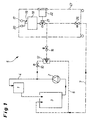
- a measuring device 5 which on the one hand Primary line 6 (shown with a line) and on the other hand a secondary line 7 (shown in broken lines).
- Primary line 6 shown with a line
- secondary line 7 shown in broken lines.
- Both the primary line 6 and the secondary line 7 are in circulation executed. With alternative design variants, however, they can also individually or both lead to disposal.
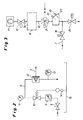
- the primary circuit 6 shown in particular in FIG. 2 comprises in detail behind the inlet of the actual supply circuit 4 manual shut-off device 8, a pressure limiter 9, a safety valve 10, a pressure indicator 11, an analysis filter 12 and a flow warmer 13 before it flows into the central supply 3.
- the safety valve 10 is controlled by a leak warning probe 14, which monitors the escape of liquid into a safety trough 15.
- the secondary line 7 branches off from the primary line 6 on the analysis filter 12. It is shown in detail in FIG. 3.
- the inflow to the secondary line 7 is controlled by a supply valve 16.
- the Liquid to be measured from the secondary circuit 7 by means of a pump 17, preferably by means of a rotary vane pump, into the measuring chamber 18 sucked.
- a valve 19 is located between the measuring chamber 18 and the pump 17 provided that switching between filling and emptying the Measuring chamber.
- the present exemplary embodiment is used for emptying a membrane pump 20, by means of which the located in the measuring chamber Liquid is transferred back to the secondary line 7.
- a changeover valve 21 is also provided, which leads to a calibration unit 22.
- a tempering tank 23 which on the one hand a pre-tempering the liquid to be measured and on the other hand a pH value measurement 24 and Conductivity measurement 25 is used, the latter two measurements by the Temperature control can also be increased in its accuracy.
- the secondary line 7 comprises a discharge valve 26, which in particular can be used in conjunction with the valve 16 through the membrane pump 20 introduced into the secondary line 7 liquid in the to let the desired direction flow.
- the measuring chamber 18 shown in detail in FIGS. 4 and 5 comprises in Essentially a measuring space 27, which is made of a base body 28 made of POM is surrounded, which is arranged via insulation 29 in a housing 30 is.
- the measuring room itself has a diamond-shaped cross-section, such as particularly evident from FIG. 5. This results in a tapering Bottom area 31, so that a corresponding liquid easily can run in or out through a feed line 32.
- the measuring chamber 18 also includes a level sensor 33, which in particular outputs when the measuring space 27 is completely filled and a corresponding one Measurement can be made.
- the measuring room is over a suction line 34 is subjected to a negative pressure or positive pressure, to initiate the desired fluid movement.
- the measuring chamber comprises an ultrasonic sensor 35, which is in active connection with the measuring chamber 27 via a membrane 36, which with a reflector plate 37, which is opposite the ultrasonic sensor, interacts and which by means of an adapter 38 which on a Pressure ring 39 acts in the base body is fixed.
- the membrane 36 is integrally formed with the base body 28 and in the present embodiment about 1mm thick. Your surface was pre-existing Example polished to achieve a small depth. It goes without saying that in an alternative embodiment the ultrasonic sensor, which in the present case serves as both a transmitter and a receiver, can also be arranged in the bottom region 31, and also in this embodiment a reflector plate 37 arranged opposite this sensor should be.
- a temperature sensor 40 projects into the measuring space 27 fastened in the base body 28 by means of a compression fitting 41 is.
- the first expanded measuring chamber in FIG. 5a already has Described an optical sensor 100 or a sensor 100 for Measure intramolecular properties.
- a laser light is conductive optical fiber 101 at right angles to an outside 102 of an optical system 103 introduced.
- the optics 103 are integrated in an optics holder 104 and, like this, is flush with a wall 105 of the measuring space 27.
- the optics holder 104 is not firmly connected to the base body 28, but only screwed with a fiber adapter 106 via a thread 107. By screwing the fiber adapter 106 into the optics holder 104 via the stop of a stop ring 108 on the base body 28 In addition, a sealing ring 109 between the optics holder 104 and the Base body 28 pressed in such that the measuring space 27 is tight against leakage of the liquid to be measured.
- a laser light pulse is generated by the fiber 101 and the optics 103 during operation of the sensor radiated into a measuring area 110 of the measuring space 27.
- the hereby excited fluorescence emission to optics 103 is transmitted outwards this passes through and reaches the fiber 101.
- a receiver unit is connected to the end of the fiber (not shown), which detects and evaluates the light.
- conductive fiber 121 is brought up to an upper side 122 of the measuring space 27 and sealed with an adapter 123 in the base body 28.
- the end horizontal optics 124 form the measuring room.
- the temperature sensor 40 is arranged in the center of the measuring space 27 or alternatively designed so small that it is not in the measuring range under the optics 124 lies.
- the laser light hits the surface of one perpendicularly into the Measuring chamber sucked in liquid and is therefore returned in the best possible way the fiber reflects.
- the fill level sensor 33 can easily be omitted, for example via a transit time measurement of the one emitted and reflected in the measuring space 27 Laser light the distance between the optics 124 and the liquid level can be measured reliably.
- the measuring chamber 18 has temperature control plates 42, which form the side wall of the measuring space 27 and on the outside thereof Peltier elements 43 are provided which interact with heat sinks 44.
- the Peltier elements 43 can be cooled or have a warming effect on the liquid in the measuring space 27.
- heat sinks 44 are operated by means of fans 45 tempered.
- the base body 28 is also with fastening holes 46 the insulation 29 or the housing 30 connected.
- the measuring device itself is, as shown in FIG. 1, housed in a system cabinet 47, Depending on the specific application, parts of the primary line 6 and the secondary line 7 is provided inside or outside this cabinet could be.
- An evaluation unit 48, a Central control 49 and a screen 50 may be provided.
- the cabinet preferably has an overall temperature control 51, for example a fan, on and includes the safety tub 15.
- the system cabinet 47 can be provided with a chassis 52 his.
- a protective door 53 is preferably provided in the system cabinet 47, through which the calibration unit 22 is accessible.
- the calibration unit 22 preferably has a plurality of vessels 54, which, for example, over Provide suction lances 55 with the calibration medium from measuring chamber 18. This can be done, for example, via a separate pump 56 or via the existing system pump 17 happen anyway, preferably each Suction lance is provided with a corresponding valve 57.
- each vessel 54 has a fill level sensor 58, so that the measuring device can be warned in time if there is not enough calibration fluid is available. This can then easily be refilled through the door 53 are, for security reasons, the opening state of this door 53rd by means of a safety switch 59 or a comparable device is monitored.
- a safety trough 60 is arranged under the calibration device 22, which opens into the safety trough 15, so that calibration fluid after Possibility not to overflow uncontrolled or distributed in the system cabinet can be.
- rinsing systems can be provided by means of whose measuring chambers are rinsed between individual measuring cycles can, so that in particular the measurement results falsify deposits can be avoided.
- optical sensors or sensors for measuring intramolecular properties can also be provided in or on all flow-through lines, in particular in the primary line 6, the secondary line 7 or the non-numbered Feed to the measuring chamber 18.
- These lines can be used at a measuring point for example, an unclad, laser light-conducting fiber in the line be mounted to measure the fluorescence.
- a measuring point for example, an unclad, laser light-conducting fiber in the line be mounted to measure the fluorescence.
- the larger the optical contact area the better the measurement results the fiber with the liquid to be measured.
- Achieving optical contact area can be done in a pipeline, for example arranged a spiral fiber coaxial with the tube his.
- the pipe flow is influenced and on the other hand the fiber in the to be measured Liquid lies so that, for example, substances are found in dead flow areas can attach to the fiber.
- a window in the pipe boundary here in the pipe wall his.
- the window closes on the inside of the tube thereby flush with the pipe wall.
- a window can in particular also have an elongated shape that extends along the pipe direction extends.
- a likewise elongated sensor can be arranged on the tube with which a longer residence time of the flowing molecules in the spatial measuring range can be guaranteed.
- Flow deflectors ensure homogeneous mixing of the flowing liquid are promoted, for example by strengthening the vertebrae and Turbulence.
Landscapes
- Chemical & Material Sciences (AREA)
- Physics & Mathematics (AREA)
- Life Sciences & Earth Sciences (AREA)
- Health & Medical Sciences (AREA)
- Pathology (AREA)
- Analytical Chemistry (AREA)
- Biochemistry (AREA)
- General Health & Medical Sciences (AREA)
- General Physics & Mathematics (AREA)
- Immunology (AREA)
- Engineering & Computer Science (AREA)
- Acoustics & Sound (AREA)
- Dispersion Chemistry (AREA)
- Signal Processing (AREA)
- Chemical Kinetics & Catalysis (AREA)
- General Chemical & Material Sciences (AREA)
- Oil, Petroleum & Natural Gas (AREA)
- Food Science & Technology (AREA)
- Medicinal Chemistry (AREA)
- Investigating Or Analyzing Materials By The Use Of Ultrasonic Waves (AREA)
Applications Claiming Priority (4)
| Application Number | Priority Date | Filing Date | Title |
|---|---|---|---|
| US36479202A | 2002-03-15 | 2002-03-15 | |
| US364792P | 2002-03-15 | ||
| DE10232085 | 2002-07-15 | ||
| DE2002132085 DE10232085A1 (de) | 2002-03-15 | 2002-07-15 | Messkammer, Messgerät und Messverfahren zur Ermittlung des Fremdstoffgehaltes einer Flüssigkeit |
Publications (1)
| Publication Number | Publication Date |
|---|---|
| EP1365236A2 true EP1365236A2 (fr) | 2003-11-26 |
Family
ID=29403606
Family Applications (1)
| Application Number | Title | Priority Date | Filing Date |
|---|---|---|---|
| EP20030005925 Withdrawn EP1365236A2 (fr) | 2002-03-15 | 2003-03-17 | Cellule, dispositif et procédé pour déterminer le contenu d'une matière étrangère dans un fluide |
Country Status (1)
| Country | Link |
|---|---|
| EP (1) | EP1365236A2 (fr) |
Cited By (1)
| Publication number | Priority date | Publication date | Assignee | Title |
|---|---|---|---|---|
| WO2020126457A1 (fr) * | 2018-12-18 | 2020-06-25 | Blaser Swisslube Ag | Procédé et dispositif pour surveiller une émulsion de refroidissement-lubrification |
-
2003
- 2003-03-17 EP EP20030005925 patent/EP1365236A2/fr not_active Withdrawn
Cited By (2)
| Publication number | Priority date | Publication date | Assignee | Title |
|---|---|---|---|---|
| WO2020126457A1 (fr) * | 2018-12-18 | 2020-06-25 | Blaser Swisslube Ag | Procédé et dispositif pour surveiller une émulsion de refroidissement-lubrification |
| EP3964834A1 (fr) * | 2018-12-18 | 2022-03-09 | Blaser Swisslube AG | Procédé et dispositif de supervision d'une émulsion de lubrifiant et refroidissement |
Similar Documents
| Publication | Publication Date | Title |
|---|---|---|
| DE102016105770B4 (de) | Automatisches Analysegerät und Verfahren | |
| DE102011007011B4 (de) | Analysegerät zur automatisierten Bestimmung einer Messgröße einer Flüssigkeitsprobe und Verfahren zur Überwachung einer Messgröße | |
| DE19806559B4 (de) | Verfahren und Vorrichtung zur Behandlung von Geschirr in Spülmaschinen | |
| DE69129937T2 (de) | Trübungsmessung | |
| DE102009028165A1 (de) | Verfahren und Vorrichtung zur automatisierten Bestimmung des chemischen Sauerstoffbedarfs einer Flüssigkeitsprobe | |
| EP2420818B1 (fr) | Procédé et dispositif destinés à la détermination d'une viscosité | |
| EP2138127A1 (fr) | Appareil de nettoyage | |
| EP3964834A1 (fr) | Procédé et dispositif de supervision d'une émulsion de lubrifiant et refroidissement | |
| CN105738287B (zh) | 水质分析仪 | |
| EP2009438B1 (fr) | Procédé et dispositif destinés à la détermination de la teneur en eau d'huiles minérales et de liquides similaires | |
| EP1007934B1 (fr) | Dispositif pour analyser des echantillons de liquides | |
| DE112008003610T5 (de) | Pass-Fail-Tool, um den Verschmutzungsgrad durch Partikel in einem Fluid zu testen | |
| EP1721139B1 (fr) | Vehicule avec ensemble de determination spectroscopique des constituants et des concentrations de composes organiques aptes au pompage et procede | |
| DE102004045816A1 (de) | Vorrichtung und Verfahren zur Untersuchung einer Flüssigkeitsprobe | |
| DE102017104492A1 (de) | Vorrichtung und Verfahren zur Bereitstellung von Reinigungsfluid | |
| DE10209466B4 (de) | Vorrichtung zum fortlaufenden Überwachen und Regeln von Prozesslösung | |
| CH461846A (de) | Verfahren zur Bestimmung des Fettinhaltes von Fettemulsionen, insbesondere Milch | |
| EP1365236A2 (fr) | Cellule, dispositif et procédé pour déterminer le contenu d'une matière étrangère dans un fluide | |
| DE69310895T2 (de) | Beurteilung von flüssigkeitsmerkmalen | |
| EP0843170A2 (fr) | Dispositif pour mesurer la tension de surface de liquides | |
| DE3712377C2 (fr) | ||
| DE10232085A1 (de) | Messkammer, Messgerät und Messverfahren zur Ermittlung des Fremdstoffgehaltes einer Flüssigkeit | |
| DE19544851A1 (de) | Vorrichtung zur Untersuchung von Flüssigkeitsproben | |
| EP1685388B9 (fr) | Dispositif et procede pour analyser un echantillon liquide | |
| DE645431C (de) | Absatzweise arbeitende, selbsttaetige Untersuchungs- und Anzeigevorrichtung fuer Fluessigkeiten |
Legal Events
| Date | Code | Title | Description |
|---|---|---|---|
| PUAI | Public reference made under article 153(3) epc to a published international application that has entered the european phase |
Free format text: ORIGINAL CODE: 0009012 |
|
| AK | Designated contracting states |
Kind code of ref document: A2 Designated state(s): AT BE BG CH CY CZ DE DK EE ES FI FR GB GR HU IE IT LI LU MC NL PT SE SI SK TR |
|
| AX | Request for extension of the european patent |
Extension state: AL LT LV MK RO SI |
|
| STAA | Information on the status of an ep patent application or granted ep patent |
Free format text: STATUS: THE APPLICATION IS DEEMED TO BE WITHDRAWN |
|
| 18D | Application deemed to be withdrawn |
Effective date: 20051001 |