EP1366967A2 - Kommunikationsgestütztes Zugsteuerungssystem und -methode - Google Patents
Kommunikationsgestütztes Zugsteuerungssystem und -methode Download PDFInfo
- Publication number
- EP1366967A2 EP1366967A2 EP03400029A EP03400029A EP1366967A2 EP 1366967 A2 EP1366967 A2 EP 1366967A2 EP 03400029 A EP03400029 A EP 03400029A EP 03400029 A EP03400029 A EP 03400029A EP 1366967 A2 EP1366967 A2 EP 1366967A2
- Authority
- EP
- European Patent Office
- Prior art keywords
- blocks
- information
- track
- control system
- beacon
- Prior art date
- Legal status (The legal status is an assumption and is not a legal conclusion. Google has not performed a legal analysis and makes no representation as to the accuracy of the status listed.)
- Ceased
Links
Images

Classifications
-
- B—PERFORMING OPERATIONS; TRANSPORTING
- B61—RAILWAYS
- B61L—GUIDING RAILWAY TRAFFIC; ENSURING THE SAFETY OF RAILWAY TRAFFIC
- B61L27/00—Central railway traffic control systems; Trackside control; Communication systems specially adapted therefor
- B61L27/20—Trackside control of safe travel of vehicle or train, e.g. braking curve calculation
-
- B—PERFORMING OPERATIONS; TRANSPORTING
- B61—RAILWAYS
- B61L—GUIDING RAILWAY TRAFFIC; ENSURING THE SAFETY OF RAILWAY TRAFFIC
- B61L27/00—Central railway traffic control systems; Trackside control; Communication systems specially adapted therefor
- B61L27/20—Trackside control of safe travel of vehicle or train, e.g. braking curve calculation
- B61L2027/204—Trackside control of safe travel of vehicle or train, e.g. braking curve calculation using Communication-based Train Control [CBTC]
Definitions
- the present invention relates generally to an improved system and method of vehicle control. More specifically, the present invention is directed to a Communications based Train Control (CBTC) system that utilizes low-cost, readily available hardware to control and direct various trains in a safe and efficient manner.
- CBTC Communications based Train Control
- signaling is achieved by dividing each track into sections or "blocks", which is a length of track of defined limits.
- the length of a block is usually determined to be the distance it takes a train, running at full speed, to come to a complete stop under the worst possible conditions.
- Each block is protected by a signal placed at its entrance. If the block is occupied by a train, the signal will display a red “aspect", to instruct the conductor to stop the train. If the section is clear, the signal can show a green or "proceed" aspect.
- a track circuit is typically the mechanism by which the presence of a train in a block is usually detected.
- Many rail-lines with moderate or heavy traffic are equipped with color light signals operated automatically or semiautomatically by track circuits.
- the track circuits detect a train, the signal shows a red aspect. If no train is detected and the circuit is complete and the signal shows a green aspect (or yellow, in a multi-aspect signalled area).
- a low voltage from a battery is applied to one of the running rails in the block and returned via the other rail.
- a relay at the entrance to the section detects the voltage and is energized to connect a separate supply to the green lamp of the signal.
- One known conventional system provides a calculation of the movement within a block by means of a message sent to a central unit from the train about its speed.
- the central unit then performs a distance calculation by multiplying the train's speed by the desired time increment. Accordingly, the speed may be centrally controlled if a collision risk occurs.
- the position within a block of each train By being able to determine, at least approximately, the position within a block of each train, several trains can be permitted into the same block as long as the central surveillance unit, as well as the communication with the train, functions properly.
- the position determinations obtained are so uncertain, that either the blocks must be made very small, so that the calculation must be updated frequently, or the number of allowed trains within the same block must be strictly limited.
- Another known conventional train control system also includes dividing the tracks into blocks where, within each block, movement of the train is determined by means of a rotation meter on the wheels of each train. The position determination within the block is then made centrally by emitting clock pulses that are returned by the train with a delay corresponding to the distance of travel within the block, measured by the rotation meter.
- the passage of each train past a block borderline is reported to the central unit, whereupon information about speed and distance travelled is repeatedly determined.
- the central unit calculates the location of each train within the block and controls the velocity of at least one of the trains to avoid a collision, if two or more, trains are approaching each other.
- the conventional systems require a physical division of the track network into blocks, with installations that, when passed by a mobile unit on each train, trigger the central unit calculation of the distance traveled by means of a repeated exchange of information between the central unit and the mobile units. This results in a requirement for very frequent communication between the central unit and each mobile unit. Should this communication break down, for any reason during a period of time, the security of the position determination is lost. This might indicate that cable-based signal transmission should be chosen for safety reasons. As the methods used for calculation of the distance travelled will necessarily produce a result having considerable tolerances, the blocks must have a limited length unless the safety distances between the trains can be made very long.
- the mentioned systems are primarily applicable to train traffic over longer distances on railway lines, as their traffic generally is not so frequent and the safety distances can be made long. This makes a division of the railway line into blocks of considerable length, and thus of limited number, possible. For urban tramways, however, the conditions are considerably more complicated as dense traffic, as well as strongly varying speeds, is necessary. Under these conditions, the blocks would have to be very short in order for the tolerances of the calculated distance traveled within the block to not risk the safety of the position determination.
- a communications-based train control system has been suggested wherein the concept of dividing the track network into blocks is eliminated and there is thus no indication to a central unit of the passing of each train past block borderlines. Instead, the position within the track network of each train is calculated on-board each train by distance measurements taken during travel. In order for the position determination to be held within close enough tolerances such that dense traffic can be permitted without safety risks, a calibration of the position determination process is performed over a series of short intervals by passive elements at determined fixed points, by means of transponders scanned by radio equipment on board the train. The determined position of the train is then transmitted by wireless communication to a central unit, which may thereby calculate the distance between different trains, for speed control and for any possible emergency braking.
- the mobile unit on-board the train includes distance meters.
- the distance meters further include pulse counters mounted on the wheel axles and are used for measuring the distance travelled during a particular time interval. In this way, the position and the speed of the train can be determined.
- at least two measuring wheels are necessary in order to detect slippage, blockage and any possible pulse counter function errors.
- a distance meter will unavoidably lead to an accumulated error in the distance measurement.
- wheels of a train have a tendency to "slip,” “slide” and “spin” referring to various situations where the rotational speed of the wheels does not correspond with the actual rolling contact between the wheel tread and the rail surface.
- calibration takes place every time the train passes a fixed number of points in the track network and is preferably performed at every stop. Calibrating the distance measurement is done by a radio frequency sensor on-board the train that registers the passage of a passive transponder placed in the ground between the tracks or suspended from the current supply line.
- U.S. Patent 4,735,383 describes a railway control system in which a plurality of transponders are positioned at intervals spaced along a track. Each passing train within the system has radio equipment for reading the identity of a passed transponder. Each train then transmits the transponder identity and information about its own identity to a central station. The central station then provides each train with signalling information. The central station, however, provides signalling information to only one train at a time using a single radio channel. Because individual messages are sent serially to each of the trains, this system requires the central station to provide very short broadcasts to each train.
- U.S. Patent 5,740,046 describes a method for controlling vehicles in a tram line which uses a number of passive beacon tags to determine a tram's position.
- the length of the tracks is divided into separate cells.
- a central system communicates with the trams by sending messages, each of which is intended for an individual tram. In order to only reach an individual tram, each messages is transmitted only within the individual cell in which the intended tram is located. To reach all of the trams within a track area would therefore require multiple transmissions from the central system.
- the present invention is directed to a vehicle control system and method in which a plurality of beacon tags are disposed along a length of a track for a predetermine number of blocks.
- the beacon tags each provide identification information pertaining to the tag's location.
- Each vehicles that passes along the track has a tag reader that solicits information from the beacon tags and a transmitter that transmits the solicited information, as well as vehicle identification information for the transmitting vehicle, to a wayside control unit.
- the wayside control unit receives the transmitted position information and vehicle identification information and in turn transmits a single broadcast of information pertaining to each of the blocks of the predetermined number of blocks. This signal is received by all of the vehicles, which use only the information about immediately approaching blocks.
- dynamic tags located at positions along the length of the predetermine number of blocks can be used as a backup system for providing the same information that is provided by the wayside control unit.
- the system includes beacon tags 10 disposed along the length of a track 12, trains 20 that have tags readers 22 and transmitters 24, and a wayside control unit 30 that preferably transmits information to all trains 20 within an area 14.
- the plurality of beacon tags 10 are disposed along a length of the track 12 for the area 14 consisting of a predetermined number of blocks 16.
- the tag readers 22 located on the trains 20 solicit information from the beacon tags 10.
- the transmitters 24 then transmit the solicited information, as well as vehicle identification information for the train 20, to a wayside control unit 30.
- the wayside control unit 30 receives the transmitted position information and vehicle identification information from all of the trains within the area 14 and then transmits a single broadcast of information pertaining to each of the blocks 16 of the area 14. This signal is received by all of the trains 20 within an area, which in turn use only the information about approaching blocks 16.
- the beacon tags 10 are preferably passive RF transponders which provide information only when asked.
- beacon tag 10 when a tag reader 22, which can be a transponder transmitter, requests information from the beacon tag 10, the beacon tag 10 responds with whatever information it may have stored within itself.
- the beacon tags 10 are preferably provided every few meters over the entire length of the track 12 and are located between the rails 12A. Each beacon tag 10 has stored within it at least the following information; tag location identifying precisely where, along the track, the tag is physically located; information regarding the distance to the next, adjacent, identification tag; the identification of the next adjacent identification tag; and information relative to the track 12 profile.
- Track profile information includes information about the location and severity of track grades and track curves, as well as information about maximum vehicle density within areas of the track.
- An onboard computer (not shown) then stores and processes the identification information received from all beacon tags 10 and displays the processed information in a formatted fashion on a display monitor (not shown) visible to a train conductor or other personnel onboard the train 20.
- This processed information can include, for example, the current train speed and the train's location.
- the information from the beacon tags 10, as well as information about the train's 20 identity is also transferred to the transmitter 24, for transmission to the wayside control unit 30.
- the wayside control unit 30 receives information from all of the trains 20 regarding the identity and position of all trains within the wayside control unit's area 14.
- the wayside control unit 30 then processes the information about each train's 20 identity, each train's location, and the track 12 profile, as well as stored information about the train's 20 past locations. Using this information, the wayside control unit 30 is able to calculate information about the status of each of the blocks 16 within the area 14.
- This status information includes information can include, for example, the allowable speed within each block 16, information about the closing of blocks 16, and information about any required track switching.
- the wayside control unit 30 then transmits a single broadcast pertaining to, preferably, all of the blocks 16 within the area 14.
- the broadcast is received by receivers 28 on each of the trains 20.
- Individual trains 20 receive the information about all of the blocks 16 but only utilize the information about the block 16A in which the train 20A is currently located and the blocks 16 that the train 20A is approaching. The individual trains 20 then use this information to control their speed, to stop when appropriate, or to perform track switching when appropriate.
- the wayside control unit 30 uses the information sent from the trains 20 to determine the locations of the trains 20 within the area 14, the wayside control unit 30 assigns a block 16 of track 12 behind each subject train 20 as closed to prevent accidents and assigns the blocks 16 where a train can safely travel as open.
- the system can be used for opening or closing blocks 16 in either a fixed block control system or a "pseudo-moving block" control system. In either of these systems, information about the status of blocks 16 is transmitted to the trains 20 by the wayside control unit 30.
- blocks are static blocks with predetermined sizes.
- the block 16A in which a subject train 20A is travelling is said to have a red aspect associated with it.
- the block 16B immediately behind the subject train 20A, equal in distance to the length of track 12 it would take for the subject train 20A to safely come to a complete stop, given its present speed, is said to have a yellow aspect, and the block 16C immediately behind the "yellow" block is said to have a green aspect.
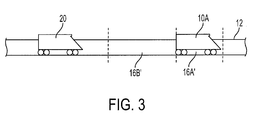
- a pseudo-moving block In a pseudo-moving block system, the block 16A' associated with each train 20A moves. The space occupied by a train 20 at any given moment is that train's block 16A', regardless of the train's 20A movement. The block 16A moves along with the train 20A, unlike a "fixed" block system in which each block 16 is distinct from any train 20 that happens to be traveling within its boundaries. Further, because the profile of the track 12 and other factors, such as weather conditions, the location and speed of other nearby trains 20, the size the blocks 16 near the block 16A in which each train 20A is traveling is dynamic.
- the "red" pseudo block 16B' immediately behind the slow moving train may increase in size, allowing for a greater stopping distance associated with the train that is speeding up.
- track profile if it is known that a sharp curve, requiring severely reduced speeds in order to safely traverse, is approaching relative to a given train, the length and aspects of the blocks behind that train can be adjusted to accommodate for the anticipated reduction in speed of the train.
- dynamic tags 40 located at positions along the length of the area 14A can be used as a backup system for providing information that is similar to the information provided by the wayside control unit 30. Unlike the beacon tags 10, the dynamic tags 40 does not need to be solicited in order to transfer the data stored within it. For example, a dynamic tag 40 can be controlled to transmit certain data to a train 20, whenever the tag reader 22 or its corresponding antenna, is close enough to the dynamic tag 40. Dynamic tags 40, like the beacon tags 10, are located along the entire length of the track 12; however, dynamic tags do not need to be located as close together as the beacon tags 10.
Landscapes
- Engineering & Computer Science (AREA)
- Mechanical Engineering (AREA)
- Train Traffic Observation, Control, And Security (AREA)
Applications Claiming Priority (2)
| Application Number | Priority Date | Filing Date | Title |
|---|---|---|---|
| US157859 | 1998-09-21 | ||
| US10/157,859 US6666411B1 (en) | 2002-05-31 | 2002-05-31 | Communications-based vehicle control system and method |
Publications (2)
| Publication Number | Publication Date |
|---|---|
| EP1366967A2 true EP1366967A2 (de) | 2003-12-03 |
| EP1366967A3 EP1366967A3 (de) | 2004-01-14 |
Family
ID=29419657
Family Applications (1)
| Application Number | Title | Priority Date | Filing Date |
|---|---|---|---|
| EP03400029A Ceased EP1366967A3 (de) | 2002-05-31 | 2003-05-16 | Kommunikationsgestütztes Zugsteuerungssystem und -methode |
Country Status (3)
| Country | Link |
|---|---|
| US (1) | US6666411B1 (de) |
| EP (1) | EP1366967A3 (de) |
| CN (1) | CN1461719A (de) |
Cited By (6)
| Publication number | Priority date | Publication date | Assignee | Title |
|---|---|---|---|---|
| WO2009003837A1 (de) | 2007-06-29 | 2009-01-08 | Siemens Aktiengesellschaft | Verfahren und anordnung zum betreiben einer eisenbahnstrecke |
| RU2390455C1 (ru) * | 2009-04-13 | 2010-05-27 | Открытое акционерное общество "Российские железные дороги" (ОАО "РЖД") | Способ предотвращения столкновения подвижного состава и устройство для его осуществления |
| CN102244897A (zh) * | 2011-08-29 | 2011-11-16 | 南车南京浦镇车辆有限公司 | 基于rssi的地铁列车定位方法 |
| CN106672020B (zh) * | 2016-12-12 | 2019-04-16 | 交控科技股份有限公司 | 基于对象控制器的前车识别方法、车载控制器及列车 |
| CN115465338A (zh) * | 2022-09-20 | 2022-12-13 | 上海富欣智能交通控制有限公司 | 动态选择管理员的方法及控制系统 |
| US20230007902A1 (en) * | 2021-07-08 | 2023-01-12 | Transportation Ip Holdings, Llc | Vehicle brake control system and method |
Families Citing this family (49)
| Publication number | Priority date | Publication date | Assignee | Title |
|---|---|---|---|---|
| RU2337034C2 (ru) * | 2002-10-30 | 2008-10-27 | Дюрр Аутомоцион Гмбх | Транспортная система с направляющими путями и способ управления тележками такой транспортной системы |
| US10894550B2 (en) | 2017-05-05 | 2021-01-19 | Bnsf Railway Company | Railroad virtual track block system |
| JP2004203258A (ja) * | 2002-12-26 | 2004-07-22 | Hitachi Ltd | 信号保安方法,信号保安装置及びそれを用いた信号保安システム |
| US7512481B2 (en) * | 2003-02-27 | 2009-03-31 | General Electric Company | System and method for computer aided dispatching using a coordinating agent |
| US7092815B2 (en) * | 2003-12-17 | 2006-08-15 | Vrbia, Inc. | Traffic control systems for vehicle spacing to dissipate traffic gridlock |
| JP4087786B2 (ja) * | 2003-12-19 | 2008-05-21 | 株式会社日立製作所 | 列車位置検知方法 |
| JP4454303B2 (ja) * | 2003-12-22 | 2010-04-21 | 株式会社日立製作所 | 信号保安システム |
| ITTO20040325A1 (it) * | 2004-05-14 | 2004-08-14 | Ansaldo Segnalamento Ferroviario Spa | Dispositivo per la trasmissione sicura di dati verso boe per la segnalazione ferroviaria |
| CN1817710B (zh) * | 2005-02-07 | 2012-10-24 | 傅庆斌 | 用于控制轨道车运行的方法及控制系统 |
| JP4375253B2 (ja) * | 2005-02-25 | 2009-12-02 | 株式会社日立製作所 | 信号保安システム |
| US7469767B2 (en) * | 2005-08-03 | 2008-12-30 | Jasem Al Jasem | Speed control method and system for a motor vehicle |
| US7548032B2 (en) * | 2005-08-23 | 2009-06-16 | General Electric Company | Locomotive speed determination |
| CN101224752B (zh) * | 2008-01-25 | 2012-02-15 | 深圳市丰泰瑞达实业有限公司 | 用于铁路区间公里标修正的方法及装置 |
| CN101244723B (zh) * | 2008-01-25 | 2010-12-22 | 深圳市丰泰瑞达实业有限公司 | 铁路运行综合信息发送的方法及装置 |
| US8452466B2 (en) * | 2008-05-07 | 2013-05-28 | General Electric Company | Methods and system for detecting railway vacancy |
| DE102008060188A1 (de) * | 2008-11-28 | 2010-06-10 | Siemens Aktiengesellschaft | Verfahren und Vorrichtung zur Abstandsmessung |
| US9308926B2 (en) * | 2008-12-29 | 2016-04-12 | Universal City Studios Llc | Position control system |
| GB0909373D0 (en) * | 2009-05-30 | 2009-07-15 | Park Signalling Ltd | Apparatus and method for implementing safe visual information provision |
| DE102009039701A1 (de) * | 2009-08-31 | 2011-03-17 | Siemens Aktiengesellschaft | Verfahren zur Übertragung von Daten von einer streckenseitigen Einrichtung an ein Fahrzeug sowie fahrzeugseitige und streckenseitige Einrichtung |
| CN101713821A (zh) * | 2009-11-23 | 2010-05-26 | 北京大成通号轨道交通设备有限公司 | 一种检测列车通过的环路信标 |
| US8428798B2 (en) | 2010-01-08 | 2013-04-23 | Wabtec Holding Corp. | Short headway communications based train control system |
| CA2820772A1 (en) * | 2010-12-09 | 2012-06-14 | Said El Fassi | Method for communicating information between an on-board control unit and a public transport network |
| US9085310B2 (en) * | 2011-05-25 | 2015-07-21 | Thales Canada Inc. | Method of determining the position of a vehicle moving along a guideway |
| WO2013112885A2 (en) * | 2012-01-25 | 2013-08-01 | Carnegie Mellon University | Railway transport management |
| JP6075839B2 (ja) * | 2012-09-20 | 2017-02-08 | 株式会社日立国際電気 | 列車無線通信システムの受信電文選択方法 |
| DE102012217470A1 (de) * | 2012-09-26 | 2014-03-27 | Siemens Aktiengesellschaft | Verfahren zum Erzeugen eines Fahrstraßeneinstell-Anstoßsignals für eine zentrale Zuglenkung und Einrichtung auf einem Zug zum Erzeugen des Fahrstraßeneinstell-Anstoßsignals |
| CN102975748B (zh) * | 2012-11-29 | 2015-05-27 | 北京全路通信信号研究设计院有限公司 | 一种列车定位与测速方法及系统 |
| CN107364434A (zh) | 2013-09-03 | 2017-11-21 | 梅特罗姆铁路公司 | 铁路车辆信号执行和分离控制 |
| US11814088B2 (en) | 2013-09-03 | 2023-11-14 | Metrom Rail, Llc | Vehicle host interface module (vHIM) based braking solutions |
| US9499185B2 (en) | 2013-12-20 | 2016-11-22 | Thales Canada Inc | Wayside guideway vehicle detection and switch deadlocking system with a multimodal guideway vehicle sensor |
| FR3019676B1 (fr) * | 2014-04-02 | 2017-09-01 | Alstom Transp Tech | Procede de calcul d'un intervalle de positions d'un vehicule ferroviaire sur une voie ferree et dispositif associe |
| DE102015203476A1 (de) * | 2015-02-26 | 2016-09-01 | Siemens Aktiengesellschaft | Verfahren und Ortungseinrichtung zum Bestimmen der Position eines spurgeführten Fahrzeugs, insbesondere eines Schienenfahrzeugs |
| EP3184400A1 (de) * | 2015-12-22 | 2017-06-28 | Televic Rail NV | System und verfahren zur bereitstellung von informationen an ein informationssystem in einem fahrzeug |
| CN106197397B (zh) * | 2016-07-15 | 2019-03-29 | 湖南云辙科技有限公司 | 一种基于导轨定位导引系统及方法 |
| EP3589528A4 (de) | 2017-02-28 | 2020-05-06 | Thales Canada Inc. | Vorrichtungen, systeme, verfahren und software zur zugsteuerung und -verfolgung mithilfe mehrerer sensoren, ssd/qr-zeichen und/oder hf-reflektoren |
| US12007787B2 (en) | 2020-04-13 | 2024-06-11 | Westinghouse Air Brake Technologies Corporation | Vehicle control system |
| US11511779B2 (en) | 2017-05-05 | 2022-11-29 | Bnsf Railway Company | System and method for virtual block stick circuits |
| US12503145B2 (en) | 2017-05-05 | 2025-12-23 | Bnsf Railway Company | System and method for virtual block operational status control with long block time delay |
| US11349589B2 (en) | 2017-08-04 | 2022-05-31 | Metrom Rail, Llc | Methods and systems for decentralized rail signaling and positive train control |
| US11153077B2 (en) * | 2018-12-14 | 2021-10-19 | Westinghouse Air Brake Technologies Corporation | Secure vehicle to vehicle communication |
| CN109664916B (zh) * | 2017-10-17 | 2021-04-27 | 交控科技股份有限公司 | 以车载控制器为核心的列车运行控制系统 |
| CN109774748B (zh) * | 2017-11-14 | 2021-04-27 | 交控科技股份有限公司 | 基于车车通信的列车超速防护方法、车载控制器和列车 |
| US11794796B2 (en) | 2018-05-08 | 2023-10-24 | TekTracking, LLC | System and method to ensure signal light integrity and viewability |
| CN109278808B (zh) * | 2018-08-13 | 2021-01-26 | 浙江众合科技股份有限公司 | 一种适用于美式动态信标的多保护区段防护方法 |
| CN109603167A (zh) * | 2018-12-26 | 2019-04-12 | 上海恒润文化集团有限公司 | 一种有轨游乐车防撞系统 |
| US12319328B2 (en) * | 2019-05-21 | 2025-06-03 | Mitsubishi Electric Corporation | Ground control device, radio communication apparatus, radio train control system, and train control method |
| EP4054914A1 (de) | 2019-11-06 | 2022-09-14 | Humatics Corporation | Verfahren und zugehörige systeme sowie verfahren zur bestimmung von zugbewegungsmerkmalen |
| CN116964479A (zh) | 2021-02-01 | 2023-10-27 | 地面运输系统加拿大公司 | 校准测距系统的系统和方法 |
| US20230114494A1 (en) * | 2021-10-08 | 2023-04-13 | Hyperloop Technologies, Inc. | System and Method for Hyperloop Transponder Communication |
Family Cites Families (16)
| Publication number | Priority date | Publication date | Assignee | Title |
|---|---|---|---|---|
| US5006847A (en) | 1984-11-16 | 1991-04-09 | Aeg Westinghouse Transportation Systems, Inc. | Train motion detection apparatus |
| NL191474C (nl) * | 1986-03-07 | 1995-07-18 | Nederland Ptt | Radioverbindingsstelsel voorzien van bakenzenders. |
| US4864306A (en) | 1986-06-23 | 1989-09-05 | Wiita Floyd L | Railway anticollision apparatus and method |
| GB8620002D0 (en) | 1986-08-16 | 1986-09-24 | Westinghouse Brake & Signal | Communicating vital control signals |
| GB8718552D0 (en) | 1987-08-05 | 1987-09-09 | British Railways Board | Track to train communications systems |
| GB8810922D0 (en) | 1988-05-09 | 1988-06-15 | Westinghouse Brake & Signal | Railway signalling system |
| GB9202830D0 (en) | 1992-02-11 | 1992-03-25 | Westinghouse Brake & Signal | A railway signalling system |
| US5340062A (en) * | 1992-08-13 | 1994-08-23 | Harmon Industries, Inc. | Train control system integrating dynamic and fixed data |
| SE501095C2 (sv) | 1992-08-31 | 1994-11-14 | Carrnovo Ab | Förfarande och anordning för styrning av ett antal rullande enheter i en bananläggning |
| US5332180A (en) * | 1992-12-28 | 1994-07-26 | Union Switch & Signal Inc. | Traffic control system utilizing on-board vehicle information measurement apparatus |
| US5364047A (en) * | 1993-04-02 | 1994-11-15 | General Railway Signal Corporation | Automatic vehicle control and location system |
| US5983161A (en) * | 1993-08-11 | 1999-11-09 | Lemelson; Jerome H. | GPS vehicle collision avoidance warning and control system and method |
| US5533695A (en) * | 1994-08-19 | 1996-07-09 | Harmon Industries, Inc. | Incremental train control system |
| JP3521491B2 (ja) | 1994-08-31 | 2004-04-19 | トヨタ自動車株式会社 | 路車間通信装置 |
| TW279960B (de) * | 1994-09-23 | 1996-07-01 | Traffic Object Supervision Systems | |
| US5995881A (en) * | 1997-07-22 | 1999-11-30 | Westinghouse Air Brake Company | Integrated cab signal rail navigation system |
-
2002
- 2002-05-31 US US10/157,859 patent/US6666411B1/en not_active Expired - Fee Related
-
2003
- 2003-04-29 CN CN03130604A patent/CN1461719A/zh active Pending
- 2003-05-16 EP EP03400029A patent/EP1366967A3/de not_active Ceased
Cited By (9)
| Publication number | Priority date | Publication date | Assignee | Title |
|---|---|---|---|---|
| WO2009003837A1 (de) | 2007-06-29 | 2009-01-08 | Siemens Aktiengesellschaft | Verfahren und anordnung zum betreiben einer eisenbahnstrecke |
| US8428797B2 (en) | 2007-06-29 | 2013-04-23 | Siemens Aktiengesellschaft | Method and arrangement for the operation of a railroad line |
| RU2390455C1 (ru) * | 2009-04-13 | 2010-05-27 | Открытое акционерное общество "Российские железные дороги" (ОАО "РЖД") | Способ предотвращения столкновения подвижного состава и устройство для его осуществления |
| CN102244897A (zh) * | 2011-08-29 | 2011-11-16 | 南车南京浦镇车辆有限公司 | 基于rssi的地铁列车定位方法 |
| CN106672020B (zh) * | 2016-12-12 | 2019-04-16 | 交控科技股份有限公司 | 基于对象控制器的前车识别方法、车载控制器及列车 |
| US10875559B2 (en) | 2016-12-12 | 2020-12-29 | Traffic Control Technology Co., Ltd | Preceding train identification method based on object controller, vehicle on board controller and train |
| US20230007902A1 (en) * | 2021-07-08 | 2023-01-12 | Transportation Ip Holdings, Llc | Vehicle brake control system and method |
| US11993299B2 (en) * | 2021-07-08 | 2024-05-28 | Transportation Ip Holdings, Llc | Vehicle brake control system and method |
| CN115465338A (zh) * | 2022-09-20 | 2022-12-13 | 上海富欣智能交通控制有限公司 | 动态选择管理员的方法及控制系统 |
Also Published As
| Publication number | Publication date |
|---|---|
| EP1366967A3 (de) | 2004-01-14 |
| CN1461719A (zh) | 2003-12-17 |
| US6666411B1 (en) | 2003-12-23 |
| US20030222180A1 (en) | 2003-12-04 |
Similar Documents
| Publication | Publication Date | Title |
|---|---|---|
| US6666411B1 (en) | Communications-based vehicle control system and method | |
| CN110356434B (zh) | 一种基于tag定位的轻量级列控系统 | |
| US11235789B2 (en) | Train control system and train control method including virtual train stop | |
| CN107554556B (zh) | 基于无线通信的重载铁路移动闭塞系统 | |
| US5740046A (en) | Method to control in a track traffic system moving units, device for effecting of such control and process for installation of the device | |
| US9150229B2 (en) | Systems and method for controlling warnings at vehicle crossings | |
| MXPA05000100A (es) | Sistema de control de tren y metodo para controlar un tren o trenes. | |
| CN102653279A (zh) | 一种列车信号系统装置及列车可行距离检测方法 | |
| CN105813907A (zh) | 铁路车辆信号执行和分离控制 | |
| CN113415318B (zh) | 一种列车连挂编组辅助防护系统及防护方法 | |
| US5436631A (en) | System for targeted braking of vehicles | |
| KR20160001852A (ko) | Etcs 기반 자동무인운전 신호시스템 | |
| CN105564466B (zh) | 一种地铁控制系统失效下的列车辅助安全驾驶决策系统 | |
| CN118514735A (zh) | 一种移动闭塞系统及自动站间闭塞控制方法 | |
| CN117775082A (zh) | 一种基于二次雷达的轨道交通后备降级运行系统及方法 | |
| CN116142257A (zh) | 一种列车控制系统 | |
| CN103863362B (zh) | Prt系统及准移动闭塞的prt系统的行车方法 | |
| Kobayashi et al. | ATACS (advanced train administration and communication system) | |
| KR100511643B1 (ko) | 열차의 위치 정보를 활용한 연동 장치 | |
| RU2392133C1 (ru) | Способ и комплексная система безопасности (ксб) для автоматического управления прицельным торможением подвижного состава | |
| JP4125019B2 (ja) | 軌道車両の運行支援方法および同運行支援システム | |
| RU2519323C1 (ru) | Система интервального регулирования движения поездов | |
| EP1355817B1 (de) | Schienensystem für ein schienenfahrzeug | |
| GB2597348A (en) | Monitoring trains on a railway | |
| KR20150143958A (ko) | 역간 폐색에 의한 열차 운행 장치 및 방법 |
Legal Events
| Date | Code | Title | Description |
|---|---|---|---|
| PUAI | Public reference made under article 153(3) epc to a published international application that has entered the european phase |
Free format text: ORIGINAL CODE: 0009012 |
|
| PUAL | Search report despatched |
Free format text: ORIGINAL CODE: 0009013 |
|
| AK | Designated contracting states |
Kind code of ref document: A2 Designated state(s): AT BE BG CH CY CZ DE DK EE ES FI FR GB GR HU IE IT LI LU MC NL PT RO SE SI SK TR |
|
| AX | Request for extension of the european patent |
Extension state: AL LT LV MK |
|
| AK | Designated contracting states |
Kind code of ref document: A3 Designated state(s): AT BE BG CH CY CZ DE DK EE ES FI FR GB GR HU IE IT LI LU MC NL PT RO SE SI SK TR |
|
| AX | Request for extension of the european patent |
Extension state: AL LT LV MK |
|
| 17P | Request for examination filed |
Effective date: 20040225 |
|
| 17Q | First examination report despatched |
Effective date: 20040421 |
|
| AKX | Designation fees paid |
Designated state(s): AT BE BG CH CY CZ DE DK EE ES FI FR GB GR HU IE IT LI LU MC NL PT RO SE SI SK TR |
|
| STAA | Information on the status of an ep patent application or granted ep patent |
Free format text: STATUS: THE APPLICATION HAS BEEN REFUSED |
|
| 18R | Application refused |
Effective date: 20050711 |