EP1368403B1 - Polymere - Google Patents
Polymere Download PDFInfo
- Publication number
- EP1368403B1 EP1368403B1 EP02710131A EP02710131A EP1368403B1 EP 1368403 B1 EP1368403 B1 EP 1368403B1 EP 02710131 A EP02710131 A EP 02710131A EP 02710131 A EP02710131 A EP 02710131A EP 1368403 B1 EP1368403 B1 EP 1368403B1
- Authority
- EP
- European Patent Office
- Prior art keywords
- formula
- groups
- group
- compound
- iii
- Prior art date
- Legal status (The legal status is an assumption and is not a legal conclusion. Google has not performed a legal analysis and makes no representation as to the accuracy of the status listed.)
- Expired - Lifetime
Links
- 229920000642 polymer Polymers 0.000 title claims abstract description 37
- 239000003446 ligand Substances 0.000 claims abstract description 10
- 238000004519 manufacturing process Methods 0.000 claims abstract description 8
- 150000001875 compounds Chemical class 0.000 claims description 46
- -1 aminoalkyl phosphate Chemical compound 0.000 claims description 27
- 125000005647 linker group Chemical group 0.000 claims description 26
- 125000006239 protecting group Chemical group 0.000 claims description 18
- 229910052739 hydrogen Inorganic materials 0.000 claims description 16
- 239000001257 hydrogen Substances 0.000 claims description 16
- 238000000034 method Methods 0.000 claims description 14
- 150000002148 esters Chemical class 0.000 claims description 10
- UFHFLCQGNIYNRP-UHFFFAOYSA-N Hydrogen Chemical group [H][H] UFHFLCQGNIYNRP-UHFFFAOYSA-N 0.000 claims description 9
- 230000008569 process Effects 0.000 claims description 9
- 229910021653 sulphate ion Inorganic materials 0.000 claims description 9
- 229910019142 PO4 Inorganic materials 0.000 claims description 8
- 239000010452 phosphate Substances 0.000 claims description 8
- 125000004429 atom Chemical group 0.000 claims description 7
- 150000003839 salts Chemical class 0.000 claims description 7
- 125000000217 alkyl group Chemical group 0.000 claims description 6
- 229910052760 oxygen Inorganic materials 0.000 claims description 6
- 125000004178 (C1-C4) alkyl group Chemical group 0.000 claims description 5
- JYEUMXHLPRZUAT-UHFFFAOYSA-N 1,2,3-triazine Chemical group C1=CN=NN=C1 JYEUMXHLPRZUAT-UHFFFAOYSA-N 0.000 claims description 5
- 125000003118 aryl group Chemical group 0.000 claims description 5
- 230000000903 blocking effect Effects 0.000 claims description 5
- 125000003178 carboxy group Chemical group [H]OC(*)=O 0.000 claims description 5
- 125000005842 heteroatom Chemical group 0.000 claims description 5
- 125000004435 hydrogen atom Chemical group [H]* 0.000 claims description 5
- 125000002887 hydroxy group Chemical group [H]O* 0.000 claims description 5
- 239000000178 monomer Substances 0.000 claims description 5
- 239000012625 DNA intercalator Substances 0.000 claims description 4
- QAOWNCQODCNURD-UHFFFAOYSA-L Sulfate Chemical compound [O-]S([O-])(=O)=O QAOWNCQODCNURD-UHFFFAOYSA-L 0.000 claims description 4
- 125000003545 alkoxy group Chemical group 0.000 claims description 4
- 229910052799 carbon Inorganic materials 0.000 claims description 4
- 125000004181 carboxyalkyl group Chemical group 0.000 claims description 4
- MGNCLNQXLYJVJD-UHFFFAOYSA-N cyanuric chloride Chemical compound ClC1=NC(Cl)=NC(Cl)=N1 MGNCLNQXLYJVJD-UHFFFAOYSA-N 0.000 claims description 4
- 125000002768 hydroxyalkyl group Chemical group 0.000 claims description 4
- 125000000449 nitro group Chemical group [O-][N+](*)=O 0.000 claims description 4
- 229910052757 nitrogen Inorganic materials 0.000 claims description 4
- 125000004390 alkyl sulfonyl group Chemical group 0.000 claims description 3
- 125000004414 alkyl thio group Chemical group 0.000 claims description 3
- 150000001408 amides Chemical class 0.000 claims description 3
- 125000004432 carbon atom Chemical group C* 0.000 claims description 3
- 125000004093 cyano group Chemical group *C#N 0.000 claims description 3
- 125000004966 cyanoalkyl group Chemical group 0.000 claims description 3
- 125000004971 nitroalkyl group Chemical group 0.000 claims description 3
- 125000002924 primary amino group Chemical group [H]N([H])* 0.000 claims description 3
- 125000003396 thiol group Chemical class [H]S* 0.000 claims description 3
- 125000001589 carboacyl group Chemical group 0.000 claims description 2
- 238000005304 joining Methods 0.000 claims description 2
- 239000002243 precursor Substances 0.000 claims description 2
- 229910052717 sulfur Inorganic materials 0.000 claims description 2
- 108091034117 Oligonucleotide Proteins 0.000 abstract 1
- YMWUJEATGCHHMB-UHFFFAOYSA-N Dichloromethane Chemical compound ClCCl YMWUJEATGCHHMB-UHFFFAOYSA-N 0.000 description 18
- 239000000047 product Substances 0.000 description 18
- WYURNTSHIVDZCO-UHFFFAOYSA-N Tetrahydrofuran Chemical compound C1CCOC1 WYURNTSHIVDZCO-UHFFFAOYSA-N 0.000 description 16
- 125000001424 substituent group Chemical group 0.000 description 13
- YLQBMQCUIZJEEH-UHFFFAOYSA-N Furan Chemical compound C=1C=COC=1 YLQBMQCUIZJEEH-UHFFFAOYSA-N 0.000 description 12
- JUJWROOIHBZHMG-UHFFFAOYSA-N Pyridine Chemical compound C1=CC=NC=C1 JUJWROOIHBZHMG-UHFFFAOYSA-N 0.000 description 12
- 238000006243 chemical reaction Methods 0.000 description 12
- ZMANZCXQSJIPKH-UHFFFAOYSA-N Triethylamine Chemical compound CCN(CC)CC ZMANZCXQSJIPKH-UHFFFAOYSA-N 0.000 description 9
- CSCPPACGZOOCGX-UHFFFAOYSA-N Acetone Chemical compound CC(C)=O CSCPPACGZOOCGX-UHFFFAOYSA-N 0.000 description 8
- 239000002904 solvent Substances 0.000 description 8
- XLYOFNOQVPJJNP-UHFFFAOYSA-N water Substances O XLYOFNOQVPJJNP-UHFFFAOYSA-N 0.000 description 7
- UIIMBOGNXHQVGW-UHFFFAOYSA-M Sodium bicarbonate Chemical compound [Na+].OC([O-])=O UIIMBOGNXHQVGW-UHFFFAOYSA-M 0.000 description 6
- RAXXELZNTBOGNW-UHFFFAOYSA-N imidazole Natural products C1=CNC=N1 RAXXELZNTBOGNW-UHFFFAOYSA-N 0.000 description 6
- 108020004707 nucleic acids Proteins 0.000 description 6
- 150000007523 nucleic acids Chemical class 0.000 description 6
- 102000039446 nucleic acids Human genes 0.000 description 6
- UMJSCPRVCHMLSP-UHFFFAOYSA-N pyridine Natural products COC1=CC=CN=C1 UMJSCPRVCHMLSP-UHFFFAOYSA-N 0.000 description 6
- 239000007787 solid Substances 0.000 description 6
- 239000000243 solution Substances 0.000 description 6
- PIICEJLVQHRZGT-UHFFFAOYSA-N Ethylenediamine Chemical compound NCCN PIICEJLVQHRZGT-UHFFFAOYSA-N 0.000 description 5
- 125000005907 alkyl ester group Chemical group 0.000 description 5
- 238000001514 detection method Methods 0.000 description 5
- 239000000203 mixture Substances 0.000 description 5
- XEKOWRVHYACXOJ-UHFFFAOYSA-N Ethyl acetate Chemical compound CCOC(C)=O XEKOWRVHYACXOJ-UHFFFAOYSA-N 0.000 description 4
- CSNNHWWHGAXBCP-UHFFFAOYSA-L Magnesium sulfate Chemical compound [Mg+2].[O-][S+2]([O-])([O-])[O-] CSNNHWWHGAXBCP-UHFFFAOYSA-L 0.000 description 4
- 108091093037 Peptide nucleic acid Proteins 0.000 description 4
- KYQCOXFCLRTKLS-UHFFFAOYSA-N Pyrazine Chemical compound C1=CN=CC=N1 KYQCOXFCLRTKLS-UHFFFAOYSA-N 0.000 description 4
- KAESVJOAVNADME-UHFFFAOYSA-N Pyrrole Chemical compound C=1C=CNC=1 KAESVJOAVNADME-UHFFFAOYSA-N 0.000 description 4
- CDBYLPFSWZWCQE-UHFFFAOYSA-L Sodium Carbonate Chemical compound [Na+].[Na+].[O-]C([O-])=O CDBYLPFSWZWCQE-UHFFFAOYSA-L 0.000 description 4
- YTPLMLYBLZKORZ-UHFFFAOYSA-N Thiophene Chemical compound C=1C=CSC=1 YTPLMLYBLZKORZ-UHFFFAOYSA-N 0.000 description 4
- QVGXLLKOCUKJST-UHFFFAOYSA-N atomic oxygen Chemical compound [O] QVGXLLKOCUKJST-UHFFFAOYSA-N 0.000 description 4
- 125000001309 chloro group Chemical group Cl* 0.000 description 4
- 239000001301 oxygen Substances 0.000 description 4
- PYWVYCXTNDRMGF-UHFFFAOYSA-N rhodamine B Chemical class [Cl-].C=12C=CC(=[N+](CC)CC)C=C2OC2=CC(N(CC)CC)=CC=C2C=1C1=CC=CC=C1C(O)=O PYWVYCXTNDRMGF-UHFFFAOYSA-N 0.000 description 4
- RWQNBRDOKXIBIV-UHFFFAOYSA-N thymine Chemical compound CC1=CNC(=O)NC1=O RWQNBRDOKXIBIV-UHFFFAOYSA-N 0.000 description 4
- 0 **c1nc(Cl)nc(Cl)n1 Chemical compound **c1nc(Cl)nc(Cl)n1 0.000 description 3
- WEVYAHXRMPXWCK-UHFFFAOYSA-N Acetonitrile Chemical compound CC#N WEVYAHXRMPXWCK-UHFFFAOYSA-N 0.000 description 3
- IJGRMHOSHXDMSA-UHFFFAOYSA-N Atomic nitrogen Chemical compound N#N IJGRMHOSHXDMSA-UHFFFAOYSA-N 0.000 description 3
- CZPWVGJYEJSRLH-UHFFFAOYSA-N Pyrimidine Chemical compound C1=CN=CN=C1 CZPWVGJYEJSRLH-UHFFFAOYSA-N 0.000 description 3
- 125000002252 acyl group Chemical group 0.000 description 3
- 125000001797 benzyl group Chemical group [H]C1=C([H])C([H])=C(C([H])=C1[H])C([H])([H])* 0.000 description 3
- 230000015572 biosynthetic process Effects 0.000 description 3
- 238000005859 coupling reaction Methods 0.000 description 3
- 125000000623 heterocyclic group Chemical group 0.000 description 3
- 125000002496 methyl group Chemical group [H]C([H])([H])* 0.000 description 3
- 230000003278 mimic effect Effects 0.000 description 3
- 125000004433 nitrogen atom Chemical group N* 0.000 description 3
- 239000003960 organic solvent Substances 0.000 description 3
- 239000011541 reaction mixture Substances 0.000 description 3
- 229910000030 sodium bicarbonate Inorganic materials 0.000 description 3
- 235000017557 sodium bicarbonate Nutrition 0.000 description 3
- 125000002861 (C1-C4) alkanoyl group Chemical group 0.000 description 2
- 125000000229 (C1-C4)alkoxy group Chemical group 0.000 description 2
- FYADHXFMURLYQI-UHFFFAOYSA-N 1,2,4-triazine Chemical compound C1=CN=NC=N1 FYADHXFMURLYQI-UHFFFAOYSA-N 0.000 description 2
- AGIJRRREJXSQJR-UHFFFAOYSA-N 2h-thiazine Chemical compound N1SC=CC=C1 AGIJRRREJXSQJR-UHFFFAOYSA-N 0.000 description 2
- FCQCLMZIGUFTQR-UHFFFAOYSA-N 3-N-Benzoyl-Thymine Natural products O=C1C(C)=CNC(=O)N1C(=O)C1=CC=CC=C1 FCQCLMZIGUFTQR-UHFFFAOYSA-N 0.000 description 2
- KDCGOANMDULRCW-UHFFFAOYSA-N 7H-purine Chemical compound N1=CNC2=NC=NC2=C1 KDCGOANMDULRCW-UHFFFAOYSA-N 0.000 description 2
- OKTJSMMVPCPJKN-UHFFFAOYSA-N Carbon Chemical compound [C] OKTJSMMVPCPJKN-UHFFFAOYSA-N 0.000 description 2
- LFQSCWFLJHTTHZ-UHFFFAOYSA-N Ethanol Chemical compound CCO LFQSCWFLJHTTHZ-UHFFFAOYSA-N 0.000 description 2
- VEXZGXHMUGYJMC-UHFFFAOYSA-N Hydrochloric acid Chemical compound Cl VEXZGXHMUGYJMC-UHFFFAOYSA-N 0.000 description 2
- PCNDJXKNXGMECE-UHFFFAOYSA-N Phenazine Natural products C1=CC=CC2=NC3=CC=CC=C3N=C21 PCNDJXKNXGMECE-UHFFFAOYSA-N 0.000 description 2
- WTKZEGDFNFYCGP-UHFFFAOYSA-N Pyrazole Chemical compound C=1C=NNC=1 WTKZEGDFNFYCGP-UHFFFAOYSA-N 0.000 description 2
- NINIDFKCEFEMDL-UHFFFAOYSA-N Sulfur Chemical compound [S] NINIDFKCEFEMDL-UHFFFAOYSA-N 0.000 description 2
- 239000005864 Sulphur Substances 0.000 description 2
- DTQVDTLACAAQTR-UHFFFAOYSA-N Trifluoroacetic acid Chemical compound OC(=O)C(F)(F)F DTQVDTLACAAQTR-UHFFFAOYSA-N 0.000 description 2
- 125000003277 amino group Chemical group 0.000 description 2
- 125000004103 aminoalkyl group Chemical group 0.000 description 2
- 239000012267 brine Substances 0.000 description 2
- 238000007796 conventional method Methods 0.000 description 2
- 230000008878 coupling Effects 0.000 description 2
- 238000010168 coupling process Methods 0.000 description 2
- 150000002170 ethers Chemical class 0.000 description 2
- 238000009396 hybridization Methods 0.000 description 2
- 150000002431 hydrogen Chemical class 0.000 description 2
- CBOIHMRHGLHBPB-UHFFFAOYSA-N hydroxymethyl Chemical compound O[CH2] CBOIHMRHGLHBPB-UHFFFAOYSA-N 0.000 description 2
- 125000004029 hydroxymethyl group Chemical group [H]OC([H])([H])* 0.000 description 2
- 230000003993 interaction Effects 0.000 description 2
- 229910052943 magnesium sulfate Inorganic materials 0.000 description 2
- 235000019341 magnesium sulphate Nutrition 0.000 description 2
- QJGQUHMNIGDVPM-UHFFFAOYSA-N nitrogen group Chemical group [N] QJGQUHMNIGDVPM-UHFFFAOYSA-N 0.000 description 2
- 239000002773 nucleotide Substances 0.000 description 2
- 125000003729 nucleotide group Chemical group 0.000 description 2
- 238000012261 overproduction Methods 0.000 description 2
- 125000001997 phenyl group Chemical group [H]C1=C([H])C([H])=C(*)C([H])=C1[H] 0.000 description 2
- NBIIXXVUZAFLBC-UHFFFAOYSA-K phosphate Chemical compound [O-]P([O-])([O-])=O NBIIXXVUZAFLBC-UHFFFAOYSA-K 0.000 description 2
- CHKVPAROMQMJNQ-UHFFFAOYSA-M potassium bisulfate Chemical compound [K+].OS([O-])(=O)=O CHKVPAROMQMJNQ-UHFFFAOYSA-M 0.000 description 2
- BWHMMNNQKKPAPP-UHFFFAOYSA-L potassium carbonate Chemical compound [K+].[K+].[O-]C([O-])=O BWHMMNNQKKPAPP-UHFFFAOYSA-L 0.000 description 2
- 239000001120 potassium sulphate Substances 0.000 description 2
- 239000002244 precipitate Substances 0.000 description 2
- 238000002360 preparation method Methods 0.000 description 2
- 238000010992 reflux Methods 0.000 description 2
- 229910000029 sodium carbonate Inorganic materials 0.000 description 2
- HPALAKNZSZLMCH-UHFFFAOYSA-M sodium;chloride;hydrate Chemical compound O.[Na+].[Cl-] HPALAKNZSZLMCH-UHFFFAOYSA-M 0.000 description 2
- 238000010532 solid phase synthesis reaction Methods 0.000 description 2
- 238000003756 stirring Methods 0.000 description 2
- 230000001225 therapeutic effect Effects 0.000 description 2
- 229930192474 thiophene Natural products 0.000 description 2
- 229940113082 thymine Drugs 0.000 description 2
- 125000003088 (fluoren-9-ylmethoxy)carbonyl group Chemical group 0.000 description 1
- RYHBNJHYFVUHQT-UHFFFAOYSA-N 1,4-Dioxane Chemical compound C1COCCO1 RYHBNJHYFVUHQT-UHFFFAOYSA-N 0.000 description 1
- XXJGBENTLXFVFI-UHFFFAOYSA-N 1-amino-methylene Chemical compound N[CH2] XXJGBENTLXFVFI-UHFFFAOYSA-N 0.000 description 1
- DURPTKYDGMDSBL-UHFFFAOYSA-N 1-butoxybutane Chemical group CCCCOCCCC DURPTKYDGMDSBL-UHFFFAOYSA-N 0.000 description 1
- NJYVEMPWNAYQQN-UHFFFAOYSA-N 5-carboxyfluorescein Chemical compound C12=CC=C(O)C=C2OC2=CC(O)=CC=C2C21OC(=O)C1=CC(C(=O)O)=CC=C21 NJYVEMPWNAYQQN-UHFFFAOYSA-N 0.000 description 1
- YMZMTOFQCVHHFB-UHFFFAOYSA-N 5-carboxytetramethylrhodamine Chemical compound C=12C=CC(N(C)C)=CC2=[O+]C2=CC(N(C)C)=CC=C2C=1C1=CC=C(C(O)=O)C=C1C([O-])=O YMZMTOFQCVHHFB-UHFFFAOYSA-N 0.000 description 1
- CCRGYMRZYGPFRS-UHFFFAOYSA-N CCC(C)(C)N=O Chemical compound CCC(C)(C)N=O CCRGYMRZYGPFRS-UHFFFAOYSA-N 0.000 description 1
- AFVFQIVMOAPDHO-UHFFFAOYSA-N Methanesulfonic acid Chemical compound CS(O)(=O)=O AFVFQIVMOAPDHO-UHFFFAOYSA-N 0.000 description 1
- DTQVDTLACAAQTR-UHFFFAOYSA-M Trifluoroacetate Chemical compound [O-]C(=O)C(F)(F)F DTQVDTLACAAQTR-UHFFFAOYSA-M 0.000 description 1
- 150000001242 acetic acid derivatives Chemical class 0.000 description 1
- DPKHZNPWBDQZCN-UHFFFAOYSA-N acridine orange free base Chemical compound C1=CC(N(C)C)=CC2=NC3=CC(N(C)C)=CC=C3C=C21 DPKHZNPWBDQZCN-UHFFFAOYSA-N 0.000 description 1
- 125000002015 acyclic group Chemical group 0.000 description 1
- 125000004453 alkoxycarbonyl group Chemical group 0.000 description 1
- 125000004448 alkyl carbonyl group Chemical group 0.000 description 1
- 125000002947 alkylene group Chemical group 0.000 description 1
- 150000008064 anhydrides Chemical class 0.000 description 1
- 239000007864 aqueous solution Substances 0.000 description 1
- 125000003435 aroyl group Chemical group 0.000 description 1
- 125000005129 aryl carbonyl group Chemical group 0.000 description 1
- 244000052616 bacterial pathogen Species 0.000 description 1
- 125000000043 benzamido group Chemical group [H]N([*])C(=O)C1=C([H])C([H])=C([H])C([H])=C1[H] 0.000 description 1
- DZBUGLKDJFMEHC-UHFFFAOYSA-N benzoquinolinylidene Natural products C1=CC=CC2=CC3=CC=CC=C3N=C21 DZBUGLKDJFMEHC-UHFFFAOYSA-N 0.000 description 1
- PASDCCFISLVPSO-UHFFFAOYSA-N benzoyl chloride Chemical compound ClC(=O)C1=CC=CC=C1 PASDCCFISLVPSO-UHFFFAOYSA-N 0.000 description 1
- 125000003236 benzoyl group Chemical group [H]C1=C([H])C([H])=C(C([H])=C1[H])C(*)=O 0.000 description 1
- KCXMKQUNVWSEMD-UHFFFAOYSA-N benzyl chloride Chemical compound ClCC1=CC=CC=C1 KCXMKQUNVWSEMD-UHFFFAOYSA-N 0.000 description 1
- 229940073608 benzyl chloride Drugs 0.000 description 1
- 125000000440 benzylamino group Chemical group [H]N(*)C([H])([H])C1=C([H])C([H])=C([H])C([H])=C1[H] 0.000 description 1
- 125000001246 bromo group Chemical group Br* 0.000 description 1
- 150000004657 carbamic acid derivatives Chemical class 0.000 description 1
- VYXSBFYARXAAKO-WTKGSRSZSA-N chembl402140 Chemical compound Cl.C1=2C=C(C)C(NCC)=CC=2OC2=C\C(=N/CC)C(C)=CC2=C1C1=CC=CC=C1C(=O)OCC VYXSBFYARXAAKO-WTKGSRSZSA-N 0.000 description 1
- 238000003776 cleavage reaction Methods 0.000 description 1
- 239000012230 colorless oil Substances 0.000 description 1
- 238000004132 cross linking Methods 0.000 description 1
- UCDHYFZYUGDETN-UHFFFAOYSA-N cyanophosphonic acid Chemical compound OP(O)(=O)C#N UCDHYFZYUGDETN-UHFFFAOYSA-N 0.000 description 1
- 125000000113 cyclohexyl group Chemical group [H]C1([H])C([H])([H])C([H])([H])C([H])(*)C([H])([H])C1([H])[H] 0.000 description 1
- 238000003745 diagnosis Methods 0.000 description 1
- MHDVGSVTJDSBDK-UHFFFAOYSA-N dibenzyl ether Chemical group C=1C=CC=CC=1COCC1=CC=CC=C1 MHDVGSVTJDSBDK-UHFFFAOYSA-N 0.000 description 1
- 239000000539 dimer Substances 0.000 description 1
- ZMMJGEGLRURXTF-UHFFFAOYSA-N ethidium bromide Chemical compound [Br-].C12=CC(N)=CC=C2C2=CC=C(N)C=C2[N+](CC)=C1C1=CC=CC=C1 ZMMJGEGLRURXTF-UHFFFAOYSA-N 0.000 description 1
- 229960005542 ethidium bromide Drugs 0.000 description 1
- 229940093499 ethyl acetate Drugs 0.000 description 1
- 235000019439 ethyl acetate Nutrition 0.000 description 1
- 238000001914 filtration Methods 0.000 description 1
- GNBHRKFJIUUOQI-UHFFFAOYSA-N fluorescein Chemical class O1C(=O)C2=CC=CC=C2C21C1=CC=C(O)C=C1OC1=CC(O)=CC=C21 GNBHRKFJIUUOQI-UHFFFAOYSA-N 0.000 description 1
- 125000001153 fluoro group Chemical group F* 0.000 description 1
- PCHJSUWPFVWCPO-UHFFFAOYSA-N gold Chemical compound [Au] PCHJSUWPFVWCPO-UHFFFAOYSA-N 0.000 description 1
- 239000010931 gold Substances 0.000 description 1
- 229910052737 gold Inorganic materials 0.000 description 1
- 229910052736 halogen Inorganic materials 0.000 description 1
- 125000005843 halogen group Chemical group 0.000 description 1
- 150000002367 halogens Chemical class 0.000 description 1
- 125000001072 heteroaryl group Chemical group 0.000 description 1
- 239000000833 heterodimer Substances 0.000 description 1
- UQEAIHBTYFGYIE-UHFFFAOYSA-N hexamethyldisiloxane Chemical group C[Si](C)(C)O[Si](C)(C)C UQEAIHBTYFGYIE-UHFFFAOYSA-N 0.000 description 1
- 230000007062 hydrolysis Effects 0.000 description 1
- 238000006460 hydrolysis reaction Methods 0.000 description 1
- 229920001477 hydrophilic polymer Polymers 0.000 description 1
- 239000005457 ice water Substances 0.000 description 1
- MTNDZQHUAFNZQY-UHFFFAOYSA-N imidazoline Chemical compound C1CN=CN1 MTNDZQHUAFNZQY-UHFFFAOYSA-N 0.000 description 1
- 150000003949 imides Chemical class 0.000 description 1
- 239000000543 intermediate Substances 0.000 description 1
- 125000002346 iodo group Chemical group I* 0.000 description 1
- 239000000463 material Substances 0.000 description 1
- 125000000956 methoxy group Chemical group [H]C([H])([H])O* 0.000 description 1
- 230000002906 microbiologic effect Effects 0.000 description 1
- NMKIHZILXGGHHL-UHFFFAOYSA-N n,n'-bis[3-[(6-chloro-2-methoxyacridin-9-yl)amino]propyl]butane-1,4-diamine Chemical compound C1=C(OC)C=C2C(NCCCNCCCCNCCCNC3=C4C=CC(Cl)=CC4=NC4=CC=C(C=C43)OC)=C(C=CC(Cl)=C3)C3=NC2=C1 NMKIHZILXGGHHL-UHFFFAOYSA-N 0.000 description 1
- 239000003921 oil Substances 0.000 description 1
- 239000012044 organic layer Substances 0.000 description 1
- 125000004430 oxygen atom Chemical group O* 0.000 description 1
- XKJCHHZQLQNZHY-UHFFFAOYSA-N phthalimide Chemical compound C1=CC=C2C(=O)NC(=O)C2=C1 XKJCHHZQLQNZHY-UHFFFAOYSA-N 0.000 description 1
- 229910000027 potassium carbonate Inorganic materials 0.000 description 1
- 238000001953 recrystallisation Methods 0.000 description 1
- 229940043267 rhodamine b Drugs 0.000 description 1
- 239000000523 sample Substances 0.000 description 1
- 230000007017 scission Effects 0.000 description 1
- 239000002002 slurry Substances 0.000 description 1
- WBHQBSYUUJJSRZ-UHFFFAOYSA-M sodium bisulfate Chemical compound [Na+].OS([O-])(=O)=O WBHQBSYUUJJSRZ-UHFFFAOYSA-M 0.000 description 1
- PMZURENOXWZQFD-UHFFFAOYSA-L sodium sulphate Substances [Na+].[Na+].[O-]S([O-])(=O)=O PMZURENOXWZQFD-UHFFFAOYSA-L 0.000 description 1
- 125000006850 spacer group Chemical group 0.000 description 1
- 239000007858 starting material Substances 0.000 description 1
- 239000000126 substance Substances 0.000 description 1
- 239000000725 suspension Substances 0.000 description 1
- 230000008685 targeting Effects 0.000 description 1
- AOCSUUGBCMTKJH-UHFFFAOYSA-N tert-butyl n-(2-aminoethyl)carbamate Chemical compound CC(C)(C)OC(=O)NCCN AOCSUUGBCMTKJH-UHFFFAOYSA-N 0.000 description 1
- JOXIMZWYDAKGHI-UHFFFAOYSA-N toluene-4-sulfonic acid Chemical compound CC1=CC=C(S(O)(=O)=O)C=C1 JOXIMZWYDAKGHI-UHFFFAOYSA-N 0.000 description 1
Classifications
-
- C—CHEMISTRY; METALLURGY
- C07—ORGANIC CHEMISTRY
- C07D—HETEROCYCLIC COMPOUNDS
- C07D403/00—Heterocyclic compounds containing two or more hetero rings, having nitrogen atoms as the only ring hetero atoms, not provided for by group C07D401/00
- C07D403/14—Heterocyclic compounds containing two or more hetero rings, having nitrogen atoms as the only ring hetero atoms, not provided for by group C07D401/00 containing three or more hetero rings
-
- C—CHEMISTRY; METALLURGY
- C07—ORGANIC CHEMISTRY
- C07D—HETEROCYCLIC COMPOUNDS
- C07D403/00—Heterocyclic compounds containing two or more hetero rings, having nitrogen atoms as the only ring hetero atoms, not provided for by group C07D401/00
- C07D403/02—Heterocyclic compounds containing two or more hetero rings, having nitrogen atoms as the only ring hetero atoms, not provided for by group C07D401/00 containing two hetero rings
- C07D403/06—Heterocyclic compounds containing two or more hetero rings, having nitrogen atoms as the only ring hetero atoms, not provided for by group C07D401/00 containing two hetero rings linked by a carbon chain containing only aliphatic carbon atoms
-
- C—CHEMISTRY; METALLURGY
- C08—ORGANIC MACROMOLECULAR COMPOUNDS; THEIR PREPARATION OR CHEMICAL WORKING-UP; COMPOSITIONS BASED THEREON
- C08G—MACROMOLECULAR COMPOUNDS OBTAINED OTHERWISE THAN BY REACTIONS ONLY INVOLVING UNSATURATED CARBON-TO-CARBON BONDS
- C08G61/00—Macromolecular compounds obtained by reactions forming a carbon-to-carbon link in the main chain of the macromolecule
- C08G61/02—Macromolecular compounds containing only carbon atoms in the main chain of the macromolecule, e.g. polyxylylenes
-
- C—CHEMISTRY; METALLURGY
- C08—ORGANIC MACROMOLECULAR COMPOUNDS; THEIR PREPARATION OR CHEMICAL WORKING-UP; COMPOSITIONS BASED THEREON
- C08G—MACROMOLECULAR COMPOUNDS OBTAINED OTHERWISE THAN BY REACTIONS ONLY INVOLVING UNSATURATED CARBON-TO-CARBON BONDS
- C08G61/00—Macromolecular compounds obtained by reactions forming a carbon-to-carbon link in the main chain of the macromolecule
- C08G61/12—Macromolecular compounds containing atoms other than carbon in the main chain of the macromolecule
- C08G61/122—Macromolecular compounds containing atoms other than carbon in the main chain of the macromolecule derived from five- or six-membered heterocyclic compounds, other than imides
-
- C—CHEMISTRY; METALLURGY
- C08—ORGANIC MACROMOLECULAR COMPOUNDS; THEIR PREPARATION OR CHEMICAL WORKING-UP; COMPOSITIONS BASED THEREON
- C08G—MACROMOLECULAR COMPOUNDS OBTAINED OTHERWISE THAN BY REACTIONS ONLY INVOLVING UNSATURATED CARBON-TO-CARBON BONDS
- C08G61/00—Macromolecular compounds obtained by reactions forming a carbon-to-carbon link in the main chain of the macromolecule
- C08G61/12—Macromolecular compounds containing atoms other than carbon in the main chain of the macromolecule
- C08G61/122—Macromolecular compounds containing atoms other than carbon in the main chain of the macromolecule derived from five- or six-membered heterocyclic compounds, other than imides
- C08G61/123—Macromolecular compounds containing atoms other than carbon in the main chain of the macromolecule derived from five- or six-membered heterocyclic compounds, other than imides derived from five-membered heterocyclic compounds
- C08G61/124—Macromolecular compounds containing atoms other than carbon in the main chain of the macromolecule derived from five- or six-membered heterocyclic compounds, other than imides derived from five-membered heterocyclic compounds with a five-membered ring containing one nitrogen atom in the ring
Definitions
- the present invention relates to polymers, in particular polymers which are useful as nucleic acid mimics or for use in the solid phase synthesis of oligomers.
- DNA such as found in nature, if frequently used as a tool or probe in the detection of analytes such as biological substances, in particular in diagnosis and detection of microbiological organisms such as pathogenic bacteria.
- PNA peptide nucleic acid
- PNA has a polymer or pseudopeptide backbone synthesized to mimic a strand of DNA in its configuration by having six bonds between nucleotide units and three bonds between the backbone and each nucleotide base.
- the advantages of using DNA mimics in detection methods are generally that these have increased detection limits with respect to naturally occurring DNA.
- the hybridization kinetics may be faster and the structures may be more robust or stable than DNA.
- nucleic acid mimics there are many applications of nucleic acid mimics in biotechnological research and in therapeutic applications, some of which are summarised for example in EP-A-0839830, together with an acyclic nucleotide mimic structure.
- Further polymers, useful for solid phase synthesis of oligomers are described in WO 92/07882.
- the present invention provides a polymer having a plurality of 5-6 membered unsaturated rings which may be the same or different, linked together by way of linker chains to form a backbone, at least some of said 5-6 membered unsaturated rings carrying a ligand.
- the present invention provides a compound of general formula (I) where n is an integer in excess of 1, each A is the same or different and is a 5 or 6 membered unsaturated ring, each R 1 is the same or different to any other such group and is selected from hydrogen or a ligand group, each R 2 is the same or different and is an optionally substituted linker group, R 3 is hydrogen or a blocking group, R 4 is at least a part of a linker group, p is 0 or 1, and R 5 is a leaving group or a blocked derivative thereof.
- n is an integer in excess of 1
- each A is the same or different and is a 5 or 6 membered unsaturated ring
- each R 1 is the same or different to any other such group and is selected from hydrogen or a ligand group
- each R 2 is the same or different and is an optionally substituted linker group
- R 3 is hydrogen or a blocking group
- R 4 is at least a part of a linker group
- p is 0
- Suitable 5-6 membered unsaturated rings A are C 5-6 cycloalkenyl, C 5-6 cycloalkynyl, phenyl or unsaturated heterocyclic rings.
- Heterocyclic rings may contain one or more heteroatoms. Suitable heteroatoms are oxygen, nitrogen or sulphur.
- suitable heterocyclic rings include triazine, pyridine, pyrimidine, pyrazine, imidazole, imidazoline, pyrazole, pyrrole, furan, thiazine and thiophene.
- the 5-6 membered unsaturated rings are generally planar under normal conditions, and so preferred rings are aromatic rings such as phenyl or heteroaromatic rings such as triazine, pyridine, pyrimidine, pyrazine, imidazole, pyrazole, pyrrole, furan, thiazine and thiophene,
- aromatic rings such as phenyl or heteroaromatic rings such as triazine, pyridine, pyrimidine, pyrazine, imidazole, pyrazole, pyrrole, furan, thiazine and thiophene,
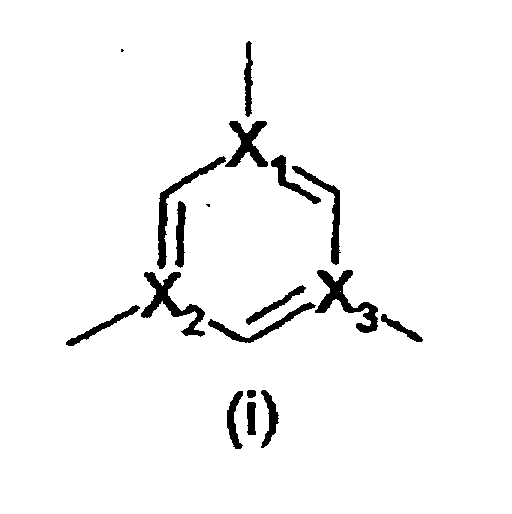
- the unsaturated ring A is a 6-membered aromatic group of sub-formula (i) where X 1 , X 2 and X 3 are independently selected from C or N.
- groups or sub-formula (i) are nitrogen-containing rings such as triazine, pyridine and pyrimidine, and of these, triazine is a most preferred group.
- Suitable linker groups R 2 will vary depending upon the precise nature of the polymer required and the purpose to which it is to be put. Generally however, R 2 will comprise an optionally substituted chain of from 2-8 atoms or an optionally substituted ring of 3-8 atoms, where the atoms are selected from carbon atoms or heteroatoms such as nitrogen, oxygen and sulphur.
- R 2 is a ring, it may be aromatic or non-aromatic.
- a particular example of an aromatic ring linker is benzyl and a particular example of a non-aromatic ring linker R 2 is cyclohexyl.
- linker R 2 comprises an optionally substituted chain of 2-8 atoms and preferably 3-8 atoms.
- linker groups R 2 include carbon or nitrogen atoms, these will be substituted with further groups to satisfy valency constraints and these groups may be hydrogen but may alternatively be an optional substituent.
- Suitable optional substituents for linker groups R 2 include alkyl (such as C 1-4 alkyl), hydroxy, hydroxyalkyl (such as hydroxyC 1-4 alkyl and in particular hydroxymethyl) alkoxy (such as C 1-4 alkoxy), alkanoyl (such as C 1-4 alkanoyl), carboxy or salts or esters thereof (such as alkyl esters), carboxyalkyl (such as carboxyC 1-4 alkyl and in particular CH 2 COOH) or salts or esters thereof, (such as alkyl esters), nitro, nitroalkyl, such as C 1-4 nitroalkyl in particular -CH 2 NO 2 ) cyano, cyanoalkyl such as C 1-4 cyanoalkyl in particular -CH 2 CN), amino, mono- or di-alkyl amino, aminoalkyl (such as aminoC 1-4 alkyl and in particular -CH 2 NH 2 ) phosphate, alkyl phosphate (such as C 1-4
- the substituents on the linker groups may affect the lipophilicity or hydrophilicity of the desired polymer.
- substituents may be omitted or may be selected from alkyl groups such as C 1-4 alkyl and in particular methyl.
- hydrophilic polymers are required, charged or electron-rich substituents such as hydroxy, hydroxyalkyl, carboxy or salts or esters thereof (such as alkyl esters), carboxyalkyl, nitro, cyano, phosphate, alkylphosphate, sulphate or alkylsulphate may suitably be used.
- substituents for the linker groups R 2 include reporter molecules or tags, these may comprise fluorescent labels.
- Typical nucleic acid labels include fluorescein derivatives (such as 5-carboxyfluorescein, fluorescein isothiocyanates (FITCs), fluorescein dichlorotriazines (DTAIs)), rhodamine derivatives (such as 5-carboxytetramethylrhodamine, rhodamine 6G, Rhodamine GreenTM, Rhodamine RedTM, LissamineTM, rhodamine B), Texas RedTM, BODIPYTM and Cascade BlueTM.
- fluorescein derivatives such as 5-carboxyfluorescein, fluorescein isothiocyanates (FITCs), fluorescein dichlorotriazines (DTAIs)
- rhodamine derivatives such as 5-carboxytetramethylrhodamine, rhodamine 6G, Rhodamine GreenTM, Rho
- stains which may be used for detection of nucleic acids include ethidium bromide, acridine homodimer, acridine orange, ethidium-acridine heterodimer, SYBRTM Green, SYBRTM Gold and PicoGreenTM.
- linking groups R 2 include both carbon and heteroatoms, in particular oxygen or nitrogen atoms.
- linking groups R 2 are groups of sub-formula (ii) or (iii) -Y 1 -(CR 6 R 7 ) m -Y 2 - - (CR 8 R 9 ) s -Y 3 -(CR 10 R 11 ) t - where m, s and t are independently selected from integers of from 1-6 and preferably 2-4, and Y 1 and Y 2 are independently selected from a bond, O, S, NR 12 , -C(O)O-, -OC(O)-, -NR 12 C(O)-, -C(O)NR 12 -, or -NR 12 C(O)NR 13 where R 12 and R 13 are independently selected from hydrogen or C 1-4 alkyl such as methyl, and Y 3 is a group which is formed by joining two moieties together, such as esters and amides of formulae -C(O)O-, -OC(O)-,-NR 12 C(O)-, -C
- At least some groups R 6 , R 7 , R 8 , R 9 , R 10 and R 11 are hydrogen. Most preferably, a maximum of one group R 6 , R 7 , R 8 , R 9 , R 10 and R 11 is other than hydrogen.
- R 12 and R 13 are hydrogen.
- alkyl includes both straight and branched chain groups, which, unless otherwise stated may contain for example from 1-10 and suitably from 1-6 carbon atoms.
- Other terms, such as alkoxy and alkanoyl used herein will include alkyl groups as discussed here, combined with the conventional functionality.
- linking groups of sub-formula (ii) are groups -NHCH 2 CH 2 NH-, -OCH 2 CH 2 O-, -NHC(O)CH 2 O-, -NHC(O)NHCH 2 -, -NHC(OH)CH 2 NH-, -NHCH (CH 2 COOH)CH 2 NH-, -NHCH (CH 2 OH)CH 2 NH 2 -, -OCH(CH 2 OH)CH 2 O-, -NHCH(CH 2 OPO 3 2- )CH 2 NH 2 -, or -NHCH(CH 2 NH 2 )CH 2 NH-.
- a particularly preferred example of a linking group R 2 is a group -NHCH 2 CH 2 NH-. Such linking groups will be useful in particular where lipophilic polymers are required.
- Ligands R 1 may be selected for example from nucleobases, and in particular naturally occurring nucleobases, nucleobase binding groups or DNA intercalators. These may be bound directly to the ring A, or a spacer group such as a C 1-4 and preferably a C 1-2 alkylene chain may be interposed between the nucleobases, nucleobase binding group or DNA intercalator and the ring A.
- Such ligands will allow the compound of formula (I) to form interactions, such as hybridisation interactions, with DNA or RNA molecules.
- the ligands R 1 will generally comprise naturally occurring nucleobases. However, in some instances, where additional spacing between ligands is required, at least some of the groups R 1 may be hydrogen. Preferably however, most if not all groups R 1 will be other than hydrogen.
- R 3 , R 4 where present, and R 5 will depend upon the production process used in the manufacture of the polymer as outlined below, as well as the nature of the linking group R 2 .
- Suitable blocking groups R 3 are those used to protect groups Y 2 in sub-formula (ii) above during the polymer production reaction.
- R 3 may be an alkylcarbonyl or arylcarbonyl such as benzyl carbonyl group when Y 2 is oxygen, or an alkoxy carbonyl ester such as t-butoxy carbonyl ester when Y 2 is NH-.
- R 3 will be hydrogen.
- R 5 may be a leaving group such as halogen such as fluoro, chloro, bromo or iodo, as well as mesylate or tosylate, and in particular chloro.
- halogen such as fluoro, chloro, bromo or iodo
- mesylate or tosylate and in particular chloro.
- Such leaving groups may be required in the production process to allow the polymer chain to build up in that direction if required. However, the terminal leaving groups may be blocked if desired or necessary to prevent chain extension in that direction, using conventional chemistry as described hereinafter.
- n may be anything depending upon the nature of the product being produced. Generally speaking however, n will be in the range of from 2-200 and preferably from about 6-100, more preferably 10-60.
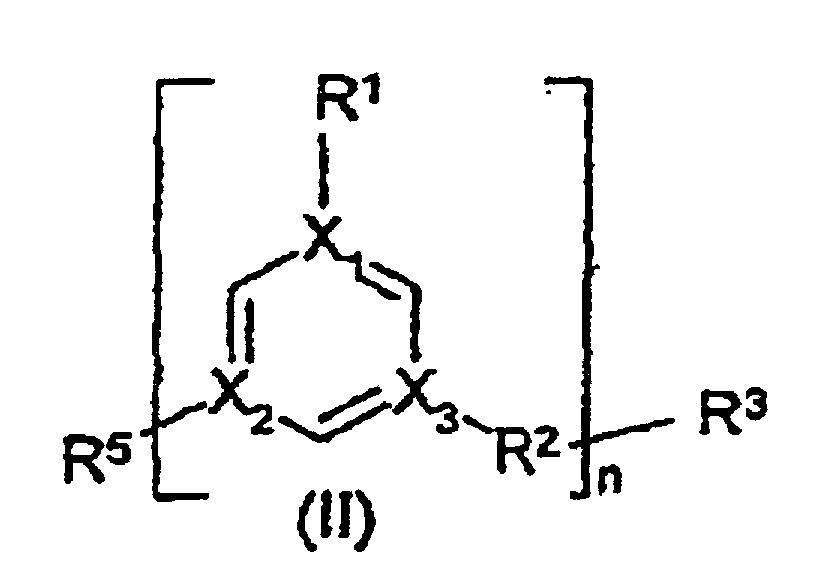
- the compounds of the invention are compounds of formula (II) where R 2 , R 3 , R 5 and n are as defined in relation to formula (I), each R 1 is the same or different and is as defined in relation to formula (I), and X 1 , X 2 and X 3 are as defined in relation to sub-formula (ii).
- Particularly suitable compounds of formula (II) can be partially represented as follows: where B 1 , B 2 and B 3 represent nucleobases a, b and c are independently selected from 0 or an integer of from 1-6, provided that a+b+c is equivalent to m as defined in relation to sub-formula (iii); each R 20 is an optional substituent for a linker group as defined above; R 5 is as defined in relation to formula (I), Y 1 and Y 2 are as defined in relation to sub-formula (iii) and the polymer extends further in a similar fashion in the direction of the dotted line.
- b is 0, 1 or 2 and preferably 0 or 1.
- a and c are independently selected from 0, 1 or 2.
- b is 1, one of a or c is 0 and the other is 1.
- R 5 is a leaving group
- Polymeric compounds of formula (I) are suitably prepared by processes which are conventional in the literature. In particular, they may be prepared by consecutively adding appropriately substituted monomers to a chain. Thus, compounds of formula (I) are suitably prepared by a reiterative process comprising the following steps:
- the compound of formula (III) employed may be the same or different. Where these are different, the precise structure of the target polymer of formula (I) can be selected.
- the coupling reactions of the above process are suitably effected under conventional conditions.
- the coupling is suitably effected in a solvent, and in particular an organic solvent such as tetrahydrofuran (THF) at moderate temperatures which may be in the range of from 0 to 80°C, preferably from 30 to 50°C.
- THF tetrahydrofuran
- the reaction may be effected in the presence of a base which is suitably a weak base such as triethylamine.
- the coupling results in the formation of the linker group R 2 .
- a bond such as an amide bond in the middle of the linker R 2 , which may therefore be of sub-formula (iii) as defined above.
- a particularly suitable group R 2' in formula (IV) would comprise a group of sub-formula (iv) -(CR 8 R 9 ) s -NH- where R 8 , R 9 and s are as defined in relation to sub-formula (iii), and in the compound of formula (III), R 5 is hydroxy, and R 4 is a group of sub-formula (v) -C(O)-(CR 10 R 11 ) t - where R 10 , R 11 and t are as defined in relation to sub-formula (iii).
- protecting groups R 14 and R 15 will vary depending upon the moiety they are attached to (i.e R 2' or R 2 respectively), and suitable examples would be apparent to a skilled chemist. Preferably R 14 is different to R 15 to facilitate removal of one of these groups at a time.
- Suitable protecting groups R 14 and R 15 include benzyl, alkoxycarbonyl esters such as t-butoxycarbonyl ester (Boc),9-fluorenylmethoxycarbonyl ester (FMOC), or amides such as N-formyl, or imides such as phthalimide.
- R 14 and/or R 15 are suitably esters such as acetates in particular OC(O)CH 3 or trifluoroacetate, carbamates such as alkyl carbamates in particular -OC(O)OCH 3 , or ethers such as tertiary butylether, benzylether, or trimethylsilylether.
- protecting groups on the group R 1' and/or R 2' Similar considerations apply with respect to the presence or otherwise of protecting groups on the group R 1' and/or R 2' .
- R 1 is a naturally occurring nucleobase
- Suitable protecting groups include alkanoyl or aroyl groups such as benzoyl. This are suitably introduced onto the base as a preliminary step using conventional methods for example as illustrated hereinafter.
- R 2' contains reactive substituents such as hydroxy, amino or carboxy groups, these may be protected during the preparation using methods similar to those outlined in relation to R 14 and R 15 .
- R 14 and R 15 and any protecting groups present on R 1' or R 2' may be effected under conventional conditions also as illustrated in the examples given hereinafter.
- Suitable leaving groups R 17 , R 18 and R 19 include leaving groups as listed above in relation to R 5 , and in particular are halo groups such as chloro.
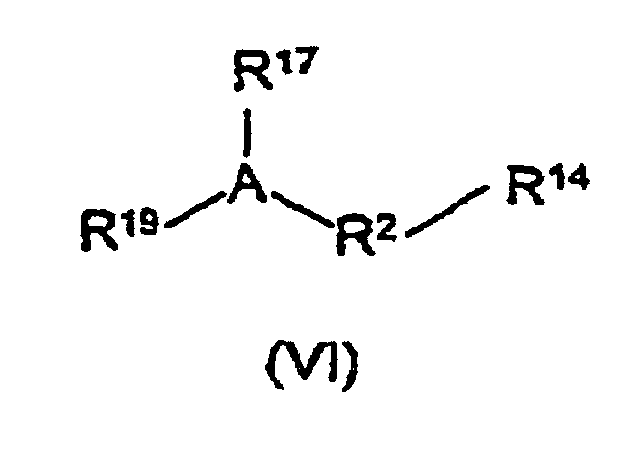
- compounds of formula (III), where p is 0 and R 5 is the same leaving group as R 19 are suitably prepared by reacting a compound of formula (VI) R 2 is as defined in relation to formula (I), R 14 is as defined in relation to formula (III), and R 17 and R 19 are as defined in relation to formula (V), with a compound of formula (VII) HR 1' where R 1' is as defined in relation to formula (III).
- the reaction is suitably effected in a solvent such as an acetone/water solvent, in the presence of a base such as sodium carbonate.
- Moderate temperatures for example from 0° to 50°C, and conveniently about room temperature, are employed, in order to avoid over production of an unwanted trisubstituted product, which may be a particular risk, where R 17 and R 19 are the same leaving groups.
- Compounds of formula (VI) may be prepared by reacting a compound of formula (V) as defined above, with a compound of formula (VIII) H-R 2 -R 14 where R 2 is as defined in relation to formula (I), and R 14 is as defined in relation to formula (III).
- the reaction is suitably effected in an organic solvent such an acetone/water solvent, in the presence of a base such as sodium hydrogen carbonate.
- a base such as sodium hydrogen carbonate.
- low temperatures for example from -20° to 10°C, and conveniently about 0°C, are employed, in order to avoid over production of an unwanted di- or tri-substituted products
- the invention provides a method of preparing a compound of formula (X) where R 2 is as defined in relation to formula (I) and R 14 is as defined in relation to formula (III), by reacting a cyanuric chloride with a compound of formula (XI) H-R 2 -R 14 were R 2 and R 14 are as defined above, at a temperature below 10°C, and preferably at about 0°C.
- Compounds of formula (III) may be converted to compounds of formula (IV), by reaction with a compound of formula (IX) where R 2 is as defined in relation to formula (I), and R 15 and q are as defined in relation to formula (IV).
- the reaction is suitably effected in an organic solvent such as tetrahydrofuran (THF), at elevated temperatures, for example at the reflux temperature of the solvent.
- THF tetrahydrofuran
- Processes for the production of compounds of formula (I) may be subject to automation if required.
- N -Boc-ethylenediamine from step 1 (500mg) was added to a slurry of cyanuric chloride (75mg) in acetone (12ml) which was then poured into ice water held at 0°C with stirring.
- Sodium bicarbonate (262mg) was added and after stirring for 2 hours at 0°C, a white solid was filtered off, washed with water and dried in vacuo over P 2 O 5 . Care was taken to ensure that the temperature of the reaction did not go above 0°C to prevent formation of unwanted di- and tri- substituted products and hydrolysis of the chloro groups.
- the desired product was obtained as a white solid (763mg, 93%) which was recrystallized from pyridine.
- Thymine (2.62g) was dissolved in acetonitrile (33ml) and pyridine (13.5ml) and benzoyl chloride (11.68g) was added. The reaction mixture was stirred at room temperature for 24 hours. The resultant orange solution was evaporated to dryness and the residue extracted into a 1:1 dioxane/water mixture (62ml). Potassium carbonate (4.86g) was added and the suspension was stirred at room temperature overnight. Hydrochloric acid (1N) was added to the solution to reduce the pH to about 3, whereupon the precipitate was collected and recrystallised from ethanol. The desired 3-benzoylamino derivative was obtained as pale yellow needles (2.5g).
- step (3) The 3- N -benzoyl thymine from step (3) (0.4g), sodium carbonate (0.2g) and the monosubstituted product of step 2 (0.5g) in acetone (20ml) and water (10ml) were mixed together. The reaction mixture was then stirred at room temperature for 5 hours. Completion of the reaction was indicated by TLC. The resultant yellow precipitate was filtered off and dried to give the desired product as a pale yellow solid (0.41g).
- a second monomer was prepared which introduced a third substituent onto the triazine molecule.
- Ethylene diamine (10g) in dichloromethane (60ml) was mixed with benzylchloride (21.01g)in dichloromethane. The mixture was stirred at room temperature for some hours and the solution was concentrated under reduced pressure. The residue was dissolved in ethylactate (100ml) and the resultant solution was washed with 1M potassium hydrogen sulphate (2x100ml), 5% sodium hydrogen sulphate (100ml), and brine (100ml), and then dried over magnesium sulphate. The solvent was evaporated under reduced pressure and the desired product was obtained as a colourless oil (22.40g, 92%).
- the trisubstituted product of step 6 (0.50mg) was suspended in dichloromethane (300ml) and trifluoroacetic acid (0.5ml) added. The mixture was stirred for 1 hour and then evaporated. The residue was dissolved in THF (5ml) with triethylamine (24.52ml) and the disubstituted product of step 4 (34mg) was added. The mixture was stirred for 2 hours at 40°C and further triethylamine added until the mixture was basic. Volatile materials were then removed under reduced pressure.
- step 7 could be repeated with the same or different monomers until an optimum chain is obtained.
Landscapes
- Chemical & Material Sciences (AREA)
- Organic Chemistry (AREA)
- Health & Medical Sciences (AREA)
- Chemical Kinetics & Catalysis (AREA)
- Medicinal Chemistry (AREA)
- Polymers & Plastics (AREA)
- Plural Heterocyclic Compounds (AREA)
- Graft Or Block Polymers (AREA)
- Pharmaceuticals Containing Other Organic And Inorganic Compounds (AREA)
- Macromolecular Compounds Obtained By Forming Nitrogen-Containing Linkages In General (AREA)
- Saccharide Compounds (AREA)
- Other Resins Obtained By Reactions Not Involving Carbon-To-Carbon Unsaturated Bonds (AREA)
Claims (18)
- Polymer, das eine Vielzahl von 5-6-gliedrigen ungesättigten Ringen aufweist, die gleich sein oder sich voneinander unterscheiden können, die mittels Verknüpfergruppen, die ein Rückgrat bilden, miteinander verknüpft sind, wobei wenigstens einige der 5-6-gliedrigen ungesättigten Ringe einen Liganden tragen.
- Polymer nach Anspruch 1, das eine Verbindung der allgemeinen Formel (I) umfaßtworin n eine ganze Zahl ist, die größer als 1 ist, jedes A gleich oder verschieden ist und ein 5- oder 6-gliedriger ungesättigter Ring ist, jedes R1 jeder anderen derartigen Gruppe gleich ist oder davon verschieden ist und ausgewählt ist aus Wasserstoff oder einer Ligandengruppe, jedes R2 eine ggf. substituierte Verknüpfergruppe ist, die jeder anderen derartigen Gruppe gleich ist oder davon verschieden ist, R3 Wasserstoff oder eine Blockiergruppe ist, R4 wenigstens ein Teil einer Verknüpfergruppe ist, p 0 oder 1 ist, und R5 eine austretende Gruppe oder ein blockiertes Derivat davon ist.

- Polymer nach Anspruch 2, wobei die Ringe A aromatische Ringe sind.
- Polymer nach Anspruch 2, wobei die Ringe A solche der Unterformel (i) sindworin X1, X2 und X3 unabhängig voneinander ausgewählt sind aus C oder N.
- Polymer nach Anspruch 4, wobei wenigstens eine der Gruppen der Unterformel (i) Triazingruppen sind.
- Polymer nach irgendeinem der vorausgehenden Ansprüche, wobei die Verknüpfergruppen R2 unabhängig voneinander ausgewählt sind aus einer Kette von 2 bis 8 Atomen oder einem Ring aus 3 bis 8 Atomen, die ausgewählt sind aus Kohlenstoffatomen und Heteroatomen, die ggf. substituiert sein können.
- Polymer nach Anspruch 6, wobei wenigstens einige der Verknüpfergruppen R2 Gruppen der Unterformel (ii) oder (iii) sind,
- Polymer nach Anspruch 7, wobei wenigstens einige Verknüpfungsgruppen R2 Gruppen der Formel -NHCH2CH2NH- sind.
- Polymer nach irgendeinem der vorausgegangenen Ansprüche, wobei die Gruppen R1 unabhängig voneinander ausgewählt sind aus Wasserstoff, Nucleobasen, Nucleobasen-bindenden Gruppen oder DNA-Intercalatoren, wobei die Nucleobasen, die Nucleobasen-bindenden Gruppen oder die DNA-Intercalatoren direkt an den Ring A gebunden sein können oder eine dazwischen eingeschobene C1-4-Alkylenkette aufweisen können.
- Polymer nach Anspruch 9, wobei wenigstens einige Gruppen R1 natürlich vorkommende Nucleobasen sind.
- Polymer nach irgendeinem der vorausgehenden Ansprüche der Formel (II)worin R2, R3, R5 und n wie in Anspruch 1 definiert sind, jedes R1 gleich ist oder unterschiedlich ist und wie in Anspruch 1 definiert ist, und X1, X2 und X3 wie in Anspruch 4 definiert sind.
- Verfahren zur Herstellung eines Polymers nach irgendeinem der vorausgehenden Ansprüche, wobei das Verfahren das schrittweise Anfügen von geeignet substituierten Monomeren an eine Kette umfaßt.
- Verfahren nach Anspruch 12, das die folgenden Schritte umfaßt:sowie danach gewünschtenfalls oder erforderlichenfalls Entfernen aller restlichen Schutzgruppen R14 oder R15 und/oder Einführen einer blockierenden Gruppe R3.(a) Umsetzen einer Verbindung der Formel (III)in der A, R4, R5 und p wie in Anspruch 2 definiert sind, R1' eine Gruppe R1, wie sie in Anspruch 1 definiert ist, oder ein geschütztes Derivat davon ist;
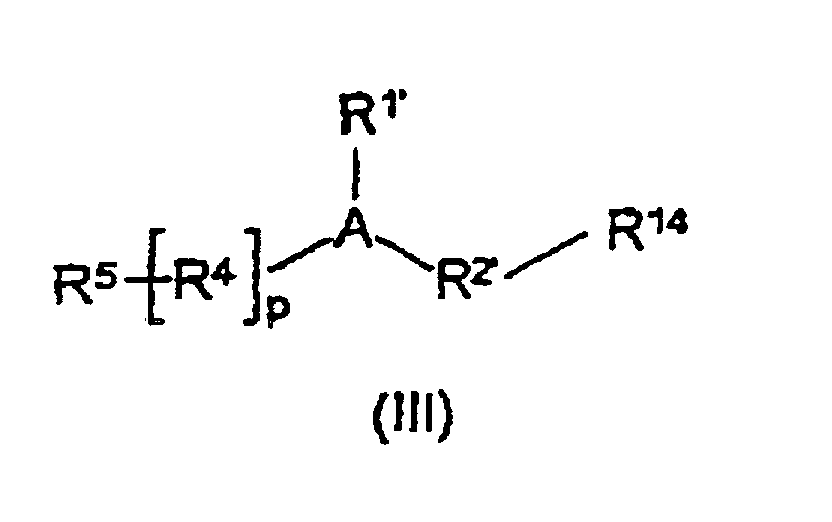
R2' eine Gruppe R2 ist, wie sie in Hinblick auf Anspruch 1 definiert ist, oder eine geschützte Form davon ist, wobei p 0 ist; oder R2' eine Vorläufergruppe ist, so daß R2 oder eine geschützte Form davon gebildet wird durch -R2'-R4-, wobei p 1 ist, und
R14 eine Schutzgruppe ist,
mit einer Verbindung der Formel (IV)wobei A, R2, R4 und p wie in Anspruch 1 definiert sind, q 0 oder 1 ist, R1' und R2' wie oben im Hinblick auf Formel (III) definiert sind, und alle davon entsprechenden Einheiten in der Verbindung der Formel (III) gleich sind oder sich davon unterscheiden, wobei R15 eine Schutzgruppe ist und q 0 oder 1 ist, danach (b) Entfernen der Schutzgruppe R14 und Umsetzen des Produkts mit einer weiteren Verbindung der Formel (III); oder(c) wenn q gleich 1 ist, Entfernen der Schutzgruppe R15 und Umsetzen des Produkts mit einer weiteren Verbindung der Formel (III); und(d) Wiederholen von Schritt (b) und/oder (c), bis das gewünschte Polymer erhalten wurde;(e) Entfernen aller Schutzgruppen an R1' und/oder R2' ;
 - Verfahren nach Ansrpuch 12 oder Anspruch 13, das auf eine automatisierte Art und Weise durchgeführt ist.
- Verbindung der Formel (III), wie sie in Anspruch 13 definiert ist.
- Verbindung der Formel (IV), wie sie in Anspruch 13 definiert ist.
- Verbindung der Formel (VI)worin R2 wie in Anspruch 2 definiert ist, R14, wie in Anspruch 13 definiert ist und R17 und R19 austretende Gruppen sind.
- Verfahren zur Herstellung einer Verbindung der Formel (X)wobei R2 wie im Hinblick auf Formel (I) definiert ist, und R14 wie im Hinblick auf Formel (III) definiert ist, durch Umsetzen eines Cyanurchlorids mit einer Verbindung der Formel (XI)

Applications Claiming Priority (3)
| Application Number | Priority Date | Filing Date | Title |
|---|---|---|---|
| GBGB0102388.6A GB0102388D0 (en) | 2001-01-31 | 2001-01-31 | Polymers |
| GB0102388 | 2001-01-31 | ||
| PCT/GB2002/000406 WO2002060974A1 (en) | 2001-01-31 | 2002-01-30 | Polymers |
Publications (2)
| Publication Number | Publication Date |
|---|---|
| EP1368403A1 EP1368403A1 (de) | 2003-12-10 |
| EP1368403B1 true EP1368403B1 (de) | 2004-08-04 |
Family
ID=9907817
Family Applications (1)
| Application Number | Title | Priority Date | Filing Date |
|---|---|---|---|
| EP02710131A Expired - Lifetime EP1368403B1 (de) | 2001-01-31 | 2002-01-30 | Polymere |
Country Status (11)
| Country | Link |
|---|---|
| US (2) | US7022808B2 (de) |
| EP (1) | EP1368403B1 (de) |
| JP (1) | JP2004531589A (de) |
| AT (1) | ATE272663T1 (de) |
| CA (1) | CA2454215A1 (de) |
| DE (1) | DE60200886T2 (de) |
| DK (1) | DK1368403T3 (de) |
| ES (1) | ES2223036T3 (de) |
| GB (1) | GB0102388D0 (de) |
| WO (1) | WO2002060974A1 (de) |
| ZA (1) | ZA200305833B (de) |
Families Citing this family (4)
| Publication number | Priority date | Publication date | Assignee | Title |
|---|---|---|---|---|
| GB0102388D0 (en) * | 2001-01-31 | 2001-03-14 | Secr Defence | Polymers |
| US7919562B2 (en) * | 2006-05-31 | 2011-04-05 | The University Of Western Ontario | Preparation of supramolecular polymers containing sequence-selective hydrogen bonding subunits in their backbone which form double helices |
| EP2569378B1 (de) | 2010-05-14 | 2014-10-01 | FUJIFILM Imaging Colorants Limited | Druckverfahren, polymer und tinte |
| KR20130120990A (ko) | 2010-05-14 | 2013-11-05 | 후지필름 이미징 컬러런츠 리미티드 | 분산물, 분산물의 제조 방법 및 잉크젯 인쇄 잉크 |
Family Cites Families (17)
| Publication number | Priority date | Publication date | Assignee | Title |
|---|---|---|---|---|
| US3301797A (en) * | 1964-03-06 | 1967-01-31 | American Cyanamid Co | Linear triazine polymers |
| US3734976A (en) * | 1966-03-11 | 1973-05-22 | Hooker Chemical Corp | Halogenated triazine elastomers |
| JPS4891146A (de) * | 1972-03-09 | 1973-11-27 | ||
| US4102872A (en) * | 1977-06-14 | 1978-07-25 | The United States Of America As Represented By The Secretary Of The Air Force | Fluorocarbon triazine polymers |
| US4347352A (en) * | 1980-03-03 | 1982-08-31 | Sterling Drug Inc. | Novel polymeric compounds, processes and methods of use |
| US4461861A (en) * | 1981-07-20 | 1984-07-24 | American Cyanamid Company | Polymer compositions stabilized with triazinyl-piperidine compounds |
| US4442278A (en) * | 1981-12-03 | 1984-04-10 | Hughes Aircraft Company | Ethynyl-substituted s-triazine derivatives, polymers thereof and process for making the same |
| US4539386A (en) * | 1983-07-27 | 1985-09-03 | Celanese Corporation | Process for forming thermally stable thermotropic liquid crystalline polyesters of predetermined chain length |
| CA2034274A1 (en) * | 1990-02-07 | 1991-08-08 | James A. Bonham | Polymers containing halomethyl-1,3,5-triazine moieties |
| US5240499A (en) * | 1990-12-21 | 1993-08-31 | Hoechst Aktiengesellschaft | Surfactant triazine compounds and their use |
| DK51092D0 (da) * | 1991-05-24 | 1992-04-15 | Ole Buchardt | Oligonucleotid-analoge betegnet pna, monomere synthoner og fremgangsmaade til fremstilling deraf samt anvendelser deraf |
| GB9126841D0 (en) * | 1991-12-18 | 1992-02-19 | Courtaulds Plc | Heterocyclic compounds |
| US7825215B1 (en) | 1993-04-26 | 2010-11-02 | Peter E. Nielsen | Substituted nucleic acid mimics |
| JPH07224162A (ja) * | 1994-02-14 | 1995-08-22 | Hoechst Japan Ltd | トリアジンポリマー |
| US5916750A (en) * | 1997-01-08 | 1999-06-29 | Biogenex Laboratories | Multifunctional linking reagents for synthesis of branched oligomers |
| US6096886A (en) * | 1997-12-08 | 2000-08-01 | Cytec Technology Corp. | Morpholino end-capped, hindered amine substituted aminotriazine |
| GB0102388D0 (en) * | 2001-01-31 | 2001-03-14 | Secr Defence | Polymers |
-
2001
- 2001-01-31 GB GBGB0102388.6A patent/GB0102388D0/en not_active Ceased
-
2002
- 2002-01-30 JP JP2002561539A patent/JP2004531589A/ja active Pending
- 2002-01-30 CA CA002454215A patent/CA2454215A1/en not_active Abandoned
- 2002-01-30 ES ES02710131T patent/ES2223036T3/es not_active Expired - Lifetime
- 2002-01-30 EP EP02710131A patent/EP1368403B1/de not_active Expired - Lifetime
- 2002-01-30 AT AT02710131T patent/ATE272663T1/de not_active IP Right Cessation
- 2002-01-30 DK DK02710131T patent/DK1368403T3/da active
- 2002-01-30 US US10/467,475 patent/US7022808B2/en not_active Expired - Fee Related
- 2002-01-30 WO PCT/GB2002/000406 patent/WO2002060974A1/en not_active Ceased
- 2002-01-30 DE DE60200886T patent/DE60200886T2/de not_active Expired - Fee Related
-
2003
- 2003-07-29 ZA ZA200305833A patent/ZA200305833B/en unknown
-
2006
- 2006-01-17 US US11/333,041 patent/US20060122289A1/en not_active Abandoned
Also Published As
| Publication number | Publication date |
|---|---|
| ATE272663T1 (de) | 2004-08-15 |
| US7022808B2 (en) | 2006-04-04 |
| GB0102388D0 (en) | 2001-03-14 |
| JP2004531589A (ja) | 2004-10-14 |
| CA2454215A1 (en) | 2002-08-08 |
| US20040091896A1 (en) | 2004-05-13 |
| US20060122289A1 (en) | 2006-06-08 |
| DE60200886D1 (de) | 2004-09-09 |
| EP1368403A1 (de) | 2003-12-10 |
| WO2002060974A1 (en) | 2002-08-08 |
| DE60200886T2 (de) | 2005-08-18 |
| DK1368403T3 (da) | 2004-10-11 |
| ES2223036T3 (es) | 2005-02-16 |
| ZA200305833B (en) | 2004-07-26 |
Similar Documents
| Publication | Publication Date | Title |
|---|---|---|
| US6015887A (en) | Chiral peptide nucleic acids and methods for preparing same | |
| WO2016060135A1 (ja) | モルフォリノオリゴヌクレオチドの製造方法 | |
| JPWO2003000683A1 (ja) | ピロール−イミダゾールポリアミドの固相合成法 | |
| AU750974B2 (en) | Method for producing polymers having nucleo-bases as side-groups | |
| CA2436665A1 (en) | Nucleic acid derivatives | |
| US9499576B2 (en) | Compound, nucleic, acid, method for producing nucleic acid, and kit for producing nucleic acid | |
| US7022808B2 (en) | Polymers | |
| US20160311845A1 (en) | Nucleotide derivative or salt thereof, nucleotide-derived 5'-phosphate ester or salt thereof, nucleotide-derived 3'-phosphoramidite compound or salt thereof, and polynucleotide | |
| US9765169B2 (en) | Functionalized polymer hybrids | |
| Amant et al. | Synthesis and oligomerization of Fmoc/Boc-protected PNA monomers of 2, 6-diaminopurine, 2-aminopurine and thymine | |
| AU2002228184A1 (en) | Polymers | |
| US6482954B2 (en) | Imidazole containing compounds having relatively low hydrogen content and relatively high nitrogen content and polymers and copolymers formed therefrom | |
| JP7220439B1 (ja) | キメラ分子の製造方法 | |
| Gasser et al. | Synthesis of a ferrocenyl uracil PNA monomer for insertion into PNA sequences | |
| AU2005225589A1 (en) | Labelling reagents, methods for the synthesis of such reagents and methods for the detection of biological molecules | |
| US6541626B2 (en) | Process for selective N-acylation of purine nucleosides | |
| WO2012029434A1 (ja) | オリゴヌクレオチドおよびその利用 | |
| AU2006316903A1 (en) | Polynucleotide labelling reagent | |
| KPandey et al. | Synthesis and hybridization studies of oligonucleotide sequences with modified fluorescent nucleoside analogs | |
| US20230235328A1 (en) | Novel morpholino oligonucleotide derivatives | |
| Sivakumar et al. | Phthalimido protected peptide nucleic acid monomer–Synthesis and Characterization | |
| KR101056523B1 (ko) | 신규한 pna (감마3-pna) 및 이의 제조 방법 | |
| EP1607384A1 (de) | Neue funktionelle peptidnukleinsäure und herstellungsverfahren dafür | |
| US20160075680A1 (en) | Modified solid support for the synthesis of oligonucleotides | |
| WO2007029364A1 (ja) | ピロールアミド4量体を含む2’−デオキシグアノシンハイブリッド化合物及びその製造方法、そのための製造中間体 |
Legal Events
| Date | Code | Title | Description |
|---|---|---|---|
| PUAI | Public reference made under article 153(3) epc to a published international application that has entered the european phase |
Free format text: ORIGINAL CODE: 0009012 |
|
| 17P | Request for examination filed |
Effective date: 20030901 |
|
| AK | Designated contracting states |
Kind code of ref document: A1 Designated state(s): AT BE CH CY DE DK ES FI FR GB GR IE IT LI LU MC NL PT SE TR |
|
| AX | Request for extension of the european patent |
Extension state: AL LT LV MK RO SI |
|
| GRAP | Despatch of communication of intention to grant a patent |
Free format text: ORIGINAL CODE: EPIDOSNIGR1 |
|
| GRAS | Grant fee paid |
Free format text: ORIGINAL CODE: EPIDOSNIGR3 |
|
| GRAA | (expected) grant |
Free format text: ORIGINAL CODE: 0009210 |
|
| AK | Designated contracting states |
Kind code of ref document: B1 Designated state(s): AT BE CH CY DE DK ES FI FR GB GR IE IT LI LU MC NL PT SE TR |
|
| PG25 | Lapsed in a contracting state [announced via postgrant information from national office to epo] |
Ref country code: TR Free format text: LAPSE BECAUSE OF FAILURE TO SUBMIT A TRANSLATION OF THE DESCRIPTION OR TO PAY THE FEE WITHIN THE PRESCRIBED TIME-LIMIT Effective date: 20040804 Ref country code: AT Free format text: LAPSE BECAUSE OF FAILURE TO SUBMIT A TRANSLATION OF THE DESCRIPTION OR TO PAY THE FEE WITHIN THE PRESCRIBED TIME-LIMIT Effective date: 20040804 Ref country code: BE Free format text: LAPSE BECAUSE OF FAILURE TO SUBMIT A TRANSLATION OF THE DESCRIPTION OR TO PAY THE FEE WITHIN THE PRESCRIBED TIME-LIMIT Effective date: 20040804 Ref country code: FI Free format text: LAPSE BECAUSE OF FAILURE TO SUBMIT A TRANSLATION OF THE DESCRIPTION OR TO PAY THE FEE WITHIN THE PRESCRIBED TIME-LIMIT Effective date: 20040804 |
|
| REG | Reference to a national code |
Ref country code: GB Ref legal event code: FG4D |
|
| REG | Reference to a national code |
Ref country code: CH Ref legal event code: EP |
|
| REG | Reference to a national code |
Ref country code: IE Ref legal event code: FG4D |
|
| REF | Corresponds to: |
Ref document number: 60200886 Country of ref document: DE Date of ref document: 20040909 Kind code of ref document: P |
|
| REG | Reference to a national code |
Ref country code: DK Ref legal event code: T3 |
|
| RIN2 | Information on inventor provided after grant (corrected) |
Inventor name: HALL, ELIZABETH A. Inventor name: HUNTER KAWULIA T. |
|
| REG | Reference to a national code |
Ref country code: CH Ref legal event code: NV Representative=s name: E. BLUM & CO. PATENTANWAELTE |
|
| PG25 | Lapsed in a contracting state [announced via postgrant information from national office to epo] |
Ref country code: GR Free format text: LAPSE BECAUSE OF FAILURE TO SUBMIT A TRANSLATION OF THE DESCRIPTION OR TO PAY THE FEE WITHIN THE PRESCRIBED TIME-LIMIT Effective date: 20041104 |
|
| REG | Reference to a national code |
Ref country code: SE Ref legal event code: TRGR |
|
| ET | Fr: translation filed | ||
| LTIE | Lt: invalidation of european patent or patent extension |
Effective date: 20040804 |
|
| PG25 | Lapsed in a contracting state [announced via postgrant information from national office to epo] |
Ref country code: IT Free format text: LAPSE BECAUSE OF NON-PAYMENT OF DUE FEES Effective date: 20050130 Ref country code: LU Free format text: LAPSE BECAUSE OF NON-PAYMENT OF DUE FEES Effective date: 20050130 Ref country code: CY Free format text: LAPSE BECAUSE OF FAILURE TO SUBMIT A TRANSLATION OF THE DESCRIPTION OR TO PAY THE FEE WITHIN THE PRESCRIBED TIME-LIMIT Effective date: 20050130 |
|
| PG25 | Lapsed in a contracting state [announced via postgrant information from national office to epo] |
Ref country code: MC Free format text: LAPSE BECAUSE OF NON-PAYMENT OF DUE FEES Effective date: 20050131 |
|
| REG | Reference to a national code |
Ref country code: ES Ref legal event code: FG2A Ref document number: 2223036 Country of ref document: ES Kind code of ref document: T3 |
|
| PLBE | No opposition filed within time limit |
Free format text: ORIGINAL CODE: 0009261 |
|
| STAA | Information on the status of an ep patent application or granted ep patent |
Free format text: STATUS: NO OPPOSITION FILED WITHIN TIME LIMIT |
|
| 26N | No opposition filed |
Effective date: 20050506 |
|
| PGFP | Annual fee paid to national office [announced via postgrant information from national office to epo] |
Ref country code: FR Payment date: 20061211 Year of fee payment: 6 |
|
| PGFP | Annual fee paid to national office [announced via postgrant information from national office to epo] |
Ref country code: DK Payment date: 20061212 Year of fee payment: 6 |
|
| PGFP | Annual fee paid to national office [announced via postgrant information from national office to epo] |
Ref country code: DE Payment date: 20061214 Year of fee payment: 6 |
|
| PGFP | Annual fee paid to national office [announced via postgrant information from national office to epo] |
Ref country code: CH Payment date: 20061215 Year of fee payment: 6 Ref country code: GB Payment date: 20061215 Year of fee payment: 6 Ref country code: NL Payment date: 20061215 Year of fee payment: 6 |
|
| PGFP | Annual fee paid to national office [announced via postgrant information from national office to epo] |
Ref country code: IE Payment date: 20061220 Year of fee payment: 6 Ref country code: SE Payment date: 20061220 Year of fee payment: 6 |
|
| PGFP | Annual fee paid to national office [announced via postgrant information from national office to epo] |
Ref country code: ES Payment date: 20070112 Year of fee payment: 6 |
|
| REG | Reference to a national code |
Ref country code: CH Ref legal event code: PFA Owner name: THE SECRETARY OF STATE FOR DEFENCE IN HER BRITANN Free format text: THE SECRETARY OF STATE FOR DEFENCE IN HER BRITANNIC MAJESTY'S GOVERNMENT OF THE U. K. OF GREAT BRITAIN AND NORTHERN IRELAND#DSTL, PORTO DOWN#SALISBURY, WILTSHIRE SP4 0JQ (GB) -TRANSFER TO- THE SECRETARY OF STATE FOR DEFENCE IN HER BRITANNIC MAJESTY'S GOVERNMENT OF THE U. K. OF GREAT BRITAIN AND NORTHERN IRELAND#DSTL, PORTO DOWN#SALISBURY, WILTSHIRE SP4 0JQ (GB) |
|
| PG25 | Lapsed in a contracting state [announced via postgrant information from national office to epo] |
Ref country code: PT Free format text: LAPSE BECAUSE OF NON-PAYMENT OF DUE FEES Effective date: 20050104 |
|
| REG | Reference to a national code |
Ref country code: CH Ref legal event code: PL |
|
| REG | Reference to a national code |
Ref country code: DK Ref legal event code: EBP |
|
| EUG | Se: european patent has lapsed | ||
| GBPC | Gb: european patent ceased through non-payment of renewal fee |
Effective date: 20080130 |
|
| NLV4 | Nl: lapsed or anulled due to non-payment of the annual fee |
Effective date: 20080801 |
|
| REG | Reference to a national code |
Ref country code: IE Ref legal event code: MM4A |
|
| PG25 | Lapsed in a contracting state [announced via postgrant information from national office to epo] |
Ref country code: CH Free format text: LAPSE BECAUSE OF NON-PAYMENT OF DUE FEES Effective date: 20080131 Ref country code: DE Free format text: LAPSE BECAUSE OF NON-PAYMENT OF DUE FEES Effective date: 20080801 Ref country code: LI Free format text: LAPSE BECAUSE OF NON-PAYMENT OF DUE FEES Effective date: 20080131 Ref country code: NL Free format text: LAPSE BECAUSE OF NON-PAYMENT OF DUE FEES Effective date: 20080801 |
|
| REG | Reference to a national code |
Ref country code: FR Ref legal event code: ST Effective date: 20081029 |
|
| PG25 | Lapsed in a contracting state [announced via postgrant information from national office to epo] |
Ref country code: GB Free format text: LAPSE BECAUSE OF NON-PAYMENT OF DUE FEES Effective date: 20080130 |
|
| PG25 | Lapsed in a contracting state [announced via postgrant information from national office to epo] |
Ref country code: IE Free format text: LAPSE BECAUSE OF NON-PAYMENT OF DUE FEES Effective date: 20080130 Ref country code: SE Free format text: LAPSE BECAUSE OF NON-PAYMENT OF DUE FEES Effective date: 20080131 Ref country code: DK Free format text: LAPSE BECAUSE OF NON-PAYMENT OF DUE FEES Effective date: 20080131 |
|
| REG | Reference to a national code |
Ref country code: ES Ref legal event code: FD2A Effective date: 20080131 |
|
| PG25 | Lapsed in a contracting state [announced via postgrant information from national office to epo] |
Ref country code: FR Free format text: LAPSE BECAUSE OF NON-PAYMENT OF DUE FEES Effective date: 20080131 |
|
| PG25 | Lapsed in a contracting state [announced via postgrant information from national office to epo] |
Ref country code: ES Free format text: LAPSE BECAUSE OF NON-PAYMENT OF DUE FEES Effective date: 20080131 |
|
| PGFP | Annual fee paid to national office [announced via postgrant information from national office to epo] |
Ref country code: IT Payment date: 20070526 Year of fee payment: 6 |
|
| PGRI | Patent reinstated in contracting state [announced from national office to epo] |
Ref country code: IT Effective date: 20091201 |
|
| PGRI | Patent reinstated in contracting state [announced from national office to epo] |
Ref country code: IT Effective date: 20091201 |