EP1368733B1 - Procede pour optimiser la distribution d'un logiciel dans des reseaux de communication etendus - Google Patents
Procede pour optimiser la distribution d'un logiciel dans des reseaux de communication etendus Download PDFInfo
- Publication number
- EP1368733B1 EP1368733B1 EP02703997A EP02703997A EP1368733B1 EP 1368733 B1 EP1368733 B1 EP 1368733B1 EP 02703997 A EP02703997 A EP 02703997A EP 02703997 A EP02703997 A EP 02703997A EP 1368733 B1 EP1368733 B1 EP 1368733B1
- Authority
- EP
- European Patent Office
- Prior art keywords
- node
- distribution
- nodes
- paths
- path
- Prior art date
- Legal status (The legal status is an assumption and is not a legal conclusion. Google has not performed a legal analysis and makes no representation as to the accuracy of the status listed.)
- Expired - Lifetime
Links
Images


Classifications
-
- H—ELECTRICITY
- H04—ELECTRIC COMMUNICATION TECHNIQUE
- H04L—TRANSMISSION OF DIGITAL INFORMATION, e.g. TELEGRAPHIC COMMUNICATION
- H04L67/00—Network arrangements or protocols for supporting network services or applications
- H04L67/01—Protocols
- H04L67/06—Protocols specially adapted for file transfer, e.g. file transfer protocol [FTP]
-
- G—PHYSICS
- G06—COMPUTING OR CALCULATING; COUNTING
- G06F—ELECTRIC DIGITAL DATA PROCESSING
- G06F8/00—Arrangements for software engineering
- G06F8/60—Software deployment
- G06F8/61—Installation
-
- H—ELECTRICITY
- H04—ELECTRIC COMMUNICATION TECHNIQUE
- H04L—TRANSMISSION OF DIGITAL INFORMATION, e.g. TELEGRAPHIC COMMUNICATION
- H04L45/00—Routing or path finding of packets in data switching networks
-
- H—ELECTRICITY
- H04—ELECTRIC COMMUNICATION TECHNIQUE
- H04L—TRANSMISSION OF DIGITAL INFORMATION, e.g. TELEGRAPHIC COMMUNICATION
- H04L45/00—Routing or path finding of packets in data switching networks
- H04L45/12—Shortest path evaluation
-
- H—ELECTRICITY
- H04—ELECTRIC COMMUNICATION TECHNIQUE
- H04L—TRANSMISSION OF DIGITAL INFORMATION, e.g. TELEGRAPHIC COMMUNICATION
- H04L45/00—Routing or path finding of packets in data switching networks
- H04L45/26—Route discovery packet
-
- H—ELECTRICITY
- H04—ELECTRIC COMMUNICATION TECHNIQUE
- H04L—TRANSMISSION OF DIGITAL INFORMATION, e.g. TELEGRAPHIC COMMUNICATION
- H04L67/00—Network arrangements or protocols for supporting network services or applications
- H04L67/34—Network arrangements or protocols for supporting network services or applications involving the movement of software or configuration parameters
-
- H—ELECTRICITY
- H04—ELECTRIC COMMUNICATION TECHNIQUE
- H04W—WIRELESS COMMUNICATION NETWORKS
- H04W4/00—Services specially adapted for wireless communication networks; Facilities therefor
- H04W4/90—Services for handling of emergency or hazardous situations, e.g. earthquake and tsunami warning systems [ETWS]
-
- H—ELECTRICITY
- H04—ELECTRIC COMMUNICATION TECHNIQUE
- H04W—WIRELESS COMMUNICATION NETWORKS
- H04W40/00—Communication routing or communication path finding
-
- H—ELECTRICITY
- H04—ELECTRIC COMMUNICATION TECHNIQUE
- H04W—WIRELESS COMMUNICATION NETWORKS
- H04W76/00—Connection management
- H04W76/50—Connection management for emergency connections
Definitions
- the present invention is related to optimizing software distribution in large communication networks and in particular to hosts, servers, gateways, switches, routers and other network devices in large data and telecommunication networks.
- O&M O&M center
- the operator may save some bandwidth by distributing the software on an ad hoc basis from device to device, i.e. manual distribution based on knowledge of the network, but the real benefits are only realized when there is an automated method available that can be used to plan the entire distribution throughout the network.
- the operator easily looses control of the distribution process using the ad hoc method, and it is difficult to apply in large networks.
- Network devices may implement application functions like multimedia telephony or unified messaging, which provide additional value for the end-user beyond basic end-to-end connectivity.
- application functions like multimedia telephony or unified messaging, which provide additional value for the end-user beyond basic end-to-end connectivity.
- the number of different types of network devices has been quite small, because network functions spanning from transport to the application layer have been integrated in a single element.
- Prior art document EP1014652 shows a software distribution system for software bundles comprising a plurality of packages, at least two of which are required by a different set of nodes on a network. Rather than send all of the packages constituting the software bundle to each node, only the packages in the software bundle which are required by nodes below a certain link in the network are sent along that link, whereby to minimize the bandwidth required for transmitting the software bundle.
- This document forms the preamble of claim 1.
- the main object of the present invention is to provide a method for optimal distribution of software in a communication network that overcomes the problems identified above.
- the object is achieved by a method characterized in the features defined by the characterizing part of claim 1.
- the present invention discloses a method optimizing the distribution of software to nodes in a communication network from one distribution node.
- the communication network may be a telecommunication network, e.g. UMTS, and the distribution node may be an OMC in such a network.
- a distribution graph is constructed including the above-mentioned nodes spanned out by logical links assigned cost values indicating the cost of transferring data between the associated adjacent nodes.
- the next step in the method is to identify overlapping paths and placing them in separate groups. Identifying paths are defined as paths starting at the same node, going through exactly the same path up to some point in the distribution graph.
- the paths in each group are ordered according to the number of nodes included in each path.
- the path having the lowest number of nodes in the group is placed first, the path having the second lowest number is placed as the number two node,.
- the software is distributed from the distribution node to the rest of the nodes in the group starting by loading the software from the first node to the second node of the first ordered path. Then the software is loaded from the first node to the second node of the second ordered path, up to the last path in the group.
- the loading between the same two nodes is not taking place more than once, even if they appear as the first and the second node in more than one path.
- the first node in each path and each path in which only one node remains are removed. These last loading and removing steps are then repeated until no further paths are left in the group.
- the loading between the first and the second node is executed in parallel for two or more paths within the same group if said two or more paths include the same number of nodes and the distribution of the software in two or more of said groups is executed in parallel.
- the method comprises the step of remotely initiating a file transfer between two neighboring nodes in the network from the distribution node (OMC).
- OMC distribution node
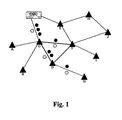
- Fig. 1 shows a distribution graph illustrating an example of how software distribution may be executed in a telecommunication network today.
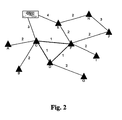
- Fig. 2 shows a distribution graph including all nodes involved in the distribution spanned out by logical transfer links each assigned a cost.
- Fig. 3 is a flow chart illustrating the steps of the software distribution procedure according to an embodiment of the present invention.
- Fig. 4 is a sequence chart illustrating the trace route procedure used in an embodiment of the present invention for constructing the distribution graph of fig. 3 .
- Fig. 5 is a sequence chart illustrating the use of TELNET and FTP for loading SWPs from one node to another in an embodiment of the present invention.
- the method according to the present invention first makes use of a shortest path algorithm.
- this algorithm determines the shortest path from a start node to all other nodes in the network.
- the different shortest path algorithms differ in complexity, but this is not important for the purpose of the method described here.
- the shortest path algorithm is used to calculate the shortest path from a distribution node, hereafter exemplified as an OMC in a telecommunication network, to at least each node to which corrected or new software shall be distributed.
- These nodes are included in a distribution list. Note that this list also may include one or more nodes to which the new software not is to be distributed. However, the inclusion of such nodes assumes that they are centrally localized relative to the other nodes, and that it is stated that the inclusion implies a more effective software distribution when utilizing the method according to the present invention. Generally, though, only the nodes to which corrected or new software is to be distributed will be included in the distribution list. Then the method described in detail below is used to optimize distribution from the OMC to each node. The distribution itself is executed using some file transfer mechanism, e.g. the File Transfer Protocol [2].
- This distribution graph contains the OMC and the nodes that are included in the distribution.
- the nodes are spanned out by the logical transfer paths that are set up between the nodes, which are referred to as edges in the graph.
- the cost of each edge is included in the graph.
- Figure 2 illustrates a typical distribution graph.
- the logical cost of transferring data from OMC to device C is the sum of all intermediate physical transmission paths, i.e. in this specific case the sum of transferring from OMC to I1 from I1 to I2, and from I2 to C.
- FIG. 2 illustrates such a distribution network. Note that only two of the participating devices have “direct” paths to the OMC. With “direct”, it is understood that there may be devices not participating in the distribution between the OMC and the “directly” connected device.
- the distribution graph is used as input to this step, which involves calculating the shortest path from the OMC to every device that is included in the distribution. As mentioned earlier the calculation is performed using a shortest path algorithm.
- the recommended algorithm is Dijkstra [1], which will produce the shortest path to every node in the distribution network starting from the OMC.
- the output of the algorithm is a set of paths, where each paths starts with the OMC and ends with one of the devices in the network. For instance, in figure 2 , the following is the shortest path: OMC, C, D, G. This means that if software is to be distributed from the OMC to device G, it should first be transferred from OMC to C, then from C to D, and finally from D to G.
- OSPF Open Shortest Path First
- OSPF routing operates only between a source and destination host, and hence it cannot be used to optimize transfer to a set of hosts.
- OSPF will help us optimize the transmission between two neighboring devices in the logical network that are connected through an intermediate physical network.
- the next step is to identify overlapping paths from the shortest path calculation.
- Two paths are overlapping if they start at the same node, and go through exactly the same path up to some point. This means that one of the paths overlaps parts of the other.
- a path always consists of two or more nodes, and in our case, all paths start at the same node, i.e. the OMC. In other words, two paths are overlapping if they have a common root path.
- the following example illustrates the concept of overlapping paths, given the shortest paths as output from the previous step.
- the nodes and paths used may be identified in figure 2 .
- the output of this step is a grouping of paths into sets of overlapping paths.
- the grouping must contain a root path, which is a path that all the other paths are overlapping. Since the distribution graph only contains nodes that are included in the distribution, the root paths will only contain two nodes. In the example above OMC, C is a root path.
- the following procedure may be used to build the groups of overlapping paths:
- OMC, C is a root path, and the three following paths are grouped together with this path. They all belong to the same group, because of the common two first nodes OMC and C.
- the number of sets of paths is equal to the number of logical links leaving the OMC.
- the next step is to order each set of overlapping paths identified in the previous step.
- the ordering is simple and based on the number of nodes in the path.
- the last order is given to the path having the largest number of nodes. If more than one path has the same number of nodes, the ordering of these nodes does not affect the operation of this method.
- the execution of the software distribution follows the grouping and ordering of overlapping paths.
- the execution of the distribution is done per group, which means that software may be distributed to different groups in parallel.
- the distribution along overlapping paths must be performed sequentially according to the ordering of group, except for the paths having the same length, which might be distributed in parallel.
- the execution starts with the path having the first order and proceeds until the path with the final order is reached.
- all nodes except the last node in this path are removed from all other paths.
- the ordering is not changed during this operation, and the execution continues with the next path in order until the final path in the order is reached.
- C to D and C to F may be executed in parallel. Then, C is removed from the latter path. Finally, software is distributed from D to G, which completes the distribution.
- the actual file transfer between two neighboring nodes in the distribution graph may be implemented using Internet FTP.
- file transfer protocols e.g. the OSI FTAM protocol and vendor proprietary protocols.
- the implementation with FTP assumes that there is both an FTP client and server running on each network device in the distribution list.
- On the OMC at least an FTP client needs to be installed.
- a convenient and widely used mechanism is the telnet protocol, which enables logging in from the OMC to a network device, and initiating a transfer to another device using the FTP client. This puts additional requirements on each network device in the distribution list to have a telnet server running, and a telnet client to be installed on the OMC.
- the execution starts with the root path.
- the FTP client on the OMC is used to transfer the software (using the put command) to the FTP server on the first network device, which is device C in the example above.
- the next use-case is to transfer software between two devices in the network, e.g. between C and D in the example above. This is executed from the OMC by "telneting" into node C, and initiating an FTP transfer from C to D (again using the put command). In both cases, nodes C and D must have an FTP server running.
- Figure 3 presents one embodiment of the method according to the present invention.
- the distribution starts by receiving the nodes where software shall be installed, i.e. nodes C, D, E, F, and G in this example.
- the next step in the method is to construct the distribution graph. This requires knowledge about the structure of the physical nodes in the network. In addition, the cost of transferring data between two adjacent nodes in the network must be known. How to construct the graph is very dependent on which type of network technology is being used throughout the network.
- OSPF is a link-state protocol that advertises all of its neighbors. Based on this information, every router in the network builds a directed graph of the entire network (in fact using Dijkstra's algorithm).
- the distribution graph may be constructed by using the traceroute utility found on most UNIX systems, but similar utilities may also be found on other platforms.
- Traceroute makes use of the Internet Control Message Protocol (ICMP) [5].
- Figure 4 illustrates the traceroute command being issued from the OMC towards every node that takes part in the distribution. An example output from the traceroute command is given below.
- the example above shows that there is a link between OMC and C, and that the shortest link goes through the intermediate nodes I1 and I2.
- the round-trip delay given by the traceroute command may also be used as edge cost.
- the following edges are added to the distribution graph: OMC to C, C to D, and D to G.
- the entire distribution graph may be constructed. Please note that intermediate nodes are not included in the graph.
- the construction of the distribution graph is specific to each network technology, and will be different for a network that uses static routing. What is important is that the output of this step is a distribution graph that contains only the nodes involved in the distribution, and the cost of transferring data between to adjacent nodes in the graph. Note that the distribution graph in packet-based networks may vary in time as the load over the communication links varies. Thus, the construction of the distribution graph should take place immediately before the actual distribution.
- the next step is to use the distribution graph to calculate the shortest paths from the OMC to every node in the distribution graph. This is an application of Dijkastra's algorithm on the edges of the distribution graph. Every edge also has an associated cost that is used by the algorithm, but this is not shown in the figure.
- the resulting set of shortest paths using the OMC as a source node is shown as output from the "calculate shortest path" step.
- the next step is to identify overlapping paths from the previous step, i.e. paths that have the same root path.
- there are two groups of overlapping paths i.e. the group starting with the root path ⁇ OMC, C ⁇ and the group consisting only of the root path ⁇ OMC, E ⁇ .
- the grouping into sets of overlapping paths is shown as output from the "identify overlapping paths" step.
- the overlapping paths After the overlapping paths have been identified, they must be ordered. This is a simple ordering of the paths based on the length of each path (i.e. the number of nodes). The ordering is performed per group of paths, and each resulting ordered group should start with the root path.
- the output of the "order overlapping paths" step is shown in Fig. 3 .
- the final step is to execute the distribution of software.
- the two groups of ordered overlapping paths is the input.
- Each grouping is executed in parallel, which means that an FTP transfer from OMC to C and to E is started in parallel.
- the transfer to node E is completed, there are no more paths in this grouping, and hence the execution ends.
- the execution of the other grouping continues with a transfer from C to D and from C to F in parallel.
- a transfer of the software from D to G is executed.
- Fig. 5 presents a sequence chart that includes the messages required to perform the distribution described textually above.
- the OMC and the network devices that take part in this distribution is shown at the top.
- a "TELNET” message means remote logging in from the OMC to a network device.
- An “FTP: PUT SWP” message means that an FTP client is started locally, and that the PUT command is used to transfer the SW Package (SWP) to the remote location.
- SWP SWP
- An advantage with the present invention is that it will optimize the transfer of software to a group of network devices. This will enable the operator to distribute software to a large number of network devices with reduced bandwidth consumption compared to the current solution.
- the effect on operator business is that more customer traffic may flow through the network also during maintenance periods, i.e. less bandwidth has to be allocated for management traffic.
- Another advantage of the present invention is that the time consumption for the entire operation will be slightly smaller, since the file transfer is not performed directly from the OMC to every device. Instead, the file transfer sessions are set up between neighboring nodes in the network.
- the method of the present invention will automatically distribute the software in sequential order, or, in case of non-overlapping paths, also in parallel. However, to the operator, the distribution will appear to be parallel to all nodes included in the distribution list.
- the present invention is intended for software distribution to network devices, which may be seen as special-purpose computers for use in communication networks. However, there is nothing stopping it from being applied for software distribution to general-purpose computers. In fact, network elements that realize application functions like unified messaging in next generation networks will be general-purpose computers. In addition, one might imagine that even the user terminals in future telecommunication networks like the MSs in UMTS will have software upgrades automatically executed from the network. This may profitably be done by means of the present invention.
Landscapes
- Engineering & Computer Science (AREA)
- Computer Networks & Wireless Communication (AREA)
- Signal Processing (AREA)
- Software Systems (AREA)
- General Engineering & Computer Science (AREA)
- Theoretical Computer Science (AREA)
- General Physics & Mathematics (AREA)
- Physics & Mathematics (AREA)
- Data Exchanges In Wide-Area Networks (AREA)
- Computer And Data Communications (AREA)
- Information Transfer Between Computers (AREA)
- Stored Programmes (AREA)
- Telephonic Communication Services (AREA)
Claims (9)
- Procédé dans un réseau de communication, comportant un ensemble de noeuds auxquels un logiciel doit être distribué à partir d'un noeud de distribution (OMC),
comprenant les étapes ci-après consistant à :- recevoir une liste de distribution de noeuds comportant au moins ledit ensemble de noeuds,- générer, sur la base d'une connaissance de structure et de la charge actuelle dans le réseau de communication, un graphique de distribution comportant les noeuds (C, D, F, G, E) de la liste de distribution avec le noeud de distribution connecté par des liaisons de communication logiques entre des noeuds adjacents, dans lequel chacune desdites liaisons de communication se voit affecter une valeur de coût correspondant au coût associé à une transmission des données sur les liaisons de communication logiques respectives,- calculer et stocker les chemins les plus courts, relativement à ces coûts, dans le graphique de distribution depuis le noeud de distribution jusqu'à chaque noeud de la liste de distribution, respectivement,- pour chaque groupe, mettre en oeuvre la distribution du logiciel du noeud de distribution (OMC) à chaque noeud (C, D, F, G, E) dans le groupe respectif par le biais des étapes ci-après consistant à :caractérisé en ce que le procédé comporte en outre les étapes ci-après consistant à :d) charger le logiciel du premier au deuxième noeud de chaque chemin dans le groupe, en commençant par le premier chemin et en continuant successivement vers le dernier noeud, dans lequel, le chargement entre deux noeuds identiques n'a pas lieu à plus d'une occurrence, et, supprimer le premier noeud de chaque chemin dans le groupe de sorte que le deuxième noeud devient le premier noeud, le troisième noeud, le cas échéant, devient le deuxième noeud,e) supprimer les chemins pour lesquels il ne reste qu'un noeud uniquef) lorsqu'aucun chemin ne reste dans le groupe, quitter la distribution du logiciel pour ce groupe, sinon, répéter les étapes a) à d),- identifier les chemins qui se chevauchent parmi les chemins stockés, dans lequel les chemins présentant un chevauchement sont défnis comme les chemins ayant un chemin en commun depuis le noeuds de distribution jusqu'à un certain noeud de la liste de distribution, et placer ensuite les chemins stockés dans des groupes de chemins présentant un chevauchement,- ordonner les chemins de chaque groupe selon le nombre de noeuds inclus dans chaque chemin, respectivement, dans lequel le chemin présentant le plus faible nombre de noeuds dans un groupe est placé en première position dans ce groupe, et le chemin présentant le plus grand nombre de noeuds dans un groupe est placé en dernière position dans ce groupe,dans lequel
ledit chargement entre le premier et le deuxième noeud est mis en oeuvre en parallèle pour deux chemins ou plus au sein du même groupe si lesdits deux chemins ou plus comprennent le même nombre de noeuds, et dans lequel la distribution du logiciel dans deux desdits groupes ou plus est mise en oeuvre en parallèle,
dans lequel ledit chargement de logiciel est mis en oeuvre en faisant appel à un protocole de transfert de fichiers, et dans lequel, dans une étape supplémentaire mise en oeuvre avant l'étape de chargement du logiciel, le procédé comporte l'étape ci-dessous consistant à :- initier à distance un transfert de fichiers entre deux noeuds voisins dans le réseau à partir du noeuds de distribution (OMC). - Procédé selon l'une quelconque des revendications précédentes, caractérisé en ce que la valeur de coût pour une liaison logique est définie comme la bande passante de la liaison logique multipliée par le retard dans la liaison logique.
- Procédé selon l'une quelconque des revendications précédentes, caractérisé en ce que l'étape consistant à générer le graphique de distribution est mise en oeuvre au moyen de l'utilitaire de suivi de chemin « Traceroute » du système UNIX moyennant quoi tous les noeuds intermédiaires entre des noeuds de la liste de distribution comportant le noeud de distribution sont supprimés sans affecter la valeur de coût.
- Procédé selon l'une quelconque des revendications précédentes, caractérisé en ce que l'étape consistant à calculer et à stocker les chemins les plus courts est mise en oeuvre au moyen de l'algorithme de Dijkastra.
- Procédé selon l'une quelconque des revendications précédentes, caractérisé en ce que ledit chargement de logiciel est mis en oeuvre en faisant appel au protocole de transfert de fichiers (FTP).
- Procédé selon la revendication 5, caractérisé en ce qu'il comporte une étape supplémentaire mise en oeuvre avant l'étape de chargement du logiciel, consistant à :- se connecter à distance audit premier noeud à partir du noeud de distribution par le biais du protocole TELNET lorsque ledit premier noeud n'est pas le noeud de distribution.
- Procédé selon l'une quelconque des revendications précédentes, caractérisé en ce que ledit réseau de communication est un réseau de protocole internet (IP).
- Procédé selon l'une quelconque des revendications précédentes, caractérisé en ce que ledit noeuds de distribution est un noeud de centre d'exploitation et de maintenance (OMC).
- Procédé selon la revendication 8, caractérisé en ce que le réseau de communication est un réseau de téléphonie mobile, et en ce que l'ensemble de noeuds inclut des noeuds de commande et/ou des noeuds de support et/ou des stations mobiles.
Applications Claiming Priority (3)
| Application Number | Priority Date | Filing Date | Title |
|---|---|---|---|
| NO20011273A NO314867B1 (no) | 2001-03-13 | 2001-03-13 | Fremgangsmåte for å optimalisere programvaredistribusjon i store kommunikasjonsnett |
| NO20011273 | 2001-03-13 | ||
| PCT/NO2002/000101 WO2002073659A2 (fr) | 2001-03-13 | 2002-03-12 | Procede pour optimiser la distribution d'un logiciel dans des reseaux de communication etendus |
Publications (2)
| Publication Number | Publication Date |
|---|---|
| EP1368733A2 EP1368733A2 (fr) | 2003-12-10 |
| EP1368733B1 true EP1368733B1 (fr) | 2009-12-09 |
Family
ID=19912251
Family Applications (1)
| Application Number | Title | Priority Date | Filing Date |
|---|---|---|---|
| EP02703997A Expired - Lifetime EP1368733B1 (fr) | 2001-03-13 | 2002-03-12 | Procede pour optimiser la distribution d'un logiciel dans des reseaux de communication etendus |
Country Status (8)
| Country | Link |
|---|---|
| US (1) | US7420923B2 (fr) |
| EP (1) | EP1368733B1 (fr) |
| AT (1) | ATE451647T1 (fr) |
| AU (1) | AU2002237593A1 (fr) |
| DE (1) | DE60234683D1 (fr) |
| MY (1) | MY128607A (fr) |
| NO (1) | NO314867B1 (fr) |
| WO (1) | WO2002073659A2 (fr) |
Families Citing this family (14)
| Publication number | Priority date | Publication date | Assignee | Title |
|---|---|---|---|---|
| US8122446B2 (en) * | 2005-11-03 | 2012-02-21 | International Business Machines Corporation | Method and apparatus for provisioning software on a network of computers |
| US9420513B1 (en) * | 2007-06-22 | 2016-08-16 | Hewlett Packard Enterprise Development Lp | Clustering approach to estimating a network metric for nodes |
| US8144626B2 (en) * | 2009-06-30 | 2012-03-27 | Fujitsu Limited | Determining disjoint paths with an optimized number of regenerators |
| DE102009038672A1 (de) * | 2009-08-24 | 2011-03-10 | Siemens Aktiengesellschaft | Verfahren und Vorrichtung zum Durchführen von Programmcode-Updates in einem Netzwerk |
| JP5672779B2 (ja) * | 2010-06-08 | 2015-02-18 | ソニー株式会社 | 送信制御装置、および送信制御方法 |
| EP2523391A1 (fr) * | 2011-05-09 | 2012-11-14 | Alcatel Lucent | Procédé et dispositif de gestion automatisée des opérations de maintenance de noeuds d'un réseau de communication |
| US9143562B2 (en) * | 2012-04-27 | 2015-09-22 | Hewlett-Packard Development Company, L.P. | Managing transfer of data from a source to a destination machine cluster |
| US9311066B1 (en) | 2012-06-25 | 2016-04-12 | Amazon Technologies, Inc. | Managing update deployment |
| US9253077B2 (en) | 2012-11-30 | 2016-02-02 | International Business Machines Corporation | Parallel top-K simple shortest paths discovery |
| EP2755422B1 (fr) | 2013-01-14 | 2018-03-14 | Telefonaktiebolaget LM Ericsson (publ) | Transfert dans un système de télécommunications à traitement réparti |
| US10543555B2 (en) | 2016-08-16 | 2020-01-28 | Lincoln Global, Inc. | Torch clamp |
| IT201800005328A1 (it) * | 2018-05-14 | 2019-11-14 | Pattino per freni a disco per veicoli ferroviari | |
| CN111338656B (zh) * | 2020-02-25 | 2023-12-15 | 平安科技(深圳)有限公司 | 安装软件包至目标主机的方法、装置和计算机设备 |
| CN115277540B (zh) * | 2022-07-29 | 2024-03-26 | 蚂蚁区块链科技(上海)有限公司 | 一种优化结构化p2p网络的方法、装置、电子设备及计算机可读存储介质 |
Citations (2)
| Publication number | Priority date | Publication date | Assignee | Title |
|---|---|---|---|---|
| EP0782080A1 (fr) * | 1995-12-29 | 1997-07-02 | AT&T Corp. | Système et méthode de propagation de révisions dans un réseau de communications |
| EP1014652A2 (fr) * | 1998-12-24 | 2000-06-28 | Platinum Technology IP, Inc. | Méthode et appareil pour la distribution des logiciels |
Family Cites Families (10)
| Publication number | Priority date | Publication date | Assignee | Title |
|---|---|---|---|---|
| US5430729A (en) * | 1994-04-04 | 1995-07-04 | Motorola, Inc. | Method and apparatus for adaptive directed route randomization and distribution in a richly connected communication network |
| US5805593A (en) | 1995-09-26 | 1998-09-08 | At&T Corp | Routing method for setting up a service between an origination node and a destination node in a connection-communications network |
| KR100194608B1 (ko) * | 1996-11-20 | 1999-06-15 | 이계철 | Atm 통신망에서의 멀티캐스트 경로 할당방법 |
| US6289021B1 (en) * | 1997-01-24 | 2001-09-11 | Interactic Holdings, Llc | Scaleable low-latency switch for usage in an interconnect structure |
| US6771604B1 (en) * | 1997-09-22 | 2004-08-03 | Lucent Technologies Inc. | Method for location management in a communication network |
| US6023586A (en) * | 1998-02-10 | 2000-02-08 | Novell, Inc. | Integrity verifying and correcting software |
| US6289511B1 (en) | 1998-09-29 | 2001-09-11 | Telephonaktiebolaget Lm Ericsson | Method and system for distributing software in a telecommunications network |
| US6813272B1 (en) * | 1999-06-23 | 2004-11-02 | Korea Telecommunication Authority | QoS-based routing method |
| JP2001222500A (ja) | 1999-12-01 | 2001-08-17 | Sharp Corp | ネットワークゲートウェイにおけるプログラムの配布方法 |
| US7173912B2 (en) * | 2000-05-05 | 2007-02-06 | Fujitsu Limited | Method and system for modeling and advertising asymmetric topology of a node in a transport network |
-
2001
- 2001-03-13 NO NO20011273A patent/NO314867B1/no unknown
-
2002
- 2002-02-27 MY MYPI20020669A patent/MY128607A/en unknown
- 2002-03-12 AU AU2002237593A patent/AU2002237593A1/en not_active Abandoned
- 2002-03-12 US US10/471,416 patent/US7420923B2/en not_active Expired - Lifetime
- 2002-03-12 EP EP02703997A patent/EP1368733B1/fr not_active Expired - Lifetime
- 2002-03-12 WO PCT/NO2002/000101 patent/WO2002073659A2/fr not_active Ceased
- 2002-03-12 AT AT02703997T patent/ATE451647T1/de not_active IP Right Cessation
- 2002-03-12 DE DE60234683T patent/DE60234683D1/de not_active Expired - Lifetime
Patent Citations (2)
| Publication number | Priority date | Publication date | Assignee | Title |
|---|---|---|---|---|
| EP0782080A1 (fr) * | 1995-12-29 | 1997-07-02 | AT&T Corp. | Système et méthode de propagation de révisions dans un réseau de communications |
| EP1014652A2 (fr) * | 1998-12-24 | 2000-06-28 | Platinum Technology IP, Inc. | Méthode et appareil pour la distribution des logiciels |
Also Published As
| Publication number | Publication date |
|---|---|
| ATE451647T1 (de) | 2009-12-15 |
| US20040213159A1 (en) | 2004-10-28 |
| NO20011273D0 (no) | 2001-03-13 |
| AU2002237593A1 (en) | 2002-09-24 |
| NO314867B1 (no) | 2003-06-02 |
| US7420923B2 (en) | 2008-09-02 |
| DE60234683D1 (de) | 2010-01-21 |
| WO2002073659A3 (fr) | 2003-01-30 |
| WO2002073659A2 (fr) | 2002-09-19 |
| NO20011273L (no) | 2002-09-16 |
| EP1368733A2 (fr) | 2003-12-10 |
| MY128607A (en) | 2007-02-28 |
Similar Documents
| Publication | Publication Date | Title |
|---|---|---|
| JP7389305B2 (ja) | 強化されたsd-wanパスの品質測定および選択 | |
| US7420923B2 (en) | Optimizing software distribution in large communication networks | |
| US10356011B2 (en) | Partial software defined network switch replacement in IP networks | |
| EP2281366B1 (fr) | Procédé et appareil assurant une connectivité logique totale dans des réseaux à commutation d'étiquettes multiprotocole | |
| US7817561B2 (en) | Demand-based distribution of internet protocol forwarding information within a router | |
| US11689431B2 (en) | SLA packet steering in network service function chaining | |
| US20180375718A1 (en) | Technique for topology aware network device upgrades | |
| US20140241173A1 (en) | Method for routing data over a telecommunications network | |
| US20190132152A1 (en) | Dynamic customer vlan identifiers in a telecommunications network | |
| MX2007004743A (es) | Maquina de enrutamiento optimizada de telecomunicaciones estrategica. | |
| WO2019210946A1 (fr) | Dispositif de gestion apte à gérer des tranches dans un réseau, et procédé et programme informatique pour la gestion de tranches de réseau | |
| US20190075048A1 (en) | Label database synchronization in a packet switched communication network | |
| WO2022083422A1 (fr) | Procédé et dispositif de soumission de trajets croisés de sr/srv6, support de stockage et dispositif électronique | |
| US8238265B2 (en) | Auto-binding SDP RSVP LSP tunnel | |
| US20180145929A1 (en) | Path computation element protocol response and simple network management protocol confirmation for tunnel configuration | |
| US11265239B1 (en) | Extended network node provisioning in software defined access fabric networks | |
| KR100462140B1 (ko) | 데이터 네트워크에서의 서비스 전개 | |
| CN119496650B (zh) | 一种网络切片隔离方法、装置、设备以及存储介质 | |
| EP2278754B1 (fr) | Procédé et système pour des communications de réseau utilisant des ressources évolutives partagées | |
| Gausseran et al. | Poster: Don't interrupt me when you reconfigure my service function chains | |
| EP1185029A2 (fr) | Distribution de service dans des réseaux de donnée | |
| EP1804466B1 (fr) | Méthode pour le téléchargement des logiciels provenant d'un réseau de gestion de télécommunication | |
| CN110380895B (zh) | 一种节点批量部署的方法、设备和系统 | |
| Costanzo | Next Generation Networking with SDN and NFV | |
| KR20170091916A (ko) | 오픈플로우 컨트롤러 및 오픈플로우 컨트롤러의 플로우 모니터링 방법 |
Legal Events
| Date | Code | Title | Description |
|---|---|---|---|
| PUAI | Public reference made under article 153(3) epc to a published international application that has entered the european phase |
Free format text: ORIGINAL CODE: 0009012 |
|
| 17P | Request for examination filed |
Effective date: 20030819 |
|
| AK | Designated contracting states |
Kind code of ref document: A2 Designated state(s): AT BE CH CY DE DK ES FI FR GB GR IE IT LI LU MC NL PT SE TR |
|
| AX | Request for extension of the european patent |
Extension state: AL LT LV MK RO SI |
|
| RAP1 | Party data changed (applicant data changed or rights of an application transferred) |
Owner name: TELEFONAKTIEBOLAGET LM ERICSSON (PUBL) |
|
| 17Q | First examination report despatched |
Effective date: 20071220 |
|
| GRAP | Despatch of communication of intention to grant a patent |
Free format text: ORIGINAL CODE: EPIDOSNIGR1 |
|
| GRAS | Grant fee paid |
Free format text: ORIGINAL CODE: EPIDOSNIGR3 |
|
| GRAA | (expected) grant |
Free format text: ORIGINAL CODE: 0009210 |
|
| AK | Designated contracting states |
Kind code of ref document: B1 Designated state(s): AT BE CH CY DE DK ES FI FR GB GR IE IT LI LU MC NL PT SE TR |
|
| REG | Reference to a national code |
Ref country code: GB Ref legal event code: FG4D |
|
| REG | Reference to a national code |
Ref country code: CH Ref legal event code: EP |
|
| REG | Reference to a national code |
Ref country code: IE Ref legal event code: FG4D |
|
| REF | Corresponds to: |
Ref document number: 60234683 Country of ref document: DE Date of ref document: 20100121 Kind code of ref document: P |
|
| REG | Reference to a national code |
Ref country code: NL Ref legal event code: VDEP Effective date: 20091209 |
|
| PG25 | Lapsed in a contracting state [announced via postgrant information from national office to epo] |
Ref country code: SE Free format text: LAPSE BECAUSE OF FAILURE TO SUBMIT A TRANSLATION OF THE DESCRIPTION OR TO PAY THE FEE WITHIN THE PRESCRIBED TIME-LIMIT Effective date: 20091209 Ref country code: FI Free format text: LAPSE BECAUSE OF FAILURE TO SUBMIT A TRANSLATION OF THE DESCRIPTION OR TO PAY THE FEE WITHIN THE PRESCRIBED TIME-LIMIT Effective date: 20091209 |
|
| PG25 | Lapsed in a contracting state [announced via postgrant information from national office to epo] |
Ref country code: AT Free format text: LAPSE BECAUSE OF FAILURE TO SUBMIT A TRANSLATION OF THE DESCRIPTION OR TO PAY THE FEE WITHIN THE PRESCRIBED TIME-LIMIT Effective date: 20091209 |
|
| PG25 | Lapsed in a contracting state [announced via postgrant information from national office to epo] |
Ref country code: NL Free format text: LAPSE BECAUSE OF FAILURE TO SUBMIT A TRANSLATION OF THE DESCRIPTION OR TO PAY THE FEE WITHIN THE PRESCRIBED TIME-LIMIT Effective date: 20091209 Ref country code: ES Free format text: LAPSE BECAUSE OF FAILURE TO SUBMIT A TRANSLATION OF THE DESCRIPTION OR TO PAY THE FEE WITHIN THE PRESCRIBED TIME-LIMIT Effective date: 20100320 Ref country code: PT Free format text: LAPSE BECAUSE OF FAILURE TO SUBMIT A TRANSLATION OF THE DESCRIPTION OR TO PAY THE FEE WITHIN THE PRESCRIBED TIME-LIMIT Effective date: 20100409 |
|
| PG25 | Lapsed in a contracting state [announced via postgrant information from national office to epo] |
Ref country code: BE Free format text: LAPSE BECAUSE OF FAILURE TO SUBMIT A TRANSLATION OF THE DESCRIPTION OR TO PAY THE FEE WITHIN THE PRESCRIBED TIME-LIMIT Effective date: 20091209 |
|
| PLBE | No opposition filed within time limit |
Free format text: ORIGINAL CODE: 0009261 |
|
| STAA | Information on the status of an ep patent application or granted ep patent |
Free format text: STATUS: NO OPPOSITION FILED WITHIN TIME LIMIT |
|
| PG25 | Lapsed in a contracting state [announced via postgrant information from national office to epo] |
Ref country code: CY Free format text: LAPSE BECAUSE OF FAILURE TO SUBMIT A TRANSLATION OF THE DESCRIPTION OR TO PAY THE FEE WITHIN THE PRESCRIBED TIME-LIMIT Effective date: 20091209 Ref country code: GR Free format text: LAPSE BECAUSE OF FAILURE TO SUBMIT A TRANSLATION OF THE DESCRIPTION OR TO PAY THE FEE WITHIN THE PRESCRIBED TIME-LIMIT Effective date: 20100310 Ref country code: MC Free format text: LAPSE BECAUSE OF NON-PAYMENT OF DUE FEES Effective date: 20100331 |
|
| REG | Reference to a national code |
Ref country code: CH Ref legal event code: PL |
|
| 26N | No opposition filed |
Effective date: 20100910 |
|
| PG25 | Lapsed in a contracting state [announced via postgrant information from national office to epo] |
Ref country code: IE Free format text: LAPSE BECAUSE OF NON-PAYMENT OF DUE FEES Effective date: 20100312 Ref country code: DK Free format text: LAPSE BECAUSE OF FAILURE TO SUBMIT A TRANSLATION OF THE DESCRIPTION OR TO PAY THE FEE WITHIN THE PRESCRIBED TIME-LIMIT Effective date: 20091209 |
|
| PG25 | Lapsed in a contracting state [announced via postgrant information from national office to epo] |
Ref country code: CH Free format text: LAPSE BECAUSE OF NON-PAYMENT OF DUE FEES Effective date: 20100331 Ref country code: LI Free format text: LAPSE BECAUSE OF NON-PAYMENT OF DUE FEES Effective date: 20100331 |
|
| PG25 | Lapsed in a contracting state [announced via postgrant information from national office to epo] |
Ref country code: IT Free format text: LAPSE BECAUSE OF FAILURE TO SUBMIT A TRANSLATION OF THE DESCRIPTION OR TO PAY THE FEE WITHIN THE PRESCRIBED TIME-LIMIT Effective date: 20091209 |
|
| PG25 | Lapsed in a contracting state [announced via postgrant information from national office to epo] |
Ref country code: LU Free format text: LAPSE BECAUSE OF NON-PAYMENT OF DUE FEES Effective date: 20100312 |
|
| PG25 | Lapsed in a contracting state [announced via postgrant information from national office to epo] |
Ref country code: TR Free format text: LAPSE BECAUSE OF FAILURE TO SUBMIT A TRANSLATION OF THE DESCRIPTION OR TO PAY THE FEE WITHIN THE PRESCRIBED TIME-LIMIT Effective date: 20091209 |
|
| REG | Reference to a national code |
Ref country code: FR Ref legal event code: PLFP Year of fee payment: 14 |
|
| PGFP | Annual fee paid to national office [announced via postgrant information from national office to epo] |
Ref country code: DE Payment date: 20150327 Year of fee payment: 14 |
|
| PGFP | Annual fee paid to national office [announced via postgrant information from national office to epo] |
Ref country code: FR Payment date: 20150317 Year of fee payment: 14 Ref country code: GB Payment date: 20150327 Year of fee payment: 14 |
|
| REG | Reference to a national code |
Ref country code: DE Ref legal event code: R119 Ref document number: 60234683 Country of ref document: DE |
|
| GBPC | Gb: european patent ceased through non-payment of renewal fee |
Effective date: 20160312 |
|
| REG | Reference to a national code |
Ref country code: FR Ref legal event code: ST Effective date: 20161130 |
|
| PG25 | Lapsed in a contracting state [announced via postgrant information from national office to epo] |
Ref country code: DE Free format text: LAPSE BECAUSE OF NON-PAYMENT OF DUE FEES Effective date: 20161001 Ref country code: GB Free format text: LAPSE BECAUSE OF NON-PAYMENT OF DUE FEES Effective date: 20160312 Ref country code: FR Free format text: LAPSE BECAUSE OF NON-PAYMENT OF DUE FEES Effective date: 20160331 |