EP1369081A1 - Viszeralfettmesser mit tonometer - Google Patents
Viszeralfettmesser mit tonometer Download PDFInfo
- Publication number
- EP1369081A1 EP1369081A1 EP02711285A EP02711285A EP1369081A1 EP 1369081 A1 EP1369081 A1 EP 1369081A1 EP 02711285 A EP02711285 A EP 02711285A EP 02711285 A EP02711285 A EP 02711285A EP 1369081 A1 EP1369081 A1 EP 1369081A1
- Authority
- EP
- European Patent Office
- Prior art keywords
- visceral fat
- subject
- blood pressure
- cuff
- amount
- Prior art date
- Legal status (The legal status is an assumption and is not a legal conclusion. Google has not performed a legal analysis and makes no representation as to the accuracy of the status listed.)
- Granted
Links
- PPBRXRYQALVLMV-UHFFFAOYSA-N C=Cc1ccccc1 Chemical compound C=Cc1ccccc1 PPBRXRYQALVLMV-UHFFFAOYSA-N 0.000 description 1
Images



Classifications
-
- A—HUMAN NECESSITIES
- A61—MEDICAL OR VETERINARY SCIENCE; HYGIENE
- A61B—DIAGNOSIS; SURGERY; IDENTIFICATION
- A61B5/00—Measuring for diagnostic purposes; Identification of persons
- A61B5/02—Detecting, measuring or recording for evaluating the cardiovascular system, e.g. pulse, heart rate, blood pressure or blood flow
-
- A—HUMAN NECESSITIES
- A61—MEDICAL OR VETERINARY SCIENCE; HYGIENE
- A61B—DIAGNOSIS; SURGERY; IDENTIFICATION
- A61B5/00—Measuring for diagnostic purposes; Identification of persons
- A61B5/02—Detecting, measuring or recording for evaluating the cardiovascular system, e.g. pulse, heart rate, blood pressure or blood flow
- A61B5/021—Measuring pressure in heart or blood vessels
- A61B5/02108—Measuring pressure in heart or blood vessels from analysis of pulse wave characteristics
- A61B5/02116—Measuring pressure in heart or blood vessels from analysis of pulse wave characteristics of pulse wave amplitude
-
- A—HUMAN NECESSITIES
- A61—MEDICAL OR VETERINARY SCIENCE; HYGIENE
- A61B—DIAGNOSIS; SURGERY; IDENTIFICATION
- A61B5/00—Measuring for diagnostic purposes; Identification of persons
- A61B5/02—Detecting, measuring or recording for evaluating the cardiovascular system, e.g. pulse, heart rate, blood pressure or blood flow
- A61B5/021—Measuring pressure in heart or blood vessels
-
- A—HUMAN NECESSITIES
- A61—MEDICAL OR VETERINARY SCIENCE; HYGIENE
- A61B—DIAGNOSIS; SURGERY; IDENTIFICATION
- A61B5/00—Measuring for diagnostic purposes; Identification of persons
- A61B5/05—Detecting, measuring or recording for diagnosis by means of electric currents or magnetic fields; Measuring using microwaves or radio waves
- A61B5/053—Measuring electrical impedance or conductance of a portion of the body
- A61B5/0537—Measuring body composition by impedance, e.g. tissue hydration or fat content
Definitions
- the present invention relates to a visceral fat scale equipped with a sphygmomanometer, which is capable of making simultaneous measurements of blood pressure and percent body fat.
- the oscillometric method is carried out in such a manner that a cuff (arm wrap) is worn around fingers, a wrist or an upper arm; air is sent to the cuff to press an artery; pressure in the cuff is gradually released to detect pulse wave components with a pressure sensor; and blood pressure (systolic and diastolic blood pressures) is measured based on the detected pulse wave components.
- a known electronic sphygmomanometer utilizing the oscillometric method is designed as follows: For setting of a target inflation value for the cuff, a cuff pressure signal is detected, for example, during inflation of the cuff. Then, a systolic blood pressure (e.g., a cuff pressure corresponding to one-half the maximum amplitude of the pulse wave) is simply estimated from the maximum amplitude value of the pulse wave included in the signal, and a value obtained by adding a specified value to the estimated systolic blood pressure is automatically set as a target inflation value.
- a systolic blood pressure e.g., a cuff pressure corresponding to one-half the maximum amplitude of the pulse wave
- the rising speed of pressure at the time of cuff inflation is set to a higher value than the speed of cuff deflation. during which a measurement of systolic and diastolic pressures is made.
- various indices e.g., percent body fat, the cross-sectional area of abdominal visceral fat, etc.
- percent body fat is obtained based on personal specific data on the subject such as height, weight, age and sex and based on the measurement of body impedance.
- the cross sectional area of abdominal visceral fat is obtained from a CT scan of the abdomen of the subject around his umbilicus and from estimation based on data on the waist size of the subject obtained by measuring the abdomen of the subject around his umbilicus as well as the personal specific data described above.
- the conventional sphygmomanometer of this type presents another problem when setting a target inflation value for the cuff.
- the conventional sphygmomanometer is susceptible to the influence of noise caused by the fluctuation of a cuff pressure signal occurring just after cuff inflation, the detection of a pulse wave at the time of cuff inflation cannot be always carried out correctly, so that an estimated value of systolic blood pressure and, in consequence, a target inflation value based on the estimated value become wrong.
- the target inflation value is set to an abnormally low value, there will occur an error in the later measurement of blood pressure values (i.e., systolic blood pressure and diastolic blood pressure) at the time of cuff deflation due to a lack of inflation.
- blood pressure values i.e., systolic blood pressure and diastolic blood pressure
- the present invention has been directed to overcoming the foregoing shortcomings and a primary object of the invention is therefore to provide a visceral fat scale equipped with a sphygmomanometer with which a subject can keep track of his blood pressure values and grasp the state of obesity to realize more accurate, comprehensive and diversified diagnoses and disease prevention.
- Another object of the invention is to provide a visceral fat scale equipped with a sphygmomanometer wherein even if it fails in making an accurate measurement of the maximum amplitude value of a pulse wave at the time of cuff inflation, an error will not occur in the measurement of blood pressure values at the time of cuff deflation.
- a visceral fat scale equipped with a sphygmomanometer according to a first aspect of the invention, wherein after exerting pressure to an artery of a subject by inflation of a cuff, a pulse wave signal is detected in the course of gradual cuff deflation and blood pressure is obtained based on the detected pulse wave signal, the visceral fat scale comprising:
- the subject since the amount of visceral fat of a subject is calculated by the arithmetic operation unit based on personal data input by the input device and the result of the calculation is displayed on the display unit, the subject can keep track of his blood pressure values and grasp the amount of visceral fat, in other words, the state of obesity, so that control of blood pressure in connection with visceral fat type obesity becomes possible.
- This enables more accurate, comprehensive, diversified diagnoses and disease prevention with a simplified device, compared to the conventional health management based on blood pressure alone.
- the personal data input by the input device includes the height, weight and waist size of the subject
- the arithmetic operation unit calculates the BMI of the subject in addition to the amount of visceral fat of the subject based on the data input by the input device.
- BMI Body Mass Index
- the display unit preferably displays the ranks of the visceral fat amount and BMI of the subject, these indices respectively having a plurality of ranks.
- the arithmetic operation unit makes an assessment of obesity by comparing the visceral fat amount and BMI of the subject with their respective reference values for assessment which have been input beforehand, and wherein the display unit displays a result of the assessment of obesity.
- the display unit preferably displays blood pressure values and the amount of visceral fat at the same time. This allows the subject to grasp his blood pressure values and the state of obesity on a first viewing of the display unit.
- the arithmetic operation unit calculate the amount of change from a previous measurement result and the ratio of the present measurement result to the previous measurement result for the blood pressure values and visceral fat amount of the subject, and that the display unit display a result of the calculation.
- the amount of visceral fat may be the cross-sectional area of abdominal visceral fat of the subject which is used as an index to an assessment of obesity in the clinical site.
- the target cuff inflation value may be determined by a systolic blood pressure estimated based on a pulse wave generated during cuff inflation and by the cross-sectional area of abdominal visceral fat.
- the target cuff inflation value may be determined by a systolic blood pressure estimated based on a pulse wave generated during cuff inflation and by a result of an assessment of obesity.
- a visceral fat scale equipped with a sphygmomanometer, wherein after exerting pressure to an artery of a subject by inflation of a cuff, a pulse wave signal is detected in the course of gradual cuff deflation and blood pressure is obtained based on the detected pulse wave signal, the visceral fat scale comprising:
- the invention has the feature that the body impedance of the subject is measured and, based on this measurement, the percent body fat of the subject is calculated and displayed. Therefore, the subject can more accurately grasp not only his blood pressure values but also the state of obesity and, accordingly, the effect of the first aspect is enhanced.
- the display unit displays the rank of any of the BMI, percent body fat and visceral fat amount of the subject, each of these indices having a plurality of ranks.
- the subject can more easily make an assessment of the degree of obesity of his own.
- the arithmetic operation unit makes an assessment of obesity by comparing any of the BMI, percent body fat and visceral fat amount of the subject with their respective values for assessment which have been input beforehand, and the display unit displays a result of the assessment of obesity.
- the display unit preferably displays blood pressure values and the amount of visceral fat at the same time. This allows the subject to grasp his blood pressure values and the state of obesity on a first viewing of the display unit.
- the arithmetic operation unit calculate the amount of change from a previous measurement result and the ratio of the present measurement result to the previous measurement result for the blood pressure values and visceral fat amount of the subject, and that the display unit display a result of the calculation.
- the amount of visceral fat may be the cross-sectional area of abdominal visceral fat of the subject which is used as an index to an assessment of obesity in the clinical site.
- the target cuff inflation value may be determined by a systolic blood pressure estimated based on a pulse wave generated during cuff inflation and by the cross-sectional area of abdominal visceral fat.
- the target cuff inflation value may be determined by a systolic blood pressure estimated based on a pulse wave generated during cuff inflation and by a result of the assessment of obesity.
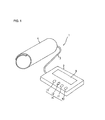
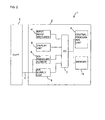
- Figures 1 and 2 show a general perspective view and block diagram, respectively, of a visceral fat scale equipped with a sphygmomanometer according to a first embodiment of the invention.
- the visceral fat scale equipped with a sphygmomanometer 1 of this embodiment is designed to measure blood pressure, using the so-called oscillometric blood pressure measuring method (the pressure pulse wave oscillation method) and has as main components, a machine body 2 and a cuff (arm wrap) 4 which is connected to the machine body 2 through an air tube 3 and wearable around an arm of a subject.
- a machine body 2 Disposed within the machine body 2 is an air supply unit 5 which is connected to the air tube 3 and comprised of a pump for supplying the cuff 4 with air and a pressure release valve for releasing the air pressure of the cuff 4, and others.
- An air pressure sensor 6 is also disposed within the machine body 2, for detecting pulse wave components through detection of the air pressure of the cuff 4.
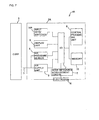
- the air supply unit 5 and the air pressure sensor 6 are connected to a central processing unit (arithmetic operation unit) 8 through an I/O circuit 7.
- the machine body 2 has, at its top face thereof, a display unit 9 and input keys/switches 14 which are comprised of a power switch 10, a blood pressure measurement starting switch 11, an increment/decrement key 12, and a display mode selector key 13. Further, the central processing unit 8 is provided with a memory 15 for storing data such as personal data which has been input by the input keys/switches 14 and sent to the memory 15 through the I/O circuit 7. It should be noted that the increment/decrement key 12 and the display mode selector key 13 correspond to the input device of the present invention.
- the display mode selector key 13 and the increment/decrement key 12 are operated thereby selectively inputting the personal data of the subject such as height, weight and waist size.
- the data thus input is stored in the memory 15.
- the central processing unit 8 calculates the BMI and abdominal visceral fat cross-sectional area (AV) of the subject and the results of the calculations are stored in the memory 15.
- the arithmetic expressions used for the above calculations have been stored in the memory 15 beforehand and are called into the central processing unit 8 when executing the arithmetic operations.
- AV abdominal visceral fat cross-sectional area
- the coefficient a 1 and constant d 1 of this expression are derived from a statistic technique such as regression analysis, based on the correlation between the waist size and abdominal cross-section C/T data of a selected group of subjects.
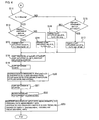
- BMI and abdominal visceral fat cross-sectional area (AV) which have been calculated and stored in the memory 15 at step S3 are compared to their reference values set for the obesity assessment.
- the rank of obesity for the subject is determined and stored in the memory 15.
- the reference values and arithmetic expression used for the comparison have been stored in the memory 15 and are called into the central processing unit 8 when executing the arithmetic operations.
- BMI is internationally used as an index to an assessment of obesity/emaciation and abdominal visceral fat cross-sectional area (AV) represents the amount of distributed visceral fat and is used for diagnoses of obesity in the clinical site.
- Obesity is ranked according to these indices BMI and AV. More concretely, BMI is classified as follows: the range of 25 to 30 is rank I, the range of 30 to 35 is rank II and the range of more than 35 is rank III.
- Abdominal visceral fat cross-sectional area (AV) is classified as follows: the range of 100 to 125 cm 2 is rank I, the range of 125 to 150 cm 2 is rank II and the range of more than 150 cm 2 is rank III.
- the air supply unit 5 supplies the cuff 4 with air so that the cuff 4 is inflated.
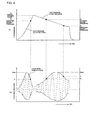
- the determining factor for the target cuff inflation value P k thus takes account of the result of the obesity assessment, there will not occur such an undesirable situation that blood pressure values (i.e., systolic blood pressure and diastolic blood pressure) are incorrectly measured during later cuff deflation, even if the measurement of the maximum amplitude value Amax' of the pulse wave generated during cuff inflation is not correctly made owing to insufficient inflation.
- blood pressure values i.e., systolic blood pressure and diastolic blood pressure
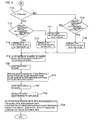
- the estimated systolic blood pressure P 1 ' is compared to the specified value (100 mmHg) based on the measurement of the maximum amplitude value Amax' of the pulse wave generated during cuff inflation, and if it is determined that the estimated value P 1 ' is less than the specified value and obesity is not diagnosed in the obesity assessment, the target cuff inflation value P k is set to the lowest limit value (e.g., 140 mmHg).
- the target cuff inflation value P k will be set to its lowest limit value so that occurrence of an undesirable situation can be avoided in which the measurement of blood pressure values (i.e., systolic blood pressure and diastolic blood pressure) is incorrectly made during later cuff deflation.
- blood pressure values i.e., systolic blood pressure and diastolic blood pressure
- step S15 If it is judged at step S11 that the estimated systolic blood pressure P 1 ' is 100 mmHg or more, a check is then made similarly to the step S12 to determine whether each of the indices (BMI and AV) exceeds its reference value for the obesity assessment, in other words, whether BMI > 25 and AV > 100 cm 2 hold.
- 1/ ⁇ may be 0.5, whereas the value of 1/ ⁇ may be 0.7.
- an estimate equation or the like which provides more improved estimation accuracy may be used.
- the display unit 9 After completion of the measurement, the display unit 9 performs selective displaying of the input data such as the personal data (height, weight , sex, age, waist size), the blood pressure measurements (systolic blood pressure and diastolic blood pressure), the indices (BMI and abdominal visceral cross-sectional area) used for the obesity assessment, the result of the assessment, and the degree of obesity (the rank of each index).
- the input data such as the personal data (height, weight , sex, age, waist size), the blood pressure measurements (systolic blood pressure and diastolic blood pressure), the indices (BMI and abdominal visceral cross-sectional area) used for the obesity assessment, the result of the assessment, and the degree of obesity (the rank of each index).
- the visceral fat scale equipped with a sphygmomanometer 1 of this embodiment may be designed such that data on blood pressure measurements, BMI and abdominal visceral cross-sectional area is stored each time a measurement is made and each data piece is displayed with the amount of change from the result of the previous measurement.
- the scale 1 may display the ratio of the present measurement result to the previous measurement result (or the ratio of the change between the present and previous measurement results to the previous measurement result) in terms of blood pressure values and abdominal visceral cross-sectional area.
- Figures 6 and 7 show a general perspective view and block diagram, respectively, of a visceral fat scale equipped with a sphygmomanometer according to a second embodiment of the invention.
- the visceral fat scale equipped with a sphygmomanometer 1A of the second embodiment has the function of measuring body impedance to obtain the percent body fat of the subject in addition to the same function as that of the visceral fat scale equipped with a sphygmomanometer 1 of the first embodiment.
- the parts identical to those of the first embodiment are indicated with the same reference numerals as in the first embodiment and a detailed explanation of them will be omitted herein.
- the visceral fat scale equipped with a sphygmomanometer 1A of the second embodiment has electrodes 16 which are positioned at the front and back faces of the upper right and upper left ends of a machine body 2A and the fingers (e.g., a thumb and an index finger) of both hands of the subject touch the electrodes 16.
- the body impedance between the fingers of the hand is measured by a body impedance measuring circuit 17, and the measurement data is input to the central processing unit 8 through the I/O circuit 7 and stored in the memory 15. Based on the measurement data, percent body fat is calculated.
- each electrode 16 is comprised of, for instance, an electrode for measurement disposed on the front face of the machine body 2A and an electrode for current application disposed on the back face of the same.
- Reference numeral 19 of Figure 6 designates a stand for setting the machine body 2A up.
- T1 The power switch 10 is turned ON to put the machine body 2 into operation.
- T2 By depressing the display mode selector key 13 and the increment/decrement key 12, the personal data of the subject such as height, weight, sex and waist size is selectively input. The data thus input is stored in the memory 15.
- T3 After the percent body fat measurement starting switch 18 has been turned ON thereby making the scale ready for percent body fat measurement, the fingers of both hands are brought into contact with the electrodes 16 to measure the body impedance between the fingers of both hands and the measurement data is stored in the memory 15.
- T4 The percent body fat of the subject is calculated based on the measurement data on the body impedance and the personal data stored in the memory 15, and the result of the calculation is stored in the memory 15.
- the BMI of the subject is calculated based on the personal data while performing calculation of the abdominal visceral fat cross-sectional area (AV) of the subject based on the personal data and the data on the body impedance or percent body fat.
- the results of the calculations are stored in the memory 15.
- the arithmetic expressions used for the above calculations have been stored in the memory 15 beforehand and are called into the central processing unit 8 when executing the arithmetic operations.
- the expression for obtaining abdominal visceral fat cross-sectional area (AV) the following regression equation (9) is used, which is obtained by adding the auxiliary term of body impedance (Z) to the expression
- AV a 2 ⁇ W L + b 2 ⁇ Z + d 2
- W L is waist size.
- the coefficients a 2 , b 2 and constant d 2 of this expression are derived from a statistic technique based on the correlation between the waist size and abdominal cross-section C/T data of a selected group of subjects.
- regression expression (10) may be used which is obtained by adding percent body fat (FAT) as an auxiliary term.
- FAT percent body fat
- the coefficients a 3 , c 1 and constant d 3 of this expression are also derived from a statistic technique based on the correlation between the waist size and abdominal cross-section C/T data of a selected group of subjects.
- the coefficients e 1 , f 1 and the constant d 4 are derived from a statistic technique based on the correlation between the abdominal cross-section C/T data and values I, II of a selected group of subjects.
- the value I is obtained by multiplying the square of waist size by height and percent body fat
- the value II is obtained by multiplying the square of waist size by height and age.
- the coefficients f 2 , g 1 and constant d 5 of this equation are derived from a statistic technique based on the correlation between the abdominal cross-section C/T data, percent body fat, and a value of a selected group of subjects, the value being obtained by multiplying the square of waist size by height and age.
- T5 The BMI, percent body fat and abdominal visceral fat cross-sectional area (AV), which have been calculated at step T4 and stored in the memory 15, are compared to their respective reference values used for the obesity assessment and the rank of obesity is determined to be stored in the memory 15.
- the reference values and equation used for the above comparative operations have been stored in the memory 15 and called into the central processing unit 8 when executing the arithmetic operations.
- BMI is an index internationally used for assessment of obesity/emaciation
- abdominal visceral fat cross-sectional area (AV) represents the amount of distributed visceral fat and is used as an index to diagnosis of obesity in the clinical site.
- Obesity is ranked according to the indices BMI, percent body fat and AV. More specifically, BMI is classified as follows: the range of 25 to 30 is rank I, the range of 30 to 35 is rank II and the range of 35 or more is rank III.
- Percent body fat is classified as follows: for male, the range of 20 to 25% is rank I, the range of 25 to 30% is rank II and the range of more than 30% is rank III, and for female, the range of 30 to 35% is rank I, the range of 35 to 40% is rank II, and the range of more than 40% is rank III.
- Abdominal visceral fat cross-sectional area is classified as follows: the range of 100 to 125 cm 2 is rank I, the range of 125 to 150 cm 2 is rank II and the range of 150 cm 2 or more is rank III.
- the steps T6 to T24 to be performed onward are basically the same as the steps S5 to S23 of the first embodiment except the following points:
- the steps T13 and T16 differ from the steps S12 and S15 of the first embodiment in that a check is made at the steps T13 and T16 whether or not percent body fat (FAT) exceeds 20% (in the case of male) or 30% (in the case of female).
- the step T24 differs from the step S23 of the first embodiment in that the display contents of the display unit 9 at the step T24 includes percent body fat as an index to the assessment of obesity. In view of this, a detailed description of the steps T6 to T24 will be omitted herein.
- the abdominal visceral fat cross-sectional area of the subject is obtained from the input personal data of the subject (height, weight, age, sex, waist size etc.), using an arithmetic expression stored beforehand.
- waist size may be estimated from the input data on the height, weight and age of the subject.
- W weight
- H L height
- Age age
- the abdominal visceral fat cross-sectional area of the subject may be calculated with the arithmetic expression used in the foregoing embodiments. This saves the trouble of measurement and inputting of waist size, so that visceral fat can be more readily obtained.
Landscapes
- Health & Medical Sciences (AREA)
- Life Sciences & Earth Sciences (AREA)
- Cardiology (AREA)
- Heart & Thoracic Surgery (AREA)
- Molecular Biology (AREA)
- Veterinary Medicine (AREA)
- Biophysics (AREA)
- Pathology (AREA)
- Engineering & Computer Science (AREA)
- Biomedical Technology (AREA)
- Public Health (AREA)
- Medical Informatics (AREA)
- Physics & Mathematics (AREA)
- Surgery (AREA)
- Animal Behavior & Ethology (AREA)
- General Health & Medical Sciences (AREA)
- Physiology (AREA)
- Vascular Medicine (AREA)
- Nuclear Medicine, Radiotherapy & Molecular Imaging (AREA)
- Radiology & Medical Imaging (AREA)
- Measuring Pulse, Heart Rate, Blood Pressure Or Blood Flow (AREA)
- Measurement And Recording Of Electrical Phenomena And Electrical Characteristics Of The Living Body (AREA)
- Measuring And Recording Apparatus For Diagnosis (AREA)
Applications Claiming Priority (3)
| Application Number | Priority Date | Filing Date | Title |
|---|---|---|---|
| JP2001048940 | 2001-02-23 | ||
| JP2001048940A JP4716586B2 (ja) | 2001-02-23 | 2001-02-23 | 血圧計付き内臓脂肪計 |
| PCT/JP2002/000861 WO2002067777A1 (en) | 2001-02-23 | 2002-02-01 | Visceral fat meter provided with tonometer |
Publications (3)
| Publication Number | Publication Date |
|---|---|
| EP1369081A1 true EP1369081A1 (de) | 2003-12-10 |
| EP1369081A4 EP1369081A4 (de) | 2006-08-09 |
| EP1369081B1 EP1369081B1 (de) | 2010-10-27 |
Family
ID=18910122
Family Applications (1)
| Application Number | Title | Priority Date | Filing Date |
|---|---|---|---|
| EP02711285A Expired - Lifetime EP1369081B1 (de) | 2001-02-23 | 2002-02-01 | Viszeralfettmesser mit tonometer |
Country Status (9)
| Country | Link |
|---|---|
| US (1) | US6905464B2 (de) |
| EP (1) | EP1369081B1 (de) |
| JP (1) | JP4716586B2 (de) |
| KR (1) | KR100874377B1 (de) |
| CN (1) | CN1321611C (de) |
| CA (1) | CA2437116C (de) |
| DE (1) | DE60238111D1 (de) |
| TW (1) | TW552128B (de) |
| WO (1) | WO2002067777A1 (de) |
Families Citing this family (20)
| Publication number | Priority date | Publication date | Assignee | Title |
|---|---|---|---|---|
| US20020046278A1 (en) * | 2000-07-17 | 2002-04-18 | Roy Hays | Method and system for global log on in a distributed system |
| US20050192841A1 (en) * | 2000-09-01 | 2005-09-01 | Roy Hays | Method and system for collecting information before user registration |
| US6730038B2 (en) * | 2002-02-05 | 2004-05-04 | Tensys Medical, Inc. | Method and apparatus for non-invasively measuring hemodynamic parameters using parametrics |
| US8272872B2 (en) * | 2002-06-27 | 2012-09-25 | National Wrestling Coaches Association | System and method for calculating optimal performance and weight classification |
| US7089052B2 (en) * | 2004-02-26 | 2006-08-08 | Tanita Corporation | Method and system for estimating visceral fat area |
| KR100565952B1 (ko) * | 2004-07-23 | 2006-03-30 | 신재우 | 다기능 혈압계 |
| TWM262153U (en) * | 2004-08-31 | 2005-04-21 | Avita Corp | Sphygmomanometer |
| TWM262152U (en) * | 2004-08-31 | 2005-04-21 | Avita Corp | Sphygmomanometer |
| JP4579669B2 (ja) * | 2004-12-16 | 2010-11-10 | 富士通株式会社 | 信頼性検証プログラムおよび信頼性検証方法 |
| KR100717405B1 (ko) * | 2005-09-09 | 2007-05-11 | 삼성전자주식회사 | 생체 신호 측정기 및 이를 이용한 건강 관리 방법 |
| JP2008142469A (ja) * | 2006-12-13 | 2008-06-26 | Tanita Corp | 生体測定装置 |
| US20080243009A1 (en) * | 2007-03-30 | 2008-10-02 | General Electric Company | Method of controlling inflation of a cuff in blood pressure determination |
| US20090240527A1 (en) * | 2008-03-21 | 2009-09-24 | Computerized Screening, Inc. | Community based managed health kiosk system |
| KR101009958B1 (ko) * | 2008-09-25 | 2011-01-20 | 한국생산기술연구원 | 인체정보 측정 장치 |
| KR20100060141A (ko) * | 2008-11-27 | 2010-06-07 | 삼성전자주식회사 | 휴대용 혈압측정 장치 및 방법 |
| JP5557321B2 (ja) * | 2010-07-14 | 2014-07-23 | 株式会社タニタ | 測定装置 |
| US10874307B2 (en) | 2017-01-24 | 2020-12-29 | Verily Life Sciences Llc | Digital artery blood pressure monitor |
| CN110115573B (zh) * | 2019-05-27 | 2024-09-17 | 威海威高瑞影医疗科技有限公司 | 一种血压间隔测量充气压力控制方法、装置及监护仪 |
| US11328820B2 (en) * | 2020-02-14 | 2022-05-10 | Doctor on Demand, Inc. | Decision engine based on disparate data sources |
| US12419527B2 (en) | 2021-09-29 | 2025-09-23 | Verily Life Sciences Llc | Comprehensive wearable vital signs monitor |
Family Cites Families (16)
| Publication number | Priority date | Publication date | Assignee | Title |
|---|---|---|---|---|
| JP2534019B2 (ja) | 1993-07-28 | 1996-09-11 | 株式会社暁電機製作所 | 電子制御式血圧・体内脂肪測定装置 |
| US5579782A (en) * | 1993-08-12 | 1996-12-03 | Omron Corporation | Device to provide data as a guide to health management |
| JP3590462B2 (ja) * | 1995-09-20 | 2004-11-17 | コーリンメディカルテクノロジー株式会社 | 血圧測定装置 |
| JPH10192258A (ja) * | 1997-01-08 | 1998-07-28 | Matsushita Electric Works Ltd | 体脂肪計 |
| US6354996B1 (en) * | 1998-04-15 | 2002-03-12 | Braun Gmbh | Body composition analyzer with trend display |
| JPH1176187A (ja) * | 1998-07-21 | 1999-03-23 | Omron Corp | 体脂肪計 |
| JP4046883B2 (ja) * | 1999-02-09 | 2008-02-13 | 株式会社タニタ | 体脂肪計及び健康管理システム |
| JP2000237149A (ja) * | 1999-02-25 | 2000-09-05 | Matsushita Electric Works Ltd | 健康測定機器 |
| JP3988910B2 (ja) * | 1999-06-11 | 2007-10-10 | 株式会社タニタ | 体脂肪分布の測定方法及び測定装置 |
| JP2001017401A (ja) * | 1999-07-08 | 2001-01-23 | Nippon Colin Co Ltd | 体脂肪率測定機能を備えた血圧測定装置 |
| TW529930B (en) * | 1999-08-27 | 2003-05-01 | Yamato Scale Co Ltd | Health condition judging/displaying device |
| JP3722678B2 (ja) * | 1999-10-27 | 2005-11-30 | 株式会社タニタ | 体脂肪計 |
| US6336136B1 (en) * | 1999-12-24 | 2002-01-01 | Scott C. Harris | Internet weight reduction system |
| WO2001076485A1 (en) * | 2000-04-05 | 2001-10-18 | Matsushita Electric Industrial Co. Ltd. | Biological information measuring instrument and biological information measuring method |
| TW515705B (en) * | 2000-05-31 | 2003-01-01 | Yamato Scale Co Ltd | Visceral fat meter |
| JP2002306439A (ja) * | 2001-04-11 | 2002-10-22 | Tanita Corp | 内臓脂肪測定装置 |
-
2001
- 2001-02-23 JP JP2001048940A patent/JP4716586B2/ja not_active Expired - Lifetime
-
2002
- 2002-01-30 TW TW091101555A patent/TW552128B/zh not_active IP Right Cessation
- 2002-02-01 CA CA002437116A patent/CA2437116C/en not_active Expired - Lifetime
- 2002-02-01 DE DE60238111T patent/DE60238111D1/de not_active Expired - Lifetime
- 2002-02-01 CN CNB028003969A patent/CN1321611C/zh not_active Expired - Lifetime
- 2002-02-01 KR KR1020027014007A patent/KR100874377B1/ko not_active Expired - Fee Related
- 2002-02-01 US US10/470,744 patent/US6905464B2/en not_active Expired - Lifetime
- 2002-02-01 EP EP02711285A patent/EP1369081B1/de not_active Expired - Lifetime
- 2002-02-01 WO PCT/JP2002/000861 patent/WO2002067777A1/ja not_active Ceased
Also Published As
| Publication number | Publication date |
|---|---|
| DE60238111D1 (de) | 2010-12-09 |
| JP4716586B2 (ja) | 2011-07-06 |
| CN1457244A (zh) | 2003-11-19 |
| US6905464B2 (en) | 2005-06-14 |
| KR100874377B1 (ko) | 2008-12-18 |
| JP2002248084A (ja) | 2002-09-03 |
| EP1369081B1 (de) | 2010-10-27 |
| EP1369081A4 (de) | 2006-08-09 |
| KR20020092437A (ko) | 2002-12-11 |
| WO2002067777A1 (en) | 2002-09-06 |
| CA2437116C (en) | 2008-01-29 |
| CA2437116A1 (en) | 2002-09-06 |
| CN1321611C (zh) | 2007-06-20 |
| TW552128B (en) | 2003-09-11 |
| US20040077955A1 (en) | 2004-04-22 |
Similar Documents
| Publication | Publication Date | Title |
|---|---|---|
| US6905464B2 (en) | Visceral fat meter provided with tonometer | |
| US8086301B2 (en) | Method and apparatus for cufflessly and non-invasively measuring wrist blood pressure in association with communication device | |
| JP3951708B2 (ja) | 生体情報評価装置 | |
| EP1550399B1 (de) | Gesundheitsüberwachungssystem für schwangere Frauen | |
| US9326692B2 (en) | Blood pressure measurement device and blood pressure measurement method | |
| US7465273B2 (en) | Method for monitoring pre-eclamptic patients | |
| US6447457B1 (en) | Non invasive blood pressure monitor and a method for the non-invasive measurement of the blood pressure | |
| KR101798495B1 (ko) | 웨어러블 손목 혈압계 | |
| JP2002306439A (ja) | 内臓脂肪測定装置 | |
| JPWO2001070106A1 (ja) | 生体情報評価装置 | |
| US7270636B2 (en) | Apparatus and method for pulse detection | |
| WO2010073689A1 (ja) | 電子血圧計および血圧測定方法 | |
| JP3970697B2 (ja) | 生体情報処理装置 | |
| US20120136262A1 (en) | Electronic sphygmomanometer and a method for blood pressure measurement by using an electronic sphygmomanometer | |
| Ali et al. | Design and implementation of a low-cost blood pressure measuring device | |
| US20230181049A1 (en) | Blood pressure meter and method for measuring blood pressure using the same | |
| KR20200107157A (ko) | 혈압 측정 시스템 및 이를 이용한 혈압 측정 방법 | |
| US6716177B2 (en) | Inferior-and-superior-limb blood-pressure index measuring apparatus | |
| EP1340455A1 (de) | Vorrichtung zum Bestimmen eines Standardwertes mit Bezug zur Pulswellenlaufzeit und Vorrichtung zum Feststellen eines Wertes mit Bezug zur Pulswellenlaufzeit | |
| JP2019017553A (ja) | 血圧測定装置 | |
| JP3061510B2 (ja) | 消費カロリー計 | |
| Jobbágy et al. | Accurate blood pressure measurement at home | |
| JP2008036449A (ja) | 内臓脂肪測定装置 |
Legal Events
| Date | Code | Title | Description |
|---|---|---|---|
| PUAI | Public reference made under article 153(3) epc to a published international application that has entered the european phase |
Free format text: ORIGINAL CODE: 0009012 |
|
| 17P | Request for examination filed |
Effective date: 20030821 |
|
| AK | Designated contracting states |
Kind code of ref document: A1 Designated state(s): AT BE CH CY DE DK ES FI FR GB GR IE IT LI LU MC NL PT SE TR |
|
| A4 | Supplementary search report drawn up and despatched |
Effective date: 20060707 |
|
| RIC1 | Information provided on ipc code assigned before grant |
Ipc: A61B 5/021 20060101ALI20060703BHEP Ipc: A61B 5/053 20060101AFI20020909BHEP Ipc: A61B 5/022 20060101ALI20060703BHEP |
|
| 17Q | First examination report despatched |
Effective date: 20071121 |
|
| GRAP | Despatch of communication of intention to grant a patent |
Free format text: ORIGINAL CODE: EPIDOSNIGR1 |
|
| GRAS | Grant fee paid |
Free format text: ORIGINAL CODE: EPIDOSNIGR3 |
|
| GRAA | (expected) grant |
Free format text: ORIGINAL CODE: 0009210 |
|
| AK | Designated contracting states |
Kind code of ref document: B1 Designated state(s): DE FR GB IT |
|
| REG | Reference to a national code |
Ref country code: GB Ref legal event code: FG4D |
|
| REF | Corresponds to: |
Ref document number: 60238111 Country of ref document: DE Date of ref document: 20101209 Kind code of ref document: P |
|
| PLBE | No opposition filed within time limit |
Free format text: ORIGINAL CODE: 0009261 |
|
| STAA | Information on the status of an ep patent application or granted ep patent |
Free format text: STATUS: NO OPPOSITION FILED WITHIN TIME LIMIT |
|
| 26N | No opposition filed |
Effective date: 20110728 |
|
| REG | Reference to a national code |
Ref country code: DE Ref legal event code: R097 Ref document number: 60238111 Country of ref document: DE Effective date: 20110728 |
|
| REG | Reference to a national code |
Ref country code: FR Ref legal event code: PLFP Year of fee payment: 15 |
|
| REG | Reference to a national code |
Ref country code: FR Ref legal event code: PLFP Year of fee payment: 16 |
|
| REG | Reference to a national code |
Ref country code: FR Ref legal event code: PLFP Year of fee payment: 17 |
|
| PGFP | Annual fee paid to national office [announced via postgrant information from national office to epo] |
Ref country code: FR Payment date: 20210113 Year of fee payment: 20 |
|
| PGFP | Annual fee paid to national office [announced via postgrant information from national office to epo] |
Ref country code: GB Payment date: 20210120 Year of fee payment: 20 Ref country code: DE Payment date: 20210119 Year of fee payment: 20 |
|
| PGFP | Annual fee paid to national office [announced via postgrant information from national office to epo] |
Ref country code: IT Payment date: 20210112 Year of fee payment: 20 |
|
| REG | Reference to a national code |
Ref country code: DE Ref legal event code: R071 Ref document number: 60238111 Country of ref document: DE |
|
| REG | Reference to a national code |
Ref country code: GB Ref legal event code: PE20 Expiry date: 20220131 |
|
| PG25 | Lapsed in a contracting state [announced via postgrant information from national office to epo] |
Ref country code: GB Free format text: LAPSE BECAUSE OF EXPIRATION OF PROTECTION Effective date: 20220131 |