EP1374957A2 - Schi- oder Snowboardschuh mit einer Ausnehmung im Sohlenbereich - Google Patents
Schi- oder Snowboardschuh mit einer Ausnehmung im Sohlenbereich Download PDFInfo
- Publication number
- EP1374957A2 EP1374957A2 EP03013888A EP03013888A EP1374957A2 EP 1374957 A2 EP1374957 A2 EP 1374957A2 EP 03013888 A EP03013888 A EP 03013888A EP 03013888 A EP03013888 A EP 03013888A EP 1374957 A2 EP1374957 A2 EP 1374957A2
- Authority
- EP
- European Patent Office
- Prior art keywords
- ski
- engagement
- binding
- winter sports
- shoe
- Prior art date
- Legal status (The legal status is an assumption and is not a legal conclusion. Google has not performed a legal analysis and makes no representation as to the accuracy of the status listed.)
- Granted
Links
Images

Classifications
-
- A—HUMAN NECESSITIES
- A63—SPORTS; GAMES; AMUSEMENTS
- A63C—SKATES; SKIS; ROLLER SKATES; DESIGN OR LAYOUT OF COURTS, RINKS OR THE LIKE
- A63C9/00—Ski bindings
- A63C9/08—Ski bindings yieldable or self-releasing in the event of an accident, i.e. safety bindings
- A63C9/086—Ski bindings yieldable or self-releasing in the event of an accident, i.e. safety bindings using parts which are fixed on the shoe of the user and are releasable from the ski binding
-
- A—HUMAN NECESSITIES
- A43—FOOTWEAR
- A43B—CHARACTERISTIC FEATURES OF FOOTWEAR; PARTS OF FOOTWEAR
- A43B5/00—Footwear for sporting purposes
- A43B5/04—Ski or like boots
- A43B5/0401—Snowboard boots
-
- A—HUMAN NECESSITIES
- A43—FOOTWEAR
- A43B—CHARACTERISTIC FEATURES OF FOOTWEAR; PARTS OF FOOTWEAR
- A43B5/00—Footwear for sporting purposes
- A43B5/04—Ski or like boots
- A43B5/0401—Snowboard boots
- A43B5/0403—Adaptations for soles or accessories with soles for snowboard bindings
-
- A—HUMAN NECESSITIES
- A43—FOOTWEAR
- A43B—CHARACTERISTIC FEATURES OF FOOTWEAR; PARTS OF FOOTWEAR
- A43B5/00—Footwear for sporting purposes
- A43B5/04—Ski or like boots
- A43B5/0415—Accessories
- A43B5/0417—Accessories for soles or associated with soles of ski boots; for ski bindings
-
- A—HUMAN NECESSITIES
- A43—FOOTWEAR
- A43B—CHARACTERISTIC FEATURES OF FOOTWEAR; PARTS OF FOOTWEAR
- A43B5/00—Footwear for sporting purposes
- A43B5/04—Ski or like boots
- A43B5/0415—Accessories
- A43B5/0417—Accessories for soles or associated with soles of ski boots; for ski bindings
- A43B5/0421—Accessories for soles or associated with soles of ski boots; for ski bindings located underneath the sole
-
- A—HUMAN NECESSITIES
- A63—SPORTS; GAMES; AMUSEMENTS
- A63C—SKATES; SKIS; ROLLER SKATES; DESIGN OR LAYOUT OF COURTS, RINKS OR THE LIKE
- A63C9/00—Ski bindings
- A63C9/08—Ski bindings yieldable or self-releasing in the event of an accident, i.e. safety bindings
- A63C9/0805—Adjustment of the toe or heel holders; Indicators therefor
-
- A—HUMAN NECESSITIES
- A63—SPORTS; GAMES; AMUSEMENTS
- A63C—SKATES; SKIS; ROLLER SKATES; DESIGN OR LAYOUT OF COURTS, RINKS OR THE LIKE
- A63C9/00—Ski bindings
- A63C9/08—Ski bindings yieldable or self-releasing in the event of an accident, i.e. safety bindings
- A63C9/084—Ski bindings yieldable or self-releasing in the event of an accident, i.e. safety bindings with heel hold-downs, e.g. swingable
- A63C9/0841—Ski bindings yieldable or self-releasing in the event of an accident, i.e. safety bindings with heel hold-downs, e.g. swingable with a single jaw
-
- A—HUMAN NECESSITIES
- A63—SPORTS; GAMES; AMUSEMENTS
- A63C—SKATES; SKIS; ROLLER SKATES; DESIGN OR LAYOUT OF COURTS, RINKS OR THE LIKE
- A63C9/00—Ski bindings
- A63C9/08—Ski bindings yieldable or self-releasing in the event of an accident, i.e. safety bindings
- A63C9/085—Ski bindings yieldable or self-releasing in the event of an accident, i.e. safety bindings with sole hold-downs, e.g. swingable
- A63C9/08507—Ski bindings yieldable or self-releasing in the event of an accident, i.e. safety bindings with sole hold-downs, e.g. swingable with a plurality of mobile jaws
-
- A—HUMAN NECESSITIES
- A63—SPORTS; GAMES; AMUSEMENTS
- A63C—SKATES; SKIS; ROLLER SKATES; DESIGN OR LAYOUT OF COURTS, RINKS OR THE LIKE
- A63C9/00—Ski bindings
- A63C9/08—Ski bindings yieldable or self-releasing in the event of an accident, i.e. safety bindings
- A63C9/085—Ski bindings yieldable or self-releasing in the event of an accident, i.e. safety bindings with sole hold-downs, e.g. swingable
- A63C9/08557—Details of the release mechanism
- A63C9/08564—Details of the release mechanism using cam or slide surface
-
- A—HUMAN NECESSITIES
- A63—SPORTS; GAMES; AMUSEMENTS
- A63C—SKATES; SKIS; ROLLER SKATES; DESIGN OR LAYOUT OF COURTS, RINKS OR THE LIKE
- A63C9/00—Ski bindings
- A63C9/08—Ski bindings yieldable or self-releasing in the event of an accident, i.e. safety bindings
- A63C9/084—Ski bindings yieldable or self-releasing in the event of an accident, i.e. safety bindings with heel hold-downs, e.g. swingable
- A63C9/0846—Details of the release or step-in mechanism
Definitions
- the invention relates to a ski or snowboard shoe, the sole area of which Recess for receiving one arranged on a winter sports device Binding part, wherein at least two themselves in the recess Opposing connecting parts that engage in the on the winter sports equipment arranged binding part are formed, are arranged, the front Connecting part at least two on both sides of the axis of symmetry of the connecting part lying engagement elements for positive or non-positive engagement in corresponding reception areas of the arranged on the winter sports equipment Has binding part.
- EP 1 174 165 A2 shows a binding construction that can be released Connect a shoe to a winter sports device made up of at least two Binding parts exist.
- the binding part arranged on winter sports has two rotatable receiving elements with receiving areas on, when producing the Connection of each receiving area with a protrusion in the sole area of the Interlocking shoe arranged binding.
- the receiving elements are over spring-loaded actuators can be pressurized independently, so that it is possible to set a non-linear tripping curve, which is due to the Actuators on the left and right can be controlled independently of each other can.
- a disadvantage of this prior art has been the large number of mechanical parts, not least due to their rotatable bearing relatively vulnerable against external influences. It is also necessary if the Binding construction is mounted on a pair of skis, to mark these around ensure the skis according to the different trigger setting be tightened "correctly", as a rule the inner edge for safety reasons should trigger harder. If the skis were put on the wrong way, it would naturally trigger the inner edge, which is significantly more heavily loaded, than the outer edge, which would inevitably lead to an increased number of falls.
- the object of the invention is to provide a new type of ski or snowboard boot Sole area a recess for receiving one on a winter sports device arranged binding part, and a binding construction of the entrance Specify the type mentioned, the overall simple and robust structure enable and avoid the known disadvantages.
- the engagement elements differ long or adjustable in length and / or are shaped differently, so that the release hardness and / or Release behavior for different release directions (L, R) of the shoe can be set differently.
- L, R release hardness and / or Release behavior for different release directions
- the front connecting part is integrally formed with the sole region of the shoe.
- the front connecting part it is also possible for the front connecting part to be rotatably supported via a preferably centrally arranged bearing part and means for changeable fixation of the position to be provided, thereby adjusting the Difference in length of the two engagement elements by changing the position of the Connection part opposite that arranged on the winter sports equipment Binding part is possible.
- the front connecting part has at least one bore for receiving a Has engaging element, thereby a secure fit of the engaging element in the front connecting part can be ensured
- another embodiment the invention provides that the bore (s) and the engagement element (s) for positive engagement are formed. It has proven to be particularly cheap highlighted when the positive connection is made by means of a thread. As a result, the engagement element can easily be in the front connecting part be screwed in and replaced if necessary, for example in the event of damage become.
- At least one Engagement element in its binding part arranged on the winter sports device facing end region have a flange-like extension, so that the Attack surface of the engagement element with that arranged on the winter sports device Binding part is enlarged.
- the length adjustment of the engaging element such as provided according to a further embodiment of the invention, via a the side of the flange-like extension facing the front connecting part spacer sleeve which can be arranged on the engagement element can thereby be an exact Length adjustment of the engaging element can be achieved, the flange-like Extension serves as a stop for the spacer sleeve. Instructs the engaging element Thread, the spacer sleeve can of course also be a counter nut be replaced.
- At least one engagement element in its on the Winter sports equipment arranged binding part facing end region essentially is round, preferably hemispherical.
- the end region advantageously at least one Engagement element asymmetrical with respect to the central longitudinal axis of the Engagement element is formed. This makes it possible, in addition to the trigger hardness due to the difference in length, the triggering behavior of the two Engagement elements of a shoe different and independent of each other adjust.
- the front connecting part has two on both sides of the Axis of symmetry of the connecting part lying engagement elements, of which the with respect to the axis of symmetry of the shoe lying on the inside of the shoe
- the engagement element is longer or arranged on the winter sports device Connection part protrudes further than that lying on the outside of the shoe Engagement element, the end region of the outer lying advantageously Engagement element with respect to the axis of symmetry of the engagement element is asymmetrical.
- this ensures that the bond is on the inside, which is significantly more stressed when skiing, triggers harder than on the outside.
- the asymmetrical shape of the external engagement element the triggering progression of the engagement element can be selected differently, for example depending on how good the Ski shoe users have mastered the winter sports equipment.
- a further embodiment of the invention provides that the engaging elements at least in the area of engagement with that arranged on the winter sports device Connecting part have a casing, preferably made of rubber.
- a binding construction for releasably connecting a shoe to a winter sports device consisting of at least two binding parts be, of which a second binding part is arranged on the winter sports equipment and a front receiving element arranged on both sides of the axis of symmetry Has receiving areas, the front receiving element in one piece trained and fixed on the winter sports equipment.
- the Contact surfaces are concave and each of the engaging elements facing end face of the receiving element to the nearest Reach side surface of the receiving element, the engagement elements whose End regions are advantageously hemispherical, in the event of stress slide along these circular segment-shaped contact surfaces, the heel area of the shoe acts as a fulcrum.
- the receiving areas are symmetrical with respect to the central longitudinal axis of the Receiving element are arranged, the receiving areas each at least include part of the side surface.
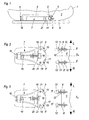
- the sole area 2 of a ski or Snowboard boot 1 has a recess 3 in which a rear connecting part 4 and a front connecting part 5 are arranged, which are opposite each other.
- the two connecting parts 4, 5 are for engagement in the on the winter sports equipment 6th arranged binding part 7 formed.
- the binding part 7 has a spring-loaded Locking element 16, which with the rear connecting part 4 form-fitting comes together.
- a front receiving element 14 is arranged, which over Screws 21 connected to the winter sports device 6 and is fixed in position on this.
- the Receiving element 14 has on its front connecting element 5 facing end a receiving area 9, in which the engaging element 8 or engages non-positively.
- the binding part 7 is firmly attached by means of screws 21 connected to the winter sports device 6 and has one acted upon by the spring 19 Locking element 16.
- the spring pressure and thus the Trigger hardness can be set in the event of a frontal or backward fall.
- the front connecting part 5 On his the front connecting part 5 has the front end Receiving element 14 two receiving areas 9, 9 ', each with a contact surface 15 on.
- the contact surfaces 15 each extend from the end face 17 of the Receiving element 14 to the respectively adjacent side surfaces 18, 18 'of the front receiving element and are concave. On these contact surfaces 15 engage the end regions 13, 13 'of the engagement elements 8, 8' of different lengths of the front connecting part 5.
- attack elements 8, 8 ' are on their Binding part 7 facing away from a thread and into a corresponding bore of the front connecting part 5 screwed in where it by means of a clamping device 10, for example grub screws, in their position be secured.
- An additional position fixation of the engaging elements 8 in the The front connecting part 5 is drilled through a spacer sleeve or Counter nut 12.
- the end of the engaging element 8 facing the binding part 7 has a flange-like extension 11 1, the end region 13, 13 ' is hemispherical.
- the glide hemispherical end regions 13, 13 'of the engagement elements 8, 8' along the concave contact surface 15 of the receiving areas 9, 9 ', with a lateral Triggering in direction L the engaging element 8 the receiving area 9 due to concave shape of the contact surface 15 in the region of the side surface 18 of the Receiving element 14 can leave relatively easily, while the end portion 13 'of Engagement element 8 'the receiving area 9' against the decreasing radius must leave the concave contact surface 15 towards the end face 17.
- the engagement elements 8, 8 ' not only different from the front connecting part 5, there are also the end regions 13, 13 'are shaped differently, in such a way that the End region 13 'asymmetrically with respect to the central longitudinal axis m' of Engagement element 8 'is designed.
- the representations only are qualitative principle sketches.
- FIG. 4a shows a continuous release of the shaped engagement element, as is desirable for skiers with average ability.
- This in Fig. 4b tripping behavior is particularly suitable for sporty skiers and is designed so that the middle position only after about 50 percent of the Setting value is exited and the engagement element then triggers linearly.
- a Trigger progression as desired by racing athletes, is shown in FIG. 4c shown.
- the middle position is also only after about 50 percent of the Leave the set value, the characteristic curve rises sharply and runs then relatively flat until actually triggered.
Landscapes
- Health & Medical Sciences (AREA)
- General Health & Medical Sciences (AREA)
- Physical Education & Sports Medicine (AREA)
- Footwear And Its Accessory, Manufacturing Method And Apparatuses (AREA)
Abstract
Description
- Fig. 1
- schematisch einen Längsschnitt durch einen auf einem Wintersportgerät angeordneten erfindungsgemäßen Schuh,
- Fig. 2
- eine Konstruktionsskizze des auf dem Wintersportgerät angeordneten Bindungsteiles und des vorderen Verbindungsteiles des Schuhs mit unterschiedlich langen Eingriffselementen,
- Fig. 3
- das Ausführungsbeispiel von Fig. 2 mit unterschiedlich ausgeformten Eingriffselementen und
- Fig. 4a bis 4c
- Kennlinien unterschiedlicher Auslöseprogressionen infolge unterschiedlich ausgeformter Endbereiche des Eingriffselementes.
Claims (20)
- Schi- oder Snowboardschuh, dessen Sohlenbereich eine Ausnehmung zum Aufnehmen eines auf einem Wintersportgerät angeordneten Bindungsteiles aufweist, wobei in der Ausnehmung wenigstens zwei sich gegenüberliegende Verbindungsteile, die zum Eingriff in das am Wintersportgerät angeordnete Bindungsteil ausgebildet sind, angeordnet sind, wobei das vordere Verbindungsteil wenigstens zwei beidseitig der Symmetrieachse des Verbindungsteiles liegende Eingriffselemente zum form- bzw. kraftschlüssigen Eingriff in korrespondierende Aufnahmebereiche des auf dem Wintersportgerät angeordneten Bindungsteiles aufweist, dadurch gekennzeichnet, dass die Eingriffselemente (8, 8') unterschiedlich lang ausgebildet bzw. längenveränderlich einstellbar und/oder unterschiedlich ausgeformt sind, sodass die Auslösehärte und/oder das Auslöseverhalten für unterschiedliche Auslöserichtungen (L, R) des Schuhs (1) unterschiedlich einstellbar ist.
- Schi- oder Snowboardschuh nach Anspruch 1, dadurch gekennzeichnet, dass wenigstens das vordere Verbindungsteil (5) einteilig mit dem Sohlenbereich (2) des Schuhs (1) ausgebildet ist.
- Schi- oder Snowboardschuh nach Anspruch 1, dadurch gekennzeichnet, dass das vordere Verbindungsteil (5) über ein vorzugsweise mittig angeordnetes Lagerteil drehbar gelagert ist und Mittel zum veränderbaren Fixieren der Lageposition vorgesehen sind.
- Schi- oder Snowboardschuh nach einem der Ansprüche 1 bis 3, dadurch gekennzeichnet, dass das vordere Verbindungsteil (5) wenigstens eine Bohrung zur Aufnahme eines Eingriffselementes (8, 8') aufweist.
- Schi- oder Snowboardschuh nach Anspruch 4, dadurch gekennzeichnet, dass die Bohrung(en) und das (die) Eingriffselement(e) (8, 8') zum formschlüssigen Eingriff ineinander ausgebildet sind.
- Schi- oder Snowboardschuh nach Anspruch 5, dadurch gekennzeichnet, dass der Formschluss mittels eines Gewindes hergestellt ist.
- Schi- oder Snowboardschuh nach einem der Ansprüche 4 bis 6, dadurch gekennzeichnet, dass im vorderen Verbindungsteil (5) weiters eine Klemmeinrichtung (10), mit der das Eingriffselement (8, 8') in der Bohrung lagefixierbar ist, angeordnet ist, sodass das Eingriffselement (8, 8') längenveränderlich einstellbar ist.
- Schi- oder Snowboardschuh nach Anspruch 7, dadurch gekennzeichnet, dass die Klemmeinrichtung (10) wenigstens eine vorzugsweise normal zur Längsachse (a) der Bohrung in diese einbringbare Schraube aufweist.
- Schi- oder Snowboardschuh nach einem der Ansprüche 1 bis 8, dadurch gekennzeichnet, dass wenigstens ein Eingriffselement (8, 8') in seinem dem auf dem Wintersportgerät (6) angeordneten Bindungsteil (7) zugewandten Ende eine flanschartige Erweiterung (11) aufweist.
- Schi- oder Snowboardschuh nach Anspruch 9, dadurch gekennzeichnet, dass die Längeneinstellung des Eingriffselementes (8, 8') über eine auf der dem vorderen Verbindungsteil (5) zugewandten Seite der flanschartigen Erweiterung (11) am Eingriffselement (8, 8') anordenbaren Distanzhülse (12) erfolgt.
- Schi- oder Snowboardschuh nach einem der Ansprüche 1 bis 10, dadurch gekennzeichnet, dass wenigstens ein Eingriffselement (8, 8') in seinem dem auf dem Wintersportgerät (6) angeordneten Bindungsteil (7) zugewandten Endbereich (13, 13') im wesentlichen rund, vorzugsweise halbkugelförmig, ausgebildet ist.
- Schi- oder Snowboardschuh nach einem der Ansprüche 1 bis 11, dadurch gekennzeichnet, dass die dem auf dem Wintersportgerät (6) angeordneten Bindungsteil (7) zugewandten Endbereiche (13, 13') der Eingriffselemente (8, 8') unterschiedlich ausgeformt sind.
- Schi- oder Snowboardschuh nach einem der Ansprüche 1 bis 12, dadurch gekennzeichnet, dass der dem auf dem Wintersportgerät (6) angeordneten Bindungsteil (7) zugewandten Endbereich (13, 13') wenigstens eines Eingriffselementes (8, 8') asymmetrisch bezüglich der Mittellängsachse (m, m') des Eingriffselementes (8, 8') ausgeformt ist.
- Schi- oder Snowboardschuh nach einem der Ansprüche 1 bis 13, dadurch gekennzeichnet, dass das vordere Verbindungsteil (5) zwei beidseitig der Symmetrieachse (Sv) des Verbindungsteiles (5) liegende Eingriffselemente (8, 8') aufweist, von denen das bezüglich der Symmetrieachse des Schuhs (1) auf der Innenseite des Schuhs (1) liegende Eingriffselement (8) länger ist bzw. zum auf dem Wintersportgerät (6) angeordneten Verbindungsteil (7) hin weiter vorsteht als das auf der Außenseite des Schuhs (1) liegende Eingriffselement (8').
- Schi- oder Snowboardschuh nach Anspruch 14, dadurch gekennzeichnet, dass der Endbereich (13') des außenliegenden Eingriffselementes (8') bezüglich der Symmetrieachse (m') des Eingriffselementes (8') asymmetrisch ausgebildet ist.
- Schi- oder Snowboardschuh nach einem der Ansprüche 1 bis 15, dadurch gekennzeichnet, dass die Eingriffselemente (8, 8') zumindest im Eingriffsbereich mit dem auf dem Wintersportgerät (6) angeordneten Verbindungsteil (7) eine Ummantelung, vorzugsweise aus Gummi, aufweisen.
- Bindungskonstruktion zum lösbaren Verbinden eines Schuhs mit einem Wintersportgerät, insbesondere Ski oder Snowboard, bestehend aus mindestens zwei Bindungsteilen, von denen ein erstes Bindungsteil im Sohlenbereich des Schuhs und ein zweites Bindungsteil auf dem Wintersportgerät angeordnet ist, wobei zum Herstellen der Verbindung das zweite, auf dem Wintersportgerät angeordnete Bindungsteil in eine Ausnehmung des ersten, im Sohlenbereich des Schuhs angeordneten Bindungsteiles eindringt und das auf dem Wintersportgerät angeordnete Bindungsteil ein vorderes Aufnahmeelement mit beidseitig der Symmetrieachse angeordneten Aufnahmebereichen mit einer Anlagefläche für am Schuh angeordnete Eingriffselemente sowie ein federbelastetes Rastelement aufweist, insbesondere für einen Schi- oder Snowboardschuh nach einem der Ansprüche 1 bis 16, dadurch gekennzeichnet, dass das vordere Aufnahmeelement (14) einstückig ausgebildet und auf dem Wintersportgerät (6) lagefixiert ist.
- Bindungskonstruktion nach Anspruch 17, dadurch gekennzeichnet, dass die Anlageflächen (15) konkav ausgebildet sind und jeweils von der den Eingriffselementen (8, 8') zugewandten Stirnfläche (17) des Aufnahmeelementes (14) bis zur nächstliegenden Seitenfläche (18, 18') des Aufnahmeelementes (14) reichen.
- Bindungskonstruktion nach Anspruch 18, dadurch gekennzeichnet, dass die Aufnahmebereiche (9, 9') symmetrisch bezüglich der Mittellängsachse des Aufnahmeelementes (14) angeordnet sind, wobei die Aufnahmebereiche (9, 9') jeweils wenigstens einen Teil der Seitenfläche (18, 18') umfassen.
- Bindungskonstruktion nach einem der Ansprüche 17 bis 19, dadurch gekennzeichnet, dass wenigstens die Anlageflächen (15) des Aufnahmeelementes (14) eine elastische Ummantelung, vorzugsweise aus verformbarem Kunststoff, aufweisen.
Priority Applications (1)
| Application Number | Priority Date | Filing Date | Title |
|---|---|---|---|
| AT03013888T ATE410207T1 (de) | 2002-06-26 | 2003-06-20 | Schi- oder snowboardschuh mit einer ausnehmung im sohlenbereich |
Applications Claiming Priority (2)
| Application Number | Priority Date | Filing Date | Title |
|---|---|---|---|
| AT9562002 | 2002-06-26 | ||
| AT0095602A AT413180B (de) | 2002-06-26 | 2002-06-26 | Schi- oder snowboardschuh mit einer ausnehmung im sohlenbereich |
Publications (3)
| Publication Number | Publication Date |
|---|---|
| EP1374957A2 true EP1374957A2 (de) | 2004-01-02 |
| EP1374957A3 EP1374957A3 (de) | 2004-02-25 |
| EP1374957B1 EP1374957B1 (de) | 2008-10-08 |
Family
ID=29716473
Family Applications (1)
| Application Number | Title | Priority Date | Filing Date |
|---|---|---|---|
| EP03013888A Expired - Lifetime EP1374957B1 (de) | 2002-06-26 | 2003-06-20 | Schi- oder Snowboardschuh mit einer Ausnehmung im Sohlenbereich |
Country Status (3)
| Country | Link |
|---|---|
| EP (1) | EP1374957B1 (de) |
| AT (2) | AT413180B (de) |
| DE (1) | DE50310594D1 (de) |
Cited By (1)
| Publication number | Priority date | Publication date | Assignee | Title |
|---|---|---|---|---|
| WO2008138068A1 (en) * | 2007-05-16 | 2008-11-20 | Nicholas Fletcher | Boot binding |
Family Cites Families (11)
| Publication number | Priority date | Publication date | Assignee | Title |
|---|---|---|---|---|
| US3630538A (en) * | 1969-10-17 | 1971-12-28 | Trans World Ski Equip Inc | Safety ski binding |
| CH537742A (de) * | 1970-08-06 | 1973-07-31 | Gertsch Ag | Sicherheits-Skibindung |
| US4021056A (en) * | 1976-04-26 | 1977-05-03 | Gilbert B. Oakes | Ski boot with sole cavity binding |
| DE2906242A1 (de) * | 1979-02-17 | 1980-08-28 | Schleich Josef | Skibindungs- und schuhsystem mit zugeordneten elementen |
| FR2470617A1 (fr) * | 1979-11-28 | 1981-06-12 | Salomon & Fils F | Dispositif de verrouillage pour fixations de securite de skis |
| DE2951902A1 (de) * | 1979-12-21 | 1981-07-02 | Rudolf 8036 Herrsching Gumpp | Schisicherheitsbindung |
| AT379745B (de) * | 1983-12-19 | 1986-02-25 | Amf Sport Freizeitgeraete | Sicherheitsskibindung |
| DE3525657C1 (de) * | 1985-07-18 | 1987-01-08 | Rudolf Gumpp | Skisicherheitsbindung |
| IT1185691B (it) * | 1985-09-04 | 1987-11-12 | Nordica Spa | Attacco centrale a scomparsa particolarmente per scarpe da sci |
| CS267410B1 (en) * | 1988-04-14 | 1990-02-12 | Frantisek Janos | Ski runner's shoes |
| AT410176B (de) * | 2000-07-21 | 2003-02-25 | Steinbach Christian | Bindungskonstruktion |
-
2002
- 2002-06-26 AT AT0095602A patent/AT413180B/de not_active IP Right Cessation
-
2003
- 2003-06-20 EP EP03013888A patent/EP1374957B1/de not_active Expired - Lifetime
- 2003-06-20 DE DE50310594T patent/DE50310594D1/de not_active Expired - Lifetime
- 2003-06-20 AT AT03013888T patent/ATE410207T1/de active
Cited By (1)
| Publication number | Priority date | Publication date | Assignee | Title |
|---|---|---|---|---|
| WO2008138068A1 (en) * | 2007-05-16 | 2008-11-20 | Nicholas Fletcher | Boot binding |
Also Published As
| Publication number | Publication date |
|---|---|
| EP1374957A3 (de) | 2004-02-25 |
| ATA9562002A (de) | 2005-05-15 |
| ATE410207T1 (de) | 2008-10-15 |
| AT413180B (de) | 2005-12-15 |
| EP1374957B1 (de) | 2008-10-08 |
| DE50310594D1 (de) | 2008-11-20 |
Similar Documents
| Publication | Publication Date | Title |
|---|---|---|
| DE69015485T2 (de) | Zusatzvorrichtung zum Ski zur Montage eines Paares Skibindungen auf dem Ski. | |
| DE2656635C3 (de) | Auslöseskibindung | |
| DE2627305A1 (de) | Skisicherheitsbindung | |
| DE3141425C1 (de) | Sicherheitsbindung für Ski | |
| DE2916348A1 (de) | Sicherheitsbindung fuer ski mit seitlicher ausloesung | |
| DE2612708C2 (de) | ||
| DE2926822A1 (de) | Bindungsanordnung fuer ski | |
| AT405243B (de) | Sicherheitsbindung für snowboards | |
| DE2638690A1 (de) | Bindung zum halten eines schuhes auf einer unterlage | |
| DE2259916C3 (de) | Vorderbacken für eine Sicherheitsskibindung | |
| EP0878218B1 (de) | Schuhabroll- und -stützelement als Teil einer Skibindung | |
| DE4010929A1 (de) | Langlaufskibindung | |
| DE4101997A1 (de) | Verbindungseinrichtung zum befestigen eines schischuhes auf einem schi | |
| DE69737865T2 (de) | Unabhängige aufhängung für einspur-rollschuhe | |
| EP1374957B1 (de) | Schi- oder Snowboardschuh mit einer Ausnehmung im Sohlenbereich | |
| AT404902B (de) | Stützvorrichtung zwischen der sohle eines schuhs und einem sportgerät | |
| EP4452430B1 (de) | Bindungssystem für eine tourenskibindung | |
| DE2600858C3 (de) | Skisicherheitsbindung mit einer mit dem Schuh lösbar verbundenen Trittplatte | |
| DE2519495A1 (de) | Skibindung | |
| DE1578818B2 (de) | Sohlenauflageplatte fuer sicherheits-skibindungen | |
| DE1811334A1 (de) | Vorrichtung zur Fixierung eines gegenueber einem Unterschaft drehbaren Oberschaftes eines Skistiefels | |
| DE2102188B2 (de) | Ausgleichsvorrichtung für die durch Abstandsänderungen zwischen Vorderbacken und Fersenhalter einer Skibindung hervorgerufenen, auf den eingespannten Schuh wirkenden Kräfteänderungen | |
| AT410176B (de) | Bindungskonstruktion | |
| DE2154239C3 (de) | Langsverstellvorrichtung fur eine die Durchbiegung eines Skis federnd ausgleichende Skibindung | |
| DE1578818C3 (de) | Sohlenauflageplatte für Sicherheits-Skibindungen |
Legal Events
| Date | Code | Title | Description |
|---|---|---|---|
| PUAI | Public reference made under article 153(3) epc to a published international application that has entered the european phase |
Free format text: ORIGINAL CODE: 0009012 |
|
| AK | Designated contracting states |
Kind code of ref document: A2 Designated state(s): AT BE BG CH CY CZ DE DK EE ES FI FR GB GR HU IE IT LI LU MC NL PT RO SE SI SK TR |
|
| AX | Request for extension of the european patent |
Extension state: AL LT LV MK |
|
| PUAL | Search report despatched |
Free format text: ORIGINAL CODE: 0009013 |
|
| AK | Designated contracting states |
Kind code of ref document: A3 Designated state(s): AT BE BG CH CY CZ DE DK EE ES FI FR GB GR HU IE IT LI LU MC NL PT RO SE SI SK TR |
|
| AX | Request for extension of the european patent |
Extension state: AL LT LV MK |
|
| RTI1 | Title (correction) |
Free format text: CHAUSSURE DE SKI OU DE SNOWBOARD AVEC CAVITE DANS LA SEMELLE |
|
| RAP1 | Party data changed (applicant data changed or rights of an application transferred) |
Owner name: ATOMIC AUSTRIA GMBH |
|
| 17P | Request for examination filed |
Effective date: 20040805 |
|
| AKX | Designation fees paid |
Designated state(s): AT DE FR |
|
| GRAP | Despatch of communication of intention to grant a patent |
Free format text: ORIGINAL CODE: EPIDOSNIGR1 |
|
| GRAS | Grant fee paid |
Free format text: ORIGINAL CODE: EPIDOSNIGR3 |
|
| GRAA | (expected) grant |
Free format text: ORIGINAL CODE: 0009210 |
|
| AK | Designated contracting states |
Kind code of ref document: B1 Designated state(s): AT DE FR |
|
| REF | Corresponds to: |
Ref document number: 50310594 Country of ref document: DE Date of ref document: 20081120 Kind code of ref document: P |
|
| PLBE | No opposition filed within time limit |
Free format text: ORIGINAL CODE: 0009261 |
|
| STAA | Information on the status of an ep patent application or granted ep patent |
Free format text: STATUS: NO OPPOSITION FILED WITHIN TIME LIMIT |
|
| 26N | No opposition filed |
Effective date: 20090709 |
|
| PGFP | Annual fee paid to national office [announced via postgrant information from national office to epo] |
Ref country code: FR Payment date: 20110621 Year of fee payment: 9 |
|
| PGFP | Annual fee paid to national office [announced via postgrant information from national office to epo] |
Ref country code: AT Payment date: 20110526 Year of fee payment: 9 |
|
| PGFP | Annual fee paid to national office [announced via postgrant information from national office to epo] |
Ref country code: DE Payment date: 20110615 Year of fee payment: 9 |
|
| REG | Reference to a national code |
Ref country code: AT Ref legal event code: MM01 Ref document number: 410207 Country of ref document: AT Kind code of ref document: T Effective date: 20120620 |
|
| REG | Reference to a national code |
Ref country code: FR Ref legal event code: ST Effective date: 20130228 |
|
| REG | Reference to a national code |
Ref country code: DE Ref legal event code: R119 Ref document number: 50310594 Country of ref document: DE Effective date: 20130101 |
|
| PG25 | Lapsed in a contracting state [announced via postgrant information from national office to epo] |
Ref country code: FR Free format text: LAPSE BECAUSE OF NON-PAYMENT OF DUE FEES Effective date: 20120702 Ref country code: DE Free format text: LAPSE BECAUSE OF NON-PAYMENT OF DUE FEES Effective date: 20130101 |
|
| PG25 | Lapsed in a contracting state [announced via postgrant information from national office to epo] |
Ref country code: AT Free format text: LAPSE BECAUSE OF NON-PAYMENT OF DUE FEES Effective date: 20120620 |