EP1375545B1 - Katalysator und verfahren für die trimerisation von isocyanaten - Google Patents
Katalysator und verfahren für die trimerisation von isocyanaten Download PDFInfo
- Publication number
- EP1375545B1 EP1375545B1 EP03020852.4A EP03020852A EP1375545B1 EP 1375545 B1 EP1375545 B1 EP 1375545B1 EP 03020852 A EP03020852 A EP 03020852A EP 1375545 B1 EP1375545 B1 EP 1375545B1
- Authority
- EP
- European Patent Office
- Prior art keywords
- carbon atoms
- group
- alkyl
- aryl
- cycloalkyl
- Prior art date
- Legal status (The legal status is an assumption and is not a legal conclusion. Google has not performed a legal analysis and makes no representation as to the accuracy of the status listed.)
- Expired - Lifetime
Links
- 0 CCCC[C@](C)C[C@]1C*CC1 Chemical compound CCCC[C@](C)C[C@]1C*CC1 0.000 description 3
Images

Classifications
-
- C—CHEMISTRY; METALLURGY
- C08—ORGANIC MACROMOLECULAR COMPOUNDS; THEIR PREPARATION OR CHEMICAL WORKING-UP; COMPOSITIONS BASED THEREON
- C08G—MACROMOLECULAR COMPOUNDS OBTAINED OTHERWISE THAN BY REACTIONS ONLY INVOLVING UNSATURATED CARBON-TO-CARBON BONDS
- C08G18/00—Polymeric products of isocyanates or isothiocyanates
- C08G18/06—Polymeric products of isocyanates or isothiocyanates with compounds having active hydrogen
- C08G18/28—Polymeric products of isocyanates or isothiocyanates with compounds having active hydrogen characterised by the compounds used containing active hydrogen
- C08G18/30—Low-molecular-weight compounds
- C08G18/38—Low-molecular-weight compounds having heteroatoms other than oxygen
- C08G18/3819—Low-molecular-weight compounds having heteroatoms other than oxygen having nitrogen
- C08G18/3842—Low-molecular-weight compounds having heteroatoms other than oxygen having nitrogen containing heterocyclic rings having at least one nitrogen atom in the ring
- C08G18/3848—Low-molecular-weight compounds having heteroatoms other than oxygen having nitrogen containing heterocyclic rings having at least one nitrogen atom in the ring containing two nitrogen atoms in the ring
-
- C—CHEMISTRY; METALLURGY
- C08—ORGANIC MACROMOLECULAR COMPOUNDS; THEIR PREPARATION OR CHEMICAL WORKING-UP; COMPOSITIONS BASED THEREON
- C08G—MACROMOLECULAR COMPOUNDS OBTAINED OTHERWISE THAN BY REACTIONS ONLY INVOLVING UNSATURATED CARBON-TO-CARBON BONDS
- C08G18/00—Polymeric products of isocyanates or isothiocyanates
- C08G18/02—Polymeric products of isocyanates or isothiocyanates of isocyanates or isothiocyanates only
-
- B—PERFORMING OPERATIONS; TRANSPORTING
- B01—PHYSICAL OR CHEMICAL PROCESSES OR APPARATUS IN GENERAL
- B01J—CHEMICAL OR PHYSICAL PROCESSES, e.g. CATALYSIS OR COLLOID CHEMISTRY; THEIR RELEVANT APPARATUS
- B01J31/00—Catalysts comprising hydrides, coordination complexes or organic compounds
- B01J31/02—Catalysts comprising hydrides, coordination complexes or organic compounds containing organic compounds or metal hydrides
- B01J31/0234—Nitrogen-, phosphorus-, arsenic- or antimony-containing compounds
- B01J31/0235—Nitrogen containing compounds
- B01J31/0239—Quaternary ammonium compounds
-
- B—PERFORMING OPERATIONS; TRANSPORTING
- B01—PHYSICAL OR CHEMICAL PROCESSES OR APPARATUS IN GENERAL
- B01J—CHEMICAL OR PHYSICAL PROCESSES, e.g. CATALYSIS OR COLLOID CHEMISTRY; THEIR RELEVANT APPARATUS
- B01J31/00—Catalysts comprising hydrides, coordination complexes or organic compounds
- B01J31/02—Catalysts comprising hydrides, coordination complexes or organic compounds containing organic compounds or metal hydrides
- B01J31/0234—Nitrogen-, phosphorus-, arsenic- or antimony-containing compounds
- B01J31/0235—Nitrogen containing compounds
- B01J31/0244—Nitrogen containing compounds with nitrogen contained as ring member in aromatic compounds or moieties, e.g. pyridine
-
- B—PERFORMING OPERATIONS; TRANSPORTING
- B01—PHYSICAL OR CHEMICAL PROCESSES OR APPARATUS IN GENERAL
- B01J—CHEMICAL OR PHYSICAL PROCESSES, e.g. CATALYSIS OR COLLOID CHEMISTRY; THEIR RELEVANT APPARATUS
- B01J31/00—Catalysts comprising hydrides, coordination complexes or organic compounds
- B01J31/02—Catalysts comprising hydrides, coordination complexes or organic compounds containing organic compounds or metal hydrides
- B01J31/0234—Nitrogen-, phosphorus-, arsenic- or antimony-containing compounds
- B01J31/0255—Phosphorus containing compounds
- B01J31/0267—Phosphines or phosphonium compounds, i.e. phosphorus bonded to at least one carbon atom, including e.g. sp2-hybridised phosphorus compounds such as phosphabenzene, the other atoms bonded to phosphorus being either carbon or hydrogen
- B01J31/0268—Phosphonium compounds, i.e. phosphine with an additional hydrogen or carbon atom bonded to phosphorous so as to result in a formal positive charge on phosphorous
-
- C—CHEMISTRY; METALLURGY
- C08—ORGANIC MACROMOLECULAR COMPOUNDS; THEIR PREPARATION OR CHEMICAL WORKING-UP; COMPOSITIONS BASED THEREON
- C08G—MACROMOLECULAR COMPOUNDS OBTAINED OTHERWISE THAN BY REACTIONS ONLY INVOLVING UNSATURATED CARBON-TO-CARBON BONDS
- C08G18/00—Polymeric products of isocyanates or isothiocyanates
- C08G18/02—Polymeric products of isocyanates or isothiocyanates of isocyanates or isothiocyanates only
- C08G18/022—Polymeric products of isocyanates or isothiocyanates of isocyanates or isothiocyanates only the polymeric products containing isocyanurate groups
-
- C—CHEMISTRY; METALLURGY
- C08—ORGANIC MACROMOLECULAR COMPOUNDS; THEIR PREPARATION OR CHEMICAL WORKING-UP; COMPOSITIONS BASED THEREON
- C08G—MACROMOLECULAR COMPOUNDS OBTAINED OTHERWISE THAN BY REACTIONS ONLY INVOLVING UNSATURATED CARBON-TO-CARBON BONDS
- C08G18/00—Polymeric products of isocyanates or isothiocyanates
- C08G18/06—Polymeric products of isocyanates or isothiocyanates with compounds having active hydrogen
- C08G18/08—Processes
- C08G18/16—Catalysts
- C08G18/18—Catalysts containing secondary or tertiary amines or salts thereof
- C08G18/1875—Catalysts containing secondary or tertiary amines or salts thereof containing ammonium salts or mixtures of secondary of tertiary amines and acids
-
- C—CHEMISTRY; METALLURGY
- C08—ORGANIC MACROMOLECULAR COMPOUNDS; THEIR PREPARATION OR CHEMICAL WORKING-UP; COMPOSITIONS BASED THEREON
- C08G—MACROMOLECULAR COMPOUNDS OBTAINED OTHERWISE THAN BY REACTIONS ONLY INVOLVING UNSATURATED CARBON-TO-CARBON BONDS
- C08G18/00—Polymeric products of isocyanates or isothiocyanates
- C08G18/06—Polymeric products of isocyanates or isothiocyanates with compounds having active hydrogen
- C08G18/08—Processes
- C08G18/16—Catalysts
- C08G18/18—Catalysts containing secondary or tertiary amines or salts thereof
- C08G18/20—Heterocyclic amines; Salts thereof
- C08G18/2009—Heterocyclic amines; Salts thereof containing one heterocyclic ring
- C08G18/2027—Heterocyclic amines; Salts thereof containing one heterocyclic ring having two nitrogen atoms in the ring
-
- C—CHEMISTRY; METALLURGY
- C08—ORGANIC MACROMOLECULAR COMPOUNDS; THEIR PREPARATION OR CHEMICAL WORKING-UP; COMPOSITIONS BASED THEREON
- C08L—COMPOSITIONS OF MACROMOLECULAR COMPOUNDS
- C08L75/00—Compositions of polyureas or polyurethanes; Compositions of derivatives of such polymers
- C08L75/04—Polyurethanes
-
- B—PERFORMING OPERATIONS; TRANSPORTING
- B01—PHYSICAL OR CHEMICAL PROCESSES OR APPARATUS IN GENERAL
- B01J—CHEMICAL OR PHYSICAL PROCESSES, e.g. CATALYSIS OR COLLOID CHEMISTRY; THEIR RELEVANT APPARATUS
- B01J2231/00—Catalytic reactions performed with catalysts classified in B01J31/00
- B01J2231/30—Addition reactions at carbon centres, i.e. to either C-C or C-X multiple bonds
- B01J2231/34—Other additions, e.g. Monsanto-type carbonylations, addition to 1,2-C=X or 1,2-C-X triplebonds, additions to 1,4-C=C-C=X or 1,4-C=-C-X triple bonds with X, e.g. O, S, NH/N
- B01J2231/341—1,2-additions, e.g. aldol or Knoevenagel condensations
-
- C—CHEMISTRY; METALLURGY
- C08—ORGANIC MACROMOLECULAR COMPOUNDS; THEIR PREPARATION OR CHEMICAL WORKING-UP; COMPOSITIONS BASED THEREON
- C08G—MACROMOLECULAR COMPOUNDS OBTAINED OTHERWISE THAN BY REACTIONS ONLY INVOLVING UNSATURATED CARBON-TO-CARBON BONDS
- C08G2115/00—Oligomerisation
- C08G2115/02—Oligomerisation to isocyanurate groups
Definitions
- the invention relates to a catalyst useful for the catalytic cyclotrimerization of isocyanate monomers polyisocyanates (poly) isocyanurates, and a process for preparing polyisocyanates (poly) isocyanurates by catalytic cyclotrimerization of isocyanates monomers.
- EP-003 765 discloses the partial cyclotrimerization of isophorone diisocyanate (IPDI or 1-isocyanato-3,3,5-trimethyl-5-isocyanatomethylcyclohexane) by employing a hydroxide of a quaternary hydroxyalkylammonium as a catalyst.
- IPDI isophorone diisocyanate
- hydroxide of a quaternary hydroxyalkylammonium as a catalyst.
- catalysts based on a quaternary ammonium hydroxide have a very high reactivity which makes it difficult to control the trimerization reaction, in particular when the starting isocyanate is an aliphatic or cycloaliphatic isocyanate.
- the hydrolysable chlorine content also influences the coloration of the crude reaction product which increases as the amount of chlorine is high.
- the anions exemplified in this patent are all alkylcarboxylic acid derived anions.
- the catalysts described in this document do not make it possible to achieve the desired goal.
- the object of the invention is to provide a catalyst for the cyclotrimerization of isocyanates, especially diisocyanates which allows a control of the reaction, while having an acceptable conversion rate, which is not substantially dependent on the chlorine content. hydrolysable, the starting isocyanate and provides a product whose color is not marked significantly.
- the object of the invention is also to provide a process for the catalytic trimerization of isocyanates, especially for the partial cyclotrimerization of diisocyanates, which is easy to control, does not depend or little on the content of hydrolyzable chlorine present in the isocyanate monomer and which decreases as much as possible the coloration of the crude reaction.
- ionic type catalysts whose counter anion is the hydrogencarbonate anion make it possible to achieve the desired objective.
- These catalysts are formed of a monatomic or polyatomic cation bulky, either as such, or in the form of a complex formed with a complexing agent, in particular of the cryptant type.
- the cation is chosen from bulky alkali metal cations, in particular rubidium and cesium.
- the cation may also consist of a light alkali metal cation, in complexed form. Mention may in particular be made of sodium and potassium cations complexed with crown ethers.
- the cation may also consist of a molecular species, in which all atoms are linked by covalent bonds.
- onium type cations of which the representative species are phosphoniums, sulfoniums and quaternary ammoniums.
- the quaternary ammonium cations are preferred in which at least one, preferably two, and more preferably the three groups of R 1 to R 3 are methyl, R 5 , R 6 and R 7 being such as defined above, and preferably only one of R 5 to R 7 being OH.
- R 1 to R 3 represent a C 1 -C 4 alkyl group, a C 1 -C 4 hydroxyalkyl group, and R 5 to R 7 represent H or OH said compounds advantageously comprising a single OH group in the omega position relative to the central nitrogen atom.
- a particularly preferred catalyst is choline hydrogen carbonate, especially when the isocyanate that one wants to cyclotrimerize is a cycloaliphatic diisocyanate such as NBDI, IPDI or H 12 MDI, or a mixture of a cycloaliphatic diisocyanate as mentioned previously and of a linear or branched chain aliphatic diisocyanate, in particular HDI.
- the catalysts according to the invention are known compounds. They can be obtained especially in the case of quaternary ammoniums, when R 7 represents OH by reaction of a tertiary amine of general formula III: in which R 1 to R 3 are as defined above with an epoxide of general formula IV: wherein R 4 and R 5 are as defined above, in the presence of CO 2 and H 2 O.
- the hydroxylated quaternary ammonium may be esterified using an acylimidazole for example.
- acylimidazole for example.
- the catalyst according to the invention can be used for the cyclotrimerization of any type of isocyanate, or a mixture of isocyanates whether aliphatic, cycloaliphatic or aromatic, including prepolymers having terminal isocyanate groups, in particular those described in US Pat. US 5,115,071 . It can thus be used for the trimerization of isocyanates in the presence of various diols, triols and other polyols whose molecular weights are in a wide range, including polyols and aminopolyols comprising polyether and polyester groups, used for the production of polyurethane resins and polyisocyanurates.
- IPDI isophorone diisocyanate or 1-isocyanato-3,3,5-trimethyl-5-isocyanato methyl cyclohexane
- NBDI norbornane diisocyanate or 2,5 (6) -diisocyanatomethyl-bicyclo [2,2,1] heptane
- MDI 4,4'-dicyclohexylmethanediyl diisocyanate
- the catalyst according to the invention is added in an amount of between 300 and 5000 ppm, preferably between 500 and 3500 ppm relative to the total amount of starting isocyanates.
- the catalyst is added to the reaction medium with stirring, preferably in the absence of a solvent.
- the reaction is allowed to proceed for a time varying between 1 h and 4 h, preferably about one hour and a half.
- the reaction is advantageously carried out at a temperature between room temperature and 120.degree. C., preferably between 40 and 100.degree. C., advantageously under a neutral atmosphere.
- the invention also relates to the use of the catalyst in a solid form such as for example obtained by depositing the catalyst on a mineral such as silica, or by covalent attachment to a resin.
- the subject of the invention is also a process for the catalytic trimerization of isocyanates, in particular diisocyanates or isocyanate mixtures, especially diisocyanates, characterized in that ammonium hydrogencarbonate is used as trimerization catalyst.
- isocyanates in particular diisocyanates or isocyanate mixtures, especially diisocyanates, characterized in that ammonium hydrogencarbonate is used as trimerization catalyst.
- the invention therefore also relates to a process for the preparation of isocyanurate polyisocyanates by catalytic cyclotrimerization of isocyanates in which a catalytic system comprising catalyst is a cyclotrimerization catalyst based on a quaternary ammonium salt and as cocatalyst imidazole or a derivative thereof.
- imidazole derivatives any compound comprising the imidazole ring and bearing one or more substituents customary in organic chemistry.
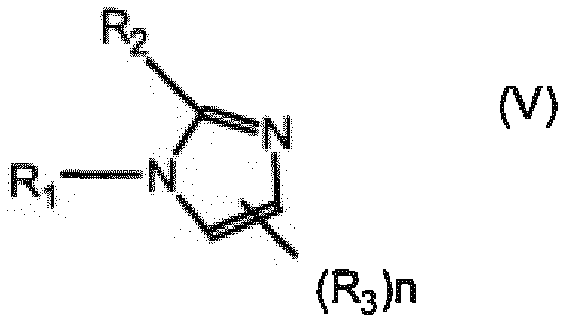
- the imidazole derivatives in particular correspond to the general formula V: wherein R 1, R 2 and R 3 identical or different are selected from H, OH, SH, alkyl C 1 -C 4 hydroxyalkyl, C 1 -C 4 aminoalkyl, C 1 -C 4 alkylamino, C 1 -C 4 dialkylamino (each alkyl having 1 to 4 carbon atoms), alkylthio C 1 -C 4 haloalkyl, C 1 -C 4 cycloalkyl, C 3 -C 8 aryl, C 5 - C 10 , (C 5 -C 10 ) aryl-C 1 -C 4 alkyl; (C 1 -C 4 ) alkyl-C 5 -C 10 aryl, heterocyclic whose heterocycle comprises from 2 to 10 carbon atoms and from 1 to 4 identical or different heteroatoms chosen from O, S and N and the group NR 4 , R 4 being in particular C 1 -C 4 alkyl or
- the catalyst based on a quaternary ammonium salt is as defined above.
- any type of known cyclotrimerization catalyst of the quaternary ammonium salt type can be used.
- the isocyanate which is to be cyclotrimerized is a cycloaliphatic diisocyanate, such as NBDI, IPDI or H 12 MDI, or a mixture of a cycloaliphatic diisocyanate and a linear chain aliphatic diisocyanate, especially HDI. It is preferred to use a quaternary ammonium hydrogencarbonate as defined above, especially choline hydrogen carbonate.
- catalytic system comprising a quaternary ammonium salt and imidazole or derivatives, according to the present invention, makes it possible to increase the reactivity of isocyanates, in particular cycloaliphatic isocyanates, optionally, in admixture with linear chain aliphatic isocyanates, which reactivity can be controlled effectively without substantially depending on the hydrolysable chlorine content of the starting isocyanate (s) monomer (s) .
- reaction mixture obtained at the end of the cyclotrimerization reaction which may be partial, has a strongly attenuated coloration relative to a reaction mixture obtained in the absence of imidazole.
- imidazole as a co-catalyst for a cyclotrimerization reaction in which the catalyst is a salt quaternary ammonium, results in the formation of a substantial amount of uretdione ring dimer (s) (I ') isocyanate (s) starting, capable of improving the properties of the resulting mixture, in particular to reduce the viscosity of the isocyanurate polyisocyanates.
- the imidazole is added with stirring to the isocyanate monomer (s) which it is desired to polymerize, preferably in the absence of a solvent, and stirring is continued until a homogeneous mixture is obtained.
- the catalyst is added while stirring is maintained and the reaction medium is heated.
- the reaction is allowed to proceed for a time varying between 1 h and 4 h, preferably about 1 hour and a half.
- imidazole as a co-catalyst also makes it possible to substantially reduce the amount of catalyst necessary for the cyclotrimerization of (s) (1 ') isocyanate (s).
- a quantity of catalyst ranging from 100 to 300 ppm, preferably about 200 ppm, relative to the amount of isocyanate (s) starting, when the amount of cocatalyst is 400 to 800 ppm, preferably about 600 ppm, based on the amount of isocyanate (s) starting.
- the cyclotrimerization reaction in particular partial cyclotrimerization is conducted at a temperature between room temperature and 120 ° C, preferably 60 to 70 ° C for the IPDI.
- the subject of the invention is also a polyisocyanate (poly) isocyanurate composition obtained by the process according to the invention, such a composition being characterized by the presence of reaction products between the starting isocyanate and imidazole and between the products of polymerization of these isocyanates, especially in the form of isocyanurates with imidazole or a derivative thereof, these products which may also include biuret, carbamate and / or allophanate groups obtained by reacting the isocyanate groups with the OH groups present in the catalyst.
- the products obtained may subsequently undergo a chemical reaction: dimerization, allophanation, biuretization, blocking reaction with a blocking agent (or masking) either before or after distillation of the monomer.
- the compounds obtained are used for the preparation of coatings, especially as basic constituents for varnishes and paints.
- EXAMPLE 1 (comparative) : Preparation of trimer isophorone diisocyanate (IPDT).
- IPDI 11.800 g of IPDI are charged to a reactor. It is stirred under a stream of argon and heated to a temperature of 85.degree.
- Example 2 The procedure is as for Example 1 except that 1.6 g (0.2% by weight) of choline bicarbonate is added and the reaction is heated to 60 ° C.
- Examples 1 to 5 are reported in the table below.
- the IPDI (800 g) is charged to a reactor of 11, and stirred under an argon stream.
- Imidazole is introduced at a rate of 4 mmol / 100 g of IPDI at room temperature. Stirring is maintained and the reaction medium is brought to 80 ° C. When the temperature is stabilized, choline bicarbonate (0.05% by weight) is introduced. The evolution of the reaction is monitored by measuring the transformation rate (TT) of the IPDI of the time by measuring the NCO titre (potentiometry).
- the reaction is continued for a period of one hour 30.
- the conversion rate of the IPDI obtained is of the order of 70%.
- the reaction is continued at 80 ° C for a period of two hours.
- the transformation rate of the IPDI is 60%.
- Example 6 The procedure is as in Example 6 except that imidazole is not introduced.
- the amounts of catalyst (choline hydrogencarbonate) are 0.2% and 0.15% by weight.
- the coloration of the reaction medium is evaluated according to the method AFNOR NF T20605 or ASTM D1209.84.
- the IPDI is redistilled before the trimerization reaction.
Landscapes
- Chemical & Material Sciences (AREA)
- Chemical Kinetics & Catalysis (AREA)
- Organic Chemistry (AREA)
- Health & Medical Sciences (AREA)
- Medicinal Chemistry (AREA)
- Polymers & Plastics (AREA)
- Engineering & Computer Science (AREA)
- Materials Engineering (AREA)
- Polyurethanes Or Polyureas (AREA)
- Organic Low-Molecular-Weight Compounds And Preparation Thereof (AREA)
- Catalysts (AREA)
- Low-Molecular Organic Synthesis Reactions Using Catalysts (AREA)
Claims (39)
- Verwendung eines katalytischen Systems auf Basis eines quaternären Ammoniumsalzes als Reaktionskatalysator einer Zyklotrimerisierung von Isocyanaten bei Vorhandensein eines Imidazols oder eines seiner Derivate als Co-Katalysator.
- Verwendung nach Anspruch 1, dadurch gekennzeichnet, dass der Co-Katalysator der allgemeinen Formel (V) entspricht:

- Verwendung nach Anspruch 2, dadurch gekennzeichnet, dass der Co-Katalysator der allgemeinen Formel (V) entspricht:

- Verwendung nach Anspruch 2, dadurch gekennzeichnet, dass der Co-Katalysator der allgemeinen Formel (V) entspricht:

- Verwendung nach Anspruch 2, dadurch gekennzeichnet, dass der Co-Katalysator der allgemeinen Formel (V) entspricht:

- Verwendung nach einem der vorhergehenden Ansprüche, bei der der Reaktionskatalysator der Zyklotrimerisierung von Isocyanaten ein Hydroxid eines quaternären Hydroxyalkylammoniums ist.
- Verwendung nach einem beliebigen der Ansprüche 1 bis 5, bei der der Reaktionskatalysator der Zyklotrimerisierung von Isocyanaten ein Hydrogencarbonat eines Kations ist, das- sei es ein solches,- sei es in komplexierter Form mit einem Komplexbildner,einen mittleren Ionen- oder Molekularradius größer als 1 A hat und das mindestens teilweise in dem Reaktionsmedium lösbar ist.
- Verwendung nach einem beliebigen der vorhergehenden Ansprüche, dadurch gekennzeichnet, dass die Isocyanate aliphatische und/oder cycloaliphatische Isocyanate sind.
- Verwendung nach einem beliebigen der vorhergehenden Ansprüche, dadurch gekennzeichnet, dass die Isocyanate ausgewählt sind aus Isophorondiisocyanat, Norbonandiisocyanat und Diisocyanat von 4,4'-Dicyklohexylmethandiyl, allein oder in einer Mischung mit anderen Diisocyanaten.
- Verwendung nach einem beliebigen der vorhergehenden Ansprüche, dadurch gekennzeichnet, dass die Katalysatormenge zwischen 100 ppm und 300 ppm (ausgedrückt als Gewicht) in Bezug auf das monomere Isocyanat ist.
- Verwendung nach einem beliebigen der vorhergehenden Ansprüche, dadurch gekennzeichnet, dass die Menge des Co-Katalysators zwischen 400 ppm und 800 ppm (ausgedrückt als Gewicht) in Bezug auf das monomere Isocyanat liegt.
- Verwendung nach einem beliebigen der vorhergehenden Ansprüche für die Herstellung des Isophorondiisocynattrimers oder eines gemischten Trimers aus Isophorondiisocyanat und Hexamethylendiisocyanat, in dem das Verhältnis von Hexamethylendiisocyanat zwischen 5 bis 95 Ges.-% variiert.
- Verwendung nach einem beliebigen der Ansprüche 1 bis 11 für die Herstellung des Norbornandiisocyanattrimers oder eines gemischten Trimers aus Norbonandiisocyanat und Hexamethylendiisocyanat, in dem das Verhältnis von Hexamethylendiisocyanat von 5 bis 95 Gew.-% variiert.
- Verwendung nach einem beliebigen der Ansprüche 1 bis 11 für die Herstellung des Diisocyanattrimers von 4,4'-Dicyklohexylmethandiyl oder eines gemischten Trimers aus Diisocyanat von 4,4'-Dicyklohexylmethanediyl und Hexamethylendiisocyanat, bei dem das Verhältnis von Hexamethylendiisocyanat von 5 bis 95 Gew.-% variiert.
- Verwendung nach einem beliebigen der vorhergehenden Ansprüche, dadurch gekennzeichnet, dass das Kation der allgemeinen Formel I entspricht:
 Q ein Stickstoff-, Phosphor- oder Schwefelatom darstellt; undR1, R2, R3 und R4, identisch oder unterschiedlich, bezeichnen, Alkylgruppen, gegebenenfalls hydroxyliert, mit 1 bis 20 Kohlenstoffatomen, Cycloalkylreste mit 4 bis 15 Kohlenstoffatomen,gegebenenfalls mit Hydroxylgruppen substituiert, Aralkylreste mit 7 bis 15 Kohlenstoffatomen, gegebenenfalls substituiert mit Hydroxylgruppen oder Arylresten mit 6 bis 15 Kohlenstoffatomen, gegebenenfalls substituiert mit Hydroxylgruppen oder wenn Q gleich N ist, zwei der Reste R1, R2, R3 und R4 auch mit dem Stickstoffatom und gegebenenfalls mit einem Sauerstoffheteroatom oder Stickstoffheteroatom einen heterozyklischen Kern mit 4 bis 6 Kohlenstoffatomen bilden können oder wenn Q gleich N ist, die Reste R1, R2, und R3 jeweils Ethylenreste darstellen, die unter Verbindung mit dem quaternären Stickstoffatom und einem anderen tertiären Stickstoffatom eingehen ein bizyklisches Triethylendiaminskelett bilden,oder eines von R1 bis R4 eine Gruppe repräsentiert
- Verwendung nach Anspruch 15, dadurch gekennzeichnet, dass das Kation der folgenden allgemeinen Formel (II) entspricht:
 * R1, R2 und R3 identische oder unterschiedliche Reste darstellen und Alkylgruppen, gegebenenfalls hydroxyliert, mit 1 bis 20 Kohlenstoffatomen, Cycloalkylreste mit 4 bis 15 Kohlenstoffatomen, gegebenenfalls substituiert mit Hydroxylgruppen, Aralkylreste mit 7 bis 15 Kohlenstoffatomen, gegebenenfalls substituiert mit Hydroxylgruppen oder Arylresten mit 6 bis 15 Kohlenstoffatomen, gegebenenfalls substituiert mit Hydroxylgruppen, bezeichnen, wobei zwei der Reste R1, R2 oder R3 auch mit dem Stickstoffatom und gegebenenfalls mit einem Sauerstoff- oder Stickstoffheteroatom einen heterozyklischen Kern mit 4 bis 6 Kohlenstoffatomen bilden können, oder die Reste R1, R2 und R3 stellen jeweils Ethylenreste dar, die unter Verbindung mit dem quaternären Stickstoffatom und einem anderen tertiären Stickstoffatom ein bizyklisches Triethylendiaminskelett bilden, und* R5, R6 und R7, identisch oder unterschiedlich, Wasserstoff, eine OH-Gruppe, eine Alkylgruppe mit 1 bis 12 Kohlenstoffatomen, eine Cycloalkylgruppe mit 5 bis 7 Kohlenstoffatomen, eine Alkenylgruppe mit 2 bis 15 Kohlenstoffatomen, eine Alkinylgruppe mit 3 bis 6 Kohlenstoffatomen, eine Hydroxyalkylgruppe mit 1 bis 9 Kohlenstoffatomen, eine Aralkylgruppe mit 7 bis 10 Kohlenstoffatomen, eine Arylgruppe mit 6 bis 10 Kohlenstoffatomen oder eine R8-O-(CH2)n-Gruppe, bei der R8 Wasserstoff ist, einen Alkylrest mit 1 bis 12 Kohlenstoffatomen, einen Cycloalkylrest mit 4 bis 10 Kohlenstoffatomen, einen Aralkylrest mit 7 bis 10 Kohlenstoffatomen oder einen Arylrest mit 6 bis 10 Kohlenstoffatomen darstellen; und n eine ganze Zahl von 1 bis 6 ist; R7 außerdem gleichfalls eine Gruppe OCOR9 darstellen kann, wobei R9 eine C1-C6-Alkylgruppe ist.
 - Verwendung nach Anspruch 15 oder Anspruch 16, dadurch gekennzeichnet, dass:- R1, R2 und R3 eine Methylgruppe darstellen,- R5 H, OH, die Methylgruppe oder die Hydroxymethylgruppe darstellt,- R6 H, OH, die Methylgruppe oder die Hydroxymethylgruppe darstellt,- R7 H, OH, die Methylgruppe, die Hydroxymethylgruppe oder die Acetylgruppe darstellt.
- Verwendung nach Anspruch 15 oder Anspruch 16, dadurch gekennzeichnet, dass:- R1, R2 und R3, identisch oder unterschiedlich, eine C1-C4 Alkylgruppe darstellen,- R5 H oder eine C1-C4 Alkylgruppe darstellt,- R6 H, OH oder eine C1-C4 Alkylgruppe darstellt,- R7 H, OH, eine C1-C4 Alkylgruppe oder die Acetylgruppe darstellt, ohne dass die Gesamtheit der Kohlenstoffatome von R1 bis R7 8 überschreitet.
- Verwendung nach Anspruch 15 oder Anspruch 16, dadurch gekennzeichnet, dass mindestens eine der drei Gruppen R1 bis R3 die Methylgruppe darstellt, wobei R5, R6 und R7 und ein einziges von R5 bis R7 OH ist.
- Verwendung nach Anspruch 15 oder Anspruch 16, dadurch gekennzeichnet, dass R1 bis R3 eine C1-C4 Alkylgruppe, eine C1-C4 Hydroxyalkylgruppe darstellen und R5 bis R7 H oder OH darstellen, wobei die Verbindungen eine einzige OH-Gruppe in Omega-Position in Bezug auf das zentrale Stickstoffatom aufweisen.
- Verwendung nach Anspruch 15 oder Anspruch 16, dadurch gekennzeichnet, dass die Verbindung Cholinhydrogencarbonat ist.
- Verwendung nach Anspruch 15 oder Anspruch 16, dadurch gekennzeichnet, dass der Katalysator eine feste Form aufweist, die durch Ablagerung von Hydrogencarbonat auf einem Mineral oder eine kovalente Bindung an einem Harz erhalten wird.
- Verfahren zur Herstellung von Polyisocyanaten (Poly)isocyanuraten durch katalytische Zyklotrimerisierung von Isocyanaten, bei der als Katalysator ein katalytisches System auf der Basis eines quaternären Ammoniumsalzes bei Vorhandensein eines Imidazols oder eines seiner Derivate als Co-Katalysator verwendet wird.
- Verfahren nach Anspruch 23, dadurch gekennzeichnet, dass der Co-Katalysator der allgemeinen Formel V entspricht:

- Verfahren nach Anspruch 24, dadurch gekennzeichnet, dass der Co-Katalysator der allgemeinen Formel V entspricht:

- Verfahren nach Anspruch 24, dadurch gekennzeichnet, dass der Co-Katalysator der allgemeinen Formel V entspricht:

- Verfahren nach Anspruch 24, dadurch gekennzeichnet, dass der Co-Katalysator der allgemeinen Formel V entspricht:
- Verfahren nach einem beliebigen der Ansprüche 23 bis 27, dadurch gekennzeichnet, dass der Zyklotrimerisierungskatalysator derart ausgebildet ist, wie er in den Ansprüchen 15 bis 22 definiert ist.
- Verfahren nach Anspruch 28, dadurch gekennzeichnet, dass das quaternäre Ammoniumsalz die allgemeine Formel aufweist:
 * R1, R2 und R3 identische oder unterschiedliche Reste darstellen und Alkylgruppen, gegebenenfalls hydroxyliert, mit 1 bis 20 Kohlenstoffatomen, Cycloalkylreste mit 4 bis 15 Kohlenstoffatomen, gegebenenfalls substituiert mit Hydroxylgruppen, Aralkylreste mit 7 bis 15 Kohlenstoffatomen, gegebenenfalls substituiert mit Hydroxylgruppen oder Arylreste mit 6 bis 15 Kohlenstoffatomen, gegebenenfalls substituiert mit Hydroxylgruppen, bezeichnen, wobei zwei der Reste R1, R2 oder R3 auch mit dem Stickstoffatom und gegebenenfalls mit einem Sauerstoff- oder Stickstoffheteroatom einen heterozyklischen Kern mit 4 bis 6 Kohlenstoffatomen bilden können, oder die Reste R1, R2 und R3 jeweils Ethylenreste darstellen, die unter Verbindung mit dem quaternären Stickstoffatom und einem anderen tertiären Stickstoffatom ein bizyklisches Triethylendiaminskelett bilden, und* R4 und R5, identisch oder unterschiedlich, Wasserstoff und/oder eine Alkylgruppe mit 1 bis 12 Kohlenstoffatomen, eine Cycloalkylgruppe mit 5 bis 7 Kohlenstoffatomen, eine Alkenylgruppe mit 2 bis 15 Kohlenstoffatomen, eine Alkenylgruppe mit 3 bis 6 Kohlenstoffatomen, eine Hydroxyalklgruppe mit 1 bis 9 Kohlenstoffatomen, eine Aralkylgruppe mit 7 bis 10 Kohlenstoffatomen, eine Arylgruppe mit 6 bis 10 Kohlenstoffatomen oder eine R6-O-(CH2)n-Gruppe, bei der R6 Wasserstoff ist, einen Alkylrest mit 1 bis 12 Kohlenstoffatomen, einen Cycloalkylrest mit 4 bis 10 Kohlenstoffatomen, einen Aralkylrest mit 7 bis 10 Kohlenstoffatomen oder einen Arylrest mit 6 bis 10 Kohlenstoffatomen darstellen; undX- ein Anion darstellt, ausgewählt aus OH- und den Anionen der Formel -OOC-(O)a-Y, wobei Y ausgewählt ist aus
n eine ganze Zahl von 1 bis 6 ist; und
einem Wasserstoffatom,
einer Alkylgruppe mit 1 bis 20 Kohlenstoffatomen,
eine Alkenylgruppe mit 2 bis 15 Kohlenstoffatomen,
einer Cycloalkylgruppe mit 3 bis 6 Kohlenstoffatomen,
einer Phenylgruppe,
einer Alkylphenylgruppe mit 1 bis 9 Kohlenstoffatomen im Alkylrest oder in den Gruppen, die an den Phenylkern gebunden sind,
eine Benzylgruppe,
eine Alkylbenzylgruppe mit 1 bis 9 Kohlenstoffatomen in dem Alkylrest oder in den Gruppen, die an den Benzylkern gebunden sind, und eine Gruppe CH(3-b)Z(b), bei der b eine Ganze Zahl von 1 bis 3 ist und Z OH, CN, CI, eine Alkoxygruppe mit 1 bis 5 Kohlenstoffatomen oder eine Phenyl- oder Methoxyphenylgruppe ist, oder
Z (CH2)dCOOR ist, wobei d eine ganze Zahl zwischen 0 und 4 ist und R ein Wasserstoffatom oder eine Alkylgruppe ist, die bis zu 20 Kohlenstoffatome haben kann,
und a gleich null oder 1 ist. - Verfahren nach Anspruch 28, dadurch gekennzeichnet, dass das quaternäre Ammoniumsalz Cholin ist.
- Verfahren nach einem der Ansprüche 23 bis 30, dadurch gekennzeichnet, dass die Menge des Katalysators 100 ppm bis 300 ppm in Bezug auf das monomere Isocyanat beträgt.
- Verfahren nach einem beliebigen der Anspräche 23 bis 31, dadurch gekennzeichnet, dass die Menge des Co-Katalysators zwischen 400 ppm und 800 ppm in Bezug auf das Monomerisozyanat beträgt.
- Zusammensetzung von Poly-Isocyanaten (Poly)isocyanuraten, die durch Zyklotrimerisierung von Isocyanaten allein oder in Mischung durch die Verwendung eines Katalysators und eines Co-Katalysators erhalten wird, wie in einem der Ansprüche 1 bis 22 definiert.
- Zusammensetzung von Poly-Isocyanaten (Poly)isocyanuraten, die durch Zyklotrimerisierung von Isocyanaten, allein oder in Mischung, nach dem Verfahren, wie es in einem beliebigen der Ansprüche 23 bis 32 definiert ist, erhalten wurden.
- Zusammensetzung nach Anspruch 34, enthaltend die Reaktionsprodukte des monomeren und/oder trimeren Isocyanats mit Imidazol oder eines seiner Derivate.
- Zusammensetzung von Poly-Isocyanaten (Poly)isocyanuraten, bei der die Zusammensetzung ein Reaktionsprodukt eines monomeren und/oder trimeren Isocyanats mit einem Co-Katalysator ist, der Imidazol oder eines seiner Derivate entsprechend der allgemeinen Formel (V) ist, bei Vorhandensein eines katalytischen Systems auf der Basis eines quaternären Ammoniumsalzes:

- Zusammensetzung nach Anspruch 36, dadurch gekennzeichnet, dass der Co-Katalysator der allgemeinen Formel (V) entspricht:

- Zusammensetzung nach Anspruch 36, dadurch gekennzeichnet, dass der Co-Katalysator der allgemeinen Formel (V) entspricht:

- Zusammensetzung nach Anspruch 36, dadurch gekennzeichnet, dass der Co-Katalysator der allgemeinen Formel (V) entspricht:

Applications Claiming Priority (5)
| Application Number | Priority Date | Filing Date | Title |
|---|---|---|---|
| FR9713855 | 1997-11-04 | ||
| FR9713856A FR2770533B1 (fr) | 1997-11-04 | 1997-11-04 | Utilisation d'imidazole en tant que co-catalyseur de la trimerisation d'isocyanates |
| FR9713855A FR2770532B1 (fr) | 1997-11-04 | 1997-11-04 | Catalyseur de trimerisation d'isocyanates, a base d'un hydrogenocarbonate |
| FR9713856 | 1997-11-04 | ||
| EP98954515A EP1027380B1 (de) | 1997-11-04 | 1998-11-04 | Katalysator und verfahren zur trimerisierung von isocyanaten |
Related Parent Applications (2)
| Application Number | Title | Priority Date | Filing Date |
|---|---|---|---|
| EP98954515A Division EP1027380B1 (de) | 1997-11-04 | 1998-11-04 | Katalysator und verfahren zur trimerisierung von isocyanaten |
| EP98954515.7 Division | 1998-11-04 |
Publications (2)
| Publication Number | Publication Date |
|---|---|
| EP1375545A1 EP1375545A1 (de) | 2004-01-02 |
| EP1375545B1 true EP1375545B1 (de) | 2016-06-29 |
Family
ID=26233919
Family Applications (2)
| Application Number | Title | Priority Date | Filing Date |
|---|---|---|---|
| EP98954515A Expired - Lifetime EP1027380B1 (de) | 1997-11-04 | 1998-11-04 | Katalysator und verfahren zur trimerisierung von isocyanaten |
| EP03020852.4A Expired - Lifetime EP1375545B1 (de) | 1997-11-04 | 1998-11-04 | Katalysator und verfahren für die trimerisation von isocyanaten |
Family Applications Before (1)
| Application Number | Title | Priority Date | Filing Date |
|---|---|---|---|
| EP98954515A Expired - Lifetime EP1027380B1 (de) | 1997-11-04 | 1998-11-04 | Katalysator und verfahren zur trimerisierung von isocyanaten |
Country Status (12)
| Country | Link |
|---|---|
| US (2) | US6635761B1 (de) |
| EP (2) | EP1027380B1 (de) |
| JP (1) | JP4342723B2 (de) |
| KR (1) | KR100549652B1 (de) |
| CN (1) | CN1184248C (de) |
| AT (1) | ATE251648T1 (de) |
| AU (1) | AU1159699A (de) |
| BR (1) | BR9813932A (de) |
| CA (1) | CA2307747A1 (de) |
| DE (1) | DE69818857T2 (de) |
| WO (1) | WO1999023128A1 (de) |
| ZA (1) | ZA9810038B (de) |
Families Citing this family (50)
| Publication number | Priority date | Publication date | Assignee | Title |
|---|---|---|---|---|
| ZA9810038B (en) * | 1997-11-04 | 2000-05-03 | Rhodia Chimie Sa | A catalyst and a method for the trimerization of isocyanates. |
| AU2001235565A1 (en) | 2000-01-20 | 2001-07-31 | Rhodia Chimie | Method for obtaining slightly coloured branched polyisocyanate(s), and resultingcomposition |
| FR2804112B1 (fr) * | 2000-01-20 | 2004-04-30 | Rhodia Chimie Sa | Procede d'obtention de cyclotrimeres d'isocyanate(s) ramifie(s) faiblement colore(s) et composition en decoulant |
| FR2808528B1 (fr) * | 2000-05-04 | 2004-05-21 | Rhodia Chimie Sa | Procede d'obtention de polyisocyanate(s) ramifie(s) faiblement colore(s), et composition en decoulant |
| FR2818974B1 (fr) | 2000-12-29 | 2003-10-24 | Rhodia Chimie Sa | (cyclo) condensation de composes isocyanates |
| DE10123419A1 (de) | 2001-05-14 | 2002-11-21 | Bayer Ag | Verfahren zur Herstellung von aliphatischen Polyisocyanaten mit Uretdion-Isocyanurat- sowie Iminooxadiazindionstruktur |
| DE10123416A1 (de) * | 2001-05-14 | 2002-11-21 | Bayer Ag | Verfahren zur Herstellung von Polyisocyanaten |
| DE10131525A1 (de) * | 2001-07-02 | 2003-01-16 | Degussa | Verfahren zur Herstellung von geruchsarmen und lagerstabilen monomerhaltigen Polyisocyanuraten aus Isophorondiisocyanat |
| US20070282026A1 (en) * | 2003-07-24 | 2007-12-06 | Huntsman Petrochemical Corporation | Low-Odor Catalyst for Isocyanate-Derived Foams and Elastomers |
| FR2929612B1 (fr) * | 2008-04-03 | 2011-02-04 | Rhodia Operations | Procede d'oligomerisation des isocyanates en continu |
| US20110201709A1 (en) * | 2008-11-10 | 2011-08-18 | Dow Global Technologies Llc | Isocyanate trimerisation catalyst system, a precursor formulation, a process for trimerising isocyanates, rigid polyisocyanurate/polyurethane foams made therefrom, and a process for making such foams |
| JP6249954B2 (ja) * | 2011-11-30 | 2017-12-20 | バイエル・インテレクチュアル・プロパティ・ゲゼルシャフト・ミット・ベシュレンクテル・ハフツングBayer Intellectual Property GmbH | 連続的イソシアネート修飾方法 |
| CN104271628B (zh) * | 2012-05-08 | 2016-08-24 | 巴斯夫欧洲公司 | 含有异氰脲酸酯基团的多异氰酸酯的制备及其用途 |
| JP6281280B2 (ja) * | 2013-12-19 | 2018-02-21 | 東ソー株式会社 | アロファネート・イソシアヌレート化触媒、該触媒を用いたポリイソシアネート組成物、該組成物の製造方法、及び該組成物を用いた二液型塗料組成物 |
| ES2978136T3 (es) | 2015-04-21 | 2024-09-05 | Covestro Deutschland Ag | Plástico de poliisocianurato que contiene grupos siloxano y método para la producción del mismo |
| CN107531875B (zh) * | 2015-04-21 | 2020-09-22 | 科思创德国股份有限公司 | 用于生产具有功能化表面的聚异氰脲酸酯塑料的方法 |
| CN107438635B (zh) | 2015-04-21 | 2021-01-19 | 科思创德国股份有限公司 | 制造聚异氰脲酸酯塑料的方法 |
| CN107531876B (zh) | 2015-04-21 | 2021-02-09 | 科思创德国股份有限公司 | 具有高热稳定性的聚异氰脲酸酯塑料 |
| TW201704220A (zh) | 2015-04-21 | 2017-02-01 | 科思創德意志股份有限公司 | 聚異氰尿酸酯聚合物及製造聚異氰尿酸酯聚合物之方法 |
| EP3286240A1 (de) | 2015-04-21 | 2018-02-28 | Covestro Deutschland AG | Auf polyisocyanuratpolymeren basierende, unter adiabatischen bedingungen hergestellte feststoffe |
| CN105032490A (zh) * | 2015-07-17 | 2015-11-11 | 华南理工大学 | 一种复配催化剂及在制备混合二异氰酸酯三聚体中的应用 |
| US9815739B2 (en) | 2015-10-30 | 2017-11-14 | Covestro Llc | Polyisocyanurate based cement for wellbore fluid loss prevention |
| CN107021920B (zh) * | 2016-08-12 | 2019-07-23 | 万华化学集团股份有限公司 | 一种异氰酸酯聚合催化剂及其制备方法,及其用于制备聚异氰酸酯的方法 |
| EP3529291B1 (de) | 2016-10-18 | 2021-06-23 | Covestro Intellectual Property GmbH & Co. KG | Herstellung von kunststoffen durch katalytische vernetzung von blockierten polyisocyanaten |
| ES2823248T3 (es) | 2016-10-18 | 2021-05-06 | Covestro Intellectual Property Gmbh & Co Kg | Revestimientos duros con alta estabilidad química y mecánica |
| WO2018073302A1 (en) | 2016-10-18 | 2018-04-26 | Covestro Deutschland Ag | Coating of wires with catalytically crosslinked blocked polyisocyanates |
| JP7216644B2 (ja) | 2016-11-14 | 2023-02-01 | コベストロ、ドイチュラント、アクチエンゲゼルシャフト | 前駆体から物体を製造する方法、および付加製造法におけるラジカル架橋性樹脂の使用 |
| EP3381962A1 (de) | 2017-03-29 | 2018-10-03 | Covestro Deutschland AG | Erzeugung von polyisocyanuratschichten durch getrennte auftragung von isocyanatkomponenten und katalysatoren |
| CN106902872B (zh) * | 2017-03-29 | 2019-09-03 | 万华化学集团股份有限公司 | 一种异氰酸酯聚合催化剂及其制备方法,及其用于制备聚异氰酸酯的方法 |
| EP3421516A1 (de) | 2017-06-28 | 2019-01-02 | Covestro Deutschland AG | Gefärbte kunststoffe basierend auf vernetzten polyisocyanaten |
| WO2019061019A1 (en) | 2017-09-26 | 2019-04-04 | Covestro Deutschland Ag | TWO-COMPONENT SYSTEM FOR ELASTIC COATINGS |
| EP3743449B1 (de) | 2017-11-14 | 2024-04-17 | Covestro Deutschland AG | Halbzeuge basierend auf dualem vernetzungsmechanismus |
| CN107868226B (zh) * | 2017-12-07 | 2020-08-28 | 万华化学集团股份有限公司 | 一种窄分布二异氰酸酯三聚体的制备方法 |
| CN111465632B (zh) * | 2017-12-21 | 2022-07-19 | 科思创德国股份有限公司 | 制备含异氰脲酸酯基团的异氰酸酯混合物的方法 |
| JP2021507041A (ja) | 2017-12-21 | 2021-02-22 | コベストロ、ドイチュラント、アクチエンゲゼルシャフトCovestro Deutschland Ag | ポリイソシアネートに基づく耐霜性接着剤 |
| US11124672B2 (en) | 2017-12-21 | 2021-09-21 | Covestro Deutschland Ag | Frost-resistant water paints based on polyisocyanates |
| WO2019157625A1 (en) | 2018-02-13 | 2019-08-22 | Covestro Deutschland Ag | Aromatic polyisocyanates with a high solids content |
| EP3794050A1 (de) | 2018-05-17 | 2021-03-24 | Covestro Intellectual Property GmbH & Co. KG | Verfahren zur herstellung von verbundwerkstoffen aus polyethylenfasern mit ultrahohem molekulargewicht und vernetzten polyisocyanaten |
| CN112204065B (zh) | 2018-05-17 | 2023-03-28 | 科思创知识产权两合公司 | 制备多异氰酸酯聚合物和聚异氰脲酸酯塑料的方法 |
| CN108822276B (zh) * | 2018-05-29 | 2021-01-19 | 武汉理工大学 | 一种pvc/pet复合膜胶黏剂的制备方法 |
| WO2020016119A1 (de) | 2018-07-16 | 2020-01-23 | Covestro Deutschland Ag | Verfahren zur oligomerisierung von isocyanaten mit polyedrischen silsesquioxan-katalysatoren |
| WO2020079160A1 (de) | 2018-10-19 | 2020-04-23 | Covestro Deutschland Ag | Wasserfrei härtende klebstoffe auf polyisocyanatbasis |
| WO2020152107A1 (de) | 2019-01-22 | 2020-07-30 | Covestro Intellectual Property Gmbh & Co. Kg | Kompositwerkstoffe basierend auf urethan- und isocyanuratpolymeren mit dualer härtung |
| WO2020174009A1 (de) | 2019-02-27 | 2020-09-03 | Covestro Intellectual Property Gmbh & Co. Kg | Polyisocyanuratwerkstoffe als elektrovergussmassen |
| EP3763792A1 (de) | 2019-07-11 | 2021-01-13 | Covestro Deutschland AG | Verfahren zur herstellung von isocyanuraten aus uretdionen |
| CN110760055B (zh) * | 2019-10-29 | 2022-02-15 | 万华化学(宁波)有限公司 | 一种多异氰酸酯组合物及制备方法 |
| WO2022002787A1 (de) | 2020-07-02 | 2022-01-06 | Covestro Deutschland Ag | Beschichtungen aus polyisocyanuratbeschichtungen (rim) und deren anwendung in spritzgiessprozessen |
| CN112250835B (zh) * | 2020-09-14 | 2022-03-11 | 万华化学(宁波)有限公司 | 一种制备无色多异氰酸酯组合物的方法 |
| EP4314102A1 (de) | 2021-03-29 | 2024-02-07 | Covestro Deutschland AG | Polyisocyanurat-prepregs und daraus hergestellte faserverbundbauteile |
| EP4303246A1 (de) | 2022-07-04 | 2024-01-10 | Covestro Deutschland AG | Polyisocyanatgemisch |
Family Cites Families (11)
| Publication number | Priority date | Publication date | Assignee | Title |
|---|---|---|---|---|
| US3980594A (en) | 1975-04-23 | 1976-09-14 | The General Tire & Rubber Company | Trimerization of aromatic isocyanates catalyzed by certain ammonium salts |
| US4040992A (en) * | 1975-07-29 | 1977-08-09 | Air Products And Chemicals, Inc. | Catalysis of organic isocyanate reactions |
| DE2806731A1 (de) * | 1978-02-17 | 1979-08-23 | Bayer Ag | Verfahren zur herstellung von isocyanuratgruppen aufweisenden polyisocyanaten |
| JPS57111310A (en) * | 1980-12-26 | 1982-07-10 | Achilles Corp | Production of rigid foam |
| US4542214A (en) * | 1982-03-04 | 1985-09-17 | Air Products And Chemicals, Inc. | Carbamate and carbonate salts of tertiary amines |
| JP2770329B2 (ja) | 1988-07-22 | 1998-07-02 | 大日本インキ化学工業株式会社 | ポリイソシアネートの製造方法 |
| DE4005762A1 (de) | 1990-02-23 | 1991-08-29 | Bayer Ag | Trimerisierungskatalysatoren, ein verfahren zu ihrer herstellung und ihre verwendung bei der herstellung von isocyanuratgruppen aufweisenden polyisocyanaten |
| JP3044261B2 (ja) * | 1990-04-11 | 2000-05-22 | 東ソー株式会社 | 通気性に優れた軟質ポリウレタンフォ−ムの製造法 |
| CA2052908A1 (en) * | 1990-11-06 | 1992-05-07 | Charles M. Milliren | System for the production of toluene diisocyanate based flexible foams and the flexible foams produced therefrom |
| DE4405055A1 (de) * | 1994-02-17 | 1995-08-24 | Basf Ag | Verfahren zur Herstellung von Isocyanuratgruppen aufweisenden Polyisocyanaten und ihre Verwendung |
| ZA9810038B (en) * | 1997-11-04 | 2000-05-03 | Rhodia Chimie Sa | A catalyst and a method for the trimerization of isocyanates. |
-
1998
- 1998-11-03 ZA ZA9810038A patent/ZA9810038B/xx unknown
- 1998-11-04 EP EP98954515A patent/EP1027380B1/de not_active Expired - Lifetime
- 1998-11-04 US US09/530,607 patent/US6635761B1/en not_active Expired - Lifetime
- 1998-11-04 AU AU11596/99A patent/AU1159699A/en not_active Abandoned
- 1998-11-04 DE DE69818857T patent/DE69818857T2/de not_active Expired - Lifetime
- 1998-11-04 JP JP2000518997A patent/JP4342723B2/ja not_active Expired - Fee Related
- 1998-11-04 EP EP03020852.4A patent/EP1375545B1/de not_active Expired - Lifetime
- 1998-11-04 KR KR1020007004756A patent/KR100549652B1/ko not_active Expired - Fee Related
- 1998-11-04 AT AT98954515T patent/ATE251648T1/de not_active IP Right Cessation
- 1998-11-04 CA CA002307747A patent/CA2307747A1/fr not_active Abandoned
- 1998-11-04 CN CNB988116995A patent/CN1184248C/zh not_active Expired - Fee Related
- 1998-11-04 WO PCT/FR1998/002359 patent/WO1999023128A1/fr not_active Ceased
- 1998-11-04 BR BR9813932-0A patent/BR9813932A/pt not_active IP Right Cessation
-
2003
- 2003-08-14 US US10/640,643 patent/US7091341B2/en not_active Expired - Fee Related
Also Published As
| Publication number | Publication date |
|---|---|
| CA2307747A1 (fr) | 1999-05-14 |
| US20050080259A1 (en) | 2005-04-14 |
| US7091341B2 (en) | 2006-08-15 |
| EP1375545A1 (de) | 2004-01-02 |
| BR9813932A (pt) | 2000-09-19 |
| US6635761B1 (en) | 2003-10-21 |
| CN1280588A (zh) | 2001-01-17 |
| CN1184248C (zh) | 2005-01-12 |
| EP1027380B1 (de) | 2003-10-08 |
| ZA9810038B (en) | 2000-05-03 |
| KR100549652B1 (ko) | 2006-02-08 |
| AU1159699A (en) | 1999-05-24 |
| ATE251648T1 (de) | 2003-10-15 |
| JP2001521952A (ja) | 2001-11-13 |
| DE69818857D1 (de) | 2003-11-13 |
| JP4342723B2 (ja) | 2009-10-14 |
| EP1027380A1 (de) | 2000-08-16 |
| DE69818857T2 (de) | 2004-08-19 |
| KR20010031693A (ko) | 2001-04-16 |
| WO1999023128A1 (fr) | 1999-05-14 |
Similar Documents
| Publication | Publication Date | Title |
|---|---|---|
| EP1027380A1 (de) | Katalysator und verfahren zur trimerisierung von isocyanaten | |
| CN110312747B (zh) | 使用螺环铵盐作为催化剂至少改性五亚甲基二异氰酸酯的方法 | |
| JP4490813B2 (ja) | ウレトジオン基を含むイソシアネート | |
| JPH11152320A (ja) | イミノオキサジアジンジオン基を有するポリイソシアネートおよびその製造方法 | |
| JP6561073B2 (ja) | Npn配列を有する触媒を使用したイソシアネートの変性方法 | |
| DE10033099A1 (de) | Verfahren zur Herstellung von geruchsarmen und lagerstabilen monomerhaltigen Polyisocyanuraten aus Isophorondiisocyanat | |
| FR2981931A1 (fr) | Procede de preparation d'un compose comprenant au moins un motif beta-hydroxy-urethane et/ou au moins un motif gamma-hydroxy-urethane. | |
| WO2002053613A1 (fr) | (cyclo)condensation de composes isocyanates | |
| KR100894598B1 (ko) | 이소포론 디이소시아네이트의 이량체화 방법 | |
| EP1497351B1 (de) | Niedrige viskosität und hohe funktionalität aufweisende polyisocyanatzusammensetzung und verfahren zur herstellung | |
| FR2770533A1 (fr) | Utilisation d'imidazole en tant que co-catalyseur de la trimerisation d'isocyanates | |
| FR2770532A1 (fr) | Catalyseur de trimerisation d'isocyanates, a base d'un hydrogenocarbonate | |
| EP1352006B1 (de) | Verfahren zur katalytischen dimerisierung von isocyanaten | |
| EP1250367B1 (de) | Verfahren zur polykondensation von isocyanaten | |
| JPH0413350B2 (de) | ||
| EP1358238B1 (de) | Katalysator zur isocyanatkondensation, zusammensetzung, die diesen enthält, verfahren zur verwendung und erhaltene zusammensetzungen | |
| FR2818975A1 (fr) | Nouveau procede de (cyclo) condensation, notamment de (cyclo) trimerisation catalytique d'isocyanates | |
| FR2816939A1 (fr) | Procede de dimerisation catalytique d'isocyanates | |
| FR2897613A1 (fr) | Procede de preparation de polyisocyanates dimeres | |
| JPH06179655A (ja) | ウレチジンジオン誘導体の製造法及びその使用法 | |
| FR2767328A1 (fr) | Utilisation de produits polyhydroxyles pour la preparation de polyisocyanates polyfonctionnels | |
| FR2833864A1 (fr) | Catalyseur de condensation pour isocyanate, composition en contenant, procede d'utilisation, et compositions obtenues | |
| HK1083855B (en) | Isocyanates containing uretdion groups |
Legal Events
| Date | Code | Title | Description |
|---|---|---|---|
| PUAI | Public reference made under article 153(3) epc to a published international application that has entered the european phase |
Free format text: ORIGINAL CODE: 0009012 |
|
| 17P | Request for examination filed |
Effective date: 20030915 |
|
| AC | Divisional application: reference to earlier application |
Ref document number: 1027380 Country of ref document: EP Kind code of ref document: P |
|
| AK | Designated contracting states |
Kind code of ref document: A1 Designated state(s): AT BE CH CY DE DK ES FI FR GB GR IE IT LI LU MC NL PT SE |
|
| AKX | Designation fees paid |
Designated state(s): AT BE CH CY DE DK ES FI FR GB GR IE IT LI LU MC NL PT SE |
|
| RAP1 | Party data changed (applicant data changed or rights of an application transferred) |
Owner name: RHODIA OPERATIONS |
|
| RAP1 | Party data changed (applicant data changed or rights of an application transferred) |
Owner name: PERSTORP FRANCE |
|
| 17Q | First examination report despatched |
Effective date: 20120319 |
|
| RAP1 | Party data changed (applicant data changed or rights of an application transferred) |
Owner name: VENCOREX FRANCE |
|
| GRAP | Despatch of communication of intention to grant a patent |
Free format text: ORIGINAL CODE: EPIDOSNIGR1 |
|
| RIC1 | Information provided on ipc code assigned before grant |
Ipc: C08G 18/18 20060101ALI20160114BHEP Ipc: C08G 18/38 20060101ALI20160114BHEP Ipc: C08G 18/20 20060101ALI20160114BHEP Ipc: C08G 18/02 20060101AFI20160114BHEP Ipc: B01J 31/02 20060101ALI20160114BHEP |
|
| INTG | Intention to grant announced |
Effective date: 20160201 |
|
| GRAS | Grant fee paid |
Free format text: ORIGINAL CODE: EPIDOSNIGR3 |
|
| GRAA | (expected) grant |
Free format text: ORIGINAL CODE: 0009210 |
|
| AC | Divisional application: reference to earlier application |
Ref document number: 1027380 Country of ref document: EP Kind code of ref document: P |
|
| AK | Designated contracting states |
Kind code of ref document: B1 Designated state(s): AT BE CH CY DE DK ES FI FR GB GR IE IT LI LU MC NL PT SE |
|
| REG | Reference to a national code |
Ref country code: GB Ref legal event code: FG4D Free format text: NOT ENGLISH |
|
| REG | Reference to a national code |
Ref country code: CH Ref legal event code: EP |
|
| REG | Reference to a national code |
Ref country code: AT Ref legal event code: REF Ref document number: 809050 Country of ref document: AT Kind code of ref document: T Effective date: 20160715 |
|
| REG | Reference to a national code |
Ref country code: IE Ref legal event code: FG4D Free format text: LANGUAGE OF EP DOCUMENT: FRENCH |
|
| REG | Reference to a national code |
Ref country code: DE Ref legal event code: R096 Ref document number: 69843547 Country of ref document: DE |
|
| PG25 | Lapsed in a contracting state [announced via postgrant information from national office to epo] |
Ref country code: FI Free format text: LAPSE BECAUSE OF FAILURE TO SUBMIT A TRANSLATION OF THE DESCRIPTION OR TO PAY THE FEE WITHIN THE PRESCRIBED TIME-LIMIT Effective date: 20160629 |
|
| REG | Reference to a national code |
Ref country code: NL Ref legal event code: MP Effective date: 20160629 |
|
| REG | Reference to a national code |
Ref country code: FR Ref legal event code: PLFP Year of fee payment: 19 |
|
| PG25 | Lapsed in a contracting state [announced via postgrant information from national office to epo] |
Ref country code: GR Free format text: LAPSE BECAUSE OF FAILURE TO SUBMIT A TRANSLATION OF THE DESCRIPTION OR TO PAY THE FEE WITHIN THE PRESCRIBED TIME-LIMIT Effective date: 20160930 Ref country code: SE Free format text: LAPSE BECAUSE OF FAILURE TO SUBMIT A TRANSLATION OF THE DESCRIPTION OR TO PAY THE FEE WITHIN THE PRESCRIBED TIME-LIMIT Effective date: 20160629 Ref country code: NL Free format text: LAPSE BECAUSE OF FAILURE TO SUBMIT A TRANSLATION OF THE DESCRIPTION OR TO PAY THE FEE WITHIN THE PRESCRIBED TIME-LIMIT Effective date: 20160629 |
|
| REG | Reference to a national code |
Ref country code: AT Ref legal event code: MK05 Ref document number: 809050 Country of ref document: AT Kind code of ref document: T Effective date: 20160629 |
|
| PG25 | Lapsed in a contracting state [announced via postgrant information from national office to epo] |
Ref country code: IT Free format text: LAPSE BECAUSE OF FAILURE TO SUBMIT A TRANSLATION OF THE DESCRIPTION OR TO PAY THE FEE WITHIN THE PRESCRIBED TIME-LIMIT Effective date: 20160629 |
|
| PGFP | Annual fee paid to national office [announced via postgrant information from national office to epo] |
Ref country code: FR Payment date: 20161116 Year of fee payment: 19 Ref country code: DE Payment date: 20161121 Year of fee payment: 19 |
|
| PG25 | Lapsed in a contracting state [announced via postgrant information from national office to epo] |
Ref country code: BE Free format text: LAPSE BECAUSE OF NON-PAYMENT OF DUE FEES Effective date: 20161130 Ref country code: PT Free format text: LAPSE BECAUSE OF FAILURE TO SUBMIT A TRANSLATION OF THE DESCRIPTION OR TO PAY THE FEE WITHIN THE PRESCRIBED TIME-LIMIT Effective date: 20161031 Ref country code: ES Free format text: LAPSE BECAUSE OF FAILURE TO SUBMIT A TRANSLATION OF THE DESCRIPTION OR TO PAY THE FEE WITHIN THE PRESCRIBED TIME-LIMIT Effective date: 20160629 Ref country code: AT Free format text: LAPSE BECAUSE OF FAILURE TO SUBMIT A TRANSLATION OF THE DESCRIPTION OR TO PAY THE FEE WITHIN THE PRESCRIBED TIME-LIMIT Effective date: 20160629 |
|
| REG | Reference to a national code |
Ref country code: DE Ref legal event code: R097 Ref document number: 69843547 Country of ref document: DE |
|
| PLBE | No opposition filed within time limit |
Free format text: ORIGINAL CODE: 0009261 |
|
| STAA | Information on the status of an ep patent application or granted ep patent |
Free format text: STATUS: NO OPPOSITION FILED WITHIN TIME LIMIT |
|
| PG25 | Lapsed in a contracting state [announced via postgrant information from national office to epo] |
Ref country code: DK Free format text: LAPSE BECAUSE OF FAILURE TO SUBMIT A TRANSLATION OF THE DESCRIPTION OR TO PAY THE FEE WITHIN THE PRESCRIBED TIME-LIMIT Effective date: 20160629 |
|
| 26N | No opposition filed |
Effective date: 20170330 |
|
| REG | Reference to a national code |
Ref country code: CH Ref legal event code: PL |
|
| GBPC | Gb: european patent ceased through non-payment of renewal fee |
Effective date: 20161104 |
|
| PG25 | Lapsed in a contracting state [announced via postgrant information from national office to epo] |
Ref country code: CH Free format text: LAPSE BECAUSE OF NON-PAYMENT OF DUE FEES Effective date: 20161130 Ref country code: LI Free format text: LAPSE BECAUSE OF NON-PAYMENT OF DUE FEES Effective date: 20161130 |
|
| REG | Reference to a national code |
Ref country code: IE Ref legal event code: MM4A |
|
| PG25 | Lapsed in a contracting state [announced via postgrant information from national office to epo] |
Ref country code: LU Free format text: LAPSE BECAUSE OF NON-PAYMENT OF DUE FEES Effective date: 20161130 |
|
| PG25 | Lapsed in a contracting state [announced via postgrant information from national office to epo] |
Ref country code: GB Free format text: LAPSE BECAUSE OF NON-PAYMENT OF DUE FEES Effective date: 20161104 Ref country code: IE Free format text: LAPSE BECAUSE OF NON-PAYMENT OF DUE FEES Effective date: 20161104 |
|
| REG | Reference to a national code |
Ref country code: BE Ref legal event code: MM Effective date: 20161130 |
|
| PG25 | Lapsed in a contracting state [announced via postgrant information from national office to epo] |
Ref country code: CY Free format text: LAPSE BECAUSE OF FAILURE TO SUBMIT A TRANSLATION OF THE DESCRIPTION OR TO PAY THE FEE WITHIN THE PRESCRIBED TIME-LIMIT Effective date: 20160629 |
|
| REG | Reference to a national code |
Ref country code: DE Ref legal event code: R119 Ref document number: 69843547 Country of ref document: DE |
|
| PG25 | Lapsed in a contracting state [announced via postgrant information from national office to epo] |
Ref country code: MC Free format text: LAPSE BECAUSE OF FAILURE TO SUBMIT A TRANSLATION OF THE DESCRIPTION OR TO PAY THE FEE WITHIN THE PRESCRIBED TIME-LIMIT Effective date: 20160629 |
|
| REG | Reference to a national code |
Ref country code: FR Ref legal event code: ST Effective date: 20180731 |
|
| PG25 | Lapsed in a contracting state [announced via postgrant information from national office to epo] |
Ref country code: DE Free format text: LAPSE BECAUSE OF NON-PAYMENT OF DUE FEES Effective date: 20180602 Ref country code: FR Free format text: LAPSE BECAUSE OF NON-PAYMENT OF DUE FEES Effective date: 20171130 |