EP1376318A1 - Clé sensible à la force et agencement de clavier - Google Patents
Clé sensible à la force et agencement de clavier Download PDFInfo
- Publication number
- EP1376318A1 EP1376318A1 EP02013328A EP02013328A EP1376318A1 EP 1376318 A1 EP1376318 A1 EP 1376318A1 EP 02013328 A EP02013328 A EP 02013328A EP 02013328 A EP02013328 A EP 02013328A EP 1376318 A1 EP1376318 A1 EP 1376318A1
- Authority
- EP
- European Patent Office
- Prior art keywords
- keys
- keyboard
- multidirectional
- combination
- key
- Prior art date
- Legal status (The legal status is an assumption and is not a legal conclusion. Google has not performed a legal analysis and makes no representation as to the accuracy of the status listed.)
- Withdrawn
Links
Images


Classifications
-
- G—PHYSICS
- G06—COMPUTING OR CALCULATING; COUNTING
- G06F—ELECTRIC DIGITAL DATA PROCESSING
- G06F3/00—Input arrangements for transferring data to be processed into a form capable of being handled by the computer; Output arrangements for transferring data from processing unit to output unit, e.g. interface arrangements
- G06F3/01—Input arrangements or combined input and output arrangements for interaction between user and computer
- G06F3/02—Input arrangements using manually operated switches, e.g. using keyboards or dials
- G06F3/0202—Constructional details or processes of manufacture of the input device
- G06F3/0219—Special purpose keyboards
-
- G—PHYSICS
- G06—COMPUTING OR CALCULATING; COUNTING
- G06F—ELECTRIC DIGITAL DATA PROCESSING
- G06F3/00—Input arrangements for transferring data to be processed into a form capable of being handled by the computer; Output arrangements for transferring data from processing unit to output unit, e.g. interface arrangements
- G06F3/01—Input arrangements or combined input and output arrangements for interaction between user and computer
- G06F3/02—Input arrangements using manually operated switches, e.g. using keyboards or dials
- G06F3/0202—Constructional details or processes of manufacture of the input device
-
- G—PHYSICS
- G06—COMPUTING OR CALCULATING; COUNTING
- G06F—ELECTRIC DIGITAL DATA PROCESSING
- G06F3/00—Input arrangements for transferring data to be processed into a form capable of being handled by the computer; Output arrangements for transferring data from processing unit to output unit, e.g. interface arrangements
- G06F3/01—Input arrangements or combined input and output arrangements for interaction between user and computer
- G06F3/02—Input arrangements using manually operated switches, e.g. using keyboards or dials
- G06F3/023—Arrangements for converting discrete items of information into a coded form, e.g. arrangements for interpreting keyboard generated codes as alphanumeric codes, operand codes or instruction codes
- G06F3/0233—Character input methods
- G06F3/0234—Character input methods using switches operable in different directions
-
- H—ELECTRICITY
- H01—ELECTRIC ELEMENTS
- H01H—ELECTRIC SWITCHES; RELAYS; SELECTORS; EMERGENCY PROTECTIVE DEVICES
- H01H13/00—Switches having rectilinearly-movable operating part or parts adapted for pushing or pulling in one direction only, e.g. push-button switch
- H01H13/70—Switches having rectilinearly-movable operating part or parts adapted for pushing or pulling in one direction only, e.g. push-button switch having a plurality of operating members associated with different sets of contacts, e.g. keyboard
- H01H13/84—Switches having rectilinearly-movable operating part or parts adapted for pushing or pulling in one direction only, e.g. push-button switch having a plurality of operating members associated with different sets of contacts, e.g. keyboard characterised by ergonomic functions, e.g. for miniature keyboards; characterised by operational sensory functions, e.g. sound feedback
Definitions
- the present invention relates to a key and keyboard arrangement of a computer, personal digital assistant, mobile phone and the like electronic apparatuses, and more particularly to multidirectional keys with multiple functions used as keys in an alphanumeric input device for a word processor.
- a conventional QWERTY format keyboard for a computer includes a plurality of keys which are arranged on the keyboard in a specific format such that the user's ten fingers touch specific keys.
- the conventional QWERTY keyboard with over seventy keys each for a specific function item, is bulky and is not convenient to be carried. Besides, in order to achieve moderate typing speed, it takes long time to practice so that the user is able to move his/her fingers quickly enough among keys and a specific finger can be placed on the right position for a correct key-in stroke.
- Some previous work shows the efforts to minimize the number of keys for a keyboard.
- U.S. Pat. No. 5841,374 discloses a minimum size of a keyboard with nineteen multifunctional keys and each key includes up to seven functions. However, the user still has to move six of his/her ten fingers among the keys to operate the keyboard.
- each multidirectional key includes a force sensor and a vector classifier.
- the force sensor detects the force vector applied by the finger tip on its corresponding multidirectional key.
- the vector is then classified according to predefined direction ranges and is designated as one of the nine functions.
- the nine functions in each key appear to be in a pattern of three rows by three columns.
- the primary object of the present invention is to provide a force sensitive key and keyboard arrangement that has only ten keys each controlled by a designated finger of the user and performs all the functions that a QWERTY keyboard provides.
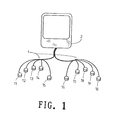
- the system of the present invention comprises a computer 2 and a keyboard 1 which has ten multidirectional keys 11, 12, 13, 14, 15, 16, 17, 18, 19 and 10.
- Each multidirectional key has a three-axial force sensor so as to detect the vector of a force that a user's finger tip applies to the key.
- the vector of the force is then classified as one of the nine classes according to direction ranges.
- the chosen class represents a specific function which inputs a specific code into the computer.
- a multidirectional key 17 includes nine function items which are shown as a matrix pattern in three columns by three rows. Taking the multidirectional key operated by the index finger of right hand as an example, the way that the finger tip operates the multidirectional key is shown in Fig. 3 and the force sensor 17 of the multidirectional key measures the force vector f as the arrow shown in Fig. 2. The force vector f is then sent to a processing unit of the computer and is classified according to the predefined direction ranges. When the value of the force vector f reaches a threshold value on either one of the nine directions, a specific function is activated according to the classification result. The nine directions as shown in Fig.
- 3 include eight directions parallel to the horizontal plane or the plane of the key surface, forward (u), backward (m), front-left (y), left (h), back-left (n), front-right (F7), right ( & ) and back-right (7), and a direction of downward pressing (j).
- ten multidirectional keys 11, 12, 13, 14, 15, 16, 17, 18, 19, and 10 which constitute keyboard functions mapping to all of the functions of a QWERTY keyboard.
- the ten keys, 11, 12, 13, 14, 15, 16, 17, 18, 19, and 10 are thus allocated with appropriate distances apart from one another, and can be placed on and operated ergonomically, respectively, by the little finger of left hand, the left ring finger, the left middle finger, the left index finger, the left thumb, the right thumb, the right index finger, the right middle finger, the right ring finger, and the right little finger.
- the function items located in the same column of a QWERTY keyboard can be discriminated by sensing the directions of the longitudinal forces applied on the key of the keyboard of the present invention.
- a longitudinal force can be a forward direction and backward direction as shown along the Y-axis of the coordinate system 4 in Fig. 3.
- Figs. 2 and 4 show the discrimination of different rows in the same column such as the discrimination among U, J, and M, or the discrimination among Y, H, and N.
- the function items of different columns on the same multidirectional key are distinguished by sensing the differences of the lateral forces applied on a multidirectional key.
- items of Y, H, and N on the multidirectional key 17 can be detected by sensing inward lateral forces applied on the multidirectional key 17 so as to be distinguished from U, J, and M on the same multidirectional key 17.
- the inward lateral forces can be exerted by pushing fingers of the left hand to the right, and the right hand to the left.
- the index finger of right hand, the index finger of the left hand, the little finger of right hand and the little finger of left hand move laterally when operating the QWERTY keyboard, so that those items on multidirectional keys are designed to have the feature of sensing inward lateral forces.
- the little finger of the right hand has to move laterally over more than one columns when operating on the QWERTY keyboard, so that those columns sensing inward force are distributed on to three keys operated by the middle finger 18 of right hand, the ring finger 19 of right hand, and the little finger 10 of right hand.
- the keys on the QWERTY keyboard operated by moving hands upward are designated as the keys of higher rows and which include the numeral keys, symbol keys and function keys.
- the discrimination of the normal keys and the three types of keys as mentioned above are made by sensing outward lateral forces applied on the multidirectional keys.
- "7", "&” and “F7” on the multidirectional key 17 are discriminated, respectively, from "U", "J” and "M” by sensing the outward lateral forces applied to the key. Therefore, from the left to the right, i.e., from the little finger of left hand to the little finger of right hand, (1, !, F1), (2, @, F2),....(9, (, F9) and (0, ), F10) arranged in the outer columns of the corresponding keys, respectively.
- the function items located at middle column of the three columns of a multidirectional key correspond to those keys on the QWERTY keyboard that are activated without lateral moves of fingers.
- the function items located at an inner column of the three columns of a multidirectional key correspond to those keys on the QWERTY keyboard that are activated by moving the fingers laterally.
- the function items located at an outer column of the three columns of a multidirectional key correspond to those keys on the QWERTY keyboard that are activated requiring to move the fingers along with their hand upward.
- the function items located at a first row of the three rows correspond to those keys on the QWERTY keyboard that are activated by moving the fingers forward.
- the function items located at a middle row of the three rows correspond to those keys on the QWERTY keyboard that are activated without movement of the fingers.
- the function items located at a third row of the three rows correspond to those keys on the QWERTY keyboard that are activated by moving the fingers backward.
- the ten separated multidirectional keys 11, 12, 13, 14, 15, 16, 17, 18, 19, and 10 are ergonomically arranged such that the keys may be operated dexterously with the ten fingers of a user.
- the multidirectional keys may also be retained by frames or mounted on the finger tips.
- the keyboard can also be made to be foldable so that it is convenient to be carried or stored.
- a force sensitive key and keyboard arrangement for computers includes ten multidirectional keys which are used for enabling ten-finger typing by applying forces and no finger movement among keys is needed.
- Each multidirectional key capable of nine functions comprises a force sensor. The force applied by a finger tip is sensed and classified as one of either of eight directions on the horizontal plane or a pressing direction, the activated direction is then designated to a key function. Functions in the same column are discriminated by sensing different longitudinal forces. Discrimination of functions between columns and higher rows operated by the same finger is achieved through applying lateral forces.
- the ten multidirectional keys represent all of the functions of a standard computer keyboard.
Landscapes
- Engineering & Computer Science (AREA)
- General Engineering & Computer Science (AREA)
- Theoretical Computer Science (AREA)
- Human Computer Interaction (AREA)
- Physics & Mathematics (AREA)
- General Physics & Mathematics (AREA)
- Input From Keyboards Or The Like (AREA)
Priority Applications (3)
| Application Number | Priority Date | Filing Date | Title |
|---|---|---|---|
| EP02013328A EP1376318A1 (fr) | 2002-06-18 | 2002-06-18 | Clé sensible à la force et agencement de clavier |
| US10/175,421 US20030234733A1 (en) | 2002-06-18 | 2002-06-20 | Force sensitive key and keyboard arrangement |
| JP2002198246A JP2004038829A (ja) | 2002-06-18 | 2002-07-08 | 感圧式キーボード若しくはキー入力手段 |
Applications Claiming Priority (3)
| Application Number | Priority Date | Filing Date | Title |
|---|---|---|---|
| EP02013328A EP1376318A1 (fr) | 2002-06-18 | 2002-06-18 | Clé sensible à la force et agencement de clavier |
| US10/175,421 US20030234733A1 (en) | 2002-06-18 | 2002-06-20 | Force sensitive key and keyboard arrangement |
| JP2002198246A JP2004038829A (ja) | 2002-06-18 | 2002-07-08 | 感圧式キーボード若しくはキー入力手段 |
Publications (1)
| Publication Number | Publication Date |
|---|---|
| EP1376318A1 true EP1376318A1 (fr) | 2004-01-02 |
Family
ID=32302940
Family Applications (1)
| Application Number | Title | Priority Date | Filing Date |
|---|---|---|---|
| EP02013328A Withdrawn EP1376318A1 (fr) | 2002-06-18 | 2002-06-18 | Clé sensible à la force et agencement de clavier |
Country Status (3)
| Country | Link |
|---|---|
| US (1) | US20030234733A1 (fr) |
| EP (1) | EP1376318A1 (fr) |
| JP (1) | JP2004038829A (fr) |
Cited By (1)
| Publication number | Priority date | Publication date | Assignee | Title |
|---|---|---|---|---|
| WO2007113075A1 (fr) * | 2006-04-04 | 2007-10-11 | International Business Machines Corporation | Claviers condensé destiné à des appareils électroniques |
Families Citing this family (3)
| Publication number | Priority date | Publication date | Assignee | Title |
|---|---|---|---|---|
| US20040012561A1 (en) * | 2002-07-19 | 2004-01-22 | Frank Zngf | Keyboard incorporated with a mouse |
| KR101437016B1 (ko) | 2007-10-23 | 2014-09-11 | (주)멜파스 | 사용자의 입력 의사를 추정하여 진정한 입력 키를 식별하는방법 |
| WO2020252465A1 (fr) | 2019-06-14 | 2020-12-17 | Keen Riley Ford | Entrée de corde/personnage de fluide |
Citations (4)
| Publication number | Priority date | Publication date | Assignee | Title |
|---|---|---|---|---|
| GB2266274A (en) * | 1992-04-13 | 1993-10-27 | Andrew Kenneth Woolnough | Keyboard with keys which have multi-direction movement modes. |
| US5841374A (en) * | 1997-01-28 | 1998-11-24 | Abraham; Joseph N. | Micro word-pad with tactile multifunctional keys |
| US6184867B1 (en) * | 1997-11-30 | 2001-02-06 | International Business Machines Corporation | Input for three dimensional navigation using two joysticks |
| US6333734B1 (en) * | 1996-08-23 | 2001-12-25 | Wolf Heider Rein | Method and device for the one-handed input of data |
Family Cites Families (10)
| Publication number | Priority date | Publication date | Assignee | Title |
|---|---|---|---|---|
| US4369439A (en) * | 1981-01-14 | 1983-01-18 | Massachusetts Institute Of Technology | Cursor position controller for a display device |
| US5361083A (en) * | 1991-04-16 | 1994-11-01 | Robicon Systems | Data input device and method |
| US5186555A (en) * | 1991-05-08 | 1993-02-16 | Ueru Chiba | Key arrangement for word processor or the like electrode instrument or machine |
| ES2073305T3 (es) * | 1991-06-06 | 1995-08-01 | Care Tec Gmbh | Teclado. |
| US5528235A (en) * | 1991-09-03 | 1996-06-18 | Edward D. Lin | Multi-status multi-function data processing key and key array |
| US5489900A (en) * | 1994-06-03 | 1996-02-06 | International Business Machines Corporation | Force sensitive transducer for use in a computer keyboard |
| US6046728A (en) * | 1997-12-05 | 2000-04-04 | Dell Usa, L.P. | Keyboard actuated pointing device |
| IL134351A0 (en) * | 2000-02-03 | 2001-05-20 | Neuman Eli | Computer input device |
| US6348878B1 (en) * | 2000-08-10 | 2002-02-19 | Kenzo Tsubai | Data entry keyboard |
| US6441753B1 (en) * | 2000-10-25 | 2002-08-27 | Motorola, Inc. | Multi-function key assembly for an electronic device |
-
2002
- 2002-06-18 EP EP02013328A patent/EP1376318A1/fr not_active Withdrawn
- 2002-06-20 US US10/175,421 patent/US20030234733A1/en not_active Abandoned
- 2002-07-08 JP JP2002198246A patent/JP2004038829A/ja not_active Abandoned
Patent Citations (4)
| Publication number | Priority date | Publication date | Assignee | Title |
|---|---|---|---|---|
| GB2266274A (en) * | 1992-04-13 | 1993-10-27 | Andrew Kenneth Woolnough | Keyboard with keys which have multi-direction movement modes. |
| US6333734B1 (en) * | 1996-08-23 | 2001-12-25 | Wolf Heider Rein | Method and device for the one-handed input of data |
| US5841374A (en) * | 1997-01-28 | 1998-11-24 | Abraham; Joseph N. | Micro word-pad with tactile multifunctional keys |
| US6184867B1 (en) * | 1997-11-30 | 2001-02-06 | International Business Machines Corporation | Input for three dimensional navigation using two joysticks |
Cited By (3)
| Publication number | Priority date | Publication date | Assignee | Title |
|---|---|---|---|---|
| WO2007113075A1 (fr) * | 2006-04-04 | 2007-10-11 | International Business Machines Corporation | Claviers condensé destiné à des appareils électroniques |
| US7378991B2 (en) | 2006-04-04 | 2008-05-27 | International Business Machines Corporation | Condensed keyboard for electronic devices |
| US8164570B2 (en) | 2006-04-04 | 2012-04-24 | International Business Machines Corporation | Condensed keyboard for electronic devices |
Also Published As
| Publication number | Publication date |
|---|---|
| US20030234733A1 (en) | 2003-12-25 |
| JP2004038829A (ja) | 2004-02-05 |
Similar Documents
| Publication | Publication Date | Title |
|---|---|---|
| US6520699B2 (en) | Keyboard | |
| US6498601B1 (en) | Method and apparatus for selecting input modes on a palmtop computer | |
| US7038659B2 (en) | Symbol encoding apparatus and method | |
| JP5166008B2 (ja) | テキストを入力する装置 | |
| US20030048260A1 (en) | System and method for selecting actions based on the identification of user's fingers | |
| KR100682885B1 (ko) | 공간형 정보 입력 장치 및 방법, 이를 위한 소프트 키매핑 방법 및 그에 따른 가상 키보드 | |
| US20040041791A1 (en) | Keyboard touchpad combination | |
| US5583497A (en) | One-handed data entry terminal and method of use | |
| JP2003500771A (ja) | 二次元で入力を記録するデータ入力装置 | |
| US20150193011A1 (en) | Determining Input Associated With One-to-Many Key Mappings | |
| US20040001097A1 (en) | Glove virtual keyboard for baseless typing | |
| EP1394664B1 (fr) | Appareil et méthode de dactylographie doigt à doigt | |
| US7023426B1 (en) | User input device | |
| EP1376318A1 (fr) | Clé sensible à la force et agencement de clavier | |
| WO2006028313A1 (fr) | Systeme de gant faisant office de clavier | |
| US20040012561A1 (en) | Keyboard incorporated with a mouse | |
| KR20040000547A (ko) | 컴퓨터의 키보드 장치 | |
| KR102123145B1 (ko) | 손가락의 점유 감지를 이용한 입력 방법 및 입력 장치 | |
| JP2002169651A (ja) | テイクオフ入力 | |
| AU2002300800B2 (en) | Apparatus and method for finger to finger typing | |
| KR101513969B1 (ko) | 손가락 움직임을 이용한 문자 입력장치 | |
| WO2004059456A1 (fr) | Procede et dispositif pour le controle du poids | |
| KR20040020212A (ko) | 장갑형 키보드 및 그것을 이용한 입력 방법 | |
| JPH056240A (ja) | 片手による文字および座標入力方式および装置 |
Legal Events
| Date | Code | Title | Description |
|---|---|---|---|
| PUAI | Public reference made under article 153(3) epc to a published international application that has entered the european phase |
Free format text: ORIGINAL CODE: 0009012 |
|
| AK | Designated contracting states |
Kind code of ref document: A1 Designated state(s): AT BE CH CY DE DK ES FI FR GB GR IE IT LI LU MC NL PT SE TR |
|
| AX | Request for extension of the european patent |
Extension state: AL LT LV MK RO SI |
|
| AKX | Designation fees paid |
Designated state(s): AT BE CH CY DE DK ES FI FR GB GR IE IT LI LU MC NL PT SE TR |
|
| STAA | Information on the status of an ep patent application or granted ep patent |
Free format text: STATUS: THE APPLICATION IS DEEMED TO BE WITHDRAWN |
|
| 18D | Application deemed to be withdrawn |
Effective date: 20040703 |