EP1376397A2 - Procédé d'extraction de motifs d'objets d'une pluralité de bases de données, un système réseau et un dispositf de traitement - Google Patents
Procédé d'extraction de motifs d'objets d'une pluralité de bases de données, un système réseau et un dispositf de traitement Download PDFInfo
- Publication number
- EP1376397A2 EP1376397A2 EP02019152A EP02019152A EP1376397A2 EP 1376397 A2 EP1376397 A2 EP 1376397A2 EP 02019152 A EP02019152 A EP 02019152A EP 02019152 A EP02019152 A EP 02019152A EP 1376397 A2 EP1376397 A2 EP 1376397A2
- Authority
- EP
- European Patent Office
- Prior art keywords
- pattern
- item
- unit
- item pattern
- support count
- Prior art date
- Legal status (The legal status is an assumption and is not a legal conclusion. Google has not performed a legal analysis and makes no representation as to the accuracy of the status listed.)
- Withdrawn
Links
Images






Classifications
-
- G—PHYSICS
- G06—COMPUTING OR CALCULATING; COUNTING
- G06F—ELECTRIC DIGITAL DATA PROCESSING
- G06F16/00—Information retrieval; Database structures therefor; File system structures therefor
- G06F16/30—Information retrieval; Database structures therefor; File system structures therefor of unstructured textual data
-
- G—PHYSICS
- G06—COMPUTING OR CALCULATING; COUNTING
- G06F—ELECTRIC DIGITAL DATA PROCESSING
- G06F16/00—Information retrieval; Database structures therefor; File system structures therefor
- G06F16/20—Information retrieval; Database structures therefor; File system structures therefor of structured data, e.g. relational data
- G06F16/24—Querying
- G06F16/245—Query processing
- G06F16/2458—Special types of queries, e.g. statistical queries, fuzzy queries or distributed queries
- G06F16/2465—Query processing support for facilitating data mining operations in structured databases
Definitions
- the present invention relates to a data analysis method and system to be applied to a database and a data warehouse, and more particularly to data mining for clarifying an association among data in records contained in a database by analyzing the records.
- a technique called data mining whereby a huge amount of data is analyzed to find out hidden patterns or relationships based on which useful information can be extracted. For instance, consider data mining as applied to basket data in a supermarket. A supermarket is stocked with steps of items (goods or merchandize items), and individual customers purchase their substeps. The combination of items purchased by a customer is recorded as basket data. When many pieces of basket data are to be analyzed, it is desirable to extract significant purchase patterns, i.e., common patterns recurring among a plurality of customers. Such patterns are called frequent patterns (large itemsets).
- References 1 and 2 involve extraction, from a database consisting of sets of records containing a plurality of binary attributes, combinations of attribute values exceeding a predetermined level of support set by a user or a minimum value of support count (minimum support, or minimum support count).
- a minimum value of support count minimum support, or minimum support count
- Support refers to the ratio of records in the entire database containing combinations of items.
- Support count refers to the number of such records.
- a combination of items that are extracted by the above methods and which exceed a minimum value support or support count is called a frequent pattern (large itemset).
- a single database, or a plurality of databases which are integrated into a single database by record identifiers is analyzed.
- the frequent pattern L(k) is a combination of items whose frequency of appearance in the database exceeds the minimum support count, and the candidate pattern is a candidate combination for that combination.
- the candidate patterns in C(k) that include patterns that are not included in L(k-1) are removed. After C(k) pruning, the step of producing L(k) is performed.
- References 3 to 5 involve the extraction of frequent patterns from a plurality of databases
- the individual databases to be analyzed have identical attributes.
- the records of all of the databases have identical attributes, and each record is assumed to be retained in a single database. No consideration was given to the case of retaining a record in a plurality of databases.
- the database to be analyzed consists of more than one portions, each partial database having a different database structure and attribute.
- the divided databases may not be integrated for reasons of preventing information leak.
- personal data and gene data are managed separately so that individuals cannot be identified based on the genetic information.
- No database may be created that contains both personal data and gene data at the same time.
- Gene data yield useful information when analyzed together with case data.
- Case data includes information that is highly beneficial in identifying individuals, such as examination values and symptoms. Accordingly, there is a need to avoid integrating databases during the analysis of case data and gene data as well. Yet, the conventional methods have not taken into consideration data analysis without database integration.
- One of the features of the pattern extraction method according to the present invention is that, in databases including a set of records having one or more attributes, each database has a different attribute and the records included in the individual databases can be associated between the databases by an identifier
- a record consists of a union of sets of items of records that are contained in the different databases and which are associated with the same identifier, wherein an item pattern consisting of a combination of items included in the different databases that satisfies a minimum value of a user-specified support count is extracted by a process of transmitting subsets of the item pattern, transmitting a list of identifiers for the records, or transmitting the number of records that correspond with the received record identifier, between the databases.
- candidate patterns for which support counts are counted up are limited by calculating an upper-bound value of the support count for partial patterns of an item pattern which is a combination of items with known support counts.
- the method of extracting an item pattern existing across two or more databases that are individually managed by a plurality of processing units, wherein an item is a pair of an attribute and an attribute value in the databases, and an item pattern is a combination of items comprises:
- the support count or the number of integrated records that include a joined item pattern existing over the plurality of databases can be counted up without revealing the association between the integrated record and its identifier to any of the plurality of processing units, the pattern extraction unit, or the tally processing unit.
- the attribute value is preferably a discreet value or a value that can be associated with a discreet value.
- One or both of the pattern extraction unit and tally processing unit may be doubled by the processing units.
- the plurality of processing units extract item patterns with support counts being not less than the specified minimum support count; in the second step, the pattern extraction unit creates joined item patterns with unknown support counts; and/or in the fourth step, the pattern extraction unit selects a joined item pattern for which the support count is not less than the minimum support count, by referring to the number transmitted from the tally processing unit.
- the method preferably further comprises the steps of:
- An upper-bound value Upper (X' (1)X' (2)...X' (m)) of the support count for an item pattern X'(1)X2(2)...X'(m) consisting of a subset of a joined item pattern X(1)X(2)...X(m) is calculated according to the following equation: wherein m (an integer of 2 or more) is the number of databases, X(i) is an item pattern consisting of items contained in an i-th database, X'(i) is an item pattern consisting of a subset of items in the item pattern X(i), and S(X) is the support count for an item pattern X.
- the upper-bound value of the support count for the item pattern X'(1)X'(2)...X'(m) is calculated from the sum of the support count for the item pattern X(1)X(2)...X(m) and the number of records that does not include the item pattern X(1)X(2)...X(m) but that may include the item pattern X'(1)X'(2)...X'(m).
- the records include: (1) In an i-th database, those records included in X'(i) but not in X(i); and (2) Those records that have different values of i and j, that are not included in X(1)X(2)...X(m), that are included in X(i), and that, in a j-th database, are not included in X(j) but included in X'(j).
- the amount of processing required for analysis can be reduced.
- the pattern extraction unit may notify the first and second processing units of the position of the tally processing unit.
- the method may further comprise the steps of:
- a network system which comprises a plurality of data processing apparatuses, a pattern extraction processing apparatus and a tally processing apparatus interconnected by a network, the system having a function of extracting an item pattern straddling over two or more databases that are managed individually by the plurality of processing apparatuses, wherein an item is a pair of an attribute and an attribute value in the databases, and an item pattern is a combination of items, wherein:
- the tally processing apparatus comprises a common identifier counter unit for counting the number of identifiers that are common to all of the recovered lists of identifiers, wherein the tally processing apparatus transmits the value counted by the common identifier counter unit to the pattern extraction processing apparatus.
- the pattern extraction processing apparatus and/or the tally processing apparatus may be doubled by the data processing apparatus.
- a processing apparatus for performing part of the process of extracting an item pattern straddling over two or more databases managed individually by a plurality of processing units, wherein an item is a pair of an attribute and an attribute value in the databases, and an item pattern is a combination of items, the processing apparatus comprising:
- a support count counter unit which transmits the first item pattern and the position of the tally processing unit to the first processing unit, transmits the second item pattern and the position of the tally processing unit to the second processing unit, prompts the first processing unit to transmit an identifier list of records including the first item pattern, prompts the second processing unit to transmit an identifier list of records including the second item pattern, and counts the value received from the tally processing unit as the support count for the joined item pattern.
- the processing apparatus preferably further comprises a support count upper-bound value counter unit for calculating an upper-bound value Upper (X'(1)X'(2)...X'(m)) of the support count for an item pattern X'(1)X'(2)...X'(m) consisting of a subset of the joined item pattern, according to equation (1), wherein m (an integer of 2 or more) is the number of the databases, X(i) is an item pattern consisting of items included in an i-th database, X'(i) is an item pattern consisting of a subset of items in the item pattern X(i), X(1)X(2)...X(m) is a joined item pattern with a known support count, and S(X) is the support count for the item pattern (X).
- m an integer of 2 or more
- X(i) is an item pattern consisting of items included in an i-th database
- X'(i) is an item pattern consisting of a subset of items in the item pattern X(i)
- a processing apparatus for performing part of the process of extracting an item pattern straddling over two or more databases that are individually managed by a plurality of processing units, wherein an item is a pair of an attribute and an attribute value in the databases, and an item pattern is a combination of items
- the processing apparatus comprising a frequent pattern extraction unit for extracting from the managed database item patterns with support counts that are not less than a specified support count and an identifier list of records including the item pattern, wherein the item patterns extracted in the frequent pattern extraction unit are transmitted to a pattern extraction apparatus, and an identifier list corresponding to an item pattern specified by the pattern extraction apparatus is transmitted from the pattern extraction apparatus to a specified tally processing apparatus.
- the processing apparatus may be designated by the pattern extraction apparatus as the tally processing apparatus, in which case the apparatus comprises a common identifier counter unit for counting the number of identifiers common to all of the identifier lists that have been received, wherein the value counted by the common identifier counter unit is transmitted to the pattern extraction processing apparatus.
- a database is made up of attributes having attribute values that can be associated with discrete values or discrete values.
- a pair of attribute and attribute value is called an item.
- an attribute value is a continuous value
- the attribute value can be divided into separate divisions and a specific discreet value can be assigned to each division, thereby associating the continuous value with discreet values. It is also possible to classify the discreet values into groups and associate each group with a specific discreet value, so that each group is associated with a discreet value that is not included in the attribute values.
- a database is a set of records each of which is a list of items.
- the records contained in each database have an identifier allowing the records to be associated with each other between the databases. Records which are held in different databases and that have an identical identifier are treated as a single record, i.e., they are considered as parts of a single record held in a plurality of databases.
- a combination of items is called an item pattern.
- the record is expressed as containing the item pattern X. If all of the items existing in an item pattern X are included in a union of sets of items contained in records in two or more databases with an identical identifier, the item pattern X is also said to be contained in the records.
- the number of records that contain the item pattern X is called a support count, and the ratio of a support count to the total number of records included in a database is called a support. Because support can be calculated from a support count, support and support count can be treated in the same manner.
- the item pattern Y is said to include the item pattern X, with the item pattern X being called a partial pattern of the item pattern Y which in turn is called an upper-level pattern of the item pattern X.
- An association rule is expressed by if[X] then [Y], in which X and Y are item patterns which include no common items. X is called an assumption and Y a conclusion.
- An association rule generally has evaluation values of support and confidence. Support level indicates the degree to which an association rule is applied, so that the support for an association rule if[X] then [Y] is the support for a product set of the item patterns X and Y. Confidence refers to the ratio of data satisfying an assumption simultaneously satisfying a conclusion (i.e., the probability of the conclusion being the case when the assumption is the case). The confidence of an association rule if[X] then [Y] is a quotient when the support for the product set of the item patterns X and Y is divided by the support for the item pattern X.
- Fig. 2 shows an example of the system structure of a first embodiment of the present invention.
- This system consists of a pattern extraction unit 201 and a plurality of data processing units 202a, 202b, ..., and 202m.
- the pattern extraction unit and the data processing units are each made of a computer and interconnected by a communication path 204.
- Data to be analyzed are stored in data storage units 203a, 203b, ..., and 203m connected to the data processing units 202a, 202b, ..., and 202m, respectively.
- the pattern extraction unit 201 includes a candidate pattern creating unit 211, a support number counter unit 212, and a support-number upper-bound value calculation unit 213.
- the pattern extraction unit 201 also includes a memory unit 215 in which to store the value of the minimum support count, a list of frequent patterns, a list of rare patterns, and information about the position of each data processing unit on the network, in the form of data or files.
- the pattern extraction unit 201 is connected to an input unit 205 including a keyboard and mouse, and an output unit 206 including a display and a printer.
- the data processing units 202a, 202b, ..., and 202m include a frequent pattern extraction units 221a, 221b, ..., and 221m, respectively, and further include memory units 225a, 225b, ..., and 225m, respectively, for storing the minimum support count transmitted from the pattern processing unit 201, an ID list to be described later, and information about the position of a tallying data processing unit, which will be described later, on the network.
- One of the data processing units has a common ID counter unit 222, which will be described later.
- the data storage units 203a, 203b, ..., and 203m store records of identifiers X1, X2, ....
- the individual storage units store data about different items; however, some of the items may be common to the records stored in a plurality of data storage units.
- Fig. 3 shows a flowchart of the procedure for data analysis.
- a user first inputs a minimum value of the support count of a frequent pattern to be extracted to the pattern extraction unit 201 via the input unit 205.
- the pattern extraction unit acquires the input minimum support count (S11), stores it in the memory unit 215, and then transmits the minimum value to the data processing units 202a, 202b, ..., and 202m.
- the minimum support count is called a minimum support count.
- the data processing units 202a, 202b, ..., and 202m receive the minimum support count transmitted from the pattern extraction unit and store it in the memory units 225a, 225b, ..., and 225m, respectively.
- the individual data processing units 202a, 202b, ..., and 202m extract, using their own frequent pattern extraction units 221a, 221b, ..., and 221m, patterns of items satisfying the minimum support count (to be referred to as local frequent patterns) from the data stored in the individually connected data storage units 203a, 203b, ..., and 203m (S12).
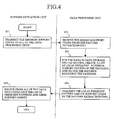
- Figs. 4 illustrates the relationship between the pattern extraction unit and the data processing unit during the process of local frequent pattern extraction in step S12 of Fig. 3.
- the pattern extraction unit 201 transmits the minimum support count to each of the data processing units 202a, 202b, ..., and 202m (S31). After receiving the minimum support count from the pattern extraction unit 201 (S32), the data processing units 202a, 202b, ..., and 202m store the minimum support count in the memory units 225a, 225b, ..., and 225m, respectively.
- the individual data processing units then extract, using their own frequent pattern extraction units 221a, 221b, ..., and 221m, the local frequent patterns only from the data stored in the respectively connected storage units 203a, 203b, ..., and 203m, the local frequent patterns being item patterns satisfying the minimum support count.
- Each data processing unit then creates a list of identifiers (ID list) of records containing the support count and item pattern of each local frequent pattern, and stores the list in the memory unit (S33).
- ID list list of identifiers
- the individual data processing units 202a, 202b, ..., and 202m transmit the entire local frequent patterns and their support counts to the pattern extraction unit 201 (S34). After receiving the local frequent patterns and their support counts from the entire data processing units (S35), the pattern extraction unit stores them in the memory unit 215 as local frequent pattern information. By this procedure, the pattern extraction unit 201 acquires the local frequent patterns in the entire data storage units 203a, 203b, ..., and 203m (S35).
- the pattern extraction unit 201 provides regions in the memory unit 215 for retaining a frequent pattern list of frequent patterns and for retaining a rare pattern list of rare patterns that are item patterns known to not satisfy the minimum support count, and empties those regions.
- the pattern extraction unit 201 joins, in the candidate pattern creating unit 211, any two or more local frequent patterns extracted in the different data processing units, and thereby creates a candidate pattern which is an item pattern with an unknown support count (S13).
- the support count is then counted up in the support count counter unit (S14).
- the candidate pattern creating unit joins those local candidate patterns in all possible combinations to create candidate patterns such as ⁇ PA1, PB1 ⁇ , ⁇ PA1, PB2 ⁇ , ..., ⁇ PA1, PB1, PM1 ⁇ , ..., ⁇ PAm, PBn, ..., PMs ⁇ , for example.
- Fig. 5 shows the procedure for counting up the support count for a candidate pattern.
- the pattern extraction unit 201 designates any one data processing unit (data processing unit 202b in the present example) as a tally data processing unit for comparing the entire ID lists, by referring to the processing unit position information (S41).
- the pattern extraction unit 201 then transmits the local frequent pattern constituting the candidate pattern created in step 13 of Fig. 3 and the position of the tally data processing unit to the data processing unit where the local frequent pattern was extracted (S42).
- the local pattern PAm and the address of the data processing unit 202b are transmitted to the data processing unit 202a.
- the local pattern PMs and the address of the data processing unit 202b are transmitted to the data processing unit 202m.
- the local frequent pattern PBn and the address of the data processing unit 202b are transmitted to the data processing unit 202b as the address of the tally data processing unit.
- the data processing unit 202b Upon receiving its own address as the address of the tally data processing unit, the data processing unit 202b knows that it has been designated as the tally data processing unit.
- the data processing units 202a and 202m that are not designated as the tally data processing unit store the position of the tally data processing unit in the memory unit, and pick out ID lists corresponding to the local frequent pattern that has been received (S44). Proceeding from step S45 to S46, the data processing units 202a and 202m transmit the picked out ID lists to the tally data processing unit (S46). In this example, the data processing unit 202a transmits the ID list of the item pattern PAm to the tally data processing unit 202b, while the data processing unit 202m transmits the ID list of the item pattern PMs to the tally data processing unit 202b.
- the data processing unit 202b which has been designated as the tally data processing unit, proceeds from step S45 to S47 and receives the ID lists transmitted from the other data processing units.
- the tally data processing unit further counts up, in the common ID counter unit 222, the number of IDs common to the ID list of the self-designated item pattern PBn and the entire ID lists transmitted from the other data processing units (S48), and transmits the number of the common IDs to the pattern extraction unit 201 (S49).
- the pattern extraction unit 201 after receiving the number of IDs from the data processing unit 202b designated as the tally data processing unit (S50), thus obtains the support count for the candidate pattern (S51).
- the support count for the selected candidate pattern ⁇ PAm, PBn, PMs ⁇ is counted up.
- the pattern extraction unit 201 determines whether the counted-up support count is equal to or more than the minimum support count (S15). If so, the candidate pattern is considered as a frequent pattern and that item pattern and the support count are added to the frequent pattern list (S16). Thereafter, the procedure goes to step S20 to prepare another candidate pattern. If the support count is less than the minimum support count in the determination of S15, the candidate pattern is added to the rare pattern list (S17), and an upper-bound value of the support count is calculated according to formula (1) in the support-count upper-bound value calculation unit 213 for partial patterns that can be prepared from the candidate pattern (S18).
- step S19 If the calculated value is less than the minimum support count, this shows that these partial patterns do not satisfy the minimum support count, and therefore these partial patterns are added to the rare pattern list (S19). If the upper-bound value of the support count of the partial patterns is not less than the minimum support count, no process is performed in step S19.
- the candidate pattern is created (S20), and, returning from step S21 to S14, a count-up process is performed. If a new candidate pattern cannot be created, the procedure comes to an end.
- the overall analysis result is obtained.
- the manner in which an association rule is created based on the frequent pattern and its support count may be as known from Reference 1, for example.
- the process for creating the association rule is shown in Fig. 6.
- the support count of the frequent pattern is the support count of the association rule.
- the support can be calculated by dividing the support count by the number of the entire records in the database.
- the confidence of the association rule can be calculated by dividing the support count of the frequent pattern by the support count of the item pattern in the assumption.
- the local frequent patterns, ID lists, and the number of common IDs are exchanged between the pattern extraction unit 201 and the individual data processing units 202a, 202b, ..., and 202m such that a frequent pattern straddling across different databases can be extracted.
- an upper-bound value of the support count is calculated which helps to avoid the generation of candidate patterns which cannot be frequent patterns, thereby reducing the number of item patterns to be processed during data analysis.
- the pattern extraction unit 201 acquires the information about the frequent pattern and its support count, it does not obtain the identifier of the records that contains the individual frequent patterns either during or at the end of the analysis process.
- the ID lists i.e., the lists of identifiers of the records
- they do not know for which frequent pattern a particular ID list is.
- the tally data processing unit processes the ID lists transmitted from the other data processing units, it does not know the item patterns corresponding to these ID lists, and while it acquires the support count for the frequent pattern, it does not know the frequent pattern itself.
- the frequent pattern straddling over different databases and the support count for the frequent pattern can be obtained without simultaneously obtaining frequent pattern and the identifier of the record containing the frequent pattern.
- an upper-bound value for the support count is calculated so that candidate patterns that cannot be frequent patterns can be detected prior to the count-up of the support count. This makes it possible to avoid counting up the support counts for these candidate patterns, thereby limiting the candidate patterns and reducing the load during analysis.
- the support which is the quotient of the support count divided by the number of the entire records, can also be used for analysis in a similar fashion.
- the number of the records included in the individual databases are different, the number of records common to all of the databases is obtained, so that the support can be calculated by using that number as the modulus. If the association rule is unnecessary, the step of creating the association rule may be omitted.
- the databases to be analyzed are sets of records with a plurality of attributes, each database containing records of a different attribute.
- case data and gene data in medicine are taken for examples, one record corresponds to a patient.
- the attributes in the case data are information relating to the disease of the patients, such as sex, age, diagnosed disease name, prescribed drug or the like.
- the attributes are information relating to the gene of the patient, such as the genetic sequence.
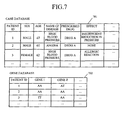
- Fig. 7 shows an example of the case data and gene data.
- the example consists of a case database (701) and a gene database (702), both having patient ID as the identifier.
- the total number of records is 10. It is assumed in the following that in a preliminary processing in the pattern extraction unit 201, the user inputs 4 as a minimum value of support count, case data is stored in the data storage unit 203a connected to the data processing unit 202a, gene data is stored in the data storage unit 203b connected to the data processing unit 202b, and local frequent patterns shown in Fig. 8 have been extracted in the individual data processing units.
- the data processing unit 202a local frequent patterns consisting of items included in the case database, their support counts, and a list of identifiers 80.1 are extracted.
- the data processing unit 202b local frequent patterns consisting of items included in the gene database, their support counts, and a list of identifiers 802 are extracted.
- the pattern extraction unit 201 retains information 803 about the local frequent patterns and their support count transmitted from the data processing unit 202a, and information 804 about the local frequent patterns and their support count transmitted from the data processing unit 202b.
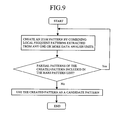
- Fig. 9 shows a flowchart of the procedure of candidate pattern extraction in the pattern extraction unit 201.
- the support count for the candidate pattern is counted up.
- the local frequent patterns are joined to create an item pattern. If the item pattern is not an upper-level pattern of an item pattern included in the list of rare patterns and the support count is unknown, a count-up process is performed again on the support count by using the created item pattern as a candidate pattern.
- Fig. 10 shows an example of the system structure according to a second embodiment of the present invention.
- a pattern extraction unit 201, a tally data processing unit 1001, and two or more data processing units 202a, 202b, ..., and 202m are connected via a communication path 204.
- Each data processing unit is connected to a data storage unit 203a, 203b, ..., or 203m.
- each data processing unit has an equivalent function to that of the data processing unit 202a shown in Fig. 2.
- a tally data processing unit 1001 has an equivalent function to the common ID counter unit 222 of the data processing unit 202b shown in Fig. 2.
- the pattern extraction unit 201 acquires a minimum support count based on user input, and transmits it to the individual data processing units 202a, 202b, ..., and 202m. Upon receiving the minimum support count, the individual data processing units 202a, 202b, ..., and 202m extract from the respectively connected data storage units 203a, 203b, ..., and 203m local frequent patterns of the minimum support count or more, and transmit the thus extracted local frequent patterns and their support counts to the pattern extraction unit 201. The pattern extraction unit 201 receives the local frequent patterns and their support counts from the entire data processing units.
- the pattern extraction unit 201 provides regions in a memory unit 215 for retaining frequent patterns and rare patterns, and empties those regions. After receiving the local frequent patterns and support counts from the entire data processing units, the pattern extraction unit 201 creates candidate patterns and transmits local frequent patterns constituting the candidate patterns to the data processing units where the local frequent patterns were extracted.
- the data processing units receive the local frequent patterns from the pattern extraction unit, pick out ID lists corresponding to the local frequent patterns, and transmit them to the tally data processing unit 1001.
- the tally data processing unit 1001 counts the number of IDs common to the entire ID lists, and transmits the number to the pattern extraction unit 201.
- the pattern extraction unit 201 acquires the support counts for the candidate patterns. If the support count is not less than the minimum support count, the particular candidate pattern is added to the list of rare patterns. If the support count is less than the minimum support count, the candidate pattern is added to the rare pattern list, partial patterns of the candidate pattern are created, an upper-bound value of the support count is calculated, and item patterns that cannot be the minimum support count or more are detected, the item patterns being added to the list of rare patterns. Then, a new candidate pattern is created and the support count is counted up in the pattern extraction unit, this being repeated so that frequent patterns and their support counts are extracted.
- data analysis can be performed by independently arranging the tally data processing unit, which in the first embodiment is performed by one of the data processing units redundantly.
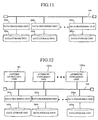
- Fig. 11 shows an example of the system structure according to a third embodiment of the present invention, in which two or more data processing units 202a, 202b, ..., and 202m are connected by a communication path 204, with each data processing unit being connected to a data processing unit 203a, 203b, ..., or 203m.
- the sole pattern extraction unit and two or more data processing units were connected by communication path, with each data processing unit being connected to a data storage unit.
- the pattern extraction unit is not independently provided, and instead the individual data processing units 202a, 202b, ..., and 202m perform the process of the pattern extraction unit redundantly.
- any one of the data processing units acquires a minimum support count and transmits it to the other data processing units.
- Each of the data processing units 202a, 202b, ...,and 202m receives the minimum support count from the data processing unit that acquired the minimum support count, extracts local frequent patterns, and transmits them and their support counts to the other data processing units.
- each of the data processing units receives the local frequent patterns and their support counts from the other data processing units, provides regions in the memory unit for retaining frequent and rare patterns, empties them, and creates candidate patterns, so that a tally data processing unit can be determined.
- the tally data processing unit is determined such that it is not the data processing unit where the candidate patterns were created.
- the individual data processing units transmit the corresponding local frequent patterns and the position of the tally data processing unit.
- the individual data processing units receive the local frequent patterns and the position of the tally data processing unit from the data processing unit that created the candidate patterns, picked out ID lists corresponding to the received local frequent patterns and transmit them to the tally data processing unit.
- the tally data processing unit Upon receiving the ID lists from the individual data processing units, the tally data processing unit counts the number of IDs common to the entire ID lists, and transmits that number to the data processing unit that created the candidate pattern.
- the data processing unit that created the candidate patterns receives the number of IDs from the tally data processing unit and obtains the candidate patterns and their support counts. If the support count is not less than the minimum support count, the particular pattern is added to the list of frequent patterns. If the support count is less than the minimum support count, the candidate pattern is added to the rare pattern list, partial patterns of that candidate pattern are created, an upper-bound value of the support count is calculated so that item patterns that cannot be the minimum support count or more can be detected and added to the rare pattern list. Next, any one of the data processing units creates a new candidate pattern and the support count is counted up, and this is repeated to extract frequent patterns and their support counts. Thus, each data processing unit performs the process of the pattern extraction unit redundantly for data analysis without there being independently provided the pattern extraction unit.
- Fig. 12 shows an example of the system according to a fourth embodiment of the present invention.
- a pattern extraction unit 201, at least one identifier conversion unit 1201a, ..., and 1201n, and at least two data processing units 202a, 202b, ..., and 202m are connected by a communication path 204, each data processing unit being connected to a data storage unit 203a, 203b, ..., or 203m.
- the data processing units transmit the list of identifiers to the tally data processing unit via an identifier conversion unit.
- This embodiment differs from the first embodiment in that in the process of counting up the support count of the item pattern, a list of identifiers corresponding to the item pattern transmitted by the pattern extraction unit is transmitted to the identifier conversion unit, where specific identifiers are converted and a list of converted identifiers is transmitted to the tally data processing unit.
- data analysis can be performed in an arrangement where the identifiers of the records contained in the databases are different.
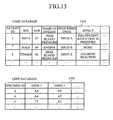
- Fig. 13 shows an example of a case database and a gene database.
- the illustrated example consists of a case database 1301 including records with patient IDs as an identifier and a gene database 1302 including records with specimen IDs as an identifier.
- the number of the entire records is 10.
- the records in the case database are managed by the patient IDs, while the records in the gene database are managed by the specimen IDs, the individual records having different identifiers.
- the patient IDs and specimen IDs are associated with each other by an identifier conversion table.
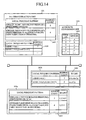
- the user inputs an input value of 4 as the minimum value of the support count, that case data is stored in the data storage unit 203a connected to the data processing unit 202a, that gene data is stored in the data storage unit 203b connected to the data processing unit 202b, that the individual data processing units extract the local frequent patterns shown in Fig. 14, and that an identifier conversion table 1405 is stored in the identifier conversion unit 1201.
- the data processing unit 202a extracts local frequent patterns formed by items included in the case database, their support counts and a list 1401 of identifiers.
- the data processing unit 202b extracts local frequent patterns formed by items included in the gene database, their support counts and a list 1402 of identifiers.
- the pattern extraction unit 201 retains information 1403 about the local frequent patterns and their support count transmitted from the data processing unit 202a, and information 1404 about the local frequent patterns and their support counts transmitted from the data processing unit 202b.
- the identifier conversion unit 1201 transmits the ID lists a, b, c and e that correspond to the received ID lists 1, 2, 3 and 5 to the data processing unit 202b which is the tally data processing unit as indicated by the received position.
- IDs a and c are common, so the number of common IDs is 2.
- the data processing unit 202b transmits this number of common IDs, 2, to the pattern extraction unit 201.
- the determination as to whether it is a frequent pattern, addition to the frequent pattern list or rare pattern list, calculation of the upper-bound value of the support count for partial patterns, and creation of a candidate pattern are performed in the same manner as in the first embodiment.
- the identifier conversion unit 1201 was independently provided, the process performed by it may be undertaken by a data processing unit.
- the data processing unit retained the ID list, which is the list of identifiers for records including the individual local frequent patterns
- the system may be arranged such that the data processing unit does not retain the ID list but instead during the support count counting-up process, each data processing unit searches its own data storage unit for records including the item patterns transmitted from the pattern extraction unit, creates an ID list and extracts the frequent patterns and their support counts.
- item patterns straddling over different databases and the number of records containing the item patterns can be extracted from the databases by a distributed processing. Further, in the case where integration of the databases should be avoided and, even during the analysis process, integration of the databases cannot be permitted in order to prevent the leaking of database-integrating information, item patterns straddling across databases can be extracted. Furthermore, by estimating the upper-bound value of the number of records containing item patterns that are subsets of item patterns for which the number of records containing them is known, and by thus limiting the number of candidates to be searched, the amount of data to be processed during analysis can be reduced.
Landscapes
- Engineering & Computer Science (AREA)
- Theoretical Computer Science (AREA)
- Databases & Information Systems (AREA)
- Physics & Mathematics (AREA)
- Data Mining & Analysis (AREA)
- General Physics & Mathematics (AREA)
- General Engineering & Computer Science (AREA)
- Mathematical Physics (AREA)
- Computational Linguistics (AREA)
- Software Systems (AREA)
- Probability & Statistics with Applications (AREA)
- Fuzzy Systems (AREA)
- Information Retrieval, Db Structures And Fs Structures Therefor (AREA)
- Management, Administration, Business Operations System, And Electronic Commerce (AREA)
- Medical Treatment And Welfare Office Work (AREA)
- Debugging And Monitoring (AREA)
Applications Claiming Priority (2)
| Application Number | Priority Date | Filing Date | Title |
|---|---|---|---|
| JP2002181135A JP3701633B2 (ja) | 2002-06-21 | 2002-06-21 | 複数データベースにまたがる項目パターン抽出方法、ネットワークシステム及び処理装置 |
| JP2002181135 | 2002-06-21 |
Publications (2)
| Publication Number | Publication Date |
|---|---|
| EP1376397A2 true EP1376397A2 (fr) | 2004-01-02 |
| EP1376397A3 EP1376397A3 (fr) | 2005-01-05 |
Family
ID=29717532
Family Applications (1)
| Application Number | Title | Priority Date | Filing Date |
|---|---|---|---|
| EP02019152A Withdrawn EP1376397A3 (fr) | 2002-06-21 | 2002-08-30 | Procédé d'extraction de motifs d'objets d'une pluralité de bases de données, un système réseau et un dispositf de traitement |
Country Status (3)
| Country | Link |
|---|---|
| US (1) | US20030236785A1 (fr) |
| EP (1) | EP1376397A3 (fr) |
| JP (1) | JP3701633B2 (fr) |
Cited By (5)
| Publication number | Priority date | Publication date | Assignee | Title |
|---|---|---|---|---|
| WO2011078698A1 (fr) * | 2009-12-14 | 2011-06-30 | Business Intelligence Solutions Safe B.V. | Procédé et système pour optimiser l'agencement d'éléments spatiaux |
| EP2011035A4 (fr) * | 2006-04-27 | 2011-08-24 | Intel Corp | Procédé basé sur un système pour l'extraction et la partition basée sur des contenus |
| CN103597485A (zh) * | 2011-06-08 | 2014-02-19 | 株式会社东芝 | 模式提取装置及其方法 |
| CN104699755A (zh) * | 2015-01-07 | 2015-06-10 | 中国电子科技集团公司第三十研究所 | 一种基于数据挖掘的智能化多目标综合识别方法 |
| CN103914528B (zh) * | 2014-03-28 | 2017-02-15 | 南京邮电大学 | 一种关联分析算法的并行化方法 |
Families Citing this family (25)
| Publication number | Priority date | Publication date | Assignee | Title |
|---|---|---|---|---|
| KR100500329B1 (ko) * | 2001-10-18 | 2005-07-11 | 주식회사 핸디소프트 | 워크플로우 마이닝 시스템 및 방법 |
| US7756853B2 (en) * | 2003-08-18 | 2010-07-13 | Oracle International Corporation | Frequent itemset counting using subsets of bitmaps |
| US7433879B1 (en) * | 2004-06-17 | 2008-10-07 | Versata Development Group, Inc. | Attribute based association rule mining |
| US7698170B1 (en) | 2004-08-05 | 2010-04-13 | Versata Development Group, Inc. | Retail recommendation domain model |
| US7720720B1 (en) | 2004-08-05 | 2010-05-18 | Versata Development Group, Inc. | System and method for generating effective recommendations |
| US7966219B1 (en) | 2004-09-24 | 2011-06-21 | Versata Development Group, Inc. | System and method for integrated recommendations |
| JP2006227896A (ja) * | 2005-02-17 | 2006-08-31 | Fuji Xerox Co Ltd | 情報分析装置、情報分析方法およびプログラム |
| US8700607B2 (en) * | 2005-08-02 | 2014-04-15 | Versata Development Group, Inc. | Applying data regression and pattern mining to predict future demand |
| WO2007043199A1 (fr) * | 2005-10-07 | 2007-04-19 | Hitachi, Ltd. | Procédé et système d’extraction de règle d’association |
| JP4916713B2 (ja) * | 2005-12-21 | 2012-04-18 | 株式会社エヌ・ティ・ティ・データ | 遺伝子情報管理システム |
| US20080075057A1 (en) * | 2006-09-25 | 2008-03-27 | Mediatek Inc. | Frequency correction burst detection |
| WO2008111424A1 (fr) * | 2007-03-09 | 2008-09-18 | Nec Corporation | Procédé et système de corrélation de champ, et programme pour ce faire |
| JP4829317B2 (ja) * | 2009-02-06 | 2011-12-07 | 株式会社東芝 | 構造化文書間整合管理装置及びプログラム |
| JP5528292B2 (ja) * | 2010-10-14 | 2014-06-25 | インターナショナル・ビジネス・マシーンズ・コーポレーション | 意味のある頻出アイテムセットを抽出するシステム、方法及びプログラム |
| US9213698B1 (en) * | 2011-02-02 | 2015-12-15 | Comindware Ltd. | Unified data architecture for business process management and data modeling |
| JP5835993B2 (ja) * | 2011-08-05 | 2015-12-24 | Juki株式会社 | 生産管理装置および部品実装システム |
| JP6245571B2 (ja) * | 2013-11-08 | 2017-12-13 | 国立大学法人佐賀大学 | データ構造、データ生成装置、その方法及びプログラム |
| JP6223889B2 (ja) * | 2014-03-31 | 2017-11-01 | 株式会社東芝 | パターン発見装置、およびプログラム |
| US11568177B2 (en) * | 2015-01-19 | 2023-01-31 | Kabushiki Kaisha Toshiba | Sequential data analysis apparatus and program |
| CN105574350B (zh) * | 2015-12-30 | 2018-02-06 | 北京锐安科技有限公司 | 事件预测方法 |
| CN106682136B (zh) * | 2016-12-19 | 2018-03-16 | 刘凯 | 一种基于数据挖掘的中医医学文献分类及存储方法 |
| CN106777137B (zh) * | 2016-12-19 | 2018-03-16 | 谭红春 | 一种中医学文献分析方法 |
| CN109376181A (zh) * | 2018-09-25 | 2019-02-22 | 深圳市元征科技股份有限公司 | 一种数据挖掘方法及相关设备 |
| EP3758279A1 (fr) * | 2019-06-27 | 2020-12-30 | Koninklijke Philips N.V. | Divulgation sélective d'attributs et d'entrées de données d'un enregistrement |
| US20250328689A1 (en) * | 2022-05-23 | 2025-10-23 | Ntt Docomo, Inc. | Data aggregation device |
Family Cites Families (4)
| Publication number | Priority date | Publication date | Assignee | Title |
|---|---|---|---|---|
| US5794209A (en) * | 1995-03-31 | 1998-08-11 | International Business Machines Corporation | System and method for quickly mining association rules in databases |
| US5758147A (en) * | 1995-06-28 | 1998-05-26 | International Business Machines Corporation | Efficient information collection method for parallel data mining |
| US5742811A (en) * | 1995-10-10 | 1998-04-21 | International Business Machines Corporation | Method and system for mining generalized sequential patterns in a large database |
| US6952693B2 (en) * | 2001-02-23 | 2005-10-04 | Ran Wolff | Distributed mining of association rules |
-
2002
- 2002-06-21 JP JP2002181135A patent/JP3701633B2/ja not_active Expired - Fee Related
- 2002-08-30 US US10/231,259 patent/US20030236785A1/en not_active Abandoned
- 2002-08-30 EP EP02019152A patent/EP1376397A3/fr not_active Withdrawn
Cited By (10)
| Publication number | Priority date | Publication date | Assignee | Title |
|---|---|---|---|---|
| EP2011035A4 (fr) * | 2006-04-27 | 2011-08-24 | Intel Corp | Procédé basé sur un système pour l'extraction et la partition basée sur des contenus |
| WO2011078698A1 (fr) * | 2009-12-14 | 2011-06-30 | Business Intelligence Solutions Safe B.V. | Procédé et système pour optimiser l'agencement d'éléments spatiaux |
| US9418120B2 (en) | 2009-12-14 | 2016-08-16 | New Bis Safe Luxco S.À R.L | Method and system for optimizing the arrangement of spatial elements |
| US9779152B2 (en) | 2009-12-14 | 2017-10-03 | New Bis Safe Luxco S.À R.L | Method and system for optimizing the arrangement of spatial elements |
| CN103597485A (zh) * | 2011-06-08 | 2014-02-19 | 株式会社东芝 | 模式提取装置及其方法 |
| EP2720154A4 (fr) * | 2011-06-08 | 2015-04-08 | Toshiba Kk | Dispositif et procédé d'extraction de motif |
| US9569835B2 (en) | 2011-06-08 | 2017-02-14 | Kabushiki Kaisha Toshiba | Pattern extracting apparatus and method |
| CN103914528B (zh) * | 2014-03-28 | 2017-02-15 | 南京邮电大学 | 一种关联分析算法的并行化方法 |
| CN104699755A (zh) * | 2015-01-07 | 2015-06-10 | 中国电子科技集团公司第三十研究所 | 一种基于数据挖掘的智能化多目标综合识别方法 |
| CN104699755B (zh) * | 2015-01-07 | 2017-12-29 | 中国电子科技集团公司第三十研究所 | 一种基于数据挖掘的智能化多目标综合识别方法 |
Also Published As
| Publication number | Publication date |
|---|---|
| EP1376397A3 (fr) | 2005-01-05 |
| JP2004029902A (ja) | 2004-01-29 |
| US20030236785A1 (en) | 2003-12-25 |
| JP3701633B2 (ja) | 2005-10-05 |
Similar Documents
| Publication | Publication Date | Title |
|---|---|---|
| EP1376397A2 (fr) | Procédé d'extraction de motifs d'objets d'une pluralité de bases de données, un système réseau et un dispositf de traitement | |
| US6832216B2 (en) | Method and system for mining association rules with negative items | |
| Thurachon et al. | Incremental association rule mining with a fast incremental updating frequent pattern growth algorithm | |
| Huang et al. | Integrating data mining with case-based reasoning for chronic diseases prognosis and diagnosis | |
| Jafarkarimi et al. | A naive recommendation model for large databases | |
| US20190005114A1 (en) | Consensus sequence identification | |
| Enriko | Comparative study of heart disease diagnosis using top ten data mining classification algorithms | |
| Hsu et al. | Exploration mining in diabetic patients databases: findings and conclusions | |
| CN117370565A (zh) | 一种信息检索方法及系统 | |
| US20220004565A1 (en) | Review and curation of record clustering changes at large scale | |
| US7979473B2 (en) | Association rule extraction method and system | |
| CN109147879B (zh) | 基于医疗单据的可视化报表的方法和系统 | |
| Lichtenstein et al. | Attribute-driven case notion discovery for unlabeled event logs | |
| Egho et al. | A contribution to the discovery of multidimensional patterns in healthcare trajectories | |
| Le et al. | A Clustering-based Sequence Variants Analysis Method for Electronic Medical Records of Multimedical Institutions | |
| Cafaro et al. | Data mining: mining frequent patterns, associations rules, and correlations | |
| Tabatabaei et al. | Identifying patient groups based on frequent patterns of patient samples | |
| AlZoubi | Mining medical databases using graph based association rules | |
| Shyu et al. | Mining association rules with uncertain item relationships | |
| Tomović | Patient length of stay analysis with machine learning algorithms | |
| Agapito et al. | A pipeline for mining association rules from large datasets of retailers invoices | |
| JP6797963B2 (ja) | 匿名加工対象特定方法、匿名加工対象特定システム及びプログラム | |
| Velmurugan et al. | Implementing association rules in medical diagnosis test data | |
| Suzuki | Evaluation scheme for exception rule/group discovery | |
| WO2007149675A2 (fr) | Diagnostic médical dérivé de données d'antécédents médicamenteux du patient |
Legal Events
| Date | Code | Title | Description |
|---|---|---|---|
| PUAI | Public reference made under article 153(3) epc to a published international application that has entered the european phase |
Free format text: ORIGINAL CODE: 0009012 |
|
| 17P | Request for examination filed |
Effective date: 20020920 |
|
| AK | Designated contracting states |
Kind code of ref document: A2 Designated state(s): AT BE BG CH CY CZ DE DK EE ES FI FR GB GR IE IT LI LU MC NL PT SE SK TR |
|
| AX | Request for extension of the european patent |
Extension state: AL LT LV MK RO SI |
|
| PUAL | Search report despatched |
Free format text: ORIGINAL CODE: 0009013 |
|
| AK | Designated contracting states |
Kind code of ref document: A3 Designated state(s): AT BE BG CH CY CZ DE DK EE ES FI FR GB GR IE IT LI LU MC NL PT SE SK TR |
|
| AX | Request for extension of the european patent |
Extension state: AL LT LV MK RO SI |
|
| AKX | Designation fees paid |
Designated state(s): DE FR GB |
|
| STAA | Information on the status of an ep patent application or granted ep patent |
Free format text: STATUS: THE APPLICATION IS DEEMED TO BE WITHDRAWN |
|
| 18D | Application deemed to be withdrawn |
Effective date: 20080301 |