EP1379001A2 - Verfahren und System für die Decodierung von Low Density Parity Check (LDPC) Codes - Google Patents
Verfahren und System für die Decodierung von Low Density Parity Check (LDPC) Codes Download PDFInfo
- Publication number
- EP1379001A2 EP1379001A2 EP03254214A EP03254214A EP1379001A2 EP 1379001 A2 EP1379001 A2 EP 1379001A2 EP 03254214 A EP03254214 A EP 03254214A EP 03254214 A EP03254214 A EP 03254214A EP 1379001 A2 EP1379001 A2 EP 1379001A2
- Authority
- EP
- European Patent Office
- Prior art keywords
- parity check
- ldpc
- codes
- signal constellation
- ldpc codes
- Prior art date
- Legal status (The legal status is an assumption and is not a legal conclusion. Google has not performed a legal analysis and makes no representation as to the accuracy of the status listed.)
- Ceased
Links
- 238000000034 method Methods 0.000 title claims description 44
- 239000011159 matrix material Substances 0.000 claims abstract description 57
- 238000004891 communication Methods 0.000 claims abstract description 40
- 230000001172 regenerating effect Effects 0.000 claims abstract description 9
- 230000010363 phase shift Effects 0.000 claims description 10
- 239000013598 vector Substances 0.000 claims description 10
- 230000005540 biological transmission Effects 0.000 claims description 5
- 238000013459 approach Methods 0.000 abstract description 24
- 238000002372 labelling Methods 0.000 description 20
- 238000010586 diagram Methods 0.000 description 19
- 230000008569 process Effects 0.000 description 13
- 238000012545 processing Methods 0.000 description 11
- 230000006870 function Effects 0.000 description 8
- 238000013507 mapping Methods 0.000 description 7
- 230000003287 optical effect Effects 0.000 description 7
- 238000013461 design Methods 0.000 description 5
- 230000008901 benefit Effects 0.000 description 3
- 230000006872 improvement Effects 0.000 description 3
- 238000004088 simulation Methods 0.000 description 3
- 230000003068 static effect Effects 0.000 description 2
- RYGMFSIKBFXOCR-UHFFFAOYSA-N Copper Chemical compound [Cu] RYGMFSIKBFXOCR-UHFFFAOYSA-N 0.000 description 1
- 230000002238 attenuated effect Effects 0.000 description 1
- 238000004422 calculation algorithm Methods 0.000 description 1
- 238000004364 calculation method Methods 0.000 description 1
- 230000015556 catabolic process Effects 0.000 description 1
- 238000010276 construction Methods 0.000 description 1
- 238000012937 correction Methods 0.000 description 1
- 230000008878 coupling Effects 0.000 description 1
- 238000010168 coupling process Methods 0.000 description 1
- 238000005859 coupling reaction Methods 0.000 description 1
- 238000006731 degradation reaction Methods 0.000 description 1
- 230000008030 elimination Effects 0.000 description 1
- 238000003379 elimination reaction Methods 0.000 description 1
- 239000000835 fiber Substances 0.000 description 1
- 230000003993 interaction Effects 0.000 description 1
- 239000004973 liquid crystal related substance Substances 0.000 description 1
- 230000007246 mechanism Effects 0.000 description 1
- 238000012986 modification Methods 0.000 description 1
- 230000004048 modification Effects 0.000 description 1
- 230000008520 organization Effects 0.000 description 1
- 230000002093 peripheral effect Effects 0.000 description 1
- 238000013139 quantization Methods 0.000 description 1
- 230000009467 reduction Effects 0.000 description 1
- 230000008929 regeneration Effects 0.000 description 1
- 238000011069 regeneration method Methods 0.000 description 1
- 230000004044 response Effects 0.000 description 1
- 238000012546 transfer Methods 0.000 description 1
Images


Classifications
-
- H—ELECTRICITY
- H04—ELECTRIC COMMUNICATION TECHNIQUE
- H04L—TRANSMISSION OF DIGITAL INFORMATION, e.g. TELEGRAPHIC COMMUNICATION
- H04L1/00—Arrangements for detecting or preventing errors in the information received
-
- H—ELECTRICITY
- H04—ELECTRIC COMMUNICATION TECHNIQUE
- H04L—TRANSMISSION OF DIGITAL INFORMATION, e.g. TELEGRAPHIC COMMUNICATION
- H04L1/00—Arrangements for detecting or preventing errors in the information received
- H04L1/004—Arrangements for detecting or preventing errors in the information received by using forward error control
- H04L1/0045—Arrangements at the receiver end
- H04L1/0047—Decoding adapted to other signal detection operation
- H04L1/005—Iterative decoding, including iteration between signal detection and decoding operation
-
- H—ELECTRICITY
- H03—ELECTRONIC CIRCUITRY
- H03M—CODING; DECODING; CODE CONVERSION IN GENERAL
- H03M13/00—Coding, decoding or code conversion, for error detection or error correction; Coding theory basic assumptions; Coding bounds; Error probability evaluation methods; Channel models; Simulation or testing of codes
- H03M13/03—Error detection or forward error correction by redundancy in data representation, i.e. code words containing more digits than the source words
- H03M13/05—Error detection or forward error correction by redundancy in data representation, i.e. code words containing more digits than the source words using block codes, i.e. a predetermined number of check bits joined to a predetermined number of information bits
- H03M13/11—Error detection or forward error correction by redundancy in data representation, i.e. code words containing more digits than the source words using block codes, i.e. a predetermined number of check bits joined to a predetermined number of information bits using multiple parity bits
- H03M13/1102—Codes on graphs and decoding on graphs, e.g. low-density parity check [LDPC] codes
-
- H—ELECTRICITY
- H03—ELECTRONIC CIRCUITRY
- H03M—CODING; DECODING; CODE CONVERSION IN GENERAL
- H03M13/00—Coding, decoding or code conversion, for error detection or error correction; Coding theory basic assumptions; Coding bounds; Error probability evaluation methods; Channel models; Simulation or testing of codes
- H03M13/03—Error detection or forward error correction by redundancy in data representation, i.e. code words containing more digits than the source words
- H03M13/05—Error detection or forward error correction by redundancy in data representation, i.e. code words containing more digits than the source words using block codes, i.e. a predetermined number of check bits joined to a predetermined number of information bits
- H03M13/11—Error detection or forward error correction by redundancy in data representation, i.e. code words containing more digits than the source words using block codes, i.e. a predetermined number of check bits joined to a predetermined number of information bits using multiple parity bits
- H03M13/1102—Codes on graphs and decoding on graphs, e.g. low-density parity check [LDPC] codes
- H03M13/1105—Decoding
- H03M13/1111—Soft-decision decoding, e.g. by means of message passing or belief propagation algorithms
-
- H—ELECTRICITY
- H03—ELECTRONIC CIRCUITRY
- H03M—CODING; DECODING; CODE CONVERSION IN GENERAL
- H03M13/00—Coding, decoding or code conversion, for error detection or error correction; Coding theory basic assumptions; Coding bounds; Error probability evaluation methods; Channel models; Simulation or testing of codes
- H03M13/03—Error detection or forward error correction by redundancy in data representation, i.e. code words containing more digits than the source words
- H03M13/05—Error detection or forward error correction by redundancy in data representation, i.e. code words containing more digits than the source words using block codes, i.e. a predetermined number of check bits joined to a predetermined number of information bits
- H03M13/11—Error detection or forward error correction by redundancy in data representation, i.e. code words containing more digits than the source words using block codes, i.e. a predetermined number of check bits joined to a predetermined number of information bits using multiple parity bits
- H03M13/1102—Codes on graphs and decoding on graphs, e.g. low-density parity check [LDPC] codes
- H03M13/1105—Decoding
- H03M13/1111—Soft-decision decoding, e.g. by means of message passing or belief propagation algorithms
- H03M13/1117—Soft-decision decoding, e.g. by means of message passing or belief propagation algorithms using approximations for check node processing, e.g. an outgoing message is depending on the signs and the minimum over the magnitudes of all incoming messages according to the min-sum rule
- H03M13/112—Soft-decision decoding, e.g. by means of message passing or belief propagation algorithms using approximations for check node processing, e.g. an outgoing message is depending on the signs and the minimum over the magnitudes of all incoming messages according to the min-sum rule with correction functions for the min-sum rule, e.g. using an offset or a scaling factor
-
- H—ELECTRICITY
- H03—ELECTRONIC CIRCUITRY
- H03M—CODING; DECODING; CODE CONVERSION IN GENERAL
- H03M13/00—Coding, decoding or code conversion, for error detection or error correction; Coding theory basic assumptions; Coding bounds; Error probability evaluation methods; Channel models; Simulation or testing of codes
- H03M13/03—Error detection or forward error correction by redundancy in data representation, i.e. code words containing more digits than the source words
- H03M13/05—Error detection or forward error correction by redundancy in data representation, i.e. code words containing more digits than the source words using block codes, i.e. a predetermined number of check bits joined to a predetermined number of information bits
- H03M13/11—Error detection or forward error correction by redundancy in data representation, i.e. code words containing more digits than the source words using block codes, i.e. a predetermined number of check bits joined to a predetermined number of information bits using multiple parity bits
- H03M13/1102—Codes on graphs and decoding on graphs, e.g. low-density parity check [LDPC] codes
- H03M13/1148—Structural properties of the code parity-check or generator matrix
- H03M13/118—Parity check matrix structured for simplifying encoding, e.g. by having a triangular or an approximate triangular structure
-
- H—ELECTRICITY
- H03—ELECTRONIC CIRCUITRY
- H03M—CODING; DECODING; CODE CONVERSION IN GENERAL
- H03M13/00—Coding, decoding or code conversion, for error detection or error correction; Coding theory basic assumptions; Coding bounds; Error probability evaluation methods; Channel models; Simulation or testing of codes
- H03M13/03—Error detection or forward error correction by redundancy in data representation, i.e. code words containing more digits than the source words
- H03M13/05—Error detection or forward error correction by redundancy in data representation, i.e. code words containing more digits than the source words using block codes, i.e. a predetermined number of check bits joined to a predetermined number of information bits
- H03M13/13—Linear codes
- H03M13/15—Cyclic codes, i.e. cyclic shifts of codewords produce other codewords, e.g. codes defined by a generator polynomial, Bose-Chaudhuri-Hocquenghem [BCH] codes
- H03M13/151—Cyclic codes, i.e. cyclic shifts of codewords produce other codewords, e.g. codes defined by a generator polynomial, Bose-Chaudhuri-Hocquenghem [BCH] codes using error location or error correction polynomials
- H03M13/152—Bose-Chaudhuri-Hocquenghem [BCH] codes
-
- H—ELECTRICITY
- H03—ELECTRONIC CIRCUITRY
- H03M—CODING; DECODING; CODE CONVERSION IN GENERAL
- H03M13/00—Coding, decoding or code conversion, for error detection or error correction; Coding theory basic assumptions; Coding bounds; Error probability evaluation methods; Channel models; Simulation or testing of codes
- H03M13/03—Error detection or forward error correction by redundancy in data representation, i.e. code words containing more digits than the source words
- H03M13/05—Error detection or forward error correction by redundancy in data representation, i.e. code words containing more digits than the source words using block codes, i.e. a predetermined number of check bits joined to a predetermined number of information bits
- H03M13/13—Linear codes
- H03M13/19—Single error correction without using particular properties of the cyclic codes, e.g. Hamming codes, extended or generalised Hamming codes
-
- H—ELECTRICITY
- H03—ELECTRONIC CIRCUITRY
- H03M—CODING; DECODING; CODE CONVERSION IN GENERAL
- H03M13/00—Coding, decoding or code conversion, for error detection or error correction; Coding theory basic assumptions; Coding bounds; Error probability evaluation methods; Channel models; Simulation or testing of codes
- H03M13/25—Error detection or forward error correction by signal space coding, i.e. adding redundancy in the signal constellation, e.g. Trellis Coded Modulation [TCM]
-
- H—ELECTRICITY
- H03—ELECTRONIC CIRCUITRY
- H03M—CODING; DECODING; CODE CONVERSION IN GENERAL
- H03M13/00—Coding, decoding or code conversion, for error detection or error correction; Coding theory basic assumptions; Coding bounds; Error probability evaluation methods; Channel models; Simulation or testing of codes
- H03M13/25—Error detection or forward error correction by signal space coding, i.e. adding redundancy in the signal constellation, e.g. Trellis Coded Modulation [TCM]
- H03M13/255—Error detection or forward error correction by signal space coding, i.e. adding redundancy in the signal constellation, e.g. Trellis Coded Modulation [TCM] with Low Density Parity Check [LDPC] codes
-
- H—ELECTRICITY
- H03—ELECTRONIC CIRCUITRY
- H03M—CODING; DECODING; CODE CONVERSION IN GENERAL
- H03M13/00—Coding, decoding or code conversion, for error detection or error correction; Coding theory basic assumptions; Coding bounds; Error probability evaluation methods; Channel models; Simulation or testing of codes
- H03M13/29—Coding, decoding or code conversion, for error detection or error correction; Coding theory basic assumptions; Coding bounds; Error probability evaluation methods; Channel models; Simulation or testing of codes combining two or more codes or code structures, e.g. product codes, generalised product codes, concatenated codes, inner and outer codes
- H03M13/2906—Coding, decoding or code conversion, for error detection or error correction; Coding theory basic assumptions; Coding bounds; Error probability evaluation methods; Channel models; Simulation or testing of codes combining two or more codes or code structures, e.g. product codes, generalised product codes, concatenated codes, inner and outer codes using block codes
- H03M13/2927—Decoding strategies
- H03M13/293—Decoding strategies with erasure setting
-
- H—ELECTRICITY
- H03—ELECTRONIC CIRCUITRY
- H03M—CODING; DECODING; CODE CONVERSION IN GENERAL
- H03M13/00—Coding, decoding or code conversion, for error detection or error correction; Coding theory basic assumptions; Coding bounds; Error probability evaluation methods; Channel models; Simulation or testing of codes
- H03M13/31—Coding, decoding or code conversion, for error detection or error correction; Coding theory basic assumptions; Coding bounds; Error probability evaluation methods; Channel models; Simulation or testing of codes combining coding for error detection or correction and efficient use of the spectrum
-
- H—ELECTRICITY
- H03—ELECTRONIC CIRCUITRY
- H03M—CODING; DECODING; CODE CONVERSION IN GENERAL
- H03M13/00—Coding, decoding or code conversion, for error detection or error correction; Coding theory basic assumptions; Coding bounds; Error probability evaluation methods; Channel models; Simulation or testing of codes
- H03M13/35—Unequal or adaptive error protection, e.g. by providing a different level of protection according to significance of source information or by adapting the coding according to the change of transmission channel characteristics
- H03M13/356—Unequal error protection [UEP]
-
- H—ELECTRICITY
- H03—ELECTRONIC CIRCUITRY
- H03M—CODING; DECODING; CODE CONVERSION IN GENERAL
- H03M13/00—Coding, decoding or code conversion, for error detection or error correction; Coding theory basic assumptions; Coding bounds; Error probability evaluation methods; Channel models; Simulation or testing of codes
- H03M13/63—Joint error correction and other techniques
- H03M13/6325—Error control coding in combination with demodulation
-
- H—ELECTRICITY
- H03—ELECTRONIC CIRCUITRY
- H03M—CODING; DECODING; CODE CONVERSION IN GENERAL
- H03M13/00—Coding, decoding or code conversion, for error detection or error correction; Coding theory basic assumptions; Coding bounds; Error probability evaluation methods; Channel models; Simulation or testing of codes
- H03M13/65—Purpose and implementation aspects
- H03M13/6577—Representation or format of variables, register sizes or word-lengths and quantization
- H03M13/6583—Normalization other than scaling, e.g. by subtraction
-
- H—ELECTRICITY
- H04—ELECTRIC COMMUNICATION TECHNIQUE
- H04L—TRANSMISSION OF DIGITAL INFORMATION, e.g. TELEGRAPHIC COMMUNICATION
- H04L1/00—Arrangements for detecting or preventing errors in the information received
- H04L1/004—Arrangements for detecting or preventing errors in the information received by using forward error control
- H04L1/0056—Systems characterized by the type of code used
- H04L1/0057—Block codes
-
- H—ELECTRICITY
- H04—ELECTRIC COMMUNICATION TECHNIQUE
- H04L—TRANSMISSION OF DIGITAL INFORMATION, e.g. TELEGRAPHIC COMMUNICATION
- H04L1/00—Arrangements for detecting or preventing errors in the information received
- H04L1/004—Arrangements for detecting or preventing errors in the information received by using forward error control
- H04L1/0056—Systems characterized by the type of code used
- H04L1/0059—Convolutional codes
- H04L1/006—Trellis-coded modulation
-
- H—ELECTRICITY
- H04—ELECTRIC COMMUNICATION TECHNIQUE
- H04L—TRANSMISSION OF DIGITAL INFORMATION, e.g. TELEGRAPHIC COMMUNICATION
- H04L1/00—Arrangements for detecting or preventing errors in the information received
- H04L1/004—Arrangements for detecting or preventing errors in the information received by using forward error control
- H04L1/0056—Systems characterized by the type of code used
- H04L1/0061—Error detection codes
-
- H—ELECTRICITY
- H04—ELECTRIC COMMUNICATION TECHNIQUE
- H04L—TRANSMISSION OF DIGITAL INFORMATION, e.g. TELEGRAPHIC COMMUNICATION
- H04L1/00—Arrangements for detecting or preventing errors in the information received
- H04L1/004—Arrangements for detecting or preventing errors in the information received by using forward error control
- H04L1/0056—Systems characterized by the type of code used
- H04L1/0064—Concatenated codes
- H04L1/0065—Serial concatenated codes
-
- H—ELECTRICITY
- H04—ELECTRIC COMMUNICATION TECHNIQUE
- H04L—TRANSMISSION OF DIGITAL INFORMATION, e.g. TELEGRAPHIC COMMUNICATION
- H04L1/00—Arrangements for detecting or preventing errors in the information received
- H04L1/004—Arrangements for detecting or preventing errors in the information received by using forward error control
- H04L1/0056—Systems characterized by the type of code used
- H04L1/0071—Use of interleaving
-
- H—ELECTRICITY
- H04—ELECTRIC COMMUNICATION TECHNIQUE
- H04L—TRANSMISSION OF DIGITAL INFORMATION, e.g. TELEGRAPHIC COMMUNICATION
- H04L27/00—Modulated-carrier systems
- H04L27/18—Phase-modulated carrier systems, i.e. using phase-shift keying
- H04L27/20—Modulator circuits; Transmitter circuits
-
- H—ELECTRICITY
- H04—ELECTRIC COMMUNICATION TECHNIQUE
- H04L—TRANSMISSION OF DIGITAL INFORMATION, e.g. TELEGRAPHIC COMMUNICATION
- H04L27/00—Modulated-carrier systems
- H04L27/32—Carrier systems characterised by combinations of two or more of the types covered by groups H04L27/02, H04L27/10, H04L27/18 or H04L27/26
- H04L27/34—Amplitude- and phase-modulated carrier systems, e.g. quadrature-amplitude modulated carrier systems
-
- H—ELECTRICITY
- H04—ELECTRIC COMMUNICATION TECHNIQUE
- H04L—TRANSMISSION OF DIGITAL INFORMATION, e.g. TELEGRAPHIC COMMUNICATION
- H04L27/00—Modulated-carrier systems
- H04L27/32—Carrier systems characterised by combinations of two or more of the types covered by groups H04L27/02, H04L27/10, H04L27/18 or H04L27/26
- H04L27/34—Amplitude- and phase-modulated carrier systems, e.g. quadrature-amplitude modulated carrier systems
- H04L27/36—Modulator circuits; Transmitter circuits
Definitions
- the present invention relates to communication systems, and more particularly to coded systems.
- Communication systems employ coding to ensure reliable communication across noisy communication channels. These communication channels exhibit a fixed capacity that can be expressed in terms of bits per symbol at certain signal to noise ratio (SNR), defining a theoretical upper limit (known as the Shannon limit). As a result, coding design has aimed to achieve rates approaching this Shannon limit.
- SNR signal to noise ratio
- coding design has aimed to achieve rates approaching this Shannon limit.
- One such class of codes that approach the Shannon limit is Low Density Parity Check (LDPC) codes.
- LDPC codes have not been widely deployed because of a number of drawbacks.
- One drawback is that the LDPC encoding technique is highly complex. Encoding an LDPC code using its generator matrix would require storing a very large, non-sparse matrix. Additionally, LDPC codes require large blocks to be effective; consequently, even though parity check matrices of LDPC codes are sparse, storing these matrices is problematic.
- LDPC codes have not become widespread in practice.
- a key challenge in LDPC code implementation has been how to achieve the connection network between several processing engines (nodes) in the decoder.
- the computational load in the decoding process specifically the check node operations, poses a problem.
- LDPC Low Density Parity Check
- Structure of the LDPC codes is provided by restricting portion part of the parity check matrix to be lower triangular and/or satisfying other requirements such that the communication between processing nodes of the decoder becomes very simple.
- the approach can advantageously exploit the unequal error protecting capability of LDPC codes on transmitted bits to provide extra error protection to more vulnerable bits of high order modulation constellations (such as 8-PSK (Phase Shift Keying)).
- the decoding process involves iteratively regenerating signal constellation bit metrics into an LDPC decoder after each decoder iteration or several decoder iterations. The above arrangement provides a computational efficient approach to decoding LDPC codes.
- a method for decoding low density parity check (LDPC) codes includes receiving a priori probability information based on distance vector information relating to distances between received noisy symbol points and symbol points of a signal constellation associated with the LDPC codes. The method also includes transmitting a posteriori probability information based on the a priori probability information. The method includes determining whether parity check equations associated with the LDPC codes are satisfied according to the a priori probability and the a posteriori probability information. Additionally, the method includes selectively regenerating the signal constellation bit metrics based on the determining step. Further, the method includes outputting decoded messages based on the regenerated signal constellation bit metrics.
- LDPC low density parity check
- a system for decoding low density parity check (LDPC) codes includes means for receiving a priori probability information based on distance vector information relating to distances between received noisy symbol points and symbol points of a signal constellation associated with the LDPC codes.
- the system also includes means for transmitting a posteriori probability information based on the a priori probability information.
- the system includes means for determining whether parity check equations associated with the LDPC codes are satisfied according to the a priori probability and the a posteriori probability information.
- the system includes means for selectively regenerating the signal constellation bit metrics based on the determination Further, the system includes means for outputting decoded messages based on the regenerated signal constellation bit metrics.
- a receiver for decoding low density parity check (LDPC) codes includes a bit metric generator configured to generate a priori probability information based on distance vector information relating to distances between received noisy symbol points and symbol points of a signal constellation associated with the LDPC codes.
- the receiver also includes a decoder configured to output a posteriori probability information based on the a priori probability information received from the bit metric generator, wherein the decoder is further configured to determine whether parity check equations associated with the LDPC codes are satisfied according to the a priori probability and the a posteriori probability information.
- the decoder outputs decoded messages based on a regenerated signal constellation bit metrics if the parity check equations are not satisfied.
- a method for transmitting messages using low density parity check (LDPC) codes includes encoding input messages according to a structured parity check matrix that imposes restrictions on a sub-matrix of the parity check matrix to generate LDPC codes.
- the method also includes transmitting the LDPC codes over a radio communication system, wherein a receiver communicating over the radio communication system is configured to iteratively decode the received LDPC codes according to a signal constellation associated with the LDPC codes.
- the receiver is configured to iteratively regenerating signal constellation bit metrics after one or more decoding iterations.
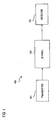
- FIG. 1 is a diagram of a communications system configured to utilize Low Density Parity Check (LDPC) codes, according to an embodiment of the present invention
- LDPC Low Density Parity Check
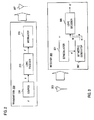
- FIG. 2 is a diagram of an exemplary transmitter in the system of FIG. 1;
- FIG. 3 is a diagram of an exemplary receiver in the system of FIG. 1;
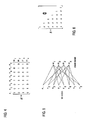
- FIG. 4 is a diagram of a sparse parity check matrix, in accordance with an embodiment of the present invention.
- FIG. 5 is a diagram of a bipartite graph of an LDPC code of the matrix of FIG. 4;
- FIG. 6 is a diagram of a sub-matrix of a sparse parity check matrix, wherein the sub-matrix contains parity check values restricted to the lower triangular region, according to an embodiment of the present invention
- FIG. 7 is a graph showing performance between codes utilizing unrestricted parity check matrix (H matrix) versus restricted H matrix having a sub-matrix as in FIG. 6;
- FIGs. 8A and 8B are, respectively, a diagram of a non-Gray 8-PSK modulation scheme, and a Gray 8-PSK modulation, each of which can be used in the system of FIG. 1;
- FIG. 9 is a graph showing performance between codes utilizing Gray labeling versus non-Gray labeling
- FIG. 10 is a flow chart of the operation of the LDPC decoder using non-Gray mapping, according to an embodiment of the present invention.
- FIG. 11 is a flow chart of the operation of the LDPC decoder of FIG. 3 using Gray mapping, according to an embodiment of the present invention.
- FIGs. 12A-12C are diagrams of the interactions between the check nodes and the bit nodes in a decoding process, according to an embodiment of the present invention.
- FIGs. 13A and 13B are flowcharts of processes for computing outgoing messages between the check nodes and the bit nodes using, respectively, a forward-backward approach and a parallel approach, according to various embodiments of the present invention
- FIGs. 14A-14C are graphs showing simulation results of LDPC codes generated in accordance with various embodiments of the present invention.
- FIGs. 15A and 15B arc diagrams of the top edge and bottom edge, respectively, of memory organized to support structured access as to realize randomness in LDPC coding, according to an embodiment of the present invention.
- FIG. 16 is a diagram of a computer system that can perform the processes of encoding and decoding of LDPC codes, in accordance with embodiments of the present invention.
- LDPC Low Density Parity Check
- FIG. 1 is a diagram of a communications system configured to utilize Low Density Parity Check (LDPC) codes, according to an embodiment of the present invention.
- a digital communications system 100 includes a transmitter 101 that generates signal waveforms across a communication channel 103 to a receiver 105.
- the transmitter 101 has a message source that produces a discrete set of possible messages; each of the possible messages has a corresponding signal waveform. These signal waveforms are attenuated, or otherwise altered, by communications channel 103.
- LDPC codes are utilized.
- the LDPC codes that are generated by the transmitter 101 enables high speed implementation without incurring any performance loss.
- These structured LDPC codes output from the transmitter 101 avoid assignment of a small number of check nodes to the bit nodes already vulnerable to channel errors by virtue of the modulation scheme (e.g., 8-PSK).
- Such LDPC codes have a parallelizable decoding algorithm (unlike turbo codes), which advantageously involves simple operations such as addition, comparison and table look-up. Moreover, carefully designed LDPC codes do not exhibit any sign of error floor.
- the transmitter 101 generates, using a relatively simple encoding technique, LDPC codes based on parity check matrices (which facilitate efficient memory access during decoding) to communicate with the receiver 105.
- the transmitter 101 employs LDPC codes that can outperform concatenated turbo+RS (Reed-Solomon) codes, provided the block length is sufficiently large.
- FIG. 2 is a diagram of an exemplary transmitter in the system of FIG. 1.
- a transmitter 200 is equipped with an LDPC encoder 203 that accepts input from an information source 201 and outputs coded stream of higher redundancy suitable for error correction processing at the receiver 105.
- the information source 201 generates k signals from a discrete alphabet, X.
- LDPC codes are specified with parity check matrices.
- encoding LDPC codes require, in general, specifying the generator matrices. Even though it is possible to obtain generator matrices from parity check matrices using Gaussian elimination, the resulting matrix is no longer sparse and storing a large generator matrix can be complex.
- Encoder 203 generates signals from alphabet Y to a modulator 205 using a simple encoding technique that makes use of only the parity check matrix by imposing structure onto the parity check matrix. Specifically, a restriction is placed on the parity check matrix by constraining certain portion of the matrix to be triangular. The construction of such a parity check matrix is described more fully below in FIG. 6. Such a restriction results in negligible performance loss, and therefore, constitutes an attractive trade-off.
- Modulator 205 maps the encoded messages from encoder 203 to signal waveforms that are transmitted to a transmit antenna 207, which emits these waveforms over the communication channel 103. Accordingly, the encoded messages are modulated and distributed to a transmit antenna 207. The transmissions from the transmit antenna 207 propagate to a receiver, as discussed below.
- FIG. 3 is a diagram of an exemplary receiver in the system of FIG. 1.
- a receiver 300 includes a demodulator 301 that performs demodulation of received signals from transmitter 200. These signals are received at a receive antenna 303 for demodulation. After demodulation, the received signals are forwarded to a decoder 305, which attempts to reconstruct the original source messages by generating messages, X', in conjunction with a bit metric generator 307. With non-Gray mapping, the bit metric generator 307 exchanges probability information with the decoder 305 back and forth (iteratively) during the decoding process, which is detailed in FIG. 10.
- Gray mapping is used (according to one embodiment of the present invention)
- one pass of the bit metric generator is sufficient, in which further attempts of bit metric generation after each LDPC decoder iteration are likely to yield limited performanoe improvement; this approach is more fully described with respect to FIG. 11.
- FIG. 4 is a diagram of a sparse parity check matrix, in accordance with an embodiment of the present invention.
- LDPC codes are long, linear block codes with sparse parity check matrix H (n-k)xn .
- H (n-k)xn typically the block length, n, ranges from thousands to tens of thousands of bits.
- n typically the block length, n, ranges from thousands to tens of thousands of bits.
- the same code can be equivalently represented by the bipartite graph, per FIG. 5.
- the LDPC decoder 305 is considered a message passing decoder, whereby the decoder 305 aims to find the values of bit nodes. To accomplish this task, bit nodes and check nodes iteratively communicate with each other. The nature of this communication is described below.
- each bit node From bit nodes to check nodes, each bit node relays to an adjacent check node an estimate about its own value based on the feedback coming from its other adjacent check nodes.
- n 1 has only two adjacent check nodes m 1 and m 3 . If the feedback coming from m 3 to n 1 indicates that the value of n 1 is probably 0, then n 1 would notify m 1 that an estimate of n 1 's own value is 0.
- the bit node performs a majority vote (soft decision) on the feedback coming from its other adjacent check nodes before reporting that decision to the check node it communicates. The above process is repeated until all bit nodes are considered to be correct (i.e., all parity check equations are satisfied) or until a predetermined maximum number of iterations is reached, whereby a decoding failure is declared.
- FIG. 6 is a diagram of a sub-matrix of a sparse parity check matrix, wherein the sub-matrix contains parity check values restricted to the lower triangular region, according to an embodiment of the present invention.
- the encoder 203 (of FIG. 2) can employ a simple encoding technique by restricting the values of the lower triangular area of the parity check matrix.
- FIG. 7 is a graph showing performance between codes utilizing unrestricted parity check matrix (H matrix) versus restricted H matrix of FIG. 6.
- the graph shows the performance comparison between two LDPC codes: one with a general parity check matrix and the other with a parity check matrix restricted to be lower triangular to simplify encoding.
- the modulation scheme for this simulation, is 8-PSK.
- the performance loss is within 0.1 dB. Therefore, the performance loss is negligible based on the restriction of the lower triangular H matrices, while the gain in simplicity of the encoding technique is significant. Accordingly, any parity check matrix that is equivalent to a lower triangular or upper triangular under row and/or column permutation can be utilized for the same purpose.
- FIGs. 8A and 8B are, respectively, a diagram of a non-Gray 8-PSK modulation scheme, and a Gray 8-PSK modulation, each of which can be used in the system of FIG. 1.
- the non-Gray 8-PSK scheme of FIG. 8A can be utilized in the receiver of FIG. 3 to provide a system that requires very low Frame Erasure Rate (FER).
- FER Frame Erasure Rate
- This requirement can also be satisfied by using a Gray 8-PSK scheme, as shown in FIG. 8B, in conjunction with an outer code, such as Bose, Chaudhuri, and Hocquenghem (BCH), Hamming, or Reed-Solomon (RS) code.
- an outer code such as Bose, Chaudhuri, and Hocquenghem (BCH), Hamming, or Reed-Solomon (RS) code.
- the LDPC decoder 305 (FIG. 3) and the bit metric generator 307, which may employ 8-PSK modulation.
- the LDPC decoder 305 using Gray labeling exhibit an earlier error floor, as shown in FIG. 9 below.
- FIG. 9 is a graph showing performance between codes utilizing Gray labeling versus non-Gray labeling of FIGs. 8A and 8B.
- the error floor stems from the fact that assuming correct feedback from LDPC decoder 305, regeneration of 8-PSK bit metrics is more accurate with non-Gray labeling since the two 8-PSK symbols with known two bits are further apart with non-Gray labeling. This can be equivalently seen as operating at higher Signal-to-Noise Ratio (SNR). Therefore, even though error asymptotes of the same LDPC code using Gray or non-Gray labeling have the same slope (i.e., parallel to each other), the one with non-Gray labeling passes through lower FER at any SNR.
- SNR Signal-to-Noise Ratio
- Gray labeling without any iteration between LDPC decoder 305 and 8-PSK bit metric generator 307 may be more suitable because re-generating 8-PSK bit metrics before every LDPC decoder iteration causes additional complexity. Moreover, when Gray labeling is used, re-generating 8-PSK bit metrics before every LDPC decoder iteration yields only very slight performance improvement. As mentioned previously, Gray labeling without iteration may be used for systems that require very low FER, provided an outer code is implemented.
- Gray labeling The choice between Gray labeling and non-Gray labeling depends also on the characteristics of the LDPC code. Typically, the higher bit or check node degrees, the better it is for Gray labeling, because for higher node degrees, the initial feedback from LDPC decoder 305 to 8-PSK (or similar higher order modulation) bit metric generator 307 deteriorates more with non-Gray labeling.
- FIG. 10 is a flow chart of the operation of the LDPC decoder using non-Gray mapping, according to an embodiment of the present invention.
- the LDPC decoder and bit metric generator iterate one after the other.
- 8-PSK modulation is utilized; however, the same principles apply to other higher modulation schemes as well.
- the 8-PSK bit metric generator 307 communicates with the LDPC decoder 305 to exchange a priori probability information and a posteriori probability information, which respectively are represented as u , and a . That is, the vectors u and a respectively represent a priori and a posteriori probabilities of log likelihood ratios of coded bits.
- ⁇ (a,b,c) ⁇ ( ⁇ (a.b).c).
- step 1001 the LDPC decoder 305 initializes log likelihood ratios of coded bits, v , before the first iteration according to the following (and as shown in FIG. 12A):
- v n ⁇ k i denotes the message that goes from bit node n to its adjacent check node k i
- u n denotes the demodulator output for the bit n
- N is the codeword size.
- a check node, k is updated, whereby the input v yields the output w .
- the incoming messages to the check node k from its d c adjacent bit nodes are denoted by v n 1 ⁇ k , v n 2 ⁇ k ,..., v n dc ⁇ k .
- the goal is to compute the outgoing messages from the check node k back to d c adjacent bit nodes.
- ) ⁇ +LUT g ( a , b ), where LUT g ( a,b ) ln(1 + e -
- the decoder 305 per step 1205, outputs a posteriori probability information (FIG. 12C), such that:
- step 1007 it is determined whether all the parity check equations are satisfied. If these parity check equations are not satisfied, then the decoder 305, as in step 1009, re-derives 8-PSK bit metrics and channel input u n . Next, the bit node is updated, as in step 1011. As shown in FIG.
- the incoming messages to the bit node n from its d v adjacent check nodes are denoted by w k 1 ⁇ n , w k 2 ⁇ n ,...., w k dv ⁇ n .
- the outgoing messages from the bit node n are computed back to d v adjacent check nodes; such messages are denoted by v n ⁇ k 1 , v n ⁇ k 2 ,...., v n ⁇ k dv , and computed as follows:
- the decoder 305 outputs the hard decision (in the case that all parity check equations are satisfied):
- FIG. 11 is a flow chart of the operation of the LDPC decoder of FIG. 3 using Gray mapping, according to an embodiment of the present invention.
- Gray labeling bit metrics are advantageously generated only once before the LDPC decoder, as re-generating bit metrics after every LDPC decoder iteration may yield nominal performance improvement.
- initialization of the log likelihood ratios of coded bits. v . are performed, and the check node is updated, per steps 1101 and
- bit node n is updated, as in step 1105. Thereafter, the decoder outputs the a posteriori probability information (step 1107). In step 1109, a determination is made whether all of the parity check equations are satisfied; if so, the decoder outputs the hard decision (step 1111). Otherwise, steps 1103-1107 are repeated.
- FIG. 13A is a flowchart of process for computing outgoing messages between the check nodes and the bit nodes using a forward-backward approach, according to an embodiment of the present invention.
- the computation of d c ( d c -1) and numerous g (.,.) functions are performed.
- the forward-backward approach reduces the complexity of the computation to 3( d c -2), in which d c - 1 variables are stored.
- the incoming messages to the check node k from d c adjacent hit nodes are denoted by v n 1 ⁇ k , v n 2 ⁇ k ,..., v n dc ⁇ k . It is desired that the outgoing messages are computed from the check node k back to d c adjacent bit nodes; these outgoing messages are denoted by w k ⁇ n 1 , w k ⁇ n 2 ,..., w k ⁇ n dc .
- forward variables ⁇ 1 , ⁇ 2 ,..., ⁇ dc , are defined as follows: In step 1301, these forward variables are computed, and stored, per step 1303.
- backward variables, b 1 ,b 2 ,...,b dc are defined by the following:
- steps 1305 these backward variables are then computed.
- the outgoing messages are computed, as in step 1307, based on the stored forward variables and the computed backward variables.
- the computation load can be further enhance by a parallel approach, as next discussed.
- FIG. 13B is a flowchart of process for computing outgoing messages between the check nodes and the bit nodes using a parallel approach, according to an embodiment of the present invention.
- the ln(.) term of the above equation can be obtained using a look-up table LUT x that represents the function In
- the computational latency of ⁇ k is advantageously log z (d c ).
- FIGs. 14A-14C are graphs showing simulation results of LDPC codes generated in accordance with various embodiments of the present invention.
- FIGs. 14A-14C show the performance of LDPC codes with higher order modulation and code rates of 3/4 (QPSK, 1.485 bits/symbol), 2/3 (8-PSK, 1.980 bits/symbol), and 5/6 (8-PSK, 2.474 bits/symbol).
- the fully parallel architecture may involve greater complexity in realizing all of the nodes and their connections. Therefore with fully parallel architecture, a smaller block size may be required to reduce the complexity. In that case, for the same clock frequency, a proportional reduction in throughput and some degradation in FER versus Es/No performance may result.
- the second approach to implementing LDPC codes is to physically realize only a subset of the total number of the nodes and use only these limited number of "physical" nodes to process all of the "functional" nodes of the code. Even though the LDPC decoder operations can be made extremely simple and can be performed in parallel, the further challenge in the design is how the communication is established between "randomly" distributed bit nodes and check nodes.
- the decoder 305 (of FIG. 3), according to one embodiment of the present invention, addresses this problem by accessing memory in a structured way, as to realize a seemingly random code. This approach is explained with respect to FIGs. 15A and 15B.
- FIGs. 15A and 15B are diagrams of the top edge and bottom edge, respectively, of memory organized to support structured access as to realize randomness in LDPC coding, according to an embodiment of the present invention.
- Structured access can be achieved without compromising the performance of a truly random code by focusing on the generation of the parity check matrix.
- a parity check matrix can be specified by the connections of the check nodes with the bit nodes.
- the bit nodes are divided into groups of 392 (392 is provided for the purposes of illustration).
- the check nodes connected to the first bit node of degree 3 are numbered as a , b and c , then the check nodes connected to the second bit node are numbered as a + p , b + p and c + p , the check nodes connected to the third bit node are numbered as a+2p, b+2p and c+2p etc.
- the check nodes connected to the first bit node are different from a , b, c so that with a suitable choice of p , all the check nodes have the same degree.
- a random search is performed over the free constants such that the resulting LDPC code is cycle-4 and cycle-6 free.
- the above arrangement facilitates memory access during check node and bit node processing.
- the values of the edges in the bipartite graph can be stored in a storage medium, such as random access memory (RAM). It is noted that for a truly random LDPC code during check node and bit node processing, the values of the edges would need to be accessed one by one in a random fashion. However, such an access scheme would be too slow for a high data rate application.
- the RAM of FIGs. 15A and 15B are organized in a manner, whereby a large group of relevant edges can be fetched in one clock cycle; accordingly, these values are placed "together" in memory.
- each box contains the value of an edge, which is multiple bits (c.g., 6).
- Edge RAM according to one embodiment of the present invention, is divided into two parts: top edge RAM (FIG. 15A) and bottom edge RAM (FIG. 15B).
- Bottom edge RAM contains the edges between bit nodes of degree 2. for example, and check nodes.
- Top edge RAM contains the edges between bit nodes of degree greater than 2 and check nodes. Therefore, for every check node, 2 adjacent edges are stored in the bottom RAM, and the rest of the edges are stored in the top edge RAM.
- a group of 392 bit nodes and 392 check nodes are selected for processing at a time.
- 392 check node processing q consecutive rows are accessed from the top edge RAM, and 2 consecutive rows from the bottom edge RAM. In this instance, q+2 is the degree of each check node.
- bit node processing if the group of 392 bit nodes has degree 2, their edges are located in 2 consecutive rows of the bottom edge RAM. If the bit nodes have degree d > 2, their edges are located in some d rows of the top edge RAM.
- the address of these d rows can be stored in non-volatile memory, such as Read-Only Memory (ROM).
- ROM Read-Only Memory
- edges in one of the rows correspond to the first edges of 392 bit nodes, the edges in another row correspond to the second edges of 392 bit nodes, etc.
- the column index of the edge that belongs to the first bit node in the group of 392 can also be stored in ROM.
- the edges that correspond to the second, third, etc. bit nodes follow the starting column index in a "wrapped around" fashion. For example, if the j th edge in the row belongs to the first bit node, then the ( j +1)st edge belongs to the second bit node, ( j +2)nd edge belongs to the third bit node, ...., and ( j -1)st edge belongs to the 392 th bit node.
- FIG. 16 illustrates a computer system 1600 upon which an embodiment according to the present invention can be implemented.
- the computer system 1600 includes a bus 1601 or other communication mechanism for communicating information, and a processor 1603 coupled to the bus 1601 for processing information.
- the computer system 1600 also includes main memory 1605, such as a random access memory (RAM) or other dynamic storage device, coupled to the bus 1601 for storing information and instructions to be executed by the processor 1603.
- Main memory 1605 can also be used for storing temporary variables or other intermediate information during execution of instructions to be executed by the processor 1603.
- the computer system 1600 further includes a read only memory (ROM) 1607 or other static storage device coupled to the bus 1601 for storing static information and instructions for the processor 1603.
- a storage device 1609 such as a magnetic disk or optical disk, is additionally coupled to the bus 1601 for storing information and instructions.
- the computer system 1600 may be coupled via the bus 1601 to a display 1611, such as a cathode ray tube (CRT), liquid crystal display, active matrix display, or plasma display, for displaying information to a computer user.
- a display 1611 such as a cathode ray tube (CRT), liquid crystal display, active matrix display, or plasma display
- An input device 1613 such as a keyboard including alphanumeric and other keys, is coupled to the bus 1601 for communicating information and command selections to the processor 1603.
- cursor control 1615 is Another type of user input device. such as a mouse, a trackball, or cursor direction keys for communicating direction information and command selections to the processor 1603 and for controlling cursor movement on the display 1611.
- generation of LDPC codes is provided by the computer system 1600 in response to the processor 1603 executing an arrangement of instructions contained in main memory 1605.
- Such instructions can be read into main memory 1605 from another computer-readable medium, such as the storage device 1609.
- Execution of the arrangement of instructions contained in main memory 1605 causes the processor 1603 to perform the process steps described herein.
- processors in a multi-processing arrangement may also be employed to execute the instructions contained in main memory 1605.
- hard-wired circuitry may be used in place of or in combination with software instructions to implement the embodiment of the present invention.
- embodiments of the present invention are not limited to any specific combination of hardware circuitry and software.
- the computer system 1600 also includes a communication interface 1617 coupled to bus 1601.
- the communication interface 1617 provides a two-way data communication coupling to a network link 1619 connected to a local network 1621.
- the communication interface 1617 may be a digital subscriber line (DSL) card or modem, an integrated services digital network (ISDN) card, a cable modem, or a telephone modem to provide a data communication connection to a corresponding type of telephone line.
- communication interface 1617 may be a local area network (LAN) card (e.g. for EthernetTM or an Asynchronous Transfer Model (ATM) network) to provide a data communication connection to a compatible LAN.
- LAN local area network
- Wireless links can also be implemented.
- communication interface 1617 sends and receives electrical, electromagnetic, or optical signals that carry digital data streams representing various types of information.
- the communication interface 1617 can include peripheral interface devices, such as a Universal Serial Bus (USB) interface, a PCMCIA (Personal Computer Memory Card International Association) interface, etc.
- USB Universal Serial Bus
- PCMCIA Personal Computer Memory Card International Association
- the network link 1619 typically provides data communication through one or more networks to other data devices.
- the network link 1619 may provide a connection through local network 1621 to a host computer 1623, which has connectivity to a network 1625 (e.g. a wide area network (WAN) or the global packet data communication network now commonly referred to as the "Internet") or to data equipment operated by service provider.
- the local network 1621 and network 1625 both use electrical, electromagnetic, or optical signals to convey information and instructions.
- the signals through the various networks and the signals on network link 1619 and through communication interface 1617, which communicate digital data with computer system 1600, are exemplary forms of carrier waves bearing the information and instructions.
- the computer system 1600 can send messages and receive data, including program code, through the network(s), network link 1619, and communication interface 1617.
- a server (not shown) might transmit requested code belonging to an application program for implementing an embodiment of the present invention through the network 1625, local network 1621 and communication interface 1617.
- the processor 1603 may execute the transmitted code while being received and/or store the code in storage device 169, or other non-volatile storage for later execution. In this manner, computer system 1600 may obtain application code in the form of a carrier wave.
- Non-volatile media include, for example, optical or magnetic disks, such as storage device 1609.
- Volatile media include dynamic memory, such as main memory 1605.
- Transmission media include coaxial cables, copper wire and fiber optics, including the wires that comprise bus 1601. Transmission media can also take the form of acoustic, optical, or electromagnetic waves, such as those generated during radio frequency (RF) and infrared (IR) data communications.
- RF radio frequency
- IR infrared
- Computer-readable media include, for example, a floppy disk, a flexible disk, hard disk, magnetic tape, any other magnetic medium, a CD-ROM, CDRW, DVD, any other optical medium, punch cards, paper tape, optical mark sheets, any other physical medium with patterns of holes or other optically recognizable indicia, a RAM, a PROM, and EPROM. a FLASH-EPROM, any other memory chip or cartridge, a carrier wave, or any other medium from which a computer can read.
- the instructions for carrying out at least part of the present invention may initially be borne on a magnetic disk of a remote computer.
- the remote computer loads the instructions into main memory and sends the instructions over a telephone line using a modem.
- a modem of a local computer system receives the data on the telephone line and uses an infrared transmitter to convert the data to an infrared signal and transmit the infrared signal to a portable computing device, such as a personal digital assistance (PDA) and a laptop.
- PDA personal digital assistance
- An infrared detector on the portable computing device receives the information and instructions borne by the infrared signal and places the data on a bus.
- the bus conveys the data to main memory, from which a processor retrieves and executes the instructions.
- the instructions received by main memory may optionally be stored on storage device either before or after execution by processor.
- the various embodiments of the present invention provide an approach for generating structured Low Density Parity Check (LDPC) codes, as to simplify the encoder and decoder.
- Structure of the LDPC codes is provided by restricting the parity check matrix to be lower triangular.
- the approach can advantageously exploit the unequal error protecting capability of LDPC codes on transmitted bits to provide extra error protection to more vulnerable bits of high order modulation constellations (such as 8-PSK (Phase Shift Keying)).
- the decoding process involves iteratively regenerating signal constellation bit metrics into an LDPC decoder after each decoder iteration or several decoder iterations.
- the above approach advantageously yields reduced complexity without sacrificing performance.
Landscapes
- Engineering & Computer Science (AREA)
- Physics & Mathematics (AREA)
- Probability & Statistics with Applications (AREA)
- Theoretical Computer Science (AREA)
- Computer Networks & Wireless Communication (AREA)
- Signal Processing (AREA)
- Mathematical Physics (AREA)
- Algebra (AREA)
- General Physics & Mathematics (AREA)
- Pure & Applied Mathematics (AREA)
- Error Detection And Correction (AREA)
- Detection And Prevention Of Errors In Transmission (AREA)
Applications Claiming Priority (2)
| Application Number | Priority Date | Filing Date | Title |
|---|---|---|---|
| US39345702P | 2002-07-03 | 2002-07-03 | |
| US393457P | 2002-07-03 |
Publications (2)
| Publication Number | Publication Date |
|---|---|
| EP1379001A2 true EP1379001A2 (de) | 2004-01-07 |
| EP1379001A3 EP1379001A3 (de) | 2004-03-10 |
Family
ID=29720448
Family Applications (1)
| Application Number | Title | Priority Date | Filing Date |
|---|---|---|---|
| EP03254214A Ceased EP1379001A3 (de) | 2002-07-03 | 2003-07-02 | Verfahren und System für die Decodierung von Low Density Parity Check (LDPC) Codes |
Country Status (4)
| Country | Link |
|---|---|
| EP (1) | EP1379001A3 (de) |
| JP (1) | JP3917563B2 (de) |
| KR (1) | KR100574306B1 (de) |
| CN (1) | CN1282312C (de) |
Cited By (10)
| Publication number | Priority date | Publication date | Assignee | Title |
|---|---|---|---|---|
| WO2005048460A1 (en) * | 2003-11-14 | 2005-05-26 | Samsung Electronics Co., Ltd. | Channel encoding/decoding apparatus and method using parallel contenated low density parity check code |
| EP1553705A1 (de) * | 2004-01-10 | 2005-07-13 | Broadcom Corporation | Iterative Demodulation und Decodierung von multi-level Turbo oder LDPC (low-density parity-check) codierten Modulationssignalen |
| EP1626505A1 (de) * | 2004-08-10 | 2006-02-15 | Samsung Electronics Co., Ltd. | Gerät und Methode für das Kodieren und Dekodieren von Blockparitätsprüfcodes geringer Dichte (LDPC) |
| US7197690B2 (en) | 2002-05-31 | 2007-03-27 | Broadcom Corporation | Bandwidth efficient coded modulation scheme based on MLC (multi-level code) signals having multiple maps |
| CN100362755C (zh) * | 2004-06-28 | 2008-01-16 | 华为技术有限公司 | 一种符号的估计方法 |
| KR100849044B1 (ko) | 2004-01-20 | 2008-07-30 | 닛본 덴끼 가부시끼가이샤 | 패리티 체크 행렬 생성 방법, 데이터 전송 시스템, 부호화장치, 복호 장치 및 패리티 체크 행렬 생성 프로그램을 저장하는 컴퓨터로 판독가능한 기록 매체 |
| CN103067025A (zh) * | 2013-01-01 | 2013-04-24 | 苏州威士达信息科技有限公司 | 基于块行循环的cmmb中ldpc编码器和编码方法 |
| US8650462B2 (en) | 2005-10-17 | 2014-02-11 | Ramot At Tel Aviv University Ltd. | Probabilistic error correction in multi-bit-per-cell flash memory |
| CN111786680A (zh) * | 2019-04-03 | 2020-10-16 | 华为技术有限公司 | 一种生成矩阵的确定方法及装置 |
| CN115664430A (zh) * | 2022-10-08 | 2023-01-31 | 北京理工大学 | 基于最大值检测的编码辅助盲帧同步方法及系统 |
Families Citing this family (18)
| Publication number | Priority date | Publication date | Assignee | Title |
|---|---|---|---|---|
| KR100543154B1 (ko) * | 2002-07-26 | 2006-01-20 | 휴우즈 일렉트로닉스 코오포레이션 | 저밀도 패리티 검사 코드 생성 방법 및 시스템 |
| US7234098B2 (en) * | 2003-10-27 | 2007-06-19 | The Directv Group, Inc. | Method and apparatus for providing reduced memory low density parity check (LDPC) codes |
| KR100594818B1 (ko) | 2004-04-13 | 2006-07-03 | 한국전자통신연구원 | 순차적 복호를 이용한 저밀도 패리티 검사 부호의 복호장치 및 그 방법 |
| KR20050118056A (ko) | 2004-05-12 | 2005-12-15 | 삼성전자주식회사 | 다양한 부호율을 갖는 Block LDPC 부호를 이용한이동 통신 시스템에서의 채널부호화 복호화 방법 및 장치 |
| US7395490B2 (en) | 2004-07-21 | 2008-07-01 | Qualcomm Incorporated | LDPC decoding methods and apparatus |
| WO2006027818A1 (ja) * | 2004-09-03 | 2006-03-16 | Mitsubishi Denki Kabushiki Kaisha | Ldpc符号生成方法および通信装置 |
| FI121431B (fi) | 2004-09-13 | 2010-11-15 | Tamfelt Pmc Oy | Paperikoneessa käytettävä kudosrakenne ja menetelmä sen valmistamiseksi |
| KR100641052B1 (ko) * | 2004-12-08 | 2006-11-02 | 한국전자통신연구원 | Ldpc 부호기 및 복호기, 및 ldpc 부호화 방법 및복호화 방법 |
| EP1717959A1 (de) * | 2005-04-29 | 2006-11-02 | STMicroelectronics N.V. | Methode und Apparat für die Kontrolle der Dekodierung eines LDPC kodierten Kodewortes, inbesondere eines DVB-S2 LDPC kodierten Kodewortes |
| CN100454768C (zh) * | 2005-06-01 | 2009-01-21 | 西南交通大学 | 非对数域最大后验概率Turbo译码方法 |
| WO2007046084A2 (en) * | 2005-10-17 | 2007-04-26 | Ramot At Tel-Aviv University Ltd. | Probabilistic error correction in multi-bit-per-cell flash memory |
| JP4727380B2 (ja) * | 2005-10-24 | 2011-07-20 | Kddi株式会社 | 復号装置および方法、ならびに復調復号装置および方法 |
| CN102386996B (zh) * | 2010-09-01 | 2015-11-25 | 国家广播电影电视总局广播科学研究院 | 一种卫星双向通信中物理层数据传输方法和装置 |
| CN102638629A (zh) * | 2012-03-30 | 2012-08-15 | 西安烽火电子科技有限责任公司 | 一种短波调制解调器及其调制解调方法 |
| US10148326B2 (en) * | 2015-07-06 | 2018-12-04 | Qualcomm Incorporated | Methods and apparatus for extended receiver processing time |
| US10122382B2 (en) * | 2015-09-18 | 2018-11-06 | SK Hynix Inc. | VSS LDPC decoder with improved throughput for hard decoding |
| CN107733570B (zh) * | 2017-09-27 | 2020-08-14 | 西安邮电大学 | 基于代数交织器的星座映射方法和映射方式的搜索方法 |
| WO2021190722A1 (en) * | 2020-03-23 | 2021-09-30 | Huawei Technologies Co., Ltd. | Communication devices and methods for iterative code design |
Citations (1)
| Publication number | Priority date | Publication date | Assignee | Title |
|---|---|---|---|---|
| CA2310186A1 (en) * | 2000-06-02 | 2001-12-02 | Jeffrey P. Castura | Method and system for decoding |
-
2003
- 2003-07-02 EP EP03254214A patent/EP1379001A3/de not_active Ceased
- 2003-07-02 JP JP2003190317A patent/JP3917563B2/ja not_active Expired - Fee Related
- 2003-07-03 KR KR1020030044955A patent/KR100574306B1/ko not_active Expired - Fee Related
- 2003-07-03 CN CNB031465102A patent/CN1282312C/zh not_active Expired - Fee Related
Patent Citations (1)
| Publication number | Priority date | Publication date | Assignee | Title |
|---|---|---|---|---|
| CA2310186A1 (en) * | 2000-06-02 | 2001-12-02 | Jeffrey P. Castura | Method and system for decoding |
Cited By (19)
| Publication number | Priority date | Publication date | Assignee | Title |
|---|---|---|---|---|
| US7197690B2 (en) | 2002-05-31 | 2007-03-27 | Broadcom Corporation | Bandwidth efficient coded modulation scheme based on MLC (multi-level code) signals having multiple maps |
| US7519895B2 (en) | 2003-11-14 | 2009-04-14 | Samsung Electronics Co., Ltd | Channel encoding/decoding apparatus and method using a parallel concatenated low density parity check code |
| WO2005048460A1 (en) * | 2003-11-14 | 2005-05-26 | Samsung Electronics Co., Ltd. | Channel encoding/decoding apparatus and method using parallel contenated low density parity check code |
| AU2004310143B2 (en) * | 2003-11-14 | 2008-07-10 | Samsung Electronics Co., Ltd. | Channel encoding/decoding apparatus and method using parallel contenated low density parity check code |
| EP1553705A1 (de) * | 2004-01-10 | 2005-07-13 | Broadcom Corporation | Iterative Demodulation und Decodierung von multi-level Turbo oder LDPC (low-density parity-check) codierten Modulationssignalen |
| US7383487B2 (en) | 2004-01-10 | 2008-06-03 | Broadcom Corporation | IPHD (iterative parallel hybrid decoding) of various MLC (multi-level code) signals |
| KR100849044B1 (ko) | 2004-01-20 | 2008-07-30 | 닛본 덴끼 가부시끼가이샤 | 패리티 체크 행렬 생성 방법, 데이터 전송 시스템, 부호화장치, 복호 장치 및 패리티 체크 행렬 생성 프로그램을 저장하는 컴퓨터로 판독가능한 기록 매체 |
| CN100362755C (zh) * | 2004-06-28 | 2008-01-16 | 华为技术有限公司 | 一种符号的估计方法 |
| EP1626505A1 (de) * | 2004-08-10 | 2006-02-15 | Samsung Electronics Co., Ltd. | Gerät und Methode für das Kodieren und Dekodieren von Blockparitätsprüfcodes geringer Dichte (LDPC) |
| US7600174B2 (en) | 2004-08-10 | 2009-10-06 | Samsung Electronics Co., Ltd | Apparatus and method for encoding and decoding a block low density parity check code |
| US8650462B2 (en) | 2005-10-17 | 2014-02-11 | Ramot At Tel Aviv University Ltd. | Probabilistic error correction in multi-bit-per-cell flash memory |
| US8788909B2 (en) | 2005-10-17 | 2014-07-22 | Ramot At Tel Aviv University Ltd. | Probabilistic error correction in multi-bit-per-cell flash memory |
| US8966342B2 (en) | 2005-10-17 | 2015-02-24 | Ramot At Tel Aviv University Ltd. | Probabilistic error correction in multi-bit-per-cell flash memory |
| US8990658B2 (en) | 2005-10-17 | 2015-03-24 | Ramot At Tel Aviv University Ltd. | Probabilistic error correction in multi-bit-per-cell flash memory |
| US9094047B2 (en) | 2005-10-17 | 2015-07-28 | Ramot At Tel Aviv University Ltd. | Probabilistic error correction in multi-bit-per-cell flash memory |
| CN103067025A (zh) * | 2013-01-01 | 2013-04-24 | 苏州威士达信息科技有限公司 | 基于块行循环的cmmb中ldpc编码器和编码方法 |
| CN103067025B (zh) * | 2013-01-01 | 2017-03-01 | 中国传媒大学 | 基于块行循环的cmmb中ldpc编码器和编码方法 |
| CN111786680A (zh) * | 2019-04-03 | 2020-10-16 | 华为技术有限公司 | 一种生成矩阵的确定方法及装置 |
| CN115664430A (zh) * | 2022-10-08 | 2023-01-31 | 北京理工大学 | 基于最大值检测的编码辅助盲帧同步方法及系统 |
Also Published As
| Publication number | Publication date |
|---|---|
| CN1527499A (zh) | 2004-09-08 |
| EP1379001A3 (de) | 2004-03-10 |
| KR20040004162A (ko) | 2004-01-13 |
| CN1282312C (zh) | 2006-10-25 |
| JP3917563B2 (ja) | 2007-05-23 |
| KR100574306B1 (ko) | 2006-04-27 |
| JP2004080753A (ja) | 2004-03-11 |
| HK1068463A1 (en) | 2005-04-29 |
Similar Documents
| Publication | Publication Date | Title |
|---|---|---|
| US7020829B2 (en) | Method and system for decoding low density parity check (LDPC) codes | |
| US7203887B2 (en) | Method and system for routing in low density parity check (LDPC) decoders | |
| US8615699B2 (en) | Method and system for routing in low density parity check (LDPC) decoders | |
| US8095854B2 (en) | Method and system for generating low density parity check codes | |
| EP1385270B1 (de) | Verfahren und System für die Generierung von Low Density Parity Check (LDPC) Codes | |
| EP1379001A2 (de) | Verfahren und System für die Decodierung von Low Density Parity Check (LDPC) Codes | |
| EP2273683B9 (de) | Kodierung von Low Density Parity Check (LDPC) Kodes | |
| HK1153056B (en) | Encoding of low density parity check (ldpc) codes |
Legal Events
| Date | Code | Title | Description |
|---|---|---|---|
| PUAI | Public reference made under article 153(3) epc to a published international application that has entered the european phase |
Free format text: ORIGINAL CODE: 0009012 |
|
| AK | Designated contracting states |
Kind code of ref document: A2 Designated state(s): AT BE BG CH CY CZ DE DK EE ES FI FR GB GR HU IE IT LI LU MC NL PT RO SE SI SK TR |
|
| AX | Request for extension of the european patent |
Extension state: AL LT LV MK |
|
| PUAL | Search report despatched |
Free format text: ORIGINAL CODE: 0009013 |
|
| AK | Designated contracting states |
Kind code of ref document: A3 Designated state(s): AT BE BG CH CY CZ DE DK EE ES FI FR GB GR HU IE IT LI LU MC NL PT RO SE SI SK TR |
|
| AX | Request for extension of the european patent |
Extension state: AL LT LV MK |
|
| RIC1 | Information provided on ipc code assigned before grant |
Ipc: 7H 03M 13/00 A |
|
| 17P | Request for examination filed |
Effective date: 20040126 |
|
| 17Q | First examination report despatched |
Effective date: 20040315 |
|
| AKX | Designation fees paid |
Designated state(s): AT BE BG CH CY CZ DE DK EE ES FI FR GB GR HU IE IT LI LU MC NL PT RO SE SI SK TR |
|
| APBN | Date of receipt of notice of appeal recorded |
Free format text: ORIGINAL CODE: EPIDOSNNOA2E |
|
| APBR | Date of receipt of statement of grounds of appeal recorded |
Free format text: ORIGINAL CODE: EPIDOSNNOA3E |
|
| APAF | Appeal reference modified |
Free format text: ORIGINAL CODE: EPIDOSCREFNE |
|
| RAP1 | Party data changed (applicant data changed or rights of an application transferred) |
Owner name: DTVG LICENSING, INC |
|
| APBT | Appeal procedure closed |
Free format text: ORIGINAL CODE: EPIDOSNNOA9E |
|
| STAA | Information on the status of an ep patent application or granted ep patent |
Free format text: STATUS: THE APPLICATION HAS BEEN REFUSED |
|
| 18R | Application refused |
Effective date: 20100303 |