EP1380210A2 - Fungicidal combinations comprising a glyoxalix acid methylester methyloxime derivative - Google Patents
Fungicidal combinations comprising a glyoxalix acid methylester methyloxime derivative Download PDFInfo
- Publication number
- EP1380210A2 EP1380210A2 EP03022589A EP03022589A EP1380210A2 EP 1380210 A2 EP1380210 A2 EP 1380210A2 EP 03022589 A EP03022589 A EP 03022589A EP 03022589 A EP03022589 A EP 03022589A EP 1380210 A2 EP1380210 A2 EP 1380210A2
- Authority
- EP
- European Patent Office
- Prior art keywords
- compound
- formula
- methyl
- component
- plants
- Prior art date
- Legal status (The legal status is an assumption and is not a legal conclusion. Google has not performed a legal analysis and makes no representation as to the accuracy of the status listed.)
- Granted
Links
- 0 *c(cc1)ccc1-c(cccc1)c1NC(c(cccn1)c1Cl)=O Chemical compound *c(cc1)ccc1-c(cccc1)c1NC(c(cccn1)c1Cl)=O 0.000 description 2
Classifications
-
- A—HUMAN NECESSITIES
- A01—AGRICULTURE; FORESTRY; ANIMAL HUSBANDRY; HUNTING; TRAPPING; FISHING
- A01N—PRESERVATION OF BODIES OF HUMANS OR ANIMALS OR PLANTS OR PARTS THEREOF; BIOCIDES, e.g. AS DISINFECTANTS, AS PESTICIDES OR AS HERBICIDES; PEST REPELLANTS OR ATTRACTANTS; PLANT GROWTH REGULATORS
- A01N37/00—Biocides, pest repellants or attractants, or plant growth regulators containing organic compounds containing a carbon atom having three bonds to hetero atoms with at the most two bonds to halogen, e.g. carboxylic acids
- A01N37/18—Biocides, pest repellants or attractants, or plant growth regulators containing organic compounds containing a carbon atom having three bonds to hetero atoms with at the most two bonds to halogen, e.g. carboxylic acids containing the group —CO—N<, e.g. carboxylic acid amides or imides; Thio analogues thereof
- A01N37/22—Biocides, pest repellants or attractants, or plant growth regulators containing organic compounds containing a carbon atom having three bonds to hetero atoms with at the most two bonds to halogen, e.g. carboxylic acids containing the group —CO—N<, e.g. carboxylic acid amides or imides; Thio analogues thereof the nitrogen atom being directly attached to an aromatic ring system, e.g. anilides
-
- A—HUMAN NECESSITIES
- A01—AGRICULTURE; FORESTRY; ANIMAL HUSBANDRY; HUNTING; TRAPPING; FISHING
- A01N—PRESERVATION OF BODIES OF HUMANS OR ANIMALS OR PLANTS OR PARTS THEREOF; BIOCIDES, e.g. AS DISINFECTANTS, AS PESTICIDES OR AS HERBICIDES; PEST REPELLANTS OR ATTRACTANTS; PLANT GROWTH REGULATORS
- A01N37/00—Biocides, pest repellants or attractants, or plant growth regulators containing organic compounds containing a carbon atom having three bonds to hetero atoms with at the most two bonds to halogen, e.g. carboxylic acids
- A01N37/44—Biocides, pest repellants or attractants, or plant growth regulators containing organic compounds containing a carbon atom having three bonds to hetero atoms with at the most two bonds to halogen, e.g. carboxylic acids containing at least one carboxylic group or a thio analogue, or a derivative thereof, and a nitrogen atom attached to the same carbon skeleton by a single or double bond, this nitrogen atom not being a member of a derivative or of a thio analogue of a carboxylic group, e.g. amino-carboxylic acids
- A01N37/50—Biocides, pest repellants or attractants, or plant growth regulators containing organic compounds containing a carbon atom having three bonds to hetero atoms with at the most two bonds to halogen, e.g. carboxylic acids containing at least one carboxylic group or a thio analogue, or a derivative thereof, and a nitrogen atom attached to the same carbon skeleton by a single or double bond, this nitrogen atom not being a member of a derivative or of a thio analogue of a carboxylic group, e.g. amino-carboxylic acids the nitrogen atom being doubly bound to the carbon skeleton
-
- A—HUMAN NECESSITIES
- A01—AGRICULTURE; FORESTRY; ANIMAL HUSBANDRY; HUNTING; TRAPPING; FISHING
- A01N—PRESERVATION OF BODIES OF HUMANS OR ANIMALS OR PLANTS OR PARTS THEREOF; BIOCIDES, e.g. AS DISINFECTANTS, AS PESTICIDES OR AS HERBICIDES; PEST REPELLANTS OR ATTRACTANTS; PLANT GROWTH REGULATORS
- A01N43/00—Biocides, pest repellants or attractants, or plant growth regulators containing heterocyclic compounds
- A01N43/34—Biocides, pest repellants or attractants, or plant growth regulators containing heterocyclic compounds having rings with one nitrogen atom as the only ring hetero atom
- A01N43/40—Biocides, pest repellants or attractants, or plant growth regulators containing heterocyclic compounds having rings with one nitrogen atom as the only ring hetero atom six-membered rings
-
- A—HUMAN NECESSITIES
- A01—AGRICULTURE; FORESTRY; ANIMAL HUSBANDRY; HUNTING; TRAPPING; FISHING
- A01N—PRESERVATION OF BODIES OF HUMANS OR ANIMALS OR PLANTS OR PARTS THEREOF; BIOCIDES, e.g. AS DISINFECTANTS, AS PESTICIDES OR AS HERBICIDES; PEST REPELLANTS OR ATTRACTANTS; PLANT GROWTH REGULATORS
- A01N43/00—Biocides, pest repellants or attractants, or plant growth regulators containing heterocyclic compounds
- A01N43/48—Biocides, pest repellants or attractants, or plant growth regulators containing heterocyclic compounds having rings with two nitrogen atoms as the only ring hetero atoms
- A01N43/56—1,2-Diazoles; Hydrogenated 1,2-diazoles
-
- A—HUMAN NECESSITIES
- A01—AGRICULTURE; FORESTRY; ANIMAL HUSBANDRY; HUNTING; TRAPPING; FISHING
- A01N—PRESERVATION OF BODIES OF HUMANS OR ANIMALS OR PLANTS OR PARTS THEREOF; BIOCIDES, e.g. AS DISINFECTANTS, AS PESTICIDES OR AS HERBICIDES; PEST REPELLANTS OR ATTRACTANTS; PLANT GROWTH REGULATORS
- A01N43/00—Biocides, pest repellants or attractants, or plant growth regulators containing heterocyclic compounds
- A01N43/72—Biocides, pest repellants or attractants, or plant growth regulators containing heterocyclic compounds having rings with nitrogen atoms and oxygen or sulfur atoms as ring hetero atoms
- A01N43/74—Biocides, pest repellants or attractants, or plant growth regulators containing heterocyclic compounds having rings with nitrogen atoms and oxygen or sulfur atoms as ring hetero atoms five-membered rings with one nitrogen atom and either one oxygen atom or one sulfur atom in positions 1,3
- A01N43/78—1,3-Thiazoles; Hydrogenated 1,3-thiazoles
Definitions
- the present invention relates to novel fungicidal compositions for the treatment of phytopathogenic diseases of crop plants, especially phytopathogenic fungi, and to a method of combating phytopathogenic diseases on crop plants.
- the combinations according to the invention may also comprise more than one of the active components b) , if broadening of the spectrum of disease control is desired.
- the active ingredient combinations are effective against phytopathogenic fungi belonging to the following classes: Ascomycetes (e.g. Venturia , Podosphaera , Erysiphe , Monilinia , Mycosphaerella , Uncinula ); Basidiomycetes (e.g. the genus Hemileia , Rhizoctonia , Puccinia ); Fungi imperfecti (e.g.
- Botrytis Helminthosporium , Rhynchosporium , Fusarium , Septoria , Cercospora , Alternaria , Pyricularia and Pseudocercosporella herpotrichoides (Tapesia spp.)) ; Oomycetes (e.g. Phytophthora , Peronospora , Bremia , Pythium , Plasmopara) .
- Oomycetes e.g. Phytophthora , Peronospora , Bremia , Pythium , Plasmopara
- Target crops for the areas of indication disclosed herein comprise within the scope of this invention e.g. the following species of plants: cereals (wheat, barley, rye, oats, rice, sorghum and related crops); beet (sugar beet and fodder beet); pomes, stone fruit and soft fruit (apples, pears, plums, peaches, almonds, cherries, strawberries, raspberries and blackberries); leguminous plants (beans, lentils, peas, soybeans); oil plants (rape, mustard, poppy, olives, sunflowers, coconut, castor oil plants, cocoa beans, groundnuts); cucumber plants (marrows, cucumbers, melons); fibre plants (cotton, flax, hemp, jute); citrus fruit (oranges, lemons, grapefruit, mandarins); vegetables (spinach, lettuce, asparagus, cabbages, carrots, onions, tomatoes, potatoes, paprika); lauraceae (avocados, cinnamon, camphor); or plants such as maize,
- the combinations according to the present invention are particularly effective against Phytophthora, Peronospora, Bremia, Pythium and Plasmopara, in particular against pathogens of monocotyledoneous plants such as cereals, including wheat and barley.
- the amount of combination of the invention to be applied will depend on various factors such as the compound employed, the subject of the treatment (plant, soil, seed), the type of treatment (e.g. spraying, dusting, seed dressing), the purpose of the treatment (prophylactic or therapeutic), the type of fungi to be treated and the application time.
- Particularly preferred mixing partners of the compound I are those which comprise as component b) a compound IIB, IIG, IIH, IIK or IIL.
- Another preferred mixing partners of the compound I are those which comprise as component b) a compound IIM, IIN, IIP or IIQ.
- Another embodiment of the present invention is represented by those combination which comprise as component a) the compound I and as component b) a compound IIC, IID, IIE, IIF or IIJ.
- Another combination is represented by the mixture comprising as component a) the compound I and as component b) the compound of the formula IIA.
- the weight ratio of a):b) is so selected as to give a synergistic fungicidal action.
- the weight ratio of a) : b) is between 10 : 1 and 1 : 20.
- the synergistic action of the composition is apparent from the fact that the fungicidal action of the composition of a) + b) is greater than the sum of the fungicidal actions of a) and b).
- the weight ratio of a):b) is for example between 6:1 and 1:6, especially 2:1 and 1:2.
- the weight ratio of a):b) is for example between 5:1 and 1:20, especially 2:1 and 1:20, and more preferably 1:1 to 1:10.
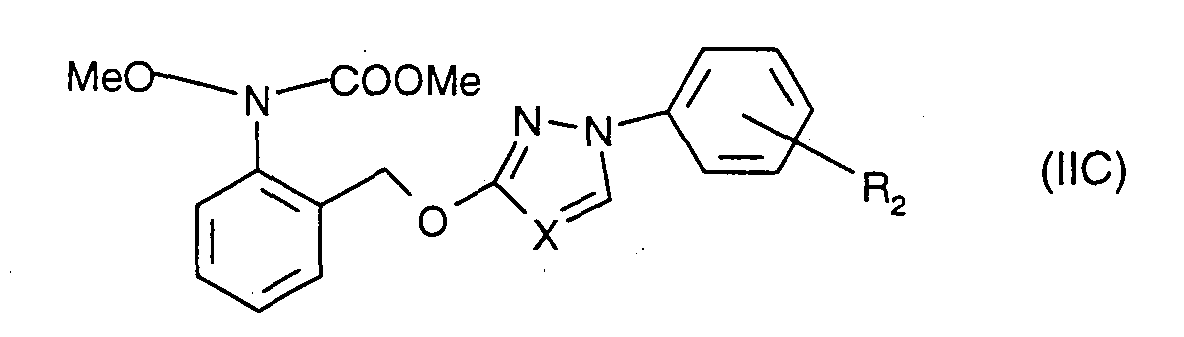
- component b) is a compound of formula IIC
- the weight ratio of a) : b) is for example between 5:1 and 1:5, especially 3:1 and 1:3, and more preferably 2:1 and 1:2.
- component b) is the compound IID
- the weight ratio of a): b) is for example between 5:1 and 1:5, especially 3:1 and 1:3, and more preferably 2:1 and 1:2.
- component b) is the compound IIE
- the weight ratio of a): b) is for example between 5:1 and 1:5, especially 3:1 and 1:3, and more preferably 2:1 and 1:2.
- component b) is a compound of formula IIF
- the weight ratio of a) : b) is for example between 5:1 and 1:5, especially 3:1 and 1:3, and more preferably 2:1 and 1:2.
- component b) is a compound of formula IIG
- the weight ratio of a): b) is for example between 5:1 and 1:5, especially 3:1 and 1:3, and more preferably 2:1 and 1:2.
- component b) is a compound of formula IIH
- the weight ratio of a) : b) is for example between 5:1 and 1:5, especially 3:1 and 1:3, and more preferably 2:1 and 1:2.
- component b) is the compound IIJ
- the weight ratio of a) : b) is for example between 5:1 and 1:5, especially 3:1 and 1:3, and more preferably 2:1 and 1:2.
- component b) is a compound of formula IIK
- the weight ratio of a) : b) is for example between 5:1 and 1:20, especially 3:1 and 1:10, and preferably 2:1 and 1:5.
- component b) is the compound IIL
- the weight ratio of a) : b) is for example between 5:1 and 1:5, specially 2:1 and 1:2, and more preferably 1:5:1 and 1:1.5.
- component b) is the compound IIM
- the weight ratio of a): b) is for example between 5:1 and 1:5, specially 2:1 and 1:2.
- component b) is the compound IIN
- the weight ratio of a): b) is for example between 6:1 and 1:6, specially 2:1 and 1:2.
- component b) is the compound IIP
- the weight ratio of a) : b) is for example between 6:1 and 1:6, specially 2:1 and 1:2.
- component b) is the compound IIQ
- the weight ratio of a): b) is for example between 6:1 and 1:6, specially 2:1 and 1:2.
- the method of the invention comprises applying to the treated plants or the locus thereof in admixture or separately, a fungicidally effective aggregate amount of compound I and a compound of component b).
- locus as used herein is intended to embrace the fields on which the treated crop plants are growing, or where the seeds of cultivated plants are sown, or the place where the seed will be placed into the soil.
- seed is intended to embrace plant propagating material such as cuttings, seedlings, seeds, germinated or soaked seeds.
- the novel combinations are extremely effective on a broad spectrum of phytopathogenic fungi, in particular from the Fungi imperfecti and Oomycetes classes. Some of them have a systemic action and can be used as foliar and soil fungicides.
- the fungicidal combinations are of particular interest for controlling a large number of fungi in various crops or their seeds, especially wheat, rye, barley, oats, rice, maize, lawns, cotton, soybeans, coffee, sugarcane, fruit and ornamentals in horticulture and viticulture, and in vegetables such as cucumbers, beans and cucurbits.
- the combinations are applied by treating the fungi or the seeds, plants or materials threatened by fungus attack, or the soil with a fungicidally effective amount of the active ingredients.
- the agents may be applied before or after infection of the materials, plants or seeds by the fungi.
- novel combinations are particularly useful for controlling the following plant diseases: Erysiphe graminis in cereals, Erysiphe cichoracearum and Sphaerotheca fuliginea in cucurbits, Podosphaera leucotricha in apples, Uncinula necator in vines, Puccinia species in cereals, Rhizoctonia species in cotton, rice and lawns, Ustilago species in cereals and sugarcane, Venturia inaequalis (scab) in apples, Helminthosporium species in cereals, Septoria nodorum in wheat, Septoria tritici in wheat wheat, Rhynchosporium secalis on barley Botrytis cinerea (gray mold) in strawberries, tomatoes and grapes, Cercospora arachidicola in groundnuts, Peronospora tabacina on tobacco, Bremia lactucae on lettuce, Pythium debaryanum on sugar beet, Pseudocercosporella herpotrichoides
- the compound I When applied to the plants the compound I is applied at a rate of 50 to 200 g/ha, particularly 75 to 150 g/ha, e.g. 75, 100, or 125g/ha, in association with 50 to 1500 g/ha, particularly 60 to 1000 g/ha, e.g. 75 g/ha, 80 g/ha, 100 g/ha, 125 g/ha, 150 g/ha, 175 g/ha 200 g/ha, 300 g/ha, 500 g/ha, or 1000 g/ha of a compound of component b), depending on the class of chemical employed as component b).
- the component b) is the compound IIA for example 50 to 400 g a.i. /ha is applied in association with the compound I.
- component b) is a compound of formula IIB for example 50 to 1500 g a.i./ha is applied in association with the compound I.
- component b) is a compound of formula IIC for example 50 to 300 g a.i./ha is applied in association with the compound I.
- component b) is the compound IID for example 50 to 300 g a.i./ha is applied in association with the compound I.
- component b) is the compound IIE for example 50 to 300 g a.i./ha is applied in association with the compound I.
- component b) is a compound of formula IIF for example 50 to 300 g a.i./ha is applied in association with the compound I.
- component b) is a compound of formula IIG for example 50 to 400 g a.i./ha is applied in association with the compound I.
- component b) is a compound of formula IIH for example 50 to 400 g a.i./ha is applied in association with the compound I.
- component b) is the compound IIJ for example 50 to 300 g a.i./ha is applied in association with the compound I.
- component b) is a compound of formula IIK for example 20 to 2000 g a.i./ha is applied in association with the compound I.
- component b) is the compound IIL for example 50 to 200 g a.i./ha is applied in association with the compound I.
- component b) is the compound IIM for example 50 to 200 g a.i./ha is applied in association with the compound I.
- component b) is the compound IIN for example 50 to 400 g a.i./ha is applied in association with the compound I.
- component b) is the compound IIP for example 50 to 400 g a.i./ha is applied in association with the compound I.
- component b) is the compound IIQ for example 50 to 400 g a.i./ha is applied in association with the compound I.
- the application rates depend on the type of effect desired, and range from 0.02 to 3 kg of active ingredient per hectare.
- rates of 0.001 to 50, and preferably from 0.01 to 10g per kg of seed are generally sufficient.
- the invention also provides fungicidal compositions comprising the compound I and a compound of component b).
- composition of the invention may be employed in any conventional form, for example in the form of a twin pack, an instant granulate, a flowable or a wettable powder in combination with agriculturally acceptable adjuvants.
- Such compositions may be produced in conventional manner, e.g. by mixing the active ingredients with appropriate adjuvants (diluents or solvents and optionally other formulating ingredients such as surfactants).
- Suitable carriers and adjuvants may be solid or liquid and correspond to the substances ordinarily employed in formulation technology, such as, e.g. natural or regenerated mineral substances, solvents, dispersants, wetting agents, tackifiers, thickeners, binding agents or fertilizers.
- Such carriers are for example described in WO 96/22690.
- Particularly formulations to be applied in spraying forms such as water dispersible concentrates or wettable powders may contain surfactants such as wetting and dispersing agents, e.g. the condensation product of formaldehyde with naphthalene sulphonate, an alkylarylsulphonate, a lignin sulphonate, a fatty alkyl sulphate, and ethoxylated alkylphenol and an ethoxylated fatty alcohol.
- surfactants such as wetting and dispersing agents, e.g. the condensation product of formaldehyde with naphthalene sulphonate, an alkylarylsulphonate, a lignin sulphonate, a fatty alkyl sulphate, and ethoxylated alkylphenol and an ethoxylated fatty alcohol.
- a seed dressing formulation is applied in a manner known per se to the seeds employing the combination of the invention and a diluent in suitable seed dressing formulation form, e.g. as an aqueous suspension or in a dry powder form having good adherence to the seeds.
- suitable seed dressing formulation form e.g. as an aqueous suspension or in a dry powder form having good adherence to the seeds.
- seed dressing formulations are known in the art.
- Seed dressing formulations may contain the single active ingredients or the combination of active ingredients in encapsulated form, e.g. as slow release capsules or microcapsules.
- the formulations include from 0.01 to 90% by weight of active agent, from 0 to 20% agriculturally acceptable surfactant and 10 to 99.99% solid or liquid adjuvant(s), the active agent consisting of at least the compound of formula I together with a compound of component b), and optionally other active agents, particularly guazatin and fenpiclonil.
- Concentrate forms of compositions generally contain in between about 2 and 80%, preferably between about 5 and 70% by weight of active agent.
- Application forms of formulation may for example contain from 0.01 to 20% by weight, preferably from 0.01 to 5% by weight of active agent.
- Examples for specific formulations-combination are as disclosed e.g. in WO 96/22690, e.g. for wettable powders, emulsifiable concentrate, dusts, extruder granules, coated granules, suspension concentrate.
- 28 parts of a combination of the compound I and a compound of component b), or of each of these compounds separately, are mixed with 2 parts of an aromatic solvent and 7 parts of toluene diisocyanate/polymethylene-polyphenylisocyanate-mixture (8:1).
- This mixture is emulsified in a mixture of 1.2 parts of polyvinylalcohol, 0.05 parts of a defoamer and 51.6 parts of water until the desired particle size is achieved.
- a mixture of 2.8 parts 1,6-diaminohexane in 5.3 parts of water is added. The mixture is agitated until the polymerization reaction is completed.
- the obtained capsule suspension is stabilized by adding 0.25 parts of a thickener and 3 parts of a dispersing agent.
- the capsule suspension formulation contains 28% of the active ingredients.
- the medium capsule diameter is 8-15 microns.
- the resulting formulation is applied to seeds as an aqueous suspension in an apparatus suitable for that purpose.
- the synergistic action may also be determined from the dose response curves according to the so-called WADLEY method.
- WADLEY so-called WADLEY
- the efficacy of the a.i. is determined by comparing the degree of fungal attack on treated plants with that on untreated, similarly inoculated and incubated check plants. Each a.i. is tested at 4 to 5 concentrations.
- the dose response curves are used to establish the EC90 (i.e. concentration of a.i. providing 90% disease control) of the single compounds as well as of the combinations (EC 90 observed ).
- the thus experimentally found values of the mixtures at a given weight ratio are compared with the values that would have been found were only a complementary efficacy of the components was present (EC 90 (A+B) expected ).
- the ratio EC90 (A+B) expected / EC90 (A+B) observed expresses the factor of interaction (F). In case of synergism, F is >1.
- Example B-1 Residual-protective action against Venturia inaequalis on apples
- Apple cuttings with 10-20 cm long fresh shoots are sprayed to drip point with an aqueous spray mixture prepared from a wettable powder formulation of the active ingredient mixture and infected 24 hours later with a conidia suspension of the fungus.
- the plants are incubated for 5 days at 90-100 % relative humidity and stood in a greenhouse for a further 10 days at 20-24°C. Fungus infestation is evaluated 12 days after infection.
- Example B-3 Action against Podosphaera leucotricha on apple shoots
- Apple cuttings with about 15 cm long fresh shoots are sprayed with a spray mixture of the active ingredient mixture.
- the treated plants are infected 24 hours later with a conidia suspension of the fungus and placed in a climatic chamber at 70 % relative humidity and 20°C. Fungus infestation is evaluated 12 days after infection.
- Example B-4 Action against Drechslera teres on barley
- 10-day-old barley plants of the "Golden Promise" variety are sprayed with a spray mixture of the active ingredient mixture.
- the treated plants are infected 24 hours later with a conidia suspension of the fungus and incubated in a climatic chamber at 70 % relative humidity and 20-22°C. Fungus infestation is evaluated 5 days after infection.
- Example B-5 Efficacy against Erysiphe graminis f.sp. tritici on wheat
- the plants are then incubated in a growth chamber at 20°C, 60% rH. Seven days after the inoculation, the percentage of infection on primary leaves is evaluated.
- the efficacy of the a.i. is determined by comparing the degree of fungal attack on treated plants with that on untreated, similarly inoculated and incubated check plants. Each a.i. is tested at 4 to 5 concentrations.
- the synergy factor is calculated according to the COLBY method.
- Grape plants, 4 weeks old (4-5 leaves), are sprayed to near run off with a suspension containing 250 mg/l of active ingredient. The deposit is then allowed to dry. One day later, the treated plants are inoculated by dusting freshly harvested conidia over the test plants; then the plants were incubated in a growth chamber for 10-14 days at +22°C and 70% r.h. The efficacy of the test compounds is determined by comparing the degree of fungal attack with that on untreated, similarly inoculated check plants. The mixtures according to the invention exhibit good activity in these Examples.
- Example B-8 Activity against Plasmopara viticola in grapevines
- Grapevine seedlings at the 4- to 5-leaf stage are sprayed to drip point with an aqueous spray mixture prepared with a wettable powder of the active ingredient mixture (0.02% of active ingredient) and, 24 hours later, infected with a sporangia suspension of the fungus.
- the fungus infestation is assessed 6 days after infection, during which time a relative atmospheric humidity of 95 to 100% and a temperature of 20°C are maintained.
- Example B-9 Activity against Phytophthora infestans in tomatoes
- Tomato plants cv. "Roter Gnom" are grown for three weeks and then sprayed with a zoospore suspension of the fungus and incubated in a cabin at 18 to 20°C and saturated atmospheric humidity. The humidification is interrupted after 24 hours. After the plants have dried, they are sprayed with a mixture which comprises the active ingredient formulated as a wettable powder at a concentration of 200ppm. After the spray coating has dried, the plants are returned to the humid chamber for 4 days. Number and size of the typical foliar lesions which have appeared after this time are used as a scale for assessing the efficacy of the test substances.
- the active ingredient which is formulated as a wettable powder is introduced, at a concentration of 60ppm (relative to the soil volume), onto the soil surface of three-week-old tomato plants cv. "Roter Gnom" in pots. After an interval of three days, the underside of the leaves is sprayed with a zoospore suspension of Phytophthora infestans. They are then kept for 5 days in a spray cabin at 18 to 20°C and saturated atmospheric humidity. After this time, typical foliar lesions appear whose number and size are used for assessing the efficacy of the test substances.
- Example B-10 Activity against Phytophthora inpotato plants
- a spray mixture (0.002% of active ingredient based on the soil volume) prepared with a wettable powder of the active ingredient is poured next to 2-3 week old potato plants (Bintje variety) which have been grown for 3 weeks. Care is taken that the spray mixture does not come into contact with the aerial parts of the plants. After 48 hours, the treated plants are infected with a sporangia suspension of the fungus. Fungus infestation is assessed after the infected plants have been incubated for 5 days at a relative atmospheric humidity of 90-100% and 20°C. The efficacy of the test combinations and the single active ingredients in the above tests is determined by comparing the degree of fungal attack with that on untreated, similarly inoculated check plants.
- the mixtures according to the invention exhibit good activity in these Examples.
Landscapes
- Life Sciences & Earth Sciences (AREA)
- Agronomy & Crop Science (AREA)
- Pest Control & Pesticides (AREA)
- Plant Pathology (AREA)
- Health & Medical Sciences (AREA)
- Engineering & Computer Science (AREA)
- Dentistry (AREA)
- General Health & Medical Sciences (AREA)
- Wood Science & Technology (AREA)
- Zoology (AREA)
- Environmental Sciences (AREA)
- Agricultural Chemicals And Associated Chemicals (AREA)
Abstract
Description
in association with


a carbamate of formula IIC (WO-96/01256 and WO-96/01258)
a compound IID (EP-278595)
methyl(2)-2-{2-[6-(trifluoromethyl)pyrid-2-yloxymethyl]-phenyl}-3-methoxyacrylate; or
a compound IIE (EP-477631)
(E)-N-methyl-2-[2-(2,5-dimethylphenoxymethyl)phenyl]-2-methoxy-iminoacetamide; or
a compound of formula IIF (WO-95/21154)

a (S)-valinamide of formula IIG (EP-398072, EP-610764, DE-4321897, WO-96/07638)
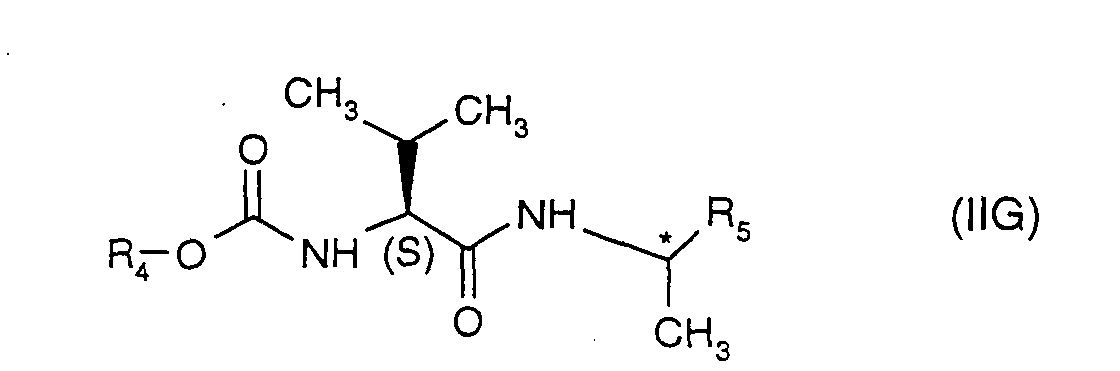
R5 is 4-chlorophenyl, 4-methylphenyl, 4-methoxyphenyl or β-naphthyl, and
wherein the asymmetric center is preferably (R); or
a (S)-valinamide of formula IIH (WO-94/25432, WO-96/04252)
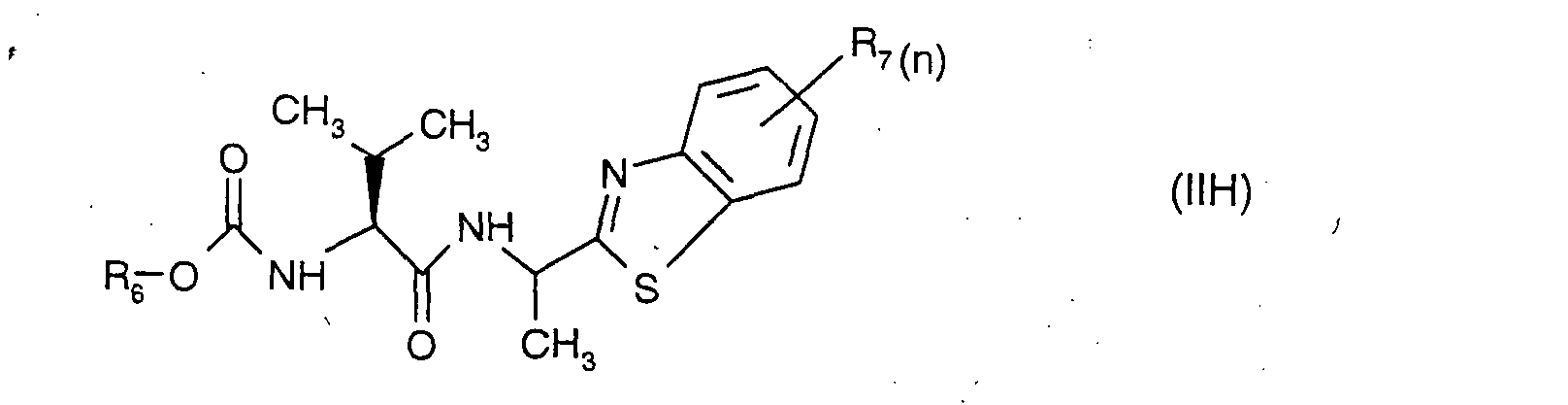
n is 0,1 or 2; or
a compound IIJ (EP-596254)
N-methyl-2-[2-{α-methyl-3-(trifluoromethyl)benzyloximinomethyl}phenyl]-2-methoximinoacetamide; or
a compound of formula IIK (EP-381330)

a compound IIL
N-(3'-(1'-chloro-3-methyl 2'-oxopentan))-3,5-dichloro-4-methylbenzamide (EP-600629); or
a compound IIM (EP-551048 and WO 96/03044)
(S)-1-anilino-4-methyl-2-methylthio-4-phenylimidazolin-5-one; or
a compound of formula IIN (WO 98/25465)


N-methyl-2-[α-{[(α-methyl-3-trifluoromethyl-benzyl)imino]-oxy}-o-tolyl]-glyoxalic acidamide-O-methyloxime (EP 569384)
is particularly effective in combating or preventing fungal diseases of crop plants. These combinations exhibit synergistic fungicidal activity.
The weight ratio of a):b) is so selected as to give a synergistic fungicidal action. In general the weight ratio of a) : b) is between 10 : 1 and 1 : 20. The synergistic action of the composition is apparent from the fact that the fungicidal action of the composition of a) + b) is greater than the sum of the fungicidal actions of a) and b).
The term locus as used herein is intended to embrace the fields on which the treated crop plants are growing, or where the seeds of cultivated plants are sown, or the place where the seed will be placed into the soil. The term seed is intended to embrace plant propagating material such as cuttings, seedlings, seeds, germinated or soaked seeds.
The novel combinations are extremely effective on a broad spectrum of phytopathogenic fungi, in particular from the Fungi imperfecti and Oomycetes classes. Some of them have a systemic action and can be used as foliar and soil fungicides.
The agents may be applied before or after infection of the materials, plants or seeds by the fungi.
The novel combinations are particularly useful for controlling the following plant diseases: Erysiphe graminis in cereals,
Erysiphe cichoracearum and Sphaerotheca fuliginea in cucurbits,
Podosphaera leucotricha in apples,
Uncinula necator in vines,
Puccinia species in cereals,
Rhizoctonia species in cotton, rice and lawns,
Ustilago species in cereals and sugarcane,
Venturia inaequalis (scab) in apples,
Helminthosporium species in cereals,
Septoria nodorum in wheat,
Septoria tritici in wheat wheat,
Rhynchosporium secalis on barley
Botrytis cinerea (gray mold) in strawberries, tomatoes and grapes,
Cercospora arachidicola in groundnuts,
Peronospora tabacina on tobacco,
Bremia lactucae on lettuce,
Pythium debaryanum on sugar beet,
Pseudocercosporella herpotrichoides (Tapesia spp.) in wheat and barley,
Pyrenophera teres in barley
Pyricularia oryzae in rice,
Phytophthora infestans in potatoes and tomatoes,
Fusarium and Verticillium species in various plants,
Plasmopara viticola in grapes,
Alternaria species in fruit and vegetables.
When the active ingredients are used for treating seed, rates of 0.001 to 50, and preferably from 0.01 to 10g per kg of seed are generally sufficient.
In general, the formulations include from 0.01 to 90% by weight of active agent, from 0 to 20% agriculturally acceptable surfactant and 10 to 99.99% solid or liquid adjuvant(s), the active agent consisting of at least the compound of formula I together with a compound of component b), and optionally other active agents, particularly guazatin and fenpiclonil. Concentrate forms of compositions generally contain in between about 2 and 80%, preferably between about 5 and 70% by weight of active agent. Application forms of formulation may for example contain from 0.01 to 20% by weight, preferably from 0.01 to 5% by weight of active agent.
The obtained capsule suspension is stabilized by adding 0.25 parts of a thickener and 3 parts of a dispersing agent. The capsule suspension formulation contains 28% of the active ingredients. The medium capsule diameter is 8-15 microns.
The resulting formulation is applied to seeds as an aqueous suspension in an apparatus suitable for that purpose.
The action to be expected E for a given active ingredient combination obeys the so-called COLBY formula and can be calculated as follows (COLBY, S.R. "Calculating synergistic and antagonistic responses of herbicide combination". Weeds, Vol. 15, pages 20-22; 1967): ppm = milligrams of active ingredient (= a.i.) per litre of spray mixture
X = % action by active ingredient I using p ppm of active ingredient
Y = % action by active ingredient II using q ppm of active ingredient.
The mixtures according to the invention exhibit good activity in these Examples.
The efficacy of the test combinations and the single active ingredients in the above tests is determined by comparing the degree of fungal attack with that on untreated, similarly inoculated check plants.
Claims (10)
- A method of combating phytopathogenic diseases on crop plants which comprises applying to the crop plants or the locus thereof being infested with said phytopathogenic disease, in admixture or separately, an effective amount of a combination of a first componentwherein X is N or CH, and R2 is 4-CH3, 4-Cl or 2,4-dichloro; ora) 2-[α-{[(α-methyl-3-trifluoromethyl-benzyl)imino]-oxy}-o-tolyl]-glyoxalic acid methyl ester-O-methyloxime (I)
in association withb) a second component selected from either
a carbamate of formula IIC
a compound IID
methyl(2)-2-{2-[6-(trifluoromethyl)pyrid-2-yloxymethyl]-phenyl}-3-methoxyacrylate; or
a compound IIE
(E)-N-methyl-2-[2-(2,5-dimethylphenoxymethyl)phenyl]-2-methoxy-iminoacetamide; or
a compound of formula IIFwherein R3 is methyl or ethyl; or
a (S)-valinamide of formula IIGwherein R4 is isopropyl, sec.-butyl or tert.-butyl, and
R5 is 4-chlorophenyl, 4-methylphenyl, 4-methoxyphenyl or β-naphthyl, and
wherein the asymmetric center is preferably (R); or
a (S)-valinamide of formula IIHwherein R6 is isopropyl, sec.-butyl or tert.-butyl, R7 is halogen, methyl or methoxy and n is 0,1 or 2; or
a compound IIJ
N-methyl-2-[2-{α-methyl-3-(trifluoromethyl)benzyloximinomethyl}phenyl]-2-methoximinoacetamide; or
a compound of formula IIKwherein R8 is halogen or C1-C4-alkyl, preferably chlorine; or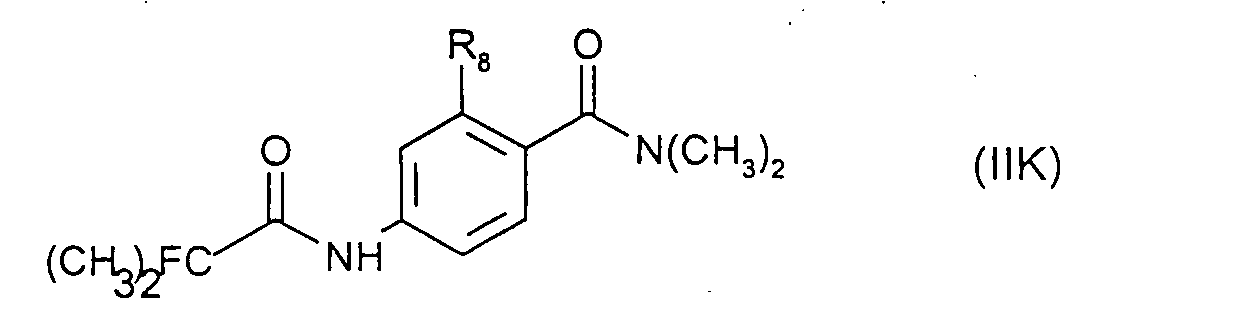
a compound IIL
N-(3'-(1'-chloro-3-methyl 2'-oxopentan))-3,5-dichloro-4-methylbenzamide; or
a compound IIM
(S)-1-anilino-4-methyl-2-methylthio-4-phenylimidazolin-5-one; or
a compound of formula IINa compound of formula IIP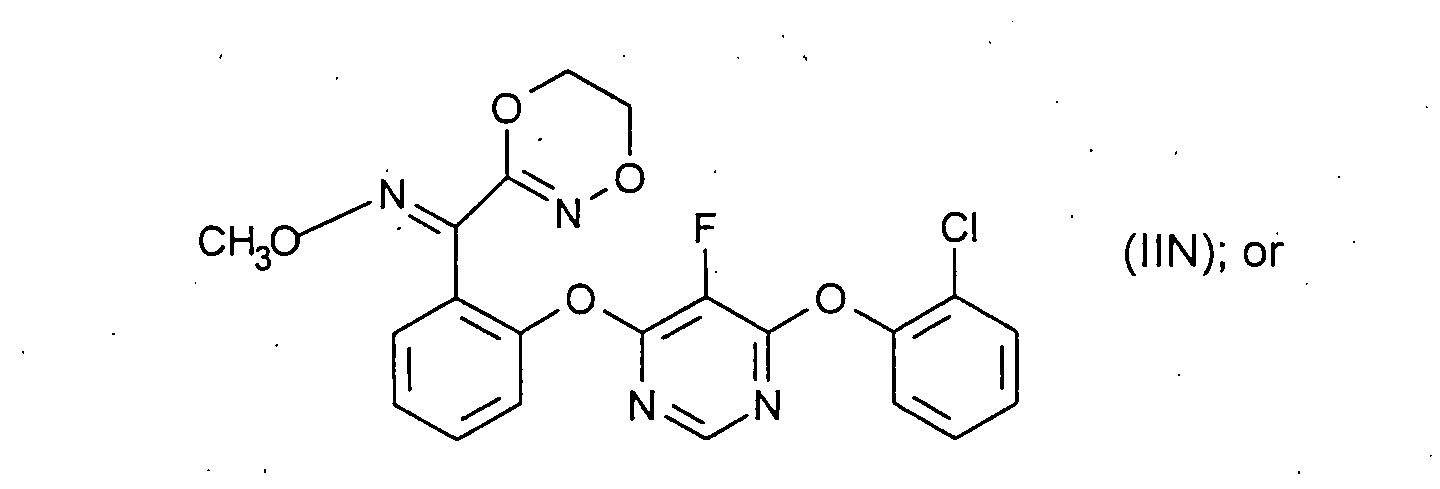 a compound IIQ
N-methyl-2-[α-{[(α-methyl-3-trifluoromethyl-benzyl)imino]-oxy}-o-tolyl]-glyoxalic acidamide-O-methyloxime. - A method according to claim 1 wherein the components b) is selected from the compounds of formula IIG, IIH, IIK and IIL.
- A method according to claim 1 wherein the component b) is selected from the group comprising IIC, IID, IIE, IIF and IIJ.
- A method according to claim 1 wherein the component b) is selected from the group comprising IIM, IIN, IIP or IIQ.
- A method according to any of claims 1 to 4 wherein the components a) and b) are applied in a quantity producing a synergistic disease controlling effect, specially a fungicidal effect.
- A fungicidal composition comprising a fungicidally effective combination ofa) a compound I according to claim 1
in association withb) either
a compound of formula IIC, or
a compound IID, or
a compound IIE, or
a compound of formula IIF, or
a compound of formula IIG, or
a compound of formula IIH, or
a compound IIJ, or
a compound of formula IIK, or
a compound IIL, or
a compound of formula IIM, or
a compound of formula IIN, or
a compound of formula IIP, or
a compound IIQ
as defined in claim 1. - A composition according to claim 6 the weight ratio of a) to b) is between 10: 1 and 1 : 20.
- A composition according to claim 6 wherein the component b) is selected from the group comprising IIG, IIH, IIK and IIL.
- A composition according to claim 6 wherein the component b) is selected from the group comprising IIC, IID, IIE, IIF and IIJ.
- A composition according to claim 6 wherein the component b) is selected from the group comprising IIM, IIN, IIP and IIQ.
Priority Applications (2)
| Application Number | Priority Date | Filing Date | Title |
|---|---|---|---|
| EP06019648A EP1728427A2 (en) | 1998-06-08 | 1999-06-04 | Fungicidal combinations comprising a glyoxalic acid methylester methyloxime derivate |
| EP06019649A EP1728428A3 (en) | 1998-06-08 | 1999-06-04 | Fungicidal combinations comprising a glyoxalic acid methylester methyloxime derivate |
Applications Claiming Priority (5)
| Application Number | Priority Date | Filing Date | Title |
|---|---|---|---|
| GB9812331 | 1998-06-08 | ||
| GBGB9812331.8A GB9812331D0 (en) | 1998-06-08 | 1998-06-08 | Organic compounds |
| GB9903669 | 1999-02-17 | ||
| GBGB9903669.1A GB9903669D0 (en) | 1999-02-17 | 1999-02-17 | Organic compounds |
| EP99927880A EP1085806B1 (en) | 1998-06-08 | 1999-06-04 | Fungicidal combinations comprising a glyoxalic acid methylester methyloxime derivative |
Related Parent Applications (1)
| Application Number | Title | Priority Date | Filing Date |
|---|---|---|---|
| EP99927880A Division EP1085806B1 (en) | 1998-06-08 | 1999-06-04 | Fungicidal combinations comprising a glyoxalic acid methylester methyloxime derivative |
Related Child Applications (2)
| Application Number | Title | Priority Date | Filing Date |
|---|---|---|---|
| EP06019649A Division EP1728428A3 (en) | 1998-06-08 | 1999-06-04 | Fungicidal combinations comprising a glyoxalic acid methylester methyloxime derivate |
| EP06019648A Division EP1728427A2 (en) | 1998-06-08 | 1999-06-04 | Fungicidal combinations comprising a glyoxalic acid methylester methyloxime derivate |
Publications (3)
| Publication Number | Publication Date |
|---|---|
| EP1380210A2 true EP1380210A2 (en) | 2004-01-14 |
| EP1380210A3 EP1380210A3 (en) | 2004-04-21 |
| EP1380210B1 EP1380210B1 (en) | 2007-04-18 |
Family
ID=26313824
Family Applications (4)
| Application Number | Title | Priority Date | Filing Date |
|---|---|---|---|
| EP06019649A Withdrawn EP1728428A3 (en) | 1998-06-08 | 1999-06-04 | Fungicidal combinations comprising a glyoxalic acid methylester methyloxime derivate |
| EP06019648A Withdrawn EP1728427A2 (en) | 1998-06-08 | 1999-06-04 | Fungicidal combinations comprising a glyoxalic acid methylester methyloxime derivate |
| EP99927880A Expired - Lifetime EP1085806B1 (en) | 1998-06-08 | 1999-06-04 | Fungicidal combinations comprising a glyoxalic acid methylester methyloxime derivative |
| EP03022589A Expired - Lifetime EP1380210B1 (en) | 1998-06-08 | 1999-06-04 | Fungicidal combinations comprising a glyoxalic acid methylester methyloxime derivative |
Family Applications Before (3)
| Application Number | Title | Priority Date | Filing Date |
|---|---|---|---|
| EP06019649A Withdrawn EP1728428A3 (en) | 1998-06-08 | 1999-06-04 | Fungicidal combinations comprising a glyoxalic acid methylester methyloxime derivate |
| EP06019648A Withdrawn EP1728427A2 (en) | 1998-06-08 | 1999-06-04 | Fungicidal combinations comprising a glyoxalic acid methylester methyloxime derivate |
| EP99927880A Expired - Lifetime EP1085806B1 (en) | 1998-06-08 | 1999-06-04 | Fungicidal combinations comprising a glyoxalic acid methylester methyloxime derivative |
Country Status (24)
| Country | Link |
|---|---|
| US (6) | US6395761B2 (en) |
| EP (4) | EP1728428A3 (en) |
| JP (1) | JP2002517410A (en) |
| KR (1) | KR100580808B1 (en) |
| CN (2) | CN1304288A (en) |
| AR (4) | AR030006A1 (en) |
| AT (2) | ATE279111T1 (en) |
| AU (1) | AU743663B2 (en) |
| BR (1) | BR9911004A (en) |
| CA (1) | CA2333267A1 (en) |
| CU (1) | CU22949A3 (en) |
| CZ (1) | CZ301164B6 (en) |
| DE (2) | DE69921123T2 (en) |
| ES (2) | ES2229719T3 (en) |
| HU (1) | HUP0102750A3 (en) |
| IL (3) | IL139597A0 (en) |
| NZ (1) | NZ508517A (en) |
| PL (2) | PL345124A1 (en) |
| PT (1) | PT1085806E (en) |
| RU (1) | RU2208316C2 (en) |
| TR (5) | TR200102940T2 (en) |
| TW (1) | TW539535B (en) |
| UA (1) | UA70327C2 (en) |
| WO (1) | WO1999063813A2 (en) |
Families Citing this family (6)
| Publication number | Priority date | Publication date | Assignee | Title |
|---|---|---|---|---|
| UA70327C2 (en) * | 1998-06-08 | 2004-10-15 | Баєр Акціенгезельшафт | Method of combating phytopathogenic diseases on crop plants and a fungicidal composition |
| WO2002054870A2 (en) * | 2001-01-16 | 2002-07-18 | Basf Aktiengesellschaft | Fungicide mixtures based on imidazole derivatives |
| DE10347090A1 (en) | 2003-10-10 | 2005-05-04 | Bayer Cropscience Ag | Synergistic fungicidal drug combinations |
| ZA200702378B (en) * | 2004-09-27 | 2008-08-27 | Du Pont | Fungicidal mixtures of thlophene derivative |
| DE102005058837A1 (en) * | 2005-12-09 | 2007-06-14 | Bayer Cropscience Ag | Fungicidal combination of active ingredients |
| WO2020231751A1 (en) | 2019-05-10 | 2020-11-19 | Bayer Cropscience Lp | Active compound combinations |
Family Cites Families (44)
| Publication number | Priority date | Publication date | Assignee | Title |
|---|---|---|---|---|
| EP0278595B2 (en) | 1987-02-09 | 2000-01-12 | Zeneca Limited | Fungicides |
| IE62559B1 (en) | 1989-02-02 | 1995-02-08 | Ici Plc | Fungicides |
| DE3915755A1 (en) | 1989-05-13 | 1990-11-29 | Bayer Ag | FUNGICIDAL AGENTS AND SUBSTITUTED AMINO ACID DERIVATIVES AND THE PRODUCTION THEREOF |
| PH11991042549B1 (en) | 1990-06-05 | 2000-12-04 | ||
| GB9018408D0 (en) * | 1990-08-22 | 1990-10-03 | Ici Plc | Fungicides |
| US5453531A (en) * | 1990-08-25 | 1995-09-26 | Bayer Aktiengesellschaft | Substituted valinamide derivatives |
| DE4030038A1 (en) | 1990-09-22 | 1992-03-26 | Basf Ag | New 2-substd. phenyl-acetamide derivs. - useful as fungicides, insecticides, acaricides and nematocides |
| DK0569384T4 (en) * | 1991-01-30 | 2000-12-04 | Zeneca Ltd | fungicides |
| IL103614A (en) | 1991-11-22 | 1998-09-24 | Basf Ag | Carboxamides for controlling botrytis and certain novel such compounds |
| US6002016A (en) | 1991-12-20 | 1999-12-14 | Rhone-Poulenc Agrochimie | Fungicidal 2-imidazolin-5-ones and 2-imidazoline-5-thiones |
| FR2685328B1 (en) | 1991-12-20 | 1995-12-01 | Rhone Poulenc Agrochimie | DERIVATIVES OF 2-IMIDAZOLINE-5-ONES AND 2-IMIDAZOLINE-5-THIONES FUNGICIDES. |
| JP2783130B2 (en) | 1992-10-02 | 1998-08-06 | 三菱化学株式会社 | Methoxyiminoacetic acid derivatives and agricultural and horticultural fungicides containing the same as active ingredients |
| US5304572A (en) | 1992-12-01 | 1994-04-19 | Rohm And Haas Company | N-acetonylbenzamides and their use as fungicides |
| DE4304172A1 (en) * | 1993-02-12 | 1994-08-25 | Bayer Ag | Fungicidal active ingredient combinations |
| DE4309272A1 (en) * | 1993-03-23 | 1994-09-29 | Basf Ag | Fungicidal mixture |
| EP0648740B1 (en) | 1993-04-28 | 1997-10-08 | Kumiai Chemical Industry Co., Ltd. | Amino acid amide derivative, agrohorticultural bactericide, and production process |
| DE4313867A1 (en) * | 1993-04-28 | 1994-11-03 | Bayer Ag | Fungicidal active ingredient combinations |
| DE4321897A1 (en) | 1993-07-01 | 1995-01-12 | Hoechst Schering Agrevo Gmbh | Substituted amino acid derivatives, processes for their preparation, compositions comprising them, and their use |
| CN1046706C (en) | 1994-02-04 | 1999-11-24 | 巴斯福股份公司 | Phenylacetic acid derivatives, their preparation and related intermediates, and compositions containing them |
| DE4423613A1 (en) | 1994-07-06 | 1996-01-11 | Basf Ag | 2- [1 ', 2', 4'-triazole-3'yloxymethylene] anilides, process for their preparation and their use |
| DE4423612A1 (en) | 1994-07-06 | 1996-01-11 | Basf Ag | 2 - [(Dihydro) pyrazolyl-3'-oxymethylene] anilides, process for their preparation and their use |
| FR2722652B1 (en) | 1994-07-22 | 1997-12-19 | Rhone Poulenc Agrochimie | FUNGICIDE COMPOSITION COMPRISING A 2-IMIDAZOLINE-5-ONE |
| PL182711B1 (en) | 1994-08-03 | 2002-02-28 | Ihara Chemical Industry Coltd | Derivatives of amino acids, method of obtaining them, fungicides for use in agriculture or horticulture and method of killing fungi |
| DE4431467A1 (en) | 1994-09-03 | 1996-03-07 | Basf Ag | Caramoylcarboxamides |
| DE4437048A1 (en) * | 1994-10-17 | 1996-04-18 | Bayer Ag | Fungicidal active ingredient combinations |
| TW330146B (en) | 1995-01-23 | 1998-04-21 | Novartis Ag | Crop protection composition and method of protecting plants |
| MY115814A (en) * | 1995-06-16 | 2003-09-30 | Bayer Ip Gmbh | Crop protection compositions |
| UA54395C2 (en) * | 1995-06-16 | 2003-03-17 | Баєр Акціенгезельшафт | Phytobactericidal composition, a method of controlling and preventing plant diseases, a plant propagating material |
| TW384208B (en) * | 1995-09-22 | 2000-03-11 | Basf Ag | Compositions and methods for controlling harmful fungi |
| DE19543746A1 (en) * | 1995-11-24 | 1997-05-28 | Basf Ag | Fungicidal agents |
| PT900021E (en) * | 1996-04-26 | 2002-11-29 | Basf Ag | MIXTURES FUNGICIDES |
| WO1997040671A1 (en) * | 1996-04-26 | 1997-11-06 | Novartis Ag | Pesticidal compositions |
| TW438575B (en) * | 1996-08-28 | 2001-06-07 | Basf Ag | Compositions and methods for controlling harmful fungi |
| SK283401B6 (en) * | 1996-08-30 | 2003-07-01 | Basf Aktiengesellschaft | Fungicidal mixtures |
| KR20000052948A (en) | 1996-11-01 | 2000-08-25 | 메리 이. 보울러 | Fungicidal cyclic amides |
| GB9624615D0 (en) * | 1996-11-26 | 1997-01-15 | Zeneca Ltd | Chrystallisation process |
| DE19739982A1 (en) | 1996-12-10 | 1998-06-18 | Bayer Ag | Fungicidal active ingredient combinations |
| AP1119A (en) * | 1996-12-13 | 2002-11-29 | Bayer Ag | A microbicide composition for plant protection. |
| ZA9711323B (en) * | 1997-01-30 | 1999-06-17 | I E Du Pont De Nemours And Com | Fungicidal mixtures |
| US20020072535A1 (en) * | 1997-04-18 | 2002-06-13 | Klaus Stenzel | Fungicide active substance combinations |
| DE19716256A1 (en) * | 1997-04-18 | 1998-10-22 | Bayer Ag | Fungicidal active ingredient combinations |
| UA70327C2 (en) * | 1998-06-08 | 2004-10-15 | Баєр Акціенгезельшафт | Method of combating phytopathogenic diseases on crop plants and a fungicidal composition |
| CA2393988A1 (en) * | 1999-12-13 | 2001-06-21 | Bayer Aktiengesellschaft | Fungicidal combinations of active substances |
| DK1482798T3 (en) * | 2002-03-01 | 2006-07-31 | Basf Ag | Fungicide mixture based on prothioconazole and trifloxystrobin |
-
1999
- 1999-04-06 UA UA2000127007A patent/UA70327C2/en unknown
- 1999-04-19 TW TW088106220A patent/TW539535B/en not_active IP Right Cessation
- 1999-06-04 CZ CZ20004542A patent/CZ301164B6/en not_active IP Right Cessation
- 1999-06-04 EP EP06019649A patent/EP1728428A3/en not_active Withdrawn
- 1999-06-04 DE DE69921123T patent/DE69921123T2/en not_active Expired - Lifetime
- 1999-06-04 TR TR2001/02940T patent/TR200102940T2/en unknown
- 1999-06-04 NZ NZ508517A patent/NZ508517A/en unknown
- 1999-06-04 TR TR2001/03300T patent/TR200103300T2/en unknown
- 1999-06-04 BR BR9911004-0A patent/BR9911004A/en not_active Application Discontinuation
- 1999-06-04 AR ARP990102662A patent/AR030006A1/en active IP Right Grant
- 1999-06-04 PL PL99345124A patent/PL345124A1/en unknown
- 1999-06-04 CN CN99807125A patent/CN1304288A/en active Pending
- 1999-06-04 CA CA002333267A patent/CA2333267A1/en not_active Abandoned
- 1999-06-04 WO PCT/EP1999/003883 patent/WO1999063813A2/en not_active Ceased
- 1999-06-04 DE DE69935872T patent/DE69935872T2/en not_active Expired - Lifetime
- 1999-06-04 TR TR2000/03671T patent/TR200003671T2/en unknown
- 1999-06-04 CN CNB2003101024382A patent/CN1290414C/en not_active Expired - Lifetime
- 1999-06-04 PT PT99927880T patent/PT1085806E/en unknown
- 1999-06-04 EP EP06019648A patent/EP1728427A2/en not_active Withdrawn
- 1999-06-04 ES ES99927880T patent/ES2229719T3/en not_active Expired - Lifetime
- 1999-06-04 RU RU2001101442/04A patent/RU2208316C2/en not_active IP Right Cessation
- 1999-06-04 EP EP99927880A patent/EP1085806B1/en not_active Expired - Lifetime
- 1999-06-04 EP EP03022589A patent/EP1380210B1/en not_active Expired - Lifetime
- 1999-06-04 TR TR2001/03301T patent/TR200103301T2/en unknown
- 1999-06-04 KR KR1020007013892A patent/KR100580808B1/en not_active Expired - Fee Related
- 1999-06-04 AT AT99927880T patent/ATE279111T1/en active
- 1999-06-04 HU HU0102750A patent/HUP0102750A3/en unknown
- 1999-06-04 JP JP2000552898A patent/JP2002517410A/en active Pending
- 1999-06-04 PL PL383223A patent/PL204353B1/en not_active IP Right Cessation
- 1999-06-04 AU AU45072/99A patent/AU743663B2/en not_active Ceased
- 1999-06-04 ES ES03022589T patent/ES2285019T3/en not_active Expired - Lifetime
- 1999-06-04 IL IL13959799A patent/IL139597A0/en active IP Right Grant
- 1999-06-04 TR TR2001/03298T patent/TR200103298T2/en unknown
- 1999-06-04 AT AT03022589T patent/ATE359706T1/en not_active IP Right Cessation
-
2000
- 2000-11-09 IL IL139597A patent/IL139597A/en not_active IP Right Cessation
- 2000-12-02 US US09/728,185 patent/US6395761B2/en not_active Expired - Lifetime
- 2000-12-08 CU CU20000288A patent/CU22949A3/en not_active IP Right Cessation
-
2002
- 2002-01-28 US US10/059,087 patent/US6451855B1/en not_active Expired - Fee Related
- 2002-07-24 US US10/202,125 patent/US20020198181A1/en not_active Abandoned
-
2006
- 2006-02-07 US US11/348,760 patent/US20060128698A1/en not_active Abandoned
- 2006-11-30 IL IL179716A patent/IL179716A/en not_active IP Right Cessation
-
2007
- 2007-08-24 AR ARP070103764A patent/AR062516A2/en not_active Application Discontinuation
- 2007-08-24 AR ARP070103766A patent/AR062518A2/en not_active Application Discontinuation
- 2007-08-24 AR ARP070103767A patent/AR062519A2/en not_active Application Discontinuation
-
2009
- 2009-08-19 US US12/543,731 patent/US20090306061A1/en not_active Abandoned
- 2009-08-19 US US12/543,717 patent/US20100048546A1/en not_active Abandoned
Also Published As
Similar Documents
| Publication | Publication Date | Title |
|---|---|---|
| WO2004049804A2 (en) | Fungicidal combinations for crop potection | |
| EP1374680B1 (en) | Fungicidal combinations comprising a 4-phenoxyquinoline | |
| US20090306061A1 (en) | Fungicidal combinations comprising a glyoxalic acid methyl ester-o-methyloxime derivatives | |
| EP1317178B1 (en) | Fungicidal compositions | |
| AU2002212227A1 (en) | Fungicidal compositions | |
| AU765903B2 (en) | Fungicidal combinations comprising a 4-phenoxyquinoline | |
| US20030189958A1 (en) | Fungicidal compositions | |
| MXPA00011995A (en) | Fungicidal combinations comprising glyoxalic acid methyl ester-o-methyloxime derivatives | |
| PL202640B1 (en) | Fungicidal combinations comprising a glyoxalic acid methylester methyloxime derivative |
Legal Events
| Date | Code | Title | Description |
|---|---|---|---|
| PUAI | Public reference made under article 153(3) epc to a published international application that has entered the european phase |
Free format text: ORIGINAL CODE: 0009012 |
|
| AC | Divisional application: reference to earlier application |
Ref document number: 1085806 Country of ref document: EP Kind code of ref document: P |
|
| AK | Designated contracting states |
Kind code of ref document: A2 Designated state(s): AT BE CH CY DE DK ES FI FR GB GR IE IT LI LU MC NL PT SE |
|
| AX | Request for extension of the european patent |
Extension state: RO |
|
| PUAL | Search report despatched |
Free format text: ORIGINAL CODE: 0009013 |
|
| AK | Designated contracting states |
Kind code of ref document: A3 Designated state(s): AT BE CH CY DE DK ES FI FR GB GR IE IT LI LU MC NL PT SE |
|
| AX | Request for extension of the european patent |
Extension state: RO |
|
| 17P | Request for examination filed |
Effective date: 20041021 |
|
| AKX | Designation fees paid |
Designated state(s): AT BE CH CY DE DK ES FI FR GB GR IE IT LI LU MC NL PT SE |
|
| AXX | Extension fees paid |
Extension state: RO Payment date: 20041021 |
|
| 17Q | First examination report despatched |
Effective date: 20050511 |
|
| GRAP | Despatch of communication of intention to grant a patent |
Free format text: ORIGINAL CODE: EPIDOSNIGR1 |
|
| RTI1 | Title (correction) |
Free format text: FUNGICIDAL COMBINATIONS COMPRISING A GLYOXALIC ACID METHYLESTER METHYLOXIME DERIVATIVE |
|
| RIC1 | Information provided on ipc code assigned before grant |
Ipc: A01N 37/50 20060101AFI20061013BHEP |
|
| GRAS | Grant fee paid |
Free format text: ORIGINAL CODE: EPIDOSNIGR3 |
|
| GRAA | (expected) grant |
Free format text: ORIGINAL CODE: 0009210 |
|
| AC | Divisional application: reference to earlier application |
Ref document number: 1085806 Country of ref document: EP Kind code of ref document: P |
|
| AK | Designated contracting states |
Kind code of ref document: B1 Designated state(s): AT BE CH CY DE DK ES FI FR GB GR IE IT LI LU MC NL PT SE |
|
| AX | Request for extension of the european patent |
Extension state: RO |
|
| PG25 | Lapsed in a contracting state [announced via postgrant information from national office to epo] |
Ref country code: FI Free format text: LAPSE BECAUSE OF FAILURE TO SUBMIT A TRANSLATION OF THE DESCRIPTION OR TO PAY THE FEE WITHIN THE PRESCRIBED TIME-LIMIT Effective date: 20070418 Ref country code: CH Free format text: LAPSE BECAUSE OF FAILURE TO SUBMIT A TRANSLATION OF THE DESCRIPTION OR TO PAY THE FEE WITHIN THE PRESCRIBED TIME-LIMIT Effective date: 20070418 Ref country code: LI Free format text: LAPSE BECAUSE OF FAILURE TO SUBMIT A TRANSLATION OF THE DESCRIPTION OR TO PAY THE FEE WITHIN THE PRESCRIBED TIME-LIMIT Effective date: 20070418 |
|
| REG | Reference to a national code |
Ref country code: CH Ref legal event code: EP |
|
| REG | Reference to a national code |
Ref country code: IE Ref legal event code: FG4D |
|
| REF | Corresponds to: |
Ref document number: 69935872 Country of ref document: DE Date of ref document: 20070531 Kind code of ref document: P |
|
| PG25 | Lapsed in a contracting state [announced via postgrant information from national office to epo] |
Ref country code: SE Free format text: LAPSE BECAUSE OF FAILURE TO SUBMIT A TRANSLATION OF THE DESCRIPTION OR TO PAY THE FEE WITHIN THE PRESCRIBED TIME-LIMIT Effective date: 20070718 |
|
| PG25 | Lapsed in a contracting state [announced via postgrant information from national office to epo] |
Ref country code: PT Free format text: LAPSE BECAUSE OF FAILURE TO SUBMIT A TRANSLATION OF THE DESCRIPTION OR TO PAY THE FEE WITHIN THE PRESCRIBED TIME-LIMIT Effective date: 20070918 |
|
| ET | Fr: translation filed | ||
| REG | Reference to a national code |
Ref country code: CH Ref legal event code: PL |
|
| REG | Reference to a national code |
Ref country code: ES Ref legal event code: FG2A Ref document number: 2285019 Country of ref document: ES Kind code of ref document: T3 |
|
| PG25 | Lapsed in a contracting state [announced via postgrant information from national office to epo] |
Ref country code: AT Free format text: LAPSE BECAUSE OF FAILURE TO SUBMIT A TRANSLATION OF THE DESCRIPTION OR TO PAY THE FEE WITHIN THE PRESCRIBED TIME-LIMIT Effective date: 20070418 |
|
| PG25 | Lapsed in a contracting state [announced via postgrant information from national office to epo] |
Ref country code: MC Free format text: LAPSE BECAUSE OF NON-PAYMENT OF DUE FEES Effective date: 20070630 Ref country code: DK Free format text: LAPSE BECAUSE OF FAILURE TO SUBMIT A TRANSLATION OF THE DESCRIPTION OR TO PAY THE FEE WITHIN THE PRESCRIBED TIME-LIMIT Effective date: 20070418 |
|
| PLBE | No opposition filed within time limit |
Free format text: ORIGINAL CODE: 0009261 |
|
| STAA | Information on the status of an ep patent application or granted ep patent |
Free format text: STATUS: NO OPPOSITION FILED WITHIN TIME LIMIT |
|
| 26N | No opposition filed |
Effective date: 20080121 |
|
| PG25 | Lapsed in a contracting state [announced via postgrant information from national office to epo] |
Ref country code: GR Free format text: LAPSE BECAUSE OF FAILURE TO SUBMIT A TRANSLATION OF THE DESCRIPTION OR TO PAY THE FEE WITHIN THE PRESCRIBED TIME-LIMIT Effective date: 20070719 |
|
| PG25 | Lapsed in a contracting state [announced via postgrant information from national office to epo] |
Ref country code: CY Free format text: LAPSE BECAUSE OF FAILURE TO SUBMIT A TRANSLATION OF THE DESCRIPTION OR TO PAY THE FEE WITHIN THE PRESCRIBED TIME-LIMIT Effective date: 20070418 |
|
| PG25 | Lapsed in a contracting state [announced via postgrant information from national office to epo] |
Ref country code: LU Free format text: LAPSE BECAUSE OF NON-PAYMENT OF DUE FEES Effective date: 20070604 |
|
| PGFP | Annual fee paid to national office [announced via postgrant information from national office to epo] |
Ref country code: ES Payment date: 20110622 Year of fee payment: 13 Ref country code: FR Payment date: 20110621 Year of fee payment: 13 Ref country code: IE Payment date: 20110617 Year of fee payment: 13 |
|
| PGFP | Annual fee paid to national office [announced via postgrant information from national office to epo] |
Ref country code: NL Payment date: 20110629 Year of fee payment: 13 Ref country code: GB Payment date: 20110601 Year of fee payment: 13 |
|
| PGFP | Annual fee paid to national office [announced via postgrant information from national office to epo] |
Ref country code: BE Payment date: 20110614 Year of fee payment: 13 Ref country code: DE Payment date: 20110531 Year of fee payment: 13 Ref country code: IT Payment date: 20110530 Year of fee payment: 13 |
|
| BERE | Be: lapsed |
Owner name: BAYER CROPSCIENCE A.G. Effective date: 20120630 |
|
| REG | Reference to a national code |
Ref country code: NL Ref legal event code: V1 Effective date: 20130101 |
|
| GBPC | Gb: european patent ceased through non-payment of renewal fee |
Effective date: 20120604 |
|
| PG25 | Lapsed in a contracting state [announced via postgrant information from national office to epo] |
Ref country code: IT Free format text: LAPSE BECAUSE OF NON-PAYMENT OF DUE FEES Effective date: 20120604 |
|
| REG | Reference to a national code |
Ref country code: IE Ref legal event code: MM4A |
|
| REG | Reference to a national code |
Ref country code: FR Ref legal event code: ST Effective date: 20130228 |
|
| REG | Reference to a national code |
Ref country code: DE Ref legal event code: R119 Ref document number: 69935872 Country of ref document: DE Effective date: 20130101 |
|
| PG25 | Lapsed in a contracting state [announced via postgrant information from national office to epo] |
Ref country code: FR Free format text: LAPSE BECAUSE OF NON-PAYMENT OF DUE FEES Effective date: 20120702 Ref country code: GB Free format text: LAPSE BECAUSE OF NON-PAYMENT OF DUE FEES Effective date: 20120604 Ref country code: BE Free format text: LAPSE BECAUSE OF NON-PAYMENT OF DUE FEES Effective date: 20120630 Ref country code: DE Free format text: LAPSE BECAUSE OF NON-PAYMENT OF DUE FEES Effective date: 20130101 Ref country code: IE Free format text: LAPSE BECAUSE OF NON-PAYMENT OF DUE FEES Effective date: 20120604 Ref country code: NL Free format text: LAPSE BECAUSE OF NON-PAYMENT OF DUE FEES Effective date: 20130101 |
|
| REG | Reference to a national code |
Ref country code: ES Ref legal event code: FD2A Effective date: 20131030 |
|
| PG25 | Lapsed in a contracting state [announced via postgrant information from national office to epo] |
Ref country code: ES Free format text: LAPSE BECAUSE OF NON-PAYMENT OF DUE FEES Effective date: 20120605 |