EP1380317A1 - Verriegelungsmechanismus für ein Shunt-Ventil - Google Patents
Verriegelungsmechanismus für ein Shunt-Ventil Download PDFInfo
- Publication number
- EP1380317A1 EP1380317A1 EP20030254355 EP03254355A EP1380317A1 EP 1380317 A1 EP1380317 A1 EP 1380317A1 EP 20030254355 EP20030254355 EP 20030254355 EP 03254355 A EP03254355 A EP 03254355A EP 1380317 A1 EP1380317 A1 EP 1380317A1
- Authority
- EP
- European Patent Office
- Prior art keywords
- gripping arm
- rotor assembly
- assembly
- actuating mechanism
- deformable membrane
- Prior art date
- Legal status (The legal status is an assumption and is not a legal conclusion. Google has not performed a legal analysis and makes no representation as to the accuracy of the status listed.)
- Granted
Links
Images




Classifications
-
- F—MECHANICAL ENGINEERING; LIGHTING; HEATING; WEAPONS; BLASTING
- F16—ENGINEERING ELEMENTS AND UNITS; GENERAL MEASURES FOR PRODUCING AND MAINTAINING EFFECTIVE FUNCTIONING OF MACHINES OR INSTALLATIONS; THERMAL INSULATION IN GENERAL
- F16K—VALVES; TAPS; COCKS; ACTUATING-FLOATS; DEVICES FOR VENTING OR AERATING
- F16K35/00—Means to prevent accidental or unauthorised actuation
- F16K35/02—Means to prevent accidental or unauthorised actuation to be locked or disconnected by means of a pushing or pulling action
- F16K35/022—Means to prevent accidental or unauthorised actuation to be locked or disconnected by means of a pushing or pulling action the locking mechanism being actuated by a separate actuating element
- F16K35/025—Means to prevent accidental or unauthorised actuation to be locked or disconnected by means of a pushing or pulling action the locking mechanism being actuated by a separate actuating element said actuating element being operated manually (e.g. a push-button located in the valve actuator)
-
- A—HUMAN NECESSITIES
- A61—MEDICAL OR VETERINARY SCIENCE; HYGIENE
- A61M—DEVICES FOR INTRODUCING MEDIA INTO, OR ONTO, THE BODY; DEVICES FOR TRANSDUCING BODY MEDIA OR FOR TAKING MEDIA FROM THE BODY; DEVICES FOR PRODUCING OR ENDING SLEEP OR STUPOR
- A61M27/00—Drainage appliance for wounds or the like, i.e. wound drains, implanted drains
- A61M27/002—Implant devices for drainage of body fluids from one part of the body to another
- A61M27/006—Cerebrospinal drainage; Accessories therefor, e.g. valves
-
- F—MECHANICAL ENGINEERING; LIGHTING; HEATING; WEAPONS; BLASTING
- F16—ENGINEERING ELEMENTS AND UNITS; GENERAL MEASURES FOR PRODUCING AND MAINTAINING EFFECTIVE FUNCTIONING OF MACHINES OR INSTALLATIONS; THERMAL INSULATION IN GENERAL
- F16K—VALVES; TAPS; COCKS; ACTUATING-FLOATS; DEVICES FOR VENTING OR AERATING
- F16K35/00—Means to prevent accidental or unauthorised actuation
- F16K35/04—Means to prevent accidental or unauthorised actuation yieldingly resisting the actuation
-
- Y—GENERAL TAGGING OF NEW TECHNOLOGICAL DEVELOPMENTS; GENERAL TAGGING OF CROSS-SECTIONAL TECHNOLOGIES SPANNING OVER SEVERAL SECTIONS OF THE IPC; TECHNICAL SUBJECTS COVERED BY FORMER USPC CROSS-REFERENCE ART COLLECTIONS [XRACs] AND DIGESTS
- Y10—TECHNICAL SUBJECTS COVERED BY FORMER USPC
- Y10T—TECHNICAL SUBJECTS COVERED BY FORMER US CLASSIFICATION
- Y10T137/00—Fluid handling
- Y10T137/7069—With lock or seal
-
- Y—GENERAL TAGGING OF NEW TECHNOLOGICAL DEVELOPMENTS; GENERAL TAGGING OF CROSS-SECTIONAL TECHNOLOGIES SPANNING OVER SEVERAL SECTIONS OF THE IPC; TECHNICAL SUBJECTS COVERED BY FORMER USPC CROSS-REFERENCE ART COLLECTIONS [XRACs] AND DIGESTS
- Y10—TECHNICAL SUBJECTS COVERED BY FORMER USPC
- Y10T—TECHNICAL SUBJECTS COVERED BY FORMER US CLASSIFICATION
- Y10T137/00—Fluid handling
- Y10T137/7069—With lock or seal
- Y10T137/7131—Common lock and valve actuator
- Y10T137/7225—Mechanical movement between lock and valve
-
- Y—GENERAL TAGGING OF NEW TECHNOLOGICAL DEVELOPMENTS; GENERAL TAGGING OF CROSS-SECTIONAL TECHNOLOGIES SPANNING OVER SEVERAL SECTIONS OF THE IPC; TECHNICAL SUBJECTS COVERED BY FORMER USPC CROSS-REFERENCE ART COLLECTIONS [XRACs] AND DIGESTS
- Y10—TECHNICAL SUBJECTS COVERED BY FORMER USPC
- Y10T—TECHNICAL SUBJECTS COVERED BY FORMER US CLASSIFICATION
- Y10T137/00—Fluid handling
- Y10T137/7069—With lock or seal
- Y10T137/7256—Locks against rotary motion
-
- Y—GENERAL TAGGING OF NEW TECHNOLOGICAL DEVELOPMENTS; GENERAL TAGGING OF CROSS-SECTIONAL TECHNOLOGIES SPANNING OVER SEVERAL SECTIONS OF THE IPC; TECHNICAL SUBJECTS COVERED BY FORMER USPC CROSS-REFERENCE ART COLLECTIONS [XRACs] AND DIGESTS
- Y10—TECHNICAL SUBJECTS COVERED BY FORMER USPC
- Y10T—TECHNICAL SUBJECTS COVERED BY FORMER US CLASSIFICATION
- Y10T70/00—Locks
- Y10T70/50—Special application
- Y10T70/5611—For control and machine elements
- Y10T70/5615—Valve
Definitions
- the present invention relates generally to medical devices for directing bodily fluids from one region of a patient to another region. More specifically, this invention relates to shunt systems having an adjustable shunt valve to control the flow of fluid through the system and, even more specifically, a locking mechanism to control the adjustment of the shunt valve.
- Hydrocephalus is a neurological condition caused by the abnormal accumulation of cerebrospinal fluid (CSF) within the ventricles, or cavities, of the brain.
- CSF cerebrospinal fluid
- Hydrocephalus which can affect infants, children and adults, arises when the normal drainage of CSF in the brain is blocked in some way.
- Such blockage can be caused by a number of factors, including, for example, genetic predisposition, intraventricular or intracranial hemorrhage, infections such as meningitis, or head trauma.
- Blockage of the flow of CSF consequently creates an imbalance between the rate at which CSF is produced by the ventricular system and the rate at which CSF is absorbed into the bloodstream. This imbalance increases pressure on the brain and causes the ventricles to enlarge.
- hydrocephalus can result in serious medical conditions, including subdural hematoma, compression of the brain tissue, and impaired blood flow.
- Hydrocephalus is most often treated by surgically inserting a shunt system to divert the flow of CSF from the ventricle to another area of the body, such as the right atrium, the peritoneum, or other locations in the body where CSF can be absorbed as part of the circulatory system.
- a shunt system has been developed for the treatment of hydrocephalus.
- shunt systems include a ventricular catheter, a shunt valve and a drainage catheter.
- the ventricular catheter can have a first end that is inserted through a hole in the skull of a patient, such that the first end resides within the ventricle of a patient, and a second end of the ventricular catheter that is typically coupled to the inlet portion of the shunt valve.
- the first end of the ventricular catheter can contain multiple holes or pores to allow CSF to enter the shunt system.
- the drainage catheter has a first end that is attached to the outlet portion of the shunt valve and a second end that is configured to allow CSF to exit the shunt system for reabsorption into the bloodstream.
- the shunt valve which can have a variety of configurations, is effective to regulate the flow rate of fluid through the shunt system.
- the fluid flow rate can be proportional to the pressure difference at the valve mechanism.
- These shunt valve mechanisms permit fluid flow only after the fluid pressure has reached a certain threshold level.
- the shunt valve will allow fluid to flow normally until the intracranial pressure has been reduced to a level that is less than the threshold pressure of the shunt valve, subject to any hysteresis of the device.
- Shunt valves can be designed to allow adjustment of the threshold pressure level at which fluid flow will commence. It is generally preferred to allow external adjustment of the pressure threshold to avoid invasive surgical procedures.
- the shunt valve contains a magnetized rotor to control the pressure threshold of the valve. Physicians can then use an external adjustment mechanism, such as a magnetic programmer, to adjust the pressure threshold of the shunt valve.
- these magnetized rotors can be unintentionally adjusted in the presence of a strong external magnetic field, such as during an MRI procedure. Unintentional adjustment of the pressure threshold could lead to either the overdrainage or underdrainage of CSF, which can result in dangerous conditions, such as subdural hematoma.
- the first lever is a pivotable lever having a shaft adapted to engage a second end of the pin, while the second lever is a manually actuated lever that is biased to urge the pin into the first, extended position.
- This manually actuated lever is located within the valve chamber that is used to pump, or flush, fluid from the shunt valve. Thus, by virtue of its location within the pumping chamber, the manually actuated lever, and consequently the pin-actuating means, can impair or inhibit the function of the pumping chamber.
- a shunt valve having an improved locking mechanism that simply and effectively prevents unintentional adjustment of the valve pressure threshold, yet still allows simple, non-invasive adjustment of the pressure threshold of the valve.
- a locking mechanism that does not compromise or inhibit normal operation of the shunt valve.
- a locking mechanism that has been designed to allow a physician to easily determine the location of the locking mechanism.
- a locking mechanism that has little or no artifact, or extraneous signal, during various radiological imaging techniques, including X-Ray or MRI, and therefore, will not interfere with, or compromise necessary medical procedures.
- the present invention overcomes the disadvantages that are inherent in prior art fluid management systems by providing a locking assembly that simply and effectively prevents any unintentional adjustment of an adjustable valve mechanism in a fluid flow control device, without compromising the function of the fluid flow control device.
- the locking assembly of the present invention generally includes at least one gripping arm for frictionally engaging at least a portion of the adjustable valve mechanism, and an actuating mechanism for controlling the deployment and release of the at least one gripping arm.
- the locking assembly prevents unintentional adjustments that can adversely affect the pressure settings of the fluid flow controlling medical device.
- the locking assembly prevents unintentional adjustment in the presence of a strong external magnetic field, such as for example, the strong unidirectional magnetic field in an MRI procedure.
- the provided locking assembly allows a clinician to easily disengage the locking assembly, such as through the application or removal of an external mechanical force, thereby allowing the clinician to adjust the pressure settings of the fluid flow control device as necessary.
- the locking assembly of the present invention stably maintains an adjustable valve mechanism of an adjustable fluid flow control device in a desired position, thereby preventing any unintentional adjustments of the fluid flow control device.
- the locking assembly of the present invention includes at least one gripping arm that is operatively joined to an actuating mechanism and can control the deployment and release of the at least one gripping arm.
- the locking assembly prevents unintentional adjustments that can adversely affect the pressure settings of the fluid flow controlling medical device.
- the locking assembly prevents unintentional adjustment in the presence of a strong external magnetic field, such as for example, the strong unidirectional magnetic field encountered in an MRI procedure.
- the locking assembly can be easily disengaged, through the application or removal of an external mechanical force, thereby allowing a clinician to adjust the pressure settings of the fluid flow control device.
- the locking assembly of the present invention can be used in conjunction with a shunt valve system, such as the shunt valve system 10 illustrated in FIG. 2.
- the locking assembly of the present invention can be used with a variety of shunt valve systems designed to drain excess fluid from one area of the body and direct it to another site in a patient's body.
- An exemplary shunt valve system for use with the locking assembly of the present invention is a shunt valve system used in a shunt system designed to treat hydrocephalus.
- the shunt valve system 10 is attached to a ventricular catheter (not shown), which is placed within a ventricle of a patient's brain, and a drainage catheter (not shown), which is placed within another area of the patient's body, such as for example, the right atrium of the heart or the peritoneum, where the cerebrospinal fluid (CSF) can be absorbed into the patient's bloodstream.
- the shunt valve system 10 therefore, controls the flow of excess CSF from the ventricle of the brain to another area of the patient's body.
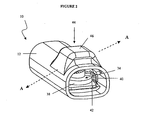
- the shunt valve system 10 used in conjunction with the locking assembly of this first embodiment includes a housing 12 having an outer surface 14 that contacts the target site of implantation and an inner surface 16 that defines a chamber 18.
- the chamber 18 is adapted to allow fluid to flow through the shunt valve system 10.
- the chamber 18 of the shunt valve system 10 includes an inlet port (not shown) for receiving fluid into the shunt valve system 10, and an outlet port (not shown) for releasing fluid from the shunt valve system 10.
- the inlet port is in fluid communication with the ventricular catheter, while the outlet port is in fluid communication with the drainage catheter.
- the distance between the outer surface 14 and the inner surface 16 defines a thickness of the housing 12.
- This thickness can vary, but preferably, the thickness of the housing 12 is in the range of about 0.5 to 1.0 mm.
- the housing 12 of the shunt valve system 10 also includes a first end 20, a second end 22, and a length extending therebetween.
- the length of the housing 12 can vary, but preferably, the length of the housing 12 is determined according to the dimensions of the target site of implantation. More preferably, the housing 12 has a length in the range of about 2.5 to 5.0 cm.
- the housing 12 of the shunt valve system 10 can have virtually any geometry, but preferably, the housing 12 has a generally rectangular shape, as illustrated in FIG. 1A.
- the housing 12 includes a top surface 24, a bottom surface 26, and opposed side surfaces 28, 30, as seen in FIG. 1A.
- the distance between the top surface 24 and bottom surface 26 defines a height H 1 of the housing 12, which can vary, but is preferably in the range of about 4.5 to 6.0 mm.
- the distance between the opposed side surfaces 28, 30 defines a width of the housing 12. This width can vary, but preferably, the width of the housing 12 is in the range of about 7.0 to 10.0 mm.
- the geometry and dimensions of the housing 12 of the shunt valve system 10, and in particular, the height, width, and length of the housing 12 are determined according to the proportions of the target site of implantation.
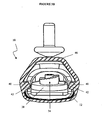
- the housing 12 of the shunt valve system 10 is designed to surround a fluid regulator, such as for example, the shunt valve mechanism 32 illustrated in FIG. 1B, which is effective to control fluid flow through the shunt valve system 10.
- the locking assembly of the present invention can be used in conjunction with virtually any shunt valve mechanism 32 that is effective to control fluid flow, but preferably, the shunt valve mechanism 32 includes a differential pressure valve, which regulates the flow of fluid according to a pressure differential created between the inlet and outlet ports of the shunt valve system 10.
- a pressure differential valve establishes a pressure threshold, which must be met before fluid begins to flow through the shunt valve system 10.
- the shunt valve mechanism 32 is also adapted to allow a clinician to non-invasively adjust the pressure threshold at which fluid begins to flow through the shunt valve system 10.
- FIGS. 1B-3B An exemplary embodiment of the shunt valve mechanism 32, illustrated in FIGS. 1B-3B, is commonly referred to as a ball-in-cone mechanism, such as for example, the Hakim shunt valve mechanism disclosed by U.S. Patent No. 4,615,691, the contents of which are hereby incorporated in their entirety by reference.
- a typical ball-in-cone shunt valve mechanism 32 the pressure threshold at which fluid begins to flow through the shunt valve system 10 is regulated by a sphere, which is seated in a circular orifice and is effective to block fluid flow through the orifice until the established pressure threshold has been met.
- the sphere is operatively joined to a first end of a cantilevered spring, while the second end of the spring is operatively joined to a rotor assembly 34, such as the rotor assembly 34 shown in FIGS. 1B-3B.
- the rotor assembly 34 typically includes a stair-step array, generally in the shape of a spiral staircase, for engaging the second end of the spring. As the rotor assembly 34 is rotated, the second end of the spring moves up or down each stair of the spiral stair array, which results in a corresponding change in the deflection of the cantilevered spring. The change in the angle of deflection of the spring, in turn, alters the force that is exerted by the spring on the sphere. A change in the forced applied by the spring to the sphere results in a corresponding increase or decrease of the established pressure threshold at which fluid begins to flow through the shunt valve system 10.
- the ball-in-cone shunt valve mechanism 32 used in the present invention is adapted to allow a clinician to adjust the pressure threshold by rotating the rotor assembly 34 in a non-invasive manner.
- the rotor assembly 34 of the shunt valve mechanism 32 includes at least one magnet carried in a housing 36 having an outer wall 38 (FIGS. 1B-3B), and optionally, an opposed, inner wall (not shown). This magnet allows the clinician to non-invasively adjust the rotor assembly 34 by applying a strong external magnetic field to the shunt valve system 10, and then rapidly switching the field, which causes the rotor assembly 34 to turn. As described above, when the rotor assembly 34 is turned, the second end of the spring is moved up or down the stair-step array, which ultimately results in a change in the pressure threshold of the shunt valve mechanism 32.
- the locking assembly can effectively prevent the rotor assembly 34 of the shunt valve mechanism 32 from rotating.
- Such a locking feature can be advantageous to prevent the rotor assembly 34 from inadvertent and undesirable rotation due to environmental magnetic forces.
- strong external magnetic forces such as during MRI procedures
- these magnetic forces can cause unanticipated rotation of the rotor assembly 34.
- the present invention overcomes this problem by providing a locking assembly that is not affected by magnetic forces.
- the locking assembly of the present invention includes at least one gripping arm 40, which can frictionally engage at least a portion of the rotor assembly 34 to prevent the rotor assembly 34 from rotating, even in the presence of strong external magnetic forces.
- the locking assembly can include virtually any number of gripping arms 40, but preferably, the locking assembly includes opposed, bilateral gripping arms 40, as shown in FIGS. 3A and 3B. To prevent the rotor assembly 34 from rotating, these gripping arms 40 can frictionally engage at least a portion of the rotor assembly 34 and can apply compressive forces to at least a portion of the rotor assembly 34.
- Each gripping arm 40 can protrude from the inner surface 16 of the housing 12 of the shunt valve system 10, as shown in FIGS. 1A and 2-3B.
- the gripping arms 40 of the locking assembly and the housing 12 of the shunt valve system 10 may be integrally formed, or alternatively, the gripping arms 40 and the housing 12 may comprise separate members that have been mated together.
- a variety of mating techniques known to those having ordinary skill in the art can be used to couple the housing 12 and the gripping arms 40.
- the gripping arms 40 can be welded, ultrasonically bonded, adhesively attached or mechanically mated to the housing 12 of the shunt valve system 10.
- each gripping arm 40 has at least one rotor contacting surface 42 that is designed to frictionally engage at least a portion of the rotor assembly 34.
- the dimensions and geometry of each rotor contacting surface 42 can vary.
- each rotor contacting surface 42 is sufficiently sized and configured to mate with a portion of the rotor assembly 34.
- the contacting surface 42 should be able to maintain the rotor assembly 34 in a static position and counteract any external force urging the rotation of the rotor assembly 34, i.e., provide a braking force which holds the rotor assembly 34 stationary.
- the rotor contacting surface 42 can mate with and frictionally engage the outer wall 38 of the rotor assembly 34, as shown in FIG.
- the rotor contacting surface 42 can mate with and frictionally engage the inner wall (not shown) of the rotor assembly 34, and in yet another embodiment, also not shown in the accompanying figures, the rotor contacting surface 42 can mate with and frictionally engage both the outer wall 38 and the opposed, inner wall (not shown) of the rotor assembly 34.
- the outer wall 38 may be smooth, as shown in FIGS. 1B-3B, or alternatively, it can include friction-increasing surface features (not shown).
- the outer wall 38 can include virtually any surface feature that can increase the friction of the outer wall 38.
- suitable friction-increasing surface features include grooves, detents, ridges, corrugations, roughened surfaces and combinations thereof.
- the inner wall can be smooth, or alternatively, it can include virtually any surface feature that can increase the friction of the inner wall. Suitable friction-increasing surface features include, but are not limited to grooves, detents, ridges, corrugations, roughened surfaces and combinations thereof.
- the rotor contacting surface 42 can be smooth, or alternatively, it can include friction-increasing surface features (not shown), such as the friction-increasing surface features described above.
- the friction-increasing surface features of the rotor contacting surface 42 are designed to mate with corresponding surface features located on the outer wall 38 of the rotor assembly 34, the inner wall of the rotor assembly, or both walls of the rotor assembly 34.
- Actuation of the gripping arms 40 can be achieved by applying an external pressure force to an actuating mechanism 44.
- the actuating mechanism 44 is configured so that the force applied thereto travels through the housing 12 of the shunt valve system 10 and to the gripping arms 40, deforming the housing 12 and enabling the release of the arms 40 from the rotor assembly 34.
- the force applied to the actuating mechanism 44 can enable the arms 40 to engage the rotor assembly 34.
- the actuating mechanism 44 of the locking assembly can have a variety of configurations, but preferably, the actuating mechanism 44 is disposed on the housing 12 of the shunt valve system 10.
- the actuating mechanism 44 and the housing 12 may be integrally formed, or alternatively, the actuating mechanism 44 and the housing 12 may comprise two separate members that have been mated together.
- a variety of mating techniques known to those having ordinary skill in the art can be used to couple the housing 12 and the actuating mechanism 44 such that forces exerted on the actuating mechanism 44 can be transferred to the housing 12 and gripping arms 40.
- the actuating mechanism 44 can be welded, ultrasonically bonded, adhesively attached or mechanically mated to the housing 12.
- the actuating mechanism 44 controls movement of the gripping arm 40 by transferring a force from the actuating mechanism 44 through the housing 12 and to the gripping arm 40, which is integral with, or mated to, the housing 12, as described above.
- the system is configured such that the gripping arms 40 are biased to the engaged position.
- the force applied to the actuating mechanism 44 is sufficient to move the housing 12 from the biased, first state to a deformed, second state, in which the gripping arms 40 are disengaged from contact with any portion of the rotor assembly 34.
- the width of the housing 12 increases, i.e., buckles, which, in turn, causes the gripping arms 40 to bulge outwardly, as shown in FIG.
- the gripping arms 40 no longer frictionally engage any portion of the rotor assembly 34, and a clinician can adjust the pressure threshold of the shunt valve mechanism 32 by rotating the rotor assembly 34.
- the housing 12 Upon removal of the force applied to the actuating mechanism 44, the housing 12 returns to the first state in which the gripping arms 40 are biased toward the center of the housing 12 to frictionally engage at least a portion of the rotor assembly 34.
- the system is biased to a disengaged state, in which the rotor contacting surface 42 does not frictionally engage any portion of the rotor assembly 34.
- the rotor contacting surface 42 of the gripping arms 40 frictionally engages a portion of the rotor assembly 34.
- application of a force on the actuating mechanism 44 causes the width of the housing 12 to decrease, which, in turn, causes the gripping arms 40 to contract inwardly, i.e., pinch together, and frictionally engage the rotor assembly 34.
- the gripping arms 40 frictionally engage a portion of the rotor assembly 34 to prevent any intentional or unintentional adjustment of the shunt valve mechanism 32.
- the housing 12 Upon removal of the force applied to the actuating mechanism 44, the housing 12 returns to its biased, first position in which the gripping arms 40 do not frictionally engage any portion of the rotor assembly 34, i.e. , the gripping arms 40 buckle away from the center of the housing 12.
- the actuating mechanism 44 is a deformable membrane 46 disposed on the housing 12 of the shunt valve system 10, as illustrated in FIGS. 1A and 2.
- the deformable membrane 46 can have virtually any size and shape, but preferably, the deformable membrane 46 is generally shaped as a button, as shown in FIGS. 1A and 2-3B.
- the deformable membrane 46 of the actuating mechanism 44 and the housing 12 of the shunt valve system 10 may be integrally formed, or alternatively, the deformable membrane 46 and the housing 12 may comprise two separate members that have been mated together using any of the various mating techniques known by those having ordinary skill in the art, as described above.
- the deformable membrane 46 of the actuating mechanism 44 is sized and shaped to provide at least a tactile cue of the location of the shunt valve system 10 after implantation within a patient.
- the deformable membrane 46 preferably protrudes above the housing 12 by a height H 2 , as seen in FIG. 1.
- the height H 2 of the deformable membrane 46 is preferably in the range of about 1.0 to 3.0 mm.
- the deformable membrane 46 can also be configured to provide a visual cue, such as for example a visible bulge that can indicate the location of the shunt valve system 10 within a patient.
- the deformable membrane 46 of the actuating mechanism 44 can be adapted to include an audible cue that can indicate when the gripping arms 40 of the locking assembly are in an engaged state, i.e., when gripping arms 40 frictionally engage a portion of the rotor assembly 34.
- the deformable membrane 46 can include a preformed spring which can be configured to produce an audible sound, such as a clicking noise, as pressure is applied to the actuating mechanism 44 to deploy the gripping arm 40.
- the locking assembly of the present invention and the shunt valve system 10 used in conjunction with the locking assembly of the present invention can be constructed from virtually any biocompatible material.
- the housing 12 of the shunt valve system 10 can be formed from virtually any biocompatible material, but preferably, the housing 12 is constructed from any suitable, flexible biocompatible material, such as for example, silicone, Dow Corning SILASTIC® BioMedical Grade Liquid Silicone Rubber, polyurethane, nylon, polyethersulfone, and combinations thereof.
- the gripping arms 40 of the locking assembly can be formed from virtually any suitable biocompatible material.
- Suitable biocompatible materials for constructing the gripping arms 40 include, but are not limited to, flexible materials, such as for example, silicone, Dow Coming SILASTIC® BioMedical Grade Liquid Silicone Rubber, polyurethane, nylon, polyethersulfone, and combinations thereof.
- the gripping arm 40 can be constructed to form a deformable membrane containing a gel medium therein.
- the deformable membrane of the gripping arm 40 can be constructed from virtually any suitable, flexible biocompatible material, such as for example, the flexible materials disclosed above.
- the deformable membrane 46 of the actuating mechanism 44 can be constructed from a variety of materials, but preferably, the deformable membrane 46 is constructed from a flexible, biocompatible material. Suitable biocompatible materials include, but are not limited to, a silicone elastomer, polyurethane, nylon, and combinations thereof. In another embodiment, the deformable membrane 46 can be constructed from a shape memory material, or alternatively, the deformable membrane 46 can be constructed to include a shape memory material embedded therein. In an embodiment where the deformable membrane 46 includes a shape memory material, the shape memory material is, preferably, a spring wire embedded within the deformable membrane 46. Suitable shape memory materials for use in the present invention include, but are not limited to, shape memory metal alloys and shape memory polymers.
- Suitable shape memory metal alloys include, but are not limited to, nickel-titanium alloys such as nitinol (TiNi), copper-base alloys such as CuZnAl and CuAlNi, FeNiAl, and combinations thereof.
- Suitable shape memory polymers such as for example, modified polycyclooctene, may include thermoplastic networks, thermoset networks, interpenetrating networks, semi-interpenetrating networks, mixed networks and combinations thereof.
- the shape memory polymers used in the present invention can be linear or branched thermoplastic elastomers having side chains or other dendritic structural elements.
- the shape memory materials which can be used in the deformable membrane 46 of the present invention, can change their shape from a first, resting shape to a second, memorized shape in the presence of an external stimulus, or external stimuli.
- the shape memory materials of the present invention can change their shape in response to a change in temperature, a change in pH, an ionic change, the presence of light, the presence of an electric field, the presence of a magnetic field, the presence of ultrasound, or any combination of these external stimuli.
- the actuating mechanism 44 can control the deployment and release of the gripping arm 40, even in the absence of an external force.
- the shape memory material of the deformable membrane 46 can change its shape from a first, resting shape to a second, memorized shape in the presence of an external stimulus, or stimuli, as described above.
- the force applied to the actuating mechanism 44 is provided by the change in the shape memory material in the deformable membrane 46. This force travels through the housing 12 and causes the housing 12 to move between a biased, first state and a deformed, second state.
- the locking assembly according to this first embodiment can include virtually any number of gripping arms 40, provided that the locking assembly 40 includes at least one gripping arm 40.
- the locking assembly can be used in conjunction with any medical device for regulating the flow of liquid therethrough.
- the second embodiment of the locking assembly can be used in conjunction with a second embodiment of the shunt valve system described above in connection with the first embodiment of the locking assembly.
- the shunt valve system 50 includes a housing 52 having an outer surface 54 that contacts the target site of implantation and an inner surface 56 that defines a fluid chamber 58 (FIG. 5A).
- the fluid chamber 58 is adapted to allow fluid to flow through the shunt valve system 50.
- the fluid chamber 58 of the shunt valve system 50 includes an inlet port (not shown) for receiving fluid into the shunt valve system 50, and an outlet port (not shown) for releasing fluid from the shunt valve system 50.
- the distance between the outer surface 54 and the inner surface 56 defines a thickness of the housing 52.
- This thickness can vary, but preferably, the thickness of the housing 52 is in the range of about 0.5 to 1.0 mm.
- the housing 52 of the shunt valve system 50 also includes a first end 60, a second end 62, and a length extending therebetween.
- the length of the housing 52 can vary, but preferably, the length of the housing 52 is determined according to the dimensions of the target site of implantation. More preferably, the housing 52 has a length in the range of about 2.5 to 5.0 cm.
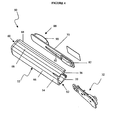
- the housing 52 of the shunt valve system 50 can have virtually any geometry, but preferably, the housing 52 has a generally rectangular shape, as illustrated in FIG. 4.
- the housing 52 includes a top surface 64, a bottom surface 66, and opposed side surfaces 68, 70, as shown in FIG. 4.
- the top surface 64 of the housing 52 can be formed as a base 72.
- This base 72 can be adapted to slidably engage a corresponding groove on the opposed side surfaces 68, 70 of the housing 52.
- FIGS. 5A and 5B the top surface 64 of the housing 52 can be formed as a base 72.
- This base 72 can be adapted to slidably engage a corresponding groove on the opposed side surfaces 68, 70 of the housing 52.
- the distance between the top surface 64 (or base 72) and bottom surface 66 defines a height H 3 of the housing 52, which can vary, but is preferably in the range of about 4.5 to 6.0 mm.
- the distance between the opposed side surfaces 68, 70 defines a width of the housing 52. This width can vary, but preferably, the width of the housing 52 is in the range of about 7.0 to 10.0 mm.
- the geometry and dimensions of the housing 52 of the shunt valve system 50, and in particular, the height, width, and length of the housing 52 are determined according to the proportions of the target site of implantation.
- the housing 52 is designed to surround the shunt valve mechanism 32 described above in connection with the first embodiment of the locking assembly of the present invention.
- the shunt valve mechanism 32 includes a sphere 74 seated in a circular orifice, a cantilevered spring 76, and a rotor assembly 78.
- the rotor assembly 78 of the shunt valve mechanism 32 includes a stair-step array 80, generally in the form of a spiral staircase.
- the stair array 80 of the rotor assembly 78 may be smooth, as shown in FIGS. 5A and 5B, or alternatively, the stair array 80 can include friction-increasing surface features (not shown).
- the stair array 80 can include virtually any surface feature that can increase the friction of the stair array 80.
- suitable friction-increasing surface features include grooves, detents, ridges, corrugations, roughened surfaces and combinations thereof.
- the locking assembly can effectively prevent the rotor assembly 78 of the shunt valve mechanism 32 from rotating. As discussed above in connection with the first embodiment of the shunt valve system 10, this feature of the locking assembly can be advantageous to prevent the rotor assembly 78 from inadvertent and undesirable rotation due to environmental magnetic forces.
- the locking assembly of the present invention includes at least one gripping arm 82, which can protrude from the inner surface 56 of the housing 52 of the shunt valve system 50.
- the gripping arm 82 can frictionally engage at least a portion of the stair array 80 of the rotor assembly 78 and can apply a compressive force on a portion of the stair array 80 to stably maintain the rotor assembly 78 in a desired, stationary position, even in the presence of external magnetic forces.
- the gripping arm 82 can have a variety of configurations, but preferably, the locking assembly includes a single gripping arm 82 that can be formed as at least one inflatable bladder 84.
- the inflatable bladder 84 is disposed on the base 72 of the housing 52 and formed as a button that can deform upon contact with the stair array 80 of the rotor assembly 78, as shown in FIG. 5B.
- the base 72 of the housing 52 and the gripping arm 82 of the locking assembly may be integrally formed, or alternatively, the base 72 and the gripping arm 82 may comprise two separate members that have been mated together by any of the various mating techniques known to those having ordinary skill in the art.
- the gripping arm 82 has at least one rotor contacting surface 86, which can frictionally engage and apply a compressive force to at least a portion of the stair array 80 of the rotor assembly 78, as described above.
- the dimensions and geometry of each rotor contacting surface 86 can vary.
- each rotor contacting surface 86 is sufficiently sized and configured to engage a portion of the stair array 80 of the rotor assembly 78, as shown in FIG. 5B.
- the contacting surface 86 should be able to maintain the rotor assembly 78 in a static position and counteract any external force urging the rotation of the rotor assembly 78.
- the rotor contacting surface 86 can be smooth, or in an alternative embodiment, it can include friction-increasing surface features (not shown). Suitable friction-increasing surface features, include, but are not limited to, grooves, detents, ridges, corrugations, roughened surfaces and combinations thereof.
- Actuation of the gripping arm 82 can be achieved by applying an external pressure force to an actuating mechanism 88.
- the actuating mechanism 88 can have a variety of configurations, but preferably, the actuating mechanism 88 can be formed as a deformable membrane disposed on a base 72, which can be slid into a corresponding groove in the housing 52 of the shunt valve system 50, as seen in FIG. 4.
- the actuating mechanism 88 can be connected to the gripping arm 82 by a channel 92 to form a closed system, such that the actuating mechanism 88 and the gripping arm 82 are in fluid communication with each other, and application of an amount of force applied to the actuating mechanism 88 transfers an equal amount of force to the gripping arm 82.
- the actuating mechanism 88 and the gripping arm 82 can be filled with a gaseous medium such as air, or alternatively, the actuating mechanism 88 and the gripping arm 82 can be filled with a liquid medium that is effective to transfer the applied force from the actuating mechanism 88 to the gripping arm 82. In yet another embodiment, the actuating mechanism 88 and the gripping arm 82 can be filled with a gel medium that can transfer the applied force from the actuating mechanism 88 to the gripping arm 82.
- the force transferred from the actuating mechanism 88 to the gripping arm 82 is sufficient to move the gripping arm 82 into and out of a position in which the pressure threshold of the shunt valve mechanism 32 is locked.
- the gripping arm 82 is biased to a disengaged condition, shown in FIG. 5A, in which the rotor contacting surface 86 does not frictionally engage any portion of the stair array 80 of the rotor assembly 78.
- the gripping arm 82 is moved to an engaged state, shown in FIG. 5B, in which the rotor contacting surface 86 frictionally engages a portion of the stair array 80 of the rotor assembly 78.
- the channel 92 can include a bleeder valve (not shown) that can initially prevent the flow of the fluid, gaseous or gel medium from the gripping arm 82 to the actuating mechanism 88, but can, over time, allow the fluid, gaseous or gel medium to seep back into the actuating mechanism 88.
- a bleeder valve (not shown) that can initially prevent the flow of the fluid, gaseous or gel medium from the gripping arm 82 to the actuating mechanism 88, but can, over time, allow the fluid, gaseous or gel medium to seep back into the actuating mechanism 88.
- the actuating mechanism 88 is a deformable membrane 90 disposed on the base 72 of the shunt valve system 50, as illustrated in FIGS. 4-5B.
- the deformable membrane 90 can have virtually any size and shape, which are, preferably, designed according to the dimensions of the target site of implantation.
- the deformable membrane 90 is generally shaped as a button and is bilaterally opposed to the gripping arm 82, as shown in FIGS. 4 and 5A.
- the deformable membrane 90 of the actuating mechanism 88 and the base 72 of the shunt valve system 50 may be integrally formed, or alternatively, the deformable membrane 90 and the base 72 may comprise two separate members that have been mated together using any of the various mating techniques known by those having ordinary skill in the art, as described above.
- the deformable membrane 90 of the actuating mechanism 88 is sized and shaped to provide at least a tactile cue of the location of the shunt valve system 50 implanted within a patient.
- the deformable membrane 46 preferably protrudes above the top surface 64 or base 72 of the housing 52, as seen in FIGS. 5A and 5B.
- the height of the deformable membrane 90 is preferably in the range of about 1.0 to 3.0 mm.
- the deformable membrane 90 can also be configured to provide a visual cue, such as for example a visible bulge that can indicate the location of the shunt valve system 50 within a patient.
- the deformable membrane 90 of the actuating mechanism 88 can be adapted to include an audible cue that can indicate when the gripping arm 82 of the locking assembly is in an engaged state, such that the gripping arm 82 frictionally engages at least a portion of the stair array 80 of the rotor assembly 78.
- the deformable membrane 90 can include a preformed spring which can be configured to produce an audible sound, such as a clicking noise, as pressure is applied to the actuating mechanism 88 to deploy the gripping arm 82.
- the locking assembly of this second embodiment of the present invention can be constructed from virtually any biocompatible material. Suitable biocompatible materials have been described above in connection with the first embodiment of the locking assembly of the present invention.
- the deformable membrane 90 in particular, can be constructed from a shape memory material, or alternatively, the deformable membrane 90 can include a shape memory material embedded therein.
- the shape memory material is, preferably, a spring wire embedded within the deformable membrane 90.
- Suitable shape memory materials for use in the present invention include those discussed above in connection with the first embodiment of the shunt valve system 10.
- the shape memory materials, which can be used in the deformable membrane 90 of the present invention, are effective to change their shape from a first, resting shape to a second, memorized shape in the presence of an external stimulus, or external stimuli.
- the shape memory materials of the present invention can change their shape in response to a change in temperature, a change in pH, an ionic change, the presence of light, the presence of an electric field, the presence of a magnetic field, the presence of ultrasound, or any combination of these external stimuli.
- the fluid, gaseous or gel medium within actuating mechanism 88 is transferred to the inflatable bladder 84 of the gripping arm 82, whereupon the gripping arm 82 bellows out, i.e., becomes enlarged with the additional fluid medium transferred thereto.
- the expanded gripping arm 82 exerts the additional force upon the stair array 80 of the rotor assembly 78 of the shunt valve mechanism 32 of the shunt valve system 50, as shown in FIG. 5B.
- the expanded gripping arm 82 thus contacts the stair array 80 of the rotor assembly 78 and applies a compressive force to a portion of the stair array 80 to prevent the rotor assembly 78 from rotating.
- the gripping arm 82 and the deformable membrane 90 are resilient, and upon release of the external mechanical force, the fluid media within the gripping arm 82 and the deformable membrane 90 will reach equilibrium and the gripping arm 82 will no longer be expanded.
- the channel 72 can include a bleeder valve (not shown) that can initially prevent the flow of the gaseous, fluid or gel medium from the gripping arm 82 to the actuating mechanism 88, but can, over time, allow the fluid, gaseous or gel medium to seep into the actuating mechanism 88.
- the rotor assembly 78 will no longer be constrained by the gripping arm 82 pressing against it. Accordingly, as shown in FIG. 5B, the rotor assembly 78 is free to rotate without encumbrances.
- the gripping arm 82 which is intended to contact the stair array 80 of the rotor assembly 78 upon expansion, can also include friction-increasing surface features upon its outer surface. Suitable friction-increasing surface features include, but are not limited to, grooves, detents, ridges, corrugations, roughened surfaces and combinations thereof. These friction-increasing surface features can cooperatively mate with the stair array 80 of the rotor assembly 78 to provide a further means of preventing the rotation of the rotor assembly 78.
Landscapes
- Engineering & Computer Science (AREA)
- Health & Medical Sciences (AREA)
- General Engineering & Computer Science (AREA)
- Mechanical Engineering (AREA)
- Biomedical Technology (AREA)
- Anesthesiology (AREA)
- Animal Behavior & Ethology (AREA)
- Otolaryngology (AREA)
- Neurology (AREA)
- Heart & Thoracic Surgery (AREA)
- Hematology (AREA)
- Life Sciences & Earth Sciences (AREA)
- Ophthalmology & Optometry (AREA)
- General Health & Medical Sciences (AREA)
- Public Health (AREA)
- Veterinary Medicine (AREA)
- External Artificial Organs (AREA)
- Infusion, Injection, And Reservoir Apparatuses (AREA)
- Media Introduction/Drainage Providing Device (AREA)
Applications Claiming Priority (2)
| Application Number | Priority Date | Filing Date | Title |
|---|---|---|---|
| US10/192,394 US7390310B2 (en) | 2002-07-10 | 2002-07-10 | Shunt valve locking mechanism |
| US192394 | 2002-07-10 |
Publications (2)
| Publication Number | Publication Date |
|---|---|
| EP1380317A1 true EP1380317A1 (de) | 2004-01-14 |
| EP1380317B1 EP1380317B1 (de) | 2007-08-29 |
Family
ID=29735304
Family Applications (1)
| Application Number | Title | Priority Date | Filing Date |
|---|---|---|---|
| EP20030254355 Expired - Lifetime EP1380317B1 (de) | 2002-07-10 | 2003-07-09 | Verriegelungsmechanismus für ein Shunt-Ventil |
Country Status (7)
| Country | Link |
|---|---|
| US (2) | US7390310B2 (de) |
| EP (1) | EP1380317B1 (de) |
| JP (1) | JP4563005B2 (de) |
| AU (1) | AU2003213296B2 (de) |
| CA (1) | CA2435178C (de) |
| DE (1) | DE60315924T2 (de) |
| ES (1) | ES2292906T3 (de) |
Cited By (10)
| Publication number | Priority date | Publication date | Assignee | Title |
|---|---|---|---|---|
| WO2004052443A1 (de) * | 2002-12-11 | 2004-06-24 | Christoph Miethke Gmbh & Co Kg | Einstellbares hydrocephalusventil |
| US7766855B2 (en) | 2004-03-27 | 2010-08-03 | Christoph Miethke Gmbh & Co. Kg | Adjustable hydrocephalus valve |
| EP2366423A3 (de) * | 2009-12-30 | 2012-05-16 | Codman Neuro Sciences Sarl | Elektrokinetischer Aktuator zur Flüssigkeitsstromtitrierung |
| DE102005013720A1 (de) | 2005-03-22 | 2012-08-02 | Christoph Miethke Gmbh & Co Kg | Einstellbares Hydrocephalusventil |
| WO2012065750A3 (de) * | 2010-11-19 | 2012-11-22 | C.Miethke Gmbh & Co Kg | Elektrisch betätigbares, insbesondere programmierbares hydrocephalus-ventil |
| EP2885044B1 (de) * | 2012-09-11 | 2019-04-10 | Christoph Miethke GmbH & Co. KG | Einstellbares hydrocephalus-ventil |
| EP4323034A4 (de) * | 2021-04-15 | 2025-02-19 | Shifamed Holdings, LLC | Einstellbare rangiersysteme sowie zugehörige systeme und verfahren |
| US12329682B2 (en) | 2019-01-18 | 2025-06-17 | Shifamed Holdings, Llc | Adjustable flow glaucoma shunts and methods for making and using same |
| US12453657B2 (en) | 2019-10-10 | 2025-10-28 | Shifamed Holdings, Llc | Adjustable flow glaucoma shunts and associated systems and methods |
| US12539404B2 (en) | 2021-01-22 | 2026-02-03 | Shifamed Holdings, Llc | Adjustable shunting systems with plate assemblies, and associated systems and methods |
Families Citing this family (98)
| Publication number | Priority date | Publication date | Assignee | Title |
|---|---|---|---|---|
| US8091556B2 (en) * | 2001-04-20 | 2012-01-10 | V-Wave Ltd. | Methods and apparatus for reducing localized circulatory system pressure |
| US9694166B2 (en) | 2002-03-26 | 2017-07-04 | Medtronics Ps Medical, Inc. | Method of draining cerebrospinal fluid |
| US20030216710A1 (en) * | 2002-03-26 | 2003-11-20 | Hurt Robert F. | Catheter |
| ES2725721T3 (es) | 2004-02-03 | 2019-09-26 | V Wave Ltd | Dispositivo y método para controlar la presión in vivo |
| FR2871386B1 (fr) * | 2004-06-11 | 2006-09-22 | Sophysa Sa | Valve sous-cutanee |
| US20060247569A1 (en) * | 2005-04-29 | 2006-11-02 | Medtronic, Inc. | Implantable cerebral spinal fluid flow device and method of controlling flow of cerebral spinal fluid |
| US7334594B2 (en) * | 2005-06-29 | 2008-02-26 | Codman & Shurtleff, Inc. | Apparatus and method for adjusting a locking mechanism of a shunt valve |
| US8273071B2 (en) * | 2006-01-18 | 2012-09-25 | The Invention Science Fund I, Llc | Remote controller for substance delivery system |
| US8617141B2 (en) * | 2005-11-09 | 2013-12-31 | The Invention Science Fund I, Llc | Remote controlled in situ reaction device |
| US20070106277A1 (en) * | 2005-11-09 | 2007-05-10 | Searete Llc, A Limited Liability Corporation Of The State Of Delaware | Remote controller for substance delivery system |
| US8083710B2 (en) * | 2006-03-09 | 2011-12-27 | The Invention Science Fund I, Llc | Acoustically controlled substance delivery device |
| US7699834B2 (en) * | 2005-11-09 | 2010-04-20 | Searete Llc | Method and system for control of osmotic pump device |
| US20070106271A1 (en) * | 2005-11-09 | 2007-05-10 | Searete Llc, A Limited Liability Corporation | Remote control of substance delivery system |
| US9067047B2 (en) * | 2005-11-09 | 2015-06-30 | The Invention Science Fund I, Llc | Injectable controlled release fluid delivery system |
| US8992511B2 (en) * | 2005-11-09 | 2015-03-31 | The Invention Science Fund I, Llc | Acoustically controlled substance delivery device |
| US8936590B2 (en) * | 2005-11-09 | 2015-01-20 | The Invention Science Fund I, Llc | Acoustically controlled reaction device |
| WO2007083288A2 (en) | 2006-01-23 | 2007-07-26 | Atria Medical Inc. | Heart anchor device |
| US20080140057A1 (en) * | 2006-03-09 | 2008-06-12 | Searete Llc, A Limited Liability Corporation Of State Of The Delaware | Injectable controlled release fluid delivery system |
| US20080108954A1 (en) * | 2006-11-02 | 2008-05-08 | Jean-Marie Mathias | Flow Controllers |
| US20080108955A1 (en) * | 2006-11-02 | 2008-05-08 | Blickhan Bryan J | Flow Controllers |
| US8123714B2 (en) | 2007-06-29 | 2012-02-28 | Codman & Shurtleff, Inc. | Programmable shunt with electromechanical valve actuator |
| US20090048648A1 (en) * | 2007-08-17 | 2009-02-19 | Searete Llc, A Limited Liability Corporation Of The State Of Delaware | Self-sterilizing device |
| US8114346B2 (en) | 2007-08-17 | 2012-02-14 | The Invention Science Fund I, Llc | Event-triggered ultraviolet light sterilization of surfaces |
| US8460229B2 (en) | 2007-08-17 | 2013-06-11 | The Invention Science Fund I, Llc | Systems, devices, and methods including catheters having components that are actively controllable between transmissive and reflective states |
| US8162924B2 (en) | 2007-08-17 | 2012-04-24 | The Invention Science Fund I, Llc | System, devices, and methods including actively-controllable superoxide water generating systems |
| US8647292B2 (en) | 2007-08-17 | 2014-02-11 | The Invention Science Fund I, Llc | Systems, devices, and methods including catheters having components that are actively controllable between two or more wettability states |
| US8702640B2 (en) | 2007-08-17 | 2014-04-22 | The Invention Science Fund I, Llc | System, devices, and methods including catheters configured to monitor and inhibit biofilm formation |
| US8734718B2 (en) | 2007-08-17 | 2014-05-27 | The Invention Science Fund I, Llc | Systems, devices, and methods including catheters having an actively controllable therapeutic agent delivery component |
| US8706211B2 (en) | 2007-08-17 | 2014-04-22 | The Invention Science Fund I, Llc | Systems, devices, and methods including catheters having self-cleaning surfaces |
| US8753304B2 (en) | 2007-08-17 | 2014-06-17 | The Invention Science Fund I, Llc | Systems, devices, and methods including catheters having acoustically actuatable waveguide components for delivering a sterilizing stimulus to a region proximate a surface of the catheter |
| US8029740B2 (en) * | 2008-07-11 | 2011-10-04 | The Invention Science Fund I, Llc | Event-triggered self-sterilization of article surfaces |
| US8366652B2 (en) | 2007-08-17 | 2013-02-05 | The Invention Science Fund I, Llc | Systems, devices, and methods including infection-fighting and monitoring shunts |
| US20090218535A1 (en) * | 2008-02-27 | 2009-09-03 | Andres Pasko | Flow controllers for fluid circuits |
| DE102008030942A1 (de) | 2008-07-02 | 2010-01-07 | Christoph Miethke Gmbh & Co Kg | Hirnwasserdrainagen |
| BRPI0916696A2 (pt) * | 2008-07-29 | 2015-11-17 | St Jude Medical Cardiology Div | método e sistema para ajuste a longo prazo de um dispositivo de implante |
| US9474831B2 (en) | 2008-12-04 | 2016-10-25 | Gearbox, Llc | Systems, devices, and methods including implantable devices with anti-microbial properties |
| EP2384168B1 (de) | 2008-12-04 | 2014-10-08 | Searete LLC | Aktiv kontrollierbare sterilisierende erregungsabgabe-implantate |
| US8585627B2 (en) | 2008-12-04 | 2013-11-19 | The Invention Science Fund I, Llc | Systems, devices, and methods including catheters configured to monitor biofilm formation having biofilm spectral information configured as a data structure |
| US12453626B2 (en) | 2009-05-04 | 2025-10-28 | V-Wave Ltd. | Shunt for redistributing atrial blood volume |
| WO2010128501A1 (en) | 2009-05-04 | 2010-11-11 | V-Wave Ltd. | Device and method for regulating pressure in a heart chamber |
| US10076403B1 (en) | 2009-05-04 | 2018-09-18 | V-Wave Ltd. | Shunt for redistributing atrial blood volume |
| US9034034B2 (en) | 2010-12-22 | 2015-05-19 | V-Wave Ltd. | Devices for reducing left atrial pressure, and methods of making and using same |
| US12186176B2 (en) | 2009-05-04 | 2025-01-07 | V-Wave Ltd. | Shunt for redistributing atrial blood volume |
| US8322365B2 (en) | 2010-08-17 | 2012-12-04 | Codman & Shurtleff, Inc. | Implantable adjustable valve |
| US9149615B2 (en) | 2010-08-17 | 2015-10-06 | DePuy Synthes Products, Inc. | Method and tools for implanted device |
| US9629715B2 (en) | 2011-07-28 | 2017-04-25 | V-Wave Ltd. | Devices for reducing left atrial pressure having biodegradable constriction, and methods of making and using same |
| US11135054B2 (en) | 2011-07-28 | 2021-10-05 | V-Wave Ltd. | Interatrial shunts having biodegradable material, and methods of making and using same |
| US9101678B2 (en) | 2011-11-03 | 2015-08-11 | Elwha Llc | Heat-sanitization of surfaces |
| US9333115B2 (en) * | 2011-12-13 | 2016-05-10 | Alcon Research, Ltd. | Separation of gas and liquid in membrane valves |
| ES2881330T3 (es) * | 2012-06-21 | 2021-11-29 | Medtronic Xomed Inc | Rotores e imanes con mayor resistencia a cambios de configuración inadvertidos |
| US10569065B2 (en) | 2012-09-11 | 2020-02-25 | Christoph Miethke Gmbh & Co Kg | Adjustable hydrocephalus valve |
| US9126010B2 (en) | 2013-03-14 | 2015-09-08 | Medtronic Xomed, Inc. | Device and method for finding the center and reading the setting of an implantable medical device |
| EP2967381B1 (de) | 2013-03-15 | 2018-12-12 | Carlos A. Hakim | Überbrückungsventilanordnung |
| WO2014145858A2 (en) | 2013-03-15 | 2014-09-18 | Bitol Designs, Llc | Occlusion resistant catheter and method of use |
| CN105555204B (zh) | 2013-05-21 | 2018-07-10 | V-波有限责任公司 | 用于递送减小左房压力的装置的设备 |
| CA2855315C (en) | 2013-06-28 | 2021-08-10 | DePuy Synthes Products, LLC | Method and tools for implanted device |
| EP3291773B1 (de) | 2015-05-07 | 2026-01-07 | The Medical Research, Infrastructure, And Health Services Fund Of The Tel Aviv Medical Center | Temporäre interatriale shunts |
| US20170340460A1 (en) | 2016-05-31 | 2017-11-30 | V-Wave Ltd. | Systems and methods for making encapsulated hourglass shaped stents |
| US10835394B2 (en) | 2016-05-31 | 2020-11-17 | V-Wave, Ltd. | Systems and methods for making encapsulated hourglass shaped stents |
| US11291807B2 (en) | 2017-03-03 | 2022-04-05 | V-Wave Ltd. | Asymmetric shunt for redistributing atrial blood volume |
| CA3054891A1 (en) | 2017-03-03 | 2018-09-07 | V-Wave Ltd. | Shunt for redistributing atrial blood volume |
| CN107854765A (zh) * | 2017-04-21 | 2018-03-30 | 苏州诺来宁医疗科技有限公司 | 一种应用于人体的抗重力装置 |
| US11045632B2 (en) | 2017-04-24 | 2021-06-29 | Longeviti Neuro Solutions Llc | Cerebral spinal fluid shunt plug |
| US11166849B2 (en) | 2017-07-20 | 2021-11-09 | Shifamed Holdings, Llc | Adjustable flow glaucoma shunts and methods for making and using same |
| US11058581B2 (en) | 2017-07-20 | 2021-07-13 | Shifamed Holdings, Llc | Adjustable flow glaucoma shunts and methods for making and using same |
| US10799689B2 (en) * | 2017-08-24 | 2020-10-13 | Medtronic Xomed, Inc. | Method and apparatus for valve adjustment |
| US10898698B1 (en) | 2020-05-04 | 2021-01-26 | V-Wave Ltd. | Devices with dimensions that can be reduced and increased in vivo, and methods of making and using the same |
| US11458287B2 (en) | 2018-01-20 | 2022-10-04 | V-Wave Ltd. | Devices with dimensions that can be reduced and increased in vivo, and methods of making and using the same |
| WO2019142152A1 (en) | 2018-01-20 | 2019-07-25 | V-Wave Ltd. | Devices and methods for providing passage between heart chambers |
| US12357792B2 (en) | 2019-01-04 | 2025-07-15 | Shifamed Holdings, Llc | Internal recharging systems and methods of use |
| US12226602B2 (en) | 2019-04-03 | 2025-02-18 | V-Wave Ltd. | Systems for delivering implantable devices across an atrial septum |
| US11612385B2 (en) | 2019-04-03 | 2023-03-28 | V-Wave Ltd. | Systems and methods for delivering implantable devices across an atrial septum |
| US11865282B2 (en) | 2019-05-20 | 2024-01-09 | V-Wave Ltd. | Systems and methods for creating an interatrial shunt |
| US12533500B2 (en) | 2019-06-18 | 2026-01-27 | Shifamed Holdings, Llc | Adjustable interatrial shunts and associated systems and methods |
| US12551268B2 (en) | 2019-07-08 | 2026-02-17 | Shifamed Holdings, Llc | Minimally invasive bleb formation devices and methods for using such devices |
| CN114667117A (zh) | 2019-09-09 | 2022-06-24 | 施菲姆德控股有限责任公司 | 可调整分流器和相关联的系统和方法 |
| CN115379818A (zh) | 2020-01-23 | 2022-11-22 | 施菲姆德控股有限责任公司 | 可调节流量的青光眼分流器及相关系统和方法 |
| EP4103117A4 (de) | 2020-02-14 | 2024-03-20 | Shifamed Holdings, LLC | Rangiersysteme mit rotationsbasierten durchflusssteuerungsvorrichtungen und zugehörige systeme und verfahren |
| US11737920B2 (en) | 2020-02-18 | 2023-08-29 | Shifamed Holdings, Llc | Adjustable flow glaucoma shunts having non-linearly arranged flow control elements, and associated systems and methods |
| EP4120978A4 (de) | 2020-03-19 | 2024-04-17 | Shifamed Holdings, LLC | Intraokulare shunts mit niedrigprofilbetätigungselementen sowie entsprechende systeme und verfahren |
| JP7743435B2 (ja) | 2020-04-16 | 2025-09-24 | シファメド・ホールディングス・エルエルシー | 調整可能な緑内障治療デバイス並びに関連付けられたシステム及び方法 |
| US12213817B2 (en) | 2020-04-23 | 2025-02-04 | Shifamed Holdings, Llc | Systems and methods for radiographic monitoring of shunts |
| WO2021217059A1 (en) | 2020-04-23 | 2021-10-28 | Shifamed Holdings, Llc | Power management for interatrial shunts and associated systems and methods |
| EP4138649B1 (de) | 2020-04-23 | 2025-09-24 | Shifamed Holdings, LLC | Intrakardiale sensoren mit schaltbaren konfigurationen und zugehörige systeme und verfahren |
| US12599756B2 (en) | 2020-05-04 | 2026-04-14 | V-Wave Ltd. | Devices with dimensions that can be reduced and increased In Vivo |
| EP4203847B1 (de) | 2020-08-25 | 2025-10-22 | Shifamed Holdings, LLC | Einstellbare interatriale shunts sowie zugehörige systeme |
| US12544010B2 (en) | 2020-10-28 | 2026-02-10 | Shifamed Holdings, Llc | Systems and methods for electrical monitoring of implantable devices |
| EP4243915A4 (de) | 2020-11-12 | 2024-08-07 | Shifamed Holdings, LLC | Einstellbare implantierbare vorrichtungen und zugehörige verfahren |
| US11234702B1 (en) | 2020-11-13 | 2022-02-01 | V-Wave Ltd. | Interatrial shunt having physiologic sensor |
| WO2022192280A1 (en) | 2021-03-09 | 2022-09-15 | Shifamed Holdings, Llc | Shape memory actuators for adjustable shunting systems, and associated systems and methods |
| CN113648476B (zh) * | 2021-08-10 | 2024-01-16 | 李冰冰 | 一种具有分级冲洗结构的妇科肿瘤清洗装置 |
| CN114748786B (zh) * | 2022-03-27 | 2024-03-05 | 迈德微创(天津)医疗器械有限责任公司 | 一种具有自锁定及防归零功能的分流阀 |
| CN119343093A (zh) | 2022-04-14 | 2025-01-21 | V-波有限责任公司 | 具有扩张颈部区域的房间分流器 |
| CN116642134A (zh) * | 2023-05-08 | 2023-08-25 | 武汉汇博鸿通电气有限公司 | 铀浓缩专用气体压力调节器 |
| US12366305B2 (en) * | 2023-10-16 | 2025-07-22 | Consolidated Edison Company Of New York, Inc. | Gas valve lock out device |
| IL327576A (en) | 2023-10-18 | 2026-05-01 | V Wave Ltd | Hybrid devices with adjustable dimensions within the body and methods of manufacturing the same |
| GB2701584A (en) * | 2024-10-29 | 2026-05-06 | Airbus Operations Ltd | Valve apparatus |
| CN120900103B (zh) * | 2025-09-30 | 2026-01-30 | 中国医学科学院北京协和医院 | 一种用于脑脊液分流装置的调压球阀及调压系统 |
Citations (6)
| Publication number | Priority date | Publication date | Assignee | Title |
|---|---|---|---|---|
| US4615691A (en) | 1983-12-08 | 1986-10-07 | Salomon Hakim | Surgically-implantable stepping motor |
| EP0232454A1 (de) * | 1985-08-29 | 1987-08-19 | Friedrich Grohe Aktiengesellschaft | Stellvorrichtung für ein thermostatisch geregeltes Mischventil |
| EP0580384A1 (de) * | 1992-07-20 | 1994-01-26 | Simpla Plastics Limited | Durchflussregelvorrichtung |
| US5637083A (en) | 1996-01-19 | 1997-06-10 | Pudenz-Schulte Medical Research Corporation | Implantable adjustable fluid flow control valve |
| US5643194A (en) | 1994-06-24 | 1997-07-01 | Sophysa | Subcutaneous valve and device for externally setting it |
| US6152933A (en) * | 1997-11-12 | 2000-11-28 | Stereotaxis, Inc. | Intracranial bolt and method of placing and using an intracranial bolt to position a medical device |
Family Cites Families (9)
| Publication number | Priority date | Publication date | Assignee | Title |
|---|---|---|---|---|
| JPS5955334A (ja) | 1982-09-22 | 1984-03-30 | Babcock Hitachi Kk | 排煙脱硝装置の還元剤注入制御方法 |
| CA1241246A (en) * | 1983-07-21 | 1988-08-30 | Salomon Hakim | Surgically-implantable device susceptible of noninvasive magnetic adjustment |
| JP3051453B2 (ja) | 1995-04-28 | 2000-06-12 | ジャサイ・ゾルタン・カズマー | 身体等の保護具 |
| EP0825368A4 (de) | 1995-04-28 | 2001-05-16 | Burlington Cons Ltd Inc | Körperschutzvorrichtung |
| AU1837697A (en) * | 1997-01-24 | 1998-08-18 | Medtronic Ps Medical | Implantable adjustable fluid flow control valve |
| US6488702B1 (en) * | 1997-01-24 | 2002-12-03 | Jomed Gmbh | Bistable spring construction for a stent and other medical apparatus |
| US20020026139A1 (en) * | 2000-02-02 | 2002-02-28 | Bertrand William Jeff | Valve seat and valve |
| WO2001076978A1 (en) * | 2000-04-07 | 2001-10-18 | International Dispensing Corporation | Dispensing valve for fluids |
| FR2816513B1 (fr) * | 2000-11-13 | 2003-03-07 | Bernard Marion | Valve sous-cutanee pour le traitement de l'hydrocephalie et ses dispositifs de reglage |
-
2002
- 2002-07-10 US US10/192,394 patent/US7390310B2/en not_active Expired - Lifetime
-
2003
- 2003-07-08 AU AU2003213296A patent/AU2003213296B2/en not_active Expired
- 2003-07-09 DE DE2003615924 patent/DE60315924T2/de not_active Expired - Lifetime
- 2003-07-09 EP EP20030254355 patent/EP1380317B1/de not_active Expired - Lifetime
- 2003-07-09 JP JP2003272507A patent/JP4563005B2/ja not_active Expired - Lifetime
- 2003-07-09 ES ES03254355T patent/ES2292906T3/es not_active Expired - Lifetime
- 2003-07-10 CA CA2435178A patent/CA2435178C/en not_active Expired - Lifetime
-
2008
- 2008-02-12 US US12/029,818 patent/US7771381B2/en not_active Expired - Lifetime
Patent Citations (6)
| Publication number | Priority date | Publication date | Assignee | Title |
|---|---|---|---|---|
| US4615691A (en) | 1983-12-08 | 1986-10-07 | Salomon Hakim | Surgically-implantable stepping motor |
| EP0232454A1 (de) * | 1985-08-29 | 1987-08-19 | Friedrich Grohe Aktiengesellschaft | Stellvorrichtung für ein thermostatisch geregeltes Mischventil |
| EP0580384A1 (de) * | 1992-07-20 | 1994-01-26 | Simpla Plastics Limited | Durchflussregelvorrichtung |
| US5643194A (en) | 1994-06-24 | 1997-07-01 | Sophysa | Subcutaneous valve and device for externally setting it |
| US5637083A (en) | 1996-01-19 | 1997-06-10 | Pudenz-Schulte Medical Research Corporation | Implantable adjustable fluid flow control valve |
| US6152933A (en) * | 1997-11-12 | 2000-11-28 | Stereotaxis, Inc. | Intracranial bolt and method of placing and using an intracranial bolt to position a medical device |
Cited By (12)
| Publication number | Priority date | Publication date | Assignee | Title |
|---|---|---|---|---|
| WO2004052443A1 (de) * | 2002-12-11 | 2004-06-24 | Christoph Miethke Gmbh & Co Kg | Einstellbares hydrocephalusventil |
| US7766855B2 (en) | 2004-03-27 | 2010-08-03 | Christoph Miethke Gmbh & Co. Kg | Adjustable hydrocephalus valve |
| DE102005013720A1 (de) | 2005-03-22 | 2012-08-02 | Christoph Miethke Gmbh & Co Kg | Einstellbares Hydrocephalusventil |
| EP2366423A3 (de) * | 2009-12-30 | 2012-05-16 | Codman Neuro Sciences Sarl | Elektrokinetischer Aktuator zur Flüssigkeitsstromtitrierung |
| US8231563B2 (en) | 2009-12-30 | 2012-07-31 | Codman Neuro Sciences Sarl | Electrokinetic actuator to titrate fluid flow |
| WO2012065750A3 (de) * | 2010-11-19 | 2012-11-22 | C.Miethke Gmbh & Co Kg | Elektrisch betätigbares, insbesondere programmierbares hydrocephalus-ventil |
| US9155871B2 (en) | 2010-11-19 | 2015-10-13 | C. Miethke Gmbh & Co Kg | Electrically operable, in one possible embodiment programmable hydrocephalus valve |
| EP2885044B1 (de) * | 2012-09-11 | 2019-04-10 | Christoph Miethke GmbH & Co. KG | Einstellbares hydrocephalus-ventil |
| US12329682B2 (en) | 2019-01-18 | 2025-06-17 | Shifamed Holdings, Llc | Adjustable flow glaucoma shunts and methods for making and using same |
| US12453657B2 (en) | 2019-10-10 | 2025-10-28 | Shifamed Holdings, Llc | Adjustable flow glaucoma shunts and associated systems and methods |
| US12539404B2 (en) | 2021-01-22 | 2026-02-03 | Shifamed Holdings, Llc | Adjustable shunting systems with plate assemblies, and associated systems and methods |
| EP4323034A4 (de) * | 2021-04-15 | 2025-02-19 | Shifamed Holdings, LLC | Einstellbare rangiersysteme sowie zugehörige systeme und verfahren |
Also Published As
| Publication number | Publication date |
|---|---|
| CA2435178A1 (en) | 2004-01-10 |
| AU2003213296A1 (en) | 2004-01-29 |
| US7390310B2 (en) | 2008-06-24 |
| US20080127689A1 (en) | 2008-06-05 |
| JP4563005B2 (ja) | 2010-10-13 |
| JP2004033773A (ja) | 2004-02-05 |
| US20040010219A1 (en) | 2004-01-15 |
| US7771381B2 (en) | 2010-08-10 |
| CA2435178C (en) | 2011-08-30 |
| AU2003213296B2 (en) | 2009-06-04 |
| DE60315924T2 (de) | 2008-05-21 |
| ES2292906T3 (es) | 2008-03-16 |
| EP1380317B1 (de) | 2007-08-29 |
| DE60315924D1 (de) | 2007-10-11 |
Similar Documents
| Publication | Publication Date | Title |
|---|---|---|
| EP1380317B1 (de) | Verriegelungsmechanismus für ein Shunt-Ventil | |
| CA1295209C (en) | Implantable shunt system and method of assembly | |
| EP1331019B1 (de) | Anti-Siphonvorrichtung | |
| EP0888795B1 (de) | Pädiatrisches, programmierbares Hydrocephalusventil | |
| JP4566595B2 (ja) | 患者から流体を排出するためのシャントシステム | |
| EP1007140B1 (de) | Implantierbares,einstellbares durchflusskontrolventil | |
| CA2636529C (en) | Programmable shunt with electromechanical valve actuator | |
| JP4028080B2 (ja) | 流体流制限装置 | |
| EP1177002B1 (de) | Werkzeug zum einstellen eines implantierbaren und einstellbaren durchflussregelventils | |
| US3452757A (en) | Two-way flushing device for treatment of hydrocephalus | |
| JPH09502908A (ja) | 接着シール力を備えた尿道プラグ | |
| US20020026139A1 (en) | Valve seat and valve | |
| JP3825054B2 (ja) | 移植可能な調整自在流体流量制御弁 | |
| AU2013242833B2 (en) | Programmable shunt with electromechanical valve actuator |
Legal Events
| Date | Code | Title | Description |
|---|---|---|---|
| PUAI | Public reference made under article 153(3) epc to a published international application that has entered the european phase |
Free format text: ORIGINAL CODE: 0009012 |
|
| AK | Designated contracting states |
Kind code of ref document: A1 Designated state(s): AT BE BG CH CY CZ DE DK EE ES FI FR GB GR HU IE IT LI LU MC NL PT RO SE SI SK TR |
|
| AX | Request for extension of the european patent |
Extension state: AL LT LV MK |
|
| 17P | Request for examination filed |
Effective date: 20040625 |
|
| AKX | Designation fees paid |
Designated state(s): CH DE ES FR GB IT LI |
|
| GRAP | Despatch of communication of intention to grant a patent |
Free format text: ORIGINAL CODE: EPIDOSNIGR1 |
|
| GRAS | Grant fee paid |
Free format text: ORIGINAL CODE: EPIDOSNIGR3 |
|
| GRAA | (expected) grant |
Free format text: ORIGINAL CODE: 0009210 |
|
| AK | Designated contracting states |
Kind code of ref document: B1 Designated state(s): CH DE ES FR GB IT LI |
|
| REG | Reference to a national code |
Ref country code: GB Ref legal event code: FG4D |
|
| REG | Reference to a national code |
Ref country code: CH Ref legal event code: EP |
|
| REF | Corresponds to: |
Ref document number: 60315924 Country of ref document: DE Date of ref document: 20071011 Kind code of ref document: P |
|
| REG | Reference to a national code |
Ref country code: DE Ref legal event code: R096 Ref document number: 60315924 Country of ref document: DE Effective date: 20071011 |
|
| REG | Reference to a national code |
Ref country code: CH Ref legal event code: NV Representative=s name: E. BLUM & CO. AG PATENT- UND MARKENANWAELTE VSP |
|
| ET | Fr: translation filed | ||
| REG | Reference to a national code |
Ref country code: ES Ref legal event code: FG2A Ref document number: 2292906 Country of ref document: ES Kind code of ref document: T3 |
|
| PLBE | No opposition filed within time limit |
Free format text: ORIGINAL CODE: 0009261 |
|
| STAA | Information on the status of an ep patent application or granted ep patent |
Free format text: STATUS: NO OPPOSITION FILED WITHIN TIME LIMIT |
|
| 26N | No opposition filed |
Effective date: 20080530 |
|
| REG | Reference to a national code |
Ref country code: DE Ref legal event code: R097 Ref document number: 60315924 Country of ref document: DE Effective date: 20080529 |
|
| REG | Reference to a national code |
Ref country code: FR Ref legal event code: PLFP Year of fee payment: 14 |
|
| REG | Reference to a national code |
Ref country code: FR Ref legal event code: PLFP Year of fee payment: 15 |
|
| REG | Reference to a national code |
Ref country code: FR Ref legal event code: PLFP Year of fee payment: 16 |
|
| REG | Reference to a national code |
Ref country code: GB Ref legal event code: 732E Free format text: REGISTERED BETWEEN 20180712 AND 20180718 |
|
| REG | Reference to a national code |
Ref country code: GB Ref legal event code: 732E Free format text: REGISTERED BETWEEN 20180719 AND 20180725 |
|
| REG | Reference to a national code |
Ref country code: DE Ref legal event code: R082 Ref document number: 60315924 Country of ref document: DE Representative=s name: MUELLER-BORE & PARTNER PATENTANWAELTE PARTG MB, DE Ref country code: DE Ref legal event code: R081 Ref document number: 60315924 Country of ref document: DE Owner name: INTEGRA LIFESCIENCES SWITZERLAND SARL, CH Free format text: FORMER OWNER: CODMAN & SHURTLEFF, INC., RAYNHAM, MASS., US |
|
| REG | Reference to a national code |
Ref country code: CH Ref legal event code: PUE Owner name: INTEGRA LIFESCIENCES SWITZERLAND SARL, CH Free format text: FORMER OWNER: DEPUY SYNTHES PRODUCTS, INC., US Ref country code: CH Ref legal event code: PUE Owner name: DEPUY SPINE, LLC, US Free format text: FORMER OWNER: CODMAN AND SHURTLEFF, INC., US Ref country code: CH Ref legal event code: PUE Owner name: DEPUY SYNTHES PRODUCTS, INC., US Free format text: FORMER OWNER: DEPUY SPINE, LLC, US |
|
| REG | Reference to a national code |
Ref country code: ES Ref legal event code: PC2A Owner name: INTEGRA LIFESCIENCES SWITZERLAND SARL Effective date: 20200102 |
|
| REG | Reference to a national code |
Ref country code: ES Ref legal event code: FD2A Effective date: 20201126 |
|
| PG25 | Lapsed in a contracting state [announced via postgrant information from national office to epo] |
Ref country code: ES Free format text: LAPSE BECAUSE OF NON-PAYMENT OF DUE FEES Effective date: 20190710 |
|
| PGFP | Annual fee paid to national office [announced via postgrant information from national office to epo] |
Ref country code: IT Payment date: 20220613 Year of fee payment: 20 Ref country code: GB Payment date: 20220519 Year of fee payment: 20 Ref country code: FR Payment date: 20220523 Year of fee payment: 20 |
|
| PGFP | Annual fee paid to national office [announced via postgrant information from national office to epo] |
Ref country code: DE Payment date: 20220517 Year of fee payment: 20 |
|
| PGFP | Annual fee paid to national office [announced via postgrant information from national office to epo] |
Ref country code: CH Payment date: 20220801 Year of fee payment: 20 |
|
| REG | Reference to a national code |
Ref country code: DE Ref legal event code: R071 Ref document number: 60315924 Country of ref document: DE |
|
| REG | Reference to a national code |
Ref country code: CH Ref legal event code: PL |
|
| REG | Reference to a national code |
Ref country code: GB Ref legal event code: PE20 Expiry date: 20230708 |
|
| PG25 | Lapsed in a contracting state [announced via postgrant information from national office to epo] |
Ref country code: GB Free format text: LAPSE BECAUSE OF EXPIRATION OF PROTECTION Effective date: 20230708 |