EP1380666B1 - Aluminiumbeschichtetes Bauteil und Verfahren zu dessen Herstellung - Google Patents
Aluminiumbeschichtetes Bauteil und Verfahren zu dessen Herstellung Download PDFInfo
- Publication number
- EP1380666B1 EP1380666B1 EP03013731A EP03013731A EP1380666B1 EP 1380666 B1 EP1380666 B1 EP 1380666B1 EP 03013731 A EP03013731 A EP 03013731A EP 03013731 A EP03013731 A EP 03013731A EP 1380666 B1 EP1380666 B1 EP 1380666B1
- Authority
- EP
- European Patent Office
- Prior art keywords
- layer
- aluminum
- structural member
- alloy
- steel substrate
- Prior art date
- Legal status (The legal status is an assumption and is not a legal conclusion. Google has not performed a legal analysis and makes no representation as to the accuracy of the status listed.)
- Revoked
Links
Images


Classifications
-
- C—CHEMISTRY; METALLURGY
- C23—COATING METALLIC MATERIAL; COATING MATERIAL WITH METALLIC MATERIAL; CHEMICAL SURFACE TREATMENT; DIFFUSION TREATMENT OF METALLIC MATERIAL; COATING BY VACUUM EVAPORATION, BY SPUTTERING, BY ION IMPLANTATION OR BY CHEMICAL VAPOUR DEPOSITION, IN GENERAL; INHIBITING CORROSION OF METALLIC MATERIAL OR INCRUSTATION IN GENERAL
- C23C—COATING METALLIC MATERIAL; COATING MATERIAL WITH METALLIC MATERIAL; SURFACE TREATMENT OF METALLIC MATERIAL BY DIFFUSION INTO THE SURFACE, BY CHEMICAL CONVERSION OR SUBSTITUTION; COATING BY VACUUM EVAPORATION, BY SPUTTERING, BY ION IMPLANTATION OR BY CHEMICAL VAPOUR DEPOSITION, IN GENERAL
- C23C2/00—Hot-dipping or immersion processes for applying the coating material in the molten state without affecting the shape; Apparatus therefor
- C23C2/04—Hot-dipping or immersion processes for applying the coating material in the molten state without affecting the shape; Apparatus therefor characterised by the coating material
- C23C2/12—Aluminium or alloys based thereon
-
- B—PERFORMING OPERATIONS; TRANSPORTING
- B32—LAYERED PRODUCTS
- B32B—LAYERED PRODUCTS, i.e. PRODUCTS BUILT-UP OF STRATA OF FLAT OR NON-FLAT, e.g. CELLULAR OR HONEYCOMB, FORM
- B32B15/00—Layered products comprising a layer of metal
- B32B15/01—Layered products comprising a layer of metal all layers being exclusively metallic
- B32B15/012—Layered products comprising a layer of metal all layers being exclusively metallic one layer being formed of an iron alloy or steel, another layer being formed of aluminium or an aluminium alloy
-
- C—CHEMISTRY; METALLURGY
- C22—METALLURGY; FERROUS OR NON-FERROUS ALLOYS; TREATMENT OF ALLOYS OR NON-FERROUS METALS
- C22C—ALLOYS
- C22C38/00—Ferrous alloys, e.g. steel alloys
- C22C38/04—Ferrous alloys, e.g. steel alloys containing manganese
-
- C—CHEMISTRY; METALLURGY
- C23—COATING METALLIC MATERIAL; COATING MATERIAL WITH METALLIC MATERIAL; CHEMICAL SURFACE TREATMENT; DIFFUSION TREATMENT OF METALLIC MATERIAL; COATING BY VACUUM EVAPORATION, BY SPUTTERING, BY ION IMPLANTATION OR BY CHEMICAL VAPOUR DEPOSITION, IN GENERAL; INHIBITING CORROSION OF METALLIC MATERIAL OR INCRUSTATION IN GENERAL
- C23C—COATING METALLIC MATERIAL; COATING MATERIAL WITH METALLIC MATERIAL; SURFACE TREATMENT OF METALLIC MATERIAL BY DIFFUSION INTO THE SURFACE, BY CHEMICAL CONVERSION OR SUBSTITUTION; COATING BY VACUUM EVAPORATION, BY SPUTTERING, BY ION IMPLANTATION OR BY CHEMICAL VAPOUR DEPOSITION, IN GENERAL
- C23C2/00—Hot-dipping or immersion processes for applying the coating material in the molten state without affecting the shape; Apparatus therefor
- C23C2/26—After-treatment
- C23C2/28—Thermal after-treatment, e.g. treatment in oil bath
-
- C—CHEMISTRY; METALLURGY
- C23—COATING METALLIC MATERIAL; COATING MATERIAL WITH METALLIC MATERIAL; CHEMICAL SURFACE TREATMENT; DIFFUSION TREATMENT OF METALLIC MATERIAL; COATING BY VACUUM EVAPORATION, BY SPUTTERING, BY ION IMPLANTATION OR BY CHEMICAL VAPOUR DEPOSITION, IN GENERAL; INHIBITING CORROSION OF METALLIC MATERIAL OR INCRUSTATION IN GENERAL
- C23C—COATING METALLIC MATERIAL; COATING MATERIAL WITH METALLIC MATERIAL; SURFACE TREATMENT OF METALLIC MATERIAL BY DIFFUSION INTO THE SURFACE, BY CHEMICAL CONVERSION OR SUBSTITUTION; COATING BY VACUUM EVAPORATION, BY SPUTTERING, BY ION IMPLANTATION OR BY CHEMICAL VAPOUR DEPOSITION, IN GENERAL
- C23C2/00—Hot-dipping or immersion processes for applying the coating material in the molten state without affecting the shape; Apparatus therefor
- C23C2/26—After-treatment
- C23C2/28—Thermal after-treatment, e.g. treatment in oil bath
- C23C2/29—Cooling or quenching
-
- Y—GENERAL TAGGING OF NEW TECHNOLOGICAL DEVELOPMENTS; GENERAL TAGGING OF CROSS-SECTIONAL TECHNOLOGIES SPANNING OVER SEVERAL SECTIONS OF THE IPC; TECHNICAL SUBJECTS COVERED BY FORMER USPC CROSS-REFERENCE ART COLLECTIONS [XRACs] AND DIGESTS
- Y10—TECHNICAL SUBJECTS COVERED BY FORMER USPC
- Y10S—TECHNICAL SUBJECTS COVERED BY FORMER USPC CROSS-REFERENCE ART COLLECTIONS [XRACs] AND DIGESTS
- Y10S428/00—Stock material or miscellaneous articles
- Y10S428/922—Static electricity metal bleed-off metallic stock
- Y10S428/9335—Product by special process
- Y10S428/939—Molten or fused coating
-
- Y—GENERAL TAGGING OF NEW TECHNOLOGICAL DEVELOPMENTS; GENERAL TAGGING OF CROSS-SECTIONAL TECHNOLOGIES SPANNING OVER SEVERAL SECTIONS OF THE IPC; TECHNICAL SUBJECTS COVERED BY FORMER USPC CROSS-REFERENCE ART COLLECTIONS [XRACs] AND DIGESTS
- Y10—TECHNICAL SUBJECTS COVERED BY FORMER USPC
- Y10T—TECHNICAL SUBJECTS COVERED BY FORMER US CLASSIFICATION
- Y10T428/00—Stock material or miscellaneous articles
- Y10T428/12—All metal or with adjacent metals
- Y10T428/12458—All metal or with adjacent metals having composition, density, or hardness gradient
-
- Y—GENERAL TAGGING OF NEW TECHNOLOGICAL DEVELOPMENTS; GENERAL TAGGING OF CROSS-SECTIONAL TECHNOLOGIES SPANNING OVER SEVERAL SECTIONS OF THE IPC; TECHNICAL SUBJECTS COVERED BY FORMER USPC CROSS-REFERENCE ART COLLECTIONS [XRACs] AND DIGESTS
- Y10—TECHNICAL SUBJECTS COVERED BY FORMER USPC
- Y10T—TECHNICAL SUBJECTS COVERED BY FORMER US CLASSIFICATION
- Y10T428/00—Stock material or miscellaneous articles
- Y10T428/12—All metal or with adjacent metals
- Y10T428/12493—Composite; i.e., plural, adjacent, spatially distinct metal components [e.g., layers, joint, etc.]
- Y10T428/1266—O, S, or organic compound in metal component
- Y10T428/12667—Oxide of transition metal or Al
-
- Y—GENERAL TAGGING OF NEW TECHNOLOGICAL DEVELOPMENTS; GENERAL TAGGING OF CROSS-SECTIONAL TECHNOLOGIES SPANNING OVER SEVERAL SECTIONS OF THE IPC; TECHNICAL SUBJECTS COVERED BY FORMER USPC CROSS-REFERENCE ART COLLECTIONS [XRACs] AND DIGESTS
- Y10—TECHNICAL SUBJECTS COVERED BY FORMER USPC
- Y10T—TECHNICAL SUBJECTS COVERED BY FORMER US CLASSIFICATION
- Y10T428/00—Stock material or miscellaneous articles
- Y10T428/12—All metal or with adjacent metals
- Y10T428/12493—Composite; i.e., plural, adjacent, spatially distinct metal components [e.g., layers, joint, etc.]
- Y10T428/12736—Al-base component
- Y10T428/1275—Next to Group VIII or IB metal-base component
- Y10T428/12757—Fe
-
- Y—GENERAL TAGGING OF NEW TECHNOLOGICAL DEVELOPMENTS; GENERAL TAGGING OF CROSS-SECTIONAL TECHNOLOGIES SPANNING OVER SEVERAL SECTIONS OF THE IPC; TECHNICAL SUBJECTS COVERED BY FORMER USPC CROSS-REFERENCE ART COLLECTIONS [XRACs] AND DIGESTS
- Y10—TECHNICAL SUBJECTS COVERED BY FORMER USPC
- Y10T—TECHNICAL SUBJECTS COVERED BY FORMER US CLASSIFICATION
- Y10T428/00—Stock material or miscellaneous articles
- Y10T428/12—All metal or with adjacent metals
- Y10T428/12493—Composite; i.e., plural, adjacent, spatially distinct metal components [e.g., layers, joint, etc.]
- Y10T428/12986—Adjacent functionally defined components
Definitions
- the present invention relates to an aluminum-coated structural member and a production method thereof. More specifically, the present invention relates to an aluminum-coated structure member, such as a structural member used for motor vehicles, produced by applying heat treatment and forming operation to aluminum-coated steel sheet, and coated with an alloy layer of an Al-Si-Fe alloy for improvement in formability, weldability and corrosion resistance.
- an aluminum-coated structure member such as a structural member used for motor vehicles, produced by applying heat treatment and forming operation to aluminum-coated steel sheet, and coated with an alloy layer of an Al-Si-Fe alloy for improvement in formability, weldability and corrosion resistance.
- a Published Japanese Patent Application Publication No. 2000-204463 shows a hot-dip aluminum-coated steel sheet which can be used for motor vehicles as fuel tank, muffler, heat shield plate, etc., from the viewpoint of excellent corrosion resistance due to oxide film, and less burden on the environment due to non-inclusion of heavy metal such as lead.
- a hard Al-Fe alloy layer contained in a hot-dip aluminum-coated steel sheet at an interface with a steel substrate is more or less problematical in the formability. Moreover, the alloy layer tends to suffer cracks in a forming operation, and hence sometimes entails another treatment to ensure sufficient corrosion resistance. Weldability is another problem because an aluminum coating layer is low in melting point, and an aluminum single surface layer is insufficient in thermal conductivity. Accordingly, the hot-dip aluminum-coated steel sheet is limited in application. US-A-4,517,229 describes to provide hot-dip aluminium coatings by emerging a steel substrate containing titanium in molten aluminium. As a result, there will be solid solution iron-aluminium-silicon diffusion alloy coating.
- an aluminum-coated structural member comprises: a steel substrate layer; and an Al-Si-Fe alloy layer formed on a surface of the steel substrate layer, the alloy layer including a softer region having a hardness smaller than or equal to a hardness of the steel substrate layer, extending from the surface of the steel substrate layer toward a surface of the alloy layer, and having a thickness greater than or equal to 50% of a thickness of the alloy layer, the Al-Si-Fe alloy layer having an oxide weight smaller than or equal to 500 mg/dm 2 .
- a production method of an aluminum-coated structural member comprises: a first method element of heating a hot-dip aluminum-coated steel sheet at a heating rate in a range of 1 ⁇ 10°C/sec; a second method element of holding the hot-dip aluminum steel sheet at a raised temperature in a temperature range of 900 ⁇ 950°C for a duration in a range of 2 ⁇ 8 minutes; a third method element of cooling the hot-dip aluminum-coated steel sheet to a temperature in a temperature range of 700 ⁇ 800°C at a cooling rate in a range of 5 ⁇ 15°C/sec; a fourth method element of forming the hot-dip aluminum-coated steel sheet into a predetermined shape in the temperature range of 700 ⁇ 800°C; and a fifth method element of cooling the hot-dip aluminum-coated steel sheet in the predetermined shape rapidly from the temperature range of 700 ⁇ 800°C to a lower temperature lower than or equal to 300°C at a cooling rate in a range of 20 ⁇ 100°C/sec.
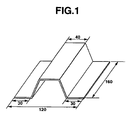
- FIG. 1 is a perspective view showing the shape and dimensions of specimens used in a test 1 according to an embodiment of the present invention, for evaluation of the formability.
- FIG. 2A is a view of a photograph showing a microstructure of a coating layer in a structural member in a practical example No. 1 in the test 1.
- FIG. 2B is a view of a photograph showing a microstructure of a coating layer in a structural member in a practical example No. 2 in the test 1.
- FIG. 3 is a graph showing performance of consecutive spot welds in spot welding, of a structural member in the embodiment of the present invention in comparison with an ordinary hot-dip aluminum-coated steel sheet.
- FIG. 4 is a view of a table 1 showing the result of test 1 in the embodiment.
- FIG. 5 is a view of a table 2 showing the result of test 3 in the embodiment.
- a hot-dip aluminum-coated steel sheet is formed by immersing a strip continuously in a bath of molten aluminum.
- hot-dip aluminum-coated steel sheets are classified broadly into two categories. One employs, as coating metal, pure aluminum (for weather resistance), and the other employs Al-Si alloy (for heat resistance) containing Si in addition to Al.
- An embodiment according to the present invention employs heat resisting coated steel sheet containing an additive of Si (approximately 3 ⁇ 11 % Si).
- the addition of Si to the coating layer is for restraining the growth of a hard Al-Fe alloy layer in a boundary between the steel and coating during the process of aluminizing, and thereby for improving the adhesion and corrosion resistance of the Al coating layer.
- a hot-dip aluminum-coated steel sheet there is formed an Al-Si-Fe alloy layer in the boundary between the Al coating and the steel substrate layer.
- FIG. 2A shows a sectional structure in one example of an aluminum-coated steel sheet including such an Al-Si-Fe layer grown to the surface by the heat treatment.
- Al-Si-Fe alloy layer by the heat treatment, mutual diffusion between Al coating and steel substrate layer produces various Al-Si-Fe ternary intermetallic compounds such as ⁇ FeAlSi phase (alpha FeAlSi), ⁇ FeAlSi phase (beta FeAlSi) and ⁇ FeAlSi phase (gamma FeAlSi).
- ⁇ FeAlSi phase alpha FeAlSi
- ⁇ FeAlSi phase beta FeAlSi
- gamma FeAlSi gamma FeAlSi
- the Al-Si-Fe alloy layer formed by the heat treatment has a layered structure made up of these intermetallic compounds, and offers advantages of formability, corrosion resistance and weldability.
- the Al-Si-Fe alloy layer exerts adverse influence on the formability in the forming process of the steel sheet, and on the corrosion resistance by deteriorating the compliance of the coating and increasing the possibility of cracks in the coating. Therefore, in this embodiment, there is formed a less hard or soft layer having a hardness smaller than the hardness of the steel substrate at or near the boundary between the steel and coating. This soft layer prevents crack, even if produced by any chance, from extending deeper from the surface toward the steel substrate.
- the thickness of this soft layer is made equal to or greater than 50% of the total thickness of the alloy coating layer. The thick soft layer extending from a level at or near the boundary with the steel substrate, to or beyond the middle in the depth of the coating layer is effective for preventing progress of crack and securing sufficient corrosion resistance.
- Oxygen contained in the form of oxides in the coating alloy layer causes pinholes in the process of electro deposition and thereby deteriorates the adhesion between the coating and deposited film if the amount of oxygen is increased. Therefore, the oxide quantity or oxide weight is made equal to or less than 500 mg/dm 2 .
- oxide weight is defined, as mentioned later, as a difference in mass between the mass of a specimen after a heat treatment at 950°C and the mass of the specimen before the heat treatment.
- the mechanism of formation of the layered structure is not fully evident.
- the presumption by the inventors of the present invention is as follows: (1) The retention of a specimen at an elevated temperature causes the diffusion of Fe, and produce a concentration gradient in Fe and Si in the coating layer. (2) In this case, the coating alloy phase is urged to transform into a stable compound phase determined by the composition at each depth, so that there are formed different compound layers in different regions of depth. (3) Therefore, by controlling the raised temperature of the heating and the holding time at the raised temperature, the diffusion quantity of Fe is varied and the degree of transformation into a stable compound is varied.
- the Al-Si-Fe alloy layer contiguous with the steel substrate layer is softened by the diffusion of Fe from the steel substrate layer, and made more adhesive with steel, and hence more formable.
- a preferable range of the Fe content is 85 ⁇ 95%.
- the hardness of the soft layer contacting with the steel substrate is equal to or lower than 80% (300 ⁇ 400 Hv) of an average hardness of the coating layer.
- the Fe content is less than 85%, the above-mentioned advantageous effect by the diffusion of Fe tends to be insufficient.
- the Fe content is more than 95%, the diffusion of Fe tends to become excessive and to make the Al content too low to obtain the corrosion resistance in the outermost layer in the multi-layer structure.
- the percent % is used to mean "mass %" (percent by mass) unless otherwise specified.
- the Al-Si-Fe alloy layer is made softer by the heat treatment and diffusion of Fe from the steel substrate.
- excessive diffusion of Fe could decrease the Al content below a level needed for the corrosion resistance.
- the corrosion resistance tends to be insufficient when the Al content is less than 25%.
- the formation of a softer layer becomes difficult, and the adhesion with the steel base could become poor when the Al content is more than 40%.
- the intermediate layer or at least one of the intermediate layers contains 25 ⁇ 40% Al.
- the weldability is improved by alloying of the aluminum coating layer with Fe diffused from the steel base material.
- the alloyed Al-Si-Fe coating layer is higher in melting point than an Al coating layer formed by hot dipping, so that welding is feasible from low current condition.
- adhesion of coating metal to a welding electrode is prevented in spot welding, to the advantage of improvement in consecutive spot welding.
- Thermal stability is improved by alloying an Al-Si-Fe coating layer entirely into a multi-layer structure such as a five-layer structure having five layers of different alloy compositions.
- a multi-layer structure including a hard outermost layer is advantageous for maintaining good contact with a welding gun in spot welding even under great pressure for high tension material.
- the coating layer having a surface Fe concentration in this range can be formed by forming an Al-Si-Fe layer having a multi-layer structure, or by forming an Al-Si-Fe layer having a concentration gradient of Fe content.
- the improvement in weldability is insufficient when the Fe concentration in the outermost layer is less than 35%.
- the Al content is decreased relatively and the corrosion resistance degrades when the Fe concentration in the outermost layer is more than 50%.
- An aluminum-coated structural member having an Al-Si-Fe alloy layer on the surface as mentioned above can be obtained by the following process.
- a heat resisting hot-dip aluminum-coated steel sheet containing Si in a coating layer is heated at a rate of 1 ⁇ 10°C/sec to a temperature in the temperature range of 900 ⁇ 950°C, and held at that raised temperature for a holding time (or duration) of 2 ⁇ 8 minutes.
- the aluminum coating could melt locally when the hot-dip aluminum-coated steel sheet is heated at a heating rate faster than 10°C/sec to a temperature higher than 900°C.
- the coating layer could oxidize when the heating rate is slower than 1°C/sec.
- the progress of austenitizing in the steel base material is too slow to obtain a sufficient strength as a structural member when the raised temperature at which the specimen is held is lower than 900°C.
- the raised temperature is higher than 950°C, the undesired oxidation of the coating layer proceeds, and the diffusion of Fe proceeds too much up to the surface of the coating layer.
- the time for holding at the raised temperature is shorter than 2 minutes, then the formation of Al-Si-Fe alloy layer becomes insufficient.
- the time for holding at the raised temperature is longer than 8 minutes, the oxidation of coating layer proceeds, and undesired influence is exerted on the adhesiveness of the coating film by electro deposition.
- the steel sheet After the heat treatment for holding in the above-mentioned temperature range, the steel sheet is carried from a heating furnace to a forming press. During the transportation, cooling starts. In this case, the rate of cooling after the heat treatment is required to be 5 ⁇ 15°C/sec in order to perform the forming operation at a predetermined temperature and the rapid cooling from a predetermined temperature. When the cooling rate is slower than 5°C/sec, the oxidation of the coating layer becomes conspicuous. For cooling at a rate higher than 15°C/sec, the need arises for forced cooling.
- the forming operation into a desired shape is started in the temperature range of 700 ⁇ 800°C.
- the shaped sheet is cooled rapidly from the temperature range of 700 ⁇ 800°C, to a temperature lower than or equal to 300°C at a rate in the range of 20 ⁇ 100°C/sec.
- the steel base material is cooled while preserving the Al-Si-Fe alloy layer formed by the heat treatment, and an aluminum-coated structural member of a desired shape is obtained.
- the above-mentioned conditions of the heat treatment are adequate also for quench hardening of the steel base material, and hence effective for enhance the strength of the material.
- Test 1 Aluminum-coated or aluminized structural members were produced under the following conditions and investigation was conducted on the formability, corrosion resistance and weldability.
- Heating rate 8°C/sec Heating temperature: 900 ⁇ 950°C Holding time: 2 ⁇ 10min Rate of Primary cooling: 7°C/sec Temperature at a start of forming: 720°C Temperature at a start of rapid cooling: 720°C Rate of Secondary cooling (quenching): 30°C/sec Temperature at an end of cooling: 100°
- Table 1 shows the results of the test.
- a softest layer in a coating is a layer contiguous with a steel substrate layer of steel base material.
- Table 1 includes a column of production conditions, divided into a column of raised temperature and a column of hold time; a column of coating layer structure and composition (%), divided into a column of component and hardness, a column of inner layer (INNER), a column of first intermediate layer (INTER1), a column of a second intermediate layer (INTER2), a column of a third intermediate layer (INTER3), and a column of outer layer (OUTER); a column of hardness of steel base material (Hv); a column of hardness of coating layer (Hv), divided into a column of softest layer, a column of average, and a column of a range (%) softer than the base material; a column of oxide weight (mg/dm 2 ); a column of formability; a column of corrosion resistance; and a column of wel
- FIG. 2A shows a micro structure of the coating layer in the structural member of No. 1 having no cracks
- FIG. 2B show a micro structure of the coating layer in the structural member of No. 2 suffering a crack.
- the structural members other than the No. 3 specimen are indicated as proper by circle.
- the results of the test show that the weldability is degraded when the holding time for the heat treatment is too long and the diffusion of Fe softens the coating layer, as in the No. 3 sample.
- the No. 3 sample is poorer in corrosion resistance and weldability.
- the No. 3 sample is good in formability. Therefore, the No. 3 sample is still adequate for some applications.
- Base material Aluminum-coated steel sheet (thickness of 1.2mm) and GA material (2.0 mm thick) of a type having a tensile strength of 440Mpa Pressing Force: 5.98 kN Squeeze: 50 Hz Up slope: 3 Hz Energization: 9kA ⁇ 18Hz Hold: 21 Hz
- Test 2 By using a hot-dip aluminum-coated steel sheet heat-treated in the same manner as the No. 1 sample of Test 1, and a hot-dip aluminum-coated steel sheet not subjected to heat treatment, as a comparative sample, comparison was made about the characteristic of consecutive spot welds under the following conditions.
- Fig. 3 shows the results of the test 2 for samples of the embodiment and comparative samples.
- the sample using the hot-dip aluminum-coated steel sheet without heat treatment shows about 500 points whereas the sample of this example according to the present invention shows 3000 points or more.
- Base material Aluminum-coated steel sheet (1.2t) and GA material (2.0t) of a type having a tensile strength of 440Mpa Pressing Force: 610 kgf Squeeze: 50 cyc Up slope: 3 cyc Energization: 9kAx18 cyc Hold: 21 cyc
- Hot-dip aluminum-coated steel sheets were held at 950°C for various lengths of time, to form an Al-Si-Fe alloy layer, and subjected to electro deposition coating onto the alloy layer. Then, the samples were checked to examine a relation between the oxide weight in the alloy layer and the paintability. The results are shown in Table 2.
- the oxide weight herein is defined as a difference in mass between the result of mass measurement by a chemical balance before the heating and the result of mass measurement after the heating.
- the Al-Si-Fe alloy layer on the steel substrate or base layer prevents a hard layer from being formed between the steel substrate and the coating, and instead forms a softer region ranging wide in the depth direction.
- the alloy layer is low in the oxide weight. Therefore, the embodiment can improve the formability and the paintability, and attain both corrosion resistance and weldability by balancing the Al content and Fe content.
- a steel sheet coated with a hot-dip aluminum coating layer containing Si is heat-treated, formed into a desired shape, and cooled rapidly. Therefore, this production method can improve the corrosion resistance, paintability, weldability and formability.
Landscapes
- Chemical & Material Sciences (AREA)
- Engineering & Computer Science (AREA)
- Materials Engineering (AREA)
- Mechanical Engineering (AREA)
- Metallurgy (AREA)
- Organic Chemistry (AREA)
- Chemical Kinetics & Catalysis (AREA)
- Physics & Mathematics (AREA)
- Oil, Petroleum & Natural Gas (AREA)
- Thermal Sciences (AREA)
- Coating With Molten Metal (AREA)
Claims (10)
- Aluminium beschichtetes Strukturelement, umfassend:eine Stahl-Substratschicht; undeine Al-Si-Fe Legierungsschicht, gebildet auf einer Oberfläche der Stahl-Substratschicht, wobei die Legierungsschicht einen weicheren Bereich aufweist, mit einer Härte, die kleiner oder gleich der Härte der Stahl-Substratschicht ist, und die sich von der Oberfläche der Stahl-Substratschicht bis zu einer Oberfläche der Legierungsschicht erstreckt, und die eine Dicke aufweist, die größer oder gleich 50% einer Dicke der Legierungsschicht ist, wobei die Al-Si-Fe Legierungsschicht ein Oxidgewicht von kleiner oder gleich 500 mg/dm2 hat.
- Aluminium beschichtetes Strukturelement gemäß Anspruch 1, wobei die Al-Si-Fe Legierungsschicht einen Mehrschichtaufbau hat, der eine innere Schicht, die an die Stahl-Substratschicht angrenzt, und eine äußere Schicht aufweist, die die Oberfläche der Legierungsschicht bildet.
- Aluminium beschichtetes Strukturelement gemäß Anspruch 2, wobei die innerste Schicht eine weichste Schicht in dem Mehrschichtaufbau ist.
- Aluminium beschichtetes Strukturelement gemäß Anspruch 2 oder 3, wobei die innerste Schicht 85~95% Fe enthält und die innerste Schicht in Hv Härte um einem Prozentsatz von mehr oder gleich 20% weicher als eine durchschnittliche Härte der Legierungsschicht ist.
- Aluminium beschichtetes Strukturelement gemäß Anspruch 2, 3 oder 4, wobei der Mehrschichtaufbau der Al-Si-Fe Legierungsschicht ferner eine Zwischenschicht umfasst, die 25~40% Al enthält, und wobei die Zwischenschicht in der Härte niedriger ist als die Stahl-Substratschicht.
- Aluminium beschichtetes Strukturelement gemäß Anspruch 2, 3 oder 4, wobei der Mehrschichtaufbau der AL-Si-Fe Legierungsschicht ferner eine Vielzahl von Zwischenschichten umfasst, wobei mindestens eine der Zwischenschichten 25~40% Al enthält und in der Härte niedriger als die Stahl-Substratschicht ist.
- Aluminium beschichtetes Strukturelement gemäß Anspruch 2, 3, 4, 5 oder 6, wobei die äußere Schicht der A1-Si-Fe Legierungsschicht härter ist als die Stahl-Substratschicht.
- Aluminium beschichtetes Strukturelement gemäß Anspruch 2, 3, 4, 5, 6 oder 7, wobei die äußere Schicht 35~50% Fe enthält.
- Aluminium beschichtetes Strukturelement, umfassend:eine Stahl-Substratschicht; undeine Al-Si-Fe Legierungsschicht, die auf einer Oberfläche der Stahl-Substratschicht gebildet ist, wobei die Al-Si-Fe Legierungsschicht einen Mehrschichtaufbau hat, der eine innere Schicht aufweist, die an die Stahl-Substratschicht angrenzt, eine äußere Schicht, die eine Oberfläche der Legierungsschicht bildet, und eine Zwischenschicht, die zwischen den inneren und äußeren Schichten gebildet ist,wobei die innere Schicht 85~95% Fe enthält, die Zwischenschicht 25~40% Al enthält, und die äußere Schicht härter als die Stahl-Substratschicht ist.
- Herstellungsverfahren eines Aluminium beschichteten Strukturelements, das eine Al-Si-Fe Legierung-Beschichtungsschicht aufweist, umfassend
Erwärmen eines Aluminium-schmelztauch-beschichteten Stahlblechs bei einer Erwärmungsrate in einem Bereich von 1~10°C/sec;
Halten des Aluminium-schmelztauch-beschichteten Stahlblechs bei einer erhöhten Temperatur in einem Temperaturbereich von 900~950°C für eine Dauer in einem Bereich von 2~8 Minuten;
Abkühlen des Aluminium-schmelztauch-beschichteten Stahlblechs auf eine Temperatur in einem Temperaturbereich von 700~800°C bei einer Abkühlungsrate in einem Bereich von 5~15°C/sec;
Umformen des Aluminium-schmelztauch-beschichteten Stahlblechs in eine vorbestimmte Gestalt in dem Temperaturbereich von 700~800°C; und
schnelles Abkühlen des Aluminium-schmelztauch-beschichteten Stahlblechs in der vorbestimmten Gestalt von dem Temperaturbereich von 700~800°C auf eine niedrigere Temperatur, niedriger oder gleich 300°C, bei einer Abkühlungsrate in einem Bereich von 20 ~100°C/sec.
Applications Claiming Priority (2)
| Application Number | Priority Date | Filing Date | Title |
|---|---|---|---|
| JP2002202770A JP3738754B2 (ja) | 2002-07-11 | 2002-07-11 | 電着塗装用アルミニウムめっき構造部材及びその製造方法 |
| JP2002202770 | 2002-07-11 |
Publications (2)
| Publication Number | Publication Date |
|---|---|
| EP1380666A1 EP1380666A1 (de) | 2004-01-14 |
| EP1380666B1 true EP1380666B1 (de) | 2006-05-10 |
Family
ID=29728502
Family Applications (1)
| Application Number | Title | Priority Date | Filing Date |
|---|---|---|---|
| EP03013731A Revoked EP1380666B1 (de) | 2002-07-11 | 2003-06-17 | Aluminiumbeschichtetes Bauteil und Verfahren zu dessen Herstellung |
Country Status (5)
| Country | Link |
|---|---|
| US (1) | US6815087B2 (de) |
| EP (1) | EP1380666B1 (de) |
| JP (1) | JP3738754B2 (de) |
| CN (1) | CN1255272C (de) |
| DE (1) | DE60305105T2 (de) |
Cited By (1)
| Publication number | Priority date | Publication date | Assignee | Title |
|---|---|---|---|---|
| EP3561141B1 (de) * | 2016-12-23 | 2026-03-04 | POSCO Co., Ltd | Feueraluminiertes stahlmaterial mit hervorragender korrosionsbeständigkeit und bearbeitbarkeit sowie herstellungsverfahren dafür |
Families Citing this family (42)
| Publication number | Priority date | Publication date | Assignee | Title |
|---|---|---|---|---|
| WO2005030424A1 (ja) * | 2003-09-29 | 2005-04-07 | Nisshin Steel Co., Ltd. | 鋼/アルミニウムの接合構造体 |
| DE102004007071B4 (de) * | 2004-02-13 | 2006-01-05 | Audi Ag | Verfahren zur Herstellung eines Bauteils durch Umformen einer Platine und Vorrichtung zur Durchführung des Verfahrens |
| DE102005041741B4 (de) * | 2005-09-02 | 2010-03-18 | Daimler Ag | Verfahren zum Herstellen eines pressgehärteten Bauteils |
| US9067260B2 (en) | 2006-09-06 | 2015-06-30 | Arcelormittal France | Steel plate for producing light structures and method for producing said plate |
| BRPI0622071A2 (pt) | 2006-10-30 | 2014-05-27 | Arcelormittal France | Tiras de aço revestidas, métodos de produção da mesma, métodos de uso das mesmas, discos de estampagem preparados a partir das mesmas, e produtos que contenham tal produto estampado |
| JP4964650B2 (ja) * | 2007-04-03 | 2012-07-04 | 新日本製鐵株式会社 | 加工後の耐食性に優れた溶融Al系めっき鋼板及びその製造方法 |
| WO2009090443A1 (en) * | 2008-01-15 | 2009-07-23 | Arcelormittal France | Process for manufacturing stamped products, and stamped products prepared from the same |
| DE102008006771B3 (de) * | 2008-01-30 | 2009-09-10 | Thyssenkrupp Steel Ag | Verfahren zur Herstellung eines Bauteils aus einem mit einem Al-Si-Überzug versehenen Stahlprodukt und Zwischenprodukt eines solchen Verfahrens |
| CN102089451B (zh) * | 2008-07-11 | 2013-03-06 | 新日铁住金株式会社 | 快速加热热压用镀铝钢板及其制造方法、以及使用该镀铝钢板的快速加热热压方法 |
| KR101008042B1 (ko) | 2009-01-09 | 2011-01-13 | 주식회사 포스코 | 내식성이 우수한 알루미늄 도금강판, 이를 이용한 열간 프레스 성형 제품 및 그 제조방법 |
| WO2010085983A1 (en) * | 2009-02-02 | 2010-08-05 | Arcelormittal Investigacion Y Desarrollo S.L. | Fabrication process of coated stamped parts and parts prepared from the same |
| DE102009053368A1 (de) * | 2009-11-14 | 2011-05-19 | Bayerische Motoren Werke Aktiengesellschaft | Verfahren und Fertigungsanlage zum Herstellen eines Blechformteils mit einer Korrosionsschutzbeschichtung |
| JP5392142B2 (ja) * | 2010-02-22 | 2014-01-22 | 新日鐵住金株式会社 | 合金化アルミめっき鋼板またはアルミ合金層を有するプレス部品のスポット溶接方法 |
| WO2011161833A1 (ja) * | 2010-06-21 | 2011-12-29 | 新日本製鐵株式会社 | 耐加熱黒変性に優れた溶融a1めっき鋼板及びその製造方法 |
| KR101253893B1 (ko) * | 2010-12-27 | 2013-04-16 | 포스코강판 주식회사 | 내산화성 및 내열성이 우수한 알루미늄 도금강판 |
| JP2014526260A (ja) * | 2011-09-12 | 2014-10-06 | ウォルフ,ジェームス,ビー. | 改善された成形食品 |
| RU2605404C2 (ru) * | 2012-08-06 | 2016-12-20 | Ниппон Стил Энд Сумитомо Метал Корпорейшн | Холоднокатаный стальной лист и способ его изготовления, и сформованное горячей штамповкой изделие |
| KR101448473B1 (ko) * | 2012-12-03 | 2014-10-10 | 현대하이스코 주식회사 | 테일러 웰디드 블랭크, 그 제조방법 및 이를 이용한 핫스탬핑 부품 |
| CN103343613B (zh) * | 2013-07-08 | 2015-09-30 | 湖北交投四优钢科技有限公司 | 一种渗铝钢扣件式脚手架钢管及制备方法 |
| EP4252930A3 (de) | 2013-10-21 | 2023-12-20 | Magna International Inc | Verfahren zum bearbeiten eines heissgeschmiedeten teils |
| KR20150073531A (ko) | 2013-12-23 | 2015-07-01 | 주식회사 포스코 | 내식성 및 용접성이 우수한 열간 프레스 성형용 강판, 성형부재 및 그 제조방법 |
| DE102014112448B4 (de) * | 2014-06-13 | 2016-11-24 | Benteler Automobiltechnik Gmbh | Herstellverfahren für Al-Si-beschichtete Stahlblechteile und Al-Si-beschichtetes Stahlblechband |
| KR101569505B1 (ko) * | 2014-12-24 | 2015-11-30 | 주식회사 포스코 | 내박리성이 우수한 hpf 성형부재 및 그 제조방법 |
| KR101569509B1 (ko) * | 2014-12-24 | 2015-11-17 | 주식회사 포스코 | 프레스성형시 내파우더링성이 우수한 hpf 성형부재 및 이의 제조방법 |
| JP6459636B2 (ja) * | 2015-02-27 | 2019-01-30 | 新日鐵住金株式会社 | 亜鉛系合金めっき溶接h形鋼及びその製造方法 |
| US10450876B2 (en) | 2015-04-15 | 2019-10-22 | United Technologies Corporation | Abrasive tip blade manufacture methods |
| KR101696069B1 (ko) | 2015-05-26 | 2017-01-13 | 주식회사 포스코 | 내박리성이 우수한 hpf 성형부재 및 그 제조방법 |
| NZ742405A (en) * | 2015-11-13 | 2022-05-27 | Prysmian Spa | Electric cable with corrosion resistant armor |
| KR101696121B1 (ko) * | 2015-12-23 | 2017-01-13 | 주식회사 포스코 | 내수소지연파괴특성, 내박리성 및 용접성이 우수한 열간성형용 알루미늄-철 합금 도금강판 및 이를 이용한 열간성형 부재 |
| KR102010048B1 (ko) * | 2017-06-01 | 2019-10-21 | 주식회사 포스코 | 도장 밀착성과 도장 후 내식성이 우수한 열간 프레스 성형 부재용 강판 및 그 제조방법 |
| WO2018221989A1 (ko) * | 2017-06-01 | 2018-12-06 | 주식회사 포스코 | 수소지연파괴 저항성이 우수한 열간 프레스 성형 부재용 강판 및 그 제조방법 |
| WO2018221991A1 (ko) * | 2017-06-01 | 2018-12-06 | 주식회사 포스코 | 도금 밀착성이 우수한 열간 프레스 성형 부재용 강판 및 그 제조방법 |
| WO2018221992A1 (ko) * | 2017-06-01 | 2018-12-06 | 주식회사 포스코 | 도장 밀착성과 도장 후 내식성이 우수한 열간 프레스 성형 부재용 강판 및 그 제조방법 |
| DE102017211076B4 (de) * | 2017-06-29 | 2019-03-14 | Thyssenkrupp Ag | Verfahren zum Herstellen eines mit einem Überzug versehenen Stahlbauteils und Stahlbauteil |
| EP3437750A1 (de) | 2017-08-02 | 2019-02-06 | Autotech Engineering A.I.E. | Pressverfahren für beschichtete stähle |
| IN202017021813A (de) | 2018-02-15 | 2020-08-21 | Nippon Steel Corp | |
| CN108588612B (zh) | 2018-04-28 | 2019-09-20 | 育材堂(苏州)材料科技有限公司 | 热冲压成形构件、热冲压成形用预涂镀钢板及热冲压成形工艺 |
| CN109518114A (zh) | 2018-08-08 | 2019-03-26 | 宝山钢铁股份有限公司 | 带铝硅合金镀层的热冲压部件的制造方法及热冲压部件 |
| KR102227111B1 (ko) * | 2018-11-30 | 2021-03-12 | 주식회사 포스코 | 열간성형 부재 및 그 제조방법 |
| DE202019107269U1 (de) * | 2019-12-30 | 2020-01-23 | C4 Laser Technology GmbH | Verschleiß- und Korrosionsschutzschicht aufweisende Bremseinheit |
| KR102330812B1 (ko) * | 2020-06-30 | 2021-11-24 | 현대제철 주식회사 | 열간 프레스용 강판 및 이의 제조 방법 |
| CN119347090B (zh) * | 2024-09-25 | 2025-10-21 | 哈尔滨工业大学 | 一种钢铝过渡接头及其固相形变驱动沉积制造方法 |
Family Cites Families (6)
| Publication number | Priority date | Publication date | Assignee | Title |
|---|---|---|---|---|
| FR1391659A (fr) * | 1961-06-21 | 1965-03-12 | Pompey Acieries | Procédé de fabrication d'articles d'épaisseur relativement faible en acier à haute teneur en aluminium ou analogue |
| JPS6048570B2 (ja) * | 1978-12-25 | 1985-10-28 | 日新製鋼株式会社 | 連続溶融アルミニウムメツキ鋼板の連続過時効処理法 |
| US4546051A (en) * | 1982-07-08 | 1985-10-08 | Nisshin Steel Co., Ltd. | Aluminum coated steel sheet and process for producing the same |
| US4517229A (en) * | 1983-07-07 | 1985-05-14 | Inland Steel Company | Diffusion treated hot-dip aluminum coated steel and method of treating |
| US5789089A (en) * | 1995-05-18 | 1998-08-04 | Nippon Steel Corporation | Hot-dipped aluminum coated steel sheet having excellent corrosion resistance and heat resistance, and production method thereof |
| JP2000204463A (ja) | 1999-01-12 | 2000-07-25 | Nippon Steel Corp | 溶接性、耐食性および耐久性に優れる燃料タンク用防錆鋼板 |
-
2002
- 2002-07-11 JP JP2002202770A patent/JP3738754B2/ja not_active Expired - Lifetime
-
2003
- 2003-06-17 DE DE60305105T patent/DE60305105T2/de not_active Expired - Lifetime
- 2003-06-17 EP EP03013731A patent/EP1380666B1/de not_active Revoked
- 2003-06-24 US US10/601,585 patent/US6815087B2/en not_active Expired - Lifetime
- 2003-07-11 CN CN03147284.2A patent/CN1255272C/zh not_active Expired - Lifetime
Cited By (1)
| Publication number | Priority date | Publication date | Assignee | Title |
|---|---|---|---|---|
| EP3561141B1 (de) * | 2016-12-23 | 2026-03-04 | POSCO Co., Ltd | Feueraluminiertes stahlmaterial mit hervorragender korrosionsbeständigkeit und bearbeitbarkeit sowie herstellungsverfahren dafür |
Also Published As
| Publication number | Publication date |
|---|---|
| US20040009366A1 (en) | 2004-01-15 |
| EP1380666A1 (de) | 2004-01-14 |
| DE60305105D1 (de) | 2006-06-14 |
| JP2004043887A (ja) | 2004-02-12 |
| CN1255272C (zh) | 2006-05-10 |
| JP3738754B2 (ja) | 2006-01-25 |
| CN1472068A (zh) | 2004-02-04 |
| DE60305105T2 (de) | 2006-09-14 |
| US6815087B2 (en) | 2004-11-09 |
Similar Documents
| Publication | Publication Date | Title |
|---|---|---|
| EP1380666B1 (de) | Aluminiumbeschichtetes Bauteil und Verfahren zu dessen Herstellung | |
| CN102089451B (zh) | 快速加热热压用镀铝钢板及其制造方法、以及使用该镀铝钢板的快速加热热压方法 | |
| EP3733922B1 (de) | Plattierungsstahlblech für heisspressformen und formelement damit | |
| KR101658685B1 (ko) | 코팅된 스탬프된 부품의 제조 방법 및 이로부터 제조된 부품 | |
| CN103328676B (zh) | 具有优异涂布性、涂层附着性和点焊性的镀锌钢板及其制备方法 | |
| KR20120075260A (ko) | 도금밀착성이 우수한 용융도금강판 및 그 제조방법 | |
| CN116648525A (zh) | 镀覆性优异的高强度热浸镀锌钢板及其制造方法 | |
| CN1859994A (zh) | 钢/铝焊接构件 | |
| CN114761603B (zh) | 加工性和耐蚀性优异的铝基合金镀覆钢板及其制造方法 | |
| KR102010083B1 (ko) | 내식성이 향상된 고내식 철-알루미늄계 합금도금강판, 그 제조방법 및 그로부터 제조된 열간 프레스 성형 부재 | |
| JP3130470B2 (ja) | プレス加工性及びメッキ密着性に優れる高強度溶融亜鉛メッキ鋼板 | |
| KR102600953B1 (ko) | 도금밀착성 및 용접성이 우수한 고강도 용융아연도금강판 및 그 제조방법 | |
| US20250043407A1 (en) | Zinc Coated Mn-containing advanced high strength steel and method of manufacturing the same | |
| KR101917442B1 (ko) | 점용접성이 우수한 고망간 합금화 용융아연도금강판 및 그 제조방법 | |
| JP2024534815A (ja) | 熱間プレス成形後に優れた塗装密着性と耐食性を示すめっき鋼板、めっき鋼板の製造方法及び熱間プレス成形部材 | |
| JP2978096B2 (ja) | めっき性に優れた高強度溶融亜鉛めっき鋼板 | |
| KR102175731B1 (ko) | 용접성 및 인산염처리성이 우수한 합금화 알루미늄도금강판 및 그 제조방법 | |
| JP2718338B2 (ja) | 孔拡げ性に優れた合金化溶融亜鉛めっき鋼板 | |
| JPH08176778A (ja) | 合金化溶融亜鉛めっき鋼板の製造方法 |
Legal Events
| Date | Code | Title | Description |
|---|---|---|---|
| PUAI | Public reference made under article 153(3) epc to a published international application that has entered the european phase |
Free format text: ORIGINAL CODE: 0009012 |
|
| 17P | Request for examination filed |
Effective date: 20030617 |
|
| AK | Designated contracting states |
Kind code of ref document: A1 Designated state(s): AT BE BG CH CY CZ DE DK EE ES FI FR GB GR HU IE IT LI LU MC NL PT RO SE SI SK TR |
|
| AX | Request for extension of the european patent |
Extension state: AL LT LV MK |
|
| AKX | Designation fees paid |
Designated state(s): DE FR GB |
|
| 17Q | First examination report despatched |
Effective date: 20050201 |
|
| GRAP | Despatch of communication of intention to grant a patent |
Free format text: ORIGINAL CODE: EPIDOSNIGR1 |
|
| GRAS | Grant fee paid |
Free format text: ORIGINAL CODE: EPIDOSNIGR3 |
|
| GRAA | (expected) grant |
Free format text: ORIGINAL CODE: 0009210 |
|
| AK | Designated contracting states |
Kind code of ref document: B1 Designated state(s): DE FR GB |
|
| REG | Reference to a national code |
Ref country code: GB Ref legal event code: FG4D |
|
| REF | Corresponds to: |
Ref document number: 60305105 Country of ref document: DE Date of ref document: 20060614 Kind code of ref document: P |
|
| ET | Fr: translation filed | ||
| PLBI | Opposition filed |
Free format text: ORIGINAL CODE: 0009260 |
|
| 26 | Opposition filed |
Opponent name: ARCELOR FRANCE Effective date: 20070206 |
|
| PLAX | Notice of opposition and request to file observation + time limit sent |
Free format text: ORIGINAL CODE: EPIDOSNOBS2 |
|
| PLAF | Information modified related to communication of a notice of opposition and request to file observations + time limit |
Free format text: ORIGINAL CODE: EPIDOSCOBS2 |
|
| PLBB | Reply of patent proprietor to notice(s) of opposition received |
Free format text: ORIGINAL CODE: EPIDOSNOBS3 |
|
| PLAB | Opposition data, opponent's data or that of the opponent's representative modified |
Free format text: ORIGINAL CODE: 0009299OPPO |
|
| RDAF | Communication despatched that patent is revoked |
Free format text: ORIGINAL CODE: EPIDOSNREV1 |
|
| APAH | Appeal reference modified |
Free format text: ORIGINAL CODE: EPIDOSCREFNO |
|
| APBM | Appeal reference recorded |
Free format text: ORIGINAL CODE: EPIDOSNREFNO |
|
| APBP | Date of receipt of notice of appeal recorded |
Free format text: ORIGINAL CODE: EPIDOSNNOA2O |
|
| APBQ | Date of receipt of statement of grounds of appeal recorded |
Free format text: ORIGINAL CODE: EPIDOSNNOA3O |
|
| PGFP | Annual fee paid to national office [announced via postgrant information from national office to epo] |
Ref country code: DE Payment date: 20120613 Year of fee payment: 10 |
|
| PGFP | Annual fee paid to national office [announced via postgrant information from national office to epo] |
Ref country code: FR Payment date: 20120619 Year of fee payment: 10 Ref country code: GB Payment date: 20120613 Year of fee payment: 10 |
|
| REG | Reference to a national code |
Ref country code: DE Ref legal event code: R103 Ref document number: 60305105 Country of ref document: DE Ref country code: DE Ref legal event code: R064 Ref document number: 60305105 Country of ref document: DE |
|
| APBU | Appeal procedure closed |
Free format text: ORIGINAL CODE: EPIDOSNNOA9O |
|
| RDAG | Patent revoked |
Free format text: ORIGINAL CODE: 0009271 |
|
| STAA | Information on the status of an ep patent application or granted ep patent |
Free format text: STATUS: PATENT REVOKED |
|
| 27W | Patent revoked |
Effective date: 20130320 |
|
| GBPR | Gb: patent revoked under art. 102 of the ep convention designating the uk as contracting state |
Effective date: 20130320 |
|
| REG | Reference to a national code |
Ref country code: DE Ref legal event code: R107 Ref document number: 60305105 Country of ref document: DE Effective date: 20130919 |