EP1380942A2 - Méthode et système pour commande flexible et basée sur le temps de l'apparence et le comportement d'applications - Google Patents
Méthode et système pour commande flexible et basée sur le temps de l'apparence et le comportement d'applications Download PDFInfo
- Publication number
- EP1380942A2 EP1380942A2 EP03254391A EP03254391A EP1380942A2 EP 1380942 A2 EP1380942 A2 EP 1380942A2 EP 03254391 A EP03254391 A EP 03254391A EP 03254391 A EP03254391 A EP 03254391A EP 1380942 A2 EP1380942 A2 EP 1380942A2
- Authority
- EP
- European Patent Office
- Prior art keywords
- computer system
- execution
- index
- media program
- state
- Prior art date
- Legal status (The legal status is an assumption and is not a legal conclusion. Google has not performed a legal analysis and makes no representation as to the accuracy of the status listed.)
- Withdrawn
Links
Images



Classifications
-
- G—PHYSICS
- G06—COMPUTING OR CALCULATING; COUNTING
- G06F—ELECTRIC DIGITAL DATA PROCESSING
- G06F9/00—Arrangements for program control, e.g. control units
- G06F9/06—Arrangements for program control, e.g. control units using stored programs, i.e. using an internal store of processing equipment to receive or retain programs
- G06F9/46—Multiprogramming arrangements
- G06F9/54—Interprogram communication
- G06F9/542—Event management; Broadcasting; Multicasting; Notifications
-
- G—PHYSICS
- G06—COMPUTING OR CALCULATING; COUNTING
- G06F—ELECTRIC DIGITAL DATA PROCESSING
- G06F9/00—Arrangements for program control, e.g. control units
- G06F9/06—Arrangements for program control, e.g. control units using stored programs, i.e. using an internal store of processing equipment to receive or retain programs
- G06F9/44—Arrangements for executing specific programs
- G06F9/451—Execution arrangements for user interfaces
-
- G—PHYSICS
- G11—INFORMATION STORAGE
- G11B—INFORMATION STORAGE BASED ON RELATIVE MOVEMENT BETWEEN RECORD CARRIER AND TRANSDUCER
- G11B27/00—Editing; Indexing; Addressing; Timing or synchronising; Monitoring; Measuring tape travel
- G11B27/02—Editing, e.g. varying the order of information signals recorded on, or reproduced from, record carriers
- G11B27/031—Electronic editing of digitised analogue information signals, e.g. audio or video signals
-
- G—PHYSICS
- G11—INFORMATION STORAGE
- G11B—INFORMATION STORAGE BASED ON RELATIVE MOVEMENT BETWEEN RECORD CARRIER AND TRANSDUCER
- G11B27/00—Editing; Indexing; Addressing; Timing or synchronising; Monitoring; Measuring tape travel
- G11B27/10—Indexing; Addressing; Timing or synchronising; Measuring tape travel
-
- G—PHYSICS
- G11—INFORMATION STORAGE
- G11B—INFORMATION STORAGE BASED ON RELATIVE MOVEMENT BETWEEN RECORD CARRIER AND TRANSDUCER
- G11B27/00—Editing; Indexing; Addressing; Timing or synchronising; Monitoring; Measuring tape travel
- G11B27/10—Indexing; Addressing; Timing or synchronising; Measuring tape travel
- G11B27/19—Indexing; Addressing; Timing or synchronising; Measuring tape travel by using information detectable on the record carrier
- G11B27/28—Indexing; Addressing; Timing or synchronising; Measuring tape travel by using information detectable on the record carrier by using information signals recorded by the same method as the main recording
- G11B27/32—Indexing; Addressing; Timing or synchronising; Measuring tape travel by using information detectable on the record carrier by using information signals recorded by the same method as the main recording on separate auxiliary tracks of the same or an auxiliary record carrier
-
- G—PHYSICS
- G11—INFORMATION STORAGE
- G11B—INFORMATION STORAGE BASED ON RELATIVE MOVEMENT BETWEEN RECORD CARRIER AND TRANSDUCER
- G11B27/00—Editing; Indexing; Addressing; Timing or synchronising; Monitoring; Measuring tape travel
- G11B27/10—Indexing; Addressing; Timing or synchronising; Measuring tape travel
- G11B27/19—Indexing; Addressing; Timing or synchronising; Measuring tape travel by using information detectable on the record carrier
- G11B27/28—Indexing; Addressing; Timing or synchronising; Measuring tape travel by using information detectable on the record carrier by using information signals recorded by the same method as the main recording
- G11B27/32—Indexing; Addressing; Timing or synchronising; Measuring tape travel by using information detectable on the record carrier by using information signals recorded by the same method as the main recording on separate auxiliary tracks of the same or an auxiliary record carrier
- G11B27/322—Indexing; Addressing; Timing or synchronising; Measuring tape travel by using information detectable on the record carrier by using information signals recorded by the same method as the main recording on separate auxiliary tracks of the same or an auxiliary record carrier used signal is digitally coded
-
- H—ELECTRICITY
- H04—ELECTRIC COMMUNICATION TECHNIQUE
- H04N—PICTORIAL COMMUNICATION, e.g. TELEVISION
- H04N21/00—Selective content distribution, e.g. interactive television or video on demand [VOD]
- H04N21/20—Servers specifically adapted for the distribution of content, e.g. VOD servers; Operations thereof
- H04N21/23—Processing of content or additional data; Elementary server operations; Server middleware
- H04N21/235—Processing of additional data, e.g. scrambling of additional data or processing content descriptors
-
- H—ELECTRICITY
- H04—ELECTRIC COMMUNICATION TECHNIQUE
- H04N—PICTORIAL COMMUNICATION, e.g. TELEVISION
- H04N21/00—Selective content distribution, e.g. interactive television or video on demand [VOD]
- H04N21/40—Client devices specifically adapted for the reception of or interaction with content, e.g. set-top-box [STB]; Operations thereof
- H04N21/43—Processing of content or additional data, e.g. demultiplexing additional data from a digital video stream; Elementary client operations, e.g. monitoring of home network or synchronising decoder's clock; Client middleware
- H04N21/4302—Content synchronisation processes, e.g. decoder synchronisation
- H04N21/4307—Synchronising the rendering of multiple content streams or additional data on devices, e.g. synchronisation of audio on a mobile phone with the video output on the TV screen
- H04N21/43074—Synchronising the rendering of multiple content streams or additional data on devices, e.g. synchronisation of audio on a mobile phone with the video output on the TV screen of additional data with content streams on the same device, e.g. of EPG data or interactive icon with a TV programme
-
- H—ELECTRICITY
- H04—ELECTRIC COMMUNICATION TECHNIQUE
- H04N—PICTORIAL COMMUNICATION, e.g. TELEVISION
- H04N21/00—Selective content distribution, e.g. interactive television or video on demand [VOD]
- H04N21/40—Client devices specifically adapted for the reception of or interaction with content, e.g. set-top-box [STB]; Operations thereof
- H04N21/43—Processing of content or additional data, e.g. demultiplexing additional data from a digital video stream; Elementary client operations, e.g. monitoring of home network or synchronising decoder's clock; Client middleware
- H04N21/431—Generation of visual interfaces for content selection or interaction; Content or additional data rendering
-
- H—ELECTRICITY
- H04—ELECTRIC COMMUNICATION TECHNIQUE
- H04N—PICTORIAL COMMUNICATION, e.g. TELEVISION
- H04N21/00—Selective content distribution, e.g. interactive television or video on demand [VOD]
- H04N21/40—Client devices specifically adapted for the reception of or interaction with content, e.g. set-top-box [STB]; Operations thereof
- H04N21/43—Processing of content or additional data, e.g. demultiplexing additional data from a digital video stream; Elementary client operations, e.g. monitoring of home network or synchronising decoder's clock; Client middleware
- H04N21/435—Processing of additional data, e.g. decrypting of additional data, reconstructing software from modules extracted from the transport stream
-
- H—ELECTRICITY
- H04—ELECTRIC COMMUNICATION TECHNIQUE
- H04N—PICTORIAL COMMUNICATION, e.g. TELEVISION
- H04N21/00—Selective content distribution, e.g. interactive television or video on demand [VOD]
- H04N21/40—Client devices specifically adapted for the reception of or interaction with content, e.g. set-top-box [STB]; Operations thereof
- H04N21/43—Processing of content or additional data, e.g. demultiplexing additional data from a digital video stream; Elementary client operations, e.g. monitoring of home network or synchronising decoder's clock; Client middleware
- H04N21/443—OS processes, e.g. booting an STB, implementing a Java virtual machine in an STB or power management in an STB
- H04N21/4431—OS processes, e.g. booting an STB, implementing a Java virtual machine in an STB or power management in an STB characterized by the use of Application Program Interface [API] libraries
-
- H—ELECTRICITY
- H04—ELECTRIC COMMUNICATION TECHNIQUE
- H04N—PICTORIAL COMMUNICATION, e.g. TELEVISION
- H04N21/00—Selective content distribution, e.g. interactive television or video on demand [VOD]
- H04N21/60—Network structure or processes for video distribution between server and client or between remote clients; Control signalling between clients, server and network components; Transmission of management data between server and client, e.g. sending from server to client commands for recording incoming content stream; Communication details between server and client
- H04N21/63—Control signaling related to video distribution between client, server and network components; Network processes for video distribution between server and clients or between remote clients, e.g. transmitting basic layer and enhancement layers over different transmission paths, setting up a peer-to-peer communication via Internet between remote STB's; Communication protocols; Addressing
- H04N21/633—Control signals issued by server directed to the network components or client
- H04N21/6332—Control signals issued by server directed to the network components or client directed to client
-
- H—ELECTRICITY
- H04—ELECTRIC COMMUNICATION TECHNIQUE
- H04N—PICTORIAL COMMUNICATION, e.g. TELEVISION
- H04N21/00—Selective content distribution, e.g. interactive television or video on demand [VOD]
- H04N21/60—Network structure or processes for video distribution between server and client or between remote clients; Control signalling between clients, server and network components; Transmission of management data between server and client, e.g. sending from server to client commands for recording incoming content stream; Communication details between server and client
- H04N21/65—Transmission of management data between client and server
- H04N21/654—Transmission by server directed to the client
-
- H—ELECTRICITY
- H04—ELECTRIC COMMUNICATION TECHNIQUE
- H04N—PICTORIAL COMMUNICATION, e.g. TELEVISION
- H04N21/00—Selective content distribution, e.g. interactive television or video on demand [VOD]
- H04N21/60—Network structure or processes for video distribution between server and client or between remote clients; Control signalling between clients, server and network components; Transmission of management data between server and client, e.g. sending from server to client commands for recording incoming content stream; Communication details between server and client
- H04N21/65—Transmission of management data between client and server
- H04N21/654—Transmission by server directed to the client
- H04N21/6543—Transmission by server directed to the client for forcing some client operations, e.g. recording
-
- H—ELECTRICITY
- H04—ELECTRIC COMMUNICATION TECHNIQUE
- H04N—PICTORIAL COMMUNICATION, e.g. TELEVISION
- H04N21/00—Selective content distribution, e.g. interactive television or video on demand [VOD]
- H04N21/80—Generation or processing of content or additional data by content creator independently of the distribution process; Content per se
- H04N21/81—Monomedia components thereof
- H04N21/8166—Monomedia components thereof involving executable data, e.g. software
- H04N21/818—OS software
-
- H—ELECTRICITY
- H04—ELECTRIC COMMUNICATION TECHNIQUE
- H04N—PICTORIAL COMMUNICATION, e.g. TELEVISION
- H04N21/00—Selective content distribution, e.g. interactive television or video on demand [VOD]
- H04N21/80—Generation or processing of content or additional data by content creator independently of the distribution process; Content per se
- H04N21/83—Generation or processing of protective or descriptive data associated with content; Content structuring
- H04N21/845—Structuring of content, e.g. decomposing content into time segments
- H04N21/8455—Structuring of content, e.g. decomposing content into time segments involving pointers to the content, e.g. pointers to the I-frames of the video stream
-
- H—ELECTRICITY
- H04—ELECTRIC COMMUNICATION TECHNIQUE
- H04N—PICTORIAL COMMUNICATION, e.g. TELEVISION
- H04N21/00—Selective content distribution, e.g. interactive television or video on demand [VOD]
- H04N21/80—Generation or processing of content or additional data by content creator independently of the distribution process; Content per se
- H04N21/83—Generation or processing of protective or descriptive data associated with content; Content structuring
- H04N21/845—Structuring of content, e.g. decomposing content into time segments
- H04N21/8456—Structuring of content, e.g. decomposing content into time segments by decomposing the content in the time domain, e.g. in time segments
-
- H—ELECTRICITY
- H04—ELECTRIC COMMUNICATION TECHNIQUE
- H04N—PICTORIAL COMMUNICATION, e.g. TELEVISION
- H04N21/00—Selective content distribution, e.g. interactive television or video on demand [VOD]
- H04N21/80—Generation or processing of content or additional data by content creator independently of the distribution process; Content per se
- H04N21/85—Assembly of content; Generation of multimedia applications
- H04N21/858—Linking data to content, e.g. by linking an URL to a video object, by creating a hotspot
-
- H—ELECTRICITY
- H04—ELECTRIC COMMUNICATION TECHNIQUE
- H04N—PICTORIAL COMMUNICATION, e.g. TELEVISION
- H04N7/00—Television systems
- H04N7/16—Analogue secrecy systems; Analogue subscription systems
- H04N7/162—Authorising the user terminal, e.g. by paying; Registering the use of a subscription channel, e.g. billing
- H04N7/163—Authorising the user terminal, e.g. by paying; Registering the use of a subscription channel, e.g. billing by receiver means only
Definitions
- This invention relates generally to computer systems and software applications therefor and, more specifically, to timing, control, and execution of software applications.
- the improved price-performance of digital technology has made possible the advent of digital media broadcasting.
- the reduced cost of microprocessors, digital memory, and related devices has made it possible to place computers in set-top boxes (STBs) and related devices to receive digital cable or digital satellite television signals and decode those signals into audio-visual programs.
- STBs set-top boxes
- EPG electronic program guide
- the EPG is a rudimentary example of an interactive television application exploiting the capability of the digital broadcast medium to transmit additional content and for the STB to execute this additional content.
- the computer functionality of STBs also makes other interactive television applications possible. With appropriately configured STBs, users potentially can play along with game shows, take tests in on-line distance learning courses, bid in on-line auctions, and otherwise actively engage the content being broadcast. STBs thus allow users to have highly interactive television experiences.
- One type of additional content application which is desirable in such a broadcast environment is one which provides functionality synchronized with video or audio content on a broadcast channel.
- Providing application-specific behaviors in the STB and correlating the application-specific behaviors with video and audio streams presents a number of concerns. These concerns, and conventional responses to these concerns are described in detail in the co-pending patent applications incorporated by reference. Nonetheless, at least two of these concerns merit repeating.
- synchronizing behaviors of the application specific programming with a series of events in the video and audio data can be difficult.
- Applications of this type conventionally use asynchronous trigger signals embedded in the broadcast signal. These asynchronous trigger signals can be difficult to deliver accurately when data blocks carrying such triggers must be multiplexed with so much other video and audio data transmitted in the medium. Further, these time-dependencies present particular concerns when a user engages a program already in progress and may have missed a timing synchronization event at the outset of the program. Correlating the application-specific programming with the video and audio stream may be troublesome, if even possible.
- Developers of interactive programming or other programs for which it is desired to transmit additional content to go along with video and audio data are suitably concerned with how to provide and correlate timing of such content. It is highly desirable to develop support in STBs to reduce data transmission needs and to allow for correlation of application behaviors. Correspondingly, it is highly desirable for developers to be able to test and modify applications to ensure that they will operate appropriately in the STB environment, and that the timing of events in such applications is appropriate. Similarly, it is highly desirable to be able to emulate program execution to monitor memory usage and other attributes of the applications to make sure that the applications will run properly on STBs. It is important that developers be able to review important portions of applications, and be able to make desired modifications.
- Embodiments of the present invention enable provide support for controlling program appearance and behavior during execution of a computer system. Behavioral attribute changes are correlated with state changes which are associated with a list of triggering events which initiate the behavioral changes. As a result, applications can be generated with provision of data in the form of collections of state changes and event lists without having to generate or provide custom application code.
- embodiments of the present invention provide a method, a computer readable medium, and a data system for controlling computer system operation during execution of the computer system.
- at least one attribute change of a computer system to occur during execution of the computer system is identified.
- the attribute change is associated with a state change occurring in the computer system such that the state change initiates the attribute change.
- Index points are identified in the execution of the computer system indicative of when the state change is to occur. These index points are associated with appropriate state changes.
- reaching events associated with the index points triggers the associated state changes and, thus, the associated attributes are changed automatically upon reaching the appropriate index points.
- Embodiments of the present invention suitably operate in a broadcast environment where execution of the computer system is correlated with a media program, and the media program and data concerning attribute changes and index points are broadcast via digital transmission.
- Embodiments of the present invention also suitably operate in an emulation environment where the media program and data concerning attribute changes and index points are loaded into an emulator where their presentation can be tested, monitored, and revised if necessary.
- the index points are collected into index tables, and the state changes are collected in state tables.
- the index table and the associated state table can be modified, updated, and/or transmitted independently of one another, and can be separately or sequentially loaded from a data stream containing the index table and the state table.
- the index table and state, table can be received from a broadcast network and viewed at that time or stored for later execution.
- the index table and state table also can be stored directly on a system and executed in an emulation environment to monitor application behaviors according to an emulated passage of time.
- the emulated passage of time can be modified to scrutinize resulting behaviors to allow for monitoring of application parameters, and to allow for modification of the index table and state table to adjust application behaviors.
- embodiments of the present invention provide a method, a computer readable medium, and a data system for controlling computer system operation during execution of the computer system.
- at least one attribute change of a computer system to occur during execution of the computer system is identified.
- the attribute change is associated with a state change occurring in the computer system such that the state change initiates the attribute change.
- Index points are identified in the execution of the computer system indicative of when the state change is to occur. These index points are associated with appropriate state changes.
- reaching events associated with the index points triggers the associated state changes and, thus, the associated attributes are changed automatically upon reaching the appropriate index points.
- Embodiments of the present invention suitably operate in a broadcast environment where execution of the computer system is correlated with a media program, and the media program and data concerning attribute changes and index points are broadcast via digital transmission.
- Embodiments of the present invention also suitably operate in an emulation environment where the media program and data concerning attribute changes and index points are loaded into an emulator where their presentation can be tested, monitored, and revised if necessary.
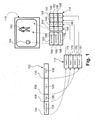
- FIGURE 1 shows exemplary interaction between a video timeline 102. for a program with identified events 104, 106, 108, and 110, an index table 112, a plurality of state changes collected in a state table 114, and a program display 116 in one embodiment of the invention that is given by way of a non-limiting example.
- the video timeline 102 depicts four sequences in the program, including an introduction 124, Part 1 126, Part 2 128, and Part 3 130.
- the beginnings of these sequences 124, 126, 128, and 130 are identified as events 104, 106, 108, and 110, respectively, to be used in correlating presentation of additional content.
- the events 104, 106, 108, and 110 are thus associated with index points 174, 176, 178, and 181 and collected in the index table 112 in sequential order.
- each of the index points 174, 176, 178, and 181 are associated with a state 144, 146, 148, and 150, respectively, in the state table 114.
- the state table 114 also lists three program attributes 164, 166, and 168 which control appearance and behavior of the program as shown on the program display 116.
- each of the events 104, 106, 108, and 110 are reached. Reaching each of these events 104, 106, 108, and 110 triggers index points 174, 176, 178, and 181, respectively, in the index table 112. Reaching index points 174, 176, 178, and 181 in the index table 112 triggers state changes to states 144, 146, 148, and 150, respectively, thereby potentially changing each of the program attributes appearing on the program display 116.
- the program commences at a beginning associated with event 104.
- the event 104 which occurs at "frame 0" at the beginning of the program, is associated with index point 174 and state 144, which is a first state in the state table 114.
- state 144 a program attribute "btn.visible” 180 is set to "T” 182 for true, thereby making a button 184 appear on the program display 116.
- a program attribute "image.file” 186 is set to "a” 188, thereby making an associated image 190 appear on the program display.
- a program attribute "screen.color” 192 is set to "6” 194, changing a color of a background on the program display 116.
- the program continues to progress according to the video timeline 102 and reaches the event 106 which occurs at "frame i" at the beginning of a next segment of the program.
- the event 106 occurs at "frame i" and is associated with index point 176 and state 146.
- index point 176 automatically triggers the state change to state 146.
- the program attribute "btn.visible” 180 is set to "F” 196 for false, thereby making the button 184 disappear from the program display 116.
- the program attribute "image.file” 186 is set to "b” 198, making an associated image (not shown) appear on the program display in the place of image 190.
- the program attribute "screen.color” 192 is set to "8" 199, again changing a color of a background on the program display.
- index points 178 and 181 respectively, trigger state changes in the state table 114 to the states 148 and 150, respectively, thereby changing the appearance and behavior of the program as evidenced by the appearance of the display screen 116.
- states changes associated with the index points are triggered, initiating associated attribute changes.
- execution of an application as described by the non-limiting example advantageously can be performed upon actual execution of the application at a viewer/user location or in emulating the execution of the application prior to dissemination of the application.
- the application might be executed by a STB which first loads the state change and index point information, then executes the state changes according to the index points.
- the application might be executed on a computer emulating the STB environment by loading the state change and index point information and allowing program developers or editors to monitor how the application will execute in a view/user environment.
- FIGURES 2 and 3 show routines for how such execution and emulation, respectively, can be performed according to embodiments of the present invention.
- FIGURE 2 shows a flowchart of a routine 200 for executing an application implemented using a series of state changes and index points collected in a state table and an index table, respectively.
- the routine can be conceived as executing in a STB suitably coupled with a television or other monitoring equipment.
- the routine commences at a block 210.
- a state table is loaded, the state table listing the state changes which define the behaviors of the application.
- an index table is loaded.
- the index table lists the index points which trigger state changes listed in the state table. It will be appreciated that either the loading of the state table at the block 220 or the loading of the index table at the block 230 may be performed first.
- index points have been collected into index tables for purposes of this non-limiting example, index points also could be collected into index lists or presented in other ways.
- state table is used to refer to a collection of state change/attribute change data
- index table is used to refer to a collection of index point data.
- program sequence execution is initiated at a block 240. If the viewer or user has engaged the program at the time of program broadcast, initiation of the program sequence at the block 240 could be triggered at a broadcast site. Alternatively, if the viewer or user later engages the program time from a recording device, that same program initiation signal embedded in the broadcast suitably initiates program execution upon replaying of the broadcast. In any case, initiation of program execution then begins a passage of time or a sequence of events which correspond with the index points received in the index table, thereby facilitating program execution.
- the routine checks to see if the last index point has been reached at a decision block 270. If not, the routine loops to the decision block 250 until an index point is reached at the decision block 250 or a last index point is reached at the decision block 270. If a last index point is reached at the decision block 270, the application ends at a block 280.
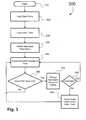
- FIGURE 3 is a flowchart of a routine 300 for emulating execution of the application.
- the routine 300 commences at a block 310 and, like the routine 200 (FIGURE 2) starts by loading a state table at a block 320 and loading an index table at a block 330. It will be appreciated that loading of either table could proceed first. It will also be appreciated that, in an emulator environment, the tables likely will be loaded from a local storage device rather than received from a broadcast medium.
- the routine 300 suitably is executed on a computer on which the state table and index table have been stored on a hard disk or other recording medium.
- the computer suitably may be the same device on which the application and tables previously have been created.
- execution parameters are monitored. These parameters suitably include utilization of memory or other resources, execution time and other-time related information, or other parameters. Allowing an operator to monitor these parameters allows the operator to further ensure proper run-time behavior once the application is broadcast.
- the operator controls an emulated passage of time.
- the operator can let the application execute according to an ordinary timing sequence that might be expected in a broadcast environment.
- the operator can execute the application in slow motion at a slower execution rate than would normally be expected.
- the operator can execute the application one time unit or frame at a time.
- the operator can execute the application more rapidly than would be expected in a broadcast situation.
- the operator can move backward as well as forward through application execution to review to his or her satisfaction operation of the application.
- a decision block 360 it is determined if an index point has been reached. Once an index point has been reached, at a block 370 the associated behavioral changes, including state changes, are executed.
- the operator determines whether the behavioral changes resulting from the interaction of the state changes in the state table, the index points in the index table, and the emulated passage of time yield an acceptable result. If the result is acceptable, the operator continues with the control of the emulated passage of time at the block 350 to further emulate the application. If the result is not acceptable, at a decision block 380, the operator can revise the state changes in the state table or the index points in the index table to modify the execution of the application.
- the routine resumes with the operator's control of the emulated passage of time at the block 350 to further emulate application execution.
- the operator can execute an aspect of the application that was just revised to determine if the revisions are acceptable.
- the operator can continue with the emulated control of time at the block 350 indefinitely, or the operator can choose to terminate emulation of the application at any time (not shown).
- FIGURE 4 shows an exemplary embodiment of a monitoring environment 470 in which the routine of FIGURE 3 suitably is implemented for emulating execution of the application.
- the emulating environment includes a viewing window 472 for showing the program including attribute changes 474 generated.
- An application icon 476 is situated on the screen to signal to a viewer that the object on the screen marked by the application icon 476 is of interest to him or her.
- An application icon 476 can be used, for example, to signal a viewer interaction opportunity, such as the user having a chance to purchase the item marked with the application icon 476 through the use of his or her keyboard or remote control.
- An application window allows 478 allows for text- and command-drive manipulation of code associated with the attribute changes, if the developer desires to make changes beyond or in addition to those that can be made through manipulation of the tables.
- a status window 480 textually presents a list of functions being executed to present the attribute changes shown so that the developer can monitor what is causing the attributes shown on the screen.
- a recording window 482 and a remote window 484 are provided.
- the developer can simulate how a viewer or user of an interactive program might interact with a STB or other device to engage the program. For example, if a program such as a cooking show offers opportunities to purchase merchandise, the developer can click on a screen button 485 to simulate a user making a choice on a keypad. As a result, this allows the developer to determine how well interactive attribute changes he or she created will function.
- the recording window 482 records actions of the simulated user to allow the interactive program to be played back to review how well the interactive functionality operated.
- a resource monitoring window 486 also allows the developer to monitor system resource usage, such as memory usage, to determine whether the program meets practical constraints and objectives.
- FIGURE 5 shows a block diagram of an exemplary system embodiment of the present invention in a production and broadcast environment.
- Applications are created in an authoring environment 510.
- the applications are emulated there according to the routine 300 (FIGURE 3) to determine if they will execute satisfactorily in a broadcast environment.
- the application is disseminated in a broadcast environment 520.
- digital applications can be transmitted via digital cable transmission, digital satellite transmission, or also may be transmitted via the Internet or other means.
- the application, including the state changes and the index points (not shown) are received at an STB 530 where they are processed by an interpreter 540 executing in the STB 530.
- the interpreter 540 receives and processes the state changes and index points, such as in the manner described in the routine 200 (FIGURE 2).
- the output of the interpreter 540 is presented to a user or viewer via a monitor 550, which suitably is a television, an audiovisual monitor, a computer, or another device equipped to process the application.
- a return path 560 allows for user/viewer input back to the broadcast site which can be incorporated by a dynamic transmission processor 570 responsive to user/viewer input. For example, if the application invites viewers to take place in an on-line poll, votes gathered by the interpreter 540 can be transmitted via the STB 530 over the return path 560 to the dynamic transmission processor 570 where the poll can be tallied.
- Results can be relayed via a live host or, if the audiovisual portion of the program is prerecorded, the results could be encoded as data and processed by the interpreter 540 in the STB 530 to be presented to the user.
- the return path 560 for digital STBs suitably is a phone line through which users order pay-per-view movies and through which other transactions are processed.
- the return path 560 could be a phone line, a return band through the digital broadcast medium, or another implementation.
- the application could be emulated by a system capable to mimic the functions of the STB 530 and the interpreter 540.
- the application would not be broadcast, but instead it would be loaded from a local medium and executed.
- Functions of the dynamic processor 570 in response to user actions could be simulated locally as well.
- FIGURE 6 shows a block diagram of one presently preferred embodiment of the interpreter 540.
- the interpreter 540 processes index points 602 and state changes collected in a state table 606 via an execution model 604.
- the execution model 604 contains standard function calls to interpret functions invoked in the state table.
- the execution model 604 also is responsive to the index points to sequence through the state table as dictated by the application behaviors encoded in the state table 606.
- specified operands in the state changes are pushed onto an execution stack 608.
- a byte code interpreter 610 retrieves these operands which, for non-limiting examples, can be values or additional function code.
- the byte-code interpreter 610 then implements the behaviors that were encoded in the state table 606, triggered by the index points 602, and directed by the execution model 604 to the execution stack 608.
- FIGURE 6 does not show a clock or other synchronizing device, although it will be appreciated that some indication of passage of time, whether a frame number count, elapsed time, or other such indicator is desired to drive execution of the computer system.
- a system clock reading of frame or other sequence numbers, or similar means can be used to drive execution of the system in a standalone or emulation environment.
- time or frame indicators would be broadcast or a system clock suitably synchronized to a broadcast time or counter could be used to drive execution of the computer system.
- FIGURE 7 shows a computer system 700, which could be in the form of a media controller, STB, or emulator station operable for using embodiments of the present invention.
- the computer system 700 is operable for controlling a display 702, such as a television, and an audio subsystem 704, such as a stereo or a loudspeaker system.
- the computer system 700 receives input from a network or storage 706 in the case of the STB or the emulator station, respectively.
- the computer system 700 also receives user input from a wired or wireless user keypad 708, which may be in the nature of a STB remote, a computer keyboard, or another input device.
- the computer system 700 receives input via an input/output controller 710, which directs signals to and from a video controller 712, an audio controller 714, and a central processing unit (CPU) 716.
- the input/output controller 710 suitably is a multiplexer for routing video data blocks received to a video controller 712 in the nature of a video decoder, audio data blocks to an audio controller 714 in the nature of an audio decoder, and for routing other data blocks to a CPU 716 for processing.
- the CPU 716 communicates through a system controller 718 with input and storage devices such as read only memory (ROM) 720, system memory 722, system storage 724, and input device controller 726.
- ROM read only memory
- the computer system 700 shown in FIGURE 7 thus can receive state changes collected in state tables and index points collected in index tables and pass them through the input/output controller 710 to the CPU 716 where they will be processed through the system controller 718, suitably in response to user input gathered through the user keypad 708 and the input device controller 726.
- the state changes collected in the table can then be executed and/or modified as triggered by the index points in the index table as previously described in connection with the foregoing example, method flowcharts, block diagrams, and co-pending patent applications incorporated by reference.
- User input or emulated user input can be returned by the input device controller 726 through the system controller 718 to the CPU 716 for processing.
- the CPU 716 transmits the information through the input/output controller 710 to the network or storage 706 as appropriate.
Landscapes
- Engineering & Computer Science (AREA)
- Multimedia (AREA)
- Signal Processing (AREA)
- Software Systems (AREA)
- Theoretical Computer Science (AREA)
- General Engineering & Computer Science (AREA)
- Physics & Mathematics (AREA)
- General Physics & Mathematics (AREA)
- Computer Security & Cryptography (AREA)
- Human Computer Interaction (AREA)
- Library & Information Science (AREA)
- Debugging And Monitoring (AREA)
- Information Retrieval, Db Structures And Fs Structures Therefor (AREA)
- User Interface Of Digital Computer (AREA)
- Television Systems (AREA)
- Stored Programmes (AREA)
- Two-Way Televisions, Distribution Of Moving Picture Or The Like (AREA)
Applications Claiming Priority (2)
| Application Number | Priority Date | Filing Date | Title |
|---|---|---|---|
| US39565502P | 2002-07-12 | 2002-07-12 | |
| US395655P | 2002-07-12 |
Publications (2)
| Publication Number | Publication Date |
|---|---|
| EP1380942A2 true EP1380942A2 (fr) | 2004-01-14 |
| EP1380942A3 EP1380942A3 (fr) | 2006-09-13 |
Family
ID=29712260
Family Applications (3)
| Application Number | Title | Priority Date | Filing Date |
|---|---|---|---|
| EP03254412A Withdrawn EP1380945A3 (fr) | 2002-07-12 | 2003-07-11 | Méthode et système pour commande de l'apparence et le comportement d'applications basé sur le temps |
| EP03254407A Withdrawn EP1380943A3 (fr) | 2002-07-12 | 2003-07-11 | Méthode et système pour générer une commande flexible et basée sur le temps de l'apparence et le comportement d'applications |
| EP03254391A Withdrawn EP1380942A3 (fr) | 2002-07-12 | 2003-07-11 | Méthode et système pour commande flexible et basée sur le temps de l'apparence et le comportement d'applications |
Family Applications Before (2)
| Application Number | Title | Priority Date | Filing Date |
|---|---|---|---|
| EP03254412A Withdrawn EP1380945A3 (fr) | 2002-07-12 | 2003-07-11 | Méthode et système pour commande de l'apparence et le comportement d'applications basé sur le temps |
| EP03254407A Withdrawn EP1380943A3 (fr) | 2002-07-12 | 2003-07-11 | Méthode et système pour générer une commande flexible et basée sur le temps de l'apparence et le comportement d'applications |
Country Status (3)
| Country | Link |
|---|---|
| US (3) | US7260782B2 (fr) |
| EP (3) | EP1380945A3 (fr) |
| NO (2) | NO20033172D0 (fr) |
Cited By (2)
| Publication number | Priority date | Publication date | Assignee | Title |
|---|---|---|---|---|
| US7882436B2 (en) | 2004-03-10 | 2011-02-01 | Trevor Burke Technology Limited | Distribution of video data |
| EP2735139A4 (fr) * | 2011-07-20 | 2015-07-22 | Sony Corp | Procédé, programme informatique, appareil de réception, et appareil de fourniture d'informations pour déclencher un compactage |
Families Citing this family (39)
| Publication number | Priority date | Publication date | Assignee | Title |
|---|---|---|---|---|
| GB0225339D0 (en) * | 2002-10-31 | 2002-12-11 | Trevor Burke Technology Ltd | Method and apparatus for programme generation and classification |
| US20050039177A1 (en) * | 1997-07-12 | 2005-02-17 | Trevor Burke Technology Limited | Method and apparatus for programme generation and presentation |
| US20040070594A1 (en) * | 1997-07-12 | 2004-04-15 | Burke Trevor John | Method and apparatus for programme generation and classification |
| US7260782B2 (en) * | 2002-07-12 | 2007-08-21 | Ensequence, Inc. | Method and system for generating flexible time-based control of application appearance and behavior |
| KR100573685B1 (ko) * | 2003-03-07 | 2006-04-25 | 엘지전자 주식회사 | 대화형 광디스크의 애니메이션 데이터 재생방법 및 장치 |
| US7636919B2 (en) * | 2003-09-16 | 2009-12-22 | International Business Machines Corporation | User-centric policy creation and enforcement to manage visually notified state changes of disparate applications |
| KR20050064150A (ko) * | 2003-12-23 | 2005-06-29 | 엘지전자 주식회사 | 고밀도 광디스크의 메뉴 구성방법 및 실행방법과기록재생장치 |
| KR20050066265A (ko) * | 2003-12-26 | 2005-06-30 | 엘지전자 주식회사 | 고밀도 광디스크의 메뉴 구성방법 및 실행방법과기록재생장치 |
| KR20050066264A (ko) * | 2003-12-26 | 2005-06-30 | 엘지전자 주식회사 | 고밀도 광디스크의 메뉴 구성방법 및 실행방법과기록재생장치 |
| US8870639B2 (en) | 2004-06-28 | 2014-10-28 | Winview, Inc. | Methods and apparatus for distributed gaming over a mobile device |
| US8376855B2 (en) | 2004-06-28 | 2013-02-19 | Winview, Inc. | Methods and apparatus for distributed gaming over a mobile device |
| US10226698B1 (en) | 2004-07-14 | 2019-03-12 | Winview, Inc. | Game of skill played by remote participants utilizing wireless devices in connection with a common game event |
| US7788634B2 (en) * | 2004-09-03 | 2010-08-31 | Ensequence, Inc. | Methods and systems for efficient behavior generation in software application development tool |
| US10721543B2 (en) | 2005-06-20 | 2020-07-21 | Winview, Inc. | Method of and system for managing client resources and assets for activities on computing devices |
| US7905777B2 (en) | 2005-08-04 | 2011-03-15 | Igt | Methods and apparatus for auctioning an item via a gaming device |
| US8216065B2 (en) | 2005-09-09 | 2012-07-10 | Igt | Gaming system having multiple adjacently arranged gaming machines which each provide a component for a multi-component game |
| US9511287B2 (en) | 2005-10-03 | 2016-12-06 | Winview, Inc. | Cellular phone games based upon television archives |
| US9919210B2 (en) | 2005-10-03 | 2018-03-20 | Winview, Inc. | Synchronized gaming and programming |
| US8149530B1 (en) | 2006-04-12 | 2012-04-03 | Winview, Inc. | Methodology for equalizing systemic latencies in television reception in connection with games of skill played in connection with live television programming |
| US9056251B2 (en) | 2006-01-10 | 2015-06-16 | Winview, Inc. | Method of and system for conducting multiple contests of skill with a single performance |
| US10556183B2 (en) | 2006-01-10 | 2020-02-11 | Winview, Inc. | Method of and system for conducting multiple contest of skill with a single performance |
| US8002618B1 (en) | 2006-01-10 | 2011-08-23 | Winview, Inc. | Method of and system for conducting multiple contests of skill with a single performance |
| US11082746B2 (en) | 2006-04-12 | 2021-08-03 | Winview, Inc. | Synchronized gaming and programming |
| US7857699B2 (en) * | 2006-11-01 | 2010-12-28 | Igt | Gaming system and method of operating a gaming system having a bonus participation bidding sequence |
| US9716918B1 (en) | 2008-11-10 | 2017-07-25 | Winview, Inc. | Interactive advertising system |
| US8250059B2 (en) * | 2009-09-14 | 2012-08-21 | International Business Machines Corporation | Crawling browser-accessible applications |
| US8601442B2 (en) * | 2009-09-30 | 2013-12-03 | Microsoft Corporation | Marker correlation of application constructs with visualizations |
| US8941779B2 (en) | 2012-03-21 | 2015-01-27 | Sony Corporation | Non-closed caption data transport in standard caption service |
| US8667456B1 (en) * | 2011-04-20 | 2014-03-04 | Google Inc. | Cloud-based indexing for integrated development environments |
| TWI528749B (zh) | 2011-09-06 | 2016-04-01 | Sony Corp | A signal receiving device, a signal receiving method, an information processing program and an information processing system |
| US8930988B2 (en) * | 2011-12-21 | 2015-01-06 | Sony Corporation | Reception apparatus, reception method, program, and information processing system |
| US9113230B2 (en) | 2011-12-21 | 2015-08-18 | Sony Corporation | Method, computer program, and reception apparatus for delivery of supplemental content |
| US9936231B2 (en) * | 2012-03-21 | 2018-04-03 | Saturn Licensing Llc | Trigger compaction |
| US10104447B2 (en) | 2012-06-19 | 2018-10-16 | Saturn Licensing Llc | Extensions to trigger parameters table for interactive television |
| US20150135071A1 (en) * | 2013-11-12 | 2015-05-14 | Fox Digital Entertainment, Inc. | Method and apparatus for distribution and presentation of audio visual data enhancements |
| US10101801B2 (en) * | 2013-11-13 | 2018-10-16 | Cisco Technology, Inc. | Method and apparatus for prefetching content in a data stream |
| US10372511B2 (en) * | 2014-07-18 | 2019-08-06 | Verizon Patent And Licensing Inc. | Method and apparatus for providing an application control trigger |
| US11551529B2 (en) | 2016-07-20 | 2023-01-10 | Winview, Inc. | Method of generating separate contests of skill or chance from two independent events |
| US11308765B2 (en) | 2018-10-08 | 2022-04-19 | Winview, Inc. | Method and systems for reducing risk in setting odds for single fixed in-play propositions utilizing real time input |
Family Cites Families (29)
| Publication number | Priority date | Publication date | Assignee | Title |
|---|---|---|---|---|
| JPH0658624B2 (ja) * | 1990-03-30 | 1994-08-03 | インターナショナル・ビシネス・マシーンズ・コーポレーション | グラフィカル・ユーザ・インターフェース管理装置 |
| US5604907A (en) * | 1993-12-30 | 1997-02-18 | International Business Machines Corporation | Computer system for executing action slots including multiple action object classes |
| US5680617A (en) * | 1994-05-16 | 1997-10-21 | Apple Computer, Inc. | Computer-human interface which provides for user customization of object behavior |
| US5870727A (en) * | 1995-05-22 | 1999-02-09 | Gte Data Services Incorporated | Rule-based system for the provision of complex navigational logic |
| CA2180969C (fr) * | 1995-07-11 | 2003-05-13 | Kayoko Asai | Appareil de lecture multimedia utilisant une synchronisation d'instants de traitement definis par un scenario durant la lecture d'articles monomedia de duree finie |
| US6188396B1 (en) * | 1996-03-29 | 2001-02-13 | International Business Machines Corp. | Synchronizing multimedia parts with reference to absolute time, relative time, and event time |
| EP1517560A1 (fr) * | 1996-09-11 | 2005-03-23 | Matsushita Electric Industrial Co., Ltd. | Dispositif pour la transmission d'information de commande d'affichage |
| US6209028B1 (en) * | 1997-03-21 | 2001-03-27 | Walker Digital, Llc | System and method for supplying supplemental audio information for broadcast television programs |
| CA2261028C (fr) * | 1997-05-21 | 2012-02-07 | Koninklijke Philips Electronics N.V. | Transmission et reception de programmes televises |
| US6177928B1 (en) * | 1997-08-22 | 2001-01-23 | At&T Corp. | Flexible synchronization framework for multimedia streams having inserted time stamp |
| US5986655A (en) * | 1997-10-28 | 1999-11-16 | Xerox Corporation | Method and system for indexing and controlling the playback of multimedia documents |
| US6008802A (en) * | 1998-01-05 | 1999-12-28 | Intel Corporation | Method and apparatus for automatically performing a function based on the reception of information corresponding to broadcast data |
| US6810503B1 (en) * | 1998-02-11 | 2004-10-26 | Microsoft Corporation | Method and apparatus for controlling the timing of the invocation of events within a computer runtime environment |
| JPH11282658A (ja) * | 1998-03-31 | 1999-10-15 | Fujitsu Ltd | 対話的ソフトウエア構築・駆動装置 |
| US6266053B1 (en) * | 1998-04-03 | 2001-07-24 | Synapix, Inc. | Time inheritance scene graph for representation of media content |
| US6268864B1 (en) * | 1998-06-11 | 2001-07-31 | Presenter.Com, Inc. | Linking a video and an animation |
| US6263339B1 (en) * | 1998-08-25 | 2001-07-17 | Informix Software, Inc. | Dynamic object visualization and code generation |
| US6357042B2 (en) * | 1998-09-16 | 2002-03-12 | Anand Srinivasan | Method and apparatus for multiplexing separately-authored metadata for insertion into a video data stream |
| US6577849B1 (en) * | 1999-02-03 | 2003-06-10 | Motorola, Inc. | Method and apparatus for providing additional information about a broadcast |
| US6774917B1 (en) * | 1999-03-11 | 2004-08-10 | Fuji Xerox Co., Ltd. | Methods and apparatuses for interactive similarity searching, retrieval, and browsing of video |
| US6769130B1 (en) * | 2000-01-20 | 2004-07-27 | Interactual Technologies, Inc. | System, method and article of manufacture for late synchronization during the execution of a multimedia event on a plurality of client computers |
| US6415438B1 (en) * | 1999-10-05 | 2002-07-02 | Webtv Networks, Inc. | Trigger having a time attribute |
| JP2003513538A (ja) * | 1999-10-22 | 2003-04-08 | アクティブスカイ,インコーポレイテッド | オブジェクト指向ビデオシステム |
| US7174562B1 (en) * | 1999-12-20 | 2007-02-06 | Microsoft Corporation | Interactive television triggers having connected content/disconnected content attribute |
| EP1146749A1 (fr) * | 2000-04-07 | 2001-10-17 | Canal+ Technologies Société Anonyme | Appareil et méthode de test d'applications |
| ATE376208T1 (de) * | 2000-08-02 | 2007-11-15 | Mattel Inc | Überlagerungstastatur |
| US7213255B2 (en) * | 2000-08-25 | 2007-05-01 | Intellocity Usa, Inc. | Set-top preview program |
| US7260782B2 (en) * | 2002-07-12 | 2007-08-21 | Ensequence, Inc. | Method and system for generating flexible time-based control of application appearance and behavior |
| US7231630B2 (en) * | 2002-07-12 | 2007-06-12 | Ensequence Inc. | Method and system automatic control of graphical computer application appearance and execution |
-
2003
- 2003-04-30 US US10/427,357 patent/US7260782B2/en not_active Expired - Lifetime
- 2003-04-30 US US10/427,343 patent/US20040010793A1/en not_active Abandoned
- 2003-04-30 US US10/427,255 patent/US20040010792A1/en not_active Abandoned
- 2003-07-10 NO NO20033172A patent/NO20033172D0/no not_active Application Discontinuation
- 2003-07-10 NO NO20033171A patent/NO20033171D0/no not_active Application Discontinuation
- 2003-07-11 EP EP03254412A patent/EP1380945A3/fr not_active Withdrawn
- 2003-07-11 EP EP03254407A patent/EP1380943A3/fr not_active Withdrawn
- 2003-07-11 EP EP03254391A patent/EP1380942A3/fr not_active Withdrawn
Non-Patent Citations (1)
| Title |
|---|
| None * |
Cited By (2)
| Publication number | Priority date | Publication date | Assignee | Title |
|---|---|---|---|---|
| US7882436B2 (en) | 2004-03-10 | 2011-02-01 | Trevor Burke Technology Limited | Distribution of video data |
| EP2735139A4 (fr) * | 2011-07-20 | 2015-07-22 | Sony Corp | Procédé, programme informatique, appareil de réception, et appareil de fourniture d'informations pour déclencher un compactage |
Also Published As
| Publication number | Publication date |
|---|---|
| EP1380942A3 (fr) | 2006-09-13 |
| US7260782B2 (en) | 2007-08-21 |
| US20040010793A1 (en) | 2004-01-15 |
| EP1380945A2 (fr) | 2004-01-14 |
| EP1380945A3 (fr) | 2006-09-13 |
| EP1380943A3 (fr) | 2006-09-13 |
| US20040010792A1 (en) | 2004-01-15 |
| EP1380943A2 (fr) | 2004-01-14 |
| NO20033171D0 (no) | 2003-07-10 |
| US20040010771A1 (en) | 2004-01-15 |
| NO20033172D0 (no) | 2003-07-10 |
Similar Documents
| Publication | Publication Date | Title |
|---|---|---|
| EP1380942A2 (fr) | Méthode et système pour commande flexible et basée sur le temps de l'apparence et le comportement d'applications | |
| US8631453B2 (en) | Video branching | |
| US20020186234A1 (en) | Method and system for selecting a position in an image sequence | |
| CN113077861A (zh) | 显示设备、控制装置及通信监测方法 | |
| US20090317060A1 (en) | Method and apparatus for processing multimedia | |
| US20080222678A1 (en) | Method and Apparatus for Programme Generation and Presentation | |
| JP2004524777A (ja) | キーフレームに基づく再生位置選択方法及びシステム | |
| CN113453057B (zh) | 一种显示设备及播放进度控制方法 | |
| US20100293472A1 (en) | Information processing apparatus and method, and program | |
| US20110016396A1 (en) | Content media reproduction device and content media | |
| CN102508646A (zh) | 内容签名用户界面 | |
| EP2614638B1 (fr) | Signature de contenu | |
| CN112866783A (zh) | 评论交互方法和装置、电子设备 | |
| KR20110027708A (ko) | 콘텐트 아이템의 요약을 프리젠테이션하는 방법 및 장치 | |
| KR20090020930A (ko) | 개인 맞춤형 녹화 컨텐츠 처리 방법 및 장치 | |
| CN113490064A (zh) | 一种视频播放方法和设备及服务器 | |
| CN119166094A (zh) | 一种显示设备及音效配置方法 | |
| CN115767196B (zh) | 一种显示设备及媒资播放方法 | |
| CN119420977B (zh) | 一种显示设备及栏目浏览方法 | |
| CN101489027A (zh) | 视频播放系统、视频播放装置、及其控制方法 | |
| CN121657900A (zh) | 虚拟空间的显示方法及装置、电子设备、存储介质 |
Legal Events
| Date | Code | Title | Description |
|---|---|---|---|
| PUAI | Public reference made under article 153(3) epc to a published international application that has entered the european phase |
Free format text: ORIGINAL CODE: 0009012 |
|
| AK | Designated contracting states |
Kind code of ref document: A2 Designated state(s): AT BE BG CH CY CZ DE DK EE ES FI FR GB GR HU IE IT LI LU MC NL PT RO SE SI SK TR |
|
| AX | Request for extension of the european patent |
Extension state: AL LT LV MK |
|
| PUAL | Search report despatched |
Free format text: ORIGINAL CODE: 0009013 |
|
| AK | Designated contracting states |
Kind code of ref document: A3 Designated state(s): AT BE BG CH CY CZ DE DK EE ES FI FR GB GR HU IE IT LI LU MC NL PT RO SE SI SK TR |
|
| AX | Request for extension of the european patent |
Extension state: AL LT LV MK |
|
| RIC1 | Information provided on ipc code assigned before grant |
Ipc: G06F 9/46 20060101AFI20060808BHEP |
|
| 17P | Request for examination filed |
Effective date: 20070131 |
|
| 17Q | First examination report despatched |
Effective date: 20070315 |
|
| AKX | Designation fees paid |
Designated state(s): AT BE BG CH CY CZ DE DK EE ES FI FR GB GR HU IE IT LI LU MC NL PT RO SE SI SK TR |
|
| STAA | Information on the status of an ep patent application or granted ep patent |
Free format text: STATUS: THE APPLICATION IS DEEMED TO BE WITHDRAWN |
|
| 18D | Application deemed to be withdrawn |
Effective date: 20070926 |