EP1382441A9 - Procédé et dispositif de l'assemblage automatique de vitrage feuilleté - Google Patents
Procédé et dispositif de l'assemblage automatique de vitrage feuilleté Download PDFInfo
- Publication number
- EP1382441A9 EP1382441A9 EP03077198A EP03077198A EP1382441A9 EP 1382441 A9 EP1382441 A9 EP 1382441A9 EP 03077198 A EP03077198 A EP 03077198A EP 03077198 A EP03077198 A EP 03077198A EP 1382441 A9 EP1382441 A9 EP 1382441A9
- Authority
- EP
- European Patent Office
- Prior art keywords
- glass
- station
- assembling
- composite
- plastic material
- Prior art date
- Legal status (The legal status is an assumption and is not a legal conclusion. Google has not performed a legal analysis and makes no representation as to the accuracy of the status listed.)
- Withdrawn
Links
- 239000011521 glass Substances 0.000 title claims abstract description 93
- 239000002131 composite material Substances 0.000 title claims abstract description 26
- 238000000034 method Methods 0.000 title claims abstract description 17
- 238000005520 cutting process Methods 0.000 claims abstract description 13
- 239000000463 material Substances 0.000 claims abstract description 13
- 229920003023 plastic Polymers 0.000 claims abstract description 12
- 230000002093 peripheral effect Effects 0.000 claims abstract description 6
- 229920002037 poly(vinyl butyral) polymer Polymers 0.000 description 39
- 238000004519 manufacturing process Methods 0.000 description 7
- 238000005516 engineering process Methods 0.000 description 4
- 125000000391 vinyl group Chemical group [H]C([*])=C([H])[H] 0.000 description 3
- 229920002554 vinyl polymer Polymers 0.000 description 3
- 230000033001 locomotion Effects 0.000 description 2
- 229910000831 Steel Inorganic materials 0.000 description 1
- 230000001133 acceleration Effects 0.000 description 1
- 238000004378 air conditioning Methods 0.000 description 1
- 238000005452 bending Methods 0.000 description 1
- 230000003750 conditioning effect Effects 0.000 description 1
- 230000008878 coupling Effects 0.000 description 1
- 238000010168 coupling process Methods 0.000 description 1
- 238000005859 coupling reaction Methods 0.000 description 1
- 230000007613 environmental effect Effects 0.000 description 1
- 238000009434 installation Methods 0.000 description 1
- 239000010959 steel Substances 0.000 description 1
- 238000004659 sterilization and disinfection Methods 0.000 description 1
- 238000003860 storage Methods 0.000 description 1
- 230000001360 synchronised effect Effects 0.000 description 1
Images


Classifications
-
- C—CHEMISTRY; METALLURGY
- C03—GLASS; MINERAL OR SLAG WOOL
- C03B—MANUFACTURE, SHAPING, OR SUPPLEMENTARY PROCESSES
- C03B33/00—Severing cooled glass
- C03B33/07—Cutting armoured, multi-layered, coated or laminated, glass products
- C03B33/076—Laminated glass comprising interlayers
- C03B33/078—Polymeric interlayers
-
- B—PERFORMING OPERATIONS; TRANSPORTING
- B26—HAND CUTTING TOOLS; CUTTING; SEVERING
- B26D—CUTTING; DETAILS COMMON TO MACHINES FOR PERFORATING, PUNCHING, CUTTING-OUT, STAMPING-OUT OR SEVERING
- B26D3/00—Cutting work characterised by the nature of the cut made; Apparatus therefor
- B26D3/10—Making cuts of other than simple rectilinear form
-
- B—PERFORMING OPERATIONS; TRANSPORTING
- B32—LAYERED PRODUCTS
- B32B—LAYERED PRODUCTS, i.e. PRODUCTS BUILT-UP OF STRATA OF FLAT OR NON-FLAT, e.g. CELLULAR OR HONEYCOMB, FORM
- B32B17/00—Layered products essentially comprising sheet glass, or glass, slag, or like fibres
- B32B17/06—Layered products essentially comprising sheet glass, or glass, slag, or like fibres comprising glass as the main or only constituent of a layer, next to another layer of a specific material
- B32B17/10—Layered products essentially comprising sheet glass, or glass, slag, or like fibres comprising glass as the main or only constituent of a layer, next to another layer of a specific material of synthetic resin
- B32B17/10005—Layered products essentially comprising sheet glass, or glass, slag, or like fibres comprising glass as the main or only constituent of a layer, next to another layer of a specific material of synthetic resin laminated safety glass or glazing
- B32B17/10009—Layered products essentially comprising sheet glass, or glass, slag, or like fibres comprising glass as the main or only constituent of a layer, next to another layer of a specific material of synthetic resin laminated safety glass or glazing characterized by the number, the constitution or treatment of glass sheets
- B32B17/10036—Layered products essentially comprising sheet glass, or glass, slag, or like fibres comprising glass as the main or only constituent of a layer, next to another layer of a specific material of synthetic resin laminated safety glass or glazing characterized by the number, the constitution or treatment of glass sheets comprising two outer glass sheets
-
- B—PERFORMING OPERATIONS; TRANSPORTING
- B32—LAYERED PRODUCTS
- B32B—LAYERED PRODUCTS, i.e. PRODUCTS BUILT-UP OF STRATA OF FLAT OR NON-FLAT, e.g. CELLULAR OR HONEYCOMB, FORM
- B32B17/00—Layered products essentially comprising sheet glass, or glass, slag, or like fibres
- B32B17/06—Layered products essentially comprising sheet glass, or glass, slag, or like fibres comprising glass as the main or only constituent of a layer, next to another layer of a specific material
- B32B17/10—Layered products essentially comprising sheet glass, or glass, slag, or like fibres comprising glass as the main or only constituent of a layer, next to another layer of a specific material of synthetic resin
- B32B17/10005—Layered products essentially comprising sheet glass, or glass, slag, or like fibres comprising glass as the main or only constituent of a layer, next to another layer of a specific material of synthetic resin laminated safety glass or glazing
- B32B17/1055—Layered products essentially comprising sheet glass, or glass, slag, or like fibres comprising glass as the main or only constituent of a layer, next to another layer of a specific material of synthetic resin laminated safety glass or glazing characterized by the resin layer, i.e. interlayer
- B32B17/10761—Layered products essentially comprising sheet glass, or glass, slag, or like fibres comprising glass as the main or only constituent of a layer, next to another layer of a specific material of synthetic resin laminated safety glass or glazing characterized by the resin layer, i.e. interlayer containing vinyl acetal
-
- B—PERFORMING OPERATIONS; TRANSPORTING
- B32—LAYERED PRODUCTS
- B32B—LAYERED PRODUCTS, i.e. PRODUCTS BUILT-UP OF STRATA OF FLAT OR NON-FLAT, e.g. CELLULAR OR HONEYCOMB, FORM
- B32B17/00—Layered products essentially comprising sheet glass, or glass, slag, or like fibres
- B32B17/06—Layered products essentially comprising sheet glass, or glass, slag, or like fibres comprising glass as the main or only constituent of a layer, next to another layer of a specific material
- B32B17/10—Layered products essentially comprising sheet glass, or glass, slag, or like fibres comprising glass as the main or only constituent of a layer, next to another layer of a specific material of synthetic resin
- B32B17/10005—Layered products essentially comprising sheet glass, or glass, slag, or like fibres comprising glass as the main or only constituent of a layer, next to another layer of a specific material of synthetic resin laminated safety glass or glazing
- B32B17/10807—Making laminated safety glass or glazing; Apparatus therefor
- B32B17/10899—Making laminated safety glass or glazing; Apparatus therefor by introducing interlayers of synthetic resin
- B32B17/10935—Making laminated safety glass or glazing; Apparatus therefor by introducing interlayers of synthetic resin as a preformed layer, e.g. formed by extrusion
-
- B—PERFORMING OPERATIONS; TRANSPORTING
- B32—LAYERED PRODUCTS
- B32B—LAYERED PRODUCTS, i.e. PRODUCTS BUILT-UP OF STRATA OF FLAT OR NON-FLAT, e.g. CELLULAR OR HONEYCOMB, FORM
- B32B17/00—Layered products essentially comprising sheet glass, or glass, slag, or like fibres
- B32B17/06—Layered products essentially comprising sheet glass, or glass, slag, or like fibres comprising glass as the main or only constituent of a layer, next to another layer of a specific material
- B32B17/10—Layered products essentially comprising sheet glass, or glass, slag, or like fibres comprising glass as the main or only constituent of a layer, next to another layer of a specific material of synthetic resin
- B32B17/10005—Layered products essentially comprising sheet glass, or glass, slag, or like fibres comprising glass as the main or only constituent of a layer, next to another layer of a specific material of synthetic resin laminated safety glass or glazing
- B32B17/10807—Making laminated safety glass or glazing; Apparatus therefor
- B32B17/10899—Making laminated safety glass or glazing; Apparatus therefor by introducing interlayers of synthetic resin
- B32B17/10954—Making laminated safety glass or glazing; Apparatus therefor by introducing interlayers of synthetic resin by using an aligning laminating device
-
- B—PERFORMING OPERATIONS; TRANSPORTING
- B65—CONVEYING; PACKING; STORING; HANDLING THIN OR FILAMENTARY MATERIAL
- B65G—TRANSPORT OR STORAGE DEVICES, e.g. CONVEYORS FOR LOADING OR TIPPING, SHOP CONVEYOR SYSTEMS OR PNEUMATIC TUBE CONVEYORS
- B65G49/00—Conveying systems characterised by their application for specified purposes not otherwise provided for
- B65G49/05—Conveying systems characterised by their application for specified purposes not otherwise provided for for fragile or damageable materials or articles
- B65G49/06—Conveying systems characterised by their application for specified purposes not otherwise provided for for fragile or damageable materials or articles for fragile sheets, e.g. glass
- B65G49/068—Stacking or destacking devices; Means for preventing damage to stacked sheets, e.g. spaces
-
- B—PERFORMING OPERATIONS; TRANSPORTING
- B65—CONVEYING; PACKING; STORING; HANDLING THIN OR FILAMENTARY MATERIAL
- B65G—TRANSPORT OR STORAGE DEVICES, e.g. CONVEYORS FOR LOADING OR TIPPING, SHOP CONVEYOR SYSTEMS OR PNEUMATIC TUBE CONVEYORS
- B65G2249/00—Aspects relating to conveying systems for the manufacture of fragile sheets
- B65G2249/04—Arrangements of vacuum systems or suction cups
Definitions
- the present invention relates to a method and a compact sized apparatus for the assembly of composite glasses such as windshields for vehicles or the like.
- a typical automobile windshield is a composite glass pane, made up of two thin glass panes, usually called “inner glass”, intended for the interior of the automobile, and “outer glass”, joined together by means of an intermediate layer of plastic material such as Polyvinylbutyral
- a first disadvantage for the mounting of such components is linked to the type of work which is extremely challenging, because the efficiency it requires is based on critical parameters with very low tolerance and this implies vast investments for industry. Moreover, excluding just a few cases, to date there is another disadvantage associated with the process for mounting said composite glasses, given by the fact that they are to be mounted mainly by hand in production lines, entailing an excessive burden in terms of time, specialised labour and costs.
- the method and the apparatus of the present invention is aimed at solving the aforesaid drawbacks, because it was designed for the automobile glass industry, thereby providing the most advanced technology for the automated assembly of laminated windshields.
- the present invention provides a method for assembling a composite glass which is characterised in that it comprises the steps set out in the characterising part of claim 1.
- the present invention also provides an apparatus characterised by the operative stations as set out in the characterising part of claim 5.
- the related configuration of the apparatus of the present invention allows to carry out all the main steps of the assembling process, with the smallest bulk ever achieved heretofore.
- the feeding and arrangement of the "inner glass” and of the "outer glass”, their relative squaring, the subsequent feeding of a stack of detachable Polyvinylbutyral (PVB), their arrangement and sandwich mounting, the assembly and the final cut of the excess vinyl around the glass edge, all is provided automatically in more ore less 25 m 2 of floor space.
- the high output rate (up to 5 windshields per minute) allows to combine the apparatus of the present invention to nearly all fast windshield production lines in the world.
- a method and a device comprise a compact system for assembling glasses starting from the separate feeding and subsequent coupling of an inner glass and of an outer glass, and a related tray of stacked vinyl sheets, all transported within the apparatus itself and wherefrom the windshield exits completely assembled, ready for the subsequent assembly operation on the car.
- the apparatus is provided with an autonomous air conditioning system, which maintains the PVB sheets in the proper thermo-hygrometric conditions for their employment even when the apparatus operates in a normal industrial environment.
- An autonomous air conditioning system which maintains the PVB sheets in the proper thermo-hygrometric conditions for their employment even when the apparatus operates in a normal industrial environment.
- the existence of a conditioning system allows to reduce the clean space of the storage room for the PVB sheets and, consequently, to achieve a reduction in the cost of the related installation and operation step.
- the apparatus comprises a series of integrated functional modules co-operating with each other, which means that the different manufacturing steps are completely synchronised.
- the apparatus of the present invention can easily be inserted in a pre-existing production, because it has considerable elasticity in its performance parameters, such as a vast tolerance in material supply, a vast range of glass formats and models, the possibility of different assembly characteristic, a limited technical idle time and the great efficiency of the product.
- performance parameters such as a vast tolerance in material supply, a vast range of glass formats and models, the possibility of different assembly characteristic, a limited technical idle time and the great efficiency of the product.
- expert human assemblers could barely reach such a level of efficiency, but they could not achieve the objectives so quickly at such a fast operating rate.
- the apparatus of the present invention is a compact apparatus for assembling composite glasses, which substantially consists of a set of automated cells which are physically closed in a stabilised hygro-thermostatic conduit (better illustrated below).
- the series of stations provides for the glass to be assembled, profiled and then delivered.
- the various stations constituting the cells are shown assembled according to the apparatus of the present invention. More specifically, the first station consists of a conveyor belt 1 in which the glass panes (i.e. the "inner glass” and the “outer glass") are loaded and are subsequently accelerated in a second station.
- a steel structure 3 positioned superiorly to the first station 1, houses a tray with the stacked PVB sheets (said tray is not shown herein).
- the glasses can be loaded via rack, manual or automated, or by the feeding conveyor belt external to the apparatus (not in the figure). Typical velocities of the input line are between 10 and 20 metres/min, whilst the output velocity from the second station is increased to 60 metres/min.
- the trays filled with one or more stacks of PVB can be loaded manually or automatically via flow connection conveyors and be replaced periodically.
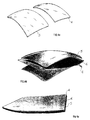
- FIG. 4a through 4c the principle for the assembly of a composite glass according to the present invention is schematically shown therein. More specifically, two glasses 4 and 5 are fed horizontally, one after the other and both face down (with the wings downwards) on the conveyor belt 1. Additionally, a PVB sheet 6 is fed from the station 3. It must be noted immediately that the dimensions of the PVB sheet 6 must exceed those of the glasses 4 and 5, so that the PVB sheet, once positioned on the glasses, projects by several millimetres out of the peripheral edges.
- a third station which consists of a squaring, or rather a calibration station, in which both glass panes 4 and 5 are centred and aligned relative to a common reference so that the axes X, Y and the planar angle are fixed in a determined manner.
- Each glass pane 4 and 5 reaches the alignment station 7 at high speed, then is first slowed and lastly stopped by the conveyor belt of the station 7. In this condition, the alignment is performed by means of servo-controlled tools, which are particular but known in the prior art, and able to handle the product which is extremely fragile.
- the apparatus according to the present invention guarantees an exactness in the absolute references of each glass pane 4 and 5 with an error of 0.5 millimetres.
- the PVB sheet 6 once it is peeled from the stack in the station 3, it enters a gripping and positioning station 8 and after descent by means of detaching tools, it is positioned over a special belt.
- the determination of the position of the sheet according to the axes X and Y and its angling, as well as the detachment devices and the related applied technology, are comprised in a series of technologies which have already been covered by the patent application EP 1052206 A1 in the name of the present applicant and, therefore, their detailed description shall be omitted herein.
- the first glass pane 4 i.e. the inner glass
- the glass is gripped again by appropriate suction cups 11.
- the second pane 5 (the outer glass) is then transferred by an upper handling head 12, which moves below the PVB peeler machine and above the line of the conveyor belt 9. In this case, too, the glass is gripped by the suction cups 11.
- the position of the PVB sheet 6 is corrected and the sheet is transferred over the convex surface of the inner glass 4.
- viewing systems are used for this purposes for sensing the position and actual orientation of the PVB sheet 6 before it is gripped and handled by an appropriate manipulator tool.
- the correction of the position and orientation of the PVB sheet 6 aims at centring the sheet 6 relative to the glass 4 according to the Y and X axes, and to orient it about said centre.
- the PVB sheet 6 is transferred by the belt onto the glass pane by a manipulator with four degrees of freedom which corrects the final position of the PVB sheet to combine the latter with the position of the glass 4 in the assembly station 9.
- This technology for the manipulation of the PVB sheet is also the subject of the patent application EP 1052206 A1 by the same applicant.
- a composite "sandwich” glass comprising the two glass panes 4 and 5 and the PVB sheet 6 interposed between them, is assembled.
- the assembly sequence is as follows:
- the maximum mounting error between the glass panes 4 and 5 is 0.5 millimetres in the radial direction relative to any point of the glass edge, whilst the maximum mounting error between the edge of the glass panes and the PVB sheet 6 is 3 millimetres.
- the windshield thus assembled is conveyed towards the subsequent PVB cutting station 13 downstream.
- the windshield is transferred by an additional automated head 14, which performs an "exact” advancing motion relative to the initial position.
- This "exact” transfer of the windshield maintains all previous alignments obtained an maintained in the cutting station 13. All transfer movements of the automated heads are guided by controlled cycle motors to control the ends, the velocity and travel accelerations.
- the final finishing operation is performed, i.e. the part of the PVB sheet 6 projecting out of the edges of the assembled panes 4 and 5 is correctly cut off.
- the cut is performed by two automated heads 15 (whereof only one is shown in the figures), which are programmable according to different requirements/needs.
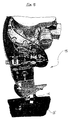
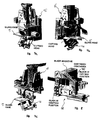
- an arm is illustrated therein which comprises a programmable automated head 15.
- the automated head 15 is a 6-axis robot, and it is able to assure the necessary spaces between the glass and the edge of the PVB sheet as predetermined for each individual windshield model. Following the assembly of the composite glass, a predetermined minimal excess portion of PVB sheet is to be left along the entire profile of the glass edge, since further processes which follow (mainly sterilisation in an autoclave) usually entail a shrinking of the vinyl.
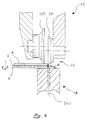
- a cutting head 16 is provided, mounted on the automated head 15 (better illustrated below).
- an alignment region 17 is provided, mounted on the automated head and able to align the edges of the glass panes 4 and 5 relative to the PVB sheet 6.
- the composite glass thus obtained is then fed by means of a conveyor belt 18 to a subsequent station for assembling the glass outside the apparatus of the present invention.
- a first advantage is provided by the extreme compactness of the apparatus, which makes it particularly suited to be transported in a single container.
- Another advantage is given by the simplicity and, at the same time, by the high reliability of the apparatus which make it particularly advantageous in terms of employment and operating costs.
Landscapes
- Chemical & Material Sciences (AREA)
- Engineering & Computer Science (AREA)
- Materials Engineering (AREA)
- Organic Chemistry (AREA)
- Life Sciences & Earth Sciences (AREA)
- Forests & Forestry (AREA)
- Mechanical Engineering (AREA)
- Joining Of Glass To Other Materials (AREA)
- Automobile Manufacture Line, Endless Track Vehicle, Trailer (AREA)
Applications Claiming Priority (2)
| Application Number | Priority Date | Filing Date | Title |
|---|---|---|---|
| ITRM20020377 | 2002-07-12 | ||
| IT2002RM000377A ITRM20020377A1 (it) | 2002-07-12 | 2002-07-12 | Procedimento ed apparecchiatura robotizzata compatta per l'assemblaggio di vetrature composite. |
Publications (2)
| Publication Number | Publication Date |
|---|---|
| EP1382441A1 EP1382441A1 (fr) | 2004-01-21 |
| EP1382441A9 true EP1382441A9 (fr) | 2004-04-28 |
Family
ID=11456408
Family Applications (1)
| Application Number | Title | Priority Date | Filing Date |
|---|---|---|---|
| EP03077198A Withdrawn EP1382441A1 (fr) | 2002-07-12 | 2003-07-11 | Procédé et dispositif de l'assemblage automatique de vitrage feuilleté |
Country Status (2)
| Country | Link |
|---|---|
| EP (1) | EP1382441A1 (fr) |
| IT (1) | ITRM20020377A1 (fr) |
Families Citing this family (8)
| Publication number | Priority date | Publication date | Assignee | Title |
|---|---|---|---|---|
| FI118004B (fi) * | 2004-11-09 | 2007-05-31 | Tamglass Ltd Oy | Menetelmä ja laite lasilevyjen laminoimiseksi |
| DE102007003173B4 (de) * | 2006-12-08 | 2016-10-20 | Webasto Ag | Verfahren und Vorrichtung zur Herstellung eines Glas-/Kunststoffverbundes |
| DE102008009843A1 (de) * | 2008-02-08 | 2009-08-13 | Bystronic Armatec Gmbh | Schneidvorrichtung |
| DE102008031061A1 (de) | 2008-07-01 | 2011-01-05 | Grenzebach Maschinenbau Gmbh | Verfahren und Vorrichtung zum Besäumen photovoltaischer Module |
| EP2174784A1 (fr) | 2008-10-13 | 2010-04-14 | 3S Swiss Solar Systems AG | Procédé destiné à séparer une section saillante d'une couche de strate |
| DE102008052319A1 (de) * | 2008-10-20 | 2010-04-22 | Hegla Gmbh & Co. Kg | Vorrichtung und Verfahren zum Entfernen von Folienüberstand an einer Glaskante einer Verbundsicherheitsglastafel |
| FR2993197B1 (fr) * | 2012-07-11 | 2015-02-13 | Saint Gobain | Dispositif et procede de decoupe de matiere plastique en particulier d’un vitrage feuillete |
| CN113021963B (zh) * | 2021-04-25 | 2023-09-29 | 北京新远建邦科技有限公司 | 一种用于生产复合保温凹槽板的半自动生产线 |
Family Cites Families (6)
| Publication number | Priority date | Publication date | Assignee | Title |
|---|---|---|---|---|
| FR2510029A1 (fr) * | 1981-07-24 | 1983-01-28 | Saint Gobain Vitrage | Dispositif de decoupe de feuilles de matiere plastique |
| NZ201127A (en) * | 1981-07-28 | 1986-03-14 | Ppg Industries Inc | Assembling flexible material with a bent glass sheet or sheets to form laminated windscreen |
| FR2594812B1 (fr) * | 1986-02-27 | 1988-05-27 | Saint Gobain Vitrage | Procede et dispositif pour l'assemblage automatique des vitrages feuilletes |
| DE3728284A1 (de) * | 1987-08-25 | 1989-04-27 | Flachglas Ag | Konfektioniervorrichtung |
| IT1230916B (it) * | 1988-06-27 | 1991-11-08 | Central Glass Co Ltd | Dispositivo e metodo per tagliare parte di bordo superfluo di interstrato di vetro laminato |
| US5556505A (en) * | 1994-07-05 | 1996-09-17 | Ford Motor Company | Windshield assembly system |
-
2002
- 2002-07-12 IT IT2002RM000377A patent/ITRM20020377A1/it unknown
-
2003
- 2003-07-11 EP EP03077198A patent/EP1382441A1/fr not_active Withdrawn
Also Published As
| Publication number | Publication date |
|---|---|
| EP1382441A1 (fr) | 2004-01-21 |
| ITRM20020377A1 (it) | 2004-01-12 |
| ITRM20020377A0 (it) | 2002-07-12 |
Similar Documents
| Publication | Publication Date | Title |
|---|---|---|
| EP2861361B1 (fr) | Ligne de production des ébauches et procédé pour empiler des ébauches sorties de cisailles ou d' une presse de découpage | |
| CN109638359B (zh) | 一种模切叠片一体成形工艺 | |
| CN115610895B (zh) | 一种货物柔性补货方法、装置 | |
| EP1382441A9 (fr) | Procédé et dispositif de l'assemblage automatique de vitrage feuilleté | |
| EP2204280A2 (fr) | Procédé et appareil d'alimentation de sacs dans une machine d'emballage | |
| CN210850561U (zh) | 一种太阳能电池组件封装膜切割设备 | |
| CN116991134B (zh) | 生产线上产品换型方法及系统 | |
| CN112296672B (zh) | 嵌入式消毒柜柔性自动化冲压装配生产线 | |
| EP3909753A1 (fr) | Systèmes et procédés de fabrication automatisée de composites | |
| CN110509604B (zh) | 一种皮壳包装盒成型除泡机及其使用方法 | |
| CN112660530A (zh) | 盘装产品包装生产线 | |
| CN107089359B (zh) | 一种自动化生产线 | |
| CN109968700A (zh) | 一种液化天然气船用聚氨酯绝缘箱的制造方法及制造系统 | |
| CN212504583U (zh) | 一种玻璃切割加工线 | |
| CN116477165A (zh) | 贴签粘附系统、方法以及计算机可读的非暂时性存储介质 | |
| CN117961564A (zh) | 软包铜排全自动生产系统 | |
| CN221047102U (zh) | 一种液化气钢瓶封头的冲压成型设备 | |
| CN215034536U (zh) | 一种电池片划片装置及串焊机 | |
| CN112912311A (zh) | 用于在两个加工工位间的运输路径上运输工件的运输系统 | |
| EP3253511B1 (fr) | Procédé de chargement d'ébauches dans une presse, et système | |
| CN107117345B (zh) | 自动贴背胶和保护膜装置及方法 | |
| CN214357197U (zh) | 盘装产品包装生产线 | |
| CN117324800B (zh) | 一种激光切割生产线及生产方法 | |
| CN206969057U (zh) | 自动贴背胶和保护膜装置 | |
| CN217373482U (zh) | 一种自动贴膜机组 |
Legal Events
| Date | Code | Title | Description |
|---|---|---|---|
| PUAI | Public reference made under article 153(3) epc to a published international application that has entered the european phase |
Free format text: ORIGINAL CODE: 0009012 |
|
| AK | Designated contracting states |
Kind code of ref document: A1 Designated state(s): AT BE BG CH CY CZ DE DK EE ES FI FR GB GR HU IE IT LI LU MC NL PT RO SE SI SK TR |
|
| AX | Request for extension of the european patent |
Extension state: AL LT LV MK |
|
| 17P | Request for examination filed |
Effective date: 20040714 |
|
| AKX | Designation fees paid |
Designated state(s): AT BE BG CH CY CZ DE DK EE ES FI FR GB GR HU IE IT LI LU MC NL PT RO SE SI SK TR |
|
| 17Q | First examination report despatched |
Effective date: 20050608 |
|
| STAA | Information on the status of an ep patent application or granted ep patent |
Free format text: STATUS: THE APPLICATION IS DEEMED TO BE WITHDRAWN |
|
| 18D | Application deemed to be withdrawn |
Effective date: 20051220 |