EP1385149A1 - Normalisierung eines Verifizierungsmasses in einer Vorrichtung zur Sprecherverifikation - Google Patents
Normalisierung eines Verifizierungsmasses in einer Vorrichtung zur Sprecherverifikation Download PDFInfo
- Publication number
- EP1385149A1 EP1385149A1 EP03291716A EP03291716A EP1385149A1 EP 1385149 A1 EP1385149 A1 EP 1385149A1 EP 03291716 A EP03291716 A EP 03291716A EP 03291716 A EP03291716 A EP 03291716A EP 1385149 A1 EP1385149 A1 EP 1385149A1
- Authority
- EP
- European Patent Office
- Prior art keywords
- speaker
- score
- parameter
- model
- voice
- Prior art date
- Legal status (The legal status is an assumption and is not a legal conclusion. Google has not performed a legal analysis and makes no representation as to the accuracy of the status listed.)
- Granted
Links
- 238000012795 verification Methods 0.000 title claims abstract description 59
- 238000010606 normalization Methods 0.000 title claims abstract description 28
- 230000001755 vocal effect Effects 0.000 claims abstract description 23
- 238000012360 testing method Methods 0.000 claims abstract description 12
- 230000006978 adaptation Effects 0.000 claims description 20
- 238000009826 distribution Methods 0.000 claims description 20
- 230000006870 function Effects 0.000 claims description 7
- 238000012549 training Methods 0.000 abstract description 3
- 238000000034 method Methods 0.000 description 6
- 239000000203 mixture Substances 0.000 description 4
- 238000010586 diagram Methods 0.000 description 3
- 230000008901 benefit Effects 0.000 description 2
- 230000008859 change Effects 0.000 description 2
- 238000010200 validation analysis Methods 0.000 description 2
- 201000008197 Laryngitis Diseases 0.000 description 1
- 230000032683 aging Effects 0.000 description 1
- 238000013459 approach Methods 0.000 description 1
- 230000001413 cellular effect Effects 0.000 description 1
- 238000006243 chemical reaction Methods 0.000 description 1
- 238000004891 communication Methods 0.000 description 1
- 150000001875 compounds Chemical class 0.000 description 1
- 238000010276 construction Methods 0.000 description 1
- 230000001419 dependent effect Effects 0.000 description 1
- 230000002452 interceptive effect Effects 0.000 description 1
- 238000012986 modification Methods 0.000 description 1
- 230000004048 modification Effects 0.000 description 1
- 230000008569 process Effects 0.000 description 1
- 230000000306 recurrent effect Effects 0.000 description 1
- 238000011160 research Methods 0.000 description 1
- 230000004044 response Effects 0.000 description 1
- 230000000717 retained effect Effects 0.000 description 1
- 230000035945 sensitivity Effects 0.000 description 1
- 230000001360 synchronised effect Effects 0.000 description 1
- 230000009466 transformation Effects 0.000 description 1
- 239000013598 vector Substances 0.000 description 1
Images
Classifications
-
- G—PHYSICS
- G10—MUSICAL INSTRUMENTS; ACOUSTICS
- G10L—SPEECH ANALYSIS TECHNIQUES OR SPEECH SYNTHESIS; SPEECH RECOGNITION; SPEECH OR VOICE PROCESSING TECHNIQUES; SPEECH OR AUDIO CODING OR DECODING
- G10L17/00—Speaker identification or verification techniques
- G10L17/06—Decision making techniques; Pattern matching strategies
- G10L17/12—Score normalisation
Definitions
- the present invention relates to recognition automatic speakerphone, and more particularly the verification of a speaker authorized to access a service application, independently, or depending on the content of the voice segment, such as password, pronounced by speaker.
- Speaker verification or voice authentication
- voice authentication is a mode ergonomic for securing access. Unfortunately, its current performance do not provide total security.
- a developer of verification means speaker in a recognition device automatic speech, object of the invention must compromise between an authorized fraud rate corresponding to imposters accessing the application and the level of ergonomics required corresponding to a speaker acceptance rate of good faith to which the service application cannot be refused.
- any speaker verification process results in a verification score which reflects the similarity between an authorized speaker voice model suspected and an unknown speaker voice segment wishing to access the application.
- the score of verification is then compared to the threshold of decision. According to the result of this comparison, the device decides to accept or reject the unknown speaker, i.e. to authorize or prohibit him from accessing the application. If the threshold of decision is severe and therefore high, we will accept wrong few impostors but we will reject speakers allowed. If the decision threshold is loose and therefore weak, we will reject few authorized speakers but we will accept many impostors.
- the difficulty therefore lies in determining of the decision threshold, especially since for the same rate acceptance threshold is variable from speaker to speaker the other ("A COMPARISON OF A PRIORI THRESHOLD SETTING PROCEDURES FOR SPEAKER VERIFICATION IN THE CAVE PROJECT ", J.-B. PIERROT et al., Proceedings ICASSP, 1998).
- a way to get rid of sensitivity to threshold per speaker lies in the normalization of the distribution of verification scores. If by a appropriate transformation, the distributions of scores are made independent of the model of speaker, we then solve the research problem of a threshold per speaker, i.e. by model of speaker. The problem is therefore moved to the search for normalization of scores.
- s x (Y) is the verification score for a speech segment to be tested Y against an authorized speaker model X
- the verification score normalized by the z-norm method is: where ⁇ x and ⁇ X are respectively the mean and the standard deviation of the distribution of the impostor scores on the X model.
- a phase learning known as enrollment, very short at during which a voiceprint of the speaker authorized user is created by generating a template vocal of it.
- the vocal model of authorized speaker is adapted as and when uses with speech recordings validated by the application or by an algorithm decision, as disclosed in the article "ROBUST METHODS OF UPDATING MODEL AND A PRIORI THRESHOLD IN SPEAKER VERIFICATION ", Tomoko MATSUI et al., Proceedings ICASSP, 1996, p. 97-100.
- his speech recorded during the access request is used to update day his model. This update enriches the modeling and takes into account the evolutions of the voice of the authorized speaker over time.
- the distribution of scores is changed and the threshold of initially defined decision may be unsuitable for the application. Indeed, the more the model is determined with a lot of data, the better the scores of verification in the case of a speaker-user authorized. If the decision threshold is set loose enough not to dismiss too many users allowed in the initial configuration it's also quite permissive and lets a large number of impostors. As the vocal model of speaker is enriched as and when requests access, the distribution of scores is modified, which can lead to very low rejection of authorized speakers and at an acceptance rate of relatively high impostors, while a modification of the decision threshold would benefit fully from the enrichment of modeling and would erroneously maintain low rejection while having a low acceptance rate of impostors.
- MATSUI et al. offer to adapt the decision threshold when the model of speaker is suitable. This adaptation is therefore made directly on the decision threshold for a point of expected operation.
- the adaptation of the threshold proposed by MATSUI et al. assumes that the device has retained all speech recordings needed to learning and adapting the speaker model to be able to determine a set of scores from verification which will be used to estimate a decision threshold for this set. This threshold is interpolated with the old threshold to get the new one threshold.
- the main objective of the invention is to normalize the verification score so that it is compared to a still relevant decision threshold, independent of the speaker, while ensuring that the verification score evolves with the speaker's voice allowed, without the use of records additional impostors. Consequently, relative to the device for recognizing speech, the invention aims to reduce the space of memory required for recordings additional impostors, while guaranteeing a more precise and quick decision.
- a system for automatically recognize a speaker's voice authorized to access an application includes a way to generate parameters of a voice model of acceptance relating to a vocal segment pronounced by the authorized speaker and parameters of a model voice of refusal beforehand during a phase learning, a way to normalize by normalization parameters a verification score of speaker dependent on the likelihood ratio between a voice segment to be tested and the models of acceptance and refusal, and a means to compare the verification score normalized to a first threshold in order to not allow access to the speaker having pronounced the voice segment to be tested in the application than if the normalized score is at least as large than the first threshold.
- This device is characterized, according to the invention, in that it comprises means for update at least one of the parameters of normalization based on a previous value said parameter and the verification score of speaker at each voice segment test only when the normalized score is at least one second threshold which is at least equal to the first threshold.
- the expression "at least equal to” means a variable greater than or equal to a threshold.
- the first threshold is modified without require adjustment of parameters.
- the normalized score is thus updated in line, as and when attempts to speaker verification and therefore access requests to the application, so that the normalized score evolves with changes in the speaker's voice. Updating based on at least one parameter and no of a threshold allows to modify the score of standard decision regardless of the point of operation required by the application.
- the updated normalization setting can be representative of the statistical mean value speaker verification score or standard deviation speaker verification score, or these two parameters are updated.
- the update of the normalized score is still improved when the device includes a means to update at least one of the parameters of the acceptance model based on a value previous of said model parameter only when the normalized score is at least equal to the second threshold.
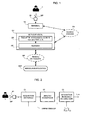
- FIG. 1 there is shown schematically a preferred context for using the automatic voice recognition device DR speaker according to the invention.
- This context relates to a client-server telecommunications system in which a TE speaker terminal such as a set telephone or a personal computer with a modem, or a mobile terminal, such as mobile radio is connected to a voice server SV interactive telephone line containing the device DR, through a telephone access network or cellular radiotelephone AR.
- a speaker authorized wishes to access an application from predetermined AP service
- an MP password or a sentence pronounced by an authorized speaker L before the microphone MI of terminal TE is transmitted to the server SV in response to an invitation to transmit the word password during a dialogue with the voice server SV.
- the DR device analyzes the password MP and gives access to the predetermined AP application when speaker L's voice has been recognized correctly.
- the AP application offers services managed in a SAP application server connected to the voice server SV through a packet network RP, such as the internet.
- the DR device is implemented in a terminal, such than a telephone, a personal computer, a mobile radio, or digital assistant staff.
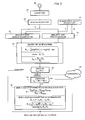
- the device speaker automatic speech recognition functionally comprises means learning system consisting of three software modules A1, A2 and A3, and a means of automatic verification speaker composed of six software modules V1 to V6. They cooperate with a portion of memory not volatile in the server to store various parameters, most of which are updated, used to normalized verification score determinations defined below.
- the learning medium determines parameters mainly characterizing a model voice of the authorized speaker L to recognize. he includes an A1 speech acquisition module connected to an acoustic source, such as the MI microphone, an A2 acoustic analysis module including the output is looped through an iterative input of speech models during a learning phase, and an A3 speaker model generation module.
- the automatic learning phase is based for example on the statistical modeling of an MP password by HMM (Hidden Markov Model) hidden Markov chains.
- HMM Hidden Markov Model
- N versions of the password are then stored in the acquisition module A1, after conversion analog to digital.
- MP password is chosen freely by speaker L and is a priori unknown the speaker voice recognition device DR. No further password registration spoken by speakers other than the speaker allowed L is only necessary during the phase learning.
- composition of passwords is free, that is to say, is constituted by everything voice segment, and can be changed as desired authorized speaker on each attempt to recognition of his voice.
- the analysis module A2 estimates, in a known iterative way, parameters predetermined m of a hidden Markov model ⁇ , so deduce the Gaussian distribution means of these model parameters.
- Module A2 inherits other parameters of a general voice model that have been memorized in module A2, because of the low number of available data resulting from the analysis few versions of the password N.
- the parameters of the acceptance voice model ⁇ as well generated by the authorized speaker L are stored in the module A3.
- the vocal model ⁇ also called reference acoustic, is characteristic of the voice of the authorized speaker L and can be associated in memory from the SV server to a speaker identifier, such as a secret code, entered on the terminal keyboard TE before saying the password MP.
- the acoustic analysis module A2 builds a vocal rejection model ⁇ , also known as an alternative model (background model) or anti-model.
- the parameters of the refusal model ⁇ are known and pre-stored in the server SV during the learning phase. They are representative of an "average" vocal model of a high number of arbitrary speakers, and therefore of a deceptive vocal model.
- the generation module A3 determines initial parameter values and necessary for the normalization of verification score according to the invention, estimated on a corpus of training data defined beforehand in particular according to the application AP to which the speaker accesses by the recognized password. These training data have been previously written in the memory of the server SV and allow the module A3 to determine initial values. and normalization parameters depending in particular on parameters of the vocal models ⁇ and ⁇ and used in recurrent formulas of these parameters during a first test, and of the adaptation factors ⁇ ⁇ and ⁇ ⁇ respectively for the normalization parameters and .
- the acceptance and refusal models ⁇ are generated according to a GMM (Gaussian Mixture Model) modeling based on the mixture of normal distributions, called Gaussian distributions, relating to parameters.
- GMM modeling is for example defined in the article by Douglas A. REYNOLDS, "Speaker identification and verification using Gaussian mixture speaker models", Speech Communication 17, 1995, p. 91-108.
- the speaker L When trying to access the AP application, for example after validation of the secret code aforementioned compound by the SV voice server, the speaker L speaks a vocal segment in front of the MI microphone containing the password MP, an occurrence of speech signal X for a duration T, so that the chain of modules V1 to V6 shown in Figure 3 check that the speaker is the speaker the password during the learning phase.
- the duration T is expressed in number of portions of duration predetermined about 32 ms of the voice segment, called frames.
- the number T is variable in depending on the speaker's speed of speech.
- the acquisition modules A1 and A2 analyze acoustically the signal X containing the password MP that has just been spoken, and produce a signal vocal test X composed of a series of T vectors of cepstral coefficients.
- Similarity modules V1 and V2 evaluate the similarities between the test vocal signal X produced by the acoustic analysis module A2 on the one hand, and the acceptance vocal model ⁇ and the refusal vocal model ⁇ read in memory by the module A3 on the other hand, the parameters m of the models ⁇ and ⁇ having been updated at the end of the previous speaker voice check, as discussed below.
- ⁇ ) respectively produced by modules V1 and V2 and characterizing the likelihood that the observed test voice signal X is representative of the authorized speaker having uttered a voice segment represented by the acceptance model ⁇ and the likelihood that the observed test voice signal X is representative of any speaker who could have spoken a voice segment represented by the refusal model ⁇ .
- the score is proportional to the likelihood ratio relating to the acceptance model ⁇ representative of the authorized speaker and to the refusal model ⁇ representative of any speaker. It expresses the confidence placed in the observed test voice signal X.
- S V the higher the score S V , the more the voice of the speaker at the origin of the test voice signal X has characteristics close to those of the acceptance model ⁇ .
- T denotes the number of frames (frames) contained in the MP voice segment to be tested.
- the module V3 also determines a normalized verification score S N as a function of the speaker verification score S V and two normalization parameters and of the acceptance model ⁇ representative of the voice of the authorized speaker L, according to the following relation:
- the first normalization parameter represents the statistical mean value, i.e. the mathematical expectation of the speaker verification score.
- the update of the first parameter is weighted by a predetermined adaptation factor ⁇ ⁇ less than 1.
- the second normalization parameter represents the standard deviation of the verification score S v equal to the square root of the difference of the mean square value of the score S V and the square of the statistical mean value ⁇ 2 ⁇ .
- the update of the second parameter is weighted by another predetermined adaptation factor ⁇ ⁇ less than 1.
- Parameter values and in the right limbs of the two previous recurrence relations were determined during the speaker verification preceding the current one and are read with the adaptation factors ⁇ ⁇ and ⁇ ⁇ by the module V3 before determining the score S N.
- the normalization of the speaker verification score S V into the normalized score S N advantageously follows the variations in the verification score, that is to say of the speaker's voice, represented by the parameters and .
- the evolution of the voice of the authorized speaker L is reported in the normalized score S N by updating the parameters and , but also model parameters m used for the initial modeling.
- the decision module V4 compares the normalized score S N with a first predetermined threshold TH1.
- the module V4 authorizes the access of the speaker to the service application AP when the standardized score S N is equal to or greater than the predetermined threshold TH1.
- the voice server SV invites the speaker to say the password MP a few more times, for example three times.
- the access decision made in the V4 module depends on the constant TH1 threshold and therefore independent of the authorized speaker. According to the invention, the decision rather depends on the standardized verification score S N , the parameters of which such as the factors ⁇ ⁇ and ⁇ ⁇ are chosen once and for all in dependence on the ergonomics desired for accessing the application AP. If the type of application is changed, the threshold TH1 and a second threshold TH2 can be modified by the manager of the new application in the server SV.
- the validation module V5 compares the normalized threshold S N with the second threshold TH2 preferably greater than the first threshold TH1, although the thresholds can be equal.
- the adaptation module V6 updates parameters only if the normalized score is greater than the TH2 threshold, that is to say when, for example, the voice of the authorized speaker has changed significantly, in particular because of aging or speaker's laryngitis.
- one or both of the adaptation factors ⁇ ⁇ and ⁇ ⁇ vary depending on the number of adaptations, i.e. the number of normalization parameter updates made in the V6 module from the learning phase in order to quickly adapt the normalization parameters so that they converge quickly during the first adaptations, then less and less then until the adaptation is suspended.
- the module V6 also updates each parameter m at least of the acceptance model ⁇ and possibly of the refusal model ⁇ , so as to reduce the rate of imposture represented by the probability P (X
- m Ap and N Ap respectively denote the mean of the Gaussian distribution, also known as the normal distribution, of the probability density of the model parameter m during the learning phase and the number of frames in the vocal segments, this is i.e. in passwords, used to estimate the means of the Gaussian distributions relating to the hidden Markov models ⁇ and ⁇ .
- the parameter m adapt denotes the average of the Gaussian distribution of the probability density of the parameter of model m which was determined during the update which has just been carried out and therefore which reflects the evolution of the parameter m over the updates, after the learning phase.
- N adapt denotes the number of frames used to estimate the average of the Gaussian distribution of the model parameter m for the update which has just been carried out.
- the number of frames T of the voice signal to be tested varies from one verification to the next depending in particular on the speed of speech of the speaker.
- the V6 module stores the new values of the parameters m of the voice models ⁇ and ⁇ and normalization parameters and which will be used to determine the S V and S N scores in module V3 during the next speaker voice test.
- only one of the normalization parameters and is updated preferably only the statistical mean value parameter which is essential by assigning the null value to the adaptation factor ⁇ .
- at least one or some of the model parameters m are only updated, which is essential by assigning the null value to the numbers of frames N adapt for the other model parameters which are not update.
Landscapes
- Engineering & Computer Science (AREA)
- Human Computer Interaction (AREA)
- Acoustics & Sound (AREA)
- Game Theory and Decision Science (AREA)
- Health & Medical Sciences (AREA)
- Audiology, Speech & Language Pathology (AREA)
- Business, Economics & Management (AREA)
- Physics & Mathematics (AREA)
- Computer Vision & Pattern Recognition (AREA)
- Multimedia (AREA)
- Telephonic Communication Services (AREA)
- Collating Specific Patterns (AREA)
- Storage Device Security (AREA)
- Electrically Operated Instructional Devices (AREA)
- Small-Scale Networks (AREA)
Applications Claiming Priority (2)
| Application Number | Priority Date | Filing Date | Title |
|---|---|---|---|
| FR0209299 | 2002-07-22 | ||
| FR0209299A FR2842643B1 (fr) | 2002-07-22 | 2002-07-22 | Normalisation de score de verification dans un dispositif de reconnaissance vocale de locuteur |
Publications (2)
| Publication Number | Publication Date |
|---|---|
| EP1385149A1 true EP1385149A1 (de) | 2004-01-28 |
| EP1385149B1 EP1385149B1 (de) | 2005-10-05 |
Family
ID=29797644
Family Applications (1)
| Application Number | Title | Priority Date | Filing Date |
|---|---|---|---|
| EP03291716A Expired - Lifetime EP1385149B1 (de) | 2002-07-22 | 2003-07-10 | Normalisierung eines Verifizierungsmasses in einer Vorrichtung zur Sprecherverifikation |
Country Status (5)
| Country | Link |
|---|---|
| US (1) | US7409343B2 (de) |
| EP (1) | EP1385149B1 (de) |
| DE (1) | DE60301767T9 (de) |
| ES (1) | ES2246462T3 (de) |
| FR (1) | FR2842643B1 (de) |
Cited By (1)
| Publication number | Priority date | Publication date | Assignee | Title |
|---|---|---|---|---|
| US7408866B2 (en) | 2003-02-14 | 2008-08-05 | Konica Minolta Holdings, Inc. | Objective lens for optical pickup apparatus, optical pickup apparatus and optical information recording reproducing apparatus |
Families Citing this family (47)
| Publication number | Priority date | Publication date | Assignee | Title |
|---|---|---|---|---|
| US6941266B1 (en) * | 2000-11-15 | 2005-09-06 | At&T Corp. | Method and system for predicting problematic dialog situations in a task classification system |
| US7630892B2 (en) * | 2004-09-10 | 2009-12-08 | Microsoft Corporation | Method and apparatus for transducer-based text normalization and inverse text normalization |
| US20060085189A1 (en) * | 2004-10-15 | 2006-04-20 | Derek Dalrymple | Method and apparatus for server centric speaker authentication |
| GB2426368A (en) * | 2005-05-21 | 2006-11-22 | Ibm | Using input signal quality in speeech recognition |
| US7603275B2 (en) * | 2005-10-31 | 2009-10-13 | Hitachi, Ltd. | System, method and computer program product for verifying an identity using voiced to unvoiced classifiers |
| US7788101B2 (en) * | 2005-10-31 | 2010-08-31 | Hitachi, Ltd. | Adaptation method for inter-person biometrics variability |
| KR100745980B1 (ko) * | 2006-01-11 | 2007-08-06 | 삼성전자주식회사 | 분류기 통합을 위한 스코어 합성 방법 및 장치 |
| US7480641B2 (en) * | 2006-04-07 | 2009-01-20 | Nokia Corporation | Method, apparatus, mobile terminal and computer program product for providing efficient evaluation of feature transformation |
| DE102006019362A1 (de) | 2006-04-21 | 2007-10-25 | Deutsche Telekom Ag | Verfahren und Vorrichtung zur Verifizierung der Identität eines Nutzers verschiedener Telekommunikationsdienste mittels biometrischer Merkmale |
| AU2007335251B2 (en) * | 2006-12-19 | 2014-05-15 | Validvoice, Llc | Confidence levels for speaker recognition |
| EP1968320B1 (de) * | 2007-02-27 | 2018-07-18 | Accenture Global Services Limited | Steuerung für eine Videoanrufvorrichtung |
| US8086461B2 (en) * | 2007-06-13 | 2011-12-27 | At&T Intellectual Property Ii, L.P. | System and method for tracking persons of interest via voiceprint |
| JP2010008601A (ja) * | 2008-06-25 | 2010-01-14 | Fujitsu Ltd | 案内情報表示装置、案内情報表示方法及びプログラム |
| AU2009273750B2 (en) * | 2008-07-21 | 2015-07-16 | Auraya Pty Ltd | Voice authentication systems and methods |
| US8190437B2 (en) * | 2008-10-24 | 2012-05-29 | Nuance Communications, Inc. | Speaker verification methods and apparatus |
| US8442824B2 (en) | 2008-11-26 | 2013-05-14 | Nuance Communications, Inc. | Device, system, and method of liveness detection utilizing voice biometrics |
| EP2216775B1 (de) * | 2009-02-05 | 2012-11-21 | Nuance Communications, Inc. | Sprechererkennung |
| US8209174B2 (en) * | 2009-04-17 | 2012-06-26 | Saudi Arabian Oil Company | Speaker verification system |
| US20140188481A1 (en) * | 2009-12-22 | 2014-07-03 | Cyara Solutions Pty Ltd | System and method for automated adaptation and improvement of speaker authentication in a voice biometric system environment |
| US9224388B2 (en) * | 2011-03-04 | 2015-12-29 | Qualcomm Incorporated | Sound recognition method and system |
| DE102011103938B3 (de) | 2011-06-10 | 2012-08-09 | Audi Ag | Verfahren zum Betrieb eines Bussystems zur Kommunikation mit mehreren Kommunikationsteilnehmern und Kraftfahrzeug |
| US8965763B1 (en) * | 2012-02-02 | 2015-02-24 | Google Inc. | Discriminative language modeling for automatic speech recognition with a weak acoustic model and distributed training |
| US8543398B1 (en) | 2012-02-29 | 2013-09-24 | Google Inc. | Training an automatic speech recognition system using compressed word frequencies |
| US9390445B2 (en) | 2012-03-05 | 2016-07-12 | Visa International Service Association | Authentication using biometric technology through a consumer device |
| US8374865B1 (en) | 2012-04-26 | 2013-02-12 | Google Inc. | Sampling training data for an automatic speech recognition system based on a benchmark classification distribution |
| US8571859B1 (en) | 2012-05-31 | 2013-10-29 | Google Inc. | Multi-stage speaker adaptation |
| US8805684B1 (en) | 2012-05-31 | 2014-08-12 | Google Inc. | Distributed speaker adaptation |
| US9251792B2 (en) * | 2012-06-15 | 2016-02-02 | Sri International | Multi-sample conversational voice verification |
| US8554559B1 (en) | 2012-07-13 | 2013-10-08 | Google Inc. | Localized speech recognition with offload |
| US9123333B2 (en) | 2012-09-12 | 2015-09-01 | Google Inc. | Minimum bayesian risk methods for automatic speech recognition |
| US9043210B1 (en) | 2012-10-02 | 2015-05-26 | Voice Security Systems, Inc. | Biometric voice command and control switching device and method of use |
| US20140278389A1 (en) * | 2013-03-12 | 2014-09-18 | Motorola Mobility Llc | Method and Apparatus for Adjusting Trigger Parameters for Voice Recognition Processing Based on Noise Characteristics |
| US8694315B1 (en) * | 2013-02-05 | 2014-04-08 | Visa International Service Association | System and method for authentication using speaker verification techniques and fraud model |
| EP3084605B1 (de) * | 2013-12-18 | 2019-06-12 | Telefonaktiebolaget LM Ericsson (publ) | Verfahren und netzwerkknoten zur auswahl einer medienverarbeitungseinheit |
| EP2897076B8 (de) * | 2014-01-17 | 2018-02-07 | Cirrus Logic International Semiconductor Ltd. | Manipulationssicheres Element zur Verwendung bei der Sprechererkennung |
| US10157272B2 (en) | 2014-02-04 | 2018-12-18 | Qualcomm Incorporated | Systems and methods for evaluating strength of an audio password |
| KR102339657B1 (ko) | 2014-07-29 | 2021-12-16 | 삼성전자주식회사 | 전자 장치 및 이의 제어 방법 |
| WO2016015687A1 (zh) * | 2014-07-31 | 2016-02-04 | 腾讯科技(深圳)有限公司 | 声纹验证方法及装置 |
| CN104967622B (zh) * | 2015-06-30 | 2017-04-05 | 百度在线网络技术(北京)有限公司 | 基于声纹的通讯方法、装置和系统 |
| US9978374B2 (en) * | 2015-09-04 | 2018-05-22 | Google Llc | Neural networks for speaker verification |
| CN106782564B (zh) * | 2016-11-18 | 2018-09-11 | 百度在线网络技术(北京)有限公司 | 用于处理语音数据的方法和装置 |
| DK179560B1 (en) * | 2017-05-16 | 2019-02-18 | Apple Inc. | FAR-FIELD EXTENSION FOR DIGITAL ASSISTANT SERVICES |
| US10896673B1 (en) * | 2017-09-21 | 2021-01-19 | Wells Fargo Bank, N.A. | Authentication of impaired voices |
| EP4276817A4 (de) * | 2021-01-05 | 2024-05-29 | Panasonic Intellectual Property Corporation of America | Identifikationsvorrichtung, identifikationsverfahren und programm |
| US12021806B1 (en) | 2021-09-21 | 2024-06-25 | Apple Inc. | Intelligent message delivery |
| US11516079B1 (en) * | 2021-10-27 | 2022-11-29 | Dell Products L.P. | Network initialization communication storage system |
| US20250029601A1 (en) * | 2023-07-21 | 2025-01-23 | Sri International | Detecting synthetic speech |
Family Cites Families (15)
| Publication number | Priority date | Publication date | Assignee | Title |
|---|---|---|---|---|
| US4032711A (en) * | 1975-12-31 | 1977-06-28 | Bell Telephone Laboratories, Incorporated | Speaker recognition arrangement |
| US4837830A (en) * | 1987-01-16 | 1989-06-06 | Itt Defense Communications, A Division Of Itt Corporation | Multiple parameter speaker recognition system and methods |
| CA2105034C (en) * | 1992-10-09 | 1997-12-30 | Biing-Hwang Juang | Speaker verification with cohort normalized scoring |
| US5884261A (en) * | 1994-07-07 | 1999-03-16 | Apple Computer, Inc. | Method and apparatus for tone-sensitive acoustic modeling |
| US6073101A (en) * | 1996-02-02 | 2000-06-06 | International Business Machines Corporation | Text independent speaker recognition for transparent command ambiguity resolution and continuous access control |
| US5842165A (en) * | 1996-02-29 | 1998-11-24 | Nynex Science & Technology, Inc. | Methods and apparatus for generating and using garbage models for speaker dependent speech recognition purposes |
| US5895448A (en) * | 1996-02-29 | 1999-04-20 | Nynex Science And Technology, Inc. | Methods and apparatus for generating and using speaker independent garbage models for speaker dependent speech recognition purpose |
| JP2991144B2 (ja) * | 1997-01-29 | 1999-12-20 | 日本電気株式会社 | 話者認識装置 |
| US5946654A (en) * | 1997-02-21 | 1999-08-31 | Dragon Systems, Inc. | Speaker identification using unsupervised speech models |
| US6125345A (en) * | 1997-09-19 | 2000-09-26 | At&T Corporation | Method and apparatus for discriminative utterance verification using multiple confidence measures |
| FR2769118B1 (fr) * | 1997-09-29 | 1999-12-03 | Matra Communication | Procede de reconnaissance de parole |
| US6119084A (en) * | 1997-12-29 | 2000-09-12 | Nortel Networks Corporation | Adaptive speaker verification apparatus and method including alternative access control |
| US6107935A (en) * | 1998-02-11 | 2000-08-22 | International Business Machines Corporation | Systems and methods for access filtering employing relaxed recognition constraints |
| US6219639B1 (en) * | 1998-04-28 | 2001-04-17 | International Business Machines Corporation | Method and apparatus for recognizing identity of individuals employing synchronized biometrics |
| US6327564B1 (en) * | 1999-03-05 | 2001-12-04 | Matsushita Electric Corporation Of America | Speech detection using stochastic confidence measures on the frequency spectrum |
-
2002
- 2002-07-22 FR FR0209299A patent/FR2842643B1/fr not_active Expired - Fee Related
-
2003
- 2003-07-10 ES ES03291716T patent/ES2246462T3/es not_active Expired - Lifetime
- 2003-07-10 DE DE60301767T patent/DE60301767T9/de active Active
- 2003-07-10 EP EP03291716A patent/EP1385149B1/de not_active Expired - Lifetime
- 2003-07-22 US US10/623,607 patent/US7409343B2/en not_active Expired - Fee Related
Non-Patent Citations (3)
| Title |
|---|
| HEBERT M ET AL: "IMPROVED NORMALIZATION WITHOUT RECOURSE TO AN IMPOSTOR DATABASE FOR SPEAKER VERIFICATION", 2000 IEEE INTERNATIONAL CONFERENCE ON ACOUSTICS, SPEECH, AND SIGNAL PROCESSING. PROCEEDINGS. (ICASSP). ISTANBUL, TURKEY, JUNE 5-9, 2000, IEEE INTERNATIONAL CONFERENCE ON ACOUSTICS, SPEECH, AND SIGNAL PROCESSING (ICASSP), NEW YORK, NY: IEEE, US, vol. 2 OF 6, 5 June 2000 (2000-06-05), pages 1213 - 1216, XP001072110, ISBN: 0-7803-6294-2 * |
| MARITHOZ J ET AL: "A MAP approach, with synchronous decoding and unit-based normalization for text-dependent speaker verification", IDIAP RESEARCH REPORT (PUBLISHED IN ICSLP 2000), October 2000 (2000-10-01), Martigny, Switzerland, XP002232327, Retrieved from the Internet <URL:http://citeseer.nj.nec.com/marithoz00map.html> [retrieved on 20030221] * |
| MATSUI T ET AL: "Robust methods of updating model and a priori threshold in speaker verification", 1996 IEEE INTERNATIONAL CONFERENCE ON ACOUSTICS, SPEECH, AND SIGNAL PROCESSING CONFERENCE PROCEEDINGS (CAT. NO.96CH35903), 1996 IEEE INTERNATIONAL CONFERENCE ON ACOUSTICS, SPEECH, AND SIGNAL PROCESSING CONFERENCE PROCEEDINGS, ATLANTA, GA, USA, 7-10 M, vol. 1, 1996, New York, NY, USA, IEEE, USA, pages 97 - 100, XP002232328, ISBN: 0-7803-3192-3 * |
Cited By (1)
| Publication number | Priority date | Publication date | Assignee | Title |
|---|---|---|---|---|
| US7408866B2 (en) | 2003-02-14 | 2008-08-05 | Konica Minolta Holdings, Inc. | Objective lens for optical pickup apparatus, optical pickup apparatus and optical information recording reproducing apparatus |
Also Published As
| Publication number | Publication date |
|---|---|
| FR2842643A1 (fr) | 2004-01-23 |
| DE60301767T2 (de) | 2006-06-29 |
| DE60301767T9 (de) | 2006-10-26 |
| US7409343B2 (en) | 2008-08-05 |
| EP1385149B1 (de) | 2005-10-05 |
| FR2842643B1 (fr) | 2004-09-03 |
| US20040107099A1 (en) | 2004-06-03 |
| ES2246462T3 (es) | 2006-02-16 |
| DE60301767D1 (de) | 2005-11-10 |
Similar Documents
| Publication | Publication Date | Title |
|---|---|---|
| EP1385149B1 (de) | Normalisierung eines Verifizierungsmasses in einer Vorrichtung zur Sprecherverifikation | |
| JP7817946B2 (ja) | 受動的かつ継続的なマルチ話者音声生体認証 | |
| US11727942B2 (en) | Age compensation in biometric systems using time-interval, gender and age | |
| US5897616A (en) | Apparatus and methods for speaker verification/identification/classification employing non-acoustic and/or acoustic models and databases | |
| US9343067B2 (en) | Speaker verification | |
| US6804647B1 (en) | Method and system for on-line unsupervised adaptation in speaker verification | |
| WO2017197953A1 (zh) | 基于声纹的身份识别方法及装置 | |
| US20160329052A1 (en) | Tamper-resistant element for use in speaker recognition | |
| EP2202723B1 (de) | Verfahren und System zur Authentifizierung einem Sprecher | |
| WO2008100971A1 (en) | Text-dependent speaker verification | |
| WO2017162053A1 (zh) | 一种身份认证的方法和装置 | |
| EP3842969A1 (de) | Verfahren und system zur identifizierung und biometrischen authentifizierung mit einem audiovisuellen template | |
| Saquib et al. | A survey on automatic speaker recognition systems | |
| Markov et al. | Text-independent speaker recognition using non-linear frame likelihood transformation | |
| US20060085189A1 (en) | Method and apparatus for server centric speaker authentication | |
| US20210366489A1 (en) | Voice authentication system and method | |
| Georgescu et al. | GMM-UBM modeling for speaker recognition on a Romanian large speech corpora | |
| Gauvain et al. | Experiments with speaker verification over the telephone. | |
| EP0896711A1 (de) | Sprechererkennungsverfahren unter anwendung eines prädiktiven models, insbesondere zur zugangskontrolle geeignet | |
| Ozerov et al. | GMM-based classification from noisy features | |
| CN109872721A (zh) | 语音认证方法、信息处理设备以及存储介质 | |
| BenZeghiba et al. | Speaker verification based on user-customized password | |
| Luettin | Speaker verification experiments on the XM2VTS database | |
| Neiberg | Text Independent speaker verification using adapted Gaussian mixture models | |
| WO2007060360A1 (fr) | Procede d'authentification de donnees sequentielles et equipements mettant en oeuvre un tel procede |
Legal Events
| Date | Code | Title | Description |
|---|---|---|---|
| PUAI | Public reference made under article 153(3) epc to a published international application that has entered the european phase |
Free format text: ORIGINAL CODE: 0009012 |
|
| AK | Designated contracting states |
Kind code of ref document: A1 Designated state(s): AT BE BG CH CY CZ DE DK EE ES FI FR GB GR HU IE IT LI LU MC NL PT RO SE SI SK TR |
|
| AX | Request for extension of the european patent |
Extension state: AL LT LV MK |
|
| 17P | Request for examination filed |
Effective date: 20040105 |
|
| AKX | Designation fees paid |
Designated state(s): DE ES GB IT |
|
| GRAP | Despatch of communication of intention to grant a patent |
Free format text: ORIGINAL CODE: EPIDOSNIGR1 |
|
| GRAS | Grant fee paid |
Free format text: ORIGINAL CODE: EPIDOSNIGR3 |
|
| GRAA | (expected) grant |
Free format text: ORIGINAL CODE: 0009210 |
|
| AK | Designated contracting states |
Kind code of ref document: B1 Designated state(s): DE ES GB IT |
|
| REG | Reference to a national code |
Ref country code: GB Ref legal event code: FG4D Free format text: NOT ENGLISH |
|
| GBT | Gb: translation of ep patent filed (gb section 77(6)(a)/1977) |
Effective date: 20051005 |
|
| REF | Corresponds to: |
Ref document number: 60301767 Country of ref document: DE Date of ref document: 20051110 Kind code of ref document: P |
|
| REG | Reference to a national code |
Ref country code: ES Ref legal event code: FG2A Ref document number: 2246462 Country of ref document: ES Kind code of ref document: T3 |
|
| PLBE | No opposition filed within time limit |
Free format text: ORIGINAL CODE: 0009261 |
|
| STAA | Information on the status of an ep patent application or granted ep patent |
Free format text: STATUS: NO OPPOSITION FILED WITHIN TIME LIMIT |
|
| 26N | No opposition filed |
Effective date: 20060706 |
|
| PGFP | Annual fee paid to national office [announced via postgrant information from national office to epo] |
Ref country code: IT Payment date: 20110618 Year of fee payment: 9 |
|
| PGFP | Annual fee paid to national office [announced via postgrant information from national office to epo] |
Ref country code: GB Payment date: 20110701 Year of fee payment: 9 Ref country code: ES Payment date: 20110715 Year of fee payment: 9 Ref country code: DE Payment date: 20110708 Year of fee payment: 9 |
|
| REG | Reference to a national code |
Ref country code: DE Ref legal event code: R082 Ref document number: 60301767 Country of ref document: DE Representative=s name: MUELLER, JOCHEN, DIPL.-ING., DE Ref country code: DE Ref legal event code: R082 Ref document number: 60301767 Country of ref document: DE Representative=s name: JOCHEN MUELLER, DE |
|
| GBPC | Gb: european patent ceased through non-payment of renewal fee |
Effective date: 20120710 |
|
| PG25 | Lapsed in a contracting state [announced via postgrant information from national office to epo] |
Ref country code: DE Free format text: LAPSE BECAUSE OF NON-PAYMENT OF DUE FEES Effective date: 20130201 Ref country code: GB Free format text: LAPSE BECAUSE OF NON-PAYMENT OF DUE FEES Effective date: 20120710 |
|
| REG | Reference to a national code |
Ref country code: DE Ref legal event code: R119 Ref document number: 60301767 Country of ref document: DE Effective date: 20130201 |
|
| PG25 | Lapsed in a contracting state [announced via postgrant information from national office to epo] |
Ref country code: IT Free format text: LAPSE BECAUSE OF NON-PAYMENT OF DUE FEES Effective date: 20120710 |
|
| REG | Reference to a national code |
Ref country code: ES Ref legal event code: FD2A Effective date: 20131023 |
|
| PG25 | Lapsed in a contracting state [announced via postgrant information from national office to epo] |
Ref country code: ES Free format text: LAPSE BECAUSE OF NON-PAYMENT OF DUE FEES Effective date: 20120711 |