EP1387293A1 - System zum Manipulieren von Datenstrukturen - Google Patents
System zum Manipulieren von Datenstrukturen Download PDFInfo
- Publication number
- EP1387293A1 EP1387293A1 EP02016948A EP02016948A EP1387293A1 EP 1387293 A1 EP1387293 A1 EP 1387293A1 EP 02016948 A EP02016948 A EP 02016948A EP 02016948 A EP02016948 A EP 02016948A EP 1387293 A1 EP1387293 A1 EP 1387293A1
- Authority
- EP
- European Patent Office
- Prior art keywords
- data structure
- dataset
- database
- data
- descriptive
- Prior art date
- Legal status (The legal status is an assumption and is not a legal conclusion. Google has not performed a legal analysis and makes no representation as to the accuracy of the status listed.)
- Withdrawn
Links
Images










Classifications
-
- G—PHYSICS
- G06—COMPUTING OR CALCULATING; COUNTING
- G06F—ELECTRIC DIGITAL DATA PROCESSING
- G06F16/00—Information retrieval; Database structures therefor; File system structures therefor
- G06F16/20—Information retrieval; Database structures therefor; File system structures therefor of structured data, e.g. relational data
- G06F16/28—Databases characterised by their database models, e.g. relational or object models
- G06F16/284—Relational databases
Definitions
- the present application relates to methods and systems for the manipulation of data structures, and to client and server side elements of such systems, as well as a computer program for carrying out such methods.
- Databases are becoming an increasingly important resource and the information found in them throughout the world is growing in size, complexity and value very quickly. As databases grow and develop over time, and the uses and applications to which they are put change, it is necessary to make changes to the structure of the database, so as to ensure compatibility and stability, to improve performance etc.
- a method of manipulating a first data structure comprises the operations of performing a compilation operation to generate a dataset descriptive of said first data structure, manipulating said dataset so as to describe a second data structure, and operating on at least a part of a database so that it comprises said second data structure.
- the user may identify the section of the database in which he is interested which may even include the entire database.
- a model, or description of this part of the database may then be automatically formulated, and stored. The user is then free to make any changes desired to this model or description, by means for example of a conventional user interface, in which an image representing the model or description may be displayed on a computer screen, to which the user can make the desired changes.
- the first data structure may be at least a part of the database.
- the first data structure may be at least partially replaced in the database.
- the dataset may be compiled from data contributed by a user and the compilation operation may comprise the further operations of extracting information from said first data structure, and formulating said dataset so as to describe said first data structure based on said extracted information.
- the extracted information may comprise data descriptive of the structure of said first data structure or of the values stored in said first data structure.
- the extracted information may comprise a description of the relations between elements of the first data structure.
- the dataset may be formulated to describe the first data structure according to a predefined format.
- the operation of manipulating may comprise changing the dataset in a manner which corresponds to a change in the value of data in the first data structure and/or may include adding a data value and/or may include changing the dataset in a manner which corresponds to a change in a structural feature of said first data structure and/or may include adding a structural feature.
- manipulating may comprise generating history data of a sequence of individual manipulation operations and/or may comprise accessing history data to undo or redo at least one of the manipulation operations.
- an operation of verifying whether the dataset describes a structure that complies with a predetermined format and/or with the structure of the database there may further be performed an operation of verifying whether the dataset describes a structure that complies with a predetermined format and/or with the structure of the database.
- This operation of verification may comprise determining whether the descriptive dataset complies with a set of predefined rules.
- the operating step may comprise the operations of interpreting the dataset in the context of the format of said database, and instructing said database so that said database reflects the interpreted dataset.
- the operation of interpreting may include analysing the structural features of the dataset and data and/or may include modifying the structural features of the database corresponding to the structural features of the dataset and modifying the data of the database corresponding to the data included in the dataset.
- the first data structure may be at least a part of a further database.
- the first data structure may comprise a plurality of two dimensional tables.
- a program having instructions adapted to carry out at least one of the above operations.
- a computer readable medium in which a program in embodied, said program having instructions adapted to carry out at least one of the above operations.
- a computer program product may comprise the computer readable medium.
- a data structure manipulation system comprising a compilation unit for compiling a dataset descriptive of a first data structure, a manipulation unit for amending said dataset so as to describe a second data structure, an operating unit, for operating on at least a part of a database so that it comprises said second data structure and a memory for storing said database.
- a client side component of a data structure manipulation system comprising a compilation initiator for causing a dataset descriptive of a first data structure to be compiled, a manipulation initiator for causing amendment of said dataset so as to describe a second data structure, and an operation initiator for causing at least a part of a database to be operated upon so that it comprises said second data structure.
- a server side component of a data structure manipulation system for use in conjunction with the client side component as discussed above, the server side component comprising a memory for storing said database, and an operating unit for operating, in response to a signal from said operation initiator, on at least a part of said database so that said database comprises a second data structure described by said descriptive dataset.
- a computer system comprising a data structure manipulation system according to the invention as discussed above.
- relational database data is conceptually represented in two dimensional tables consisting of rows and columns. Strictly speaking, the tables are called relations, the rows, tuples and the columns, attributes.
- a relational database uses attribute values to associate data from different tables. Relational systems provide a development environment that is significantly easier to use than that provided by previous approaches. The data structures are simple to build and easy to understand and the writing of programs to manipulate them relatively straightforward. For these reasons, in recent years the vast majority of producers of new database systems based their products to a greater or lesser extent on the relational model.
- relational databases data can be retrieved from any set of relational tables using a combination of just eight intuitively simple relational operations. These comprise what is known as the relational algebra.
- the five basic operations of relational algebra are: restrict, project, times, union and minus.
- SQL Structured Query Language
- SQL Structured Query Language
- the task of the SQL interpreter is to break the given SQL statements down into a series of algebraic operations that will build the database described by the statement.
- One major principle of the relational algebra is that all of its operations work at the relation level alone. The only argument they may take is a relation or a set of relations and all that they return is a single relation that satisfies the constraints placed by the operation. The relations provided to the argument must, by definition exist within the given database, either as base relations or views. The resulting relation is a temporary relation that has been derived by applying an operation to the given relation.
- SQL which was originally devised in the 1970's as a language for relational databases and has since become the de facto industry standard language for relational systems.
- SQL a database user can create and delete data held in relations, enforce relational integrity rules and perform the full range of operations required by the relational algebra. It is a relationally complete language, but is not as yet a computationally complete language. It exists merely as an interface to data held in relations. Only some very basic data processing functions are provided. Complete applications usually require SQL course to be embedded within computationally complete language such as C, Fortran, Cobol, Pascal or Ada.
- SQL has undergone a series of standardisations, and not all relational products that support SQL necessarily support all of the most recent standards.
- SQL This command is then translated by the underlying system in to a series of algebraic operations.
- SQL also has provisions for database creation and database security. There are three basic types of SQL command:
- a candidate Key is an attribute or set of attributes that can be used to identify uniquely each tuple (or row) in a relation, (i.e. has a different value in every row).
- a primary key is a special form of candidate key. It may be possible to have more than one key for a relation, and one candidate key is nominated as the primary key, i.e. that which is used to identify the row.
- a foreign key is an attribute (or set of attributes) that exists in more than one table and which is the primary key for one of those tables.
- a relational database can be described as efficient when it has the following characteristics:
- Normalisation theory consists of a number of definitions of what are termed normal forms.
- the most basic normal form is the first normal form (1nf).
- Functional dependency is a concept central to normalisation theory. It is concerned with a particular semantic relationship between the attributes of the relation. If we take a set of attributes (x) within a relation, we say that an attribute, or set or attributes (a) is functionally dependent on x if, and only if, for every combination of values in x, there is one, and only one, corresponding value in a. Functional dependencies are a useful means of identifying candidate keys.
- A is functionally dependent on X, where the union is X and A comprises the complete set of attributes in a relation, if each tuple (or row) is to be unique, each combination of values in X can only occur once, as it is tied to exactly one set of values in A which comprises the rest of the tuple (or row). This does not seem that X is necessarily a candidate key. This is what is known as a superkey. A superkey exists when each combination of values for a particular set of attributes can occur only once. A superkey for any relation is the set of all it attributes. However this is not much use as an identifier. We need to extend a definition of candidate key from that given already.
- the candidate key is a super key that has no redundancy. By redundancy, we mean super key with attributes within it that could be removed but still be able to give a unique identity to each tuple (or row).
- a candidate key is a non-reducible set of attributes that gives a unique identity to a tuple (or row).
- key attributes All attributes that are part of a candidate key are termed key attributes. Attributes that do not form any part of a candidate key are non-key attributes. In those relations with more than one candidate key, we must designate one of these to be the primary key.
- a relation in third normal form 3nf is one with no transitive dependencies. To be in 3nf, a relation must be in 2nf, and contain no transitive dependencies. When we find the transitive dependency, we must remove all those attributes that have a transitive dependency. We must then create a new relation consisting of these removed attributes along with the attributes upon which they are dependent. The attribute on which the dependence exist becomes the primary key for the new relation and remains as a foreign key in the original relation, allowing the tuples (or rows) to be reconstituted as before using a natural join. 3nf is concerned with functional dependencies between the primary key and non-key attributes and with transitive dependencies.
- a relation may still have redundancy problems in 3nf as it ignores relationships between or within candidate keys.
- 3nf is only defined in terms of functional dependencies between the primary key and a non-key attribute and transitive dependencies, dependencies between these candidate keys are of interest to the database designer aiming for 3nf.
- each of these attributes has to be unique to each tuple (or row)
- once we have created a tuple (or row) with a particular set of attribute values it is not then possible to associate these values with any other. Unnecessary replication of data will simply not occur.
- a problem can arise when a relation has more than one candidate key and some of these keys are composite.
- BCNF Boyce-Codd normal form
- An API, or Application Program Interface is a set of routines, protocols, and tools for building software applications.
- An API assists the development of a program by providing a set of building blocks, which can be put together by a programmer.
- Most operating environments provide an API so that programmers can write applications consistent with the operating environment.
- An API may comprise calls, subroutines, and software interrupts so that a program, usually a higher-level program such as an application program, can make use of the usually lower-level services and functions of another application, operating system, network operating system, driver, or other lower-level software program.
- the resulting library of functions provides new capability, such as writing a file in an application program's proprietary format, communicating over a TCP/IP network, or accessing an SQL database.
- the lower-level software may be integrated with the application program at compile/link time (using an include file or object library) or loaded (before the application program) as a driver. APIs are increasingly popular now that open systems are popular and customers insist that systems and products work with those of other vendors.
- An example of an API is the StarOffice API developed by Sun Microsystems.
- the SDBCX Module offers a set of high level services and interfaces for database applications.
- a database is stored at a server.
- the information in this database can be accessed by users in a local area network to which the server is connected.
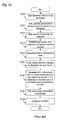
- a user identifies the relation to be amended at step S100.
- SQL queries are generated to retrieve the required relation from the database at step S101, and these SQL queries are then transmitted to the database at step S102.
- the database generates an SQL response containing the required relation at step S103, and returned so that the record or other structural element to be modified is read from the database via the local network to a user station.
- the required relation is displayed to the user, and at step S105 the user makes desired changes to the displayed representation.
- SQL instructions able to cause modifications to the relation as stored in the database in accordance with the amendments specified by the user are then generated at step S106. These SQL instructions are transmitted to the database at step S107, and the database is finally modified at step S108, so that changes made to the record or other structural element thus downloaded as necessary by the user at the user station as required, are reintegrated into the database, and the database is updated to reflect the changes.
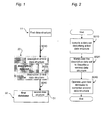
- Fig. 1 shows the flow of information in a method of administering a database according to an embodiment of the invention.
- a descriptive dataset structure 20 using which structure a description of the first data structure is compiled in an operation S010, from a first data structure 11.
- This description of the first dataset is then processed so as to describe a second data structure, in the operation S020, to form a new description 22, a database 30 is then defined in a operation S040, so as to comprise the second data structure, described by the description of the second data structure 22.
- the user may identify the section of the database in which he is interested which may even include the entire database.
- a model, or description of this part of the database may then be automatically formulated, and stored.
- the user is then free to make any changes desired to this model or description, by means for example of a conventional user interface, in which an image representing the model or description may be displayed on a computer screen, to which the user can make the desired changes.
- the model or description may be changed correspondingly.
- This method of administering a database has a variety of advantages, since it may be possible to make changes without maintaining a real time connection to the database, and it is possible to make experimental changes to the structure of the database with the option to revert to previous arrangements without any changes being made to the database itself.
- the first data structure 11 may comprise for example a file in the storage means of a computer and the descriptive dataset may comprise elements of an API (Application Programming Interface) as described above.
- the operation S020 of processing the descriptive dataset so as to describe a second data structure may correspond to a user making changes which correspond to a change in the structure of the data structure described by the descriptive dataset, for example the addition, modification or deletion of an element thereof.
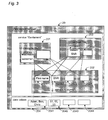
- Fig. 2 shows a method of administering a database according to the embodiment of the invention as described above with reference to Fig. 1.
- the method thus comprises the step S010 of compiling a data set describing a first data structure, the step S020 of processing the descriptive data set to describe a second data structure, and the step S040 of defining the first database to comprise second data structure.
- the operation of processing S020 is modified so as to include the changing of an element in the descriptive dataset 20 which relates to a data value, as distinguished from elements in the descriptive dataset which relate to the structure of the data structure, such as the names and properties of tables and columns in the data structure.
- the method thus comprises the step S010 of compiling a data set describing a first data structure, the step s021 of processing the descriptive data set to describe a second data structure having a data value different to a corresponding one in the first data set, and the step S040 of defining the first database to comprise second data structure.
- this embodiment of the invention offers a method of modifying the data contents of the first data structure.
- the operation of processing S020 as described heretofore is modified so as to include the changing of an element in the descriptive dataset 20 which relates to the structure of the first data structure, as distinguished from elements in the descriptive dataset which relate to the data values as such that may be found in the first data structure, in particular the values found in particular tuples or rows of the data structure.
- the method thus comprises the step S010 of compiling a data set describing a first data structure, the step s022 of processing the descriptive data set to describe a second data structure having a structural feature different to a corresponding one in the first data set, and the step S040 of defining the first database to comprise second data structure.
- this embodiment of the invention offers a method of modifying the structure of the first data structure.
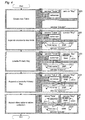
- Fig. 3 shows details of a possible realisation of the descriptive dataset structure 20 as used according to the above embodiments. It is noted that the further details of Fig. 3 constitute examples only and should not be construed as limiting the invention.
- the structure in Fig. 3 is based on an API architecture, in which the structure elements of a dataset are described in terms of the tables, columns and keys of which the dataset structure is comprised.
- the dataset comprises entries relating to the different tables found in the dataset, in the service "table” for example the table salesman 2011.
- the service "key” contains information relating to the keys defined for the dataset, such as a primary key SNR 2031 further information relating to the columns in the dataset are stored in the service "column", such as the columns first name 2021 and SNR 2022.
- the entries in the respective services contain references to the entries to the other services, with which they have a structural relationship, for example the entry salesman 2011 in the service "table” 201 makes reference to the entries first name 2021 and SNR 2022 in the service "column” 202, indicating that the salesman table comprises two columns, a first name column and an SNR column.
- the descriptive dataset 20 further comprises a data value field, in which are stored the data values associated with the columns defined in the service "column” 202.
- the descriptor is a special kind of API object, which is defined for example in the Staroffice RTM API, which mirrors the structure of the object which should be appended to a container object. This means that a descriptor, once created, can be appended more than once, with only small changes to the structure. For example, when appending columns to the columns container, we could create one descriptor with
- StarOffice API SDBCX One important use of the StarOffice API SDBCX layer is that it is possible to programmatically create tables, along with their columns, indexes, and keys. This API element is also well suited to the definition of a descriptive dataset according to the present invention.
- a table object is created by asking the tables container for its
- this descriptor is used to create a new table in the database. This can be done by simply appending the descriptor to the table's container. Before the descriptor is appended, it is necessary to append, at least, a column to the table descriptor. This is done the same as with all kinds of containers used in the SDBCX layer. On the column object, some properties need to be set, such as Name, Type, and others. The column name must be unique, in the columns container.
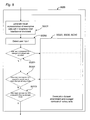
- Fig. 5 shows in further detail the steps which may make up step S020 of the method of Fig. 2.
- a graphical representation of the descriptive dataset 20 is generated, and presented to a user in a graphical user interface environment for example on a computer screen.
- the visual representation may comprise for example one or more tables, labelled in a manner corresponding to the named assigned to the corresponding element in the descriptive dataset 20.
- buttons, slide a bars, drop down boxes, text boxes, menus and so on with which the user may interact by means of keyboard inputs, mouse motion, and mouse button activations, mouse scroller wheel inputs, voice recognition commands, touch sensitive screen or pad inputs etc.
- the user may modify the visual representation presented to him, so that the representation takes on the form of the data structure that the user desires, based on the original data structure.
- step S0202 of detecting user input involves a change to the visual representation, which corresponds to a change in the displayed data structure returning to the step S0201, of generating the visual representation, such that the visual representation comprises the requested changes corresponding to the user input detected at step S0202.
- step S0203 when a user input corresponding to a change in the displayed data structure is thus detected at step S0203, before the visual representation is generated, data relating to the amendment is stored at a step labelled S0220, S0230, or S0240.
- step S020 proceeds to step S0204, wherein it is determined whether the user input detected at step S0202 corresponds to a request to cancel one or more of the changes to the descriptive dataset already made, at a previous iteration of step S020.
- step S020 proceeds once more to step S0220, S0230 or S0240, wherein it retrieves the data relating to previous amendments stored as described above, and using this information, amends the descriptive dataset such that on returning to step S0201, a new visual representation can be generated wherein the previous changes are cancelled.
- step S0202 wherein it is determined whether the user inputs detected correspond for a request to finalise the changes made. Where it is detected that the detected user input does indeed correspond to such a request, the method of step S020 is terminated, and the process is then able to proceed to the next step, for example step S040.
- step S020 may comprise one of a plurality of steps, S0220, S0230 or S0240.
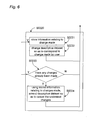
- Fig. 6 shows details of step S0220 as referred to above.
- step S0220 when at step S0203 it is determined that a user input detected at step S0202 corresponds to a change in the displayed data structure, the method proceeds to step S0221, wherein information relating to the change made is stored, before proceeding to step S0222 wherein the descriptive dataset is changed to correspond to the change made by the user to the visual representation, where upon the method then exits step S0220, and proceeds to step s0201, wherein a visual representation of the new description dataset is generated.
- step S0202 When it is determined that user input detected at step S0202 corresponds to a request to cancel one or more changes already made at step S0204, the method proceeds to step S0223, where it is determined whether any changes liable to be cancelled have already been made to the descriptive dataset. Where it is determined that no such changes have been made, the method exits step S0220 without further action.
- step s0224 wherein using stored information relating to changes made, as stored at step S0221, the descriptive dataset is amended so as to cancel the undesired changes, before the method exits steps S0220, and proceeds to step S0201, so as to generate a visual representation of the descriptive dataset, with the undesired changes removed.
- Fig. 7 shows details of step S0230 as referred to above, and relates to a possible realisation of the method of step S0220.
- step S0230 when at step S0203 it is determined that a user input detected at step S0202 corresponds to a change in the displayed data structure, the method proceeds to step S0231, wherein information describing the change made is stored, before proceeding to step S0232 wherein the descriptive dataset is changed to correspond to the change made by the user to the visual representation, whereupon the method then exits step S0230, and proceeds to step S0201, wherein a visual representation of the new description dataset is generated.
- step S0202 When it is determined that user input detected at step S0202 corresponds to a request to cancel one or more changes already made at step S0204, the method proceeds to step S0233, where it is determined whether any changes liable to be cancelled have already been made to the descriptive dataset. Where it is determined that no such changes have been made, the method exits step S0230 without further action.
- step s0224 wherein using the stored description of the changes made, as stored at step S0231, the descriptive dataset is amended so as to undo the undesired changes, before the method exits steps S0230, and proceeds to step S0201, so as to generate a visual representation of the descriptive dataset, with the undesired changes reversed.
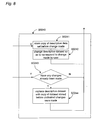
- Fig. 8 shows details of step S0240 as referred to above, and relates to an alternative realisation of the method of step S0220
- step S0240 when at step S0203 it is determined that a user input detected at step S0202 corresponds to a change in the displayed data structure, the method proceeds to step S0241, wherein a copy of all or part of the descriptive data set is stored, before proceeding to step S0242 wherein the descriptive dataset is changed to correspond to the change made by the user to the visual representation, whereupon the method then exits step S0240, and proceeds to step S0201, wherein a visual representation of the new description dataset is generated.
- step S0243 it is determined whether any changes liable to be cancelled have already been made to the descriptive dataset. Where it is determined that no such changes have been made, the method exits step S0240 without further action. Where it is determined that changes have been made to the descriptive dataset which are liable to be cancelled, the method proceeds to step S0244, wherein the descriptive data set is replaced by, or amended to correspond to, the copy of the data set stored at step S0241, before the method exits steps S0240, and proceeds to step S0201, so as to generate a visual representation of the descriptive dataset, without undesired changes.
- Fig. 9 shows a data structure manipulation system according to an embodiment of the present invention.
- the system comprises a compiler 201, for compiling a dataset descriptive of a first data structure, a processor 202, for processing said dataset so as to describe a second data structure 31, an operating unit 203, for operating on at least a part of a database 30 so that it comprises said second data structure, and a memory for storing said database.
- the first data structure may comprise elements associated with a database such as discussed above, for example one or more tables comprising one or more columns.
- the compiler 201, processor 202 and operating unit 203 may each take the form of dedicated hardware, for example as a microchip or a plurality thereof, or consist of firmware loaded into for example an EPROM, or further consist of a set of software routines stored in a storage device such as Random Access Memory, a hard drive, a CDROM etc.
- the compiler, processor and operating unit may further comprise any combination of the above forms.
- compiler and processor may relate to arrangements configured to perform solely the tasks specifically attributed to them, and not necessarily be interpreted as relating to devices known in the art which may commonly be referred to in similar terms.
- the compiler 201, processor 202 and operating unit 203 may all be housed in a computer system, such as a desktop personal computer.
- the compiler is adapted to perform the action of compiling a dataset descriptive of a first data structure. This may for example involve the generation of a description of the data structure in terms of API elements as discussed above, for example in terms of Star Office API elements.
- the elements of the first data structure that are selected by the compiler for representation may comprise structural elements, such as the names and properties of tables, or the columns of which they are made up, and may further comprise the data values that may be stored in the rows, or tuples of table in the first data structure.
- the processor is adapted to perform the action of processing the descriptive dataset produced by the compiler 201, such that the data structure it described is modified.
- the processor may process the descriptive dataset by modifying the properties of the API elements used in the description, as well as the addition of new API elements to the description, and the removal of one provided by the compiler 201.
- the processor may also be adapted to provide a representation of the data structure described by the descriptive dataset to a user, for example in the form of a computer print out, or as an image or set of images displayed on a computer display device such as a VDU.
- the processor may further be adapted to store one or more copies of the descriptive dataset at intervals throughout the processing procedure, such that if at any stage it is decided that any of the changes made to the descriptive dataset are not in fact required, it is possible to revert to a copy of the descriptive dataset recorded prior to the undesired change.
- a record of the applied changes themselves may be recorded, such that if at any stage it is decided that any of the changes made to the descriptive dataset are not in fact required, it is possible to regenerate the descriptive dataset in the form in which it would exist if the undesired change had never been made, or to revert to a copy of the descriptive dataset recorded prior to the undesired change.
- the changes made to the descriptive dataset by the processor may be made at the instigation of a user.
- the processor may be further adapted to accept instruction from the user by means of for example a keyboard or a mouse, possibly in connection with a Graphical User Interface.
- the processor is also adapted to provide a representation of the data structure described by the descriptive dataset to a user as an image or set of images displayed on a computer display device such as a VDU, it may be possible for the user to make changes to the image or set of images displayed on a computer display device, whereby such changes are correspondingly applied to the descriptive dataset.
- the memory 3 may take the form of any conventional data storage device, such as a Random Access Memory, a hard drive, etc.
- the compiler 201, processor 202 and operating unit 203 are housed in a computer system, such as a desktop personal computer, the memory may also be housed in that computer system.
- the transfer of information from the operating unit 203 to the memory 204 is shown by an arrow between the respective elements, which should not be interpreted as excluding bi-directional communication.
- the memory may be provided at some other location, for example in a separate Server computer, or in a stand-alone data storage device such as a virtual jukebox. Where this is the case, it will be necessary to provide a means allowing data transfer at least from the operating unit to the memory.
- This may comprise a Local Area Network, or some other Network arrangement such as the World Wide Web.
- the different processes performed in the described embodiments may be divided between a server, for example a server 102 at which the memory 204 is provided, and a client station, for example the user station 103.
- a server for example a server 102 at which the memory 204 is provided
- a client station for example the user station 103.
- the Compiler 201, Processor 202 and Operating unit 203 may all be situated in a user station 103, and the Memory 204 in the Server 102.
- the Compiler 201 and the Processor 202 may all be situated in a user station 103 and the Memory 204 and the Operating unit 203 in the Server 102.
- the Operating unit 203 and the Processor 202 may all be situated in a user station 103 and the Memory 204 and the Compiler 201 in the Server 102.
- the Processor 202 may be situated in a user station 103 and the Memory 204, the Compiler 201 and the Operating unit 203 in the Server 102.
- the operating unit is adapted to operate so as to cause the Database 205 to reflect the second data structure described by the descriptive dataset after processing.
- This operation may take the form of the transmission of a series of SQL commands as discussed above.
- the description of the Data structure has been realised in terms of API elements as discussed above or otherwise, it may also be necessary for the operating unit to translate or interpret the descriptive dataset so as to generate SQL instructions
- the first data structure may be accessible by a plurality of processes simultaneously, some or all of which processes may be in accordance with embodiments of the present invention.
- the first database may be accessible by a plurality of processes simultaneously, some or all of which processes may be in accordance with embodiments of the present invention.
- Fig. 10 shows the flow of information in a method of administering a database according to a further embodiment of the invention.
- a description 21 of the first data structure is compiled in an operation S010, from a first data structure 11, which is a part of the first database, 30.
- This description of the first dataset is then processed so as to describe a second data structure, in the operation S020, to form a new description 22, the first database 30 is then operated upon in an operation S040, so that it comprises the second data structure, described by the description of the second data structure 22.
- Fig. 11 shows a further development of the embodiment of the present invention described above with reference to Fig. 9.
- the database 30 further comprises a first data structure 11, from which the compilation unit 201 in the data processor 2 extracts information necessary to compile the descriptive dataset.
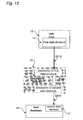
- Fig. 12 shows the flow of information in a method according to a further embodiment of the invention.
- a description 21 of the first data structure is compiled in an operation S010, from a first data structure 11, which is defined by a user.
- This description of the first dataset is then processed so as to describe a second data structure, in the operation S020, to form a new description 22, a database 30 is then operated upon in an operation S040, so as to comprise the second data structure, described by the description of the second data structure 22.
- the definition of the first data structure by a user may involve manual data entry, for example using standard computer user interface techniques such as keyboard entry, point and click with a curser control device etc.
- this definition process may involve the generation of a graphical representation of aspects of the first data structure, for example as displayed on a computer's VDU.
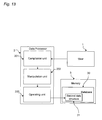
- Fig. 13 shows a development of the embodiment of the present invention as discussed with regard to Fig. 9.
- the compilation unit 201 receives data directly from a user 1, in order to compile the descriptive dataset.
- the user may provide information to the compilation unit in the form of data entered through a keyboard, or by the users interaction with a graphical user interface by means of a mouse, graphics tablets or similar device or in any other data input method as will readily occur to the skilled person.
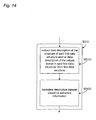
- Fig. 14 shows further detail of the steps involved in the method of step S010 as described for example with reference to Fig. 2 according to one embodiment of the invention.
- step S010 comprises two sub-steps S0101 and step S0102, which involve the extraction of data descriptive of the structure of the first data structure 11 and/or data descriptive of the values stored in said first data structure 11 from the first data structure, and formulating a descriptive dataset based on the extracted information.
- the extraction of data from the dataset may involve data mining or other analytical techniques and may require input from a user, in order to identify what parts of the first data structure are required to be represented in the descriptive dataset.
- the formulation of the descriptive dataset might involve the generation of a new stand alone database, or the formulation of a description in terms of a relational or objected oriented description language. This step may also require intervention from a user, for example in the form of a user selecting from various options relating to the form in which the descriptive dataset is to be represented.
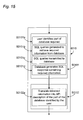
- Fig. 15 shows one possible more detailed realisation of the steps S0101 and S0102 of the method of step S010.
- step S0101 further comprises steps S0101A for indicating the part of the database required, e.g. on the basis of a user input operation, the step S0101B of SQL queries being automatically generated so as to retrieve the necessary information from the database, the step S0101C of transmitting the SQL queries thus generated to the database, and S0101D of the database generating SQL responses to the SQL queries, containing the requested information.
- the step S0102 comprises the sub-step S0102A, of translating the information transmitted at S0101D into a description of the part of the database identified by the user in terms of API elements as described above.
- API language to describe the dataset has the advantage that the structure thus described can be readily interpreted and presented by software using the same or a related API, or otherwise, that the descriptive dataset is in any case in a format which is well known and documented.
- Fig. 16 shows a data structure manipulation system according to another embodiment of the invention.
- the system comprises a compiler 201, for compiling a dataset descriptive of a first data structure, a processor 202, for processing said dataset so as to describe a second data structure 31, a operating unit 203, for defining at least a part of a database 205 so as to comprise said second data structure and a memory, for storing said database.
- the compiler 201 further comprises an extractor unit 211 for extracting information from said first data structure, and a formulation unit 221 for formulating said dataset so as to describe said first data structure based on said extracted information.
- the compiler is adapted to perform the action of compiling a dataset descriptive of a first data structure. To do this, it is provided with an extractor unit 211, which extracts information from the first database 30 relating to the part thereof which is intended for manipulation. This extraction may be carried out for example by means of SQL commands and messages as discussed above.
- the compiler is further provided with a formulation unit 221, which formulates a description of the information retrieved, or the part of the first database 30 represented thereby, by the extraction unit. This may for example involve the generation of a description of the data structure in terms of API elements as discussed above, for example in terms of Star Office API elements.
- the elements of the first data structure that are selected by the compiler for representation may comprise structural elements, such as the names and properties of tables, or the columns of which they are made up, and may further comprise the data values that may be stored in the rows, or tuples of table in the first data structure.
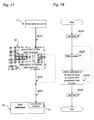
- Fig. 17 shows the flow of information in a method according to a further embodiment of the invention.
- This method corresponds to the flow of information according to the embodiment of the invention as described with reference to Fig. 1, but further comprises the additional operation S030 of verifying whether the descriptive dataset describes a structure that complies with a predetermined format after said operation S020 of processing and prior to the operation of defining S040.
- the format with which compliance is verified may be for example a set of predefined rules.
- the format may further be a theoretical ideal as determined using for example normalization techniques, for example the Normal Forms as described above.
- Fig. 18 shows a method of administering a database according to the embodiment of the invention shown in Fig. 17.
- This method corresponds to the method according to the embodiment of the invention as shown in Fig. 2, but further comprises the additional operation S030 of verifying whether the descriptive dataset describes a structure that complies with a predetermined format after said operation S020 of processing, and prior to the operation of defining S040.
- the method thus comprises the step S010 of compiling a data set describing a first data structure, the step S020 of processing the descriptive data set to describe a second data structure, the step s030 of verifying compliance of the second data structure with a predetermined format and the step S040 of defining the first database to comprise second data structure.
- the format with which compliance is verified may be for example a set of predefined rules.
- the format may further be a theoretical ideal as determined using for example normalization techniques, for example the Normal Forms as described above.
- Fig. 19 shows a system for the administration of a database according to the embodiment of the invention shown in Fig. 16.
- This system corresponds to the method according to the embodiment of the invention as shown in Fig. 1, but further additionally comprises a verification unit 204, which is adapted to verify whether the descriptive data set describes a structure that complies with a predetermined format.
- This verification unit is disposed so as to verify the descriptive data set as output from the manipulation unit 202, and after verifying the compliance with the predetermined format of the descriptive data set, to pass the descriptive data set on to the operating unit 203.
- the data processor system as a whole therefore comprises a compilation unit 201, itself comprising an extractor unit 211 for extracting data from a first data structure 11, a formulation unit 221, for formulating the data extracted from the first data structure in a predetermined manner, a manipulation unit, for manipulating the descriptive data set according to user commands, a verification unit 204 for verifying the compliance of the descriptive data set thus manipulated with a predetermined format, and an operating unit 203, for operating on a second data structure 31, such that the second data structure comprises the descriptive data set as manipulated by the manipulation unit 202 and verified by the verification unit 204.
- a compilation unit 201 itself comprising an extractor unit 211 for extracting data from a first data structure 11, a formulation unit 221, for formulating the data extracted from the first data structure in a predetermined manner, a manipulation unit, for manipulating the descriptive data set according to user commands, a verification unit 204 for verifying the compliance of the descriptive data set thus manipulated with a predetermined format, and an operating unit 203, for operating on
- the format with which compliance is verified may be for example a set of pre-defined rules.
- the format may further be a theoretical ideal as determined using for example normalization techniques, for example the normal forms as described above.
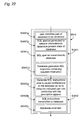
- Fig. 20 shows in further detail one method of carrying out the step S030 of verifying compliance of the description of the second data structure with a predetermined format.
- the format with which compliance is verified comprises the first, second and third normal forms as described above.
- step S0301, S0302, or S0303 there is first performed a step S0301, S0302, or S0303, of acquiring any necessary further information in addition to the descriptive data set, necessary for the verification of the compliance of the descriptive data set with the normal forms.
- step S0310 It is then determined at step S0310, whether any set of related attributes in the descriptive data set, or selected part thereof, lacks a separate table with a primary key. If it is determined that any set of related attributes does not have a separate table with a primary key, the method proceeds to step S0312, where it is determined whether it is necessary or desirable for changes to be made by the user to the descriptive data set so as to address the lack of separate tables with primary keys, or whether this can be dealt with automatically. Where it is determined that user intervention is required, the method exits step S030, and returns to the manipulation step S020. Otherwise, the method proceeds to S0313, wherein a table with a primary key is added for each identified set of related attributes not already having such a structure.
- step S0310 When it is determined that all related attributes in the descriptive data set have a separate table with a primary key, it can be determined that the data structure is in the first normal form.
- the method then proceeds to step S0320, where it is determined whether any attributes in the descriptive data set depends on only part of a multi-valued key. If it is determined that any attributes in the descriptive data set does depend on only part of a multi-valued key, the method proceeds to step S0321, at which it is determined whether it is desirable for this situation to be rectified by the user directly, or whether the situation can be satisfactorily resolved by automatic means. Where it is determined that user intervention is required, the method exits step S030 and returns to the manipulation step S020. Otherwise, the method proceeds to step S0322, wherein the attributes identified as depending on only part of multi-valued keys are removed to new tables.
- step S0320 If it is determined that no attribute depends on only a part of a multi-valued key, it can be concluded that the data structure is further in the second normal form.
- the method then finally moves to step S0330, at which it is determined whether any attribute does not contribute to a description of a key. Where it is determined that an attribute does not contribute to a description of the key, the method proceeds to step S0331, where it is determined whether this situation can be best dealt with by the user, or whether the situation can satisfactorily be rectified automatically. Where it is determined that user intervention is required, the method exits step S030, and returns to the manipulation step S020. Otherwise, the method proceeds to step S0332, wherein the attributes identified as not contributing to a description of a key are removed to new tables.
- step S0330 When it is determined that no attribute fails to contribute to a description of a key, descriptive data sets can be considered to conform to the third normal form. At this stage, according to this embodiment, the validation of the structure of the descriptive data set is considered to be complete, and the method exits step S030 to proceed to the operating step S040 as described above.
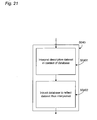
- Fig. 21 shows in further detail the method of operation step S040 according to an embodiment of the invention.
- the step S040 comprises two sub-steps, S0401, and S0402.
- Step S0401 comprises the interpretation of the descriptive data set in the context of the database. This involves the consideration of information relating to the database itself, for example the structure of the database, so that the descriptive data set can be correctly incorporated into the database, in a manner compatible with the pre-existing structure, and further relating to the environment in which the database exists, for example the database language used, the query language used, the operating system environment etc.
- the method of S040 proceeds to step S0402, wherein the database is instructed so as to reflect the data set interpreted in the context of that database.
- step S0402 This involves the transmission of signals to the database so as to cause modifications in the database, relating to structural and/or data changes so that after the performance of step S0402, the database includes the descriptive data set, either as new data, or as a replacement for all or part of the existing data in the database.
- the method exits step S040.
- Fig. 22 shows in further detail the method of step S040 as described above with reference to Fig. 21.
- step S0401 is further sub-divided into steps S0401a, S0401b, S0401c and S0401d
- step S0402 is further sub-divided into steps S0402a, S0402b and S0402c.
- Step S0401a includes an operation to identify the of the part of the database to be amended. This may be made by means of user interaction, or otherwise be automatically determined for example on the basis of the part of the database originally extracted to form the descriptive database.
- step S0401b at which according to this embodiment, SQL queries are generated for transmission to the database, in order to request the retrieval of information relating to the present state of the database. These queries are transmitted to the database at step S0401c, and the necessary response is generated and transmitted by the database at step S0401d.
- the retrieved information may relate to changes made to the database since the extraction of the necessary information to generate the descriptive data set, or may simply represent the present state of the database, or a part thereof.
- the retrieved information may further comprise information relating for example to what parts of the database are presently being accessed by other users, and the access rights granted these users.
- step S0402 the first sub-step of which is step S0402a, at which SQL instructions are generated on the basis of information retrieved from the database at step S0401d, and the descriptive data set, intended when applied to the database, to cause it to be amended so as to incorporate the data structure described by the descriptive data set, at the appropriate location.
- step S0402a the first sub-step of which SQL instructions are generated on the basis of information retrieved from the database at step S0401d, and the descriptive data set, intended when applied to the database, to cause it to be amended so as to incorporate the data structure described by the descriptive data set, at the appropriate location.
- These instructions are then transmitted to the database at steps S0402b, which is then amended accordingly at step S0402c.
- the method then exits step S040.
- Fig. 23 shows a development of the embodiment of the present invention as discussed above with reference to Fig. 19, further developed so as to incorporate in the operating unit 203, an interpretation unit 211 and an instruction unit 221, adapted to interpret the descriptive data set in the context of the database, and to instruct the database so as to reflect the database thus interpreted, respectively, as discussed with reference to Fig. 21.
- Fig. 23 shows in further detail the operational units that the Operating unit 203 in the data structure manipulation system for example as described above with reference to Fig. 19 may comprise according to an embodiment of the invention.
- the Operating unit 203 comprises two sub units, 2031, and 2032.
- the sub unit 2031 is an interpretation unit, which is adapted to perform interpretation of the descriptive data set in the context of the database. This involves the consideration of information relating to the database itself, for example the structure of the database, so that the descriptive data set can be correctly incorporated into the database, in a manner compatible with the pre-existing structure, and further relating to the environment in which the database exists, for example the database language used, the query language used, the operating system environment etc.
- the second sub unit is an interpretation unit, which is adapted to wherein instruct the database so as to reflect the data set interpreted in the context of that database. This involves the transmission of signals to the database so as to cause modifications in the database, relating to structural and/or data changes so that the database comes to include the descriptive data set, either as new data, or as a replacement for all or part of the existing data in the database.
- Fig. 24 shows the flow of information in a method of administering a database according to a further embodiment of the invention.
- a description 21 of the first data structure is compiled in an operation S010, from a first data structure 11, which is a part of a second database 10.
- This description of the first dataset is then processed so as to describe a second data structure, in the operation S020, to form a new description 22, the first database 30 is then operated upon in an operation S040, so as to comprise the second data structure, described by the description of the second data structure 22.
- the operation S010 of compiling a dataset 21 descriptive of the first data structure may be carried out by requesting information form the second database using a database query language such a SQL, as described above.
- the operation S020 of processing the descriptive dataset so as to describe a second data structure may correspond to a user making changes which correspond to a change in the structure of the data structure described by the descriptive dataset, for example the addition, modification or deletion of a relation or an element thereof, such as a column.
- the change may also relate to metadata aspects of the data structure, for example the assignment of a particular column as a foreign or primary key.
- Fig. 25 shows the flow of information in a method of administering a database according to another embodiment of the invention.
- This flow of information corresponds to the flow of information according to the embodiment of the invention as shown in Fig. 24, but further comprises the additional operation S031 of verifying whether the descriptive dataset describes a structure that complies with the format of the second database 10 after said operation S020 of processing, and prior to the operation of defining S040.
- entries in a particular column in a particular table of the second database be of a particular data type, for example as an integer. It may be that changes are made to the dataset descriptive of a part of the second database including that particular table, such that the requirement that entries in the particular column in the a particular table of the second data structure described by the descriptive dataset after processing are no longer of the particular data type set in the second database.
- the operation S031 may be used to detect such deviations.
- Fig. 26 shows the method of administering a database according to the embodiment of the invention shown in Fig. 25.
- This method corresponds to the method operations shown in the flow of information according to the embodiment of the invention as shown in Fig. 24, but further comprises the additional operation S031 of verifying whether the descriptive dataset describes a structure that complies with the format of the second database 10 after said operation S020 of processing, and prior to the operation of defining S040, as described above with reference to Fig. 13.
- the method thus comprises the step S010 of compiling a data set describing a first data structure, the step S020 of processing the descriptive data set to describe a second data structure, the step s031 of verifying compliance of the second data structure with the format of second database and the step S040 of defining the first database to comprise second data structure.
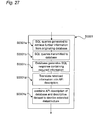
- Fig. 27 shows further detail of the method of step S0301, as described above with reference to Fig. 20.
- step S0301 comprises five sub-steps.
- step S0301a SQL queries are generated intended to retrieve the necessary information from the database for the valuation of the descriptive database in relation to the normal forms.
- This retrieved information may comprise the structural information relating to the database itself, so that a model of the complete database can be constructed as it would stand if the data structure described by the descriptive data set were to be incorporated into the database, which model can be tested as a whole for compliance with the normal forms.
- the retrieved data may relate to only selected parts of the main database. It may also be desirable to test other characteristics of the descriptive data set, for example the use of the correct data types for corresponding fields etc. It may further be desirable to retrieve data values in order to verify the consistency of the data structure described by the descriptive data set with these values.
- the SQL queries thus generated are then transmitted to the database at step S0301b.
- the database on receiving these queries generates an SQL response containing the requested information at step S0301c.
- the information transmitted from the database is received and translated into an API description at step S0301d, in a similar form to that of the descriptive data set, so that the two sets of information can be incorporated, compared, etc. as necessary.
- step e the API description of the database and the descriptive data set are merged to describe an extended data structure, the compliance of which with the normal forms is then verified in the following steps as described above with reference to Fig. 20.
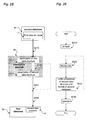
- Fig. 28 shows the flow of information in a method of administering a database according to another embodiment of the invention.
- This flow of information corresponds to the flow of information according to the embodiment of the invention as discussed with regard to Fig. 10, but further comprises the additional operation S032 of verifying whether the descriptive dataset describes a structure that complies with the format of the first database 30 after said operation S020 of processing, and prior to the operation of defining S040.
- entries in a particular column in a particular table of the first database be of a particular data type, for example as an integer. It may be that changes are made to the dataset descriptive of a part of the first database including that particular table, such that the requirement that entries in the particular column in the a particular table of the second data structure described by the descriptive dataset after processing are no longer of the particular data-type set in the first database.
- the operation S032 could be used to detect such deviations. By this means, the possibility of the first database being corrupted by the modifications applied thereto is avoided.
- Fig. 29 shows the method of administering a database according to the embodiment of the invention shown in Fig. 28.
- This method corresponds to the method shown in the flow of information according to the embodiment of the invention as shown in Fig. 10, but further comprises the additional operation S032 of verifying whether the descriptive dataset describes a structure that complies with the format of the first database 30 after said operation S020 of processing, and prior to the operation of defining S040, as described above with reference to Fig. 26.
- the method thus comprises the step S010 of compiling a data set describing a first data structure, the step S020 of processing the descriptive data set to describe a second data structure, the step s032 of verifying compliance of the second data structure with format of the first database and the step S040 of defining the first database to comprise the second data structure.
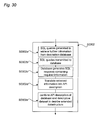
- Fig. 30 shows further detail of the method of step S0302, as described above with reference to Fig. 20.
- step S0302 comprises five sub-steps.
- SQL queries are generated intended to retrieve the necessary information from the destination database, for the valuation of the descriptive database in relation to the normal forms.
- the verification steps are carried out on the basis of information retrieved from the destination database.
- This retrieved information may comprise the structural information relating to the database itself, so that a model of the complete database can be constructed as it would stand if the data structure described by the descriptive data set were to be incorporated into the database, which model can be tested as a whole for compliance with the normal forms.
- the retrieved data may relate to only selected parts of the main database. It may also be desirable to test other characteristics of the descriptive data set, for example the use of the correct data types for corresponding fields etc. It may further be desirable to retrieve data values in order to verify the consistency of the data structure described by the descriptive data set with these values.
- the SQL queries thus generated are then transmitted to the database at step S0302b.
- the database on receiving these queries generates an SQL response containing the requested information at step S0302c.
- the information transmitted from the database is received and translated into an API description c, in a similar form to that of the descriptive data set, so that the two sets of information can be incorporated, compared, etc. as necessary.
- step s0302e the API description of the database and the descriptive data set are merged to describe an extended data structure, the compliance of which with the normal forms is then verified in the following steps as described above with reference to Fig. 20.
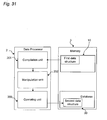
- Fig. 31 shows a yet further embodiment of the present invention, which is a development of the embodiment discussed above with reference to Fig. 9.
- a first data structure in a further database 10, in addition to the second data structure 11 which is provided in the database 30.
- both databases 10 and 30 are provided in the same memory 3, although it would be equally possible to provide the two databases in separate memories, or indeed entirely separate computers which need not necessarily be at the same location.
- the compilation unit 201 retrieves data from the first data structure 11, to compile the descriptive data set, which is then manipulated in the manipulation unit 202, before being passed to the operating unit 203. The operating unit then acts on the second data structure 31 as described with reference to Fig. 9.
- This embodiment may thus have the effect of generating an entirely new second data structure which may comprise an edited version of all or part of the first data structure, or alternatively may involve adding the edited version of all or part of the first data structure to an already existing data structure.
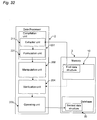
- Fig. 32 shows a further development of this embodiment, which further includes the verification unit 204 as described above with reference to Fig. 23.
- further information relating to the database 10 is retrieved, for example in the manner described with reference to Fig. 22, so as to verify the compliance of the extended data structure with the normal forms.
- this further information may be retrieved from the database 30, depending on the situation.
- the second data structure is an entirely new data structure, based on an edited version of the first data structure, there will be no further information in the database 30 to retrieve, while it is important to ensure that the descriptive data set fully complies with the normal forms in the context of the first database.
- the descriptive data set is to be incorporated into a pre-existing second data structure, it is necessary to ensure that the descriptive data set complies with the format of the data structure into which it is to be incorporated.
- the choice of the source of this information can be selected by a user, or preferably automatically on the basis of the exact nature of the task to be accomplished.
- any of the embodiments of the present invention can be realised in a distributed manner, in which certain functional units are positioned, or certain steps are performed, at distinct locations. These locations may be geographically distant, whereby communication between the processes or functional units thus separated may take place over a network connection or other communications link, or may alternatively take place in separate elements of a single processor or other data management device.
- a database may be notionally located a central server, which can be accessed and or modified by one or more notionally remote "clients", where clients are software or hardware elements resident in remote devices and adapted for communicating with the server, and where necessary interpreting the commands of a user to the database, and the information from the database to the user.
- clients are software or hardware elements resident in remote devices and adapted for communicating with the server, and where necessary interpreting the commands of a user to the database, and the information from the database to the user.
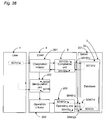
- Figures 33, 34, 35 and 36 show possible distributions of functional units as described with regard to the foregoing embodiments between a client and a server, and the distribution of method steps as described with regard to the foregoing embodiments between a user, a client and a server.
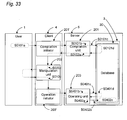
- Fig. 33 shows a possible distribution of the functional units as described with regard to the forgoing embodiment between a client and a server and the distribution of method steps as described with regard to the foregoing embodiment between a user, a client and a server.
- a compilation initiator 201' a manipulation unit 202, and a operation initiator 203' at a client 4, and a compilation unit 201, an operating unit 203 and a memory 3 storing a database 30 at a server 5.
- the compilation unit 201, manipulation unit 202, operating unit 203, and database 30 all fulfil the functions described in relation thereto in the foregoing embodiment.
- the compilation initiator 201' performs the operation of instructing the compilation unit 201 to perform compilation tasks required, and the operation initiator 203' performs the function of instructing the operating unit 203 to perform operating tasks as required.
- the system as described with regards to Fig. 3 further allows for input from a user 1.
- the user provides information at a step S0101a identifying the part of the database 30 that is to be edited.
- the compilation unit S0101b at the server 5 generators SQL queries to retrieve the indicated information from the database 30, when suitably instructed by the compilation initiator 201' at the client 4.
- the SQL queries generated by the compilation unit 201 are transmitted to the database 30 at step S0101c, and at step S0101d the database generates an SQL response containing the requested information, which in returned to the compilation unit 201.
- the information received from the database is translated into an API description of the part of the database identified by the user at step S0101a.
- the descriptive dataset thus compiled is then returned to the client 4, and then to the manipulation unit 202 thereof.
- the manipulation unit 202 generates a visual representation of the descriptive dataset in a graphical user interface environment at step S0201, which is displayed to the user 1. There ensues a series of manipulation procedures at which the user is able to modify the visual representation, such that corresponding changes are made to the descriptive dataset, as described with regard to Figures 5 to 8.
- the descriptive dataset as modified by the manipulation unit 202 is forwarded via the operation initiation 203' to the operating unit 203 at the server 5.
- the operating unit 203 then proceeds to generate SQL queries to retrieve information about the present state of the database 30 at step S0401b, when suitably operated by the operation initiator 203'.
- the SQL queries are transmitted to the database at step S0401c, which then generates the SQL response containing required information at step S0401d.
- This information is returned to the operating unit 203, which at step S0402a generates SQL instructions able to case modifications to the database so as to bring the indicated part of that database into conformity with the descriptive dataset at step S0402a.
- These SQL instructions are transmitted to the database at step S0402b, and finally at step S0402c the database is amended.
- Fig. 34 shows a further possible distribution of the functional units as described with regard to the forgoing embodiment between a client and a server and the distribution of method steps as described with regard to the foregoing embodiment between a user, a client and a server.
- a compilation initiator 201' a manipulation unit 202, and a operation initiator 203' and an operating unit 203 at a client 4, and a compilation unit 201 and a memory 3 storing a database 30 at a server 5.
- the compilation unit 201, manipulation unit 202, operating unit 203, and database 30 all fulfil the functions described in relation thereto in the foregoing embodiment.
- the compilation initiator 201' performs the operation of instructing the compilation unit 201 to perform compilation tasks required, and the operation initiator 203' performs the function of instructing the operating unit 203 to perform operating tasks as required.
- the system as described with regards to Fig. 3 further allows for input from a user 1.
- the user provides information at a step S0101a identifying the part of the database 30 that is to be edited.
- the compilation unit S0101b generators SQL queries to retrieve the indicated information from the database 30 when suitably instructed by the compilation initiator 201'.
- the SQL queries generated by the compilation unit 201 are transmitted to the database 30 at step S0101c, and at step S0101d the database generates an SQL response containing the requested information, which in returned to the compilation unit 201.
- the information received from the database is translated into an API description of the part of the database identified by the user at step S0101a.
- the descriptive dataset thus compiled is then returned to the client 4, and then to the manipulation unit 202 thereof.
- the manipulation unit 202 generates a visual representation of the descriptive dataset in a graphical user interface environment at step S0201, which is displayed to the user 1.
- the descriptive dataset as modified by the manipulation unit 202 is forwarded via the operation initiation 203' to the operating unit 203 which is also located at the client 4.
- the operating unit 203 then proceeds to generate SQL queries to retrieve information about the present state of the database 30 at step S0401b, when suitably operated by the operation initiator 203'.
- the SQL queries are transmitted to the database, which is at the server 5, at step S0401c, which then generates the SQL response containing required information at step S0401d.
- This information is returned to the operating unit 203 at the client 4, which at step S0402a generates SQL instructions able to case modifications to the database so as to bring the indicated part of that database into conformity with the descriptive dataset at step S0402a.
- SQL instructions are transmitted to the database at step S0402b, and finally at step S0402c the database is amended.
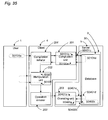
- Fig. 35 shows a possible distribution of the functional units as described with regard to the forgoing embodiment between a client and a server and the distribution of method steps as described with regard to the foregoing embodiment between a user, a client and a server.
- a compilation initiator 201' a manipulation unit 202, and a operation initiator 203' and a compilation unit 201 at a client 4, and an operating unit 203 and a memory 3 storing a database 30 at a server 5.
- the compilation unit 201, manipulation unit 202, operating unit 203, and database 30 all fulfil the functions described in relation thereto in the foregoing embodiment.
- the compilation initiator 201' performs the operation of instructing the compilation unit 201 to perform compilation tasks required, and the operation initiator 203' performs the function of instructing the operating unit 203 to perform operating tasks as required.
- the system as described with regards to Fig. 3 further allows for input from a user 1.
- the user provides information at a step S0101a identifying the part of the database 30 that is to be edited.
- the compilation unit S0101b generators SQL queries to retrieve the indicated information from the database 30 when suitably instructed by the compilation initiator 201'.
- the SQL queries generated by the compilation unit 201 at the client 4 are transmitted to the database 30, at the server 5, at step S0101c, and at step S0101d the database generates an SQL response containing the requested information, which is returned to the compilation unit 201 at the client 4.
- the information received from the database is translated into an API description of the part of the database identified by the user at step S0101a.
- the descriptive dataset thus compiled is then returned to the manipulation unit 202.
- the manipulation unit 202 generates a visual representation of the descriptive dataset in a graphical user interface environment at step S0201, which is displayed to the user 1. There ensues a series of manipulation procedures at which the user is able to modify the visual representation, such that corresponding changes are made to the descriptive dataset, as described with regard to Figures 5 to 8.
- the descriptive dataset as modified by the manipulation unit 202 is forwarded via the operation initiation 203' at the client 4 to the operating unit 203 at the server 5.
- the operating unit 203 then proceeds to generate SQL queries to retrieve information about the present state of the database 30 at step S0401b, when suitably operated by the operation initiator 203'.
- the SQL queries are transmitted to the database at step S0401c, which then generates the SQL response containing required information at step S0401d.
- This information is returned to the operating unit 203, which at step S0402a generates SQL instructions able to case modifications to the database so as to bring the indicated part of that database into conformity with the descriptive dataset at step S0402a.
- These SQL instructions are transmitted to the database at step S0402b, and finally at step S0402c the database is amended.
- Fig. 36 shows a possible distribution of the functional units as described with regard to the forgoing embodiment between a client and a server and the distribution of method steps as described with regard to the foregoing embodiment between a user, a client and a server.
- a compilation initiator 201' a manipulation unit 202, an operation initiator 203' a compilation unit 201, and an operating unit 203 at a client 4, and a memory 3 storing a database 30 at a server 5.
- the compilation unit 201, manipulation unit 202, operating unit 203, and database 30 all fulfil the functions described in relation thereto in the foregoing embodiment.
- the compilation initiator 201' performs the operation of instructing the compilation unit 201 to perform compilation tasks required, and the operation initiator 203' performs the function of instructing the operating unit 203 to perform operating tasks as required.
- the system as described with regards to Fig. 3 further allows for input from a user 1.
- the user provides information at a step S0101a identifying the part of the database 30 that is to be edited.
- the compilation unit S0101b generators SQL queries to retrieve the indicated information from the database 30 when suitably instructed by the compilation initiator 201'.
- the SQL queries generated by the compilation unit 201, located at the client, are transmitted to the database 30, at the server, at step S0101c, and at step S0101d the database generates an SQL response containing the requested information, which in returned to the compilation unit 201 at the client.
- the information received from the database is translated into an API description of the part of the database identified by the user at step S0101a.
- the descriptive dataset thus compiled is then sent to the manipulation unit 202.
- the manipulation unit 202 generates a visual representation of the descriptive dataset in a graphical user interface environment at step S0201, which is displayed to the user 1. There ensues a series of manipulation procedures at which the user is able to modify the visual representation, such that corresponding changes are made to the descriptive dataset, as described with regard to Figures 5 to 8.
- the descriptive dataset as modified by the manipulation unit 202 is forwarded via the operation initiation 203' to the operating unit 203.
- the operating unit 203 then proceeds to generate SQL queries to retrieve information about the present state of the database 30 at step S0401b, when suitably operated by the operation initiator 203'.
- the SQL queries are transmitted from the client to the database, located at the server, at step S0401c, which then generates the SQL response containing required information at step S0401d.
- This information is returned to the operating unit 203 at the client, which at step S0402a generates SQL instructions able to case modifications to the database so as to bring the indicated part of that database into conformity with the descriptive dataset at step S0402a.
- These SQL instructions are transmitted from the client to the database, at the server, at step S0402b, and finally at step S0402c the database is amended.
- the first database and the first data structure may be accessible simultaneously by a plurality of processes simultaneously, some or all of which processes may or may not be embodiments of the present invention.
- the situation may arise where for example two users manipulate the same first data structure simultaneously but differently.
- One user causes the first database to be amended to at least partially replace the first data structure with his second data structure such that when the second user attempts to replace the first data structure with his second data structure, it is found that the first data structure no longer exists.
- Situations of this kind can result in corruption of the database, and it will thus be desirable to incorporate a mechanism to prevent this occurring.
- Such a mechanism may involve permitting only one user access to a particular first data structure at a time, only allowing others to view, but not manipulate a particular first data structure that is presently being manipulated by another user, or other techniques as may readily occur to the skilled person.
- a program or programs may be provided having instructions adapted to cause a data processing device or a network of data processing devices to realize elements of the above embodiments and to carry out the method of at least one of the above operations.
- a computer readable medium may be provided, in which a program is embodied, where the program is to make a computer execute the method of the above operation.
- a computer-readable medium may be provided having a program embodied thereon, where the program is to make a computer or a system of data processing devices to execute functions or operations of the features and elements of the above described examples.
- a computer-readable medium can be a magnetic or optical or other tangible medium on which a program is recorded, but can also be a signal, e.g. analog or digital, electronic, magnetic or optical, in which the program is embodied for transmission.
- the computer-readable medium may constitute a data stream embodying the program.
- the computer-readable medium may constitute a data structure embodying the program.
- a computer program product may be provided comprising the computer-readable medium.
- a client side component of a data structure manipulation system as described with reference to any of Figures 2 to 17, comprising a compiler for compiling a dataset 21 descriptive of a first data structure, and a processor for amending S020, S021, S022 said dataset so as to describe a second data structure 31.
- a client side component of a data structure manipulation system as described with reference to any of Figures 2 to 17, comprising a compiler for compiling a dataset 21 descriptive of a first data structure, said processor for amending S020, S021, S022 said dataset so as to describe a second data structure 31, and an operating unit, for operating on S040 at least a part of a database 30 so that it comprises said second data structure.
- a client side component of a data structure manipulation system as described with reference to any of Figures 2 to 17, comprising a processor for amending S020, S021, S022 a dataset 21 descriptive of a first data structure compiled at a server so as to describe a second data structure 31, and an operating unit for operating on S040 at least a part of a database 30 so that it comprises said second data structure.
- a client side component of a data structure manipulation system as described with reference to any of Figures 2 to 17, comprising, a processor for amending S020, S021, S022 a dataset 21 descriptive of a first data structure compiled at a server so as to describe a second data structure 31.
- a server side component of a data structure manipulation system as described with reference to any of Figures 2 to 17, comprising, said operating unit, for operating on S040 at least a part of a database 30 so that it comprises said second data structure.
- a server side component of a data structure manipulation system as described with reference to any of Figures 2 to 17, comprising, said compiler for compiling a dataset 21 descriptive of a first data structure.
- a data structure manipulation system may have the following configuration:
Landscapes
- Engineering & Computer Science (AREA)
- Databases & Information Systems (AREA)
- Theoretical Computer Science (AREA)
- Data Mining & Analysis (AREA)
- Physics & Mathematics (AREA)
- General Engineering & Computer Science (AREA)
- General Physics & Mathematics (AREA)
- Information Retrieval, Db Structures And Fs Structures Therefor (AREA)
Priority Applications (2)
| Application Number | Priority Date | Filing Date | Title |
|---|---|---|---|
| EP02016948A EP1387293A1 (de) | 2002-08-01 | 2002-08-01 | System zum Manipulieren von Datenstrukturen |
| GB0317993A GB2391664A (en) | 2002-08-01 | 2003-07-31 | Manipulating the structure of a database |
Applications Claiming Priority (1)
| Application Number | Priority Date | Filing Date | Title |
|---|---|---|---|
| EP02016948A EP1387293A1 (de) | 2002-08-01 | 2002-08-01 | System zum Manipulieren von Datenstrukturen |
Publications (1)
| Publication Number | Publication Date |
|---|---|
| EP1387293A1 true EP1387293A1 (de) | 2004-02-04 |
Family
ID=27798845
Family Applications (1)
| Application Number | Title | Priority Date | Filing Date |
|---|---|---|---|
| EP02016948A Withdrawn EP1387293A1 (de) | 2002-08-01 | 2002-08-01 | System zum Manipulieren von Datenstrukturen |
Country Status (2)
| Country | Link |
|---|---|
| EP (1) | EP1387293A1 (de) |
| GB (1) | GB2391664A (de) |
Cited By (3)
| Publication number | Priority date | Publication date | Assignee | Title |
|---|---|---|---|---|
| CN102999561A (zh) * | 2011-10-28 | 2013-03-27 | 微软公司 | 数据集和数据服务的上下文趋向 |
| TWI619033B (zh) * | 2016-02-26 | 2018-03-21 | Hitachi, Ltd. | 執行以時間序列資料與分析資料當中的至少一部分作為輸入資料之分析處理的分析系統及分析方法 |
| CN112347125A (zh) * | 2020-11-16 | 2021-02-09 | 李增国 | 一种设备数据处理的方法及物联网数据处理方法 |
Citations (2)
| Publication number | Priority date | Publication date | Assignee | Title |
|---|---|---|---|---|
| EP0657829A1 (de) * | 1993-12-10 | 1995-06-14 | International Business Machines Corporation | Verfahren und Vorrichtung basierend auf eine graphische Benutzeroberfläche zum Manipulieren von Datenbankstrukturen |
| US5950190A (en) * | 1997-05-13 | 1999-09-07 | Aptek, Inc. | Dynamic, self-modifying graphical user interface for relational database applications |
Family Cites Families (3)
| Publication number | Priority date | Publication date | Assignee | Title |
|---|---|---|---|---|
| US5175727A (en) * | 1990-04-16 | 1992-12-29 | Maher John W | Communication system network interconnecting a plurality of communication systems |
| JP2947111B2 (ja) * | 1995-02-17 | 1999-09-13 | 日本電気株式会社 | 交換機のデータ引き継ぎ方法およびシステム |
| DE50103762D1 (de) * | 2001-06-12 | 2004-10-28 | Sap Ag | Verfahren, System und Computerprogrammprodukt zum Ändern der Datenstruktur mit der in einem Computersystem ein Anwendungsprogramm auf Datenbanksysteme zugreift |
-
2002
- 2002-08-01 EP EP02016948A patent/EP1387293A1/de not_active Withdrawn
-
2003
- 2003-07-31 GB GB0317993A patent/GB2391664A/en not_active Withdrawn
Patent Citations (2)
| Publication number | Priority date | Publication date | Assignee | Title |
|---|---|---|---|---|
| EP0657829A1 (de) * | 1993-12-10 | 1995-06-14 | International Business Machines Corporation | Verfahren und Vorrichtung basierend auf eine graphische Benutzeroberfläche zum Manipulieren von Datenbankstrukturen |
| US5950190A (en) * | 1997-05-13 | 1999-09-07 | Aptek, Inc. | Dynamic, self-modifying graphical user interface for relational database applications |
Non-Patent Citations (1)
| Title |
|---|
| "CHANGE DATABASE DEFINITIONS AUTIMATICALLY", IBM TECHNICAL DISCLOSURE BULLETIN, IBM CORP. NEW YORK, US, vol. 37, no. 9, 1 September 1994 (1994-09-01), pages 679 - 680, XP000475543, ISSN: 0018-8689 * |
Cited By (7)
| Publication number | Priority date | Publication date | Assignee | Title |
|---|---|---|---|---|
| CN102999561A (zh) * | 2011-10-28 | 2013-03-27 | 微软公司 | 数据集和数据服务的上下文趋向 |
| US8538934B2 (en) * | 2011-10-28 | 2013-09-17 | Microsoft Corporation | Contextual gravitation of datasets and data services |
| CN102999561B (zh) * | 2011-10-28 | 2015-11-18 | 微软技术许可有限责任公司 | 数据集和数据服务的上下文趋向 |
| TWI549006B (zh) * | 2011-10-28 | 2016-09-11 | 微軟技術授權有限責任公司 | 資料集和資料服務的上下文趨向 |
| TWI619033B (zh) * | 2016-02-26 | 2018-03-21 | Hitachi, Ltd. | 執行以時間序列資料與分析資料當中的至少一部分作為輸入資料之分析處理的分析系統及分析方法 |
| CN112347125A (zh) * | 2020-11-16 | 2021-02-09 | 李增国 | 一种设备数据处理的方法及物联网数据处理方法 |
| CN112347125B (zh) * | 2020-11-16 | 2024-06-11 | 李增国 | 一种设备数据处理的方法及物联网数据处理方法 |
Also Published As
| Publication number | Publication date |
|---|---|
| GB2391664A (en) | 2004-02-11 |
| GB0317993D0 (en) | 2003-09-03 |
Similar Documents
| Publication | Publication Date | Title |
|---|---|---|
| US11755825B2 (en) | Method, system, and computing device for facilitating private drafting | |
| CN105144080B (zh) | 用于元数据管理的系统 | |
| US6704739B2 (en) | Tagging data assets | |
| Greenwald et al. | Oracle essentials: Oracle database 12c | |
| US8438534B2 (en) | Transformation of data between hierarchical data formats | |
| US7185000B1 (en) | Method and apparatus for presenting query plans | |
| US8549353B2 (en) | Batch processing error handling modes | |
| Abouzied et al. | Invisible loading: Access-driven data transfer from raw files into database systems | |
| US8683431B2 (en) | Applying rules to data | |
| US20180341651A1 (en) | Data revision control in large-scale data analytic systems | |
| US20120059792A1 (en) | Techniques for the Logical Replication of High-Level Procedures | |
| US20110161941A1 (en) | Creation of form-based applications | |
| US20110161371A1 (en) | Sql generation | |
| JP2001514422A (ja) | 分散型コンピュータシステム | |
| JP2002504244A (ja) | オブジェクト指向データベース管理システム | |
| CN101617290A (zh) | 操纵数据存储系统中的数据 | |
| US20110161733A1 (en) | Transaction regions in methods of processing data | |
| US7711704B2 (en) | System and method of providing date, arithmetic and other relational functions for OLAP sources | |
| US7287029B1 (en) | Tagging data assets | |
| US11409505B1 (en) | Automated authoring of software solutions from a data model with related patterns | |
| US8732596B2 (en) | Transformation of hierarchical data formats using graphical rules | |
| US20110161934A1 (en) | Generating and monitoring data items | |
| Dittrich | Engineering databases: connecting islands of automation through databases | |
| CN113590123A (zh) | Wpf界面切换方法、装置、计算机设备及存储介质 | |
| Schönig | Mastering PostgreSQL 12: Advanced techniques to build and administer scalable and reliable PostgreSQL database applications |
Legal Events
| Date | Code | Title | Description |
|---|---|---|---|
| PUAI | Public reference made under article 153(3) epc to a published international application that has entered the european phase |
Free format text: ORIGINAL CODE: 0009012 |
|
| AK | Designated contracting states |
Kind code of ref document: A1 Designated state(s): AT BE BG CH CY CZ DE DK EE ES FI FR GB GR IE IT LI LU MC NL PT SE SK TR |
|
| AX | Request for extension of the european patent |
Extension state: AL LT LV MK RO SI |
|
| AKX | Designation fees paid | ||
| REG | Reference to a national code |
Ref country code: DE Ref legal event code: 8566 |
|
| STAA | Information on the status of an ep patent application or granted ep patent |
Free format text: STATUS: THE APPLICATION IS DEEMED TO BE WITHDRAWN |
|
| 18D | Application deemed to be withdrawn |
Effective date: 20040805 |